Conference Paper: Green Industry Adapted to Recycling Needs of Lubumbashi City and Surrounding Areas in Democratic Republic of the Congo ()
1. Introduction
The green industry is an industry based on green chemistry. The latter can be defined as the design, development and application of chemical processes and products to reduce or eliminate the use and formation of harmful substances for human health and the environment. Bio-catalytic processes fully participate in the concept of green chemistry, which was introduced in the 1990s [1] - [6]. Biocatalysts constitute an alternative more green than traditional organic synthesis. They are adequate tools for the industrial transformation of naturals or synthetic compounds because bio-catalytic processes take place under mild reaction conditions with less energy and fewer problems of epimerization and rearrangement. In addition, biocatalysts are biodegradable, regio-, chemo- or stereospecific, which minimizes the formation of secondary products [1] - [6].
When organic residues are not recycled or processed efficiently, they are broken down by microorganisms and this favors the multiplication of insects, which can prove to be true vectors of disease. Odors from organic decomposition sites also affect quality of life. To solve the problem of organic waste, biomethanation is an ecological and efficient solution for converting organic matter to produce methane as well as organic fertilizers under the action of microorganisms. The valorization of organic waste through biomethanation contributes to the improvement of hygiene, and reduces bad odors and the use of non-natural fertilizers and pesticides.
Biomethanation also helps to avoid incineration and the dumping of organic waste in landfills in order to reduce emissions of greenhouse gases. Indeed, landfills and the incineration of organic waste essentially produce greenhouse gases such as carbon dioxide and nitrogen dioxide [7]. Energy from biogas is very important especially in regions lacking energy infrastructure because it reduces the use of fossil fuels, limits deforestation and improves people’s livelihoods who prepare food with firewood. Such green recycling is a good strategy to clean up the environment and improve agriculture, particularly in underdeveloped countries, such as Democratic Republic of Congo.
2. Enzymatic Reactions
Biomethanation of organic waste is a collection of organic reactions such as hydrolysis, acidification, synthesis of acetate (ethyl acetate or methyl acetate) and synthesis of methane catalyzed by enzymes. Various substrates (proteins, sugars and lipids) are metabolized or degraded in an anaerobic fashion by specific enzymes and intermediate products serve as starting materials for subsequent enzymatic conversions to produce methane and fertilizers.
3. Hydrolysis
The residual organic substances consist mainly of proteins, sugars and lipids. The enzymatic hydrolysis of these macromolecules is the first step in the production of methane and fertilizers. Enzymes are proteins or organic catalysts secreted within the cells of microorganisms. However, enzymes are also capable of acting outside the original cell. Normally, different reactions are catalyzed by different enzymes, despite the fact that a small number of enzymes are capable of catalyzing several substrates. In general, the amino acids in active centre of the enzyme act as acids, bases, nucleophiles or electrophiles and form hydrogen bonds with the substrates or with other amino acid residues in order to stabilize the transition state (Figure 1) [8] [9] [10]. From this point of view, a triad composed of serine, histidine and aspartate forms a catalytic centre of certain proteases and these three amino acids work together to carry out the expected catalytic activity. In the catalytic triad, histidine plays the role of a base (Figure 1) [8] [9] [10].
Amino acids are small molecules with an amine group, carboxylic acid group and a prosthetic group (R), which differentiate the amino acids from each other. The amino acids are constituents of proteins. They are generally levorotatory (L) and the amine functional group is on the left (Figure 2). Polar amino acids are more frequently present in the active centre of the enzyme and depending on the reaction conditions, they can be ionized. That is why they release protons as acids and they capture protons as bases and being nucleophiles they transfer electrons to electrophiles during catalysis (Figure 2) [8] [9] [10]. In the active centre, the side chains of the amino acids participate in the acid and base chemical catalysis and covalent catalysis. In other words, they can give or accept protons and thereby the active centre is thus the biological equivalent of a strong acid or strong base solution [8] [9] [10].
Nucleophilic N-terminal hydrolases constitute a family of enzymes specialized in the breakdown of amide bonds, for instance, serine protease characterized by the presence of serine, histidine and aspartic acid in the active centre [11] [12]. The strategic step in the serine protease mechanism is the nucleophilic attack at the carbonyl group of the polypeptide (protein) by the oxygen ion from the
![]()
Figure 1. Catalytic activity of serine, histidine and aspartate.
hydroxyl group of the serine (Scheme 1, reaction 2). The role of aspartate is to remove the proton bound to the nitrogen atom of histidine, while histidine removes the acid proton from the hydroxyl group of serine (Scheme 1, reaction 1) [11] [12].
Sugars or carbohydrates are organic compounds that act as an energy reservoir at the level of higher plants. Because humans consume plants, sugars turn out to be essential constituents of human food. In general, carbohydrates are one of the major chemical groups containing carbon, hydrogen and oxygen, such as starch, which is an energy reserve substance in the plant cell [13] - [23]. Starch is a long chain made up of glucose molecules and non linear glucose molecules constitute amylopectin (non linear polymer). On the other hand, glucose molecules that are linear form amylose (linear polymer). The glucose molecules within the starch can range from a few hundred to a few thousand linked together by alpha-glycoside linkages [13] - [23].
During the hydrolysis of starch, it was found that the alpha stereochemistry is maintained in the final product and the plausible catalytic mechanism involves the protonation of the glycosidic oxygen by the proton donor glutamate amino acid (Scheme 2, reaction 2) [24] - [34]. This step is followed by the ejection of the leaving group, due to an electron lone pair oriented antiperiplanar to the leaving group, to produce a corresponding cyclic oxocarbonium ion (Scheme 2, reaction 2). The latter reacts with a water molecule to generate an intermediate compound, which yields a proton to aspartate and this results in the formation of glucose molecules in the reaction medium (Scheme 2, reaction 3) [24] - [34].
Cellulose is an organic polymer formed by several units of glucose molecules linked together by beta-(1-4)-glycosidic bonds (Scheme 3) [24] - [34]. It is associated with lignin and hemicellulose, which form a protective layer or a shield of the cellulose. It has been observed that lignin and hemicellulose are difficult to hydrolyse with enzymes. For this reason, the cellulosic waste must be treated beforehand, for instance, in using dilute acids to degrade lignin and hemicellulose and thus promote the efficiency and rapidity of the enzymatic hydrolysis of cellulose (Scheme 3) [24] - [34]. In this perspective, it has been reported that the enzyme derived from the fungus Trichoderma viride was capable of transforming
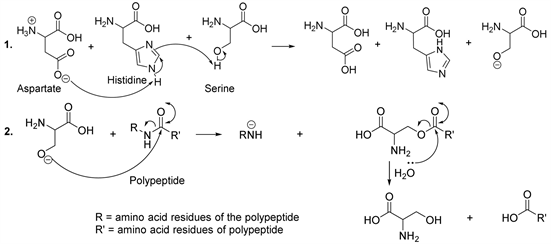
Scheme 1. Serine protease mechanism.
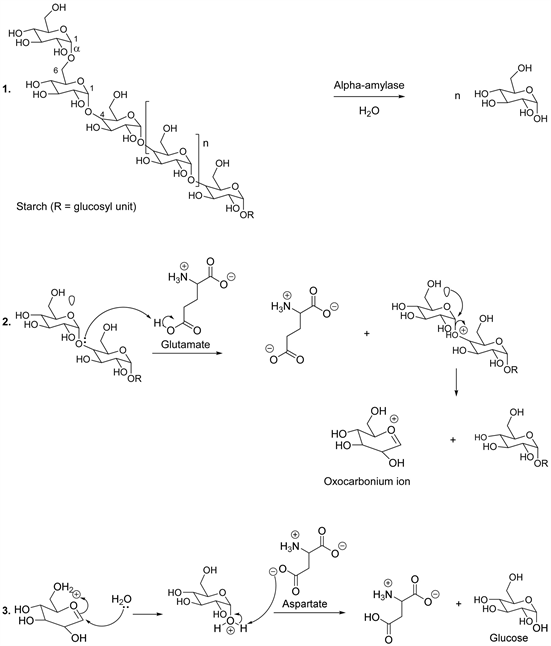
Scheme 2. Catalytic mechanism of starch.
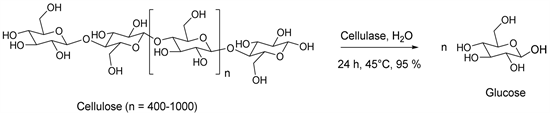
Scheme 3. Enzymatic hydrolysis of cellulose.
the cellulosic waste and the liquid glucose was cleanly obtained [24] - [34]. The authors mentioned that the natural fungus Trichoderma viride produces cellulase, which reacts with a crystalline fraction of a cellulose molecule (Scheme 3). From this point of view, it has been reported that the hydrolysis of cellulosic residues, from sugar cane, with cellulase produced glucose with excellent yield (Scheme 3) [24] - [34].
Cellulase is a group of different enzymes, in particular, the endoglucanase enzymes which hydrolyze beta-(1-4)-glycosidic internal bonds, exoglucanase enzymes that hydrolyze beta-(1-4)-glycosidic external bonds and the cellobiase that hydrolyzes the disaccharide cellobiose to produce two molecules of glucose. Experimental studies showed that two amino acids (glutamate and aspartate) constitute the root of the catalytic activity in the hydrolysis of cellulose. In this regard, the glutamate amino acid yields a proton to glycosidic oxygen and the aspartate amino acid acts as a base by accepting the proton of a water molecule, which acts as a nucleophile (Scheme 4) [24] - [34]. According to the theory of stereo-electronic control, the carbon-hydrogen bond of beta-glycoside (equatorial isomer) is activated by two lone pairs of electrons oxygen antiperiplanar to the carbon-hydrogen bond (two electronic effects) [24] - [34]. In this context, the proposed hydrolysis mechanism evolved the formation of a twist-boat conformation, which allows the substrate to line up a lone pair of electrons oxygen in an antiperiplanar way to the leaving group, before adopting a chair-like transition state (cyclic oxocarbonium ion) (Scheme 4) [24] - [34]. The nucleophilic attack at the oxocarbonium ion leads to the production of an intermediate adduct, which donates a proton to aspartate to produce the axial isomer (alpha-glycoside) and the equatorial isomer (beta-glycoside) (Scheme 4) [24] - [34].
The best known disaccharide is sucrose obtained from sugarcane juice or sugar beet. During enzymatic hydrolysis, sucrose degrades to generate D-(+)-glucose and D-(-)-fructose (Scheme 5, reaction 1) [35] - [42]. Concerning the reaction mechanism, Reddy and Maley have demonstrated the role of the aspartate amino acid as well as that of the glutamate amino acid in the catalytic activity of the enzyme invertase (Scheme 5) [35] - [42]. In this perspective, the carboxylate group of the side chain of aspartate acts as nucleophile, while the carboxylic group of the glutamate amino acid acts as an acid (donor of the proton) (Scheme 5, reaction 2) and the conjugate base accepts the proton of the water (Scheme 5,
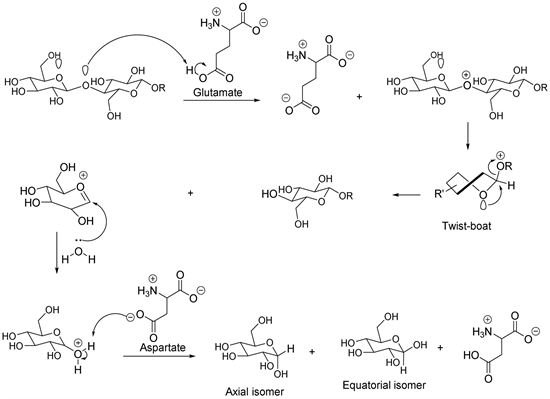
Scheme 4. Cellulose enzymatic hydrolysis mechanism.
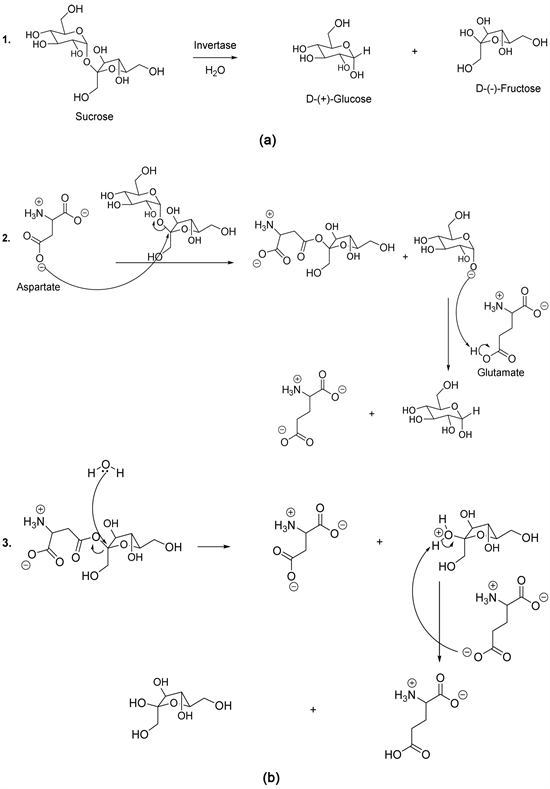
Scheme 5. (a) Enzymatic hydrolysis of sucrose; (b) Sucrose enzymatic hydrolysis mechanism.
reaction 3). The latter acts also as a nucleophile (Scheme 5, reaction 3) [35] - [42].
Lipids are triglycerides or esters of fatty acids and glycerol containing long (R) chains which are insoluble in water (Scheme 6). From the environmental point of view, lipids are important organic constituents in wastewater, which contribute enormously to environmental pollution. In this regard, if they are not removed, the lipids form a layer on the surface of the water and thus prevent the diffusion of oxygen from the air into the water. Consequently, the result is the death of aquatic living beings. From this perspective, it has been shown that the lipases are potential catalysts used to hydrolyze oils from industrial effluents,
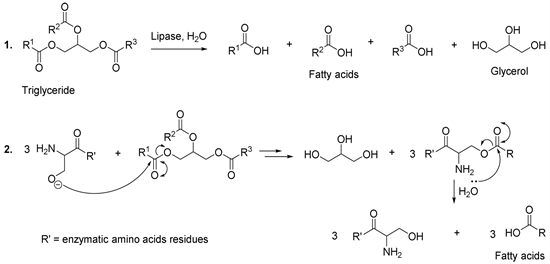
Scheme 6. Triglyceride enzymatic hydrolysis mechanism.
slaughterhouses and frying oils [43]. Experimental observations have shown that the lipases catalyze the hydrolysis of the ester bonds to produce fatty acids and glycerol (Scheme 6, reaction 1) [44]. These enzymes contain serine, histidine and aspartate amino acid in the active centre. It has been found that the aspartate amino acid can be replaced by the glutamate amino acid in the case of Geotrichum candidum lipase [44]. This enzyme uses the glutamate residue to specifically hydrolyze the fatty acids having cis double bonds in the hydrocarbon side chains [44]. With this in mind, the reaction mechanism of the lipases is thus similar to that of serine protease (Scheme 1, reaction 2).
The catalytic activity of the lipases is influenced by the water molecules present in the structure of these enzymes. From this point of view, it has been observed that when the lipases are dehydrated, they lose the ability to catalyze esterification reactions involving congested alcohols. This could be explained by the fact that the absence of water affects the mobility necessary to bind the substrates in the active centre [45] [46] [47]. This is why lipases are less active in solvents which are miscible with water because they extract water integrated into the structure of the enzyme [45] [46] [47].
4. Acidification
The products from hydrolysis are used by microorganisms as substrates to produce acids, alcohols and carbon dioxide (Scheme 7). At this level of biomethanation, amino acids could be used as a source of energy for microorganisms. From this point of view, Rupasinghe and his colleagues reported an enzymatic method for producing glucose, ethanol and acetic acid from apple residues (Scheme 7) [48] [49] [50] [51]. Indeed, the cellulose was pretreated under acidified aqueous conditions and the hydrolysis was optimized in using commercial enzymes (beta-glucosidase and pectinase). The glucose was fermented using Saccharomyces cerevisiae to produce ethanol. The bioconversion of ethanol to acetic acid was carried out using Acetobacter aceti [48] [49] [50] [51].
The enzymatic oxidation of ethanol to acetaldehyde is catalyzed by alcohol
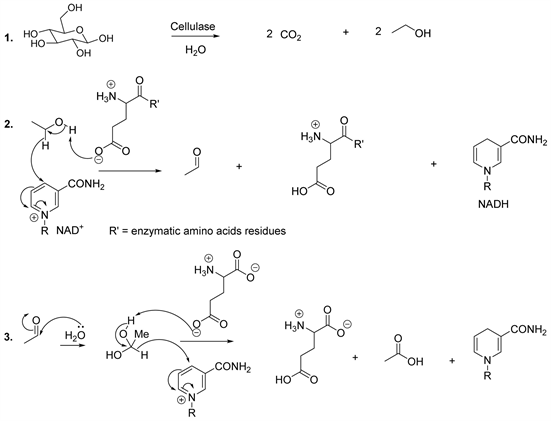
Scheme 7. Synthesis of acetic acid.
dehydrogenase (Scheme 7, reaction 2). On the other hand, the oxidation of acetaldehyde to acetic acid is catalyzed by the aldehyde dehydrogenase (Scheme 7, reaction 3). These enzymes use nicotinamide adenine dinucleotide (NAD) as co-enzyme and glutamate plays the role of a base in the active centre of the enzyme (dehydrogenase). Regarding the dehydrogenation of ethanol, the mechanism involves the transfer of the hydride ion to NAD+ (oxidized form of NAD) and this results in the formation of NADH (reduced form of NAD) and the desired product (acetaldehyde) (Scheme 7, reaction 2), while dehydrogenation of acetaldehyde involves nucleophilic attack by water molecule upon the electrophilic carbon of acetaldehyde. This step is followed by the removal of the proton by glutamate and the transfer of the hydride ion at the level of the oxidized form of NAD (Scheme 7, reaction 3) [52] [53] [54].
5. Synthesis of Acetate
It has been observed that the major part of the methane comes from the acetate (Scheme 8) [55] [56] [57]. In this context, it has been demonstrated that the lipase catalyses the reaction between acetic acid and ethanol to produce volatile natural ethyl acetate and water as by product [55] [56] [57]. Because of the reversibility of the reaction, it is important to remove water in order to optimize the formation of the product. Concerning the mechanism, the lipase utilized serine, histidine and aspartate amino acid to catalyze the production of acetate from acetic acid and alcohol (ROH). In this perspective, aspartate amino acid gives a proton to the hydroxyl group of acetic acid (Scheme 8, reaction 2). This step is followed by serine nucleophilic attack and the result is the loss of one
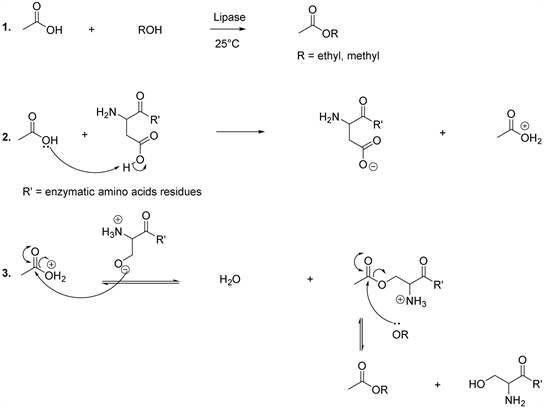
Scheme 8. Synthesis of acetate.
molecule of water and forming an intermediate adduct, which in turn reacts with the alcohol (ethanol or methanol) to produce the corresponding acetate (Scheme 8, reaction 3) [55] [56] [57].
6. Synthesis of Methane
Bacteria degrade ethyl acetate to produce ethanol and acetic acid. The latter is then metabolized to produce methane and carbon dioxide with the assistance of decarboxylase as catalyst. From the mechanism point of view, it has been reported that decarboxylation involves the formation of negatively charged intermediate compounds. In this perspective, the electrophilic substitution of carbon dioxide by a proton involves the loss of carbon dioxide to form a carbanion (methyl anion), which accepts a proton from the catalytic amino acid residue, in this case lysine, to generate the desired product (methane) (Scheme 9) [58] [59]. It has been observed that lysine and cysteine are at the centre of catalytic activity of decarboxylase (Scheme 9) [60].
7. Conclusion
This conference paper has showed the importance of recycling residual organic substances using biomethanation as an ecological strategy that minimizes environmental degradation. In fact, energy from biogas is very important especially in regions lacking energy infrastructure, for instance in Democratic Republic of the Congo, because it reduces the use of fossil fuels, limits deforestation and improves people’s livelihoods. In the same regard, natural fertilizers produced from domestic and non hazardous industrial waste are benefic to promote agriculture in order to minimize the use of synthetic fertilizers, which could harm the
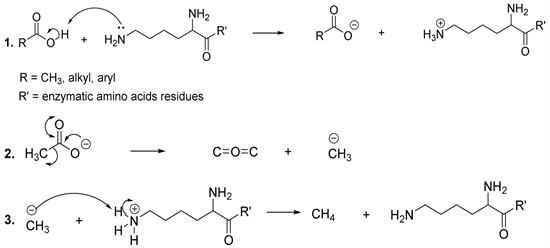
Scheme 9. Synthesis of methane
environment. The reaction mechanisms have been also proposed to better understand the formation of products, which occur during different steps of biomethanation.