1. Introduction
The Selberg trace formula, introduced by A. Selberg in 1956, describes the spectrum of the hyperbolic Laplacian in terms of geometric data involving the lengths of geodesics on a Riemann surface. Motivated by analogy between this trace formula and the explicit formulas of number theory relating the zeroes of the Riemann zeta function to prime numbers, Selberg [1] introduced a zeta function whose analytic properties are encoded in the Selberg trace formula. By focusing on the Selberg zeta function, H. Huber ( [2] , p. 386; [3] , p. 464), proved an analogue of the prime number theorem for compact Rie-
mann surfaces with the error term 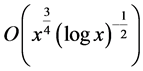 that agrees with Selberg’s one.
Using basically the same method as in [4] , D. Hejhal ( [5] , p. 475), established also the prime geodesic theorem for non-compact Riemann surfaces with the remainder
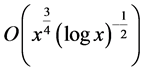 . However, in the compact case there exist several different proofs (see,
B. Randol [6] , p. 245; P. Buser [7] , p. 257, Th. 9.6.1; M. Avdispahić and L. Smajlović
[8] , Th. 3.1) that give the remainder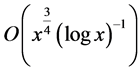 . Thanks to new integral repre-
sentations of the logarithmic derivative of the Selberg zeta function (cf. [9] , p. 185; [10] , p. 128), M. Avdispahić and L. Smajlović ( [11] , p. 13) were in position to improve
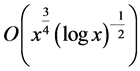 error term in a non-compact, finite volume case up to
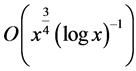 .
.
Whereas the authors in [8] and [11] approached the prime number theorem in various settings via explicit formulas for the Jorgenson-Lang fundamental class of functions, our main goal is to obtain this improvement for non-compact Riemann surfaces with cusps following a more direct method of B. Randol [6] .
2. Preliminaries
Let X be a non-compact Riemann surface regarded as a quotient  of the upper half-plane
  by a finitely-generated Fuchsian group
 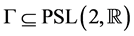 of the first kind, containing
  cusps. Let
  denote the fundamental region of
 . We shall assume that the fundamental region
  of
of  has a finite non-Euclidean area
 . We put
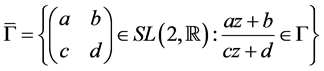
and denote by v the multiplier system of the weight  for
for . Let
. Let  be an irreducible
 ![]() unitary representation on
unitary representation on ![]() and
and![]() ,
,![]() . For an r dimensional vector space V over
. For an r dimensional vector space V over ![]() we consider an essentially self-adjoint operator
we consider an essentially self-adjoint operator
![]()
on the space ![]() of all twice continuously differentiable functions
of all twice continuously differentiable functions![]() , such that f and
, such that f and ![]() are square integrable on
are square integrable on![]() , and satisfy the equality
, and satisfy the equality
![]()
The operator ![]() has the unique self-adjoint extension
has the unique self-adjoint extension ![]() to the space
to the space![]() , a dense subspace of
, a dense subspace of![]() . Let
. Let![]() ,
, ![]() be the set of parabolic transformations corresponding to
be the set of parabolic transformations corresponding to ![]() cusps of
cusps of![]() .
. ![]() does not depend on the choice of a representative of the parabolic class
does not depend on the choice of a representative of the parabolic class ![]() and can be considered as a matrix from
and can be considered as a matrix from![]() . By
. By ![]() we will denote the multiplicity of 1 as an eigen-value of the matrix
we will denote the multiplicity of 1 as an eigen-value of the matrix
![]() , and
, and ![]() will be the degree of singularity of W. We mention that oper-
will be the degree of singularity of W. We mention that oper-
ator ![]() has both the discrete and continuous spectrum in the case
has both the discrete and continuous spectrum in the case![]() , and only the discrete spectrum in the case
, and only the discrete spectrum in the case![]() . The discrete spectrum will be denoted as
. The discrete spectrum will be denoted as ![]() (
(![]() ). The continuous spectrum is expressed through zeros (or equivalently poles) of the hyperbolic scattering determinant (see, [12] ).
). The continuous spectrum is expressed through zeros (or equivalently poles) of the hyperbolic scattering determinant (see, [12] ).
3. Selberg Zeta Function
Let ![]() denotes the set of
denotes the set of ![]() -conjugacy classes of a primitive hyperbolic element
-conjugacy classes of a primitive hyperbolic element ![]() in
in![]() , and
, and ![]() denotes the set of
denotes the set of ![]() -conjugacy classes of a hyperbolic element P in
-conjugacy classes of a hyperbolic element P in ![]() that satisfy property
that satisfy property![]() . Assume that
. Assume that![]() . We define the Selberg zeta function associated to the pair (
. We define the Selberg zeta function associated to the pair (![]() ) by
) by
![]()
![]() is absolutely convergent for
is absolutely convergent for![]() . Analytic considerations given in ( [5] , pp. 499-501) yield that the Selberg zeta function in this setting satisfies the functional equation
. Analytic considerations given in ( [5] , pp. 499-501) yield that the Selberg zeta function in this setting satisfies the functional equation
![]()
with the fudge factor
![]() (1)
(1)
Here, ![]() denotes the hyperbolic scattering determinant. It can be represented in the form
denotes the hyperbolic scattering determinant. It can be represented in the form
![]()
where the coefficients ![]() and
and ![]() depend on the group
depend on the group ![]() (see, [5] , p. 437). Here,
(see, [5] , p. 437). Here, ![]() denotes the degree of singularity of W (see Section 2). An explicit expression for the fudge factor
denotes the degree of singularity of W (see Section 2). An explicit expression for the fudge factor ![]() in the Equation (1) is given in ( [5] , p. 501, Equation (5.10)).
in the Equation (1) is given in ( [5] , p. 501, Equation (5.10)).
The logarithmic derivative of the Selberg zeta function ![]() is given by
is given by
![]()
where ![]() denotes the norm of the class P and
denotes the norm of the class P and ![]() for a primi-
for a primi-
tive element ![]() such that
such that ![]() for some
for some![]() . We will omit the indices in
. We will omit the indices in ![]() in the sequel.
in the sequel.
4. Counting Functions ![]()
Lemma 1. For![]() ,
,
![]()
where ![]() for a primitive element
for a primitive element ![]() such that
such that ![]() for some
for some![]() .
.
Proof.
![]()
We shall spend the rest of this section to derive a representation of ![]() in the form (11) bellow. We choose not to write it in a separate statement because of the length of expressions involved. However, it will serve as a base for the proof of the prime geodesic theorem in Section 5.
in the form (11) bellow. We choose not to write it in a separate statement because of the length of expressions involved. However, it will serve as a base for the proof of the prime geodesic theorem in Section 5.
Let us recall the following theorem given in ( [13] , p. 51, Th. 40).
Theorem 1. If the Dirichlet’s series ![]() is summable
is summable ![]() for
for ![]() and
and![]() ,
, ![]() , then
, then
![]() (2)
(2)
By Lemma 1,
![]()
We have,
![]()
Therefore, substituting ω = 1, ![]() , and hence
, and hence![]() ,
, ![]() in (2), we get
in (2), we get
![]()
Then,
![]() (3)
(3)
Now, put
![]()
and
![]()
for![]() . Using ( [14] , p. 12, Th. 1.3.5), it is easy to get that
. Using ( [14] , p. 12, Th. 1.3.5), it is easy to get that
![]() (4)
(4)
For![]() , let
, let![]() ,
, ![]() , be the zeros of
, be the zeros of ![]() in
in![]() . Let
. Let![]() ,
, ![]() denote all zeros of the hyperbolic scattering determinant in
denote all zeros of the hyperbolic scattering determinant in![]() .
.
Assume![]() ,
, ![]() ,
, ![]() , where
, where ![]() and
and ![]() for
for
![]() ,
,![]() . Following ( [5] , p. 468), we may also assume
. Following ( [5] , p. 468), we may also assume![]() ,
, ![]() , where,
, where, ![]() ,
, ![]() are the zeros of the Selberg zeta function
are the zeros of the Selberg zeta function ![]() for each zero
for each zero![]() ,
, ![]() ,
, ![]() , of the hyperbolic scattering determinant f. Let
, of the hyperbolic scattering determinant f. Let ![]() be a large constant such that
be a large constant such that![]() ,
, ![]() ,
,![]() . We put
. We put![]() .
.
Without loss of generality we may assume that![]() ,
, ![]() ,
,![]() . Let
. Let![]() . By the Cauchy residue theorem one has
. By the Cauchy residue theorem one has
![]() (5)
(5)
and
![]() (6)
(6)
Arguing as in [5] (p. 474) and [4] (pp. 105-108), we easily find that the sum of the
first eight integrals on the right hand side of (5) is![]() . Similarly, taking into account that
. Similarly, taking into account that ![]() is bounded for
is bounded for![]() , we obtain that the sum of the first eight integrals on the right hand side of (6) is
, we obtain that the sum of the first eight integrals on the right hand side of (6) is![]() . Following [5] (p. 474) and [4] (p. 85,
. Following [5] (p. 474) and [4] (p. 85,
Prop. 5.7), we obtain that the ninth resp. the third integral on the right hand side of (5) resp. (6) are![]() . Now, if we take
. Now, if we take![]() , (5) and (6) will give us
, (5) and (6) will give us
![]() (7)
(7)
and
![]() (8)
(8)
Bearing in mind location of the poles of ![]() given in ( [5] , p. 439, Th. 2.16; or [5] , p. 498, Th. 5.3) and the fact that
given in ( [5] , p. 439, Th. 2.16; or [5] , p. 498, Th. 5.3) and the fact that![]() , we may assume without loss of generality that
, we may assume without loss of generality that
![]()
Calculating residues and passing to the limit ![]() in (7) and (8) we get
in (7) and (8) we get
![]() (9)
(9)
and
![]() (10)
(10)
The implied constants on the right sides of (9) and (10) depend solely on![]() , m and W. With
, m and W. With ![]() in (3),
in (3), ![]() in (4), Equations (4), (3), (9) and (10) yield
in (4), Equations (4), (3), (9) and (10) yield
![]() (11)
(11)
where the first sum ranges over the finite set of poles s of
![]()
with![]() ,
, ![]() , the second sum ranges over the set of poles s of the same functions with
, the second sum ranges over the set of poles s of the same functions with![]() , and the third sum ranges over the finite set of their poles s with
, and the third sum ranges over the finite set of their poles s with![]() .
.
5. Prime Geodesic Theorem
In our setting, the prime geodesic counting function is defined by
![]()
where the sum on the right is taken over all primitive hyperbolic classes ![]() with respect to
with respect to ![]() (see, [5] , p. 473, [11] , p. 13).
(see, [5] , p. 473, [11] , p. 13).
Theorem 2. For![]() , the formula
, the formula
![]()
holds true, where, ![]() for
for![]() , and the implied constant depends solely on
, and the implied constant depends solely on![]() , m and W.
, m and W.
Proof. Following [6] (p. 245) and [15] (p. 11), for a positive number![]() , we define the second difference operator
, we define the second difference operator ![]() by
by
![]() (12)
(12)
Here, d is a constant which will be fixed later. By the mean value theorem, we have
![]() (13)
(13)
for some![]() . It is easy to verify that
. It is easy to verify that
![]() (14)
(14)
Reasoning as in [5] (p. 475), we may assume without loss of generality that ![]() is non-decreasing. Hence, (12) implies
is non-decreasing. Hence, (12) implies
![]() (15)
(15)
Since (14) holds true, one can easily deduce that![]() ,
, ![]() ,
, ![]() ,
, ![]() ,
, ![]() ,
, ![]() ,
,![]() . Thus, (13) and finiteness of the sums contained in
. Thus, (13) and finiteness of the sums contained in ![]() on the right hand side (11) yield
on the right hand side (11) yield
![]() (16)
(16)
Similarly,
![]() (17)
(17)
In order to estimate![]() , we will first consider
, we will first consider
![]()
By (14) it is evident that
![]() (18)
(18)
On the other hand, the mean value theorem (13) gives us
![]() (19)
(19)
Let ![]() be the number of roots of
be the number of roots of ![]() on the critical line
on the critical line ![]() in the interval
in the interval![]() . It is known ( [5] , p. 477, Th. 3.8) that
. It is known ( [5] , p. 477, Th. 3.8) that![]() . Taking
. Taking ![]() and following ( [3] , pp. 463-464; [6] , p. 246), we use (19) resp. (18) in the sums over
and following ( [3] , pp. 463-464; [6] , p. 246), we use (19) resp. (18) in the sums over![]() ,
, ![]() ,
, ![]() resp. sum over
resp. sum over![]() ,
, ![]() (below) to get
(below) to get
![]()
Thus,
![]() (20)
(20)
Similarly,
![]() (21)
(21)
Observe that ![]() (see, [5] , p. 437, Prop. 2.13). Thus, application of
(see, [5] , p. 437, Prop. 2.13). Thus, application of ![]() to the third and the fourth sum in
to the third and the fourth sum in ![]() gives us
gives us
![]() .
.
Let us write
![]() (22)
(22)
where ![]() denotes the sum of the first four sums in
denotes the sum of the first four sums in ![]() and
and ![]() denotes the sum of the last four sums in
denotes the sum of the last four sums in![]() . Now, Equations (11), (16), (17), (20), (21) and (22) give us
. Now, Equations (11), (16), (17), (20), (21) and (22) give us
![]() (23)
(23)
Putting![]() ,
, ![]() , the Equation (23) becomes
, the Equation (23) becomes
![]() (24)
(24)
Since the left sides of Equations (20), (21) are ![]() for such choice of M and d, we get
for such choice of M and d, we get![]() . Now, it is obvious that
. Now, it is obvious that![]() . Finally, Equation (24) gives us
. Finally, Equation (24) gives us
![]()
Returning to (15), we conclude that inequality
![]()
holds true. Following ( [15] , p. 11), we analogously obtain that
![]()
Hence,
![]() (25)
(25)
Arguing as in [5] (p. 475) and [4] (p. 113), one immediately sees that equality (25) proves the theorem.
Acknowledgements
We thank the Editor and the referee for their comments.