1. Introduction
The quantum stochastic calculus [4] [6] developed by Hudson and Parthasarathy is essentially a noncommutative extension of classical Ito stochastic calculus. In this theory, annihilation, creation, and number operator processes in boson Fock space play the role of “quantum noises”, [2] which are in continuous time. On the other hand, the quantum stochastic calculus has been extended by Hitsuda is by means of the Hitsuda-Skorohod integral of anticipative process [3] [9] and the related gradient operator of Malliavin calculus. In this noncausal formulation the action of each QS integral is defined explicitly on Fock space vectors, and the essential quantum Ito formula is seen in terms of the Skorohod isometry.
In 2002, Attal [1] unify and extend both of the above approaches on Guichardet spaces. In this note, explicitly definitions of QS integrals provided and introduced no unnatural domain limitations. Moreover, maximality of operator domains is demon-strated for these QS integrals on Guichardet spaces.
In this argument, we define an adjoint pair of operator , where
 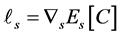 with
with  being the conditional expectation (operator). The motivation for this study comes from the following observations. It is known that
  is a projection operator on Guichardet Spaces. Hence, restricted to the range of
 ,
, ![]() coincides with the stochastic gradient operator
coincides with the stochastic gradient operator![]() . We show that
. We show that ![]() (resp.
(resp.![]() ) is essentially a kind of localization of the stochastic gradient operators (resp. Skorohod integral operators
) is essentially a kind of localization of the stochastic gradient operators (resp. Skorohod integral operators![]() ). We examine that
). We examine that ![]() and
and ![]() can be called a local stochastic gradient operators (resp. local Skorohod integral operators
can be called a local stochastic gradient operators (resp. local Skorohod integral operators![]() ). Then, it is necessary and important to study a pair of operator
). Then, it is necessary and important to study a pair of operator![]() .
.
This paper is organized as follows. In Section 2, we fix some necessary notations and recall main notions and facts about unbounded operators on Guichardet spaces. In Section 3, Section 4 and Section 5, we state our main results. We first examined that ![]() and
and ![]() satisfy a local CAR (canonical anti-communication relation) and
satisfy a local CAR (canonical anti-communication relation) and ![]() forms a mutually orthogonal operator sequence although each’s is not a projection operator. We find that
forms a mutually orthogonal operator sequence although each’s is not a projection operator. We find that ![]() is s-adapted operator if and only if
is s-adapted operator if and only if ![]() is s-adapted operator. Finally we show application exponential vector formulation of QS calculus.
is s-adapted operator. Finally we show application exponential vector formulation of QS calculus.
2. Unbounded Operators on Guichardet Spaces
In this section, we fix some necessary notations and recall main notions and facts about unbounded operators on Guichardet spaces. For detail formulation of unbounded operators, we refer reader to [1].
Let ![]() be the set of all nonnegative real numbers and
be the set of all nonnegative real numbers and ![]() the finite power set of
the finite power set of![]() , namely
, namely
![]()
where ![]() denotes the cardinality of
denotes the cardinality of ![]() as a set, with
as a set, with ![]() denoting the collection of
denoting the collection of ![]() element subsets. Obviously,
element subsets. Obviously,![]() . Particularly, let
. Particularly, let ![]() be an atom of measure 1. We denote by
be an atom of measure 1. We denote by ![]() the usual space of square integral real-valued functions on
the usual space of square integral real-valued functions on![]() .
.
Fixing a complex separable Hilbert space![]() , Guichardet space tensor product
, Guichardet space tensor product![]() , which we identify with the space of square-integrable functions
, which we identify with the space of square-integrable functions![]() , and is denoted by
, and is denoted by![]() . Guichardet space enjoys a continuous tensor product structure: for each
. Guichardet space enjoys a continuous tensor product structure: for each ![]() the map
the map
![]()
where![]() ,
,![]() .
.
For a Hilbert space-valued map![]() , let
, let ![]() be the map
be the map ![]() given by
given by
![]()
when![]() , we call
, we call ![]() is Skorohod integrable,
is Skorohod integrable, ![]() is Skorohod integral operator on
is Skorohod integral operator on ![]() and
and
![]()
For a map![]() , let
, let ![]() and
and ![]() be the maps
be the maps ![]() given by
given by
![]()
![]()
when![]() , we call
, we call ![]() and
and ![]() the stochastic gradient of f and the adapted gradient of
the stochastic gradient of f and the adapted gradient of![]() , respectively. Moreover,
, respectively. Moreover,
![]()
![]()
where![]() . Obviously, if
. Obviously, if![]() ,
, ![]() , where
, where![]() .
.
Let![]() , the adapted projection on
, the adapted projection on ![]() is the orthogonal projection onto the closed subspace
is the orthogonal projection onto the closed subspace![]() :
:
![]()
Remark 2.1 As Hilbert space operators![]() ,
, ![]() and
and ![]() are unbounded operators.
are unbounded operators. ![]() and
and![]() are closed, densely defined operators. Especially,
are closed, densely defined operators. Especially, ![]() is adjoint operator of
is adjoint operator of ![]() and
and
![]()
where ![]() is the number operator,
is the number operator, ![]() with maximal domain and
with maximal domain and ![]() is identical operator.
is identical operator.
Lemma 2.1 [1] Let ![]() and
and ![]() be Skorohod integrable, if the map
be Skorohod integrable, if the map
![]()
is integrable, then
![]() . (1)
. (1)
Lemma 2.2 [1] Let ![]() be measurable. If
be measurable. If ![]() for almost every
for almost every![]() , then
, then
![]() , (2)
, (2)
where (1) may call the canonical-commutation relations.
3. Local Skorohod Integral and Stochastic Gradient Operators
In the present section we state and prove our main results. We first make some preparations.
Let ![]() be an operator on
be an operator on ![]() with domain
with domain![]() , we define an conditioned expectation operator
, we define an conditioned expectation operator ![]() on
on ![]() by the a.e. prescription
by the a.e. prescription
![]() ,
,
with domain
![]()
where![]() ,
, ![]() ,
,![]() .
.
Clearly, ![]() is a subspce of
is a subspce of![]() , and for any
, and for any![]() , we have
, we have ![]() for a.a.
for a.a.![]() . Thus
. Thus ![]() is an s-adapted subspace.
is an s-adapted subspace.
Remark 3.1 If ![]() is s-adapted(i.e. for all
is s-adapted(i.e. for all![]() ,
, ![]() for a.a.
for a.a.![]() ), then the subspaces
), then the subspaces ![]() and
and ![]() coincide, and
coincide, and ![]() for
for ![]() in this subspace, it follows that
in this subspace, it follows that
![]()
Whenever ![]() belongs to
belongs to![]() . If
. If ![]() is densely defined, s-adapted and
is densely defined, s-adapted and ![]() is closable, then
is closable, then![]() .
.
Remark 3.2 ![]() is s-adapted operator and
is s-adapted operator and![]() .
.
Definition 3.1 For![]() , we call
, we call ![]() the local stochastic gradient operator and its adjoint operator
the local stochastic gradient operator and its adjoint operator ![]() is the local Skorohod integral operator. And operator domain of
is the local Skorohod integral operator. And operator domain of ![]() is given by
is given by
![]()
where ![]() is operator on
is operator on![]() .
.
We note that for![]() ,
,
![]()
![]()
hence,![]() . Especially, when
. Especially, when![]() , we have
, we have![]() .
.
Theorem 3.1 By lemma2.2, we can get the following relations
![]() (3)
(3)
which we may call the local CAR(canonical anti-commutation relations).
Proof we note that
![]()
The next theorem shows that ![]() is not a projection operator on
is not a projection operator on![]() .
.
Theorem 3.2![]() , whenever
, whenever ![]() and
and![]() .
.
Proof Let ![]() with
with![]() . The following algebraic relations are evident for
. The following algebraic relations are evident for![]() ,
,
![]()
![]()
![]()
We show that![]() , thus
, thus
![]()
We note that ![]() for
for ![]() with
with![]() , which means that the
, which means that the ![]() is not mutually orthogonal. However, the theorem below shows that the local operator sequence
is not mutually orthogonal. However, the theorem below shows that the local operator sequence ![]() is mutually orthogonal.
is mutually orthogonal.
Theorem 3.3![]() ,whenever
,whenever ![]() and
and![]() .
.
Proof Let ![]() and
and![]() . If
. If![]() , then we can show that
, then we can show that![]() , from which it follows that
, from which it follows that
![]()
Now, if![]() , then by the result of the first step we have
, then by the result of the first step we have
![]()
This completes the proof.
Theorem 3.4 ![]() is s-adapted operator if and only if
is s-adapted operator if and only if ![]() is s-adapted operator.
is s-adapted operator.
Proof we know that ![]() and
and ![]() is s-adapted operator. we have
is s-adapted operator. we have
![]()
![]() for a.a.
for a.a.![]() , obviously, if
, obviously, if ![]() is s-adapted, then
is s-adapted, then ![]() and
and ![]() for a.a.
for a.a.![]() . On the other hand, if
. On the other hand, if ![]() is s-adapted,
is s-adapted, ![]() is also s-adapted.
is also s-adapted.
4. Application to Exponential Vector Formulation of QS Calculus
Recall that in the exponential vector formulation of QS calculus, all processes are defined on a domain of the algebraic tensor product form![]() , where
, where ![]() is a dense subspace of
is a dense subspace of ![]() and
and ![]()
which ![]() is a subset of
is a subset of ![]() and
and ![]() denotes the expential vector of the test function
denotes the expential vector of the test function ![]() which in Guichardet spaces given by
which in Guichardet spaces given by![]() .
.
For all ![]() and a.a.
and a.a.![]() , we have
, we have
![]() and
and ![]() (4)
(4)
since, the domain of the form ![]() are s-adapted. Note the a.e. identity
are s-adapted. Note the a.e. identity
![]() where
where ![]() (5)
(5)
Theorem 4.1 ![]() be an operator on
be an operator on ![]() with domain of the form
with domain of the form![]() . Then
. Then ![]() is s-adapted if and only if, for all
is s-adapted if and only if, for all ![]() and
and![]() :
:
![]() (6)
(6)
where ![]()
Proof By definition of![]() ,
, ![]() be an operator on
be an operator on ![]() with domain of the form
with domain of the form![]() . We note that if
. We note that if ![]() is s-adapted, then
is s-adapted, then![]() . Let
. Let ![]() and
and![]() , by (4), for a.a.
, by (4), for a.a.![]() ,
,
![]()
and so, for a.a.![]() ,
,
![]()
Acknowledgements
The authors are extremely grateful to the referees for their valuable comments and suggestions on improvement of the first version of the present paper. The authors are supported by National Natural Science Foundation of China (Grant No. 11261027 and No. 11461061).