A Characterization of Complex Projective Spaces by Sections of Line Bundles ()
1. Introduction
Kobayashi and Ochiai [1] have given Characterizations of the complex projective spaces. Kobayashi-Ochiai Theorem [1] has been applied to obtain many important characterizations of the projective spaces, such as the proof of Frankel conjectures [2] , the proof of Hartshorne conjecture [3] , and many others [4] -[7] . In this note, we want to give a characterization of the complex projective spaces via sections of line bundles.
Results which can be found in [1] [8] and [9] are used freely often without explicit references. Let M be a complex space with a line bundle L.  is the sheaf of germs of sheaf of holomorphic functions,
  is the sheaf of germs of holomorphic sections of a line bundle L.
  means
means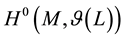 .
.
2. Characterization of the Projective Spaces
In this paper, a characterization of the projective space will be given.
Definition. Let M be a compact complex space with a line bundle L. M is said to be completely intersected with respect to a line bundle L, provided that complex subspace 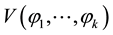 is irreducible for any linearly independent elements of
  of
of , where each
  is irreducible, and
 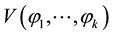 is the common zeros of
 .
.
From the Lemma 1.1 [1] and the proof of theorem 16.2.1 [8] , we have
Lemma 1. Let V be a compact irreducible complex space. Let F and L be line bundles over V. Let  be an irreducible section of L and put
 . The following sequence of sheaf homomorphisms is exact:

where  is the multiplication by
 ,
,  is the sheaf defined by
 ![]() and
and ![]() is the restriction map.
is the restriction map.
Lemma 2. Let M be a n-dimensional compact complex space with a line bundle L. Let ![]() be linear independent elements of
be linear independent elements of![]() , such that each
, such that each ![]() is irreducible. If M is completely intersected with respect to L, then there is an exact sequence:
is irreducible. If M is completely intersected with respect to L, then there is an exact sequence:
![]()
where ![]() is the subspace of
is the subspace of ![]() spanned by the sections
spanned by the sections ![]() and
and ![]() is the restriction map.
is the restriction map.
Proof. The proof is by induction on k. The case k = 0 is trivial. Since M is completely intersected with respect to L, ![]() and
and ![]() are irreducible. Assume the lemma for
are irreducible. Assume the lemma for![]() , we have the exact sequence:
, we have the exact sequence:
![]()
If![]() , then
, then ![]() from which it follows that
from which it follows that ![]() are linearly dependent, a contradiction. Thus,
are linearly dependent, a contradiction. Thus, ![]() is nontrivial on
is nontrivial on![]() ; it follows that
; it follows that ![]() defined as the set of zeros of =
defined as the set of zeros of = ![]() on
on ![]() is an irreducible divisor.
is an irreducible divisor.
We apply Lemma l to![]() ,
, ![]() ,
,![]() . Then,
. Then,![]() . The exact sequence in Lemma 1 induces the following exact sequence
. The exact sequence in Lemma 1 induces the following exact sequence
![]()
This means that the kernel of the restriction map ![]() is spanned by the restriction of
is spanned by the restriction of ![]() to
to![]() . Combining this with the lemma for
. Combining this with the lemma for![]() , we obtain the lemma for k.
, we obtain the lemma for k.
Now we give the main result of this paper.
Theorem. Let M be a n-dimensional compact irreducible complex space with a line bundle L. If ![]() and M is completely intersected with respect to L, then M is biholomorphic to a complex space
and M is completely intersected with respect to L, then M is biholomorphic to a complex space ![]() of dimension n.
of dimension n.
Proof. Since![]() , we can choose linearly independent sections
, we can choose linearly independent sections ![]() from
from ![]() with each
with each ![]() irreducible. Put
irreducible. Put![]() .
.
Claim 1. Each ![]() is an irreducible divisor of M.
is an irreducible divisor of M.
First of all, ![]() is nonempty. Indeed, if
is nonempty. Indeed, if ![]() for some i, then
for some i, then ![]() for all
for all![]() . Define map
. Define map ![]() by
by![]() . It is clear that h is isomorphic, that is, L is a trivial line bundle over M. It follows that
. It is clear that h is isomorphic, that is, L is a trivial line bundle over M. It follows that![]() , which is contradictory to the hypothesis that
, which is contradictory to the hypothesis that![]() . Thus, each
. Thus, each![]() . Since
. Since ![]() is irreducible,
is irreducible, ![]() is irreducible and
is irreducible and ![]() by [Corollary 14, Ch II, 3] and [Theorem 11, Ch III, 3]. Hence,
by [Corollary 14, Ch II, 3] and [Theorem 11, Ch III, 3]. Hence, ![]() is an irreducible divisor.
is an irreducible divisor.
Let ![]() be the common zeros of
be the common zeros of![]() , then
, then![]() . By the hypothesis, M is completely intersected with respect to L; each
. By the hypothesis, M is completely intersected with respect to L; each ![]() is irreducible.
is irreducible.
Claim 2.![]() .
.
For![]() ,
, ![]() is an irreducible divisor by Claim 1, thus
is an irreducible divisor by Claim 1, thus![]() . Assume that
. Assume that ![]() . If
. If![]() , then
, then ![]() by Lemma 2. This induces that
by Lemma 2. This induces that ![]() are linearly dependent, a contradiction. Thus,
are linearly dependent, a contradiction. Thus, ![]() is nontrivial on the irreducible complex subspace
is nontrivial on the irreducible complex subspace![]() . It follows by [Theorem 14, Ch. III, 3] that
. It follows by [Theorem 14, Ch. III, 3] that![]() .
.
Claim 3. ![]() is base point free.
is base point free.
By Claim 2, ![]() is an irreducible complex subspace of dimension
is an irreducible complex subspace of dimension![]() . In particular,
. In particular, ![]() is one point. If
is one point. If ![]() vanishes at
vanishes at![]() , then
, then ![]() are linearly dependent by Lemma 2. Since
are linearly dependent by Lemma 2. Since ![]() are defined as linearly independent sections in the beginning of this proof, it is a contradiction. Thus,
are defined as linearly independent sections in the beginning of this proof, it is a contradiction. Thus, ![]() does not vanish at
does not vanish at![]() . This shows that
. This shows that ![]() have no common zeros, that is,
have no common zeros, that is, ![]() is base point free.
is base point free.
Since![]() , we may let
, we may let ![]() be the complex projective space of dimension n defined as the set of hyperplanes through the origin in
be the complex projective space of dimension n defined as the set of hyperplanes through the origin in![]() . For any point
. For any point![]() , put
, put
![]() . Since
. Since ![]() is base point free,
is base point free, ![]() is a hyperplane through the origin in
is a hyperplane through the origin in ![]() and so
and so![]() . We now obtain a holomorphic mapping
. We now obtain a holomorphic mapping![]() .
.
Claim 4. The mapping ![]() is bijective.
is bijective.
Giving a point y of![]() , it is a hyperplane through the origin in
, it is a hyperplane through the origin in![]() . Let
. Let ![]() be a basis for this hyperplane with each
be a basis for this hyperplane with each ![]() irreducible. Then, y is the complex subspace spanned by
irreducible. Then, y is the complex subspace spanned by![]() , that is,
, that is,![]() . Let
. Let ![]() be the set of zeros of
be the set of zeros of ![]() for
for![]() . Since M is completely intersected with respect to L,
. Since M is completely intersected with respect to L, ![]() is irreducible and
is irreducible and ![]() by Claim 2, that is,
by Claim 2, that is, ![]() is a point. It follows that there exists a point x of M, such that
is a point. It follows that there exists a point x of M, such that![]() .
.
Thus,![]() . By Lemma 2, we have the exact sequence
. By Lemma 2, we have the exact sequence
![]() .
.
For any![]() , we have
, we have![]() . Since
. Since ![]() and the above sequence is exact, it follows that
and the above sequence is exact, it follows that ![]() and so
and so![]() . Thus,
. Thus, ![]() is surjective.
is surjective.
On the other hand, let u and v be any two points of M. ![]() is a hyperplane through the origin in
is a hyperplane through the origin in![]() . Let
. Let ![]() be a basis for
be a basis for ![]() with each
with each ![]() irreducible. By Claim 2,
irreducible. By Claim 2, ![]() is a single point and this induces that
is a single point and this induces that![]() . If
. If![]() , then
, then![]() . It follows that
. It follows that![]() , that is,
, that is,![]() . Thus
. Thus ![]() is injective.
is injective.
Consequently, we have shown that M is biholomorphic to a complex projective space ![]() of dimension n.
of dimension n.
As an application of the theorem above, we give a proof for the famous Kobayashi-Ochiai Theorem [1] .
Corollary ([Theorem 1.1 [1] ). Let M be a n-dimensional complex irreducible complex space with an ample line bundle F. If ![]() and
and![]() , then M is biholomorphic to a complex projective space
, then M is biholomorphic to a complex projective space ![]() of dimension n.
of dimension n.
Proof. By the theorem in this paper, it suffices to show that M is completely intersected with respect to F. Let ![]() be linearly independent elements of
be linearly independent elements of ![]() with each
with each ![]() irreducible. Let
irreducible. Let ![]() be the common zeros of
be the common zeros of ![]() on M.
on M.
Assume that ![]() is reducible, then write
is reducible, then write ![]() for some nontrivial
for some nontrivial ![]() and
and![]() . Because
. Because ![]() are linearly independent elements of
are linearly independent elements of ![]() with each
with each ![]() irreducible, there are no common zeros of
irreducible, there are no common zeros of ![]() on
on![]() . And due to the definition of
. And due to the definition of![]() , we have
, we have
![]()
By the hypothesis, ![]() , and so
, and so
![]() .
.
Since F is ample, ![]() and
and ![]() are positive integers. Thus,
are positive integers. Thus, ![]() , a contradiction. It follows that
, a contradiction. It follows that ![]() is irreducible. By the theorem above, M is biholomorphic to
is irreducible. By the theorem above, M is biholomorphic to![]() .
.
NOTES
*Corresponding author.