Comparison of treatment guidance based on bronchial responsiveness to mannitol, spirometry or exhaled nitric oxide in stable asthmatic children ()
1. INTRODUCTION
The goal of asthma management as described in national and international guidelines is optimal asthma control [1]. Despite highly effective therapy options being available, this goal is only achieved in a minority of asthmatic children [2-4]. Up to 80% of children suffer from occasional asthma symptoms, more than 40% from limitation in their physical activity and/or nocturnal awakening, and for more than 50%, parents are worried about their asthmatic child [5]. The reasons for this lack in achieving asthma control are likely to be multiple, one being that objective parameters of disease activity are not evaluated on a regular base to guide therapy [2]. Several instruments have been developed to evaluate asthma control including the Asthma Control Questionnaire (ACQ) [6], the Asthma Control Scoring System (ACSS) [7], and the Asthma Control Test (ACT) [8], the latter being adapted for its use in children [9]. For applying these instruments including the GINA [1] guidelines, caregivers have to rely on the report of symptoms by the child and/or parents. One possible reason for not achieving the goals stated in guidelines may be the poor perception of asthma control by parents and patients [5,10]. There is an apparent tendency of parents and children with significant symptoms to inappropriately report good control [5].
It is therefore likely that the measurement of pathophysiological mechanisms of asthma, hence, the measurement of objective parameters of disease activity such as airway obstruction, bronchial hyper-responsiveness (BHR), and airway inflammation [4,11] may be helpful to guide treatment. There are, however, still many open questions. Several studies have shown only a weak or no correlation between objective parameters and asthma symptoms. No correlation was shown between FEV1 and individual symptom scores or clinical disease severity scores in asthmatic children, whereas a weak correlation has been found for the ratio FEV1/FVC and symptom scores [12,13]. In addition, only 34% of asthmatic children show a significant correlation between BHR to methacholine and symptom scores [11]. One explanation of this lack in correlation may be the fact that lung function and BHR show a slow response to modification by inhaled corticosteroids and may therefore not be ideal tools for short term therapy guidance [14,15]. For the above-mentioned reasons, it would be beneficial to have additional objective parameters for the guidance of treatment. Ideally, such parameters reflect the pathophysiology of allergic asthma, correlate closely to symptoms and show a fast response on changing disease control.
The measurement of fractional exhaled nitric oxide (FeNO) has been shown to be helpful in the assessment of asthma in children and adults, mainly in treatment monitoring. Regular determination of FeNO can be helpful in observing adherence to treatment and in predicting exacerbations as well as the course of asthma [10,16-23]. FeNO measurements are simple to perform, reproducible and have a good acceptance by healthy and asthmatic adults and children [24]. In recent years, several publications have shown that FeNO is an efficient tool for diagnosing allergic asthma [23,25]. In addition, FeNO has achieved an important role in predicting clinical outcome in terms of steroid response, exacerbations and long-term outcomes [18-22]. Furthermore, it has been reported that FeNO can be used as a marker for asthma control [26,27] and that FeNO has a fast response to treatment modification [14,28]. Several studies have assessed the use of FeNO as an alternative method to modify ICS treatment based on symptoms and/or pulmonary function in asthmatic children and adults with conflicting results [17, 29-33].
Mannitol dry powder (MDP) challenge is an indirect bronchial provocation test, which is well studied in adults and is used more and more in the assessment of childhood asthma. A recent study has proven that the MDP challenge is safe and feasible in asthmatic children [34]. However, only few studies have investigated the use of mannitol as diagnostic tool to evaluate BHR. Anderson and Lipworth evaluated relationships between mannitol BHR and methacholine challenge as well as measures of airway inflammation (FeNO and salivary eosinophilic cationic protein) in adult persistent asthmatics receiving inhaled corticosteroids [35]. The authors observed a good correlation between mannitol, methacholine and FeNO and concluded that mannitol challenge adequately reflects bronchial inflammation. Interestingly, a recent study suggested that FeNO is sensitive and specific for accurately predicting BHR, measured by the response to inhaled mannitol, in steroid-naïve adolescents and young adults, revealing an optimal cut-off at 25 ppb [36]. The authors concluded that inhaled mannitol challenge does not add additional diagnostic information when FeNO values are low. Moreover, mannitol has been shown to be less sensitive than methacholine to predict BHR in youth athletes with exercise-induced bronchoconstriction, pointing to a possible influence of asthma phenotype in the value of diagnostic methods for BHR [37].
Compared to studies addressing BHR, data on the usefulness of mannitol challenge in guiding treatment in asthmatic children are even scarcer. A recent study by Kersten et al. showed that mannitol PD15 did not significantly change after stepping down ICS treatment in stable asthmatic children [38]. Similarly, the STAMINA trial in an adult cohort with persistent asthma demonstrated a higher exposure to ICS when treatment was guided by mannitol compared to a conventional strategy based on symptoms, reliever use, and lung function, in spite of an equivocal number of severe asthma exacerbations [39]. Taken together, to date it is still unclear which objective parameter is the most useful to guide treatment in children with asthma. Moreover, there are discrepancies to which stage objective measures of asthma control correlate with subjective symptoms reporting, hence to most frequently used tools for assessment of asthma control, such as the ACT. A recent study confirms and expands the concept that C-ACT is complementary to, but not a substitute for other markers of disease control in asthmatic children [40].
The aim of this study was to compare treatment guidance based on bronchial hyper-responsiveness to mannitol, FeNO and spirometry in stable children with allergic asthma.
2. METHODS
Subjects. 60 children with stable allergic asthma aged between 7 to 16 years were recruited. All children were on a low to medium dose treatment with inhaled corticosteroids (ICS; 200 - 400 μg budesonide equivalent per day). A total of 48 children completed the study (27 boys, 21 girls) and were included in the final analysis. Children were recruited from the asthma clinics of the Alpine Children’s Hospital, Davos and the department of paediatrics of HFR Fribourg, Switzerland.
Exclusion criteria included the following: children with a history of other respiratory disease, such as cystic fibrosis or neonatal lung disease, and acute upper airway infection within the last 3 weeks or asthma exacerbation within the last 3 months requiring systemic steroids.
The study was approved by the local ethics committee. Informed written consent was obtained from the parents or guardians of all subjects.
Study Design. Double-blinded, randomized controlled trial assessing three different strategies to adapt ICS treatment in children with allergic asthma, consisting of two consecutive clinical visits three months apart. At each visit the following assessments were performed.
Fractional exhaled nitric oxide (FeNO) was measured using an electrochemistry-based analyser (NIOX MINO™; Aerocrine, Stockholm, Sweden) according to American Thoracic Society/European Respiratory Society guidelines [41]. The NIOXMINO™ is pre-calibrated for the predetermined life-span of the device and relies on built-in flow control with audio and visual feedback to maintain flow rates at 50 ± 5 ml/s. After a deep inhalation of NO-free air via an integrated NO-filter the subjects slowly exhaled over 10 s at the required flow rate. Measurements were repeated twice at short intervals of 1 - 2 min.
Spirometry was performed according to the recommendations by the American Thoracic Society [42]. Forced expiratory volume in one second (FEV1) was measured using a spirometer (Masterlab, Jaeger, Würzburg, Germany) with the patient seated and wearing a nose clip. The best of 3 technically acceptable FEV1 manoeuvres was recorded. FEV1 values were expressed as percent predicted according reference data [43].
Bronchial hyper-responsiveness (BHR) to mannitol. Dry powdered mannitol was supplied in kit form (Aridol™, Pharmaxis Ltd., Frenchs Forest, NSW, Australia) and contained one empty capsule (placebo), 1 × 5 mg, 1 × 10 mg, 1 × 20 mg and 15 × 40 mg capsules administered using the Osmohaler™ dry powder inhaler (Plastiape, Osnago, Italy). FEV1 was measured 60 s after each mannitol dose (0, 5, 10, 20, 40, 80, 160, 160, 160 mg). The 80 mg and 160 mg doses were given in multiples of 40 mg capsules. The subject was asked to inhale from the device and to hold his breath for 5 s. 60 s after inhalation of the empty capsule (Placebo), the FEV1 was measured twice and the highest of these values was taken as the baseline FEV1 and was used to calculate the FEV1 decline in response to the mannitol challenge. This procedure was repeated for each dose step until a 15% decline in FEV1 was achieved (PD15; positive MDP-test) or a cumulative dose of 635 mg had been administered [44,45].
Quality of life. Quality of life was assessed twice by the disease-specific paediatric asthma quality-of-life questionnaire (PAQLQ) [46]. Both the self-administered (PAQLQ) version and the interviewer-administered (PAQLQi) questionnaire were used with the PAQLQ always applied first. Both questionnaires are composed of the same questions. The questionnaire consists of 23 questions grouped in three domains: symptoms, activity and emotional function. The symptom domain is composed of 10 questions, the activity domain is composed of 5 questions and the emotional function domain consists of 8 questions. The responses for each item are demonstrated on a 7-point scale, where 1 represents severe impairment and 7 represents no impairment.
Asthma control. The asthma control test (ACT™) was used to assess asthma control [8]. The test contains five questions. Each question is scored from 0 (maximum impairment) to 5 (no impairment). The sum of points of the single questions is added on to the total symptom score with a minimum of 0 and a maximum of 25 points.
Randomization. A well-trained lung-function technician blinded to the treatment decisions performed all above-mentioned assessments. The patients were then randomly assigned to one of three monitoring groups (group 1 FeNO, group 2 mannitol and group 3 spirometry). According to the test results and the group the child was assigned to, one of the investigators (BK; JHW) informed the responsible paediatrician of the asthma clinic, which was blinded for the test results, on how treatment had to be adapted. The dose of ICS was doubled in group 1 when FeNO was >22 ppb, in group 2 in case of a positive MDP-test and in group 3 when FEV1 was <80% of predicted, respectively, or was maintained in the remaining subjects.
Statistical analysis. Data were analysed using SPSS 16.0 (SPSS Inc., Chicago, Illinois, USA). Results are expressed as mean and standard deviation (SD) or median and interquartile range (IQR) in the case of non-normally distributed data. Differences between groups at visit 1 were analysed with the students t-test or non-parametric Mann-Whitney U test for independent samples. Changes during the intervention between visit 1 and visit 2 were analysed with paired t-test or Wilcoxon signed rank test, where appropriate. Differences in categorical variables between the two groups were analysed by the Chi2-test. Correlation analyses were performed using the Pearson correlation coefficient or Spearman rank order. A pvalue of <0.05 was considered significant.
3. RESULTS
60 children were enrolled in the study and randomized. Twelve subjects were excluded from the final analyses for the following reasons: five individuals experienced an exacerbation of their asthma due to acute viral airway infection (two in groups 1 and 2, and one subject in group 3, respectively), five others did not adhere to the treatment recommendations and two were lost for follow-up. A total of 48 patients successfully completed the study (16 per group). Patient characteristics at baseline are summarized in Table 1.
Baseline comparison. When children were grouped according to their baseline FeNO values, individuals with elevated FeNO (≥22 ppb) had reduced quality of life (PAQLQ: 146 ± 8.6 vs 154 ± 5.2; p < 0.001 and PAQLQi: 146.4 ± 8.6 vs 154.7 ± 5.8; p < 0.001, respectively) and lower asthma control (20.8 ± 1.9 vs 23.5 ± 1.2; p < 0.001) (Figures 1(a)-(c)). Whilst showing a similar FEV1 (94.1% ± 12.1% vs 95.6% ± 13.6%; p = 0.6), these subjects also had lower MEF50 (78.7% ± 21.7% vs 90.3% ± 15.0%; p = 0.038).
Of the children with FeNO ≥ 22 ppb, 24 out of 25 (96%) showed a positive mannitol challenge compared to only 3 out of 23 (13%) with FeNO < 22 ppb (p < 0.001) (Figure 1(d)). Subjects with a positive MDP-test had significantly higher FeNO values compared to children with a negative challenge (median [IQR]: 31 [20.5] vs 8 [12.25]; p < 0.001) (Figure 2(a)). They also showed lower quality of life (PAQLQ: 147 ± 8.4 vs 154 ± 5.4; p < 0.001 and PAQLQi: 148.5 ± 5.3 vs 155.5 ± 5.7; p < 0.001, respectively) and lower asthma control (21.0 ± 1.9 vs 23.5 ± 1.3; p < 0.001) (Figures 2(b)-(d)). Subjects

Table 1. Patient characteristics at baseline visit.
*mean ± standard deviation (SD); §median [IQR]; ¶chi2 test.
with a negative MDP test showed higher peripheral forced flows (MEF50) as compared to children with BHR (91.3% ± 13.6% vs 78.8% ± 21.8%; p = 0.026), whereas there was no difference in FEV1 (94.7% ± 12.3% vs 94.9% ± 13.2%; p = 0.95).
Intervention. At the first visit, 8 out of 16 (50%) children from group 1 (FeNO) showed FeNO levels > 22 ppb, in group 2, (BHR) 8 children out of 16 (50%) showed a positive MDP-test and in group 3 (spirometry), 3 children out of 16 (18.7%) had a FEV1 < 80% of predicted and had their ICS-dose doubled. There were no significant differences between the three groups regarding the assessments at visit 1. In group 1, FeNO decreased significantly between visit 1 and visit 2 (p = 0.005), whereas the self-administered PAQLQ score (p = 0.02), the interviewer-administered PAQLQ(i) score (p = 0.033) and the asthma control test (ACT; p = 0.031) increased significantly. Neither the number of children with a positive mannitol challenge (p = 0.72) nor the spirometricparameter (FEV1: p = 0.211; MEF50: p = 0.083) changed significantly (Figures 3(a)-(d) and Table 2). In group 2 (mannitol) and group 3 (spirometry) there were no significant changes in the objective parameters, such as FeNO, spirometry and the number of children with positive mannitoltests, and no significant changes in the quality of life scores nor in the asthma control test (Table 2).
Correlations. Significant negative correlations were found for FeNO and quality of life (PAQLQ score: cc −0.65; p < 0.001 and PAQLQ(i) score: cc −0.51; p < 0.001) and a strong negative correlation for FeNO and ACT score (cc −0.77; p < 0.001) (Figures 4(a)-(c)). MEF50%pred was weakly correlated to FeNO (cc −0.422; p = 0.0029; data not shown), whereas there was no significant correlation between FeNO and FEV1%pred (cc −0.28; p = 0.054) (Figure 4(d)). The asthma control test was significantly correlated with both the self-administered PAQLQ score and the interviewer-administered PAQLQ(i) (cc 0.61; p < 0.001 and cc 0.55; p < 0.001, respectively). In addition, there were weak but significant relationships between the asthma control score and lung function (FEV1%pred: cc 0.29; p = 0.041 and MEF50%pred: cc 0.46; p = 0.0011, respectively).
4. DISCUSSION
According to current guidelines for the management of asthma in schoolchildren, treatment guidance is mainly based on reported symptoms [47]. If asthma control is insufficient, the anti-inflammatory treatment is stepped up, whereas the dose will remain unchanged or be reduced when good asthma control is achieved. However, asthma control was found to be insufficient with signifycant impact on the daily life in the majority of children in several previous European studies [5,10]. Studies as-

Figure 1. Relationships between FeNO levels and quality of life, asthma control and the results of the MDP test at baseline. (a, b) Quality of life scores at baseline grouped according to FeNO values; (c) Asthma control scores at baseline grouped according to FeNO values. The median is the line bisecting the box, the box limits represent 25th and 75th percentiles and whiskers extend to the 10th and 90th percentile, whereas the black dots represent outliers; (d) Percentage of children with positive and negative MDP-test grouped according to FeNO values at baseline. Black bar indicates children with a positive MDP-test, white bar children with a negative MDP-test. PAQLQ = Pediatric Asthma Quality of life questionnaire; PAQLQi = interview based Pediatric Asthma Quality of life questionnaire; FeNO: Fractional exhaled nitric oxide; ACT: Asthma Control Test; MDP: mannitol dry powder provocation test.
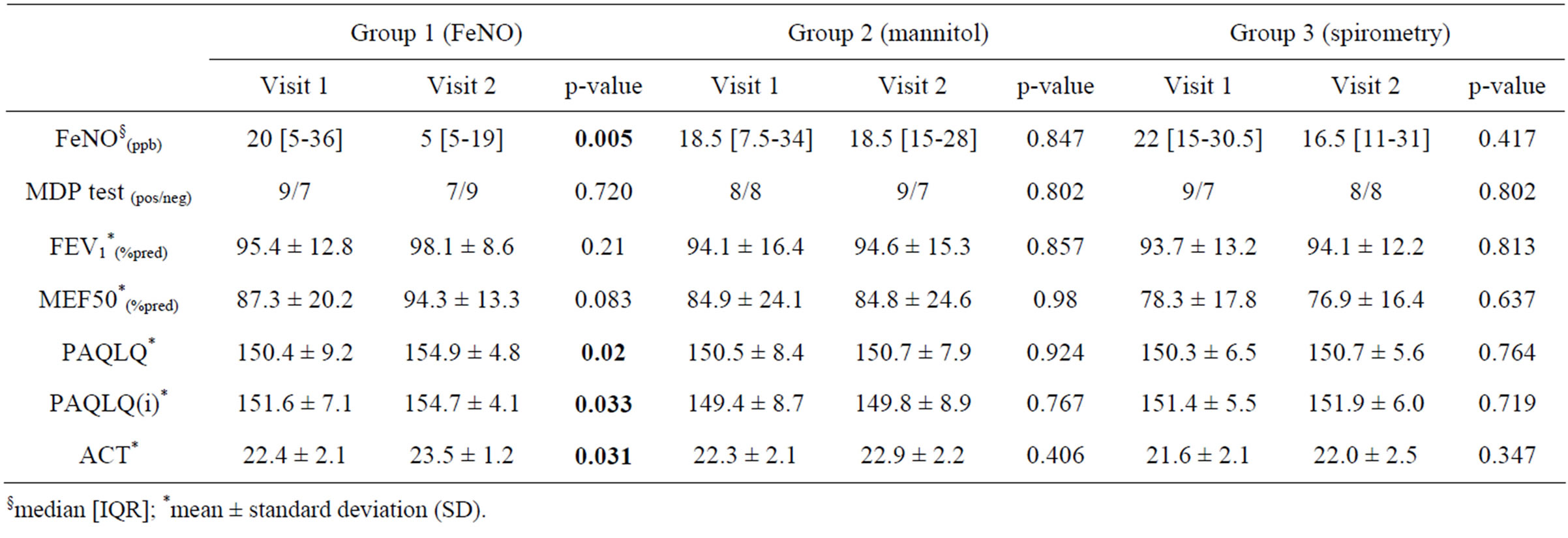
Table 2. FeNO, MDP test, FEV1, PAQLQ, PAQLQi and ACT for the three groups at visit 1 and visit 2.
§median [IQR]; *mean ± standard deviation (SD).
sessing treatment titration based on objective measures of airway inflammation determined by the means of FeNO gave controversial results [17,29-31]. We performed a randomized, prospective, double blinded study to investigate the impact of treatment guidance based on FeNO, BHR to mannitol, or spirometry on quality of life, asthma control and airway inflammation. Treatment guidance based on FeNO led to significant improvements

Figure 2. FeNO levels quality of life and asthma control in children with positive and negative MDP tests at baseline. (a) FeNO values of children with positive and negative MDP tests; (b, c) Quality of life scores at baseline grouped according to the results of the MDP test at baseline; (d) Asthma control scores at baseline grouped according to the results of the MDP test at baseline. The median is the line bisecting the box, the box limits represent 25th and 75th percentiles and whiskers extend to the 10th and 90th percentile, whereas the black dots represent outliers. PAQLQ = Pediatric Asthma Quality of life questionnaire; PAQLQi = interview based Pediatric Asthma Quality of life questionnaire; FeNO: Fractional exhaled nitric oxide; ACT: Asthma Control Test; MDP: mannitol dry powder provocation test.
in asthma control and quality of life, and to a reduction of airway inflammation as expressed by FeNO. This was in contrast to the children in whom treatment was adapted according to FEV1 levels or the presence of BHR to mannitol. In our study, ICS dose was doubled when FeNO was elevated (≥22 ppb) indicating airway inflammation, or remained unchanged in children with normal levels (<22 ppb). This cut-off value was based on available normative data [19,41]. In the spirometry group ICS dose was doubled when FEV1 was <80% predicted, as suggested by current guidelines [47,48], or in the presence of BHR to mannitol, in the BHR group, respectively. Only three children in the spirometry group had FEV1 values < 80% of predicted which clearly limits statistical analysis.
FEV1 is within the accepted normal range in most school children independent of their asthma severity, when defined on the basis of symptoms [13,49]. The majority of asthmatic children attending a tertiary care facility have FEV1 values within the normal range [49]. This indicates that the cut-off values may not adequately stratify asthmatic children [13,49].
Concerning spirometry it has been shown that in children FEV1 and individual symptom scores or clinical disease severity have no significant correlation [12,13,50, 51], and only a weak correlation was found for FEV1/ FVC and symptom scores [12,13]. Hence, it appears that the current guidelines for asthma management may lead to sub-optimal control of the disease [4]. These findings indicate that not only symptoms and spirometry may be considered for managing asthma treatment but also other objective parameters, such as BHR and airway inflammation.
BHR to a variety of stimuli is a key feature of asthma and is an important determinant of asthma prognosis and lung function development in childhood [52,53]. Grol et al. found that low FEV1 and severe BHR in childhood are independent risk factors for reduced FEV1 in young

Figure 3. Results for the three groups at baseline and after three months. Results for the different management groups at visit 1 and 2. The ICS dose was adapted according to FeNO values (FeNO group), the result of the MDP-test (mannitol group) of FEV1 (spirometry group). (a) FeNO values at visit 1 and 2. 3 (b, c) quality of life assessed by the PAQLQ at visit 1 and 2; (d) Asthma control at visit 1 and 2. The median is the line bisecting the box, the box limits represent 25th and 75th percentiles and whiskers extend to the 10th and 90th percentile, whereas the black dots represent outliers. FeNO decreased, PAQLQ and ACT scores increased in the FeNO group only. PAQLQ = Pediatric Asthma Quality of life questionnaire; PAQLQi = interview based Pediatric Asthma Quality of life questionnaire; FeNO: Fractional exhaled nitric oxide; ACT: Asthma Control Test; MDP: mannitol dry powder provocation test.
adulthood [54]. Therefore, in order to achieve optimal or total asthma control, it could be expected that the measurement of BHR in asthmatic children on a regular basis would be helpful. However, BHR challenge tests have some disadvantages that have to be taken into account: they are difficult to perform in younger children, are time consuming, and come with certain risks [55]. In addition, it has been shown that BHR shows only a slow response to modifications of inhaled corticosteroid therapy and so is not an ideal tool for short term treatment guidance [14-16]. A study by Nuijsink et al. has demonstrated that a treatment strategy guided by airway hyper-responsiveness over a 2-year period in 210 atopic asthmatic children had no benefits in terms of number of symptom-free days but resulted in a better outcome of pre-bronchodilator FEV1 [11]. Sont et al. showed that a treatment strategy including BHR determination leads to a lower rate of mild exacerbations, higher FEV1, greater reduction in thickness of the subepithelial reticular layer in bronchial biopsies but was associated with higher ICS doses in asthmatic allergic adults [4].
Asthma is considered to be primarily an inflammatory disease of the airways; allergic asthma in particular shows an eosinophilic inflammation. Therefore it can be argued that an objective parameter of eosinophilic airway inflammation, which correlates to symptoms and shows a fast response on changing disease control, would be a valuable tool in diagnosing and managing asthma. It has been shown that FeNO is a non-invasive marker of eosinophilic airway inflammation [57-59] and measurement of FeNO can be of help in diagnosing allergic asthma [23,25,56]. FeNO can be used to predict clinical outcome in terms of steroid response and exacerbations. Little et al. [26] have shown that asthmatic adults with elevated FeNO levels had a benefit from an increase in the ICS dose. With ICS treatment FeNO decreases in asthmatics in a dose dependent manner. It has therefore been suggested that FeNO might serve as a sensitive inflammatory marker for assessing treatment response [20,21]. In addition elevated FeNO predicts asthma relapse after

Figure 4. Correlations between FeNO and quality of life, asthma control and lung function. (a, b) Correlations between baseline FeNO values and quality of life scores; (c) Correlation between asthma control score and FeNO; (d) Correlation between FEV1 and FeNO. There was a significant negative correlation between FeNO values PAQLQ scores and ACT scores but not correlation between FeNO and FEV1. cc = correlation coefficient; PAQLQ = Pediatric Asthma Quality of life questionnaire; PAQLQi = interview based Pediatric Asthma Quality of life questionnaire; FeNO: Fractional exhaled nitric oxide; ACT: Asthma Control Test.
discontinuation or reduction of steroids in adults and children [18,19]; furthermore, FeNO shows a fast response to treatment modification [14,28].
Several studies in asthmatic adults and children investigated the usefulness of FeNO to guide therapy with contrasting results. Shaw et al. found that an asthma treatment strategy in asthmatic adults based on FeNO levels was feasible but did not result in a significant reduction in asthma exacerbations [35]. These results are consistent with findings by Smith et al. [30] in adults and Pijnienburg et al. [17] and Pike et al. [33] in children. Due to the short study duration we did not see differences in asthma exacerbations in our study. There are also conflicting results in these studies regarding the effect of FeNO-based ICS treatment titration compared to a control group treated according to current guidelines. Whereas Smith et al. showed a significant decrease in maintenance dose of ICS without compromising asthma control [30], Shaw et al. did not observe a reduction in the total amount of ICS used. Nevertheless, participants of the FeNO-guided group were on a lower ICS dose at the end of the study compared to the control group [29]. In contrast, Szefler et al. demonstrated that adding FeNO measurement to standard care did not result in significant improvement in asthma control but in higher ICS doses in asthmatic inner-city adolescents and young adults [31]. De Jongste et al. found similar results in asthmatic children [57]. Most recently, Pike et al. demonstrated that FENO-guided ICS titration did not reduce corticosteroid usage or exacerbation frequency in paediatric outpatients with moderate to severe asthma when compared to conventional asthma management [33].
In a study including 85 atopic asthmatic schoolchildren, Pijnenburg et al. showed that titration of ICS treatment based on FeNO led to a decrease in BHR and airway inflammation, but did not result in better asthma symptom control [17]. In our study we observed a significant decrease in FeNO and increased asthma control (ACT) as well as an increased quality of life (PAQLQ) in the FeNO guided group. One reason may be, on the one hand, the lower cut-off value for FeNO in our study (22 ppb), which allowed an earlier increase of ICS treatment that might have resulted in a better control of airway inflammation. On the other hand, our study population was characterized by children with milder asthma on a relatively low ICS dose at study entry (200 mcg budesonide-equivalent), in opposite to others who included more severely affected subjects.
In contrast to other studies we did not observe a change in the number of children with a positive mannitol challenge. This is likely due to various reasons. First, the study duration of only 3 months was shorter than in other studies with durations between 6 to 24 months [4,11,17] and might have been too short to reduce BHR significantly. It has previously been demonstrated that BHR shows a slow response to modification of ICS therapy [14]. Second, in other studies either methacholine [4,11,17] has been used as the provocative agent. An important limitation of our data is the fact that we were not able to analyse response slopes, as only the final test result (positive and negative, respectively) was available for further analysis. In contrast to previous studies that evaluated the value of treatment guided by FeNO in addition to symptoms or symptom guided treatment [17,29, 31,57] we adapted the ICS therapy on objective measurements only, i.e. FEV1, BHR to mannitol and FeNO.
Children with elevated FeNO had lower quality of life scores and lower ACT scores, with a high inverse correlation between FeNO and the PAQLQ scores or the ACT score, respectively. Such relationships have been described in previous studies. A similar correlation between the ACT scores and FeNO in asthmatic children has been found in two studies [27,40], and Roberts et al. showed a clear negative correlation between the PAQLQ and FeNO [58]. However, other studies failed to find such relationships [13,59,60]. It remains unclear whether symptoms, and in consequence asthma related quality of life, is directly linked to airway inflammation as reflected by FeNO, or if these parameters measure independent factors.
Interestingly, FeNO was also associated with BHR to mannitol. 24 out of 25 of the children with FeNO > 22 ppb showed a positive mannitol challenge, compared to 13% of children with lower FeNO levels. Therefore, the sensitivity of FeNO > 22 ppb to predict a positive MDP was 96% with a specificity of 87%. A similar relationship between FeNO and BHR to mannitol was found by Decimo et al. [61].
5. CONCLUSION
In conclusion, we have shown that there is a close relationship between elevated FeNO levels and bronchial hyper-responsiveness to mannitol. Children with elevated FeNO had lower quality of life scores and lower asthma control. Children with a positive MDP test had lower asthma quality of life and lower asthma control. Taken together, we demonstrated that ICS dose modification based on FeNO led to increased quality of life and asthma control and a reduction in airway inflammation and was superior to treatment changes based on BHR to mannitol or on FEV1.
NOTES