1. Introduction
Several studies have been reported on substituted RCo5−xXx compounds (R = lanthanide, Y or Th) in order to investigate the effect of metalloids such as X = Al, Ga, Si, B on the physical properties of these systems [1-3]. In particular, there have been several studies on the structural and magnetic properties of the RCo4B compounds [4-11]. The interest in these compounds was mainly because of their moderate hard magnetic properties with less content of the expensive Co than in RCo5 systems.
Boron-for-cobalt substitution gives rise to new structures with general formula Rn+1Co3n+5B2n derived from the CaCu5 structure type. The RCo4B compounds with non-magnetic R elements exhibit unique magnetic properties governed by the Co sublattice only. Their magnetic behavior differs from that of the other RCo4B standards, and they exhibit large magnetocrystalline anisotropy. The RCo4B structure has two R sites (1a and 1b), two others for Co atoms (2c and 6i) and one for boron (2d). It has been shown that the Co 2c site, in ThCo4B is the only site, which exhibits a significant magnetic moment [12], whereas both of the Th and Co 6i sites carry a negligible magnetic moment. On the contrary, in YCo4B both Co 2c and Co 6i sites do carry a magnetic moment. We present in this paper a DFT-based study on the electronic band structure, spin-density maps, magnetic moment in ThCo4B using different schemes and Brillouin-zone integration methods as implemented in the Wien2k package [13].
2. Computational Methods
The CeCo4B structure can be obtained from the CaCu5 structure if two different crystal lattice sites were introduced for the Ce (1a and 1b) in addition to two other sites for Co (2c and 6i) and one for B(2d), as shown in Figure 1. Kuzma et al. [14] showed that the B for Co substitution in RCo5 (R is a rare earth or Y) structure leads to a series of compounds of the Rn+1Co3n+5B2n type. ThCo4B differs significantly from the RCo4B where R is a rare earth, having much higher c lattice parameter but with the lattice parameter a close observed for PrCo4B and NdCo4B [2]. ThCo5 crystallizes in the CaCu5 structure (space groupP6/mmm, No. 191). The unit cell contains one formula unit. The experimental lattice constants used in our calculations are a = 4.75 Å and c = 3.93 Å [16]. The ThCo4B has the CeCo4B type of structure (space groupP6/mmm, No. 191). The unit cell contains two formula units, with the room temperature lattice parameters obtained from X-ray diffraction are a = 5.088 Å and c = 7.003 Å [17].
The Wein2K electronic structure code uses the FullPotential Linearized Augmented Plane Wave (FPLAPW) [18] based on the Density Functional Theory (DFT) [19]. The Local Density Approximation (LDA) of Perdew and Wang [20] and the Generalized Gradient Approximation (GGA) of Perdew, Burke and Ernzerhof [21] were used for correlation and exchange potentials as implemented in the Wien2k code [13]. Both core and valence states are calculated self-consistently, the core states fully relativistically for the spherical part of the potential, and the valence
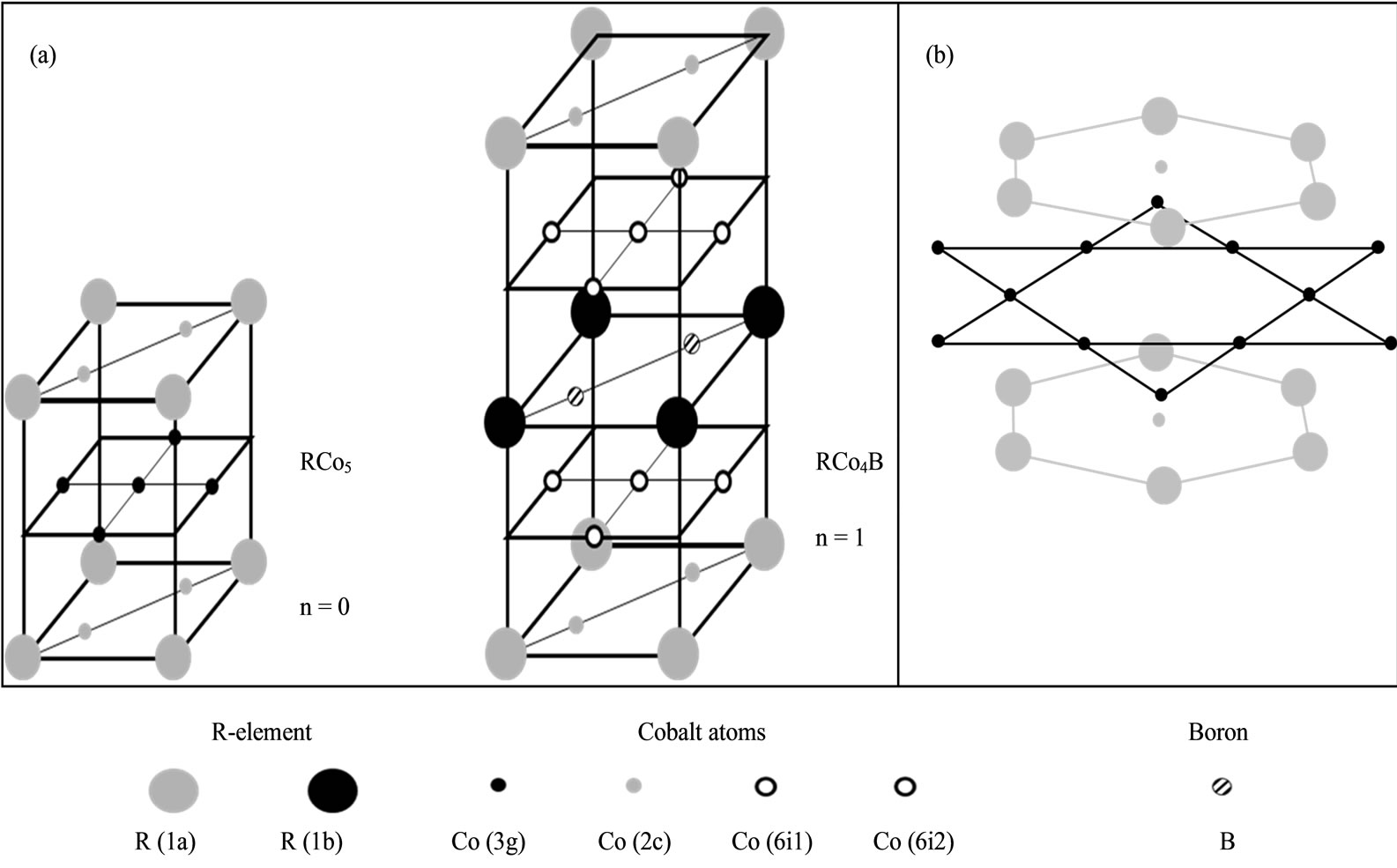
Figure 1. (a) Crystal structures of the Rn+1Co3n+5B2n compounds (n = 0, and 1) [15]; (b) Crystal structure of ThCo5. Shown are 2 layers of hexagonal Co (2c) with a Kagome lattice of Co (3g) atoms lying between. The Th atoms lie in the middle of the hexagons in the Co (2c) layers [14].
states using the full potential. Local orbital extensions [22] with the converged basis of approximately 1000 basis functions were used to reduce linearization errors in Th and Co spheres. For the Brillouin zone integration we used the modified tetrahedron method for the self-consistent band structure calculations. Self-consistent calculations were performed and the convergence was checked by varying the number of k points up to 64 in the ireducible Brillouin zone. In order to systematically study the effect of considering different interactions on the magnetic properties, electronic bands and spin-density structure we first performed a pure spin-polarized calculation and then subsequently incorporated SO scheme into the calculation.
The SO interaction was included using a second variational scheme [23] by taking all states below the cut off energy 1.5 Ry. The orbital moment is affected by spin orbit coupling and other correlation effects. The band structure and density of states of localized electrons are not easy to be understood using local density approximation (LDA) method. The spin orbit interaction must be considered in dealing with the 6p states of Th. The 5f states however are above Fermi energy and, unlike the 4f states in rare-earth compounds, are not considered as localized.
3. Results and Discussion
The calculated magnetic moments at each sphere and their comparison with the experimental results and other calculation are shown in Table 1.
In this table we present our calculated magnetic moments at different Th and Co sites in ThCo5 and ThCo4B structures together reported experimental and other ab initio results for comparison. The calculated Co magnetic moments in ThCo4B at the 2c and 6i sites of Co are 1.33 and 0.28 µb respectively. These values are in good agreement with 1.30 and 0.26 µb reported by Benea et al. [17] using the fully relativistic SPR-KKR method. Rather different values were reported by FPLO calculations [24] namely 1.548 and 0.427 µb respectively. Relatively different values were reported by neutron diffraction experiments [25] namely 1.8 and 0.1 µb respectively. It is also evident that the magnetic moments at the non-equivalent Th (1a) and Th (1b) sites and at the B (2d) site are rather small and negative in good agreement with earlier work [17, 24].The spin and site-resolved DOS for ThCo4B and ThCo5 structures are shown in Figures 2(a) and (b) respectively. The main features of Figure 2 are:
a) The f-states of Th (1a) and Th (1b) non-equivalent sites contribute significantly to the total DOS of ThCo4B. These DOS states are located above Ef indicating their

Table 1. Magnetic moments in the ThCo4B, and ThCo5 compounds.
non-localized nature in these two compounds. The hybridization between the Th (1b) and B (2d) atoms results in DOS features different from those of the Th (1a) atoms. This may be attributed to the fact that Th (1a) atoms lack the presence of the B (2d) atoms in the crystal plane in which they are located;
b) The states of boron contribute but little to the total DOS. These features are generally in accord with the data reported by Benea et al. [17] and Szajek [24].
The calculated band structures of the two Co sites 2c and 6i have noticeable different behavior as shown in Figure 3. Considering the close relationship between the ThCo4B and ThCo5 structure types (the ordered substitution of one half of the Co 2c site in the ThCo5 by B leads to ThCo4B structure, with B located on the 2d site), the calculated Co contributions to DOS can be compared in mentioned compounds. Upon changing the Co by B different environment were introduced for the Co atoms and its 3g site in the ThCo5 structure to be the 6i site in the ThCo4B structure. The effect of the SO coupling on the 6p states of the Th (1a) and Th (1b) atoms is shown by comparing the spin-polarized Band Figure 4(a) to their counterparts where SO has been taken into consideration
Figure 4(b). The splitting into 6 p1/2 and 6 p3/2 is around 7 eV however it is a bit larger for the Th (1a) atom. Our calculation is consistent with the work of Szajek [24].
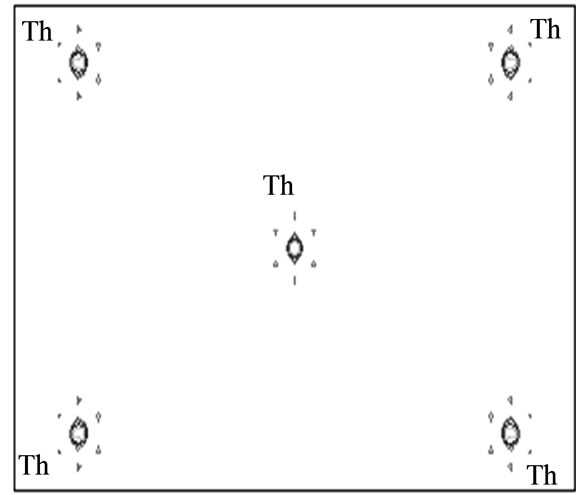
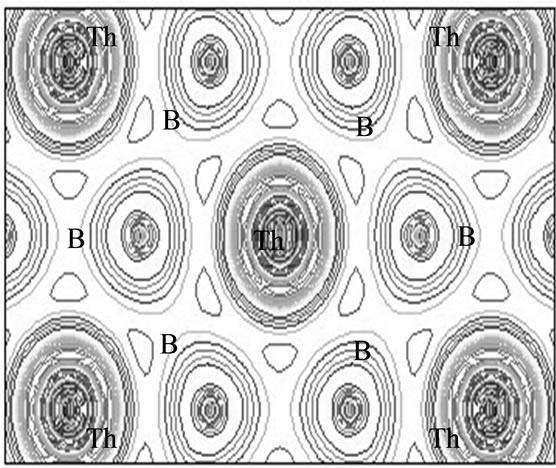
The spin-density maps are shown in Figure 5, for ThCo4B in the (100), (001) and (002) planes using just the spin-polarized scheme. In the (100) plane nine atoms of Th and four Co (2c) are displayed. The (100) and (001) planes are boron-free. The latter one displays 5 atoms of Th and 6 Co (2c) atoms. The (002) plane, on the other hand is Co-free and has 5 Th and 6 B atoms (for the charge density maps see Figure 6). These spin-density maps show clearly that spin contours are concentrated mainly around the Co atoms in support to the data of Table 1. The effect of SO interaction on the spin density is shown in Figure 7. The SO effect is largely due to the p-state of the Th atoms as we have discussed earlier. We have performed similar calculation on ThCo5 in the (100) and (001) planes. These two planes contain 9 Th + 4 Co and 5 Th + 6 Co atoms respectively. We have found that the SO effect is also strongest on the Th atoms of this system. The spin-contour maps for ThCo5 in the (100) plane, using the bare spin-polarized approximation and in the case of incorporating the SO interaction are shown in Figures 8(a) and (b) respectively.
 (a)
(a)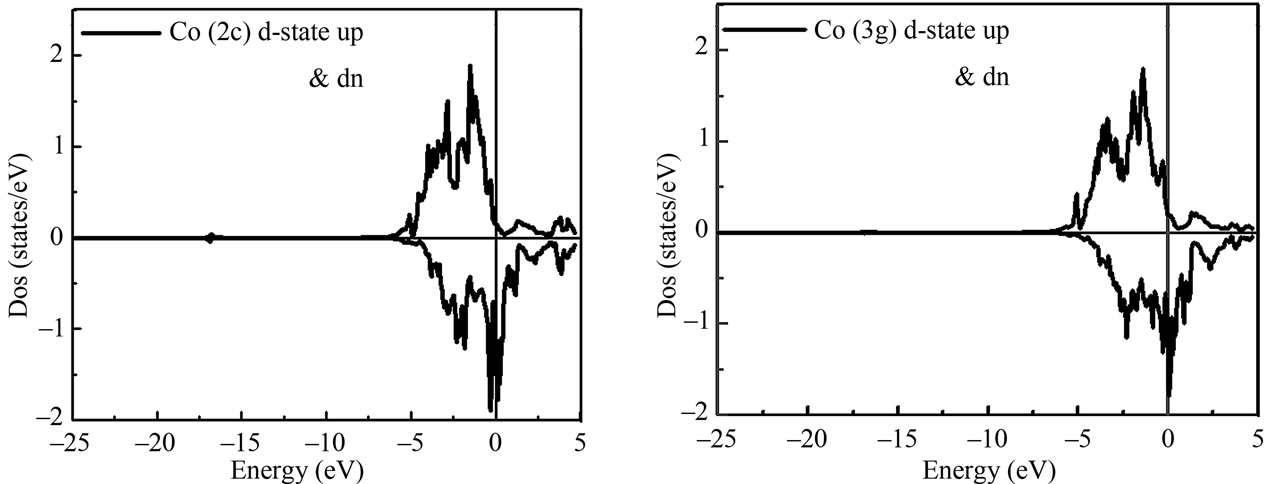 (b)
(b)
Figure 2. (a) the spin polarized Dos (up + down) for ThCo4B; (b) the spin polarized Dos (up + down) for ThCo5.
 (a)
(a) (b)
(b)
Figure 3. (a) the spin polarized band structure (up) for the Co (2c)-atom in ThCo4B; (b) the spin polarized band structure (up) for the Co (6i)-atom in ThCo4B.
 (a)
(a)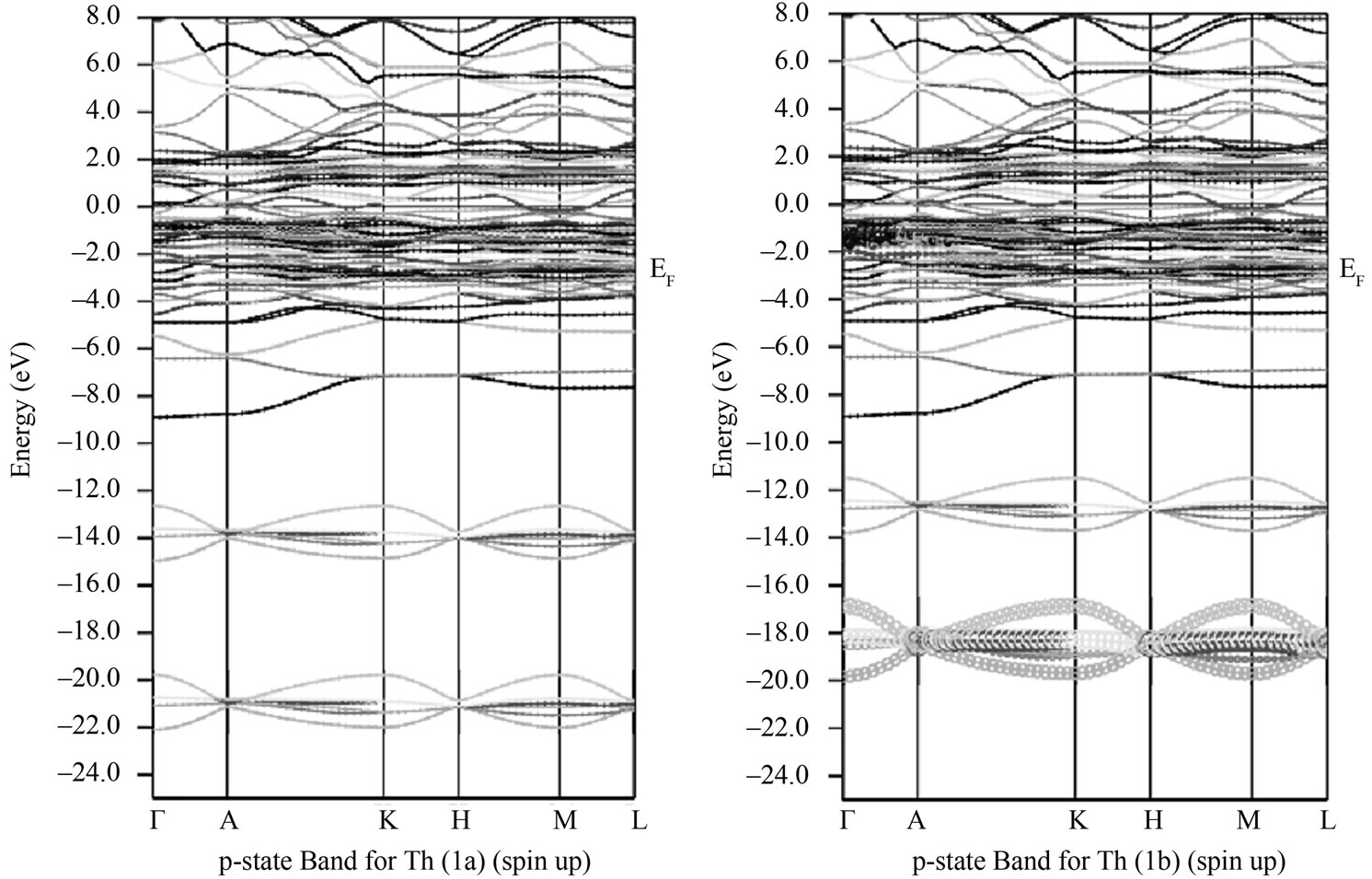 (b)
(b)
Figure 4. (a) the spin polarized band structure (up), for Th (1a) and Th (1b) [p-state] in ThCo4B; (b) the spin polarized band structure with So (up) for Th (1a) & Th (1b) [p-state] in ThCo4B.
 (a)
(a) (b)
(b) (c)
(c)
Figure 5. (a) the spin density map (spin polarized) for ThCo4B (100-plane); (b) the spin density map (spin polarized) for ThCo4B (001-plane); (c) the spin density map (spin polarized) for ThCo4B (002-plane).
 (a)
(a) (b)
(b) (c)
(c)
Figure 6. (a) the electronic charge density (spin polarized) for ThCo4B (100-plane); (b) the electronic charge density (spin polarized) for ThCo4B (001-plane); (c) the electronic charge density (spin polarized) for ThCo4B (002-plane).
 (a)
(a) (b)
(b)
Figure 7. (a) the spin density map (spin polarized with SO) for ThCo4B (100-plane); (b) the spin density map (spin polarized with SO) for ThCo4B (002-plane).
 (a)
(a) (b)
(b)
Figure 8. (a) (left) the spin density map (spin polarized) for ThCo5 (100-plane). (right) the spin density map (spin polarized for) ThCo5 (001-plane); (b) (left) the spin density map (spin polarized with SO) for ThCo5 (100-plane). (right) the spin density map (spin polarized with SO) for ThCo5 (001-plane).
4. Conclusion
The magnetic moment of ThCo4B compound is largely due to cobalt atoms in particular those at the 2c sites. Spin-orbit coupling affects the p-state of Th significantly. The p1/2-p3/2 spin-orbit splitting of this core state is site dependent, i.e. it is not the same for the Th (1a) and (1b) sites. Spin-polarized and spin-polarized calculation with SO interaction included, demonstrate the effect of SO on the spin density maps in ThCo4B and its parent compound ThCo5.