Determination of Trace Elements in the Tamsagbulag and Tagaan Els crude oils and Their Distillation Fractions Using by ICP-OES ()
1. Introduction
Crude oil represents a complex mixture containing both organic and inorganic chemical species, being trace metals one group the inorganic components present in this type of matrix [1-3]. Information on trace element concentrations in crude oil is getting increasingly important for the geochemical characterization of source rocks and basins and also to allow corrective actions during crude oil processing [4]. Trace metals have been found in different proportions in different crudes and consequently in their derivatives. Frequently Ni and V are found in largest concentrations contributing to environmental pollution [5-7]. Because of their mutagenic and carcinogenic potential Ni and V emissions have been strictly controlled in several countries. In addition, V is a catalyst poison and causes corrosion in furnaces and boilers during oil processing. The knowledge of the concentration ratio between V and Ni in crude oil provides powerful geological information allowing oil-oil and oil-rock correlation and evaluation of the palaeoenvironmental conditions [8] of sedimentation. Other metals, such as Fe, Cu and Zn, may also be present in significant amounts. Chemical species of these metals can be partially transferred to fractions (fuels for instance), decreasing their quality and performance.
2. Experimental
2.1. Instrumentation
A Perkin Elmer model Optima 2000 DV Plasma inductively coupled plasma optical emission spectrometer (axial viewing) was used for this study. The instrument is equipped with a dual echelle monochromator, a RF generator of 40 MHz, GemCon nebulizer. A peristaltic pump was used to feed the nebulization system with sample solution. An auxiliary gas flow regulator was used to control the flow of O2 into the nebulizer gas. The operating conditions are listed in Table 1 [9].
2.2. Reagents and Solutions
All reagents employed were of analytical grade. The kerosene was used as solvent in the test as it provides better detection limits and physical property than others [10,11]. ICP Solvent was from Conostan (Ponca City, OK, USA). A multielement organometallic standard (Custom blend, Conoco, Ponca City, OK, USA) with analyte concentration of 500 μg·g−1 was used to spike the crude oil samples. Two basin (crude oil of XIX-213, 21, 34, 40, 25-50, B 27-42 oil well Tamsagbulag basin and TE 27-5, TE 14-19 oil well Tsagaan els basin.) crude oil samples were used. These crude oil samples were spiked
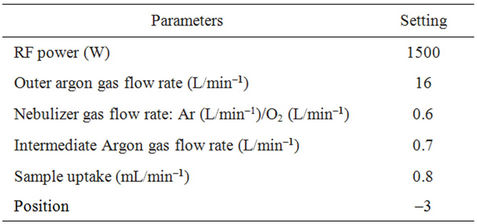
Table 1. Operating parameters for ICP OES measurements.
with the multielement organometallic analyte standard (Conostan Custom blend).
2.3. Preparation of Samples and Standard
After petroleum samples were dewatered by calcium chloride [12], the water is decreased below 0.08% by determination of Karlo-Fisher method [13]. After dewatering, the petroleum samples were distilled into fractions of diesel (200˚C - 350˚C), oil (350˚C - 450˚C) and heavy residue (above 450˚C) [14].
For preparation of sample, crude oil and its fractions of 200˚C - 350˚C and 350˚C - 450˚C were diluted tenfold, above 450˚C fraction was diluted thirtyfold with kerosene [10].
Conostan Custom Blend standard was spiked to these solutions. Trace elements are determined in samples by comparison standard.
3. Results and Discussion
Results of trace elements in petroleum of Tamsagbulag and Tsagaan els basin are shown in Tables 2 and 3.
About 30 elements between 0.01 - 35.6 ppm were determined in petroleum of Tamsagbulag and Tsagaan Els basin. The Li is not detected in petroleum of Tamsagbulag and Tsagaan Els basin. The relatively high Na 20.98 ppm in Tamsagbulag, 35.6 in Tsagaan els basin crude oil is noteworthy. This could be incidental due to the contact of crude oil with salt water [16].
Table 2 presents rare earth elements of Y, La and Sc that were determined 0.01 - 0.07 ppm in petroleum of Tamsagbulag and Tsagaan Els basin. Therefore, it is impossible to use raw material of rare earth elements [3]. Sum trace elements relatively for petroleum of Tamsagbulag and Tsagaan Els, sum trace elements in petroleum of Tamsagbulag more 1.5 than petroleum of Tsagaan Els.