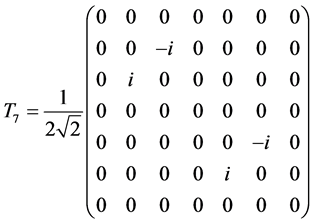
<?xml version="1.0" encoding="UTF-8"?><!DOCTYPE article  PUBLIC "-//NLM//DTD Journal Publishing DTD v3.0 20080202//EN" "http://dtd.nlm.nih.gov/publishing/3.0/journalpublishing3.dtd"><article xmlns:mml="http://www.w3.org/1998/Math/MathML" xmlns:xlink="http://www.w3.org/1999/xlink" dtd-version="3.0" xml:lang="en" article-type="research article"><front><journal-meta><journal-id journal-id-type="publisher-id">JMP</journal-id><journal-title-group><journal-title>Journal of Modern Physics</journal-title></journal-title-group><issn pub-type="epub">2153-1196</issn><publisher><publisher-name>Scientific Research Publishing</publisher-name></publisher></journal-meta><article-meta><article-id pub-id-type="doi">10.4236/jmp.2016.710096</article-id><article-id pub-id-type="publisher-id">JMP-67320</article-id><article-categories><subj-group subj-group-type="heading"><subject>Articles</subject></subj-group><subj-group subj-group-type="Discipline-v2"><subject>Physics&amp;Mathematics</subject></subj-group></article-categories><title-group><article-title>
 
 
  On the Charges and Currents in the Quantum Field Theory
 
</article-title></title-group><contrib-group><contrib contrib-type="author" xlink:type="simple"><name name-style="western"><surname>Daniel</surname><given-names>Sepunaru</given-names></name><xref ref-type="aff" rid="aff1"><sub>1</sub></xref><xref ref-type="corresp" rid="cor1"><sup>*</sup></xref></contrib></contrib-group><aff id="aff1"><label>1</label><addr-line>RCQCE—Research Center for Quantum Communication, Holon Academic Institute of Technology, Holon, Israel</addr-line></aff><author-notes><corresp id="cor1">* E-mail:<email>danielsepunaru@walla.co.il</email></corresp></author-notes><pub-date pub-type="epub"><day>08</day><month>06</month><year>2016</year></pub-date><volume>07</volume><issue>10</issue><fpage>1082</fpage><lpage>1090</lpage><history><date date-type="received"><day>7</day>	<month>January</month>	<year>2016</year></date><date date-type="rev-recd"><day>accepted</day>	<month>9</month>	<year>June</year>	</date><date date-type="accepted"><day>14</day>	<month>June</month>	<year>2016</year></date></history><permissions><copyright-statement>&#169; Copyright  2014 by authors and Scientific Research Publishing Inc. </copyright-statement><copyright-year>2014</copyright-year><license><license-p>This work is licensed under the Creative Commons Attribution International License (CC BY). http://creativecommons.org/licenses/by/4.0/</license-p></license></permissions><abstract><p>
 
 
  This paper is concerned with the determination of currents and charges in hypercomplex extensions of the Feynman-Dyson derivation of the Maxwell-Faraday equations. We analyze the appearance of charges and currents in non-Abelian versions of that approach: SU(2), SU(3) and G2. The structure constants of G2 Lie algebra are computed explicitly. Finally, we suggest a seven-dimensional treatment of color.
 
</p></abstract><kwd-group><kwd>Gauge Charges</kwd><kwd> Structure Constants</kwd><kwd> Multiplication Tables</kwd><kwd> Color</kwd></kwd-group></article-meta></front><body><sec id="s1"><title>1. Introduction</title><p>This paper is a continuation of the discussion on hypercomplex extensions of the Feynman-Dyson derivation of the Maxwell-Faraday equations. Usually mathematical proofs have only relatively minor value since for any set of mathematical arguments it is possible to present an equally valuable set of contra-arguments; in physics, by contrast, the ultimate verification of a statement is its confirmation by experiment and the solution is unique.</p><p>The specific topic of the present discussion is the determination of currents and charges in the suggested schemas [<xref ref-type="bibr" rid="scirp.67320-ref1">1</xref>] - [<xref ref-type="bibr" rid="scirp.67320-ref4">4</xref>] . As the defining model we consider the structure of the classical electrodynamics which consists of two parts: the first, the “inertial” fields produced by a moving source that is wrapped around the source, and the second, the radiated part that consist of the excessive field due to the accelerated motion of the source. Equivalently, the solutions may be viewed as a description of the motion of a source under the influence of an external field. The role of the inhomogeneous equations in all that is crucial. They define the electromagnetic parameters of the source: charge and current. This is not “merely” a definition, for it produces a drastic change in the physical content of the theory which leads to reconsideration of the structure of the space-time continuum (a change from Galilean to Lorentz group transformations that leave the equations invariant). It also introduces a new type of symmetry―internal local gauge symmetry.</p><p>Thus, charge and the current turn out to be newly conserved quantities. Note that the non-Abelian extension of the gauge fields proceeds through the steps described above [<xref ref-type="bibr" rid="scirp.67320-ref3">3</xref>] . Therefore a more detailed analysis of what has been done so far is required as well as an explanation of the reasoning behind it.</p></sec><sec id="s2"><title>2. Mathematical Preliminary.</title><p>Mathematical background for our discussion is necessary.</p><p>Since we are interested in a theory with uniquely determined predictions, it is advisable to use a numeric system that allows that to occur: normed division algebras which include the real (1dimensional), complex (2 dimensional), quaternion (4 dimensional) and octonion (8 dimensional) algebras that satisfy the definition of quadratic composition algebras:</p><disp-formula id="scirp.67320-formula755"><graphic  xlink:href="http://html.scirp.org/file/4-7502611x6.png"  xlink:type="simple"/></disp-formula><disp-formula id="scirp.67320-formula756"><label>(1)</label><graphic position="anchor" xlink:href="http://html.scirp.org/file/4-7502611x7.png"  xlink:type="simple"/></disp-formula><disp-formula id="scirp.67320-formula757"><graphic  xlink:href="http://html.scirp.org/file/4-7502611x8.png"  xlink:type="simple"/></disp-formula><p>Definitions of trace <inline-formula><inline-graphic xlink:href="http://html.scirp.org/file/4-7502611x9.png" xlink:type="simple"/></inline-formula> and norm <inline-formula><inline-graphic xlink:href="http://html.scirp.org/file/4-7502611x10.png" xlink:type="simple"/></inline-formula> are consistent with those of matrix calculus.</p><p>Note that in contrast with reals, complex and quaternions, octonions are non-associative (but still alternative) algebra and therefore can’t be represented by matrices.</p><p>Now we need to introduce multidimensional numeric objects-vectors to extend the usual arithmetic operations-addition, multiplication by a constant number, and multiplication between them. In so doing, we now gain three types of multiplication:</p><p>1) scalar multiplication described by the Jordan product</p><disp-formula id="scirp.67320-formula758"><graphic  xlink:href="http://html.scirp.org/file/4-7502611x11.png"  xlink:type="simple"/></disp-formula><p>which maps vector fields into scalars;</p><p>2) vector multiplication described by the Lie bracket product</p><disp-formula id="scirp.67320-formula759"><graphic  xlink:href="http://html.scirp.org/file/4-7502611x12.png"  xlink:type="simple"/></disp-formula><p>which maps vector fields into vectors; and</p><p>3) tensor multiplication <inline-formula><inline-graphic xlink:href="http://html.scirp.org/file/4-7502611x13.png" xlink:type="simple"/></inline-formula> which leads to the higher dimensional algebras.</p><p>Surprisingly, vector multiplication does not always satisfy the usually required properties [<xref ref-type="bibr" rid="scirp.67320-ref5">5</xref>] [<xref ref-type="bibr" rid="scirp.67320-ref6">6</xref>] .</p><p>It realized consistently only in n = 1, n = 3 and n = 7 dimensional space according to [<xref ref-type="bibr" rid="scirp.67320-ref7">7</xref>] [<xref ref-type="bibr" rid="scirp.67320-ref8">8</xref>] :</p><disp-formula id="scirp.67320-formula760"><label>, (2)</label><graphic position="anchor" xlink:href="http://html.scirp.org/file/4-7502611x14.png"  xlink:type="simple"/></disp-formula><p>where n is the dimension of the underlined vector space.</p><p>Bearing in the mind the definition of charge in the following discussion, from now on, by the term multiplication we mean the Lie bracket product</p><disp-formula id="scirp.67320-formula761"><label>. (3)</label><graphic position="anchor" xlink:href="http://html.scirp.org/file/4-7502611x15.png"  xlink:type="simple"/></disp-formula><p>For the quaternions (<inline-formula><inline-graphic xlink:href="http://html.scirp.org/file/4-7502611x16.png" xlink:type="simple"/></inline-formula>) the structure constants <inline-formula><inline-graphic xlink:href="http://html.scirp.org/file/4-7502611x17.png" xlink:type="simple"/></inline-formula> may be computed from</p><disp-formula id="scirp.67320-formula762"><label>(4)</label><graphic position="anchor" xlink:href="http://html.scirp.org/file/4-7502611x18.png"  xlink:type="simple"/></disp-formula><p>where<inline-formula><inline-graphic xlink:href="http://html.scirp.org/file/4-7502611x19.png" xlink:type="simple"/></inline-formula>, and <inline-formula><inline-graphic xlink:href="http://html.scirp.org/file/4-7502611x20.png" xlink:type="simple"/></inline-formula> is totally antisymmetric Levi-Civita symbol with the only nonzero independent components<inline-formula><inline-graphic xlink:href="http://html.scirp.org/file/4-7502611x20.png" xlink:type="simple"/></inline-formula><inline-formula><inline-graphic xlink:href="http://html.scirp.org/file/4-7502611x21.png" xlink:type="simple"/></inline-formula>. Thus we get quaternion multiplication table (see <xref ref-type="fig" rid="fig1">Figure 1</xref>), where<inline-formula><inline-graphic xlink:href="http://html.scirp.org/file/4-7502611x20.png" xlink:type="simple"/></inline-formula><inline-formula><inline-graphic xlink:href="http://html.scirp.org/file/4-7502611x21.png" xlink:type="simple"/></inline-formula><inline-formula><inline-graphic xlink:href="http://html.scirp.org/file/4-7502611x22.png" xlink:type="simple"/></inline-formula>. From (1) it follows that <inline-formula><inline-graphic xlink:href="http://html.scirp.org/file/4-7502611x20.png" xlink:type="simple"/></inline-formula><inline-formula><inline-graphic xlink:href="http://html.scirp.org/file/4-7502611x21.png" xlink:type="simple"/></inline-formula><inline-formula><inline-graphic xlink:href="http://html.scirp.org/file/4-7502611x22.png" xlink:type="simple"/></inline-formula><inline-formula><inline-graphic xlink:href="http://html.scirp.org/file/4-7502611x23.png" xlink:type="simple"/></inline-formula> are the traceless, antihermition generators of quaternion algebra. We compute the quaternion and octonion multiplication tables in order to compare them with the corresponding commutation</p><fig id="fig1"  position="float"><label><xref ref-type="fig" rid="fig1">Figure 1</xref></label><caption><title> Quaternion multiplication table</title></caption><graphic mimetype="image"   position="float"  xlink:type="simple"  xlink:href="http://html.scirp.org/file/4-7502611x24.png"/></fig><p>relation tables and structure constants for the most popular in physical applications Lie algebras.</p><p>For the octonions (<inline-formula><inline-graphic xlink:href="http://html.scirp.org/file/4-7502611x25.png" xlink:type="simple"/></inline-formula>) we get octonions multiplication table (see <xref ref-type="fig" rid="fig2">Figure 2</xref>), where<inline-formula><inline-graphic xlink:href="http://html.scirp.org/file/4-7502611x25.png" xlink:type="simple"/></inline-formula><inline-formula><inline-graphic xlink:href="http://html.scirp.org/file/4-7502611x26.png" xlink:type="simple"/></inline-formula>. From (1) it follows that <inline-formula><inline-graphic xlink:href="http://html.scirp.org/file/4-7502611x25.png" xlink:type="simple"/></inline-formula><inline-formula><inline-graphic xlink:href="http://html.scirp.org/file/4-7502611x26.png" xlink:type="simple"/></inline-formula><inline-formula><inline-graphic xlink:href="http://html.scirp.org/file/4-7502611x27.png" xlink:type="simple"/></inline-formula> are the traceless, antihermition generators of octonian algebra. Then the structure constants <inline-formula><inline-graphic xlink:href="http://html.scirp.org/file/4-7502611x25.png" xlink:type="simple"/></inline-formula><inline-formula><inline-graphic xlink:href="http://html.scirp.org/file/4-7502611x26.png" xlink:type="simple"/></inline-formula><inline-formula><inline-graphic xlink:href="http://html.scirp.org/file/4-7502611x27.png" xlink:type="simple"/></inline-formula><inline-formula><inline-graphic xlink:href="http://html.scirp.org/file/4-7502611x28.png" xlink:type="simple"/></inline-formula> may be computed from</p><disp-formula id="scirp.67320-formula763"><label>(5)</label><graphic position="anchor" xlink:href="http://html.scirp.org/file/4-7502611x29.png"  xlink:type="simple"/></disp-formula><p>where<inline-formula><inline-graphic xlink:href="http://html.scirp.org/file/4-7502611x30.png" xlink:type="simple"/></inline-formula>, and <inline-formula><inline-graphic xlink:href="http://html.scirp.org/file/4-7502611x30.png" xlink:type="simple"/></inline-formula><inline-formula><inline-graphic xlink:href="http://html.scirp.org/file/4-7502611x31.png" xlink:type="simple"/></inline-formula> is the totally antisymmetric analog of the Levi-Civita symbol in seven-dimen- sional vector space with only nonzero independent components</p><disp-formula id="scirp.67320-formula764"><label>(6)</label><graphic position="anchor" xlink:href="http://html.scirp.org/file/4-7502611x32.png"  xlink:type="simple"/></disp-formula></sec><sec id="s3"><title>3. Internal (Local Gauge) Symmetries</title><p>Our knowledge of the physical system is expressed in terms of conserved measurable quantities. The Noether theorem provides the connection between them and the symmetry transformations which leave the equations of motion invariant.</p><p>Now let us consider the symmetries that play a major role in the description of the fundamental interactions. These are rank-one electromagnetic U(1) and its extension, the Weinberg-Salam-Glashow electroweak model SU(2) <inline-formula><inline-graphic xlink:href="http://html.scirp.org/file/4-7502611x33.png" xlink:type="simple"/></inline-formula>U(1). Further, we use the second-rank extension of these-SU(3) of QCD and its close relative, G(2) [<xref ref-type="bibr" rid="scirp.67320-ref9">9</xref>] . In all the cases we have dealt with, the continuous Lie groups and algebras associate the transformations in the inner space of the particle with quantities measurable by macroscopic devices according to Noether theorem [<xref ref-type="bibr" rid="scirp.67320-ref10">10</xref>] . That connection is established by the universal relation</p><disp-formula id="scirp.67320-formula765"><label>(7)</label><graphic position="anchor" xlink:href="http://html.scirp.org/file/4-7502611x34.png"  xlink:type="simple"/></disp-formula><p>where <inline-formula><inline-graphic xlink:href="http://html.scirp.org/file/4-7502611x35.png" xlink:type="simple"/></inline-formula> are traceless, hermitian matrices, which we call gauge charges and <inline-formula><inline-graphic xlink:href="http://html.scirp.org/file/4-7502611x35.png" xlink:type="simple"/></inline-formula><inline-formula><inline-graphic xlink:href="http://html.scirp.org/file/4-7502611x36.png" xlink:type="simple"/></inline-formula> are the structure constants that uniquely determine the symmetry group.</p><sec id="s3_1"><title>3.1. The Lie Algebra of the SU(2) Group</title><p>The group parameters form a three-dimensional vector space. As its base we choose standard Pauli matrices:</p><disp-formula id="scirp.67320-formula766"><label>(8)</label><graphic position="anchor" xlink:href="http://html.scirp.org/file/4-7502611x37.png"  xlink:type="simple"/></disp-formula><p>Here and in the following we use the normalization:</p><disp-formula id="scirp.67320-formula767"><label>(9)</label><graphic position="anchor" xlink:href="http://html.scirp.org/file/4-7502611x38.png"  xlink:type="simple"/></disp-formula><p>We use the common normalization convention in order to allow the comparison of vector spaces formed by consecutive Lie algebras. Then, structure constants <inline-formula><inline-graphic xlink:href="http://html.scirp.org/file/4-7502611x39.png" xlink:type="simple"/></inline-formula> are computed from (7). It is convenient to present the results in the form of a multiplication table (see <xref ref-type="fig" rid="fig3">Figure 3</xref>).</p><p>The <inline-formula><inline-graphic xlink:href="http://html.scirp.org/file/4-7502611x40.png" xlink:type="simple"/></inline-formula> obtained is a totally anti-symmetric Levi-Civita symbol in three-dimensional vector space with only independent nonzero components<inline-formula><inline-graphic xlink:href="http://html.scirp.org/file/4-7502611x40.png" xlink:type="simple"/></inline-formula><inline-formula><inline-graphic xlink:href="http://html.scirp.org/file/4-7502611x41.png" xlink:type="simple"/></inline-formula>.</p><fig id="fig2"  position="float"><label><xref ref-type="fig" rid="fig2">Figure 2</xref></label><caption><title> Octonions multiplication table</title></caption><graphic mimetype="image"   position="float"  xlink:type="simple"  xlink:href="http://html.scirp.org/file/4-7502611x42.png"/></fig><fig id="fig3"  position="float"><label><xref ref-type="fig" rid="fig3">Figure 3</xref></label><caption><title> Lie algebra and structure constants of SU(2)</title></caption><graphic mimetype="image"   position="float"  xlink:type="simple"  xlink:href="http://html.scirp.org/file/4-7502611x43.png"/></fig></sec><sec id="s3_2"><title>3.2. The Lie Algebra of the SU(3) Group</title><p>Here we have to deal with eight group parameters. In order to maintain the connection with the Lie algebra of the SU(2) group we choose traceless, hermitian Gell-Mann matrices as the base of our vector space:</p><disp-formula id="scirp.67320-formula768"><label>(10)</label><graphic position="anchor" xlink:href="http://html.scirp.org/file/4-7502611x44.png"  xlink:type="simple"/></disp-formula><p>Now from (7) we calculate the structure constants and present the results as a multiplication table (see <xref ref-type="fig" rid="fig4">Figure 4</xref>).</p><p>where</p><disp-formula id="scirp.67320-formula769"><label>(11)</label><graphic position="anchor" xlink:href="http://html.scirp.org/file/4-7502611x45.png"  xlink:type="simple"/></disp-formula><p>are non-vanishing, totally anti-symmetric structure constants.</p></sec><sec id="s3_3"><title>3.3. The Lie Algebra of the G2 Group</title><p>The general elements of the G2 Lie algebra are described by fourteen parameters. The standard base is given in terms of fourteen 7 &#215; 7 traceless hermitian matrices [<xref ref-type="bibr" rid="scirp.67320-ref11">11</xref>] :</p><fig id="fig4"  position="float"><label><xref ref-type="fig" rid="fig4">Figure 4</xref></label><caption><title> Lie algebra and structure constants of SU(3)</title></caption><graphic mimetype="image"   position="float"  xlink:type="simple"  xlink:href="http://html.scirp.org/file/4-7502611x46.png"/></fig><p><inline-formula><inline-graphic xlink:href="http://html.scirp.org/file/4-7502611x47.png" xlink:type="simple"/></inline-formula>, <inline-formula><inline-graphic xlink:href="http://html.scirp.org/file/4-7502611x47.png" xlink:type="simple"/></inline-formula><inline-formula><inline-graphic xlink:href="http://html.scirp.org/file/4-7502611x48.png" xlink:type="simple"/></inline-formula></p><p><inline-formula><inline-graphic xlink:href="http://html.scirp.org/file/4-7502611x49.png" xlink:type="simple"/></inline-formula>, <inline-formula><inline-graphic xlink:href="http://html.scirp.org/file/4-7502611x49.png" xlink:type="simple"/></inline-formula><inline-formula><inline-graphic xlink:href="http://html.scirp.org/file/4-7502611x50.png" xlink:type="simple"/></inline-formula></p><p><inline-formula><inline-graphic xlink:href="http://html.scirp.org/file/4-7502611x51.png" xlink:type="simple"/></inline-formula>, <inline-formula><inline-graphic xlink:href="http://html.scirp.org/file/4-7502611x51.png" xlink:type="simple"/></inline-formula><inline-formula><inline-graphic xlink:href="http://html.scirp.org/file/4-7502611x52.png" xlink:type="simple"/></inline-formula></p><p><img data-original="http://html.scirp.org/file/4-7502611x53.png" />,<img data-original="http://html.scirp.org/file/4-7502611x54.png" /> (12)</p><p><inline-formula><inline-graphic xlink:href="http://html.scirp.org/file/4-7502611x55.png" xlink:type="simple"/></inline-formula>, <inline-formula><inline-graphic xlink:href="http://html.scirp.org/file/4-7502611x55.png" xlink:type="simple"/></inline-formula><inline-formula><inline-graphic xlink:href="http://html.scirp.org/file/4-7502611x56.png" xlink:type="simple"/></inline-formula></p><p><inline-formula><inline-graphic xlink:href="http://html.scirp.org/file/4-7502611x57.png" xlink:type="simple"/></inline-formula>, <inline-formula><inline-graphic xlink:href="http://html.scirp.org/file/4-7502611x57.png" xlink:type="simple"/></inline-formula><inline-formula><inline-graphic xlink:href="http://html.scirp.org/file/4-7502611x58.png" xlink:type="simple"/></inline-formula></p><p><inline-formula><inline-graphic xlink:href="http://html.scirp.org/file/4-7502611x59.png" xlink:type="simple"/></inline-formula>, <inline-formula><inline-graphic xlink:href="http://html.scirp.org/file/4-7502611x59.png" xlink:type="simple"/></inline-formula><inline-formula><inline-graphic xlink:href="http://html.scirp.org/file/4-7502611x60.png" xlink:type="simple"/></inline-formula></p><p>And thus we obtain the corresponding multiplication table (see <xref ref-type="fig" rid="fig5">Figure 5</xref>).</p><fig id="fig5"  position="float"><label><xref ref-type="fig" rid="fig5">Figure 5</xref></label><caption><title> Lie algebra and structure constants of G2</title></caption><graphic mimetype="image"   position="float"  xlink:type="simple"  xlink:href="http://html.scirp.org/file/4-7502611x61.png"/></fig><p>where</p><disp-formula id="scirp.67320-formula770"><label>(13)</label><graphic position="anchor" xlink:href="http://html.scirp.org/file/4-7502611x62.png"  xlink:type="simple"/></disp-formula><p>are non-vanishing, totally anti-symmetric structure constants.</p><p>Notice that SU(2) Pauli matrices as well as SU(3) Gell-Mann matrices do not allow some general form that can describe all the matrices. I guess that the G2 (T1 to T14) also do not allow to do so.</p></sec></sec><sec id="s4"><title>4. Equations of Motion of Non-Abelian Waves</title><p>Consider an elementary particle whose motion is parametrized by the external position <inline-formula><inline-graphic xlink:href="http://html.scirp.org/file/4-7502611x63.png" xlink:type="simple"/></inline-formula> velocity <inline-formula><inline-graphic xlink:href="http://html.scirp.org/file/4-7502611x63.png" xlink:type="simple"/></inline-formula><inline-formula><inline-graphic xlink:href="http://html.scirp.org/file/4-7502611x64.png" xlink:type="simple"/></inline-formula> and internal gauge charges<inline-formula><inline-graphic xlink:href="http://html.scirp.org/file/4-7502611x63.png" xlink:type="simple"/></inline-formula><inline-formula><inline-graphic xlink:href="http://html.scirp.org/file/4-7502611x64.png" xlink:type="simple"/></inline-formula><inline-formula><inline-graphic xlink:href="http://html.scirp.org/file/4-7502611x65.png" xlink:type="simple"/></inline-formula>, which are the non-Abelian analogs of electromagnetic charge; n is the dimension of the vector space formed by those charges. Then the defining commutation relations are</p><disp-formula id="scirp.67320-formula771"><label>(14)</label><graphic position="anchor" xlink:href="http://html.scirp.org/file/4-7502611x66.png"  xlink:type="simple"/></disp-formula><p>where <inline-formula><inline-graphic xlink:href="http://html.scirp.org/file/4-7502611x67.png" xlink:type="simple"/></inline-formula> and<inline-formula><inline-graphic xlink:href="http://html.scirp.org/file/4-7502611x67.png" xlink:type="simple"/></inline-formula><inline-formula><inline-graphic xlink:href="http://html.scirp.org/file/4-7502611x68.png" xlink:type="simple"/></inline-formula>.</p><p>In general, the equations of particle motion are Newtonian equations</p><disp-formula id="scirp.67320-formula772"><label>(15)</label><graphic position="anchor" xlink:href="http://html.scirp.org/file/4-7502611x69.png"  xlink:type="simple"/></disp-formula><p>and generalized Wong’s equations [<xref ref-type="bibr" rid="scirp.67320-ref2">2</xref>]</p><disp-formula id="scirp.67320-formula773"><label>(16)</label><graphic position="anchor" xlink:href="http://html.scirp.org/file/4-7502611x70.png"  xlink:type="simple"/></disp-formula><p>(in the time axial gauge<inline-formula><inline-graphic xlink:href="http://html.scirp.org/file/4-7502611x71.png" xlink:type="simple"/></inline-formula>). <inline-formula><inline-graphic xlink:href="http://html.scirp.org/file/4-7502611x71.png" xlink:type="simple"/></inline-formula><inline-formula><inline-graphic xlink:href="http://html.scirp.org/file/4-7502611x72.png" xlink:type="simple"/></inline-formula>is the vector potentials of the external gauge fields</p><disp-formula id="scirp.67320-formula774"><label>(17)</label><graphic position="anchor" xlink:href="http://html.scirp.org/file/4-7502611x73.png"  xlink:type="simple"/></disp-formula><p>Particle motion affected by the generalized Lorentz force</p><disp-formula id="scirp.67320-formula775"><label>(18)</label><graphic position="anchor" xlink:href="http://html.scirp.org/file/4-7502611x74.png"  xlink:type="simple"/></disp-formula><p>where</p><disp-formula id="scirp.67320-formula776"><label>(19)</label><graphic position="anchor" xlink:href="http://html.scirp.org/file/4-7502611x75.png"  xlink:type="simple"/></disp-formula><p>are three-dimensional vectors in outer particle space and n- dimensional vectors in the inner particle space. They are the expected solutions of the generalized Yang-Mills [<xref ref-type="bibr" rid="scirp.67320-ref12">12</xref>] -Shaw [<xref ref-type="bibr" rid="scirp.67320-ref13">13</xref>] -Lee [<xref ref-type="bibr" rid="scirp.67320-ref3">3</xref>] -Wong [<xref ref-type="bibr" rid="scirp.67320-ref2">2</xref>] equations</p><disp-formula id="scirp.67320-formula777"><label>(20)</label><graphic position="anchor" xlink:href="http://html.scirp.org/file/4-7502611x76.png"  xlink:type="simple"/></disp-formula><disp-formula id="scirp.67320-formula778"><label>(21)</label><graphic position="anchor" xlink:href="http://html.scirp.org/file/4-7502611x77.png"  xlink:type="simple"/></disp-formula><disp-formula id="scirp.67320-formula779"><label>(22)</label><graphic position="anchor" xlink:href="http://html.scirp.org/file/4-7502611x78.png"  xlink:type="simple"/></disp-formula><disp-formula id="scirp.67320-formula780"><label>(23)</label><graphic position="anchor" xlink:href="http://html.scirp.org/file/4-7502611x79.png"  xlink:type="simple"/></disp-formula><p>In particular, for <inline-formula><inline-graphic xlink:href="http://html.scirp.org/file/4-7502611x80.png" xlink:type="simple"/></inline-formula> we have Maxwell-Faraday electromagnetic theory; for <inline-formula><inline-graphic xlink:href="http://html.scirp.org/file/4-7502611x80.png" xlink:type="simple"/></inline-formula><inline-formula><inline-graphic xlink:href="http://html.scirp.org/file/4-7502611x81.png" xlink:type="simple"/></inline-formula> we have the Weinberg- Salam-Glashow electroweak model; for <inline-formula><inline-graphic xlink:href="http://html.scirp.org/file/4-7502611x80.png" xlink:type="simple"/></inline-formula><inline-formula><inline-graphic xlink:href="http://html.scirp.org/file/4-7502611x81.png" xlink:type="simple"/></inline-formula><inline-formula><inline-graphic xlink:href="http://html.scirp.org/file/4-7502611x82.png" xlink:type="simple"/></inline-formula> we have SU(3) QCD and for <inline-formula><inline-graphic xlink:href="http://html.scirp.org/file/4-7502611x80.png" xlink:type="simple"/></inline-formula><inline-formula><inline-graphic xlink:href="http://html.scirp.org/file/4-7502611x81.png" xlink:type="simple"/></inline-formula><inline-formula><inline-graphic xlink:href="http://html.scirp.org/file/4-7502611x82.png" xlink:type="simple"/></inline-formula><inline-formula><inline-graphic xlink:href="http://html.scirp.org/file/4-7502611x83.png" xlink:type="simple"/></inline-formula> we obtain G2 generalization of Yang-Mills theory that may also have some relevance to the unified theory of fundamental interactions.</p><p>However, neither SU(3) nor G2 are based on seven-dimensional space of internal parameters in obvious contradiction to the requirement that <inline-formula><inline-graphic xlink:href="http://html.scirp.org/file/4-7502611x84.png" xlink:type="simple"/></inline-formula> from [<xref ref-type="bibr" rid="scirp.67320-ref7">7</xref>] and [<xref ref-type="bibr" rid="scirp.67320-ref8">8</xref>] .</p></sec><sec id="s5"><title>5. Color</title><p>So far we have considered matrices with the real and complex matrix elements. There are numerous ways to obtain hypercomplex extensions of these matrices. The simplest is:</p><disp-formula id="scirp.67320-formula781"><label>(24)</label><graphic position="anchor" xlink:href="http://html.scirp.org/file/4-7502611x85.png"  xlink:type="simple"/></disp-formula><p>These expressions may be treated as a substitution of <inline-formula><inline-graphic xlink:href="http://html.scirp.org/file/4-7502611x86.png" xlink:type="simple"/></inline-formula> matrices containing complex matrix elements by <inline-formula><inline-graphic xlink:href="http://html.scirp.org/file/4-7502611x86.png" xlink:type="simple"/></inline-formula><inline-formula><inline-graphic xlink:href="http://html.scirp.org/file/4-7502611x87.png" xlink:type="simple"/></inline-formula> matrices containing quaternion matrix elements. This treatment is legitimate since quaternions do allow for matrix representation while octonions, as stated previously, cannot be represented by matrices. Nevertheless, (25) give us an idea of how to introduce a special definition of charges and currents that do satisfy the <inline-formula><inline-graphic xlink:href="http://html.scirp.org/file/4-7502611x86.png" xlink:type="simple"/></inline-formula><inline-formula><inline-graphic xlink:href="http://html.scirp.org/file/4-7502611x87.png" xlink:type="simple"/></inline-formula><inline-formula><inline-graphic xlink:href="http://html.scirp.org/file/4-7502611x88.png" xlink:type="simple"/></inline-formula> requirement. Namely,</p><disp-formula id="scirp.67320-formula782"><label>(25)</label><graphic position="anchor" xlink:href="http://html.scirp.org/file/4-7502611x89.png"  xlink:type="simple"/></disp-formula><p>Then the structure constants are: <inline-formula><inline-graphic xlink:href="http://html.scirp.org/file/4-7502611x90.png" xlink:type="simple"/></inline-formula></p><p>We assume that these are the color charges and currents in the unified theory of the fundamental interactions. Our confidence is based on the discovery made by I. Newton [<xref ref-type="bibr" rid="scirp.67320-ref14">14</xref>] :</p></sec><sec id="s6"><title>6. Conclusion</title><p>It looks like a long way to go until the comparison with the experimental results could be obtained within this approach. However, definitely it provides an interesting extension of the current version of the quantum field theory.</p></sec><sec id="s7"><title>Cite this paper</title><p>Daniel Sepunaru, (2016) On the Charges and Currents in the Quantum Field Theory. Journal of Modern Physics,07,1082-1090. doi: 10.4236/jmp.2016.710096</p></sec></body><back><ref-list><title>References</title><ref id="scirp.67320-ref1"><label>1</label><mixed-citation publication-type="other" xlink:type="simple">Dyson, F.J. (1990) American Journal of Physics, 58, 209-211. http://dx.doi.org/10.1119/1.16188</mixed-citation></ref><ref id="scirp.67320-ref2"><label>2</label><mixed-citation publication-type="other" xlink:type="simple">Wong, S.K. (1970) Il Nuovo Cimento A, 65, 689-694. http://dx.doi.org/10.1007/BF02892134</mixed-citation></ref><ref id="scirp.67320-ref3"><label>3</label><mixed-citation publication-type="other" xlink:type="simple">Lee, C.R. (1990) Physics Letters A, 148, 146-148. http://dx.doi.org/10.1016/0375-9601(90)90769-K</mixed-citation></ref><ref id="scirp.67320-ref4"><label>4</label><mixed-citation publication-type="other" xlink:type="simple">Sepunaru, D. (2015) Journal of Modern Physics, 6, 698-709. http://dx.doi.org/10.4236/jmp.2015.65075</mixed-citation></ref><ref id="scirp.67320-ref5"><label>5</label><mixed-citation publication-type="other" xlink:type="simple">Silagadze, Z.K. (2002) Annales de Fondation Louis de Broglie, 27, 241-255. http://arxiv.org/abs/hep-ph/0106235</mixed-citation></ref><ref id="scirp.67320-ref6"><label>6</label><mixed-citation publication-type="other" xlink:type="simple">Tanimura, S. (1992) Annals of Physics, 220, 229-247. http://dx.doi.org/10.1016/0003-4916(92)90362-P</mixed-citation></ref><ref id="scirp.67320-ref7"><label>7</label><mixed-citation publication-type="other" xlink:type="simple">Eckmann, B. (1943) Commentarii Mathematici Helvetici, 15, 318-339. http://dx.doi.org/10.1007/BF02565648</mixed-citation></ref><ref id="scirp.67320-ref8"><label>8</label><mixed-citation publication-type="other" xlink:type="simple">Rost, M. (1996) Documenta Mathematica, 1, 209-214.</mixed-citation></ref><ref id="scirp.67320-ref9"><label>9</label><mixed-citation publication-type="other" xlink:type="simple">Behrends, R.E., Dreitlein, J., Fronsdal, C. and Lee, W. (1962) Reviews of Modern Physics, 34, 1. http://dx.doi.org/10.1103/RevModPhys.34.1</mixed-citation></ref><ref id="scirp.67320-ref10"><label>10</label><mixed-citation publication-type="other" xlink:type="simple">Noether, E. (1918) Gottingen Math. Physic., Nachr. kgl. Ges.. Wiss. Kl., 235-257.</mixed-citation></ref><ref id="scirp.67320-ref11"><label>11</label><mixed-citation publication-type="other" xlink:type="simple">Carone, C.D. and Rastogi, A. (2008) Physical Review D, 77, 035011. http://dx.doi.org/10.1103/PhysRevD.77.035011</mixed-citation></ref><ref id="scirp.67320-ref12"><label>12</label><mixed-citation publication-type="other" xlink:type="simple">Yang, C.N. and Mills, R.L. (1954) Physical Review, 96, 191-201. http://dx.doi.org/10.1103/PhysRev.96.191</mixed-citation></ref><ref id="scirp.67320-ref13"><label>13</label><mixed-citation publication-type="other" xlink:type="simple">Shaw, R. (1955) Ph.D. Diss., Cambridge University, Cambridge, pt. II, ch. III.</mixed-citation></ref><ref id="scirp.67320-ref14"><label>14</label><mixed-citation publication-type="other" xlink:type="simple">Newton, I. (1704) Opticks: Or, A Treatise of the Reflections, Refractions, Inflexions and Colours of Light. Also Two Treatises of the Species and Magnitude of Curvilinear Figures. London.</mixed-citation></ref></ref-list></back></article>