<?xml version="1.0" encoding="UTF-8"?><!DOCTYPE article PUBLIC "-//NLM//DTD Journal Publishing DTD v3.0 20080202//EN" "http://dtd.nlm.nih.gov/publishing/3.0/journalpublishing3.dtd">
<article xmlns:mml="http://www.w3.org/1998/Math/MathML" xmlns:xlink="http://www.w3.org/1999/xlink" dtd-version="3.0" xml:lang="en" article-type="research article">
 <front>
  <journal-meta>
   <journal-id journal-id-type="publisher-id">
    jmp
   </journal-id>
   <journal-title-group>
    <journal-title>
     Journal of Modern Physics
    </journal-title>
   </journal-title-group>
   <issn pub-type="epub">
    2153-1196
   </issn>
   <issn publication-format="print">
    2153-120X
   </issn>
   <publisher>
    <publisher-name>
     Scientific Research Publishing
    </publisher-name>
   </publisher>
  </journal-meta>
  <article-meta>
   <article-id pub-id-type="doi">
    10.4236/jmp.2025.165038
   </article-id>
   <article-id pub-id-type="publisher-id">
    jmp-142804
   </article-id>
   <article-categories>
    <subj-group subj-group-type="heading">
     <subject>
      Articles
     </subject>
    </subj-group>
    <subj-group subj-group-type="Discipline-v2">
     <subject>
      Physics 
     </subject>
     <subject>
       Mathematics
     </subject>
    </subj-group>
   </article-categories>
   <title-group>
    Variational Methods for Solving High-Dimensional Quantum Systems
   </title-group>
   <contrib-group>
    <contrib contrib-type="author" xlink:type="simple">
     <name name-style="western">
      <surname>
       Daming
      </surname>
      <given-names>
       Li
      </given-names>
     </name>
    </contrib>
   </contrib-group> 
   <aff id="affnull">
    <addr-line>
     aSchool of Mathematical Sciences, Shanghai Jiao Tong University, Shanghai, China
    </addr-line> 
   </aff> 
   <pub-date pub-type="epub">
    <day>
     22
    </day> 
    <month>
     05
    </month>
    <year>
     2025
    </year>
   </pub-date> 
   <volume>
    16
   </volume> 
   <issue>
    05
   </issue>
   <fpage>
    686
   </fpage>
   <lpage>
    714
   </lpage>
   <history>
    <date date-type="received">
     <day>
      18,
     </day>
     <month>
      February
     </month>
     <year>
      2025
     </year>
    </date>
    <date date-type="published">
     <day>
      23,
     </day>
     <month>
      February
     </month>
     <year>
      2025
     </year> 
    </date> 
    <date date-type="accepted">
     <day>
      23,
     </day>
     <month>
      May
     </month>
     <year>
      2025
     </year> 
    </date>
   </history>
   <permissions>
    <copyright-statement>
     © Copyright 2014 by authors and Scientific Research Publishing Inc. 
    </copyright-statement>
    <copyright-year>
     2014
    </copyright-year>
    <license>
     <license-p>
      This work is licensed under the Creative Commons Attribution International License (CC BY). http://creativecommons.org/licenses/by/4.0/
     </license-p>
    </license>
   </permissions>
   <abstract>
    Variational methods are highly valuable computational tools for solving high-dimensional quantum systems. In this paper, we explore the effectiveness of three variational methods: density matrix renormalization group (DMRG), Boltzmann machine learning, and variational quantum eigensolver (VQE). We apply these methods to solve two different quantum systems: the Fermi-Hubbard model in condensed matter physics and the Schwinger model in high energy physics. To facilitate the computations on quantum computers, we map each model to a spin 1/2 system using the Jordan-Wigner transformation. This transformation allows us to take advantage of the capabilities of quantum computing. We calculate the ground state of both quantum systems and compare the results obtained using three variational methods. Our aim is to demonstrate the power and effectiveness of these variational approaches in tackling complex quantum systems. 
   </abstract>
   <kwd-group> 
    <kwd>
     Density Matrix Renormalization Group
    </kwd> 
    <kwd>
      Boltzmann Machine Learning
    </kwd> 
    <kwd>
      Variational Quantum Eigensolver
    </kwd> 
    <kwd>
      Fermi-Hubbard Model
    </kwd> 
    <kwd>
      Schwinger Model
    </kwd>
   </kwd-group>
  </article-meta>
 </front>
 <body>
  <sec id="s1">
   <title>1. Introduction</title>
   <p>Many exciting phenomena in quantum many-body systems are due to the interplay of quantum fluctuations and correlations. Celebrated examples are the superfluid Helium <xref ref-type="bibr" rid="scirp.142804-1">
     [1]
    </xref> <xref ref-type="bibr" rid="scirp.142804-2">
     [2]
    </xref>, the fractional quantum Hall effect <xref ref-type="bibr" rid="scirp.142804-3">
     [3]
    </xref> <xref ref-type="bibr" rid="scirp.142804-4">
     [4]
    </xref>, the Haldane phase in quantum spin chains <xref ref-type="bibr" rid="scirp.142804-5">
     [5]
    </xref> <xref ref-type="bibr" rid="scirp.142804-6">
     [6]
    </xref>, quantum spin liquids <xref ref-type="bibr" rid="scirp.142804-7">
     [7]
    </xref>, and high-temperature superconductivity <xref ref-type="bibr" rid="scirp.142804-8">
     [8]
    </xref>. The aim of theoretical physics is to understand the emergent properties for such challenging quantum many-body systems. The main difficulty in investigating quantum many-body problems is due to the fact that the Hilbert space spanned by the possible microstates grows exponentially with the system size. To unravel the physics of microscopic model systems and to study the robustness of quantum phases of matter, large scale numerical simulations are essential. The exact diagonization method is only possible for small many-body systems. For large systems, efficient quantum Monte Carlo (QMC) methods can be applied. In a large class of quantum many-body systems (e.g., fermionic degrees of freedom, geometric frustration), however, these QMC sampling techniques cannot be used effectively due to the sign problem <xref ref-type="bibr" rid="scirp.142804-9">
     [9]
    </xref>. In this case, the variational methods have been shown to be a powerful tool to efficiently simulate quantum many-body systems.</p>
   <p>The first type of variational method is the density matrix renormalization group (DMRG) method which was originally developed to study ground state properties of one-dimensional systems. The success of the DMRG method is based on the area law of the quantum ground state <xref ref-type="bibr" rid="scirp.142804-10">
     [10]
    </xref>, and thus can be represented efficiently using matrix product states (MPS) <xref ref-type="bibr" rid="scirp.142804-11">
     [11]
    </xref>-<xref ref-type="bibr" rid="scirp.142804-19">
     [19]
    </xref>. This algorithm has been generalized to study two-dimensional systems <xref ref-type="bibr" rid="scirp.142804-20">
     [20]
    </xref>, Abelian and non-Abelian symmetries <xref ref-type="bibr" rid="scirp.142804-21">
     [21]
    </xref>-<xref ref-type="bibr" rid="scirp.142804-25">
     [25]
    </xref>, single-site optimization with density matrix perturbation <xref ref-type="bibr" rid="scirp.142804-26">
     [26]
    </xref> <xref ref-type="bibr" rid="scirp.142804-27">
     [27]
    </xref>, hybrid real-momentum space representation <xref ref-type="bibr" rid="scirp.142804-28">
     [28]
    </xref> <xref ref-type="bibr" rid="scirp.142804-29">
     [29]
    </xref>, and the development of real-space parallelization <xref ref-type="bibr" rid="scirp.142804-30">
     [30]
    </xref>, continuous matrix product state (cMPS) <xref ref-type="bibr" rid="scirp.142804-31">
     [31]
    </xref> <xref ref-type="bibr" rid="scirp.142804-32">
     [32]
    </xref>. The cMPS can also be used to study the Lieb-Liniger model <xref ref-type="bibr" rid="scirp.142804-33">
     [33]
    </xref> <xref ref-type="bibr" rid="scirp.142804-34">
     [34]
    </xref>, the Gaudin-Yang model <xref ref-type="bibr" rid="scirp.142804-35">
     [35]
    </xref>, periodic bc atomtronics <xref ref-type="bibr" rid="scirp.142804-36">
     [36]
    </xref> and 1 + 1 relative Bose theories <xref ref-type="bibr" rid="scirp.142804-37">
     [37]
    </xref>.</p>
   <p>The machine learning has been extensively used in physical sciences <xref ref-type="bibr" rid="scirp.142804-38">
     [38]
    </xref>. The second type of variational method is based on machine learning, where neutral network variational ansatz efficiently represents highly correlated quantum states and their parameters are easily optimized by means of the variational Monte Carlo (VMC) method <xref ref-type="bibr" rid="scirp.142804-39">
     [39]
    </xref>, which has powerful expressibility for quantum state <xref ref-type="bibr" rid="scirp.142804-40">
     [40]
    </xref>-<xref ref-type="bibr" rid="scirp.142804-43">
     [43]
    </xref>. Alongside with restricted Boltzmann machine (RBM) <xref ref-type="bibr" rid="scirp.142804-44">
     [44]
    </xref>-<xref ref-type="bibr" rid="scirp.142804-59">
     [59]
    </xref>, other network structures such as a feed-forward <xref ref-type="bibr" rid="scirp.142804-60">
     [60]
    </xref>-<xref ref-type="bibr" rid="scirp.142804-63">
     [63]
    </xref>, recurrent neural networks <xref ref-type="bibr" rid="scirp.142804-64">
     [64]
    </xref> <xref ref-type="bibr" rid="scirp.142804-65">
     [65]
    </xref>, autoregressive neural TensorNet <xref ref-type="bibr" rid="scirp.142804-66">
     [66]
    </xref>, and convolutional neural networks <xref ref-type="bibr" rid="scirp.142804-67">
     [67]
    </xref>-<xref ref-type="bibr" rid="scirp.142804-78">
     [78]
    </xref>, have been adopted. Recurrent neural networks (RNNs) are tremendously powerful tools that have been used in language modeling <xref ref-type="bibr" rid="scirp.142804-79">
     [79]
    </xref>, speech recognition <xref ref-type="bibr" rid="scirp.142804-80">
     [80]
    </xref>, and image generation <xref ref-type="bibr" rid="scirp.142804-81">
     [81]
    </xref> <xref ref-type="bibr" rid="scirp.142804-82">
     [82]
    </xref>. RNNs process data streams by maintaining a hidden state, which is updated by applying an identical function to the previous hidden state and the input at the next time step.</p>
   <p>At the same time, neural networks using self-attention layers, like the Transformer <xref ref-type="bibr" rid="scirp.142804-83">
     [83]
    </xref>, have had a profound impact on much of machine learning. They have led to breakthroughs in natural language processing <xref ref-type="bibr" rid="scirp.142804-84">
     [84]
    </xref>, language modeling <xref ref-type="bibr" rid="scirp.142804-85">
     [85]
    </xref>, image recognition <xref ref-type="bibr" rid="scirp.142804-86">
     [86]
    </xref>, and protein folding <xref ref-type="bibr" rid="scirp.142804-87">
     [87]
    </xref>. However, the application of Transformer in this field is still rather limited, with a few results concerning quantum lattice models <xref ref-type="bibr" rid="scirp.142804-88">
     [88]
    </xref>, open systems <xref ref-type="bibr" rid="scirp.142804-89">
     [89]
    </xref>, quantum state tomography <xref ref-type="bibr" rid="scirp.142804-90">
     [90]
    </xref> and quantum circuit simulation <xref ref-type="bibr" rid="scirp.142804-91">
     [91]
    </xref>. Therefore, the full potential of the transformer architecture has yet to be explored.</p>
   <p>The third type of variational method is called the variational quantum eigensolver (VQE), which is extensively used in quantum calculation. This is a hybrid algorithm, where the quantum state is prepared by a quantum algorithm, which is implemented according to a quantum circuit with many quantum gates. Classical computer is used to optimize the parameters used in quantum circuit. Compared with the matrix product state and machine learning ansatz, the variational state in VQE is realized by quantum algorithm, which can be implemented in the quantum hardware devices, and thus exponential speedup over classical methods becomes possible. The previous quantum algorithms to find the ground state of a given Hamiltonian were based on adiabatic state preparation and quantum phase estimation subroutines <xref ref-type="bibr" rid="scirp.142804-92">
     [92]
    </xref> <xref ref-type="bibr" rid="scirp.142804-93">
     [93]
    </xref>, both of which have circuit depth requirements beyond those available in the NISQ era. Here we listed both the original VQE architecture <xref ref-type="bibr" rid="scirp.142804-94">
     [94]
    </xref> and some more advanced methods: orthogonality constrained VQE <xref ref-type="bibr" rid="scirp.142804-95">
     [95]
    </xref>, subspace expansion method <xref ref-type="bibr" rid="scirp.142804-96">
     [96]
    </xref>, subspace VQE <xref ref-type="bibr" rid="scirp.142804-97">
     [97]
    </xref> <xref ref-type="bibr" rid="scirp.142804-98">
     [98]
    </xref>, multistate contracted VQE <xref ref-type="bibr" rid="scirp.142804-99">
     [99]
    </xref>, adiabatically assisted VQE <xref ref-type="bibr" rid="scirp.142804-100">
     [100]
    </xref> <xref ref-type="bibr" rid="scirp.142804-101">
     [101]
    </xref>, and accelerated VQE <xref ref-type="bibr" rid="scirp.142804-102">
     [102]
    </xref>-<xref ref-type="bibr" rid="scirp.142804-104">
     [104]
    </xref>. To study the dynamics of many-body quantum systems, the conventional quantum Hamiltonian simulation algorithm such as the Trotter-Suzuki product formula <xref ref-type="bibr" rid="scirp.142804-105">
     [105]
    </xref> was used. However, the circuit depth of standard Trotterization methods can rapidly exceed the coherence time of noisy quantum computers. This has led to recent proposals for variational approaches to dynamical simulation, including iterative variational algorithms <xref ref-type="bibr" rid="scirp.142804-106">
     [106]
    </xref> <xref ref-type="bibr" rid="scirp.142804-107">
     [107]
    </xref>, imaginary time evolution <xref ref-type="bibr" rid="scirp.142804-108">
     [108]
    </xref>, general first order derivative equations with non-Hermitian Hamiltonians <xref ref-type="bibr" rid="scirp.142804-109">
     [109]
    </xref>, adaptive ansatz to reduce the circuit depth <xref ref-type="bibr" rid="scirp.142804-110">
     [110]
    </xref> <xref ref-type="bibr" rid="scirp.142804-111">
     [111]
    </xref> and variational fast forwarding <xref ref-type="bibr" rid="scirp.142804-112">
     [112]
    </xref>-<xref ref-type="bibr" rid="scirp.142804-115">
     [115]
    </xref>.</p>
   <p>In this paper, these three variational methods are discussed in detail and are used to solve the ground state energy of the Fermi-Hubbard model and Schwinger model. The paper is organized as follows: The details of the three variational methods are given in Sections 2, 3, and 4. In Sections 5 and 6, the Fermi-Hubbard model and Schwinger model have been mapped to spin 1/2 systems using the Jordan-Wigner representation. In Section 7, the ground state energy of the Fermi-Hubbard model and Schwinger model are calculated using these three variational methods. The discussion is given in the final Section 8.</p>
  </sec><sec id="s2">
   <title>
    <xref ref-type="bibr" rid="scirp.142804-"></xref>2. Density Matrix Renormalization Group</title>
   <p>
    <xref ref-type="bibr" rid="scirp.142804-"></xref>A general discrete Hilbert space of the many-body quantum systems with 
    <math xmlns="http://www.w3.org/1998/Math/MathML"> <mi>
       N 
     </mi> 
    </math> sites has the structure</p>
   <p>
    <math xmlns="http://www.w3.org/1998/Math/MathML"> <mrow> 
      <mi>
        ℋ 
      </mi> 
      <mo>
        = 
      </mo> 
      <mtext>
        span 
      </mtext> 
      <mrow> 
       <mo>
         { 
       </mo> 
       <mrow> 
        <mrow> 
         <mo>
           | 
         </mo> 
         <mrow> 
          <msub> 
           <mi>
             s 
           </mi> 
           <mn>
             0 
           </mn> 
          </msub> 
         </mrow> 
         <mo>
           〉 
         </mo> 
        </mrow> 
        <mo>
          ⊗ 
        </mo> 
        <mo>
          ⋯ 
        </mo> 
        <mo>
          ⊗ 
        </mo> 
        <mrow> 
         <mo>
           | 
         </mo> 
         <mrow> 
          <msub> 
           <mi>
             s 
           </mi> 
           <mrow> 
            <mi>
              N 
            </mi> 
            <mo>
              − 
            </mo> 
            <mn>
              1 
            </mn> 
           </mrow> 
          </msub> 
         </mrow> 
         <mo>
           〉 
         </mo> 
        </mrow> 
        <mo>
          | 
        </mo> 
        <msub> 
         <mi>
           s 
         </mi> 
         <mi>
           i 
         </mi> 
        </msub> 
        <mo>
          ∈ 
        </mo> 
        <msub> 
         <mi>
           ℒ 
         </mi> 
         <mi>
           i 
         </mi> 
        </msub> 
        <mo>
          , 
        </mo> 
        <mi>
          i 
        </mi> 
        <mo>
          ∈ 
        </mo> 
        <mrow> 
         <mo>
           { 
         </mo> 
         <mrow> 
          <mn>
            0 
          </mn> 
          <mo>
            , 
          </mo> 
          <mo>
            ⋯ 
          </mo> 
          <mo>
            , 
          </mo> 
          <mi>
            N 
          </mi> 
          <mo>
            − 
          </mo> 
          <mn>
            1 
          </mn> 
         </mrow> 
         <mo>
           } 
         </mo> 
        </mrow> 
       </mrow> 
       <mo>
         } 
       </mo> 
      </mrow> 
     </mrow> 
    </math>(1)</p>
   <p>where 
    <math xmlns="http://www.w3.org/1998/Math/MathML"> <mrow> 
      <msub> 
       <mi>
         ℒ 
       </mi> 
       <mi>
         i 
       </mi> 
      </msub> 
     </mrow> 
    </math> is the set of discrete quantum numbers at site 
    <math xmlns="http://www.w3.org/1998/Math/MathML"> <mi>
       i 
     </mi> 
    </math>. 
    <math xmlns="http://www.w3.org/1998/Math/MathML"> <mrow> 
      <msub> 
       <mrow> 
        <mrow> 
         <mo>
           { 
         </mo> 
         <mrow> 
          <mrow> 
           <mo>
             | 
           </mo> 
           <mrow> 
            <msub> 
             <mi>
               s 
             </mi> 
             <mi>
               i 
             </mi> 
            </msub> 
           </mrow> 
           <mo>
             〉 
           </mo> 
          </mrow> 
         </mrow> 
         <mo>
           } 
         </mo> 
        </mrow> 
       </mrow> 
       <mrow> 
        <msub> 
         <mi>
           s 
         </mi> 
         <mi>
           i 
         </mi> 
        </msub> 
        <mo>
          ∈ 
        </mo> 
        <msub> 
         <mi>
           ℒ 
         </mi> 
         <mi>
           i 
         </mi> 
        </msub> 
       </mrow> 
      </msub> 
     </mrow> 
    </math> is the standard orthogonal basis for the local Hilbert space 
    <math xmlns="http://www.w3.org/1998/Math/MathML"> <mrow> 
      <msub> 
       <mi>
         ℋ 
       </mi> 
       <mi>
         i 
       </mi> 
      </msub> 
     </mrow> 
    </math> corresponding to the 
    <math xmlns="http://www.w3.org/1998/Math/MathML"> <mi>
       i 
     </mi> 
    </math>th site, 
    <math xmlns="http://www.w3.org/1998/Math/MathML"> <mrow> 
      <mi>
        i 
      </mi> 
      <mo>
        = 
      </mo> 
      <mn>
        0 
      </mn> 
      <mo>
        , 
      </mo> 
      <mo>
        ⋯ 
      </mo> 
      <mo>
        , 
      </mo> 
      <mi>
        N 
      </mi> 
      <mo>
        − 
      </mo> 
      <mn>
        1 
      </mn> 
     </mrow> 
    </math>. The whole Hilbert space 
    <math xmlns="http://www.w3.org/1998/Math/MathML"> <mi>
       ℋ 
     </mi> 
    </math> is the tensor product of individual local Hilbert space: 
    <math xmlns="http://www.w3.org/1998/Math/MathML"> <mrow> 
      <mi>
        ℋ 
      </mi> 
      <mo>
        = 
      </mo> 
      <msubsup> 
       <mo>
         ⊗ 
       </mo> 
       <mrow> 
        <mi>
          i 
        </mi> 
        <mo>
          = 
        </mo> 
        <mn>
          0 
        </mn> 
       </mrow> 
       <mrow> 
        <mi>
          N 
        </mi> 
        <mo>
          − 
        </mo> 
        <mn>
          1 
        </mn> 
       </mrow> 
      </msubsup> 
      <msub> 
       <mi>
         ℋ 
       </mi> 
       <mi>
         i 
       </mi> 
      </msub> 
     </mrow> 
    </math>. The standard orthogonal basis 
    <math xmlns="http://www.w3.org/1998/Math/MathML"> <mrow> 
      <mrow> 
       <mo>
         | 
       </mo> 
       <mrow> 
        <msub> 
         <mi>
           s 
         </mi> 
         <mn>
           0 
         </mn> 
        </msub> 
        <mo>
          ⋯ 
        </mo> 
        <msub> 
         <mi>
           s 
         </mi> 
         <mrow> 
          <mi>
            N 
          </mi> 
          <mo>
            − 
          </mo> 
          <mn>
            1 
          </mn> 
         </mrow> 
        </msub> 
       </mrow> 
       <mo>
         〉 
       </mo> 
      </mrow> 
      <mo>
        ≡ 
      </mo> 
      <mrow> 
       <mo>
         | 
       </mo> 
       <mrow> 
        <msub> 
         <mi>
           s 
         </mi> 
         <mn>
           0 
         </mn> 
        </msub> 
       </mrow> 
       <mo>
         〉 
       </mo> 
      </mrow> 
      <mo>
        ⊗ 
      </mo> 
      <mo>
        ⋯ 
      </mo> 
      <mo>
        ⊗ 
      </mo> 
      <mrow> 
       <mo>
         | 
       </mo> 
       <mrow> 
        <msub> 
         <mi>
           s 
         </mi> 
         <mrow> 
          <mi>
            N 
          </mi> 
          <mo>
            − 
          </mo> 
          <mn>
            1 
          </mn> 
         </mrow> 
        </msub> 
       </mrow> 
       <mo>
         〉 
       </mo> 
      </mrow> 
     </mrow> 
    </math> in 
    <math xmlns="http://www.w3.org/1998/Math/MathML"> <mi>
       ℋ 
     </mi> 
    </math> is also called the computational basis. For the qubit systems, 
    <math xmlns="http://www.w3.org/1998/Math/MathML"> <mrow> 
      <msub> 
       <mi>
         ℒ 
       </mi> 
       <mi>
         i 
       </mi> 
      </msub> 
      <mo>
        = 
      </mo> 
      <mrow> 
       <mo>
         { 
       </mo> 
       <mrow> 
        <mn>
          0 
        </mn> 
        <mo>
          , 
        </mo> 
        <mn>
          1 
        </mn> 
       </mrow> 
       <mo>
         } 
       </mo> 
      </mrow> 
     </mrow> 
    </math>. For spin-1/2, 
    <math xmlns="http://www.w3.org/1998/Math/MathML"> <mrow> 
      <msub> 
       <mi>
         ℒ 
       </mi> 
       <mi>
         i 
       </mi> 
      </msub> 
      <mo>
        = 
      </mo> 
      <mrow> 
       <mo>
         { 
       </mo> 
       <mrow> 
        <mo>
          − 
        </mo> 
        <mn>
          1 
        </mn> 
        <mo>
          , 
        </mo> 
        <mn>
          1 
        </mn> 
       </mrow> 
       <mo>
         } 
       </mo> 
      </mrow> 
     </mrow> 
    </math>, which is the two eigenvalues of Pauli matrix 
    <math xmlns="http://www.w3.org/1998/Math/MathML"> <mi>
       Z 
     </mi> 
    </math>. For general spin- 
    <math xmlns="http://www.w3.org/1998/Math/MathML"> <mi>
       S 
     </mi> 
    </math> with integral or half integral 
    <math xmlns="http://www.w3.org/1998/Math/MathML"> <mrow> 
      <mi>
        S 
      </mi> 
      <mo>
        = 
      </mo> 
      <mrow> 
       <mn>
         1 
       </mn> 
       <mo>
         / 
       </mo> 
       <mn>
         2 
       </mn> 
      </mrow> 
      <mo>
        , 
      </mo> 
      <mn>
        1 
      </mn> 
      <mo>
        , 
      </mo> 
      <mrow> 
       <mn>
         3 
       </mn> 
       <mo>
         / 
       </mo> 
       <mn>
         2 
       </mn> 
      </mrow> 
      <mo>
        , 
      </mo> 
      <mn>
        2 
      </mn> 
      <mo>
        , 
      </mo> 
      <mo>
        ⋯ 
      </mo> 
     </mrow> 
    </math>, 
    <math xmlns="http://www.w3.org/1998/Math/MathML"> <mrow> 
      <msub> 
       <mi>
         ℒ 
       </mi> 
       <mi>
         i 
       </mi> 
      </msub> 
      <mo>
        = 
      </mo> 
      <mrow> 
       <mo>
         { 
       </mo> 
       <mrow> 
        <mo>
          − 
        </mo> 
        <mn>
          2 
        </mn> 
        <mi>
          S 
        </mi> 
        <mo>
          , 
        </mo> 
        <mo>
          − 
        </mo> 
        <mn>
          2 
        </mn> 
        <mi>
          S 
        </mi> 
        <mo>
          + 
        </mo> 
        <mn>
          2 
        </mn> 
        <mo>
          , 
        </mo> 
        <mo>
          ⋯ 
        </mo> 
        <mo>
          , 
        </mo> 
        <mn>
          2 
        </mn> 
        <mi>
          S 
        </mi> 
        <mo>
          − 
        </mo> 
        <mn>
          2 
        </mn> 
        <mo>
          , 
        </mo> 
        <mn>
          2 
        </mn> 
        <mi>
          S 
        </mi> 
       </mrow> 
       <mo>
         } 
       </mo> 
      </mrow> 
     </mrow> 
    </math> and 
    <math xmlns="http://www.w3.org/1998/Math/MathML"> <mrow> 
      <msub> 
       <mi>
         ℋ 
       </mi> 
       <mi>
         i 
       </mi> 
      </msub> 
     </mrow> 
    </math> has the dimension 
    <math xmlns="http://www.w3.org/1998/Math/MathML"> <mrow> 
      <mn>
        2 
      </mn> 
      <mi>
        S 
      </mi> 
      <mo>
        + 
      </mo> 
      <mn>
        1 
      </mn> 
     </mrow> 
    </math>. Sometimes, the dimension of Hilbert space is reduced under some kind of restriction. For example, the spin 1/2 system with the restriction 
    <math xmlns="http://www.w3.org/1998/Math/MathML"> <mrow> 
      <mstyle displaystyle="true"> 
       <msubsup> 
        <mo>
          ∑ 
        </mo> 
        <mrow> 
         <mi>
           i 
         </mi> 
         <mo>
           = 
         </mo> 
         <mn>
           0 
         </mn> 
        </mrow> 
        <mrow> 
         <mi>
           N 
         </mi> 
         <mo>
           − 
         </mo> 
         <mn>
           1 
         </mn> 
        </mrow> 
       </msubsup> 
       <mrow> 
        <msub> 
         <mi>
           Z 
         </mi> 
         <mi>
           i 
         </mi> 
        </msub> 
       </mrow> 
      </mstyle> 
      <mo>
        = 
      </mo> 
      <mn>
        0 
      </mn> 
     </mrow> 
    </math>, the dimension 16 of 
    <math xmlns="http://www.w3.org/1998/Math/MathML"> <mi>
       ℋ 
     </mi> 
    </math> is reduced to 6 if 
    <math xmlns="http://www.w3.org/1998/Math/MathML"> <mrow> 
      <mi>
        N 
      </mi> 
      <mo>
        = 
      </mo> 
      <mn>
        4 
      </mn> 
     </mrow> 
    </math>.</p>
   <p>The state 
    <math xmlns="http://www.w3.org/1998/Math/MathML"> <mrow> 
      <mrow> 
       <mo>
         | 
       </mo> 
       <mi>
         ψ 
       </mi> 
       <mo>
         〉 
       </mo> 
      </mrow> 
      <mo>
        ∈ 
      </mo> 
      <mi>
        ℋ 
      </mi> 
     </mrow> 
    </math> can be represented by</p>
   <p>
    <math xmlns="http://www.w3.org/1998/Math/MathML"> <mrow> 
      <mrow> 
       <mo>
         | 
       </mo> 
       <mi>
         ψ 
       </mi> 
       <mo>
         〉 
       </mo> 
      </mrow> 
      <mo>
        = 
      </mo> 
      <munder> 
       <mstyle mathsize="140%" displaystyle="true"> 
        <mo>
          ∑ 
        </mo> 
       </mstyle> 
       <mi>
         s 
       </mi> 
      </munder> 
      <mtext>
          
      </mtext> 
      <mi>
        ψ 
      </mi> 
      <mrow> 
       <mo>
         ( 
       </mo> 
       <mi>
         s 
       </mi> 
       <mo>
         ) 
       </mo> 
      </mrow> 
      <mrow> 
       <mo>
         | 
       </mo> 
       <mi>
         s 
       </mi> 
       <mo>
         〉 
       </mo> 
      </mrow> 
      <mo>
        = 
      </mo> 
      <munder> 
       <mstyle mathsize="140%" displaystyle="true"> 
        <mo>
          ∑ 
        </mo> 
       </mstyle> 
       <mrow> 
        <msub> 
         <mi>
           s 
         </mi> 
         <mn>
           0 
         </mn> 
        </msub> 
        <mo>
          , 
        </mo> 
        <mo>
          ⋯ 
        </mo> 
        <mo>
          , 
        </mo> 
        <msub> 
         <mi>
           s 
         </mi> 
         <mrow> 
          <mi>
            N 
          </mi> 
          <mo>
            − 
          </mo> 
          <mn>
            1 
          </mn> 
         </mrow> 
        </msub> 
       </mrow> 
      </munder> 
      <mtext>
          
      </mtext> 
      <mi>
        ψ 
      </mi> 
      <mrow> 
       <mo>
         ( 
       </mo> 
       <mrow> 
        <msub> 
         <mi>
           s 
         </mi> 
         <mn>
           0 
         </mn> 
        </msub> 
        <mo>
          , 
        </mo> 
        <mo>
          ⋯ 
        </mo> 
        <mo>
          , 
        </mo> 
        <msub> 
         <mi>
           s 
         </mi> 
         <mrow> 
          <mi>
            N 
          </mi> 
          <mo>
            − 
          </mo> 
          <mn>
            1 
          </mn> 
         </mrow> 
        </msub> 
       </mrow> 
       <mo>
         ) 
       </mo> 
      </mrow> 
      <mrow> 
       <mo>
         | 
       </mo> 
       <mrow> 
        <msub> 
         <mi>
           s 
         </mi> 
         <mn>
           0 
         </mn> 
        </msub> 
        <mo>
          ⋯ 
        </mo> 
        <msub> 
         <mi>
           s 
         </mi> 
         <mrow> 
          <mi>
            N 
          </mi> 
          <mo>
            − 
          </mo> 
          <mn>
            1 
          </mn> 
         </mrow> 
        </msub> 
       </mrow> 
       <mo>
         〉 
       </mo> 
      </mrow> 
     </mrow> 
    </math>(2)</p>
   <p>where the sum 
    <math xmlns="http://www.w3.org/1998/Math/MathML"> <mi>
       s 
     </mi> 
    </math> over all quantum numbers is assumed. Since the computational basis is standard orthogonal, the wave function 
    <math xmlns="http://www.w3.org/1998/Math/MathML"> <mrow> 
      <mi>
        ψ 
      </mi> 
      <mrow> 
       <mo>
         ( 
       </mo> 
       <mi>
         s 
       </mi> 
       <mo>
         ) 
       </mo> 
      </mrow> 
      <mo>
        = 
      </mo> 
      <mrow> 
       <mo>
         〈 
       </mo> 
       <mi>
         s 
       </mi> 
       <mo>
         | 
       </mo> 
       <mi>
         ψ 
       </mi> 
       <mo>
         〉 
       </mo> 
      </mrow> 
     </mrow> 
    </math> is the inner product of 
    <math xmlns="http://www.w3.org/1998/Math/MathML"> <mrow> 
      <mrow> 
       <mo>
         | 
       </mo> 
       <mi>
         ψ 
       </mi> 
       <mo>
         〉 
       </mo> 
      </mrow> 
     </mrow> 
    </math> and 
    <math xmlns="http://www.w3.org/1998/Math/MathML"> <mrow> 
      <mrow> 
       <mo>
         | 
       </mo> 
       <mi>
         s 
       </mi> 
       <mo>
         〉 
       </mo> 
      </mrow> 
     </mrow> 
    </math>.</p>
   <p>The Hamiltonian 
    <math xmlns="http://www.w3.org/1998/Math/MathML"> <mi>
       H 
     </mi> 
    </math> of many-body quantum system is a Hermitian operator from 
    <math xmlns="http://www.w3.org/1998/Math/MathML"> <mrow> 
      <msup> 
       <mi>
         d 
       </mi> 
       <mi>
         N 
       </mi> 
      </msup> 
     </mrow> 
    </math> dimensional Hilbert space 
    <math xmlns="http://www.w3.org/1998/Math/MathML"> <mi>
       ℋ 
     </mi> 
    </math> into itself. We assume that the dimension 
    <math xmlns="http://www.w3.org/1998/Math/MathML"> <mi>
       d 
     </mi> 
    </math> of 
    <math xmlns="http://www.w3.org/1998/Math/MathML"> <mrow> 
      <msub> 
       <mi>
         ℋ 
       </mi> 
       <mi>
         i 
       </mi> 
      </msub> 
     </mrow> 
    </math> are same for 
    <math xmlns="http://www.w3.org/1998/Math/MathML"> <mrow> 
      <mi>
        i 
      </mi> 
      <mo>
        = 
      </mo> 
      <mn>
        0 
      </mn> 
      <mo>
        , 
      </mo> 
      <mo>
        ⋯ 
      </mo> 
      <mo>
        , 
      </mo> 
      <mi>
        N 
      </mi> 
      <mo>
        − 
      </mo> 
      <mn>
        1 
      </mn> 
     </mrow> 
    </math>. The calculation of the spectra of 
    <math xmlns="http://www.w3.org/1998/Math/MathML"> <mi>
       H 
     </mi> 
    </math> is difficult due to the exponentially large dimension over 
    <math xmlns="http://www.w3.org/1998/Math/MathML"> <mi>
       N 
     </mi> 
    </math>. For small 
    <math xmlns="http://www.w3.org/1998/Math/MathML"> <mi>
       N 
     </mi> 
    </math>, exact diagonalization can be adopted since 
    <math xmlns="http://www.w3.org/1998/Math/MathML"> <mi>
       H 
     </mi> 
    </math> can be represented as the Hermitian matrix in the computation basis 
    <math xmlns="http://www.w3.org/1998/Math/MathML"> <mrow> 
      <mrow> 
       <mo>
         | 
       </mo> 
       <mi>
         s 
       </mi> 
       <mo>
         〉 
       </mo> 
      </mrow> 
     </mrow> 
    </math>.</p>
   <p>A general operator 
    <math xmlns="http://www.w3.org/1998/Math/MathML"> <mover accent="true"> 
      <mi>
        O 
      </mi> 
      <mo>
        ^ 
      </mo> 
     </mover> 
    </math> in the basis 
    <math xmlns="http://www.w3.org/1998/Math/MathML"> <mrow> 
      <mrow> 
       <mo>
         | 
       </mo> 
       <mi>
         s 
       </mi> 
       <mo>
         〉 
       </mo> 
      </mrow> 
     </mrow> 
    </math> can be written as</p>
   <p>
    <math xmlns="http://www.w3.org/1998/Math/MathML"> <mrow> 
      <mover accent="true"> 
       <mi>
         O 
       </mi> 
       <mo>
         ^ 
       </mo> 
      </mover> 
      <mo>
        = 
      </mo> 
      <munder> 
       <mstyle displaystyle="true" mathsize="140%"> 
        <mo>
          ∑ 
        </mo> 
       </mstyle> 
       <mrow> 
        <mi>
          s 
        </mi> 
        <mo>
          , 
        </mo> 
        <msup> 
         <mi>
           s 
         </mi> 
         <mo>
           ′ 
         </mo> 
        </msup> 
       </mrow> 
      </munder> 
      <mtext>
          
      </mtext> 
      <msubsup> 
       <mi>
         O 
       </mi> 
       <mrow> 
        <msub> 
         <msup> 
          <mi>
            s 
          </mi> 
          <mo>
            ′ 
          </mo> 
         </msup> 
         <mn>
           0 
         </mn> 
        </msub> 
        <mo>
          ⋯ 
        </mo> 
        <msub> 
         <msup> 
          <mi>
            s 
          </mi> 
          <mo>
            ′ 
          </mo> 
         </msup> 
         <mrow> 
          <mi>
            N 
          </mi> 
          <mo>
            − 
          </mo> 
          <mn>
            1 
          </mn> 
         </mrow> 
        </msub> 
       </mrow> 
       <mrow> 
        <msub> 
         <mi>
           s 
         </mi> 
         <mn>
           0 
         </mn> 
        </msub> 
        <mo>
          ⋯ 
        </mo> 
        <msub> 
         <mi>
           s 
         </mi> 
         <mrow> 
          <mi>
            N 
          </mi> 
          <mo>
            − 
          </mo> 
          <mn>
            1 
          </mn> 
         </mrow> 
        </msub> 
       </mrow> 
      </msubsup> 
      <mrow> 
       <mo>
         | 
       </mo> 
       <mrow> 
        <msub> 
         <mi>
           s 
         </mi> 
         <mn>
           0 
         </mn> 
        </msub> 
        <mo>
          ⋯ 
        </mo> 
        <msub> 
         <mi>
           s 
         </mi> 
         <mrow> 
          <mi>
            N 
          </mi> 
          <mo>
            − 
          </mo> 
          <mn>
            1 
          </mn> 
         </mrow> 
        </msub> 
       </mrow> 
       <mo>
         〉 
       </mo> 
      </mrow> 
      <mrow> 
       <mo>
         〈 
       </mo> 
       <mrow> 
        <msub> 
         <msup> 
          <mi>
            s 
          </mi> 
          <mo>
            ′ 
          </mo> 
         </msup> 
         <mrow> 
          <mi>
            N 
          </mi> 
          <mo>
            − 
          </mo> 
          <mn>
            1 
          </mn> 
         </mrow> 
        </msub> 
        <mo>
          ⋯ 
        </mo> 
        <msub> 
         <msup> 
          <mi>
            s 
          </mi> 
          <mo>
            ′ 
          </mo> 
         </msup> 
         <mn>
           0 
         </mn> 
        </msub> 
       </mrow> 
       <mo>
         | 
       </mo> 
      </mrow> 
     </mrow> 
    </math>(3)</p>
   <p>Since the basis 
    <math xmlns="http://www.w3.org/1998/Math/MathML"> <mrow> 
      <mrow> 
       <mo>
         | 
       </mo> 
       <mi>
         s 
       </mi> 
       <mo>
         〉 
       </mo> 
      </mrow> 
     </mrow> 
    </math> is orthogonal to each other,</p>
   <p>
    <math xmlns="http://www.w3.org/1998/Math/MathML"> <mrow> 
      <mover accent="true"> 
       <mi>
         O 
       </mi> 
       <mo>
         ^ 
       </mo> 
      </mover> 
      <mrow> 
       <mo>
         | 
       </mo> 
       <mrow> 
        <msub> 
         <msup> 
          <mi>
            s 
          </mi> 
          <mo>
            ′ 
          </mo> 
         </msup> 
         <mn>
           0 
         </mn> 
        </msub> 
        <mo>
          ⋯ 
        </mo> 
        <msub> 
         <msup> 
          <mi>
            s 
          </mi> 
          <mo>
            ′ 
          </mo> 
         </msup> 
         <mrow> 
          <mi>
            N 
          </mi> 
          <mo>
            − 
          </mo> 
          <mn>
            1 
          </mn> 
         </mrow> 
        </msub> 
       </mrow> 
       <mo>
         〉 
       </mo> 
      </mrow> 
      <mo>
        = 
      </mo> 
      <munder> 
       <mstyle displaystyle="true" mathsize="140%"> 
        <mo>
          ∑ 
        </mo> 
       </mstyle> 
       <mi>
         s 
       </mi> 
      </munder> 
      <mtext>
          
      </mtext> 
      <msubsup> 
       <mi>
         O 
       </mi> 
       <mrow> 
        <msub> 
         <msup> 
          <mi>
            s 
          </mi> 
          <mo>
            ′ 
          </mo> 
         </msup> 
         <mn>
           0 
         </mn> 
        </msub> 
        <mo>
          ⋯ 
        </mo> 
        <msub> 
         <msup> 
          <mi>
            s 
          </mi> 
          <mo>
            ′ 
          </mo> 
         </msup> 
         <mrow> 
          <mi>
            N 
          </mi> 
          <mo>
            − 
          </mo> 
          <mn>
            1 
          </mn> 
         </mrow> 
        </msub> 
       </mrow> 
       <mrow> 
        <msub> 
         <mi>
           s 
         </mi> 
         <mn>
           0 
         </mn> 
        </msub> 
        <mo>
          ⋯ 
        </mo> 
        <msub> 
         <mi>
           s 
         </mi> 
         <mrow> 
          <mi>
            N 
          </mi> 
          <mo>
            − 
          </mo> 
          <mn>
            1 
          </mn> 
         </mrow> 
        </msub> 
       </mrow> 
      </msubsup> 
      <mrow> 
       <mo>
         | 
       </mo> 
       <mrow> 
        <msub> 
         <mi>
           s 
         </mi> 
         <mn>
           0 
         </mn> 
        </msub> 
        <mo>
          ⋯ 
        </mo> 
        <msub> 
         <mi>
           s 
         </mi> 
         <mrow> 
          <mi>
            N 
          </mi> 
          <mo>
            − 
          </mo> 
          <mn>
            1 
          </mn> 
         </mrow> 
        </msub> 
       </mrow> 
       <mo>
         〉 
       </mo> 
      </mrow> 
     </mrow> 
    </math>(4)</p>
   <p>i.e., 
    <math xmlns="http://www.w3.org/1998/Math/MathML"> <mrow> 
      <mover accent="true"> 
       <mi>
         O 
       </mi> 
       <mo>
         ^ 
       </mo> 
      </mover> 
      <mrow> 
       <mo>
         | 
       </mo> 
       <msup> 
        <mi>
          s 
        </mi> 
        <mo>
          ′ 
        </mo> 
       </msup> 
       <mo>
         〉 
       </mo> 
      </mrow> 
      <mo>
        = 
      </mo> 
      <mstyle displaystyle="true"> 
       <msub> 
        <mo>
          ∑ 
        </mo> 
        <mi>
          s 
        </mi> 
       </msub> 
       <mrow> 
        <msubsup> 
         <mi>
           O 
         </mi> 
         <msup> 
          <mi>
            s 
          </mi> 
          <mo>
            ′ 
          </mo> 
         </msup> 
         <mi>
           s 
         </mi> 
        </msubsup> 
        <mrow> 
         <mo>
           | 
         </mo> 
         <mi>
           s 
         </mi> 
         <mo>
           〉 
         </mo> 
        </mrow> 
       </mrow> 
      </mstyle> 
     </mrow> 
    </math>. Apply this operator 
    <math xmlns="http://www.w3.org/1998/Math/MathML"> <mover accent="true"> 
      <mi>
        O 
      </mi> 
      <mo>
        ^ 
      </mo> 
     </mover> 
    </math> to a general state 
    <math display="inline" xmlns="http://www.w3.org/1998/Math/MathML"> <mrow> 
      <mrow> 
       <mo>
         | 
       </mo> 
       <mi>
         ψ 
       </mi> 
       <mo>
         〉 
       </mo> 
      </mrow> 
     </mrow> 
    </math> in (2), one has</p>
   <p>
    <math xmlns="http://www.w3.org/1998/Math/MathML"> <mrow> 
      <mover accent="true"> 
       <mi>
         O 
       </mi> 
       <mo>
         ^ 
       </mo> 
      </mover> 
      <mrow> 
       <mo>
         | 
       </mo> 
       <mi>
         ψ 
       </mi> 
       <mo>
         〉 
       </mo> 
      </mrow> 
      <mo>
        = 
      </mo> 
      <munder> 
       <mstyle displaystyle="true" mathsize="140%"> 
        <mo>
          ∑ 
        </mo> 
       </mstyle> 
       <mrow> 
        <mi>
          s 
        </mi> 
        <mo>
          , 
        </mo> 
        <msup> 
         <mi>
           s 
         </mi> 
         <mo>
           ′ 
         </mo> 
        </msup> 
       </mrow> 
      </munder> 
      <mtext>
          
      </mtext> 
      <msubsup> 
       <mi>
         O 
       </mi> 
       <msup> 
        <mi>
          s 
        </mi> 
        <mo>
          ′ 
        </mo> 
       </msup> 
       <mi>
         s 
       </mi> 
      </msubsup> 
      <mi>
        ψ 
      </mi> 
      <mrow> 
       <mo>
         ( 
       </mo> 
       <msup> 
        <mi>
          s 
        </mi> 
        <mo>
          ′ 
        </mo> 
       </msup> 
       <mo>
         ) 
       </mo> 
      </mrow> 
      <mrow> 
       <mo>
         | 
       </mo> 
       <mi>
         s 
       </mi> 
       <mo>
         〉 
       </mo> 
      </mrow> 
     </mrow> 
    </math>(5)</p>
   <p>The inner product between 
    <math xmlns="http://www.w3.org/1998/Math/MathML"> <mrow> 
      <mover accent="true"> 
       <mi>
         O 
       </mi> 
       <mo>
         ^ 
       </mo> 
      </mover> 
      <mrow> 
       <mo>
         | 
       </mo> 
       <mi>
         ψ 
       </mi> 
       <mo>
         〉 
       </mo> 
      </mrow> 
     </mrow> 
    </math> and 
    <math display="inline" xmlns="http://www.w3.org/1998/Math/MathML"> <mrow> 
      <mrow> 
       <mo>
         | 
       </mo> 
       <mi>
         ψ 
       </mi> 
       <mo>
         〉 
       </mo> 
      </mrow> 
     </mrow> 
    </math> is</p>
   <p>
    <math xmlns="http://www.w3.org/1998/Math/MathML"> <mrow> 
      <mrow> 
       <mo>
         〈 
       </mo> 
       <mi>
         ψ 
       </mi> 
       <mo>
         | 
       </mo> 
      </mrow> 
      <mover accent="true"> 
       <mi>
         O 
       </mi> 
       <mo>
         ^ 
       </mo> 
      </mover> 
      <mrow> 
       <mo>
         | 
       </mo> 
       <mi>
         ψ 
       </mi> 
       <mo>
         〉 
       </mo> 
      </mrow> 
      <mo>
        = 
      </mo> 
      <munder> 
       <mstyle displaystyle="true" mathsize="140%"> 
        <mo>
          ∑ 
        </mo> 
       </mstyle> 
       <mrow> 
        <mi>
          s 
        </mi> 
        <mo>
          , 
        </mo> 
        <msup> 
         <mi>
           s 
         </mi> 
         <mo>
           ′ 
         </mo> 
        </msup> 
       </mrow> 
      </munder> 
      <mtext>
          
      </mtext> 
      <msubsup> 
       <mi>
         O 
       </mi> 
       <msup> 
        <mi>
          s 
        </mi> 
        <mo>
          ′ 
        </mo> 
       </msup> 
       <mi>
         s 
       </mi> 
      </msubsup> 
      <mi>
        ψ 
      </mi> 
      <mrow> 
       <mo>
         ( 
       </mo> 
       <msup> 
        <mi>
          s 
        </mi> 
        <mo>
          ′ 
        </mo> 
       </msup> 
       <mo>
         ) 
       </mo> 
      </mrow> 
      <mover accent="true"> 
       <mrow> 
        <mi>
          ψ 
        </mi> 
        <mrow> 
         <mo>
           ( 
         </mo> 
         <mi>
           s 
         </mi> 
         <mo>
           ) 
         </mo> 
        </mrow> 
       </mrow> 
       <mo stretchy="true">
         ¯ 
       </mo> 
      </mover> 
     </mrow> 
    </math>(6)</p>
   <p>where 
    <math xmlns="http://www.w3.org/1998/Math/MathML"> <mrow> 
      <mover accent="true"> 
       <mrow> 
        <mi>
          ψ 
        </mi> 
        <mrow> 
         <mo>
           ( 
         </mo> 
         <mi>
           s 
         </mi> 
         <mo>
           ) 
         </mo> 
        </mrow> 
       </mrow> 
       <mo stretchy="true">
         ¯ 
       </mo> 
      </mover> 
     </mrow> 
    </math> denotes the complex conjugate of 
    <math xmlns="http://www.w3.org/1998/Math/MathML"> <mrow> 
      <mi>
        ψ 
      </mi> 
      <mrow> 
       <mo>
         ( 
       </mo> 
       <mi>
         s 
       </mi> 
       <mo>
         ) 
       </mo> 
      </mrow> 
     </mrow> 
    </math>.</p>
   <p>The wave function 
    <math xmlns="http://www.w3.org/1998/Math/MathML"> <mrow> 
      <mi>
        ψ 
      </mi> 
      <mrow> 
       <mo>
         ( 
       </mo> 
       <mrow> 
        <msub> 
         <mi>
           s 
         </mi> 
         <mn>
           0 
         </mn> 
        </msub> 
        <mo>
          , 
        </mo> 
        <mo>
          ⋯ 
        </mo> 
        <mo>
          , 
        </mo> 
        <msub> 
         <mi>
           s 
         </mi> 
         <mrow> 
          <mi>
            N 
          </mi> 
          <mo>
            − 
          </mo> 
          <mn>
            1 
          </mn> 
         </mrow> 
        </msub> 
       </mrow> 
       <mo>
         ) 
       </mo> 
      </mrow> 
     </mrow> 
    </math> can be regarded as the tensor 
    <math xmlns="http://www.w3.org/1998/Math/MathML"> <mrow> 
      <msub> 
       <mi>
         ψ 
       </mi> 
       <mrow> 
        <msub> 
         <mi>
           s 
         </mi> 
         <mn>
           0 
         </mn> 
        </msub> 
        <mo>
          ⋯ 
        </mo> 
        <msub> 
         <mi>
           s 
         </mi> 
         <mrow> 
          <mi>
            N 
          </mi> 
          <mo>
            − 
          </mo> 
          <mn>
            1 
          </mn> 
         </mrow> 
        </msub> 
       </mrow> 
      </msub> 
     </mrow> 
    </math> of order 
    <math xmlns="http://www.w3.org/1998/Math/MathML"> <mi>
       N 
     </mi> 
    </math>, and thus the manipulation of the wave function is reduced to be that of tensor 
    <math xmlns="http://www.w3.org/1998/Math/MathML"> <mrow> 
      <msub> 
       <mi>
         ψ 
       </mi> 
       <mrow> 
        <msub> 
         <mi>
           s 
         </mi> 
         <mn>
           0 
         </mn> 
        </msub> 
        <mo>
          ⋯ 
        </mo> 
        <msub> 
         <mi>
           s 
         </mi> 
         <mrow> 
          <mi>
            N 
          </mi> 
          <mo>
            − 
          </mo> 
          <mn>
            1 
          </mn> 
         </mrow> 
        </msub> 
       </mrow> 
      </msub> 
     </mrow> 
    </math>. Similarly, 
    <math xmlns="http://www.w3.org/1998/Math/MathML"> <mrow> 
      <msubsup> 
       <mi>
         O 
       </mi> 
       <msup> 
        <mi>
          s 
        </mi> 
        <mo>
          ′ 
        </mo> 
       </msup> 
       <mi>
         s 
       </mi> 
      </msubsup> 
      <mo>
        = 
      </mo> 
      <msubsup> 
       <mi>
         O 
       </mi> 
       <mrow> 
        <msub> 
         <msup> 
          <mi>
            s 
          </mi> 
          <mo>
            ′ 
          </mo> 
         </msup> 
         <mn>
           0 
         </mn> 
        </msub> 
        <mo>
          ⋯ 
        </mo> 
        <msub> 
         <msup> 
          <mi>
            s 
          </mi> 
          <mo>
            ′ 
          </mo> 
         </msup> 
         <mrow> 
          <mi>
            N 
          </mi> 
          <mo>
            − 
          </mo> 
          <mn>
            1 
          </mn> 
         </mrow> 
        </msub> 
       </mrow> 
       <mrow> 
        <msub> 
         <mi>
           s 
         </mi> 
         <mn>
           0 
         </mn> 
        </msub> 
        <mo>
          ⋯ 
        </mo> 
        <msub> 
         <mi>
           s 
         </mi> 
         <mrow> 
          <mi>
            N 
          </mi> 
          <mo>
            − 
          </mo> 
          <mn>
            1 
          </mn> 
         </mrow> 
        </msub> 
       </mrow> 
      </msubsup> 
     </mrow> 
    </math> is the tensor of order 
    <math xmlns="http://www.w3.org/1998/Math/MathML"> <mrow> 
      <mn>
        2 
      </mn> 
      <mi>
        N 
      </mi> 
     </mrow> 
    </math>. The computational cost of 
    <math xmlns="http://www.w3.org/1998/Math/MathML"> <mrow> 
      <mstyle displaystyle="true"> 
       <msub> 
        <mo>
          ∑ 
        </mo> 
        <msup> 
         <mi>
           s 
         </mi> 
         <mo>
           ′ 
         </mo> 
        </msup> 
       </msub> 
       <mrow> 
        <msubsup> 
         <mi>
           O 
         </mi> 
         <msup> 
          <mi>
            s 
          </mi> 
          <mo>
            ′ 
          </mo> 
         </msup> 
         <mi>
           s 
         </mi> 
        </msubsup> 
        <mi>
          ψ 
        </mi> 
        <mrow> 
         <mo>
           ( 
         </mo> 
         <msup> 
          <mi>
            s 
          </mi> 
          <mo>
            ′ 
          </mo> 
         </msup> 
         <mo>
           ) 
         </mo> 
        </mrow> 
       </mrow> 
      </mstyle> 
      <mo>
        = 
      </mo> 
      <mstyle displaystyle="true"> 
       <msub> 
        <mo>
          ∑ 
        </mo> 
        <mrow> 
         <msub> 
          <msup> 
           <mi>
             s 
           </mi> 
           <mo>
             ′ 
           </mo> 
          </msup> 
          <mn>
            0 
          </mn> 
         </msub> 
         <mo>
           , 
         </mo> 
         <mo>
           ⋯ 
         </mo> 
         <mo>
           , 
         </mo> 
         <msub> 
          <msup> 
           <mi>
             s 
           </mi> 
           <mo>
             ′ 
           </mo> 
          </msup> 
          <mrow> 
           <mi>
             N 
           </mi> 
           <mo>
             − 
           </mo> 
           <mn>
             1 
           </mn> 
          </mrow> 
         </msub> 
        </mrow> 
       </msub> 
       <mrow> 
        <msubsup> 
         <mi>
           O 
         </mi> 
         <mrow> 
          <msub> 
           <msup> 
            <mi>
              s 
            </mi> 
            <mo>
              ′ 
            </mo> 
           </msup> 
           <mn>
             0 
           </mn> 
          </msub> 
          <mo>
            ⋯ 
          </mo> 
          <msub> 
           <msup> 
            <mi>
              s 
            </mi> 
            <mo>
              ′ 
            </mo> 
           </msup> 
           <mrow> 
            <mi>
              N 
            </mi> 
            <mo>
              − 
            </mo> 
            <mn>
              1 
            </mn> 
           </mrow> 
          </msub> 
         </mrow> 
         <mrow> 
          <msub> 
           <mi>
             s 
           </mi> 
           <mn>
             0 
           </mn> 
          </msub> 
          <mo>
            ⋯ 
          </mo> 
          <msub> 
           <mi>
             s 
           </mi> 
           <mrow> 
            <mi>
              N 
            </mi> 
            <mo>
              − 
            </mo> 
            <mn>
              1 
            </mn> 
           </mrow> 
          </msub> 
         </mrow> 
        </msubsup> 
        <msub> 
         <mi>
           ψ 
         </mi> 
         <mrow> 
          <msub> 
           <msup> 
            <mi>
              s 
            </mi> 
            <mo>
              ′ 
            </mo> 
           </msup> 
           <mn>
             0 
           </mn> 
          </msub> 
          <mo>
            , 
          </mo> 
          <mo>
            ⋯ 
          </mo> 
          <mo>
            , 
          </mo> 
          <msub> 
           <msup> 
            <mi>
              s 
            </mi> 
            <mo>
              ′ 
            </mo> 
           </msup> 
           <mrow> 
            <mi>
              N 
            </mi> 
            <mo>
              − 
            </mo> 
            <mn>
              1 
            </mn> 
           </mrow> 
          </msub> 
         </mrow> 
        </msub> 
       </mrow> 
      </mstyle> 
     </mrow> 
    </math> is 
    <math xmlns="http://www.w3.org/1998/Math/MathML"> <mrow> 
      <mi>
        O 
      </mi> 
      <mrow> 
       <mo>
         ( 
       </mo> 
       <mrow> 
        <msup> 
         <mi>
           d 
         </mi> 
         <mrow> 
          <mn>
            2 
          </mn> 
          <mi>
            N 
          </mi> 
         </mrow> 
        </msup> 
       </mrow> 
       <mo>
         ) 
       </mo> 
      </mrow> 
     </mrow> 
    </math> which is not acceptable. The trick of reducing computational cost is the decomposition of tensor and then truncation. A very important operation for tensor is the decomposition as follows:</p>
   <p>
    <math xmlns="http://www.w3.org/1998/Math/MathML"> <mrow> 
      <msub> 
       <mi>
         ψ 
       </mi> 
       <mrow> 
        <msub> 
         <mi>
           s 
         </mi> 
         <mn>
           0 
         </mn> 
        </msub> 
        <mo>
          ⋯ 
        </mo> 
        <msub> 
         <mi>
           s 
         </mi> 
         <mrow> 
          <mi>
            N 
          </mi> 
          <mo>
            − 
          </mo> 
          <mn>
            1 
          </mn> 
         </mrow> 
        </msub> 
       </mrow> 
      </msub> 
      <mo>
        = 
      </mo> 
      <msup> 
       <mi>
         M 
       </mi> 
       <mrow> 
        <mrow> 
         <mo>
           [ 
         </mo> 
         <mn>
           0 
         </mn> 
         <mo>
           ] 
         </mo> 
        </mrow> 
        <msub> 
         <mi>
           s 
         </mi> 
         <mn>
           0 
         </mn> 
        </msub> 
       </mrow> 
      </msup> 
      <msup> 
       <mi>
         M 
       </mi> 
       <mrow> 
        <mrow> 
         <mo>
           [ 
         </mo> 
         <mn>
           1 
         </mn> 
         <mo>
           ] 
         </mo> 
        </mrow> 
        <msub> 
         <mi>
           s 
         </mi> 
         <mn>
           1 
         </mn> 
        </msub> 
       </mrow> 
      </msup> 
      <mo>
        ⋯ 
      </mo> 
      <msup> 
       <mi>
         M 
       </mi> 
       <mrow> 
        <mrow> 
         <mo>
           [ 
         </mo> 
         <mrow> 
          <mi>
            N 
          </mi> 
          <mo>
            − 
          </mo> 
          <mn>
            1 
          </mn> 
         </mrow> 
         <mo>
           ] 
         </mo> 
        </mrow> 
        <msub> 
         <mi>
           s 
         </mi> 
         <mrow> 
          <mi>
            N 
          </mi> 
          <mo>
            − 
          </mo> 
          <mn>
            1 
          </mn> 
         </mrow> 
        </msub> 
       </mrow> 
      </msup> 
     </mrow> 
    </math>(7)</p>
   <p>where 
    <math xmlns="http://www.w3.org/1998/Math/MathML"> <mrow> 
      <msup> 
       <mi>
         M 
       </mi> 
       <mrow> 
        <mrow> 
         <mo>
           [ 
         </mo> 
         <mi>
           i 
         </mi> 
         <mo>
           ] 
         </mo> 
        </mrow> 
        <msub> 
         <mi>
           s 
         </mi> 
         <mi>
           i 
         </mi> 
        </msub> 
       </mrow> 
      </msup> 
      <mo>
        = 
      </mo> 
      <msub> 
       <mrow> 
        <mrow> 
         <mo>
           ( 
         </mo> 
         <mrow> 
          <msup> 
           <mi>
             M 
           </mi> 
           <mrow> 
            <mrow> 
             <mo>
               [ 
             </mo> 
             <mi>
               i 
             </mi> 
             <mo>
               ] 
             </mo> 
            </mrow> 
            <msub> 
             <mi>
               s 
             </mi> 
             <mi>
               i 
             </mi> 
            </msub> 
           </mrow> 
          </msup> 
         </mrow> 
         <mo>
           ) 
         </mo> 
        </mrow> 
       </mrow> 
       <mrow> 
        <msub> 
         <mi>
           α 
         </mi> 
         <mi>
           i 
         </mi> 
        </msub> 
        <msub> 
         <mi>
           α 
         </mi> 
         <mrow> 
          <mi>
            i 
          </mi> 
          <mo>
            + 
          </mo> 
          <mn>
            1 
          </mn> 
         </mrow> 
        </msub> 
       </mrow> 
      </msub> 
     </mrow> 
    </math> is the 
    <math xmlns="http://www.w3.org/1998/Math/MathML"> <mrow> 
      <msub> 
       <mi>
         χ 
       </mi> 
       <mi>
         i 
       </mi> 
      </msub> 
      <mo>
        × 
      </mo> 
      <msub> 
       <mi>
         χ 
       </mi> 
       <mrow> 
        <mi>
          i 
        </mi> 
        <mo>
          + 
        </mo> 
        <mn>
          1 
        </mn> 
       </mrow> 
      </msub> 
     </mrow> 
    </math> matrix for fixed (physical) indices 
    <math xmlns="http://www.w3.org/1998/Math/MathML"> <mrow> 
      <msub> 
       <mi>
         s 
       </mi> 
       <mi>
         i 
       </mi> 
      </msub> 
     </mrow> 
    </math>, 
    <math xmlns="http://www.w3.org/1998/Math/MathML"> <mrow> 
      <mi>
        i 
      </mi> 
      <mo>
        = 
      </mo> 
      <mn>
        0 
      </mn> 
      <mo>
        , 
      </mo> 
      <mo>
        ⋯ 
      </mo> 
      <mo>
        , 
      </mo> 
      <mi>
        N 
      </mi> 
      <mo>
        − 
      </mo> 
      <mn>
        1 
      </mn> 
     </mrow> 
    </math>, i.e., 
    <math xmlns="http://www.w3.org/1998/Math/MathML"> <mrow> 
      <msup> 
       <mi>
         M 
       </mi> 
       <mrow> 
        <mrow> 
         <mo>
           [ 
         </mo> 
         <mi>
           i 
         </mi> 
         <mo>
           ] 
         </mo> 
        </mrow> 
       </mrow> 
      </msup> 
     </mrow> 
    </math> is a tensor of order 3. The index 
    <math xmlns="http://www.w3.org/1998/Math/MathML"> <mrow> 
      <msubsup> 
       <mrow> 
        <mrow> 
         <mo>
           { 
         </mo> 
         <mrow> 
          <msub> 
           <mi>
             α 
           </mi> 
           <mi>
             i 
           </mi> 
          </msub> 
         </mrow> 
         <mo>
           } 
         </mo> 
        </mrow> 
       </mrow> 
       <mrow> 
        <mi>
          i 
        </mi> 
        <mo>
          = 
        </mo> 
        <mn>
          0 
        </mn> 
       </mrow> 
       <mi>
         N 
       </mi> 
      </msubsup> 
     </mrow> 
    </math> is contracted in the multiplication of all 
    <math xmlns="http://www.w3.org/1998/Math/MathML"> <mrow> 
      <msup> 
       <mi>
         M 
       </mi> 
       <mrow> 
        <mrow> 
         <mo>
           [ 
         </mo> 
         <mi>
           i 
         </mi> 
         <mo>
           ] 
         </mo> 
        </mrow> 
        <msub> 
         <mi>
           s 
         </mi> 
         <mi>
           i 
         </mi> 
        </msub> 
       </mrow> 
      </msup> 
     </mrow> 
    </math>, and 
    <math xmlns="http://www.w3.org/1998/Math/MathML"> <mrow> 
      <msub> 
       <mi>
         α 
       </mi> 
       <mn>
         0 
       </mn> 
      </msub> 
      <mo>
        = 
      </mo> 
      <msub> 
       <mi>
         χ 
       </mi> 
       <mn>
         0 
       </mn> 
      </msub> 
      <mo>
        = 
      </mo> 
      <msub> 
       <mi>
         α 
       </mi> 
       <mi>
         N 
       </mi> 
      </msub> 
      <mo>
        = 
      </mo> 
      <msub> 
       <mi>
         χ 
       </mi> 
       <mi>
         N 
       </mi> 
      </msub> 
      <mo>
        = 
      </mo> 
      <mn>
        1 
      </mn> 
     </mrow> 
    </math> since the contracted result 
    <math xmlns="http://www.w3.org/1998/Math/MathML"> <mrow> 
      <msub> 
       <mi>
         ψ 
       </mi> 
       <mrow> 
        <msub> 
         <mi>
           s 
         </mi> 
         <mn>
           0 
         </mn> 
        </msub> 
        <mo>
          ⋯ 
        </mo> 
        <msub> 
         <mi>
           s 
         </mi> 
         <mrow> 
          <mi>
            N 
          </mi> 
          <mo>
            − 
          </mo> 
          <mn>
            1 
          </mn> 
         </mrow> 
        </msub> 
       </mrow> 
      </msub> 
     </mrow> 
    </math> is a complex number. Since the index 
    <math xmlns="http://www.w3.org/1998/Math/MathML"> <mrow> 
      <msubsup> 
       <mrow> 
        <mrow> 
         <mo>
           { 
         </mo> 
         <mrow> 
          <msub> 
           <mi>
             α 
           </mi> 
           <mi>
             i 
           </mi> 
          </msub> 
         </mrow> 
         <mo>
           } 
         </mo> 
        </mrow> 
       </mrow> 
       <mrow> 
        <mi>
          i 
        </mi> 
        <mo>
          = 
        </mo> 
        <mn>
          0 
        </mn> 
       </mrow> 
       <mi>
         N 
       </mi> 
      </msubsup> 
     </mrow> 
    </math> is not physical, they are called virtual indices.</p>
   <p>The decomposition (7) can be realized by 
    <math xmlns="http://www.w3.org/1998/Math/MathML"> <mrow> 
      <mi>
        N 
      </mi> 
      <mo>
        − 
      </mo> 
      <mn>
        1 
      </mn> 
     </mrow> 
    </math> steps of singular value decomposition (SVD) of matrices, which is given in detail in Appendix. Inserting (7) into (2), we get the matrix product state</p>
   <p>
    <math xmlns="http://www.w3.org/1998/Math/MathML"> <mrow> 
      <mrow> 
       <mo>
         | 
       </mo> 
       <mi>
         ψ 
       </mi> 
       <mo>
         〉 
       </mo> 
      </mrow> 
      <mo>
        = 
      </mo> 
      <munder> 
       <mstyle mathsize="140%" displaystyle="true"> 
        <mo>
          ∑ 
        </mo> 
       </mstyle> 
       <mrow> 
        <msub> 
         <mi>
           s 
         </mi> 
         <mn>
           0 
         </mn> 
        </msub> 
        <mo>
          , 
        </mo> 
        <mo>
          ⋯ 
        </mo> 
        <mo>
          , 
        </mo> 
        <msub> 
         <mi>
           s 
         </mi> 
         <mrow> 
          <mi>
            N 
          </mi> 
          <mo>
            − 
          </mo> 
          <mn>
            1 
          </mn> 
         </mrow> 
        </msub> 
       </mrow> 
      </munder> 
      <mtext>
          
      </mtext> 
      <msup> 
       <mi>
         M 
       </mi> 
       <mrow> 
        <mrow> 
         <mo>
           [ 
         </mo> 
         <mn>
           0 
         </mn> 
         <mo>
           ] 
         </mo> 
        </mrow> 
        <msub> 
         <mi>
           s 
         </mi> 
         <mn>
           0 
         </mn> 
        </msub> 
       </mrow> 
      </msup> 
      <msup> 
       <mi>
         M 
       </mi> 
       <mrow> 
        <mrow> 
         <mo>
           [ 
         </mo> 
         <mn>
           1 
         </mn> 
         <mo>
           ] 
         </mo> 
        </mrow> 
        <msub> 
         <mi>
           s 
         </mi> 
         <mn>
           1 
         </mn> 
        </msub> 
       </mrow> 
      </msup> 
      <mo>
        ⋯ 
      </mo> 
      <msup> 
       <mi>
         M 
       </mi> 
       <mrow> 
        <mrow> 
         <mo>
           [ 
         </mo> 
         <mrow> 
          <mi>
            N 
          </mi> 
          <mo>
            − 
          </mo> 
          <mn>
            1 
          </mn> 
         </mrow> 
         <mo>
           ] 
         </mo> 
        </mrow> 
        <msub> 
         <mi>
           s 
         </mi> 
         <mrow> 
          <mi>
            N 
          </mi> 
          <mo>
            − 
          </mo> 
          <mn>
            1 
          </mn> 
         </mrow> 
        </msub> 
       </mrow> 
      </msup> 
      <mrow> 
       <mo>
         | 
       </mo> 
       <mrow> 
        <msub> 
         <mi>
           s 
         </mi> 
         <mn>
           0 
         </mn> 
        </msub> 
        <mo>
          ⋯ 
        </mo> 
        <msub> 
         <mi>
           s 
         </mi> 
         <mrow> 
          <mi>
            N 
          </mi> 
          <mo>
            − 
          </mo> 
          <mn>
            1 
          </mn> 
         </mrow> 
        </msub> 
       </mrow> 
       <mo>
         〉 
       </mo> 
      </mrow> 
     </mrow> 
    </math>(8)</p>
   <p>If 
    <math xmlns="http://www.w3.org/1998/Math/MathML"> <mrow> 
      <msub> 
       <mi>
         s 
       </mi> 
       <mi>
         i 
       </mi> 
      </msub> 
      <mo>
        = 
      </mo> 
      <mn>
        1 
      </mn> 
      <mo>
        , 
      </mo> 
      <mo>
        ⋯ 
      </mo> 
      <mo>
        , 
      </mo> 
      <mi>
        d 
      </mi> 
     </mrow> 
    </math> for 
    <math xmlns="http://www.w3.org/1998/Math/MathML"> <mrow> 
      <mi>
        i 
      </mi> 
      <mo>
        = 
      </mo> 
      <mn>
        0 
      </mn> 
      <mo>
        , 
      </mo> 
      <mo>
        ⋯ 
      </mo> 
      <mo>
        , 
      </mo> 
      <mi>
        N 
      </mi> 
      <mo>
        − 
      </mo> 
      <mn>
        1 
      </mn> 
     </mrow> 
    </math>, then 
    <math xmlns="http://www.w3.org/1998/Math/MathML"> <mrow> 
      <msub> 
       <mi>
         χ 
       </mi> 
       <mn>
         1 
       </mn> 
      </msub> 
      <mo>
        = 
      </mo> 
      <mi>
        d 
      </mi> 
     </mrow> 
    </math> and 
    <math xmlns="http://www.w3.org/1998/Math/MathML"> <mrow> 
      <msub> 
       <mi>
         χ 
       </mi> 
       <mrow> 
        <mi>
          i 
        </mi> 
        <mo>
          + 
        </mo> 
        <mn>
          1 
        </mn> 
       </mrow> 
      </msub> 
      <mo>
        ≤ 
      </mo> 
      <mi>
        d 
      </mi> 
      <msub> 
       <mi>
         χ 
       </mi> 
       <mi>
         i 
       </mi> 
      </msub> 
     </mrow> 
    </math>, 
    <math xmlns="http://www.w3.org/1998/Math/MathML"> <mrow> 
      <mi>
        i 
      </mi> 
      <mo>
        = 
      </mo> 
      <mn>
        1 
      </mn> 
      <mo>
        , 
      </mo> 
      <mo>
        ⋯ 
      </mo> 
      <mo>
        , 
      </mo> 
      <mi>
        N 
      </mi> 
      <mo>
        − 
      </mo> 
      <mn>
        2 
      </mn> 
     </mrow> 
    </math>, and thus 
    <math xmlns="http://www.w3.org/1998/Math/MathML"> <mrow> 
      <msub> 
       <mi>
         χ 
       </mi> 
       <mi>
         i 
       </mi> 
      </msub> 
      <mo>
        ≈ 
      </mo> 
      <msup> 
       <mi>
         d 
       </mi> 
       <mi>
         i 
       </mi> 
      </msup> 
     </mrow> 
    </math>. The exact decomposition of (7) will cause exponential disaster. Fortunately, if the state of interest is not highly entangled, the truncation in SVD will not cause much error for the approximation of this state.</p>
   <p>As shown in Appendix, if the tensor 
    <math xmlns="http://www.w3.org/1998/Math/MathML"> <mrow> 
      <msub> 
       <mi>
         ψ 
       </mi> 
       <mrow> 
        <msub> 
         <mi>
           s 
         </mi> 
         <mn>
           0 
         </mn> 
        </msub> 
        <mo>
          ⋯ 
        </mo> 
        <msub> 
         <mi>
           s 
         </mi> 
         <mrow> 
          <mi>
            N 
          </mi> 
          <mo>
            − 
          </mo> 
          <mn>
            1 
          </mn> 
         </mrow> 
        </msub> 
       </mrow> 
      </msub> 
     </mrow> 
    </math> is normalized</p>
   <p>
    <math xmlns="http://www.w3.org/1998/Math/MathML"> <mrow> 
      <munder> 
       <mstyle mathsize="140%" displaystyle="true"> 
        <mo>
          ∑ 
        </mo> 
       </mstyle> 
       <mrow> 
        <msub> 
         <mi>
           s 
         </mi> 
         <mn>
           0 
         </mn> 
        </msub> 
        <mo>
          , 
        </mo> 
        <mo>
          ⋯ 
        </mo> 
        <mo>
          , 
        </mo> 
        <msub> 
         <mi>
           s 
         </mi> 
         <mrow> 
          <mi>
            N 
          </mi> 
          <mo>
            − 
          </mo> 
          <mn>
            1 
          </mn> 
         </mrow> 
        </msub> 
       </mrow> 
      </munder> 
      <msup> 
       <mrow> 
        <mrow> 
         <mo>
           | 
         </mo> 
         <mrow> 
          <msub> 
           <mi>
             ψ 
           </mi> 
           <mrow> 
            <msub> 
             <mi>
               s 
             </mi> 
             <mn>
               0 
             </mn> 
            </msub> 
            <mo>
              ⋯ 
            </mo> 
            <msub> 
             <mi>
               s 
             </mi> 
             <mrow> 
              <mi>
                N 
              </mi> 
              <mo>
                − 
              </mo> 
              <mn>
                1 
              </mn> 
             </mrow> 
            </msub> 
           </mrow> 
          </msub> 
         </mrow> 
         <mo>
           | 
         </mo> 
        </mrow> 
       </mrow> 
       <mn>
         2 
       </mn> 
      </msup> 
      <mo>
        = 
      </mo> 
      <mn>
        1 
      </mn> 
     </mrow> 
    </math>(9)</p>
   <p>the 
    <math xmlns="http://www.w3.org/1998/Math/MathML"> <mi>
       N 
     </mi> 
    </math> tensors 
    <math xmlns="http://www.w3.org/1998/Math/MathML"> <mrow> 
      <msubsup> 
       <mrow> 
        <mrow> 
         <mo>
           { 
         </mo> 
         <mrow> 
          <msup> 
           <mi>
             M 
           </mi> 
           <mrow> 
            <mrow> 
             <mo>
               [ 
             </mo> 
             <mi>
               i 
             </mi> 
             <mo>
               ] 
             </mo> 
            </mrow> 
           </mrow> 
          </msup> 
         </mrow> 
         <mo>
           } 
         </mo> 
        </mrow> 
       </mrow> 
       <mrow> 
        <mi>
          i 
        </mi> 
        <mo>
          = 
        </mo> 
        <mn>
          0 
        </mn> 
       </mrow> 
       <mrow> 
        <mi>
          N 
        </mi> 
        <mo>
          − 
        </mo> 
        <mn>
          1 
        </mn> 
       </mrow> 
      </msubsup> 
     </mrow> 
    </math> of order 3 satisfy the left canonical condition</p>
   <p>
    <math xmlns="http://www.w3.org/1998/Math/MathML"> <mrow> 
      <munder> 
       <mstyle mathsize="140%" displaystyle="true"> 
        <mo>
          ∑ 
        </mo> 
       </mstyle> 
       <mrow> 
        <msub> 
         <mi>
           s 
         </mi> 
         <mi>
           i 
         </mi> 
        </msub> 
       </mrow> 
      </munder> 
      <msup> 
       <mrow> 
        <mrow> 
         <mo>
           ( 
         </mo> 
         <mrow> 
          <msup> 
           <mi>
             M 
           </mi> 
           <mrow> 
            <mrow> 
             <mo>
               [ 
             </mo> 
             <mi>
               i 
             </mi> 
             <mo>
               ] 
             </mo> 
            </mrow> 
            <msub> 
             <mi>
               s 
             </mi> 
             <mi>
               i 
             </mi> 
            </msub> 
           </mrow> 
          </msup> 
         </mrow> 
         <mo>
           ) 
         </mo> 
        </mrow> 
       </mrow> 
       <mo>
         † 
       </mo> 
      </msup> 
      <msup> 
       <mi>
         M 
       </mi> 
       <mrow> 
        <mrow> 
         <mo>
           [ 
         </mo> 
         <mi>
           i 
         </mi> 
         <mo>
           ] 
         </mo> 
        </mrow> 
        <msub> 
         <mi>
           s 
         </mi> 
         <mi>
           i 
         </mi> 
        </msub> 
       </mrow> 
      </msup> 
      <mo>
        = 
      </mo> 
      <msub> 
       <mi mathvariant="double-struck">
         I 
       </mi> 
       <mrow> 
        <msub> 
         <mi>
           χ 
         </mi> 
         <mrow> 
          <mi>
            i 
          </mi> 
          <mo>
            + 
          </mo> 
          <mn>
            1 
          </mn> 
         </mrow> 
        </msub> 
       </mrow> 
      </msub> 
      <mo>
        , 
      </mo> 
      <mtext>
          
      </mtext> 
      <mtext>
          
      </mtext> 
      <mi>
        i 
      </mi> 
      <mo>
        = 
      </mo> 
      <mn>
        0 
      </mn> 
      <mo>
        , 
      </mo> 
      <mo>
        ⋯ 
      </mo> 
      <mo>
        , 
      </mo> 
      <mi>
        N 
      </mi> 
      <mo>
        − 
      </mo> 
      <mn>
        1 
      </mn> 
     </mrow> 
    </math>(10)</p>
   <p>where 
    <math xmlns="http://www.w3.org/1998/Math/MathML"> <mrow> 
      <msub> 
       <mi mathvariant="double-struck">
         I 
       </mi> 
       <mrow> 
        <msub> 
         <mi>
           χ 
         </mi> 
         <mrow> 
          <mi>
            i 
          </mi> 
          <mo>
            + 
          </mo> 
          <mn>
            1 
          </mn> 
         </mrow> 
        </msub> 
       </mrow> 
      </msub> 
     </mrow> 
    </math> is the 
    <math xmlns="http://www.w3.org/1998/Math/MathML"> <mrow> 
      <msub> 
       <mi>
         χ 
       </mi> 
       <mrow> 
        <mi>
          i 
        </mi> 
        <mo>
          + 
        </mo> 
        <mn>
          1 
        </mn> 
       </mrow> 
      </msub> 
      <mo>
        × 
      </mo> 
      <msub> 
       <mi>
         χ 
       </mi> 
       <mrow> 
        <mi>
          i 
        </mi> 
        <mo>
          + 
        </mo> 
        <mn>
          1 
        </mn> 
       </mrow> 
      </msub> 
     </mrow> 
    </math> identity matrix. For a general tenor 
    <math xmlns="http://www.w3.org/1998/Math/MathML"> <mrow> 
      <msub> 
       <mi>
         ψ 
       </mi> 
       <mrow> 
        <msub> 
         <mi>
           s 
         </mi> 
         <mn>
           0 
         </mn> 
        </msub> 
        <mo>
          ⋯ 
        </mo> 
        <msub> 
         <mi>
           s 
         </mi> 
         <mrow> 
          <mi>
            N 
          </mi> 
          <mo>
            − 
          </mo> 
          <mn>
            1 
          </mn> 
         </mrow> 
        </msub> 
       </mrow> 
      </msub> 
     </mrow> 
    </math> of order 
    <math xmlns="http://www.w3.org/1998/Math/MathML"> <mi>
       N 
     </mi> 
    </math>, we have the left canonical form</p>
   <p>
    <math xmlns="http://www.w3.org/1998/Math/MathML"> <mrow> 
      <msub> 
       <mi>
         ψ 
       </mi> 
       <mrow> 
        <msub> 
         <mi>
           s 
         </mi> 
         <mn>
           0 
         </mn> 
        </msub> 
        <mo>
          ⋯ 
        </mo> 
        <msub> 
         <mi>
           s 
         </mi> 
         <mrow> 
          <mi>
            N 
          </mi> 
          <mo>
            − 
          </mo> 
          <mn>
            1 
          </mn> 
         </mrow> 
        </msub> 
       </mrow> 
      </msub> 
      <mo>
        = 
      </mo> 
      <msup> 
       <mi>
         A 
       </mi> 
       <mrow> 
        <mrow> 
         <mo>
           [ 
         </mo> 
         <mn>
           0 
         </mn> 
         <mo>
           ] 
         </mo> 
        </mrow> 
        <msub> 
         <mi>
           s 
         </mi> 
         <mn>
           0 
         </mn> 
        </msub> 
       </mrow> 
      </msup> 
      <msup> 
       <mi>
         A 
       </mi> 
       <mrow> 
        <mrow> 
         <mo>
           [ 
         </mo> 
         <mn>
           1 
         </mn> 
         <mo>
           ] 
         </mo> 
        </mrow> 
        <msub> 
         <mi>
           s 
         </mi> 
         <mn>
           1 
         </mn> 
        </msub> 
       </mrow> 
      </msup> 
      <mo>
        ⋯ 
      </mo> 
      <msup> 
       <mi>
         A 
       </mi> 
       <mrow> 
        <mrow> 
         <mo>
           [ 
         </mo> 
         <mrow> 
          <mi>
            N 
          </mi> 
          <mo>
            − 
          </mo> 
          <mn>
            1 
          </mn> 
         </mrow> 
         <mo>
           ] 
         </mo> 
        </mrow> 
        <msub> 
         <mi>
           s 
         </mi> 
         <mrow> 
          <mi>
            N 
          </mi> 
          <mo>
            − 
          </mo> 
          <mn>
            1 
          </mn> 
         </mrow> 
        </msub> 
       </mrow> 
      </msup> 
      <msup> 
       <mtext>
         Λ 
       </mtext> 
       <mrow> 
        <mrow> 
         <mo>
           [ 
         </mo> 
         <mi>
           N 
         </mi> 
         <mo>
           ] 
         </mo> 
        </mrow> 
       </mrow> 
      </msup> 
     </mrow> 
    </math>(11)</p>
   <p>with the left canonical condition for the 
    <math xmlns="http://www.w3.org/1998/Math/MathML"> <mi>
       N 
     </mi> 
    </math> tensors 
    <math xmlns="http://www.w3.org/1998/Math/MathML"> <mrow> 
      <msubsup> 
       <mrow> 
        <mrow> 
         <mo>
           { 
         </mo> 
         <mrow> 
          <msup> 
           <mi>
             A 
           </mi> 
           <mrow> 
            <mrow> 
             <mo>
               [ 
             </mo> 
             <mi>
               i 
             </mi> 
             <mo>
               ] 
             </mo> 
            </mrow> 
           </mrow> 
          </msup> 
         </mrow> 
         <mo>
           } 
         </mo> 
        </mrow> 
       </mrow> 
       <mrow> 
        <mi>
          i 
        </mi> 
        <mo>
          = 
        </mo> 
        <mn>
          0 
        </mn> 
       </mrow> 
       <mrow> 
        <mi>
          N 
        </mi> 
        <mo>
          − 
        </mo> 
        <mn>
          1 
        </mn> 
       </mrow> 
      </msubsup> 
     </mrow> 
    </math></p>
   <p>
    <math xmlns="http://www.w3.org/1998/Math/MathML"> <mrow> 
      <munder> 
       <mstyle mathsize="140%" displaystyle="true"> 
        <mo>
          ∑ 
        </mo> 
       </mstyle> 
       <mrow> 
        <msub> 
         <mi>
           s 
         </mi> 
         <mi>
           i 
         </mi> 
        </msub> 
       </mrow> 
      </munder> 
      <msup> 
       <mrow> 
        <mrow> 
         <mo>
           ( 
         </mo> 
         <mrow> 
          <msup> 
           <mi>
             A 
           </mi> 
           <mrow> 
            <mrow> 
             <mo>
               [ 
             </mo> 
             <mi>
               i 
             </mi> 
             <mo>
               ] 
             </mo> 
            </mrow> 
            <msub> 
             <mi>
               s 
             </mi> 
             <mi>
               i 
             </mi> 
            </msub> 
           </mrow> 
          </msup> 
         </mrow> 
         <mo>
           ) 
         </mo> 
        </mrow> 
       </mrow> 
       <mo>
         † 
       </mo> 
      </msup> 
      <msup> 
       <mi>
         A 
       </mi> 
       <mrow> 
        <mrow> 
         <mo>
           [ 
         </mo> 
         <mi>
           i 
         </mi> 
         <mo>
           ] 
         </mo> 
        </mrow> 
        <msub> 
         <mi>
           s 
         </mi> 
         <mi>
           i 
         </mi> 
        </msub> 
       </mrow> 
      </msup> 
      <mo>
        = 
      </mo> 
      <msub> 
       <mi mathvariant="double-struck">
         I 
       </mi> 
       <mrow> 
        <msub> 
         <mi>
           χ 
         </mi> 
         <mrow> 
          <mi>
            i 
          </mi> 
          <mo>
            + 
          </mo> 
          <mn>
            1 
          </mn> 
         </mrow> 
        </msub> 
       </mrow> 
      </msub> 
      <mo>
        , 
      </mo> 
      <mtext>
          
      </mtext> 
      <mtext>
          
      </mtext> 
      <mi>
        i 
      </mi> 
      <mo>
        = 
      </mo> 
      <mn>
        0 
      </mn> 
      <mo>
        , 
      </mo> 
      <mo>
        ⋯ 
      </mo> 
      <mo>
        , 
      </mo> 
      <mi>
        N 
      </mi> 
      <mo>
        − 
      </mo> 
      <mn>
        1 
      </mn> 
     </mrow> 
    </math>(12)</p>
   <p>Here we intentionally introduce a number 
    <math xmlns="http://www.w3.org/1998/Math/MathML"> <mrow> 
      <msup> 
       <mtext>
         Λ 
       </mtext> 
       <mrow> 
        <mrow> 
         <mo>
           [ 
         </mo> 
         <mi>
           N 
         </mi> 
         <mo>
           ] 
         </mo> 
        </mrow> 
       </mrow> 
      </msup> 
     </mrow> 
    </math> which becomes 1 if 
    <math xmlns="http://www.w3.org/1998/Math/MathML"> <mrow> 
      <msub> 
       <mi>
         ψ 
       </mi> 
       <mrow> 
        <msub> 
         <mi>
           s 
         </mi> 
         <mn>
           0 
         </mn> 
        </msub> 
        <mo>
          ⋯ 
        </mo> 
        <msub> 
         <mi>
           s 
         </mi> 
         <mrow> 
          <mi>
            N 
          </mi> 
          <mo>
            − 
          </mo> 
          <mn>
            1 
          </mn> 
         </mrow> 
        </msub> 
       </mrow> 
      </msub> 
     </mrow> 
    </math> satisfies (9). In fact, this left canonical form can also be obtained from the general matrix product form (7) where 
    <math xmlns="http://www.w3.org/1998/Math/MathML"> <mrow> 
      <msup> 
       <mi>
         M 
       </mi> 
       <mrow> 
        <mrow> 
         <mo>
           [ 
         </mo> 
         <mi>
           i 
         </mi> 
         <mo>
           ] 
         </mo> 
        </mrow> 
       </mrow> 
      </msup> 
     </mrow> 
    </math> does not satisfy (10). This can be realized by 
    <math xmlns="http://www.w3.org/1998/Math/MathML"> <mrow> 
      <mi>
        N 
      </mi> 
      <mo>
        − 
      </mo> 
      <mn>
        1 
      </mn> 
     </mrow> 
    </math> steps of SVD. First,</p>
   <p>
    <math xmlns="http://www.w3.org/1998/Math/MathML"> <mrow> 
      <msub> 
       <mrow> 
        <mrow> 
         <mo>
           ( 
         </mo> 
         <mrow> 
          <msup> 
           <mi>
             M 
           </mi> 
           <mrow> 
            <mrow> 
             <mo>
               [ 
             </mo> 
             <mn>
               0 
             </mn> 
             <mo>
               ] 
             </mo> 
            </mrow> 
            <msub> 
             <mi>
               s 
             </mi> 
             <mn>
               0 
             </mn> 
            </msub> 
           </mrow> 
          </msup> 
         </mrow> 
         <mo>
           ) 
         </mo> 
        </mrow> 
       </mrow> 
       <mrow> 
        <msub> 
         <mi>
           α 
         </mi> 
         <mn>
           0 
         </mn> 
        </msub> 
        <mo>
          , 
        </mo> 
        <msub> 
         <mi>
           α 
         </mi> 
         <mn>
           1 
         </mn> 
        </msub> 
       </mrow> 
      </msub> 
      <mo>
        = 
      </mo> 
      <munder> 
       <mstyle mathsize="140%" displaystyle="true"> 
        <mo>
          ∑ 
        </mo> 
       </mstyle> 
       <mi>
         k 
       </mi> 
      </munder> 
      <mtext>
          
      </mtext> 
      <msub> 
       <mi>
         U 
       </mi> 
       <mrow> 
        <mrow> 
         <mo>
           ( 
         </mo> 
         <mrow> 
          <msub> 
           <mi>
             α 
           </mi> 
           <mn>
             0 
           </mn> 
          </msub> 
          <msub> 
           <mi>
             s 
           </mi> 
           <mn>
             0 
           </mn> 
          </msub> 
         </mrow> 
         <mo>
           ) 
         </mo> 
        </mrow> 
        <mo>
          , 
        </mo> 
        <mi>
          k 
        </mi> 
       </mrow> 
      </msub> 
      <msub> 
       <mi>
         S 
       </mi> 
       <mi>
         k 
       </mi> 
      </msub> 
      <msub> 
       <mrow> 
        <mrow> 
         <mo>
           ( 
         </mo> 
         <mrow> 
          <msup> 
           <mi>
             V 
           </mi> 
           <mo>
             † 
           </mo> 
          </msup> 
         </mrow> 
         <mo>
           ) 
         </mo> 
        </mrow> 
       </mrow> 
       <mrow> 
        <mi>
          k 
        </mi> 
        <mo>
          , 
        </mo> 
        <msub> 
         <mi>
           α 
         </mi> 
         <mn>
           1 
         </mn> 
        </msub> 
       </mrow> 
      </msub> 
     </mrow> 
    </math>(13)</p>
   <p>where 
    <math xmlns="http://www.w3.org/1998/Math/MathML"> <mi>
       U 
     </mi> 
    </math> and 
    <math xmlns="http://www.w3.org/1998/Math/MathML"> <mi>
       V 
     </mi> 
    </math> are unitary matrices and 
    <math xmlns="http://www.w3.org/1998/Math/MathML"> <mrow> 
      <mrow> 
       <mo>
         { 
       </mo> 
       <mrow> 
        <msub> 
         <mi>
           S 
         </mi> 
         <mi>
           k 
         </mi> 
        </msub> 
       </mrow> 
       <mo>
         } 
       </mo> 
      </mrow> 
     </mrow> 
    </math> are the singular values. Then 
    <math xmlns="http://www.w3.org/1998/Math/MathML"> <mrow> 
      <msub> 
       <mrow> 
        <mrow> 
         <mo>
           ( 
         </mo> 
         <mrow> 
          <msup> 
           <mi>
             A 
           </mi> 
           <mrow> 
            <mrow> 
             <mo>
               [ 
             </mo> 
             <mn>
               0 
             </mn> 
             <mo>
               ] 
             </mo> 
            </mrow> 
            <msub> 
             <mi>
               s 
             </mi> 
             <mn>
               0 
             </mn> 
            </msub> 
           </mrow> 
          </msup> 
         </mrow> 
         <mo>
           ) 
         </mo> 
        </mrow> 
       </mrow> 
       <mrow> 
        <msub> 
         <mi>
           α 
         </mi> 
         <mn>
           0 
         </mn> 
        </msub> 
        <mo>
          , 
        </mo> 
        <mi>
          k 
        </mi> 
       </mrow> 
      </msub> 
      <mo>
        = 
      </mo> 
      <msub> 
       <mi>
         U 
       </mi> 
       <mrow> 
        <mrow> 
         <mo>
           ( 
         </mo> 
         <mrow> 
          <msub> 
           <mi>
             α 
           </mi> 
           <mn>
             0 
           </mn> 
          </msub> 
          <msub> 
           <mi>
             s 
           </mi> 
           <mn>
             0 
           </mn> 
          </msub> 
         </mrow> 
         <mo>
           ) 
         </mo> 
        </mrow> 
        <mo>
          , 
        </mo> 
        <mi>
          k 
        </mi> 
       </mrow> 
      </msub> 
     </mrow> 
    </math> satisfies the left canonical condition. The remaining part 
    <math xmlns="http://www.w3.org/1998/Math/MathML"> <mrow> 
      <msub> 
       <mi>
         S 
       </mi> 
       <mi>
         k 
       </mi> 
      </msub> 
      <msub> 
       <mrow> 
        <mrow> 
         <mo>
           ( 
         </mo> 
         <mrow> 
          <msup> 
           <mi>
             V 
           </mi> 
           <mo>
             † 
           </mo> 
          </msup> 
         </mrow> 
         <mo>
           ) 
         </mo> 
        </mrow> 
       </mrow> 
       <mrow> 
        <mi>
          k 
        </mi> 
        <mo>
          , 
        </mo> 
        <msub> 
         <mi>
           α 
         </mi> 
         <mn>
           1 
         </mn> 
        </msub> 
       </mrow> 
      </msub> 
     </mrow> 
    </math> is combined with 
    <math xmlns="http://www.w3.org/1998/Math/MathML"> <mrow> 
      <msub> 
       <mrow> 
        <mrow> 
         <mo>
           ( 
         </mo> 
         <mrow> 
          <msup> 
           <mi>
             M 
           </mi> 
           <mrow> 
            <mrow> 
             <mo>
               [ 
             </mo> 
             <mn>
               1 
             </mn> 
             <mo>
               ] 
             </mo> 
            </mrow> 
            <msub> 
             <mi>
               s 
             </mi> 
             <mn>
               1 
             </mn> 
            </msub> 
           </mrow> 
          </msup> 
         </mrow> 
         <mo>
           ) 
         </mo> 
        </mrow> 
       </mrow> 
       <mrow> 
        <msub> 
         <mi>
           α 
         </mi> 
         <mn>
           1 
         </mn> 
        </msub> 
        <mo>
          , 
        </mo> 
        <msub> 
         <mi>
           α 
         </mi> 
         <mn>
           2 
         </mn> 
        </msub> 
       </mrow> 
      </msub> 
     </mrow> 
    </math> to get 
    <math xmlns="http://www.w3.org/1998/Math/MathML"> <mrow> 
      <mstyle displaystyle="true"> 
       <msub> 
        <mo>
          ∑ 
        </mo> 
        <mrow> 
         <msub> 
          <mi>
            α 
          </mi> 
          <mn>
            1 
          </mn> 
         </msub> 
        </mrow> 
       </msub> 
       <mrow> 
        <msub> 
         <mi>
           S 
         </mi> 
         <mi>
           k 
         </mi> 
        </msub> 
        <msub> 
         <mrow> 
          <mrow> 
           <mo>
             ( 
           </mo> 
           <mrow> 
            <msup> 
             <mi>
               V 
             </mi> 
             <mo>
               † 
             </mo> 
            </msup> 
           </mrow> 
           <mo>
             ) 
           </mo> 
          </mrow> 
         </mrow> 
         <mrow> 
          <mi>
            k 
          </mi> 
          <mo>
            , 
          </mo> 
          <msub> 
           <mi>
             α 
           </mi> 
           <mn>
             1 
           </mn> 
          </msub> 
         </mrow> 
        </msub> 
        <msub> 
         <mrow> 
          <mrow> 
           <mo>
             ( 
           </mo> 
           <mrow> 
            <msup> 
             <mi>
               M 
             </mi> 
             <mrow> 
              <mrow> 
               <mo>
                 [ 
               </mo> 
               <mn>
                 1 
               </mn> 
               <mo>
                 ] 
               </mo> 
              </mrow> 
              <msub> 
               <mi>
                 s 
               </mi> 
               <mn>
                 1 
               </mn> 
              </msub> 
             </mrow> 
            </msup> 
           </mrow> 
           <mo>
             ) 
           </mo> 
          </mrow> 
         </mrow> 
         <mrow> 
          <msub> 
           <mi>
             α 
           </mi> 
           <mn>
             1 
           </mn> 
          </msub> 
          <mo>
            , 
          </mo> 
          <msub> 
           <mi>
             α 
           </mi> 
           <mn>
             2 
           </mn> 
          </msub> 
         </mrow> 
        </msub> 
       </mrow> 
      </mstyle> 
     </mrow> 
    </math> and use SVD for this matrix again, we can find 
    <math xmlns="http://www.w3.org/1998/Math/MathML"> <mrow> 
      <msup> 
       <mi>
         A 
       </mi> 
       <mrow> 
        <mrow> 
         <mo>
           [ 
         </mo> 
         <mn>
           1 
         </mn> 
         <mo>
           ] 
         </mo> 
        </mrow> 
        <msub> 
         <mi>
           s 
         </mi> 
         <mn>
           1 
         </mn> 
        </msub> 
       </mrow> 
      </msup> 
     </mrow> 
    </math> which satisfies the left canonical condition. Continuing this process, we can get the left canonical form (11).</p>
   <p>Similarly, if the SVD is implemented from the right-hand side, the general tensor has the right canonical form</p>
   <p>
    <math xmlns="http://www.w3.org/1998/Math/MathML"> <mrow> 
      <msub> 
       <mi>
         ψ 
       </mi> 
       <mrow> 
        <msub> 
         <mi>
           s 
         </mi> 
         <mn>
           0 
         </mn> 
        </msub> 
        <mo>
          ⋯ 
        </mo> 
        <msub> 
         <mi>
           s 
         </mi> 
         <mrow> 
          <mi>
            N 
          </mi> 
          <mo>
            − 
          </mo> 
          <mn>
            1 
          </mn> 
         </mrow> 
        </msub> 
       </mrow> 
      </msub> 
      <mo>
        = 
      </mo> 
      <msup> 
       <mtext>
         Λ 
       </mtext> 
       <mrow> 
        <mrow> 
         <mo>
           [ 
         </mo> 
         <mn>
           0 
         </mn> 
         <mo>
           ] 
         </mo> 
        </mrow> 
       </mrow> 
      </msup> 
      <msup> 
       <mi>
         B 
       </mi> 
       <mrow> 
        <mrow> 
         <mo>
           [ 
         </mo> 
         <mn>
           0 
         </mn> 
         <mo>
           ] 
         </mo> 
        </mrow> 
        <msub> 
         <mi>
           s 
         </mi> 
         <mn>
           0 
         </mn> 
        </msub> 
       </mrow> 
      </msup> 
      <msup> 
       <mi>
         B 
       </mi> 
       <mrow> 
        <mrow> 
         <mo>
           [ 
         </mo> 
         <mn>
           1 
         </mn> 
         <mo>
           ] 
         </mo> 
        </mrow> 
        <msub> 
         <mi>
           s 
         </mi> 
         <mn>
           1 
         </mn> 
        </msub> 
       </mrow> 
      </msup> 
      <mo>
        ⋯ 
      </mo> 
      <msup> 
       <mi>
         B 
       </mi> 
       <mrow> 
        <mrow> 
         <mo>
           [ 
         </mo> 
         <mrow> 
          <mi>
            N 
          </mi> 
          <mo>
            − 
          </mo> 
          <mn>
            1 
          </mn> 
         </mrow> 
         <mo>
           ] 
         </mo> 
        </mrow> 
        <msub> 
         <mi>
           s 
         </mi> 
         <mrow> 
          <mi>
            N 
          </mi> 
          <mo>
            − 
          </mo> 
          <mn>
            1 
          </mn> 
         </mrow> 
        </msub> 
       </mrow> 
      </msup> 
     </mrow> 
    </math>(14)</p>
   <p>with the right canonical condition for the tensor 
    <math xmlns="http://www.w3.org/1998/Math/MathML"> <mrow> 
      <msubsup> 
       <mrow> 
        <mrow> 
         <mo>
           { 
         </mo> 
         <mrow> 
          <msup> 
           <mi>
             B 
           </mi> 
           <mrow> 
            <mrow> 
             <mo>
               [ 
             </mo> 
             <mi>
               i 
             </mi> 
             <mo>
               ] 
             </mo> 
            </mrow> 
           </mrow> 
          </msup> 
         </mrow> 
         <mo>
           } 
         </mo> 
        </mrow> 
       </mrow> 
       <mrow> 
        <mi>
          i 
        </mi> 
        <mo>
          = 
        </mo> 
        <mn>
          0 
        </mn> 
       </mrow> 
       <mrow> 
        <mi>
          N 
        </mi> 
        <mo>
          − 
        </mo> 
        <mn>
          1 
        </mn> 
       </mrow> 
      </msubsup> 
     </mrow> 
    </math> of order 3</p>
   <p>
    <math xmlns="http://www.w3.org/1998/Math/MathML"> <mrow> 
      <munder> 
       <mstyle mathsize="140%" displaystyle="true"> 
        <mo>
          ∑ 
        </mo> 
       </mstyle> 
       <mrow> 
        <msub> 
         <mi>
           s 
         </mi> 
         <mi>
           i 
         </mi> 
        </msub> 
       </mrow> 
      </munder> 
      <mtext>
          
      </mtext> 
      <msup> 
       <mi>
         B 
       </mi> 
       <mrow> 
        <mrow> 
         <mo>
           [ 
         </mo> 
         <mi>
           i 
         </mi> 
         <mo>
           ] 
         </mo> 
        </mrow> 
        <msub> 
         <mi>
           s 
         </mi> 
         <mi>
           i 
         </mi> 
        </msub> 
       </mrow> 
      </msup> 
      <msup> 
       <mrow> 
        <mrow> 
         <mo>
           ( 
         </mo> 
         <mrow> 
          <msup> 
           <mi>
             B 
           </mi> 
           <mrow> 
            <mrow> 
             <mo>
               [ 
             </mo> 
             <mi>
               i 
             </mi> 
             <mo>
               ] 
             </mo> 
            </mrow> 
            <msub> 
             <mi>
               s 
             </mi> 
             <mi>
               i 
             </mi> 
            </msub> 
           </mrow> 
          </msup> 
         </mrow> 
         <mo>
           ) 
         </mo> 
        </mrow> 
       </mrow> 
       <mo>
         † 
       </mo> 
      </msup> 
      <mo>
        = 
      </mo> 
      <msub> 
       <mi mathvariant="double-struck">
         I 
       </mi> 
       <mrow> 
        <msub> 
         <mi>
           χ 
         </mi> 
         <mi>
           i 
         </mi> 
        </msub> 
       </mrow> 
      </msub> 
      <mo>
        , 
      </mo> 
      <mtext>
          
      </mtext> 
      <mtext>
          
      </mtext> 
      <mi>
        i 
      </mi> 
      <mo>
        = 
      </mo> 
      <mn>
        0 
      </mn> 
      <mo>
        , 
      </mo> 
      <mo>
        ⋯ 
      </mo> 
      <mo>
        , 
      </mo> 
      <mi>
        N 
      </mi> 
      <mo>
        − 
      </mo> 
      <mn>
        1 
      </mn> 
     </mrow> 
    </math>(15)</p>
   <p>If the SVD is implemented from both sides, they will meet at some bonds, e.g.,</p>
   <p>
    <math xmlns="http://www.w3.org/1998/Math/MathML"> <mrow> 
      <msub> 
       <mi>
         ψ 
       </mi> 
       <mrow> 
        <msub> 
         <mi>
           s 
         </mi> 
         <mn>
           0 
         </mn> 
        </msub> 
        <mo>
          ⋯ 
        </mo> 
        <msub> 
         <mi>
           s 
         </mi> 
         <mrow> 
          <mi>
            N 
          </mi> 
          <mo>
            − 
          </mo> 
          <mn>
            1 
          </mn> 
         </mrow> 
        </msub> 
       </mrow> 
      </msub> 
      <mo>
        = 
      </mo> 
      <msup> 
       <mtext>
         Λ 
       </mtext> 
       <mrow> 
        <mrow> 
         <mo>
           [ 
         </mo> 
         <mn>
           0 
         </mn> 
         <mo>
           ] 
         </mo> 
        </mrow> 
       </mrow> 
      </msup> 
      <msup> 
       <mi>
         A 
       </mi> 
       <mrow> 
        <mrow> 
         <mo>
           [ 
         </mo> 
         <mn>
           0 
         </mn> 
         <mo>
           ] 
         </mo> 
        </mrow> 
        <msub> 
         <mi>
           s 
         </mi> 
         <mn>
           0 
         </mn> 
        </msub> 
       </mrow> 
      </msup> 
      <msup> 
       <mi>
         A 
       </mi> 
       <mrow> 
        <mrow> 
         <mo>
           [ 
         </mo> 
         <mn>
           1 
         </mn> 
         <mo>
           ] 
         </mo> 
        </mrow> 
        <msub> 
         <mi>
           s 
         </mi> 
         <mn>
           1 
         </mn> 
        </msub> 
       </mrow> 
      </msup> 
      <msup> 
       <mtext>
         Λ 
       </mtext> 
       <mrow> 
        <mrow> 
         <mo>
           [ 
         </mo> 
         <mn>
           2 
         </mn> 
         <mo>
           ] 
         </mo> 
        </mrow> 
       </mrow> 
      </msup> 
      <msup> 
       <mi>
         B 
       </mi> 
       <mrow> 
        <mrow> 
         <mo>
           [ 
         </mo> 
         <mn>
           2 
         </mn> 
         <mo>
           ] 
         </mo> 
        </mrow> 
        <msub> 
         <mi>
           s 
         </mi> 
         <mn>
           2 
         </mn> 
        </msub> 
       </mrow> 
      </msup> 
      <mo>
        ⋯ 
      </mo> 
      <msup> 
       <mi>
         B 
       </mi> 
       <mrow> 
        <mrow> 
         <mo>
           [ 
         </mo> 
         <mrow> 
          <mi>
            N 
          </mi> 
          <mo>
            − 
          </mo> 
          <mn>
            1 
          </mn> 
         </mrow> 
         <mo>
           ] 
         </mo> 
        </mrow> 
        <msub> 
         <mi>
           s 
         </mi> 
         <mrow> 
          <mi>
            N 
          </mi> 
          <mo>
            − 
          </mo> 
          <mn>
            1 
          </mn> 
         </mrow> 
        </msub> 
       </mrow> 
      </msup> 
      <msup> 
       <mtext>
         Λ 
       </mtext> 
       <mrow> 
        <mrow> 
         <mo>
           [ 
         </mo> 
         <mi>
           N 
         </mi> 
         <mo>
           ] 
         </mo> 
        </mrow> 
       </mrow> 
      </msup> 
     </mrow> 
    </math>(16)</p>
   <p>We call this the mixed canonical form. Here 
    <math xmlns="http://www.w3.org/1998/Math/MathML"> <mrow> 
      <msup> 
       <mtext>
         Λ 
       </mtext> 
       <mrow> 
        <mrow> 
         <mo>
           [ 
         </mo> 
         <mn>
           2 
         </mn> 
         <mo>
           ] 
         </mo> 
        </mrow> 
       </mrow> 
      </msup> 
     </mrow> 
    </math> is a 
    <math xmlns="http://www.w3.org/1998/Math/MathML"> <mrow> 
      <msub> 
       <mi>
         χ 
       </mi> 
       <mn>
         2 
       </mn> 
      </msub> 
      <mo>
        × 
      </mo> 
      <msub> 
       <mi>
         χ 
       </mi> 
       <mn>
         2 
       </mn> 
      </msub> 
     </mrow> 
    </math> diagonal matrix.</p>
   <p>A full decomposition is</p>
   <p>
    <math xmlns="http://www.w3.org/1998/Math/MathML"> <mrow> 
      <msub> 
       <mi>
         ψ 
       </mi> 
       <mrow> 
        <msub> 
         <mi>
           s 
         </mi> 
         <mn>
           0 
         </mn> 
        </msub> 
        <mo>
          ⋯ 
        </mo> 
        <msub> 
         <mi>
           s 
         </mi> 
         <mrow> 
          <mi>
            N 
          </mi> 
          <mo>
            − 
          </mo> 
          <mn>
            1 
          </mn> 
         </mrow> 
        </msub> 
       </mrow> 
      </msub> 
      <mo>
        = 
      </mo> 
      <msup> 
       <mtext>
         Λ 
       </mtext> 
       <mrow> 
        <mrow> 
         <mo>
           [ 
         </mo> 
         <mn>
           0 
         </mn> 
         <mo>
           ] 
         </mo> 
        </mrow> 
       </mrow> 
      </msup> 
      <msup> 
       <mtext>
         Γ 
       </mtext> 
       <mrow> 
        <mrow> 
         <mo>
           [ 
         </mo> 
         <mn>
           0 
         </mn> 
         <mo>
           ] 
         </mo> 
        </mrow> 
        <msub> 
         <mi>
           s 
         </mi> 
         <mn>
           0 
         </mn> 
        </msub> 
       </mrow> 
      </msup> 
      <mo>
        ⋯ 
      </mo> 
      <msup> 
       <mtext>
         Λ 
       </mtext> 
       <mrow> 
        <mrow> 
         <mo>
           [ 
         </mo> 
         <mrow> 
          <mi>
            N 
          </mi> 
          <mo>
            − 
          </mo> 
          <mn>
            1 
          </mn> 
         </mrow> 
         <mo>
           ] 
         </mo> 
        </mrow> 
       </mrow> 
      </msup> 
      <msup> 
       <mtext>
         Γ 
       </mtext> 
       <mrow> 
        <mrow> 
         <mo>
           [ 
         </mo> 
         <mrow> 
          <mi>
            N 
          </mi> 
          <mo>
            − 
          </mo> 
          <mn>
            1 
          </mn> 
         </mrow> 
         <mo>
           ] 
         </mo> 
        </mrow> 
        <msub> 
         <mi>
           s 
         </mi> 
         <mrow> 
          <mi>
            N 
          </mi> 
          <mo>
            − 
          </mo> 
          <mn>
            1 
          </mn> 
         </mrow> 
        </msub> 
       </mrow> 
      </msup> 
      <msup> 
       <mtext>
         Λ 
       </mtext> 
       <mrow> 
        <mrow> 
         <mo>
           [ 
         </mo> 
         <mi>
           N 
         </mi> 
         <mo>
           ] 
         </mo> 
        </mrow> 
       </mrow> 
      </msup> 
     </mrow> 
    </math>(17)</p>
   <p>where 
    <math xmlns="http://www.w3.org/1998/Math/MathML"> <mrow> 
      <msup> 
       <mtext>
         Γ 
       </mtext> 
       <mrow> 
        <mrow> 
         <mo>
           [ 
         </mo> 
         <mi>
           i 
         </mi> 
         <mo>
           ] 
         </mo> 
        </mrow> 
        <msub> 
         <mi>
           s 
         </mi> 
         <mi>
           i 
         </mi> 
        </msub> 
       </mrow> 
      </msup> 
     </mrow> 
    </math> is the 
    <math xmlns="http://www.w3.org/1998/Math/MathML"> <mrow> 
      <msub> 
       <mi>
         χ 
       </mi> 
       <mi>
         i 
       </mi> 
      </msub> 
      <mo>
        × 
      </mo> 
      <msub> 
       <mi>
         χ 
       </mi> 
       <mrow> 
        <mi>
          i 
        </mi> 
        <mo>
          + 
        </mo> 
        <mn>
          1 
        </mn> 
       </mrow> 
      </msub> 
     </mrow> 
    </math> matrix and 
    <math xmlns="http://www.w3.org/1998/Math/MathML"> <mrow> 
      <msup> 
       <mtext>
         Λ 
       </mtext> 
       <mrow> 
        <mrow> 
         <mo>
           [ 
         </mo> 
         <mi>
           i 
         </mi> 
         <mo>
           ] 
         </mo> 
        </mrow> 
       </mrow> 
      </msup> 
     </mrow> 
    </math> is the 
    <math xmlns="http://www.w3.org/1998/Math/MathML"> <mrow> 
      <msub> 
       <mi>
         χ 
       </mi> 
       <mi>
         i 
       </mi> 
      </msub> 
      <mo>
        × 
      </mo> 
      <msub> 
       <mi>
         χ 
       </mi> 
       <mi>
         i 
       </mi> 
      </msub> 
     </mrow> 
    </math> diagonal matrix. Obviously, these three canonical forms are related to each other</p>
   <p>
    <math xmlns="http://www.w3.org/1998/Math/MathML"> <mrow> 
      <msup> 
       <mi>
         A 
       </mi> 
       <mrow> 
        <mrow> 
         <mo>
           [ 
         </mo> 
         <mi>
           i 
         </mi> 
         <mo>
           ] 
         </mo> 
        </mrow> 
        <msub> 
         <mi>
           s 
         </mi> 
         <mi>
           i 
         </mi> 
        </msub> 
       </mrow> 
      </msup> 
      <mo>
        = 
      </mo> 
      <msup> 
       <mtext>
         Λ 
       </mtext> 
       <mrow> 
        <mrow> 
         <mo>
           [ 
         </mo> 
         <mi>
           i 
         </mi> 
         <mo>
           ] 
         </mo> 
        </mrow> 
       </mrow> 
      </msup> 
      <msup> 
       <mtext>
         Γ 
       </mtext> 
       <mrow> 
        <mrow> 
         <mo>
           [ 
         </mo> 
         <mi>
           i 
         </mi> 
         <mo>
           ] 
         </mo> 
        </mrow> 
        <msub> 
         <mi>
           s 
         </mi> 
         <mi>
           i 
         </mi> 
        </msub> 
       </mrow> 
      </msup> 
      <mo>
        = 
      </mo> 
      <msup> 
       <mtext>
         Λ 
       </mtext> 
       <mrow> 
        <mrow> 
         <mo>
           [ 
         </mo> 
         <mi>
           i 
         </mi> 
         <mo>
           ] 
         </mo> 
        </mrow> 
       </mrow> 
      </msup> 
      <msup> 
       <mi>
         B 
       </mi> 
       <mrow> 
        <mrow> 
         <mo>
           [ 
         </mo> 
         <mi>
           i 
         </mi> 
         <mo>
           ] 
         </mo> 
        </mrow> 
        <msub> 
         <mi>
           s 
         </mi> 
         <mi>
           i 
         </mi> 
        </msub> 
       </mrow> 
      </msup> 
      <msup> 
       <mrow> 
        <mrow> 
         <mo>
           ( 
         </mo> 
         <mrow> 
          <msup> 
           <mtext>
             Λ 
           </mtext> 
           <mrow> 
            <mrow> 
             <mo>
               [ 
             </mo> 
             <mrow> 
              <mi>
                i 
              </mi> 
              <mo>
                + 
              </mo> 
              <mn>
                1 
              </mn> 
             </mrow> 
             <mo>
               ] 
             </mo> 
            </mrow> 
           </mrow> 
          </msup> 
         </mrow> 
         <mo>
           ) 
         </mo> 
        </mrow> 
       </mrow> 
       <mrow> 
        <mo>
          − 
        </mo> 
        <mn>
          1 
        </mn> 
       </mrow> 
      </msup> 
      <mo>
        , 
      </mo> 
      <mtext>
          
      </mtext> 
      <mtext>
          
      </mtext> 
      <msup> 
       <mi>
         B 
       </mi> 
       <mrow> 
        <mrow> 
         <mo>
           [ 
         </mo> 
         <mi>
           i 
         </mi> 
         <mo>
           ] 
         </mo> 
        </mrow> 
        <msub> 
         <mi>
           s 
         </mi> 
         <mi>
           i 
         </mi> 
        </msub> 
       </mrow> 
      </msup> 
      <mo>
        = 
      </mo> 
      <msup> 
       <mtext>
         Γ 
       </mtext> 
       <mrow> 
        <mrow> 
         <mo>
           [ 
         </mo> 
         <mi>
           i 
         </mi> 
         <mo>
           ] 
         </mo> 
        </mrow> 
        <msub> 
         <mi>
           s 
         </mi> 
         <mi>
           i 
         </mi> 
        </msub> 
       </mrow> 
      </msup> 
      <msup> 
       <mtext>
         Λ 
       </mtext> 
       <mrow> 
        <mrow> 
         <mo>
           [ 
         </mo> 
         <mrow> 
          <mi>
            i 
          </mi> 
          <mo>
            + 
          </mo> 
          <mn>
            1 
          </mn> 
         </mrow> 
         <mo>
           ] 
         </mo> 
        </mrow> 
       </mrow> 
      </msup> 
      <mo>
        = 
      </mo> 
      <msup> 
       <mrow> 
        <mrow> 
         <mo>
           ( 
         </mo> 
         <mrow> 
          <msup> 
           <mtext>
             Λ 
           </mtext> 
           <mrow> 
            <mrow> 
             <mo>
               [ 
             </mo> 
             <mi>
               i 
             </mi> 
             <mo>
               ] 
             </mo> 
            </mrow> 
           </mrow> 
          </msup> 
         </mrow> 
         <mo>
           ) 
         </mo> 
        </mrow> 
       </mrow> 
       <mrow> 
        <mo>
          − 
        </mo> 
        <mn>
          1 
        </mn> 
       </mrow> 
      </msup> 
      <msup> 
       <mi>
         A 
       </mi> 
       <mrow> 
        <mrow> 
         <mo>
           [ 
         </mo> 
         <mi>
           i 
         </mi> 
         <mo>
           ] 
         </mo> 
        </mrow> 
        <msub> 
         <mi>
           s 
         </mi> 
         <mi>
           i 
         </mi> 
        </msub> 
       </mrow> 
      </msup> 
      <msup> 
       <mtext>
         Λ 
       </mtext> 
       <mrow> 
        <mrow> 
         <mo>
           [ 
         </mo> 
         <mrow> 
          <mi>
            i 
          </mi> 
          <mo>
            + 
          </mo> 
          <mn>
            1 
          </mn> 
         </mrow> 
         <mo>
           ] 
         </mo> 
        </mrow> 
       </mrow> 
      </msup> 
     </mrow> 
    </math>(18)</p>
   <p>for 
    <math xmlns="http://www.w3.org/1998/Math/MathML"> <mrow> 
      <mi>
        i 
      </mi> 
      <mo>
        = 
      </mo> 
      <mn>
        0 
      </mn> 
      <mo>
        , 
      </mo> 
      <mo>
        ⋯ 
      </mo> 
      <mo>
        , 
      </mo> 
      <mi>
        N 
      </mi> 
      <mo>
        − 
      </mo> 
      <mn>
        1 
      </mn> 
     </mrow> 
    </math>.</p>
   <p>Assume that 
    <math xmlns="http://www.w3.org/1998/Math/MathML"> <mrow> 
      <msubsup> 
       <mi>
         O 
       </mi> 
       <msup> 
        <mi>
          s 
        </mi> 
        <mo>
          ′ 
        </mo> 
       </msup> 
       <mi>
         s 
       </mi> 
      </msubsup> 
      <mo>
        = 
      </mo> 
      <msubsup> 
       <mi>
         O 
       </mi> 
       <mrow> 
        <msub> 
         <msup> 
          <mi>
            s 
          </mi> 
          <mo>
            ′ 
          </mo> 
         </msup> 
         <mn>
           0 
         </mn> 
        </msub> 
        <mo>
          ⋯ 
        </mo> 
        <msub> 
         <msup> 
          <mi>
            s 
          </mi> 
          <mo>
            ′ 
          </mo> 
         </msup> 
         <mrow> 
          <mi>
            N 
          </mi> 
          <mo>
            − 
          </mo> 
          <mn>
            1 
          </mn> 
         </mrow> 
        </msub> 
       </mrow> 
       <mrow> 
        <msub> 
         <mi>
           s 
         </mi> 
         <mn>
           0 
         </mn> 
        </msub> 
        <mo>
          ⋯ 
        </mo> 
        <msub> 
         <mi>
           s 
         </mi> 
         <mrow> 
          <mi>
            N 
          </mi> 
          <mo>
            − 
          </mo> 
          <mn>
            1 
          </mn> 
         </mrow> 
        </msub> 
       </mrow> 
      </msubsup> 
     </mrow> 
    </math> has the decomposition</p>
   <p>
    <math xmlns="http://www.w3.org/1998/Math/MathML"> <mrow> 
      <mi>
        O 
      </mi> 
      <mo>
        = 
      </mo> 
      <msup> 
       <mi>
         v 
       </mi> 
       <mi>
         L 
       </mi> 
      </msup> 
      <msup> 
       <mi>
         W 
       </mi> 
       <mrow> 
        <mrow> 
         <mo>
           [ 
         </mo> 
         <mn>
           0 
         </mn> 
         <mo>
           ] 
         </mo> 
        </mrow> 
       </mrow> 
      </msup> 
      <mo>
        ⋯ 
      </mo> 
      <msup> 
       <mi>
         W 
       </mi> 
       <mrow> 
        <mrow> 
         <mo>
           [ 
         </mo> 
         <mrow> 
          <mi>
            N 
          </mi> 
          <mo>
            − 
          </mo> 
          <mn>
            1 
          </mn> 
         </mrow> 
         <mo>
           ] 
         </mo> 
        </mrow> 
       </mrow> 
      </msup> 
      <msup> 
       <mi>
         v 
       </mi> 
       <mi>
         R 
       </mi> 
      </msup> 
     </mrow> 
    </math>(19)</p>
   <p>where 
    <math xmlns="http://www.w3.org/1998/Math/MathML"> <mrow> 
      <msup> 
       <mi>
         W 
       </mi> 
       <mrow> 
        <mrow> 
         <mo>
           [ 
         </mo> 
         <mi>
           i 
         </mi> 
         <mo>
           ] 
         </mo> 
        </mrow> 
       </mrow> 
      </msup> 
      <mo>
        = 
      </mo> 
      <msub> 
       <mrow> 
        <mrow> 
         <mo>
           ( 
         </mo> 
         <mrow> 
          <msubsup> 
           <mi>
             W 
           </mi> 
           <mrow> 
            <msub> 
             <mi>
               s 
             </mi> 
             <mi>
               i 
             </mi> 
            </msub> 
            <msub> 
             <msup> 
              <mi>
                s 
              </mi> 
              <mo>
                ′ 
              </mo> 
             </msup> 
             <mi>
               i 
             </mi> 
            </msub> 
           </mrow> 
           <mrow> 
            <mrow> 
             <mo>
               [ 
             </mo> 
             <mi>
               i 
             </mi> 
             <mo>
               ] 
             </mo> 
            </mrow> 
           </mrow> 
          </msubsup> 
         </mrow> 
         <mo>
           ) 
         </mo> 
        </mrow> 
       </mrow> 
       <mrow> 
        <msub> 
         <mi>
           α 
         </mi> 
         <mi>
           i 
         </mi> 
        </msub> 
        <msub> 
         <mi>
           α 
         </mi> 
         <mrow> 
          <mi>
            i 
          </mi> 
          <mo>
            + 
          </mo> 
          <mn>
            1 
          </mn> 
         </mrow> 
        </msub> 
       </mrow> 
      </msub> 
     </mrow> 
    </math> is the tensor of order 4 with 
    <math xmlns="http://www.w3.org/1998/Math/MathML"> <mrow> 
      <mn>
        1 
      </mn> 
      <mo>
        ≤ 
      </mo> 
      <msub> 
       <mi>
         s 
       </mi> 
       <mi>
         i 
       </mi> 
      </msub> 
      <mo>
        , 
      </mo> 
      <msub> 
       <msup> 
        <mi>
          s 
        </mi> 
        <mo>
          ′ 
        </mo> 
       </msup> 
       <mi>
         i 
       </mi> 
      </msub> 
      <mo>
        ≤ 
      </mo> 
      <mi>
        d 
      </mi> 
     </mrow> 
    </math>, 
    <math xmlns="http://www.w3.org/1998/Math/MathML"> <mrow> 
      <mn>
        1 
      </mn> 
      <mo>
        ≤ 
      </mo> 
      <msub> 
       <mi>
         α 
       </mi> 
       <mi>
         i 
       </mi> 
      </msub> 
      <mo>
        ≤ 
      </mo> 
      <msub> 
       <mi>
         χ 
       </mi> 
       <mi>
         i 
       </mi> 
      </msub> 
     </mrow> 
    </math> and 
    <math xmlns="http://www.w3.org/1998/Math/MathML"> <mrow> 
      <mn>
        1 
      </mn> 
      <mo>
        ≤ 
      </mo> 
      <msub> 
       <mi>
         α 
       </mi> 
       <mrow> 
        <mi>
          i 
        </mi> 
        <mo>
          + 
        </mo> 
        <mn>
          1 
        </mn> 
       </mrow> 
      </msub> 
      <mo>
        ≤ 
      </mo> 
      <msub> 
       <mi>
         χ 
       </mi> 
       <mrow> 
        <mi>
          i 
        </mi> 
        <mo>
          + 
        </mo> 
        <mn>
          1 
        </mn> 
       </mrow> 
      </msub> 
     </mrow> 
    </math>, 
    <math xmlns="http://www.w3.org/1998/Math/MathML"> <mrow> 
      <msup> 
       <mi>
         v 
       </mi> 
       <mi>
         L 
       </mi> 
      </msup> 
     </mrow> 
    </math> and 
    <math xmlns="http://www.w3.org/1998/Math/MathML"> <mrow> 
      <msup> 
       <mi>
         v 
       </mi> 
       <mi>
         R 
       </mi> 
      </msup> 
     </mrow> 
    </math> are the 
    <math xmlns="http://www.w3.org/1998/Math/MathML"> <mrow> 
      <mn>
        1 
      </mn> 
      <mo>
        × 
      </mo> 
      <msub> 
       <mi>
         χ 
       </mi> 
       <mn>
         1 
       </mn> 
      </msub> 
     </mrow> 
    </math> and 
    <math xmlns="http://www.w3.org/1998/Math/MathML"> <mrow> 
      <msub> 
       <mi>
         χ 
       </mi> 
       <mi>
         N 
       </mi> 
      </msub> 
      <mo>
        × 
      </mo> 
      <mn>
        1 
      </mn> 
     </mrow> 
    </math> matrices, respectively. For example, the Hamiltonian</p>
   <p>
    <math xmlns="http://www.w3.org/1998/Math/MathML"> <mrow> 
      <mi>
        H 
      </mi> 
      <mo>
        = 
      </mo> 
      <mo>
        − 
      </mo> 
      <munderover> 
       <mstyle mathsize="140%" displaystyle="true"> 
        <mo>
          ∑ 
        </mo> 
       </mstyle> 
       <mrow> 
        <mi>
          i 
        </mi> 
        <mo>
          = 
        </mo> 
        <mn>
          0 
        </mn> 
       </mrow> 
       <mrow> 
        <mi>
          N 
        </mi> 
        <mo>
          − 
        </mo> 
        <mn>
          2 
        </mn> 
       </mrow> 
      </munderover> 
      <mtext>
          
      </mtext> 
      <mi>
        J 
      </mi> 
      <msub> 
       <mi>
         X 
       </mi> 
       <mi>
         i 
       </mi> 
      </msub> 
      <msub> 
       <mi>
         X 
       </mi> 
       <mrow> 
        <mi>
          i 
        </mi> 
        <mo>
          + 
        </mo> 
        <mn>
          1 
        </mn> 
       </mrow> 
      </msub> 
      <mo>
        − 
      </mo> 
      <munderover> 
       <mstyle mathsize="140%" displaystyle="true"> 
        <mo>
          ∑ 
        </mo> 
       </mstyle> 
       <mrow> 
        <mi>
          i 
        </mi> 
        <mo>
          = 
        </mo> 
        <mn>
          0 
        </mn> 
       </mrow> 
       <mrow> 
        <mi>
          N 
        </mi> 
        <mo>
          − 
        </mo> 
        <mn>
          1 
        </mn> 
       </mrow> 
      </munderover> 
      <mtext>
          
      </mtext> 
      <mi>
        g 
      </mi> 
      <msub> 
       <mi>
         Z 
       </mi> 
       <mi>
         i 
       </mi> 
      </msub> 
     </mrow> 
    </math>(20)</p>
   <p>can be written in the form (19) with</p>
   <p>
    <math xmlns="http://www.w3.org/1998/Math/MathML"> <mrow> 
      <msup> 
       <mi>
         v 
       </mi> 
       <mi>
         L 
       </mi> 
      </msup> 
      <mo>
        = 
      </mo> 
      <mrow> 
       <mo>
         ( 
       </mo> 
       <mrow> 
        <mn>
          1 
        </mn> 
        <mo>
          , 
        </mo> 
        <mn>
          0 
        </mn> 
        <mo>
          , 
        </mo> 
        <mn>
          0 
        </mn> 
       </mrow> 
       <mo>
         ) 
       </mo> 
      </mrow> 
      <mo>
        , 
      </mo> 
      <mtext>
          
      </mtext> 
      <mtext>
          
      </mtext> 
      <msup> 
       <mi>
         v 
       </mi> 
       <mi>
         R 
       </mi> 
      </msup> 
      <mo>
        = 
      </mo> 
      <msup> 
       <mrow> 
        <mrow> 
         <mo>
           ( 
         </mo> 
         <mrow> 
          <mn>
            0 
          </mn> 
          <mo>
            , 
          </mo> 
          <mn>
            0 
          </mn> 
          <mo>
            , 
          </mo> 
          <mn>
            1 
          </mn> 
         </mrow> 
         <mo>
           ) 
         </mo> 
        </mrow> 
       </mrow> 
       <mtext>
         T 
       </mtext> 
      </msup> 
      <mo>
        , 
      </mo> 
      <mtext>
          
      </mtext> 
      <mtext>
          
      </mtext> 
      <msup> 
       <mi>
         W 
       </mi> 
       <mrow> 
        <mrow> 
         <mo>
           [ 
         </mo> 
         <mi>
           i 
         </mi> 
         <mo>
           ] 
         </mo> 
        </mrow> 
       </mrow> 
      </msup> 
      <mo>
        = 
      </mo> 
      <mrow> 
       <mo>
         ( 
       </mo> 
       <mrow> 
        <mtable> 
         <mtr> 
          <mtd> 
           <mn>
             1 
           </mn> 
          </mtd> 
          <mtd> 
           <mi>
             X 
           </mi> 
          </mtd> 
          <mtd> 
           <mrow> 
            <mo>
              − 
            </mo> 
            <mi>
              g 
            </mi> 
            <mi>
              Z 
            </mi> 
           </mrow> 
          </mtd> 
         </mtr> 
         <mtr> 
          <mtd> 
           <mn>
             0 
           </mn> 
          </mtd> 
          <mtd> 
           <mn>
             0 
           </mn> 
          </mtd> 
          <mtd> 
           <mrow> 
            <mo>
              − 
            </mo> 
            <mi>
              J 
            </mi> 
            <mi>
              X 
            </mi> 
           </mrow> 
          </mtd> 
         </mtr> 
         <mtr> 
          <mtd> 
           <mn>
             0 
           </mn> 
          </mtd> 
          <mtd> 
           <mn>
             0 
           </mn> 
          </mtd> 
          <mtd> 
           <mn>
             1 
           </mn> 
          </mtd> 
         </mtr> 
        </mtable> 
       </mrow> 
       <mo>
         ) 
       </mo> 
      </mrow> 
      <mo>
        , 
      </mo> 
      <mtext>
          
      </mtext> 
      <mtext>
          
      </mtext> 
      <mi>
        i 
      </mi> 
      <mo>
        = 
      </mo> 
      <mn>
        0 
      </mn> 
      <mo>
        , 
      </mo> 
      <mo>
        ⋯ 
      </mo> 
      <mo>
        , 
      </mo> 
      <mi>
        N 
      </mi> 
      <mo>
        − 
      </mo> 
      <mn>
        1 
      </mn> 
     </mrow> 
    </math></p>
   <p>Here 
    <math xmlns="http://www.w3.org/1998/Math/MathML"> <mi>
       X 
     </mi> 
    </math>, 
    <math xmlns="http://www.w3.org/1998/Math/MathML"> <mi>
       Y 
     </mi> 
    </math> and 
    <math xmlns="http://www.w3.org/1998/Math/MathML"> <mi>
       Z 
     </mi> 
    </math> are the Pauli 
    <math xmlns="http://www.w3.org/1998/Math/MathML"> <mi>
       x 
     </mi> 
    </math>, 
    <math xmlns="http://www.w3.org/1998/Math/MathML"> <mi>
       y 
     </mi> 
    </math> and 
    <math xmlns="http://www.w3.org/1998/Math/MathML"> <mi>
       z 
     </mi> 
    </math> matrices, respectively.</p>
   <p>From the decompositions in (7) and (19), one has</p>
   <p>
    <math xmlns="http://www.w3.org/1998/Math/MathML"> <mtable columnalign="left"> 
      <mtr> 
       <mtd> 
        <msubsup> 
         <mi>
           O 
         </mi> 
         <mrow> 
          <msub> 
           <msup> 
            <mi>
              s 
            </mi> 
            <mo>
              ′ 
            </mo> 
           </msup> 
           <mn>
             0 
           </mn> 
          </msub> 
          <mo>
            ⋯ 
          </mo> 
          <msub> 
           <msup> 
            <mi>
              s 
            </mi> 
            <mo>
              ′ 
            </mo> 
           </msup> 
           <mrow> 
            <mi>
              N 
            </mi> 
            <mo>
              − 
            </mo> 
            <mn>
              1 
            </mn> 
           </mrow> 
          </msub> 
         </mrow> 
         <mrow> 
          <msub> 
           <mi>
             s 
           </mi> 
           <mn>
             0 
           </mn> 
          </msub> 
          <mo>
            ⋯ 
          </mo> 
          <msub> 
           <mi>
             s 
           </mi> 
           <mrow> 
            <mi>
              N 
            </mi> 
            <mo>
              − 
            </mo> 
            <mn>
              1 
            </mn> 
           </mrow> 
          </msub> 
         </mrow> 
        </msubsup> 
        <msub> 
         <mi>
           ψ 
         </mi> 
         <mrow> 
          <msub> 
           <msup> 
            <mi>
              s 
            </mi> 
            <mo>
              ′ 
            </mo> 
           </msup> 
           <mn>
             0 
           </mn> 
          </msub> 
          <mo>
            , 
          </mo> 
          <mo>
            ⋯ 
          </mo> 
          <mo>
            , 
          </mo> 
          <msub> 
           <msup> 
            <mi>
              s 
            </mi> 
            <mo>
              ′ 
            </mo> 
           </msup> 
           <mrow> 
            <mi>
              N 
            </mi> 
            <mo>
              − 
            </mo> 
            <mn>
              1 
            </mn> 
           </mrow> 
          </msub> 
         </mrow> 
        </msub> 
        <mo>
          = 
        </mo> 
        <msubsup> 
         <mi>
           v 
         </mi> 
         <mrow> 
          <msub> 
           <mi>
             α 
           </mi> 
           <mn>
             0 
           </mn> 
          </msub> 
         </mrow> 
         <mi>
           L 
         </mi> 
        </msubsup> 
        <msub> 
         <mrow> 
          <mo>
            ( 
          </mo> 
          <mrow> 
           <msubsup> 
            <mi>
              W 
            </mi> 
            <mrow> 
             <msub> 
              <mi>
                s 
              </mi> 
              <mn>
                0 
              </mn> 
             </msub> 
             <msub> 
              <msup> 
               <mi>
                 s 
               </mi> 
               <mo>
                 ′ 
               </mo> 
              </msup> 
              <mn>
                0 
              </mn> 
             </msub> 
            </mrow> 
            <mrow> 
             <mrow> 
              <mo>
                [ 
              </mo> 
              <mn>
                0 
              </mn> 
              <mo>
                ] 
              </mo> 
             </mrow> 
            </mrow> 
           </msubsup> 
          </mrow> 
          <mo>
            ) 
          </mo> 
         </mrow> 
         <mrow> 
          <msub> 
           <mi>
             α 
           </mi> 
           <mn>
             0 
           </mn> 
          </msub> 
          <msub> 
           <mi>
             α 
           </mi> 
           <mn>
             1 
           </mn> 
          </msub> 
         </mrow> 
        </msub> 
        <mo>
          ⋯ 
        </mo> 
        <msub> 
         <mrow> 
          <mo>
            ( 
          </mo> 
          <mrow> 
           <msubsup> 
            <mi>
              W 
            </mi> 
            <mrow> 
             <msub> 
              <mi>
                s 
              </mi> 
              <mrow> 
               <mi>
                 N 
               </mi> 
               <mo>
                 − 
               </mo> 
               <mn>
                 1 
               </mn> 
              </mrow> 
             </msub> 
             <msub> 
              <msup> 
               <mi>
                 s 
               </mi> 
               <mo>
                 ′ 
               </mo> 
              </msup> 
              <mrow> 
               <mi>
                 N 
               </mi> 
               <mo>
                 − 
               </mo> 
               <mn>
                 1 
               </mn> 
              </mrow> 
             </msub> 
            </mrow> 
            <mrow> 
             <mrow> 
              <mo>
                [ 
              </mo> 
              <mrow> 
               <mi>
                 N 
               </mi> 
               <mo>
                 − 
               </mo> 
               <mn>
                 1 
               </mn> 
              </mrow> 
              <mo>
                ] 
              </mo> 
             </mrow> 
            </mrow> 
           </msubsup> 
          </mrow> 
          <mo>
            ) 
          </mo> 
         </mrow> 
         <mrow> 
          <msub> 
           <mi>
             α 
           </mi> 
           <mrow> 
            <mi>
              N 
            </mi> 
            <mo>
              − 
            </mo> 
            <mn>
              1 
            </mn> 
           </mrow> 
          </msub> 
          <msub> 
           <mi>
             α 
           </mi> 
           <mi>
             N 
           </mi> 
          </msub> 
         </mrow> 
        </msub> 
        <msubsup> 
         <mi>
           v 
         </mi> 
         <mrow> 
          <msub> 
           <mi>
             α 
           </mi> 
           <mi>
             N 
           </mi> 
          </msub> 
         </mrow> 
         <mi>
           R 
         </mi> 
        </msubsup> 
       </mtd> 
      </mtr> 
      <mtr> 
       <mtd> 
        <mtext>
            
        </mtext> 
        <mtext>
            
        </mtext> 
        <mtext>
            
        </mtext> 
        <mtext>
            
        </mtext> 
        <mtext>
            
        </mtext> 
        <mtext>
            
        </mtext> 
        <mtext>
            
        </mtext> 
        <mtext>
            
        </mtext> 
        <mtext>
            
        </mtext> 
        <mtext>
            
        </mtext> 
        <mtext>
            
        </mtext> 
        <mtext>
            
        </mtext> 
        <mtext>
            
        </mtext> 
        <mtext>
            
        </mtext> 
        <mtext>
            
        </mtext> 
        <mtext>
            
        </mtext> 
        <mtext>
            
        </mtext> 
        <mtext>
            
        </mtext> 
        <mtext>
            
        </mtext> 
        <mtext>
            
        </mtext> 
        <mtext>
            
        </mtext> 
        <mtext>
            
        </mtext> 
        <mtext>
            
        </mtext> 
        <mtext>
            
        </mtext> 
        <mtext>
            
        </mtext> 
        <mtext>
            
        </mtext> 
        <mtext>
            
        </mtext> 
        <mtext>
            
        </mtext> 
        <mtext>
            
        </mtext> 
        <mtext>
            
        </mtext> 
        <mtext>
            
        </mtext> 
        <mtext>
            
        </mtext> 
        <msub> 
         <mrow> 
          <mo>
            ( 
          </mo> 
          <mrow> 
           <msup> 
            <mi>
              M 
            </mi> 
            <mrow> 
             <mrow> 
              <mo>
                [ 
              </mo> 
              <mn>
                0 
              </mn> 
              <mo>
                ] 
              </mo> 
             </mrow> 
             <msub> 
              <msup> 
               <mi>
                 s 
               </mi> 
               <mo>
                 ′ 
               </mo> 
              </msup> 
              <mn>
                0 
              </mn> 
             </msub> 
            </mrow> 
           </msup> 
          </mrow> 
          <mo>
            ) 
          </mo> 
         </mrow> 
         <mrow> 
          <msub> 
           <mi>
             β 
           </mi> 
           <mn>
             0 
           </mn> 
          </msub> 
          <msub> 
           <mi>
             β 
           </mi> 
           <mn>
             1 
           </mn> 
          </msub> 
         </mrow> 
        </msub> 
        <mo>
          ⋯ 
        </mo> 
        <msub> 
         <mrow> 
          <mo>
            ( 
          </mo> 
          <mrow> 
           <msup> 
            <mi>
              M 
            </mi> 
            <mrow> 
             <mrow> 
              <mo>
                [ 
              </mo> 
              <mrow> 
               <mi>
                 N 
               </mi> 
               <mo>
                 − 
               </mo> 
               <mn>
                 1 
               </mn> 
              </mrow> 
              <mo>
                ] 
              </mo> 
             </mrow> 
             <msub> 
              <msup> 
               <mi>
                 s 
               </mi> 
               <mo>
                 ′ 
               </mo> 
              </msup> 
              <mrow> 
               <mi>
                 N 
               </mi> 
               <mo>
                 − 
               </mo> 
               <mn>
                 1 
               </mn> 
              </mrow> 
             </msub> 
            </mrow> 
           </msup> 
          </mrow> 
          <mo>
            ) 
          </mo> 
         </mrow> 
         <mrow> 
          <msub> 
           <mi>
             β 
           </mi> 
           <mrow> 
            <mi>
              N 
            </mi> 
            <mo>
              − 
            </mo> 
            <mn>
              1 
            </mn> 
           </mrow> 
          </msub> 
          <msub> 
           <mi>
             β 
           </mi> 
           <mi>
             N 
           </mi> 
          </msub> 
         </mrow> 
        </msub> 
       </mtd> 
      </mtr> 
     </mtable> 
    </math>(21)</p>
   <p>The inner product 
    <math xmlns="http://www.w3.org/1998/Math/MathML"> <mrow> 
      <mi>
        O 
      </mi> 
      <mrow> 
       <mo>
         | 
       </mo> 
       <mi>
         ψ 
       </mi> 
       <mo>
         〉 
       </mo> 
      </mrow> 
     </mrow> 
    </math> with 
    <math display="inline" xmlns="http://www.w3.org/1998/Math/MathML"> <mrow> 
      <mrow> 
       <mo>
         | 
       </mo> 
       <mi>
         ψ 
       </mi> 
       <mo>
         〉 
       </mo> 
      </mrow> 
     </mrow> 
    </math> in (6) is a scalar</p>
   <p>
    <math xmlns="http://www.w3.org/1998/Math/MathML" display="inline"> <mtable> 
      <mtr> 
       <mtd> 
        <mrow> 
         <mo>
           〈 
         </mo> 
         <mi>
           ψ 
         </mi> 
         <mo>
           | 
         </mo> 
        </mrow> 
        <mover accent="true"> 
         <mi>
           O 
         </mi> 
         <mo>
           ^ 
         </mo> 
        </mover> 
        <mrow> 
         <mo>
           | 
         </mo> 
         <mi>
           ψ 
         </mi> 
         <mo>
           〉 
         </mo> 
        </mrow> 
        <mo>
          = 
        </mo> 
        <msubsup> 
         <mi>
           O 
         </mi> 
         <mrow> 
          <msub> 
           <msup> 
            <mi>
              s 
            </mi> 
            <mo>
              ′ 
            </mo> 
           </msup> 
           <mn>
             0 
           </mn> 
          </msub> 
          <mo>
            ⋯ 
          </mo> 
          <msub> 
           <msup> 
            <mi>
              s 
            </mi> 
            <mo>
              ′ 
            </mo> 
           </msup> 
           <mrow> 
            <mi>
              N 
            </mi> 
            <mo>
              − 
            </mo> 
            <mn>
              1 
            </mn> 
           </mrow> 
          </msub> 
         </mrow> 
         <mrow> 
          <msub> 
           <mi>
             s 
           </mi> 
           <mn>
             0 
           </mn> 
          </msub> 
          <mo>
            ⋯ 
          </mo> 
          <msub> 
           <mi>
             s 
           </mi> 
           <mrow> 
            <mi>
              N 
            </mi> 
            <mo>
              − 
            </mo> 
            <mn>
              1 
            </mn> 
           </mrow> 
          </msub> 
         </mrow> 
        </msubsup> 
        <msub> 
         <mi>
           ψ 
         </mi> 
         <mrow> 
          <msub> 
           <msup> 
            <mi>
              s 
            </mi> 
            <mo>
              ′ 
            </mo> 
           </msup> 
           <mn>
             0 
           </mn> 
          </msub> 
          <mo>
            , 
          </mo> 
          <mo>
            ⋯ 
          </mo> 
          <mo>
            , 
          </mo> 
          <msub> 
           <msup> 
            <mi>
              s 
            </mi> 
            <mo>
              ′ 
            </mo> 
           </msup> 
           <mrow> 
            <mi>
              N 
            </mi> 
            <mo>
              − 
            </mo> 
            <mn>
              1 
            </mn> 
           </mrow> 
          </msub> 
         </mrow> 
        </msub> 
        <mover accent="true"> 
         <mrow> 
          <msub> 
           <mi>
             ψ 
           </mi> 
           <mrow> 
            <msub> 
             <mi>
               s 
             </mi> 
             <mn>
               0 
             </mn> 
            </msub> 
            <mo>
              , 
            </mo> 
            <mo>
              ⋯ 
            </mo> 
            <mo>
              , 
            </mo> 
            <msub> 
             <mi>
               s 
             </mi> 
             <mrow> 
              <mi>
                N 
              </mi> 
              <mo>
                − 
              </mo> 
              <mn>
                1 
              </mn> 
             </mrow> 
            </msub> 
           </mrow> 
          </msub> 
         </mrow> 
         <mo stretchy="true">
           ¯ 
         </mo> 
        </mover> 
       </mtd> 
      </mtr> 
      <mtr> 
       <mtd> 
        <mo>
          = 
        </mo> 
        <msubsup> 
         <mi>
           v 
         </mi> 
         <mrow> 
          <msub> 
           <mi>
             α 
           </mi> 
           <mn>
             0 
           </mn> 
          </msub> 
         </mrow> 
         <mi>
           L 
         </mi> 
        </msubsup> 
        <msub> 
         <mrow> 
          <mo>
            ( 
          </mo> 
          <mrow> 
           <msubsup> 
            <mi>
              W 
            </mi> 
            <mrow> 
             <msub> 
              <mi>
                s 
              </mi> 
              <mn>
                0 
              </mn> 
             </msub> 
             <msub> 
              <msup> 
               <mi>
                 s 
               </mi> 
               <mo>
                 ′ 
               </mo> 
              </msup> 
              <mn>
                0 
              </mn> 
             </msub> 
            </mrow> 
            <mrow> 
             <mrow> 
              <mo>
                [ 
              </mo> 
              <mn>
                0 
              </mn> 
              <mo>
                ] 
              </mo> 
             </mrow> 
            </mrow> 
           </msubsup> 
          </mrow> 
          <mo>
            ) 
          </mo> 
         </mrow> 
         <mrow> 
          <msub> 
           <mi>
             α 
           </mi> 
           <mn>
             0 
           </mn> 
          </msub> 
          <msub> 
           <mi>
             α 
           </mi> 
           <mn>
             1 
           </mn> 
          </msub> 
         </mrow> 
        </msub> 
        <mo>
          ⋯ 
        </mo> 
        <msub> 
         <mrow> 
          <mo>
            ( 
          </mo> 
          <mrow> 
           <msubsup> 
            <mi>
              W 
            </mi> 
            <mrow> 
             <msub> 
              <mi>
                s 
              </mi> 
              <mrow> 
               <mi>
                 N 
               </mi> 
               <mo>
                 − 
               </mo> 
               <mn>
                 1 
               </mn> 
              </mrow> 
             </msub> 
             <msub> 
              <msup> 
               <mi>
                 s 
               </mi> 
               <mo>
                 ′ 
               </mo> 
              </msup> 
              <mrow> 
               <mi>
                 N 
               </mi> 
               <mo>
                 − 
               </mo> 
               <mn>
                 1 
               </mn> 
              </mrow> 
             </msub> 
            </mrow> 
            <mrow> 
             <mrow> 
              <mo>
                [ 
              </mo> 
              <mrow> 
               <mi>
                 N 
               </mi> 
               <mo>
                 − 
               </mo> 
               <mn>
                 1 
               </mn> 
              </mrow> 
              <mo>
                ] 
              </mo> 
             </mrow> 
            </mrow> 
           </msubsup> 
          </mrow> 
          <mo>
            ) 
          </mo> 
         </mrow> 
         <mrow> 
          <msub> 
           <mi>
             α 
           </mi> 
           <mrow> 
            <mi>
              N 
            </mi> 
            <mo>
              − 
            </mo> 
            <mn>
              1 
            </mn> 
           </mrow> 
          </msub> 
          <msub> 
           <mi>
             α 
           </mi> 
           <mi>
             N 
           </mi> 
          </msub> 
         </mrow> 
        </msub> 
        <msubsup> 
         <mi>
           v 
         </mi> 
         <mrow> 
          <msub> 
           <mi>
             α 
           </mi> 
           <mi>
             N 
           </mi> 
          </msub> 
         </mrow> 
         <mi>
           R 
         </mi> 
        </msubsup> 
       </mtd> 
      </mtr> 
      <mtr> 
       <mtd> 
        <mtext>
            
        </mtext> 
        <mtext>
            
        </mtext> 
        <mtext>
            
        </mtext> 
        <mtext>
            
        </mtext> 
        <mtext>
            
        </mtext> 
        <mtext>
            
        </mtext> 
        <mtext>
            
        </mtext> 
        <msub> 
         <mrow> 
          <mo>
            ( 
          </mo> 
          <mrow> 
           <msup> 
            <mi>
              M 
            </mi> 
            <mrow> 
             <mrow> 
              <mo>
                [ 
              </mo> 
              <mn>
                0 
              </mn> 
              <mo>
                ] 
              </mo> 
             </mrow> 
             <msub> 
              <msup> 
               <mi>
                 s 
               </mi> 
               <mo>
                 ′ 
               </mo> 
              </msup> 
              <mn>
                0 
              </mn> 
             </msub> 
            </mrow> 
           </msup> 
          </mrow> 
          <mo>
            ) 
          </mo> 
         </mrow> 
         <mrow> 
          <msub> 
           <mi>
             β 
           </mi> 
           <mn>
             0 
           </mn> 
          </msub> 
          <msub> 
           <mi>
             β 
           </mi> 
           <mn>
             1 
           </mn> 
          </msub> 
         </mrow> 
        </msub> 
        <mo>
          ⋯ 
        </mo> 
        <msub> 
         <mrow> 
          <mo>
            ( 
          </mo> 
          <mrow> 
           <msup> 
            <mi>
              M 
            </mi> 
            <mrow> 
             <mrow> 
              <mo>
                [ 
              </mo> 
              <mrow> 
               <mi>
                 N 
               </mi> 
               <mo>
                 − 
               </mo> 
               <mn>
                 1 
               </mn> 
              </mrow> 
              <mo>
                ] 
              </mo> 
             </mrow> 
             <msub> 
              <msup> 
               <mi>
                 s 
               </mi> 
               <mo>
                 ′ 
               </mo> 
              </msup> 
              <mrow> 
               <mi>
                 N 
               </mi> 
               <mo>
                 − 
               </mo> 
               <mn>
                 1 
               </mn> 
              </mrow> 
             </msub> 
            </mrow> 
           </msup> 
          </mrow> 
          <mo>
            ) 
          </mo> 
         </mrow> 
         <mrow> 
          <msub> 
           <mi>
             β 
           </mi> 
           <mrow> 
            <mi>
              N 
            </mi> 
            <mo>
              − 
            </mo> 
            <mn>
              1 
            </mn> 
           </mrow> 
          </msub> 
          <msub> 
           <mi>
             β 
           </mi> 
           <mi>
             N 
           </mi> 
          </msub> 
         </mrow> 
        </msub> 
       </mtd> 
      </mtr> 
      <mtr> 
       <mtd> 
        <mtext>
            
        </mtext> 
        <mtext>
            
        </mtext> 
        <mtext>
            
        </mtext> 
        <mtext>
            
        </mtext> 
        <mtext>
            
        </mtext> 
        <mtext>
            
        </mtext> 
        <mtext>
            
        </mtext> 
        <msub> 
         <mover accent="true"> 
          <mrow> 
           <mrow> 
            <mo>
              ( 
            </mo> 
            <mrow> 
             <msup> 
              <mi>
                M 
              </mi> 
              <mrow> 
               <mrow> 
                <mo>
                  [ 
                </mo> 
                <mn>
                  0 
                </mn> 
                <mo>
                  ] 
                </mo> 
               </mrow> 
               <msub> 
                <mi>
                  s 
                </mi> 
                <mn>
                  0 
                </mn> 
               </msub> 
              </mrow> 
             </msup> 
            </mrow> 
            <mo>
              ) 
            </mo> 
           </mrow> 
          </mrow> 
          <mo stretchy="true">
            ¯ 
          </mo> 
         </mover> 
         <mrow> 
          <msub> 
           <mi>
             γ 
           </mi> 
           <mn>
             0 
           </mn> 
          </msub> 
          <msub> 
           <mi>
             γ 
           </mi> 
           <mn>
             1 
           </mn> 
          </msub> 
         </mrow> 
        </msub> 
        <mo>
          ⋯ 
        </mo> 
        <msub> 
         <mover accent="true"> 
          <mrow> 
           <mrow> 
            <mo>
              ( 
            </mo> 
            <mrow> 
             <msup> 
              <mi>
                M 
              </mi> 
              <mrow> 
               <mrow> 
                <mo>
                  [ 
                </mo> 
                <mrow> 
                 <mi>
                   N 
                 </mi> 
                 <mo>
                   − 
                 </mo> 
                 <mn>
                   1 
                 </mn> 
                </mrow> 
                <mo>
                  ] 
                </mo> 
               </mrow> 
               <msub> 
                <mi>
                  s 
                </mi> 
                <mrow> 
                 <mi>
                   N 
                 </mi> 
                 <mo>
                   − 
                 </mo> 
                 <mn>
                   1 
                 </mn> 
                </mrow> 
               </msub> 
              </mrow> 
             </msup> 
            </mrow> 
            <mo>
              ) 
            </mo> 
           </mrow> 
          </mrow> 
          <mo stretchy="true">
            ¯ 
          </mo> 
         </mover> 
         <mrow> 
          <msub> 
           <mi>
             γ 
           </mi> 
           <mrow> 
            <mi>
              N 
            </mi> 
            <mo>
              − 
            </mo> 
            <mn>
              1 
            </mn> 
           </mrow> 
          </msub> 
          <msub> 
           <mi>
             γ 
           </mi> 
           <mi>
             N 
           </mi> 
          </msub> 
         </mrow> 
        </msub> 
       </mtd> 
      </mtr> 
     </mtable> 
    </math>(22)</p>
   <p>The summation over one virtual index 
    <math xmlns="http://www.w3.org/1998/Math/MathML"> <mrow> 
      <msub> 
       <mi>
         α 
       </mi> 
       <mn>
         0 
       </mn> 
      </msub> 
     </mrow> 
    </math> and two physical indices 
    <math xmlns="http://www.w3.org/1998/Math/MathML"> <mrow> 
      <msub> 
       <mi>
         s 
       </mi> 
       <mn>
         0 
       </mn> 
      </msub> 
     </mrow> 
    </math> and 
    <math display="inline" xmlns="http://www.w3.org/1998/Math/MathML"> <mrow> 
      <msub> 
       <msup> 
        <mi>
          s 
        </mi> 
        <mo>
          ′ 
        </mo> 
       </msup> 
       <mn>
         0 
       </mn> 
      </msub> 
     </mrow> 
    </math> of 
    <math xmlns="http://www.w3.org/1998/Math/MathML"> <mrow> 
      <msubsup> 
       <mi>
         v 
       </mi> 
       <mrow> 
        <msub> 
         <mi>
           α 
         </mi> 
         <mn>
           0 
         </mn> 
        </msub> 
       </mrow> 
       <mi>
         L 
       </mi> 
      </msubsup> 
      <msub> 
       <mrow> 
        <mrow> 
         <mo>
           ( 
         </mo> 
         <mrow> 
          <msubsup> 
           <mi>
             W 
           </mi> 
           <mrow> 
            <msub> 
             <mi>
               s 
             </mi> 
             <mn>
               0 
             </mn> 
            </msub> 
            <msub> 
             <msup> 
              <mi>
                s 
              </mi> 
              <mo>
                ′ 
              </mo> 
             </msup> 
             <mn>
               0 
             </mn> 
            </msub> 
           </mrow> 
           <mrow> 
            <mrow> 
             <mo>
               [ 
             </mo> 
             <mn>
               0 
             </mn> 
             <mo>
               ] 
             </mo> 
            </mrow> 
           </mrow> 
          </msubsup> 
         </mrow> 
         <mo>
           ) 
         </mo> 
        </mrow> 
       </mrow> 
       <mrow> 
        <msub> 
         <mi>
           α 
         </mi> 
         <mn>
           0 
         </mn> 
        </msub> 
        <msub> 
         <mi>
           α 
         </mi> 
         <mn>
           1 
         </mn> 
        </msub> 
       </mrow> 
      </msub> 
     </mrow> 
    </math>, 
    <math xmlns="http://www.w3.org/1998/Math/MathML"> <mrow> 
      <msub> 
       <mrow> 
        <mrow> 
         <mo>
           ( 
         </mo> 
         <mrow> 
          <msup> 
           <mi>
             M 
           </mi> 
           <mrow> 
            <mrow> 
             <mo>
               [ 
             </mo> 
             <mn>
               0 
             </mn> 
             <mo>
               ] 
             </mo> 
            </mrow> 
            <msub> 
             <msup> 
              <mi>
                s 
              </mi> 
              <mo>
                ′ 
              </mo> 
             </msup> 
             <mn>
               0 
             </mn> 
            </msub> 
           </mrow> 
          </msup> 
         </mrow> 
         <mo>
           ) 
         </mo> 
        </mrow> 
       </mrow> 
       <mrow> 
        <msub> 
         <mi>
           β 
         </mi> 
         <mn>
           0 
         </mn> 
        </msub> 
        <msub> 
         <mi>
           β 
         </mi> 
         <mn>
           1 
         </mn> 
        </msub> 
       </mrow> 
      </msub> 
     </mrow> 
    </math> and 
    <math xmlns="http://www.w3.org/1998/Math/MathML"> <mrow> 
      <msub> 
       <mrow> 
        <mover accent="true"> 
         <mrow> 
          <mrow> 
           <mo>
             ( 
           </mo> 
           <mrow> 
            <msup> 
             <mi>
               M 
             </mi> 
             <mrow> 
              <mrow> 
               <mo>
                 [ 
               </mo> 
               <mn>
                 0 
               </mn> 
               <mo>
                 ] 
               </mo> 
              </mrow> 
              <msub> 
               <mi>
                 s 
               </mi> 
               <mn>
                 0 
               </mn> 
              </msub> 
             </mrow> 
            </msup> 
           </mrow> 
           <mo>
             ) 
           </mo> 
          </mrow> 
         </mrow> 
         <mo stretchy="true">
           ¯ 
         </mo> 
        </mover> 
       </mrow> 
       <mrow> 
        <msub> 
         <mi>
           γ 
         </mi> 
         <mn>
           0 
         </mn> 
        </msub> 
        <msub> 
         <mi>
           γ 
         </mi> 
         <mn>
           1 
         </mn> 
        </msub> 
       </mrow> 
      </msub> 
     </mrow> 
    </math> is a tensor of order 3 with virtual indices 
    <math xmlns="http://www.w3.org/1998/Math/MathML"> <mrow> 
      <msub> 
       <mi>
         α 
       </mi> 
       <mn>
         1 
       </mn> 
      </msub> 
     </mrow> 
    </math>, 
    <math xmlns="http://www.w3.org/1998/Math/MathML"> <mrow> 
      <msub> 
       <mi>
         β 
       </mi> 
       <mn>
         1 
       </mn> 
      </msub> 
     </mrow> 
    </math> and 
    <math xmlns="http://www.w3.org/1998/Math/MathML"> <mrow> 
      <msub> 
       <mi>
         γ 
       </mi> 
       <mn>
         1 
       </mn> 
      </msub> 
     </mrow> 
    </math>. Note that 
    <math xmlns="http://www.w3.org/1998/Math/MathML"> <mrow> 
      <msub> 
       <mi>
         β 
       </mi> 
       <mn>
         0 
       </mn> 
      </msub> 
      <mo>
        = 
      </mo> 
      <msub> 
       <mi>
         γ 
       </mi> 
       <mn>
         0 
       </mn> 
      </msub> 
      <mo>
        = 
      </mo> 
      <mn>
        1 
      </mn> 
     </mrow> 
    </math>.</p>
   <p>If the operator 
    <math xmlns="http://www.w3.org/1998/Math/MathML"> <mover accent="true"> 
      <mi>
        O 
      </mi> 
      <mo>
        ^ 
      </mo> 
     </mover> 
    </math> is local and 
    <math xmlns="http://www.w3.org/1998/Math/MathML"> <mrow> 
      <msub> 
       <mi>
         ψ 
       </mi> 
       <mi>
         s 
       </mi> 
      </msub> 
     </mrow> 
    </math> is a canonical form, the expression in (22) can be simplified. For example, 
    <math xmlns="http://www.w3.org/1998/Math/MathML"> <mrow> 
      <msub> 
       <mi>
         ψ 
       </mi> 
       <mi>
         s 
       </mi> 
      </msub> 
     </mrow> 
    </math> has the mixed canonical form (16), 
    <math xmlns="http://www.w3.org/1998/Math/MathML"> <mover accent="true"> 
      <mi>
        O 
      </mi> 
      <mo>
        ^ 
      </mo> 
     </mover> 
    </math> is the operator acting on local site 2 and site 3. For example, 
    <math xmlns="http://www.w3.org/1998/Math/MathML"> <mrow> 
      <msub> 
       <mrow> 
        <mrow> 
         <mo>
           ( 
         </mo> 
         <mrow> 
          <msubsup> 
           <mi>
             W 
           </mi> 
           <mrow> 
            <msub> 
             <mi>
               s 
             </mi> 
             <mi>
               i 
             </mi> 
            </msub> 
            <msub> 
             <msup> 
              <mi>
                s 
              </mi> 
              <mo>
                ′ 
              </mo> 
             </msup> 
             <mi>
               i 
             </mi> 
            </msub> 
           </mrow> 
           <mrow> 
            <mrow> 
             <mo>
               [ 
             </mo> 
             <mi>
               i 
             </mi> 
             <mo>
               ] 
             </mo> 
            </mrow> 
           </mrow> 
          </msubsup> 
         </mrow> 
         <mo>
           ) 
         </mo> 
        </mrow> 
       </mrow> 
       <mrow> 
        <msub> 
         <mi>
           α 
         </mi> 
         <mi>
           i 
         </mi> 
        </msub> 
        <mo>
          , 
        </mo> 
        <msub> 
         <mi>
           α 
         </mi> 
         <mrow> 
          <mi>
            i 
          </mi> 
          <mo>
            + 
          </mo> 
          <mn>
            1 
          </mn> 
         </mrow> 
        </msub> 
       </mrow> 
      </msub> 
      <mo>
        = 
      </mo> 
      <msub> 
       <mi>
         δ 
       </mi> 
       <mrow> 
        <msub> 
         <mi>
           s 
         </mi> 
         <mi>
           i 
         </mi> 
        </msub> 
        <mo>
          , 
        </mo> 
        <msub> 
         <msup> 
          <mi>
            s 
          </mi> 
          <mo>
            ′ 
          </mo> 
         </msup> 
         <mi>
           i 
         </mi> 
        </msub> 
       </mrow> 
      </msub> 
      <msub> 
       <mi>
         δ 
       </mi> 
       <mrow> 
        <msub> 
         <mi>
           α 
         </mi> 
         <mi>
           i 
         </mi> 
        </msub> 
        <mo>
          , 
        </mo> 
        <msub> 
         <mi>
           α 
         </mi> 
         <mrow> 
          <mi>
            i 
          </mi> 
          <mo>
            + 
          </mo> 
          <mn>
            1 
          </mn> 
         </mrow> 
        </msub> 
       </mrow> 
      </msub> 
     </mrow> 
    </math> for 
    <math xmlns="http://www.w3.org/1998/Math/MathML"> <mrow> 
      <mi>
        i 
      </mi> 
      <mo>
        ≠ 
      </mo> 
      <mn>
        2 
      </mn> 
      <mo>
        , 
      </mo> 
      <mn>
        3 
      </mn> 
     </mrow> 
    </math>,</p>
   <p><img width="562.5" src="https://html.scirp.org/file/7505582-rId330.svg?20250526030029">(23)</img></p>
   <p>The ground state of Hamiltonian 
    <math xmlns="http://www.w3.org/1998/Math/MathML"> <mover accent="true"> 
      <mi>
        H 
      </mi> 
      <mo>
        ^ 
      </mo> 
     </mover> 
    </math> can be calculated by DMRG algorithm <xref ref-type="bibr" rid="scirp.142804-11">
     [11]
    </xref>, which is a variational method by minimizing 
    <math display="inline" xmlns="http://www.w3.org/1998/Math/MathML"> <mrow> 
      <mrow> 
       <mo>
         〈 
       </mo> 
       <mi>
         ψ 
       </mi> 
       <mo>
         | 
       </mo> 
      </mrow> 
      <mover accent="true"> 
       <mi>
         H 
       </mi> 
       <mo>
         ^ 
       </mo> 
      </mover> 
      <mrow> 
       <mo>
         | 
       </mo> 
       <mi>
         ψ 
       </mi> 
       <mo>
         〉 
       </mo> 
      </mrow> 
     </mrow> 
    </math> over the tensor 
    <math xmlns="http://www.w3.org/1998/Math/MathML"> <mrow> 
      <msub> 
       <mi>
         ψ 
       </mi> 
       <mi>
         s 
       </mi> 
      </msub> 
     </mrow> 
    </math> of order 
    <math xmlns="http://www.w3.org/1998/Math/MathML"> <mi>
       N 
     </mi> 
    </math>. Here we always require that 
    <math xmlns="http://www.w3.org/1998/Math/MathML"> <mrow> 
      <mstyle displaystyle="true"> 
       <msub> 
        <mo>
          ∑ 
        </mo> 
        <mi>
          s 
        </mi> 
       </msub> 
       <mrow> 
        <msup> 
         <mrow> 
          <mrow> 
           <mo>
             | 
           </mo> 
           <mrow> 
            <msub> 
             <mi>
               ψ 
             </mi> 
             <mi>
               s 
             </mi> 
            </msub> 
           </mrow> 
           <mo>
             | 
           </mo> 
          </mrow> 
         </mrow> 
         <mn>
           2 
         </mn> 
        </msup> 
       </mrow> 
      </mstyle> 
      <mo>
        = 
      </mo> 
      <mn>
        1 
      </mn> 
     </mrow> 
    </math>. Since 
    <math xmlns="http://www.w3.org/1998/Math/MathML"> <mrow> 
      <msub> 
       <mi>
         ψ 
       </mi> 
       <mi>
         s 
       </mi> 
      </msub> 
     </mrow> 
    </math> has the structure of matrix product state, this global minimization can be realized by local minimization step by step. For example, 
    <math xmlns="http://www.w3.org/1998/Math/MathML"> <mover accent="true"> 
      <mi>
        H 
      </mi> 
      <mo>
        ^ 
      </mo> 
     </mover> 
    </math> and 
    <math xmlns="http://www.w3.org/1998/Math/MathML"> <mrow> 
      <msub> 
       <mi>
         ψ 
       </mi> 
       <mi>
         s 
       </mi> 
      </msub> 
     </mrow> 
    </math> have a form (19), and (16), respectively, then 
    <math display="inline" xmlns="http://www.w3.org/1998/Math/MathML"> <mrow> 
      <mrow> 
       <mo>
         〈 
       </mo> 
       <mi>
         ψ 
       </mi> 
       <mo>
         | 
       </mo> 
      </mrow> 
      <mover accent="true"> 
       <mi>
         H 
       </mi> 
       <mo>
         ^ 
       </mo> 
      </mover> 
      <mrow> 
       <mo>
         | 
       </mo> 
       <mi>
         ψ 
       </mi> 
       <mo>
         〉 
       </mo> 
      </mrow> 
     </mrow> 
    </math> has a form (23) can be written as</p>
   <p>
    <math xmlns="http://www.w3.org/1998/Math/MathML"> <mrow> 
      <mrow> 
       <mo>
         〈 
       </mo> 
       <mi>
         ψ 
       </mi> 
       <mo>
         | 
       </mo> 
      </mrow> 
      <mover accent="true"> 
       <mi>
         H 
       </mi> 
       <mo>
         ^ 
       </mo> 
      </mover> 
      <mrow> 
       <mo>
         | 
       </mo> 
       <mi>
         ψ 
       </mi> 
       <mo>
         〉 
       </mo> 
      </mrow> 
      <mo>
        = 
      </mo> 
      <mrow> 
       <mo>
         〈 
       </mo> 
       <mi>
         Θ 
       </mi> 
       <mo>
         | 
       </mo> 
      </mrow> 
      <msub> 
       <mi>
         H 
       </mi> 
       <mrow> 
        <mtext>
          eff 
        </mtext> 
       </mrow> 
      </msub> 
      <mrow> 
       <mo>
         | 
       </mo> 
       <mi>
         Θ 
       </mi> 
       <mo>
         〉 
       </mo> 
      </mrow> 
     </mrow> 
    </math>(24)</p>
   <p>where 
    <math xmlns="http://www.w3.org/1998/Math/MathML"> <mrow> 
      <mtext>
        Θ 
      </mtext> 
      <mo>
        = 
      </mo> 
      <msup> 
       <mtext>
         Λ 
       </mtext> 
       <mrow> 
        <mrow> 
         <mo>
           [ 
         </mo> 
         <mn>
           2 
         </mn> 
         <mo>
           ] 
         </mo> 
        </mrow> 
       </mrow> 
      </msup> 
      <msup> 
       <mi>
         B 
       </mi> 
       <mrow> 
        <mrow> 
         <mo>
           [ 
         </mo> 
         <mn>
           2 
         </mn> 
         <mo>
           ] 
         </mo> 
        </mrow> 
       </mrow> 
      </msup> 
      <msup> 
       <mi>
         B 
       </mi> 
       <mrow> 
        <mrow> 
         <mo>
           [ 
         </mo> 
         <mn>
           3 
         </mn> 
         <mo>
           ] 
         </mo> 
        </mrow> 
       </mrow> 
      </msup> 
     </mrow> 
    </math> is a tensor of order 4. 
    <math xmlns="http://www.w3.org/1998/Math/MathML"> <mrow> 
      <msub> 
       <mi>
         H 
       </mi> 
       <mrow> 
        <mtext>
          eff 
        </mtext> 
       </mrow> 
      </msub> 
     </mrow> 
    </math>, which is the tensor of order 8, is obtained by the contraction of the left environment 
    <math xmlns="http://www.w3.org/1998/Math/MathML"> <mrow> 
      <msup> 
       <mi>
         L 
       </mi> 
       <mrow> 
        <mrow> 
         <mo>
           [ 
         </mo> 
         <mn>
           2 
         </mn> 
         <mo>
           ] 
         </mo> 
        </mrow> 
       </mrow> 
      </msup> 
     </mrow> 
    </math>, right environment 
    <math xmlns="http://www.w3.org/1998/Math/MathML"> <mrow> 
      <msup> 
       <mi>
         R 
       </mi> 
       <mrow> 
        <mrow> 
         <mo>
           [ 
         </mo> 
         <mn>
           3 
         </mn> 
         <mo>
           ] 
         </mo> 
        </mrow> 
       </mrow> 
      </msup> 
     </mrow> 
    </math>, 
    <math xmlns="http://www.w3.org/1998/Math/MathML"> <mrow> 
      <msup> 
       <mi>
         W 
       </mi> 
       <mrow> 
        <mrow> 
         <mo>
           [ 
         </mo> 
         <mn>
           2 
         </mn> 
         <mo>
           ] 
         </mo> 
        </mrow> 
       </mrow> 
      </msup> 
     </mrow> 
    </math> and 
    <math xmlns="http://www.w3.org/1998/Math/MathML"> <mrow> 
      <msup> 
       <mi>
         W 
       </mi> 
       <mrow> 
        <mrow> 
         <mo>
           [ 
         </mo> 
         <mn>
           3 
         </mn> 
         <mo>
           ] 
         </mo> 
        </mrow> 
       </mrow> 
      </msup> 
     </mrow> 
    </math>. Here the left environment 
    <math xmlns="http://www.w3.org/1998/Math/MathML"> <mrow> 
      <msup> 
       <mi>
         L 
       </mi> 
       <mrow> 
        <mrow> 
         <mo>
           [ 
         </mo> 
         <mi>
           i 
         </mi> 
         <mo>
           ] 
         </mo> 
        </mrow> 
       </mrow> 
      </msup> 
     </mrow> 
    </math> is obtained from the contraction of 
    <math xmlns="http://www.w3.org/1998/Math/MathML"> <mrow> 
      <msup> 
       <mi>
         L 
       </mi> 
       <mrow> 
        <mrow> 
         <mo>
           [ 
         </mo> 
         <mrow> 
          <mi>
            i 
          </mi> 
          <mo>
            − 
          </mo> 
          <mn>
            1 
          </mn> 
         </mrow> 
         <mo>
           ] 
         </mo> 
        </mrow> 
       </mrow> 
      </msup> 
     </mrow> 
    </math>, 
    <math xmlns="http://www.w3.org/1998/Math/MathML"> <mrow> 
      <msup> 
       <mi>
         W 
       </mi> 
       <mrow> 
        <mrow> 
         <mo>
           [ 
         </mo> 
         <mrow> 
          <mi>
            i 
          </mi> 
          <mo>
            − 
          </mo> 
          <mn>
            1 
          </mn> 
         </mrow> 
         <mo>
           ] 
         </mo> 
        </mrow> 
       </mrow> 
      </msup> 
     </mrow> 
    </math>, 
    <math xmlns="http://www.w3.org/1998/Math/MathML"> <mrow> 
      <msup> 
       <mi>
         A 
       </mi> 
       <mrow> 
        <mrow> 
         <mo>
           [ 
         </mo> 
         <mrow> 
          <mi>
            i 
          </mi> 
          <mo>
            − 
          </mo> 
          <mn>
            1 
          </mn> 
         </mrow> 
         <mo>
           ] 
         </mo> 
        </mrow> 
       </mrow> 
      </msup> 
     </mrow> 
    </math> and 
    <math xmlns="http://www.w3.org/1998/Math/MathML"> <mrow> 
      <mover accent="true"> 
       <mrow> 
        <msup> 
         <mi>
           A 
         </mi> 
         <mrow> 
          <mrow> 
           <mo>
             [ 
           </mo> 
           <mrow> 
            <mi>
              i 
            </mi> 
            <mo>
              − 
            </mo> 
            <mn>
              1 
            </mn> 
           </mrow> 
           <mo>
             ] 
           </mo> 
          </mrow> 
         </mrow> 
        </msup> 
       </mrow> 
       <mo stretchy="true">
         ¯ 
       </mo> 
      </mover> 
     </mrow> 
    </math>, 
    <math xmlns="http://www.w3.org/1998/Math/MathML"> <mrow> 
      <msubsup> 
       <mi>
         L 
       </mi> 
       <mrow> 
        <msub> 
         <mi>
           β 
         </mi> 
         <mn>
           0 
         </mn> 
        </msub> 
        <msub> 
         <mi>
           γ 
         </mi> 
         <mn>
           0 
         </mn> 
        </msub> 
        <msub> 
         <mi>
           α 
         </mi> 
         <mn>
           0 
         </mn> 
        </msub> 
       </mrow> 
       <mrow> 
        <mrow> 
         <mo>
           [ 
         </mo> 
         <mn>
           0 
         </mn> 
         <mo>
           ] 
         </mo> 
        </mrow> 
       </mrow> 
      </msubsup> 
      <mo>
        = 
      </mo> 
      <msub> 
       <mi>
         δ 
       </mi> 
       <mrow> 
        <msub> 
         <mi>
           β 
         </mi> 
         <mn>
           0 
         </mn> 
        </msub> 
        <msub> 
         <mi>
           γ 
         </mi> 
         <mn>
           0 
         </mn> 
        </msub> 
       </mrow> 
      </msub> 
      <msubsup> 
       <mi>
         v 
       </mi> 
       <mrow> 
        <msub> 
         <mi>
           α 
         </mi> 
         <mn>
           0 
         </mn> 
        </msub> 
       </mrow> 
       <mi>
         L 
       </mi> 
      </msubsup> 
     </mrow> 
    </math>. Similarly, 
    <math xmlns="http://www.w3.org/1998/Math/MathML"> <mrow> 
      <msup> 
       <mi>
         R 
       </mi> 
       <mrow> 
        <mrow> 
         <mo>
           [ 
         </mo> 
         <mi>
           i 
         </mi> 
         <mo>
           ] 
         </mo> 
        </mrow> 
       </mrow> 
      </msup> 
     </mrow> 
    </math> is obtained from the contraction of 
    <math xmlns="http://www.w3.org/1998/Math/MathML"> <mrow> 
      <msup> 
       <mi>
         R 
       </mi> 
       <mrow> 
        <mrow> 
         <mo>
           [ 
         </mo> 
         <mrow> 
          <mi>
            i 
          </mi> 
          <mo>
            + 
          </mo> 
          <mn>
            1 
          </mn> 
         </mrow> 
         <mo>
           ] 
         </mo> 
        </mrow> 
       </mrow> 
      </msup> 
     </mrow> 
    </math>, 
    <math xmlns="http://www.w3.org/1998/Math/MathML"> <mrow> 
      <msup> 
       <mi>
         W 
       </mi> 
       <mrow> 
        <mrow> 
         <mo>
           [ 
         </mo> 
         <mrow> 
          <mi>
            i 
          </mi> 
          <mo>
            + 
          </mo> 
          <mn>
            1 
          </mn> 
         </mrow> 
         <mo>
           ] 
         </mo> 
        </mrow> 
       </mrow> 
      </msup> 
     </mrow> 
    </math> and 
    <math xmlns="http://www.w3.org/1998/Math/MathML"> <mrow> 
      <msup> 
       <mi>
         B 
       </mi> 
       <mrow> 
        <mrow> 
         <mo>
           [ 
         </mo> 
         <mrow> 
          <mi>
            i 
          </mi> 
          <mo>
            + 
          </mo> 
          <mn>
            1 
          </mn> 
         </mrow> 
         <mo>
           ] 
         </mo> 
        </mrow> 
       </mrow> 
      </msup> 
     </mrow> 
    </math>, 
    <math xmlns="http://www.w3.org/1998/Math/MathML"> <mrow> 
      <mover accent="true"> 
       <mrow> 
        <msup> 
         <mi>
           B 
         </mi> 
         <mrow> 
          <mrow> 
           <mo>
             [ 
           </mo> 
           <mrow> 
            <mi>
              i 
            </mi> 
            <mo>
              + 
            </mo> 
            <mn>
              1 
            </mn> 
           </mrow> 
           <mo>
             ] 
           </mo> 
          </mrow> 
         </mrow> 
        </msup> 
       </mrow> 
       <mo stretchy="true">
         ¯ 
       </mo> 
      </mover> 
     </mrow> 
    </math>, 
    <math xmlns="http://www.w3.org/1998/Math/MathML"> <mrow> 
      <msubsup> 
       <mi>
         R 
       </mi> 
       <mrow> 
        <msub> 
         <mi>
           β 
         </mi> 
         <mi>
           N 
         </mi> 
        </msub> 
        <msub> 
         <mi>
           γ 
         </mi> 
         <mi>
           N 
         </mi> 
        </msub> 
        <msub> 
         <mi>
           α 
         </mi> 
         <mi>
           N 
         </mi> 
        </msub> 
       </mrow> 
       <mrow> 
        <mrow> 
         <mo>
           [ 
         </mo> 
         <mi>
           N 
         </mi> 
         <mo>
           ] 
         </mo> 
        </mrow> 
       </mrow> 
      </msubsup> 
      <mo>
        = 
      </mo> 
      <msub> 
       <mi>
         δ 
       </mi> 
       <mrow> 
        <msub> 
         <mi>
           β 
         </mi> 
         <mi>
           N 
         </mi> 
        </msub> 
        <msub> 
         <mi>
           γ 
         </mi> 
         <mi>
           N 
         </mi> 
        </msub> 
       </mrow> 
      </msub> 
      <msubsup> 
       <mi>
         v 
       </mi> 
       <mrow> 
        <msub> 
         <mi>
           α 
         </mi> 
         <mi>
           N 
         </mi> 
        </msub> 
       </mrow> 
       <mi>
         R 
       </mi> 
      </msubsup> 
     </mrow> 
    </math>.</p>
   <p>To keep the mixed canonical form of tensor of order 
    <math xmlns="http://www.w3.org/1998/Math/MathML"> <mi>
       N 
     </mi> 
    </math>, THE SVD for the minimum 
    <math xmlns="http://www.w3.org/1998/Math/MathML"> <mrow> 
      <msub> 
       <mi>
         Θ 
       </mi> 
       <mrow> 
        <mi>
          min 
        </mi> 
       </mrow> 
      </msub> 
     </mrow> 
    </math> is</p>
   <p>
    <math xmlns="http://www.w3.org/1998/Math/MathML"> <mrow> 
      <msub> 
       <mi>
         Θ 
       </mi> 
       <mrow> 
        <mi>
          min 
        </mi> 
       </mrow> 
      </msub> 
      <mo>
        = 
      </mo> 
      <msup> 
       <mover accent="true"> 
        <mi>
          A 
        </mi> 
        <mo>
          ˜ 
        </mo> 
       </mover> 
       <mrow> 
        <mrow> 
         <mo>
           [ 
         </mo> 
         <mn>
           2 
         </mn> 
         <mo>
           ] 
         </mo> 
        </mrow> 
       </mrow> 
      </msup> 
      <msup> 
       <mover accent="true"> 
        <mi>
          Λ 
        </mi> 
        <mo>
          ˜ 
        </mo> 
       </mover> 
       <mrow> 
        <mrow> 
         <mo>
           [ 
         </mo> 
         <mn>
           3 
         </mn> 
         <mo>
           ] 
         </mo> 
        </mrow> 
       </mrow> 
      </msup> 
      <msup> 
       <mover accent="true"> 
        <mi>
          B 
        </mi> 
        <mo>
          ˜ 
        </mo> 
       </mover> 
       <mrow> 
        <mrow> 
         <mo>
           [ 
         </mo> 
         <mn>
           3 
         </mn> 
         <mo>
           ] 
         </mo> 
        </mrow> 
       </mrow> 
      </msup> 
      <mo>
        ⇔ 
      </mo> 
      <msub> 
       <mi>
         Θ 
       </mi> 
       <mrow> 
        <mrow> 
         <mo>
           ( 
         </mo> 
         <mrow> 
          <msub> 
           <mi>
             β 
           </mi> 
           <mn>
             2 
           </mn> 
          </msub> 
          <msub> 
           <msup> 
            <mi>
              s 
            </mi> 
            <mo>
              ′ 
            </mo> 
           </msup> 
           <mn>
             2 
           </mn> 
          </msub> 
         </mrow> 
         <mo>
           ) 
         </mo> 
        </mrow> 
        <mo>
          , 
        </mo> 
        <mrow> 
         <mo>
           ( 
         </mo> 
         <mrow> 
          <msub> 
           <mi>
             β 
           </mi> 
           <mn>
             4 
           </mn> 
          </msub> 
          <msub> 
           <msup> 
            <mi>
              s 
            </mi> 
            <mo>
              ′ 
            </mo> 
           </msup> 
           <mn>
             3 
           </mn> 
          </msub> 
         </mrow> 
         <mo>
           ) 
         </mo> 
        </mrow> 
       </mrow> 
      </msub> 
      <mo>
        = 
      </mo> 
      <munderover> 
       <mstyle mathsize="140%" displaystyle="true"> 
        <mo>
          ∑ 
        </mo> 
       </mstyle> 
       <mrow> 
        <msub> 
         <mi>
           β 
         </mi> 
         <mn>
           3 
         </mn> 
        </msub> 
        <mo>
          = 
        </mo> 
        <mn>
          1 
        </mn> 
       </mrow> 
       <mrow> 
        <mi>
          min 
        </mi> 
        <mrow> 
         <mo>
           ( 
         </mo> 
         <mrow> 
          <mi>
            d 
          </mi> 
          <msub> 
           <mi>
             χ 
           </mi> 
           <mn>
             2 
           </mn> 
          </msub> 
          <mo>
            , 
          </mo> 
          <mi>
            d 
          </mi> 
          <msub> 
           <mi>
             χ 
           </mi> 
           <mn>
             4 
           </mn> 
          </msub> 
         </mrow> 
         <mo>
           ) 
         </mo> 
        </mrow> 
       </mrow> 
      </munderover> 
      <msubsup> 
       <mover accent="true"> 
        <mi>
          A 
        </mi> 
        <mo>
          ˜ 
        </mo> 
       </mover> 
       <mrow> 
        <mrow> 
         <mo>
           ( 
         </mo> 
         <mrow> 
          <msub> 
           <mi>
             β 
           </mi> 
           <mn>
             2 
           </mn> 
          </msub> 
          <msub> 
           <msup> 
            <mi>
              s 
            </mi> 
            <mo>
              ′ 
            </mo> 
           </msup> 
           <mn>
             2 
           </mn> 
          </msub> 
         </mrow> 
         <mo>
           ) 
         </mo> 
        </mrow> 
        <mo>
          , 
        </mo> 
        <msub> 
         <mi>
           β 
         </mi> 
         <mn>
           3 
         </mn> 
        </msub> 
       </mrow> 
       <mrow> 
        <mrow> 
         <mo>
           [ 
         </mo> 
         <mn>
           2 
         </mn> 
         <mo>
           ] 
         </mo> 
        </mrow> 
       </mrow> 
      </msubsup> 
      <msubsup> 
       <mover accent="true"> 
        <mi>
          Λ 
        </mi> 
        <mo>
          ˜ 
        </mo> 
       </mover> 
       <mrow> 
        <msub> 
         <mi>
           β 
         </mi> 
         <mn>
           3 
         </mn> 
        </msub> 
        <msub> 
         <mi>
           β 
         </mi> 
         <mn>
           3 
         </mn> 
        </msub> 
       </mrow> 
       <mrow> 
        <mrow> 
         <mo>
           [ 
         </mo> 
         <mn>
           3 
         </mn> 
         <mo>
           ] 
         </mo> 
        </mrow> 
       </mrow> 
      </msubsup> 
      <msubsup> 
       <mover accent="true"> 
        <mi>
          B 
        </mi> 
        <mo>
          ˜ 
        </mo> 
       </mover> 
       <mrow> 
        <msub> 
         <mi>
           β 
         </mi> 
         <mn>
           3 
         </mn> 
        </msub> 
        <mo>
          , 
        </mo> 
        <mrow> 
         <mo>
           ( 
         </mo> 
         <mrow> 
          <msub> 
           <mi>
             β 
           </mi> 
           <mn>
             4 
           </mn> 
          </msub> 
          <msub> 
           <msup> 
            <mi>
              s 
            </mi> 
            <mo>
              ′ 
            </mo> 
           </msup> 
           <mn>
             3 
           </mn> 
          </msub> 
         </mrow> 
         <mo>
           ) 
         </mo> 
        </mrow> 
       </mrow> 
       <mrow> 
        <mrow> 
         <mo>
           [ 
         </mo> 
         <mn>
           3 
         </mn> 
         <mo>
           ] 
         </mo> 
        </mrow> 
       </mrow> 
      </msubsup> 
     </mrow> 
    </math>(25)</p>
   <p>Here the tensor 
    <math xmlns="http://www.w3.org/1998/Math/MathML"> <mrow> 
      <msubsup> 
       <mtext>
         Θ 
       </mtext> 
       <mrow> 
        <msub> 
         <mi>
           β 
         </mi> 
         <mn>
           2 
         </mn> 
        </msub> 
        <msub> 
         <mi>
           β 
         </mi> 
         <mn>
           4 
         </mn> 
        </msub> 
       </mrow> 
       <mrow> 
        <msub> 
         <msup> 
          <mi>
            s 
          </mi> 
          <mo>
            ′ 
          </mo> 
         </msup> 
         <mn>
           2 
         </mn> 
        </msub> 
        <msub> 
         <msup> 
          <mi>
            s 
          </mi> 
          <mo>
            ′ 
          </mo> 
         </msup> 
         <mn>
           3 
         </mn> 
        </msub> 
       </mrow> 
      </msubsup> 
     </mrow> 
    </math> of order 4 is rewritten as a matrix 
    <math display="inline" xmlns="http://www.w3.org/1998/Math/MathML"> <mrow> 
      <msub> 
       <mtext>
         Θ 
       </mtext> 
       <mrow> 
        <mrow> 
         <mo>
           ( 
         </mo> 
         <mrow> 
          <msub> 
           <mi>
             β 
           </mi> 
           <mn>
             2 
           </mn> 
          </msub> 
          <msub> 
           <msup> 
            <mi>
              s 
            </mi> 
            <mo>
              ′ 
            </mo> 
           </msup> 
           <mn>
             2 
           </mn> 
          </msub> 
         </mrow> 
         <mo>
           ) 
         </mo> 
        </mrow> 
        <mo>
          , 
        </mo> 
        <mrow> 
         <mo>
           ( 
         </mo> 
         <mrow> 
          <msub> 
           <mi>
             β 
           </mi> 
           <mn>
             4 
           </mn> 
          </msub> 
          <msub> 
           <msup> 
            <mi>
              s 
            </mi> 
            <mo>
              ′ 
            </mo> 
           </msup> 
           <mn>
             3 
           </mn> 
          </msub> 
         </mrow> 
         <mo>
           ) 
         </mo> 
        </mrow> 
       </mrow> 
      </msub> 
     </mrow> 
    </math>. The bond dimension becomes 
    <math xmlns="http://www.w3.org/1998/Math/MathML"> <mi>
       d 
     </mi> 
    </math> times 
    <math xmlns="http://www.w3.org/1998/Math/MathML"> <mrow> 
      <msub> 
       <mi>
         χ 
       </mi> 
       <mn>
         2 
       </mn> 
      </msub> 
     </mrow> 
    </math> or 
    <math xmlns="http://www.w3.org/1998/Math/MathML"> <mrow> 
      <msub> 
       <mi>
         χ 
       </mi> 
       <mn>
         4 
       </mn> 
      </msub> 
     </mrow> 
    </math> which is almost 
    <math xmlns="http://www.w3.org/1998/Math/MathML"> <mi>
       d 
     </mi> 
    </math> times of the bond dimension for the original 
    <math xmlns="http://www.w3.org/1998/Math/MathML"> <mrow> 
      <mstyle displaystyle="true"> 
       <msubsup> 
        <mo>
          ∑ 
        </mo> 
        <mrow> 
         <msub> 
          <mi>
            β 
          </mi> 
          <mn>
            3 
          </mn> 
         </msub> 
         <mo>
           = 
         </mo> 
         <mn>
           1 
         </mn> 
        </mrow> 
        <mrow> 
         <msub> 
          <mi>
            χ 
          </mi> 
          <mn>
            3 
          </mn> 
         </msub> 
        </mrow> 
       </msubsup> 
       <mrow> 
        <msub> 
         <mrow> 
          <mrow> 
           <mo>
             ( 
           </mo> 
           <mrow> 
            <msup> 
             <mi>
               A 
             </mi> 
             <mrow> 
              <mrow> 
               <mo>
                 [ 
               </mo> 
               <mn>
                 2 
               </mn> 
               <mo>
                 ] 
               </mo> 
              </mrow> 
              <msub> 
               <msup> 
                <mi>
                  s 
                </mi> 
                <mo>
                  ′ 
                </mo> 
               </msup> 
               <mn>
                 2 
               </mn> 
              </msub> 
             </mrow> 
            </msup> 
           </mrow> 
           <mo>
             ) 
           </mo> 
          </mrow> 
         </mrow> 
         <mrow> 
          <msub> 
           <mi>
             β 
           </mi> 
           <mn>
             2 
           </mn> 
          </msub> 
          <mo>
            , 
          </mo> 
          <msub> 
           <mi>
             β 
           </mi> 
           <mn>
             3 
           </mn> 
          </msub> 
         </mrow> 
        </msub> 
        <msubsup> 
         <mtext>
           Λ 
         </mtext> 
         <mrow> 
          <msub> 
           <mi>
             β 
           </mi> 
           <mn>
             3 
           </mn> 
          </msub> 
          <msub> 
           <mi>
             β 
           </mi> 
           <mn>
             3 
           </mn> 
          </msub> 
         </mrow> 
         <mrow> 
          <mrow> 
           <mo>
             [ 
           </mo> 
           <mn>
             3 
           </mn> 
           <mo>
             ] 
           </mo> 
          </mrow> 
         </mrow> 
        </msubsup> 
        <msub> 
         <mrow> 
          <mrow> 
           <mo>
             ( 
           </mo> 
           <mrow> 
            <msup> 
             <mi>
               B 
             </mi> 
             <mrow> 
              <mrow> 
               <mo>
                 [ 
               </mo> 
               <mn>
                 3 
               </mn> 
               <mo>
                 ] 
               </mo> 
              </mrow> 
              <msub> 
               <msup> 
                <mi>
                  s 
                </mi> 
                <mo>
                  ′ 
                </mo> 
               </msup> 
               <mn>
                 3 
               </mn> 
              </msub> 
             </mrow> 
            </msup> 
           </mrow> 
           <mo>
             ) 
           </mo> 
          </mrow> 
         </mrow> 
         <mrow> 
          <msub> 
           <mi>
             β 
           </mi> 
           <mn>
             3 
           </mn> 
          </msub> 
          <mo>
            , 
          </mo> 
          <msub> 
           <mi>
             β 
           </mi> 
           <mn>
             4 
           </mn> 
          </msub> 
         </mrow> 
        </msub> 
       </mrow> 
      </mstyle> 
     </mrow> 
    </math>. Here we assume that 
    <math xmlns="http://www.w3.org/1998/Math/MathML"> <mrow> 
      <msub> 
       <mi>
         χ 
       </mi> 
       <mn>
         2 
       </mn> 
      </msub> 
      <mo>
        ~ 
      </mo> 
      <msub> 
       <mi>
         χ 
       </mi> 
       <mn>
         3 
       </mn> 
      </msub> 
      <mo>
        ~ 
      </mo> 
      <msub> 
       <mi>
         χ 
       </mi> 
       <mn>
         4 
       </mn> 
      </msub> 
     </mrow> 
    </math>. To keep the bond dimension under control, the SVD in (25) is truncated for 
    <math xmlns="http://www.w3.org/1998/Math/MathML"> <mrow> 
      <mi>
        k 
      </mi> 
      <mo>
        = 
      </mo> 
      <mn>
        1 
      </mn> 
      <mo>
        , 
      </mo> 
      <mo>
        ⋯ 
      </mo> 
      <mo>
        , 
      </mo> 
      <msub> 
       <mi>
         χ 
       </mi> 
       <mrow> 
        <mtext>
          max 
        </mtext> 
       </mrow> 
      </msub> 
     </mrow> 
    </math>. In practice, the largest 
    <math xmlns="http://www.w3.org/1998/Math/MathML"> <mrow> 
      <msub> 
       <mi>
         χ 
       </mi> 
       <mrow> 
        <mtext>
          max 
        </mtext> 
       </mrow> 
      </msub> 
     </mrow> 
    </math> singular values in magnitude 
    <math xmlns="http://www.w3.org/1998/Math/MathML"> <mrow> 
      <msubsup> 
       <mrow> 
        <mrow> 
         <mo>
           { 
         </mo> 
         <mrow> 
          <msubsup> 
           <mtext>
             Λ 
           </mtext> 
           <mrow> 
            <msub> 
             <mi>
               β 
             </mi> 
             <mn>
               3 
             </mn> 
            </msub> 
            <msub> 
             <mi>
               β 
             </mi> 
             <mn>
               3 
             </mn> 
            </msub> 
           </mrow> 
           <mrow> 
            <mrow> 
             <mo>
               [ 
             </mo> 
             <mn>
               3 
             </mn> 
             <mo>
               ] 
             </mo> 
            </mrow> 
           </mrow> 
          </msubsup> 
         </mrow> 
         <mo>
           } 
         </mo> 
        </mrow> 
       </mrow> 
       <mrow> 
        <msub> 
         <mi>
           β 
         </mi> 
         <mn>
           3 
         </mn> 
        </msub> 
        <mo>
          = 
        </mo> 
        <mn>
          1 
        </mn> 
       </mrow> 
       <mrow> 
        <msub> 
         <mi>
           χ 
         </mi> 
         <mrow> 
          <mtext>
            max 
          </mtext> 
         </mrow> 
        </msub> 
       </mrow> 
      </msubsup> 
     </mrow> 
    </math> are kept and then scale these singular values such that 
    <math xmlns="http://www.w3.org/1998/Math/MathML"> <mrow> 
      <mstyle displaystyle="true"> 
       <msubsup> 
        <mo>
          ∑ 
        </mo> 
        <mrow> 
         <mi>
           k 
         </mi> 
         <mo>
           = 
         </mo> 
         <mn>
           1 
         </mn> 
        </mrow> 
        <mrow> 
         <msub> 
          <mi>
            χ 
          </mi> 
          <mrow> 
           <mtext>
             max 
           </mtext> 
          </mrow> 
         </msub> 
        </mrow> 
       </msubsup> 
       <mrow> 
        <msup> 
         <mrow> 
          <mrow> 
           <mo>
             | 
           </mo> 
           <mrow> 
            <msubsup> 
             <mtext>
               Λ 
             </mtext> 
             <mrow> 
              <msub> 
               <mi>
                 β 
               </mi> 
               <mn>
                 3 
               </mn> 
              </msub> 
              <msub> 
               <mi>
                 β 
               </mi> 
               <mn>
                 3 
               </mn> 
              </msub> 
             </mrow> 
             <mrow> 
              <mrow> 
               <mo>
                 [ 
               </mo> 
               <mn>
                 3 
               </mn> 
               <mo>
                 ] 
               </mo> 
              </mrow> 
             </mrow> 
            </msubsup> 
           </mrow> 
           <mo>
             | 
           </mo> 
          </mrow> 
         </mrow> 
         <mn>
           2 
         </mn> 
        </msup> 
       </mrow> 
      </mstyle> 
      <mo>
        = 
      </mo> 
      <mstyle displaystyle="true"> 
       <msubsup> 
        <mo>
          ∑ 
        </mo> 
        <mrow> 
         <mi>
           k 
         </mi> 
         <mo>
           = 
         </mo> 
         <mn>
           1 
         </mn> 
        </mrow> 
        <mrow> 
         <mtext>
           min 
         </mtext> 
         <mrow> 
          <mo>
            ( 
          </mo> 
          <mrow> 
           <mi>
             d 
           </mi> 
           <msub> 
            <mi>
              χ 
            </mi> 
            <mn>
              2 
            </mn> 
           </msub> 
           <mo>
             , 
           </mo> 
           <mi>
             d 
           </mi> 
           <msub> 
            <mi>
              χ 
            </mi> 
            <mn>
              4 
            </mn> 
           </msub> 
          </mrow> 
          <mo>
            ) 
          </mo> 
         </mrow> 
        </mrow> 
       </msubsup> 
       <mrow> 
        <msup> 
         <mrow> 
          <mrow> 
           <mo>
             | 
           </mo> 
           <mrow> 
            <msubsup> 
             <mtext></mtext> 
             <mover accent="true"> 
              <mtext>
                Λ 
              </mtext> 
              <mo>
                ˜ 
              </mo> 
             </mover> 
             <mrow> 
              <msub> 
               <mi>
                 β 
               </mi> 
               <mn>
                 3 
               </mn> 
              </msub> 
              <msub> 
               <mi>
                 β 
               </mi> 
               <mn>
                 3 
               </mn> 
              </msub> 
             </mrow> 
             <mrow> 
              <mrow> 
               <mo>
                 [ 
               </mo> 
               <mn>
                 3 
               </mn> 
               <mo>
                 ] 
               </mo> 
              </mrow> 
             </mrow> 
            </msubsup> 
           </mrow> 
           <mo>
             | 
           </mo> 
          </mrow> 
         </mrow> 
         <mn>
           2 
         </mn> 
        </msup> 
       </mrow> 
      </mstyle> 
     </mrow> 
    </math> to ensure 
    <math xmlns="http://www.w3.org/1998/Math/MathML"> <mrow> 
      <msup> 
       <mrow> 
        <mrow> 
         <mo>
           | 
         </mo> 
         <mrow> 
          <msub> 
           <mi>
             ψ 
           </mi> 
           <mi>
             s 
           </mi> 
          </msub> 
         </mrow> 
         <mo>
           | 
         </mo> 
        </mrow> 
       </mrow> 
       <mn>
         2 
       </mn> 
      </msup> 
      <mo>
        = 
      </mo> 
      <mn>
        1 
      </mn> 
     </mrow> 
    </math>. For the ground state with not highly entangled, the singular values in magnitude decays vary fast. This truncation will not cause much error. Replacing 
    <math xmlns="http://www.w3.org/1998/Math/MathML"> <mrow> 
      <mtext>
        Θ 
      </mtext> 
      <mo>
        = 
      </mo> 
      <msup> 
       <mtext>
         Λ 
       </mtext> 
       <mrow> 
        <mrow> 
         <mo>
           [ 
         </mo> 
         <mn>
           2 
         </mn> 
         <mo>
           ] 
         </mo> 
        </mrow> 
       </mrow> 
      </msup> 
      <msup> 
       <mi>
         B 
       </mi> 
       <mrow> 
        <mrow> 
         <mo>
           [ 
         </mo> 
         <mn>
           2 
         </mn> 
         <mo>
           ] 
         </mo> 
        </mrow> 
       </mrow> 
      </msup> 
      <msup> 
       <mi>
         B 
       </mi> 
       <mrow> 
        <mrow> 
         <mo>
           [ 
         </mo> 
         <mn>
           3 
         </mn> 
         <mo>
           ] 
         </mo> 
        </mrow> 
       </mrow> 
      </msup> 
     </mrow> 
    </math> by 
    <math xmlns="http://www.w3.org/1998/Math/MathML"> <mrow> 
      <msub> 
       <mtext>
         Θ 
       </mtext> 
       <mrow> 
        <mtext>
          min 
        </mtext> 
       </mrow> 
      </msub> 
      <mo>
        = 
      </mo> 
      <msup> 
       <mover accent="true"> 
        <mi>
          A 
        </mi> 
        <mo>
          ˜ 
        </mo> 
       </mover> 
       <mrow> 
        <mrow> 
         <mo>
           [ 
         </mo> 
         <mn>
           2 
         </mn> 
         <mo>
           ] 
         </mo> 
        </mrow> 
       </mrow> 
      </msup> 
      <msup> 
       <mtext></mtext> 
       <mover accent="true"> 
        <mtext>
          Λ 
        </mtext> 
        <mo>
          ˜ 
        </mo> 
       </mover> 
       <mrow> 
        <mrow> 
         <mo>
           [ 
         </mo> 
         <mn>
           3 
         </mn> 
         <mo>
           ] 
         </mo> 
        </mrow> 
       </mrow> 
      </msup> 
      <msup> 
       <mover accent="true"> 
        <mi>
          B 
        </mi> 
        <mo>
          ˜ 
        </mo> 
       </mover> 
       <mrow> 
        <mrow> 
         <mo>
           [ 
         </mo> 
         <mn>
           3 
         </mn> 
         <mo>
           ] 
         </mo> 
        </mrow> 
       </mrow> 
      </msup> 
     </mrow> 
    </math>, we get another better tensor with the less value of 
    <math xmlns="http://www.w3.org/1998/Math/MathML"> <mrow> 
      <mrow> 
       <mo>
         〈 
       </mo> 
       <mi>
         ψ 
       </mi> 
       <mo>
         | 
       </mo> 
      </mrow> 
      <mover accent="true"> 
       <mi>
         O 
       </mi> 
       <mo>
         ^ 
       </mo> 
      </mover> 
      <mrow> 
       <mo>
         | 
       </mo> 
       <mi>
         ψ 
       </mi> 
       <mo>
         〉 
       </mo> 
      </mrow> 
     </mrow> 
    </math>. This better tensor is also in the mixed canonical form. This is called one step of two-site DMRG algorithm since the local tensors 
    <math xmlns="http://www.w3.org/1998/Math/MathML"> <mrow> 
      <msup> 
       <mtext>
         Λ 
       </mtext> 
       <mrow> 
        <mrow> 
         <mo>
           [ 
         </mo> 
         <mn>
           2 
         </mn> 
         <mo>
           ] 
         </mo> 
        </mrow> 
       </mrow> 
      </msup> 
      <msup> 
       <mi>
         B 
       </mi> 
       <mrow> 
        <mrow> 
         <mo>
           [ 
         </mo> 
         <mn>
           2 
         </mn> 
         <mo>
           ] 
         </mo> 
        </mrow> 
       </mrow> 
      </msup> 
     </mrow> 
    </math> at site 2 and 
    <math xmlns="http://www.w3.org/1998/Math/MathML"> <mrow> 
      <msup> 
       <mi>
         B 
       </mi> 
       <mrow> 
        <mrow> 
         <mo>
           [ 
         </mo> 
         <mn>
           3 
         </mn> 
         <mo>
           ] 
         </mo> 
        </mrow> 
       </mrow> 
      </msup> 
     </mrow> 
    </math> at site 3 are updated. To update the local tensors 
    <math xmlns="http://www.w3.org/1998/Math/MathML"> <mrow> 
      <msup> 
       <mtext>
         Λ 
       </mtext> 
       <mrow> 
        <mrow> 
         <mo>
           [ 
         </mo> 
         <mn>
           3 
         </mn> 
         <mo>
           ] 
         </mo> 
        </mrow> 
       </mrow> 
      </msup> 
      <msup> 
       <mi>
         B 
       </mi> 
       <mrow> 
        <mrow> 
         <mo>
           [ 
         </mo> 
         <mn>
           3 
         </mn> 
         <mo>
           ] 
         </mo> 
        </mrow> 
       </mrow> 
      </msup> 
     </mrow> 
    </math> at site 3 and 
    <math xmlns="http://www.w3.org/1998/Math/MathML"> <mrow> 
      <msup> 
       <mi>
         B 
       </mi> 
       <mrow> 
        <mrow> 
         <mo>
           [ 
         </mo> 
         <mn>
           4 
         </mn> 
         <mo>
           ] 
         </mo> 
        </mrow> 
       </mrow> 
      </msup> 
     </mrow> 
    </math> at site 4 in the next step of DMRG, we should prepare the left environment 
    <math xmlns="http://www.w3.org/1998/Math/MathML"> <mrow> 
      <msup> 
       <mi>
         L 
       </mi> 
       <mrow> 
        <mrow> 
         <mo>
           [ 
         </mo> 
         <mn>
           3 
         </mn> 
         <mo>
           ] 
         </mo> 
        </mrow> 
       </mrow> 
      </msup> 
     </mrow> 
    </math>, right environment 
    <math xmlns="http://www.w3.org/1998/Math/MathML"> <mrow> 
      <msup> 
       <mi>
         R 
       </mi> 
       <mrow> 
        <mrow> 
         <mo>
           [ 
         </mo> 
         <mn>
           4 
         </mn> 
         <mo>
           ] 
         </mo> 
        </mrow> 
       </mrow> 
      </msup> 
     </mrow> 
    </math>. 
    <math xmlns="http://www.w3.org/1998/Math/MathML"> <mrow> 
      <msup> 
       <mi>
         L 
       </mi> 
       <mrow> 
        <mrow> 
         <mo>
           [ 
         </mo> 
         <mn>
           3 
         </mn> 
         <mo>
           ] 
         </mo> 
        </mrow> 
       </mrow> 
      </msup> 
     </mrow> 
    </math> is the contraction of 
    <math xmlns="http://www.w3.org/1998/Math/MathML"> <mrow> 
      <msup> 
       <mi>
         L 
       </mi> 
       <mrow> 
        <mrow> 
         <mo>
           [ 
         </mo> 
         <mn>
           2 
         </mn> 
         <mo>
           ] 
         </mo> 
        </mrow> 
       </mrow> 
      </msup> 
     </mrow> 
    </math>, 
    <math xmlns="http://www.w3.org/1998/Math/MathML"> <mrow> 
      <msup> 
       <mi>
         W 
       </mi> 
       <mrow> 
        <mrow> 
         <mo>
           [ 
         </mo> 
         <mn>
           2 
         </mn> 
         <mo>
           ] 
         </mo> 
        </mrow> 
       </mrow> 
      </msup> 
     </mrow> 
    </math>, 
    <math xmlns="http://www.w3.org/1998/Math/MathML"> <mrow> 
      <msup> 
       <mover accent="true"> 
        <mi>
          A 
        </mi> 
        <mo>
          ˜ 
        </mo> 
       </mover> 
       <mrow> 
        <mrow> 
         <mo>
           [ 
         </mo> 
         <mn>
           2 
         </mn> 
         <mo>
           ] 
         </mo> 
        </mrow> 
       </mrow> 
      </msup> 
     </mrow> 
    </math> and 
    <math xmlns="http://www.w3.org/1998/Math/MathML"> <mrow> 
      <mover accent="true"> 
       <mrow> 
        <msup> 
         <mover accent="true"> 
          <mi>
            A 
          </mi> 
          <mo>
            ˜ 
          </mo> 
         </mover> 
         <mrow> 
          <mrow> 
           <mo>
             [ 
           </mo> 
           <mn>
             2 
           </mn> 
           <mo>
             ] 
           </mo> 
          </mrow> 
         </mrow> 
        </msup> 
       </mrow> 
       <mo stretchy="true">
         ¯ 
       </mo> 
      </mover> 
     </mrow> 
    </math>. So we use 
    <math xmlns="http://www.w3.org/1998/Math/MathML"> <mrow> 
      <mi>
        N 
      </mi> 
      <mo>
        − 
      </mo> 
      <mn>
        1 
      </mn> 
     </mrow> 
    </math> steps of DMRG to update all 
    <math xmlns="http://www.w3.org/1998/Math/MathML"> <mi>
       N 
     </mi> 
    </math> sub-tensors from the left to the right-hand side. This is called one sweep of DMRG. The next sweep is implemented from the right to the left-hand side. This algorithm will stop if 
    <math display="inline" xmlns="http://www.w3.org/1998/Math/MathML"> <mrow> 
      <mrow> 
       <mo>
         〈 
       </mo> 
       <mi>
         ψ 
       </mi> 
       <mo>
         | 
       </mo> 
      </mrow> 
      <mover accent="true"> 
       <mi>
         H 
       </mi> 
       <mo>
         ^ 
       </mo> 
      </mover> 
      <mrow> 
       <mo>
         | 
       </mo> 
       <mi>
         ψ 
       </mi> 
       <mo>
         〉 
       </mo> 
      </mrow> 
     </mrow> 
    </math> will not decrease.</p>
  </sec><sec id="s3">
   <title>
    <xref ref-type="bibr" rid="scirp.142804-"></xref>3. Boltzmann Machine Learning</title>
   <p>The quantum expectation value of an operator 
    <math xmlns="http://www.w3.org/1998/Math/MathML"> <mover accent="true"> 
      <mi>
        O 
      </mi> 
      <mo>
        ^ 
      </mo> 
     </mover> 
    </math> on a non-normalized state 
    <math display="inline" xmlns="http://www.w3.org/1998/Math/MathML"> <mrow> 
      <mrow> 
       <mo>
         | 
       </mo> 
       <mi>
         ψ 
       </mi> 
       <mo>
         〉 
       </mo> 
      </mrow> 
     </mrow> 
    </math> can be written as a classical expectation value over the distribution 
    <math xmlns="http://www.w3.org/1998/Math/MathML"> <mrow> 
      <mi>
        p 
      </mi> 
      <mrow> 
       <mo>
         ( 
       </mo> 
       <mi>
         s 
       </mi> 
       <mo>
         ) 
       </mo> 
      </mrow> 
      <mo>
        = 
      </mo> 
      <mrow> 
       <mrow> 
        <msup> 
         <mrow> 
          <mrow> 
           <mo>
             | 
           </mo> 
           <mrow> 
            <mi>
              ψ 
            </mi> 
            <mrow> 
             <mo>
               ( 
             </mo> 
             <mi>
               s 
             </mi> 
             <mo>
               ) 
             </mo> 
            </mrow> 
           </mrow> 
           <mo>
             | 
           </mo> 
          </mrow> 
         </mrow> 
         <mn>
           2 
         </mn> 
        </msup> 
       </mrow> 
       <mo>
         / 
       </mo> 
       <mrow> 
        <mrow> 
         <mo>
           〈 
         </mo> 
         <mi>
           ψ 
         </mi> 
         <mo>
           | 
         </mo> 
         <mi>
           ψ 
         </mi> 
         <mo>
           〉 
         </mo> 
        </mrow> 
       </mrow> 
      </mrow> 
     </mrow> 
    </math> using</p>
   <p>
    <math xmlns="http://www.w3.org/1998/Math/MathML" display="inline"> <mrow> 
      <mrow> 
       <mo>
         〈 
       </mo> 
       <mover accent="true"> 
        <mi>
          O 
        </mi> 
        <mo>
          ^ 
        </mo> 
       </mover> 
       <mo>
         〉 
       </mo> 
      </mrow> 
      <mo>
        ≡ 
      </mo> 
      <mfrac> 
       <mrow> 
        <mrow> 
         <mo>
           〈 
         </mo> 
         <mi>
           ψ 
         </mi> 
         <mo>
           | 
         </mo> 
        </mrow> 
        <mover accent="true"> 
         <mi>
           O 
         </mi> 
         <mo>
           ^ 
         </mo> 
        </mover> 
        <mrow> 
         <mo>
           | 
         </mo> 
         <mi>
           ψ 
         </mi> 
         <mo>
           〉 
         </mo> 
        </mrow> 
       </mrow> 
       <mrow> 
        <mrow> 
         <mo>
           〈 
         </mo> 
         <mi>
           ψ 
         </mi> 
         <mo>
           | 
         </mo> 
         <mi>
           ψ 
         </mi> 
         <mo>
           〉 
         </mo> 
        </mrow> 
       </mrow> 
      </mfrac> 
      <mo>
        = 
      </mo> 
      <mi mathvariant="double-struck">
        E 
      </mi> 
      <mrow> 
       <mo>
         [ 
       </mo> 
       <mover accent="true"> 
        <mi>
          O 
        </mi> 
        <mo>
          ˜ 
        </mo> 
       </mover> 
       <mo>
         ] 
       </mo> 
      </mrow> 
      <mo>
        ≡ 
      </mo> 
      <munder> 
       <mstyle displaystyle="true" mathsize="140%"> 
        <mo>
          ∑ 
        </mo> 
       </mstyle> 
       <mi>
         s 
       </mi> 
      </munder> 
      <mtext>
          
      </mtext> 
      <mi>
        p 
      </mi> 
      <mrow> 
       <mo>
         ( 
       </mo> 
       <mi>
         s 
       </mi> 
       <mo>
         ) 
       </mo> 
      </mrow> 
      <mover accent="true"> 
       <mi>
         O 
       </mi> 
       <mo>
         ˜ 
       </mo> 
      </mover> 
      <mrow> 
       <mo>
         ( 
       </mo> 
       <mi>
         s 
       </mi> 
       <mo>
         ) 
       </mo> 
      </mrow> 
     </mrow> 
    </math>(26)</p>
   <p>where</p>
   <p>
    <math xmlns="http://www.w3.org/1998/Math/MathML"> <mrow> 
      <mover accent="true"> 
       <mi>
         O 
       </mi> 
       <mo>
         ˜ 
       </mo> 
      </mover> 
      <mrow> 
       <mo>
         ( 
       </mo> 
       <mi>
         s 
       </mi> 
       <mo>
         ) 
       </mo> 
      </mrow> 
      <mo>
        = 
      </mo> 
      <mfrac> 
       <mrow> 
        <mrow> 
         <mo>
           〈 
         </mo> 
         <mi>
           s 
         </mi> 
         <mo>
           | 
         </mo> 
        </mrow> 
        <mover accent="true"> 
         <mi>
           O 
         </mi> 
         <mo>
           ^ 
         </mo> 
        </mover> 
        <mrow> 
         <mo>
           | 
         </mo> 
         <mi>
           ψ 
         </mi> 
         <mo>
           〉 
         </mo> 
        </mrow> 
       </mrow> 
       <mrow> 
        <mrow> 
         <mo>
           〈 
         </mo> 
         <mi>
           s 
         </mi> 
         <mo>
           | 
         </mo> 
         <mi>
           ψ 
         </mi> 
         <mo>
           〉 
         </mo> 
        </mrow> 
       </mrow> 
      </mfrac> 
      <mo>
        = 
      </mo> 
      <munder> 
       <mstyle mathsize="140%" displaystyle="true"> 
        <mo>
          ∑ 
        </mo> 
       </mstyle> 
       <msup> 
        <mi>
          s 
        </mi> 
        <mo>
          ′ 
        </mo> 
       </msup> 
      </munder> 
      <mfrac> 
       <mrow> 
        <mi>
          ψ 
        </mi> 
        <mrow> 
         <mo>
           ( 
         </mo> 
         <msup> 
          <mi>
            s 
          </mi> 
          <mo>
            ′ 
          </mo> 
         </msup> 
         <mo>
           ) 
         </mo> 
        </mrow> 
       </mrow> 
       <mrow> 
        <mi>
          ψ 
        </mi> 
        <mrow> 
         <mo>
           ( 
         </mo> 
         <mi>
           s 
         </mi> 
         <mo>
           ) 
         </mo> 
        </mrow> 
       </mrow> 
      </mfrac> 
      <mrow> 
       <mo>
         〈 
       </mo> 
       <mi>
         s 
       </mi> 
       <mo>
         | 
       </mo> 
      </mrow> 
      <mover accent="true"> 
       <mi>
         O 
       </mi> 
       <mo>
         ^ 
       </mo> 
      </mover> 
      <mrow> 
       <mo>
         | 
       </mo> 
       <msup> 
        <mi>
          s 
        </mi> 
        <mo>
          ′ 
        </mo> 
       </msup> 
       <mo>
         〉 
       </mo> 
      </mrow> 
     </mrow> 
    </math>(27)</p>
   <p>If the matrix presentation 
    <math xmlns="http://www.w3.org/1998/Math/MathML"> <mi>
       O 
     </mi> 
    </math> of the operator 
    <math xmlns="http://www.w3.org/1998/Math/MathML"> <mover accent="true"> 
      <mi>
        O 
      </mi> 
      <mo>
        ^ 
      </mo> 
     </mover> 
    </math> under the basis 
    <math xmlns="http://www.w3.org/1998/Math/MathML"> <mrow> 
      <mrow> 
       <mo>
         | 
       </mo> 
       <msup> 
        <mi>
          s 
        </mi> 
        <mo>
          ′ 
        </mo> 
       </msup> 
       <mo>
         〉 
       </mo> 
      </mrow> 
     </mrow> 
    </math> is sparse, there are only 
    <math xmlns="http://www.w3.org/1998/Math/MathML"> <mrow> 
      <mi>
        O 
      </mi> 
      <mrow> 
       <mo>
         ( 
       </mo> 
       <mi>
         n 
       </mi> 
       <mo>
         ) 
       </mo> 
      </mrow> 
     </mrow> 
    </math> basis 
    <math xmlns="http://www.w3.org/1998/Math/MathML"> <mrow> 
      <mrow> 
       <mo>
         | 
       </mo> 
       <mi>
         s 
       </mi> 
       <mo>
         〉 
       </mo> 
      </mrow> 
     </mrow> 
    </math> such that 
    <math xmlns="http://www.w3.org/1998/Math/MathML"> <mrow> 
      <mrow> 
       <mo>
         〈 
       </mo> 
       <mi>
         s 
       </mi> 
       <mo>
         | 
       </mo> 
      </mrow> 
      <mover accent="true"> 
       <mi>
         O 
       </mi> 
       <mo>
         ^ 
       </mo> 
      </mover> 
      <mrow> 
       <mo>
         | 
       </mo> 
       <msup> 
        <mi>
          s 
        </mi> 
        <mo>
          ′ 
        </mo> 
       </msup> 
       <mo>
         〉 
       </mo> 
      </mrow> 
     </mrow> 
    </math> are nonzero. Equation (26) shows that 
    <math xmlns="http://www.w3.org/1998/Math/MathML"> <mrow> 
      <mrow> 
       <mo>
         〈 
       </mo> 
       <mover accent="true"> 
        <mi>
          O 
        </mi> 
        <mo>
          ^ 
        </mo> 
       </mover> 
       <mo>
         〉 
       </mo> 
      </mrow> 
     </mrow> 
    </math> can be calculated by Monte Carlo sampling of 
    <math xmlns="http://www.w3.org/1998/Math/MathML"> <mrow> 
      <mover accent="true"> 
       <mi>
         O 
       </mi> 
       <mo>
         ˜ 
       </mo> 
      </mover> 
      <mrow> 
       <mo>
         ( 
       </mo> 
       <mi>
         s 
       </mi> 
       <mo>
         ) 
       </mo> 
      </mrow> 
     </mrow> 
    </math> with the probability 
    <math xmlns="http://www.w3.org/1998/Math/MathML"> <mrow> 
      <mi>
        p 
      </mi> 
      <mrow> 
       <mo>
         ( 
       </mo> 
       <mi>
         s 
       </mi> 
       <mo>
         ) 
       </mo> 
      </mrow> 
     </mrow> 
    </math>.</p>
   <p>We use neutral network to describe the wave function 
    <math xmlns="http://www.w3.org/1998/Math/MathML"> <mrow> 
      <mi>
        ψ 
      </mi> 
      <mrow> 
       <mo>
         ( 
       </mo> 
       <mi>
         s 
       </mi> 
       <mo>
         ) 
       </mo> 
      </mrow> 
     </mrow> 
    </math>, which depends on real parameters 
    <math xmlns="http://www.w3.org/1998/Math/MathML"> <mrow> 
      <mi>
        θ 
      </mi> 
      <mo>
        = 
      </mo> 
      <msubsup> 
       <mrow> 
        <mrow> 
         <mo>
           { 
         </mo> 
         <mrow> 
          <msub> 
           <mi>
             θ 
           </mi> 
           <mi>
             k 
           </mi> 
          </msub> 
         </mrow> 
         <mo>
           } 
         </mo> 
        </mrow> 
       </mrow> 
       <mrow> 
        <mi>
          k 
        </mi> 
        <mo>
          = 
        </mo> 
        <mn>
          1 
        </mn> 
       </mrow> 
       <mi>
         p 
       </mi> 
      </msubsup> 
     </mrow> 
    </math>, and thus denoted by 
    <math xmlns="http://www.w3.org/1998/Math/MathML"> <mrow> 
      <msub> 
       <mi>
         ψ 
       </mi> 
       <mi>
         θ 
       </mi> 
      </msub> 
      <mrow> 
       <mo>
         ( 
       </mo> 
       <mi>
         s 
       </mi> 
       <mo>
         ) 
       </mo> 
      </mrow> 
     </mrow> 
    </math>. Denote by 
    <math xmlns="http://www.w3.org/1998/Math/MathML"> <mrow> 
      <mi>
        δ 
      </mi> 
      <msub> 
       <mi>
         θ 
       </mi> 
       <mi>
         k 
       </mi> 
      </msub> 
     </mrow> 
    </math> the change of the kth component 
    <math xmlns="http://www.w3.org/1998/Math/MathML"> <mrow> 
      <msub> 
       <mi>
         θ 
       </mi> 
       <mi>
         k 
       </mi> 
      </msub> 
     </mrow> 
    </math>. 
    <math xmlns="http://www.w3.org/1998/Math/MathML"> <mrow> 
      <msub> 
       <mi>
         ψ 
       </mi> 
       <mrow> 
        <mi>
          θ 
        </mi> 
        <mo>
          + 
        </mo> 
        <mi>
          δ 
        </mi> 
        <msub> 
         <mi>
           θ 
         </mi> 
         <mi>
           k 
         </mi> 
        </msub> 
       </mrow> 
      </msub> 
      <mrow> 
       <mo>
         ( 
       </mo> 
       <mi>
         s 
       </mi> 
       <mo>
         ) 
       </mo> 
      </mrow> 
     </mrow> 
    </math> has the expansion</p>
   <p>
    <math xmlns="http://www.w3.org/1998/Math/MathML"> <mrow> 
      <msub> 
       <mi>
         ψ 
       </mi> 
       <mrow> 
        <mi>
          θ 
        </mi> 
        <mo>
          + 
        </mo> 
        <mi>
          δ 
        </mi> 
        <msub> 
         <mi>
           θ 
         </mi> 
         <mi>
           k 
         </mi> 
        </msub> 
       </mrow> 
      </msub> 
      <mrow> 
       <mo>
         ( 
       </mo> 
       <mi>
         s 
       </mi> 
       <mo>
         ) 
       </mo> 
      </mrow> 
      <mo>
        = 
      </mo> 
      <msub> 
       <mi>
         ψ 
       </mi> 
       <mi>
         θ 
       </mi> 
      </msub> 
      <mrow> 
       <mo>
         ( 
       </mo> 
       <mi>
         s 
       </mi> 
       <mo>
         ) 
       </mo> 
      </mrow> 
      <mo>
        + 
      </mo> 
      <mi>
        δ 
      </mi> 
      <msub> 
       <mi>
         θ 
       </mi> 
       <mi>
         k 
       </mi> 
      </msub> 
      <mfrac> 
       <mrow> 
        <mo>
          ∂ 
        </mo> 
        <msub> 
         <mi>
           ψ 
         </mi> 
         <mi>
           θ 
         </mi> 
        </msub> 
        <mrow> 
         <mo>
           ( 
         </mo> 
         <mi>
           s 
         </mi> 
         <mo>
           ) 
         </mo> 
        </mrow> 
       </mrow> 
       <mrow> 
        <mo>
          ∂ 
        </mo> 
        <msub> 
         <mi>
           θ 
         </mi> 
         <mi>
           k 
         </mi> 
        </msub> 
       </mrow> 
      </mfrac> 
      <mo>
        + 
      </mo> 
      <mi>
        O 
      </mi> 
      <mrow> 
       <mo>
         ( 
       </mo> 
       <mrow> 
        <mi>
          δ 
        </mi> 
        <msubsup> 
         <mi>
           θ 
         </mi> 
         <mi>
           k 
         </mi> 
         <mn>
           2 
         </mn> 
        </msubsup> 
       </mrow> 
       <mo>
         ) 
       </mo> 
      </mrow> 
     </mrow> 
    </math>(28)</p>
   <p>Define the local operator 
    <math xmlns="http://www.w3.org/1998/Math/MathML"> <mrow> 
      <msub> 
       <mover accent="true"> 
        <mi>
          Ψ 
        </mi> 
        <mo>
          ^ 
        </mo> 
       </mover> 
       <mi>
         k 
       </mi> 
      </msub> 
     </mrow> 
    </math> with matrix elements</p>
   <p>
    <math xmlns="http://www.w3.org/1998/Math/MathML"> <mrow> 
      <mrow> 
       <mo>
         〈 
       </mo> 
       <mi>
         s 
       </mi> 
       <mo>
         | 
       </mo> 
      </mrow> 
      <msub> 
       <mover accent="true"> 
        <mi>
          Ψ 
        </mi> 
        <mo>
          ^ 
        </mo> 
       </mover> 
       <mi>
         k 
       </mi> 
      </msub> 
      <mrow> 
       <mo>
         | 
       </mo> 
       <msup> 
        <mi>
          s 
        </mi> 
        <mo>
          ′ 
        </mo> 
       </msup> 
       <mo>
         〉 
       </mo> 
      </mrow> 
      <mo>
        = 
      </mo> 
      <msub> 
       <mi>
         δ 
       </mi> 
       <mrow> 
        <mi>
          s 
        </mi> 
        <mo>
          , 
        </mo> 
        <msup> 
         <mi>
           s 
         </mi> 
         <mo>
           ′ 
         </mo> 
        </msup> 
       </mrow> 
      </msub> 
      <msub> 
       <mi>
         Ψ 
       </mi> 
       <mi>
         k 
       </mi> 
      </msub> 
      <mrow> 
       <mo>
         ( 
       </mo> 
       <mi>
         s 
       </mi> 
       <mo>
         ) 
       </mo> 
      </mrow> 
     </mrow> 
    </math>(29)</p>
   <p>where we introduced the log-derivative of 
    <math xmlns="http://www.w3.org/1998/Math/MathML"> <mrow> 
      <msub> 
       <mi>
         ψ 
       </mi> 
       <mi>
         θ 
       </mi> 
      </msub> 
      <mrow> 
       <mo>
         ( 
       </mo> 
       <mi>
         s 
       </mi> 
       <mo>
         ) 
       </mo> 
      </mrow> 
     </mrow> 
    </math></p>
   <p>
    <math xmlns="http://www.w3.org/1998/Math/MathML"> <mrow> 
      <msub> 
       <mi>
         Ψ 
       </mi> 
       <mi>
         k 
       </mi> 
      </msub> 
      <mrow> 
       <mo>
         ( 
       </mo> 
       <mi>
         s 
       </mi> 
       <mo>
         ) 
       </mo> 
      </mrow> 
      <mo>
        = 
      </mo> 
      <mfrac> 
       <mrow> 
        <mo>
          ∂ 
        </mo> 
        <mi>
          ln 
        </mi> 
        <msub> 
         <mi>
           ψ 
         </mi> 
         <mi>
           θ 
         </mi> 
        </msub> 
        <mrow> 
         <mo>
           ( 
         </mo> 
         <mi>
           s 
         </mi> 
         <mo>
           ) 
         </mo> 
        </mrow> 
       </mrow> 
       <mrow> 
        <mo>
          ∂ 
        </mo> 
        <msub> 
         <mi>
           θ 
         </mi> 
         <mi>
           k 
         </mi> 
        </msub> 
       </mrow> 
      </mfrac> 
      <mo>
        = 
      </mo> 
      <mfrac> 
       <mn>
         1 
       </mn> 
       <mrow> 
        <msub> 
         <mi>
           ψ 
         </mi> 
         <mi>
           θ 
         </mi> 
        </msub> 
        <mrow> 
         <mo>
           ( 
         </mo> 
         <mi>
           s 
         </mi> 
         <mo>
           ) 
         </mo> 
        </mrow> 
       </mrow> 
      </mfrac> 
      <mfrac> 
       <mrow> 
        <mo>
          ∂ 
        </mo> 
        <msub> 
         <mi>
           ψ 
         </mi> 
         <mi>
           θ 
         </mi> 
        </msub> 
        <mrow> 
         <mo>
           ( 
         </mo> 
         <mi>
           s 
         </mi> 
         <mo>
           ) 
         </mo> 
        </mrow> 
       </mrow> 
       <mrow> 
        <mo>
          ∂ 
        </mo> 
        <msub> 
         <mi>
           θ 
         </mi> 
         <mi>
           k 
         </mi> 
        </msub> 
       </mrow> 
      </mfrac> 
     </mrow> 
    </math>(30)</p>
   <p>Here 
    <math xmlns="http://www.w3.org/1998/Math/MathML"> <mrow> 
      <msub> 
       <mtext>
         Ψ 
       </mtext> 
       <mi>
         k 
       </mi> 
      </msub> 
      <mrow> 
       <mo>
         ( 
       </mo> 
       <mi>
         s 
       </mi> 
       <mo>
         ) 
       </mo> 
      </mrow> 
     </mrow> 
    </math> depends on 
    <math xmlns="http://www.w3.org/1998/Math/MathML"> <mi>
       θ 
     </mi> 
    </math>. We thus have</p>
   <p>
    <math xmlns="http://www.w3.org/1998/Math/MathML"> <mrow> 
      <mrow> 
       <mo>
         〈 
       </mo> 
       <mi>
         s 
       </mi> 
       <mo>
         | 
       </mo> 
      </mrow> 
      <msub> 
       <mover accent="true"> 
        <mi>
          Ψ 
        </mi> 
        <mo>
          ^ 
        </mo> 
       </mover> 
       <mi>
         k 
       </mi> 
      </msub> 
      <mrow> 
       <mo>
         | 
       </mo> 
       <mrow> 
        <msub> 
         <mi>
           ψ 
         </mi> 
         <mi>
           θ 
         </mi> 
        </msub> 
       </mrow> 
       <mo>
         〉 
       </mo> 
      </mrow> 
      <mo>
        = 
      </mo> 
      <msub> 
       <mi>
         Ψ 
       </mi> 
       <mi>
         k 
       </mi> 
      </msub> 
      <mrow> 
       <mo>
         ( 
       </mo> 
       <mi>
         s 
       </mi> 
       <mo>
         ) 
       </mo> 
      </mrow> 
      <msub> 
       <mi>
         ψ 
       </mi> 
       <mi>
         θ 
       </mi> 
      </msub> 
      <mrow> 
       <mo>
         ( 
       </mo> 
       <mi>
         s 
       </mi> 
       <mo>
         ) 
       </mo> 
      </mrow> 
      <mo>
        = 
      </mo> 
      <mfrac> 
       <mrow> 
        <mo>
          ∂ 
        </mo> 
        <msub> 
         <mi>
           ψ 
         </mi> 
         <mi>
           θ 
         </mi> 
        </msub> 
        <mrow> 
         <mo>
           ( 
         </mo> 
         <mi>
           s 
         </mi> 
         <mo>
           ) 
         </mo> 
        </mrow> 
       </mrow> 
       <mrow> 
        <mo>
          ∂ 
        </mo> 
        <msub> 
         <mi>
           θ 
         </mi> 
         <mi>
           k 
         </mi> 
        </msub> 
       </mrow> 
      </mfrac> 
     </mrow> 
    </math>(31)</p>
   <p>From (28), one has</p>
   <p>
    <math xmlns="http://www.w3.org/1998/Math/MathML"> <mrow> 
      <mrow> 
       <mo>
         | 
       </mo> 
       <mrow> 
        <msub> 
         <mi>
           ψ 
         </mi> 
         <mrow> 
          <mi>
            θ 
          </mi> 
          <mo>
            + 
          </mo> 
          <msub> 
           <mi>
             θ 
           </mi> 
           <mi>
             k 
           </mi> 
          </msub> 
         </mrow> 
        </msub> 
       </mrow> 
       <mo>
         〉 
       </mo> 
      </mrow> 
      <mo>
        = 
      </mo> 
      <mrow> 
       <mo>
         ( 
       </mo> 
       <mrow> 
        <mn>
          1 
        </mn> 
        <mo>
          + 
        </mo> 
        <mi>
          δ 
        </mi> 
        <msub> 
         <mi>
           θ 
         </mi> 
         <mi>
           k 
         </mi> 
        </msub> 
        <msub> 
         <mtext></mtext> 
         <mover accent="true"> 
          <mtext>
            Ψ 
          </mtext> 
          <mo>
            ^ 
          </mo> 
         </mover> 
         <mi>
           k 
         </mi> 
        </msub> 
       </mrow> 
       <mo>
         ) 
       </mo> 
      </mrow> 
      <mrow> 
       <mo>
         | 
       </mo> 
       <mrow> 
        <msub> 
         <mi>
           ψ 
         </mi> 
         <mi>
           θ 
         </mi> 
        </msub> 
       </mrow> 
       <mo>
         〉 
       </mo> 
      </mrow> 
     </mrow> 
    </math>(32)</p>
   <p>where we omitted 
    <math xmlns="http://www.w3.org/1998/Math/MathML"> <mrow> 
      <mi>
        O 
      </mi> 
      <mrow> 
       <mo>
         ( 
       </mo> 
       <mrow> 
        <mi>
          δ 
        </mi> 
        <msubsup> 
         <mi>
           θ 
         </mi> 
         <mi>
           k 
         </mi> 
         <mn>
           2 
         </mn> 
        </msubsup> 
       </mrow> 
       <mo>
         ) 
       </mo> 
      </mrow> 
     </mrow> 
    </math>.</p>
   <p>
    <math xmlns="http://www.w3.org/1998/Math/MathML"> <mrow> 
      <mo>
        | 
      </mo> 
      <msub> 
       <mi>
         ψ 
       </mi> 
       <mi>
         θ 
       </mi> 
      </msub> 
      <mo>
        〉 
      </mo> 
     </mrow> 
    </math> is normalized to be</p>
   <p>
    <math xmlns="http://www.w3.org/1998/Math/MathML"> <mrow> 
      <mrow> 
       <mo>
         | 
       </mo> 
       <mrow> 
        <msub> 
         <mi>
           v 
         </mi> 
         <mrow> 
          <mn>
            0 
          </mn> 
          <mo>
            , 
          </mo> 
          <mi>
            θ 
          </mi> 
         </mrow> 
        </msub> 
       </mrow> 
       <mo>
         〉 
       </mo> 
      </mrow> 
      <mo>
        = 
      </mo> 
      <mfrac> 
       <mrow> 
        <mrow> 
         <mo>
           | 
         </mo> 
         <mrow> 
          <msub> 
           <mi>
             ψ 
           </mi> 
           <mi>
             θ 
           </mi> 
          </msub> 
         </mrow> 
         <mo>
           〉 
         </mo> 
        </mrow> 
       </mrow> 
       <mrow> 
        <msqrt> 
         <mrow> 
          <mrow> 
           <mo>
             〈 
           </mo> 
           <mrow> 
            <msub> 
             <mi>
               ψ 
             </mi> 
             <mi>
               θ 
             </mi> 
            </msub> 
           </mrow> 
           <mo>
             | 
           </mo> 
           <mrow> 
            <msub> 
             <mi>
               ψ 
             </mi> 
             <mi>
               θ 
             </mi> 
            </msub> 
           </mrow> 
           <mo>
             〉 
           </mo> 
          </mrow> 
         </mrow> 
        </msqrt> 
       </mrow> 
      </mfrac> 
     </mrow> 
    </math>(33)</p>
   <p>Define</p>
   <p>
    <math xmlns="http://www.w3.org/1998/Math/MathML"> <mrow> 
      <mrow> 
       <mo>
         | 
       </mo> 
       <mrow> 
        <msub> 
         <mi>
           v 
         </mi> 
         <mrow> 
          <mi>
            k 
          </mi> 
          <mo>
            , 
          </mo> 
          <mi>
            θ 
          </mi> 
         </mrow> 
        </msub> 
       </mrow> 
       <mo>
         〉 
       </mo> 
      </mrow> 
      <mo>
        = 
      </mo> 
      <mrow> 
       <mo>
         ( 
       </mo> 
       <mrow> 
        <msub> 
         <mover accent="true"> 
          <mi>
            Ψ 
          </mi> 
          <mo>
            ^ 
          </mo> 
         </mover> 
         <mi>
           k 
         </mi> 
        </msub> 
        <mo>
          − 
        </mo> 
        <mrow> 
         <mo>
           〈 
         </mo> 
         <mrow> 
          <msub> 
           <mover accent="true"> 
            <mi>
              Ψ 
            </mi> 
            <mo>
              ^ 
            </mo> 
           </mover> 
           <mi>
             k 
           </mi> 
          </msub> 
         </mrow> 
         <mo>
           〉 
         </mo> 
        </mrow> 
       </mrow> 
       <mo>
         ) 
       </mo> 
      </mrow> 
      <mrow> 
       <mo>
         | 
       </mo> 
       <mrow> 
        <msub> 
         <mi>
           v 
         </mi> 
         <mrow> 
          <mn>
            0 
          </mn> 
          <mo>
            , 
          </mo> 
          <mi>
            θ 
          </mi> 
         </mrow> 
        </msub> 
       </mrow> 
       <mo>
         〉 
       </mo> 
      </mrow> 
      <mo>
        , 
      </mo> 
      <mtext>
          
      </mtext> 
      <mtext>
          
      </mtext> 
      <mi>
        k 
      </mi> 
      <mo>
        = 
      </mo> 
      <mn>
        1 
      </mn> 
      <mo>
        , 
      </mo> 
      <mo>
        ⋯ 
      </mo> 
      <mo>
        , 
      </mo> 
      <mi>
        p 
      </mi> 
     </mrow> 
    </math>(34)</p>
   <p>where</p>
   <p>
    <math display="inline" xmlns="http://www.w3.org/1998/Math/MathML"> <mrow> 
      <mrow> 
       <mo>
         〈 
       </mo> 
       <mrow> 
        <msub> 
         <mover accent="true"> 
          <mi>
            Ψ 
          </mi> 
          <mo>
            ^ 
          </mo> 
         </mover> 
         <mi>
           k 
         </mi> 
        </msub> 
       </mrow> 
       <mo>
         〉 
       </mo> 
      </mrow> 
      <mo>
        = 
      </mo> 
      <mrow> 
       <mo>
         〈 
       </mo> 
       <mrow> 
        <msub> 
         <mi>
           v 
         </mi> 
         <mrow> 
          <mn>
            0 
          </mn> 
          <mo>
            , 
          </mo> 
          <mi>
            θ 
          </mi> 
         </mrow> 
        </msub> 
       </mrow> 
       <mo>
         | 
       </mo> 
      </mrow> 
      <msub> 
       <mover accent="true"> 
        <mi>
          Ψ 
        </mi> 
        <mo>
          ^ 
        </mo> 
       </mover> 
       <mi>
         k 
       </mi> 
      </msub> 
      <mrow> 
       <mo>
         | 
       </mo> 
       <mrow> 
        <msub> 
         <mi>
           v 
         </mi> 
         <mrow> 
          <mn>
            0 
          </mn> 
          <mo>
            , 
          </mo> 
          <mi>
            θ 
          </mi> 
         </mrow> 
        </msub> 
       </mrow> 
       <mo>
         〉 
       </mo> 
      </mrow> 
      <mo>
        = 
      </mo> 
      <mfrac> 
       <mrow> 
        <mrow> 
         <mo>
           〈 
         </mo> 
         <mrow> 
          <msub> 
           <mi>
             ψ 
           </mi> 
           <mi>
             θ 
           </mi> 
          </msub> 
         </mrow> 
         <mo>
           | 
         </mo> 
        </mrow> 
        <msub> 
         <mover accent="true"> 
          <mi>
            Ψ 
          </mi> 
          <mo>
            ^ 
          </mo> 
         </mover> 
         <mi>
           k 
         </mi> 
        </msub> 
        <mrow> 
         <mo>
           | 
         </mo> 
         <mrow> 
          <msub> 
           <mi>
             ψ 
           </mi> 
           <mi>
             θ 
           </mi> 
          </msub> 
         </mrow> 
         <mo>
           〉 
         </mo> 
        </mrow> 
       </mrow> 
       <mrow> 
        <mrow> 
         <mo>
           〈 
         </mo> 
         <mrow> 
          <msub> 
           <mi>
             ψ 
           </mi> 
           <mi>
             θ 
           </mi> 
          </msub> 
         </mrow> 
         <mo>
           | 
         </mo> 
         <mrow> 
          <msub> 
           <mi>
             ψ 
           </mi> 
           <mi>
             θ 
           </mi> 
          </msub> 
         </mrow> 
         <mo>
           〉 
         </mo> 
        </mrow> 
       </mrow> 
      </mfrac> 
     </mrow> 
    </math>(35)</p>
   <p>Thus 
    <math xmlns="http://www.w3.org/1998/Math/MathML"> <mrow> 
      <mrow> 
       <mo>
         | 
       </mo> 
       <mrow> 
        <msub> 
         <mi>
           v 
         </mi> 
         <mrow> 
          <mi>
            k 
          </mi> 
          <mo>
            , 
          </mo> 
          <mi>
            θ 
          </mi> 
         </mrow> 
        </msub> 
       </mrow> 
       <mo>
         〉 
       </mo> 
      </mrow> 
     </mrow> 
    </math> and 
    <math display="inline" xmlns="http://www.w3.org/1998/Math/MathML"> <mrow> 
      <mrow> 
       <mo>
         | 
       </mo> 
       <mrow> 
        <msub> 
         <mi>
           v 
         </mi> 
         <mrow> 
          <mn>
            0 
          </mn> 
          <mo>
            , 
          </mo> 
          <mi>
            θ 
          </mi> 
         </mrow> 
        </msub> 
       </mrow> 
       <mo>
         〉 
       </mo> 
      </mrow> 
     </mrow> 
    </math> are orthogonal, 
    <math xmlns="http://www.w3.org/1998/Math/MathML"> <mrow> 
      <mi>
        k 
      </mi> 
      <mo>
        = 
      </mo> 
      <mn>
        1 
      </mn> 
      <mo>
        , 
      </mo> 
      <mo>
        ⋯ 
      </mo> 
      <mo>
        , 
      </mo> 
      <mi>
        p 
      </mi> 
     </mrow> 
    </math>. But 
    <math display="inline" xmlns="http://www.w3.org/1998/Math/MathML"> <mrow> 
      <mrow> 
       <mo>
         〈 
       </mo> 
       <mrow> 
        <msub> 
         <mi>
           v 
         </mi> 
         <mrow> 
          <mi>
            k 
          </mi> 
          <mo>
            , 
          </mo> 
          <mi>
            θ 
          </mi> 
         </mrow> 
        </msub> 
       </mrow> 
       <mo>
         | 
       </mo> 
       <mrow> 
        <msub> 
         <mi>
           v 
         </mi> 
         <mrow> 
          <msup> 
           <mi>
             k 
           </mi> 
           <mo>
             ′ 
           </mo> 
          </msup> 
          <mo>
            , 
          </mo> 
          <mi>
            θ 
          </mi> 
         </mrow> 
        </msub> 
       </mrow> 
       <mo>
         〉 
       </mo> 
      </mrow> 
      <mo>
        ≠ 
      </mo> 
      <mn>
        0 
      </mn> 
     </mrow> 
    </math> for 
    <math xmlns="http://www.w3.org/1998/Math/MathML"> <mrow> 
      <mi>
        k 
      </mi> 
      <mo>
        , 
      </mo> 
      <msup> 
       <mi>
         k 
       </mi> 
       <mo>
         ′ 
       </mo> 
      </msup> 
      <mo>
        = 
      </mo> 
      <mn>
        1 
      </mn> 
      <mo>
        , 
      </mo> 
      <mo>
        ⋯ 
      </mo> 
      <mo>
        , 
      </mo> 
      <mi>
        p 
      </mi> 
     </mrow> 
    </math>.</p>
   <p>The norm squared of 
    <math xmlns="http://www.w3.org/1998/Math/MathML"> <mrow> 
      <mrow> 
       <mo>
         | 
       </mo> 
       <mrow> 
        <msub> 
         <mi>
           ψ 
         </mi> 
         <mrow> 
          <mi>
            θ 
          </mi> 
          <mo>
            + 
          </mo> 
          <mi>
            δ 
          </mi> 
          <msub> 
           <mi>
             θ 
           </mi> 
           <mi>
             k 
           </mi> 
          </msub> 
         </mrow> 
        </msub> 
       </mrow> 
       <mo>
         〉 
       </mo> 
      </mrow> 
     </mrow> 
    </math> is</p>
   <p>
    <math xmlns="http://www.w3.org/1998/Math/MathML"> <mtable> 
      <mtr> 
       <mtd> 
        <mrow> 
         <mo>
           〈 
         </mo> 
         <mrow> 
          <msub> 
           <mi>
             ψ 
           </mi> 
           <mrow> 
            <mi>
              θ 
            </mi> 
            <mo>
              + 
            </mo> 
            <mi>
              δ 
            </mi> 
            <msub> 
             <mi>
               θ 
             </mi> 
             <mi>
               k 
             </mi> 
            </msub> 
           </mrow> 
          </msub> 
         </mrow> 
         <mo>
           | 
         </mo> 
         <mrow> 
          <msub> 
           <mi>
             ψ 
           </mi> 
           <mrow> 
            <mi>
              θ 
            </mi> 
            <mo>
              + 
            </mo> 
            <mi>
              δ 
            </mi> 
            <msub> 
             <mi>
               θ 
             </mi> 
             <mi>
               k 
             </mi> 
            </msub> 
           </mrow> 
          </msub> 
         </mrow> 
         <mo>
           〉 
         </mo> 
        </mrow> 
        <mo>
          = 
        </mo> 
        <mrow> 
         <mo>
           〈 
         </mo> 
         <mrow> 
          <msub> 
           <mi>
             ψ 
           </mi> 
           <mi>
             θ 
           </mi> 
          </msub> 
         </mrow> 
         <mo>
           | 
         </mo> 
        </mrow> 
        <msup> 
         <mrow> 
          <mo>
            ( 
          </mo> 
          <mrow> 
           <mn>
             1 
           </mn> 
           <mo>
             + 
           </mo> 
           <mi>
             δ 
           </mi> 
           <msub> 
            <mi>
              θ 
            </mi> 
            <mi>
              k 
            </mi> 
           </msub> 
           <msub> 
            <mover accent="true"> 
             <mi>
               Ψ 
             </mi> 
             <mo>
               ^ 
             </mo> 
            </mover> 
            <mi>
              k 
            </mi> 
           </msub> 
          </mrow> 
          <mo>
            ) 
          </mo> 
         </mrow> 
         <mo>
           * 
         </mo> 
        </msup> 
        <mrow> 
         <mo>
           ( 
         </mo> 
         <mrow> 
          <mn>
            1 
          </mn> 
          <mo>
            + 
          </mo> 
          <mi>
            δ 
          </mi> 
          <msub> 
           <mi>
             θ 
           </mi> 
           <mi>
             k 
           </mi> 
          </msub> 
          <msub> 
           <mover accent="true"> 
            <mi>
              Ψ 
            </mi> 
            <mo>
              ^ 
            </mo> 
           </mover> 
           <mi>
             k 
           </mi> 
          </msub> 
         </mrow> 
         <mo>
           ) 
         </mo> 
        </mrow> 
        <mrow> 
         <mo>
           | 
         </mo> 
         <mrow> 
          <msub> 
           <mi>
             ψ 
           </mi> 
           <mi>
             θ 
           </mi> 
          </msub> 
         </mrow> 
         <mo>
           〉 
         </mo> 
        </mrow> 
       </mtd> 
      </mtr> 
      <mtr> 
       <mtd> 
        <mo>
          = 
        </mo> 
        <mrow> 
         <mo>
           〈 
         </mo> 
         <mrow> 
          <msub> 
           <mi>
             ψ 
           </mi> 
           <mi>
             θ 
           </mi> 
          </msub> 
         </mrow> 
         <mo>
           | 
         </mo> 
         <mrow> 
          <msub> 
           <mi>
             ψ 
           </mi> 
           <mi>
             θ 
           </mi> 
          </msub> 
         </mrow> 
         <mo>
           〉 
         </mo> 
        </mrow> 
        <mrow> 
         <mo>
           [ 
         </mo> 
         <mrow> 
          <mn>
            1 
          </mn> 
          <mo>
            + 
          </mo> 
          <mn>
            2 
          </mn> 
          <mi>
            Re 
          </mi> 
          <mrow> 
           <mo>
             ( 
           </mo> 
           <mrow> 
            <mi>
              δ 
            </mi> 
            <msub> 
             <mi>
               θ 
             </mi> 
             <mi>
               k 
             </mi> 
            </msub> 
            <mrow> 
             <mo>
               〈 
             </mo> 
             <mrow> 
              <msub> 
               <mover accent="true"> 
                <mi>
                  Ψ 
                </mi> 
                <mo>
                  ^ 
                </mo> 
               </mover> 
               <mi>
                 k 
               </mi> 
              </msub> 
             </mrow> 
             <mo>
               〉 
             </mo> 
            </mrow> 
           </mrow> 
           <mo>
             ) 
           </mo> 
          </mrow> 
          <mo>
            + 
          </mo> 
          <mi>
            O 
          </mi> 
          <mrow> 
           <mo>
             ( 
           </mo> 
           <mrow> 
            <mi>
              δ 
            </mi> 
            <msubsup> 
             <mi>
               θ 
             </mi> 
             <mi>
               k 
             </mi> 
             <mn>
               2 
             </mn> 
            </msubsup> 
           </mrow> 
           <mo>
             ) 
           </mo> 
          </mrow> 
         </mrow> 
         <mo>
           ] 
         </mo> 
        </mrow> 
       </mtd> 
      </mtr> 
     </mtable> 
    </math>(36)</p>
   <p>where 
    <math xmlns="http://www.w3.org/1998/Math/MathML"> <mrow> 
      <mtext>
        Re 
      </mtext> 
     </mrow> 
    </math> denotes the real part. One has from (32) (36)</p>
   <p>
    <math xmlns="http://www.w3.org/1998/Math/MathML"> <mtable> 
      <mtr> 
       <mtd> 
        <mrow> 
         <mo>
           | 
         </mo> 
         <mrow> 
          <msub> 
           <mi>
             v 
           </mi> 
           <mrow> 
            <mn>
              0 
            </mn> 
            <mo>
              , 
            </mo> 
            <mi>
              θ 
            </mi> 
            <mo>
              + 
            </mo> 
            <mi>
              δ 
            </mi> 
            <msub> 
             <mi>
               θ 
             </mi> 
             <mi>
               k 
             </mi> 
            </msub> 
           </mrow> 
          </msub> 
         </mrow> 
         <mo>
           〉 
         </mo> 
        </mrow> 
        <mo>
          = 
        </mo> 
        <mfrac> 
         <mrow> 
          <mrow> 
           <mo>
             | 
           </mo> 
           <mrow> 
            <msub> 
             <mi>
               ψ 
             </mi> 
             <mrow> 
              <mi>
                θ 
              </mi> 
              <mo>
                + 
              </mo> 
              <mi>
                δ 
              </mi> 
              <msub> 
               <mi>
                 θ 
               </mi> 
               <mi>
                 k 
               </mi> 
              </msub> 
             </mrow> 
            </msub> 
           </mrow> 
           <mo>
             〉 
           </mo> 
          </mrow> 
         </mrow> 
         <mrow> 
          <msqrt> 
           <mrow> 
            <mrow> 
             <mo>
               〈 
             </mo> 
             <mrow> 
              <msub> 
               <mi>
                 ψ 
               </mi> 
               <mrow> 
                <mi>
                  θ 
                </mi> 
                <mo>
                  + 
                </mo> 
                <mi>
                  δ 
                </mi> 
                <msub> 
                 <mi>
                   θ 
                 </mi> 
                 <mi>
                   k 
                 </mi> 
                </msub> 
               </mrow> 
              </msub> 
             </mrow> 
             <mo>
               | 
             </mo> 
             <mrow> 
              <msub> 
               <mi>
                 ψ 
               </mi> 
               <mrow> 
                <mi>
                  θ 
                </mi> 
                <mo>
                  + 
                </mo> 
                <mi>
                  δ 
                </mi> 
                <msub> 
                 <mi>
                   θ 
                 </mi> 
                 <mi>
                   k 
                 </mi> 
                </msub> 
               </mrow> 
              </msub> 
             </mrow> 
             <mo>
               〉 
             </mo> 
            </mrow> 
           </mrow> 
          </msqrt> 
         </mrow> 
        </mfrac> 
       </mtd> 
      </mtr> 
      <mtr> 
       <mtd> 
        <mo>
          = 
        </mo> 
        <mrow> 
         <mo>
           | 
         </mo> 
         <mrow> 
          <msub> 
           <mi>
             v 
           </mi> 
           <mrow> 
            <mn>
              0 
            </mn> 
            <mo>
              , 
            </mo> 
            <mi>
              θ 
            </mi> 
           </mrow> 
          </msub> 
         </mrow> 
         <mo>
           〉 
         </mo> 
        </mrow> 
        <mo>
          + 
        </mo> 
        <mrow> 
         <mo>
           [ 
         </mo> 
         <mrow> 
          <mi>
            δ 
          </mi> 
          <msub> 
           <mi>
             θ 
           </mi> 
           <mi>
             k 
           </mi> 
          </msub> 
          <msub> 
           <mover accent="true"> 
            <mi>
              Ψ 
            </mi> 
            <mo>
              ^ 
            </mo> 
           </mover> 
           <mi>
             k 
           </mi> 
          </msub> 
          <mo>
            − 
          </mo> 
          <mi>
            Re 
          </mi> 
          <mrow> 
           <mo>
             ( 
           </mo> 
           <mrow> 
            <mi>
              δ 
            </mi> 
            <msub> 
             <mi>
               θ 
             </mi> 
             <mi>
               k 
             </mi> 
            </msub> 
            <mrow> 
             <mo>
               〈 
             </mo> 
             <mrow> 
              <msub> 
               <mover accent="true"> 
                <mi>
                  Ψ 
                </mi> 
                <mo>
                  ^ 
                </mo> 
               </mover> 
               <mi>
                 k 
               </mi> 
              </msub> 
             </mrow> 
             <mo>
               〉 
             </mo> 
            </mrow> 
           </mrow> 
           <mo>
             ) 
           </mo> 
          </mrow> 
         </mrow> 
         <mo>
           ] 
         </mo> 
        </mrow> 
        <mrow> 
         <mo>
           | 
         </mo> 
         <mrow> 
          <msub> 
           <mi>
             v 
           </mi> 
           <mrow> 
            <mn>
              0 
            </mn> 
            <mo>
              , 
            </mo> 
            <mi>
              θ 
            </mi> 
           </mrow> 
          </msub> 
         </mrow> 
         <mo>
           〉 
         </mo> 
        </mrow> 
        <mo>
          + 
        </mo> 
        <mi>
          O 
        </mi> 
        <mrow> 
         <mo>
           ( 
         </mo> 
         <mrow> 
          <mi>
            δ 
          </mi> 
          <msubsup> 
           <mi>
             θ 
           </mi> 
           <mi>
             k 
           </mi> 
           <mn>
             2 
           </mn> 
          </msubsup> 
         </mrow> 
         <mo>
           ) 
         </mo> 
        </mrow> 
       </mtd> 
      </mtr> 
      <mtr> 
       <mtd> 
        <mo>
          = 
        </mo> 
        <mrow> 
         <mo>
           [ 
         </mo> 
         <mrow> 
          <mn>
            1 
          </mn> 
          <mo>
            + 
          </mo> 
          <mi>
            i 
          </mi> 
          <mi>
            Im 
          </mi> 
          <mrow> 
           <mo>
             ( 
           </mo> 
           <mrow> 
            <mi>
              δ 
            </mi> 
            <msub> 
             <mi>
               θ 
             </mi> 
             <mi>
               k 
             </mi> 
            </msub> 
            <mrow> 
             <mo>
               〈 
             </mo> 
             <mrow> 
              <msub> 
               <mover accent="true"> 
                <mi>
                  Ψ 
                </mi> 
                <mo>
                  ^ 
                </mo> 
               </mover> 
               <mi>
                 k 
               </mi> 
              </msub> 
             </mrow> 
             <mo>
               〉 
             </mo> 
            </mrow> 
           </mrow> 
           <mo>
             ) 
           </mo> 
          </mrow> 
         </mrow> 
         <mo>
           ] 
         </mo> 
        </mrow> 
        <mrow> 
         <mo>
           | 
         </mo> 
         <mrow> 
          <msub> 
           <mi>
             v 
           </mi> 
           <mrow> 
            <mn>
              0 
            </mn> 
            <mo>
              , 
            </mo> 
            <mi>
              θ 
            </mi> 
           </mrow> 
          </msub> 
         </mrow> 
         <mo>
           〉 
         </mo> 
        </mrow> 
        <mo>
          + 
        </mo> 
        <mi>
          δ 
        </mi> 
        <msub> 
         <mi>
           θ 
         </mi> 
         <mi>
           k 
         </mi> 
        </msub> 
        <mrow> 
         <mo>
           | 
         </mo> 
         <mrow> 
          <msub> 
           <mi>
             v 
           </mi> 
           <mrow> 
            <mi>
              k 
            </mi> 
            <mo>
              , 
            </mo> 
            <mi>
              θ 
            </mi> 
           </mrow> 
          </msub> 
         </mrow> 
         <mo>
           〉 
         </mo> 
        </mrow> 
        <mo>
          + 
        </mo> 
        <mi>
          O 
        </mi> 
        <mrow> 
         <mo>
           ( 
         </mo> 
         <mrow> 
          <mi>
            δ 
          </mi> 
          <msubsup> 
           <mi>
             θ 
           </mi> 
           <mi>
             k 
           </mi> 
           <mn>
             2 
           </mn> 
          </msubsup> 
         </mrow> 
         <mo>
           ) 
         </mo> 
        </mrow> 
        <mtext>
            
        </mtext> 
        <mtext>
            
        </mtext> 
        <mtext>
            
        </mtext> 
        <mrow> 
         <mo>
           ( 
         </mo> 
         <mrow> 
          <mtext>
            by 
          </mtext> 
          <mtext>
              
          </mtext> 
          <mrow> 
           <mo>
             ( 
           </mo> 
           <mrow> 
            <mn>
              34 
            </mn> 
           </mrow> 
           <mo>
             ) 
           </mo> 
          </mrow> 
         </mrow> 
         <mo>
           ) 
         </mo> 
        </mrow> 
       </mtd> 
      </mtr> 
      <mtr> 
       <mtd> 
        <mo>
          = 
        </mo> 
        <msup> 
         <mtext>
           e 
         </mtext> 
         <mrow> 
          <mi>
            i 
          </mi> 
          <mi>
            δ 
          </mi> 
          <mi>
            ϕ 
          </mi> 
         </mrow> 
        </msup> 
        <mrow> 
         <mo>
           [ 
         </mo> 
         <mrow> 
          <mrow> 
           <mo>
             | 
           </mo> 
           <mrow> 
            <msub> 
             <mi>
               v 
             </mi> 
             <mrow> 
              <mn>
                0 
              </mn> 
              <mo>
                , 
              </mo> 
              <mi>
                θ 
              </mi> 
             </mrow> 
            </msub> 
           </mrow> 
           <mo>
             〉 
           </mo> 
          </mrow> 
          <mo>
            + 
          </mo> 
          <mi>
            δ 
          </mi> 
          <msub> 
           <mi>
             θ 
           </mi> 
           <mi>
             k 
           </mi> 
          </msub> 
          <mrow> 
           <mo>
             | 
           </mo> 
           <mrow> 
            <msub> 
             <mi>
               v 
             </mi> 
             <mrow> 
              <mi>
                k 
              </mi> 
              <mo>
                , 
              </mo> 
              <mi>
                θ 
              </mi> 
             </mrow> 
            </msub> 
           </mrow> 
           <mo>
             〉 
           </mo> 
          </mrow> 
         </mrow> 
         <mo>
           ] 
         </mo> 
        </mrow> 
        <mo>
          + 
        </mo> 
        <mi>
          O 
        </mi> 
        <mrow> 
         <mo>
           ( 
         </mo> 
         <mrow> 
          <mi>
            δ 
          </mi> 
          <msubsup> 
           <mi>
             θ 
           </mi> 
           <mi>
             k 
           </mi> 
           <mn>
             2 
           </mn> 
          </msubsup> 
         </mrow> 
         <mo>
           ) 
         </mo> 
        </mrow> 
       </mtd> 
      </mtr> 
     </mtable> 
    </math>(37)</p>
   <p>where 
    <math xmlns="http://www.w3.org/1998/Math/MathML"> <mrow> 
      <mi>
        δ 
      </mi> 
      <mi>
        ϕ 
      </mi> 
      <mo>
        = 
      </mo> 
      <mi>
        Im 
      </mi> 
      <mrow> 
       <mo>
         ( 
       </mo> 
       <mrow> 
        <mi>
          δ 
        </mi> 
        <msub> 
         <mi>
           θ 
         </mi> 
         <mi>
           k 
         </mi> 
        </msub> 
        <mrow> 
         <mo>
           〈 
         </mo> 
         <mrow> 
          <msub> 
           <mover accent="true"> 
            <mi>
              Ψ 
            </mi> 
            <mo>
              ^ 
            </mo> 
           </mover> 
           <mi>
             k 
           </mi> 
          </msub> 
         </mrow> 
         <mo>
           〉 
         </mo> 
        </mrow> 
       </mrow> 
       <mo>
         ) 
       </mo> 
      </mrow> 
     </mrow> 
    </math> is the imaginary part of 
    <math xmlns="http://www.w3.org/1998/Math/MathML"> <mrow> 
      <mi>
        δ 
      </mi> 
      <msub> 
       <mi>
         θ 
       </mi> 
       <mi>
         k 
       </mi> 
      </msub> 
      <mrow> 
       <mo>
         〈 
       </mo> 
       <mrow> 
        <msub> 
         <mover accent="true"> 
          <mi>
            Ψ 
          </mi> 
          <mo>
            ^ 
          </mo> 
         </mover> 
         <mi>
           k 
         </mi> 
        </msub> 
       </mrow> 
       <mo>
         〉 
       </mo> 
      </mrow> 
     </mrow> 
    </math>.</p>
   <p>Let 
    <math xmlns="http://www.w3.org/1998/Math/MathML"> <mover accent="true"> 
      <mi>
        H 
      </mi> 
      <mo>
        ^ 
      </mo> 
     </mover> 
    </math> be the Hamiltonian operator and using (37), one has</p>
   <p>
    <math xmlns="http://www.w3.org/1998/Math/MathML"> <mtable columnalign="left"> 
      <mtr> 
       <mtd> 
        <mfrac> 
         <mo>
           ∂ 
         </mo> 
         <mrow> 
          <mo>
            ∂ 
          </mo> 
          <msub> 
           <mi>
             θ 
           </mi> 
           <mi>
             k 
           </mi> 
          </msub> 
         </mrow> 
        </mfrac> 
        <mfrac> 
         <mrow> 
          <mrow> 
           <mo>
             〈 
           </mo> 
           <mrow> 
            <msub> 
             <mi>
               ψ 
             </mi> 
             <mi>
               θ 
             </mi> 
            </msub> 
           </mrow> 
           <mo>
             | 
           </mo> 
          </mrow> 
          <mover accent="true"> 
           <mi>
             H 
           </mi> 
           <mo>
             ^ 
           </mo> 
          </mover> 
          <mrow> 
           <mo>
             | 
           </mo> 
           <mrow> 
            <msub> 
             <mi>
               ψ 
             </mi> 
             <mi>
               θ 
             </mi> 
            </msub> 
           </mrow> 
           <mo>
             〉 
           </mo> 
          </mrow> 
         </mrow> 
         <mrow> 
          <mrow> 
           <mo>
             〈 
           </mo> 
           <mrow> 
            <msub> 
             <mi>
               ψ 
             </mi> 
             <mi>
               θ 
             </mi> 
            </msub> 
           </mrow> 
           <mo>
             | 
           </mo> 
           <mrow> 
            <msub> 
             <mi>
               ψ 
             </mi> 
             <mi>
               θ 
             </mi> 
            </msub> 
           </mrow> 
           <mo>
             〉 
           </mo> 
          </mrow> 
         </mrow> 
        </mfrac> 
        <mo>
          = 
        </mo> 
        <mfrac> 
         <mo>
           ∂ 
         </mo> 
         <mrow> 
          <mo>
            ∂ 
          </mo> 
          <msub> 
           <mi>
             θ 
           </mi> 
           <mi>
             k 
           </mi> 
          </msub> 
         </mrow> 
        </mfrac> 
        <mrow> 
         <mo>
           〈 
         </mo> 
         <mrow> 
          <msub> 
           <mi>
             v 
           </mi> 
           <mrow> 
            <mn>
              0 
            </mn> 
            <mo>
              , 
            </mo> 
            <mi>
              θ 
            </mi> 
           </mrow> 
          </msub> 
         </mrow> 
         <mo>
           | 
         </mo> 
        </mrow> 
        <mover accent="true"> 
         <mi>
           H 
         </mi> 
         <mo>
           ^ 
         </mo> 
        </mover> 
        <mrow> 
         <mo>
           | 
         </mo> 
         <mrow> 
          <msub> 
           <mi>
             v 
           </mi> 
           <mrow> 
            <mn>
              0 
            </mn> 
            <mo>
              , 
            </mo> 
            <mi>
              θ 
            </mi> 
           </mrow> 
          </msub> 
         </mrow> 
         <mo>
           〉 
         </mo> 
        </mrow> 
       </mtd> 
      </mtr> 
      <mtr> 
       <mtd> 
        <mo>
          = 
        </mo> 
        <munder> 
         <mrow> 
          <mi>
            lim 
          </mi> 
         </mrow> 
         <mrow> 
          <mi>
            δ 
          </mi> 
          <msub> 
           <mi>
             θ 
           </mi> 
           <mi>
             k 
           </mi> 
          </msub> 
          <mo>
            → 
          </mo> 
          <mn>
            0 
          </mn> 
         </mrow> 
        </munder> 
        <mfrac> 
         <mrow> 
          <mrow> 
           <mo>
             〈 
           </mo> 
           <mrow> 
            <msub> 
             <mi>
               v 
             </mi> 
             <mrow> 
              <mn>
                0 
              </mn> 
              <mo>
                , 
              </mo> 
              <mi>
                θ 
              </mi> 
              <mo>
                + 
              </mo> 
              <mi>
                δ 
              </mi> 
              <msub> 
               <mi>
                 θ 
               </mi> 
               <mi>
                 k 
               </mi> 
              </msub> 
             </mrow> 
            </msub> 
           </mrow> 
           <mo>
             | 
           </mo> 
          </mrow> 
          <mover accent="true"> 
           <mi>
             H 
           </mi> 
           <mo>
             ^ 
           </mo> 
          </mover> 
          <mrow> 
           <mo>
             | 
           </mo> 
           <mrow> 
            <msub> 
             <mi>
               v 
             </mi> 
             <mrow> 
              <mn>
                0 
              </mn> 
              <mo>
                , 
              </mo> 
              <mi>
                θ 
              </mi> 
              <mo>
                + 
              </mo> 
              <mi>
                δ 
              </mi> 
              <msub> 
               <mi>
                 θ 
               </mi> 
               <mi>
                 k 
               </mi> 
              </msub> 
             </mrow> 
            </msub> 
           </mrow> 
           <mo>
             〉 
           </mo> 
          </mrow> 
          <mo>
            − 
          </mo> 
          <mrow> 
           <mo>
             〈 
           </mo> 
           <mrow> 
            <msub> 
             <mi>
               v 
             </mi> 
             <mrow> 
              <mn>
                0 
              </mn> 
              <mo>
                , 
              </mo> 
              <mi>
                θ 
              </mi> 
             </mrow> 
            </msub> 
           </mrow> 
           <mo>
             | 
           </mo> 
          </mrow> 
          <mover accent="true"> 
           <mi>
             H 
           </mi> 
           <mo>
             ^ 
           </mo> 
          </mover> 
          <mrow> 
           <mo>
             | 
           </mo> 
           <mrow> 
            <msub> 
             <mi>
               v 
             </mi> 
             <mrow> 
              <mn>
                0 
              </mn> 
              <mo>
                , 
              </mo> 
              <mi>
                θ 
              </mi> 
             </mrow> 
            </msub> 
           </mrow> 
           <mo>
             〉 
           </mo> 
          </mrow> 
         </mrow> 
         <mrow> 
          <mi>
            δ 
          </mi> 
          <msub> 
           <mi>
             θ 
           </mi> 
           <mi>
             k 
           </mi> 
          </msub> 
         </mrow> 
        </mfrac> 
       </mtd> 
      </mtr> 
     </mtable> 
    </math></p>
   <p>
    <math xmlns="http://www.w3.org/1998/Math/MathML"> <mtable columnalign="left"> 
      <mtr> 
       <mtd> 
        <mo>
          = 
        </mo> 
        <mrow> 
         <mo>
           〈 
         </mo> 
         <mrow> 
          <msub> 
           <mi>
             v 
           </mi> 
           <mrow> 
            <mi>
              k 
            </mi> 
            <mo>
              , 
            </mo> 
            <mi>
              θ 
            </mi> 
           </mrow> 
          </msub> 
         </mrow> 
         <mo>
           | 
         </mo> 
        </mrow> 
        <mover accent="true"> 
         <mi>
           H 
         </mi> 
         <mo>
           ^ 
         </mo> 
        </mover> 
        <mrow> 
         <mo>
           | 
         </mo> 
         <mrow> 
          <msub> 
           <mi>
             v 
           </mi> 
           <mrow> 
            <mn>
              0 
            </mn> 
            <mo>
              , 
            </mo> 
            <mi>
              θ 
            </mi> 
           </mrow> 
          </msub> 
         </mrow> 
         <mo>
           〉 
         </mo> 
        </mrow> 
        <mo>
          + 
        </mo> 
        <mrow> 
         <mo>
           〈 
         </mo> 
         <mrow> 
          <msub> 
           <mi>
             v 
           </mi> 
           <mrow> 
            <mn>
              0 
            </mn> 
            <mo>
              , 
            </mo> 
            <mi>
              θ 
            </mi> 
           </mrow> 
          </msub> 
         </mrow> 
         <mo>
           | 
         </mo> 
        </mrow> 
        <mover accent="true"> 
         <mi>
           H 
         </mi> 
         <mo>
           ^ 
         </mo> 
        </mover> 
        <mrow> 
         <mo>
           | 
         </mo> 
         <mrow> 
          <msub> 
           <mi>
             v 
           </mi> 
           <mrow> 
            <mi>
              k 
            </mi> 
            <mo>
              , 
            </mo> 
            <mi>
              θ 
            </mi> 
           </mrow> 
          </msub> 
         </mrow> 
         <mo>
           〉 
         </mo> 
        </mrow> 
       </mtd> 
      </mtr> 
      <mtr> 
       <mtd> 
        <mo>
          = 
        </mo> 
        <mn>
          2 
        </mn> 
        <mi>
          Re 
        </mi> 
        <mrow> 
         <mo>
           [ 
         </mo> 
         <mrow> 
          <mfrac> 
           <mrow> 
            <mrow> 
             <mo>
               〈 
             </mo> 
             <mrow> 
              <msub> 
               <mi>
                 ψ 
               </mi> 
               <mi>
                 θ 
               </mi> 
              </msub> 
             </mrow> 
             <mo>
               | 
             </mo> 
            </mrow> 
            <mover accent="true"> 
             <mi>
               H 
             </mi> 
             <mo>
               ^ 
             </mo> 
            </mover> 
            <mrow> 
             <mo>
               ( 
             </mo> 
             <mrow> 
              <msub> 
               <mover accent="true"> 
                <mi>
                  Ψ 
                </mi> 
                <mo>
                  ^ 
                </mo> 
               </mover> 
               <mi>
                 k 
               </mi> 
              </msub> 
              <mo>
                − 
              </mo> 
              <mrow> 
               <mo>
                 〈 
               </mo> 
               <mrow> 
                <msub> 
                 <mover accent="true"> 
                  <mi>
                    Ψ 
                  </mi> 
                  <mo>
                    ^ 
                  </mo> 
                 </mover> 
                 <mi>
                   k 
                 </mi> 
                </msub> 
               </mrow> 
               <mo>
                 〉 
               </mo> 
              </mrow> 
             </mrow> 
             <mo>
               ) 
             </mo> 
            </mrow> 
            <mrow> 
             <mo>
               | 
             </mo> 
             <mrow> 
              <msub> 
               <mi>
                 ψ 
               </mi> 
               <mi>
                 θ 
               </mi> 
              </msub> 
             </mrow> 
             <mo>
               〉 
             </mo> 
            </mrow> 
           </mrow> 
           <mrow> 
            <mrow> 
             <mo>
               〈 
             </mo> 
             <mrow> 
              <msub> 
               <mi>
                 ψ 
               </mi> 
               <mi>
                 θ 
               </mi> 
              </msub> 
             </mrow> 
             <mo>
               | 
             </mo> 
             <mrow> 
              <msub> 
               <mi>
                 ψ 
               </mi> 
               <mi>
                 θ 
               </mi> 
              </msub> 
             </mrow> 
             <mo>
               〉 
             </mo> 
            </mrow> 
           </mrow> 
          </mfrac> 
         </mrow> 
         <mo>
           ] 
         </mo> 
        </mrow> 
       </mtd> 
      </mtr> 
      <mtr> 
       <mtd> 
        <mo>
          = 
        </mo> 
        <mn>
          2 
        </mn> 
        <mi>
          Re 
        </mi> 
        <mrow> 
         <mo>
           [ 
         </mo> 
         <mrow> 
          <mfrac> 
           <mrow> 
            <mrow> 
             <mo>
               〈 
             </mo> 
             <mrow> 
              <msub> 
               <mi>
                 ψ 
               </mi> 
               <mi>
                 θ 
               </mi> 
              </msub> 
             </mrow> 
             <mo>
               | 
             </mo> 
            </mrow> 
            <mover accent="true"> 
             <mi>
               H 
             </mi> 
             <mo>
               ^ 
             </mo> 
            </mover> 
            <msub> 
             <mover accent="true"> 
              <mi>
                Ψ 
              </mi> 
              <mo>
                ^ 
              </mo> 
             </mover> 
             <mi>
               k 
             </mi> 
            </msub> 
            <mrow> 
             <mo>
               | 
             </mo> 
             <mrow> 
              <msub> 
               <mi>
                 ψ 
               </mi> 
               <mi>
                 θ 
               </mi> 
              </msub> 
             </mrow> 
             <mo>
               〉 
             </mo> 
            </mrow> 
           </mrow> 
           <mrow> 
            <mrow> 
             <mo>
               〈 
             </mo> 
             <mrow> 
              <msub> 
               <mi>
                 ψ 
               </mi> 
               <mi>
                 θ 
               </mi> 
              </msub> 
             </mrow> 
             <mo>
               | 
             </mo> 
             <mrow> 
              <msub> 
               <mi>
                 ψ 
               </mi> 
               <mi>
                 θ 
               </mi> 
              </msub> 
             </mrow> 
             <mo>
               〉 
             </mo> 
            </mrow> 
           </mrow> 
          </mfrac> 
          <mo>
            − 
          </mo> 
          <mfrac> 
           <mrow> 
            <mrow> 
             <mo>
               〈 
             </mo> 
             <mrow> 
              <msub> 
               <mi>
                 ψ 
               </mi> 
               <mi>
                 θ 
               </mi> 
              </msub> 
             </mrow> 
             <mo>
               | 
             </mo> 
            </mrow> 
            <mover accent="true"> 
             <mi>
               H 
             </mi> 
             <mo>
               ^ 
             </mo> 
            </mover> 
            <mrow> 
             <mo>
               | 
             </mo> 
             <mrow> 
              <msub> 
               <mi>
                 ψ 
               </mi> 
               <mi>
                 θ 
               </mi> 
              </msub> 
             </mrow> 
             <mo>
               〉 
             </mo> 
            </mrow> 
           </mrow> 
           <mrow> 
            <mrow> 
             <mo>
               〈 
             </mo> 
             <mrow> 
              <msub> 
               <mi>
                 ψ 
               </mi> 
               <mi>
                 θ 
               </mi> 
              </msub> 
             </mrow> 
             <mo>
               | 
             </mo> 
             <mrow> 
              <msub> 
               <mi>
                 ψ 
               </mi> 
               <mi>
                 θ 
               </mi> 
              </msub> 
             </mrow> 
             <mo>
               〉 
             </mo> 
            </mrow> 
           </mrow> 
          </mfrac> 
          <mfrac> 
           <mrow> 
            <mrow> 
             <mo>
               〈 
             </mo> 
             <mrow> 
              <msub> 
               <mi>
                 ψ 
               </mi> 
               <mi>
                 θ 
               </mi> 
              </msub> 
             </mrow> 
             <mo>
               | 
             </mo> 
            </mrow> 
            <msub> 
             <mover accent="true"> 
              <mi>
                Ψ 
              </mi> 
              <mo>
                ^ 
              </mo> 
             </mover> 
             <mi>
               k 
             </mi> 
            </msub> 
            <mrow> 
             <mo>
               | 
             </mo> 
             <mrow> 
              <msub> 
               <mi>
                 ψ 
               </mi> 
               <mi>
                 θ 
               </mi> 
              </msub> 
             </mrow> 
             <mo>
               〉 
             </mo> 
            </mrow> 
           </mrow> 
           <mrow> 
            <mrow> 
             <mo>
               〈 
             </mo> 
             <mrow> 
              <msub> 
               <mi>
                 ψ 
               </mi> 
               <mi>
                 θ 
               </mi> 
              </msub> 
             </mrow> 
             <mo>
               | 
             </mo> 
             <mrow> 
              <msub> 
               <mi>
                 ψ 
               </mi> 
               <mi>
                 θ 
               </mi> 
              </msub> 
             </mrow> 
             <mo>
               〉 
             </mo> 
            </mrow> 
           </mrow> 
          </mfrac> 
         </mrow> 
         <mo>
           ] 
         </mo> 
        </mrow> 
       </mtd> 
      </mtr> 
     </mtable> 
    </math>(38)</p>
   <p>The 
    <math xmlns="http://www.w3.org/1998/Math/MathML"> <mi>
       k 
     </mi> 
    </math>th parameter 
    <math xmlns="http://www.w3.org/1998/Math/MathML"> <mrow> 
      <msub> 
       <mi>
         θ 
       </mi> 
       <mi>
         k 
       </mi> 
      </msub> 
     </mrow> 
    </math> is updated according to the gradient descent method</p>
   <p>
    <math xmlns="http://www.w3.org/1998/Math/MathML"> <mrow> 
      <msub> 
       <mi>
         θ 
       </mi> 
       <mi>
         k 
       </mi> 
      </msub> 
      <mo>
        ← 
      </mo> 
      <msub> 
       <mi>
         θ 
       </mi> 
       <mi>
         k 
       </mi> 
      </msub> 
      <mo>
        − 
      </mo> 
      <mi>
        η 
      </mi> 
      <msub> 
       <mi>
         f 
       </mi> 
       <mi>
         k 
       </mi> 
      </msub> 
     </mrow> 
    </math>(39)</p>
   <p>where 
    <math xmlns="http://www.w3.org/1998/Math/MathML"> <mrow> 
      <msub> 
       <mi>
         f 
       </mi> 
       <mi>
         k 
       </mi> 
      </msub> 
      <mo>
        = 
      </mo> 
      <mfrac> 
       <mrow> 
        <mo>
          ∂ 
        </mo> 
        <msub> 
         <mi>
           E 
         </mi> 
         <mi>
           θ 
         </mi> 
        </msub> 
       </mrow> 
       <mrow> 
        <mo>
          ∂ 
        </mo> 
        <msub> 
         <mi>
           θ 
         </mi> 
         <mi>
           k 
         </mi> 
        </msub> 
       </mrow> 
      </mfrac> 
     </mrow> 
    </math>, 
    <math display="inline" xmlns="http://www.w3.org/1998/Math/MathML"> <mrow> 
      <msub> 
       <mi>
         E 
       </mi> 
       <mi>
         θ 
       </mi> 
      </msub> 
      <mo>
        = 
      </mo> 
      <mfrac> 
       <mrow> 
        <mrow> 
         <mo>
           〈 
         </mo> 
         <mrow> 
          <msub> 
           <mi>
             ψ 
           </mi> 
           <mi>
             θ 
           </mi> 
          </msub> 
         </mrow> 
         <mo>
           | 
         </mo> 
        </mrow> 
        <mover accent="true"> 
         <mi>
           H 
         </mi> 
         <mo>
           ^ 
         </mo> 
        </mover> 
        <mrow> 
         <mo>
           | 
         </mo> 
         <mrow> 
          <msub> 
           <mi>
             ψ 
           </mi> 
           <mi>
             θ 
           </mi> 
          </msub> 
         </mrow> 
         <mo>
           〉 
         </mo> 
        </mrow> 
       </mrow> 
       <mrow> 
        <mrow> 
         <mo>
           〈 
         </mo> 
         <mrow> 
          <msub> 
           <mi>
             ψ 
           </mi> 
           <mi>
             θ 
           </mi> 
          </msub> 
         </mrow> 
         <mo>
           | 
         </mo> 
         <mrow> 
          <msub> 
           <mi>
             ψ 
           </mi> 
           <mi>
             θ 
           </mi> 
          </msub> 
         </mrow> 
         <mo>
           〉 
         </mo> 
        </mrow> 
       </mrow> 
      </mfrac> 
     </mrow> 
    </math>, 
    <math xmlns="http://www.w3.org/1998/Math/MathML"> <mrow> 
      <mi>
        η 
      </mi> 
      <mo>
        &gt; 
      </mo> 
      <mn>
        0 
      </mn> 
     </mrow> 
    </math> is the learning rate.</p>
   <p>If each component 
    <math xmlns="http://www.w3.org/1998/Math/MathML"> <mrow> 
      <msub> 
       <mi>
         θ 
       </mi> 
       <mi>
         k 
       </mi> 
      </msub> 
     </mrow> 
    </math> has a change 
    <math xmlns="http://www.w3.org/1998/Math/MathML"> <mrow> 
      <mi>
        δ 
      </mi> 
      <msub> 
       <mi>
         θ 
       </mi> 
       <mi>
         k 
       </mi> 
      </msub> 
     </mrow> 
    </math>, the wave function 
    <math xmlns="http://www.w3.org/1998/Math/MathML"> <mrow> 
      <msub> 
       <mi>
         ψ 
       </mi> 
       <mi>
         θ 
       </mi> 
      </msub> 
      <mrow> 
       <mo>
         ( 
       </mo> 
       <mi>
         s 
       </mi> 
       <mo>
         ) 
       </mo> 
      </mrow> 
     </mrow> 
    </math> has changed to be 
    <math xmlns="http://www.w3.org/1998/Math/MathML"> <mrow> 
      <msub> 
       <mi>
         ψ 
       </mi> 
       <mrow> 
        <mi>
          θ 
        </mi> 
        <mo>
          + 
        </mo> 
        <mi>
          δ 
        </mi> 
        <mi>
          θ 
        </mi> 
       </mrow> 
      </msub> 
      <mrow> 
       <mo>
         ( 
       </mo> 
       <mi>
         s 
       </mi> 
       <mo>
         ) 
       </mo> 
      </mrow> 
     </mrow> 
    </math>. Let 
    <math display="inline" xmlns="http://www.w3.org/1998/Math/MathML"> <mrow> 
      <mrow> 
       <mo>
         | 
       </mo> 
       <mrow> 
        <msub> 
         <mi>
           v 
         </mi> 
         <mrow> 
          <mn>
            0 
          </mn> 
          <mo>
            , 
          </mo> 
          <mi>
            θ 
          </mi> 
          <mo>
            + 
          </mo> 
          <mi>
            δ 
          </mi> 
          <mi>
            θ 
          </mi> 
         </mrow> 
        </msub> 
       </mrow> 
       <mo>
         〉 
       </mo> 
      </mrow> 
      <mo>
        = 
      </mo> 
      <mrow> 
       <mrow> 
        <mrow> 
         <mo>
           | 
         </mo> 
         <mrow> 
          <msub> 
           <mi>
             ψ 
           </mi> 
           <mrow> 
            <mi>
              θ 
            </mi> 
            <mo>
              + 
            </mo> 
            <mi>
              δ 
            </mi> 
            <mi>
              θ 
            </mi> 
           </mrow> 
          </msub> 
         </mrow> 
         <mo>
           〉 
         </mo> 
        </mrow> 
       </mrow> 
       <mo>
         / 
       </mo> 
       <mrow> 
        <msqrt> 
         <mrow> 
          <mrow> 
           <mo>
             〈 
           </mo> 
           <mrow> 
            <msub> 
             <mi>
               ψ 
             </mi> 
             <mrow> 
              <mi>
                θ 
              </mi> 
              <mo>
                + 
              </mo> 
              <mi>
                δ 
              </mi> 
              <msub> 
               <mi>
                 θ 
               </mi> 
               <mi>
                 k 
               </mi> 
              </msub> 
             </mrow> 
            </msub> 
           </mrow> 
           <mo>
             | 
           </mo> 
           <mrow> 
            <msub> 
             <mi>
               ψ 
             </mi> 
             <mrow> 
              <mi>
                θ 
              </mi> 
              <mo>
                + 
              </mo> 
              <mi>
                δ 
              </mi> 
              <msub> 
               <mi>
                 θ 
               </mi> 
               <mi>
                 k 
               </mi> 
              </msub> 
             </mrow> 
            </msub> 
           </mrow> 
           <mo>
             〉 
           </mo> 
          </mrow> 
         </mrow> 
        </msqrt> 
       </mrow> 
      </mrow> 
     </mrow> 
    </math>. Equation (37) is generalized to be</p>
   <p>
    <math xmlns="http://www.w3.org/1998/Math/MathML"> <mrow> 
      <mrow> 
       <mo>
         | 
       </mo> 
       <mrow> 
        <msub> 
         <mi>
           v 
         </mi> 
         <mrow> 
          <mn>
            0 
          </mn> 
          <mo>
            , 
          </mo> 
          <mi>
            θ 
          </mi> 
          <mo>
            + 
          </mo> 
          <mi>
            δ 
          </mi> 
          <mi>
            θ 
          </mi> 
         </mrow> 
        </msub> 
       </mrow> 
       <mo>
         〉 
       </mo> 
      </mrow> 
      <mo>
        = 
      </mo> 
      <msup> 
       <mtext>
         e 
       </mtext> 
       <mrow> 
        <mi>
          i 
        </mi> 
        <mi>
          δ 
        </mi> 
        <mi>
          ϕ 
        </mi> 
       </mrow> 
      </msup> 
      <mrow> 
       <mo>
         [ 
       </mo> 
       <mrow> 
        <mrow> 
         <mo>
           | 
         </mo> 
         <mrow> 
          <msub> 
           <mi>
             v 
           </mi> 
           <mrow> 
            <mn>
              0 
            </mn> 
            <mo>
              , 
            </mo> 
            <mi>
              θ 
            </mi> 
           </mrow> 
          </msub> 
         </mrow> 
         <mo>
           〉 
         </mo> 
        </mrow> 
        <mo>
          + 
        </mo> 
        <munderover> 
         <mstyle mathsize="140%" displaystyle="true"> 
          <mo>
            ∑ 
          </mo> 
         </mstyle> 
         <mrow> 
          <mi>
            k 
          </mi> 
          <mo>
            = 
          </mo> 
          <mn>
            1 
          </mn> 
         </mrow> 
         <mi>
           p 
         </mi> 
        </munderover> 
        <mtext>
            
        </mtext> 
        <mi>
          δ 
        </mi> 
        <msub> 
         <mi>
           θ 
         </mi> 
         <mi>
           k 
         </mi> 
        </msub> 
        <mrow> 
         <mo>
           | 
         </mo> 
         <mrow> 
          <msub> 
           <mi>
             v 
           </mi> 
           <mrow> 
            <mi>
              k 
            </mi> 
            <mo>
              , 
            </mo> 
            <mi>
              θ 
            </mi> 
           </mrow> 
          </msub> 
         </mrow> 
         <mo>
           〉 
         </mo> 
        </mrow> 
       </mrow> 
       <mo>
         ] 
       </mo> 
      </mrow> 
      <mo>
        + 
      </mo> 
      <mi>
        O 
      </mi> 
      <mrow> 
       <mo>
         ( 
       </mo> 
       <mrow> 
        <mi>
          δ 
        </mi> 
        <msup> 
         <mi>
           θ 
         </mi> 
         <mn>
           2 
         </mn> 
        </msup> 
       </mrow> 
       <mo>
         ) 
       </mo> 
      </mrow> 
     </mrow> 
    </math>(40)</p>
   <p>where 
    <math xmlns="http://www.w3.org/1998/Math/MathML"> <mrow> 
      <mi>
        δ 
      </mi> 
      <mi>
        ϕ 
      </mi> 
      <mo>
        = 
      </mo> 
      <mstyle displaystyle="true"> 
       <msubsup> 
        <mo>
          ∑ 
        </mo> 
        <mrow> 
         <mi>
           k 
         </mi> 
         <mo>
           = 
         </mo> 
         <mn>
           1 
         </mn> 
        </mrow> 
        <mi>
          p 
        </mi> 
       </msubsup> 
       <mrow> 
        <mi>
          Im 
        </mi> 
        <mrow> 
         <mo>
           ( 
         </mo> 
         <mrow> 
          <mi>
            δ 
          </mi> 
          <msub> 
           <mi>
             θ 
           </mi> 
           <mi>
             k 
           </mi> 
          </msub> 
          <mrow> 
           <mo>
             〈 
           </mo> 
           <mrow> 
            <msub> 
             <mover accent="true"> 
              <mi>
                Ψ 
              </mi> 
              <mo>
                ^ 
              </mo> 
             </mover> 
             <mi>
               k 
             </mi> 
            </msub> 
           </mrow> 
           <mo>
             〉 
           </mo> 
          </mrow> 
         </mrow> 
         <mo>
           ) 
         </mo> 
        </mrow> 
       </mrow> 
      </mstyle> 
     </mrow> 
    </math>.</p>
   <p>The distance between 
    <math xmlns="http://www.w3.org/1998/Math/MathML"> <mrow> 
      <mrow> 
       <mo>
         | 
       </mo> 
       <mrow> 
        <msub> 
         <mi>
           v 
         </mi> 
         <mrow> 
          <mn>
            0 
          </mn> 
          <mo>
            , 
          </mo> 
          <mi>
            θ 
          </mi> 
         </mrow> 
        </msub> 
       </mrow> 
       <mo>
         〉 
       </mo> 
      </mrow> 
     </mrow> 
    </math> and 
    <math xmlns="http://www.w3.org/1998/Math/MathML"> <mrow> 
      <mrow> 
       <mo>
         | 
       </mo> 
       <mrow> 
        <msub> 
         <mi>
           v 
         </mi> 
         <mrow> 
          <mn>
            0 
          </mn> 
          <mo>
            , 
          </mo> 
          <mi>
            θ 
          </mi> 
          <mo>
            + 
          </mo> 
          <mi>
            δ 
          </mi> 
          <mi>
            θ 
          </mi> 
         </mrow> 
        </msub> 
       </mrow> 
       <mo>
         〉 
       </mo> 
      </mrow> 
     </mrow> 
    </math> is</p>
   <p>
    <math xmlns="http://www.w3.org/1998/Math/MathML"> <mrow> 
      <mi>
        δ 
      </mi> 
      <msup> 
       <mi>
         s 
       </mi> 
       <mn>
         2 
       </mn> 
      </msup> 
      <mo>
        = 
      </mo> 
      <munder> 
       <mrow> 
        <mtext>
          min 
        </mtext> 
       </mrow> 
       <mrow> 
        <mi>
          δ 
        </mi> 
        <mi>
          α 
        </mi> 
       </mrow> 
      </munder> 
      <msup> 
       <mrow> 
        <mrow> 
         <mo>
           ‖ 
         </mo> 
         <mrow> 
          <msup> 
           <mtext>
             e 
           </mtext> 
           <mrow> 
            <mo>
              − 
            </mo> 
            <mi>
              i 
            </mi> 
            <mi>
              δ 
            </mi> 
            <mi>
              α 
            </mi> 
           </mrow> 
          </msup> 
          <mrow> 
           <mo>
             | 
           </mo> 
           <mrow> 
            <msub> 
             <mi>
               v 
             </mi> 
             <mrow> 
              <mn>
                0 
              </mn> 
              <mo>
                , 
              </mo> 
              <mi>
                θ 
              </mi> 
              <mo>
                + 
              </mo> 
              <mi>
                δ 
              </mi> 
              <mi>
                θ 
              </mi> 
             </mrow> 
            </msub> 
           </mrow> 
           <mo>
             〉 
           </mo> 
          </mrow> 
          <mo>
            − 
          </mo> 
          <mrow> 
           <mo>
             | 
           </mo> 
           <mrow> 
            <msub> 
             <mi>
               v 
             </mi> 
             <mrow> 
              <mn>
                0 
              </mn> 
              <mo>
                , 
              </mo> 
              <mi>
                θ 
              </mi> 
             </mrow> 
            </msub> 
           </mrow> 
           <mo>
             〉 
           </mo> 
          </mrow> 
         </mrow> 
         <mo>
           ‖ 
         </mo> 
        </mrow> 
       </mrow> 
       <mn>
         2 
       </mn> 
      </msup> 
     </mrow> 
    </math>(41)</p>
   <p>When 
    <math xmlns="http://www.w3.org/1998/Math/MathML"> <mrow> 
      <mi>
        δ 
      </mi> 
      <mi>
        α 
      </mi> 
      <mo>
        = 
      </mo> 
      <mi>
        δ 
      </mi> 
      <mi>
        ϕ 
      </mi> 
     </mrow> 
    </math>, 
    <math xmlns="http://www.w3.org/1998/Math/MathML"> <mrow> 
      <mi>
        δ 
      </mi> 
      <msup> 
       <mi>
         s 
       </mi> 
       <mn>
         2 
       </mn> 
      </msup> 
     </mrow> 
    </math> is minimized to be</p>
   <p>
    <math xmlns="http://www.w3.org/1998/Math/MathML"> <mrow> 
      <mi>
        δ 
      </mi> 
      <msup> 
       <mi>
         s 
       </mi> 
       <mn>
         2 
       </mn> 
      </msup> 
      <mo>
        = 
      </mo> 
      <munder> 
       <mstyle mathsize="140%" displaystyle="true"> 
        <mo>
          ∑ 
        </mo> 
       </mstyle> 
       <mrow> 
        <mn>
          1 
        </mn> 
        <mo>
          ≤ 
        </mo> 
        <mi>
          k 
        </mi> 
        <mo>
          , 
        </mo> 
        <msup> 
         <mi>
           k 
         </mi> 
         <mo>
           ′ 
         </mo> 
        </msup> 
        <mo>
          ≤ 
        </mo> 
        <mi>
          p 
        </mi> 
       </mrow> 
      </munder> 
      <mrow> 
       <mo>
         〈 
       </mo> 
       <mrow> 
        <msub> 
         <mi>
           v 
         </mi> 
         <mrow> 
          <mi>
            k 
          </mi> 
          <mo>
            , 
          </mo> 
          <mi>
            θ 
          </mi> 
         </mrow> 
        </msub> 
       </mrow> 
       <mo>
         | 
       </mo> 
       <mrow> 
        <msub> 
         <mi>
           v 
         </mi> 
         <mrow> 
          <msup> 
           <mi>
             k 
           </mi> 
           <mo>
             ′ 
           </mo> 
          </msup> 
          <mo>
            , 
          </mo> 
          <mi>
            θ 
          </mi> 
         </mrow> 
        </msub> 
       </mrow> 
       <mo>
         〉 
       </mo> 
      </mrow> 
      <mi>
        δ 
      </mi> 
      <msub> 
       <mi>
         θ 
       </mi> 
       <mi>
         k 
       </mi> 
      </msub> 
      <mi>
        δ 
      </mi> 
      <msub> 
       <mi>
         θ 
       </mi> 
       <msup> 
        <mi>
          k 
        </mi> 
        <mo>
          ′ 
        </mo> 
       </msup> 
      </msub> 
      <mo>
        + 
      </mo> 
      <mi>
        o 
      </mi> 
      <mrow> 
       <mo>
         ( 
       </mo> 
       <mrow> 
        <mi>
          δ 
        </mi> 
        <msup> 
         <mi>
           θ 
         </mi> 
         <mn>
           2 
         </mn> 
        </msup> 
       </mrow> 
       <mo>
         ) 
       </mo> 
      </mrow> 
      <mo>
        = 
      </mo> 
      <munder> 
       <mstyle mathsize="140%" displaystyle="true"> 
        <mo>
          ∑ 
        </mo> 
       </mstyle> 
       <mrow> 
        <mn>
          1 
        </mn> 
        <mo>
          ≤ 
        </mo> 
        <mi>
          k 
        </mi> 
        <mo>
          , 
        </mo> 
        <msup> 
         <mi>
           k 
         </mi> 
         <mo>
           ′ 
         </mo> 
        </msup> 
        <mo>
          ≤ 
        </mo> 
        <mi>
          p 
        </mi> 
       </mrow> 
      </munder> 
      <mtext>
          
      </mtext> 
      <msub> 
       <mi>
         S 
       </mi> 
       <mrow> 
        <mi>
          k 
        </mi> 
        <mo>
          , 
        </mo> 
        <msup> 
         <mi>
           k 
         </mi> 
         <mo>
           ′ 
         </mo> 
        </msup> 
       </mrow> 
      </msub> 
      <mi>
        δ 
      </mi> 
      <msub> 
       <mi>
         θ 
       </mi> 
       <mi>
         k 
       </mi> 
      </msub> 
      <mi>
        δ 
      </mi> 
      <msub> 
       <mi>
         θ 
       </mi> 
       <msup> 
        <mi>
          k 
        </mi> 
        <mo>
          ′ 
        </mo> 
       </msup> 
      </msub> 
      <mo>
        + 
      </mo> 
      <mi>
        o 
      </mi> 
      <mrow> 
       <mo>
         ( 
       </mo> 
       <mrow> 
        <mi>
          δ 
        </mi> 
        <msup> 
         <mi>
           θ 
         </mi> 
         <mn>
           2 
         </mn> 
        </msup> 
       </mrow> 
       <mo>
         ) 
       </mo> 
      </mrow> 
     </mrow> 
    </math>(42)</p>
   <p>with</p>
   <p>
    <math xmlns="http://www.w3.org/1998/Math/MathML"> <mtable> 
      <mtr> 
       <mtd> 
        <msub> 
         <mi>
           S 
         </mi> 
         <mrow> 
          <mi>
            k 
          </mi> 
          <mo>
            , 
          </mo> 
          <msup> 
           <mi>
             k 
           </mi> 
           <mo>
             ′ 
           </mo> 
          </msup> 
         </mrow> 
        </msub> 
        <mo>
          = 
        </mo> 
        <mfrac> 
         <mrow> 
          <mrow> 
           <mo>
             〈 
           </mo> 
           <mrow> 
            <msub> 
             <mi>
               v 
             </mi> 
             <mrow> 
              <mi>
                k 
              </mi> 
              <mo>
                , 
              </mo> 
              <mi>
                θ 
              </mi> 
             </mrow> 
            </msub> 
           </mrow> 
           <mo>
             | 
           </mo> 
           <mrow> 
            <msub> 
             <mi>
               v 
             </mi> 
             <mrow> 
              <msup> 
               <mi>
                 k 
               </mi> 
               <mo>
                 ′ 
               </mo> 
              </msup> 
              <mo>
                , 
              </mo> 
              <mi>
                θ 
              </mi> 
             </mrow> 
            </msub> 
           </mrow> 
           <mo>
             〉 
           </mo> 
          </mrow> 
          <mo>
            + 
          </mo> 
          <mrow> 
           <mo>
             〈 
           </mo> 
           <mrow> 
            <msub> 
             <mi>
               v 
             </mi> 
             <mrow> 
              <msup> 
               <mi>
                 k 
               </mi> 
               <mo>
                 ′ 
               </mo> 
              </msup> 
              <mo>
                , 
              </mo> 
              <mi>
                θ 
              </mi> 
             </mrow> 
            </msub> 
           </mrow> 
           <mo>
             | 
           </mo> 
           <mrow> 
            <msub> 
             <mi>
               v 
             </mi> 
             <mrow> 
              <mi>
                k 
              </mi> 
              <mo>
                , 
              </mo> 
              <mi>
                θ 
              </mi> 
             </mrow> 
            </msub> 
           </mrow> 
           <mo>
             〉 
           </mo> 
          </mrow> 
         </mrow> 
         <mn>
           2 
         </mn> 
        </mfrac> 
        <mo>
          = 
        </mo> 
        <mi>
          Re 
        </mi> 
        <mrow> 
         <mo>
           ( 
         </mo> 
         <mrow> 
          <mrow> 
           <mo>
             〈 
           </mo> 
           <mrow> 
            <msub> 
             <mi>
               v 
             </mi> 
             <mrow> 
              <mi>
                k 
              </mi> 
              <mo>
                , 
              </mo> 
              <mi>
                θ 
              </mi> 
             </mrow> 
            </msub> 
           </mrow> 
           <mo>
             | 
           </mo> 
           <mrow> 
            <msub> 
             <mi>
               v 
             </mi> 
             <mrow> 
              <msup> 
               <mi>
                 k 
               </mi> 
               <mo>
                 ′ 
               </mo> 
              </msup> 
              <mo>
                , 
              </mo> 
              <mi>
                θ 
              </mi> 
             </mrow> 
            </msub> 
           </mrow> 
           <mo>
             〉 
           </mo> 
          </mrow> 
         </mrow> 
         <mo>
           ) 
         </mo> 
        </mrow> 
       </mtd> 
      </mtr> 
      <mtr> 
       <mtd> 
        <mo>
          = 
        </mo> 
        <mi>
          Re 
        </mi> 
        <mrow> 
         <mo>
           ( 
         </mo> 
         <mrow> 
          <mrow> 
           <mo>
             〈 
           </mo> 
           <mrow> 
            <msubsup> 
             <mover accent="true"> 
              <mi>
                Ψ 
              </mi> 
              <mo>
                ^ 
              </mo> 
             </mover> 
             <mi>
               k 
             </mi> 
             <mo>
               * 
             </mo> 
            </msubsup> 
            <msub> 
             <mover accent="true"> 
              <mi>
                Ψ 
              </mi> 
              <mo>
                ^ 
              </mo> 
             </mover> 
             <msup> 
              <mi>
                k 
              </mi> 
              <mo>
                ′ 
              </mo> 
             </msup> 
            </msub> 
           </mrow> 
           <mo>
             〉 
           </mo> 
          </mrow> 
          <mo>
            − 
          </mo> 
          <msup> 
           <mrow> 
            <mrow> 
             <mo>
               〈 
             </mo> 
             <mrow> 
              <msub> 
               <mover accent="true"> 
                <mi>
                  Ψ 
                </mi> 
                <mo>
                  ^ 
                </mo> 
               </mover> 
               <mi>
                 k 
               </mi> 
              </msub> 
             </mrow> 
             <mo>
               〉 
             </mo> 
            </mrow> 
           </mrow> 
           <mo>
             * 
           </mo> 
          </msup> 
          <mrow> 
           <mo>
             〈 
           </mo> 
           <mrow> 
            <msub> 
             <mi>
               Ψ 
             </mi> 
             <msup> 
              <mi>
                k 
              </mi> 
              <mo>
                ′ 
              </mo> 
             </msup> 
            </msub> 
           </mrow> 
           <mo>
             〉 
           </mo> 
          </mrow> 
         </mrow> 
         <mo>
           ) 
         </mo> 
        </mrow> 
       </mtd> 
      </mtr> 
     </mtable> 
    </math>(43)</p>
   <p>where we used</p>
   <p>
    <math xmlns="http://www.w3.org/1998/Math/MathML"> <mrow> 
      <mrow> 
       <mo>
         〈 
       </mo> 
       <mrow> 
        <msub> 
         <mi>
           v 
         </mi> 
         <mrow> 
          <mi>
            k 
          </mi> 
          <mo>
            , 
          </mo> 
          <mi>
            θ 
          </mi> 
         </mrow> 
        </msub> 
       </mrow> 
       <mo>
         | 
       </mo> 
       <mrow> 
        <msub> 
         <mi>
           v 
         </mi> 
         <mrow> 
          <msup> 
           <mi>
             k 
           </mi> 
           <mo>
             ′ 
           </mo> 
          </msup> 
          <mo>
            , 
          </mo> 
          <mi>
            θ 
          </mi> 
         </mrow> 
        </msub> 
       </mrow> 
       <mo>
         〉 
       </mo> 
      </mrow> 
      <mo>
        = 
      </mo> 
      <mrow> 
       <mo>
         〈 
       </mo> 
       <mrow> 
        <msub> 
         <mi>
           v 
         </mi> 
         <mrow> 
          <mn>
            0 
          </mn> 
          <mo>
            , 
          </mo> 
          <mi>
            θ 
          </mi> 
         </mrow> 
        </msub> 
       </mrow> 
       <mo>
         | 
       </mo> 
      </mrow> 
      <msup> 
       <mrow> 
        <mrow> 
         <mo>
           ( 
         </mo> 
         <mrow> 
          <msub> 
           <mover accent="true"> 
            <mi>
              Ψ 
            </mi> 
            <mo>
              ^ 
            </mo> 
           </mover> 
           <mi>
             k 
           </mi> 
          </msub> 
          <mo>
            − 
          </mo> 
          <mrow> 
           <mo>
             〈 
           </mo> 
           <mrow> 
            <msub> 
             <mover accent="true"> 
              <mi>
                Ψ 
              </mi> 
              <mo>
                ^ 
              </mo> 
             </mover> 
             <mi>
               k 
             </mi> 
            </msub> 
           </mrow> 
           <mo>
             〉 
           </mo> 
          </mrow> 
         </mrow> 
         <mo>
           ) 
         </mo> 
        </mrow> 
       </mrow> 
       <mo>
         * 
       </mo> 
      </msup> 
      <mrow> 
       <mo>
         ( 
       </mo> 
       <mrow> 
        <msub> 
         <mover accent="true"> 
          <mi>
            Ψ 
          </mi> 
          <mo>
            ^ 
          </mo> 
         </mover> 
         <msup> 
          <mi>
            k 
          </mi> 
          <mo>
            ′ 
          </mo> 
         </msup> 
        </msub> 
        <mo>
          − 
        </mo> 
        <mrow> 
         <mo>
           〈 
         </mo> 
         <mrow> 
          <msub> 
           <mover accent="true"> 
            <mi>
              Ψ 
            </mi> 
            <mo>
              ^ 
            </mo> 
           </mover> 
           <msup> 
            <mi>
              k 
            </mi> 
            <mo>
              ′ 
            </mo> 
           </msup> 
          </msub> 
         </mrow> 
         <mo>
           〉 
         </mo> 
        </mrow> 
       </mrow> 
       <mo>
         ) 
       </mo> 
      </mrow> 
      <mrow> 
       <mo>
         | 
       </mo> 
       <mrow> 
        <msub> 
         <mi>
           v 
         </mi> 
         <mrow> 
          <mn>
            0 
          </mn> 
          <mo>
            , 
          </mo> 
          <mi>
            θ 
          </mi> 
         </mrow> 
        </msub> 
       </mrow> 
       <mo>
         〉 
       </mo> 
      </mrow> 
     </mrow> 
    </math>(44)</p>
   <p>Find 
    <math xmlns="http://www.w3.org/1998/Math/MathML"> <mrow> 
      <mi>
        δ 
      </mi> 
      <mi>
        θ 
      </mi> 
     </mrow> 
    </math> such that: 1) 
    <math xmlns="http://www.w3.org/1998/Math/MathML"> <mrow> 
      <mtext>
        Δ 
      </mtext> 
      <mi>
        E 
      </mi> 
      <mo>
        = 
      </mo> 
      <msub> 
       <mi>
         E 
       </mi> 
       <mrow> 
        <mi>
          θ 
        </mi> 
        <mo>
          + 
        </mo> 
        <mi>
          δ 
        </mi> 
        <mi>
          θ 
        </mi> 
       </mrow> 
      </msub> 
      <mo>
        − 
      </mo> 
      <msub> 
       <mi>
         E 
       </mi> 
       <mi>
         θ 
       </mi> 
      </msub> 
     </mrow> 
    </math> is minimized; 2) the distance 
    <math xmlns="http://www.w3.org/1998/Math/MathML"> <mrow> 
      <mi>
        δ 
      </mi> 
      <msup> 
       <mi>
         s 
       </mi> 
       <mn>
         2 
       </mn> 
      </msup> 
     </mrow> 
    </math> between 
    <math xmlns="http://www.w3.org/1998/Math/MathML"> <mrow> 
      <mrow> 
       <mo>
         | 
       </mo> 
       <mrow> 
        <msub> 
         <mi>
           v 
         </mi> 
         <mrow> 
          <mn>
            0 
          </mn> 
          <mo>
            , 
          </mo> 
          <mi>
            θ 
          </mi> 
         </mrow> 
        </msub> 
       </mrow> 
       <mo>
         〉 
       </mo> 
      </mrow> 
     </mrow> 
    </math> and 
    <math xmlns="http://www.w3.org/1998/Math/MathML"> <mrow> 
      <mrow> 
       <mo>
         | 
       </mo> 
       <mrow> 
        <msub> 
         <mi>
           v 
         </mi> 
         <mrow> 
          <mn>
            0 
          </mn> 
          <mo>
            , 
          </mo> 
          <mi>
            θ 
          </mi> 
          <mo>
            + 
          </mo> 
          <mi>
            δ 
          </mi> 
          <mi>
            θ 
          </mi> 
         </mrow> 
        </msub> 
       </mrow> 
       <mo>
         〉 
       </mo> 
      </mrow> 
     </mrow> 
    </math> is as small as possible. Minimize</p>
   <p>
    <math xmlns="http://www.w3.org/1998/Math/MathML"> <mrow> 
      <mtext>
        Δ 
      </mtext> 
      <mi>
        E 
      </mi> 
      <mo>
        + 
      </mo> 
      <mi>
        μ 
      </mi> 
      <mi>
        δ 
      </mi> 
      <msup> 
       <mi>
         s 
       </mi> 
       <mn>
         2 
       </mn> 
      </msup> 
      <mo>
        = 
      </mo> 
      <munder> 
       <mstyle mathsize="140%" displaystyle="true"> 
        <mo>
          ∑ 
        </mo> 
       </mstyle> 
       <mi>
         k 
       </mi> 
      </munder> 
      <mfrac> 
       <mrow> 
        <mo>
          ∂ 
        </mo> 
        <msub> 
         <mi>
           E 
         </mi> 
         <mi>
           θ 
         </mi> 
        </msub> 
       </mrow> 
       <mrow> 
        <mo>
          ∂ 
        </mo> 
        <msub> 
         <mi>
           θ 
         </mi> 
         <mi>
           k 
         </mi> 
        </msub> 
       </mrow> 
      </mfrac> 
      <mi>
        δ 
      </mi> 
      <msub> 
       <mi>
         θ 
       </mi> 
       <mi>
         k 
       </mi> 
      </msub> 
      <mo>
        + 
      </mo> 
      <mi>
        μ 
      </mi> 
      <munder> 
       <mstyle mathsize="140%" displaystyle="true"> 
        <mo>
          ∑ 
        </mo> 
       </mstyle> 
       <mrow> 
        <mi>
          k 
        </mi> 
        <mo>
          , 
        </mo> 
        <msup> 
         <mi>
           k 
         </mi> 
         <mo>
           ′ 
         </mo> 
        </msup> 
       </mrow> 
      </munder> 
      <mtext>
          
      </mtext> 
      <msub> 
       <mi>
         S 
       </mi> 
       <mrow> 
        <mi>
          k 
        </mi> 
        <mo>
          , 
        </mo> 
        <msup> 
         <mi>
           k 
         </mi> 
         <mo>
           ′ 
         </mo> 
        </msup> 
       </mrow> 
      </msub> 
      <mi>
        δ 
      </mi> 
      <msub> 
       <mi>
         θ 
       </mi> 
       <mi>
         k 
       </mi> 
      </msub> 
      <mi>
        δ 
      </mi> 
      <msub> 
       <mi>
         θ 
       </mi> 
       <msup> 
        <mi>
          k 
        </mi> 
        <mo>
          ′ 
        </mo> 
       </msup> 
      </msub> 
      <mo>
        + 
      </mo> 
      <mi>
        o 
      </mi> 
      <mrow> 
       <mo>
         ( 
       </mo> 
       <mrow> 
        <mi>
          δ 
        </mi> 
        <msup> 
         <mi>
           θ 
         </mi> 
         <mn>
           2 
         </mn> 
        </msup> 
       </mrow> 
       <mo>
         ) 
       </mo> 
      </mrow> 
     </mrow> 
    </math>(45)</p>
   <p>to find that 
    <math xmlns="http://www.w3.org/1998/Math/MathML"> <mrow> 
      <mi>
        δ 
      </mi> 
      <mi>
        θ 
      </mi> 
     </mrow> 
    </math> satisfies</p>
   <p>
    <math xmlns="http://www.w3.org/1998/Math/MathML"> <mrow> 
      <munder> 
       <mstyle mathsize="140%" displaystyle="true"> 
        <mo>
          ∑ 
        </mo> 
       </mstyle> 
       <msup> 
        <mi>
          k 
        </mi> 
        <mo>
          ′ 
        </mo> 
       </msup> 
      </munder> 
      <mtext>
          
      </mtext> 
      <msub> 
       <mi>
         S 
       </mi> 
       <mrow> 
        <mi>
          k 
        </mi> 
        <mo>
          , 
        </mo> 
        <msup> 
         <mi>
           k 
         </mi> 
         <mo>
           ′ 
         </mo> 
        </msup> 
       </mrow> 
      </msub> 
      <mi>
        δ 
      </mi> 
      <msub> 
       <mi>
         θ 
       </mi> 
       <msup> 
        <mi>
          k 
        </mi> 
        <mo>
          ′ 
        </mo> 
       </msup> 
      </msub> 
      <mo>
        = 
      </mo> 
      <mo>
        − 
      </mo> 
      <mfrac> 
       <mrow> 
        <msub> 
         <mi>
           f 
         </mi> 
         <mi>
           k 
         </mi> 
        </msub> 
       </mrow> 
       <mrow> 
        <mn>
          2 
        </mn> 
        <mi>
          μ 
        </mi> 
       </mrow> 
      </mfrac> 
     </mrow> 
    </math>(46)</p>
   <p>which can be used to update the parameter 
    <math xmlns="http://www.w3.org/1998/Math/MathML"> <mi>
       θ 
     </mi> 
    </math>. This algorithm is called the stochastic reconfiguration method.</p>
   <p>In the Boltzmann machine ansatz, the wave function is chosen to be</p>
   <p>
    <math xmlns="http://www.w3.org/1998/Math/MathML"> <mrow> 
      <msub> 
       <mi>
         ψ 
       </mi> 
       <mi>
         θ 
       </mi> 
      </msub> 
      <mrow> 
       <mo>
         ( 
       </mo> 
       <mi>
         s 
       </mi> 
       <mo>
         ) 
       </mo> 
      </mrow> 
      <mo>
        = 
      </mo> 
      <mi>
        exp 
      </mi> 
      <mrow> 
       <mo>
         ( 
       </mo> 
       <mrow> 
        <munderover> 
         <mstyle mathsize="140%" displaystyle="true"> 
          <mo>
            ∑ 
          </mo> 
         </mstyle> 
         <mrow> 
          <mi>
            j 
          </mi> 
          <mo>
            = 
          </mo> 
          <mn>
            0 
          </mn> 
         </mrow> 
         <mrow> 
          <mi>
            N 
          </mi> 
          <mo>
            − 
          </mo> 
          <mn>
            1 
          </mn> 
         </mrow> 
        </munderover> 
        <mtext>
            
        </mtext> 
        <msub> 
         <mi>
           a 
         </mi> 
         <mi>
           j 
         </mi> 
        </msub> 
        <msub> 
         <mi>
           s 
         </mi> 
         <mi>
           j 
         </mi> 
        </msub> 
       </mrow> 
       <mo>
         ) 
       </mo> 
      </mrow> 
      <munderover> 
       <mstyle mathsize="140%" displaystyle="true"> 
        <mo>
          ∏ 
        </mo> 
       </mstyle> 
       <mrow> 
        <mi>
          i 
        </mi> 
        <mo>
          = 
        </mo> 
        <mn>
          0 
        </mn> 
       </mrow> 
       <mrow> 
        <mi>
          M 
        </mi> 
        <mo>
          − 
        </mo> 
        <mn>
          1 
        </mn> 
       </mrow> 
      </munderover> 
      <mtext>
          
      </mtext> 
      <mn>
        2 
      </mn> 
      <mi>
        cosh 
      </mi> 
      <mrow> 
       <mo>
         ( 
       </mo> 
       <mrow> 
        <msub> 
         <mi>
           b 
         </mi> 
         <mi>
           i 
         </mi> 
        </msub> 
        <mo>
          + 
        </mo> 
        <munderover> 
         <mstyle mathsize="140%" displaystyle="true"> 
          <mo>
            ∑ 
          </mo> 
         </mstyle> 
         <mrow> 
          <mi>
            j 
          </mi> 
          <mo>
            = 
          </mo> 
          <mn>
            0 
          </mn> 
         </mrow> 
         <mrow> 
          <mi>
            N 
          </mi> 
          <mo>
            − 
          </mo> 
          <mn>
            1 
          </mn> 
         </mrow> 
        </munderover> 
        <mtext>
            
        </mtext> 
        <msub> 
         <mi>
           W 
         </mi> 
         <mrow> 
          <mi>
            i 
          </mi> 
          <mi>
            j 
          </mi> 
         </mrow> 
        </msub> 
        <msub> 
         <mi>
           s 
         </mi> 
         <mi>
           j 
         </mi> 
        </msub> 
       </mrow> 
       <mo>
         ) 
       </mo> 
      </mrow> 
     </mrow> 
    </math>(47)</p>
   <p>where 
    <math xmlns="http://www.w3.org/1998/Math/MathML"> <mrow> 
      <mi>
        θ 
      </mi> 
      <mo>
        = 
      </mo> 
      <mrow> 
       <mo>
         { 
       </mo> 
       <mrow> 
        <msub> 
         <mi>
           a 
         </mi> 
         <mi>
           j 
         </mi> 
        </msub> 
        <mo>
          , 
        </mo> 
        <msub> 
         <mi>
           b 
         </mi> 
         <mi>
           i 
         </mi> 
        </msub> 
        <mo>
          , 
        </mo> 
        <msub> 
         <mi>
           W 
         </mi> 
         <mrow> 
          <mi>
            i 
          </mi> 
          <mi>
            j 
          </mi> 
         </mrow> 
        </msub> 
       </mrow> 
       <mo>
         } 
       </mo> 
      </mrow> 
     </mrow> 
    </math> are the real parameters. Here 
    <math xmlns="http://www.w3.org/1998/Math/MathML"> <mi>
       M 
     </mi> 
    </math> is a given positive integer number. 
    <math xmlns="http://www.w3.org/1998/Math/MathML"> <mrow> 
      <mi>
        α 
      </mi> 
      <mo>
        = 
      </mo> 
      <mrow> 
       <mi>
         M 
       </mi> 
       <mo>
         / 
       </mo> 
       <mi>
         N 
       </mi> 
      </mrow> 
     </mrow> 
    </math> is the ratio of 
    <math xmlns="http://www.w3.org/1998/Math/MathML"> <mi>
       M 
     </mi> 
    </math> and 
    <math xmlns="http://www.w3.org/1998/Math/MathML"> <mi>
       N 
     </mi> 
    </math>. Compared to the other neutral network ansatz, 
    <math xmlns="http://www.w3.org/1998/Math/MathML"> <mrow> 
      <msub> 
       <mi>
         Ψ 
       </mi> 
       <mi>
         k 
       </mi> 
      </msub> 
     </mrow> 
    </math> for the Boltzmann machine ansatz can be calculated analytically <xref ref-type="bibr" rid="scirp.142804-39">
     [39]
    </xref>.</p>
  </sec><sec id="s4">
   <title>
    <xref ref-type="bibr" rid="scirp.142804-"></xref>4. Variational Quantum Eigensolver</title>
   <p>The variational quantum eigensolver is aimed at finding the ground state energy of a Hamiltonian 
    <math xmlns="http://www.w3.org/1998/Math/MathML"> <mover accent="true"> 
      <mi>
        H 
      </mi> 
      <mo>
        ^ 
      </mo> 
     </mover> 
    </math> by minimizing the cost function 
    <math display="inline" xmlns="http://www.w3.org/1998/Math/MathML"> <mrow> 
      <mi>
        L 
      </mi> 
      <mrow> 
       <mo>
         ( 
       </mo> 
       <mi>
         θ 
       </mi> 
       <mo>
         ) 
       </mo> 
      </mrow> 
      <mo>
        = 
      </mo> 
      <mrow> 
       <mo>
         〈 
       </mo> 
       <mrow> 
        <msub> 
         <mi>
           ψ 
         </mi> 
         <mi>
           θ 
         </mi> 
        </msub> 
       </mrow> 
       <mo>
         | 
       </mo> 
      </mrow> 
      <mover accent="true"> 
       <mi>
         H 
       </mi> 
       <mo>
         ^ 
       </mo> 
      </mover> 
      <mrow> 
       <mo>
         | 
       </mo> 
       <mrow> 
        <msub> 
         <mi>
           ψ 
         </mi> 
         <mi>
           θ 
         </mi> 
        </msub> 
       </mrow> 
       <mo>
         〉 
       </mo> 
      </mrow> 
     </mrow> 
    </math>, where he parameter 
    <math xmlns="http://www.w3.org/1998/Math/MathML"> <mi>
       θ 
     </mi> 
    </math> is updated by 
    <math xmlns="http://www.w3.org/1998/Math/MathML"> <mrow> 
      <mi>
        θ 
      </mi> 
      <mo>
        − 
      </mo> 
      <mi>
        η 
      </mi> 
      <mo>
        ∇ 
      </mo> 
      <mi>
        L 
      </mi> 
      <mrow> 
       <mo>
         ( 
       </mo> 
       <mi>
         θ 
       </mi> 
       <mo>
         ) 
       </mo> 
      </mrow> 
     </mrow> 
    </math> by iterations. Here 
    <math xmlns="http://www.w3.org/1998/Math/MathML"> <mrow> 
      <mi>
        η 
      </mi> 
      <mo>
        &gt; 
      </mo> 
      <mn>
        0 
      </mn> 
     </mrow> 
    </math> is the learning rate. We choose the trial state 
    <math xmlns="http://www.w3.org/1998/Math/MathML"> <mrow> 
      <mrow> 
       <mo>
         | 
       </mo> 
       <mrow> 
        <msub> 
         <mi>
           ψ 
         </mi> 
         <mi>
           θ 
         </mi> 
        </msub> 
       </mrow> 
       <mo>
         〉 
       </mo> 
      </mrow> 
      <mo>
        = 
      </mo> 
      <msub> 
       <mi>
         U 
       </mi> 
       <mi>
         θ 
       </mi> 
      </msub> 
      <mrow> 
       <mo>
         | 
       </mo> 
       <mrow> 
        <msub> 
         <mi>
           ψ 
         </mi> 
         <mn>
           0 
         </mn> 
        </msub> 
       </mrow> 
       <mo>
         〉 
       </mo> 
      </mrow> 
     </mrow> 
    </math> for some ansatz 
    <math xmlns="http://www.w3.org/1998/Math/MathML"> <mrow> 
      <msub> 
       <mi>
         U 
       </mi> 
       <mi>
         θ 
       </mi> 
      </msub> 
     </mrow> 
    </math> and initial state 
    <math xmlns="http://www.w3.org/1998/Math/MathML"> <mrow> 
      <mrow> 
       <mo>
         | 
       </mo> 
       <mrow> 
        <msub> 
         <mi>
           ψ 
         </mi> 
         <mn>
           0 
         </mn> 
        </msub> 
       </mrow> 
       <mo>
         〉 
       </mo> 
      </mrow> 
     </mrow> 
    </math>. The variational Hamiltonian ansatz also aims to prepare a trial ground state for a given Hamiltonian 
    <math xmlns="http://www.w3.org/1998/Math/MathML"> <mrow> 
      <mover accent="true"> 
       <mi>
         H 
       </mi> 
       <mo>
         ^ 
       </mo> 
      </mover> 
      <mo>
        = 
      </mo> 
      <mstyle displaystyle="true"> 
       <msub> 
        <mo>
          ∑ 
        </mo> 
        <mi>
          k 
        </mi> 
       </msub> 
       <mrow> 
        <msub> 
         <mover accent="true"> 
          <mi>
            H 
          </mi> 
          <mo>
            ^ 
          </mo> 
         </mover> 
         <mi>
           k 
         </mi> 
        </msub> 
       </mrow> 
      </mstyle> 
     </mrow> 
    </math> (where 
    <math xmlns="http://www.w3.org/1998/Math/MathML"> <mrow> 
      <msub> 
       <mover accent="true"> 
        <mi>
          H 
        </mi> 
        <mo>
          ^ 
        </mo> 
       </mover> 
       <mi>
         k 
       </mi> 
      </msub> 
     </mrow> 
    </math> are Hermitian operators, usual Pauli strings) by Trotterizing an adiabatic state preparation process <xref ref-type="bibr" rid="scirp.142804-116">
     [116]
    </xref>. Here, each Trotter step corresponds to a variational ansatz so that the unitary is given 
    <math xmlns="http://www.w3.org/1998/Math/MathML"> <mrow> 
      <msub> 
       <mi>
         U 
       </mi> 
       <mi>
         θ 
       </mi> 
      </msub> 
      <mo>
        = 
      </mo> 
      <mstyle displaystyle="true"> 
       <msub> 
        <mo>
          ∏ 
        </mo> 
        <mi>
          l 
        </mi> 
       </msub> 
       <mrow> 
        <mrow> 
         <mo>
           ( 
         </mo> 
         <mrow> 
          <mstyle displaystyle="true"> 
           <msub> 
            <mo>
              ∏ 
            </mo> 
            <mi>
              k 
            </mi> 
           </msub> 
           <mrow> 
            <msup> 
             <mtext>
               e 
             </mtext> 
             <mrow> 
              <mo>
                − 
              </mo> 
              <mi>
                i 
              </mi> 
              <msub> 
               <mi>
                 θ 
               </mi> 
               <mrow> 
                <mi>
                  l 
                </mi> 
                <mo>
                  , 
                </mo> 
                <mi>
                  k 
                </mi> 
               </mrow> 
              </msub> 
              <msub> 
               <mover accent="true"> 
                <mi>
                  H 
                </mi> 
                <mo>
                  ^ 
                </mo> 
               </mover> 
               <mi>
                 k 
               </mi> 
              </msub> 
             </mrow> 
            </msup> 
           </mrow> 
          </mstyle> 
         </mrow> 
         <mo>
           ) 
         </mo> 
        </mrow> 
       </mrow> 
      </mstyle> 
     </mrow> 
    </math>.</p>
   <p>Consider a general Hamiltonian</p>
   <p>
    <math xmlns="http://www.w3.org/1998/Math/MathML"> <mtable> 
      <mtr> 
       <mtd> 
        <mover accent="true"> 
         <mi>
           H 
         </mi> 
         <mo>
           ^ 
         </mo> 
        </mover> 
        <mo>
          = 
        </mo> 
        <munder> 
         <mstyle displaystyle="true" mathsize="140%"> 
          <mo>
            ∑ 
          </mo> 
         </mstyle> 
         <mrow> 
          <mi>
            σ 
          </mi> 
          <mo>
            = 
          </mo> 
          <mo>
            ↑ 
          </mo> 
          <mo>
            , 
          </mo> 
          <mo>
            ↓ 
          </mo> 
         </mrow> 
        </munder> 
        <munderover> 
         <mstyle displaystyle="true" mathsize="140%"> 
          <mo>
            ∑ 
          </mo> 
         </mstyle> 
         <mrow> 
          <mi>
            j 
          </mi> 
          <mo>
            = 
          </mo> 
          <mn>
            0 
          </mn> 
         </mrow> 
         <mrow> 
          <mi>
            N 
          </mi> 
          <mo>
            − 
          </mo> 
          <mn>
            2 
          </mn> 
         </mrow> 
        </munderover> 
        <mrow> 
         <mo>
           ( 
         </mo> 
         <mrow> 
          <msubsup> 
           <mi>
             C 
           </mi> 
           <mi>
             X 
           </mi> 
           <mtext>
             h 
           </mtext> 
          </msubsup> 
          <msub> 
           <mi>
             X 
           </mi> 
           <mrow> 
            <mi>
              j 
            </mi> 
            <mo>
              , 
            </mo> 
            <mi>
              σ 
            </mi> 
           </mrow> 
          </msub> 
          <msub> 
           <mi>
             X 
           </mi> 
           <mrow> 
            <mi>
              j 
            </mi> 
            <mo>
              + 
            </mo> 
            <mn>
              1 
            </mn> 
            <mo>
              , 
            </mo> 
            <mi>
              σ 
            </mi> 
           </mrow> 
          </msub> 
          <mo>
            + 
          </mo> 
          <msubsup> 
           <mi>
             C 
           </mi> 
           <mi>
             Y 
           </mi> 
           <mtext>
             h 
           </mtext> 
          </msubsup> 
          <msub> 
           <mi>
             Y 
           </mi> 
           <mrow> 
            <mi>
              j 
            </mi> 
            <mo>
              , 
            </mo> 
            <mi>
              σ 
            </mi> 
           </mrow> 
          </msub> 
          <msub> 
           <mi>
             Y 
           </mi> 
           <mrow> 
            <mi>
              j 
            </mi> 
            <mo>
              + 
            </mo> 
            <mn>
              1 
            </mn> 
            <mo>
              , 
            </mo> 
            <mi>
              σ 
            </mi> 
           </mrow> 
          </msub> 
          <mo>
            + 
          </mo> 
          <msubsup> 
           <mi>
             C 
           </mi> 
           <mi>
             Z 
           </mi> 
           <mtext>
             h 
           </mtext> 
          </msubsup> 
          <msub> 
           <mi>
             Z 
           </mi> 
           <mrow> 
            <mi>
              j 
            </mi> 
            <mo>
              , 
            </mo> 
            <mi>
              σ 
            </mi> 
           </mrow> 
          </msub> 
          <msub> 
           <mi>
             Z 
           </mi> 
           <mrow> 
            <mi>
              j 
            </mi> 
            <mo>
              + 
            </mo> 
            <mn>
              1 
            </mn> 
            <mo>
              , 
            </mo> 
            <mi>
              σ 
            </mi> 
           </mrow> 
          </msub> 
         </mrow> 
         <mo>
           ) 
         </mo> 
        </mrow> 
       </mtd> 
      </mtr> 
      <mtr> 
       <mtd> 
        <mtext>
            
        </mtext> 
        <mtext>
            
        </mtext> 
        <mo>
          + 
        </mo> 
        <munderover> 
         <mstyle displaystyle="true" mathsize="140%"> 
          <mo>
            ∑ 
          </mo> 
         </mstyle> 
         <mrow> 
          <mi>
            j 
          </mi> 
          <mo>
            = 
          </mo> 
          <mn>
            0 
          </mn> 
         </mrow> 
         <mrow> 
          <mi>
            N 
          </mi> 
          <mo>
            − 
          </mo> 
          <mn>
            1 
          </mn> 
         </mrow> 
        </munderover> 
        <mrow> 
         <mo>
           ( 
         </mo> 
         <mrow> 
          <msubsup> 
           <mi>
             C 
           </mi> 
           <mi>
             X 
           </mi> 
           <mtext>
             v 
           </mtext> 
          </msubsup> 
          <msub> 
           <mi>
             X 
           </mi> 
           <mrow> 
            <mi>
              j 
            </mi> 
            <mo>
              , 
            </mo> 
            <mo>
              ↑ 
            </mo> 
           </mrow> 
          </msub> 
          <msub> 
           <mi>
             X 
           </mi> 
           <mrow> 
            <mi>
              j 
            </mi> 
            <mo>
              , 
            </mo> 
            <mo>
              ↓ 
            </mo> 
           </mrow> 
          </msub> 
          <mo>
            + 
          </mo> 
          <msubsup> 
           <mi>
             C 
           </mi> 
           <mi>
             Y 
           </mi> 
           <mtext>
             v 
           </mtext> 
          </msubsup> 
          <msub> 
           <mi>
             Y 
           </mi> 
           <mrow> 
            <mi>
              j 
            </mi> 
            <mo>
              , 
            </mo> 
            <mo>
              ↑ 
            </mo> 
           </mrow> 
          </msub> 
          <msub> 
           <mi>
             Y 
           </mi> 
           <mrow> 
            <mi>
              j 
            </mi> 
            <mo>
              , 
            </mo> 
            <mo>
              ↓ 
            </mo> 
           </mrow> 
          </msub> 
          <mo>
            + 
          </mo> 
          <msubsup> 
           <mi>
             C 
           </mi> 
           <mi>
             Z 
           </mi> 
           <mtext>
             v 
           </mtext> 
          </msubsup> 
          <msub> 
           <mi>
             Z 
           </mi> 
           <mrow> 
            <mi>
              j 
            </mi> 
            <mo>
              , 
            </mo> 
            <mo>
              ↑ 
            </mo> 
           </mrow> 
          </msub> 
          <msub> 
           <mi>
             Z 
           </mi> 
           <mrow> 
            <mi>
              j 
            </mi> 
            <mo>
              , 
            </mo> 
            <mo>
              ↓ 
            </mo> 
           </mrow> 
          </msub> 
         </mrow> 
         <mo>
           ) 
         </mo> 
        </mrow> 
       </mtd> 
      </mtr> 
     </mtable> 
    </math>(48)</p>
   <p>where 
    <math xmlns="http://www.w3.org/1998/Math/MathML"> <mi>
       N 
     </mi> 
    </math> is an even integer and the coefficients 
    <math xmlns="http://www.w3.org/1998/Math/MathML"> <mrow> 
      <msubsup> 
       <mi>
         C 
       </mi> 
       <mi>
         α 
       </mi> 
       <mtext>
         h 
       </mtext> 
      </msubsup> 
      <mo>
        &gt; 
      </mo> 
      <mn>
        0 
      </mn> 
     </mrow> 
    </math> and 
    <math xmlns="http://www.w3.org/1998/Math/MathML"> <mrow> 
      <msubsup> 
       <mi>
         C 
       </mi> 
       <mi>
         α 
       </mi> 
       <mtext>
         v 
       </mtext> 
      </msubsup> 
     </mrow> 
    </math> do not depend on sites. 
    <math xmlns="http://www.w3.org/1998/Math/MathML"> <mrow> 
      <msub> 
       <mi>
         X 
       </mi> 
       <mrow> 
        <mi>
          j 
        </mi> 
        <mo>
          , 
        </mo> 
        <mi>
          σ 
        </mi> 
       </mrow> 
      </msub> 
     </mrow> 
    </math>, etc., denotes the Pauli 
    <math xmlns="http://www.w3.org/1998/Math/MathML"> <mi>
       X 
     </mi> 
    </math> matrix acting on site 
    <math xmlns="http://www.w3.org/1998/Math/MathML"> <mi>
       j 
     </mi> 
    </math> and spin 
    <math xmlns="http://www.w3.org/1998/Math/MathML"> <mrow> 
      <mi>
        σ 
      </mi> 
      <mo>
        = 
      </mo> 
      <mtext>
          
      </mtext> 
      <mo>
        ↑ 
      </mo> 
      <mo>
        , 
      </mo> 
      <mo>
        ↓ 
      </mo> 
     </mrow> 
    </math>. Splitting the 
    <math xmlns="http://www.w3.org/1998/Math/MathML"> <mi>
       N 
     </mi> 
    </math> sites to be even sites and odd sites, this Hamiltonian can be written as</p>
   <p>
    <math xmlns="http://www.w3.org/1998/Math/MathML"> <mrow> 
      <mover accent="true"> 
       <mi>
         H 
       </mi> 
       <mo>
         ^ 
       </mo> 
      </mover> 
      <mo>
        = 
      </mo> 
      <munder> 
       <mstyle displaystyle="true" mathsize="140%"> 
        <mo>
          ∑ 
        </mo> 
       </mstyle> 
       <mrow> 
        <mi>
          α 
        </mi> 
        <mo>
          = 
        </mo> 
        <mi>
          X 
        </mi> 
        <mo>
          , 
        </mo> 
        <mi>
          Y 
        </mi> 
        <mo>
          , 
        </mo> 
        <mi>
          Z 
        </mi> 
       </mrow> 
      </munder> 
      <mrow> 
       <mo>
         ( 
       </mo> 
       <mrow> 
        <msubsup> 
         <mi>
           H 
         </mi> 
         <mi>
           α 
         </mi> 
         <mrow> 
          <mtext>
            h 
          </mtext> 
          <mo>
            , 
          </mo> 
          <mtext>
            e 
          </mtext> 
         </mrow> 
        </msubsup> 
        <mo>
          + 
        </mo> 
        <msubsup> 
         <mi>
           H 
         </mi> 
         <mi>
           α 
         </mi> 
         <mrow> 
          <mtext>
            h 
          </mtext> 
          <mo>
            , 
          </mo> 
          <mtext>
            o 
          </mtext> 
         </mrow> 
        </msubsup> 
        <mo>
          + 
        </mo> 
        <msubsup> 
         <mi>
           H 
         </mi> 
         <mi>
           α 
         </mi> 
         <mrow> 
          <mtext>
            v 
          </mtext> 
          <mo>
            , 
          </mo> 
          <mtext>
            e 
          </mtext> 
         </mrow> 
        </msubsup> 
        <mo>
          + 
        </mo> 
        <msubsup> 
         <mi>
           H 
         </mi> 
         <mi>
           α 
         </mi> 
         <mrow> 
          <mtext>
            v 
          </mtext> 
          <mo>
            , 
          </mo> 
          <mtext>
            o 
          </mtext> 
         </mrow> 
        </msubsup> 
       </mrow> 
       <mo>
         ) 
       </mo> 
      </mrow> 
      <mo>
        = 
      </mo> 
      <msup> 
       <mi>
         H 
       </mi> 
       <mtext>
         e 
       </mtext> 
      </msup> 
      <mo>
        + 
      </mo> 
      <msup> 
       <mi>
         H 
       </mi> 
       <mtext>
         o 
       </mtext> 
      </msup> 
     </mrow> 
    </math>(49)</p>
   <p>where</p>
   <p>
    <math xmlns="http://www.w3.org/1998/Math/MathML"> <mrow> 
      <msup> 
       <mi>
         H 
       </mi> 
       <mtext>
         e 
       </mtext> 
      </msup> 
      <mo>
        = 
      </mo> 
      <munder> 
       <mstyle mathsize="140%" displaystyle="true"> 
        <mo>
          ∑ 
        </mo> 
       </mstyle> 
       <mrow> 
        <mi>
          α 
        </mi> 
        <mo>
          = 
        </mo> 
        <mi>
          X 
        </mi> 
        <mo>
          , 
        </mo> 
        <mi>
          Y 
        </mi> 
        <mo>
          , 
        </mo> 
        <mi>
          Z 
        </mi> 
       </mrow> 
      </munder> 
      <mrow> 
       <mo>
         ( 
       </mo> 
       <mrow> 
        <msubsup> 
         <mi>
           H 
         </mi> 
         <mi>
           α 
         </mi> 
         <mrow> 
          <mtext>
            h 
          </mtext> 
          <mo>
            , 
          </mo> 
          <mtext>
            e 
          </mtext> 
         </mrow> 
        </msubsup> 
        <mo>
          + 
        </mo> 
        <msubsup> 
         <mi>
           H 
         </mi> 
         <mi>
           α 
         </mi> 
         <mrow> 
          <mtext>
            v 
          </mtext> 
          <mo>
            , 
          </mo> 
          <mtext>
            e 
          </mtext> 
         </mrow> 
        </msubsup> 
       </mrow> 
       <mo>
         ) 
       </mo> 
      </mrow> 
      <mo>
        , 
      </mo> 
      <mtext>
          
      </mtext> 
      <mtext>
          
      </mtext> 
      <msup> 
       <mi>
         H 
       </mi> 
       <mtext>
         o 
       </mtext> 
      </msup> 
      <mo>
        = 
      </mo> 
      <munder> 
       <mstyle mathsize="140%" displaystyle="true"> 
        <mo>
          ∑ 
        </mo> 
       </mstyle> 
       <mrow> 
        <mi>
          α 
        </mi> 
        <mo>
          = 
        </mo> 
        <mi>
          X 
        </mi> 
        <mo>
          , 
        </mo> 
        <mi>
          Y 
        </mi> 
        <mo>
          , 
        </mo> 
        <mi>
          Z 
        </mi> 
       </mrow> 
      </munder> 
      <mrow> 
       <mo>
         ( 
       </mo> 
       <mrow> 
        <msubsup> 
         <mi>
           H 
         </mi> 
         <mi>
           α 
         </mi> 
         <mrow> 
          <mtext>
            h 
          </mtext> 
          <mo>
            , 
          </mo> 
          <mtext>
            o 
          </mtext> 
         </mrow> 
        </msubsup> 
        <mo>
          + 
        </mo> 
        <msubsup> 
         <mi>
           H 
         </mi> 
         <mi>
           α 
         </mi> 
         <mrow> 
          <mtext>
            v 
          </mtext> 
          <mo>
            , 
          </mo> 
          <mtext>
            o 
          </mtext> 
         </mrow> 
        </msubsup> 
       </mrow> 
       <mo>
         ) 
       </mo> 
      </mrow> 
     </mrow> 
    </math>(50)</p>
   <p>
    <math xmlns="http://www.w3.org/1998/Math/MathML"> <mrow> 
      <msubsup> 
       <mi>
         H 
       </mi> 
       <mi>
         α 
       </mi> 
       <mrow> 
        <mtext>
          h 
        </mtext> 
        <mo>
          , 
        </mo> 
        <mtext>
          e 
        </mtext> 
       </mrow> 
      </msubsup> 
      <mo>
        = 
      </mo> 
      <munder> 
       <mstyle mathsize="140%" displaystyle="true"> 
        <mo>
          ∑ 
        </mo> 
       </mstyle> 
       <mrow> 
        <mi>
          σ 
        </mi> 
        <mo>
          = 
        </mo> 
        <mo>
          ↑ 
        </mo> 
        <mo>
          , 
        </mo> 
        <mo>
          ↓ 
        </mo> 
       </mrow> 
      </munder> 
      <mtext>
          
      </mtext> 
      <munderover> 
       <mstyle mathsize="140%" displaystyle="true"> 
        <mo>
          ∑ 
        </mo> 
       </mstyle> 
       <mrow> 
        <mtext>
          even 
        </mtext> 
        <mtext>
            
        </mtext> 
        <mi>
          j 
        </mi> 
        <mo>
          = 
        </mo> 
        <mn>
          0 
        </mn> 
       </mrow> 
       <mrow> 
        <mi>
          N 
        </mi> 
        <mo>
          − 
        </mo> 
        <mn>
          2 
        </mn> 
       </mrow> 
      </munderover> 
      <mtext>
          
      </mtext> 
      <msubsup> 
       <mi>
         C 
       </mi> 
       <mi>
         α 
       </mi> 
       <mtext>
         h 
       </mtext> 
      </msubsup> 
      <msub> 
       <mi>
         α 
       </mi> 
       <mrow> 
        <mi>
          j 
        </mi> 
        <mo>
          , 
        </mo> 
        <mi>
          σ 
        </mi> 
       </mrow> 
      </msub> 
      <msub> 
       <mi>
         α 
       </mi> 
       <mrow> 
        <mi>
          j 
        </mi> 
        <mo>
          + 
        </mo> 
        <mn>
          1 
        </mn> 
        <mo>
          , 
        </mo> 
        <mi>
          σ 
        </mi> 
       </mrow> 
      </msub> 
      <mo>
        , 
      </mo> 
      <mtext>
          
      </mtext> 
      <mtext>
          
      </mtext> 
      <msubsup> 
       <mi>
         H 
       </mi> 
       <mi>
         α 
       </mi> 
       <mrow> 
        <mtext>
          v 
        </mtext> 
        <mo>
          , 
        </mo> 
        <mtext>
          e 
        </mtext> 
       </mrow> 
      </msubsup> 
      <mo>
        = 
      </mo> 
      <munderover> 
       <mstyle mathsize="140%" displaystyle="true"> 
        <mo>
          ∑ 
        </mo> 
       </mstyle> 
       <mrow> 
        <mtext>
          even 
        </mtext> 
        <mtext>
            
        </mtext> 
        <mi>
          j 
        </mi> 
        <mo>
          = 
        </mo> 
        <mn>
          0 
        </mn> 
       </mrow> 
       <mrow> 
        <mi>
          N 
        </mi> 
        <mo>
          − 
        </mo> 
        <mn>
          1 
        </mn> 
       </mrow> 
      </munderover> 
      <mtext>
          
      </mtext> 
      <msubsup> 
       <mi>
         C 
       </mi> 
       <mi>
         α 
       </mi> 
       <mtext>
         v 
       </mtext> 
      </msubsup> 
      <msub> 
       <mi>
         α 
       </mi> 
       <mrow> 
        <mi>
          j 
        </mi> 
        <mo>
          , 
        </mo> 
        <mi>
          σ 
        </mi> 
       </mrow> 
      </msub> 
      <msub> 
       <mi>
         α 
       </mi> 
       <mrow> 
        <mi>
          j 
        </mi> 
        <mo>
          , 
        </mo> 
        <mo>
          ↑ 
        </mo> 
       </mrow> 
      </msub> 
      <msub> 
       <mi>
         α 
       </mi> 
       <mrow> 
        <mi>
          j 
        </mi> 
        <mo>
          , 
        </mo> 
        <mo>
          ↓ 
        </mo> 
       </mrow> 
      </msub> 
      <mo>
        , 
      </mo> 
      <mtext>
          
      </mtext> 
      <mtext>
          
      </mtext> 
      <mi>
        α 
      </mi> 
      <mo>
        = 
      </mo> 
      <mi>
        X 
      </mi> 
      <mo>
        , 
      </mo> 
      <mi>
        Y 
      </mi> 
      <mo>
        , 
      </mo> 
      <mi>
        Z 
      </mi> 
     </mrow> 
    </math>(51)</p>
   <p>
    <math xmlns="http://www.w3.org/1998/Math/MathML"> <mrow> 
      <msubsup> 
       <mi>
         H 
       </mi> 
       <mi>
         α 
       </mi> 
       <mrow> 
        <mtext>
          h 
        </mtext> 
        <mo>
          , 
        </mo> 
        <mtext>
          o 
        </mtext> 
       </mrow> 
      </msubsup> 
     </mrow> 
    </math> and 
    <math xmlns="http://www.w3.org/1998/Math/MathML"> <mrow> 
      <msubsup> 
       <mi>
         H 
       </mi> 
       <mi>
         α 
       </mi> 
       <mrow> 
        <mtext>
          v 
        </mtext> 
        <mo>
          , 
        </mo> 
        <mtext>
          o 
        </mtext> 
       </mrow> 
      </msubsup> 
     </mrow> 
    </math> are defined similarly by replacing summation over even site 
    <math xmlns="http://www.w3.org/1998/Math/MathML"> <mi>
       j 
     </mi> 
    </math> with odd site 
    <math xmlns="http://www.w3.org/1998/Math/MathML"> <mi>
       j 
     </mi> 
    </math>.</p>
   <p>Inspired by Ref. <xref ref-type="bibr" rid="scirp.142804-117">
     [117]
    </xref> <xref ref-type="bibr" rid="scirp.142804-118">
     [118]
    </xref>, the quantum circuit is 
    <math xmlns="http://www.w3.org/1998/Math/MathML"> <mrow> 
      <msub> 
       <mi>
         U 
       </mi> 
       <mi>
         θ 
       </mi> 
      </msub> 
      <mo>
        = 
      </mo> 
      <mstyle displaystyle="true"> 
       <msubsup> 
        <mo>
          ∏ 
        </mo> 
        <mrow> 
         <mi>
           k 
         </mi> 
         <mo>
           = 
         </mo> 
         <mn>
           1 
         </mn> 
        </mrow> 
        <mi>
          p 
        </mi> 
       </msubsup> 
       <mrow> 
        <msup> 
         <mi>
           U 
         </mi> 
         <mtext>
           h 
         </mtext> 
        </msup> 
        <mrow> 
         <mo>
           ( 
         </mo> 
         <mrow> 
          <msubsup> 
           <mi>
             θ 
           </mi> 
           <mi>
             k 
           </mi> 
           <mtext>
             h 
           </mtext> 
          </msubsup> 
         </mrow> 
         <mo>
           ) 
         </mo> 
        </mrow> 
        <msup> 
         <mi>
           U 
         </mi> 
         <mtext>
           v 
         </mtext> 
        </msup> 
        <mrow> 
         <mo>
           ( 
         </mo> 
         <mrow> 
          <msubsup> 
           <mi>
             θ 
           </mi> 
           <mi>
             k 
           </mi> 
           <mtext>
             v 
           </mtext> 
          </msubsup> 
         </mrow> 
         <mo>
           ) 
         </mo> 
        </mrow> 
       </mrow> 
      </mstyle> 
     </mrow> 
    </math>, where</p>
   <p>
    <math xmlns="http://www.w3.org/1998/Math/MathML"> <mtable columnalign="left"> 
      <mtr> 
       <mtd> 
        <msup> 
         <mi>
           U 
         </mi> 
         <mtext>
           h 
         </mtext> 
        </msup> 
        <mrow> 
         <mo>
           ( 
         </mo> 
         <mrow> 
          <msubsup> 
           <mi>
             θ 
           </mi> 
           <mi>
             k 
           </mi> 
           <mtext>
             h 
           </mtext> 
          </msubsup> 
         </mrow> 
         <mo>
           ) 
         </mo> 
        </mrow> 
        <mo>
          = 
        </mo> 
        <mi>
          G 
        </mi> 
        <mrow> 
         <mo>
           ( 
         </mo> 
         <mrow> 
          <msubsup> 
           <mi>
             θ 
           </mi> 
           <mrow> 
            <mi>
              k 
            </mi> 
            <mo>
              , 
            </mo> 
            <mi>
              X 
            </mi> 
           </mrow> 
           <mrow> 
            <mtext>
              h 
            </mtext> 
            <mo>
              , 
            </mo> 
            <mtext>
              e 
            </mtext> 
           </mrow> 
          </msubsup> 
          <mo>
            , 
          </mo> 
          <msubsup> 
           <mi>
             H 
           </mi> 
           <mi>
             X 
           </mi> 
           <mrow> 
            <mtext>
              h 
            </mtext> 
            <mo>
              , 
            </mo> 
            <mtext>
              e 
            </mtext> 
           </mrow> 
          </msubsup> 
         </mrow> 
         <mo>
           ) 
         </mo> 
        </mrow> 
        <mi>
          G 
        </mi> 
        <mrow> 
         <mo>
           ( 
         </mo> 
         <mrow> 
          <msubsup> 
           <mi>
             θ 
           </mi> 
           <mrow> 
            <mi>
              k 
            </mi> 
            <mo>
              , 
            </mo> 
            <mi>
              Y 
            </mi> 
           </mrow> 
           <mrow> 
            <mtext>
              h 
            </mtext> 
            <mo>
              , 
            </mo> 
            <mtext>
              e 
            </mtext> 
           </mrow> 
          </msubsup> 
          <mo>
            , 
          </mo> 
          <msubsup> 
           <mi>
             H 
           </mi> 
           <mi>
             Y 
           </mi> 
           <mrow> 
            <mtext>
              h 
            </mtext> 
            <mo>
              , 
            </mo> 
            <mtext>
              e 
            </mtext> 
           </mrow> 
          </msubsup> 
         </mrow> 
         <mo>
           ) 
         </mo> 
        </mrow> 
        <mi>
          G 
        </mi> 
        <mrow> 
         <mo>
           ( 
         </mo> 
         <mrow> 
          <msubsup> 
           <mi>
             θ 
           </mi> 
           <mrow> 
            <mi>
              k 
            </mi> 
            <mo>
              , 
            </mo> 
            <mi>
              Z 
            </mi> 
           </mrow> 
           <mrow> 
            <mtext>
              h 
            </mtext> 
            <mo>
              , 
            </mo> 
            <mtext>
              e 
            </mtext> 
           </mrow> 
          </msubsup> 
          <mo>
            , 
          </mo> 
          <msubsup> 
           <mi>
             H 
           </mi> 
           <mi>
             Z 
           </mi> 
           <mrow> 
            <mtext>
              h 
            </mtext> 
            <mo>
              , 
            </mo> 
            <mtext>
              e 
            </mtext> 
           </mrow> 
          </msubsup> 
         </mrow> 
         <mo>
           ) 
         </mo> 
        </mrow> 
       </mtd> 
      </mtr> 
      <mtr> 
       <mtd> 
        <mtext>
            
        </mtext> 
        <mtext>
            
        </mtext> 
        <mtext>
            
        </mtext> 
        <mtext>
            
        </mtext> 
        <mtext>
            
        </mtext> 
        <mtext>
            
        </mtext> 
        <mtext>
            
        </mtext> 
        <mtext>
            
        </mtext> 
        <mtext>
            
        </mtext> 
        <mtext>
            
        </mtext> 
        <mtext>
            
        </mtext> 
        <mtext>
            
        </mtext> 
        <mtext>
            
        </mtext> 
        <mtext>
            
        </mtext> 
        <mtext>
            
        </mtext> 
        <mi>
          G 
        </mi> 
        <mrow> 
         <mo>
           ( 
         </mo> 
         <mrow> 
          <msubsup> 
           <mi>
             θ 
           </mi> 
           <mrow> 
            <mi>
              k 
            </mi> 
            <mo>
              , 
            </mo> 
            <mi>
              Z 
            </mi> 
           </mrow> 
           <mrow> 
            <mtext>
              h 
            </mtext> 
            <mo>
              , 
            </mo> 
            <mtext>
              o 
            </mtext> 
           </mrow> 
          </msubsup> 
          <mo>
            , 
          </mo> 
          <msubsup> 
           <mi>
             H 
           </mi> 
           <mi>
             Z 
           </mi> 
           <mrow> 
            <mtext>
              h 
            </mtext> 
            <mo>
              , 
            </mo> 
            <mtext>
              o 
            </mtext> 
           </mrow> 
          </msubsup> 
         </mrow> 
         <mo>
           ) 
         </mo> 
        </mrow> 
        <mi>
          G 
        </mi> 
        <mrow> 
         <mo>
           ( 
         </mo> 
         <mrow> 
          <msubsup> 
           <mi>
             θ 
           </mi> 
           <mrow> 
            <mi>
              k 
            </mi> 
            <mo>
              , 
            </mo> 
            <mi>
              Y 
            </mi> 
           </mrow> 
           <mrow> 
            <mtext>
              h 
            </mtext> 
            <mo>
              , 
            </mo> 
            <mtext>
              o 
            </mtext> 
           </mrow> 
          </msubsup> 
          <mo>
            , 
          </mo> 
          <msubsup> 
           <mi>
             H 
           </mi> 
           <mi>
             Y 
           </mi> 
           <mrow> 
            <mtext>
              h 
            </mtext> 
            <mo>
              , 
            </mo> 
            <mtext>
              o 
            </mtext> 
           </mrow> 
          </msubsup> 
         </mrow> 
         <mo>
           ) 
         </mo> 
        </mrow> 
        <mi>
          G 
        </mi> 
        <mrow> 
         <mo>
           ( 
         </mo> 
         <mrow> 
          <msubsup> 
           <mi>
             θ 
           </mi> 
           <mrow> 
            <mi>
              k 
            </mi> 
            <mo>
              , 
            </mo> 
            <mi>
              X 
            </mi> 
           </mrow> 
           <mrow> 
            <mtext>
              h 
            </mtext> 
            <mo>
              , 
            </mo> 
            <mtext>
              o 
            </mtext> 
           </mrow> 
          </msubsup> 
          <mo>
            , 
          </mo> 
          <msubsup> 
           <mi>
             H 
           </mi> 
           <mi>
             X 
           </mi> 
           <mrow> 
            <mtext>
              h 
            </mtext> 
            <mo>
              , 
            </mo> 
            <mtext>
              o 
            </mtext> 
           </mrow> 
          </msubsup> 
         </mrow> 
         <mo>
           ) 
         </mo> 
        </mrow> 
       </mtd> 
      </mtr> 
     </mtable> 
    </math>(52)</p>
   <p>where 
    <math xmlns="http://www.w3.org/1998/Math/MathML"> <mrow> 
      <mi>
        G 
      </mi> 
      <mrow> 
       <mo>
         ( 
       </mo> 
       <mrow> 
        <mi>
          x 
        </mi> 
        <mo>
          , 
        </mo> 
        <mi>
          H 
        </mi> 
       </mrow> 
       <mo>
         ) 
       </mo> 
      </mrow> 
      <mo>
        = 
      </mo> 
      <msup> 
       <mtext>
         e 
       </mtext> 
       <mrow> 
        <mo>
          − 
        </mo> 
        <mi>
          i 
        </mi> 
        <mi>
          x 
        </mi> 
        <mi>
          H 
        </mi> 
       </mrow> 
      </msup> 
     </mrow> 
    </math>. 
    <math xmlns="http://www.w3.org/1998/Math/MathML"> <mrow> 
      <msup> 
       <mi>
         U 
       </mi> 
       <mtext>
         v 
       </mtext> 
      </msup> 
      <mrow> 
       <mo>
         ( 
       </mo> 
       <mrow> 
        <msubsup> 
         <mi>
           θ 
         </mi> 
         <mi>
           k 
         </mi> 
         <mtext>
           v 
         </mtext> 
        </msubsup> 
       </mrow> 
       <mo>
         ) 
       </mo> 
      </mrow> 
     </mrow> 
    </math> is defined similarly, with the subscription 
    <math xmlns="http://www.w3.org/1998/Math/MathML"> <mtext>
       h 
     </mtext> 
    </math> replaced by 
    <math xmlns="http://www.w3.org/1998/Math/MathML"> <mtext>
       v 
     </mtext> 
    </math>. Since the terms in 
    <math xmlns="http://www.w3.org/1998/Math/MathML"> <mrow> 
      <msubsup> 
       <mi>
         H 
       </mi> 
       <mi>
         α 
       </mi> 
       <mrow> 
        <mtext>
          h 
        </mtext> 
        <mo>
          , 
        </mo> 
        <mtext>
          o 
        </mtext> 
       </mrow> 
      </msubsup> 
     </mrow> 
    </math>, etc., commute with each other,</p>
   <p>
    <math xmlns="http://www.w3.org/1998/Math/MathML"> <mrow> 
      <mi>
        G 
      </mi> 
      <mrow> 
       <mo>
         ( 
       </mo> 
       <mrow> 
        <msubsup> 
         <mi>
           θ 
         </mi> 
         <mrow> 
          <mi>
            k 
          </mi> 
          <mo>
            , 
          </mo> 
          <mi>
            X 
          </mi> 
         </mrow> 
         <mrow> 
          <mtext>
            h 
          </mtext> 
          <mo>
            , 
          </mo> 
          <mtext>
            e 
          </mtext> 
         </mrow> 
        </msubsup> 
        <mo>
          , 
        </mo> 
        <msubsup> 
         <mi>
           H 
         </mi> 
         <mi>
           X 
         </mi> 
         <mrow> 
          <mtext>
            h 
          </mtext> 
          <mo>
            , 
          </mo> 
          <mtext>
            e 
          </mtext> 
         </mrow> 
        </msubsup> 
       </mrow> 
       <mo>
         ) 
       </mo> 
      </mrow> 
      <mo>
        = 
      </mo> 
      <munder> 
       <mstyle mathsize="140%" displaystyle="true"> 
        <mo>
          ∏ 
        </mo> 
       </mstyle> 
       <mrow> 
        <mi>
          σ 
        </mi> 
        <mo>
          = 
        </mo> 
        <mo>
          ↑ 
        </mo> 
        <mo>
          , 
        </mo> 
        <mo>
          ↓ 
        </mo> 
       </mrow> 
      </munder> 
      <mtext>
          
      </mtext> 
      <munderover> 
       <mstyle mathsize="140%" displaystyle="true"> 
        <mo>
          ∏ 
        </mo> 
       </mstyle> 
       <mrow> 
        <mtext>
          even 
        </mtext> 
        <mtext>
            
        </mtext> 
        <mi>
          j 
        </mi> 
        <mo>
          = 
        </mo> 
        <mn>
          0 
        </mn> 
       </mrow> 
       <mrow> 
        <mi>
          N 
        </mi> 
        <mo>
          − 
        </mo> 
        <mn>
          2 
        </mn> 
       </mrow> 
      </munderover> 
      <mtext>
          
      </mtext> 
      <msup> 
       <mtext>
         e 
       </mtext> 
       <mrow> 
        <mo>
          − 
        </mo> 
        <mi>
          i 
        </mi> 
        <msubsup> 
         <mi>
           C 
         </mi> 
         <mi>
           α 
         </mi> 
         <mtext>
           h 
         </mtext> 
        </msubsup> 
        <msub> 
         <mi>
           α 
         </mi> 
         <mrow> 
          <mi>
            j 
          </mi> 
          <mo>
            , 
          </mo> 
          <mi>
            σ 
          </mi> 
         </mrow> 
        </msub> 
        <msub> 
         <mi>
           α 
         </mi> 
         <mrow> 
          <mi>
            j 
          </mi> 
          <mo>
            + 
          </mo> 
          <mn>
            1 
          </mn> 
          <mo>
            , 
          </mo> 
          <mi>
            σ 
          </mi> 
         </mrow> 
        </msub> 
       </mrow> 
      </msup> 
     </mrow> 
    </math></p>
   <p>The initial state 
    <math xmlns="http://www.w3.org/1998/Math/MathML"> <mrow> 
      <mrow> 
       <mo>
         | 
       </mo> 
       <mrow> 
        <msub> 
         <mi>
           ψ 
         </mi> 
         <mn>
           0 
         </mn> 
        </msub> 
       </mrow> 
       <mo>
         〉 
       </mo> 
      </mrow> 
     </mrow> 
    </math> is chosen to be the ground state 
    <math xmlns="http://www.w3.org/1998/Math/MathML"> <mrow> 
      <mrow> 
       <mo>
         | 
       </mo> 
       <mrow> 
        <msub> 
         <mi>
           ψ 
         </mi> 
         <mn>
           0 
         </mn> 
        </msub> 
       </mrow> 
       <mo>
         〉 
       </mo> 
      </mrow> 
      <mo>
        = 
      </mo> 
      <msub> 
       <mo>
         ⊗ 
       </mo> 
       <mrow> 
        <mi>
          σ 
        </mi> 
        <mo>
          = 
        </mo> 
        <mo>
          ↑ 
        </mo> 
        <mo>
          , 
        </mo> 
        <mo>
          ↓ 
        </mo> 
       </mrow> 
      </msub> 
      <msubsup> 
       <mo>
         ⊗ 
       </mo> 
       <mrow> 
        <mtext>
          even 
        </mtext> 
        <mtext>
            
        </mtext> 
        <mi>
          j 
        </mi> 
        <mo>
          = 
        </mo> 
        <mn>
          0 
        </mn> 
       </mrow> 
       <mrow> 
        <mi>
          N 
        </mi> 
        <mo>
          − 
        </mo> 
        <mn>
          2 
        </mn> 
       </mrow> 
      </msubsup> 
      <mfrac> 
       <mn>
         1 
       </mn> 
       <mrow> 
        <msqrt> 
         <mn>
           2 
         </mn> 
        </msqrt> 
       </mrow> 
      </mfrac> 
      <mrow> 
       <mo>
         ( 
       </mo> 
       <mrow> 
        <mrow> 
         <mo>
           | 
         </mo> 
         <mrow> 
          <mn>
            01 
          </mn> 
         </mrow> 
         <mo>
           〉 
         </mo> 
        </mrow> 
        <mo>
          − 
        </mo> 
        <mrow> 
         <mo>
           | 
         </mo> 
         <mrow> 
          <mn>
            10 
          </mn> 
         </mrow> 
         <mo>
           〉 
         </mo> 
        </mrow> 
       </mrow> 
       <mo>
         ) 
       </mo> 
      </mrow> 
     </mrow> 
    </math> of 
    <math xmlns="http://www.w3.org/1998/Math/MathML"> <mrow> 
      <mstyle displaystyle="true"> 
       <msub> 
        <mo>
          ∑ 
        </mo> 
        <mrow> 
         <mi>
           α 
         </mi> 
         <mo>
           = 
         </mo> 
         <mi>
           X 
         </mi> 
         <mo>
           , 
         </mo> 
         <mi>
           Y 
         </mi> 
         <mo>
           , 
         </mo> 
         <mi>
           Z 
         </mi> 
        </mrow> 
       </msub> 
       <mrow> 
        <msubsup> 
         <mi>
           H 
         </mi> 
         <mi>
           α 
         </mi> 
         <mrow> 
          <mtext>
            h 
          </mtext> 
          <mo>
            , 
          </mo> 
          <mtext>
            e 
          </mtext> 
         </mrow> 
        </msubsup> 
       </mrow> 
      </mstyle> 
     </mrow> 
    </math> with the ground state energy 
    <math xmlns="http://www.w3.org/1998/Math/MathML"> <mrow> 
      <mo>
        − 
      </mo> 
      <mn>
        3 
      </mn> 
      <mi>
        N 
      </mi> 
      <msubsup> 
       <mi>
         C 
       </mi> 
       <mi>
         α 
       </mi> 
       <mtext>
         h 
       </mtext> 
      </msubsup> 
     </mrow> 
    </math>. This is because</p>
   <p>
    <math xmlns="http://www.w3.org/1998/Math/MathML"> <mrow> 
      <msub> 
       <mi>
         α 
       </mi> 
       <mrow> 
        <mi>
          j 
        </mi> 
        <mo>
          , 
        </mo> 
        <mi>
          σ 
        </mi> 
       </mrow> 
      </msub> 
      <msub> 
       <mi>
         α 
       </mi> 
       <mrow> 
        <mi>
          j 
        </mi> 
        <mo>
          + 
        </mo> 
        <mn>
          1 
        </mn> 
        <mo>
          , 
        </mo> 
        <mi>
          σ 
        </mi> 
       </mrow> 
      </msub> 
      <mrow> 
       <mo>
         ( 
       </mo> 
       <mrow> 
        <mrow> 
         <mo>
           | 
         </mo> 
         <mrow> 
          <mn>
            01 
          </mn> 
         </mrow> 
         <mo>
           〉 
         </mo> 
        </mrow> 
        <mo>
          − 
        </mo> 
        <mrow> 
         <mo>
           | 
         </mo> 
         <mrow> 
          <mn>
            10 
          </mn> 
         </mrow> 
         <mo>
           〉 
         </mo> 
        </mrow> 
       </mrow> 
       <mo>
         ) 
       </mo> 
      </mrow> 
      <mo>
        = 
      </mo> 
      <mo>
        − 
      </mo> 
      <mrow> 
       <mo>
         ( 
       </mo> 
       <mrow> 
        <mrow> 
         <mo>
           | 
         </mo> 
         <mrow> 
          <mn>
            01 
          </mn> 
         </mrow> 
         <mo>
           〉 
         </mo> 
        </mrow> 
        <mo>
          − 
        </mo> 
        <mrow> 
         <mo>
           | 
         </mo> 
         <mrow> 
          <mn>
            10 
          </mn> 
         </mrow> 
         <mo>
           〉 
         </mo> 
        </mrow> 
       </mrow> 
       <mo>
         ) 
       </mo> 
      </mrow> 
     </mrow> 
    </math>(53)</p>
   <p>for 
    <math xmlns="http://www.w3.org/1998/Math/MathML"> <mrow> 
      <mi>
        α 
      </mi> 
      <mo>
        = 
      </mo> 
      <mi>
        X 
      </mi> 
      <mo>
        , 
      </mo> 
      <mi>
        Y 
      </mi> 
      <mo>
        , 
      </mo> 
      <mi>
        Z 
      </mi> 
     </mrow> 
    </math>, 
    <math xmlns="http://www.w3.org/1998/Math/MathML"> <mrow> 
      <mi>
        σ 
      </mi> 
      <mo>
        = 
      </mo> 
      <mtext>
          
      </mtext> 
      <mo>
        ↑ 
      </mo> 
      <mo>
        , 
      </mo> 
      <mo>
        ↓ 
      </mo> 
     </mrow> 
    </math> and even site 
    <math xmlns="http://www.w3.org/1998/Math/MathML"> <mrow> 
      <mi>
        j 
      </mi> 
      <mo>
        = 
      </mo> 
      <mn>
        0 
      </mn> 
      <mo>
        , 
      </mo> 
      <mn>
        2 
      </mn> 
      <mo>
        , 
      </mo> 
      <mo>
        ⋯ 
      </mo> 
      <mo>
        , 
      </mo> 
      <mi>
        N 
      </mi> 
      <mo>
        − 
      </mo> 
      <mn>
        2 
      </mn> 
     </mrow> 
    </math>.</p>
  </sec><sec id="s5">
   <title>
    <xref ref-type="bibr" rid="scirp.142804-"></xref>5. Fermi-Hubbard Model</title>
   <p>The Hamiltonian for Fermi-Hubbard model is</p>
   <p>
    <math xmlns="http://www.w3.org/1998/Math/MathML"> <mtable> 
      <mtr> 
       <mtd> 
        <mover accent="true"> 
         <mi>
           H 
         </mi> 
         <mo>
           ^ 
         </mo> 
        </mover> 
        <mo>
          = 
        </mo> 
        <mo>
          − 
        </mo> 
        <mi>
          t 
        </mi> 
        <munder> 
         <mstyle displaystyle="true" mathsize="140%"> 
          <mo>
            ∑ 
          </mo> 
         </mstyle> 
         <mrow> 
          <mi>
            σ 
          </mi> 
          <mo>
            = 
          </mo> 
          <mo>
            ↑ 
          </mo> 
          <mo>
            , 
          </mo> 
          <mo>
            ↓ 
          </mo> 
         </mrow> 
        </munder> 
        <mtext>
            
        </mtext> 
        <munderover> 
         <mstyle displaystyle="true" mathsize="140%"> 
          <mo>
            ∑ 
          </mo> 
         </mstyle> 
         <mrow> 
          <mi>
            j 
          </mi> 
          <mo>
            = 
          </mo> 
          <mn>
            0 
          </mn> 
         </mrow> 
         <mrow> 
          <mi>
            N 
          </mi> 
          <mo>
            − 
          </mo> 
          <mn>
            2 
          </mn> 
         </mrow> 
        </munderover> 
        <mrow> 
         <mo>
           ( 
         </mo> 
         <mrow> 
          <msubsup> 
           <mi>
             c 
           </mi> 
           <mrow> 
            <mi>
              j 
            </mi> 
            <mo>
              , 
            </mo> 
            <mi>
              σ 
            </mi> 
           </mrow> 
           <mo>
             † 
           </mo> 
          </msubsup> 
          <msub> 
           <mi>
             c 
           </mi> 
           <mrow> 
            <mi>
              j 
            </mi> 
            <mo>
              + 
            </mo> 
            <mn>
              1 
            </mn> 
            <mo>
              , 
            </mo> 
            <mi>
              σ 
            </mi> 
           </mrow> 
          </msub> 
          <mo>
            + 
          </mo> 
          <mtext>
            h 
          </mtext> 
          <mo>
            . 
          </mo> 
          <mtext>
            c 
          </mtext> 
          <mo>
            . 
          </mo> 
         </mrow> 
         <mo>
           ) 
         </mo> 
        </mrow> 
        <mo>
          + 
        </mo> 
        <mi>
          U 
        </mi> 
        <munderover> 
         <mstyle displaystyle="true" mathsize="140%"> 
          <mo>
            ∑ 
          </mo> 
         </mstyle> 
         <mrow> 
          <mi>
            j 
          </mi> 
          <mo>
            = 
          </mo> 
          <mn>
            0 
          </mn> 
         </mrow> 
         <mrow> 
          <mi>
            N 
          </mi> 
          <mo>
            − 
          </mo> 
          <mn>
            1 
          </mn> 
         </mrow> 
        </munderover> 
        <mtext>
            
        </mtext> 
        <msub> 
         <mi>
           n 
         </mi> 
         <mrow> 
          <mi>
            j 
          </mi> 
          <mo>
            , 
          </mo> 
          <mo>
            ↑ 
          </mo> 
         </mrow> 
        </msub> 
        <msub> 
         <mi>
           n 
         </mi> 
         <mrow> 
          <mi>
            j 
          </mi> 
          <mo>
            , 
          </mo> 
          <mo>
            ↓ 
          </mo> 
         </mrow> 
        </msub> 
        <mo>
          − 
        </mo> 
        <mi>
          μ 
        </mi> 
        <munder> 
         <mstyle displaystyle="true" mathsize="140%"> 
          <mo>
            ∑ 
          </mo> 
         </mstyle> 
         <mrow> 
          <mi>
            σ 
          </mi> 
          <mo>
            = 
          </mo> 
          <mo>
            ↑ 
          </mo> 
          <mo>
            , 
          </mo> 
          <mo>
            ↓ 
          </mo> 
         </mrow> 
        </munder> 
        <mtext>
            
        </mtext> 
        <munderover> 
         <mstyle displaystyle="true" mathsize="140%"> 
          <mo>
            ∑ 
          </mo> 
         </mstyle> 
         <mrow> 
          <mi>
            j 
          </mi> 
          <mo>
            = 
          </mo> 
          <mn>
            0 
          </mn> 
         </mrow> 
         <mrow> 
          <mi>
            N 
          </mi> 
          <mo>
            − 
          </mo> 
          <mn>
            1 
          </mn> 
         </mrow> 
        </munderover> 
        <mtext>
            
        </mtext> 
        <msub> 
         <mi>
           n 
         </mi> 
         <mrow> 
          <mi>
            j 
          </mi> 
          <mo>
            , 
          </mo> 
          <mi>
            σ 
          </mi> 
         </mrow> 
        </msub> 
       </mtd> 
      </mtr> 
      <mtr> 
       <mtd> 
        <mo>
          = 
        </mo> 
        <mo>
          − 
        </mo> 
        <mi>
          t 
        </mi> 
        <munder> 
         <mstyle displaystyle="true" mathsize="140%"> 
          <mo>
            ∑ 
          </mo> 
         </mstyle> 
         <mrow> 
          <mi>
            σ 
          </mi> 
          <mo>
            = 
          </mo> 
          <mo>
            ↑ 
          </mo> 
          <mo>
            , 
          </mo> 
          <mo>
            ↓ 
          </mo> 
         </mrow> 
        </munder> 
        <mtext>
            
        </mtext> 
        <munderover> 
         <mstyle displaystyle="true" mathsize="140%"> 
          <mo>
            ∑ 
          </mo> 
         </mstyle> 
         <mrow> 
          <mi>
            j 
          </mi> 
          <mo>
            = 
          </mo> 
          <mn>
            0 
          </mn> 
         </mrow> 
         <mrow> 
          <mi>
            N 
          </mi> 
          <mo>
            − 
          </mo> 
          <mn>
            2 
          </mn> 
         </mrow> 
        </munderover> 
        <mrow> 
         <mo>
           ( 
         </mo> 
         <mrow> 
          <msubsup> 
           <mi>
             c 
           </mi> 
           <mrow> 
            <mi>
              j 
            </mi> 
            <mo>
              , 
            </mo> 
            <mi>
              σ 
            </mi> 
           </mrow> 
           <mo>
             † 
           </mo> 
          </msubsup> 
          <msub> 
           <mi>
             c 
           </mi> 
           <mrow> 
            <mi>
              j 
            </mi> 
            <mo>
              + 
            </mo> 
            <mn>
              1 
            </mn> 
            <mo>
              , 
            </mo> 
            <mi>
              σ 
            </mi> 
           </mrow> 
          </msub> 
          <mo>
            + 
          </mo> 
          <mtext>
            h 
          </mtext> 
          <mo>
            . 
          </mo> 
          <mtext>
            c 
          </mtext> 
          <mo>
            . 
          </mo> 
         </mrow> 
         <mo>
           ) 
         </mo> 
        </mrow> 
        <mo>
          + 
        </mo> 
        <mi>
          U 
        </mi> 
        <munderover> 
         <mstyle displaystyle="true" mathsize="140%"> 
          <mo>
            ∑ 
          </mo> 
         </mstyle> 
         <mrow> 
          <mi>
            j 
          </mi> 
          <mo>
            = 
          </mo> 
          <mn>
            0 
          </mn> 
         </mrow> 
         <mrow> 
          <mi>
            N 
          </mi> 
          <mo>
            − 
          </mo> 
          <mn>
            1 
          </mn> 
         </mrow> 
        </munderover> 
        <mrow> 
         <mo>
           ( 
         </mo> 
         <mrow> 
          <msub> 
           <mi>
             n 
           </mi> 
           <mrow> 
            <mi>
              j 
            </mi> 
            <mo>
              , 
            </mo> 
            <mo>
              ↑ 
            </mo> 
           </mrow> 
          </msub> 
          <mo>
            − 
          </mo> 
          <mfrac> 
           <mn>
             1 
           </mn> 
           <mn>
             2 
           </mn> 
          </mfrac> 
         </mrow> 
         <mo>
           ) 
         </mo> 
        </mrow> 
        <mrow> 
         <mo>
           ( 
         </mo> 
         <mrow> 
          <msub> 
           <mi>
             n 
           </mi> 
           <mrow> 
            <mi>
              j 
            </mi> 
            <mo>
              , 
            </mo> 
            <mo>
              ↓ 
            </mo> 
           </mrow> 
          </msub> 
          <mo>
            − 
          </mo> 
          <mfrac> 
           <mn>
             1 
           </mn> 
           <mn>
             2 
           </mn> 
          </mfrac> 
         </mrow> 
         <mo>
           ) 
         </mo> 
        </mrow> 
       </mtd> 
      </mtr> 
      <mtr> 
       <mtd> 
        <mtext>
            
        </mtext> 
        <mtext>
            
        </mtext> 
        <mtext>
            
        </mtext> 
        <mo>
          − 
        </mo> 
        <mrow> 
         <mo>
           ( 
         </mo> 
         <mrow> 
          <mi>
            μ 
          </mi> 
          <mo>
            − 
          </mo> 
          <mfrac> 
           <mi>
             U 
           </mi> 
           <mn>
             2 
           </mn> 
          </mfrac> 
         </mrow> 
         <mo>
           ) 
         </mo> 
        </mrow> 
        <munder> 
         <mstyle displaystyle="true" mathsize="140%"> 
          <mo>
            ∑ 
          </mo> 
         </mstyle> 
         <mrow> 
          <mi>
            σ 
          </mi> 
          <mo>
            = 
          </mo> 
          <mo>
            ↑ 
          </mo> 
          <mo>
            , 
          </mo> 
          <mo>
            ↓ 
          </mo> 
         </mrow> 
        </munder> 
        <mtext>
            
        </mtext> 
        <munderover> 
         <mstyle displaystyle="true" mathsize="140%"> 
          <mo>
            ∑ 
          </mo> 
         </mstyle> 
         <mrow> 
          <mi>
            j 
          </mi> 
          <mo>
            = 
          </mo> 
          <mn>
            0 
          </mn> 
         </mrow> 
         <mrow> 
          <mi>
            N 
          </mi> 
          <mo>
            − 
          </mo> 
          <mn>
            1 
          </mn> 
         </mrow> 
        </munderover> 
        <mtext>
            
        </mtext> 
        <msub> 
         <mi>
           n 
         </mi> 
         <mrow> 
          <mi>
            j 
          </mi> 
          <mo>
            , 
          </mo> 
          <mi>
            σ 
          </mi> 
         </mrow> 
        </msub> 
        <mo>
          − 
        </mo> 
        <mfrac> 
         <mrow> 
          <mi>
            N 
          </mi> 
          <mi>
            U 
          </mi> 
         </mrow> 
         <mn>
           4 
         </mn> 
        </mfrac> 
       </mtd> 
      </mtr> 
     </mtable> 
    </math>(54)</p>
   <p>where open boundary condition is assumed and 
    <math xmlns="http://www.w3.org/1998/Math/MathML"> <mrow> 
      <msub> 
       <mi>
         n 
       </mi> 
       <mrow> 
        <mi>
          j 
        </mi> 
        <mo>
          , 
        </mo> 
        <mi>
          σ 
        </mi> 
       </mrow> 
      </msub> 
      <mo>
        = 
      </mo> 
      <msubsup> 
       <mi>
         c 
       </mi> 
       <mrow> 
        <mi>
          j 
        </mi> 
        <mo>
          , 
        </mo> 
        <mi>
          σ 
        </mi> 
       </mrow> 
       <mo>
         † 
       </mo> 
      </msubsup> 
      <msub> 
       <mi>
         c 
       </mi> 
       <mrow> 
        <mi>
          j 
        </mi> 
        <mo>
          , 
        </mo> 
        <mi>
          σ 
        </mi> 
       </mrow> 
      </msub> 
     </mrow> 
    </math>. The creation operator 
    <math xmlns="http://www.w3.org/1998/Math/MathML"> <mrow> 
      <msubsup> 
       <mi>
         c 
       </mi> 
       <mrow> 
        <mi>
          j 
        </mi> 
        <mo>
          , 
        </mo> 
        <mi>
          σ 
        </mi> 
       </mrow> 
       <mo>
         † 
       </mo> 
      </msubsup> 
     </mrow> 
    </math> and the annihilate operators 
    <math xmlns="http://www.w3.org/1998/Math/MathML"> <mrow> 
      <msub> 
       <mi>
         c 
       </mi> 
       <mrow> 
        <mi>
          j 
        </mi> 
        <mo>
          , 
        </mo> 
        <mi>
          σ 
        </mi> 
       </mrow> 
      </msub> 
     </mrow> 
    </math> satisfy</p>
   <p>
    <math xmlns="http://www.w3.org/1998/Math/MathML"> <mrow> 
      <mrow> 
       <mo>
         { 
       </mo> 
       <mrow> 
        <msub> 
         <mi>
           c 
         </mi> 
         <mrow> 
          <mi>
            j 
          </mi> 
          <mo>
            , 
          </mo> 
          <mi>
            σ 
          </mi> 
         </mrow> 
        </msub> 
        <mo>
          , 
        </mo> 
        <msubsup> 
         <mi>
           c 
         </mi> 
         <mrow> 
          <mi>
            k 
          </mi> 
          <mo>
            , 
          </mo> 
          <mi>
            τ 
          </mi> 
         </mrow> 
         <mo>
           † 
         </mo> 
        </msubsup> 
       </mrow> 
       <mo>
         } 
       </mo> 
      </mrow> 
      <mo>
        = 
      </mo> 
      <msub> 
       <mi>
         δ 
       </mi> 
       <mrow> 
        <mi>
          j 
        </mi> 
        <mi>
          k 
        </mi> 
       </mrow> 
      </msub> 
      <msub> 
       <mi>
         δ 
       </mi> 
       <mrow> 
        <mi>
          σ 
        </mi> 
        <mi>
          τ 
        </mi> 
       </mrow> 
      </msub> 
      <mo>
        , 
      </mo> 
      <mtext>
          
      </mtext> 
      <mtext>
          
      </mtext> 
      <mrow> 
       <mo>
         { 
       </mo> 
       <mrow> 
        <msub> 
         <mi>
           c 
         </mi> 
         <mrow> 
          <mi>
            j 
          </mi> 
          <mo>
            , 
          </mo> 
          <mi>
            σ 
          </mi> 
         </mrow> 
        </msub> 
        <mo>
          , 
        </mo> 
        <msub> 
         <mi>
           c 
         </mi> 
         <mrow> 
          <mi>
            k 
          </mi> 
          <mo>
            , 
          </mo> 
          <mi>
            τ 
          </mi> 
         </mrow> 
        </msub> 
       </mrow> 
       <mo>
         } 
       </mo> 
      </mrow> 
      <mo>
        = 
      </mo> 
      <mn>
        0 
      </mn> 
      <mo>
        , 
      </mo> 
      <mtext>
          
      </mtext> 
      <mtext>
          
      </mtext> 
      <mrow> 
       <mo>
         { 
       </mo> 
       <mrow> 
        <msubsup> 
         <mi>
           c 
         </mi> 
         <mrow> 
          <mi>
            j 
          </mi> 
          <mo>
            , 
          </mo> 
          <mi>
            σ 
          </mi> 
         </mrow> 
         <mo>
           † 
         </mo> 
        </msubsup> 
        <mo>
          , 
        </mo> 
        <msubsup> 
         <mi>
           c 
         </mi> 
         <mrow> 
          <mi>
            k 
          </mi> 
          <mo>
            , 
          </mo> 
          <mi>
            τ 
          </mi> 
         </mrow> 
         <mo>
           † 
         </mo> 
        </msubsup> 
       </mrow> 
       <mo>
         } 
       </mo> 
      </mrow> 
      <mo>
        = 
      </mo> 
      <mn>
        0 
      </mn> 
     </mrow> 
    </math>(55)</p>
   <p>For the half filling case: 
    <math xmlns="http://www.w3.org/1998/Math/MathML"> <mrow> 
      <mi>
        μ 
      </mi> 
      <mo>
        = 
      </mo> 
      <mrow> 
       <mi>
         U 
       </mi> 
       <mo>
         / 
       </mo> 
       <mn>
         2 
       </mn> 
      </mrow> 
     </mrow> 
    </math>, the Hamiltonian is reduced to</p>
   <p>
    <math xmlns="http://www.w3.org/1998/Math/MathML"> <mrow> 
      <mover accent="true"> 
       <mi>
         H 
       </mi> 
       <mo>
         ^ 
       </mo> 
      </mover> 
      <mo>
        = 
      </mo> 
      <mo>
        − 
      </mo> 
      <mi>
        t 
      </mi> 
      <munder> 
       <mstyle displaystyle="true" mathsize="140%"> 
        <mo>
          ∑ 
        </mo> 
       </mstyle> 
       <mrow> 
        <mi>
          σ 
        </mi> 
        <mo>
          = 
        </mo> 
        <mo>
          ↑ 
        </mo> 
        <mo>
          , 
        </mo> 
        <mo>
          ↓ 
        </mo> 
       </mrow> 
      </munder> 
      <mtext>
          
      </mtext> 
      <munderover> 
       <mstyle displaystyle="true" mathsize="140%"> 
        <mo>
          ∑ 
        </mo> 
       </mstyle> 
       <mrow> 
        <mi>
          j 
        </mi> 
        <mo>
          = 
        </mo> 
        <mn>
          0 
        </mn> 
       </mrow> 
       <mrow> 
        <mi>
          N 
        </mi> 
        <mo>
          − 
        </mo> 
        <mn>
          2 
        </mn> 
       </mrow> 
      </munderover> 
      <mrow> 
       <mo>
         ( 
       </mo> 
       <mrow> 
        <msubsup> 
         <mi>
           c 
         </mi> 
         <mrow> 
          <mi>
            j 
          </mi> 
          <mo>
            , 
          </mo> 
          <mi>
            σ 
          </mi> 
         </mrow> 
         <mo>
           † 
         </mo> 
        </msubsup> 
        <msub> 
         <mi>
           c 
         </mi> 
         <mrow> 
          <mi>
            j 
          </mi> 
          <mo>
            + 
          </mo> 
          <mn>
            1 
          </mn> 
          <mo>
            , 
          </mo> 
          <mi>
            σ 
          </mi> 
         </mrow> 
        </msub> 
        <mo>
          + 
        </mo> 
        <mtext>
          h 
        </mtext> 
        <mo>
          . 
        </mo> 
        <mtext>
          c 
        </mtext> 
        <mo>
          . 
        </mo> 
       </mrow> 
       <mo>
         ) 
       </mo> 
      </mrow> 
      <mo>
        + 
      </mo> 
      <mi>
        U 
      </mi> 
      <munderover> 
       <mstyle displaystyle="true" mathsize="140%"> 
        <mo>
          ∑ 
        </mo> 
       </mstyle> 
       <mrow> 
        <mi>
          j 
        </mi> 
        <mo>
          = 
        </mo> 
        <mn>
          0 
        </mn> 
       </mrow> 
       <mrow> 
        <mi>
          N 
        </mi> 
        <mo>
          − 
        </mo> 
        <mn>
          1 
        </mn> 
       </mrow> 
      </munderover> 
      <mrow> 
       <mo>
         ( 
       </mo> 
       <mrow> 
        <msub> 
         <mi>
           n 
         </mi> 
         <mrow> 
          <mi>
            j 
          </mi> 
          <mo>
            , 
          </mo> 
          <mo>
            ↑ 
          </mo> 
         </mrow> 
        </msub> 
        <mo>
          − 
        </mo> 
        <mfrac> 
         <mn>
           1 
         </mn> 
         <mn>
           2 
         </mn> 
        </mfrac> 
       </mrow> 
       <mo>
         ) 
       </mo> 
      </mrow> 
      <mrow> 
       <mo>
         ( 
       </mo> 
       <mrow> 
        <msub> 
         <mi>
           n 
         </mi> 
         <mrow> 
          <mi>
            j 
          </mi> 
          <mo>
            , 
          </mo> 
          <mo>
            ↓ 
          </mo> 
         </mrow> 
        </msub> 
        <mo>
          − 
        </mo> 
        <mfrac> 
         <mn>
           1 
         </mn> 
         <mn>
           2 
         </mn> 
        </mfrac> 
       </mrow> 
       <mo>
         ) 
       </mo> 
      </mrow> 
      <mo>
        − 
      </mo> 
      <mfrac> 
       <mrow> 
        <mi>
          N 
        </mi> 
        <mi>
          U 
        </mi> 
       </mrow> 
       <mn>
         4 
       </mn> 
      </mfrac> 
     </mrow> 
    </math>(56)</p>
   <p>Combining the index 
    <math xmlns="http://www.w3.org/1998/Math/MathML"> <mrow> 
      <mi>
        σ 
      </mi> 
      <mo>
        = 
      </mo> 
      <mtext>
          
      </mtext> 
      <mo>
        ↑ 
      </mo> 
      <mrow> 
       <mo>
         ( 
       </mo> 
       <mn>
         0 
       </mn> 
       <mo>
         ) 
       </mo> 
      </mrow> 
      <mo>
        , 
      </mo> 
      <mo>
        ↓ 
      </mo> 
      <mrow> 
       <mo>
         ( 
       </mo> 
       <mn>
         1 
       </mn> 
       <mo>
         ) 
       </mo> 
      </mrow> 
     </mrow> 
    </math> and 
    <math xmlns="http://www.w3.org/1998/Math/MathML"> <mrow> 
      <mi>
        j 
      </mi> 
      <mo>
        = 
      </mo> 
      <mn>
        0 
      </mn> 
      <mo>
        , 
      </mo> 
      <mo>
        ⋯ 
      </mo> 
      <mo>
        , 
      </mo> 
      <mi>
        N 
      </mi> 
      <mo>
        − 
      </mo> 
      <mn>
        1 
      </mn> 
     </mrow> 
    </math> to be 
    <math xmlns="http://www.w3.org/1998/Math/MathML"> <mrow> 
      <mi>
        k 
      </mi> 
      <mo>
        = 
      </mo> 
      <mi>
        N 
      </mi> 
      <mi>
        σ 
      </mi> 
      <mo>
        + 
      </mo> 
      <mi>
        j 
      </mi> 
     </mrow> 
    </math>, we have</p>
   <p>
    <math xmlns="http://www.w3.org/1998/Math/MathML"> <mrow> 
      <mover accent="true"> 
       <mi>
         H 
       </mi> 
       <mo>
         ^ 
       </mo> 
      </mover> 
      <mo>
        = 
      </mo> 
      <mo>
        − 
      </mo> 
      <munderover> 
       <mstyle displaystyle="true" mathsize="140%"> 
        <mo>
          ∑ 
        </mo> 
       </mstyle> 
       <mrow> 
        <mi>
          k 
        </mi> 
        <mo>
          = 
        </mo> 
        <mn>
          0 
        </mn> 
       </mrow> 
       <mrow> 
        <mn>
          2 
        </mn> 
        <mi>
          N 
        </mi> 
        <mo>
          − 
        </mo> 
        <mn>
          2 
        </mn> 
       </mrow> 
      </munderover> 
      <mtext>
          
      </mtext> 
      <msub> 
       <mi>
         t 
       </mi> 
       <mi>
         k 
       </mi> 
      </msub> 
      <mrow> 
       <mo>
         ( 
       </mo> 
       <mrow> 
        <msubsup> 
         <mi>
           c 
         </mi> 
         <mi>
           k 
         </mi> 
         <mo>
           † 
         </mo> 
        </msubsup> 
        <msub> 
         <mi>
           c 
         </mi> 
         <mrow> 
          <mi>
            k 
          </mi> 
          <mo>
            + 
          </mo> 
          <mn>
            1 
          </mn> 
         </mrow> 
        </msub> 
        <mo>
          + 
        </mo> 
        <mtext>
          h 
        </mtext> 
        <mo>
          . 
        </mo> 
        <mtext>
          c 
        </mtext> 
        <mo>
          . 
        </mo> 
       </mrow> 
       <mo>
         ) 
       </mo> 
      </mrow> 
      <mo>
        + 
      </mo> 
      <mi>
        U 
      </mi> 
      <munderover> 
       <mstyle displaystyle="true" mathsize="140%"> 
        <mo>
          ∑ 
        </mo> 
       </mstyle> 
       <mrow> 
        <mi>
          k 
        </mi> 
        <mo>
          = 
        </mo> 
        <mn>
          0 
        </mn> 
       </mrow> 
       <mrow> 
        <mi>
          N 
        </mi> 
        <mo>
          − 
        </mo> 
        <mn>
          1 
        </mn> 
       </mrow> 
      </munderover> 
      <mrow> 
       <mo>
         ( 
       </mo> 
       <mrow> 
        <msub> 
         <mi>
           n 
         </mi> 
         <mi>
           k 
         </mi> 
        </msub> 
        <mo>
          − 
        </mo> 
        <mfrac> 
         <mn>
           1 
         </mn> 
         <mn>
           2 
         </mn> 
        </mfrac> 
       </mrow> 
       <mo>
         ) 
       </mo> 
      </mrow> 
      <mrow> 
       <mo>
         ( 
       </mo> 
       <mrow> 
        <msub> 
         <mi>
           n 
         </mi> 
         <mrow> 
          <mi>
            k 
          </mi> 
          <mo>
            + 
          </mo> 
          <mi>
            N 
          </mi> 
         </mrow> 
        </msub> 
        <mo>
          − 
        </mo> 
        <mfrac> 
         <mn>
           1 
         </mn> 
         <mn>
           2 
         </mn> 
        </mfrac> 
       </mrow> 
       <mo>
         ) 
       </mo> 
      </mrow> 
      <mo>
        − 
      </mo> 
      <mfrac> 
       <mrow> 
        <mi>
          N 
        </mi> 
        <mi>
          U 
        </mi> 
       </mrow> 
       <mn>
         4 
       </mn> 
      </mfrac> 
     </mrow> 
    </math>(57)</p>
   <p>where 
    <math xmlns="http://www.w3.org/1998/Math/MathML"> <mrow> 
      <msub> 
       <mi>
         t 
       </mi> 
       <mi>
         k 
       </mi> 
      </msub> 
      <mo>
        = 
      </mo> 
      <mi>
        t 
      </mi> 
     </mrow> 
    </math> if 
    <math xmlns="http://www.w3.org/1998/Math/MathML"> <mrow> 
      <mi>
        k 
      </mi> 
      <mo>
        ≠ 
      </mo> 
      <mi>
        N 
      </mi> 
      <mo>
        − 
      </mo> 
      <mn>
        1 
      </mn> 
     </mrow> 
    </math> and 0 if 
    <math xmlns="http://www.w3.org/1998/Math/MathML"> <mrow> 
      <mi>
        k 
      </mi> 
      <mo>
        = 
      </mo> 
      <mi>
        N 
      </mi> 
      <mo>
        − 
      </mo> 
      <mn>
        1 
      </mn> 
     </mrow> 
    </math>. The Jordan-Wigner representation shows that</p>
   <p>
    <math xmlns="http://www.w3.org/1998/Math/MathML"> <mrow> 
      <msub> 
       <mi>
         n 
       </mi> 
       <mi>
         j 
       </mi> 
      </msub> 
      <mo>
        = 
      </mo> 
      <mfrac> 
       <mn>
         1 
       </mn> 
       <mn>
         2 
       </mn> 
      </mfrac> 
      <mo>
        + 
      </mo> 
      <mfrac> 
       <mn>
         1 
       </mn> 
       <mn>
         2 
       </mn> 
      </mfrac> 
      <msub> 
       <mi>
         Z 
       </mi> 
       <mi>
         j 
       </mi> 
      </msub> 
      <mo>
        ⇔ 
      </mo> 
      <msub> 
       <mi>
         Z 
       </mi> 
       <mi>
         j 
       </mi> 
      </msub> 
      <mo>
        = 
      </mo> 
      <mn>
        2 
      </mn> 
      <msub> 
       <mi>
         n 
       </mi> 
       <mi>
         j 
       </mi> 
      </msub> 
      <mo>
        − 
      </mo> 
      <mn>
        1 
      </mn> 
     </mrow> 
    </math></p>
   <p>
    <math xmlns="http://www.w3.org/1998/Math/MathML"> <mrow> 
      <mn>
        2 
      </mn> 
      <mrow> 
       <mo>
         ( 
       </mo> 
       <mrow> 
        <msubsup> 
         <mi>
           c 
         </mi> 
         <mrow> 
          <mi>
            k 
          </mi> 
          <mo>
            + 
          </mo> 
          <mn>
            1 
          </mn> 
         </mrow> 
         <mo>
           † 
         </mo> 
        </msubsup> 
        <msub> 
         <mi>
           c 
         </mi> 
         <mi>
           k 
         </mi> 
        </msub> 
        <mo>
          + 
        </mo> 
        <msubsup> 
         <mi>
           c 
         </mi> 
         <mi>
           k 
         </mi> 
         <mo>
           † 
         </mo> 
        </msubsup> 
        <msub> 
         <mi>
           c 
         </mi> 
         <mrow> 
          <mi>
            k 
          </mi> 
          <mo>
            + 
          </mo> 
          <mn>
            1 
          </mn> 
         </mrow> 
        </msub> 
       </mrow> 
       <mo>
         ) 
       </mo> 
      </mrow> 
      <mo>
        = 
      </mo> 
      <msub> 
       <mi>
         X 
       </mi> 
       <mi>
         k 
       </mi> 
      </msub> 
      <msub> 
       <mi>
         X 
       </mi> 
       <mrow> 
        <mi>
          k 
        </mi> 
        <mo>
          + 
        </mo> 
        <mn>
          1 
        </mn> 
       </mrow> 
      </msub> 
      <mo>
        + 
      </mo> 
      <msub> 
       <mi>
         Y 
       </mi> 
       <mi>
         k 
       </mi> 
      </msub> 
      <msub> 
       <mi>
         Y 
       </mi> 
       <mrow> 
        <mi>
          k 
        </mi> 
        <mo>
          + 
        </mo> 
        <mn>
          1 
        </mn> 
       </mrow> 
      </msub> 
     </mrow> 
    </math></p>
   <p>Here 
    <math xmlns="http://www.w3.org/1998/Math/MathML"> <mrow> 
      <mi>
        X 
      </mi> 
      <mo>
        , 
      </mo> 
      <mi>
        Y 
      </mi> 
      <mo>
        , 
      </mo> 
      <mi>
        Z 
      </mi> 
     </mrow> 
    </math> are Pauli operators. In the Jordan-Wigner representation, the Hamiltonian for half-filling case, is written as</p>
   <p>
    <math xmlns="http://www.w3.org/1998/Math/MathML"> <mrow> 
      <mfrac> 
       <mn>
         1 
       </mn> 
       <mrow> 
        <mi>
          t 
        </mi> 
        <mi>
          N 
        </mi> 
       </mrow> 
      </mfrac> 
      <mover accent="true"> 
       <mi>
         H 
       </mi> 
       <mo>
         ^ 
       </mo> 
      </mover> 
      <mo>
        = 
      </mo> 
      <mo>
        − 
      </mo> 
      <mfrac> 
       <mn>
         1 
       </mn> 
       <mrow> 
        <mn>
          2 
        </mn> 
        <mi>
          N 
        </mi> 
       </mrow> 
      </mfrac> 
      <munderover> 
       <mstyle displaystyle="true" mathsize="140%"> 
        <mo>
          ∑ 
        </mo> 
       </mstyle> 
       <mrow> 
        <mi>
          k 
        </mi> 
        <mo>
          = 
        </mo> 
        <mn>
          0 
        </mn> 
       </mrow> 
       <mrow> 
        <mn>
          2 
        </mn> 
        <mi>
          N 
        </mi> 
        <mo>
          − 
        </mo> 
        <mn>
          2 
        </mn> 
       </mrow> 
      </munderover> 
      <mtext>
          
      </mtext> 
      <msub> 
       <mi>
         t 
       </mi> 
       <mi>
         k 
       </mi> 
      </msub> 
      <mrow> 
       <mo>
         ( 
       </mo> 
       <mrow> 
        <msub> 
         <mi>
           X 
         </mi> 
         <mi>
           k 
         </mi> 
        </msub> 
        <msub> 
         <mi>
           X 
         </mi> 
         <mrow> 
          <mi>
            k 
          </mi> 
          <mo>
            + 
          </mo> 
          <mn>
            1 
          </mn> 
         </mrow> 
        </msub> 
        <mo>
          + 
        </mo> 
        <msub> 
         <mi>
           Y 
         </mi> 
         <mi>
           k 
         </mi> 
        </msub> 
        <msub> 
         <mi>
           Y 
         </mi> 
         <mrow> 
          <mi>
            k 
          </mi> 
          <mo>
            + 
          </mo> 
          <mn>
            1 
          </mn> 
         </mrow> 
        </msub> 
       </mrow> 
       <mo>
         ) 
       </mo> 
      </mrow> 
      <mo>
        + 
      </mo> 
      <mfrac> 
       <mi>
         U 
       </mi> 
       <mrow> 
        <mn>
          4 
        </mn> 
        <mi>
          t 
        </mi> 
        <mi>
          N 
        </mi> 
       </mrow> 
      </mfrac> 
      <munderover> 
       <mstyle displaystyle="true" mathsize="140%"> 
        <mo>
          ∑ 
        </mo> 
       </mstyle> 
       <mrow> 
        <mi>
          k 
        </mi> 
        <mo>
          = 
        </mo> 
        <mn>
          0 
        </mn> 
       </mrow> 
       <mrow> 
        <mi>
          N 
        </mi> 
        <mo>
          − 
        </mo> 
        <mn>
          1 
        </mn> 
       </mrow> 
      </munderover> 
      <mtext>
          
      </mtext> 
      <msub> 
       <mi>
         Z 
       </mi> 
       <mi>
         k 
       </mi> 
      </msub> 
      <msub> 
       <mi>
         Z 
       </mi> 
       <mrow> 
        <mi>
          k 
        </mi> 
        <mo>
          + 
        </mo> 
        <mi>
          N 
        </mi> 
       </mrow> 
      </msub> 
      <mo>
        − 
      </mo> 
      <mfrac> 
       <mi>
         U 
       </mi> 
       <mrow> 
        <mn>
          4 
        </mn> 
        <mi>
          t 
        </mi> 
       </mrow> 
      </mfrac> 
     </mrow> 
    </math>(58)</p>
   <p>which is the special case for the Hamiltonian in (48) except the constant 
    <math xmlns="http://www.w3.org/1998/Math/MathML"> <mrow> 
      <mo>
        − 
      </mo> 
      <mfrac> 
       <mi>
         U 
       </mi> 
       <mrow> 
        <mn>
          4 
        </mn> 
        <mi>
          t 
        </mi> 
       </mrow> 
      </mfrac> 
     </mrow> 
    </math>.</p>
   <p>If one uses the index 
    <math xmlns="http://www.w3.org/1998/Math/MathML"> <mrow> 
      <mi>
        k 
      </mi> 
      <mo>
        = 
      </mo> 
      <mn>
        2 
      </mn> 
      <mi>
        j 
      </mi> 
      <mo>
        + 
      </mo> 
      <mi>
        σ 
      </mi> 
     </mrow> 
    </math> for 
    <math xmlns="http://www.w3.org/1998/Math/MathML"> <mrow> 
      <mi>
        j 
      </mi> 
      <mo>
        = 
      </mo> 
      <mn>
        0 
      </mn> 
      <mo>
        , 
      </mo> 
      <mo>
        ⋯ 
      </mo> 
      <mo>
        , 
      </mo> 
      <mi>
        N 
      </mi> 
      <mo>
        − 
      </mo> 
      <mn>
        1 
      </mn> 
     </mrow> 
    </math> and 
    <math xmlns="http://www.w3.org/1998/Math/MathML"> <mrow> 
      <mi>
        σ 
      </mi> 
      <mo>
        = 
      </mo> 
      <mtext>
          
      </mtext> 
      <mo>
        ↑ 
      </mo> 
      <mrow> 
       <mo>
         ( 
       </mo> 
       <mn>
         0 
       </mn> 
       <mo>
         ) 
       </mo> 
      </mrow> 
      <mo>
        , 
      </mo> 
      <mo>
        ↓ 
      </mo> 
      <mrow> 
       <mo>
         ( 
       </mo> 
       <mn>
         1 
       </mn> 
       <mo>
         ) 
       </mo> 
      </mrow> 
     </mrow> 
    </math>, the Hamiltonian in (56) becomes</p>
   <p>
    <math xmlns="http://www.w3.org/1998/Math/MathML"> <mrow> 
      <mover accent="true"> 
       <mi>
         H 
       </mi> 
       <mo>
         ^ 
       </mo> 
      </mover> 
      <mo>
        = 
      </mo> 
      <mo>
        − 
      </mo> 
      <mi>
        t 
      </mi> 
      <munderover> 
       <mstyle displaystyle="true" mathsize="140%"> 
        <mo>
          ∑ 
        </mo> 
       </mstyle> 
       <mrow> 
        <mi>
          k 
        </mi> 
        <mo>
          = 
        </mo> 
        <mn>
          0 
        </mn> 
       </mrow> 
       <mrow> 
        <mn>
          2 
        </mn> 
        <mi>
          N 
        </mi> 
        <mo>
          − 
        </mo> 
        <mn>
          3 
        </mn> 
       </mrow> 
      </munderover> 
      <mrow> 
       <mo>
         ( 
       </mo> 
       <mrow> 
        <msubsup> 
         <mi>
           c 
         </mi> 
         <mi>
           k 
         </mi> 
         <mo>
           † 
         </mo> 
        </msubsup> 
        <msub> 
         <mi>
           c 
         </mi> 
         <mrow> 
          <mi>
            k 
          </mi> 
          <mo>
            + 
          </mo> 
          <mn>
            2 
          </mn> 
         </mrow> 
        </msub> 
        <mo>
          + 
        </mo> 
        <mtext>
          h 
        </mtext> 
        <mo>
          . 
        </mo> 
        <mtext>
          c 
        </mtext> 
        <mo>
          . 
        </mo> 
       </mrow> 
       <mo>
         ) 
       </mo> 
      </mrow> 
      <mo>
        + 
      </mo> 
      <mi>
        U 
      </mi> 
      <munderover> 
       <mstyle displaystyle="true" mathsize="140%"> 
        <mo>
          ∑ 
        </mo> 
       </mstyle> 
       <mrow> 
        <mi>
          k 
        </mi> 
        <mo>
          = 
        </mo> 
        <mn>
          0 
        </mn> 
       </mrow> 
       <mrow> 
        <mi>
          N 
        </mi> 
        <mo>
          − 
        </mo> 
        <mn>
          1 
        </mn> 
       </mrow> 
      </munderover> 
      <mrow> 
       <mo>
         ( 
       </mo> 
       <mrow> 
        <msub> 
         <mi>
           n 
         </mi> 
         <mrow> 
          <mn>
            2 
          </mn> 
          <mi>
            k 
          </mi> 
         </mrow> 
        </msub> 
        <mo>
          − 
        </mo> 
        <mfrac> 
         <mn>
           1 
         </mn> 
         <mn>
           2 
         </mn> 
        </mfrac> 
       </mrow> 
       <mo>
         ) 
       </mo> 
      </mrow> 
      <mrow> 
       <mo>
         ( 
       </mo> 
       <mrow> 
        <msub> 
         <mi>
           n 
         </mi> 
         <mrow> 
          <mn>
            2 
          </mn> 
          <mi>
            k 
          </mi> 
          <mo>
            + 
          </mo> 
          <mn>
            1 
          </mn> 
         </mrow> 
        </msub> 
        <mo>
          − 
        </mo> 
        <mfrac> 
         <mn>
           1 
         </mn> 
         <mn>
           2 
         </mn> 
        </mfrac> 
       </mrow> 
       <mo>
         ) 
       </mo> 
      </mrow> 
      <mo>
        − 
      </mo> 
      <mfrac> 
       <mrow> 
        <mi>
          N 
        </mi> 
        <mi>
          U 
        </mi> 
       </mrow> 
       <mn>
         4 
       </mn> 
      </mfrac> 
     </mrow> 
    </math>(59)</p>
   <p>Under the Jordan-Wigner representation</p>
   <p>
    <math xmlns="http://www.w3.org/1998/Math/MathML"> <mrow> 
      <mn>
        2 
      </mn> 
      <mrow> 
       <mo>
         ( 
       </mo> 
       <mrow> 
        <msubsup> 
         <mi>
           c 
         </mi> 
         <mrow> 
          <mi>
            k 
          </mi> 
          <mo>
            + 
          </mo> 
          <mn>
            2 
          </mn> 
         </mrow> 
         <mo>
           † 
         </mo> 
        </msubsup> 
        <msub> 
         <mi>
           c 
         </mi> 
         <mi>
           k 
         </mi> 
        </msub> 
        <mo>
          + 
        </mo> 
        <msubsup> 
         <mi>
           c 
         </mi> 
         <mi>
           k 
         </mi> 
         <mo>
           † 
         </mo> 
        </msubsup> 
        <msub> 
         <mi>
           c 
         </mi> 
         <mrow> 
          <mi>
            k 
          </mi> 
          <mo>
            + 
          </mo> 
          <mn>
            2 
          </mn> 
         </mrow> 
        </msub> 
       </mrow> 
       <mo>
         ) 
       </mo> 
      </mrow> 
      <mo>
        = 
      </mo> 
      <msub> 
       <mi>
         X 
       </mi> 
       <mi>
         k 
       </mi> 
      </msub> 
      <mrow> 
       <mo>
         ( 
       </mo> 
       <mrow> 
        <mo>
          − 
        </mo> 
        <msub> 
         <mi>
           Z 
         </mi> 
         <mrow> 
          <mi>
            k 
          </mi> 
          <mo>
            + 
          </mo> 
          <mn>
            1 
          </mn> 
         </mrow> 
        </msub> 
       </mrow> 
       <mo>
         ) 
       </mo> 
      </mrow> 
      <msub> 
       <mi>
         X 
       </mi> 
       <mrow> 
        <mi>
          k 
        </mi> 
        <mo>
          + 
        </mo> 
        <mn>
          2 
        </mn> 
       </mrow> 
      </msub> 
      <mo>
        + 
      </mo> 
      <msub> 
       <mi>
         Y 
       </mi> 
       <mi>
         k 
       </mi> 
      </msub> 
      <mrow> 
       <mo>
         ( 
       </mo> 
       <mrow> 
        <mo>
          − 
        </mo> 
        <msub> 
         <mi>
           Z 
         </mi> 
         <mrow> 
          <mi>
            k 
          </mi> 
          <mo>
            + 
          </mo> 
          <mn>
            1 
          </mn> 
         </mrow> 
        </msub> 
       </mrow> 
       <mo>
         ) 
       </mo> 
      </mrow> 
      <msub> 
       <mi>
         Y 
       </mi> 
       <mrow> 
        <mi>
          k 
        </mi> 
        <mo>
          + 
        </mo> 
        <mn>
          2 
        </mn> 
       </mrow> 
      </msub> 
     </mrow> 
    </math></p>
   <p>it becomes</p>
   <p>
    <math xmlns="http://www.w3.org/1998/Math/MathML"> <mrow> 
      <mfrac> 
       <mn>
         1 
       </mn> 
       <mrow> 
        <mi>
          t 
        </mi> 
        <mi>
          N 
        </mi> 
       </mrow> 
      </mfrac> 
      <mover accent="true"> 
       <mi>
         H 
       </mi> 
       <mo>
         ^ 
       </mo> 
      </mover> 
      <mo>
        = 
      </mo> 
      <mo>
        − 
      </mo> 
      <mfrac> 
       <mn>
         1 
       </mn> 
       <mrow> 
        <mn>
          2 
        </mn> 
        <mi>
          N 
        </mi> 
       </mrow> 
      </mfrac> 
      <munderover> 
       <mstyle displaystyle="true" mathsize="140%"> 
        <mo>
          ∑ 
        </mo> 
       </mstyle> 
       <mrow> 
        <mi>
          k 
        </mi> 
        <mo>
          = 
        </mo> 
        <mn>
          0 
        </mn> 
       </mrow> 
       <mrow> 
        <mn>
          2 
        </mn> 
        <mi>
          N 
        </mi> 
        <mo>
          − 
        </mo> 
        <mn>
          3 
        </mn> 
       </mrow> 
      </munderover> 
      <mrow> 
       <mo>
         ( 
       </mo> 
       <mrow> 
        <msub> 
         <mi>
           X 
         </mi> 
         <mi>
           k 
         </mi> 
        </msub> 
        <mrow> 
         <mo>
           ( 
         </mo> 
         <mrow> 
          <mo>
            − 
          </mo> 
          <msub> 
           <mi>
             Z 
           </mi> 
           <mrow> 
            <mi>
              k 
            </mi> 
            <mo>
              + 
            </mo> 
            <mn>
              1 
            </mn> 
           </mrow> 
          </msub> 
         </mrow> 
         <mo>
           ) 
         </mo> 
        </mrow> 
        <msub> 
         <mi>
           X 
         </mi> 
         <mrow> 
          <mi>
            k 
          </mi> 
          <mo>
            + 
          </mo> 
          <mn>
            2 
          </mn> 
         </mrow> 
        </msub> 
        <mo>
          + 
        </mo> 
        <msub> 
         <mi>
           Y 
         </mi> 
         <mi>
           k 
         </mi> 
        </msub> 
        <mrow> 
         <mo>
           ( 
         </mo> 
         <mrow> 
          <mo>
            − 
          </mo> 
          <msub> 
           <mi>
             Z 
           </mi> 
           <mrow> 
            <mi>
              k 
            </mi> 
            <mo>
              + 
            </mo> 
            <mn>
              1 
            </mn> 
           </mrow> 
          </msub> 
         </mrow> 
         <mo>
           ) 
         </mo> 
        </mrow> 
        <msub> 
         <mi>
           Y 
         </mi> 
         <mrow> 
          <mi>
            k 
          </mi> 
          <mo>
            + 
          </mo> 
          <mn>
            2 
          </mn> 
         </mrow> 
        </msub> 
       </mrow> 
       <mo>
         ) 
       </mo> 
      </mrow> 
      <mo>
        + 
      </mo> 
      <mfrac> 
       <mi>
         U 
       </mi> 
       <mrow> 
        <mn>
          4 
        </mn> 
        <mi>
          t 
        </mi> 
       </mrow> 
      </mfrac> 
      <munderover> 
       <mstyle displaystyle="true" mathsize="140%"> 
        <mo>
          ∑ 
        </mo> 
       </mstyle> 
       <mrow> 
        <mi>
          k 
        </mi> 
        <mo>
          = 
        </mo> 
        <mn>
          0 
        </mn> 
       </mrow> 
       <mrow> 
        <mi>
          N 
        </mi> 
        <mo>
          − 
        </mo> 
        <mn>
          1 
        </mn> 
       </mrow> 
      </munderover> 
      <mtext>
          
      </mtext> 
      <msub> 
       <mi>
         Z 
       </mi> 
       <mrow> 
        <mn>
          2 
        </mn> 
        <mi>
          k 
        </mi> 
       </mrow> 
      </msub> 
      <msub> 
       <mi>
         Z 
       </mi> 
       <mrow> 
        <mn>
          2 
        </mn> 
        <mi>
          k 
        </mi> 
        <mo>
          + 
        </mo> 
        <mn>
          1 
        </mn> 
       </mrow> 
      </msub> 
      <mo>
        − 
      </mo> 
      <mfrac> 
       <mi>
         U 
       </mi> 
       <mrow> 
        <mn>
          4 
        </mn> 
        <mi>
          t 
        </mi> 
       </mrow> 
      </mfrac> 
     </mrow> 
    </math> (60)</p>
  </sec><sec id="s6">
   <title>
    <xref ref-type="bibr" rid="scirp.142804-"></xref>6. Schwinger Model</title>
   <p>The massive Schwinger model, or QED in two space-time dimensions, is a gauge theory describing the interaction of a single fermionic species with the photon field. In the temporal gauge, the Hamiltonian density is</p>
   <p>
    <math xmlns="http://www.w3.org/1998/Math/MathML"> <mrow> 
      <mi>
        ℋ 
      </mi> 
      <mo>
        = 
      </mo> 
      <mo>
        − 
      </mo> 
      <mi>
        i 
      </mi> 
      <msup> 
       <mi>
         ψ 
       </mi> 
       <mo>
         † 
       </mo> 
      </msup> 
      <msup> 
       <mi>
         γ 
       </mi> 
       <mn>
         0 
       </mn> 
      </msup> 
      <msup> 
       <mi>
         γ 
       </mi> 
       <mn>
         1 
       </mn> 
      </msup> 
      <mrow> 
       <mo>
         ( 
       </mo> 
       <mrow> 
        <msub> 
         <mo>
           ∂ 
         </mo> 
         <mi>
           x 
         </mi> 
        </msub> 
        <mo>
          + 
        </mo> 
        <mi>
          i 
        </mi> 
        <mi>
          g 
        </mi> 
        <mi>
          A 
        </mi> 
       </mrow> 
       <mo>
         ) 
       </mo> 
      </mrow> 
      <mi>
        ψ 
      </mi> 
      <mo>
        + 
      </mo> 
      <mi>
        m 
      </mi> 
      <msup> 
       <mi>
         ψ 
       </mi> 
       <mo>
         † 
       </mo> 
      </msup> 
      <mrow> 
       <mo>
         ( 
       </mo> 
       <mi>
         x 
       </mi> 
       <mo>
         ) 
       </mo> 
      </mrow> 
      <msup> 
       <mi>
         γ 
       </mi> 
       <mn>
         0 
       </mn> 
      </msup> 
      <mi>
        ψ 
      </mi> 
      <mo>
        + 
      </mo> 
      <mfrac> 
       <mn>
         1 
       </mn> 
       <mn>
         2 
       </mn> 
      </mfrac> 
      <msup> 
       <mi>
         E 
       </mi> 
       <mn>
         2 
       </mn> 
      </msup> 
     </mrow> 
    </math>(61)</p>
   <p>where</p>
   <p>
    <math xmlns="http://www.w3.org/1998/Math/MathML"> <mrow> 
      <msup> 
       <mi>
         γ 
       </mi> 
       <mn>
         0 
       </mn> 
      </msup> 
      <mo>
        = 
      </mo> 
      <mrow> 
       <mo>
         ( 
       </mo> 
       <mrow> 
        <mtable> 
         <mtr> 
          <mtd> 
           <mn>
             1 
           </mn> 
          </mtd> 
          <mtd> 
           <mn>
             0 
           </mn> 
          </mtd> 
         </mtr> 
         <mtr> 
          <mtd> 
           <mn>
             0 
           </mn> 
          </mtd> 
          <mtd> 
           <mrow> 
            <mo>
              − 
            </mo> 
            <mn>
              1 
            </mn> 
           </mrow> 
          </mtd> 
         </mtr> 
        </mtable> 
       </mrow> 
       <mo>
         ) 
       </mo> 
      </mrow> 
      <mo>
        , 
      </mo> 
      <mtext>
          
      </mtext> 
      <mtext>
          
      </mtext> 
      <msup> 
       <mi>
         γ 
       </mi> 
       <mn>
         1 
       </mn> 
      </msup> 
      <mo>
        = 
      </mo> 
      <mrow> 
       <mo>
         ( 
       </mo> 
       <mrow> 
        <mtable> 
         <mtr> 
          <mtd> 
           <mn>
             0 
           </mn> 
          </mtd> 
          <mtd> 
           <mn>
             1 
           </mn> 
          </mtd> 
         </mtr> 
         <mtr> 
          <mtd> 
           <mrow> 
            <mo>
              − 
            </mo> 
            <mn>
              1 
            </mn> 
           </mrow> 
          </mtd> 
          <mtd> 
           <mn>
             0 
           </mn> 
          </mtd> 
         </mtr> 
        </mtable> 
       </mrow> 
       <mo>
         ) 
       </mo> 
      </mrow> 
     </mrow> 
    </math></p>
   <p>are the 
    <math xmlns="http://www.w3.org/1998/Math/MathML"> <mi>
       γ 
     </mi> 
    </math> matrices, 
    <math xmlns="http://www.w3.org/1998/Math/MathML"> <mi>
       m 
     </mi> 
    </math> and 
    <math xmlns="http://www.w3.org/1998/Math/MathML"> <mi>
       g 
     </mi> 
    </math> are two parameters. The electric field, 
    <math xmlns="http://www.w3.org/1998/Math/MathML"> <mrow> 
      <mi>
        E 
      </mi> 
      <mo>
        = 
      </mo> 
      <msub> 
       <mo>
         ∂ 
       </mo> 
       <mi>
         t 
       </mi> 
      </msub> 
      <mi>
        A 
      </mi> 
     </mrow> 
    </math> satisfies the Gauss’s law</p>
   <p>
    <math xmlns="http://www.w3.org/1998/Math/MathML"> <mrow> 
      <msub> 
       <mo>
         ∂ 
       </mo> 
       <mi>
         x 
       </mi> 
      </msub> 
      <mi>
        E 
      </mi> 
      <mrow> 
       <mo>
         ( 
       </mo> 
       <mi>
         x 
       </mi> 
       <mo>
         ) 
       </mo> 
      </mrow> 
      <mo>
        − 
      </mo> 
      <mi>
        g 
      </mi> 
      <msup> 
       <mi>
         ψ 
       </mi> 
       <mo>
         † 
       </mo> 
      </msup> 
      <mrow> 
       <mo>
         ( 
       </mo> 
       <mi>
         x 
       </mi> 
       <mo>
         ) 
       </mo> 
      </mrow> 
      <mi>
        ψ 
      </mi> 
      <mrow> 
       <mo>
         ( 
       </mo> 
       <mi>
         x 
       </mi> 
       <mo>
         ) 
       </mo> 
      </mrow> 
      <mo>
        = 
      </mo> 
      <mn>
        0 
      </mn> 
     </mrow> 
    </math></p>
   <p>Here 
    <math xmlns="http://www.w3.org/1998/Math/MathML"> <mrow> 
      <msub> 
       <mo>
         ∂ 
       </mo> 
       <mi>
         x 
       </mi> 
      </msub> 
     </mrow> 
    </math> and 
    <math xmlns="http://www.w3.org/1998/Math/MathML"> <mrow> 
      <msub> 
       <mo>
         ∂ 
       </mo> 
       <mi>
         t 
       </mi> 
      </msub> 
     </mrow> 
    </math> denotes the partial derivative along one-dimensional space direction 
    <math xmlns="http://www.w3.org/1998/Math/MathML"> <mi>
       x 
     </mi> 
    </math> and time direction 
    <math xmlns="http://www.w3.org/1998/Math/MathML"> <mi>
       t 
     </mi> 
    </math>.</p>
   <p>The theory is quantized using canonical quantization by imposing anticommutation relations on the fermion fields</p>
   <p>
    <math xmlns="http://www.w3.org/1998/Math/MathML"> <mrow> 
      <mrow> 
       <mo>
         { 
       </mo> 
       <mrow> 
        <msup> 
         <mi>
           ψ 
         </mi> 
         <mo>
           † 
         </mo> 
        </msup> 
        <mrow> 
         <mo>
           ( 
         </mo> 
         <mrow> 
          <mi>
            x 
          </mi> 
          <mo>
            , 
          </mo> 
          <mi>
            t 
          </mi> 
         </mrow> 
         <mo>
           ) 
         </mo> 
        </mrow> 
        <mo>
          , 
        </mo> 
        <mi>
          ψ 
        </mi> 
        <mrow> 
         <mo>
           ( 
         </mo> 
         <mrow> 
          <mi>
            y 
          </mi> 
          <mo>
            , 
          </mo> 
          <mi>
            t 
          </mi> 
         </mrow> 
         <mo>
           ) 
         </mo> 
        </mrow> 
       </mrow> 
       <mo>
         } 
       </mo> 
      </mrow> 
      <mo>
        = 
      </mo> 
      <mi>
        δ 
      </mi> 
      <mrow> 
       <mo>
         ( 
       </mo> 
       <mrow> 
        <mi>
          x 
        </mi> 
        <mo>
          − 
        </mo> 
        <mi>
          y 
        </mi> 
       </mrow> 
       <mo>
         ) 
       </mo> 
      </mrow> 
     </mrow> 
    </math>(62)</p>
   <p>and by imposing commutation relations on the gauge fields</p>
   <p>
    <math xmlns="http://www.w3.org/1998/Math/MathML"> <mrow> 
      <mrow> 
       <mo>
         [ 
       </mo> 
       <mrow> 
        <mi>
          E 
        </mi> 
        <mrow> 
         <mo>
           ( 
         </mo> 
         <mrow> 
          <mi>
            x 
          </mi> 
          <mo>
            , 
          </mo> 
          <mi>
            t 
          </mi> 
         </mrow> 
         <mo>
           ) 
         </mo> 
        </mrow> 
        <mo>
          , 
        </mo> 
        <mi>
          A 
        </mi> 
        <mrow> 
         <mo>
           ( 
         </mo> 
         <mrow> 
          <mi>
            y 
          </mi> 
          <mo>
            , 
          </mo> 
          <mi>
            t 
          </mi> 
         </mrow> 
         <mo>
           ) 
         </mo> 
        </mrow> 
       </mrow> 
       <mo>
         ] 
       </mo> 
      </mrow> 
      <mo>
        = 
      </mo> 
      <mi>
        i 
      </mi> 
      <mi>
        δ 
      </mi> 
      <mrow> 
       <mo>
         ( 
       </mo> 
       <mrow> 
        <mi>
          x 
        </mi> 
        <mo>
          − 
        </mo> 
        <mi>
          y 
        </mi> 
       </mrow> 
       <mo>
         ) 
       </mo> 
      </mrow> 
     </mrow> 
    </math>(63)</p>
   <p>The model can now be formulated on a “staggered” spatial lattice. Let the lattice spacing be 
    <math xmlns="http://www.w3.org/1998/Math/MathML"> <mi>
       a 
     </mi> 
    </math>, and label the sites with an integer 
    <math xmlns="http://www.w3.org/1998/Math/MathML"> <mi>
       n 
     </mi> 
    </math>. Define a single-component fermion field 
    <math xmlns="http://www.w3.org/1998/Math/MathML"> <mrow> 
      <mi>
        ϕ 
      </mi> 
      <mrow> 
       <mo>
         ( 
       </mo> 
       <mi>
         n 
       </mi> 
       <mo>
         ) 
       </mo> 
      </mrow> 
     </mrow> 
    </math> at each site 
    <math xmlns="http://www.w3.org/1998/Math/MathML"> <mi>
       n 
     </mi> 
    </math>, obeying anticommutation relations</p>
   <p>
    <math xmlns="http://www.w3.org/1998/Math/MathML"> <mrow> 
      <mrow> 
       <mo>
         { 
       </mo> 
       <mrow> 
        <msup> 
         <mi>
           ϕ 
         </mi> 
         <mo>
           † 
         </mo> 
        </msup> 
        <mrow> 
         <mo>
           ( 
         </mo> 
         <mi>
           n 
         </mi> 
         <mo>
           ) 
         </mo> 
        </mrow> 
        <mo>
          , 
        </mo> 
        <mi>
          ϕ 
        </mi> 
        <mrow> 
         <mo>
           ( 
         </mo> 
         <mi>
           m 
         </mi> 
         <mo>
           ) 
         </mo> 
        </mrow> 
       </mrow> 
       <mo>
         } 
       </mo> 
      </mrow> 
      <mo>
        = 
      </mo> 
      <msub> 
       <mi>
         δ 
       </mi> 
       <mrow> 
        <mi>
          m 
        </mi> 
        <mi>
          n 
        </mi> 
       </mrow> 
      </msub> 
     </mrow> 
    </math>(64)</p>
   <p>The gauge field is defined on the links 
    <math xmlns="http://www.w3.org/1998/Math/MathML"> <mrow> 
      <mrow> 
       <mo>
         ( 
       </mo> 
       <mrow> 
        <mi>
          n 
        </mi> 
        <mo>
          , 
        </mo> 
        <mi>
          n 
        </mi> 
        <mo>
          + 
        </mo> 
        <mn>
          1 
        </mn> 
       </mrow> 
       <mo>
         ) 
       </mo> 
      </mrow> 
     </mrow> 
    </math> connecting each pair of sites by</p>
   <p>
    <math xmlns="http://www.w3.org/1998/Math/MathML"> <mrow> 
      <mi>
        U 
      </mi> 
      <mrow> 
       <mo>
         ( 
       </mo> 
       <mrow> 
        <mi>
          n 
        </mi> 
        <mo>
          , 
        </mo> 
        <mi>
          n 
        </mi> 
        <mo>
          + 
        </mo> 
        <mn>
          1 
        </mn> 
       </mrow> 
       <mo>
         ) 
       </mo> 
      </mrow> 
      <mo>
        = 
      </mo> 
      <msup> 
       <mtext>
         e 
       </mtext> 
       <mrow> 
        <mi>
          i 
        </mi> 
        <mi>
          θ 
        </mi> 
        <mrow> 
         <mo>
           ( 
         </mo> 
         <mi>
           n 
         </mi> 
         <mo>
           ) 
         </mo> 
        </mrow> 
       </mrow> 
      </msup> 
      <mo>
        = 
      </mo> 
      <msup> 
       <mtext>
         e 
       </mtext> 
       <mrow> 
        <mi>
          i 
        </mi> 
        <mi>
          a 
        </mi> 
        <mi>
          g 
        </mi> 
        <mi>
          A 
        </mi> 
        <mrow> 
         <mo>
           ( 
         </mo> 
         <mi>
           n 
         </mi> 
         <mo>
           ) 
         </mo> 
        </mrow> 
       </mrow> 
      </msup> 
     </mrow> 
    </math>(65)</p>
   <p>Then the lattice Hamiltonian equivalent to Equation (61) is</p>
   <p>
    <math xmlns="http://www.w3.org/1998/Math/MathML"> <mrow> 
      <mover accent="true"> 
       <mi>
         H 
       </mi> 
       <mo>
         ^ 
       </mo> 
      </mover> 
      <mo>
        = 
      </mo> 
      <mfrac> 
       <mrow> 
        <mo>
          − 
        </mo> 
        <mi>
          i 
        </mi> 
       </mrow> 
       <mrow> 
        <mn>
          2 
        </mn> 
        <mi>
          a 
        </mi> 
       </mrow> 
      </mfrac> 
      <munderover> 
       <mstyle displaystyle="true" mathsize="140%"> 
        <mo>
          ∑ 
        </mo> 
       </mstyle> 
       <mrow> 
        <mi>
          n 
        </mi> 
        <mo>
          = 
        </mo> 
        <mn>
          0 
        </mn> 
       </mrow> 
       <mrow> 
        <mi>
          N 
        </mi> 
        <mo>
          − 
        </mo> 
        <mn>
          1 
        </mn> 
       </mrow> 
      </munderover> 
      <mrow> 
       <mo>
         [ 
       </mo> 
       <mrow> 
        <msup> 
         <mi>
           ϕ 
         </mi> 
         <mo>
           † 
         </mo> 
        </msup> 
        <mrow> 
         <mo>
           ( 
         </mo> 
         <mi>
           n 
         </mi> 
         <mo>
           ) 
         </mo> 
        </mrow> 
        <msup> 
         <mtext>
           e 
         </mtext> 
         <mrow> 
          <mi>
            i 
          </mi> 
          <mi>
            θ 
          </mi> 
          <mrow> 
           <mo>
             ( 
           </mo> 
           <mi>
             n 
           </mi> 
           <mo>
             ) 
           </mo> 
          </mrow> 
         </mrow> 
        </msup> 
        <mi>
          ϕ 
        </mi> 
        <mrow> 
         <mo>
           ( 
         </mo> 
         <mrow> 
          <mi>
            n 
          </mi> 
          <mo>
            + 
          </mo> 
          <mn>
            1 
          </mn> 
         </mrow> 
         <mo>
           ) 
         </mo> 
        </mrow> 
        <mo>
          − 
        </mo> 
        <mtext>
          H 
        </mtext> 
        <mo>
          . 
        </mo> 
        <mtext>
          c 
        </mtext> 
        <mo>
          . 
        </mo> 
       </mrow> 
       <mo>
         ] 
       </mo> 
      </mrow> 
      <mo>
        + 
      </mo> 
      <mi>
        m 
      </mi> 
      <munderover> 
       <mstyle displaystyle="true" mathsize="140%"> 
        <mo>
          ∑ 
        </mo> 
       </mstyle> 
       <mrow> 
        <mi>
          n 
        </mi> 
        <mo>
          = 
        </mo> 
        <mn>
          0 
        </mn> 
       </mrow> 
       <mrow> 
        <mi>
          N 
        </mi> 
        <mo>
          − 
        </mo> 
        <mn>
          1 
        </mn> 
       </mrow> 
      </munderover> 
      <msup> 
       <mrow> 
        <mrow> 
         <mo>
           ( 
         </mo> 
         <mrow> 
          <mo>
            − 
          </mo> 
          <mn>
            1 
          </mn> 
         </mrow> 
         <mo>
           ) 
         </mo> 
        </mrow> 
       </mrow> 
       <mi>
         n 
       </mi> 
      </msup> 
      <msup> 
       <mi>
         ϕ 
       </mi> 
       <mo>
         † 
       </mo> 
      </msup> 
      <mrow> 
       <mo>
         ( 
       </mo> 
       <mi>
         n 
       </mi> 
       <mo>
         ) 
       </mo> 
      </mrow> 
      <mi>
        ϕ 
      </mi> 
      <mrow> 
       <mo>
         ( 
       </mo> 
       <mi>
         n 
       </mi> 
       <mo>
         ) 
       </mo> 
      </mrow> 
      <mo>
        + 
      </mo> 
      <mfrac> 
       <mrow> 
        <msup> 
         <mi>
           g 
         </mi> 
         <mn>
           2 
         </mn> 
        </msup> 
        <mi>
          a 
        </mi> 
       </mrow> 
       <mn>
         2 
       </mn> 
      </mfrac> 
      <munderover> 
       <mstyle displaystyle="true" mathsize="140%"> 
        <mo>
          ∑ 
        </mo> 
       </mstyle> 
       <mrow> 
        <mi>
          n 
        </mi> 
        <mo>
          = 
        </mo> 
        <mn>
          0 
        </mn> 
       </mrow> 
       <mrow> 
        <mi>
          N 
        </mi> 
        <mo>
          − 
        </mo> 
        <mn>
          1 
        </mn> 
       </mrow> 
      </munderover> 
      <mtext>
          
      </mtext> 
      <msup> 
       <mi>
         L 
       </mi> 
       <mn>
         2 
       </mn> 
      </msup> 
      <mrow> 
       <mo>
         ( 
       </mo> 
       <mi>
         n 
       </mi> 
       <mo>
         ) 
       </mo> 
      </mrow> 
     </mrow> 
    </math>(66)</p>
   <p>where the number of lattice sites 
    <math xmlns="http://www.w3.org/1998/Math/MathML"> <mi>
       N 
     </mi> 
    </math> is even, and the correspondence between lattice and continuum fields is</p>
   <p>
    <math xmlns="http://www.w3.org/1998/Math/MathML"> <mrow> 
      <mfrac> 
       <mrow> 
        <mi>
          ϕ 
        </mi> 
        <mrow> 
         <mo>
           ( 
         </mo> 
         <mi>
           n 
         </mi> 
         <mo>
           ) 
         </mo> 
        </mrow> 
       </mrow> 
       <mrow> 
        <msqrt> 
         <mi>
           a 
         </mi> 
        </msqrt> 
       </mrow> 
      </mfrac> 
      <mo>
        → 
      </mo> 
      <mrow> 
       <mo>
         { 
       </mo> 
       <mrow> 
        <mtable columnalign="left"> 
         <mtr columnalign="left"> 
          <mtd columnalign="left"> 
           <mrow> 
            <msub> 
             <mi>
               ψ 
             </mi> 
             <mi>
               e 
             </mi> 
            </msub> 
            <mrow> 
             <mo>
               ( 
             </mo> 
             <mi>
               x 
             </mi> 
             <mo>
               ) 
             </mo> 
            </mrow> 
            <mo>
              , 
            </mo> 
           </mrow> 
          </mtd> 
          <mtd columnalign="left"> 
           <mrow> 
            <mi>
              n 
            </mi> 
            <mtext>
                
            </mtext> 
            <mtext>
              even 
            </mtext> 
            <mo>
              , 
            </mo> 
           </mrow> 
          </mtd> 
         </mtr> 
         <mtr columnalign="left"> 
          <mtd columnalign="left"> 
           <mrow> 
            <msub> 
             <mi>
               ψ 
             </mi> 
             <mi>
               o 
             </mi> 
            </msub> 
            <mrow> 
             <mo>
               ( 
             </mo> 
             <mi>
               x 
             </mi> 
             <mo>
               ) 
             </mo> 
            </mrow> 
            <mo>
              , 
            </mo> 
           </mrow> 
          </mtd> 
          <mtd columnalign="left"> 
           <mrow> 
            <mi>
              n 
            </mi> 
            <mtext>
                
            </mtext> 
            <mtext>
              odd 
            </mtext> 
           </mrow> 
          </mtd> 
         </mtr> 
        </mtable> 
       </mrow> 
      </mrow> 
     </mrow> 
    </math>(67)</p>
   <p>
    <math xmlns="http://www.w3.org/1998/Math/MathML"> <mrow> 
      <msub> 
       <mi>
         ψ 
       </mi> 
       <mi>
         e 
       </mi> 
      </msub> 
     </mrow> 
    </math> and 
    <math xmlns="http://www.w3.org/1998/Math/MathML"> <mrow> 
      <msub> 
       <mi>
         ψ 
       </mi> 
       <mi>
         o 
       </mi> 
      </msub> 
     </mrow> 
    </math> are the two components of the continuum spinor 
    <math xmlns="http://www.w3.org/1998/Math/MathML"> <mrow> 
      <mi>
        ψ 
      </mi> 
      <mo>
        = 
      </mo> 
      <mrow> 
       <mo>
         ( 
       </mo> 
       <mrow> 
        <msub> 
         <mi>
           ψ 
         </mi> 
         <mi>
           e 
         </mi> 
        </msub> 
        <mo>
          , 
        </mo> 
        <msub> 
         <mi>
           ψ 
         </mi> 
         <mi>
           o 
         </mi> 
        </msub> 
       </mrow> 
       <mo>
         ) 
       </mo> 
      </mrow> 
     </mrow> 
    </math>,</p>
   <p>
    <math xmlns="http://www.w3.org/1998/Math/MathML"> <mrow> 
      <mfrac> 
       <mn>
         1 
       </mn> 
       <mrow> 
        <mi>
          a 
        </mi> 
        <mi>
          g 
        </mi> 
       </mrow> 
      </mfrac> 
      <mi>
        θ 
      </mi> 
      <mrow> 
       <mo>
         ( 
       </mo> 
       <mi>
         n 
       </mi> 
       <mo>
         ) 
       </mo> 
      </mrow> 
      <mo>
        → 
      </mo> 
      <mi>
        A 
      </mi> 
      <mrow> 
       <mo>
         ( 
       </mo> 
       <mi>
         x 
       </mi> 
       <mo>
         ) 
       </mo> 
      </mrow> 
      <mo>
        , 
      </mo> 
      <mtext>
          
      </mtext> 
      <mtext>
          
      </mtext> 
      <mi>
        g 
      </mi> 
      <mi>
        L 
      </mi> 
      <mrow> 
       <mo>
         ( 
       </mo> 
       <mi>
         n 
       </mi> 
       <mo>
         ) 
       </mo> 
      </mrow> 
      <mo>
        → 
      </mo> 
      <mi>
        E 
      </mi> 
      <mrow> 
       <mo>
         ( 
       </mo> 
       <mi>
         x 
       </mi> 
       <mo>
         ) 
       </mo> 
      </mrow> 
     </mrow> 
    </math>(68)</p>
   <p>From the commutation relations (63) and the above correspondence, one has</p>
   <p>
    <math xmlns="http://www.w3.org/1998/Math/MathML"> <mrow> 
      <mrow> 
       <mo>
         [ 
       </mo> 
       <mrow> 
        <mi>
          θ 
        </mi> 
        <mrow> 
         <mo>
           ( 
         </mo> 
         <mi>
           n 
         </mi> 
         <mo>
           ) 
         </mo> 
        </mrow> 
        <mo>
          , 
        </mo> 
        <mi>
          L 
        </mi> 
        <mrow> 
         <mo>
           ( 
         </mo> 
         <mi>
           m 
         </mi> 
         <mo>
           ) 
         </mo> 
        </mrow> 
       </mrow> 
       <mo>
         ] 
       </mo> 
      </mrow> 
      <mo>
        = 
      </mo> 
      <mi>
        i 
      </mi> 
      <msub> 
       <mi>
         δ 
       </mi> 
       <mrow> 
        <mi>
          n 
        </mi> 
        <mi>
          m 
        </mi> 
       </mrow> 
      </msub> 
     </mrow> 
    </math>(69)</p>
   <p>The dimensionless Hamiltonian is 
    <math xmlns="http://www.w3.org/1998/Math/MathML"> <mrow> 
      <mfrac> 
       <mn>
         2 
       </mn> 
       <mrow> 
        <mi>
          a 
        </mi> 
        <msup> 
         <mi>
           g 
         </mi> 
         <mn>
           2 
         </mn> 
        </msup> 
       </mrow> 
      </mfrac> 
      <mover accent="true"> 
       <mi>
         H 
       </mi> 
       <mo>
         ^ 
       </mo> 
      </mover> 
     </mrow> 
    </math>, which is also denoted by 
    <math xmlns="http://www.w3.org/1998/Math/MathML"> <mover accent="true"> 
      <mi>
        H 
      </mi> 
      <mo>
        ^ 
      </mo> 
     </mover> 
    </math></p>
   <p>
    <math xmlns="http://www.w3.org/1998/Math/MathML"> <mrow> 
      <mover accent="true"> 
       <mi>
         H 
       </mi> 
       <mo>
         ^ 
       </mo> 
      </mover> 
      <mo>
        = 
      </mo> 
      <mo>
        − 
      </mo> 
      <mi>
        i 
      </mi> 
      <mi>
        x 
      </mi> 
      <munderover> 
       <mstyle displaystyle="true" mathsize="140%"> 
        <mo>
          ∑ 
        </mo> 
       </mstyle> 
       <mrow> 
        <mi>
          n 
        </mi> 
        <mo>
          = 
        </mo> 
        <mn>
          0 
        </mn> 
       </mrow> 
       <mrow> 
        <mi>
          N 
        </mi> 
        <mo>
          − 
        </mo> 
        <mn>
          1 
        </mn> 
       </mrow> 
      </munderover> 
      <mrow> 
       <mo>
         [ 
       </mo> 
       <mrow> 
        <msup> 
         <mi>
           ϕ 
         </mi> 
         <mo>
           † 
         </mo> 
        </msup> 
        <mrow> 
         <mo>
           ( 
         </mo> 
         <mi>
           n 
         </mi> 
         <mo>
           ) 
         </mo> 
        </mrow> 
        <msup> 
         <mtext>
           e 
         </mtext> 
         <mrow> 
          <mi>
            i 
          </mi> 
          <mi>
            θ 
          </mi> 
          <mrow> 
           <mo>
             ( 
           </mo> 
           <mi>
             n 
           </mi> 
           <mo>
             ) 
           </mo> 
          </mrow> 
         </mrow> 
        </msup> 
        <mi>
          ϕ 
        </mi> 
        <mrow> 
         <mo>
           ( 
         </mo> 
         <mrow> 
          <mi>
            n 
          </mi> 
          <mo>
            + 
          </mo> 
          <mn>
            1 
          </mn> 
         </mrow> 
         <mo>
           ) 
         </mo> 
        </mrow> 
        <mo>
          − 
        </mo> 
        <mtext>
          H 
        </mtext> 
        <mo>
          . 
        </mo> 
        <mtext>
          c 
        </mtext> 
        <mo>
          . 
        </mo> 
       </mrow> 
       <mo>
         ] 
       </mo> 
      </mrow> 
      <mo>
        + 
      </mo> 
      <mi>
        μ 
      </mi> 
      <munderover> 
       <mstyle displaystyle="true" mathsize="140%"> 
        <mo>
          ∑ 
        </mo> 
       </mstyle> 
       <mrow> 
        <mi>
          n 
        </mi> 
        <mo>
          = 
        </mo> 
        <mn>
          0 
        </mn> 
       </mrow> 
       <mrow> 
        <mi>
          N 
        </mi> 
        <mo>
          − 
        </mo> 
        <mn>
          1 
        </mn> 
       </mrow> 
      </munderover> 
      <msup> 
       <mrow> 
        <mrow> 
         <mo>
           ( 
         </mo> 
         <mrow> 
          <mo>
            − 
          </mo> 
          <mn>
            1 
          </mn> 
         </mrow> 
         <mo>
           ) 
         </mo> 
        </mrow> 
       </mrow> 
       <mi>
         n 
       </mi> 
      </msup> 
      <msup> 
       <mi>
         ϕ 
       </mi> 
       <mo>
         † 
       </mo> 
      </msup> 
      <mrow> 
       <mo>
         ( 
       </mo> 
       <mi>
         n 
       </mi> 
       <mo>
         ) 
       </mo> 
      </mrow> 
      <mi>
        ϕ 
      </mi> 
      <mrow> 
       <mo>
         ( 
       </mo> 
       <mi>
         n 
       </mi> 
       <mo>
         ) 
       </mo> 
      </mrow> 
      <mo>
        + 
      </mo> 
      <munderover> 
       <mstyle displaystyle="true" mathsize="140%"> 
        <mo>
          ∑ 
        </mo> 
       </mstyle> 
       <mrow> 
        <mi>
          n 
        </mi> 
        <mo>
          = 
        </mo> 
        <mn>
          0 
        </mn> 
       </mrow> 
       <mrow> 
        <mi>
          N 
        </mi> 
        <mo>
          − 
        </mo> 
        <mn>
          1 
        </mn> 
       </mrow> 
      </munderover> 
      <mtext>
          
      </mtext> 
      <msup> 
       <mi>
         L 
       </mi> 
       <mn>
         2 
       </mn> 
      </msup> 
      <mrow> 
       <mo>
         ( 
       </mo> 
       <mi>
         n 
       </mi> 
       <mo>
         ) 
       </mo> 
      </mrow> 
     </mrow> 
    </math>(70)</p>
   <p>with the dimensionless parameters</p>
   <p>
    <math xmlns="http://www.w3.org/1998/Math/MathML"> <mrow> 
      <mi>
        x 
      </mi> 
      <mo>
        = 
      </mo> 
      <mfrac> 
       <mn>
         1 
       </mn> 
       <mrow> 
        <msup> 
         <mi>
           g 
         </mi> 
         <mn>
           2 
         </mn> 
        </msup> 
        <msup> 
         <mi>
           a 
         </mi> 
         <mn>
           2 
         </mn> 
        </msup> 
       </mrow> 
      </mfrac> 
      <mo>
        , 
      </mo> 
      <mtext>
          
      </mtext> 
      <mtext>
          
      </mtext> 
      <mi>
        μ 
      </mi> 
      <mo>
        = 
      </mo> 
      <mfrac> 
       <mrow> 
        <mn>
          2 
        </mn> 
        <mi>
          m 
        </mi> 
       </mrow> 
       <mrow> 
        <msup> 
         <mi>
           g 
         </mi> 
         <mn>
           2 
         </mn> 
        </msup> 
        <mi>
          a 
        </mi> 
       </mrow> 
      </mfrac> 
     </mrow> 
    </math>(71)</p>
   <p>The Gauss law 
    <math xmlns="http://www.w3.org/1998/Math/MathML"> <mrow> 
      <msub> 
       <mo>
         ∂ 
       </mo> 
       <mi>
         x 
       </mi> 
      </msub> 
      <mi>
        E 
      </mi> 
      <mo>
        = 
      </mo> 
      <mi>
        g 
      </mi> 
      <msup> 
       <mi>
         ψ 
       </mi> 
       <mo>
         † 
       </mo> 
      </msup> 
      <mi>
        ψ 
      </mi> 
     </mrow> 
    </math> is discretized to be</p>
   <p>
    <math xmlns="http://www.w3.org/1998/Math/MathML"> <mrow> 
      <mi>
        L 
      </mi> 
      <mrow> 
       <mo>
         ( 
       </mo> 
       <mi>
         n 
       </mi> 
       <mo>
         ) 
       </mo> 
      </mrow> 
      <mo>
        − 
      </mo> 
      <mi>
        L 
      </mi> 
      <mrow> 
       <mo>
         ( 
       </mo> 
       <mrow> 
        <mi>
          n 
        </mi> 
        <mo>
          − 
        </mo> 
        <mn>
          1 
        </mn> 
       </mrow> 
       <mo>
         ) 
       </mo> 
      </mrow> 
      <mo>
        = 
      </mo> 
      <mi>
        ϕ 
      </mi> 
      <msup> 
       <mrow> 
        <mrow> 
         <mo>
           ( 
         </mo> 
         <mi>
           n 
         </mi> 
         <mo>
           ) 
         </mo> 
        </mrow> 
       </mrow> 
       <mo>
         † 
       </mo> 
      </msup> 
      <mi>
        ϕ 
      </mi> 
      <mrow> 
       <mo>
         ( 
       </mo> 
       <mi>
         n 
       </mi> 
       <mo>
         ) 
       </mo> 
      </mrow> 
      <mo>
        − 
      </mo> 
      <mfrac> 
       <mn>
         1 
       </mn> 
       <mn>
         2 
       </mn> 
      </mfrac> 
      <mrow> 
       <mo>
         [ 
       </mo> 
       <mrow> 
        <mn>
          1 
        </mn> 
        <mo>
          − 
        </mo> 
        <msup> 
         <mrow> 
          <mrow> 
           <mo>
             ( 
           </mo> 
           <mrow> 
            <mo>
              − 
            </mo> 
            <mn>
              1 
            </mn> 
           </mrow> 
           <mo>
             ) 
           </mo> 
          </mrow> 
         </mrow> 
         <mi>
           n 
         </mi> 
        </msup> 
       </mrow> 
       <mo>
         ] 
       </mo> 
      </mrow> 
     </mrow> 
    </math>(72)</p>
   <p>The elimination of fermion fields can be realized by using a Jordan-Wigner transformation</p>
   <p>
    <math xmlns="http://www.w3.org/1998/Math/MathML"> <mrow> 
      <mi>
        ϕ 
      </mi> 
      <mrow> 
       <mo>
         ( 
       </mo> 
       <mi>
         n 
       </mi> 
       <mo>
         ) 
       </mo> 
      </mrow> 
      <mo>
        = 
      </mo> 
      <munder> 
       <mstyle mathsize="140%" displaystyle="true"> 
        <mo>
          ∏ 
        </mo> 
       </mstyle> 
       <mrow> 
        <mi>
          k 
        </mi> 
        <mo>
          &lt; 
        </mo> 
        <mi>
          n 
        </mi> 
       </mrow> 
      </munder> 
      <mrow> 
       <mo>
         ( 
       </mo> 
       <mrow> 
        <mo>
          − 
        </mo> 
        <msubsup> 
         <mi>
           σ 
         </mi> 
         <mi>
           k 
         </mi> 
         <mi>
           z 
         </mi> 
        </msubsup> 
       </mrow> 
       <mo>
         ) 
       </mo> 
      </mrow> 
      <msubsup> 
       <mi>
         σ 
       </mi> 
       <mi>
         n 
       </mi> 
       <mo>
         − 
       </mo> 
      </msubsup> 
      <mo>
        , 
      </mo> 
      <mtext>
          
      </mtext> 
      <mtext>
          
      </mtext> 
      <mi>
        ϕ 
      </mi> 
      <msup> 
       <mrow> 
        <mrow> 
         <mo>
           ( 
         </mo> 
         <mi>
           n 
         </mi> 
         <mo>
           ) 
         </mo> 
        </mrow> 
       </mrow> 
       <mo>
         † 
       </mo> 
      </msup> 
      <mo>
        = 
      </mo> 
      <munder> 
       <mstyle mathsize="140%" displaystyle="true"> 
        <mo>
          ∏ 
        </mo> 
       </mstyle> 
       <mrow> 
        <mi>
          k 
        </mi> 
        <mo>
          &lt; 
        </mo> 
        <mi>
          n 
        </mi> 
       </mrow> 
      </munder> 
      <mrow> 
       <mo>
         ( 
       </mo> 
       <mrow> 
        <mo>
          − 
        </mo> 
        <msubsup> 
         <mi>
           σ 
         </mi> 
         <mi>
           k 
         </mi> 
         <mi>
           z 
         </mi> 
        </msubsup> 
       </mrow> 
       <mo>
         ) 
       </mo> 
      </mrow> 
      <msubsup> 
       <mi>
         σ 
       </mi> 
       <mi>
         n 
       </mi> 
       <mo>
         + 
       </mo> 
      </msubsup> 
     </mrow> 
    </math></p>
   <p>where 
    <math xmlns="http://www.w3.org/1998/Math/MathML"> <mrow> 
      <msubsup> 
       <mi>
         σ 
       </mi> 
       <mi>
         n 
       </mi> 
       <mo>
         ± 
       </mo> 
      </msubsup> 
      <mo>
        = 
      </mo> 
      <mrow> 
       <mrow> 
        <mrow> 
         <mo>
           ( 
         </mo> 
         <mrow> 
          <msub> 
           <mi>
             X 
           </mi> 
           <mi>
             n 
           </mi> 
          </msub> 
          <mo>
            ± 
          </mo> 
          <mi>
            i 
          </mi> 
          <msub> 
           <mi>
             Y 
           </mi> 
           <mi>
             n 
           </mi> 
          </msub> 
         </mrow> 
         <mo>
           ) 
         </mo> 
        </mrow> 
       </mrow> 
       <mo>
         / 
       </mo> 
       <mn>
         2 
       </mn> 
      </mrow> 
     </mrow> 
    </math> denotes the matrix 
    <math xmlns="http://www.w3.org/1998/Math/MathML"> <mrow> 
      <mrow> 
       <mo>
         | 
       </mo> 
       <mn>
         0 
       </mn> 
       <mo>
         〉 
       </mo> 
      </mrow> 
      <mrow> 
       <mo>
         〈 
       </mo> 
       <mn>
         1 
       </mn> 
       <mo>
         | 
       </mo> 
      </mrow> 
     </mrow> 
    </math> ( 
    <math xmlns="http://www.w3.org/1998/Math/MathML"> <mrow> 
      <mrow> 
       <mo>
         | 
       </mo> 
       <mn>
         1 
       </mn> 
       <mo>
         〉 
       </mo> 
      </mrow> 
      <mrow> 
       <mo>
         〈 
       </mo> 
       <mn>
         0 
       </mn> 
       <mo>
         | 
       </mo> 
      </mrow> 
     </mrow> 
    </math>) acting on the jth qubit.</p>
   <p>The Gauss law in (72) is reduced to be</p>
   <p>
    <math xmlns="http://www.w3.org/1998/Math/MathML"> <mrow> 
      <mi>
        L 
      </mi> 
      <mrow> 
       <mo>
         ( 
       </mo> 
       <mi>
         n 
       </mi> 
       <mo>
         ) 
       </mo> 
      </mrow> 
      <mo>
        − 
      </mo> 
      <mi>
        L 
      </mi> 
      <mrow> 
       <mo>
         ( 
       </mo> 
       <mrow> 
        <mi>
          n 
        </mi> 
        <mo>
          − 
        </mo> 
        <mn>
          1 
        </mn> 
       </mrow> 
       <mo>
         ) 
       </mo> 
      </mrow> 
      <mo>
        = 
      </mo> 
      <mfrac> 
       <mn>
         1 
       </mn> 
       <mn>
         2 
       </mn> 
      </mfrac> 
      <mrow> 
       <mo>
         [ 
       </mo> 
       <mrow> 
        <msubsup> 
         <mi>
           σ 
         </mi> 
         <mi>
           n 
         </mi> 
         <mi>
           z 
         </mi> 
        </msubsup> 
        <mo>
          + 
        </mo> 
        <msup> 
         <mrow> 
          <mrow> 
           <mo>
             ( 
           </mo> 
           <mrow> 
            <mo>
              − 
            </mo> 
            <mn>
              1 
            </mn> 
           </mrow> 
           <mo>
             ) 
           </mo> 
          </mrow> 
         </mrow> 
         <mi>
           n 
         </mi> 
        </msup> 
       </mrow> 
       <mo>
         ] 
       </mo> 
      </mrow> 
     </mrow> 
    </math>(73)</p>
   <p>and the dimensionless Hamiltonian in (70) is</p>
   <p>
    <math xmlns="http://www.w3.org/1998/Math/MathML"> <mrow> 
      <mi>
        H 
      </mi> 
      <mo>
        = 
      </mo> 
      <mo>
        − 
      </mo> 
      <mi>
        i 
      </mi> 
      <mi>
        x 
      </mi> 
      <munderover> 
       <mstyle mathsize="140%" displaystyle="true"> 
        <mo>
          ∑ 
        </mo> 
       </mstyle> 
       <mrow> 
        <mi>
          n 
        </mi> 
        <mo>
          = 
        </mo> 
        <mn>
          0 
        </mn> 
       </mrow> 
       <mrow> 
        <mi>
          N 
        </mi> 
        <mo>
          − 
        </mo> 
        <mn>
          1 
        </mn> 
       </mrow> 
      </munderover> 
      <mrow> 
       <mo>
         [ 
       </mo> 
       <mrow> 
        <msubsup> 
         <mi>
           σ 
         </mi> 
         <mi>
           n 
         </mi> 
         <mo>
           + 
         </mo> 
        </msubsup> 
        <msup> 
         <mtext>
           e 
         </mtext> 
         <mrow> 
          <mi>
            i 
          </mi> 
          <mi>
            θ 
          </mi> 
          <mrow> 
           <mo>
             ( 
           </mo> 
           <mi>
             n 
           </mi> 
           <mo>
             ) 
           </mo> 
          </mrow> 
         </mrow> 
        </msup> 
        <msubsup> 
         <mi>
           σ 
         </mi> 
         <mrow> 
          <mi>
            n 
          </mi> 
          <mo>
            + 
          </mo> 
          <mn>
            1 
          </mn> 
         </mrow> 
         <mo>
           − 
         </mo> 
        </msubsup> 
        <mo>
          − 
        </mo> 
        <mtext>
          H 
        </mtext> 
        <mo>
          . 
        </mo> 
        <mtext>
          c 
        </mtext> 
        <mo>
          . 
        </mo> 
       </mrow> 
       <mo>
         ] 
       </mo> 
      </mrow> 
      <mo>
        + 
      </mo> 
      <mi>
        μ 
      </mi> 
      <munderover> 
       <mstyle mathsize="140%" displaystyle="true"> 
        <mo>
          ∑ 
        </mo> 
       </mstyle> 
       <mrow> 
        <mi>
          n 
        </mi> 
        <mo>
          = 
        </mo> 
        <mn>
          0 
        </mn> 
       </mrow> 
       <mrow> 
        <mi>
          N 
        </mi> 
        <mo>
          − 
        </mo> 
        <mn>
          1 
        </mn> 
       </mrow> 
      </munderover> 
      <msup> 
       <mrow> 
        <mrow> 
         <mo>
           ( 
         </mo> 
         <mrow> 
          <mo>
            − 
          </mo> 
          <mn>
            1 
          </mn> 
         </mrow> 
         <mo>
           ) 
         </mo> 
        </mrow> 
       </mrow> 
       <mi>
         n 
       </mi> 
      </msup> 
      <mfrac> 
       <mn>
         1 
       </mn> 
       <mn>
         2 
       </mn> 
      </mfrac> 
      <mrow> 
       <mo>
         ( 
       </mo> 
       <mrow> 
        <msubsup> 
         <mi>
           σ 
         </mi> 
         <mi>
           n 
         </mi> 
         <mi>
           z 
         </mi> 
        </msubsup> 
        <mo>
          + 
        </mo> 
        <mn>
          1 
        </mn> 
       </mrow> 
       <mo>
         ) 
       </mo> 
      </mrow> 
      <mo>
        + 
      </mo> 
      <munderover> 
       <mstyle mathsize="140%" displaystyle="true"> 
        <mo>
          ∑ 
        </mo> 
       </mstyle> 
       <mrow> 
        <mi>
          n 
        </mi> 
        <mo>
          = 
        </mo> 
        <mn>
          0 
        </mn> 
       </mrow> 
       <mrow> 
        <mi>
          N 
        </mi> 
        <mo>
          − 
        </mo> 
        <mn>
          1 
        </mn> 
       </mrow> 
      </munderover> 
      <mtext>
          
      </mtext> 
      <msup> 
       <mi>
         L 
       </mi> 
       <mn>
         2 
       </mn> 
      </msup> 
      <mrow> 
       <mo>
         ( 
       </mo> 
       <mi>
         n 
       </mi> 
       <mo>
         ) 
       </mo> 
      </mrow> 
     </mrow> 
    </math>(74)</p>
   <p>The factor 
    <math xmlns="http://www.w3.org/1998/Math/MathML"> <mrow> 
      <msup> 
       <mi>
         e 
       </mi> 
       <mrow> 
        <mi>
          i 
        </mi> 
        <mi>
          θ 
        </mi> 
        <mrow> 
         <mo>
           ( 
         </mo> 
         <mi>
           n 
         </mi> 
         <mo>
           ) 
         </mo> 
        </mrow> 
       </mrow> 
      </msup> 
     </mrow> 
    </math> has been eliminated by a residual gauge transformation <xref ref-type="bibr" rid="scirp.142804-119">
     [119]
    </xref></p>
   <p>
    <math xmlns="http://www.w3.org/1998/Math/MathML"> <mrow> 
      <msubsup> 
       <mi>
         σ 
       </mi> 
       <mi>
         n 
       </mi> 
       <mo>
         − 
       </mo> 
      </msubsup> 
      <mo>
        → 
      </mo> 
      <munder> 
       <mstyle mathsize="140%" displaystyle="true"> 
        <mo>
          ∏ 
        </mo> 
       </mstyle> 
       <mrow> 
        <mi>
          l 
        </mi> 
        <mo>
          &lt; 
        </mo> 
        <mi>
          n 
        </mi> 
       </mrow> 
      </munder> 
      <mrow> 
       <mo>
         { 
       </mo> 
       <mrow> 
        <msup> 
         <mtext>
           e 
         </mtext> 
         <mrow> 
          <mo>
            − 
          </mo> 
          <mi>
            i 
          </mi> 
          <mi>
            θ 
          </mi> 
          <mrow> 
           <mo>
             ( 
           </mo> 
           <mi>
             l 
           </mi> 
           <mo>
             ) 
           </mo> 
          </mrow> 
         </mrow> 
        </msup> 
       </mrow> 
       <mo>
         } 
       </mo> 
      </mrow> 
      <msubsup> 
       <mi>
         σ 
       </mi> 
       <mi>
         n 
       </mi> 
       <mo>
         − 
       </mo> 
      </msubsup> 
     </mrow> 
    </math>(75)</p>
   <p>Finally, the model (70) can be mapped to a spin 1/2 Hamiltonian <xref ref-type="bibr" rid="scirp.142804-119">
     [119]
    </xref> <xref ref-type="bibr" rid="scirp.142804-120">
     [120]
    </xref></p>
   <p>
    <math xmlns="http://www.w3.org/1998/Math/MathML"> <mtable> 
      <mtr> 
       <mtd> 
        <mi>
          H 
        </mi> 
        <mo>
          = 
        </mo> 
        <mi>
          x 
        </mi> 
        <munderover> 
         <mstyle mathsize="140%" displaystyle="true"> 
          <mo>
            ∑ 
          </mo> 
         </mstyle> 
         <mrow> 
          <mi>
            n 
          </mi> 
          <mo>
            = 
          </mo> 
          <mn>
            0 
          </mn> 
         </mrow> 
         <mrow> 
          <mi>
            N 
          </mi> 
          <mo>
            − 
          </mo> 
          <mn>
            2 
          </mn> 
         </mrow> 
        </munderover> 
        <mrow> 
         <mo>
           [ 
         </mo> 
         <mrow> 
          <msubsup> 
           <mi>
             σ 
           </mi> 
           <mi>
             n 
           </mi> 
           <mo>
             + 
           </mo> 
          </msubsup> 
          <msubsup> 
           <mi>
             σ 
           </mi> 
           <mrow> 
            <mi>
              n 
            </mi> 
            <mo>
              + 
            </mo> 
            <mn>
              1 
            </mn> 
           </mrow> 
           <mo>
             − 
           </mo> 
          </msubsup> 
          <mo>
            + 
          </mo> 
          <msubsup> 
           <mi>
             σ 
           </mi> 
           <mi>
             n 
           </mi> 
           <mo>
             − 
           </mo> 
          </msubsup> 
          <msubsup> 
           <mi>
             σ 
           </mi> 
           <mrow> 
            <mi>
              n 
            </mi> 
            <mo>
              + 
            </mo> 
            <mn>
              1 
            </mn> 
           </mrow> 
           <mo>
             + 
           </mo> 
          </msubsup> 
         </mrow> 
         <mo>
           ] 
         </mo> 
        </mrow> 
        <mo>
          + 
        </mo> 
        <mfrac> 
         <mi>
           μ 
         </mi> 
         <mn>
           2 
         </mn> 
        </mfrac> 
        <munderover> 
         <mstyle mathsize="140%" displaystyle="true"> 
          <mo>
            ∑ 
          </mo> 
         </mstyle> 
         <mrow> 
          <mi>
            n 
          </mi> 
          <mo>
            = 
          </mo> 
          <mn>
            0 
          </mn> 
         </mrow> 
         <mrow> 
          <mi>
            N 
          </mi> 
          <mo>
            − 
          </mo> 
          <mn>
            1 
          </mn> 
         </mrow> 
        </munderover> 
        <mrow> 
         <mo>
           [ 
         </mo> 
         <mrow> 
          <mn>
            1 
          </mn> 
          <mo>
            + 
          </mo> 
          <msup> 
           <mrow> 
            <mrow> 
             <mo>
               ( 
             </mo> 
             <mrow> 
              <mo>
                − 
              </mo> 
              <mn>
                1 
              </mn> 
             </mrow> 
             <mo>
               ) 
             </mo> 
            </mrow> 
           </mrow> 
           <mi>
             n 
           </mi> 
          </msup> 
          <msubsup> 
           <mi>
             σ 
           </mi> 
           <mi>
             n 
           </mi> 
           <mi>
             z 
           </mi> 
          </msubsup> 
         </mrow> 
         <mo>
           ] 
         </mo> 
        </mrow> 
        <mo>
          + 
        </mo> 
        <munderover> 
         <mstyle mathsize="140%" displaystyle="true"> 
          <mo>
            ∑ 
          </mo> 
         </mstyle> 
         <mrow> 
          <mi>
            n 
          </mi> 
          <mo>
            = 
          </mo> 
          <mn>
            0 
          </mn> 
         </mrow> 
         <mrow> 
          <mi>
            N 
          </mi> 
          <mo>
            − 
          </mo> 
          <mn>
            2 
          </mn> 
         </mrow> 
        </munderover> 
        <msup> 
         <mrow> 
          <mo>
            [ 
          </mo> 
          <mrow> 
           <mi>
             ℓ 
           </mi> 
           <mo>
             + 
           </mo> 
           <mfrac> 
            <mn>
              1 
            </mn> 
            <mn>
              2 
            </mn> 
           </mfrac> 
           <munderover> 
            <mstyle mathsize="140%" displaystyle="true"> 
             <mo>
               ∑ 
             </mo> 
            </mstyle> 
            <mrow> 
             <mi>
               k 
             </mi> 
             <mo>
               = 
             </mo> 
             <mn>
               0 
             </mn> 
            </mrow> 
            <mi>
              n 
            </mi> 
           </munderover> 
           <mrow> 
            <mo>
              ( 
            </mo> 
            <mrow> 
             <msup> 
              <mrow> 
               <mrow> 
                <mo>
                  ( 
                </mo> 
                <mrow> 
                 <mo>
                   − 
                 </mo> 
                 <mn>
                   1 
                 </mn> 
                </mrow> 
                <mo>
                  ) 
                </mo> 
               </mrow> 
              </mrow> 
              <mi>
                k 
              </mi> 
             </msup> 
             <mo>
               + 
             </mo> 
             <msubsup> 
              <mi>
                σ 
              </mi> 
              <mi>
                k 
              </mi> 
              <mi>
                z 
              </mi> 
             </msubsup> 
            </mrow> 
            <mo>
              ) 
            </mo> 
           </mrow> 
          </mrow> 
          <mo>
            ] 
          </mo> 
         </mrow> 
         <mn>
           2 
         </mn> 
        </msup> 
       </mtd> 
      </mtr> 
      <mtr> 
       <mtd> 
        <mo>
          = 
        </mo> 
        <mfrac> 
         <mi>
           x 
         </mi> 
         <mn>
           2 
         </mn> 
        </mfrac> 
        <munderover> 
         <mstyle mathsize="140%" displaystyle="true"> 
          <mo>
            ∑ 
          </mo> 
         </mstyle> 
         <mrow> 
          <mi>
            n 
          </mi> 
          <mo>
            = 
          </mo> 
          <mn>
            0 
          </mn> 
         </mrow> 
         <mrow> 
          <mi>
            N 
          </mi> 
          <mo>
            − 
          </mo> 
          <mn>
            2 
          </mn> 
         </mrow> 
        </munderover> 
        <mrow> 
         <mo>
           [ 
         </mo> 
         <mrow> 
          <msub> 
           <mi>
             X 
           </mi> 
           <mi>
             n 
           </mi> 
          </msub> 
          <msub> 
           <mi>
             X 
           </mi> 
           <mrow> 
            <mi>
              n 
            </mi> 
            <mo>
              + 
            </mo> 
            <mn>
              1 
            </mn> 
           </mrow> 
          </msub> 
          <mo>
            + 
          </mo> 
          <msub> 
           <mi>
             Y 
           </mi> 
           <mi>
             n 
           </mi> 
          </msub> 
          <msub> 
           <mi>
             Y 
           </mi> 
           <mrow> 
            <mi>
              n 
            </mi> 
            <mo>
              + 
            </mo> 
            <mn>
              1 
            </mn> 
           </mrow> 
          </msub> 
         </mrow> 
         <mo>
           ] 
         </mo> 
        </mrow> 
        <mo>
          + 
        </mo> 
        <mfrac> 
         <mi>
           μ 
         </mi> 
         <mn>
           2 
         </mn> 
        </mfrac> 
        <munderover> 
         <mstyle mathsize="140%" displaystyle="true"> 
          <mo>
            ∑ 
          </mo> 
         </mstyle> 
         <mrow> 
          <mi>
            n 
          </mi> 
          <mo>
            = 
          </mo> 
          <mn>
            0 
          </mn> 
         </mrow> 
         <mrow> 
          <mi>
            N 
          </mi> 
          <mo>
            − 
          </mo> 
          <mn>
            1 
          </mn> 
         </mrow> 
        </munderover> 
        <mrow> 
         <mo>
           [ 
         </mo> 
         <mrow> 
          <mn>
            1 
          </mn> 
          <mo>
            + 
          </mo> 
          <msup> 
           <mrow> 
            <mrow> 
             <mo>
               ( 
             </mo> 
             <mrow> 
              <mo>
                − 
              </mo> 
              <mn>
                1 
              </mn> 
             </mrow> 
             <mo>
               ) 
             </mo> 
            </mrow> 
           </mrow> 
           <mi>
             n 
           </mi> 
          </msup> 
          <msub> 
           <mi>
             Z 
           </mi> 
           <mi>
             n 
           </mi> 
          </msub> 
         </mrow> 
         <mo>
           ] 
         </mo> 
        </mrow> 
        <mo>
          + 
        </mo> 
        <munderover> 
         <mstyle mathsize="140%" displaystyle="true"> 
          <mo>
            ∑ 
          </mo> 
         </mstyle> 
         <mrow> 
          <mi>
            n 
          </mi> 
          <mo>
            = 
          </mo> 
          <mn>
            0 
          </mn> 
         </mrow> 
         <mrow> 
          <mi>
            N 
          </mi> 
          <mo>
            − 
          </mo> 
          <mn>
            2 
          </mn> 
         </mrow> 
        </munderover> 
        <msup> 
         <mrow> 
          <mo>
            [ 
          </mo> 
          <mrow> 
           <mi>
             ℓ 
           </mi> 
           <mo>
             + 
           </mo> 
           <mfrac> 
            <mn>
              1 
            </mn> 
            <mn>
              2 
            </mn> 
           </mfrac> 
           <munderover> 
            <mstyle mathsize="140%" displaystyle="true"> 
             <mo>
               ∑ 
             </mo> 
            </mstyle> 
            <mrow> 
             <mi>
               k 
             </mi> 
             <mo>
               = 
             </mo> 
             <mn>
               0 
             </mn> 
            </mrow> 
            <mi>
              n 
            </mi> 
           </munderover> 
           <mrow> 
            <mo>
              ( 
            </mo> 
            <mrow> 
             <msup> 
              <mrow> 
               <mrow> 
                <mo>
                  ( 
                </mo> 
                <mrow> 
                 <mo>
                   − 
                 </mo> 
                 <mn>
                   1 
                 </mn> 
                </mrow> 
                <mo>
                  ) 
                </mo> 
               </mrow> 
              </mrow> 
              <mi>
                k 
              </mi> 
             </msup> 
             <mo>
               + 
             </mo> 
             <msub> 
              <mi>
                Z 
              </mi> 
              <mi>
                k 
              </mi> 
             </msub> 
            </mrow> 
            <mo>
              ) 
            </mo> 
           </mrow> 
          </mrow> 
          <mo>
            ] 
          </mo> 
         </mrow> 
         <mn>
           2 
         </mn> 
        </msup> 
       </mtd> 
      </mtr> 
     </mtable> 
    </math>(76)</p>
   <p>where 
    <math xmlns="http://www.w3.org/1998/Math/MathML"> <mi>
       ℓ 
     </mi> 
    </math> is the boundary electric field (on the leftmost link), which can describe the background field. In the second equality, we used</p>
   <p>
    <math xmlns="http://www.w3.org/1998/Math/MathML"> <mrow> 
      <msubsup> 
       <mi>
         σ 
       </mi> 
       <mi>
         n 
       </mi> 
       <mo>
         + 
       </mo> 
      </msubsup> 
      <msubsup> 
       <mi>
         σ 
       </mi> 
       <mrow> 
        <mi>
          n 
        </mi> 
        <mo>
          + 
        </mo> 
        <mn>
          1 
        </mn> 
       </mrow> 
       <mo>
         − 
       </mo> 
      </msubsup> 
      <mo>
        + 
      </mo> 
      <msubsup> 
       <mi>
         σ 
       </mi> 
       <mi>
         n 
       </mi> 
       <mo>
         − 
       </mo> 
      </msubsup> 
      <msubsup> 
       <mi>
         σ 
       </mi> 
       <mrow> 
        <mi>
          n 
        </mi> 
        <mo>
          + 
        </mo> 
        <mn>
          1 
        </mn> 
       </mrow> 
       <mo>
         + 
       </mo> 
      </msubsup> 
      <mo>
        = 
      </mo> 
      <mfrac> 
       <mrow> 
        <msub> 
         <mi>
           X 
         </mi> 
         <mi>
           n 
         </mi> 
        </msub> 
        <msub> 
         <mi>
           X 
         </mi> 
         <mrow> 
          <mi>
            n 
          </mi> 
          <mo>
            + 
          </mo> 
          <mn>
            1 
          </mn> 
         </mrow> 
        </msub> 
        <mo>
          + 
        </mo> 
        <msub> 
         <mi>
           Y 
         </mi> 
         <mi>
           n 
         </mi> 
        </msub> 
        <msub> 
         <mi>
           Y 
         </mi> 
         <mrow> 
          <mi>
            n 
          </mi> 
          <mo>
            + 
          </mo> 
          <mn>
            1 
          </mn> 
         </mrow> 
        </msub> 
       </mrow> 
       <mn>
         2 
       </mn> 
      </mfrac> 
      <mo>
        , 
      </mo> 
      <mtext>
          
      </mtext> 
      <mtext>
          
      </mtext> 
      <msubsup> 
       <mi>
         σ 
       </mi> 
       <mi>
         n 
       </mi> 
       <mi>
         z 
       </mi> 
      </msubsup> 
      <mo>
        = 
      </mo> 
      <msub> 
       <mi>
         Z 
       </mi> 
       <mi>
         n 
       </mi> 
      </msub> 
     </mrow> 
    </math></p>
  </sec><sec id="s7">
   <title>
    <xref ref-type="bibr" rid="scirp.142804-"></xref>7. Simulation Results</title>
   <p>We investigate the Fermi-Hubbard model at half filling, where the Hamiltonian is given by (56) or (58). <xref ref-type="table" rid="table1">
     Table 1
    </xref> presents the ground state energy per site 
    <math xmlns="http://www.w3.org/1998/Math/MathML"> <mrow> 
      <mrow> 
       <mrow> 
        <msub> 
         <mi>
           E 
         </mi> 
         <mn>
           0 
         </mn> 
        </msub> 
       </mrow> 
       <mo>
         / 
       </mo> 
       <mi>
         N 
       </mi> 
      </mrow> 
     </mrow> 
    </math> obtained by DMRG algorithm for different values of 
    <math xmlns="http://www.w3.org/1998/Math/MathML"> <mi>
       N 
     </mi> 
    </math> and 
    <math xmlns="http://www.w3.org/1998/Math/MathML"> <mrow> 
      <mrow> 
       <mi>
         U 
       </mi> 
       <mo>
         / 
       </mo> 
       <mi>
         t 
       </mi> 
      </mrow> 
     </mrow> 
    </math>. It is evident that the thermodynamic limit ( 
    <math xmlns="http://www.w3.org/1998/Math/MathML"> <mrow> 
      <mi>
        N 
      </mi> 
      <mo>
        → 
      </mo> 
      <mi>
        ∞ 
      </mi> 
     </mrow> 
    </math>) is achieved in each column. We also check these results by exact diagonalization and find that the error between the DMRG and exact ground state energies is less than 1.42 × 10<sup>−</sup><sup>9</sup> for all 
    <math xmlns="http://www.w3.org/1998/Math/MathML"> <mrow> 
      <mrow> 
       <mo>
         ( 
       </mo> 
       <mrow> 
        <mrow> 
         <mi>
           U 
         </mi> 
         <mo>
           / 
         </mo> 
         <mi>
           t 
         </mi> 
        </mrow> 
        <mo>
          , 
        </mo> 
        <mi>
          N 
        </mi> 
       </mrow> 
       <mo>
         ) 
       </mo> 
      </mrow> 
     </mrow> 
    </math> in <xref ref-type="table" rid="table1">
     Table 1
    </xref>, demonstrating the high accuracy of the DMRG method. <xref ref-type="fig" rid="fig1">
     Figure 1
    </xref> illustrates the energy 
    <math xmlns="http://www.w3.org/1998/Math/MathML"> <mrow> 
      <mrow> 
       <mo>
         〈 
       </mo> 
       <mover accent="true"> 
        <mi>
          H 
        </mi> 
        <mo>
          ^ 
        </mo> 
       </mover> 
       <mo>
         〉 
       </mo> 
      </mrow> 
      <mo>
        = 
      </mo> 
      <mrow> 
       <mo>
         〈 
       </mo> 
       <mi>
         ψ 
       </mi> 
       <mo>
         | 
       </mo> 
      </mrow> 
      <mover accent="true"> 
       <mi>
         H 
       </mi> 
       <mo>
         ^ 
       </mo> 
      </mover> 
      <mrow> 
       <mo>
         | 
       </mo> 
       <mi>
         ψ 
       </mi> 
       <mo>
         〉 
       </mo> 
      </mrow> 
     </mrow> 
    </math> in Equation (24) as a function of iteration for different values of 
    <math xmlns="http://www.w3.org/1998/Math/MathML"> <mrow> 
      <mrow> 
       <mi>
         U 
       </mi> 
       <mo>
         / 
       </mo> 
       <mi>
         t 
       </mi> 
      </mrow> 
     </mrow> 
    </math> with 
    <math xmlns="http://www.w3.org/1998/Math/MathML"> <mrow> 
      <mi>
        N 
      </mi> 
      <mo>
        = 
      </mo> 
      <mn>
        8 
      </mn> 
     </mrow> 
    </math>. We perform 8 sweeps, with 14 ( 
    <math xmlns="http://www.w3.org/1998/Math/MathML"> <mrow> 
      <mo>
        = 
      </mo> 
      <mn>
        2 
      </mn> 
      <mrow> 
       <mo>
         ( 
       </mo> 
       <mrow> 
        <mi>
          N 
        </mi> 
        <mo>
          − 
        </mo> 
        <mn>
          1 
        </mn> 
       </mrow> 
       <mo>
         ) 
       </mo> 
      </mrow> 
     </mrow> 
    </math>) local minimizations in each sweep (multiplied by 2 due to spin up and spin down states). It is noteworthy that the ground state energy is obtained after a single sweep (14 local minimizations). Furthermore, the energy 
    <math xmlns="http://www.w3.org/1998/Math/MathML"> <mrow> 
      <mrow> 
       <mo>
         〈 
       </mo> 
       <mover accent="true"> 
        <mi>
          H 
        </mi> 
        <mo>
          ^ 
        </mo> 
       </mover> 
       <mo>
         〉 
       </mo> 
      </mrow> 
     </mrow> 
    </math> decreases with each step of local minimization.</p>
   <fig id="fig1" position="float">
    <label>Figure 1</label>
    <caption>
     <title>Figure 1. The dependence of 

      <math xmlns="http://www.w3.org/1998/Math/MathML"> <mrow> 
  
        <mrow>
   
         <mo>
          
    〈
   
         </mo> 
   
         <mover accent="true"> 
    
          <mi>
           
     H
    
          </mi> 
    
          <mo>
           
     ^
    
          </mo> 
   
         </mover> 
   
         <mo>
          
    〉
   
         </mo>
  
        </mrow>
 
       </mrow>

      </math> of the Fermi-Hubbard model for half-filling case on the iteration for different 

      <math xmlns="http://www.w3.org/1998/Math/MathML"> <mrow> 
  
        <mrow>
   
         <mi>
          
    U
   
         </mi>
   
         <mo>
          
    /
   
         </mo>
   
         <mi>
          
    t
   
         </mi>
  
        </mrow> 
 
       </mrow>

      </math>, 

      <math xmlns="http://www.w3.org/1998/Math/MathML"> <mrow> 
  
        <mi>
         
   N
  
        </mi>
  
        <mo>
         
   =
  
        </mo>
  
        <mn>
         
   8
  
        </mn>
 
       </mrow>

      </math> by DMRG algorithm.</title>
    </caption>
    <graphic mimetype="image" position="float" xlink:type="simple" xlink:href="https://html.scirp.org/file/7505582-rId870.jpeg?20250526030030" />
   </fig>
   <table-wrap id="table1">
    <label>
     <xref ref-type="table" rid="table1">
      Table 1
     </xref></label>
    <caption>
     <title>
      <xref ref-type="bibr" rid="scirp.142804-"></xref>Table 1. The ground state energy 

      <math xmlns="http://www.w3.org/1998/Math/MathML"> <mrow> 
  
        <mrow>
   
         <mrow> 
    
          <msub> 
     
           <mi>
             E 
           </mi> 
     
           <mn>
             0 
           </mn> 
    
          </msub> 
   
         </mrow>
   
         <mo>
          
    /
   
         </mo>
   
         <mi>
          
    N
   
         </mi>
  
        </mrow> 
 
       </mrow>

      </math> of the Fermi-Hubbard model for half-filling case obtained by DMRG algorithm.</title>
    </caption>
    <table class="MsoTableGrid custom-table" border="0" cellspacing="0" cellpadding="0"> 
     <tr> 
      <td class="custom-bottom-td acenter" width="22.81%"><p style="text-align:center"> 
        <math xmlns="http://www.w3.org/1998/Math/MathML"> <mrow> 
          <mrow> 
           <mi>
             U 
           </mi> 
           <mo>
             / 
           </mo> 
           <mi>
             t 
           </mi> 
          </mrow> 
         </mrow> 
        </math></p></td> 
      <td class="custom-bottom-td acenter" width="22.81%"><p style="text-align:center">0</p></td> 
      <td class="custom-bottom-td acenter" width="22.81%"><p style="text-align:center">2</p></td> 
      <td class="custom-bottom-td acenter" width="22.81%"><p style="text-align:center">4</p></td> 
      <td class="custom-bottom-td acenter" width="22.81%"><p style="text-align:center">8</p></td> 
     </tr> 
     <tr> 
      <td class="custom-top-td acenter" width="22.81%"><p style="text-align:center"> 
        <math xmlns="http://www.w3.org/1998/Math/MathML"> <mrow> 
          <mi>
            N 
          </mi> 
          <mo>
            = 
          </mo> 
          <mn>
            4 
          </mn> 
         </mrow> 
        </math></p></td> 
      <td class="custom-top-td acenter" width="22.81%"><p style="text-align:center">−1.118033</p></td> 
      <td class="custom-top-td acenter" width="22.81%"><p style="text-align:center">−1.718985</p></td> 
      <td class="custom-top-td acenter" width="22.81%"><p style="text-align:center">−2.488286</p></td> 
      <td class="custom-top-td acenter" width="22.81%"><p style="text-align:center">−4.279293</p></td> 
     </tr> 
     <tr> 
      <td class="acenter" width="22.81%"><p style="text-align:center"> 
        <math xmlns="http://www.w3.org/1998/Math/MathML"> <mrow> 
          <mi>
            N 
          </mi> 
          <mo>
            = 
          </mo> 
          <mn>
            6 
          </mn> 
         </mrow> 
        </math></p></td> 
      <td class="acenter" width="22.81%"><p style="text-align:center">−1.164653</p></td> 
      <td class="acenter" width="22.81%"><p style="text-align:center">−1.757718</p></td> 
      <td class="acenter" width="22.81%"><p style="text-align:center">−2.515427</p></td> 
      <td class="acenter" width="22.81%"><p style="text-align:center">−4.294683</p></td> 
     </tr> 
     <tr> 
      <td class="acenter" width="22.81%"><p style="text-align:center"> 
        <math xmlns="http://www.w3.org/1998/Math/MathML"> <mrow> 
          <mi>
            N 
          </mi> 
          <mo>
            = 
          </mo> 
          <mn>
            8 
          </mn> 
         </mrow> 
        </math></p></td> 
      <td class="acenter" width="22.81%"><p style="text-align:center">−1.189692</p></td> 
      <td class="acenter" width="22.81%"><p style="text-align:center">−1.778204</p></td> 
      <td class="acenter" width="22.81%"><p style="text-align:center">−2.529475</p></td> 
      <td class="acenter" width="22.81%"><p style="text-align:center">−4.302603</p></td> 
     </tr> 
    </table>
   </table-wrap>
   <p>We display the ground state energy per site, 
    <math xmlns="http://www.w3.org/1998/Math/MathML"> <mrow> 
      <mrow> 
       <mrow> 
        <msub> 
         <mi>
           E 
         </mi> 
         <mn>
           0 
         </mn> 
        </msub> 
       </mrow> 
       <mo>
         / 
       </mo> 
       <mi>
         N 
       </mi> 
      </mrow> 
     </mrow> 
    </math>, obtained using the restricted Boltzmann machine with 
    <math xmlns="http://www.w3.org/1998/Math/MathML"> <mrow> 
      <mi>
        α 
      </mi> 
      <mo>
        = 
      </mo> 
      <mn>
        4 
      </mn> 
     </mrow> 
    </math> in <xref ref-type="table" rid="table2">
     Table 2
    </xref>. To calculate the ground state energy 
    <math xmlns="http://www.w3.org/1998/Math/MathML"> <mrow> 
      <mrow> 
       <mrow> 
        <msub> 
         <mi>
           E 
         </mi> 
         <mn>
           0 
         </mn> 
        </msub> 
       </mrow> 
       <mo>
         / 
       </mo> 
       <mi>
         N 
       </mi> 
      </mrow> 
     </mrow> 
    </math>, we use the last 10,000 sampling data out of a total of 40,000 data points. Comparing these results with those obtained using the DMRG algorithm, we find that the results from the restricted Boltzmann machine are reliable when 
    <math xmlns="http://www.w3.org/1998/Math/MathML"> <mrow> 
      <mrow> 
       <mi>
         U 
       </mi> 
       <mo>
         / 
       </mo> 
       <mi>
         t 
       </mi> 
      </mrow> 
     </mrow> 
    </math> and 
    <math xmlns="http://www.w3.org/1998/Math/MathML"> <mi>
       N 
     </mi> 
    </math> are not too large. However, for 
    <math xmlns="http://www.w3.org/1998/Math/MathML"> <mrow> 
      <mrow> 
       <mi>
         U 
       </mi> 
       <mo>
         / 
       </mo> 
       <mi>
         t 
       </mi> 
      </mrow> 
      <mo>
        = 
      </mo> 
      <mn>
        8 
      </mn> 
     </mrow> 
    </math> and 
    <math xmlns="http://www.w3.org/1998/Math/MathML"> <mrow> 
      <mi>
        N 
      </mi> 
      <mo>
        = 
      </mo> 
      <mn>
        8 
      </mn> 
     </mrow> 
    </math>, the value 
    <math xmlns="http://www.w3.org/1998/Math/MathML"> <mrow> 
      <mrow> 
       <mrow> 
        <msub> 
         <mi>
           E 
         </mi> 
         <mn>
           0 
         </mn> 
        </msub> 
       </mrow> 
       <mo>
         / 
       </mo> 
       <mi>
         N 
       </mi> 
      </mrow> 
      <mo>
        = 
      </mo> 
      <mo>
        − 
      </mo> 
      <mn>
        4.211473 
      </mn> 
     </mrow> 
    </math> in <xref ref-type="table" rid="table2">
     Table 2
    </xref> is significantly higher than 
    <math xmlns="http://www.w3.org/1998/Math/MathML"> <mrow> 
      <mrow> 
       <mrow> 
        <msub> 
         <mi>
           E 
         </mi> 
         <mn>
           0 
         </mn> 
        </msub> 
       </mrow> 
       <mo>
         / 
       </mo> 
       <mi>
         N 
       </mi> 
      </mrow> 
      <mo>
        = 
      </mo> 
      <mo>
        − 
      </mo> 
      <mn>
        4.302603 
      </mn> 
     </mrow> 
    </math> in <xref ref-type="table" rid="table1">
     Table 1
    </xref>. <xref ref-type="fig" rid="fig2">
     Figure 2
    </xref> illustrates the dependence of 
    <math xmlns="http://www.w3.org/1998/Math/MathML"> <mrow> 
      <mrow> 
       <mo>
         〈 
       </mo> 
       <mover accent="true"> 
        <mi>
          H 
        </mi> 
        <mo>
          ^ 
        </mo> 
       </mover> 
       <mo>
         〉 
       </mo> 
      </mrow> 
     </mrow> 
    </math> on the iteration number for the restricted Boltzmann machine with 
    <math xmlns="http://www.w3.org/1998/Math/MathML"> <mrow> 
      <mi>
        α 
      </mi> 
      <mo>
        = 
      </mo> 
      <mn>
        4 
      </mn> 
     </mrow> 
    </math> and 
    <math xmlns="http://www.w3.org/1998/Math/MathML"> <mrow> 
      <mi>
        N 
      </mi> 
      <mo>
        = 
      </mo> 
      <mn>
        8 
      </mn> 
     </mrow> 
    </math>. For the case 
    <math xmlns="http://www.w3.org/1998/Math/MathML"> <mrow> 
      <mrow> 
       <mi>
         U 
       </mi> 
       <mo>
         / 
       </mo> 
       <mi>
         t 
       </mi> 
      </mrow> 
      <mo>
        = 
      </mo> 
      <mn>
        8.0 
      </mn> 
     </mrow> 
    </math>, there are large fluctuations of 
    <math xmlns="http://www.w3.org/1998/Math/MathML"> <mrow> 
      <mrow> 
       <mo>
         〈 
       </mo> 
       <mover accent="true"> 
        <mi>
          H 
        </mi> 
        <mo>
          ^ 
        </mo> 
       </mover> 
       <mo>
         〉 
       </mo> 
      </mrow> 
     </mrow> 
    </math> with each iteration.</p>
   <fig id="fig2" position="float">
    <label>Figure 2</label>
    <caption>
     <title>Figure 2. The dependence of 

      <math xmlns="http://www.w3.org/1998/Math/MathML"> <mrow> 
  
        <mrow>
   
         <mo>
          
    〈
   
         </mo> 
   
         <mover accent="true"> 
    
          <mi>
           
     H
    
          </mi> 
    
          <mo>
           
     ^
    
          </mo> 
   
         </mover> 
   
         <mo>
          
    〉
   
         </mo>
  
        </mrow>
 
       </mrow>

      </math> of the Fermi-Hubbard model for half-filling case on the iteration for different 

      <math xmlns="http://www.w3.org/1998/Math/MathML"> <mrow> 
  
        <mrow>
   
         <mi>
          
    U
   
         </mi>
   
         <mo>
          
    /
   
         </mo>
   
         <mi>
          
    t
   
         </mi>
  
        </mrow> 
 
       </mrow>

      </math> by restricted Boltzmann machine with 

      <math xmlns="http://www.w3.org/1998/Math/MathML"> <mrow> 
  
        <mi>
         
   α
  
        </mi>
  
        <mo>
         
   =
  
        </mo>
  
        <mn>
         
   4
  
        </mn>
 
       </mrow>

      </math> and 

      <math xmlns="http://www.w3.org/1998/Math/MathML"> <mrow> 
  
        <mi>
         
   N
  
        </mi>
  
        <mo>
         
   =
  
        </mo>
  
        <mn>
         
   8
  
        </mn>
 
       </mrow>

      </math>.</title>
    </caption>
    <graphic mimetype="image" position="float" xlink:type="simple" xlink:href="https://html.scirp.org/file/7505582-rId915.jpeg?20250526030030" />
   </fig>
   <table-wrap id="table2">
    <label>
     <xref ref-type="table" rid="table2">
      Table 2
     </xref></label>
    <caption>
     <title>
      <xref ref-type="bibr" rid="scirp.142804-"></xref>Table 2. The ground state energy 

      <math xmlns="http://www.w3.org/1998/Math/MathML"> <mrow> 
  
        <mrow>
   
         <mrow> 
    
          <msub> 
     
           <mi>
             E 
           </mi> 
     
           <mn>
             0 
           </mn> 
    
          </msub> 
   
         </mrow>
   
         <mo>
          
    /
   
         </mo>
   
         <mi>
          
    N
   
         </mi>
  
        </mrow> 
 
       </mrow>

      </math> of the Fermi-Hubbard model for half-filling case obtained from the last 10,000 sampling data (total 40,000 data). Using restricted Boltzmann machine with 

      <math xmlns="http://www.w3.org/1998/Math/MathML"> <mrow> 
  
        <mi>
         
   α
  
        </mi>
  
        <mo>
         
   =
  
        </mo>
  
        <mn>
         
   4
  
        </mn>
 
       </mrow>

      </math>.</title>
    </caption>
    <table class="MsoTableGrid custom-table" border="0" cellspacing="0" cellpadding="0"> 
     <tr> 
      <td class="custom-bottom-td acenter" width="20.22%"><p style="text-align:center"> 
        <math xmlns="http://www.w3.org/1998/Math/MathML"> <mrow> 
          <mrow> 
           <mi>
             U 
           </mi> 
           <mo>
             / 
           </mo> 
           <mi>
             t 
           </mi> 
          </mrow> 
         </mrow> 
        </math></p></td> 
      <td class="custom-bottom-td acenter" width="19.93%"><p style="text-align:center">0</p></td> 
      <td class="custom-bottom-td acenter" width="19.95%"><p style="text-align:center">2</p></td> 
      <td class="custom-bottom-td acenter" width="19.95%"><p style="text-align:center">4</p></td> 
      <td class="custom-bottom-td acenter" width="19.95%"><p style="text-align:center">8</p></td> 
     </tr> 
     <tr> 
      <td class="custom-top-td acenter" width="20.22%"><p style="text-align:center"> 
        <math xmlns="http://www.w3.org/1998/Math/MathML"> <mrow> 
          <mi>
            N 
          </mi> 
          <mo>
            = 
          </mo> 
          <mn>
            4 
          </mn> 
         </mrow> 
        </math></p></td> 
      <td class="custom-top-td acenter" width="19.93%"><p style="text-align:center">−1.112495</p><p style="text-align:center">±</p><p style="text-align:center">0.00458</p></td> 
      <td class="custom-top-td acenter" width="19.95%"><p style="text-align:center">−1.713604</p><p style="text-align:center">±</p><p style="text-align:center">0.00430</p></td> 
      <td class="custom-top-td acenter" width="19.95%"><p style="text-align:center">−2.482209</p><p style="text-align:center">±</p><p style="text-align:center">0.00468</p></td> 
      <td class="custom-top-td acenter" width="19.95%"><p style="text-align:center">−4.270301</p><p style="text-align:center">±</p><p style="text-align:center">0.00639</p></td> 
     </tr> 
     <tr> 
      <td class="acenter" width="20.22%"><p style="text-align:center"> 
        <math xmlns="http://www.w3.org/1998/Math/MathML"> <mrow> 
          <mi>
            N 
          </mi> 
          <mo>
            = 
          </mo> 
          <mn>
            6 
          </mn> 
         </mrow> 
        </math></p></td> 
      <td class="acenter" width="19.93%"><p style="text-align:center">−1.154108</p><p style="text-align:center">±</p><p style="text-align:center">0.00698</p></td> 
      <td class="acenter" width="19.95%"><p style="text-align:center">−1.747218</p><p style="text-align:center">±</p><p style="text-align:center">0.00706</p></td> 
      <td class="acenter" width="19.95%"><p style="text-align:center">−2.502630</p><p style="text-align:center">±</p><p style="text-align:center">0.00775</p></td> 
      <td class="acenter" width="19.95%"><p style="text-align:center">−4.272329</p><p style="text-align:center">±</p><p style="text-align:center">0.01133</p></td> 
     </tr> 
     <tr> 
      <td class="acenter" width="20.22%"><p style="text-align:center"> 
        <math xmlns="http://www.w3.org/1998/Math/MathML"> <mrow> 
          <mi>
            N 
          </mi> 
          <mo>
            = 
          </mo> 
          <mn>
            8 
          </mn> 
         </mrow> 
        </math></p></td> 
      <td class="acenter" width="19.93%"><p style="text-align:center">−1.172597</p><p style="text-align:center">±</p><p style="text-align:center">0.00820</p></td> 
      <td class="acenter" width="19.95%"><p style="text-align:center">−1.759270</p><p style="text-align:center">±</p><p style="text-align:center">0.00934</p></td> 
      <td class="acenter" width="19.95%"><p style="text-align:center">−2.507544</p><p style="text-align:center">±</p><p style="text-align:center">0.01090</p></td> 
      <td class="acenter" width="19.95%"><p style="text-align:center">−4.211473</p><p style="text-align:center">±</p><p style="text-align:center">0.01207</p></td> 
     </tr> 
    </table>
   </table-wrap>
   <p>
    <xref ref-type="table" rid="table3">
     Table 3
    </xref> displays the ground state energy per site, 
    <math xmlns="http://www.w3.org/1998/Math/MathML"> <mrow> 
      <mrow> 
       <mrow> 
        <msub> 
         <mi>
           E 
         </mi> 
         <mn>
           0 
         </mn> 
        </msub> 
       </mrow> 
       <mo>
         / 
       </mo> 
       <mi>
         N 
       </mi> 
      </mrow> 
     </mrow> 
    </math>, obtained using the variational quantum eigensolver (VQE) with 
    <math xmlns="http://www.w3.org/1998/Math/MathML"> <mrow> 
      <mi>
        p 
      </mi> 
      <mo>
        = 
      </mo> 
      <mn>
        6 
      </mn> 
     </mrow> 
    </math>. The results from VQE show good agreement with those obtained using the DMRG algorithm. The largest deviation in 
    <math xmlns="http://www.w3.org/1998/Math/MathML"> <mrow> 
      <mrow> 
       <mrow> 
        <msub> 
         <mi>
           E 
         </mi> 
         <mn>
           0 
         </mn> 
        </msub> 
       </mrow> 
       <mo>
         / 
       </mo> 
       <mi>
         N 
       </mi> 
      </mrow> 
     </mrow> 
    </math> between VQE and DMRG is 0.017611, which occurs for the case 
    <math xmlns="http://www.w3.org/1998/Math/MathML"> <mrow> 
      <mrow> 
       <mi>
         U 
       </mi> 
       <mo>
         / 
       </mo> 
       <mi>
         t 
       </mi> 
      </mrow> 
      <mo>
        = 
      </mo> 
      <mn>
        8 
      </mn> 
     </mrow> 
    </math> and 
    <math xmlns="http://www.w3.org/1998/Math/MathML"> <mrow> 
      <mi>
        N 
      </mi> 
      <mo>
        = 
      </mo> 
      <mn>
        8 
      </mn> 
     </mrow> 
    </math>. <xref ref-type="fig" rid="fig3">
     Figure 3
    </xref> illustrates the dependence of 
    <math xmlns="http://www.w3.org/1998/Math/MathML"> <mrow> 
      <mrow> 
       <mo>
         〈 
       </mo> 
       <mover accent="true"> 
        <mi>
          H 
        </mi> 
        <mo>
          ^ 
        </mo> 
       </mover> 
       <mo>
         〉 
       </mo> 
      </mrow> 
     </mrow> 
    </math> on the iteration number for VQE with different values of 
    <math xmlns="http://www.w3.org/1998/Math/MathML"> <mrow> 
      <mrow> 
       <mi>
         U 
       </mi> 
       <mo>
         / 
       </mo> 
       <mi>
         t 
       </mi> 
      </mrow> 
     </mrow> 
    </math> and 
    <math xmlns="http://www.w3.org/1998/Math/MathML"> <mrow> 
      <mi>
        N 
      </mi> 
      <mo>
        = 
      </mo> 
      <mn>
        8 
      </mn> 
     </mrow> 
    </math>. When compared with the fluctuation in 
    <math xmlns="http://www.w3.org/1998/Math/MathML"> <mrow> 
      <mrow> 
       <mo>
         〈 
       </mo> 
       <mover accent="true"> 
        <mi>
          H 
        </mi> 
        <mo>
          ^ 
        </mo> 
       </mover> 
       <mo>
         〉 
       </mo> 
      </mrow> 
     </mrow> 
    </math> shown in <xref ref-type="fig" rid="fig2">
     Figure 2
    </xref> for the restricted Boltzmann machine, the fluctuation observed in <xref ref-type="fig" rid="fig3">
     Figure 3
    </xref> is very small.</p>
   <fig id="fig3" position="float">
    <label>Figure 3</label>
    <caption>
     <title>Figure 3. The dependence of 

      <math xmlns="http://www.w3.org/1998/Math/MathML"> <mrow> 
  
        <mrow>
   
         <mo>
          
    〈
   
         </mo> 
   
         <mover accent="true"> 
    
          <mi>
           
     H
    
          </mi> 
    
          <mo>
           
     ^
    
          </mo> 
   
         </mover> 
   
         <mo>
          
    〉
   
         </mo>
  
        </mrow>
 
       </mrow>

      </math> of the Fermi-Hubbard model for half-filling case on the iteration by VQE with 

      <math xmlns="http://www.w3.org/1998/Math/MathML"> <mrow> 
  
        <mi>
         
   p
  
        </mi>
  
        <mo>
         
   =
  
        </mo>
  
        <mn>
         
   6
  
        </mn>
 
       </mrow>

      </math> for different 

      <math xmlns="http://www.w3.org/1998/Math/MathML"> <mrow> 
  
        <mrow>
   
         <mi>
          
    U
   
         </mi>
   
         <mo>
          
    /
   
         </mo>
   
         <mi>
          
    t
   
         </mi>
  
        </mrow> 
 
       </mrow>

      </math>, 

      <math xmlns="http://www.w3.org/1998/Math/MathML"> <mrow> 
  
        <mi>
         
   N
  
        </mi>
  
        <mo>
         
   =
  
        </mo>
  
        <mn>
         
   8
  
        </mn>
 
       </mrow>

      </math>.</title>
    </caption>
    <graphic mimetype="image" position="float" xlink:type="simple" xlink:href="https://html.scirp.org/file/7505582-rId946.jpeg?20250526030030" />
   </fig>
   <table-wrap id="table3">
    <label>
     <xref ref-type="table" rid="table3">
      Table 3
     </xref></label>
    <caption>
     <title>
      <xref ref-type="bibr" rid="scirp.142804-"></xref>Table 3. The ground state energy 

      <math xmlns="http://www.w3.org/1998/Math/MathML"> <mrow> 
  
        <mrow>
   
         <mrow> 
    
          <msub> 
     
           <mi>
             E 
           </mi> 
     
           <mn>
             0 
           </mn> 
    
          </msub> 
   
         </mrow>
   
         <mo>
          
    /
   
         </mo>
   
         <mi>
          
    N
   
         </mi>
  
        </mrow> 
 
       </mrow>

      </math> of the Fermi-Hubbard model for half-filling case obtained by VQE after 2000 iterations, 

      <math xmlns="http://www.w3.org/1998/Math/MathML"> <mrow> 
  
        <mi>
         
   p
  
        </mi>
  
        <mo>
         
   =
  
        </mo>
  
        <mn>
         
   6
  
        </mn>
 
       </mrow>

      </math> in quantum circuit 

      <math xmlns="http://www.w3.org/1998/Math/MathML"> <mrow> 
  
        <mi>
         
   U
  
        </mi>
  
        <mrow>
   
         <mo>
          
    (
   
         </mo> 
   
         <mi>
          
    θ
   
         </mi> 
   
         <mo>
          
    )
   
         </mo>
  
        </mrow>
 
       </mrow>

      </math>, the learning rate 

      <math xmlns="http://www.w3.org/1998/Math/MathML"> <mrow> 
  
        <mi>
         
   η
  
        </mi>
  
        <mo>
         
   =
  
        </mo>
  
        <mn>
         
   0.01
  
        </mn>
 
       </mrow>

      </math>.</title>
    </caption>
    <table class="MsoTableGrid custom-table" border="0" cellspacing="0" cellpadding="0"> 
     <tr> 
      <td class="custom-bottom-td acenter" width="22.81%"><p style="text-align:center"> 
        <math xmlns="http://www.w3.org/1998/Math/MathML"> <mrow> 
          <mrow> 
           <mi>
             U 
           </mi> 
           <mo>
             / 
           </mo> 
           <mi>
             t 
           </mi> 
          </mrow> 
         </mrow> 
        </math></p></td> 
      <td class="custom-bottom-td acenter" width="22.81%"><p style="text-align:center">0</p></td> 
      <td class="custom-bottom-td acenter" width="22.81%"><p style="text-align:center">2</p></td> 
      <td class="custom-bottom-td acenter" width="22.81%"><p style="text-align:center">4</p></td> 
      <td class="custom-bottom-td acenter" width="22.81%"><p style="text-align:center">8</p></td> 
     </tr> 
     <tr> 
      <td class="custom-top-td acenter" width="22.81%"><p style="text-align:center"> 
        <math xmlns="http://www.w3.org/1998/Math/MathML"> <mrow> 
          <mi>
            N 
          </mi> 
          <mo>
            = 
          </mo> 
          <mn>
            4 
          </mn> 
         </mrow> 
        </math></p></td> 
      <td class="custom-top-td acenter" width="22.81%"><p style="text-align:center">−1.11802</p><p style="text-align:center">±</p><p style="text-align:center">0.000003</p></td> 
      <td class="custom-top-td acenter" width="22.81%"><p style="text-align:center">−1.718857</p><p style="text-align:center">±</p><p style="text-align:center">0.000036</p></td> 
      <td class="custom-top-td acenter" width="22.81%"><p style="text-align:center">−2.488273</p><p style="text-align:center">±</p><p style="text-align:center">0.000009</p></td> 
      <td class="custom-top-td acenter" width="22.81%"><p style="text-align:center">−4.274382</p><p style="text-align:center">±</p><p style="text-align:center">0.002363</p></td> 
     </tr> 
     <tr> 
      <td class="acenter" width="22.81%"><p style="text-align:center"> 
        <math xmlns="http://www.w3.org/1998/Math/MathML"> <mrow> 
          <mi>
            N 
          </mi> 
          <mo>
            = 
          </mo> 
          <mn>
            6 
          </mn> 
         </mrow> 
        </math></p></td> 
      <td class="acenter" width="22.81%"><p style="text-align:center">−1.164649</p><p style="text-align:center">±</p><p style="text-align:center">0.000001</p></td> 
      <td class="acenter" width="22.81%"><p style="text-align:center">−1.757449</p><p style="text-align:center">±</p><p style="text-align:center">0.000014</p></td> 
      <td class="acenter" width="22.81%"><p style="text-align:center">−2.514657</p><p style="text-align:center">±</p><p style="text-align:center">0.000070</p></td> 
      <td class="acenter" width="22.81%"><p style="text-align:center">−4.284413</p><p style="text-align:center">±</p><p style="text-align:center">0.000717</p></td> 
     </tr> 
     <tr> 
      <td class="acenter" width="22.81%"><p style="text-align:center"> 
        <math xmlns="http://www.w3.org/1998/Math/MathML"> <mrow> 
          <mi>
            N 
          </mi> 
          <mo>
            = 
          </mo> 
          <mn>
            8 
          </mn> 
         </mrow> 
        </math></p></td> 
      <td class="acenter" width="22.81%"><p style="text-align:center">−1.189618</p><p style="text-align:center">±</p><p style="text-align:center">0.000004</p></td> 
      <td class="acenter" width="22.81%"><p style="text-align:center">−1.776534</p><p style="text-align:center">±</p><p style="text-align:center">0.000159</p></td> 
      <td class="acenter" width="22.81%"><p style="text-align:center">−2.520144</p><p style="text-align:center">±</p><p style="text-align:center">0.001265</p></td> 
      <td class="acenter" width="22.81%"><p style="text-align:center">−4.284992</p><p style="text-align:center">±</p><p style="text-align:center">0.001337</p></td> 
     </tr> 
    </table>
   </table-wrap>
   <p>The ground state energy per site, 
    <math xmlns="http://www.w3.org/1998/Math/MathML"> <mrow> 
      <mrow> 
       <mrow> 
        <msub> 
         <mi>
           E 
         </mi> 
         <mn>
           0 
         </mn> 
        </msub> 
       </mrow> 
       <mo>
         / 
       </mo> 
       <mi>
         N 
       </mi> 
      </mrow> 
     </mrow> 
    </math>, of the Schwinger model (76) has been calculated using both the density matrix renormalization group (DMRG) algorithm and the variational quantum eigensolver (VQE). However, the restricted Boltzmann machine is not suitable for solving the Schwinger model as it fails to approach the ground state energy accurately. In this study, we have chosen 
    <math xmlns="http://www.w3.org/1998/Math/MathML"> <mrow> 
      <mi>
        x 
      </mi> 
      <mo>
        = 
      </mo> 
      <mn>
        100 
      </mn> 
     </mrow> 
    </math> and 
    <math xmlns="http://www.w3.org/1998/Math/MathML"> <mrow> 
      <mi>
        ℓ 
      </mi> 
      <mo>
        = 
      </mo> 
      <mn>
        0 
      </mn> 
     </mrow> 
    </math>. <xref ref-type="table" rid="table4">
     Table 4
    </xref> presents the ground state energy per site obtained by the DMRG algorithm for different values of 
    <math xmlns="http://www.w3.org/1998/Math/MathML"> <mi>
       μ 
     </mi> 
    </math> and 
    <math xmlns="http://www.w3.org/1998/Math/MathML"> <mi>
       N 
     </mi> 
    </math>. Comparing the results to the exact values, we observe that 
    <math xmlns="http://www.w3.org/1998/Math/MathML"> <mrow> 
      <mrow> 
       <mrow> 
        <msub> 
         <mi>
           E 
         </mi> 
         <mn>
           0 
         </mn> 
        </msub> 
       </mrow> 
       <mo>
         / 
       </mo> 
       <mi>
         N 
       </mi> 
      </mrow> 
     </mrow> 
    </math> for 
    <math xmlns="http://www.w3.org/1998/Math/MathML"> <mrow> 
      <mi>
        N 
      </mi> 
      <mo>
        = 
      </mo> 
      <mn>
        4 
      </mn> 
     </mrow> 
    </math> and 8 has an error less than 
    <math xmlns="http://www.w3.org/1998/Math/MathML"> <mrow> 
      <mi>
        O 
      </mi> 
      <mrow> 
       <mo>
         ( 
       </mo> 
       <mrow> 
        <msup> 
         <mrow> 
          <mn>
            10 
          </mn> 
         </mrow> 
         <mrow> 
          <mo>
            − 
          </mo> 
          <mn>
            10 
          </mn> 
         </mrow> 
        </msup> 
       </mrow> 
       <mo>
         ) 
       </mo> 
      </mrow> 
     </mrow> 
    </math>, while for 
    <math xmlns="http://www.w3.org/1998/Math/MathML"> <mrow> 
      <mi>
        N 
      </mi> 
      <mo>
        = 
      </mo> 
      <mn>
        16 
      </mn> 
     </mrow> 
    </math> the error is on the order of 
    <math xmlns="http://www.w3.org/1998/Math/MathML"> <mrow> 
      <mi>
        O 
      </mi> 
      <mrow> 
       <mo>
         ( 
       </mo> 
       <mrow> 
        <msup> 
         <mrow> 
          <mn>
            10 
          </mn> 
         </mrow> 
         <mrow> 
          <mo>
            − 
          </mo> 
          <mn>
            4 
          </mn> 
         </mrow> 
        </msup> 
       </mrow> 
       <mo>
         ) 
       </mo> 
      </mrow> 
     </mrow> 
    </math>. For fixed values of 
    <math xmlns="http://www.w3.org/1998/Math/MathML"> <mrow> 
      <mi>
        μ 
      </mi> 
      <mo>
        = 
      </mo> 
      <mn>
        0 
      </mn> 
     </mrow> 
    </math> and 0.5, 
    <math xmlns="http://www.w3.org/1998/Math/MathML"> <mrow> 
      <mrow> 
       <mrow> 
        <msub> 
         <mi>
           E 
         </mi> 
         <mn>
           0 
         </mn> 
        </msub> 
       </mrow> 
       <mo>
         / 
       </mo> 
       <mi>
         N 
       </mi> 
      </mrow> 
     </mrow> 
    </math> tends to the thermodynamic limit as 
    <math xmlns="http://www.w3.org/1998/Math/MathML"> <mrow> 
      <mi>
        N 
      </mi> 
      <mo>
        → 
      </mo> 
      <mi>
        ∞ 
      </mi> 
     </mrow> 
    </math>. <xref ref-type="table" rid="table5">
     Table 5
    </xref> displays the ground state energy per site obtained by VQE for different values of 
    <math xmlns="http://www.w3.org/1998/Math/MathML"> <mi>
       μ 
     </mi> 
    </math> and 
    <math xmlns="http://www.w3.org/1998/Math/MathML"> <mrow> 
      <mi>
        N 
      </mi> 
      <mo>
        = 
      </mo> 
      <mn>
        4 
      </mn> 
      <mo>
        , 
      </mo> 
      <mn>
        8 
      </mn> 
     </mrow> 
    </math>, and 16 due to computational limitations. It is worth noting that 
    <math xmlns="http://www.w3.org/1998/Math/MathML"> <mrow> 
      <mrow> 
       <mrow> 
        <msub> 
         <mi>
           E 
         </mi> 
         <mn>
           0 
         </mn> 
        </msub> 
       </mrow> 
       <mo>
         / 
       </mo> 
       <mi>
         N 
       </mi> 
      </mrow> 
     </mrow> 
    </math> obtained by VQE is slightly larger than those obtained by the DMRG algorithm.</p>
   <table-wrap id="table4">
    <label>
     <xref ref-type="table" rid="table4">
      Table 4
     </xref></label>
    <caption>
     <title>
      <xref ref-type="bibr" rid="scirp.142804-"></xref>Table 4. The ground state energy 

      <math xmlns="http://www.w3.org/1998/Math/MathML"> <mrow> 
  
        <mrow>
   
         <mrow> 
    
          <msub> 
     
           <mi>
             E 
           </mi> 
     
           <mn>
             0 
           </mn> 
    
          </msub> 
   
         </mrow>
   
         <mo>
          
    /
   
         </mo>
   
         <mi>
          
    N
   
         </mi>
  
        </mrow> 
 
       </mrow>

      </math> of the Schwinger model with 

      <math xmlns="http://www.w3.org/1998/Math/MathML"> <mrow> 
  
        <mi>
         
   x
  
        </mi>
  
        <mo>
         
   =
  
        </mo>
  
        <mn>
         
   100
  
        </mn>
 
       </mrow>

      </math> obtained by DMRG algorithm.</title>
    </caption>
    <table class="MsoTableGrid custom-table" border="0" cellspacing="0" cellpadding="0"> 
     <tr> 
      <td class="custom-bottom-td acenter" width="22.81%"><p style="text-align:center"> 
        <math xmlns="http://www.w3.org/1998/Math/MathML"> <mi>
           μ 
         </mi> 
        </math></p></td> 
      <td class="custom-bottom-td acenter" width="22.81%"><p style="text-align:center">0.0</p></td> 
      <td class="custom-bottom-td acenter" width="22.81%"><p style="text-align:center">2.5</p></td> 
     </tr> 
     <tr> 
      <td class="custom-top-td acenter" width="22.81%"><p style="text-align:center"> 
        <math xmlns="http://www.w3.org/1998/Math/MathML"> <mrow> 
          <mi>
            N 
          </mi> 
          <mo>
            = 
          </mo> 
          <mn>
            4 
          </mn> 
         </mrow> 
        </math></p></td> 
      <td class="custom-top-td acenter" width="22.81%"><p style="text-align:center">−55.627908</p></td> 
      <td class="custom-top-td acenter" width="22.81%"><p style="text-align:center">−54.403737</p></td> 
     </tr> 
     <tr> 
      <td class="acenter" width="22.81%"><p style="text-align:center"> 
        <math xmlns="http://www.w3.org/1998/Math/MathML"> <mrow> 
          <mi>
            N 
          </mi> 
          <mo>
            = 
          </mo> 
          <mn>
            8 
          </mn> 
         </mrow> 
        </math></p></td> 
      <td class="acenter" width="22.81%"><p style="text-align:center">−59.184968</p></td> 
      <td class="acenter" width="22.81%"><p style="text-align:center">−57.966911</p></td> 
     </tr> 
     <tr> 
      <td class="acenter" width="22.81%"><p style="text-align:center"> 
        <math xmlns="http://www.w3.org/1998/Math/MathML"> <mrow> 
          <mi>
            N 
          </mi> 
          <mo>
            = 
          </mo> 
          <mn>
            16 
          </mn> 
         </mrow> 
        </math></p></td> 
      <td class="acenter" width="22.81%"><p style="text-align:center">−61.162808</p></td> 
      <td class="acenter" width="22.81%"><p style="text-align:center">−59.954053</p></td> 
     </tr> 
     <tr> 
      <td class="acenter" width="22.81%"><p style="text-align:center"> 
        <math xmlns="http://www.w3.org/1998/Math/MathML"> <mrow> 
          <mi>
            N 
          </mi> 
          <mo>
            = 
          </mo> 
          <mn>
            32 
          </mn> 
         </mrow> 
        </math></p></td> 
      <td class="acenter" width="22.81%"><p style="text-align:center">−62.209047</p></td> 
      <td class="acenter" width="22.81%"><p style="text-align:center">−61.012423</p></td> 
     </tr> 
     <tr> 
      <td class="acenter" width="22.81%"><p style="text-align:center"> 
        <math xmlns="http://www.w3.org/1998/Math/MathML"> <mrow> 
          <mi>
            N 
          </mi> 
          <mo>
            = 
          </mo> 
          <mn>
            64 
          </mn> 
         </mrow> 
        </math></p></td> 
      <td class="acenter" width="22.81%"><p style="text-align:center">−62.752515</p></td> 
      <td class="acenter" width="22.81%"><p style="text-align:center">−61.564360</p></td> 
     </tr> 
    </table>
   </table-wrap>
   <table-wrap id="table5">
    <label>
     <xref ref-type="table" rid="table5">
      Table 5
     </xref></label>
    <caption>
     <title>
      <xref ref-type="bibr" rid="scirp.142804-"></xref>Table 5. The ground state energy 

      <math xmlns="http://www.w3.org/1998/Math/MathML"> <mrow> 
  
        <mrow>
   
         <mrow> 
    
          <msub> 
     
           <mi>
             E 
           </mi> 
     
           <mn>
             0 
           </mn> 
    
          </msub> 
   
         </mrow>
   
         <mo>
          
    /
   
         </mo>
   
         <mi>
          
    N
   
         </mi>
  
        </mrow> 
 
       </mrow>

      </math> of the Schwinger model with 

      <math xmlns="http://www.w3.org/1998/Math/MathML"> <mrow> 
  
        <mi>
         
   x
  
        </mi>
  
        <mo>
         
   =
  
        </mo>
  
        <mn>
         
   100
  
        </mn>
 
       </mrow>

      </math> obtained by VQE. The last 1000 iterations are used (total 3000 iterations), 

      <math xmlns="http://www.w3.org/1998/Math/MathML"> <mrow> 
  
        <mi>
         
   p
  
        </mi>
  
        <mo>
         
   =
  
        </mo>
  
        <mn>
         
   6
  
        </mn>
 
       </mrow>

      </math> in quantum circuit 

      <math xmlns="http://www.w3.org/1998/Math/MathML"> <mrow> 
  
        <mi>
         
   U
  
        </mi>
  
        <mrow>
   
         <mo>
          
    (
   
         </mo> 
   
         <mi>
          
    θ
   
         </mi> 
   
         <mo>
          
    )
   
         </mo>
  
        </mrow>
 
       </mrow>

      </math>, and the learning rate 

      <math xmlns="http://www.w3.org/1998/Math/MathML"> <mrow> 
  
        <mi>
         
   η
  
        </mi>
  
        <mo>
         
   =
  
        </mo>
  
        <mn>
         
   0.01
  
        </mn>
 
       </mrow>

      </math>.</title>
    </caption>
    <table class="MsoTableGrid custom-table" border="0" cellspacing="0" cellpadding="0"> 
     <tr> 
      <td class="custom-bottom-td acenter" width="23.63%"><p style="text-align:center"> 
        <math xmlns="http://www.w3.org/1998/Math/MathML"> <mi>
           μ 
         </mi> 
        </math></p></td> 
      <td class="custom-bottom-td acenter" width="38.18%"><p style="text-align:center">0.0</p></td> 
      <td class="custom-bottom-td acenter" width="38.19%"><p style="text-align:center">2.5</p></td> 
     </tr> 
     <tr> 
      <td class="custom-top-td acenter" width="23.63%"><p style="text-align:center"> 
        <math xmlns="http://www.w3.org/1998/Math/MathML"> <mrow> 
          <mi>
            N 
          </mi> 
          <mo>
            = 
          </mo> 
          <mn>
            4 
          </mn> 
         </mrow> 
        </math></p></td> 
      <td class="custom-top-td acenter" width="38.18%"><p style="text-align:center">−55.513396 ± 0.000435</p></td> 
      <td class="custom-top-td acenter" width="38.19%"><p style="text-align:center">−54.263672 ± 0.000295</p></td> 
     </tr> 
     <tr> 
      <td class="acenter" width="23.63%"><p style="text-align:center"> 
        <math xmlns="http://www.w3.org/1998/Math/MathML"> <mrow> 
          <mi>
            N 
          </mi> 
          <mo>
            = 
          </mo> 
          <mn>
            8 
          </mn> 
         </mrow> 
        </math></p></td> 
      <td class="acenter" width="38.18%"><p style="text-align:center">−58.831446 ± 0.000582</p></td> 
      <td class="acenter" width="38.19%"><p style="text-align:center">−57.581606 ± 0.000463</p></td> 
     </tr> 
     <tr> 
      <td class="acenter" width="23.63%"><p style="text-align:center"> 
        <math xmlns="http://www.w3.org/1998/Math/MathML"> <mrow> 
          <mi>
            N 
          </mi> 
          <mo>
            = 
          </mo> 
          <mn>
            16 
          </mn> 
         </mrow> 
        </math></p></td> 
      <td class="acenter" width="38.18%"><p style="text-align:center">−60.318314 ± 0.000503</p></td> 
      <td class="acenter" width="38.19%"><p style="text-align:center">−59.068237 ± 0.000498</p></td> 
     </tr> 
    </table>
   </table-wrap>
  </sec><sec id="s8">
   <title>
    <xref ref-type="bibr" rid="scirp.142804-"></xref>8. Discussion</title>
   <p>We have used three variational methods to calculate the ground state energy for Fermi-Hubbard model at half filling and Schwinger model. The DMRG algorithm has proven to be successful for these two models, while the VQE algorithm, although less accurate, is also effective for calculating ground state energies. However, it seems that the restricted Boltzmann learning method is not as accurate as the DMRG algorithm for the Fermi-Hubbard model. It’s unfortunate that the restricted Boltzmann does not work for solving the ground state energy of Schwinger model. We also used mean field ansatz, Jastrow ansatz, multi-layer dense network, group convolutional neural networks <xref ref-type="bibr" rid="scirp.142804-75">
     [75]
    </xref> <xref ref-type="bibr" rid="scirp.142804-121">
     [121]
    </xref> and autoregressive networks <xref ref-type="bibr" rid="scirp.142804-62">
     [62]
    </xref>, etc., but it also does not work. The authors in <xref ref-type="bibr" rid="scirp.142804-122">
     [122]
    </xref> used the transformer quantum state (TQS) to study the ground state of 1D transverse field Ising model and showed the power of TQS in expressing the quantum states for quantum many-body systems. We used TQS to calculate the ground state energy of Schwinger model with 
    <math xmlns="http://www.w3.org/1998/Math/MathML"> <mrow> 
      <mi>
        N 
      </mi> 
      <mo>
        = 
      </mo> 
      <mn>
        20 
      </mn> 
     </mrow> 
    </math> for different 
    <math xmlns="http://www.w3.org/1998/Math/MathML"> <mi>
       μ 
     </mi> 
    </math> in <xref ref-type="fig" rid="fig4">
     Figure 4
    </xref>. TQS is trained for many randomly chosen 
    <math xmlns="http://www.w3.org/1998/Math/MathML"> <mrow> 
      <mi>
        μ 
      </mi> 
      <mo>
        ∈ 
      </mo> 
      <mrow> 
       <mo>
         [ 
       </mo> 
       <mrow> 
        <mn>
          1.5 
        </mn> 
        <mo>
          , 
        </mo> 
        <mn>
          3.5 
        </mn> 
       </mrow> 
       <mo>
         ] 
       </mo> 
      </mrow> 
     </mrow> 
    </math> and then the TQS model is extrapolated to the other values of 
    <math xmlns="http://www.w3.org/1998/Math/MathML"> <mrow> 
      <mi>
        μ 
      </mi> 
      <mo>
        = 
      </mo> 
      <mrow> 
       <mo>
         [ 
       </mo> 
       <mrow> 
        <mn>
          0 
        </mn> 
        <mo>
          , 
        </mo> 
        <mn>
          1.5 
        </mn> 
       </mrow> 
       <mo>
         ] 
       </mo> 
      </mrow> 
      <mo>
        ∪ 
      </mo> 
      <mrow> 
       <mo>
         [ 
       </mo> 
       <mrow> 
        <mn>
          3.5 
        </mn> 
        <mo>
          , 
        </mo> 
        <mn>
          5 
        </mn> 
       </mrow> 
       <mo>
         ] 
       </mo> 
      </mrow> 
     </mrow> 
    </math>. The trained TQS model can also be fine-tuned. The calculated result in <xref ref-type="fig" rid="fig4">
     Figure 4
    </xref> should be comparable with the ground state energy obtained by DMRG algorithm.</p>
   <fig id="fig4" position="float">
    <label>Figure 4</label>
    <caption>
     <title>Figure 4. The ground state energy 

      <math xmlns="http://www.w3.org/1998/Math/MathML"> <mrow> 
  
        <mrow>
   
         <mrow> 
    
          <msub> 
     
           <mi>
             E 
           </mi> 
     
           <mn>
             0 
           </mn> 
    
          </msub> 
   
         </mrow>
   
         <mo>
          
    /
   
         </mo>
   
         <mi>
          
    N
   
         </mi>
  
        </mrow> 
 
       </mrow>

      </math> of Schwinger model with 

      <math xmlns="http://www.w3.org/1998/Math/MathML"> <mrow> 
  
        <mi>
         
   N
  
        </mi>
  
        <mo>
         
   =
  
        </mo>
  
        <mn>
         
   20
  
        </mn>
 
       </mrow>

      </math> obtained by transformer quantum state (TQS).</title>
    </caption>
    <graphic mimetype="image" position="float" xlink:type="simple" xlink:href="https://html.scirp.org/file/7505582-rId996.jpeg?20250526030030" />
   </fig>
   <p>Variational methods can indeed be applied to various other aspects of quantum systems, such as excited states, thermal states, real-time dynamics, dissipative dynamics, and quantum control. It’s beneficial to learn from algorithms and ideas used in one variational method and apply them to other variational methods. This cross-pollination of ideas can lead to further advancements in the field.</p>
  </sec><sec id="s9">
   <title>Acknowledgements</title>
   <p>Daming Li was supported by National Key Research and Development Program of China (No. 2024YFA1014104), and Shanghai Science and Technology Innovation Action Plan Project (No. 22JC1401500).</p>
  </sec><sec id="s10">
   <title>Appendix</title>
   <sec id="s10_1">
    <title>The decomposition in (7)</title>
    <p>For the sake of notation convenience, 
     <math xmlns="http://www.w3.org/1998/Math/MathML"> <mrow> 
       <msub> 
        <mi>
          s 
        </mi> 
        <mi>
          i 
        </mi> 
       </msub> 
       <mo>
         = 
       </mo> 
       <mn>
         1 
       </mn> 
       <mo>
         , 
       </mo> 
       <mo>
         ⋯ 
       </mo> 
       <mo>
         , 
       </mo> 
       <mi>
         d 
       </mi> 
      </mrow> 
     </math> for 
     <math xmlns="http://www.w3.org/1998/Math/MathML"> <mrow> 
       <mi>
         i 
       </mi> 
       <mo>
         = 
       </mo> 
       <mn>
         0 
       </mn> 
       <mo>
         , 
       </mo> 
       <mo>
         ⋯ 
       </mo> 
       <mo>
         , 
       </mo> 
       <mi>
         N 
       </mi> 
       <mo>
         − 
       </mo> 
       <mn>
         1 
       </mn> 
      </mrow> 
     </math>. Combining the last 
     <math xmlns="http://www.w3.org/1998/Math/MathML"> <mrow> 
       <mi>
         N 
       </mi> 
       <mo>
         − 
       </mo> 
       <mn>
         1 
       </mn> 
      </mrow> 
     </math> indices 
     <math xmlns="http://www.w3.org/1998/Math/MathML"> <mrow> 
       <msubsup> 
        <mrow> 
         <mrow> 
          <mo>
            { 
          </mo> 
          <mrow> 
           <msub> 
            <mi>
              s 
            </mi> 
            <mi>
              i 
            </mi> 
           </msub> 
          </mrow> 
          <mo>
            } 
          </mo> 
         </mrow> 
        </mrow> 
        <mrow> 
         <mi>
           i 
         </mi> 
         <mo>
           = 
         </mo> 
         <mn>
           1 
         </mn> 
        </mrow> 
        <mrow> 
         <mi>
           N 
         </mi> 
         <mo>
           − 
         </mo> 
         <mn>
           1 
         </mn> 
        </mrow> 
       </msubsup> 
      </mrow> 
     </math> together: 
     <math xmlns="http://www.w3.org/1998/Math/MathML"> <mrow> 
       <mrow> 
        <mo>
          ( 
        </mo> 
        <mrow> 
         <msub> 
          <mi>
            s 
          </mi> 
          <mn>
            1 
          </mn> 
         </msub> 
         <mo>
           ⋯ 
         </mo> 
         <msub> 
          <mi>
            s 
          </mi> 
          <mrow> 
           <mi>
             N 
           </mi> 
           <mo>
             − 
           </mo> 
           <mn>
             1 
           </mn> 
          </mrow> 
         </msub> 
        </mrow> 
        <mo>
          ) 
        </mo> 
       </mrow> 
       <mo>
         = 
       </mo> 
       <mrow> 
        <mo>
          ( 
        </mo> 
        <mrow> 
         <msub> 
          <mi>
            s 
          </mi> 
          <mn>
            1 
          </mn> 
         </msub> 
         <mo>
           − 
         </mo> 
         <mn>
           1 
         </mn> 
        </mrow> 
        <mo>
          ) 
        </mo> 
       </mrow> 
       <msup> 
        <mi>
          d 
        </mi> 
        <mrow> 
         <mi>
           N 
         </mi> 
         <mo>
           − 
         </mo> 
         <mn>
           2 
         </mn> 
        </mrow> 
       </msup> 
       <mo>
         + 
       </mo> 
       <mo>
         ⋯ 
       </mo> 
       <mo>
         + 
       </mo> 
       <mrow> 
        <mo>
          ( 
        </mo> 
        <mrow> 
         <msub> 
          <mi>
            s 
          </mi> 
          <mrow> 
           <mi>
             N 
           </mi> 
           <mo>
             − 
           </mo> 
           <mn>
             1 
           </mn> 
          </mrow> 
         </msub> 
         <mo>
           − 
         </mo> 
         <mn>
           1 
         </mn> 
        </mrow> 
        <mo>
          ) 
        </mo> 
       </mrow> 
       <msup> 
        <mi>
          d 
        </mi> 
        <mn>
          0 
        </mn> 
       </msup> 
       <mo>
         + 
       </mo> 
       <mn>
         1 
       </mn> 
       <mo>
         ≤ 
       </mo> 
       <msup> 
        <mi>
          d 
        </mi> 
        <mrow> 
         <mi>
           N 
         </mi> 
         <mo>
           − 
         </mo> 
         <mn>
           1 
         </mn> 
        </mrow> 
       </msup> 
      </mrow> 
     </math>, the tensor 
     <math xmlns="http://www.w3.org/1998/Math/MathML"> <mrow> 
       <msub> 
        <mi>
          ψ 
        </mi> 
        <mrow> 
         <msub> 
          <mi>
            s 
          </mi> 
          <mn>
            0 
          </mn> 
         </msub> 
         <mo>
           , 
         </mo> 
         <mo>
           ⋯ 
         </mo> 
         <mo>
           , 
         </mo> 
         <msub> 
          <mi>
            s 
          </mi> 
          <mrow> 
           <mi>
             N 
           </mi> 
           <mo>
             − 
           </mo> 
           <mn>
             1 
           </mn> 
          </mrow> 
         </msub> 
        </mrow> 
       </msub> 
      </mrow> 
     </math> can be regarded as 
     <math xmlns="http://www.w3.org/1998/Math/MathML"> <mrow> 
       <mi>
         d 
       </mi> 
       <mo>
         × 
       </mo> 
       <msup> 
        <mi>
          d 
        </mi> 
        <mrow> 
         <mi>
           N 
         </mi> 
         <mo>
           − 
         </mo> 
         <mn>
           1 
         </mn> 
        </mrow> 
       </msup> 
      </mrow> 
     </math> matrix</p>
    <p>
     <math xmlns="http://www.w3.org/1998/Math/MathML"> <mrow> 
       <msub> 
        <mi>
          ψ 
        </mi> 
        <mrow> 
         <msub> 
          <mi>
            s 
          </mi> 
          <mn>
            0 
          </mn> 
         </msub> 
         <mo>
           , 
         </mo> 
         <mo>
           ⋯ 
         </mo> 
         <mo>
           , 
         </mo> 
         <msub> 
          <mi>
            s 
          </mi> 
          <mrow> 
           <mi>
             N 
           </mi> 
           <mo>
             − 
           </mo> 
           <mn>
             1 
           </mn> 
          </mrow> 
         </msub> 
        </mrow> 
       </msub> 
       <mo>
         → 
       </mo> 
       <msub> 
        <mi>
          ψ 
        </mi> 
        <mrow> 
         <msub> 
          <mi>
            s 
          </mi> 
          <mn>
            0 
          </mn> 
         </msub> 
         <mo>
           , 
         </mo> 
         <mrow> 
          <mo>
            ( 
          </mo> 
          <mrow> 
           <msub> 
            <mi>
              s 
            </mi> 
            <mn>
              1 
            </mn> 
           </msub> 
           <mo>
             ⋯ 
           </mo> 
           <msub> 
            <mi>
              s 
            </mi> 
            <mrow> 
             <mi>
               N 
             </mi> 
             <mo>
               − 
             </mo> 
             <mn>
               1 
             </mn> 
            </mrow> 
           </msub> 
          </mrow> 
          <mo>
            ) 
          </mo> 
         </mrow> 
        </mrow> 
       </msub> 
      </mrow> 
     </math>(77)</p>
    <p>The SVD of 
     <math xmlns="http://www.w3.org/1998/Math/MathML"> <mrow> 
       <mi>
         d 
       </mi> 
       <mo>
         × 
       </mo> 
       <msup> 
        <mi>
          d 
        </mi> 
        <mrow> 
         <mi>
           N 
         </mi> 
         <mo>
           − 
         </mo> 
         <mn>
           1 
         </mn> 
        </mrow> 
       </msup> 
      </mrow> 
     </math> matrix 
     <math xmlns="http://www.w3.org/1998/Math/MathML"> <mrow> 
       <msub> 
        <mi>
          ψ 
        </mi> 
        <mrow> 
         <msub> 
          <mi>
            s 
          </mi> 
          <mn>
            0 
          </mn> 
         </msub> 
         <mo>
           , 
         </mo> 
         <mrow> 
          <mo>
            ( 
          </mo> 
          <mrow> 
           <msub> 
            <mi>
              s 
            </mi> 
            <mn>
              1 
            </mn> 
           </msub> 
           <mo>
             ⋯ 
           </mo> 
           <msub> 
            <mi>
              s 
            </mi> 
            <mrow> 
             <mi>
               N 
             </mi> 
             <mo>
               − 
             </mo> 
             <mn>
               1 
             </mn> 
            </mrow> 
           </msub> 
          </mrow> 
          <mo>
            ) 
          </mo> 
         </mrow> 
        </mrow> 
       </msub> 
      </mrow> 
     </math> is</p>
    <p>
     <math xmlns="http://www.w3.org/1998/Math/MathML"> <mrow> 
       <msub> 
        <mi>
          ψ 
        </mi> 
        <mrow> 
         <msub> 
          <mi>
            s 
          </mi> 
          <mn>
            0 
          </mn> 
         </msub> 
         <mo>
           , 
         </mo> 
         <mrow> 
          <mo>
            ( 
          </mo> 
          <mrow> 
           <msub> 
            <mi>
              s 
            </mi> 
            <mn>
              1 
            </mn> 
           </msub> 
           <mo>
             ⋯ 
           </mo> 
           <msub> 
            <mi>
              s 
            </mi> 
            <mrow> 
             <mi>
               N 
             </mi> 
             <mo>
               − 
             </mo> 
             <mn>
               1 
             </mn> 
            </mrow> 
           </msub> 
          </mrow> 
          <mo>
            ) 
          </mo> 
         </mrow> 
        </mrow> 
       </msub> 
       <mo>
         = 
       </mo> 
       <munderover> 
        <mstyle mathsize="140%" displaystyle="true"> 
         <mo>
           ∑ 
         </mo> 
        </mstyle> 
        <mrow> 
         <msub> 
          <mi>
            α 
          </mi> 
          <mn>
            1 
          </mn> 
         </msub> 
         <mo>
           = 
         </mo> 
         <mn>
           1 
         </mn> 
        </mrow> 
        <mrow> 
         <msub> 
          <mi>
            χ 
          </mi> 
          <mn>
            1 
          </mn> 
         </msub> 
        </mrow> 
       </munderover> 
       <mtext>
           
       </mtext> 
       <msub> 
        <mi>
          U 
        </mi> 
        <mrow> 
         <msub> 
          <mi>
            s 
          </mi> 
          <mn>
            0 
          </mn> 
         </msub> 
         <mo>
           , 
         </mo> 
         <msub> 
          <mi>
            α 
          </mi> 
          <mn>
            1 
          </mn> 
         </msub> 
        </mrow> 
       </msub> 
       <msub> 
        <mi>
          S 
        </mi> 
        <mrow> 
         <msub> 
          <mi>
            α 
          </mi> 
          <mn>
            1 
          </mn> 
         </msub> 
        </mrow> 
       </msub> 
       <msubsup> 
        <mi>
          V 
        </mi> 
        <mrow> 
         <msub> 
          <mi>
            α 
          </mi> 
          <mn>
            1 
          </mn> 
         </msub> 
         <mo>
           , 
         </mo> 
         <mrow> 
          <mo>
            ( 
          </mo> 
          <mrow> 
           <msub> 
            <mi>
              s 
            </mi> 
            <mn>
              1 
            </mn> 
           </msub> 
           <mo>
             ⋯ 
           </mo> 
           <msub> 
            <mi>
              s 
            </mi> 
            <mrow> 
             <mi>
               N 
             </mi> 
             <mo>
               − 
             </mo> 
             <mn>
               1 
             </mn> 
            </mrow> 
           </msub> 
          </mrow> 
          <mo>
            ) 
          </mo> 
         </mrow> 
        </mrow> 
        <mo>
          † 
        </mo> 
       </msubsup> 
      </mrow> 
     </math>(78)</p>
    <p>with 
     <math xmlns="http://www.w3.org/1998/Math/MathML"> <mrow> 
       <msub> 
        <mi>
          χ 
        </mi> 
        <mn>
          1 
        </mn> 
       </msub> 
       <mo>
         ≤ 
       </mo> 
       <mi>
         d 
       </mi> 
      </mrow> 
     </math>, 
     <math xmlns="http://www.w3.org/1998/Math/MathML"> <mrow> 
       <msub> 
        <mi>
          S 
        </mi> 
        <mrow> 
         <msub> 
          <mi>
            α 
          </mi> 
          <mn>
            1 
          </mn> 
         </msub> 
        </mrow> 
       </msub> 
      </mrow> 
     </math> is the singular value, 
     <math xmlns="http://www.w3.org/1998/Math/MathML"> <mi>
        U 
      </mi> 
     </math> and 
     <math xmlns="http://www.w3.org/1998/Math/MathML"> <mi>
        V 
      </mi> 
     </math> are 
     <math xmlns="http://www.w3.org/1998/Math/MathML"> <mrow> 
       <mi>
         d 
       </mi> 
       <mo>
         × 
       </mo> 
       <msub> 
        <mi>
          χ 
        </mi> 
        <mn>
          1 
        </mn> 
       </msub> 
      </mrow> 
     </math> and 
     <math xmlns="http://www.w3.org/1998/Math/MathML"> <mrow> 
       <msup> 
        <mi>
          d 
        </mi> 
        <mrow> 
         <mi>
           N 
         </mi> 
         <mo>
           − 
         </mo> 
         <mn>
           1 
         </mn> 
        </mrow> 
       </msup> 
       <mo>
         × 
       </mo> 
       <msub> 
        <mi>
          χ 
        </mi> 
        <mn>
          1 
        </mn> 
       </msub> 
      </mrow> 
     </math> unitary matrix (the column vectors with unit length are orthogonal to each other), respectively. Let 
     <math xmlns="http://www.w3.org/1998/Math/MathML"> <mrow> 
       <msub> 
        <mrow> 
         <mrow> 
          <mo>
            ( 
          </mo> 
          <mrow> 
           <msup> 
            <mi>
              M 
            </mi> 
            <mrow> 
             <mrow> 
              <mo>
                [ 
              </mo> 
              <mn>
                0 
              </mn> 
              <mo>
                ] 
              </mo> 
             </mrow> 
             <msub> 
              <mi>
                s 
              </mi> 
              <mn>
                0 
              </mn> 
             </msub> 
            </mrow> 
           </msup> 
          </mrow> 
          <mo>
            ) 
          </mo> 
         </mrow> 
        </mrow> 
        <mrow> 
         <msub> 
          <mi>
            α 
          </mi> 
          <mn>
            0 
          </mn> 
         </msub> 
         <mo>
           , 
         </mo> 
         <msub> 
          <mi>
            α 
          </mi> 
          <mn>
            1 
          </mn> 
         </msub> 
        </mrow> 
       </msub> 
       <mo>
         = 
       </mo> 
       <msub> 
        <mi>
          U 
        </mi> 
        <mrow> 
         <msub> 
          <mi>
            s 
          </mi> 
          <mn>
            0 
          </mn> 
         </msub> 
         <mo>
           , 
         </mo> 
         <msub> 
          <mi>
            α 
          </mi> 
          <mn>
            1 
          </mn> 
         </msub> 
        </mrow> 
       </msub> 
      </mrow> 
     </math>, which is a 
     <math xmlns="http://www.w3.org/1998/Math/MathML"> <mrow> 
       <mn>
         1 
       </mn> 
       <mo>
         × 
       </mo> 
       <msub> 
        <mi>
          χ 
        </mi> 
        <mn>
          1 
        </mn> 
       </msub> 
      </mrow> 
     </math> matrix ( 
     <math xmlns="http://www.w3.org/1998/Math/MathML"> <mrow> 
       <msub> 
        <mi>
          α 
        </mi> 
        <mn>
          0 
        </mn> 
       </msub> 
       <mo>
         = 
       </mo> 
       <mn>
         1 
       </mn> 
      </mrow> 
     </math> and 
     <math xmlns="http://www.w3.org/1998/Math/MathML"> <mrow> 
       <msub> 
        <mi>
          s 
        </mi> 
        <mn>
          0 
        </mn> 
       </msub> 
      </mrow> 
     </math> fixed). The left two parts in SVD are combined to be 
     <math xmlns="http://www.w3.org/1998/Math/MathML"> <mrow> 
       <mrow> 
        <mo>
          ( 
        </mo> 
        <mrow> 
         <msub> 
          <mi>
            χ 
          </mi> 
          <mn>
            1 
          </mn> 
         </msub> 
         <mi>
           d 
         </mi> 
        </mrow> 
        <mo>
          ) 
        </mo> 
       </mrow> 
       <mo>
         × 
       </mo> 
       <msup> 
        <mi>
          d 
        </mi> 
        <mrow> 
         <mi>
           N 
         </mi> 
         <mo>
           − 
         </mo> 
         <mn>
           2 
         </mn> 
        </mrow> 
       </msup> 
      </mrow> 
     </math> matrix</p>
    <p>
     <math xmlns="http://www.w3.org/1998/Math/MathML"> <mrow> 
       <msub> 
        <mi>
          S 
        </mi> 
        <mrow> 
         <msub> 
          <mi>
            α 
          </mi> 
          <mn>
            1 
          </mn> 
         </msub> 
        </mrow> 
       </msub> 
       <msubsup> 
        <mi>
          V 
        </mi> 
        <mrow> 
         <msub> 
          <mi>
            α 
          </mi> 
          <mn>
            1 
          </mn> 
         </msub> 
         <mo>
           , 
         </mo> 
         <mrow> 
          <mo>
            ( 
          </mo> 
          <mrow> 
           <msub> 
            <mi>
              s 
            </mi> 
            <mn>
              1 
            </mn> 
           </msub> 
           <mo>
             ⋯ 
           </mo> 
           <msub> 
            <mi>
              s 
            </mi> 
            <mrow> 
             <mi>
               N 
             </mi> 
             <mo>
               − 
             </mo> 
             <mn>
               1 
             </mn> 
            </mrow> 
           </msub> 
          </mrow> 
          <mo>
            ) 
          </mo> 
         </mrow> 
        </mrow> 
        <mo>
          † 
        </mo> 
       </msubsup> 
       <mo>
         → 
       </mo> 
       <msub> 
        <mi>
          ψ 
        </mi> 
        <mrow> 
         <mrow> 
          <mo>
            ( 
          </mo> 
          <mrow> 
           <msub> 
            <mi>
              α 
            </mi> 
            <mn>
              1 
            </mn> 
           </msub> 
           <msub> 
            <mi>
              s 
            </mi> 
            <mn>
              1 
            </mn> 
           </msub> 
          </mrow> 
          <mo>
            ) 
          </mo> 
         </mrow> 
         <mo>
           , 
         </mo> 
         <mrow> 
          <mo>
            ( 
          </mo> 
          <mrow> 
           <msub> 
            <mi>
              s 
            </mi> 
            <mn>
              2 
            </mn> 
           </msub> 
           <mo>
             ⋯ 
           </mo> 
           <msub> 
            <mi>
              s 
            </mi> 
            <mrow> 
             <mi>
               N 
             </mi> 
             <mo>
               − 
             </mo> 
             <mn>
               1 
             </mn> 
            </mrow> 
           </msub> 
          </mrow> 
          <mo>
            ) 
          </mo> 
         </mrow> 
        </mrow> 
       </msub> 
      </mrow> 
     </math>(79)</p>
    <p>where 
     <math xmlns="http://www.w3.org/1998/Math/MathML"> <mrow> 
       <mrow> 
        <mo>
          ( 
        </mo> 
        <mrow> 
         <msub> 
          <mi>
            α 
          </mi> 
          <mn>
            1 
          </mn> 
         </msub> 
         <msub> 
          <mi>
            s 
          </mi> 
          <mn>
            1 
          </mn> 
         </msub> 
        </mrow> 
        <mo>
          ) 
        </mo> 
       </mrow> 
       <mo>
         = 
       </mo> 
       <mrow> 
        <mo>
          ( 
        </mo> 
        <mrow> 
         <msub> 
          <mi>
            α 
          </mi> 
          <mn>
            1 
          </mn> 
         </msub> 
         <mo>
           − 
         </mo> 
         <mn>
           1 
         </mn> 
        </mrow> 
        <mo>
          ) 
        </mo> 
       </mrow> 
       <mi>
         d 
       </mi> 
       <mo>
         + 
       </mo> 
       <msub> 
        <mi>
          s 
        </mi> 
        <mn>
          1 
        </mn> 
       </msub> 
       <mo>
         ≤ 
       </mo> 
       <mrow> 
        <mo>
          ( 
        </mo> 
        <mrow> 
         <msub> 
          <mi>
            χ 
          </mi> 
          <mn>
            1 
          </mn> 
         </msub> 
         <mo>
           − 
         </mo> 
         <mn>
           1 
         </mn> 
        </mrow> 
        <mo>
          ) 
        </mo> 
       </mrow> 
       <mi>
         d 
       </mi> 
       <mo>
         + 
       </mo> 
       <mi>
         d 
       </mi> 
       <mo>
         = 
       </mo> 
       <msub> 
        <mi>
          χ 
        </mi> 
        <mn>
          1 
        </mn> 
       </msub> 
       <mi>
         d 
       </mi> 
      </mrow> 
     </math>, 
     <math xmlns="http://www.w3.org/1998/Math/MathML"> <mrow> 
       <mrow> 
        <mo>
          ( 
        </mo> 
        <mrow> 
         <msub> 
          <mi>
            s 
          </mi> 
          <mn>
            2 
          </mn> 
         </msub> 
         <mo>
           ⋯ 
         </mo> 
         <msub> 
          <mi>
            s 
          </mi> 
          <mrow> 
           <mi>
             N 
           </mi> 
           <mo>
             − 
           </mo> 
           <mn>
             1 
           </mn> 
          </mrow> 
         </msub> 
        </mrow> 
        <mo>
          ) 
        </mo> 
       </mrow> 
       <mo>
         = 
       </mo> 
       <mrow> 
        <mo>
          ( 
        </mo> 
        <mrow> 
         <msub> 
          <mi>
            s 
          </mi> 
          <mn>
            2 
          </mn> 
         </msub> 
         <mo>
           − 
         </mo> 
         <mn>
           1 
         </mn> 
        </mrow> 
        <mo>
          ) 
        </mo> 
       </mrow> 
       <msup> 
        <mi>
          d 
        </mi> 
        <mrow> 
         <mi>
           N 
         </mi> 
         <mo>
           − 
         </mo> 
         <mn>
           3 
         </mn> 
        </mrow> 
       </msup> 
       <mo>
         + 
       </mo> 
       <mo>
         ⋯ 
       </mo> 
       <mo>
         + 
       </mo> 
       <mrow> 
        <mo>
          ( 
        </mo> 
        <mrow> 
         <msub> 
          <mi>
            s 
          </mi> 
          <mrow> 
           <mi>
             N 
           </mi> 
           <mo>
             − 
           </mo> 
           <mn>
             1 
           </mn> 
          </mrow> 
         </msub> 
         <mo>
           − 
         </mo> 
         <mn>
           1 
         </mn> 
        </mrow> 
        <mo>
          ) 
        </mo> 
       </mrow> 
       <msup> 
        <mi>
          d 
        </mi> 
        <mn>
          0 
        </mn> 
       </msup> 
       <mo>
         + 
       </mo> 
       <mn>
         1 
       </mn> 
       <mo>
         ≤ 
       </mo> 
       <msup> 
        <mi>
          d 
        </mi> 
        <mrow> 
         <mi>
           N 
         </mi> 
         <mo>
           − 
         </mo> 
         <mn>
           2 
         </mn> 
        </mrow> 
       </msup> 
      </mrow> 
     </math>. So, we have</p>
    <p>
     <math xmlns="http://www.w3.org/1998/Math/MathML"> <mrow> 
       <msub> 
        <mi>
          ψ 
        </mi> 
        <mrow> 
         <msub> 
          <mi>
            s 
          </mi> 
          <mn>
            0 
          </mn> 
         </msub> 
         <mo>
           , 
         </mo> 
         <mrow> 
          <mo>
            ( 
          </mo> 
          <mrow> 
           <msub> 
            <mi>
              s 
            </mi> 
            <mn>
              1 
            </mn> 
           </msub> 
           <mo>
             ⋯ 
           </mo> 
           <msub> 
            <mi>
              s 
            </mi> 
            <mrow> 
             <mi>
               N 
             </mi> 
             <mo>
               − 
             </mo> 
             <mn>
               1 
             </mn> 
            </mrow> 
           </msub> 
          </mrow> 
          <mo>
            ) 
          </mo> 
         </mrow> 
        </mrow> 
       </msub> 
       <mo>
         = 
       </mo> 
       <munderover> 
        <mstyle mathsize="140%" displaystyle="true"> 
         <mo>
           ∑ 
         </mo> 
        </mstyle> 
        <mrow> 
         <msub> 
          <mi>
            α 
          </mi> 
          <mn>
            1 
          </mn> 
         </msub> 
         <mo>
           = 
         </mo> 
         <mn>
           1 
         </mn> 
        </mrow> 
        <mrow> 
         <msub> 
          <mi>
            χ 
          </mi> 
          <mn>
            1 
          </mn> 
         </msub> 
        </mrow> 
       </munderover> 
       <msub> 
        <mrow> 
         <mrow> 
          <mo>
            ( 
          </mo> 
          <mrow> 
           <msup> 
            <mi>
              M 
            </mi> 
            <mrow> 
             <mrow> 
              <mo>
                [ 
              </mo> 
              <mn>
                0 
              </mn> 
              <mo>
                ] 
              </mo> 
             </mrow> 
             <msub> 
              <mi>
                s 
              </mi> 
              <mn>
                0 
              </mn> 
             </msub> 
            </mrow> 
           </msup> 
          </mrow> 
          <mo>
            ) 
          </mo> 
         </mrow> 
        </mrow> 
        <mrow> 
         <msub> 
          <mi>
            α 
          </mi> 
          <mn>
            0 
          </mn> 
         </msub> 
         <mo>
           , 
         </mo> 
         <msub> 
          <mi>
            α 
          </mi> 
          <mn>
            1 
          </mn> 
         </msub> 
        </mrow> 
       </msub> 
       <msub> 
        <mi>
          ψ 
        </mi> 
        <mrow> 
         <mrow> 
          <mo>
            ( 
          </mo> 
          <mrow> 
           <msub> 
            <mi>
              α 
            </mi> 
            <mn>
              1 
            </mn> 
           </msub> 
           <msub> 
            <mi>
              s 
            </mi> 
            <mn>
              1 
            </mn> 
           </msub> 
          </mrow> 
          <mo>
            ) 
          </mo> 
         </mrow> 
         <mo>
           , 
         </mo> 
         <mrow> 
          <mo>
            ( 
          </mo> 
          <mrow> 
           <msub> 
            <mi>
              s 
            </mi> 
            <mn>
              2 
            </mn> 
           </msub> 
           <mo>
             ⋯ 
           </mo> 
           <msub> 
            <mi>
              s 
            </mi> 
            <mrow> 
             <mi>
               N 
             </mi> 
             <mo>
               − 
             </mo> 
             <mn>
               1 
             </mn> 
            </mrow> 
           </msub> 
          </mrow> 
          <mo>
            ) 
          </mo> 
         </mrow> 
        </mrow> 
       </msub> 
      </mrow> 
     </math></p>
    <p>The SVD of 
     <math xmlns="http://www.w3.org/1998/Math/MathML"> <mrow> 
       <msub> 
        <mi>
          ψ 
        </mi> 
        <mrow> 
         <mrow> 
          <mo>
            ( 
          </mo> 
          <mrow> 
           <msub> 
            <mi>
              α 
            </mi> 
            <mn>
              1 
            </mn> 
           </msub> 
           <msub> 
            <mi>
              s 
            </mi> 
            <mn>
              1 
            </mn> 
           </msub> 
          </mrow> 
          <mo>
            ) 
          </mo> 
         </mrow> 
         <mo>
           , 
         </mo> 
         <mrow> 
          <mo>
            ( 
          </mo> 
          <mrow> 
           <msub> 
            <mi>
              s 
            </mi> 
            <mn>
              2 
            </mn> 
           </msub> 
           <mo>
             ⋯ 
           </mo> 
           <msub> 
            <mi>
              s 
            </mi> 
            <mrow> 
             <mi>
               N 
             </mi> 
             <mo>
               − 
             </mo> 
             <mn>
               1 
             </mn> 
            </mrow> 
           </msub> 
          </mrow> 
          <mo>
            ) 
          </mo> 
         </mrow> 
        </mrow> 
       </msub> 
      </mrow> 
     </math> is</p>
    <p>
     <math xmlns="http://www.w3.org/1998/Math/MathML"> <mrow> 
       <msub> 
        <mi>
          ψ 
        </mi> 
        <mrow> 
         <mrow> 
          <mo>
            ( 
          </mo> 
          <mrow> 
           <msub> 
            <mi>
              α 
            </mi> 
            <mn>
              1 
            </mn> 
           </msub> 
           <msub> 
            <mi>
              s 
            </mi> 
            <mn>
              1 
            </mn> 
           </msub> 
          </mrow> 
          <mo>
            ) 
          </mo> 
         </mrow> 
         <mo>
           , 
         </mo> 
         <mrow> 
          <mo>
            ( 
          </mo> 
          <mrow> 
           <msub> 
            <mi>
              s 
            </mi> 
            <mn>
              2 
            </mn> 
           </msub> 
           <mo>
             ⋯ 
           </mo> 
           <msub> 
            <mi>
              s 
            </mi> 
            <mrow> 
             <mi>
               N 
             </mi> 
             <mo>
               − 
             </mo> 
             <mn>
               1 
             </mn> 
            </mrow> 
           </msub> 
          </mrow> 
          <mo>
            ) 
          </mo> 
         </mrow> 
        </mrow> 
       </msub> 
       <mo>
         = 
       </mo> 
       <munderover> 
        <mstyle mathsize="140%" displaystyle="true"> 
         <mo>
           ∑ 
         </mo> 
        </mstyle> 
        <mrow> 
         <msub> 
          <mi>
            α 
          </mi> 
          <mn>
            2 
          </mn> 
         </msub> 
         <mo>
           = 
         </mo> 
         <mn>
           1 
         </mn> 
        </mrow> 
        <mrow> 
         <msub> 
          <mi>
            χ 
          </mi> 
          <mn>
            2 
          </mn> 
         </msub> 
        </mrow> 
       </munderover> 
       <mtext>
           
       </mtext> 
       <msub> 
        <mi>
          U 
        </mi> 
        <mrow> 
         <mrow> 
          <mo>
            ( 
          </mo> 
          <mrow> 
           <msub> 
            <mi>
              α 
            </mi> 
            <mn>
              1 
            </mn> 
           </msub> 
           <msub> 
            <mi>
              s 
            </mi> 
            <mn>
              1 
            </mn> 
           </msub> 
          </mrow> 
          <mo>
            ) 
          </mo> 
         </mrow> 
         <mo>
           , 
         </mo> 
         <msub> 
          <mi>
            α 
          </mi> 
          <mn>
            2 
          </mn> 
         </msub> 
        </mrow> 
       </msub> 
       <msub> 
        <mi>
          S 
        </mi> 
        <mrow> 
         <msub> 
          <mi>
            α 
          </mi> 
          <mn>
            2 
          </mn> 
         </msub> 
        </mrow> 
       </msub> 
       <msubsup> 
        <mi>
          V 
        </mi> 
        <mrow> 
         <msub> 
          <mi>
            α 
          </mi> 
          <mn>
            2 
          </mn> 
         </msub> 
         <mo>
           , 
         </mo> 
         <mrow> 
          <mo>
            ( 
          </mo> 
          <mrow> 
           <msub> 
            <mi>
              s 
            </mi> 
            <mn>
              2 
            </mn> 
           </msub> 
           <mo>
             ⋯ 
           </mo> 
           <msub> 
            <mi>
              s 
            </mi> 
            <mrow> 
             <mi>
               N 
             </mi> 
             <mo>
               − 
             </mo> 
             <mn>
               1 
             </mn> 
            </mrow> 
           </msub> 
          </mrow> 
          <mo>
            ) 
          </mo> 
         </mrow> 
        </mrow> 
        <mo>
          † 
        </mo> 
       </msubsup> 
      </mrow> 
     </math>(80)</p>
    <p>Let 
     <math xmlns="http://www.w3.org/1998/Math/MathML"> <mrow> 
       <msub> 
        <mrow> 
         <mrow> 
          <mo>
            ( 
          </mo> 
          <mrow> 
           <msup> 
            <mi>
              M 
            </mi> 
            <mrow> 
             <mrow> 
              <mo>
                [ 
              </mo> 
              <mn>
                1 
              </mn> 
              <mo>
                ] 
              </mo> 
             </mrow> 
             <msub> 
              <mi>
                s 
              </mi> 
              <mn>
                1 
              </mn> 
             </msub> 
            </mrow> 
           </msup> 
          </mrow> 
          <mo>
            ) 
          </mo> 
         </mrow> 
        </mrow> 
        <mrow> 
         <msub> 
          <mi>
            α 
          </mi> 
          <mn>
            1 
          </mn> 
         </msub> 
         <mo>
           , 
         </mo> 
         <msub> 
          <mi>
            α 
          </mi> 
          <mn>
            2 
          </mn> 
         </msub> 
        </mrow> 
       </msub> 
       <mo>
         = 
       </mo> 
       <msub> 
        <mi>
          U 
        </mi> 
        <mrow> 
         <mrow> 
          <mo>
            ( 
          </mo> 
          <mrow> 
           <msub> 
            <mi>
              α 
            </mi> 
            <mn>
              1 
            </mn> 
           </msub> 
           <msub> 
            <mi>
              s 
            </mi> 
            <mn>
              1 
            </mn> 
           </msub> 
          </mrow> 
          <mo>
            ) 
          </mo> 
         </mrow> 
         <mo>
           , 
         </mo> 
         <msub> 
          <mi>
            α 
          </mi> 
          <mn>
            2 
          </mn> 
         </msub> 
        </mrow> 
       </msub> 
      </mrow> 
     </math>, which is a 
     <math xmlns="http://www.w3.org/1998/Math/MathML"> <mrow> 
       <msub> 
        <mi>
          χ 
        </mi> 
        <mn>
          1 
        </mn> 
       </msub> 
       <mo>
         × 
       </mo> 
       <msub> 
        <mi>
          χ 
        </mi> 
        <mn>
          2 
        </mn> 
       </msub> 
      </mrow> 
     </math> matrix ( 
     <math xmlns="http://www.w3.org/1998/Math/MathML"> <mrow> 
       <msub> 
        <mi>
          s 
        </mi> 
        <mn>
          1 
        </mn> 
       </msub> 
      </mrow> 
     </math> fixed). The remaining two parts are combined as 
     <math xmlns="http://www.w3.org/1998/Math/MathML"> <mrow> 
       <mrow> 
        <mo>
          ( 
        </mo> 
        <mrow> 
         <msub> 
          <mi>
            χ 
          </mi> 
          <mn>
            2 
          </mn> 
         </msub> 
         <mi>
           d 
         </mi> 
        </mrow> 
        <mo>
          ) 
        </mo> 
       </mrow> 
       <mo>
         × 
       </mo> 
       <msup> 
        <mi>
          d 
        </mi> 
        <mrow> 
         <mi>
           N 
         </mi> 
         <mo>
           − 
         </mo> 
         <mn>
           3 
         </mn> 
        </mrow> 
       </msup> 
      </mrow> 
     </math> matrix</p>
    <p>
     <math xmlns="http://www.w3.org/1998/Math/MathML"> <mrow> 
       <msub> 
        <mi>
          S 
        </mi> 
        <mrow> 
         <msub> 
          <mi>
            α 
          </mi> 
          <mn>
            2 
          </mn> 
         </msub> 
        </mrow> 
       </msub> 
       <msubsup> 
        <mi>
          V 
        </mi> 
        <mrow> 
         <msub> 
          <mi>
            α 
          </mi> 
          <mn>
            2 
          </mn> 
         </msub> 
         <mo>
           , 
         </mo> 
         <mrow> 
          <mo>
            ( 
          </mo> 
          <mrow> 
           <msub> 
            <mi>
              s 
            </mi> 
            <mn>
              2 
            </mn> 
           </msub> 
           <mo>
             ⋯ 
           </mo> 
           <msub> 
            <mi>
              s 
            </mi> 
            <mrow> 
             <mi>
               N 
             </mi> 
             <mo>
               − 
             </mo> 
             <mn>
               1 
             </mn> 
            </mrow> 
           </msub> 
          </mrow> 
          <mo>
            ) 
          </mo> 
         </mrow> 
        </mrow> 
        <mo>
          † 
        </mo> 
       </msubsup> 
       <mo>
         → 
       </mo> 
       <msub> 
        <mi>
          ψ 
        </mi> 
        <mrow> 
         <mrow> 
          <mo>
            ( 
          </mo> 
          <mrow> 
           <msub> 
            <mi>
              α 
            </mi> 
            <mn>
              2 
            </mn> 
           </msub> 
           <msub> 
            <mi>
              s 
            </mi> 
            <mn>
              2 
            </mn> 
           </msub> 
          </mrow> 
          <mo>
            ) 
          </mo> 
         </mrow> 
         <mo>
           , 
         </mo> 
         <mrow> 
          <mo>
            ( 
          </mo> 
          <mrow> 
           <msub> 
            <mi>
              s 
            </mi> 
            <mn>
              3 
            </mn> 
           </msub> 
           <mo>
             ⋯ 
           </mo> 
           <msub> 
            <mi>
              s 
            </mi> 
            <mrow> 
             <mi>
               N 
             </mi> 
             <mo>
               − 
             </mo> 
             <mn>
               1 
             </mn> 
            </mrow> 
           </msub> 
          </mrow> 
          <mo>
            ) 
          </mo> 
         </mrow> 
        </mrow> 
       </msub> 
      </mrow> 
     </math>(81)</p>
    <p>After 
     <math xmlns="http://www.w3.org/1998/Math/MathML"> <mrow> 
       <mi>
         N 
       </mi> 
       <mo>
         − 
       </mo> 
       <mn>
         2 
       </mn> 
      </mrow> 
     </math> steps of SVD, we get 
     <math xmlns="http://www.w3.org/1998/Math/MathML"> <mrow> 
       <mrow> 
        <mo>
          ( 
        </mo> 
        <mrow> 
         <msub> 
          <mi>
            χ 
          </mi> 
          <mrow> 
           <mi>
             N 
           </mi> 
           <mo>
             − 
           </mo> 
           <mn>
             2 
           </mn> 
          </mrow> 
         </msub> 
         <mi>
           d 
         </mi> 
        </mrow> 
        <mo>
          ) 
        </mo> 
       </mrow> 
       <mo>
         × 
       </mo> 
       <mi>
         d 
       </mi> 
      </mrow> 
     </math> matrix 
     <math xmlns="http://www.w3.org/1998/Math/MathML"> <mrow> 
       <msub> 
        <mi>
          ψ 
        </mi> 
        <mrow> 
         <mrow> 
          <mo>
            ( 
          </mo> 
          <mrow> 
           <msub> 
            <mi>
              α 
            </mi> 
            <mrow> 
             <mi>
               N 
             </mi> 
             <mo>
               − 
             </mo> 
             <mn>
               2 
             </mn> 
            </mrow> 
           </msub> 
           <msub> 
            <mi>
              s 
            </mi> 
            <mrow> 
             <mi>
               N 
             </mi> 
             <mo>
               − 
             </mo> 
             <mn>
               2 
             </mn> 
            </mrow> 
           </msub> 
          </mrow> 
          <mo>
            ) 
          </mo> 
         </mrow> 
         <mo>
           , 
         </mo> 
         <msub> 
          <mi>
            s 
          </mi> 
          <mrow> 
           <mi>
             N 
           </mi> 
           <mo>
             − 
           </mo> 
           <mn>
             1 
           </mn> 
          </mrow> 
         </msub> 
        </mrow> 
       </msub> 
      </mrow> 
     </math>, and use SVD again</p>
    <p>
     <math xmlns="http://www.w3.org/1998/Math/MathML"> <mrow> 
       <msub> 
        <mi>
          ψ 
        </mi> 
        <mrow> 
         <mrow> 
          <mo>
            ( 
          </mo> 
          <mrow> 
           <msub> 
            <mi>
              α 
            </mi> 
            <mrow> 
             <mi>
               N 
             </mi> 
             <mo>
               − 
             </mo> 
             <mn>
               2 
             </mn> 
            </mrow> 
           </msub> 
           <msub> 
            <mi>
              s 
            </mi> 
            <mrow> 
             <mi>
               N 
             </mi> 
             <mo>
               − 
             </mo> 
             <mn>
               2 
             </mn> 
            </mrow> 
           </msub> 
          </mrow> 
          <mo>
            ) 
          </mo> 
         </mrow> 
         <mo>
           , 
         </mo> 
         <msub> 
          <mi>
            s 
          </mi> 
          <mrow> 
           <mi>
             N 
           </mi> 
           <mo>
             − 
           </mo> 
           <mn>
             1 
           </mn> 
          </mrow> 
         </msub> 
        </mrow> 
       </msub> 
       <mo>
         = 
       </mo> 
       <munderover> 
        <mstyle mathsize="140%" displaystyle="true"> 
         <mo>
           ∑ 
         </mo> 
        </mstyle> 
        <mrow> 
         <msub> 
          <mi>
            α 
          </mi> 
          <mrow> 
           <mi>
             N 
           </mi> 
           <mo>
             − 
           </mo> 
           <mn>
             1 
           </mn> 
          </mrow> 
         </msub> 
         <mo>
           = 
         </mo> 
         <mn>
           1 
         </mn> 
        </mrow> 
        <mrow> 
         <msub> 
          <mi>
            χ 
          </mi> 
          <mrow> 
           <mi>
             N 
           </mi> 
           <mo>
             − 
           </mo> 
           <mn>
             1 
           </mn> 
          </mrow> 
         </msub> 
        </mrow> 
       </munderover> 
       <mtext>
           
       </mtext> 
       <msub> 
        <mi>
          U 
        </mi> 
        <mrow> 
         <mrow> 
          <mo>
            ( 
          </mo> 
          <mrow> 
           <msub> 
            <mi>
              α 
            </mi> 
            <mrow> 
             <mi>
               N 
             </mi> 
             <mo>
               − 
             </mo> 
             <mn>
               2 
             </mn> 
            </mrow> 
           </msub> 
           <msub> 
            <mi>
              s 
            </mi> 
            <mrow> 
             <mi>
               N 
             </mi> 
             <mo>
               − 
             </mo> 
             <mn>
               2 
             </mn> 
            </mrow> 
           </msub> 
          </mrow> 
          <mo>
            ) 
          </mo> 
         </mrow> 
         <mo>
           , 
         </mo> 
         <msub> 
          <mi>
            α 
          </mi> 
          <mrow> 
           <mi>
             N 
           </mi> 
           <mo>
             − 
           </mo> 
           <mn>
             1 
           </mn> 
          </mrow> 
         </msub> 
        </mrow> 
       </msub> 
       <msub> 
        <mi>
          S 
        </mi> 
        <mrow> 
         <msub> 
          <mi>
            α 
          </mi> 
          <mrow> 
           <mi>
             N 
           </mi> 
           <mo>
             − 
           </mo> 
           <mn>
             1 
           </mn> 
          </mrow> 
         </msub> 
        </mrow> 
       </msub> 
       <msubsup> 
        <mi>
          V 
        </mi> 
        <mrow> 
         <msub> 
          <mi>
            α 
          </mi> 
          <mrow> 
           <mi>
             N 
           </mi> 
           <mo>
             − 
           </mo> 
           <mn>
             1 
           </mn> 
          </mrow> 
         </msub> 
         <mo>
           , 
         </mo> 
         <msub> 
          <mi>
            s 
          </mi> 
          <mrow> 
           <mi>
             N 
           </mi> 
           <mo>
             − 
           </mo> 
           <mn>
             1 
           </mn> 
          </mrow> 
         </msub> 
        </mrow> 
        <mo>
          † 
        </mo> 
       </msubsup> 
      </mrow> 
     </math>(82)</p>
    <p>Let 
     <math xmlns="http://www.w3.org/1998/Math/MathML"> <mrow> 
       <msub> 
        <mrow> 
         <mrow> 
          <mo>
            ( 
          </mo> 
          <mrow> 
           <msup> 
            <mi>
              M 
            </mi> 
            <mrow> 
             <mrow> 
              <mo>
                [ 
              </mo> 
              <mrow> 
               <mi>
                 N 
               </mi> 
               <mo>
                 − 
               </mo> 
               <mn>
                 2 
               </mn> 
              </mrow> 
              <mo>
                ] 
              </mo> 
             </mrow> 
             <msub> 
              <mi>
                s 
              </mi> 
              <mrow> 
               <mi>
                 N 
               </mi> 
               <mo>
                 − 
               </mo> 
               <mn>
                 2 
               </mn> 
              </mrow> 
             </msub> 
            </mrow> 
           </msup> 
          </mrow> 
          <mo>
            ) 
          </mo> 
         </mrow> 
        </mrow> 
        <mrow> 
         <msub> 
          <mi>
            α 
          </mi> 
          <mrow> 
           <mi>
             N 
           </mi> 
           <mo>
             − 
           </mo> 
           <mn>
             2 
           </mn> 
          </mrow> 
         </msub> 
         <mo>
           , 
         </mo> 
         <msub> 
          <mi>
            α 
          </mi> 
          <mrow> 
           <mi>
             N 
           </mi> 
           <mo>
             − 
           </mo> 
           <mn>
             1 
           </mn> 
          </mrow> 
         </msub> 
        </mrow> 
       </msub> 
       <mo>
         = 
       </mo> 
       <msub> 
        <mi>
          U 
        </mi> 
        <mrow> 
         <mrow> 
          <mo>
            ( 
          </mo> 
          <mrow> 
           <msub> 
            <mi>
              α 
            </mi> 
            <mrow> 
             <mi>
               N 
             </mi> 
             <mo>
               − 
             </mo> 
             <mn>
               2 
             </mn> 
            </mrow> 
           </msub> 
           <msub> 
            <mi>
              s 
            </mi> 
            <mrow> 
             <mi>
               N 
             </mi> 
             <mo>
               − 
             </mo> 
             <mn>
               2 
             </mn> 
            </mrow> 
           </msub> 
          </mrow> 
          <mo>
            ) 
          </mo> 
         </mrow> 
         <mo>
           , 
         </mo> 
         <msub> 
          <mi>
            α 
          </mi> 
          <mrow> 
           <mi>
             N 
           </mi> 
           <mo>
             − 
           </mo> 
           <mn>
             1 
           </mn> 
          </mrow> 
         </msub> 
        </mrow> 
       </msub> 
      </mrow> 
     </math>, which is a 
     <math xmlns="http://www.w3.org/1998/Math/MathML"> <mrow> 
       <msub> 
        <mi>
          χ 
        </mi> 
        <mrow> 
         <mi>
           N 
         </mi> 
         <mo>
           − 
         </mo> 
         <mn>
           2 
         </mn> 
        </mrow> 
       </msub> 
       <mo>
         × 
       </mo> 
       <msub> 
        <mi>
          χ 
        </mi> 
        <mrow> 
         <mi>
           N 
         </mi> 
         <mo>
           − 
         </mo> 
         <mn>
           1 
         </mn> 
        </mrow> 
       </msub> 
      </mrow> 
     </math> matrix. Let 
     <math xmlns="http://www.w3.org/1998/Math/MathML"> <mrow> 
       <msub> 
        <mrow> 
         <mrow> 
          <mo>
            ( 
          </mo> 
          <mrow> 
           <msup> 
            <mi>
              M 
            </mi> 
            <mrow> 
             <mrow> 
              <mo>
                [ 
              </mo> 
              <mrow> 
               <mi>
                 N 
               </mi> 
               <mo>
                 − 
               </mo> 
               <mn>
                 1 
               </mn> 
              </mrow> 
              <mo>
                ] 
              </mo> 
             </mrow> 
             <msub> 
              <mi>
                s 
              </mi> 
              <mrow> 
               <mi>
                 N 
               </mi> 
               <mo>
                 − 
               </mo> 
               <mn>
                 1 
               </mn> 
              </mrow> 
             </msub> 
            </mrow> 
           </msup> 
          </mrow> 
          <mo>
            ) 
          </mo> 
         </mrow> 
        </mrow> 
        <mrow> 
         <msub> 
          <mi>
            α 
          </mi> 
          <mrow> 
           <mi>
             N 
           </mi> 
           <mo>
             − 
           </mo> 
           <mn>
             1 
           </mn> 
          </mrow> 
         </msub> 
         <mo>
           , 
         </mo> 
         <msub> 
          <mi>
            α 
          </mi> 
          <mi>
            N 
          </mi> 
         </msub> 
        </mrow> 
       </msub> 
       <mo>
         = 
       </mo> 
       <msub> 
        <mi>
          S 
        </mi> 
        <mrow> 
         <msub> 
          <mi>
            α 
          </mi> 
          <mrow> 
           <mi>
             N 
           </mi> 
           <mo>
             − 
           </mo> 
           <mn>
             1 
           </mn> 
          </mrow> 
         </msub> 
        </mrow> 
       </msub> 
       <msubsup> 
        <mi>
          V 
        </mi> 
        <mrow> 
         <msub> 
          <mi>
            α 
          </mi> 
          <mrow> 
           <mi>
             N 
           </mi> 
           <mo>
             − 
           </mo> 
           <mn>
             1 
           </mn> 
          </mrow> 
         </msub> 
         <mo>
           , 
         </mo> 
         <msub> 
          <mi>
            s 
          </mi> 
          <mrow> 
           <mi>
             N 
           </mi> 
           <mo>
             − 
           </mo> 
           <mn>
             1 
           </mn> 
          </mrow> 
         </msub> 
        </mrow> 
        <mo>
          † 
        </mo> 
       </msubsup> 
      </mrow> 
     </math>, which is a 
     <math xmlns="http://www.w3.org/1998/Math/MathML"> <mrow> 
       <msub> 
        <mi>
          χ 
        </mi> 
        <mrow> 
         <mi>
           N 
         </mi> 
         <mo>
           − 
         </mo> 
         <mn>
           1 
         </mn> 
        </mrow> 
       </msub> 
       <mo>
         × 
       </mo> 
       <mn>
         1 
       </mn> 
      </mrow> 
     </math> matrix ( 
     <math xmlns="http://www.w3.org/1998/Math/MathML"> <mrow> 
       <msub> 
        <mi>
          α 
        </mi> 
        <mi>
          N 
        </mi> 
       </msub> 
       <mo>
         = 
       </mo> 
       <mn>
         1 
       </mn> 
      </mrow> 
     </math> and 
     <math xmlns="http://www.w3.org/1998/Math/MathML"> <mrow> 
       <msub> 
        <mi>
          s 
        </mi> 
        <mrow> 
         <mi>
           N 
         </mi> 
         <mo>
           − 
         </mo> 
         <mn>
           1 
         </mn> 
        </mrow> 
       </msub> 
       <mo>
         = 
       </mo> 
       <mn>
         1 
       </mn> 
      </mrow> 
     </math> fixed). Thus after 
     <math xmlns="http://www.w3.org/1998/Math/MathML"> <mrow> 
       <mi>
         N 
       </mi> 
       <mo>
         − 
       </mo> 
       <mn>
         1 
       </mn> 
      </mrow> 
     </math> steps of SVD, the decomposition in (7) is obtained.</p>
    <p>From the above SVD processes, 
     <math xmlns="http://www.w3.org/1998/Math/MathML"> <mrow> 
       <msubsup> 
        <mrow> 
         <mrow> 
          <mo>
            { 
          </mo> 
          <mrow> 
           <msup> 
            <mi>
              M 
            </mi> 
            <mrow> 
             <mrow> 
              <mo>
                [ 
              </mo> 
              <mi>
                i 
              </mi> 
              <mo>
                ] 
              </mo> 
             </mrow> 
            </mrow> 
           </msup> 
          </mrow> 
          <mo>
            } 
          </mo> 
         </mrow> 
        </mrow> 
        <mrow> 
         <mi>
           i 
         </mi> 
         <mo>
           = 
         </mo> 
         <mn>
           0 
         </mn> 
        </mrow> 
        <mrow> 
         <mi>
           N 
         </mi> 
         <mo>
           − 
         </mo> 
         <mn>
           2 
         </mn> 
        </mrow> 
       </msubsup> 
      </mrow> 
     </math> satisfy the left canonical condition. For example,</p>
    <p>
     <math xmlns="http://www.w3.org/1998/Math/MathML" display="inline"> <mtable columnalign="left"> 
       <mtr> 
        <mtd> 
         <munder> 
          <mstyle displaystyle="true" mathsize="140%"> 
           <mo>
             ∑ 
           </mo> 
          </mstyle> 
          <mrow> 
           <msub> 
            <mi>
              s 
            </mi> 
            <mn>
              0 
            </mn> 
           </msub> 
          </mrow> 
         </munder> 
         <msup> 
          <mrow> 
           <mo>
             ( 
           </mo> 
           <mrow> 
            <msup> 
             <mi>
               M 
             </mi> 
             <mrow> 
              <mrow> 
               <mo>
                 [ 
               </mo> 
               <mn>
                 0 
               </mn> 
               <mo>
                 ] 
               </mo> 
              </mrow> 
              <msub> 
               <mi>
                 s 
               </mi> 
               <mn>
                 0 
               </mn> 
              </msub> 
             </mrow> 
            </msup> 
           </mrow> 
           <mo>
             ) 
           </mo> 
          </mrow> 
          <mo>
            † 
          </mo> 
         </msup> 
         <msup> 
          <mi>
            M 
          </mi> 
          <mrow> 
           <mrow> 
            <mo>
              [ 
            </mo> 
            <mn>
              0 
            </mn> 
            <mo>
              ] 
            </mo> 
           </mrow> 
           <msub> 
            <mi>
              s 
            </mi> 
            <mn>
              0 
            </mn> 
           </msub> 
          </mrow> 
         </msup> 
         <mo>
           = 
         </mo> 
         <msub> 
          <mi mathvariant="double-struck">
            I 
          </mi> 
          <mrow> 
           <msub> 
            <mi>
              χ 
            </mi> 
            <mn>
              1 
            </mn> 
           </msub> 
          </mrow> 
         </msub> 
        </mtd> 
       </mtr> 
       <mtr> 
        <mtd> 
         <mo>
           ⇔ 
         </mo> 
         <munder> 
          <mstyle displaystyle="true" mathsize="140%"> 
           <mo>
             ∑ 
           </mo> 
          </mstyle> 
          <mrow> 
           <msub> 
            <mi>
              s 
            </mi> 
            <mn>
              0 
            </mn> 
           </msub> 
           <mo>
             , 
           </mo> 
           <mi>
             k 
           </mi> 
          </mrow> 
         </munder> 
         <mtext>
             
         </mtext> 
         <mover accent="true"> 
          <mrow> 
           <msub> 
            <mrow> 
             <mrow> 
              <mo>
                ( 
              </mo> 
              <mrow> 
               <msup> 
                <mi>
                  M 
                </mi> 
                <mrow> 
                 <mrow> 
                  <mo>
                    [ 
                  </mo> 
                  <mn>
                    0 
                  </mn> 
                  <mo>
                    ] 
                  </mo> 
                 </mrow> 
                 <msub> 
                  <mi>
                    s 
                  </mi> 
                  <mn>
                    0 
                  </mn> 
                 </msub> 
                </mrow> 
               </msup> 
              </mrow> 
              <mo>
                ) 
              </mo> 
             </mrow> 
            </mrow> 
            <mrow> 
             <mi>
               k 
             </mi> 
             <mi>
               i 
             </mi> 
            </mrow> 
           </msub> 
          </mrow> 
          <mo stretchy="true">
            ¯ 
          </mo> 
         </mover> 
         <msub> 
          <mrow> 
           <mo>
             ( 
           </mo> 
           <mrow> 
            <msup> 
             <mi>
               M 
             </mi> 
             <mrow> 
              <mrow> 
               <mo>
                 [ 
               </mo> 
               <mn>
                 0 
               </mn> 
               <mo>
                 ] 
               </mo> 
              </mrow> 
              <msub> 
               <mi>
                 s 
               </mi> 
               <mn>
                 0 
               </mn> 
              </msub> 
             </mrow> 
            </msup> 
           </mrow> 
           <mo>
             ) 
           </mo> 
          </mrow> 
          <mrow> 
           <mi>
             k 
           </mi> 
           <mi>
             j 
           </mi> 
          </mrow> 
         </msub> 
         <mo>
           = 
         </mo> 
         <munder> 
          <mstyle displaystyle="true" mathsize="140%"> 
           <mo>
             ∑ 
           </mo> 
          </mstyle> 
          <mrow> 
           <msub> 
            <mi>
              s 
            </mi> 
            <mn>
              0 
            </mn> 
           </msub> 
          </mrow> 
         </munder> 
         <mtext>
             
         </mtext> 
         <mover accent="true"> 
          <mrow> 
           <msub> 
            <mi>
              U 
            </mi> 
            <mrow> 
             <msub> 
              <mi>
                s 
              </mi> 
              <mn>
                0 
              </mn> 
             </msub> 
             <mi>
               i 
             </mi> 
            </mrow> 
           </msub> 
          </mrow> 
          <mo stretchy="true">
            ¯ 
          </mo> 
         </mover> 
         <msub> 
          <mi>
            U 
          </mi> 
          <mrow> 
           <msub> 
            <mi>
              s 
            </mi> 
            <mn>
              0 
            </mn> 
           </msub> 
           <mi>
             j 
           </mi> 
          </mrow> 
         </msub> 
         <mo>
           = 
         </mo> 
         <msub> 
          <mi>
            δ 
          </mi> 
          <mrow> 
           <mi>
             i 
           </mi> 
           <mi>
             j 
           </mi> 
          </mrow> 
         </msub> 
         <mo>
           , 
         </mo> 
         <mtext>
             
         </mtext> 
         <mtext>
             
         </mtext> 
         <mn>
           1 
         </mn> 
         <mo>
           ≤ 
         </mo> 
         <mi>
           i 
         </mi> 
         <mo>
           , 
         </mo> 
         <mi>
           j 
         </mi> 
         <mo>
           ≤ 
         </mo> 
         <msub> 
          <mi>
            χ 
          </mi> 
          <mn>
            1 
          </mn> 
         </msub> 
        </mtd> 
       </mtr> 
      </mtable> 
     </math>(83)</p>
    <p>due to the unitary matrix 
     <math xmlns="http://www.w3.org/1998/Math/MathML"> <mi>
        U 
      </mi> 
     </math> where 
     <math xmlns="http://www.w3.org/1998/Math/MathML"> <mrow> 
       <msub> 
        <mi mathvariant="double-struck">
          I 
        </mi> 
        <mrow> 
         <msub> 
          <mi>
            χ 
          </mi> 
          <mn>
            1 
          </mn> 
         </msub> 
        </mrow> 
       </msub> 
      </mrow> 
     </math> is the 
     <math xmlns="http://www.w3.org/1998/Math/MathML"> <mrow> 
       <msub> 
        <mi>
          χ 
        </mi> 
        <mn>
          1 
        </mn> 
       </msub> 
       <mo>
         × 
       </mo> 
       <msub> 
        <mi>
          χ 
        </mi> 
        <mn>
          1 
        </mn> 
       </msub> 
      </mrow> 
     </math> identity matrix. Here the summation over 
     <math xmlns="http://www.w3.org/1998/Math/MathML"> <mrow> 
       <mi>
         k 
       </mi> 
       <mo>
         = 
       </mo> 
       <mn>
         1 
       </mn> 
      </mrow> 
     </math> can be ignored. Since 
     <math xmlns="http://www.w3.org/1998/Math/MathML"> <mrow> 
       <msubsup> 
        <mrow> 
         <mrow> 
          <mo>
            { 
          </mo> 
          <mrow> 
           <msup> 
            <mi>
              M 
            </mi> 
            <mrow> 
             <mrow> 
              <mo>
                [ 
              </mo> 
              <mi>
                i 
              </mi> 
              <mo>
                ] 
              </mo> 
             </mrow> 
            </mrow> 
           </msup> 
          </mrow> 
          <mo>
            } 
          </mo> 
         </mrow> 
        </mrow> 
        <mrow> 
         <mi>
           i 
         </mi> 
         <mo>
           = 
         </mo> 
         <mn>
           0 
         </mn> 
        </mrow> 
        <mrow> 
         <mi>
           N 
         </mi> 
         <mo>
           − 
         </mo> 
         <mn>
           2 
         </mn> 
        </mrow> 
       </msubsup> 
      </mrow> 
     </math> satisfy the left canonical condition, one has</p>
    <p>
     <math xmlns="http://www.w3.org/1998/Math/MathML"> <mtable columnalign="left"> 
       <mtr> 
        <mtd> 
         <mrow> 
          <mo>
            〈 
          </mo> 
          <mi>
            ψ 
          </mi> 
          <mo>
            | 
          </mo> 
          <mi>
            ψ 
          </mi> 
          <mo>
            〉 
          </mo> 
         </mrow> 
         <mo>
           = 
         </mo> 
         <munder> 
          <mstyle displaystyle="true" mathsize="140%"> 
           <mo>
             ∑ 
           </mo> 
          </mstyle> 
          <mi>
            s 
          </mi> 
         </munder> 
         <msup> 
          <mrow> 
           <mo>
             | 
           </mo> 
           <mrow> 
            <msub> 
             <mi>
               ψ 
             </mi> 
             <mrow> 
              <msub> 
               <mi>
                 s 
               </mi> 
               <mn>
                 0 
               </mn> 
              </msub> 
              <mo>
                , 
              </mo> 
              <mo>
                ⋯ 
              </mo> 
              <mo>
                , 
              </mo> 
              <msub> 
               <mi>
                 s 
               </mi> 
               <mrow> 
                <mi>
                  N 
                </mi> 
                <mo>
                  − 
                </mo> 
                <mn>
                  1 
                </mn> 
               </mrow> 
              </msub> 
             </mrow> 
            </msub> 
           </mrow> 
           <mo>
             | 
           </mo> 
          </mrow> 
          <mn>
            2 
          </mn> 
         </msup> 
        </mtd> 
       </mtr> 
       <mtr> 
        <mtd> 
         <mo>
           = 
         </mo> 
         <munder> 
          <mstyle displaystyle="true" mathsize="140%"> 
           <mo>
             ∑ 
           </mo> 
          </mstyle> 
          <mi>
            s 
          </mi> 
         </munder> 
         <msub> 
          <mrow> 
           <mo>
             ( 
           </mo> 
           <mrow> 
            <msup> 
             <mi>
               M 
             </mi> 
             <mrow> 
              <mrow> 
               <mo>
                 [ 
               </mo> 
               <mn>
                 0 
               </mn> 
               <mo>
                 ] 
               </mo> 
              </mrow> 
              <msub> 
               <mi>
                 s 
               </mi> 
               <mn>
                 0 
               </mn> 
              </msub> 
             </mrow> 
            </msup> 
           </mrow> 
           <mo>
             ) 
           </mo> 
          </mrow> 
          <mrow> 
           <mn>
             1 
           </mn> 
           <mo>
             , 
           </mo> 
           <msub> 
            <mi>
              β 
            </mi> 
            <mn>
              1 
            </mn> 
           </msub> 
          </mrow> 
         </msub> 
         <msub> 
          <mrow> 
           <mo>
             ( 
           </mo> 
           <mrow> 
            <msup> 
             <mi>
               M 
             </mi> 
             <mrow> 
              <mrow> 
               <mo>
                 [ 
               </mo> 
               <mn>
                 1 
               </mn> 
               <mo>
                 ] 
               </mo> 
              </mrow> 
              <msub> 
               <mi>
                 s 
               </mi> 
               <mn>
                 1 
               </mn> 
              </msub> 
             </mrow> 
            </msup> 
           </mrow> 
           <mo>
             ) 
           </mo> 
          </mrow> 
          <mrow> 
           <msub> 
            <mi>
              β 
            </mi> 
            <mn>
              1 
            </mn> 
           </msub> 
           <msub> 
            <mi>
              β 
            </mi> 
            <mn>
              2 
            </mn> 
           </msub> 
          </mrow> 
         </msub> 
         <mo>
           ⋯ 
         </mo> 
         <msub> 
          <mrow> 
           <mo>
             ( 
           </mo> 
           <mrow> 
            <msup> 
             <mi>
               M 
             </mi> 
             <mrow> 
              <mrow> 
               <mo>
                 [ 
               </mo> 
               <mrow> 
                <mi>
                  N 
                </mi> 
                <mo>
                  − 
                </mo> 
                <mn>
                  1 
                </mn> 
               </mrow> 
               <mo>
                 ] 
               </mo> 
              </mrow> 
              <msub> 
               <mi>
                 s 
               </mi> 
               <mrow> 
                <mi>
                  N 
                </mi> 
                <mo>
                  − 
                </mo> 
                <mn>
                  1 
                </mn> 
               </mrow> 
              </msub> 
             </mrow> 
            </msup> 
           </mrow> 
           <mo>
             ) 
           </mo> 
          </mrow> 
          <mrow> 
           <msub> 
            <mi>
              β 
            </mi> 
            <mrow> 
             <mi>
               N 
             </mi> 
             <mo>
               − 
             </mo> 
             <mn>
               1 
             </mn> 
            </mrow> 
           </msub> 
           <mo>
             , 
           </mo> 
           <mn>
             1 
           </mn> 
          </mrow> 
         </msub> 
        </mtd> 
       </mtr> 
       <mtr> 
        <mtd> 
         <mtext>
             
         </mtext> 
         <mtext>
             
         </mtext> 
         <mtext>
             
         </mtext> 
         <mtext>
             
         </mtext> 
         <mtext>
             
         </mtext> 
         <mtext>
             
         </mtext> 
         <mtext>
             
         </mtext> 
         <mover accent="true"> 
          <mrow> 
           <msub> 
            <mrow> 
             <mrow> 
              <mo>
                ( 
              </mo> 
              <mrow> 
               <msup> 
                <mi>
                  M 
                </mi> 
                <mrow> 
                 <mrow> 
                  <mo>
                    [ 
                  </mo> 
                  <mn>
                    0 
                  </mn> 
                  <mo>
                    ] 
                  </mo> 
                 </mrow> 
                 <msub> 
                  <mi>
                    s 
                  </mi> 
                  <mn>
                    0 
                  </mn> 
                 </msub> 
                </mrow> 
               </msup> 
              </mrow> 
              <mo>
                ) 
              </mo> 
             </mrow> 
            </mrow> 
            <mrow> 
             <mn>
               1 
             </mn> 
             <mo>
               , 
             </mo> 
             <msub> 
              <mi>
                γ 
              </mi> 
              <mn>
                1 
              </mn> 
             </msub> 
            </mrow> 
           </msub> 
          </mrow> 
          <mo stretchy="true">
            ¯ 
          </mo> 
         </mover> 
         <mover accent="true"> 
          <mrow> 
           <msub> 
            <mrow> 
             <mrow> 
              <mo>
                ( 
              </mo> 
              <mrow> 
               <msup> 
                <mi>
                  M 
                </mi> 
                <mrow> 
                 <mrow> 
                  <mo>
                    [ 
                  </mo> 
                  <mn>
                    1 
                  </mn> 
                  <mo>
                    ] 
                  </mo> 
                 </mrow> 
                 <msub> 
                  <mi>
                    s 
                  </mi> 
                  <mn>
                    1 
                  </mn> 
                 </msub> 
                </mrow> 
               </msup> 
              </mrow> 
              <mo>
                ) 
              </mo> 
             </mrow> 
            </mrow> 
            <mrow> 
             <msub> 
              <mi>
                γ 
              </mi> 
              <mn>
                1 
              </mn> 
             </msub> 
             <msub> 
              <mi>
                γ 
              </mi> 
              <mn>
                2 
              </mn> 
             </msub> 
            </mrow> 
           </msub> 
          </mrow> 
          <mo stretchy="true">
            ¯ 
          </mo> 
         </mover> 
         <mo>
           ⋯ 
         </mo> 
         <mover accent="true"> 
          <mrow> 
           <msub> 
            <mrow> 
             <mrow> 
              <mo>
                ( 
              </mo> 
              <mrow> 
               <msup> 
                <mi>
                  M 
                </mi> 
                <mrow> 
                 <mrow> 
                  <mo>
                    [ 
                  </mo> 
                  <mrow> 
                   <mi>
                     N 
                   </mi> 
                   <mo>
                     − 
                   </mo> 
                   <mn>
                     1 
                   </mn> 
                  </mrow> 
                  <mo>
                    ] 
                  </mo> 
                 </mrow> 
                 <msub> 
                  <mi>
                    s 
                  </mi> 
                  <mrow> 
                   <mi>
                     N 
                   </mi> 
                   <mo>
                     − 
                   </mo> 
                   <mn>
                     1 
                   </mn> 
                  </mrow> 
                 </msub> 
                </mrow> 
               </msup> 
              </mrow> 
              <mo>
                ) 
              </mo> 
             </mrow> 
            </mrow> 
            <mrow> 
             <msub> 
              <mi>
                γ 
              </mi> 
              <mrow> 
               <mi>
                 N 
               </mi> 
               <mo>
                 − 
               </mo> 
               <mn>
                 1 
               </mn> 
              </mrow> 
             </msub> 
             <mo>
               , 
             </mo> 
             <mn>
               1 
             </mn> 
            </mrow> 
           </msub> 
          </mrow> 
          <mo stretchy="true">
            ¯ 
          </mo> 
         </mover> 
        </mtd> 
       </mtr> 
       <mtr> 
        <mtd> 
         <mo>
           = 
         </mo> 
         <munder> 
          <mstyle displaystyle="true" mathsize="140%"> 
           <mo>
             ∑ 
           </mo> 
          </mstyle> 
          <mrow> 
           <msub> 
            <mi>
              s 
            </mi> 
            <mrow> 
             <mi>
               N 
             </mi> 
             <mo>
               − 
             </mo> 
             <mn>
               1 
             </mn> 
            </mrow> 
           </msub> 
           <mo>
             , 
           </mo> 
           <msub> 
            <mi>
              α 
            </mi> 
            <mrow> 
             <mi>
               N 
             </mi> 
             <mo>
               − 
             </mo> 
             <mn>
               1 
             </mn> 
            </mrow> 
           </msub> 
          </mrow> 
         </munder> 
         <mtext>
             
         </mtext> 
         <mover accent="true"> 
          <mrow> 
           <msub> 
            <mrow> 
             <mrow> 
              <mo>
                ( 
              </mo> 
              <mrow> 
               <msup> 
                <mi>
                  M 
                </mi> 
                <mrow> 
                 <mrow> 
                  <mo>
                    [ 
                  </mo> 
                  <mrow> 
                   <mi>
                     N 
                   </mi> 
                   <mo>
                     − 
                   </mo> 
                   <mn>
                     1 
                   </mn> 
                  </mrow> 
                  <mo>
                    ] 
                  </mo> 
                 </mrow> 
                 <msub> 
                  <mi>
                    s 
                  </mi> 
                  <mrow> 
                   <mi>
                     N 
                   </mi> 
                   <mo>
                     − 
                   </mo> 
                   <mn>
                     1 
                   </mn> 
                  </mrow> 
                 </msub> 
                </mrow> 
               </msup> 
              </mrow> 
              <mo>
                ) 
              </mo> 
             </mrow> 
            </mrow> 
            <mrow> 
             <msub> 
              <mi>
                α 
              </mi> 
              <mrow> 
               <mi>
                 N 
               </mi> 
               <mo>
                 − 
               </mo> 
               <mn>
                 1 
               </mn> 
              </mrow> 
             </msub> 
             <mo>
               , 
             </mo> 
             <mn>
               1 
             </mn> 
            </mrow> 
           </msub> 
          </mrow> 
          <mo stretchy="true">
            ¯ 
          </mo> 
         </mover> 
         <msub> 
          <mrow> 
           <mo>
             ( 
           </mo> 
           <mrow> 
            <msup> 
             <mi>
               M 
             </mi> 
             <mrow> 
              <mrow> 
               <mo>
                 [ 
               </mo> 
               <mrow> 
                <mi>
                  N 
                </mi> 
                <mo>
                  − 
                </mo> 
                <mn>
                  1 
                </mn> 
               </mrow> 
               <mo>
                 ] 
               </mo> 
              </mrow> 
              <msub> 
               <mi>
                 s 
               </mi> 
               <mrow> 
                <mi>
                  N 
                </mi> 
                <mo>
                  − 
                </mo> 
                <mn>
                  1 
                </mn> 
               </mrow> 
              </msub> 
             </mrow> 
            </msup> 
           </mrow> 
           <mo>
             ) 
           </mo> 
          </mrow> 
          <mrow> 
           <msub> 
            <mi>
              α 
            </mi> 
            <mrow> 
             <mi>
               N 
             </mi> 
             <mo>
               − 
             </mo> 
             <mn>
               1 
             </mn> 
            </mrow> 
           </msub> 
           <mo>
             , 
           </mo> 
           <mn>
             1 
           </mn> 
          </mrow> 
         </msub> 
        </mtd> 
       </mtr> 
       <mtr> 
        <mtd> 
         <mo>
           = 
         </mo> 
         <munder> 
          <mstyle displaystyle="true" mathsize="140%"> 
           <mo>
             ∑ 
           </mo> 
          </mstyle> 
          <mrow> 
           <msub> 
            <mi>
              s 
            </mi> 
            <mrow> 
             <mi>
               N 
             </mi> 
             <mo>
               − 
             </mo> 
             <mn>
               1 
             </mn> 
            </mrow> 
           </msub> 
           <mo>
             , 
           </mo> 
           <msub> 
            <mi>
              α 
            </mi> 
            <mrow> 
             <mi>
               N 
             </mi> 
             <mo>
               − 
             </mo> 
             <mn>
               1 
             </mn> 
            </mrow> 
           </msub> 
          </mrow> 
         </munder> 
         <mtext>
             
         </mtext> 
         <mover accent="true"> 
          <mrow> 
           <msub> 
            <mi>
              S 
            </mi> 
            <mrow> 
             <msub> 
              <mi>
                α 
              </mi> 
              <mrow> 
               <mi>
                 N 
               </mi> 
               <mo>
                 − 
               </mo> 
               <mn>
                 1 
               </mn> 
              </mrow> 
             </msub> 
            </mrow> 
           </msub> 
           <msubsup> 
            <mi>
              V 
            </mi> 
            <mrow> 
             <msub> 
              <mi>
                α 
              </mi> 
              <mrow> 
               <mi>
                 N 
               </mi> 
               <mo>
                 − 
               </mo> 
               <mn>
                 1 
               </mn> 
              </mrow> 
             </msub> 
             <mo>
               , 
             </mo> 
             <msub> 
              <mi>
                s 
              </mi> 
              <mrow> 
               <mi>
                 N 
               </mi> 
               <mo>
                 − 
               </mo> 
               <mn>
                 1 
               </mn> 
              </mrow> 
             </msub> 
            </mrow> 
            <mo>
              † 
            </mo> 
           </msubsup> 
          </mrow> 
          <mo stretchy="true">
            ¯ 
          </mo> 
         </mover> 
         <msub> 
          <mi>
            S 
          </mi> 
          <mrow> 
           <msub> 
            <mi>
              α 
            </mi> 
            <mrow> 
             <mi>
               N 
             </mi> 
             <mo>
               − 
             </mo> 
             <mn>
               1 
             </mn> 
            </mrow> 
           </msub> 
          </mrow> 
         </msub> 
         <msubsup> 
          <mi>
            V 
          </mi> 
          <mrow> 
           <msub> 
            <mi>
              α 
            </mi> 
            <mrow> 
             <mi>
               N 
             </mi> 
             <mo>
               − 
             </mo> 
             <mn>
               1 
             </mn> 
            </mrow> 
           </msub> 
           <mo>
             , 
           </mo> 
           <msub> 
            <mi>
              s 
            </mi> 
            <mrow> 
             <mi>
               N 
             </mi> 
             <mo>
               − 
             </mo> 
             <mn>
               1 
             </mn> 
            </mrow> 
           </msub> 
          </mrow> 
          <mo>
            † 
          </mo> 
         </msubsup> 
        </mtd> 
       </mtr> 
       <mtr> 
        <mtd> 
         <mo>
           = 
         </mo> 
         <munder> 
          <mstyle displaystyle="true" mathsize="140%"> 
           <mo>
             ∑ 
           </mo> 
          </mstyle> 
          <mrow> 
           <msub> 
            <mi>
              s 
            </mi> 
            <mrow> 
             <mi>
               N 
             </mi> 
             <mo>
               − 
             </mo> 
             <mn>
               1 
             </mn> 
            </mrow> 
           </msub> 
           <mo>
             , 
           </mo> 
           <msub> 
            <mi>
              α 
            </mi> 
            <mrow> 
             <mi>
               N 
             </mi> 
             <mo>
               − 
             </mo> 
             <mn>
               1 
             </mn> 
            </mrow> 
           </msub> 
          </mrow> 
         </munder> 
         <mtext>
             
         </mtext> 
         <msubsup> 
          <mi>
            S 
          </mi> 
          <mrow> 
           <msub> 
            <mi>
              α 
            </mi> 
            <mrow> 
             <mi>
               N 
             </mi> 
             <mo>
               − 
             </mo> 
             <mn>
               1 
             </mn> 
            </mrow> 
           </msub> 
          </mrow> 
          <mn>
            2 
          </mn> 
         </msubsup> 
         <msub> 
          <mi>
            V 
          </mi> 
          <mrow> 
           <msub> 
            <mi>
              s 
            </mi> 
            <mrow> 
             <mi>
               N 
             </mi> 
             <mo>
               − 
             </mo> 
             <mn>
               1 
             </mn> 
            </mrow> 
           </msub> 
           <mo>
             , 
           </mo> 
           <msub> 
            <mi>
              α 
            </mi> 
            <mrow> 
             <mi>
               N 
             </mi> 
             <mo>
               − 
             </mo> 
             <mn>
               1 
             </mn> 
            </mrow> 
           </msub> 
          </mrow> 
         </msub> 
         <mover accent="true"> 
          <mrow> 
           <msub> 
            <mi>
              V 
            </mi> 
            <mrow> 
             <msub> 
              <mi>
                s 
              </mi> 
              <mrow> 
               <mi>
                 N 
               </mi> 
               <mo>
                 − 
               </mo> 
               <mn>
                 1 
               </mn> 
              </mrow> 
             </msub> 
             <mo>
               , 
             </mo> 
             <msub> 
              <mi>
                α 
              </mi> 
              <mrow> 
               <mi>
                 N 
               </mi> 
               <mo>
                 − 
               </mo> 
               <mn>
                 1 
               </mn> 
              </mrow> 
             </msub> 
            </mrow> 
           </msub> 
          </mrow> 
          <mo stretchy="true">
            ¯ 
          </mo> 
         </mover> 
         <mo>
           = 
         </mo> 
         <munderover> 
          <mstyle displaystyle="true" mathsize="140%"> 
           <mo>
             ∑ 
           </mo> 
          </mstyle> 
          <mrow> 
           <msub> 
            <mi>
              α 
            </mi> 
            <mrow> 
             <mi>
               N 
             </mi> 
             <mo>
               − 
             </mo> 
             <mn>
               1 
             </mn> 
            </mrow> 
           </msub> 
           <mo>
             = 
           </mo> 
           <mn>
             1 
           </mn> 
          </mrow> 
          <mrow> 
           <msub> 
            <mi>
              χ 
            </mi> 
            <mrow> 
             <mi>
               N 
             </mi> 
             <mo>
               − 
             </mo> 
             <mn>
               1 
             </mn> 
            </mrow> 
           </msub> 
          </mrow> 
         </munderover> 
         <mtext>
             
         </mtext> 
         <msubsup> 
          <mi>
            S 
          </mi> 
          <mrow> 
           <msub> 
            <mi>
              α 
            </mi> 
            <mrow> 
             <mi>
               N 
             </mi> 
             <mo>
               − 
             </mo> 
             <mn>
               1 
             </mn> 
            </mrow> 
           </msub> 
          </mrow> 
          <mn>
            2 
          </mn> 
         </msubsup> 
        </mtd> 
       </mtr> 
      </mtable> 
     </math>(84)</p>
    <p>If 
     <math xmlns="http://www.w3.org/1998/Math/MathML"> <mrow> 
       <mstyle displaystyle="true"> 
        <msub> 
         <mo>
           ∑ 
         </mo> 
         <mrow> 
          <msub> 
           <mi>
             s 
           </mi> 
           <mn>
             0 
           </mn> 
          </msub> 
          <mo>
            , 
          </mo> 
          <mo>
            ⋯ 
          </mo> 
          <mo>
            , 
          </mo> 
          <msub> 
           <mi>
             s 
           </mi> 
           <mrow> 
            <mi>
              N 
            </mi> 
            <mo>
              − 
            </mo> 
            <mn>
              1 
            </mn> 
           </mrow> 
          </msub> 
         </mrow> 
        </msub> 
        <mrow> 
         <msup> 
          <mrow> 
           <mrow> 
            <mo>
              | 
            </mo> 
            <mrow> 
             <msub> 
              <mi>
                ψ 
              </mi> 
              <mrow> 
               <msub> 
                <mi>
                  s 
                </mi> 
                <mn>
                  0 
                </mn> 
               </msub> 
               <mo>
                 , 
               </mo> 
               <mo>
                 ⋯ 
               </mo> 
               <mo>
                 , 
               </mo> 
               <msub> 
                <mi>
                  s 
                </mi> 
                <mrow> 
                 <mi>
                   N 
                 </mi> 
                 <mo>
                   − 
                 </mo> 
                 <mn>
                   1 
                 </mn> 
                </mrow> 
               </msub> 
              </mrow> 
             </msub> 
            </mrow> 
            <mo>
              | 
            </mo> 
           </mrow> 
          </mrow> 
          <mn>
            2 
          </mn> 
         </msup> 
        </mrow> 
       </mstyle> 
       <mo>
         = 
       </mo> 
       <mn>
         1 
       </mn> 
      </mrow> 
     </math>, the left canonical condition for 
     <math xmlns="http://www.w3.org/1998/Math/MathML"> <mrow> 
       <msup> 
        <mi>
          M 
        </mi> 
        <mrow> 
         <mrow> 
          <mo>
            [ 
          </mo> 
          <mrow> 
           <mi>
             N 
           </mi> 
           <mo>
             − 
           </mo> 
           <mn>
             1 
           </mn> 
          </mrow> 
          <mo>
            ] 
          </mo> 
         </mrow> 
        </mrow> 
       </msup> 
      </mrow> 
     </math> is also satisfied.</p>
   </sec>
  </sec>
 </body><back>
  <ref-list>
   <title>References</title>
   <ref id="scirp.142804-ref1">
    <label>1</label>
    <mixed-citation publication-type="other" xlink:type="simple">
     Feynman, R.P. (1954) Atomic Theory of the Two-Fluid Model of Liquid Helium. Physical Review, 94, 262-277. &gt;https://doi.org/10.1103/physrev.94.262 
    </mixed-citation>
   </ref>
   <ref id="scirp.142804-ref2">
    <label>2</label>
    <mixed-citation publication-type="other" xlink:type="simple">
     Feynman, R.P. and Cohen, M. (1956) Energy Spectrum of the Excitations in Liquid Helium. Physical Review, 102, 1189-1204. &gt;https://doi.org/10.1103/physrev.102.1189 
    </mixed-citation>
   </ref>
   <ref id="scirp.142804-ref3">
    <label>3</label>
    <mixed-citation publication-type="other" xlink:type="simple">
     Tsui, D.C., Stormer, H.L. and Gossard, A.C. (1982) Two-Dimensional Magnetotransport in the Extreme Quantum Limit. Physical Review Letters, 48, 1559-1562. &gt;https://doi.org/10.1103/physrevlett.48.1559 
    </mixed-citation>
   </ref>
   <ref id="scirp.142804-ref4">
    <label>4</label>
    <mixed-citation publication-type="other" xlink:type="simple">
     Laughlin, R.B. (1983) Anomalous Quantum Hall Effect: An Incompressible Quantum Fluid with Fractionally Charged Excitations. Physical Review Letters, 50, 1395-1398. &gt;https://doi.org/10.1103/physrevlett.50.1395 
    </mixed-citation>
   </ref>
   <ref id="scirp.142804-ref5">
    <label>5</label>
    <mixed-citation publication-type="other" xlink:type="simple">
     Haldane, F.D.M. (1983) Continuum Dynamics of the 1-D Heisenberg Antiferromagnet: Identification with the O(3) Nonlinear Sigma Model. Physics Letters A, 93, 464-468. &gt;https://doi.org/10.1016/0375-9601(83)90631-x 
    </mixed-citation>
   </ref>
   <ref id="scirp.142804-ref6">
    <label>6</label>
    <mixed-citation publication-type="other" xlink:type="simple">
     Haldane, F.D.M. (1983) Nonlinear Field Theory of Large-Spin Heisenberg Antiferromagnets: Semiclassically Quantized Solitons of the One-Dimensional Easy-Axis Néel State. Physical Review Letters, 50, 1153-1156. &gt;https://doi.org/10.1103/physrevlett.50.1153 
    </mixed-citation>
   </ref>
   <ref id="scirp.142804-ref7">
    <label>7</label>
    <mixed-citation publication-type="other" xlink:type="simple">
     Anderson, P.W. (1973) Resonating Valence Bonds: A New Kind of Insulator? Materials Research Bulletin, 8, 153-160. &gt;https://doi.org/10.1016/0025-5408(73)90167-0 
    </mixed-citation>
   </ref>
   <ref id="scirp.142804-ref8">
    <label>8</label>
    <mixed-citation publication-type="other" xlink:type="simple">
     Bednorz, J.G. and Muller, K.A. (1986) Possible Hight C Superconductivity in the Ba-La-Cu-O System. Zeitschrift für Physik B Condensed Matter, 64, 189-193. &gt;https://doi.org/10.1007/bf01303701 
    </mixed-citation>
   </ref>
   <ref id="scirp.142804-ref9">
    <label>9</label>
    <mixed-citation publication-type="other" xlink:type="simple">
     Li, D. (2016) Fermion Bag Approach for the Massive Thirring Model at Finite Density. Physical Review D, 94, Article 114501. &gt;https://doi.org/10.1103/physrevd.94.114501 
    </mixed-citation>
   </ref>
   <ref id="scirp.142804-ref10">
    <label>10</label>
    <mixed-citation publication-type="other" xlink:type="simple">
     Hastings, M.B. (2007) An Area Law for One-Dimensional Quantum Systems. Journal of Statistical Mechanics: Theory and Experiment, 2007, P08024. &gt;https://doi.org/10.1088/1742-5468/2007/08/p08024 
    </mixed-citation>
   </ref>
   <ref id="scirp.142804-ref11">
    <label>11</label>
    <mixed-citation publication-type="other" xlink:type="simple">
     White, S.R. (1992) Density Matrix Formulation for Quantum Renormalization Groups. Physical Review Letters, 69, 2863-2866. &gt;https://doi.org/10.1103/physrevlett.69.2863 
    </mixed-citation>
   </ref>
   <ref id="scirp.142804-ref12">
    <label>12</label>
    <mixed-citation publication-type="other" xlink:type="simple">
     Schollwöck, U. (2011) The Density-Matrix Renormalization Group in the Age of Matrix Product States. Annals of Physics, 326, 96-192. &gt;https://doi.org/10.1016/j.aop.2010.09.012 
    </mixed-citation>
   </ref>
   <ref id="scirp.142804-ref13">
    <label>13</label>
    <mixed-citation publication-type="other" xlink:type="simple">
     White, S.R. and Feiguin, A.E. (2004) Real-Time Evolution Using the Density Matrix Renormalization Group. Physical Review Letters, 93, Article 076401. &gt;https://doi.org/10.1103/physrevlett.93.076401 
    </mixed-citation>
   </ref>
   <ref id="scirp.142804-ref14">
    <label>14</label>
    <mixed-citation publication-type="other" xlink:type="simple">
     Zaletel, M.P., Mong, R.S.K., Karrasch, C., Moore, J.E. and Pollmann, F. (2015) Time-Evolving a Matrix Product State with Long-Ranged Interactions. Physical Review B, 91, Article 165112. &gt;https://doi.org/10.1103/physrevb.91.165112 
    </mixed-citation>
   </ref>
   <ref id="scirp.142804-ref15">
    <label>15</label>
    <mixed-citation publication-type="other" xlink:type="simple">
     Haegeman, J., Cirac, J.I., Osborne, T.J., Pižorn, I., Verschelde, H. and Verstraete, F. (2011) Time-Dependent Variational Principle for Quantum Lattices. Physical Review Letters, 107, Article 070601. &gt;https://doi.org/10.1103/physrevlett.107.070601 
    </mixed-citation>
   </ref>
   <ref id="scirp.142804-ref16">
    <label>16</label>
    <mixed-citation publication-type="other" xlink:type="simple">
     Haegeman, J., Lubich, C., Oseledets, I., Vandereycken, B. and Verstraete, F. (2016) Unifying Time Evolution and Optimization with Matrix Product States. Physical Review B, 94, Article 165116. &gt;https://doi.org/10.1103/physrevb.94.165116 
    </mixed-citation>
   </ref>
   <ref id="scirp.142804-ref17">
    <label>17</label>
    <mixed-citation publication-type="other" xlink:type="simple">
     Pollmann, F., Khemani, V., Cirac, J.I. and Sondhi, S.L. (2016) Efficient Variational Diagonalization of Fully Many-Body Localized Hamiltonians. Physical Review B, 94, Article 041116. &gt;https://doi.org/10.1103/physrevb.94.041116 
    </mixed-citation>
   </ref>
   <ref id="scirp.142804-ref18">
    <label>18</label>
    <mixed-citation publication-type="other" xlink:type="simple">
     Khemani, V., Pollmann, F. and Sondhi, S.L. (2016) Obtaining Highly Excited Eigenstates of Many-Body Localized Hamiltonians by the Density Matrix Renormalization Group Approach. Physical Review Letters, 116, Article 247204. &gt;https://doi.org/10.1103/physrevlett.116.247204 
    </mixed-citation>
   </ref>
   <ref id="scirp.142804-ref19">
    <label>19</label>
    <mixed-citation publication-type="other" xlink:type="simple">
     Yu, X., Pekker, D. and Clark, B.K. (2017) Finding Matrix Product State Representations of Highly Excited Eigenstates of Many-Body Localized Hamiltonians. Physical Review Letters, 118, Article 017201. &gt;https://doi.org/10.1103/physrevlett.118.017201 
    </mixed-citation>
   </ref>
   <ref id="scirp.142804-ref20">
    <label>20</label>
    <mixed-citation publication-type="other" xlink:type="simple">
     Liang, S. and Pang, H. (1994) Approximate Diagonalization Using the Density Matrix Renormalization-Group Method: A Two-Dimensional-Systems Perspective. Physical Review B, 49, 9214-9217. &gt;https://doi.org/10.1103/physrevb.49.9214 
    </mixed-citation>
   </ref>
   <ref id="scirp.142804-ref21">
    <label>21</label>
    <mixed-citation publication-type="other" xlink:type="simple">
     McCulloch, I.P. and Gulácsi, M. (2002) The Non-Abelian Density Matrix Renormalization Group Algorithm. Europhysics Letters (EPL), 57, 852-858. &gt;https://doi.org/10.1209/epl/i2002-00393-0 
    </mixed-citation>
   </ref>
   <ref id="scirp.142804-ref22">
    <label>22</label>
    <mixed-citation publication-type="other" xlink:type="simple">
     Singh, S., Pfeifer, R.N.C. and Vidal, G. (2010) Tensor Network Decompositions in the Presence of a Global Symmetry. Physical Review A, 82, Article 050301. &gt;https://doi.org/10.1103/physreva.82.050301 
    </mixed-citation>
   </ref>
   <ref id="scirp.142804-ref23">
    <label>23</label>
    <mixed-citation publication-type="other" xlink:type="simple">
     Singh, S., Pfeifer, R.N.C. and Vidal, G. (2011) Tensor Network States and Algorithms in the Presence of a Global U(1) Symmetry. Physical Review B, 83, Article 115125. &gt;https://doi.org/10.1103/physrevb.83.115125 
    </mixed-citation>
   </ref>
   <ref id="scirp.142804-ref24">
    <label>24</label>
    <mixed-citation publication-type="other" xlink:type="simple">
     Singh, S. and Vidal, G. (2012) Tensor Network States and Algorithms in the Presence of a Global SU(2) Symmetry. Physical Review B, 86, Article 195114. &gt;https://doi.org/10.1103/physrevb.86.195114 
    </mixed-citation>
   </ref>
   <ref id="scirp.142804-ref25">
    <label>25</label>
    <mixed-citation publication-type="other" xlink:type="simple">
     Weichselbaum, A. (2012) Non-abelian Symmetries in Tensor Networks: A Quantum Symmetry Space Approach. Annals of Physics, 327, 2972-3047. &gt;https://doi.org/10.1016/j.aop.2012.07.009 
    </mixed-citation>
   </ref>
   <ref id="scirp.142804-ref26">
    <label>26</label>
    <mixed-citation publication-type="other" xlink:type="simple">
     White, S.R. (2005) Density Matrix Renormalization Group Algorithms with a Single Center Site. Physical Review B, 72, Article 180403. &gt;https://doi.org/10.1103/physrevb.72.180403 
    </mixed-citation>
   </ref>
   <ref id="scirp.142804-ref27">
    <label>27</label>
    <mixed-citation publication-type="other" xlink:type="simple">
     Hubig, C., McCulloch, I.P., Schollwöck, U. and Wolf, F.A. (2015) Strictly Single-Site DMRG Algorithm with Subspace Expansion. Physical Review B, 91, Article 155115. &gt;https://doi.org/10.1103/physrevb.91.155115 
    </mixed-citation>
   </ref>
   <ref id="scirp.142804-ref28">
    <label>28</label>
    <mixed-citation publication-type="other" xlink:type="simple">
     Motruk, J., Zaletel, M.P., Mong, R.S.K. and Pollmann, F. (2016) Density Matrix Renormalization Group on a Cylinder in Mixed Real and Momentum Space. Physical Review B, 93, Article 155139. &gt;https://doi.org/10.1103/physrevb.93.155139 
    </mixed-citation>
   </ref>
   <ref id="scirp.142804-ref29">
    <label>29</label>
    <mixed-citation publication-type="other" xlink:type="simple">
     Ehlers, G., White, S.R. and Noack, R.M. (2017) Hybrid-Space Density Matrix Renormalization Group Study of the Doped Two-Dimensional Hubbard Model. Physical Review B, 95, Article 125125. &gt;https://doi.org/10.1103/physrevb.95.125125 
    </mixed-citation>
   </ref>
   <ref id="scirp.142804-ref30">
    <label>30</label>
    <mixed-citation publication-type="other" xlink:type="simple">
     Stoudenmire, E.M. and White, S.R. (2013) Real-Space Parallel Density Matrix Renormalization Group. Physical Review B, 87, Article 155137. &gt;https://doi.org/10.1103/physrevb.87.155137 
    </mixed-citation>
   </ref>
   <ref id="scirp.142804-ref31">
    <label>31</label>
    <mixed-citation publication-type="other" xlink:type="simple">
     Verstraete, F. and Cirac, J.I. (2010) Continuous Matrix Product States for Quantum Fields. Physical Review Letters, 104, Article 190405. &gt;https://doi.org/10.1103/physrevlett.104.190405 
    </mixed-citation>
   </ref>
   <ref id="scirp.142804-ref32">
    <label>32</label>
    <mixed-citation publication-type="other" xlink:type="simple">
     Haegeman, J., Cirac, J.I., Osborne, T.J. and Verstraete, F. (2013) Calculus of Continuous Matrix Product States. Physical Review B, 88, Article 085118. &gt;https://doi.org/10.1103/physrevb.88.085118 
    </mixed-citation>
   </ref>
   <ref id="scirp.142804-ref33">
    <label>33</label>
    <mixed-citation publication-type="other" xlink:type="simple">
     Rincón, J., Ganahl, M. and Vidal, G. (2015) Lieb-Liniger Model with Exponentially Decaying Interactions: A Continuous Matrix Product State Study. Physical Review B, 92, Article 115107. &gt;https://doi.org/10.1103/physrevb.92.115107 
    </mixed-citation>
   </ref>
   <ref id="scirp.142804-ref34">
    <label>34</label>
    <mixed-citation publication-type="other" xlink:type="simple">
     Ganahl, M., Rincón, J. and Vidal, G. (2017) Continuous Matrix Product States for Quantum Fields: An Energy Minimization Algorithm. Physical Review Letters, 118, Article 220402. &gt;https://doi.org/10.1103/physrevlett.118.220402 
    </mixed-citation>
   </ref>
   <ref id="scirp.142804-ref35">
    <label>35</label>
    <mixed-citation publication-type="other" xlink:type="simple">
     Chung, S.S., Bauman, S., Sun, K. and Bolech, C.J. (2016) On the New Continuous Matrix Product Ansatz. Journal of Physics: Conference Series, 702, Article 012004. &gt;https://doi.org/10.1088/1742-6596/702/1/012004 
    </mixed-citation>
   </ref>
   <ref id="scirp.142804-ref36">
    <label>36</label>
    <mixed-citation publication-type="other" xlink:type="simple">
     Draxler, D., Haegeman, J., Verstraete, F. and Rizzi, M. (2017) Continuous Matrix Product States with Periodic Boundary Conditions and an Application to Atomtronics. Physical Review B, 95, Article 045145. &gt;https://doi.org/10.1103/physrevb.95.045145 
    </mixed-citation>
   </ref>
   <ref id="scirp.142804-ref37">
    <label>37</label>
    <mixed-citation publication-type="other" xlink:type="simple">
     Tilloy, A. (2021) Relativistic Continuous Matrix Product States for Quantum Fields without Cutoff. Physical Review D, 104, Article 096007. &gt;https://doi.org/10.1103/physrevd.104.096007 
    </mixed-citation>
   </ref>
   <ref id="scirp.142804-ref38">
    <label>38</label>
    <mixed-citation publication-type="other" xlink:type="simple">
     Carleo, G., Cirac, I., Cranmer, K., Daudet, L., Schuld, M., Tishby, N., et al. (2019) Machine Learning and the Physical Sciences. Reviews of Modern Physics, 91, Article 045002. &gt;https://doi.org/10.1103/revmodphys.91.045002 
    </mixed-citation>
   </ref>
   <ref id="scirp.142804-ref39">
    <label>39</label>
    <mixed-citation publication-type="other" xlink:type="simple">
     Carleo, G. and Troyer, M. (2017) Solving the Quantum Many-Body Problem with Artificial Neural Networks. Science, 355, 602-606. &gt;https://doi.org/10.1126/science.aag2302 
    </mixed-citation>
   </ref>
   <ref id="scirp.142804-ref40">
    <label>40</label>
    <mixed-citation publication-type="other" xlink:type="simple">
     Gao, X. and Duan, L. (2017) Efficient Representation of Quantum Many-Body States with Deep Neural Networks. Nature Communications, 8, Article No. 662. &gt;https://doi.org/10.1038/s41467-017-00705-2 
    </mixed-citation>
   </ref>
   <ref id="scirp.142804-ref41">
    <label>41</label>
    <mixed-citation publication-type="other" xlink:type="simple">
     Carleo, G., Nomura, Y. and Imada, M. (2018) Constructing Exact Representations of Quantum Many-Body Systems with Deep Neural Networks. Nature Communications, 9, Article No. 5322. &gt;https://doi.org/10.1038/s41467-018-07520-3 
    </mixed-citation>
   </ref>
   <ref id="scirp.142804-ref42">
    <label>42</label>
    <mixed-citation publication-type="other" xlink:type="simple">
     Freitas, N., Morigi, G. and Dunjko, V. (2018) Neural Network Operations and Susuki-Trotter Evolution of Neural Network States. International Journal of Quantum Information, 16, Article 1840008. &gt;https://doi.org/10.1142/s0219749918400087 
    </mixed-citation>
   </ref>
   <ref id="scirp.142804-ref43">
    <label>43</label>
    <mixed-citation publication-type="other" xlink:type="simple">
     Glasser, I., Pancotti, N., August, M., Rodriguez, I.D. and Cirac, J.I. (2018) Neural-Network Quantum States, String-Bond States, and Chiral Topological States. Physical Review X, 8, Article 011006. &gt;https://doi.org/10.1103/physrevx.8.011006 
    </mixed-citation>
   </ref>
   <ref id="scirp.142804-ref44">
    <label>44</label>
    <mixed-citation publication-type="other" xlink:type="simple">
     Nomura, Y., Darmawan, A.S., Yamaji, Y. and Imada, M. (2017) Restricted Boltzmann Machine Learning for Solving Strongly Correlated Quantum Systems. Physical Review B, 96, Article 205152. &gt;https://doi.org/10.1103/physrevb.96.205152 
    </mixed-citation>
   </ref>
   <ref id="scirp.142804-ref45">
    <label>45</label>
    <mixed-citation publication-type="other" xlink:type="simple">
     Vieijra, T., Casert, C., Nys, J., De Neve, W., Haegeman, J., Ryckebusch, J., et al. (2020) Restricted Boltzmann Machines for Quantum States with Non-Abelian or Anyonic Symmetries. Physical Review Letters, 124, Article 097201. &gt;https://doi.org/10.1103/physrevlett.124.097201 
    </mixed-citation>
   </ref>
   <ref id="scirp.142804-ref46">
    <label>46</label>
    <mixed-citation publication-type="other" xlink:type="simple">
     Golubeva, A. and Melko, R.G. (2022) Pruning a Restricted Boltzmann Machine for Quantum State Reconstruction. Physical Review B, 105, Article 125124. &gt;https://doi.org/10.1103/physrevb.105.125124 
    </mixed-citation>
   </ref>
   <ref id="scirp.142804-ref47">
    <label>47</label>
    <mixed-citation publication-type="other" xlink:type="simple">
     Pilati, S. and Pieri, P. (2020) Simulating Disordered Quantum Ising Chains via Dense and Sparse Restricted Boltzmann Machines. Physical Review E, 101, Article 063308. &gt;https://doi.org/10.1103/physreve.101.063308 
    </mixed-citation>
   </ref>
   <ref id="scirp.142804-ref48">
    <label>48</label>
    <mixed-citation publication-type="other" xlink:type="simple">
     Lu, S., Gao, X. and Duan, L.-. (2019) Efficient Representation of Topologically Ordered States with Restricted Boltzmann Machines. Physical Review B, 99, Article 155136. &gt;https://doi.org/10.1103/physrevb.99.155136 
    </mixed-citation>
   </ref>
   <ref id="scirp.142804-ref49">
    <label>49</label>
    <mixed-citation publication-type="other" xlink:type="simple">
     Nomura, Y., Yoshioka, N. and Nori, F. (2021) Purifying Deep Boltzmann Machines for Thermal Quantum States. Physical Review Letters, 127, Article 060601. &gt;https://doi.org/10.1103/physrevlett.127.060601 
    </mixed-citation>
   </ref>
   <ref id="scirp.142804-ref50">
    <label>50</label>
    <mixed-citation publication-type="other" xlink:type="simple">
     Vicentini, F., Biella, A., Regnault, N. and Ciuti, C. (2019) Variational Neural-Network Ansatz for Steady States in Open Quantum Systems. Physical Review Letters, 122, Article 250503. &gt;https://doi.org/10.1103/physrevlett.122.250503 
    </mixed-citation>
   </ref>
   <ref id="scirp.142804-ref51">
    <label>51</label>
    <mixed-citation publication-type="other" xlink:type="simple">
     Yoshioka, N. and Hamazaki, R. (2019) Constructing Neural Stationary States for Open Quantum Many-Body Systems. Physical Review B, 99, Article 214306. &gt;https://doi.org/10.1103/physrevb.99.214306 
    </mixed-citation>
   </ref>
   <ref id="scirp.142804-ref52">
    <label>52</label>
    <mixed-citation publication-type="other" xlink:type="simple">
     Nagy, A. and Savona, V. (2019) Variational Quantum Monte Carlo Method with a Neural-Network Ansatz for Open Quantum Systems. Physical Review Letters, 122, Article 250501. &gt;https://doi.org/10.1103/physrevlett.122.250501 
    </mixed-citation>
   </ref>
   <ref id="scirp.142804-ref53">
    <label>53</label>
    <mixed-citation publication-type="other" xlink:type="simple">
     Hartmann, M.J. and Carleo, G. (2019) Neural-Network Approach to Dissipative Quantum Many-Body Dynamics. Physical Review Letters, 122, Article 250502. &gt;https://doi.org/10.1103/physrevlett.122.250502 
    </mixed-citation>
   </ref>
   <ref id="scirp.142804-ref54">
    <label>54</label>
    <mixed-citation publication-type="other" xlink:type="simple">
     Nomura, Y. (2021) Helping Restricted Boltzmann Machines with Quantum-State Representation by Restoring Symmetry. Journal of Physics: Condensed Matter, 33, Article 174003. &gt;https://doi.org/10.1088/1361-648x/abe268 
    </mixed-citation>
   </ref>
   <ref id="scirp.142804-ref55">
    <label>55</label>
    <mixed-citation publication-type="other" xlink:type="simple">
     Park, C. and Kastoryano, M.J. (2022) Expressive Power of Complex-Valued Restricted Boltzmann Machines for Solving Nonstoquastic Hamiltonians. Physical Review B, 106, Article 134437. &gt;https://doi.org/10.1103/physrevb.106.134437 
    </mixed-citation>
   </ref>
   <ref id="scirp.142804-ref56">
    <label>56</label>
    <mixed-citation publication-type="other" xlink:type="simple">
     Park, C. and Kastoryano, M.J. (2020) Geometry of Learning Neural Quantum States. Physical Review Research, 2, Article 023232. &gt;https://doi.org/10.1103/physrevresearch.2.023232 
    </mixed-citation>
   </ref>
   <ref id="scirp.142804-ref57">
    <label>57</label>
    <mixed-citation publication-type="other" xlink:type="simple">
     Choo, K., Carleo, G., Regnault, N. and Neupert, T. (2018) Symmetries and Many-Body Excitations with Neural-Network Quantum States. Physical Review Letters, 121, Article 167204. &gt;https://doi.org/10.1103/physrevlett.121.167204 
    </mixed-citation>
   </ref>
   <ref id="scirp.142804-ref58">
    <label>58</label>
    <mixed-citation publication-type="other" xlink:type="simple">
     Torlai, G. and Melko, R.G. (2018) Latent Space Purification via Neural Density Operators. Physical Review Letters, 120, Article 240503. &gt;https://doi.org/10.1103/physrevlett.120.240503 
    </mixed-citation>
   </ref>
   <ref id="scirp.142804-ref59">
    <label>59</label>
    <mixed-citation publication-type="other" xlink:type="simple">
     Zen, R., My, L., Tan, R., Hébert, F., Gattobigio, M., Miniatura, C., et al. (2020) Transfer Learning for Scalability of Neural-Network Quantum States. Physical Review E, 101, Article 053301. &gt;https://doi.org/10.1103/physreve.101.053301 
    </mixed-citation>
   </ref>
   <ref id="scirp.142804-ref60">
    <label>60</label>
    <mixed-citation publication-type="other" xlink:type="simple">
     Cai, Z. and Liu, J. (2018) Approximating Quantum Many-Body Wave Functions Using Artificial Neural Networks. Physical Review B, 97, Article 035116. &gt;https://doi.org/10.1103/physrevb.97.035116 
    </mixed-citation>
   </ref>
   <ref id="scirp.142804-ref61">
    <label>61</label>
    <mixed-citation publication-type="other" xlink:type="simple">
     Luo, D. and Clark, B.K. (2019) Backflow Transformations via Neural Networks for Quantum Many-Body Wave Functions. Physical Review Letters, 122, Article 226401. &gt;https://doi.org/10.1103/physrevlett.122.226401 
    </mixed-citation>
   </ref>
   <ref id="scirp.142804-ref62">
    <label>62</label>
    <mixed-citation publication-type="other" xlink:type="simple">
     Sharir, O., Levine, Y., Wies, N., Carleo, G. and Shashua, A. (2020) Deep Autoregressive Models for the Efficient Variational Simulation of Many-Body Quantum Systems. Physical Review Letters, 124, Article 020503. &gt;https://doi.org/10.1103/physrevlett.124.020503 
    </mixed-citation>
   </ref>
   <ref id="scirp.142804-ref63">
    <label>63</label>
    <mixed-citation publication-type="other" xlink:type="simple">
     Kessler, J., Calcavecchia, F. and Kühne, T.D. (2021) Artificial Neural Networks as Trial Wave Functions for Quantum Monte Carlo. Advanced Theory and Simulations, 4, Article 200069. &gt;https://doi.org/10.1002/adts.202000269 
    </mixed-citation>
   </ref>
   <ref id="scirp.142804-ref64">
    <label>64</label>
    <mixed-citation publication-type="other" xlink:type="simple">
     Hibat-Allah, M., Ganahl, M., Hayward, L.E., Melko, R.G. and Carrasquilla, J. (2020) Recurrent Neural Network Wave Functions. Physical Review Research, 2, Article 023358. &gt;https://doi.org/10.1103/physrevresearch.2.023358 
    </mixed-citation>
   </ref>
   <ref id="scirp.142804-ref65">
    <label>65</label>
    <mixed-citation publication-type="other" xlink:type="simple">
     Roth, C. (2020) Iterative Retraining of Quantum Spin Models Using Recurrent Neural Networks.
    </mixed-citation>
   </ref>
   <ref id="scirp.142804-ref66">
    <label>66</label>
    <mixed-citation publication-type="other" xlink:type="simple">
     Chen, Z., Newhouse, L., Chen, E., Luo, D. and Soljačić, M. (2023) ANTN: Bridging Autoregressive Neural Networks and Tensor Networks for Quantum Many-Body Simulation.
    </mixed-citation>
   </ref>
   <ref id="scirp.142804-ref67">
    <label>67</label>
    <mixed-citation publication-type="other" xlink:type="simple">
     Schmitt, M. and Heyl, M. (2020) Quantum Many-Body Dynamics in Two Dimensions with Artificial Neural Networks. Physical Review Letters, 125, Article 100503. &gt;https://doi.org/10.1103/physrevlett.125.100503 
    </mixed-citation>
   </ref>
   <ref id="scirp.142804-ref68">
    <label>68</label>
    <mixed-citation publication-type="other" xlink:type="simple">
     Gutiérrez, I.L. and Mendl, C.B. (2022) Real Time Evolution with Neural-Network Quantum States. Quantum, 6, 627. &gt;https://doi.org/10.22331/q-2022-01-20-627 
    </mixed-citation>
   </ref>
   <ref id="scirp.142804-ref69">
    <label>69</label>
    <mixed-citation publication-type="other" xlink:type="simple">
     Yang, L., Leng, Z., Yu, G., Patel, A., Hu, W. and Pu, H. (2020) Deep Learning-Enhanced Variational Monte Carlo Method for Quantum Many-Body Physics. Physical Review Research, 2, Article 012039. &gt;https://doi.org/10.1103/physrevresearch.2.012039 
    </mixed-citation>
   </ref>
   <ref id="scirp.142804-ref70">
    <label>70</label>
    <mixed-citation publication-type="other" xlink:type="simple">
     Irikura, N. and Saito, H. (2020) Neural-Network Quantum States at Finite Temperature. Physical Review Research, 2, Article 013284. &gt;https://doi.org/10.1103/physrevresearch.2.013284 
    </mixed-citation>
   </ref>
   <ref id="scirp.142804-ref71">
    <label>71</label>
    <mixed-citation publication-type="other" xlink:type="simple">
     Vieijra, T. and Nys, J. (2021) Many-body Quantum States with Exact Conservation of Non-Abelian and Lattice Symmetries through Variational Monte Carlo. Physical Review B, 104, Article 045123. &gt;https://doi.org/10.1103/physrevb.104.045123 
    </mixed-citation>
   </ref>
   <ref id="scirp.142804-ref72">
    <label>72</label>
    <mixed-citation publication-type="other" xlink:type="simple">
     Liang, X., Liu, W., Lin, P., Guo, G., Zhang, Y. and He, L. (2018) Solving Frustrated Quantum Many-Particle Models with Convolutional Neural Networks. Physical Review B, 98, Article 104426. &gt;https://doi.org/10.1103/physrevb.98.104426 
    </mixed-citation>
   </ref>
   <ref id="scirp.142804-ref73">
    <label>73</label>
    <mixed-citation publication-type="other" xlink:type="simple">
     Liu, C. and Wang, D. (2021) Random Sampling Neural Network for Quantum Many-Body Problems. Physical Review B, 103, Article 205107. &gt;https://doi.org/10.1103/physrevb.103.205107 
    </mixed-citation>
   </ref>
   <ref id="scirp.142804-ref74">
    <label>74</label>
    <mixed-citation publication-type="other" xlink:type="simple">
     Saito, H. and Kato, M. (2018) Machine Learning Technique to Find Quantum Many-Body Ground States of Bosons on a Lattice. Journal of the Physical Society of Japan, 87, Article 014001. &gt;https://doi.org/10.7566/jpsj.87.014001 
    </mixed-citation>
   </ref>
   <ref id="scirp.142804-ref75">
    <label>75</label>
    <mixed-citation publication-type="other" xlink:type="simple">
     Roth, C. and MacDonald, A.H. (2021) Group Convolutional Neural Networks Improve Quantum State Accuracy.
    </mixed-citation>
   </ref>
   <ref id="scirp.142804-ref76">
    <label>76</label>
    <mixed-citation publication-type="other" xlink:type="simple">
     Fu, C., Zhang, X., Zhang, H., Ling, H., Xu, S. and Ji, S. (2021) Lattice Convolutional Networks for Learning Ground States of Quantum Many-Body Systems.
    </mixed-citation>
   </ref>
   <ref id="scirp.142804-ref77">
    <label>77</label>
    <mixed-citation publication-type="other" xlink:type="simple">
     Liang, X., Li, M., Xiao, Q., An, H., et al. (2022) 2
     <sup>1296</sup> Exponentially Complex Quantum Many-Body Simulation via Scalable Deep Learning Method.
    </mixed-citation>
   </ref>
   <ref id="scirp.142804-ref78">
    <label>78</label>
    <mixed-citation publication-type="other" xlink:type="simple">
     Choo, K., Neupert, T. and Carleo, G. (2019) Two-Dimensional Frustrated J1-J2 Model Studied with Neural Network Quantum States. Physical Review B, 100, Article 125124. &gt;https://doi.org/10.1103/physrevb.100.125124 
    </mixed-citation>
   </ref>
   <ref id="scirp.142804-ref79">
    <label>79</label>
    <mixed-citation publication-type="other" xlink:type="simple">
     Mikolov, T., Kombrink, S., Burget, L., Cernocky, J. and Khudanpur, S. (2011) Extensions of Recurrent Neural Network Language Model. 2011 IEEE International Conference on Acoustics, Speech and Signal Processing (ICASSP), Prague, 22-27 May 2011, 5528-5531. &gt;https://doi.org/10.1109/icassp.2011.5947611 
    </mixed-citation>
   </ref>
   <ref id="scirp.142804-ref80">
    <label>80</label>
    <mixed-citation publication-type="other" xlink:type="simple">
     Graves, A., Mohamed, A. and Hinton, G. (2013) Speech Recognition with Deep Recurrent Neural Networks. 2013 IEEE International Conference on Acoustics, Speech and Signal Processing, Vancouver, 26-31 May 2013, 6645-6649. &gt;https://doi.org/10.1109/icassp.2013.6638947 
    </mixed-citation>
   </ref>
   <ref id="scirp.142804-ref81">
    <label>81</label>
    <mixed-citation publication-type="other" xlink:type="simple">
     Gregor, K., Danihelka, I., Graves, A., Rezende, D.J. and Wierstra, D. (2015) Draw: A Recurrent Neural Network for Image Generation.
    </mixed-citation>
   </ref>
   <ref id="scirp.142804-ref82">
    <label>82</label>
    <mixed-citation publication-type="other" xlink:type="simple">
     Oord, A.V.D., Kalchbrenner, N. and Kavukcuoglu, K. (2016) Pixel Recurrent Neural Networks.
    </mixed-citation>
   </ref>
   <ref id="scirp.142804-ref83">
    <label>83</label>
    <mixed-citation publication-type="other" xlink:type="simple">
     Vaswani, A., Shazeer, N., Parmar, N., Uszkoreit, J., et al. (2017) Attention Is All You Need. 2017 31st Conference on Neural Information Processing Systems, Long Beach, 4-9 December 2017, 1-11.
    </mixed-citation>
   </ref>
   <ref id="scirp.142804-ref84">
    <label>84</label>
    <mixed-citation publication-type="other" xlink:type="simple">
     Devlin, J., Chang, M.W., Lee, K. and Toutanova, K. (2018) BERT: Pre-Training of Deep Bidirectional Transformers for Language Understanding.
    </mixed-citation>
   </ref>
   <ref id="scirp.142804-ref85">
    <label>85</label>
    <mixed-citation publication-type="other" xlink:type="simple">
     Brown, T.B., Mann, B., Ryder, N., et al. (2020) Language Models Are Few-Shot Learners. Advances in Neural Information Processing Systems, 33, 1877-1901.
    </mixed-citation>
   </ref>
   <ref id="scirp.142804-ref86">
    <label>86</label>
    <mixed-citation publication-type="other" xlink:type="simple">
     Dosovitskiy, A., Beyer, L., Kolesnikov, A., et al. (2020) An Image Is Worth 16x16 Words: Transformers for Image Recognition at Scale.
    </mixed-citation>
   </ref>
   <ref id="scirp.142804-ref87">
    <label>87</label>
    <mixed-citation publication-type="other" xlink:type="simple">
     Jumper, J., Evans, R., Pritzel, A., et al. (2021) Highly Accurate Protein Structure Prediction with AlphaFold. Nature, 596, Article 583589.
    </mixed-citation>
   </ref>
   <ref id="scirp.142804-ref88">
    <label>88</label>
    <mixed-citation publication-type="other" xlink:type="simple">
     Luo, D., Chen, Z., Hu, K., Zhao, Z., et al. (2021) Gauge Invariant and Anyonic Symmetric Transformer and RNN Quantum States for Quantum Lattice Models.
    </mixed-citation>
   </ref>
   <ref id="scirp.142804-ref89">
    <label>89</label>
    <mixed-citation publication-type="other" xlink:type="simple">
     Luo, D., Chen, Z., Carrasquilla, J. and Clark, B.K. (2022) Autoregressive Neural Network for Simulating Open Quantum Systems via a Probabilistic Formulation. Physical Review Letters, 128, Article 090501. &gt;https://doi.org/10.1103/physrevlett.128.090501 
    </mixed-citation>
   </ref>
   <ref id="scirp.142804-ref90">
    <label>90</label>
    <mixed-citation publication-type="other" xlink:type="simple">
     Cha, P., Ginsparg, P., Wu, F., Carrasquilla, J., McMahon, P.L. and Kim, E. (2021) Attention-Based Quantum Tomography. Machine Learning: Science and Technology, 3, 01LT01. &gt;https://doi.org/10.1088/2632-2153/ac362b 
    </mixed-citation>
   </ref>
   <ref id="scirp.142804-ref91">
    <label>91</label>
    <mixed-citation publication-type="other" xlink:type="simple">
     Carrasquilla, J., Luo, D., Pérez, F., Milsted, A., Clark, B.K., Volkovs, M., et al. (2021) Probabilistic Simulation of Quantum Circuits Using a Deep-Learning Architecture. Physical Review A, 104, Article 032610. &gt;https://doi.org/10.1103/physreva.104.032610 
    </mixed-citation>
   </ref>
   <ref id="scirp.142804-ref92">
    <label>92</label>
    <mixed-citation publication-type="other" xlink:type="simple">
     Abrams, D.S. and Lloyd, S. (1999) Quantum Algorithm Providing Exponential Speed Increase for Finding Eigenvalues and Eigenvectors. Physical Review Letters, 83, 5162-5165. &gt;https://doi.org/10.1103/physrevlett.83.5162 
    </mixed-citation>
   </ref>
   <ref id="scirp.142804-ref93">
    <label>93</label>
    <mixed-citation publication-type="other" xlink:type="simple">
     Aspuru-Guzik, A., Dutoi, A.D., Love, P.J. and Head-Gordon, M. (2005) Simulated Quantum Computation of Molecular Energies. Science, 309, 1704-1707. &gt;https://doi.org/10.1126/science.1113479 
    </mixed-citation>
   </ref>
   <ref id="scirp.142804-ref94">
    <label>94</label>
    <mixed-citation publication-type="other" xlink:type="simple">
     Kandala, A., Temme, K., Córcoles, A.D., Mezzacapo, A., Chow, J.M. and Gambetta, J.M. (2019) Error Mitigation Extends the Computational Reach of a Noisy Quantum Processor. Nature, 567, 491-495. &gt;https://doi.org/10.1038/s41586-019-1040-7 
    </mixed-citation>
   </ref>
   <ref id="scirp.142804-ref95">
    <label>95</label>
    <mixed-citation publication-type="other" xlink:type="simple">
     Higgott, O., Wang, D. and Brierley, S. (2019) Variational Quantum Computation of Excited States. Quantum, 3, 156. &gt;https://doi.org/10.22331/q-2019-07-01-156 
    </mixed-citation>
   </ref>
   <ref id="scirp.142804-ref96">
    <label>96</label>
    <mixed-citation publication-type="other" xlink:type="simple">
     McClean, J.R., Kimchi-Schwartz, M.E., Carter, J. and de Jong, W.A. (2017) Hybrid Quantum-Classical Hierarchy for Mitigation of Decoherence and Determination of Excited States. Physical Review A, 95, Article 042308. &gt;https://doi.org/10.1103/physreva.95.042308 
    </mixed-citation>
   </ref>
   <ref id="scirp.142804-ref97">
    <label>97</label>
    <mixed-citation publication-type="other" xlink:type="simple">
     Heya, K., Nakanishi, K.M., Mitarai, K. and Fujii, K. (2019) Subspace Variational Quantum Simulator.
    </mixed-citation>
   </ref>
   <ref id="scirp.142804-ref98">
    <label>98</label>
    <mixed-citation publication-type="other" xlink:type="simple">
     Nakanishi, K.M., Mitarai, K. and Fujii, K. (2019) Subspace-Search Variational Quantum Eigensolver for Excited States. Physical Review Research, 1, Article 033062. &gt;https://doi.org/10.1103/physrevresearch.1.033062 
    </mixed-citation>
   </ref>
   <ref id="scirp.142804-ref99">
    <label>99</label>
    <mixed-citation publication-type="other" xlink:type="simple">
     Parrish, R.M., Hohenstein, E.G., McMahon, P.L. and Martínez, T.J. (2019) Quantum Computation of Electronic Transitions Using a Variational Quantum Eigensolver. Physical Review Letters, 122, Article 230401. &gt;https://doi.org/10.1103/physrevlett.122.230401 
    </mixed-citation>
   </ref>
   <ref id="scirp.142804-ref100">
    <label>100</label>
    <mixed-citation publication-type="other" xlink:type="simple">
     Garcia-Saez, A. and Latorre, J. (2018) Addressing Hard Classical Problems with Adiabatically Assisted Variational Quantum Eigensolvers.
    </mixed-citation>
   </ref>
   <ref id="scirp.142804-ref101">
    <label>101</label>
    <mixed-citation publication-type="other" xlink:type="simple">
     Cerezo, M., Sharma, K., Arrasmith, A. and Coles, P.J. (2020) Variational Quantum State Eigensolver.
    </mixed-citation>
   </ref>
   <ref id="scirp.142804-ref102">
    <label>102</label>
    <mixed-citation publication-type="other" xlink:type="simple">
     Wang, D., Higgott, O. and Brierley, S. (2019) Accelerated Variational Quantum Eigensolver. Physical Review Letters, 122, Article 140504. &gt;https://doi.org/10.1103/physrevlett.122.140504 
    </mixed-citation>
   </ref>
   <ref id="scirp.142804-ref103">
    <label>103</label>
    <mixed-citation publication-type="other" xlink:type="simple">
     Wang, G., Koh, D.E., Johnson, P.D. and Cao, Y. (2021) Minimizing Estimation Runtime on Noisy Quantum Computers. PRX Quantum, 2, Article 010346. &gt;https://doi.org/10.1103/prxquantum.2.010346 
    </mixed-citation>
   </ref>
   <ref id="scirp.142804-ref104">
    <label>104</label>
    <mixed-citation publication-type="other" xlink:type="simple">
     Wang, G., Koh, D.E., Johnson, P.D. and Cao, Y. (2006) Bayesian Inference with Engineered Likelihood Functions for Robust Amplitude Estimation.
    </mixed-citation>
   </ref>
   <ref id="scirp.142804-ref105">
    <label>105</label>
    <mixed-citation publication-type="other" xlink:type="simple">
     Wang, Y. (2012) Quantum Computation and Quantum Information. Statistical Science, 27, 373-394. &gt;https://doi.org/10.1214/11-sts378 
    </mixed-citation>
   </ref>
   <ref id="scirp.142804-ref106">
    <label>106</label>
    <mixed-citation publication-type="other" xlink:type="simple">
     Li, Y. and Benjamin, S.C. (2017) Efficient Variational Quantum Simulator Incorporating Active Error Minimization. Physical Review X, 7, Article 021050. &gt;https://doi.org/10.1103/physrevx.7.021050 
    </mixed-citation>
   </ref>
   <ref id="scirp.142804-ref107">
    <label>107</label>
    <mixed-citation publication-type="other" xlink:type="simple">
     Yuan, X., Endo, S., Zhao, Q., Li, Y. and Benjamin, S.C. (2019) Theory of Variational Quantum Simulation. Quantum, 3, 191. &gt;https://doi.org/10.22331/q-2019-10-07-191 
    </mixed-citation>
   </ref>
   <ref id="scirp.142804-ref108">
    <label>108</label>
    <mixed-citation publication-type="other" xlink:type="simple">
     McArdle, S., Jones, T., Endo, S., Li, Y., Benjamin, S.C. and Yuan, X. (2019) Variational Ansatz-Based Quantum Simulation of Imaginary Time Evolution. NPJ Quantum Information, 5, Article No. 75. &gt;https://doi.org/10.1038/s41534-019-0187-2 
    </mixed-citation>
   </ref>
   <ref id="scirp.142804-ref109">
    <label>109</label>
    <mixed-citation publication-type="other" xlink:type="simple">
     Endo, S., Sun, J., Li, Y., Benjamin, S.C. and Yuan, X. (2020) Variational Quantum Simulation of General Processes. Physical Review Letters, 125, Article 010501. &gt;https://doi.org/10.1103/physrevlett.125.010501 
    </mixed-citation>
   </ref>
   <ref id="scirp.142804-ref110">
    <label>110</label>
    <mixed-citation publication-type="other" xlink:type="simple">
     Yao, Y., Gomes, N., Zhang, F., Wang, C., Ho, K., Iadecola, T., et al. (2021) Adaptive Variational Quantum Dynamics Simulations. PRX Quantum, 2, Article 030307. &gt;https://doi.org/10.1103/prxquantum.2.030307 
    </mixed-citation>
   </ref>
   <ref id="scirp.142804-ref111">
    <label>111</label>
    <mixed-citation publication-type="other" xlink:type="simple">
     Zhang, Z.J., Sun, J., Yuan, X. and Yung, M.H. (2020) Low-Depth Hamiltonian Simulation by Adaptive Product Formula.
    </mixed-citation>
   </ref>
   <ref id="scirp.142804-ref112">
    <label>112</label>
    <mixed-citation publication-type="other" xlink:type="simple">
     Cîrstoiu, C., Holmes, Z., Iosue, J., Cincio, L., Coles, P.J. and Sornborger, A. (2020) Variational Fast Forwarding for Quantum Simulation beyond the Coherence Time. npj Quantum Information, 6, Article No. 82. &gt;https://doi.org/10.1038/s41534-020-00302-0 
    </mixed-citation>
   </ref>
   <ref id="scirp.142804-ref113">
    <label>113</label>
    <mixed-citation publication-type="other" xlink:type="simple">
     Gibbs, J., Gili, K., Holmes, Z., Commeau, B., Arrasmith, A., Cincio, L., et al. (2022) Long-Time Simulations for Fixed Input States on Quantum Hardware. npj Quantum Information, 8, Article No. 135. &gt;https://doi.org/10.1038/s41534-022-00625-0 
    </mixed-citation>
   </ref>
   <ref id="scirp.142804-ref114">
    <label>114</label>
    <mixed-citation publication-type="other" xlink:type="simple">
     Khatri, S., LaRose, R., Poremba, A., Cincio, L., Sornborger, A.T. and Coles, P.J. (2019) Quantum-Assisted Quantum Compiling. Quantum, 3, 140. &gt;https://doi.org/10.22331/q-2019-05-13-140 
    </mixed-citation>
   </ref>
   <ref id="scirp.142804-ref115">
    <label>115</label>
    <mixed-citation publication-type="other" xlink:type="simple">
     Commeau, B., Cerezo, M., Holmes, Z., Cincio, L., et al. (2020) Variational Hamiltonian Diagonalization for Dynamical Quantum Simulation.
    </mixed-citation>
   </ref>
   <ref id="scirp.142804-ref116">
    <label>116</label>
    <mixed-citation publication-type="other" xlink:type="simple">
     Wecker, D., Hastings, M.B. and Troyer, M. (2015) Progress towards Practical Quantum Variational Algorithms. Physical Review A, 92, Article 042303. &gt;https://doi.org/10.1103/physreva.92.042303 
    </mixed-citation>
   </ref>
   <ref id="scirp.142804-ref117">
    <label>117</label>
    <mixed-citation publication-type="other" xlink:type="simple">
     Wiersema, R., Zhou, C., de Sereville, Y., Carrasquilla, J.F., Kim, Y.B. and Yuen, H. (2020) Exploring Entanglement and Optimization within the Hamiltonian Variational Ansatz. PRX Quantum, 1, Article 020319. &gt;https://doi.org/10.1103/prxquantum.1.020319 
    </mixed-citation>
   </ref>
   <ref id="scirp.142804-ref118">
    <label>118</label>
    <mixed-citation publication-type="other" xlink:type="simple">
     Ho, W.W. and Hsieh, T.H. (2019) Efficient Variational Simulation of Non-Trivial Quantum States. Sci Post Physics, 6, 10-19. &gt;https://doi.org/10.21468/scipostphys.6.3.029 
    </mixed-citation>
   </ref>
   <ref id="scirp.142804-ref119">
    <label>119</label>
    <mixed-citation publication-type="other" xlink:type="simple">
     Hamer, C.J., Weihong, Z. and Oitmaa, J. (1997) Series Expansions for the Massive Schwinger Model in Hamiltonian Lattice Theory. Physical Review D, 56, 55-67. &gt;https://doi.org/10.1103/physrevd.56.55 
    </mixed-citation>
   </ref>
   <ref id="scirp.142804-ref120">
    <label>120</label>
    <mixed-citation publication-type="other" xlink:type="simple">
     Bañuls, M.C., Cichy, K., Cirac, J.I. and Jansen, K. (2013) The Mass Spectrum of the Schwinger Model with Matrix Product States. Journal of High Energy Physics, 2013, Article No. 158. &gt;https://doi.org/10.1007/jhep11(2013)158 
    </mixed-citation>
   </ref>
   <ref id="scirp.142804-ref121">
    <label>121</label>
    <mixed-citation publication-type="other" xlink:type="simple">
     Cohen, T. and Welling, M. (2016) Group Equivariant Convolutional Networks.
    </mixed-citation>
   </ref>
   <ref id="scirp.142804-ref122">
    <label>122</label>
    <mixed-citation publication-type="other" xlink:type="simple">
     Zhang, Y. and Di Ventra, M. (2023) Transformer Quantum State: A Multipurpose Model for Quantum Many-Body Problems. Physical Review B, 107, Article 075147. &gt;https://doi.org/10.1103/physrevb.107.075147
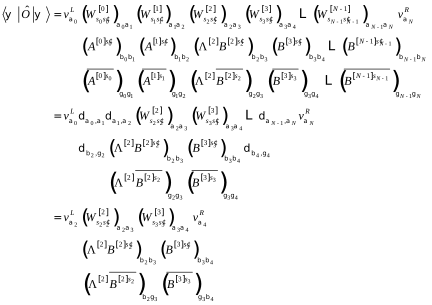
    </mixed-citation>
   </ref>
  </ref-list>
 </back>
</article>