In this paper, we define the set of all real numbers as , the set of all non-negative real numbers as , the set of all non-negative integers by .
In 2012, Samet et al.
[1]
proposed the concept of α-admissible mapping, which plays a very important role in fixed point theory. In 2014, on the basis of α-admissible mapping, the concepts of α-orbit admissible and triangular α-orbit admissible mapping were raised by Popescu
[2]
.
Next, we will recall a new metric space. In 2013, Alghamdi et al.
[3]
introduced b-metric-like space for the first time. It is also known as a dislocated metric space by Karapınar
[4]
. In 2015, Chen et al.
[5]
established several novel theorems concerning fixed points and common fixed points within the context of b-metric spaces, and gave some examples and applications to prove the accuracy and practicability of their conclusions. In 2016, Gholamian et al.
[6]
introduced generalized Meir-Keeler compression in b-metric-like spaces, and proved the existence of fixed points by function. In 2017, Zoto et al.
[7]
introduced α-admissible mapping to prove the uniqueness of fixed point in b-metric-like spaces. In 2018, Gholizadeh et al.
[8]
proved the results of the best proximity point in b-metric-like spaces, and provided an example to prove the accuracy of the result. In the same year, Dakun et al.
[9]
introduced the concept of -contractions, and studied the common fixed point theorems for such contractions in b-metric-like spaces. In 2021, Javed et al.
[10]
extended b-metric-like-space to fuzzy b-metric-like-space, proved the uniqueness of fixed point, and applies it to integral equation, which shows the practicability of the results in this paper.
After the above mappings and related metric spaces, we continue to understand a contraction, that is, Geraghty type hybrid contractions. In 2020, Alzaid et al.
[11]
studied Geraghty type hybrid contractions and got some fixed point results in a b-metric space.
Subsequently, Karapinar et al.
[12]
introduced admissible hybrid Geraghty contractions by combining hybrid Geraghty contractions with α-admissible mapping, and obtained some fixed point results of such contractions in a complete metric space.
In 1996, a class of asymmetric structures were introduced firstly in terms of w-distance by Kada et al.
[13]
in metric spaces. In 2023, Hu et al.
[14]
generalized the w-distance and obtained the φ-fixed point result for nonlinear compression. Inspired by it, we also prove some fixed point theorems by w-distance. Next, we introduce some related lemmas about w-distance.
Inspired by the aforementioned research outcomes and the latest advancements in fixed point theory within b-metric-like spaces, we decide to expand the research results of Karapinar et al.
[12]
to the fixed disc of . And inspired by
[14]
, employing a w-distance, we introduce a new type contraction in b-metric-like spaces, called β-ζ-contraction, and some new fixed point theorems are obtained by weakening their conditions. On the one hand, our results improve the research results of Alzaid et al.
[11]
and expand the research results of Karapinar et al.
[12]
. On the other hand, it enriches the fixed point theory results under b-metric-like spaces.
The geometric characteristics of non-unique fixed points have been extensively examined from multiple perspectives. For instance, the fixed-disc problem, fixed-circle problem and so on. Özgür and Taş
[15]
introduced the concept of a fixed circle, and the fixed circle problem in metric space is proposed as a new direction for the promotion of fixed point theory. Later, Hussain et al.
[16]
presented some fixed disc results for improving contractions in F-metric space.
In 2019, the concept of α--admissible was raised by Aydi et al.
[17]
in rectangular metric spaces. Now we give a corresponding definition in b-metric-like spaces.
2. Preliminaries
Definition 1.
[2]
Let be a function. We say that a mapping is α-orbital admissible if , for all .
Definition 2.
[2]
Let be a function. If meets the following conditions:
(i) , for all ;
(ii) , for all ,
then is called a triangular α-orbital admissible mapping.
Based on a certain understanding, below, we give the related concepts of b-metric-like-space.
Definition 3.
[3]
Let be a non-empty set and be a given real number. is a b-metric-like, if it meets the following conditions:
;
, for all ;
, for all ,
then is said to be a b-metric-like space.
Remark*
[3]
(i) If is a b-metric-like, then the self-distance might not be zero for some ;
(ii) Every b-metric is a b-metric-like, but the converse is not true in general. For example, the readers can refer to
[3]
.
Example 1. Let . Defined by:
<img width="156.25" src="https://html.scirp.org/file/1724162-rId81.svg?20250523033238" /><img width="145.7700650759219" src="https://html.scirp.org/file/1724162-rId83.svg?20250523033238" /><img width="161.38828633405637" src="https://html.scirp.org/file/1724162-rId85.svg?20250523033238" />It is obvious that <img width="19.07238838318162" src="https://html.scirp.org/file/1724162-rId87.svg?20250523033238"> is b-metric-like space with <img width="39.91323210412148" src="https://html.scirp.org/file/1724162-rId89.svg?20250523033238">. However it is not a b-metric space, indeed, <img width="107.59219088937093" src="https://html.scirp.org/file/1724162-rId91.svg?20250523033238">. </img></img></img>Definition 4. <xref ref-type="bibr" rid="scirp.142753-3">
[3]
</xref> Let <img width="50.32537960954447" src="https://html.scirp.org/file/1724162-rId93.svg?20250523033238"> be a b-metric-like space.</img>(i) A sequence <img width="32.957502168256724" src="https://html.scirp.org/file/1724162-rId95.svg?20250523033238"> in <img width="19.08893709327549" src="https://html.scirp.org/file/1724162-rId97.svg?20250523033238"> is said to be convergent to <img width="12.121212121212121" src="https://html.scirp.org/file/1724162-rId99.svg?20250523033238"> if <img width="145.7700650759219" src="https://html.scirp.org/file/1724162-rId101.svg?20250523033238">;</img></img></img></img>(ii) A sequence <img width="32.957502168256724" src="https://html.scirp.org/file/1724162-rId95.svg?20250523033238"> in <img width="19.08893709327549" src="https://html.scirp.org/file/1724162-rId104.svg?20250523033238"> is said to be a Cauchy sequence if <img width="104.12147505422993" src="https://html.scirp.org/file/1724162-rId106.svg?20250523033238"> exists and be finite;</img></img></img>(iii) <img width="50.32537960954447" src="https://html.scirp.org/file/1724162-rId108.svg?20250523033238"> is said to be complete if every Cauchy sequence <img width="32.957502168256724" src="https://html.scirp.org/file/1724162-rId95.svg?20250523033238"> in <img width="19.08893709327549" src="https://html.scirp.org/file/1724162-rId111.svg?20250523033238"> converges to some point in <img width="19.08893709327549" src="https://html.scirp.org/file/1724162-rId113.svg?20250523033238"> such that <img width="260.3036876355748" src="https://html.scirp.org/file/1724162-rId115.svg?20250523033238">.</img></img></img></img></img>Proposition 1. <xref ref-type="bibr" rid="scirp.142753-3">
[3]
</xref> Let <img width="50.32537960954447" src="https://html.scirp.org/file/1724162-rId117.svg?20250523033238"> be a b-metric-like space. If <img width="32.957502168256724" src="https://html.scirp.org/file/1724162-rId95.svg?20250523033238"> is a sequence in <img width="19.08893709327549" src="https://html.scirp.org/file/1724162-rId120.svg?20250523033238"> such that <img width="109.32754880694142" src="https://html.scirp.org/file/1724162-rId122.svg?20250523033238">, then <img width="32.957502168256724" src="https://html.scirp.org/file/1724162-rId95.svg?20250523033238"> has a unique limit <img width="12.121212121212121" src="https://html.scirp.org/file/1724162-rId125.svg?20250523033238">. </img></img></img></img></img></img>Definition 5. <xref ref-type="bibr" rid="scirp.142753-5">
[5]
</xref> Let <img width="50.32537960954447" src="https://html.scirp.org/file/1724162-rId127.svg?20250523033238"> be a b-metric-like space and <img width="72.85342584562011" src="https://html.scirp.org/file/1724162-rId129.svg?20250523033238"> be a mapping. We say that <img width="15.604681404421326" src="https://html.scirp.org/file/1724162-rId131.svg?20250523033238"> is continuous at <img width="12.121212121212121" src="https://html.scirp.org/file/1724162-rId125.svg?20250523033238">, if <img width="145.7700650759219" src="https://html.scirp.org/file/1724162-rId134.svg?20250523033238"> implies that <img width="182.29166666666666" src="https://html.scirp.org/file/1724162-rId136.svg?20250523033238">, for each sequence <img width="32.957502168256724" src="https://html.scirp.org/file/1724162-rId95.svg?20250523033238"> in <img width="19.08893709327549" src="https://html.scirp.org/file/1724162-rId139.svg?20250523033238">.</img></img></img></img></img></img></img></img>
Theorem 2.
[11]
Let be a complete b-metric space. If there exists such that satisfying the following conditions:
(i) , for all ;
(ii) is continuous or or , and
where <img width="39.8959236773634" src="https://html.scirp.org/file/1724162-rId158.svg?20250523033238">, and <img width="107.6388888888889" src="https://html.scirp.org/file/1724162-rId160.svg?20250523033238">, with <img width="62.5" src="https://html.scirp.org/file/1724162-rId162.svg?20250523033238">, then <img width="15.604681404421326" src="https://html.scirp.org/file/1724162-rId164.svg?20250523033238"> has a unique fixed point and <img width="32.957502168256724" src="https://html.scirp.org/file/1724162-rId95.svg?20250523033238"> converges to some point <img width="15.611448395490026" src="https://html.scirp.org/file/1724162-rId167.svg?20250523033238"> in <img width="19.08893709327549" src="https://html.scirp.org/file/1724162-rId169.svg?20250523033238">, where <img width="32.957502168256724" src="https://html.scirp.org/file/1724162-rId95.svg?20250523033238"> is produced by <img width="79.82646420824295" src="https://html.scirp.org/file/1724162-rId172.svg?20250523033238">, for all <img width="45.11930585683297" src="https://html.scirp.org/file/1724162-rId174.svg?20250523033238">.</img></img></img></img></img></img></img></img></img></img>Definition 6. <xref ref-type="bibr" rid="scirp.142753-12">
[12]
</xref> Let <img width="109.32754880694142" src="https://html.scirp.org/file/1724162-rId176.svg?20250523033238"> be a function. If for every sequence <img width="32.957502168256724" src="https://html.scirp.org/file/1724162-rId95.svg?20250523033238"> in <img width="19.08893709327549" src="https://html.scirp.org/file/1724162-rId179.svg?20250523033238"> such that <img width="95.44468546637744" src="https://html.scirp.org/file/1724162-rId181.svg?20250523033238">, for all <img width="45.11930585683297" src="https://html.scirp.org/file/1724162-rId183.svg?20250523033238"> and <img width="67.67895878524946" src="https://html.scirp.org/file/1724162-rId185.svg?20250523033238">, implies that <img width="79.7918473547268" src="https://html.scirp.org/file/1724162-rId187.svg?20250523033238">, for all <img width="45.11930585683297" src="https://html.scirp.org/file/1724162-rId189.svg?20250523033238">, we say that <img width="19.08893709327549" src="https://html.scirp.org/file/1724162-rId191.svg?20250523033238"> is regular with respect to <img width="19.07238838318162" src="https://html.scirp.org/file/1724162-rId193.svg?20250523033238">. </img></img></img></img></img></img></img></img></img></img>Let <img width="104.12147505422993" src="https://html.scirp.org/file/1724162-rId195.svg?20250523033238"> satisfying that <img width="118.00433839479392" src="https://html.scirp.org/file/1724162-rId197.svg?20250523033238"> implies that <img width="71.14967462039046" src="https://html.scirp.org/file/1724162-rId199.svg?20250523033238">.</img></img></img>Theorem 3. <xref ref-type="bibr" rid="scirp.142753-12">
[12]
</xref> Let <img width="50.32537960954447" src="https://html.scirp.org/file/1724162-rId201.svg?20250523033238"> be a complete metric space and <img width="72.85342584562011" src="https://html.scirp.org/file/1724162-rId203.svg?20250523033238"> be a mapping. If <img width="15.604681404421326" src="https://html.scirp.org/file/1724162-rId205.svg?20250523033238"> satisfies the following conditions:</img></img></img>(i) <img width="15.604681404421326" src="https://html.scirp.org/file/1724162-rId207.svg?20250523033238"> is triangular α-orbital admissible;</img>(ii) there exists <img width="46.85466377440347" src="https://html.scirp.org/file/1724162-rId209.svg?20250523033238"> such that <img width="93.70932754880694" src="https://html.scirp.org/file/1724162-rId211.svg?20250523033238">;</img></img>(iii) one of the conditions satisfies:(iii<sub>a</sub>) <img width="15.604681404421326" src="https://html.scirp.org/file/1724162-rId213.svg?20250523033238"> is continuous,</img>(iii<sub>b</sub>) <img width="20.80624187256177" src="https://html.scirp.org/file/1724162-rId215.svg?20250523033238"> is continuous and <img width="83.29718004338395" src="https://html.scirp.org/file/1724162-rId217.svg?20250523033238"> for all <img width="43.365134431916736" src="https://html.scirp.org/file/1724162-rId219.svg?20250523033238"> with <img width="45.11930585683297" src="https://html.scirp.org/file/1724162-rId221.svg?20250523033238">,</img></img></img></img>(iii<sub>c</sub>) <img width="19.08893709327549" src="https://html.scirp.org/file/1724162-rId223.svg?20250523033238"> is regular with respect to <img width="19.07238838318162" src="https://html.scirp.org/file/1724162-rId225.svg?20250523033238">;</img></img>
(iv) , for all ,
and
where <img width="39.8959236773634" src="https://html.scirp.org/file/1724162-rId233.svg?20250523033238">, <img width="147.5054229934924" src="https://html.scirp.org/file/1724162-rId235.svg?20250523033238"> with <img width="62.5" src="https://html.scirp.org/file/1724162-rId237.svg?20250523033238">, then <img width="15.604681404421326" src="https://html.scirp.org/file/1724162-rId239.svg?20250523033238"> has a fixed point in <img width="19.08893709327549" src="https://html.scirp.org/file/1724162-rId241.svg?20250523033238">. </img></img></img></img></img>Definition 7. <xref ref-type="bibr" rid="scirp.142753-13">
[13]
</xref> Assume that <img width="50.32537960954447" src="https://html.scirp.org/file/1724162-rId243.svg?20250523033238"> be a metric space. If the following conditions are met:</img>(a) <img width="182.29166666666666" src="https://html.scirp.org/file/1724162-rId245.svg?20250523033238"> for all <img width="69.41431670281996" src="https://html.scirp.org/file/1724162-rId247.svg?20250523033238">;</img></img>(b) <img width="133.6225596529284" src="https://html.scirp.org/file/1724162-rId249.svg?20250523033238"> is lower semi-continuous for any <img width="39.91323210412148" src="https://html.scirp.org/file/1724162-rId251.svg?20250523033238">;</img></img>(c) there exists <img width="43.365134431916736" src="https://html.scirp.org/file/1724162-rId253.svg?20250523033238"> such that <img width="79.7918473547268" src="https://html.scirp.org/file/1724162-rId255.svg?20250523033238"> and <img width="79.7918473547268" src="https://html.scirp.org/file/1724162-rId257.svg?20250523033238"> imply <img width="83.29718004338395" src="https://html.scirp.org/file/1724162-rId259.svg?20250523033238"> for any <img width="41.63052905464007" src="https://html.scirp.org/file/1724162-rId261.svg?20250523033238">, then a function <img width="128.4164859002169" src="https://html.scirp.org/file/1724162-rId263.svg?20250523033238"> is called a w-distance on <img width="19.08893709327549" src="https://html.scirp.org/file/1724162-rId265.svg?20250523033238">. </img></img></img></img></img></img></img>Lemma 4. <xref ref-type="bibr" rid="scirp.142753-13">
[13]
</xref> <img width="50.32537960954447" src="https://html.scirp.org/file/1724162-rId267.svg?20250523033238"> is a metric space equipped with a w-distance <img width="17.338534893801473" src="https://html.scirp.org/file/1724162-rId269.svg?20250523033238">, <img width="34.69210754553339" src="https://html.scirp.org/file/1724162-rId271.svg?20250523033238"> is a sequence in <img width="19.08893709327549" src="https://html.scirp.org/file/1724162-rId273.svg?20250523033238">, and it satisfies that for any <img width="39.91323210412148" src="https://html.scirp.org/file/1724162-rId275.svg?20250523033238">, there exists <img width="57.291666666666664" src="https://html.scirp.org/file/1724162-rId277.svg?20250523033238"> such that <img width="93.70932754880694" src="https://html.scirp.org/file/1724162-rId279.svg?20250523033238"> (or <img width="131.88720173535793" src="https://html.scirp.org/file/1724162-rId281.svg?20250523033238">) for <img width="81.56182212581345" src="https://html.scirp.org/file/1724162-rId283.svg?20250523033238">. Then <img width="34.69210754553339" src="https://html.scirp.org/file/1724162-rId285.svg?20250523033238"> is a Cauchy sequence.</img></img></img></img></img></img></img></img></img></img>Lemma 5. <xref ref-type="bibr" rid="scirp.142753-13">
[13]
</xref> Suppose that <img width="50.32537960954447" src="https://html.scirp.org/file/1724162-rId287.svg?20250523033238"> is a metric space, and <img width="17.338534893801473" src="https://html.scirp.org/file/1724162-rId289.svg?20250523033238"> is a w-distance on <img width="88.50325379609545" src="https://html.scirp.org/file/1724162-rId291.svg?20250523033238"> and <img width="32.957502168256724" src="https://html.scirp.org/file/1724162-rId293.svg?20250523033238"> are three sequences in <img width="19.08893709327549" src="https://html.scirp.org/file/1724162-rId295.svg?20250523033238">, <img width="69.41431670281996" src="https://html.scirp.org/file/1724162-rId297.svg?20250523033238">.</img></img></img></img></img></img>(i) If <img width="93.70932754880694" src="https://html.scirp.org/file/1724162-rId299.svg?20250523033238"> and <img width="91.97396963123644" src="https://html.scirp.org/file/1724162-rId301.svg?20250523033238">, then <img width="39.8959236773634" src="https://html.scirp.org/file/1724162-rId303.svg?20250523033238"> In particular, if <img width="81.56182212581345" src="https://html.scirp.org/file/1724162-rId305.svg?20250523033238"> and <img width="78.09110629067246" src="https://html.scirp.org/file/1724162-rId307.svg?20250523033238">, then <img width="41.61248374512354" src="https://html.scirp.org/file/1724162-rId309.svg?20250523033238">;</img></img></img></img></img></img>(ii) If <img width="100.65075921908894" src="https://html.scirp.org/file/1724162-rId311.svg?20250523033238"> and <img width="91.97396963123644" src="https://html.scirp.org/file/1724162-rId301.svg?20250523033238">, then <img width="20.824295010845987" src="https://html.scirp.org/file/1724162-rId314.svg?20250523033238"> converges to <img width="12.121212121212121" src="https://html.scirp.org/file/1724162-rId316.svg?20250523033238">;</img></img></img></img>(iii) If <img width="100.65075921908894" src="https://html.scirp.org/file/1724162-rId318.svg?20250523033238"> and <img width="97.18004338394793" src="https://html.scirp.org/file/1724162-rId320.svg?20250523033238">, then <img width="67.64960971379011" src="https://html.scirp.org/file/1724162-rId322.svg?20250523033238"> converges to 0. </img></img></img>
Definition 8.
[15]
Suppose that is a b-metric-like space and a nonempty set , is the set of all the fixed point of mapping and is a mapping. Define by
(1) A circle <img width="185.68329718004338" src="https://html.scirp.org/file/1724162-rId338.svg?20250523033238"> in <img width="19.08893709327549" src="https://html.scirp.org/file/1724162-rId340.svg?20250523033238"> is said to be a fixed circle of <img width="15.604681404421326" src="https://html.scirp.org/file/1724162-rId342.svg?20250523033238"> if and only if <img width="95.4861111111111" src="https://html.scirp.org/file/1724162-rId344.svg?20250523033238">.</img></img></img></img>(2) A disc <img width="187.5" src="https://html.scirp.org/file/1724162-rId346.svg?20250523033238"> in <img width="19.08893709327549" src="https://html.scirp.org/file/1724162-rId348.svg?20250523033238"> is said to be a fixed disc of <img width="15.604681404421326" src="https://html.scirp.org/file/1724162-rId350.svg?20250523033238"> if and only if <img width="97.22222222222223" src="https://html.scirp.org/file/1724162-rId352.svg?20250523033238">. </img></img></img></img>Definition 9. <xref ref-type="bibr" rid="scirp.142753-16">
[16]
</xref> A simulation function is a mapping <img width="157.91757049891538" src="https://html.scirp.org/file/1724162-rId354.svg?20250523033238"> satisfying the following conditions:</img>(i) <img width="97.18004338394793" src="https://html.scirp.org/file/1724162-rId356.svg?20250523033238"> for all <img width="52.060737527114966" src="https://html.scirp.org/file/1724162-rId358.svg?20250523033238">;</img></img>(ii) if <img width="52.083333333333336" src="https://html.scirp.org/file/1724162-rId360.svg?20250523033238"> are sequences in <img width="46.834345186470074" src="https://html.scirp.org/file/1724162-rId362.svg?20250523033238"> such that <img width="128.4164859002169" src="https://html.scirp.org/file/1724162-rId364.svg?20250523033238">, then </img></img></img><img width="145.83333333333334" src="https://html.scirp.org/file/1724162-rId366.svg?20250523033238" />3. Main ResultsIn the section, we present the main results by the following definitions.Let <img width="116.31944444444444" src="https://html.scirp.org/file/1724162-rId368.svg?20250523033239"> satisfying <img width="125.0" src="https://html.scirp.org/file/1724162-rId370.svg?20250523033239"> implies that <img width="71.14967462039046" src="https://html.scirp.org/file/1724162-rId372.svg?20250523033239">. And if <img width="39.91323210412148" src="https://html.scirp.org/file/1724162-rId374.svg?20250523033239">, then <img width="67.64960971379011" src="https://html.scirp.org/file/1724162-rId376.svg?20250523033239">, where <img width="36.426712922810054" src="https://html.scirp.org/file/1724162-rId378.svg?20250523033239">.</img></img></img></img></img></img>3.1. Fixed Circle Result
In this part, we get a new fixed circle result through the new contractions.
Now, we present the definitions of fixed circle and fixed disc in b-metric-like spaces.
Definition 10. Suppose that is a b-metric-like space with a nonempty set , is a point in and is a function. The mapping is α--admissible if
Inspired by the above results, in virtue of α-<img width="17.346053772766695" src="https://html.scirp.org/file/1724162-rId384.svg?20250523033239">-admissible mapping, we obtain new fixed circle and fixed disc results in b-metric-like spaces. </img>Theorem 6. Suppose that <img width="50.32537960954447" src="https://html.scirp.org/file/1724162-rId396.svg?20250523033239"> is a b-metric-like space with a nonempty set <img width="19.08893709327549" src="https://html.scirp.org/file/1724162-rId398.svg?20250523033239"> and <img width="130.1518438177874" src="https://html.scirp.org/file/1724162-rId400.svg?20250523033239"> is a function. If the mapping <img width="72.85342584562011" src="https://html.scirp.org/file/1724162-rId402.svg?20250523033239"> is α-<img width="17.346053772766695" src="https://html.scirp.org/file/1724162-rId404.svg?20250523033239">-admissible and satisfies</img></img></img></img></img><img width="432.2916666666667" src="https://html.scirp.org/file/1724162-rId406.svg?20250523033239">(1)</img>and<img width="635.4166666666666" src="https://html.scirp.org/file/1724162-rId408.svg?20250523033239" />where <img width="39.8959236773634" src="https://html.scirp.org/file/1724162-rId410.svg?20250523033239">, <img width="125.0" src="https://html.scirp.org/file/1724162-rId412.svg?20250523033239"> with <img width="81.56182212581345" src="https://html.scirp.org/file/1724162-rId414.svg?20250523033239">. In addition, <img width="97.18004338394793" src="https://html.scirp.org/file/1724162-rId416.svg?20250523033239"> and <img width="79.7918473547268" src="https://html.scirp.org/file/1724162-rId418.svg?20250523033239">, for all <img width="55.50737207285342" src="https://html.scirp.org/file/1724162-rId420.svg?20250523033239">, then <img width="34.69210754553339" src="https://html.scirp.org/file/1724162-rId422.svg?20250523033239"> is a fixed circle of <img width="15.604681404421326" src="https://html.scirp.org/file/1724162-rId424.svg?20250523033239">.</img></img></img></img></img></img></img></img>Proof. Suppose that there exists <img width="55.50737207285342" src="https://html.scirp.org/file/1724162-rId420.svg?20250523033239"> such that <img width="45.11930585683297" src="https://html.scirp.org/file/1724162-rId427.svg?20250523033239">. And from (1), <img width="97.18004338394793" src="https://html.scirp.org/file/1724162-rId416.svg?20250523033239">, <img width="79.7918473547268" src="https://html.scirp.org/file/1724162-rId418.svg?20250523033239">, for all <img width="55.50737207285342" src="https://html.scirp.org/file/1724162-rId420.svg?20250523033239"> and <img width="15.604681404421326" src="https://html.scirp.org/file/1724162-rId432.svg?20250523033239"> is α-<img width="17.346053772766695" src="https://html.scirp.org/file/1724162-rId434.svg?20250523033239">-admissible, we obtain</img></img></img></img></img></img></img><img width="442.7083333333333" src="https://html.scirp.org/file/1724162-rId436.svg?20250523033239">(2)</img>where<img width="342.0138888888889" src="https://html.scirp.org/file/1724162-rId438.svg?20250523033239" />
Case 1. .
By (2), it follows that
Both sides of the above inequality are simultaneously raised to the <img width="13.876843018213355" src="https://html.scirp.org/file/1724162-rId444.svg?20250523033239"> power, and we get</img><img width="284.72222222222223" src="https://html.scirp.org/file/1724162-rId446.svg?20250523033239" />Taking account of the definition of <img width="13.870827915041179" src="https://html.scirp.org/file/1724162-rId448.svg?20250523033239">, we have </img><img width="435.7638888888889" src="https://html.scirp.org/file/1724162-rId450.svg?20250523033239" />or<img width="211.80555555555554" src="https://html.scirp.org/file/1724162-rId452.svg?20250523033239" />This is contradictory with <img width="83.29718004338395" src="https://html.scirp.org/file/1724162-rId454.svg?20250523033239">.</img>Case 2. <img width="39.8959236773634" src="https://html.scirp.org/file/1724162-rId456.svg?20250523033239">.</img>It deduces from (2) that<img width="90.23861171366595" src="https://html.scirp.org/file/1724162-rId458.svg?20250523033239" />
This is a contradiction. So, in all cases, we have , for all . The proof is completed. □
Corollary 1. Suppose that is a b-metric-like space with a nonempty set and is a function. If mapping is α--admissible and satisfies
and<img width="635.4166666666666" src="https://html.scirp.org/file/1724162-rId476.svg?20250523033239" />where <img width="39.8959236773634" src="https://html.scirp.org/file/1724162-rId410.svg?20250523033239">, <img width="125.0" src="https://html.scirp.org/file/1724162-rId412.svg?20250523033239"> with <img width="81.56182212581345" src="https://html.scirp.org/file/1724162-rId480.svg?20250523033239">. In addition, <img width="97.18004338394793" src="https://html.scirp.org/file/1724162-rId482.svg?20250523033239"> and <img width="79.7918473547268" src="https://html.scirp.org/file/1724162-rId484.svg?20250523033239">, for all <img width="55.50737207285342" src="https://html.scirp.org/file/1724162-rId486.svg?20250523033239">, then <img width="34.69210754553339" src="https://html.scirp.org/file/1724162-rId488.svg?20250523033239"> is fixed disc of <img width="15.604681404421326" src="https://html.scirp.org/file/1724162-rId490.svg?20250523033239">.</img></img></img></img></img></img></img></img><xref ref-type="bibr" rid="scirp.142753-"></xref>Proof. The result follows by a similar discussion method as Theorem 6. The proof is completed. □3.2. Fixed Point ResultsIn this part, we get some new fixed point results through some new contractions.Definition 11. Let <img width="50.32537960954447" src="https://html.scirp.org/file/1724162-rId492.svg?20250523033240"> be a b-metric-like space. A mapping <img width="72.85342584562011" src="https://html.scirp.org/file/1724162-rId494.svg?20250523033240"> is called an α-β-admissible contraction if there exists a function <img width="109.32754880694142" src="https://html.scirp.org/file/1724162-rId496.svg?20250523033240"> such that</img></img></img><img width="381.9444444444444" src="https://html.scirp.org/file/1724162-rId498.svg?20250523033240">(3)</img>and<img width="611.1111111111112" src="https://html.scirp.org/file/1724162-rId500.svg?20250523033240" />
where , with .
Definition 12. be a complete b-metric like space with a w-distance , . is called an admissible β-ζ-contraction if there exists a function such that
(4)
and
where <img width="39.8959236773634" src="https://html.scirp.org/file/1724162-rId410.svg?20250523033240">, <img width="125.0" src="https://html.scirp.org/file/1724162-rId412.svg?20250523033240"> with <img width="62.5" src="https://html.scirp.org/file/1724162-rId504.svg?20250523033240">.</img></img></img>Theorem 7. Let <img width="50.32537960954447" src="https://html.scirp.org/file/1724162-rId523.svg?20250523033240"> be a complete b-metric-like space with a w-distance <img width="17.338534893801473" src="https://html.scirp.org/file/1724162-rId525.svg?20250523033240">, <img width="36.426712922810054" src="https://html.scirp.org/file/1724162-rId527.svg?20250523033240"> and <img width="72.85342584562011" src="https://html.scirp.org/file/1724162-rId529.svg?20250523033240"> be an admissible β-ζ-contraction. If the following conditions hold:</img></img></img></img>(i) <img width="15.604681404421326" src="https://html.scirp.org/file/1724162-rId531.svg?20250523033240"> is triangular α-orbital admissible;</img>(ii) there exists <img width="46.85466377440347" src="https://html.scirp.org/file/1724162-rId533.svg?20250523033240"> such that <img width="93.70932754880694" src="https://html.scirp.org/file/1724162-rId535.svg?20250523033240">;</img></img>(iii) <img width="15.604681404421326" src="https://html.scirp.org/file/1724162-rId537.svg?20250523033240"> is continuous;</img>(iv) <img width="76.35574837310196" src="https://html.scirp.org/file/1724162-rId539.svg?20250523033240"> for any <img width="36.426712922810054" src="https://html.scirp.org/file/1724162-rId541.svg?20250523033240">,</img></img>then <img width="15.604681404421326" src="https://html.scirp.org/file/1724162-rId543.svg?20250523033240"> has a unique fixed point <img width="17.3235166738848" src="https://html.scirp.org/file/1724162-rId545.svg?20250523033240">. </img></img>Proof. Step 1. we will get <img width="95.44468546637744" src="https://html.scirp.org/file/1724162-rId547.svg?20250523033240">, <img width="88.50325379609545" src="https://html.scirp.org/file/1724162-rId549.svg?20250523033240">, for all <img width="46.834345186470074" src="https://html.scirp.org/file/1724162-rId551.svg?20250523033240">, <img width="125.0" src="https://html.scirp.org/file/1724162-rId553.svg?20250523033240">, <img width="125.0" src="https://html.scirp.org/file/1724162-rId555.svg?20250523033240">.</img></img></img></img></img>From (ii), there exists <img width="46.85466377440347" src="https://html.scirp.org/file/1724162-rId557.svg?20250523033240"> such that <img width="93.70932754880694" src="https://html.scirp.org/file/1724162-rId559.svg?20250523033240">. Define a sequence <img width="32.957502168256724" src="https://html.scirp.org/file/1724162-rId561.svg?20250523033240"> by <img width="65.94360086767897" src="https://html.scirp.org/file/1724162-rId563.svg?20250523033240">, for all <img width="45.11930585683297" src="https://html.scirp.org/file/1724162-rId565.svg?20250523033240">. By (i) and induction, it follows easily that </img></img></img></img></img><img width="192.6247288503254" src="https://html.scirp.org/file/1724162-rId567.svg?20250523033240">(5)</img>
and
(6)
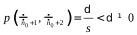
Case 1. There exists such that .
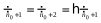
If , then . Therefore, by (c) of Definition 7, we have the limit of , and taking the limits at both sides of the inequality, we get , so that . When , it is a constant sequence, which is or . Then
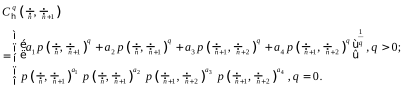
Let <img width="79.7918473547268" src="https://html.scirp.org/file/1724162-rId593.svg?20250523033240"> in (4), we have </img><img width="470.4861111111111" src="https://html.scirp.org/file/1724162-rId595.svg?20250523033240">(7)</img>It follows that<img width="538.1944444444445" src="https://html.scirp.org/file/1724162-rId597.svg?20250523033240" />where<img width="524.3055555555555" src="https://html.scirp.org/file/1724162-rId599.svg?20250523033240">(8)</img>that is <img width="204.77223427331887" src="https://html.scirp.org/file/1724162-rId601.svg?20250523033240">, it is a contraction. So <img width="121.47505422993491" src="https://html.scirp.org/file/1724162-rId603.svg?20250523033240">. Continuing this process, we can get <img width="125.0" src="https://html.scirp.org/file/1724162-rId605.svg?20250523033240">. Similarly, we can prove <img width="125.0" src="https://html.scirp.org/file/1724162-rId607.svg?20250523033240">. Case 2. <img width="111.06290672451192" src="https://html.scirp.org/file/1724162-rId609.svg?20250523033240">.</img></img></img></img></img>Let <img width="93.75" src="https://html.scirp.org/file/1724162-rId611.svg?20250523033240"> in (4), then we have</img><img width="399.3055555555556" src="https://html.scirp.org/file/1724162-rId613.svg?20250523033240" />that is
(9)
where
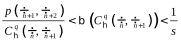
(10)
By (9), we have . Then
Then, we can get <img width="133.6225596529284" src="https://html.scirp.org/file/1724162-rId623.svg?20250523033240"> by definition of <img width="19.080659150043367" src="https://html.scirp.org/file/1724162-rId625.svg?20250523033240">, and so <img width="125.0" src="https://html.scirp.org/file/1724162-rId627.svg?20250523033240">. By the same way, we can get <img width="125.0" src="https://html.scirp.org/file/1724162-rId629.svg?20250523033240">.</img></img></img></img>To sum up, we have<img width="138.82863340563992" src="https://html.scirp.org/file/1724162-rId631.svg?20250523033240" />Step 2. we suffice to prove that <img width="119.73969631236442" src="https://html.scirp.org/file/1724162-rId633.svg?20250523033240">.</img>Suppose on the contrary that there exist <img width="41.63052905464007" src="https://html.scirp.org/file/1724162-rId635.svg?20250523033240"> and two sequences <img width="95.44468546637744" src="https://html.scirp.org/file/1724162-rId637.svg?20250523033240"> such that</img></img><img width="284.72222222222223" src="https://html.scirp.org/file/1724162-rId639.svg?20250523033240">(11)</img>where <img width="72.88503253796095" src="https://html.scirp.org/file/1724162-rId641.svg?20250523033240">. Then</img><img width="347.22222222222223" src="https://html.scirp.org/file/1724162-rId643.svg?20250523033240">(12)</img>By the triangle inequality, we have<img width="347.22222222222223" src="https://html.scirp.org/file/1724162-rId645.svg?20250523033240">(13)</img>
Taking the limits on both sides of (13), and combining it with (12), we can get
(14)
and
(15)
Then, and
(16)
Let , in (4), where and by (6), it follows that
(17)
Then, we have
(18)
where
(19)
(20)
Taking the upper limits in (19), we have
(21)
Now, we take the upper limits on the both sides of (18), that is
By (16) and (21), thus it can be seen that<img width="248.26388888888889" src="https://html.scirp.org/file/1724162-rId673.svg?20250523033240" />and then<img width="220.48611111111111" src="https://html.scirp.org/file/1724162-rId675.svg?20250523033240" />By definition of <img width="19.080659150043367" src="https://html.scirp.org/file/1724162-rId677.svg?20250523033240">, we can get</img><img width="164.93055555555554" src="https://html.scirp.org/file/1724162-rId679.svg?20250523033240">(22)</img>Indeed, taking in (20), (22) hold. Taking the limits in (19), by (22), we can get<img width="159.7222222222222" src="https://html.scirp.org/file/1724162-rId681.svg?20250523033240">(23)</img>By <img width="38.17787418655098" src="https://html.scirp.org/file/1724162-rId683.svg?20250523033240">, we have</img><img width="454.8611111111111" src="https://html.scirp.org/file/1724162-rId685.svg?20250523033240" />
This is a contradiction. Therefore, is a Cauchy sequence.
Step 3. We prove the existence of fixed points.
Since is complete, there exists such that . And by (iv), we have
(24)
The proof is completed. □
Theorem 8. When the condition (iv) is removed in Theorem 7, it can also be proved that has a fixed point .
Proof. Since , for each , there exists such that for all . As and is lower semicontinuous, we get
(25)
Taking the limits on both sides of (25), we obtain
(26)
Next, we will prove that . It can be divided into the following two cases.
Case 1. .
Suppose that there exists such that , and , by (c), we can conclude that , it says that . If for all ,
(27)
that is , where
(28)
Then, we can conclude that
Then, <img width="248.26388888888889" src="https://html.scirp.org/file/1724162-rId747.svg?20250523033240">, that is <img width="124.94577006507593" src="https://html.scirp.org/file/1724162-rId749.svg?20250523033240">. By (i) of Lemma 5, we have</img></img><img width="59.00216919739696" src="https://html.scirp.org/file/1724162-rId751.svg?20250523033240" />Case 2. <img width="107.6388888888889" src="https://html.scirp.org/file/1724162-rId753.svg?20250523033240">.</img>This is easy to prove the above results. The proof is completed. □Example 2 Let <img width="67.64960971379011" src="https://html.scirp.org/file/1724162-rId755.svg?20250523033240"> be endowed with the usual metric <img width="102.43055555555556" src="https://html.scirp.org/file/1724162-rId757.svg?20250523033240">, and let <img width="126.68112798264642" src="https://html.scirp.org/file/1724162-rId759.svg?20250523033240"> for <img width="53.772766695576756" src="https://html.scirp.org/file/1724162-rId761.svg?20250523033240">. <img width="15.604681404421326" src="https://html.scirp.org/file/1724162-rId763.svg?20250523033240"> is a mapping defined as follows: </img></img></img></img></img><img width="185.68329718004338" src="https://html.scirp.org/file/1724162-rId765.svg?20250523033240" />Take <img width="38.17787418655098" src="https://html.scirp.org/file/1724162-rId767.svg?20250523033240"> and <img width="53.772766695576756" src="https://html.scirp.org/file/1724162-rId769.svg?20250523033240"> as follows:</img></img><img width="201.38888888888889" src="https://html.scirp.org/file/1724162-rId771.svg?20250523033240" />and<img width="229.16666666666666" src="https://html.scirp.org/file/1724162-rId773.svg?20250523033240" />
It is obvious that is a complete b-metric-like space with . Let , and . Now we show that is an admissible hybrid Geraghty contraction. Indeed,
(i) if , , then (4) holds clearly.
(ii) if with or with ,
(iii) if <img width="71.18055555555556" src="https://html.scirp.org/file/1724162-rId801.svg?20250523033240">, <img width="72.88503253796095" src="https://html.scirp.org/file/1724162-rId803.svg?20250523033240"> or <img width="74.62039045553145" src="https://html.scirp.org/file/1724162-rId805.svg?20250523033240">, <img width="71.18055555555556" src="https://html.scirp.org/file/1724162-rId807.svg?20250523033240">, then <img width="79.7918473547268" src="https://html.scirp.org/file/1724162-rId809.svg?20250523033240">, that is (4) holds.</img></img></img></img></img>In all cases, (4) is satisfied. Thus, <img width="15.604681404421326" src="https://html.scirp.org/file/1724162-rId811.svg?20250523033240"> is an β-ζ contraction and it satisfies all conditions of Theorem 7. So <img width="15.604681404421326" src="https://html.scirp.org/file/1724162-rId813.svg?20250523033240"> has a fixed point <img width="41.63052905464007" src="https://html.scirp.org/file/1724162-rId815.svg?20250523033240"> such that <img width="65.91500433651345" src="https://html.scirp.org/file/1724162-rId817.svg?20250523033240">. </img></img></img></img>Theorem 9 Let <img width="50.32537960954447" src="https://html.scirp.org/file/1724162-rId819.svg?20250523033240"> be a complete b-metric-like space with a w-distance <img width="17.338534893801473" src="https://html.scirp.org/file/1724162-rId821.svg?20250523033240">, and <img width="72.85342584562011" src="https://html.scirp.org/file/1724162-rId823.svg?20250523033240"> be an admissible hybrid Geraghty contraction. If the following conditions hold:</img></img></img>(i) <img width="15.604681404421326" src="https://html.scirp.org/file/1724162-rId825.svg?20250523033240"> is triangular α-orbital admissible;</img>(ii) there exists <img width="46.85466377440347" src="https://html.scirp.org/file/1724162-rId827.svg?20250523033240"> such that <img width="93.70932754880694" src="https://html.scirp.org/file/1724162-rId829.svg?20250523033240">;</img></img>(iii') <img width="20.80624187256177" src="https://html.scirp.org/file/1724162-rId831.svg?20250523033240"> is continuous and <img width="83.29718004338395" src="https://html.scirp.org/file/1724162-rId833.svg?20250523033240"> for any <img width="91.97396963123644" src="https://html.scirp.org/file/1724162-rId835.svg?20250523033240">;</img></img></img>then <img width="15.604681404421326" src="https://html.scirp.org/file/1724162-rId837.svg?20250523033240"> has a fixed point in <img width="19.08893709327549" src="https://html.scirp.org/file/1724162-rId839.svg?20250523033240">. </img></img>Proof. Following the proof of Theorem 7, we attain <img width="32.957502168256724" src="https://html.scirp.org/file/1724162-rId841.svg?20250523033240"> is a Cauchy sequence and there exists <img width="45.11930585683297" src="https://html.scirp.org/file/1724162-rId843.svg?20250523033240"> such that (24) holds. By (iii'), it deduces easily that </img></img><img width="272.4511930585684" src="https://html.scirp.org/file/1724162-rId845.svg?20250523033240" />If <img width="52.060737527114966" src="https://html.scirp.org/file/1724162-rId847.svg?20250523033240">. Let <img width="90.23861171366595" src="https://html.scirp.org/file/1724162-rId849.svg?20250523033240"> in (4), by (iii'), it follows that </img></img>
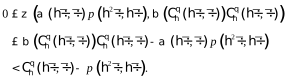
(29)
When , then
This is a contradiction. So <img width="52.060737527114966" src="https://html.scirp.org/file/1724162-rId857.svg?20250523033240">, that is, <img width="15.604681404421326" src="https://html.scirp.org/file/1724162-rId859.svg?20250523033240"> has a fixed point.</img></img>When <img width="39.8959236773634" src="https://html.scirp.org/file/1724162-rId861.svg?20250523033240">, the same result can be proved. The proof is completed. □</img>Theorem 10. Let <img width="50.32537960954447" src="https://html.scirp.org/file/1724162-rId863.svg?20250523033240"> be a complete b-metric-like space with a w-distance <img width="17.338534893801473" src="https://html.scirp.org/file/1724162-rId865.svg?20250523033240">, and <img width="72.85342584562011" src="https://html.scirp.org/file/1724162-rId867.svg?20250523033240"> be an admissible hybrid Geraghty contraction. If the following conditions hold:</img></img></img>(i) <img width="15.604681404421326" src="https://html.scirp.org/file/1724162-rId869.svg?20250523033240"> is triangular α-orbital admissible;</img>(ii) there exists <img width="46.85466377440347" src="https://html.scirp.org/file/1724162-rId871.svg?20250523033240"> such that <img width="93.70932754880694" src="https://html.scirp.org/file/1724162-rId873.svg?20250523033240">;</img></img>(iii'') <img width="50.32537960954447" src="https://html.scirp.org/file/1724162-rId875.svg?20250523033240"> is regular,</img>then <img width="15.604681404421326" src="https://html.scirp.org/file/1724162-rId877.svg?20250523033240"> has a fixed point.</img>Proof. Similar to Theorem 7, we can also get <img width="45.11930585683297" src="https://html.scirp.org/file/1724162-rId879.svg?20250523033240">. The proof is completed.</img>□Remark* We can get the same result, if (iii'') replaced by the following condition:
(iii''') is regular with respect to and .
We provide sufficient conditions for the existence of fixed points of in Theorem 7 (rep., Theorem 9, Theorem 10), but it can’t guarantee the uniqueness of fixed point by Examples 2. Now in order to assure the uniqueness of fixed point, consider the following condition:
(iv) for all , where is the set of fixed points of .
(v) , where .
Theorem 11. Adding (iv) and (v) to the conditions of Theorem 7 (rep., Theorem 9, Theorem 10), we can obtain the uniqueness of the fixed point of .
Proof. We prove the uniqueness of fixed points.
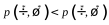
For , let and . Let in Theorem 7 and then , this is a contraction, so , take the same method, we have , then . Furthermore,
The proof is completed. □3.3. Application to Differential EquationsConsider the two-point boundary value problem of the second-order differential equation:<img width="130.20833333333334" src="https://html.scirp.org/file/1724162-rId921.svg?20250523033240">(30)</img>where <img width="123.21041214750542" src="https://html.scirp.org/file/1724162-rId923.svg?20250523033240"> is continuous. The boundary value problems (30) is equivalent to the following integral equation: </img><img width="317.7083333333333" src="https://html.scirp.org/file/1724162-rId925.svg?20250523033240">(31)</img>The Green function associated to (31) is defined by<img width="253.4722222222222" src="https://html.scirp.org/file/1724162-rId927.svg?20250523033240" />Let <img width="239.58333333333334" src="https://html.scirp.org/file/1724162-rId929.svg?20250523033240"> be a function defined by</img><img width="209.97830802603036" src="https://html.scirp.org/file/1724162-rId931.svg?20250523033240">(32)</img>
where is the set of all continuous real-valued functions defined on and . It is easy to see that is a complete b-metric-like space with . Let be a mapping defined by
(33)
Suppose that the following conditions hold:
(i) there exist a function and with , such that
for all <img width="100.69444444444444" src="https://html.scirp.org/file/1724162-rId957.svg?20250523033240">, <img width="59.00216919739696" src="https://html.scirp.org/file/1724162-rId959.svg?20250523033240">, with <img width="121.47505422993491" src="https://html.scirp.org/file/1724162-rId961.svg?20250523033240">, where </img></img></img><img width="536.4583333333334" src="https://html.scirp.org/file/1724162-rId963.svg?20250523033240" />(ii) there exists <img width="135.35791757049893" src="https://html.scirp.org/file/1724162-rId965.svg?20250523033240"> such that <img width="145.83333333333334" src="https://html.scirp.org/file/1724162-rId967.svg?20250523033240"> for all <img width="59.00216919739696" src="https://html.scirp.org/file/1724162-rId969.svg?20250523033240">;</img></img></img>(iii) for all <img width="59.00216919739696" src="https://html.scirp.org/file/1724162-rId971.svg?20250523033240">, if <img width="32.957502168256724" src="https://html.scirp.org/file/1724162-rId973.svg?20250523033240"> is a sequence in <img width="86.76789587852494" src="https://html.scirp.org/file/1724162-rId975.svg?20250523033240"> such that <img width="67.67895878524946" src="https://html.scirp.org/file/1724162-rId977.svg?20250523033240"> and <img width="98.91540130151843" src="https://html.scirp.org/file/1724162-rId979.svg?20250523033240">, for all <img width="45.11930585683297" src="https://html.scirp.org/file/1724162-rId981.svg?20250523033240">, then <img width="83.29718004338395" src="https://html.scirp.org/file/1724162-rId983.svg?20250523033240">, for all <img width="45.11930585683297" src="https://html.scirp.org/file/1724162-rId985.svg?20250523033240">.</img></img></img></img></img></img></img></img>Now we prove that existence of a solution of the above mentioned second-order differential equation.Theorem 12. Under conditions (i)-(iv), (30) has a solution in <img width="86.76789587852494" src="https://html.scirp.org/file/1724162-rId987.svg?20250523033240">.</img>Proof. It is well known that the solution of (30) is equivalent to the fixed point of <img width="15.604681404421326" src="https://html.scirp.org/file/1724162-rId989.svg?20250523033240"> in (33). Assume that <img width="123.21041214750542" src="https://html.scirp.org/file/1724162-rId991.svg?20250523033240"> such that <img width="121.47505422993491" src="https://html.scirp.org/file/1724162-rId993.svg?20250523033240">, for all <img width="59.00216919739696" src="https://html.scirp.org/file/1724162-rId995.svg?20250523033240">, and let <img width="116.26898047722342" src="https://html.scirp.org/file/1724162-rId997.svg?20250523033240">. By (i), we get that</img></img></img></img></img><img width="489.5833333333333" src="https://html.scirp.org/file/1724162-rId999.svg?20250523033240" />Let <img width="105.85683297180043" src="https://html.scirp.org/file/1724162-rId1001.svg?20250523033240"> and</img><img width="244.79166666666666" src="https://html.scirp.org/file/1724162-rId1003.svg?20250523033240" />
We can attain that
This research was funded by the Natural Science Foundation of Sichuan Province (Grant No. 2023NSFSC1299), the Scientific Research and Innovation Team Program of Sichuan University of Science and Engineering (SUSE652B002), the Innovation Fund of Postgraduate, Sichuan University of Science and Engineering (Grant No. Y2023336).
References
Samet, B., Vetro, C. and Vetro, P. (2012) Fixed Point Theorems for α-ψ-Contractive Type Mappings. Nonlinear Analysis: Theory, Methods & Applications, 75, 2154-2165. >https://doi.org/10.1016/j.na.2011.10.014
Popescu, O. (2014) Some New Fixed Point Theorems for α-Geraghty Contractive Type Maps in Metric Spaces. Fixed Point Theory and Applications, 2014, Article No. 190. >https://doi.org/10.1186/1687-1812-2014-190
Alghamdi, M.A., Hussain, N. and Salimi, P. (2013) Fixed Point and Coupled Fixed Point Theorems on b-Metric-Like Spaces. Journal of Inequalities and Applications, 2013, Article No. 402. >https://doi.org/10.1186/1029-242x-2013-402
Karapınar, E. (2017) A Short Survey on Dislocated Metric Spaces via Fixed-Point Theory. In: Banaś, J., Jleli, M., Mursaleen, M., Samet, B. and Vetro, C., Eds., Advances in Nonlinear Analysis via the Concept of Measure of Noncompactness, Springer, 457-483. >https://doi.org/10.1007/978-981-10-3722-1_13
Chen, C., Dong, J. and Zhu, C. (2015) Some Fixed Point Theorems in b-Metric-Like Spaces. Fixed Point Theory and Applications, 2015, Article No. 122. >https://doi.org/10.1186/s13663-015-0369-3
Gholamian, N. and Khanehgir, M. (2016) Fixed Points of Generalized Meir-Keeler Contraction Mappings in b-Metric-Like Spaces. Fixed Point Theory and Applications, 2016, Article No. 34. >https://doi.org/10.1186/s13663-016-0507-6
Zoto, K., Rhoades, B.E. and Radenović, S. (2017) Some Generalizations for-Contractions in b-Metric-Like Spaces and an Application. Fixed Point Theory and Applications, 2017, Article No. 26. >https://doi.org/10.1186/s13663-017-0620-1
Gholizadeh, L. and Karapınar, E. (2017) Best Proximity Point Results in Dislocated Metric Spaces via R-Functions. Revista de la Real Academia de Ciencias Exactas, Físicas y Naturales. Serie A. Matemáticas, 112, 1391-1407. >https://doi.org/10.1007/s13398-017-0431-6
Yu, D.K., Chen, C.F. and Wang, H. (2018) Common Fixed Point Theorems for-Contraction in b-Metric-Like Spaces. Journal of Inequalities and Applications, 2018, Article No. 222. >https://link.springer.com/article/10.1186/s13660-018-1802-z
Javed, K., Uddin, F., Aydi, H., Arshad, M., Ishtiaq, U. and Alsamir, H. (2021) On Fuzzy b-Metric-Like Spaces. Journal of Function Spaces, 2021, Article ID: 6615976. >https://doi.org/10.1155/2021/6615976
Alzaid, S.S., Fulga, A. and Alshammari, F.S. (2020) Discussion on Geraghty Type Hybrid Contractions. Journal of Function Spaces, 2020, Article ID: 6614291. >https://doi.org/10.1155/2020/6614291
Karapinar, E., Petrusel, A. and Petrusel, G. (2020) On Admissible Hybrid Geraghty Contractions. Carpathian Journal of Mathematics, 36, 433-442. >https://doi.org/10.37193/cjm.2020.03.11
Kada, O., Suzuki, T. and Takahashi, W. (1996) Nonconvex Minimization Theorems and Fixed Point Theorems in Complete Metric Spaces. Mathematica Japonicae, 44, 381-391.
Ju, H., Liu, X.L., Yan, S. and Jia, D. and Huan, Z. (2023) φ-Fixed Point Results for Nonlinear Contractions with an Application. Journal of Inequalities and Applications, 2023, Article No. 108.
Özgür, N.Y. and Taş, N. (2017) Some Fixed-Circle Theorems on Metric Spaces. Bulletin of the Malaysian Mathematical Sciences Society, 42, 1433-1449. >https://doi.org/10.1007/s40840-017-0555-z
Hussain, A., Al-Sulami, H., Hussain, N. and Farooq, H. (2020) Newly Fixed Disc Results Using Advanced Contractions on F-Metric Space. Journal of Applied Analysis & Computation, 10, 2313-2322. >https://doi.org/10.11948/20190197
Aydi, H., Taş, N., Özgür, N.Y. and Mlaiki, N. (2019) Fixed-Discs in Rectangular Metric Spaces. Symmetry, 11, Article 294. >https://doi.org/10.3390/sym11020294
 , the set of all non-negative real numbers as
  , the set of all non-negative integers by
  .
. function. In 2017, Zoto et al.
 -contractions, and studied the common fixed point theorems for such contractions in b-metric-like spaces. In 2021, Javed et al.
 . And inspired by
 -admissible was raised by Aydi et al.
 be a function. We say that a mapping
  is α-orbital admissible if
  , for all
  .
. be a function. If
  meets the following conditions:
 ;
; , for all
  ,
, is called a triangular α-orbital admissible mapping.
 be a non-empty set and
  be a given real number.
  is a b-metric-like, if it meets the following conditions:
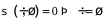 ;
;
 , for all
 , for all
  ,
, is said to be a b-metric-like space.
 is a b-metric-like, then the self-distance might not be zero for some
  . Defined
  by:
by: be a complete b-metric space. If there exists
  such that
  satisfying the following conditions:
 , for all
  is continuous or
  or
or  , and
, and , for all
  ,
, is a b-metric-like space and a nonempty set
  ,
,  is the set of all the fixed point of mapping
  and
and  is a mapping. Define
  by
by  is a b-metric-like space with a nonempty set
  ,
,  is a point in
  and
and 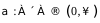 is a function. The mapping
  is α-
is α- .
. , for all
  . The proof is completed. □
 is a b-metric-like space with a nonempty set
  and
and 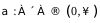 is a function. If mapping
  is α-
is α- -admissible and satisfies
 ,
,  with
with  .
.  be a complete b-metric like space with a w-distance
  ,
,  .
.  is called an admissible β-ζ-contraction if there exists a function
  such that
 (4)
(4) (6)
(6) such that
 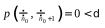 .
. , then
  . Therefore, by (c) of Definition 7, we have the limit of
  , and taking the limits at both sides of the inequality, we get
  , so that
  . When
  , it is a constant sequence, which is
  or
or  . Then
  (9)
(9) (10)
(10) . Then
 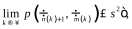 (14)
(14)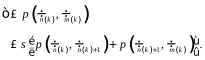 (15)
(15) and
and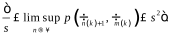 (16)
(16) ,
,  in (4), where
  and by (6), it follows that
 (17)
(17) (18)
(18)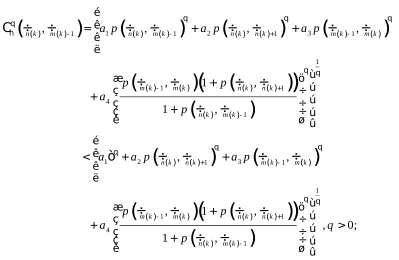 (19)
(19)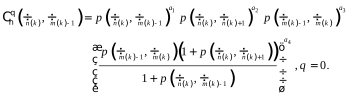 (20)
(20) (21)
(21) is a Cauchy sequence.
  is
is  complete, there exists
  such that
  . And by (iv), we have
  (24)
(24) has a fixed point
  .
. , for each
  , there exists
  such that
  for all
  . As
. As  and
and  is lower semicontinuous, we get
 (25)
(25) (26)
(26) . It can be divided into the following two cases.
 .
. such that
 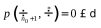 , and
, and 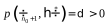 , by (c), we can conclude that
  , it says that
  . If
. If  for all
  ,
,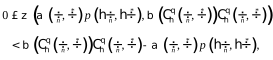 (27)
(27) , where
 (28)
(28) is a complete b-metric-like space with
  . Let
. Let  ,
,  and
and  . Now we show that
  is an admissible hybrid Geraghty contraction. Indeed,
 ,
,  , then (4) holds clearly.
 with
with  or
or  with
with  ,
,  (29)
(29) , then
  is regular with respect to
  and
and  .
.  in Theorem 7 (rep., Theorem 9, Theorem 10), but it can’t guarantee the uniqueness of fixed point by Examples 2. Now in order to assure the uniqueness of fixed point, consider the following condition:
 , where
  is the set of fixed points of
  .
. , where
  .
. of
of  .
. , let
, let  and
and  . Let
. Let  in Theorem 7 and then
  , this is a contraction, so
  , take the same method, we have
  , then
  . Furthermore,
 is the set of all continuous real-valued functions defined on
  and
and  . It is easy to see that
  is a complete b-metric-like space with
  . Let
. Let  be a mapping defined by
  (33)
(33) and
and 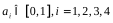 with
with  ,
,  such that