<?xml version="1.0" encoding="UTF-8"?><!DOCTYPE article PUBLIC "-//NLM//DTD Journal Publishing DTD v3.0 20080202//EN" "http://dtd.nlm.nih.gov/publishing/3.0/journalpublishing3.dtd">
<article xmlns:mml="http://www.w3.org/1998/Math/MathML" xmlns:xlink="http://www.w3.org/1999/xlink" dtd-version="3.0" xml:lang="en" article-type="research article">
 <front>
  <journal-meta>
   <journal-id journal-id-type="publisher-id">
    jhepgc
   </journal-id>
   <journal-title-group>
    <journal-title>
     Journal of High Energy Physics, Gravitation and Cosmology
    </journal-title>
   </journal-title-group>
   <issn pub-type="epub">
    2380-4327
   </issn>
   <issn publication-format="print">
    2380-4335
   </issn>
   <publisher>
    <publisher-name>
     Scientific Research Publishing
    </publisher-name>
   </publisher>
  </journal-meta>
  <article-meta>
   <article-id pub-id-type="doi">
    10.4236/jhepgc.2025.111009
   </article-id>
   <article-id pub-id-type="publisher-id">
    jhepgc-139955
   </article-id>
   <article-categories>
    <subj-group subj-group-type="heading">
     <subject>
      Articles
     </subject>
    </subj-group>
    <subj-group subj-group-type="Discipline-v2">
     <subject>
      Physics 
     </subject>
     <subject>
       Mathematics
     </subject>
    </subj-group>
   </article-categories>
   <title-group>
    3D Quantum Gravity, Localization and Particles beyond Standard Model
   </title-group>
   <contrib-group>
    <contrib contrib-type="author" xlink:type="simple">
     <name name-style="western">
      <surname>
       Risto
      </surname>
      <given-names>
       Raitio
      </given-names>
     </name>
    </contrib>
   </contrib-group> 
   <aff id="affnull">
    <addr-line>
     aHelsinki Institute of Physics, University of Helsinki, Helsinki, Finland
    </addr-line> 
   </aff> 
   <pub-date pub-type="epub">
    <day>
     02
    </day> 
    <month>
     01
    </month>
    <year>
     2025
    </year>
   </pub-date> 
   <volume>
    11
   </volume> 
   <issue>
    01
   </issue>
   <fpage>
    96
   </fpage>
   <lpage>
    109
   </lpage>
   <history>
    <date date-type="received">
     <day>
      13,
     </day>
     <month>
      September
     </month>
     <year>
      2024
     </year>
    </date>
    <date date-type="published">
     <day>
      14,
     </day>
     <month>
      September
     </month>
     <year>
      2024
     </year> 
    </date> 
    <date date-type="accepted">
     <day>
      14,
     </day>
     <month>
      January
     </month>
     <year>
      2025
     </year> 
    </date>
   </history>
   <permissions>
    <copyright-statement>
     © Copyright 2014 by authors and Scientific Research Publishing Inc. 
    </copyright-statement>
    <copyright-year>
     2014
    </copyright-year>
    <license>
     <license-p>
      This work is licensed under the Creative Commons Attribution International License (CC BY). http://creativecommons.org/licenses/by/4.0/
     </license-p>
    </license>
   </permissions>
   <abstract>
    We review a 3d quantum gravity model, which incorporates massive spinning fields into the Euclidean path integral in a Chern-Simons formulation. Fundamental matter as defined in our previous preon model is recapped. Both quantum gravity and the particle model are shown to be derivable from the supersymmetric 3d Chern-Simons action. Forces-Matter unification is achieved.
   </abstract>
   <kwd-group> 
    <kwd>
     Chern-Simons Theory
    </kwd> 
    <kwd>
      Quantum Gravity
    </kwd> 
    <kwd>
      Composite Particles
    </kwd> 
    <kwd>
      Beyond Standard Model
    </kwd>
   </kwd-group>
  </article-meta>
 </front>
 <body>
  <sec id="s1">
   <title>1. Introduction</title>
   <p>The purpose of this article is to show how a 3d Chern-Simons (CS) quantum gravity model of other authors leads by localization procedure to our CS model of elementary particles beyond the standard model. The vector supermultiplets in both cases are counterparts.</p>
   <p>The key element in our model is unbroken supersymmetry which gets “hidden” below a scale 
    <math display="inline" xmlns="http://www.w3.org/1998/Math/MathML"> <mrow> 
      <msub> 
       <mi>
         Λ 
       </mi> 
       <mrow> 
        <mi>
          c 
        </mi> 
        <mi>
          r 
        </mi> 
       </mrow> 
      </msub> 
      <mo>
        ~ 
      </mo> 
      <msup> 
       <mrow> 
        <mn>
          10 
        </mn> 
       </mrow> 
       <mrow> 
        <mn>
          10 
        </mn> 
       </mrow> 
      </msup> 
      <mtext>
          
      </mtext> 
      <mtext>
        - 
      </mtext> 
      <mtext>
          
      </mtext> 
      <msup> 
       <mrow> 
        <mn>
          10 
        </mn> 
       </mrow> 
       <mrow> 
        <mn>
          16 
        </mn> 
       </mrow> 
      </msup> 
     </mrow> 
    </math> GeV. This construction differs significantly from the community accepted models like the minimal supersymmetric standard model (MSSM), see the commendable review <xref ref-type="bibr" rid="scirp.139955-1">
     [1]
    </xref> and references therein. In our scenario, there are no squarks or sleptons. Instead, all superpartners are constituents of quarks and leptons themselves (see <xref ref-type="table" rid="table1">
     Table 1
    </xref> and <xref ref-type="table" rid="table2">
     Table 2
    </xref>). Fayet’s Forces ←→ Matter unification is obtained.</p>
   <p>This note is organized as follows. In Section 2 the 3d quantum gravity model is briefly reviewed in terms of a path integral, the partition function containing Wilson loops of Chern-Simons theory. Exact all-order and perturbative calculations can be done by introducing supersymmetric localization techniques in the path integral. Our Chern-Simons theory based composite particle model, proposed some time ago, is recapped in Section 3. Finally, in Section 4 the results are summarized. Two appendices are provided for background information. The nature of the note is phenomenological.</p>
  </sec><sec id="s2">
   <title>2. Chern-Simons Gravity</title>
   <sec id="s2_1">
    <title>2.1. Wilson Spool</title>
    <p>Low-dimensional gravity provides interesting tests of the gravitational path integral. In two and three space-time dimensions, there is no propagating graviton and all of the effective degrees of freedom are long-range. This is what happens in pure Einstein gravity with a cosmological constant (of either sign) as a Chern-Simons gauge theory <xref ref-type="bibr" rid="scirp.139955-2">
      [2]
     </xref>. A full leveraging of this fact allows the exact evaluation of the gravitational path integral either about a saddle point <xref ref-type="bibr" rid="scirp.139955-3">
      [3]
     </xref> or as a non-perturbative sum over saddles <xref ref-type="bibr" rid="scirp.139955-4">
      [4]
     </xref>. While Chern-Simons gravity is not a UV-complete<sup>1</sup> model of quantum gravity <xref ref-type="bibr" rid="scirp.139955-4">
      [4]
     </xref>, its all-loop exactness provides strong tests for potential microscopic models in the spirit of e.g. <xref ref-type="bibr" rid="scirp.139955-5">
      [5]
     </xref>.</p>
    <p>This question of gravity-matter coupling is made precise in <xref ref-type="bibr" rid="scirp.139955-6">
      [6]
     </xref>, where massive scalar fields minimally coupled to gravity with a positive cosmological constant are considered. The key result is the expression of the one-loop determinant (or partition function, see Appendix 1) of a massive scalar field coupled to a background metric, 
     <math display="inline" xmlns="http://www.w3.org/1998/Math/MathML"> <mrow> 
       <msub> 
        <mi>
          g 
        </mi> 
        <mrow> 
         <mi>
           μ 
         </mi> 
         <mi>
           ν 
         </mi> 
        </mrow> 
       </msub> 
      </mrow> 
     </math>, as a gauge invariant object of the Chern-Simons connections, 
     <math display="inline" xmlns="http://www.w3.org/1998/Math/MathML"> <mrow> 
       <msub> 
        <mi>
          A 
        </mi> 
        <mrow> 
         <mi>
           L 
         </mi> 
         <mn> 
          <mo>
            / 
          </mo> 
         </mn> 
         <mi>
           R 
         </mi> 
        </mrow> 
       </msub> 
      </mrow> 
     </math>:</p>
    <p>
     <math display="inline" xmlns="http://www.w3.org/1998/Math/MathML"> <mrow> 
       <msub> 
        <mi>
          Z 
        </mi> 
        <mrow> 
         <mtext>
           scalar 
         </mtext> 
        </mrow> 
       </msub> 
       <mrow> 
        <mo>
          [ 
        </mo> 
        <mrow> 
         <msub> 
          <mi>
            g 
          </mi> 
          <mrow> 
           <mi>
             μ 
           </mi> 
           <mi>
             ν 
           </mi> 
          </mrow> 
         </msub> 
        </mrow> 
        <mo>
          ] 
        </mo> 
       </mrow> 
       <mo>
         = 
       </mo> 
       <mi>
         exp 
       </mi> 
       <mfrac> 
        <mn>
          1 
        </mn> 
        <mn>
          4 
        </mn> 
       </mfrac> 
       <mi mathvariant="double-struck">
         W 
       </mi> 
       <mrow> 
        <mo>
          [ 
        </mo> 
        <mrow> 
         <msub> 
          <mi>
            A 
          </mi> 
          <mi>
            L 
          </mi> 
         </msub> 
         <mn>
           , 
         </mn> 
         <msub> 
          <mi>
            A 
          </mi> 
          <mi>
            R 
          </mi> 
         </msub> 
        </mrow> 
        <mo>
          ] 
        </mo> 
       </mrow> 
       <mn>
         . 
       </mn> 
      </mrow> 
     </math>(1)</p>
    <p>The object 
     <math display="inline" xmlns="http://www.w3.org/1998/Math/MathML"> <mrow> 
       <mi mathvariant="double-struck">
         W 
       </mi> 
       <mrow> 
        <mo>
          [ 
        </mo> 
        <mrow> 
         <msub> 
          <mi>
            A 
          </mi> 
          <mi>
            L 
          </mi> 
         </msub> 
         <mn>
           , 
         </mn> 
         <msub> 
          <mi>
            A 
          </mi> 
          <mi>
            R 
          </mi> 
         </msub> 
        </mrow> 
        <mo>
          ] 
        </mo> 
       </mrow> 
      </mrow> 
     </math>, coined the Wilson spool, is a collection of Wilson loop operators wrapped many times around cycles of the base geometry. The equality in (1) is expected to apply to three-dimensional gravity of either sign of cosmological constant.</p>
    <p>The importance of (1) is also practical. It was shown in <xref ref-type="bibr" rid="scirp.139955-6">
      [6]
     </xref> that certain exact methods in Chern-Simons theory (such as Abelianisation <xref ref-type="bibr" rid="scirp.139955-7">
      [7]
     </xref> (not discussed here) and supersymmetric localization <xref ref-type="bibr" rid="scirp.139955-8">
      [8]
     </xref>) extend to three-dimensional de Sitter ( 
     <math display="inline" xmlns="http://www.w3.org/1998/Math/MathML"> <mrow> 
       <mi>
         d 
       </mi> 
       <msub> 
        <mi>
          S 
        </mi> 
        <mn>
          3 
        </mn> 
       </msub> 
      </mrow> 
     </math>) Chern-Simons gravity with the Wilson spool inserted into the path integral. This allows a precise and efficient calculation of the quantum gravitational corrections to 
     <math display="inline" xmlns="http://www.w3.org/1998/Math/MathML"> <mrow> 
       <msub> 
        <mi>
          Z 
        </mi> 
        <mrow> 
         <mtext>
           scalar 
         </mtext> 
        </mrow> 
       </msub> 
      </mrow> 
     </math> at any order of perturbation theory of Newton’s constant, 
     <math display="inline" xmlns="http://www.w3.org/1998/Math/MathML"> <mrow> 
       <msub> 
        <mi>
          G 
        </mi> 
        <mi>
          N 
        </mi> 
       </msub> 
      </mrow> 
     </math>.</p>
    <p>The generalization of (1) for massive spinning fields is the following. Consider the local path integral,<sup>2</sup> 
     <math display="inline" xmlns="http://www.w3.org/1998/Math/MathML"> <mrow> 
       <msub> 
        <mi>
          Z 
        </mi> 
        <mrow> 
         <mi>
           Δ 
         </mi> 
         <mn>
           , 
         </mn> 
         <mtext>
           s 
         </mtext> 
        </mrow> 
       </msub> 
      </mrow> 
     </math>, of a spin-s field 
     <math display="inline" xmlns="http://www.w3.org/1998/Math/MathML"> <mrow> 
       <msub> 
        <mi>
          Φ 
        </mi> 
        <mrow> 
         <msub> 
          <mi>
            μ 
          </mi> 
          <mn>
            1 
          </mn> 
         </msub> 
         <msub> 
          <mi>
            μ 
          </mi> 
          <mn>
            2 
          </mn> 
         </msub> 
         <mo>
           ⋯ 
         </mo> 
         <msub> 
          <mi>
            μ 
          </mi> 
          <mi>
            s 
          </mi> 
         </msub> 
        </mrow> 
       </msub> 
      </mrow> 
     </math> with mass</p>
    <p>
     <math display="inline" xmlns="http://www.w3.org/1998/Math/MathML"> <mrow> 
       <mrow> 
        <mrow> 
         <msup> 
          <mi>
            m 
          </mi> 
          <mn>
            2 
          </mn> 
         </msup> 
        </mrow> 
        <mo>
          / 
        </mo> 
        <mi>
          Λ 
        </mi> 
       </mrow> 
       <mo>
         = 
       </mo> 
       <mrow> 
        <mo>
          ( 
        </mo> 
        <mrow> 
         <mi>
           Δ 
         </mi> 
         <mo>
           + 
         </mo> 
         <mtext>
           s 
         </mtext> 
         <mo>
           − 
         </mo> 
         <mn>
           2 
         </mn> 
        </mrow> 
        <mo>
          ) 
        </mo> 
       </mrow> 
       <mrow> 
        <mo>
          ( 
        </mo> 
        <mrow> 
         <mtext>
           s 
         </mtext> 
         <mo>
           − 
         </mo> 
         <mi>
           Δ 
         </mi> 
        </mrow> 
        <mo>
          ) 
        </mo> 
       </mrow> 
       <mn>
         , 
       </mn> 
      </mrow> 
     </math>(2)</p>
    <p>minimally coupled to a metric geometry, 
     <math display="inline" xmlns="http://www.w3.org/1998/Math/MathML"> <mrow> 
       <mrow> 
        <mo>
          ( 
        </mo> 
        <mrow> 
         <msub> 
          <mi>
            M 
          </mi> 
          <mn>
            3 
          </mn> 
         </msub> 
         <mn>
           , 
         </mn> 
         <msub> 
          <mi>
            g 
          </mi> 
          <mrow> 
           <msub> 
            <mi>
              M 
            </mi> 
            <mn>
              3 
            </mn> 
           </msub> 
          </mrow> 
         </msub> 
        </mrow> 
        <mo>
          ) 
        </mo> 
       </mrow> 
      </mrow> 
     </math>, where 
     <math display="inline" xmlns="http://www.w3.org/1998/Math/MathML"> <mi>
        Δ 
      </mi> 
     </math> is the conformal dimension (the eigenvalue of the dilatation operator 
     <math display="inline" xmlns="http://www.w3.org/1998/Math/MathML"> <mi>
        D 
      </mi> 
     </math>) and 
     <math display="inline" xmlns="http://www.w3.org/1998/Math/MathML"> <mrow> 
       <msub> 
        <mi>
          M 
        </mi> 
        <mn>
          3 
        </mn> 
       </msub> 
      </mrow> 
     </math> is topologically either Euclidean BTZ <xref ref-type="bibr" rid="scirp.139955-9">
      [9]
     </xref> or Euclidean 
     <math display="inline" xmlns="http://www.w3.org/1998/Math/MathML"> <mrow> 
       <mi>
         d 
       </mi> 
       <msub> 
        <mi>
          S 
        </mi> 
        <mn>
          3 
        </mn> 
       </msub> 
      </mrow> 
     </math>. In <xref ref-type="bibr" rid="scirp.139955-6">
      [6]
     </xref> it is proposed that</p>
    <p>
     <math display="inline" xmlns="http://www.w3.org/1998/Math/MathML"> <mrow> 
       <mi>
         log 
       </mi> 
       <msub> 
        <mi>
          Z 
        </mi> 
        <mrow> 
         <mi>
           Δ 
         </mi> 
         <mn>
           , 
         </mn> 
         <mtext>
           s 
         </mtext> 
        </mrow> 
       </msub> 
       <mrow> 
        <mo>
          [ 
        </mo> 
        <mrow> 
         <msub> 
          <mi>
            g 
          </mi> 
          <mrow> 
           <msub> 
            <mi>
              M 
            </mi> 
            <mn>
              3 
            </mn> 
           </msub> 
          </mrow> 
         </msub> 
        </mrow> 
        <mo>
          ] 
        </mo> 
       </mrow> 
       <mo>
         = 
       </mo> 
       <mfrac> 
        <mn>
          1 
        </mn> 
        <mn>
          4 
        </mn> 
       </mfrac> 
       <msub> 
        <mi mathvariant="double-struck">
          W 
        </mi> 
        <mrow> 
         <msub> 
          <mi>
            j 
          </mi> 
          <mi>
            L 
          </mi> 
         </msub> 
         <mn>
           , 
         </mn> 
         <msub> 
          <mi>
            j 
          </mi> 
          <mi>
            R 
          </mi> 
         </msub> 
        </mrow> 
       </msub> 
       <mrow> 
        <mo>
          [ 
        </mo> 
        <mrow> 
         <msub> 
          <mi>
            A 
          </mi> 
          <mi>
            L 
          </mi> 
         </msub> 
         <mn>
           , 
         </mn> 
         <msub> 
          <mi>
            A 
          </mi> 
          <mi>
            R 
          </mi> 
         </msub> 
        </mrow> 
        <mo>
          ] 
        </mo> 
       </mrow> 
       <mn>
         , 
       </mn> 
      </mrow> 
     </math>(3)</p>
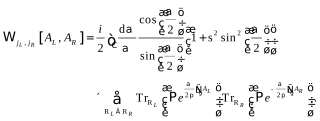
    <p>where</p>
    <p><img width="416.6666666666667" src="https://html.scirp.org/file/2181190-rId52.svg?20250117091215">(4)</img></p>
    <p>In (4), the Chern-Simons connections 
     <math display="inline" xmlns="http://www.w3.org/1998/Math/MathML"> <mrow> 
       <msub> 
        <mi>
          A 
        </mi> 
        <mrow> 
         <mi>
           L 
         </mi> 
         <mn> 
          <mo>
            / 
          </mo> 
         </mn> 
         <mi>
           R 
         </mi> 
        </mrow> 
       </msub> 
      </mrow> 
     </math> are related to the metric 
     <math display="inline" xmlns="http://www.w3.org/1998/Math/MathML"> <mrow> 
       <msub> 
        <mi>
          g 
        </mi> 
        <mrow> 
         <msub> 
          <mi>
            M 
          </mi> 
          <mn>
            3 
          </mn> 
         </msub> 
        </mrow> 
       </msub> 
      </mrow> 
     </math> in (3) through the usual Chern-Simons gravity dictionary <xref ref-type="bibr" rid="scirp.139955-10">
      [10]
     </xref> and they are integrated over a non-trivial cycle, 
     <math display="inline" xmlns="http://www.w3.org/1998/Math/MathML"> <mi>
        γ 
      </mi> 
     </math>, of the base geometry. The representations, 
     <math display="inline" xmlns="http://www.w3.org/1998/Math/MathML"> <mrow> 
       <msub> 
        <mtext>
          R 
        </mtext> 
        <mrow> 
         <mi>
           L 
         </mi> 
         <mn> 
          <mo>
            / 
          </mo> 
         </mn> 
         <mi>
           R 
         </mi> 
        </mrow> 
       </msub> 
      </mrow> 
     </math>, appearing in the Wilson loops are summed over a set determined by the mass and spin, 
     <math display="inline" xmlns="http://www.w3.org/1998/Math/MathML"> <mrow> 
       <mrow> 
        <mo>
          ( 
        </mo> 
        <mrow> 
         <mi>
           Δ 
         </mi> 
         <mn>
           , 
         </mn> 
         <mtext>
           s 
         </mtext> 
        </mrow> 
        <mo>
          ) 
        </mo> 
       </mrow> 
      </mrow> 
     </math>, of (3) and labeled by weights 
     <math display="inline" xmlns="http://www.w3.org/1998/Math/MathML"> <mrow> 
       <mrow> 
        <mo>
          ( 
        </mo> 
        <mrow> 
         <msub> 
          <mi>
            j 
          </mi> 
          <mi>
            L 
          </mi> 
         </msub> 
         <mn>
           , 
         </mn> 
         <msub> 
          <mi>
            j 
          </mi> 
          <mi>
            R 
          </mi> 
         </msub> 
        </mrow> 
        <mo>
          ) 
        </mo> 
       </mrow> 
      </mrow> 
     </math>. Lastly, the parameter 
     <math display="inline" xmlns="http://www.w3.org/1998/Math/MathML"> <mi>
        α 
      </mi> 
     </math> is integrated along a contour 
     <math display="inline" xmlns="http://www.w3.org/1998/Math/MathML"> <mi mathvariant="script">
        C 
      </mi> 
     </math> determined by a regularization scheme appropriate for the sign of cosmological constant. The ultimate effect of the 
     <math display="inline" xmlns="http://www.w3.org/1998/Math/MathML"> <mi>
        α 
      </mi> 
     </math> integral is to implement a winding of the Wilson loop operators around 
     <math display="inline" xmlns="http://www.w3.org/1998/Math/MathML"> <mi>
        γ 
      </mi> 
     </math>; this occurs through the summing the residues of the poles of its measure (as well as any of representation traces themselves). The above object, (4), is coined the spinning Wilson spool.</p>
   </sec>
   <sec id="s2_2">
    <title>2.2. 

     <math display="inline" xmlns="http://www.w3.org/1998/Math/MathML"> <mrow> 
  
       <mstyle mathvariant="bold" mathsize="normal">
   
        <mi>
         
    N
   
        </mi>
  
       </mstyle>
  
       <mo>
        
   =
  
       </mo>
  
       <mn>
        
   2
  
       </mn>
 
      </mrow>

     </math> Supersymmetric Localization</title>
    <p>We now describe an alternative route to the exact calculation of the Chern-Simons partition function through localization techniques. We will focus particularly on 
     <math display="inline" xmlns="http://www.w3.org/1998/Math/MathML"> <mrow> 
       <mi mathvariant="script">
         N 
       </mi> 
       <mo>
         = 
       </mo> 
       <mn>
         2 
       </mn> 
      </mrow> 
     </math> supersymmetric localization <xref ref-type="bibr" rid="scirp.139955-11">
      [11]
     </xref>. One benefit of this approach is that much of the basic machinery has been established with a non-trivial background connection, 
     <math display="inline" xmlns="http://www.w3.org/1998/Math/MathML"> <mi>
        a 
      </mi> 
     </math>, in mind allowing a fairly straightforward incorporation of 
     <math display="inline" xmlns="http://www.w3.org/1998/Math/MathML"> <mrow> 
       <mi>
         a 
       </mi> 
       <mo>
         ≠ 
       </mo> 
       <mn>
         0 
       </mn> 
      </mrow> 
     </math>. However: the situations with non-trivial background connections have historically arisen on manifolds with interesting topology and many of the explicit results for 
     <math display="inline" xmlns="http://www.w3.org/1998/Math/MathML"> <mrow> 
       <msup> 
        <mi>
          S 
        </mi> 
        <mn>
          3 
        </mn> 
       </msup> 
      </mrow> 
     </math> have been established with 
     <math display="inline" xmlns="http://www.w3.org/1998/Math/MathML"> <mrow> 
       <mi>
         a 
       </mi> 
       <mo>
         = 
       </mo> 
       <mn>
         0 
       </mn> 
      </mrow> 
     </math>. Below we collect and synthesize these results in a way that is useful for 
     <math display="inline" xmlns="http://www.w3.org/1998/Math/MathML"> <mrow> 
       <mi>
         d 
       </mi> 
       <msub> 
        <mi>
          S 
        </mi> 
        <mn>
          3 
        </mn> 
       </msub> 
      </mrow> 
     </math> gravity.</p>
    <p>Supersymmetry in the context of de Sitter is a contentious subject, with much of the difficulty arising from realizing unitary representations of the supersymmetry algebra in Lorentzian signature. We will take a somewhat agnostic stance on this topic by working directly in Euclidean signature, we are ultimately discussing 
     <math display="inline" xmlns="http://www.w3.org/1998/Math/MathML"> <mrow> 
       <mi>
         S 
       </mi> 
       <mi>
         U 
       </mi> 
       <msub> 
        <mrow> 
         <mrow> 
          <mo>
            ( 
          </mo> 
          <mn>
            2 
          </mn> 
          <mo>
            ) 
          </mo> 
         </mrow> 
        </mrow> 
        <mi>
          k 
        </mi> 
       </msub> 
      </mrow> 
     </math> Chern-Simons theory on 
     <math display="inline" xmlns="http://www.w3.org/1998/Math/MathML"> <mrow> 
       <msup> 
        <mi>
          S 
        </mi> 
        <mn>
          3 
        </mn> 
       </msup> 
      </mrow> 
     </math> whose 
     <math display="inline" xmlns="http://www.w3.org/1998/Math/MathML"> <mrow> 
       <mi mathvariant="script">
         N 
       </mi> 
       <mo>
         = 
       </mo> 
       <mn>
         2 
       </mn> 
      </mrow> 
     </math> supersymmetric extension is well-established. We use the existence of this symmetry to our advantage to localize the path integral all while verifying that the extension to 
     <math display="inline" xmlns="http://www.w3.org/1998/Math/MathML"> <mrow> 
       <mi mathvariant="script">
         N 
       </mi> 
       <mo>
         = 
       </mo> 
       <mn>
         2 
       </mn> 
      </mrow> 
     </math> does not alter essential features of the original partition function.</p>
    <p>Much of what follows mirrors the helpful review <xref ref-type="bibr" rid="scirp.139955-8">
      [8]
     </xref>. The vector multiplet of three-dimensional 
     <math display="inline" xmlns="http://www.w3.org/1998/Math/MathML"> <mrow> 
       <mi mathvariant="script">
         N 
       </mi> 
       <mo>
         = 
       </mo> 
       <mn>
         2 
       </mn> 
      </mrow> 
     </math> gauge theory is given by fields</p>
    <p>
     <math xmlns="http://www.w3.org/1998/Math/MathML" display="inline"> <mrow> 
       <mrow> 
        <mo>
          { 
        </mo> 
        <mrow> 
         <msub> 
          <mi>
            A 
          </mi> 
          <mi>
            μ 
          </mi> 
         </msub> 
         <mn>
           , 
         </mn> 
         <mtext>
             
         </mtext> 
         <mi>
           σ 
         </mi> 
         <mn>
           , 
         </mn> 
         <mtext>
             
         </mtext> 
         <mi mathvariant="fraktur">
           D 
         </mi> 
         <mn>
           , 
         </mn> 
         <mtext>
             
         </mtext> 
         <mi>
           λ 
         </mi> 
         <mn>
           , 
         </mn> 
         <mtext>
             
         </mtext> 
         <mover accent="true"> 
          <mi>
            λ 
          </mi> 
          <mo>
            ¯ 
          </mo> 
         </mover> 
        </mrow> 
        <mo>
          } 
        </mo> 
       </mrow> 
       <mn>
         , 
       </mn> 
      </mrow> 
     </math>(5)</p>
    <p>where 
     <math display="inline" xmlns="http://www.w3.org/1998/Math/MathML"> <mi>
        A 
      </mi> 
     </math> is a 
     <math display="inline" xmlns="http://www.w3.org/1998/Math/MathML"> <mrow> 
       <mi mathvariant="fraktur">
         g 
       </mi> 
       <mo>
         = 
       </mo> 
       <mi mathvariant="fraktur">
         s 
       </mi> 
       <mi mathvariant="fraktur">
         u 
       </mi> 
       <mrow> 
        <mo>
          ( 
        </mo> 
        <mn>
          2 
        </mn> 
        <mo>
          ) 
        </mo> 
       </mrow> 
      </mrow> 
     </math> connection, 
     <math display="inline" xmlns="http://www.w3.org/1998/Math/MathML"> <mi>
        σ 
      </mi> 
     </math>, 
     <math display="inline" xmlns="http://www.w3.org/1998/Math/MathML"> <mi mathvariant="fraktur">
        D 
      </mi> 
     </math> are scalars, and 
     <math display="inline" xmlns="http://www.w3.org/1998/Math/MathML"> <mi>
        λ 
      </mi> 
     </math>, 
     <math display="inline" xmlns="http://www.w3.org/1998/Math/MathML"> <mover accent="true"> 
       <mi>
         λ 
       </mi> 
       <mo>
         ¯ 
       </mo> 
      </mover> 
     </math> are Dirac spinors. All fields are 
     <math display="inline" xmlns="http://www.w3.org/1998/Math/MathML"> <mi mathvariant="fraktur">
        g 
      </mi> 
     </math>-valued and by convention we will take them all to be anti-Hermitian,<sup>3</sup> with supersymmetry variations parameterized by two Grassmann variables 
     <math display="inline" xmlns="http://www.w3.org/1998/Math/MathML"> <mover accent="true"> 
       <mi>
         ϵ 
       </mi> 
       <mo>
         ¯ 
       </mo> 
      </mover> 
     </math> and 
     <math display="inline" xmlns="http://www.w3.org/1998/Math/MathML"> <mi>
        ϵ 
      </mi> 
     </math> as specified in <xref ref-type="bibr" rid="scirp.139955-8">
      [8]
     </xref>. The supersymmetric Chern-Simons action is</p>
    <p>
     <math xmlns="http://www.w3.org/1998/Math/MathML" display="inline"> <mrow> 
       <msub> 
        <mi>
          S 
        </mi> 
        <mrow> 
         <mtext>
           SCS 
         </mtext> 
        </mrow> 
       </msub> 
       <mo>
         = 
       </mo> 
       <mfrac> 
        <mn>
          1 
        </mn> 
        <mrow> 
         <mn>
           4 
         </mn> 
         <mi>
           π 
         </mi> 
        </mrow> 
       </mfrac> 
       <mstyle displaystyle="true"> 
        <mrow> 
         <mo>
           ∫ 
         </mo> 
         <mrow> 
          <mtext>
            Tr 
          </mtext> 
         </mrow> 
        </mrow> 
       </mstyle> 
       <mrow> 
        <mo>
          ( 
        </mo> 
        <mrow> 
         <mi>
           A 
         </mi> 
         <mo>
           ∧ 
         </mo> 
         <mi>
           A 
         </mi> 
         <mo>
           + 
         </mo> 
         <mfrac> 
          <mn>
            2 
          </mn> 
          <mn>
            3 
          </mn> 
         </mfrac> 
         <msup> 
          <mi>
            A 
          </mi> 
          <mn>
            3 
          </mn> 
         </msup> 
        </mrow> 
        <mo>
          ) 
        </mo> 
       </mrow> 
       <mo>
         − 
       </mo> 
       <mfrac> 
        <mn>
          1 
        </mn> 
        <mrow> 
         <mn>
           4 
         </mn> 
         <mi>
           π 
         </mi> 
        </mrow> 
       </mfrac> 
       <mstyle displaystyle="true"> 
        <mrow> 
         <mo>
           ∫ 
         </mo> 
         <mrow> 
          <msup> 
           <mi>
             d 
           </mi> 
           <mn>
             3 
           </mn> 
          </msup> 
          <mi>
            x 
          </mi> 
         </mrow> 
        </mrow> 
       </mstyle> 
       <msqrt> 
        <mi>
          g 
        </mi> 
       </msqrt> 
       <mtext>
           
       </mtext> 
       <mtext>
         Tr 
       </mtext> 
       <mrow> 
        <mo>
          ( 
        </mo> 
        <mrow> 
         <mover accent="true"> 
          <mi>
            λ 
          </mi> 
          <mo>
            ¯ 
          </mo> 
         </mover> 
         <mi>
           λ 
         </mi> 
         <mo>
           − 
         </mo> 
         <mn>
           2 
         </mn> 
         <mi mathvariant="fraktur">
           D 
         </mi> 
         <mi>
           σ 
         </mi> 
        </mrow> 
        <mo>
          ) 
        </mo> 
       </mrow> 
       <mn> 
        <mi> 
        </mi>, 
       </mn> 
      </mrow> 
     </math>(6)</p>
    <p>and enters the path-integral multiplied by the level 
     <math display="inline" xmlns="http://www.w3.org/1998/Math/MathML"> <mi>
        k 
      </mi> 
     </math></p>
    <p>
     <math xmlns="http://www.w3.org/1998/Math/MathML" display="inline"> <mrow> 
       <msubsup> 
        <mi>
          Z 
        </mi> 
        <mi>
          k 
        </mi> 
        <mrow> 
         <mtext>
           SCS 
         </mtext> 
        </mrow> 
       </msubsup> 
       <mrow> 
        <mo>
          [ 
        </mo> 
        <mrow> 
         <msup> 
          <mi>
            S 
          </mi> 
          <mn>
            3 
          </mn> 
         </msup> 
        </mrow> 
        <mo>
          ] 
        </mo> 
       </mrow> 
       <mo>
         = 
       </mo> 
       <mstyle displaystyle="true"> 
        <mrow> 
         <mo>
           ∫ 
         </mo> 
         <mrow> 
          <mfrac> 
           <mrow> 
            <mi mathvariant="script">
              D 
            </mi> 
            <mi>
              A 
            </mi> 
           </mrow> 
           <mrow> 
            <msub> 
             <mi mathvariant="script">
               V 
             </mi> 
             <mi>
               G 
             </mi> 
            </msub> 
           </mrow> 
          </mfrac> 
          <mi mathvariant="script">
            D 
          </mi> 
          <mover accent="true"> 
           <mi>
             λ 
           </mi> 
           <mo>
             ¯ 
           </mo> 
          </mover> 
          <mi mathvariant="script">
            D 
          </mi> 
          <mi>
            λ 
          </mi> 
          <mi mathvariant="script">
            D 
          </mi> 
          <mi mathvariant="fraktur">
            D 
          </mi> 
          <mi mathvariant="script">
            D 
          </mi> 
          <mi>
            σ 
          </mi> 
          <mtext>
              
          </mtext> 
          <msup> 
           <mi>
             e 
           </mi> 
           <mrow> 
            <mi>
              i 
            </mi> 
            <mi>
              k 
            </mi> 
            <msub> 
             <mi>
               S 
             </mi> 
             <mrow> 
              <mtext>
                SCS 
              </mtext> 
             </mrow> 
            </msub> 
           </mrow> 
          </msup> 
         </mrow> 
        </mrow> 
       </mstyle> 
       <mn>
         . 
       </mn> 
      </mrow> 
     </math>(7)</p>
    <p>To make subsequent notation more fluent, we will drop the “ 
     <math display="inline" xmlns="http://www.w3.org/1998/Math/MathML"> <mrow> 
       <mrow> 
        <mo>
          [ 
        </mo> 
        <mrow> 
         <msup> 
          <mi>
            S 
          </mi> 
          <mn>
            3 
          </mn> 
         </msup> 
        </mrow> 
        <mo>
          ] 
        </mo> 
       </mrow> 
      </mrow> 
     </math>“ above with it understood that we are always working on the three-sphere. Note that on a formal level, as far as the function dependence on 
     <math display="inline" xmlns="http://www.w3.org/1998/Math/MathML"> <mi>
        k 
      </mi> 
     </math> is concerned, the addition of the auxiliary fields in the multiplet does not alter 
     <math display="inline" xmlns="http://www.w3.org/1998/Math/MathML"> <mrow> 
       <msubsup> 
        <mi>
          Z 
        </mi> 
        <mi>
          k 
        </mi> 
        <mrow> 
         <mtext>
           SCS 
         </mtext> 
        </mrow> 
       </msubsup> 
      </mrow> 
     </math> with respect to the non-supersymmetric path-integral 
     <math display="inline" xmlns="http://www.w3.org/1998/Math/MathML"> <mrow> 
       <msub> 
        <mi>
          Z 
        </mi> 
        <mi>
          k 
        </mi> 
       </msub> 
      </mrow> 
     </math> <xref ref-type="bibr" rid="scirp.139955-8">
      [8]
     </xref>.</p>
    <p>The deformation that allows us to localize the path-integral 
     <math display="inline" xmlns="http://www.w3.org/1998/Math/MathML"> <mrow> 
       <msubsup> 
        <mi>
          Z 
        </mi> 
        <mi>
          k 
        </mi> 
        <mrow> 
         <mtext>
           SCS 
         </mtext> 
        </mrow> 
       </msubsup> 
      </mrow> 
     </math> is the super-Yang-Mills action</p>
    <p>
     <math xmlns="http://www.w3.org/1998/Math/MathML" display="inline"> <mtable> 
       <mtr> 
        <mtd> 
         <msub> 
          <mi>
            S 
          </mi> 
          <mrow> 
           <mtext>
             SYM 
           </mtext> 
          </mrow> 
         </msub> 
         <mo>
           = 
         </mo> 
         <mo>
           − 
         </mo> 
         <mstyle displaystyle="true"> 
          <mrow> 
           <mo>
             ∫ 
           </mo> 
           <mrow> 
            <mtext>
              Tr 
            </mtext> 
           </mrow> 
          </mrow> 
         </mstyle> 
         <mrow> 
          <mo>
            ( 
          </mo> 
          <mrow> 
           <mfrac> 
            <mn>
              1 
            </mn> 
            <mn>
              2 
            </mn> 
           </mfrac> 
           <mi>
             F 
           </mi> 
           <mo>
             ∧ 
           </mo> 
           <mo>
             ⋆ 
           </mo> 
           <mi>
             F 
           </mi> 
           <mo>
             + 
           </mo> 
           <mi>
             D 
           </mi> 
           <mi>
             σ 
           </mi> 
           <mo>
             ∧ 
           </mo> 
           <mo>
             ⋆ 
           </mo> 
           <mi>
             D 
           </mi> 
           <mi>
             σ 
           </mi> 
          </mrow> 
          <mo>
            ) 
          </mo> 
         </mrow> 
        </mtd> 
       </mtr> 
       <mtr> 
        <mtd> 
         <mtext>
             
         </mtext> 
         <mtext>
             
         </mtext> 
         <mtext>
             
         </mtext> 
         <mo>
           − 
         </mo> 
         <mstyle displaystyle="true"> 
          <mrow> 
           <mo>
             ∫ 
           </mo> 
           <mrow> 
            <msup> 
             <mi>
               d 
             </mi> 
             <mn>
               3 
             </mn> 
            </msup> 
            <mi>
              x 
            </mi> 
           </mrow> 
          </mrow> 
         </mstyle> 
         <msqrt> 
          <mi>
            g 
          </mi> 
         </msqrt> 
         <mtext>
             
         </mtext> 
         <mtext>
           Tr 
         </mtext> 
         <mrow> 
          <mo>
            ( 
          </mo> 
          <mrow> 
           <mfrac> 
            <mn>
              1 
            </mn> 
            <mn>
              2 
            </mn> 
           </mfrac> 
           <msup> 
            <mrow> 
             <mrow> 
              <mo>
                ( 
              </mo> 
              <mrow> 
               <mi mathvariant="fraktur">
                 D 
               </mi> 
               <mo>
                 + 
               </mo> 
               <mi>
                 σ 
               </mi> 
              </mrow> 
              <mo>
                ) 
              </mo> 
             </mrow> 
            </mrow> 
            <mn>
              2 
            </mn> 
           </msup> 
           <mo>
             + 
           </mo> 
           <mfrac> 
            <mi>
              i 
            </mi> 
            <mn>
              2 
            </mn> 
           </mfrac> 
           <mover accent="true"> 
            <mi>
              λ 
            </mi> 
            <mo>
              ¯ 
            </mo> 
           </mover> 
           <msup> 
            <mi>
              γ 
            </mi> 
            <mi>
              μ 
            </mi> 
           </msup> 
           <msub> 
            <mi>
              D 
            </mi> 
            <mi>
              μ 
            </mi> 
           </msub> 
           <mi>
             λ 
           </mi> 
           <mo>
             − 
           </mo> 
           <mfrac> 
            <mn>
              1 
            </mn> 
            <mn>
              2 
            </mn> 
           </mfrac> 
           <mover accent="true"> 
            <mi>
              λ 
            </mi> 
            <mo>
              ¯ 
            </mo> 
           </mover> 
           <mrow> 
            <mo>
              [ 
            </mo> 
            <mrow> 
             <mi>
               σ 
             </mi> 
             <mn>
               , 
             </mn> 
             <mi>
               λ 
             </mi> 
            </mrow> 
            <mo>
              ] 
            </mo> 
           </mrow> 
           <mo>
             − 
           </mo> 
           <mfrac> 
            <mn>
              1 
            </mn> 
            <mn>
              4 
            </mn> 
           </mfrac> 
           <mover accent="true"> 
            <mi>
              λ 
            </mi> 
            <mo>
              ¯ 
            </mo> 
           </mover> 
           <mi>
             λ 
           </mi> 
          </mrow> 
          <mo>
            ) 
          </mo> 
         </mrow> 
         <mn>
           , 
         </mn> 
        </mtd> 
       </mtr> 
      </mtable> 
     </math>(8)</p>
    <p>where 
     <math display="inline" xmlns="http://www.w3.org/1998/Math/MathML"> <mrow> 
       <msub> 
        <mi>
          D 
        </mi> 
        <mi>
          μ 
        </mi> 
       </msub> 
      </mrow> 
     </math> is the gauge-covariant derivative and 
     <math display="inline" xmlns="http://www.w3.org/1998/Math/MathML"> <mrow> 
       <msub> 
        <mi>
          γ 
        </mi> 
        <mi>
          μ 
        </mi> 
       </msub> 
      </mrow> 
     </math> can be taken to be the Pauli-matrices acting on spinor indices. 
     <math display="inline" xmlns="http://www.w3.org/1998/Math/MathML"> <mrow> 
       <msub> 
        <mi>
          S 
        </mi> 
        <mrow> 
         <mtext>
           SYM 
         </mtext> 
        </mrow> 
       </msub> 
      </mrow> 
     </math> is itself a super-derivative and therefore 
     <math display="inline" xmlns="http://www.w3.org/1998/Math/MathML"> <mi>
        Q 
      </mi> 
     </math>-exact. Adding this to the path-integral with coefficient 
     <math display="inline" xmlns="http://www.w3.org/1998/Math/MathML"> <mtext>
        t 
      </mtext> 
     </math>, i.e.,</p>
    <p>
     <math xmlns="http://www.w3.org/1998/Math/MathML" display="inline"> <mrow> 
       <msubsup> 
        <mi>
          Z 
        </mi> 
        <mi>
          k 
        </mi> 
        <mrow> 
         <mtext>
           SCS 
         </mtext> 
         <mo>
           + 
         </mo> 
         <mtext>
           SYM 
         </mtext> 
        </mrow> 
       </msubsup> 
       <mrow> 
        <mo>
          ( 
        </mo> 
        <mtext>
          t 
        </mtext> 
        <mo>
          ) 
        </mo> 
       </mrow> 
       <mo>
         = 
       </mo> 
       <mstyle displaystyle="true"> 
        <mrow> 
         <mo>
           ∫ 
         </mo> 
         <mrow> 
          <mfrac> 
           <mrow> 
            <mi mathvariant="script">
              D 
            </mi> 
            <mi>
              A 
            </mi> 
           </mrow> 
           <mrow> 
            <msub> 
             <mi mathvariant="script">
               V 
             </mi> 
             <mi>
               G 
             </mi> 
            </msub> 
           </mrow> 
          </mfrac> 
          <mi mathvariant="script">
            D 
          </mi> 
          <mover accent="true"> 
           <mi>
             λ 
           </mi> 
           <mo>
             ¯ 
           </mo> 
          </mover> 
          <mi mathvariant="script">
            D 
          </mi> 
          <mi>
            λ 
          </mi> 
          <mi mathvariant="script">
            D 
          </mi> 
          <mi>
            D 
          </mi> 
          <mi mathvariant="script">
            D 
          </mi> 
          <mi>
            σ 
          </mi> 
          <mtext>
              
          </mtext> 
          <msup> 
           <mi>
             e 
           </mi> 
           <mrow> 
            <mi>
              i 
            </mi> 
            <mi>
              k 
            </mi> 
            <msub> 
             <mi>
               S 
             </mi> 
             <mrow> 
              <mtext>
                SCS 
              </mtext> 
             </mrow> 
            </msub> 
            <mo>
              − 
            </mo> 
            <mtext>
              t 
            </mtext> 
            <msub> 
             <mi>
               S 
             </mi> 
             <mrow> 
              <mtext>
                SYM 
              </mtext> 
             </mrow> 
            </msub> 
           </mrow> 
          </msup> 
         </mrow> 
        </mrow> 
       </mstyle> 
       <mn>
         , 
       </mn> 
      </mrow> 
     </math>(9)</p>
    <p>is then innocuous: 
     <math display="inline" xmlns="http://www.w3.org/1998/Math/MathML"> <mrow> 
       <msubsup> 
        <mi>
          Z 
        </mi> 
        <mi>
          k 
        </mi> 
        <mrow> 
         <mtext>
           SCS 
         </mtext> 
         <mo>
           + 
         </mo> 
         <mtext>
           SYM 
         </mtext> 
        </mrow> 
       </msubsup> 
       <mrow> 
        <mo>
          ( 
        </mo> 
        <mtext>
          t 
        </mtext> 
        <mo>
          ) 
        </mo> 
       </mrow> 
       <mo>
         = 
       </mo> 
       <msubsup> 
        <mi>
          Z 
        </mi> 
        <mi>
          k 
        </mi> 
        <mrow> 
         <mtext>
           SCS 
         </mtext> 
        </mrow> 
       </msubsup> 
      </mrow> 
     </math> for any 
     <math display="inline" xmlns="http://www.w3.org/1998/Math/MathML"> <mtext>
        t 
      </mtext> 
     </math>, including in the limit 
     <math display="inline" xmlns="http://www.w3.org/1998/Math/MathML"> <mrow> 
       <mtext>
         t 
       </mtext> 
       <mo>
         → 
       </mo> 
       <mi>
         ∞ 
       </mi> 
      </mrow> 
     </math> where the path-integral localizes on the saddle of 
     <math display="inline" xmlns="http://www.w3.org/1998/Math/MathML"> <mrow> 
       <msub> 
        <mi>
          S 
        </mi> 
        <mrow> 
         <mtext>
           SYM 
         </mtext> 
        </mrow> 
       </msub> 
      </mrow> 
     </math>.</p>
   </sec>
   <sec id="s2_3">
    <title>2.3. Localization Locus</title>
    <p>In the 
     <math display="inline" xmlns="http://www.w3.org/1998/Math/MathML"> <mrow> 
       <mtext>
         t 
       </mtext> 
       <mo>
         → 
       </mo> 
       <mi>
         ∞ 
       </mi> 
      </mrow> 
     </math> limit, the path-integral localizes on the following equations of motion</p>
    <p>
     <math display="inline" xmlns="http://www.w3.org/1998/Math/MathML"> <mrow> 
       <mi>
         F 
       </mi> 
       <mo>
         = 
       </mo> 
       <mn>
         0, 
       </mn> 
       <mtext>
           
       </mtext> 
       <mtext>
           
       </mtext> 
       <mi>
         D 
       </mi> 
       <mi>
         σ 
       </mi> 
       <mo>
         = 
       </mo> 
       <mi>
         d 
       </mi> 
       <mi>
         σ 
       </mi> 
       <mo>
         + 
       </mo> 
       <mrow> 
        <mo>
          [ 
        </mo> 
        <mrow> 
         <mi>
           A 
         </mi> 
         <mn>
           , 
         </mn> 
         <mi>
           σ 
         </mi> 
        </mrow> 
        <mo>
          ] 
        </mo> 
       </mrow> 
       <mo>
         = 
       </mo> 
       <mn>
         0, 
       </mn> 
       <mtext>
           
       </mtext> 
       <mtext>
           
       </mtext> 
       <mi mathvariant="fraktur">
         D 
       </mi> 
       <mo>
         + 
       </mo> 
       <mi>
         σ 
       </mi> 
       <mo>
         = 
       </mo> 
       <mn>
         0. 
       </mn> 
      </mrow> 
     </math>(10)</p>
    <p>We expand the solutions around a flat connection 
     <math display="inline" xmlns="http://www.w3.org/1998/Math/MathML"> <mrow> 
       <mi>
         a 
       </mi> 
       <mo>
         = 
       </mo> 
       <msup> 
        <mi>
          g 
        </mi> 
        <mrow> 
         <mo>
           − 
         </mo> 
         <mn>
           1 
         </mn> 
        </mrow> 
       </msup> 
       <mi>
         g 
       </mi> 
      </mrow> 
     </math>, for some group element 
     <math display="inline" xmlns="http://www.w3.org/1998/Math/MathML"> <mi>
        g 
      </mi> 
     </math>. Again, 
     <math display="inline" xmlns="http://www.w3.org/1998/Math/MathML"> <mi>
        g 
      </mi> 
     </math> may not be single-valued and 
     <math display="inline" xmlns="http://www.w3.org/1998/Math/MathML"> <mi>
        a 
      </mi> 
     </math> may possess a holonomy</p>
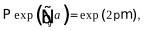
    <p><img width="185.68329718004338" src="https://html.scirp.org/file/2181190-rId171.svg?20250117091215">(11)</img></p>
    <p>for some curve 
     <math display="inline" xmlns="http://www.w3.org/1998/Math/MathML"> <mi>
        γ 
      </mi> 
     </math>. The other fields that have saddle solutions to (10) are given by</p>
    <p>
     <math xmlns="http://www.w3.org/1998/Math/MathML" display="inline"> <mrow> 
       <msubsup> 
        <mi>
          σ 
        </mi> 
        <mn>
          0 
        </mn> 
        <mrow> 
         <mrow> 
          <mo>
            ( 
          </mo> 
          <mi>
            g 
          </mi> 
          <mo>
            ) 
          </mo> 
         </mrow> 
        </mrow> 
       </msubsup> 
       <mo>
         = 
       </mo> 
       <msup> 
        <mi>
          g 
        </mi> 
        <mrow> 
         <mo>
           − 
         </mo> 
         <mn>
           1 
         </mn> 
        </mrow> 
       </msup> 
       <msub> 
        <mi>
          σ 
        </mi> 
        <mn>
          0 
        </mn> 
       </msub> 
       <mi>
         g 
       </mi> 
       <mn>
         , 
       </mn> 
       <mtext>
           
       </mtext> 
       <mtext>
           
       </mtext> 
       <msub> 
        <mi mathvariant="fraktur">
          D 
        </mi> 
        <mn>
          0 
        </mn> 
       </msub> 
       <mo>
         = 
       </mo> 
       <mo>
         − 
       </mo> 
       <msubsup> 
        <mi>
          σ 
        </mi> 
        <mn>
          0 
        </mn> 
        <mrow> 
         <mrow> 
          <mo>
            ( 
          </mo> 
          <mi>
            g 
          </mi> 
          <mo>
            ) 
          </mo> 
         </mrow> 
        </mrow> 
       </msubsup> 
       <mn>
         , 
       </mn> 
       <mtext>
           
       </mtext> 
       <mtext>
           
       </mtext> 
       <msub> 
        <mi>
          λ 
        </mi> 
        <mn>
          0 
        </mn> 
       </msub> 
       <mo>
         = 
       </mo> 
       <mn>
         0, 
       </mn> 
       <mtext>
           
       </mtext> 
       <mtext>
           
       </mtext> 
       <msub> 
        <mover accent="true"> 
         <mi>
           λ 
         </mi> 
         <mo>
           ¯ 
         </mo> 
        </mover> 
        <mn>
          0 
        </mn> 
       </msub> 
       <mo>
         = 
       </mo> 
       <mn>
         0, 
       </mn> 
      </mrow> 
     </math>(12)</p>
    <p>for 
     <math display="inline" xmlns="http://www.w3.org/1998/Math/MathML"> <mrow> 
       <msub> 
        <mi>
          σ 
        </mi> 
        <mn>
          0 
        </mn> 
       </msub> 
      </mrow> 
     </math> a constant element of 
     <math display="inline" xmlns="http://www.w3.org/1998/Math/MathML"> <mi mathvariant="fraktur">
        g 
      </mi> 
     </math>. We require 
     <math display="inline" xmlns="http://www.w3.org/1998/Math/MathML"> <mrow> 
       <msubsup> 
        <mi>
          σ 
        </mi> 
        <mn>
          0 
        </mn> 
        <mrow> 
         <mrow> 
          <mo>
            ( 
          </mo> 
          <mi>
            g 
          </mi> 
          <mo>
            ) 
          </mo> 
         </mrow> 
        </mrow> 
       </msubsup> 
      </mrow> 
     </math> to be single-valued and so the constant element defining the saddle must obey</p>
    <p>
     <math display="inline" xmlns="http://www.w3.org/1998/Math/MathML"> <mrow> 
       <mrow> 
        <mo>
          [ 
        </mo> 
        <mrow> 
         <mi mathvariant="fraktur">
           m 
         </mi> 
         <mn>
           , 
         </mn> 
         <msub> 
          <mi>
            σ 
          </mi> 
          <mn>
            0 
          </mn> 
         </msub> 
        </mrow> 
        <mo>
          ] 
        </mo> 
       </mrow> 
       <mo>
         = 
       </mo> 
       <mn>
         0 
        <mi> 
        </mi>. 
       </mn> 
      </mrow> 
     </math>(13)</p>
    <p>With this we can take 
     <math display="inline" xmlns="http://www.w3.org/1998/Math/MathML"> <mrow> 
       <msub> 
        <mi>
          σ 
        </mi> 
        <mn>
          0 
        </mn> 
       </msub> 
      </mrow> 
     </math> to be in a Cartan subalgebra containing 
     <math display="inline" xmlns="http://www.w3.org/1998/Math/MathML"> <mi mathvariant="fraktur">
        m 
      </mi> 
     </math>. We will scale fluctuations as</p>
    <p>
     <math xmlns="http://www.w3.org/1998/Math/MathML" display="inline"> <mtable columnalign="left"> 
       <mtr> 
        <mtd> 
         <mi>
           A 
         </mi> 
         <mo>
           = 
         </mo> 
         <mi>
           a 
         </mi> 
         <mo>
           + 
         </mo> 
         <mfrac> 
          <mn>
            1 
          </mn> 
          <mrow> 
           <msqrt> 
            <mtext>
              t 
            </mtext> 
           </msqrt> 
          </mrow> 
         </mfrac> 
         <mi>
           B 
         </mi> 
         <mn>
           , 
         </mn> 
         <mtext>
             
         </mtext> 
         <mtext>
             
         </mtext> 
         <mi>
           σ 
         </mi> 
         <mo>
           = 
         </mo> 
         <msubsup> 
          <mi>
            σ 
          </mi> 
          <mn>
            0 
          </mn> 
          <mrow> 
           <mrow> 
            <mo>
              ( 
            </mo> 
            <mi>
              g 
            </mi> 
            <mo>
              ) 
            </mo> 
           </mrow> 
          </mrow> 
         </msubsup> 
         <mo>
           + 
         </mo> 
         <mfrac> 
          <mn>
            1 
          </mn> 
          <mrow> 
           <msqrt> 
            <mtext>
              t 
            </mtext> 
           </msqrt> 
          </mrow> 
         </mfrac> 
         <mover accent="true"> 
          <mi>
            σ 
          </mi> 
          <mo>
            ^ 
          </mo> 
         </mover> 
         <mn>
           , 
         </mn> 
         <mtext>
             
         </mtext> 
         <mtext>
             
         </mtext> 
         <mi mathvariant="fraktur">
           D 
         </mi> 
         <mo>
           = 
         </mo> 
         <mo>
           − 
         </mo> 
         <msubsup> 
          <mi>
            σ 
          </mi> 
          <mn>
            0 
          </mn> 
          <mrow> 
           <mrow> 
            <mo>
              ( 
            </mo> 
            <mi>
              g 
            </mi> 
            <mo>
              ) 
            </mo> 
           </mrow> 
          </mrow> 
         </msubsup> 
         <mo>
           + 
         </mo> 
         <mfrac> 
          <mn>
            1 
          </mn> 
          <mrow> 
           <msqrt> 
            <mtext>
              t 
            </mtext> 
           </msqrt> 
          </mrow> 
         </mfrac> 
         <mover accent="true"> 
          <mi mathvariant="fraktur">
            D 
          </mi> 
          <mo>
            ^ 
          </mo> 
         </mover> 
         <mn>
           , 
         </mn> 
        </mtd> 
       </mtr> 
       <mtr> 
        <mtd> 
         <mi>
           λ 
         </mi> 
         <mo>
           = 
         </mo> 
         <mfrac> 
          <mn>
            1 
          </mn> 
          <mrow> 
           <msqrt> 
            <mtext>
              t 
            </mtext> 
           </msqrt> 
          </mrow> 
         </mfrac> 
         <mover accent="true"> 
          <mi>
            λ 
          </mi> 
          <mo>
            ^ 
          </mo> 
         </mover> 
         <mn>
           , 
         </mn> 
         <mtext>
             
         </mtext> 
         <mtext>
             
         </mtext> 
         <mover accent="true"> 
          <mi>
            λ 
          </mi> 
          <mo>
            ¯ 
          </mo> 
         </mover> 
         <mo>
           = 
         </mo> 
         <mfrac> 
          <mn>
            1 
          </mn> 
          <mrow> 
           <msqrt> 
            <mtext>
              t 
            </mtext> 
           </msqrt> 
          </mrow> 
         </mfrac> 
         <mover accent="true"> 
          <mover accent="true"> 
           <mi>
             λ 
           </mi> 
           <mo>
             ¯ 
           </mo> 
          </mover> 
          <mo>
            ^ 
          </mo> 
         </mover> 
         <mn>
           , 
         </mn> 
        </mtd> 
       </mtr> 
      </mtable> 
     </math>(14)</p>
    <p>and perturb the action (6) around the saddle (12) as 
     <math display="inline" xmlns="http://www.w3.org/1998/Math/MathML"> <mrow> 
       <mtext>
         t 
       </mtext> 
       <mo>
         → 
       </mo> 
       <mi>
         ∞ 
       </mi> 
      </mrow> 
     </math>. The leading contribution to 
     <math display="inline" xmlns="http://www.w3.org/1998/Math/MathML"> <mrow> 
       <msub> 
        <mi>
          S 
        </mi> 
        <mrow> 
         <mtext>
           SCS 
         </mtext> 
        </mrow> 
       </msub> 
      </mrow> 
     </math> is</p>
    <p>
     <math display="inline" xmlns="http://www.w3.org/1998/Math/MathML"> <mrow> 
       <munder> 
        <mrow> 
         <mi>
           lim 
         </mi> 
        </mrow> 
        <mrow> 
         <mtext>
           t 
         </mtext> 
         <mo>
           → 
         </mo> 
         <mi>
           ∞ 
         </mi> 
        </mrow> 
       </munder> 
       <msub> 
        <mi>
          S 
        </mi> 
        <mrow> 
         <mtext>
           SCS 
         </mtext> 
        </mrow> 
       </msub> 
       <mo>
         = 
       </mo> 
       <msub> 
        <mi>
          S 
        </mi> 
        <mrow> 
         <mtext>
           CS 
         </mtext> 
        </mrow> 
       </msub> 
       <mrow> 
        <mo>
          [ 
        </mo> 
        <mi>
          a 
        </mi> 
        <mo>
          ] 
        </mo> 
       </mrow> 
       <mo>
         − 
       </mo> 
       <mfrac> 
        <mrow> 
         <mtext>
           Vol 
         </mtext> 
         <mrow> 
          <mo>
            ( 
          </mo> 
          <mrow> 
           <msup> 
            <mi>
              S 
            </mi> 
            <mn>
              3 
            </mn> 
           </msup> 
          </mrow> 
          <mo>
            ) 
          </mo> 
         </mrow> 
        </mrow> 
        <mrow> 
         <mn>
           2 
         </mn> 
         <mi>
           π 
         </mi> 
        </mrow> 
       </mfrac> 
       <mtext>
         Tr 
       </mtext> 
       <msubsup> 
        <mi>
          σ 
        </mi> 
        <mn>
          0 
        </mn> 
        <mn>
          2 
        </mn> 
       </msubsup> 
       <mn> 
        <mi> 
        </mi>. 
       </mn> 
      </mrow> 
     </math>(15)</p>
    <p>Meanwhile the leading contribution to 
     <math display="inline" xmlns="http://www.w3.org/1998/Math/MathML"> <mrow> 
       <mtext>
         t 
       </mtext> 
       <mtext>
           
       </mtext> 
       <msub> 
        <mi>
          S 
        </mi> 
        <mrow> 
         <mtext>
           S 
         </mtext> 
         <mi>
           Y 
         </mi> 
         <mi>
           M 
         </mi> 
        </mrow> 
       </msub> 
      </mrow> 
     </math> is</p>
    <p>
     <math xmlns="http://www.w3.org/1998/Math/MathML" display="inline"> <mtable> 
       <mtr> 
        <mtd> 
         <mtext>
           t 
         </mtext> 
         <mtext>
             
         </mtext> 
         <msub> 
          <mi>
            S 
          </mi> 
          <mrow> 
           <mtext>
             S 
           </mtext> 
           <mi>
             Y 
           </mi> 
           <mi>
             M 
           </mi> 
          </mrow> 
         </msub> 
         <mo>
           = 
         </mo> 
         <mo>
           − 
         </mo> 
         <mstyle displaystyle="true"> 
          <mrow> 
           <mo>
             ∫ 
           </mo> 
           <mrow> 
            <mtext>
              Tr 
            </mtext> 
           </mrow> 
          </mrow> 
         </mstyle> 
         <mrow> 
          <mo>
            ( 
          </mo> 
          <mrow> 
           <mfrac> 
            <mn>
              1 
            </mn> 
            <mn>
              2 
            </mn> 
           </mfrac> 
           <msub> 
            <mtext>
              d 
            </mtext> 
            <mi>
              a 
            </mi> 
           </msub> 
           <mi>
             B 
           </mi> 
           <mo>
             ∧ 
           </mo> 
           <mo>
             ⋆ 
           </mo> 
           <msub> 
            <mtext>
              d 
            </mtext> 
            <mi>
              a 
            </mi> 
           </msub> 
           <mi>
             B 
           </mi> 
           <mo>
             + 
           </mo> 
           <mrow> 
            <mo>
              ( 
            </mo> 
            <mrow> 
             <msub> 
              <mtext>
                d 
              </mtext> 
              <mi>
                a 
              </mi> 
             </msub> 
             <mover accent="true"> 
              <mi>
                σ 
              </mi> 
              <mo>
                ^ 
              </mo> 
             </mover> 
             <mo>
               + 
             </mo> 
             <mrow> 
              <mo>
                [ 
              </mo> 
              <mrow> 
               <mi>
                 B 
               </mi> 
               <mn>
                 , 
               </mn> 
               <msubsup> 
                <mi>
                  σ 
                </mi> 
                <mn>
                  0 
                </mn> 
                <mrow> 
                 <mrow> 
                  <mo>
                    ( 
                  </mo> 
                  <mi>
                    g 
                  </mi> 
                  <mo>
                    ) 
                  </mo> 
                 </mrow> 
                </mrow> 
               </msubsup> 
              </mrow> 
              <mo>
                ] 
              </mo> 
             </mrow> 
            </mrow> 
            <mo>
              ) 
            </mo> 
           </mrow> 
           <mo>
             ∧ 
           </mo> 
           <mo>
             ⋆ 
           </mo> 
           <mrow> 
            <mo>
              ( 
            </mo> 
            <mrow> 
             <msub> 
              <mtext>
                d 
              </mtext> 
              <mi>
                a 
              </mi> 
             </msub> 
             <mover accent="true"> 
              <mi>
                σ 
              </mi> 
              <mo>
                ^ 
              </mo> 
             </mover> 
             <mo>
               + 
             </mo> 
             <mrow> 
              <mo>
                [ 
              </mo> 
              <mrow> 
               <mi>
                 B 
               </mi> 
               <mn>
                 , 
               </mn> 
               <msubsup> 
                <mi>
                  σ 
                </mi> 
                <mn>
                  0 
                </mn> 
                <mrow> 
                 <mrow> 
                  <mo>
                    ( 
                  </mo> 
                  <mi>
                    g 
                  </mi> 
                  <mo>
                    ) 
                  </mo> 
                 </mrow> 
                </mrow> 
               </msubsup> 
              </mrow> 
              <mo>
                ] 
              </mo> 
             </mrow> 
            </mrow> 
            <mo>
              ) 
            </mo> 
           </mrow> 
          </mrow> 
          <mo>
            ) 
          </mo> 
         </mrow> 
        </mtd> 
       </mtr> 
       <mtr> 
        <mtd> 
         <mtext>
             
         </mtext> 
         <mtext>
             
         </mtext> 
         <mtext>
             
         </mtext> 
         <mo>
           − 
         </mo> 
         <mstyle displaystyle="true"> 
          <mrow> 
           <mo>
             ∫ 
           </mo> 
           <mrow> 
            <msup> 
             <mi>
               d 
             </mi> 
             <mn>
               3 
             </mn> 
            </msup> 
            <mi>
              x 
            </mi> 
           </mrow> 
          </mrow> 
         </mstyle> 
         <msqrt> 
          <mi>
            g 
          </mi> 
         </msqrt> 
         <mtext>
             
         </mtext> 
         <mtext>
           Tr 
         </mtext> 
         <mrow> 
          <mo>
            ( 
          </mo> 
          <mrow> 
           <mfrac> 
            <mn>
              1 
            </mn> 
            <mn>
              2 
            </mn> 
           </mfrac> 
           <msup> 
            <mrow> 
             <mrow> 
              <mo>
                ( 
              </mo> 
              <mrow> 
               <mover accent="true"> 
                <mi mathvariant="fraktur">
                  D 
                </mi> 
                <mo>
                  ^ 
                </mo> 
               </mover> 
               <mo>
                 + 
               </mo> 
               <mover accent="true"> 
                <mi>
                  σ 
                </mi> 
                <mo>
                  ^ 
                </mo> 
               </mover> 
              </mrow> 
              <mo>
                ) 
              </mo> 
             </mrow> 
            </mrow> 
            <mn>
              2 
            </mn> 
           </msup> 
           <mo>
             + 
           </mo> 
           <mfrac> 
            <mi>
              i 
            </mi> 
            <mn>
              2 
            </mn> 
           </mfrac> 
           <mover accent="true"> 
            <mover accent="true"> 
             <mi>
               λ 
             </mi> 
             <mo>
               ¯ 
             </mo> 
            </mover> 
            <mo>
              ^ 
            </mo> 
           </mover> 
           <msup> 
            <mi>
              γ 
            </mi> 
            <mi>
              μ 
            </mi> 
           </msup> 
           <msubsup> 
            <mi>
              D 
            </mi> 
            <mi>
              μ 
            </mi> 
            <mrow> 
             <mrow> 
              <mo>
                ( 
              </mo> 
              <mi>
                a 
              </mi> 
              <mo>
                ) 
              </mo> 
             </mrow> 
            </mrow> 
           </msubsup> 
           <mover accent="true"> 
            <mi>
              λ 
            </mi> 
            <mo>
              ^ 
            </mo> 
           </mover> 
           <mo>
             − 
           </mo> 
           <mfrac> 
            <mn>
              1 
            </mn> 
            <mn>
              2 
            </mn> 
           </mfrac> 
           <mover accent="true"> 
            <mover accent="true"> 
             <mi>
               λ 
             </mi> 
             <mo>
               ¯ 
             </mo> 
            </mover> 
            <mo>
              ^ 
            </mo> 
           </mover> 
           <mrow> 
            <mo>
              [ 
            </mo> 
            <mrow> 
             <msubsup> 
              <mi>
                σ 
              </mi> 
              <mn>
                0 
              </mn> 
              <mrow> 
               <mrow> 
                <mo>
                  ( 
                </mo> 
                <mi>
                  g 
                </mi> 
                <mo>
                  ) 
                </mo> 
               </mrow> 
              </mrow> 
             </msubsup> 
             <mn>
               , 
             </mn> 
             <mover accent="true"> 
              <mi>
                λ 
              </mi> 
              <mo>
                ^ 
              </mo> 
             </mover> 
            </mrow> 
            <mo>
              ] 
            </mo> 
           </mrow> 
           <mo>
             − 
           </mo> 
           <mfrac> 
            <mn>
              1 
            </mn> 
            <mn>
              4 
            </mn> 
           </mfrac> 
           <mover accent="true"> 
            <mover accent="true"> 
             <mi>
               λ 
             </mi> 
             <mo>
               ¯ 
             </mo> 
            </mover> 
            <mo>
              ^ 
            </mo> 
           </mover> 
           <mover accent="true"> 
            <mi>
              λ 
            </mi> 
            <mo>
              ^ 
            </mo> 
           </mover> 
          </mrow> 
          <mo>
            ) 
          </mo> 
         </mrow> 
         <mo>
           + 
         </mo> 
         <mo>
           ⋯ 
         </mo> 
        </mtd> 
       </mtr> 
      </mtable> 
     </math>(16)</p>
    <p>where 
     <math display="inline" xmlns="http://www.w3.org/1998/Math/MathML"> <mrow> 
       <msub> 
        <mtext>
          d 
        </mtext> 
        <mi>
          a 
        </mi> 
       </msub> 
      </mrow> 
     </math> is the background exterior derivative, and 
     <math display="inline" xmlns="http://www.w3.org/1998/Math/MathML"> <mrow> 
       <msubsup> 
        <mi>
          D 
        </mi> 
        <mi>
          μ 
        </mi> 
        <mrow> 
         <mrow> 
          <mo>
            ( 
          </mo> 
          <mi>
            a 
          </mi> 
          <mo>
            ) 
          </mo> 
         </mrow> 
        </mrow> 
       </msubsup> 
      </mrow> 
     </math> is the spinor covariant derivative with fixed connection, 
     <math display="inline" xmlns="http://www.w3.org/1998/Math/MathML"> <mi>
        a 
      </mi> 
     </math>. This action can be made Gaussian under a suitable gauge-fixing and then path-integrated in standard fashion. Details can be found <xref ref-type="bibr" rid="scirp.139955-8">
      [8]
     </xref> and references therein.</p>
   </sec>
   <sec id="s2_4">
    <title>2.4. Gauge Choice</title>
    <p>We will choose the gauge<sup>4</sup></p>
    <p>
     <math display="inline" xmlns="http://www.w3.org/1998/Math/MathML"> <mrow> 
       <msub> 
        <mi mathvariant="script">
          G 
        </mi> 
        <mi>
          a 
        </mi> 
       </msub> 
       <mrow> 
        <mo>
          [ 
        </mo> 
        <mi>
          B 
        </mi> 
        <mo>
          ] 
        </mo> 
       </mrow> 
       <mo>
         = 
       </mo> 
       <msubsup> 
        <mtext>
          d 
        </mtext> 
        <mi>
          a 
        </mi> 
        <mo>
          † 
        </mo> 
       </msubsup> 
       <mi>
         B 
       </mi> 
       <mo>
         ≡ 
       </mo> 
       <mo>
         − 
       </mo> 
       <mo>
         ⋆ 
       </mo> 
       <msub> 
        <mtext>
          d 
        </mtext> 
        <mi>
          a 
        </mi> 
       </msub> 
       <mo>
         ⋆ 
       </mo> 
       <mi>
         B 
       </mi> 
       <mo>
         = 
       </mo> 
       <mn>
         0, 
       </mn> 
      </mrow> 
     </math>(17)</p>
    <p>whose Fadeev-Popov determinant, 
     <math display="inline" xmlns="http://www.w3.org/1998/Math/MathML"> <mrow> 
       <msub> 
        <mi>
          Δ 
        </mi> 
        <mi>
          a 
        </mi> 
       </msub> 
       <mrow> 
        <mo>
          [ 
        </mo> 
        <mi>
          B 
        </mi> 
        <mo>
          ] 
        </mo> 
       </mrow> 
      </mrow> 
     </math>, can be enacted through adding ghosts 
     <math display="inline" xmlns="http://www.w3.org/1998/Math/MathML"> <mrow> 
       <mover accent="true"> 
        <mi>
          c 
        </mi> 
        <mo>
          ¯ 
        </mo> 
       </mover> 
       <mn>
         , 
       </mn> 
       <mi>
         c 
       </mi> 
      </mrow> 
     </math>:</p>
    <p>
     <math xmlns="http://www.w3.org/1998/Math/MathML" display="inline"> <mtable> 
       <mtr> 
        <mtd> 
         <msubsup> 
          <mi>
            Z 
          </mi> 
          <mi>
            k 
          </mi> 
          <mrow> 
           <mtext>
             SCS 
           </mtext> 
           <mo>
             + 
           </mo> 
           <mtext>
             SYM 
           </mtext> 
          </mrow> 
         </msubsup> 
         <mo>
           = 
         </mo> 
         <msup> 
          <mtext>
            e 
          </mtext> 
          <mrow> 
           <mi>
             i 
           </mi> 
           <mi>
             k 
           </mi> 
           <msub> 
            <mi>
              S 
            </mi> 
            <mrow> 
             <mtext>
               CS 
             </mtext> 
            </mrow> 
           </msub> 
           <mrow> 
            <mo>
              [ 
            </mo> 
            <mi>
              a 
            </mi> 
            <mo>
              ] 
            </mo> 
           </mrow> 
          </mrow> 
         </msup> 
         <mstyle displaystyle="true"> 
          <mrow> 
           <mo>
             ∫ 
           </mo> 
           <mrow> 
            <mtext>
              d 
            </mtext> 
            <msub> 
             <mi>
               σ 
             </mi> 
             <mn>
               0 
             </mn> 
            </msub> 
           </mrow> 
          </mrow> 
         </mstyle> 
         <mtext>
             
         </mtext> 
         <msup> 
          <mtext>
            e 
          </mtext> 
          <mrow> 
           <mo>
             − 
           </mo> 
           <mi>
             i 
           </mi> 
           <mfrac> 
            <mi>
              k 
            </mi> 
            <mrow> 
             <mn>
               2 
             </mn> 
             <mi>
               π 
             </mi> 
            </mrow> 
           </mfrac> 
           <mtext>
             vol 
           </mtext> 
           <mrow> 
            <mo>
              ( 
            </mo> 
            <mrow> 
             <msub> 
              <mi>
                M 
              </mi> 
              <mn>
                3 
              </mn> 
             </msub> 
            </mrow> 
            <mo>
              ) 
            </mo> 
           </mrow> 
           <mtext>
             Tr 
           </mtext> 
           <msubsup> 
            <mi>
              σ 
            </mi> 
            <mn>
              0 
            </mn> 
            <mn>
              2 
            </mn> 
           </msubsup> 
          </mrow> 
         </msup> 
        </mtd> 
       </mtr> 
       <mtr> 
        <mtd> 
         <mtext>
             
         </mtext> 
         <mtext>
             
         </mtext> 
         <mtext>
             
         </mtext> 
         <mo>
           × 
         </mo> 
         <mstyle displaystyle="true"> 
          <mrow> 
           <mo>
             ∫ 
           </mo> 
           <mrow> 
            <mfrac> 
             <mrow> 
              <mi mathvariant="script">
                D 
              </mi> 
              <mi>
                B 
              </mi> 
             </mrow> 
             <mi mathvariant="script">
               V 
             </mi> 
            </mfrac> 
            <mi mathvariant="script">
              D 
            </mi> 
            <mover accent="true"> 
             <mover accent="true"> 
              <mi>
                λ 
              </mi> 
              <mo>
                ¯ 
              </mo> 
             </mover> 
             <mo>
               ^ 
             </mo> 
            </mover> 
            <mi mathvariant="script">
              D 
            </mi> 
            <mover accent="true"> 
             <mi>
               λ 
             </mi> 
             <mo>
               ^ 
             </mo> 
            </mover> 
            <mi mathvariant="script">
              D 
            </mi> 
            <mover accent="true"> 
             <mi mathvariant="fraktur">
               D 
             </mi> 
             <mo>
               ^ 
             </mo> 
            </mover> 
            <mi mathvariant="script">
              D 
            </mi> 
            <mover accent="true"> 
             <mi>
               σ 
             </mi> 
             <mo>
               ^ 
             </mo> 
            </mover> 
            <mi mathvariant="script">
              D 
            </mi> 
            <mover accent="true"> 
             <mi>
               c 
             </mi> 
             <mo>
               ¯ 
             </mo> 
            </mover> 
            <mi mathvariant="script">
              D 
            </mi> 
            <mi>
              c 
            </mi> 
            <mtext>
                
            </mtext> 
            <mi>
              δ 
            </mi> 
            <mrow> 
             <mo>
               [ 
             </mo> 
             <mrow> 
              <msubsup> 
               <mtext>
                 d 
               </mtext> 
               <mi>
                 a 
               </mi> 
               <mo>
                 † 
               </mo> 
              </msubsup> 
              <mi>
                B 
              </mi> 
             </mrow> 
             <mo>
               ] 
             </mo> 
            </mrow> 
            <msup> 
             <mtext>
               e 
             </mtext> 
             <mrow> 
              <mo>
                − 
              </mo> 
              <mtext>
                t 
              </mtext> 
              <msub> 
               <mi>
                 S 
               </mi> 
               <mrow> 
                <mtext>
                  SYM 
                </mtext> 
               </mrow> 
              </msub> 
              <mo>
                − 
              </mo> 
              <msub> 
               <mi>
                 S 
               </mi> 
               <mrow> 
                <mtext>
                  ghost 
                </mtext> 
               </mrow> 
              </msub> 
             </mrow> 
            </msup> 
           </mrow> 
          </mrow> 
         </mstyle> 
         <mn>
           , 
         </mn> 
        </mtd> 
       </mtr> 
      </mtable> 
     </math>(18)</p>
    <p>with action</p>
    <p>
     <math xmlns="http://www.w3.org/1998/Math/MathML" display="inline"> <mrow> 
       <msub> 
        <mi>
          S 
        </mi> 
        <mrow> 
         <mtext>
           ghost 
         </mtext> 
        </mrow> 
       </msub> 
       <mo>
         = 
       </mo> 
       <mstyle displaystyle="true"> 
        <mrow> 
         <mo>
           ∫ 
         </mo> 
         <mrow> 
          <mtext>
            Tr 
          </mtext> 
         </mrow> 
        </mrow> 
       </mstyle> 
       <mrow> 
        <mo>
          ( 
        </mo> 
        <mrow> 
         <mover accent="true"> 
          <mi>
            c 
          </mi> 
          <mo>
            ¯ 
          </mo> 
         </mover> 
         <mo>
           ∧ 
         </mo> 
         <mo>
           ⋆ 
         </mo> 
         <msubsup> 
          <mtext>
            d 
          </mtext> 
          <mi>
            a 
          </mi> 
          <mo>
            † 
          </mo> 
         </msubsup> 
         <msub> 
          <mtext>
            d 
          </mtext> 
          <mrow> 
           <mi>
             a 
           </mi> 
           <mo>
             + 
           </mo> 
           <msup> 
            <mtext>
              t 
            </mtext> 
            <mrow> 
             <mo>
               − 
             </mo> 
             <mrow> 
              <mn>
                1 
              </mn> 
              <mo>
                / 
              </mo> 
              <mn>
                2 
              </mn> 
             </mrow> 
            </mrow> 
           </msup> 
           <mi>
             B 
           </mi> 
          </mrow> 
         </msub> 
         <mtext>
             
         </mtext> 
         <mi>
           c 
         </mi> 
        </mrow> 
        <mo>
          ) 
        </mo> 
       </mrow> 
       <mo>
         = 
       </mo> 
       <mstyle displaystyle="true"> 
        <mrow> 
         <mo>
           ∫ 
         </mo> 
         <mrow> 
          <msup> 
           <mi>
             d 
           </mi> 
           <mn>
             3 
           </mn> 
          </msup> 
          <mi>
            x 
          </mi> 
         </mrow> 
        </mrow> 
       </mstyle> 
       <msqrt> 
        <mi>
          g 
        </mi> 
       </msqrt> 
       <mtext>
           
       </mtext> 
       <mtext>
         Tr 
       </mtext> 
       <mrow> 
        <mo>
          ( 
        </mo> 
        <mrow> 
         <mover accent="true"> 
          <mi>
            c 
          </mi> 
          <mo>
            ¯ 
          </mo> 
         </mover> 
         <mo>
           ∧ 
         </mo> 
         <mo>
           ⋆ 
         </mo> 
         <msubsup> 
          <mi>
            Δ 
          </mi> 
          <mi>
            a 
          </mi> 
          <mn>
            0 
          </mn> 
         </msubsup> 
         <mtext>
             
         </mtext> 
         <mi>
           c 
         </mi> 
        </mrow> 
        <mo>
          ) 
        </mo> 
       </mrow> 
       <mo>
         + 
       </mo> 
       <mi>
         O 
       </mi> 
       <mrow> 
        <mo>
          ( 
        </mo> 
        <mrow> 
         <msup> 
          <mtext>
            t 
          </mtext> 
          <mrow> 
           <mo>
             − 
           </mo> 
           <mrow> 
            <mn>
              1 
            </mn> 
            <mo>
              / 
            </mo> 
            <mn>
              2 
            </mn> 
           </mrow> 
          </mrow> 
         </msup> 
        </mrow> 
        <mo>
          ) 
        </mo> 
       </mrow> 
       <mn>
         , 
       </mn> 
      </mrow> 
     </math>(19)</p>
    <p>where 
     <math display="inline" xmlns="http://www.w3.org/1998/Math/MathML"> <mrow> 
       <msubsup> 
        <mi>
          Δ 
        </mi> 
        <mi>
          a 
        </mi> 
        <mn>
          0 
        </mn> 
       </msubsup> 
       <mo>
         = 
       </mo> 
       <msubsup> 
        <mtext>
          d 
        </mtext> 
        <mi>
          a 
        </mi> 
        <mo>
          † 
        </mo> 
       </msubsup> 
       <msub> 
        <mtext>
          d 
        </mtext> 
        <mi>
          a 
        </mi> 
       </msub> 
      </mrow> 
     </math> is the 
     <math display="inline" xmlns="http://www.w3.org/1998/Math/MathML"> <mi>
        a 
      </mi> 
     </math>-deformed Laplacian acting on 
     <math display="inline" xmlns="http://www.w3.org/1998/Math/MathML"> <mi mathvariant="fraktur">
        g 
      </mi> 
     </math>-valued zero-forms.<sup>5</sup> The ghost determinants simply cancel the determinants from 
     <math display="inline" xmlns="http://www.w3.org/1998/Math/MathML"> <mover accent="true"> 
       <mi mathvariant="fraktur">
         D 
       </mi> 
       <mo>
         ^ 
       </mo> 
      </mover> 
     </math> and 
     <math display="inline" xmlns="http://www.w3.org/1998/Math/MathML"> <mover accent="true"> 
       <mi>
         σ 
       </mi> 
       <mo>
         ^ 
       </mo> 
      </mover> 
     </math> (as well as a Jacobian from 
     <math display="inline" xmlns="http://www.w3.org/1998/Math/MathML"> <mrow> 
       <mi>
         δ 
       </mi> 
       <mrow> 
        <mo>
          [ 
        </mo> 
        <mrow> 
         <msubsup> 
          <mtext>
            d 
          </mtext> 
          <mi>
            a 
          </mi> 
          <mo>
            † 
          </mo> 
         </msubsup> 
         <mi>
           B 
         </mi> 
        </mrow> 
        <mo>
          ] 
        </mo> 
       </mrow> 
      </mrow> 
     </math>) and so we arrive at the promised Gaussian path-integral:</p>
    <p>
     <math display="inline" xmlns="http://www.w3.org/1998/Math/MathML"> <mrow> 
       <msubsup> 
        <mi>
          Z 
        </mi> 
        <mi>
          k 
        </mi> 
        <mrow> 
         <mtext>
           SCS 
         </mtext> 
         <mo>
           + 
         </mo> 
         <mtext>
           SYM 
         </mtext> 
        </mrow> 
       </msubsup> 
       <mo>
         = 
       </mo> 
       <msup> 
        <mi>
          e 
        </mi> 
        <mrow> 
         <mi>
           i 
         </mi> 
         <mi>
           k 
         </mi> 
         <msub> 
          <mi>
            S 
          </mi> 
          <mrow> 
           <mtext>
             CS 
           </mtext> 
          </mrow> 
         </msub> 
         <mrow> 
          <mo>
            [ 
          </mo> 
          <mi>
            a 
          </mi> 
          <mo>
            ] 
          </mo> 
         </mrow> 
        </mrow> 
       </msup> 
       <mstyle displaystyle="true"> 
        <mrow> 
         <mo>
           ∫ 
         </mo> 
         <mrow> 
          <mi>
            d 
          </mi> 
          <msub> 
           <mi>
             σ 
           </mi> 
           <mn>
             0 
           </mn> 
          </msub> 
         </mrow> 
        </mrow> 
       </mstyle> 
       <mtext>
           
       </mtext> 
       <msup> 
        <mi>
          e 
        </mi> 
        <mrow> 
         <mo>
           − 
         </mo> 
         <mi>
           i 
         </mi> 
         <mfrac> 
          <mi>
            k 
          </mi> 
          <mrow> 
           <mn>
             2 
           </mn> 
           <mi>
             π 
           </mi> 
          </mrow> 
         </mfrac> 
         <mtext>
           vol 
         </mtext> 
         <msub> 
          <mi>
            M 
          </mi> 
          <mn>
            3 
          </mn> 
         </msub> 
         <mtext>
           Tr 
         </mtext> 
         <msubsup> 
          <mi>
            σ 
          </mi> 
          <mn>
            0 
          </mn> 
          <mn>
            2 
          </mn> 
         </msubsup> 
        </mrow> 
       </msup> 
       <mtext>
           
       </mtext> 
       <msub> 
        <mi>
          Z 
        </mi> 
        <mrow> 
         <mtext>
           Gauss 
         </mtext> 
        </mrow> 
       </msub> 
       <mrow> 
        <mo>
          [ 
        </mo> 
        <mrow> 
         <msub> 
          <mi>
            σ 
          </mi> 
          <mn>
            0 
          </mn> 
         </msub> 
        </mrow> 
        <mo>
          ] 
        </mo> 
       </mrow> 
       <mn>
         , 
       </mn> 
      </mrow> 
     </math>(20)</p>
    <p>with</p>
    <p>
     <math xmlns="http://www.w3.org/1998/Math/MathML" display="inline"> <mrow> 
       <msub> 
        <mi>
          Z 
        </mi> 
        <mrow> 
         <mtext>
           Gauss 
         </mtext> 
        </mrow> 
       </msub> 
       <mrow> 
        <mo>
          [ 
        </mo> 
        <mrow> 
         <msub> 
          <mi>
            σ 
          </mi> 
          <mn>
            0 
          </mn> 
         </msub> 
        </mrow> 
        <mo>
          ] 
        </mo> 
       </mrow> 
       <mn> 
        <mo>
          : 
        </mo> 
       </mn> 
       <mo>
         = 
       </mo> 
       <mstyle displaystyle="true"> 
        <mrow> 
         <mo>
           ∫ 
         </mo> 
        </mrow> 
       </mstyle> 
       <msub> 
        <mrow> 
         <mrow> 
          <mo>
            [ 
          </mo> 
          <mrow> 
           <mi mathvariant="script">
             D 
           </mi> 
           <mi>
             B 
           </mi> 
          </mrow> 
          <mo>
            ] 
          </mo> 
         </mrow> 
        </mrow> 
        <mrow> 
         <msubsup> 
          <mrow> 
           <mtext>
             ker 
           </mtext> 
          </mrow> 
          <mi>
            a 
          </mi> 
          <mo>
            † 
          </mo> 
         </msubsup> 
        </mrow> 
       </msub> 
       <mi mathvariant="script">
         D 
       </mi> 
       <mover accent="true"> 
        <mover accent="true"> 
         <mi>
           λ 
         </mi> 
         <mo>
           ¯ 
         </mo> 
        </mover> 
        <mo>
          ^ 
        </mo> 
       </mover> 
       <mi mathvariant="script">
         D 
       </mi> 
       <mover accent="true"> 
        <mi>
          λ 
        </mi> 
        <mo>
          ^ 
        </mo> 
       </mover> 
       <mtext>
           
       </mtext> 
       <msup> 
        <mi>
          e 
        </mi> 
        <mrow> 
         <mfrac> 
          <mn>
            1 
          </mn> 
          <mn>
            2 
          </mn> 
         </mfrac> 
         <mstyle displaystyle="true"> 
          <mrow> 
           <mo>
             ∫ 
           </mo> 
           <mrow> 
            <mtext>
              Tr 
            </mtext> 
           </mrow> 
          </mrow> 
         </mstyle> 
         <msup> 
          <mrow> 
           <mrow> 
            <mo>
              ( 
            </mo> 
            <mrow> 
             <msub> 
              <mtext>
                d 
              </mtext> 
              <mi>
                a 
              </mi> 
             </msub> 
             <mi>
               B 
             </mi> 
            </mrow> 
            <mo>
              ) 
            </mo> 
           </mrow> 
          </mrow> 
          <mn>
            2 
          </mn> 
         </msup> 
         <mo>
           + 
         </mo> 
         <mstyle displaystyle="true"> 
          <mrow> 
           <mo>
             ∫ 
           </mo> 
           <mrow> 
            <mtext>
              Tr 
            </mtext> 
           </mrow> 
          </mrow> 
         </mstyle> 
         <msup> 
          <mrow> 
           <mrow> 
            <mo>
              [ 
            </mo> 
            <mrow> 
             <mi>
               B 
             </mi> 
             <mn>
               , 
             </mn> 
             <msubsup> 
              <mi>
                σ 
              </mi> 
              <mn>
                0 
              </mn> 
              <mrow> 
               <mrow> 
                <mo>
                  ( 
                </mo> 
                <mi>
                  g 
                </mi> 
                <mo>
                  ) 
                </mo> 
               </mrow> 
              </mrow> 
             </msubsup> 
            </mrow> 
            <mo>
              ] 
            </mo> 
           </mrow> 
          </mrow> 
          <mn>
            2 
          </mn> 
         </msup> 
         <mo>
           − 
         </mo> 
         <mstyle displaystyle="true"> 
          <mrow> 
           <mo>
             ∫ 
           </mo> 
           <mrow> 
            <mtext>
              Tr 
            </mtext> 
           </mrow> 
          </mrow> 
         </mstyle> 
         <mrow> 
          <mo>
            ( 
          </mo> 
          <mrow> 
           <mfrac> 
            <mi>
              i 
            </mi> 
            <mn>
              2 
            </mn> 
           </mfrac> 
           <mover accent="true"> 
            <mover accent="true"> 
             <mi>
               λ 
             </mi> 
             <mo>
               ¯ 
             </mo> 
            </mover> 
            <mo>
              ^ 
            </mo> 
           </mover> 
           <msub> 
            <mi>
              γ 
            </mi> 
            <mi>
              μ 
            </mi> 
           </msub> 
           <msubsup> 
            <mi>
              D 
            </mi> 
            <mi>
              μ 
            </mi> 
            <mrow> 
             <mrow> 
              <mo>
                ( 
              </mo> 
              <mi>
                a 
              </mi> 
              <mo>
                ) 
              </mo> 
             </mrow> 
            </mrow> 
           </msubsup> 
           <mover accent="true"> 
            <mi>
              λ 
            </mi> 
            <mo>
              ^ 
            </mo> 
           </mover> 
           <mo>
             − 
           </mo> 
           <mfrac> 
            <mn>
              1 
            </mn> 
            <mn>
              2 
            </mn> 
           </mfrac> 
           <mover accent="true"> 
            <mover accent="true"> 
             <mi>
               λ 
             </mi> 
             <mo>
               ¯ 
             </mo> 
            </mover> 
            <mo>
              ^ 
            </mo> 
           </mover> 
           <mrow> 
            <mo>
              [ 
            </mo> 
            <mrow> 
             <msubsup> 
              <mi>
                σ 
              </mi> 
              <mn>
                0 
              </mn> 
              <mrow> 
               <mrow> 
                <mo>
                  ( 
                </mo> 
                <mi>
                  g 
                </mi> 
                <mo>
                  ) 
                </mo> 
               </mrow> 
              </mrow> 
             </msubsup> 
             <mn>
               , 
             </mn> 
             <mover accent="true"> 
              <mi>
                λ 
              </mi> 
              <mo>
                ^ 
              </mo> 
             </mover> 
            </mrow> 
            <mo>
              ] 
            </mo> 
           </mrow> 
           <mo>
             − 
           </mo> 
           <mfrac> 
            <mn>
              1 
            </mn> 
            <mn>
              4 
            </mn> 
           </mfrac> 
           <mover accent="true"> 
            <mover accent="true"> 
             <mi>
               λ 
             </mi> 
             <mo>
               ¯ 
             </mo> 
            </mover> 
            <mo>
              ^ 
            </mo> 
           </mover> 
           <mover accent="true"> 
            <mi>
              λ 
            </mi> 
            <mo>
              ^ 
            </mo> 
           </mover> 
          </mrow> 
          <mo>
            ) 
          </mo> 
         </mrow> 
        </mrow> 
       </msup> 
       <mn>
         . 
       </mn> 
      </mrow> 
     </math>(21)</p>
   </sec>
  </sec><sec id="s3">
   <title>3. Composite Supersymmetric Particles</title>
   <p>Now we come to the point of this note. The localization procedure of subsection 2.2 is not only a calculational tool but the vectormultiplet (5) should be literally realized on the matter sector of the corresponding particle model. In fact, this supersymmetric matter structure was anticipated on phenomenological basis some time ago in <xref ref-type="bibr" rid="scirp.139955-12">
     [12]
    </xref>-<xref ref-type="bibr" rid="scirp.139955-14">
     [14]
    </xref>. The setup for this particle scenario is as follows:</p>
   <p>1) Unbroken supersymmetry is adopted for fundamental particles. The divisive point between the Minimal Supersymmetric SM and our model (for visible and dark matter) is the following: supersymmetry is unbroken and superpartners are included in constructing the standard model particles. There are no squarks or sleptons to be dicovered.<sup>6</sup> This can be achieved only if standard model fermions are split into three preons. A binding mechanism for preons has been constructed using spontaneously broken 3d Chern-Simons theory.</p>
   <p>Preons, or here chernons, are free particles above the energy scale 
    <math display="inline" xmlns="http://www.w3.org/1998/Math/MathML"> <mrow> 
      <msub> 
       <mi>
         Λ 
       </mi> 
       <mrow> 
        <mi>
          c 
        </mi> 
        <mi>
          r 
        </mi> 
       </mrow> 
      </msub> 
     </mrow> 
    </math>, numerically about ~ 10<sup>10</sup> - 10<sup>16</sup> GeV. It is close to reheating scale 
    <math display="inline" xmlns="http://www.w3.org/1998/Math/MathML"> <mrow> 
      <msub> 
       <mi>
         T 
       </mi> 
       <mi>
         R 
       </mi> 
      </msub> 
     </mrow> 
    </math> and the grand unified theory (GUT) scale. At 
    <math display="inline" xmlns="http://www.w3.org/1998/Math/MathML"> <mrow> 
      <msub> 
       <mi>
         Λ 
       </mi> 
       <mrow> 
        <mi>
          c 
        </mi> 
        <mi>
          r 
        </mi> 
       </mrow> 
      </msub> 
     </mrow> 
    </math> chernons make a phase transition by an attractive Chern-Simons model interaction into composite states of standard model quarks and leptons, including gauge interactions. Chernons have undergone “second quarkization”.</p>
   <p>2) Gravity must be present on quantum level with proper global symmetries.</p>
   <p>3) The scenario must match the cosmological standard model with preheating observational data and baryon asymmetry of matter <xref ref-type="bibr" rid="scirp.139955-14">
     [14]
    </xref>.</p>
   <p>The chernon scenario with the three interactions is described by the following Lagrangians. To include charged matter we define the charged chiral field Lagrangian for fermion 
    <math display="inline" xmlns="http://www.w3.org/1998/Math/MathML"> <mrow> 
      <msup> 
       <mi>
         m 
       </mi> 
       <mo>
         − 
       </mo> 
      </msup> 
     </mrow> 
    </math>, complex scalar 
    <math display="inline" xmlns="http://www.w3.org/1998/Math/MathML"> <mrow> 
      <msup> 
       <mi>
         s 
       </mi> 
       <mo>
         − 
       </mo> 
      </msup> 
     </mrow> 
    </math> and the electromagnetic field tensor 
    <math display="inline" xmlns="http://www.w3.org/1998/Math/MathML"> <mrow> 
      <msub> 
       <mi>
         F 
       </mi> 
       <mrow> 
        <mi>
          μ 
        </mi> 
        <mi>
          ν 
        </mi> 
       </mrow> 
      </msub> 
     </mrow> 
    </math><sup>7</sup></p>
   <p>
    <math display="inline" xmlns="http://www.w3.org/1998/Math/MathML"> <mrow> 
      <msub> 
       <mi>
         ℒ 
       </mi> 
       <mrow> 
        <mi>
          Q 
        </mi> 
        <mi>
          E 
        </mi> 
        <mi>
          D 
        </mi> 
       </mrow> 
      </msub> 
      <mo>
        = 
      </mo> 
      <mo>
        − 
      </mo> 
      <mfrac> 
       <mn>
         1 
       </mn> 
       <mn>
         2 
       </mn> 
      </mfrac> 
      <msup> 
       <mover accent="true"> 
        <mi>
          m 
        </mi> 
        <mo>
          ¯ 
        </mo> 
       </mover> 
       <mo>
         − 
       </mo> 
      </msup> 
      <msup> 
       <mi>
         γ 
       </mi> 
       <mi>
         μ 
       </mi> 
      </msup> 
      <mrow> 
       <mo>
         ( 
       </mo> 
       <mrow> 
        <msub> 
         <mo>
           ∂ 
         </mo> 
         <mi>
           μ 
         </mi> 
        </msub> 
        <mo>
          + 
        </mo> 
        <mi>
          i 
        </mi> 
        <mi>
          e 
        </mi> 
        <msub> 
         <mi>
           A 
         </mi> 
         <mi>
           μ 
         </mi> 
        </msub> 
       </mrow> 
       <mo>
         ) 
       </mo> 
      </mrow> 
      <msup> 
       <mi>
         m 
       </mi> 
       <mo>
         − 
       </mo> 
      </msup> 
      <mo>
        − 
      </mo> 
      <mfrac> 
       <mn>
         1 
       </mn> 
       <mn>
         2 
       </mn> 
      </mfrac> 
      <msup> 
       <mrow> 
        <mrow> 
         <mo>
           ( 
         </mo> 
         <mrow> 
          <mo>
            ∂ 
          </mo> 
          <msup> 
           <mi>
             s 
           </mi> 
           <mo>
             − 
           </mo> 
          </msup> 
         </mrow> 
         <mo>
           ) 
         </mo> 
        </mrow> 
       </mrow> 
       <mn>
         2 
       </mn> 
      </msup> 
      <mo>
        − 
      </mo> 
      <mfrac> 
       <mn>
         1 
       </mn> 
       <mn>
         4 
       </mn> 
      </mfrac> 
      <msub> 
       <mi>
         F 
       </mi> 
       <mrow> 
        <mi>
          μ 
        </mi> 
        <mi>
          ν 
        </mi> 
       </mrow> 
      </msub> 
      <msup> 
       <mi>
         F 
       </mi> 
       <mrow> 
        <mi>
          μ 
        </mi> 
        <mi>
          ν 
        </mi> 
       </mrow> 
      </msup> 
      <mn>
        . 
      </mn> 
     </mrow> 
    </math>(22)</p>
   <p>We assign color to the neutral fermion 
    <math display="inline" xmlns="http://www.w3.org/1998/Math/MathML"> <mrow> 
      <mi>
        m 
      </mi> 
      <mo>
        → 
      </mo> 
      <msubsup> 
       <mi>
         m 
       </mi> 
       <mi>
         i 
       </mi> 
       <mn>
         0 
       </mn> 
      </msubsup> 
     </mrow> 
    </math> ( 
    <math display="inline" xmlns="http://www.w3.org/1998/Math/MathML"> <mrow> 
      <mi>
        i 
      </mi> 
      <mo>
        = 
      </mo> 
      <mi>
        R 
      </mi> 
      <mn>
        , 
      </mn> 
      <mi>
        G 
      </mi> 
      <mn>
        , 
      </mn> 
      <mi>
        B 
      </mi> 
     </mrow> 
    </math>). The color sector Lagrangian is then<sup>8</sup></p>
   <p>
    <math display="inline" xmlns="http://www.w3.org/1998/Math/MathML"> <mrow> 
      <msub> 
       <mi>
         ℒ 
       </mi> 
       <mrow> 
        <mi>
          Q 
        </mi> 
        <mi>
          C 
        </mi> 
        <mi>
          D 
        </mi> 
       </mrow> 
      </msub> 
      <mo>
        = 
      </mo> 
      <mo>
        − 
      </mo> 
      <mfrac> 
       <mn>
         1 
       </mn> 
       <mn>
         2 
       </mn> 
      </mfrac> 
      <mstyle displaystyle="true"> 
       <munder> 
        <mo>
          ∑ 
        </mo> 
        <mrow> 
         <mi>
           i 
         </mi> 
         <mo>
           = 
         </mo> 
         <mi>
           R 
         </mi> 
         <mn>
           , 
         </mn> 
         <mi>
           G 
         </mi> 
         <mn>
           , 
         </mn> 
         <mi>
           B 
         </mi> 
        </mrow> 
       </munder> 
      </mstyle> 
      <mrow> 
       <mo>
         [ 
       </mo> 
       <mrow> 
        <msubsup> 
         <mover accent="true"> 
          <mi>
            m 
          </mi> 
          <mo>
            ¯ 
          </mo> 
         </mover> 
         <mi>
           i 
         </mi> 
         <mn>
           0 
         </mn> 
        </msubsup> 
        <msup> 
         <mi>
           γ 
         </mi> 
         <mi>
           μ 
         </mi> 
        </msup> 
        <mrow> 
         <mo>
           ( 
         </mo> 
         <mrow> 
          <msub> 
           <mo>
             ∂ 
           </mo> 
           <mi>
             μ 
           </mi> 
          </msub> 
          <mo>
            + 
          </mo> 
          <mi>
            i 
          </mi> 
          <mi>
            g 
          </mi> 
          <msubsup> 
           <mi>
             G 
           </mi> 
           <mi>
             μ 
           </mi> 
           <mi>
             a 
           </mi> 
          </msubsup> 
          <msub> 
           <mi>
             t 
           </mi> 
           <mi>
             a 
           </mi> 
          </msub> 
         </mrow> 
         <mo>
           ) 
         </mo> 
        </mrow> 
        <msubsup> 
         <mi>
           m 
         </mi> 
         <mi>
           i 
         </mi> 
         <mn>
           0 
         </mn> 
        </msubsup> 
       </mrow> 
       <mo>
         ] 
       </mo> 
      </mrow> 
      <mo>
        − 
      </mo> 
      <mfrac> 
       <mn>
         1 
       </mn> 
       <mn>
         4 
       </mn> 
      </mfrac> 
      <msubsup> 
       <mi>
         G 
       </mi> 
       <mrow> 
        <mi>
          μ 
        </mi> 
        <mi>
          ν 
        </mi> 
       </mrow> 
       <mi>
         a 
       </mi> 
      </msubsup> 
      <msubsup> 
       <mi>
         G 
       </mi> 
       <mi>
         a 
       </mi> 
       <mrow> 
        <mi>
          μ 
        </mi> 
        <mi>
          ν 
        </mi> 
       </mrow> 
      </msubsup> 
      <mn>
        . 
      </mn> 
     </mrow> 
    </math>(23)</p>
   <p>We now have the supermultiplets shown in <xref ref-type="table" rid="table1">
     Table 1
    </xref>.</p>
   <table-wrap id="table1">
    <label>
     <xref ref-type="table" rid="table1">
      Table 1
     </xref></label>
    <caption>
     <title>
      <xref ref-type="bibr" rid="scirp.139955-"></xref>Table 1. The particle 

      <math display="inline" xmlns="http://www.w3.org/1998/Math/MathML"> <mrow> 
  
        <msup> 
   
         <mi>
          
    s
   
         </mi> 
   
         <mo>
          
    −
   
         </mo> 
  
        </msup> 
 
       </mrow>

      </math> is a charged scalar particle. The particles 

      <math display="inline" xmlns="http://www.w3.org/1998/Math/MathML"> <mrow> 
  
        <msup> 
   
         <mi>
          
    m
   
         </mi> 
   
         <mo>
          
    −
   
         </mo> 
  
        </msup> 
  
        <mn>
         
   ,
  
        </mn>
  
        <msup> 
   
         <mi>
          
    m
   
         </mi> 
   
         <mn>
          
    0
   
         </mn> 
  
        </msup> 
 
       </mrow>

      </math> are charged and neutral, respectively, Dirac spinors. The 

      <math display="inline" xmlns="http://www.w3.org/1998/Math/MathML"> <mi>
        
  a
 
       </mi>

      </math> is axion and 

      <math display="inline" xmlns="http://www.w3.org/1998/Math/MathML"> <mi>
        
  n
 
       </mi>

      </math> axino <xref ref-type="bibr" rid="scirp.139955-15">
       [15]
      </xref>. 

      <math display="inline" xmlns="http://www.w3.org/1998/Math/MathML"> <mrow> 
  
        <msup> 
   
         <mi>
          
    m
   
         </mi> 
   
         <mn>
          
    0
   
         </mn> 
  
        </msup> 
 
       </mrow>

      </math> is color singlet particle and 

      <math display="inline" xmlns="http://www.w3.org/1998/Math/MathML"> <mi>
        
  γ
 
       </mi>

      </math> is the photon. 

      <math display="inline" xmlns="http://www.w3.org/1998/Math/MathML"> <mrow> 
  
        <msub> 
   
         <mi>
          
    m
   
         </mi> 
   
         <mi>
          
    i
   
         </mi> 
  
        </msub> 
 
       </mrow>

      </math> and 

      <math display="inline" xmlns="http://www.w3.org/1998/Math/MathML"> <mrow> 
  
        <msub> 
   
         <mi>
          
    g
   
         </mi> 
   
         <mi>
          
    i
   
         </mi> 
  
        </msub> 
 
       </mrow>

      </math> (

      <math display="inline" xmlns="http://www.w3.org/1998/Math/MathML"> <mrow> 
  
        <mi>
         
   i
  
        </mi>
  
        <mo>
         
   =
  
        </mo>
  
        <mi>
         
   R
  
        </mi>
  
        <mn>
         
   ,
  
        </mn>
  
        <mi>
         
   G
  
        </mi>
  
        <mn>
         
   ,
  
        </mn>
  
        <mi>
         
   B
  
        </mi>
 
       </mrow>

      </math>) are zero charge color triplet fermions and bosons, respectively.</title>
    </caption>
    <table class="MsoTableGrid custom-table" border="0" cellspacing="0" cellpadding="0"> 
     <tr> 
      <td class="custom-bottom-td acenter" width="54.05%"><p style="text-align:center">Multiplet</p></td> 
      <td class="custom-bottom-td acenter" width="45.95%"><p style="text-align:center">Particle, Sparticle</p></td> 
     </tr> 
     <tr> 
      <td class="custom-top-td acenter" width="54.05%"><p style="text-align:center">chiral multiplets spins 0, 1/2</p></td> 
      <td class="custom-top-td acenter" width="45.95%"><p style="text-align:center"> 
        <math display="inline" xmlns="http://www.w3.org/1998/Math/MathML"> <mrow> 
          <msup> 
           <mi>
             s 
           </mi> 
           <mo>
             − 
           </mo> 
          </msup> 
         </mrow> 
        </math>, 
        <math display="inline" xmlns="http://www.w3.org/1998/Math/MathML"> <mrow> 
          <msup> 
           <mi>
             m 
           </mi> 
           <mo>
             − 
           </mo> 
          </msup> 
         </mrow> 
        </math>; 
        <math display="inline" xmlns="http://www.w3.org/1998/Math/MathML"> <mrow> 
          <msub> 
           <mi>
             σ 
           </mi> 
           <mi>
             i 
           </mi> 
          </msub> 
         </mrow> 
        </math>, 
        <math display="inline" xmlns="http://www.w3.org/1998/Math/MathML"> <mrow> 
          <msubsup> 
           <mi>
             m 
           </mi> 
           <mi>
             i 
           </mi> 
           <mn>
             0 
           </mn> 
          </msubsup> 
         </mrow> 
        </math>; 
        <math display="inline" xmlns="http://www.w3.org/1998/Math/MathML"> <mi>
           a 
         </mi> 
        </math>, 
        <math display="inline" xmlns="http://www.w3.org/1998/Math/MathML"> <mi>
           n 
         </mi> 
        </math></p></td> 
     </tr> 
     <tr> 
      <td class="acenter" width="54.05%"><p style="text-align:center">vector multiplets spins 1/2, 1</p></td> 
      <td class="acenter" width="45.95%"><p style="text-align:center"> 
        <math display="inline" xmlns="http://www.w3.org/1998/Math/MathML"> <mrow> 
          <msup> 
           <mi>
             m 
           </mi> 
           <mn>
             0 
           </mn> 
          </msup> 
         </mrow> 
        </math>, 
        <math display="inline" xmlns="http://www.w3.org/1998/Math/MathML"> <mi>
           γ 
         </mi> 
        </math>; 
        <math display="inline" xmlns="http://www.w3.org/1998/Math/MathML"> <mrow> 
          <msubsup> 
           <mi>
             m 
           </mi> 
           <mi>
             i 
           </mi> 
           <mn>
             0 
           </mn> 
          </msubsup> 
         </mrow> 
        </math>, 
        <math display="inline" xmlns="http://www.w3.org/1998/Math/MathML"> <mrow> 
          <msub> 
           <mi>
             g 
           </mi> 
           <mi>
             i 
           </mi> 
          </msub> 
         </mrow> 
        </math></p></td> 
     </tr> 
    </table>
   </table-wrap>
   <p>Note that in <xref ref-type="table" rid="table1">
     Table 1
    </xref> there is a zero charge quark triplet 
    <math display="inline" xmlns="http://www.w3.org/1998/Math/MathML"> <mrow> 
      <msub> 
       <mi>
         m 
       </mi> 
       <mi>
         i 
       </mi> 
      </msub> 
     </mrow> 
    </math> but no gluon octet. Instead, supersymmetry demands the gluons to appear only in triplets at this stage (before reheating) of cosmological evolution. The dark sector we get from axion sector {a, n} in <xref ref-type="table" rid="table1">
     Table 1
    </xref>.</p>
   <p>The matter-chernon correspondence for the first two flavors (r = 1, 2; i.e. the first generation) is indicated in <xref ref-type="table" rid="table2">
     Table 2
    </xref> for left handed particles.</p>
   <table-wrap id="table2">
    <label>
     <xref ref-type="table" rid="table2">
      Table 2
     </xref></label>
    <caption>
     <title>
      <xref ref-type="bibr" rid="scirp.139955-"></xref>Table 2. Visible and Dark Matter with corresponding particles and chernon composites. 

      <math display="inline" xmlns="http://www.w3.org/1998/Math/MathML"> <mrow> 
  
        <msubsup> 
   
         <mi>
          
    m
   
         </mi> 
   
         <mi>
          
    i
   
         </mi> 
   
         <mn>
          
    0
   
         </mn> 
  
        </msubsup> 
 
       </mrow>

      </math> (

      <math display="inline" xmlns="http://www.w3.org/1998/Math/MathML"> <mrow> 
  
        <mi>
         
   i
  
        </mi>
  
        <mo>
         
   =
  
        </mo>
  
        <mi>
         
   R
  
        </mi>
  
        <mn>
         
   ,
  
        </mn>
  
        <mi>
         
   G
  
        </mi>
  
        <mn>
         
   ,
  
        </mn>
  
        <mi>
         
   B
  
        </mi>
 
       </mrow>

      </math>) is color triplet, 

      <math display="inline" xmlns="http://www.w3.org/1998/Math/MathML"> <mrow> 
  
        <msup> 
   
         <mi>
          
    m
   
         </mi> 
   
         <mo>
          
    ±
   
         </mo> 
  
        </msup> 
 
       </mrow>

      </math> are color singlets of charge ±1/3. 

      <math display="inline" xmlns="http://www.w3.org/1998/Math/MathML"> <msup> 
  
        <mi>
         
   e
  
        </mi> 
  
        <mo>
         
   ′
  
        </mo> 
 
       </msup> 

      </math> and 

      <math display="inline" xmlns="http://www.w3.org/1998/Math/MathML"> <msup> 
  
        <mi>
         
   γ
  
        </mi> 
  
        <mo>
         
   ′
  
        </mo> 
 
       </msup> 

      </math> refer to dark electron and dark photon, respectively. BC stands for Bose condensate. Chernons obey anyon statistics.</title>
    </caption>
    <table class="MsoTableGrid custom-table" border="0" cellspacing="0" cellpadding="0"> 
     <tr> 
      <td class="custom-bottom-td acenter" width="48.90%"><p style="text-align:center">SM Matter 1<sup>st</sup> gen.</p></td> 
      <td class="custom-bottom-td acenter" width="51.10%"><p style="text-align:center">Chernon state</p></td> 
     </tr> 
     <tr> 
      <td class="custom-top-td acenter" width="48.90%"><p style="text-align:center"> 
        <math display="inline" xmlns="http://www.w3.org/1998/Math/MathML"> <mrow> 
          <msub> 
           <mi>
             ν 
           </mi> 
           <mi>
             e 
           </mi> 
          </msub> 
         </mrow> 
        </math></p></td> 
      <td class="custom-top-td acenter" width="51.10%"><p style="text-align:center"> 
        <math display="inline" xmlns="http://www.w3.org/1998/Math/MathML"> <mrow> 
          <msubsup> 
           <mi>
             m 
           </mi> 
           <mi>
             R 
           </mi> 
           <mn>
             0 
           </mn> 
          </msubsup> 
          <msubsup> 
           <mi>
             m 
           </mi> 
           <mi>
             G 
           </mi> 
           <mn>
             0 
           </mn> 
          </msubsup> 
          <msubsup> 
           <mi>
             m 
           </mi> 
           <mi>
             B 
           </mi> 
           <mn>
             0 
           </mn> 
          </msubsup> 
         </mrow> 
        </math></p></td> 
     </tr> 
     <tr> 
      <td class="acenter" width="48.90%"><p style="text-align:center"> 
        <math display="inline" xmlns="http://www.w3.org/1998/Math/MathML"> <mrow> 
          <msub> 
           <mi>
             u 
           </mi> 
           <mi>
             R 
           </mi> 
          </msub> 
         </mrow> 
        </math></p></td> 
      <td class="acenter" width="51.10%"><p style="text-align:center"> 
        <math display="inline" xmlns="http://www.w3.org/1998/Math/MathML"> <mrow> 
          <msup> 
           <mi>
             m 
           </mi> 
           <mo>
             + 
           </mo> 
          </msup> 
          <msup> 
           <mi>
             m 
           </mi> 
           <mo>
             + 
           </mo> 
          </msup> 
          <msubsup> 
           <mi>
             m 
           </mi> 
           <mi>
             R 
           </mi> 
           <mn>
             0 
           </mn> 
          </msubsup> 
         </mrow> 
        </math></p></td> 
     </tr> 
     <tr> 
      <td class="acenter" width="48.90%"><p style="text-align:center"> 
        <math display="inline" xmlns="http://www.w3.org/1998/Math/MathML"> <mrow> 
          <msub> 
           <mi>
             u 
           </mi> 
           <mi>
             G 
           </mi> 
          </msub> 
         </mrow> 
        </math></p></td> 
      <td class="acenter" width="51.10%"><p style="text-align:center"> 
        <math display="inline" xmlns="http://www.w3.org/1998/Math/MathML"> <mrow> 
          <msup> 
           <mi>
             m 
           </mi> 
           <mo>
             + 
           </mo> 
          </msup> 
          <msup> 
           <mi>
             m 
           </mi> 
           <mo>
             + 
           </mo> 
          </msup> 
          <msubsup> 
           <mi>
             m 
           </mi> 
           <mi>
             G 
           </mi> 
           <mn>
             0 
           </mn> 
          </msubsup> 
         </mrow> 
        </math></p></td> 
     </tr> 
     <tr> 
      <td class="acenter" width="48.90%"><p style="text-align:center"> 
        <math display="inline" xmlns="http://www.w3.org/1998/Math/MathML"> <mrow> 
          <msub> 
           <mi>
             u 
           </mi> 
           <mi>
             B 
           </mi> 
          </msub> 
         </mrow> 
        </math></p></td> 
      <td class="acenter" width="51.10%"><p style="text-align:center"> 
        <math display="inline" xmlns="http://www.w3.org/1998/Math/MathML"> <mrow> 
          <msup> 
           <mi>
             m 
           </mi> 
           <mo>
             + 
           </mo> 
          </msup> 
          <msup> 
           <mi>
             m 
           </mi> 
           <mo>
             + 
           </mo> 
          </msup> 
          <msubsup> 
           <mi>
             m 
           </mi> 
           <mi>
             B 
           </mi> 
           <mn>
             0 
           </mn> 
          </msubsup> 
         </mrow> 
        </math></p></td> 
     </tr> 
     <tr> 
      <td class="acenter" width="48.90%"><p style="text-align:center"> 
        <math display="inline" xmlns="http://www.w3.org/1998/Math/MathML"> <mrow> 
          <msup> 
           <mi>
             e 
           </mi> 
           <mo>
             − 
           </mo> 
          </msup> 
         </mrow> 
        </math></p></td> 
      <td class="acenter" width="51.10%"><p style="text-align:center"> 
        <math display="inline" xmlns="http://www.w3.org/1998/Math/MathML"> <mrow> 
          <msup> 
           <mi>
             m 
           </mi> 
           <mo>
             − 
           </mo> 
          </msup> 
          <msup> 
           <mi>
             m 
           </mi> 
           <mo>
             − 
           </mo> 
          </msup> 
          <msup> 
           <mi>
             m 
           </mi> 
           <mo>
             − 
           </mo> 
          </msup> 
         </mrow> 
        </math></p></td> 
     </tr> 
     <tr> 
      <td class="acenter" width="48.90%"><p style="text-align:center"> 
        <math display="inline" xmlns="http://www.w3.org/1998/Math/MathML"> <mrow> 
          <msub> 
           <mi>
             d 
           </mi> 
           <mi>
             R 
           </mi> 
          </msub> 
         </mrow> 
        </math></p></td> 
      <td class="acenter" width="51.10%"><p style="text-align:center"> 
        <math display="inline" xmlns="http://www.w3.org/1998/Math/MathML"> <mrow> 
          <msup> 
           <mi>
             m 
           </mi> 
           <mo>
             − 
           </mo> 
          </msup> 
          <msubsup> 
           <mi>
             m 
           </mi> 
           <mi>
             G 
           </mi> 
           <mn>
             0 
           </mn> 
          </msubsup> 
          <msubsup> 
           <mi>
             m 
           </mi> 
           <mi>
             B 
           </mi> 
           <mn>
             0 
           </mn> 
          </msubsup> 
         </mrow> 
        </math></p></td> 
     </tr> 
     <tr> 
      <td class="acenter" width="48.90%"><p style="text-align:center"> 
        <math display="inline" xmlns="http://www.w3.org/1998/Math/MathML"> <mrow> 
          <msub> 
           <mi>
             d 
           </mi> 
           <mi>
             G 
           </mi> 
          </msub> 
         </mrow> 
        </math></p></td> 
      <td class="acenter" width="51.10%"><p style="text-align:center"> 
        <math display="inline" xmlns="http://www.w3.org/1998/Math/MathML"> <mrow> 
          <msup> 
           <mi>
             m 
           </mi> 
           <mo>
             − 
           </mo> 
          </msup> 
          <msubsup> 
           <mi>
             m 
           </mi> 
           <mi>
             B 
           </mi> 
           <mn>
             0 
           </mn> 
          </msubsup> 
          <msubsup> 
           <mi>
             m 
           </mi> 
           <mi>
             R 
           </mi> 
           <mn>
             0 
           </mn> 
          </msubsup> 
         </mrow> 
        </math></p></td> 
     </tr> 
     <tr> 
      <td class="acenter" width="48.90%"><p style="text-align:center"> 
        <math display="inline" xmlns="http://www.w3.org/1998/Math/MathML"> <mrow> 
          <msub> 
           <mi>
             d 
           </mi> 
           <mi>
             B 
           </mi> 
          </msub> 
         </mrow> 
        </math></p></td> 
      <td class="acenter" width="51.10%"><p style="text-align:center"> 
        <math display="inline" xmlns="http://www.w3.org/1998/Math/MathML"> <mrow> 
          <msup> 
           <mi>
             m 
           </mi> 
           <mo>
             − 
           </mo> 
          </msup> 
          <msubsup> 
           <mi>
             m 
           </mi> 
           <mi>
             R 
           </mi> 
           <mn>
             0 
           </mn> 
          </msubsup> 
          <msubsup> 
           <mi>
             m 
           </mi> 
           <mi>
             G 
           </mi> 
           <mn>
             0 
           </mn> 
          </msubsup> 
         </mrow> 
        </math></p></td> 
     </tr> 
     <tr> 
      <td class="acenter" width="48.90%"><p style="text-align:center">W-Z Dark Matter</p></td> 
      <td class="acenter" width="51.10%"><p style="text-align:center">Particle</p></td> 
     </tr> 
     <tr> 
      <td class="acenter" width="48.90%"><p style="text-align:center">boson (or BC)</p></td> 
      <td class="acenter" width="51.10%"><p style="text-align:center"> 
        <math display="inline" xmlns="http://www.w3.org/1998/Math/MathML"> <mi>
           s 
         </mi> 
        </math>, axion(s)</p></td> 
     </tr> 
     <tr> 
      <td class="acenter" width="48.90%"><p style="text-align:center"> 
        <math display="inline" xmlns="http://www.w3.org/1998/Math/MathML"> <msup> 
          <mi>
            e 
          </mi> 
          <mo>
            ′ 
          </mo> 
         </msup> 
        </math></p></td> 
      <td class="acenter" width="51.10%"><p style="text-align:center">axino 
        <math display="inline" xmlns="http://www.w3.org/1998/Math/MathML"> <mi>
           n 
         </mi> 
        </math></p></td> 
     </tr> 
     <tr> 
      <td class="acenter" width="48.90%"><p style="text-align:center">meson, baryon 
        <math display="inline" xmlns="http://www.w3.org/1998/Math/MathML"> <mi>
           o 
         </mi> 
        </math></p></td> 
      <td class="acenter" width="51.10%"><p style="text-align:center"> 
        <math display="inline" xmlns="http://www.w3.org/1998/Math/MathML"> <mrow> 
          <mi>
            n 
          </mi> 
          <mover accent="true"> 
           <mi>
             n 
           </mi> 
           <mo>
             ¯ 
           </mo> 
          </mover> 
          <mn>
            ,3 
          </mn> 
          <mi>
            n 
          </mi> 
         </mrow> 
        </math></p></td> 
     </tr> 
     <tr> 
      <td class="acenter" width="48.90%"><p style="text-align:center">nuclei (atoms with 
        <math display="inline" xmlns="http://www.w3.org/1998/Math/MathML"> <msup> 
          <mi>
            γ 
          </mi> 
          <mo>
            ′ 
          </mo> 
         </msup> 
        </math>)</p></td> 
      <td class="acenter" width="51.10%"><p style="text-align:center">multi 
        <math display="inline" xmlns="http://www.w3.org/1998/Math/MathML"> <mi>
           n 
         </mi> 
        </math></p></td> 
     </tr> 
     <tr> 
      <td class="acenter" width="48.90%"><p style="text-align:center">celestial bodies</p></td> 
      <td class="acenter" width="51.10%"><p style="text-align:center">any dark stuff</p></td> 
     </tr> 
     <tr> 
      <td class="acenter" width="48.90%"><p style="text-align:center">black holes</p></td> 
      <td class="acenter" width="51.10%"><p style="text-align:center">anything (neutral)</p></td> 
     </tr> 
    </table>
   </table-wrap>
   <p>After quarks have been formed by the process described in <xref ref-type="bibr" rid="scirp.139955-14">
     [14]
    </xref> the SM octet of gluons will emerge because it is known that fractional charge states have not been observed in nature. To make observable color neutral, integer charge states (baryons and mesons) possible we proceed as follows. The local 
    <math display="inline" xmlns="http://www.w3.org/1998/Math/MathML"> <mrow> 
      <mi>
        S 
      </mi> 
      <mi>
        U 
      </mi> 
      <msub> 
       <mrow> 
        <mrow> 
         <mo>
           ( 
         </mo> 
         <mn>
           3 
         </mn> 
         <mo>
           ) 
         </mo> 
        </mrow> 
       </mrow> 
       <mrow> 
        <mi>
          c 
        </mi> 
        <mi>
          o 
        </mi> 
        <mi>
          l 
        </mi> 
        <mi>
          o 
        </mi> 
        <mi>
          r 
        </mi> 
       </mrow> 
      </msub> 
     </mrow> 
    </math> octet structure is formed by quark-antiquark composite pairs as follows (with only color charge indicated):</p>
   <p>
    <math xmlns="http://www.w3.org/1998/Math/MathML" display="inline"> <mrow> 
      <mtext>
        Gluons 
      </mtext> 
      <mn> 
       <mo>
         : 
       </mo> 
      </mn> 
      <mi>
        R 
      </mi> 
      <mover accent="true"> 
       <mi>
         G 
       </mi> 
       <mo>
         ¯ 
       </mo> 
      </mover> 
      <mn>
        , 
      </mn> 
      <mi>
        R 
      </mi> 
      <mover accent="true"> 
       <mi>
         B 
       </mi> 
       <mo>
         ¯ 
       </mo> 
      </mover> 
      <mn>
        , 
      </mn> 
      <mi>
        G 
      </mi> 
      <mover accent="true"> 
       <mi>
         R 
       </mi> 
       <mo>
         ¯ 
       </mo> 
      </mover> 
      <mn>
        , 
      </mn> 
      <mi>
        G 
      </mi> 
      <mover accent="true"> 
       <mi>
         B 
       </mi> 
       <mo>
         ¯ 
       </mo> 
      </mover> 
      <mn>
        , 
      </mn> 
      <mi>
        B 
      </mi> 
      <mover accent="true"> 
       <mi>
         R 
       </mi> 
       <mo>
         ¯ 
       </mo> 
      </mover> 
      <mn>
        , 
      </mn> 
      <mi>
        B 
      </mi> 
      <mover accent="true"> 
       <mi>
         G 
       </mi> 
       <mo>
         ¯ 
       </mo> 
      </mover> 
      <mn>
        , 
      </mn> 
      <mfrac> 
       <mn>
         1 
       </mn> 
       <mrow> 
        <msqrt> 
         <mn>
           2 
         </mn> 
        </msqrt> 
       </mrow> 
      </mfrac> 
      <mrow> 
       <mo>
         ( 
       </mo> 
       <mrow> 
        <mi>
          R 
        </mi> 
        <mover accent="true"> 
         <mi>
           R 
         </mi> 
         <mo>
           ¯ 
         </mo> 
        </mover> 
        <mo>
          − 
        </mo> 
        <mi>
          G 
        </mi> 
        <mover accent="true"> 
         <mi>
           G 
         </mi> 
         <mo>
           ¯ 
         </mo> 
        </mover> 
       </mrow> 
       <mo>
         ) 
       </mo> 
      </mrow> 
      <mn>
        , 
      </mn> 
      <mfrac> 
       <mn>
         1 
       </mn> 
       <mrow> 
        <msqrt> 
         <mn>
           6 
         </mn> 
        </msqrt> 
       </mrow> 
      </mfrac> 
      <mrow> 
       <mo>
         ( 
       </mo> 
       <mrow> 
        <mi>
          R 
        </mi> 
        <mover accent="true"> 
         <mi>
           R 
         </mi> 
         <mo>
           ¯ 
         </mo> 
        </mover> 
        <mo>
          + 
        </mo> 
        <mi>
          G 
        </mi> 
        <mover accent="true"> 
         <mi>
           G 
         </mi> 
         <mo>
           ¯ 
         </mo> 
        </mover> 
        <mo>
          − 
        </mo> 
        <mn>
          2 
        </mn> 
        <mi>
          B 
        </mi> 
        <mover accent="true"> 
         <mi>
           B 
         </mi> 
         <mo>
           ¯ 
         </mo> 
        </mover> 
       </mrow> 
       <mo>
         ) 
       </mo> 
      </mrow> 
      <mn>
        . 
      </mn> 
     </mrow> 
    </math>(24)</p>
   <p>With the gluon triplet the first hunch is that they form, with octet gluons now available, the 
    <math display="inline" xmlns="http://www.w3.org/1998/Math/MathML"> <mrow> 
      <mn>
        3 
      </mn> 
      <mo>
        ⊗ 
      </mo> 
      <mn>
        3 
      </mn> 
      <mo>
        ⊗ 
      </mo> 
      <mn>
        3 
      </mn> 
      <mo>
        = 
      </mo> 
      <mn>
        10 
      </mn> 
      <mo>
        ⊕ 
      </mo> 
      <mn>
        8 
      </mn> 
      <mo>
        ⊕ 
      </mo> 
      <mn>
        8 
      </mn> 
      <mo>
        ⊕ 
      </mo> 
      <mn>
        1 
      </mn> 
     </mrow> 
    </math> bosonic states with spins 1 and 3. These three gluon coupling states would need a separate investigation.</p>
   <p>Finally, we introduce the weak interaction. After the SM quarks, gluons and leptons have been formed at scale 
    <math display="inline" xmlns="http://www.w3.org/1998/Math/MathML"> <mrow> 
      <msub> 
       <mi>
         Λ 
       </mi> 
       <mrow> 
        <mi>
          c 
        </mi> 
        <mi>
          r 
        </mi> 
       </mrow> 
      </msub> 
     </mrow> 
    </math> there is no more observable supersymmetry in nature <xref ref-type="bibr" rid="scirp.139955-16">
     [16]
    </xref>. To avoid a more complicated vector supermultiplet in <xref ref-type="table" rid="table1">
     Table 1
    </xref>, we may append the standard model electroweak interaction in our model as a 
    <math display="inline" xmlns="http://www.w3.org/1998/Math/MathML"> <mrow> 
      <mi>
        S 
      </mi> 
      <mi>
        U 
      </mi> 
      <msub> 
       <mrow> 
        <mrow> 
         <mo>
           ( 
         </mo> 
         <mn>
           2 
         </mn> 
         <mo>
           ) 
         </mo> 
        </mrow> 
       </mrow> 
       <mi>
         Y 
       </mi> 
      </msub> 
     </mrow> 
    </math> Higgs extension with the weak bosons presented as composite pairs like gluons in (24). The standard model has now been heuristically derived.</p>
   <p>Standard model and dark matter is formed by chernon composites in the very early universe at temperature about the reheating value 
    <math display="inline" xmlns="http://www.w3.org/1998/Math/MathML"> <mrow> 
      <msub> 
       <mi>
         T 
       </mi> 
       <mi>
         R 
       </mi> 
      </msub> 
     </mrow> 
    </math>. Due to spontaneous symmetry breaking in three dimensional QED<sub>3</sub> by a heavy Higgs-like particle the Chern-Simons action can provide a binding force stronger than Coulomb repulsion between equal charge chernons. Details of chernon binding and a mechanism for baryon asymmetry in the Universe are presented in <xref ref-type="bibr" rid="scirp.139955-14">
     [14]
    </xref> <xref ref-type="bibr" rid="scirp.139955-17">
     [17]
    </xref>. Here we mention the action used</p>
   <p>
    <math display="inline" xmlns="http://www.w3.org/1998/Math/MathML"> <mrow> 
      <mi>
        S 
      </mi> 
      <mo>
        = 
      </mo> 
      <mfrac> 
       <mi>
         k 
       </mi> 
       <mrow> 
        <mn>
          4 
        </mn> 
        <mi>
          π 
        </mi> 
       </mrow> 
      </mfrac> 
      <mstyle displaystyle="true"> 
       <mrow> 
        <msub> 
         <mo>
           ∫ 
         </mo> 
         <mi>
           M 
         </mi> 
        </msub> 
       </mrow> 
      </mstyle> 
      <mtext>
          
      </mtext> 
      <mtext>
        tr 
      </mtext> 
      <mrow> 
       <mo>
         ( 
       </mo> 
       <mrow> 
        <mi>
          A 
        </mi> 
        <mo>
          ∧ 
        </mo> 
        <mtext>
          d 
        </mtext> 
        <mi>
          A 
        </mi> 
        <mo>
          + 
        </mo> 
        <mfrac> 
         <mn>
           2 
         </mn> 
         <mn>
           3 
         </mn> 
        </mfrac> 
        <mi>
          A 
        </mi> 
        <mo>
          ∧ 
        </mo> 
        <mi>
          A 
        </mi> 
        <mo>
          ∧ 
        </mo> 
        <mi>
          A 
        </mi> 
       </mrow> 
       <mo>
         ) 
       </mo> 
      </mrow> 
      <mn>
        , 
      </mn> 
     </mrow> 
    </math>(25)</p>
   <p>and the gauge invariant effective potential for chernon scattering obtained in <xref ref-type="bibr" rid="scirp.139955-18">
     [18]
    </xref> <xref ref-type="bibr" rid="scirp.139955-19">
     [19]
    </xref></p>
   <p>
    <math display="inline" xmlns="http://www.w3.org/1998/Math/MathML"> <mrow> 
      <msub> 
       <mi>
         V 
       </mi> 
       <mrow> 
        <mtext>
          CS 
        </mtext> 
       </mrow> 
      </msub> 
      <mrow> 
       <mo>
         ( 
       </mo> 
       <mi>
         r 
       </mi> 
       <mo>
         ) 
       </mo> 
      </mrow> 
      <mo>
        = 
      </mo> 
      <mfrac> 
       <mrow> 
        <msup> 
         <mi>
           e 
         </mi> 
         <mn>
           2 
         </mn> 
        </msup> 
       </mrow> 
       <mrow> 
        <mn>
          2 
        </mn> 
        <mi>
          π 
        </mi> 
       </mrow> 
      </mfrac> 
      <mrow> 
       <mo>
         [ 
       </mo> 
       <mrow> 
        <mn>
          1 
        </mn> 
        <mo>
          − 
        </mo> 
        <mfrac> 
         <mi>
           θ 
         </mi> 
         <mrow> 
          <msub> 
           <mi>
             m 
           </mi> 
           <mrow> 
            <mi>
              c 
            </mi> 
            <mi>
              h 
            </mi> 
           </mrow> 
          </msub> 
         </mrow> 
        </mfrac> 
       </mrow> 
       <mo>
         ] 
       </mo> 
      </mrow> 
      <msub> 
       <mi>
         K 
       </mi> 
       <mn>
         0 
       </mn> 
      </msub> 
      <mrow> 
       <mo>
         ( 
       </mo> 
       <mrow> 
        <mi>
          θ 
        </mi> 
        <mi>
          r 
        </mi> 
       </mrow> 
       <mo>
         ) 
       </mo> 
      </mrow> 
      <mo>
        + 
      </mo> 
      <mfrac> 
       <mn>
         1 
       </mn> 
       <mrow> 
        <msub> 
         <mi>
           m 
         </mi> 
         <mrow> 
          <mi>
            c 
          </mi> 
          <mi>
            h 
          </mi> 
         </mrow> 
        </msub> 
        <msup> 
         <mi>
           r 
         </mi> 
         <mn>
           2 
         </mn> 
        </msup> 
       </mrow> 
      </mfrac> 
      <msup> 
       <mrow> 
        <mrow> 
         <mo>
           { 
         </mo> 
         <mrow> 
          <mi>
            l 
          </mi> 
          <mo>
            − 
          </mo> 
          <mfrac> 
           <mrow> 
            <msup> 
             <mi>
               e 
             </mi> 
             <mn>
               2 
             </mn> 
            </msup> 
           </mrow> 
           <mrow> 
            <mn>
              2 
            </mn> 
            <mi>
              π 
            </mi> 
            <mi>
              θ 
            </mi> 
           </mrow> 
          </mfrac> 
          <mrow> 
           <mo>
             [ 
           </mo> 
           <mrow> 
            <mn>
              1 
            </mn> 
            <mo>
              − 
            </mo> 
            <mi>
              θ 
            </mi> 
            <mi>
              r 
            </mi> 
            <msub> 
             <mi>
               K 
             </mi> 
             <mn>
               1 
             </mn> 
            </msub> 
            <mrow> 
             <mo>
               ( 
             </mo> 
             <mrow> 
              <mi>
                θ 
              </mi> 
              <mi>
                r 
              </mi> 
             </mrow> 
             <mo>
               ) 
             </mo> 
            </mrow> 
           </mrow> 
           <mo>
             ] 
           </mo> 
          </mrow> 
         </mrow> 
         <mo>
           } 
         </mo> 
        </mrow> 
       </mrow> 
       <mn>
         2 
       </mn> 
      </msup> 
      <mn>
        , 
      </mn> 
     </mrow> 
    </math>(26)</p>
   <p>where 
    <math display="inline" xmlns="http://www.w3.org/1998/Math/MathML"> <mrow> 
      <msub> 
       <mi>
         K 
       </mi> 
       <mn>
         0 
       </mn> 
      </msub> 
      <mrow> 
       <mo>
         ( 
       </mo> 
       <mi>
         x 
       </mi> 
       <mo>
         ) 
       </mo> 
      </mrow> 
     </mrow> 
    </math> and 
    <math display="inline" xmlns="http://www.w3.org/1998/Math/MathML"> <mrow> 
      <msub> 
       <mi>
         K 
       </mi> 
       <mn>
         1 
       </mn> 
      </msub> 
      <mrow> 
       <mo>
         ( 
       </mo> 
       <mi>
         x 
       </mi> 
       <mo>
         ) 
       </mo> 
      </mrow> 
     </mrow> 
    </math> are the modified Bessel functions and 
    <math display="inline" xmlns="http://www.w3.org/1998/Math/MathML"> <mi>
       l 
     </mi> 
    </math> is the angular momentum ( 
    <math display="inline" xmlns="http://www.w3.org/1998/Math/MathML"> <mrow> 
      <mi>
        l 
      </mi> 
      <mo>
        = 
      </mo> 
      <mn>
        0 
      </mn> 
     </mrow> 
    </math> in this note). In (26) the first term [ ] corresponds to the electromagnetic potential, the second one { }<sup>2</sup> contains the centrifugal barrier ( 
    <math display="inline" xmlns="http://www.w3.org/1998/Math/MathML"> <mrow> 
      <mrow> 
       <mi>
         l 
       </mi> 
       <mo>
         / 
       </mo> 
       <mrow> 
        <mi>
          m 
        </mi> 
        <msup> 
         <mi>
           r 
         </mi> 
         <mn>
           2 
         </mn> 
        </msup> 
       </mrow> 
      </mrow> 
     </mrow> 
    </math>), the Aharonov-Bohm term and the two photon exchange term.</p>
  </sec><sec id="s4">
   <title>4. Summary</title>
   <p>Lattice methods have been developed for CS theory canonical quantization <xref ref-type="bibr" rid="scirp.139955-20">
     [20]
    </xref> <xref ref-type="bibr" rid="scirp.139955-21">
     [21]
    </xref>. These make it possible to develop numerical methods for calculations. The generation question is likely to be solved by an additional symmetry group or excitation interaction.</p>
   <p>The supersymmetric Chern-Simons action (6) with matter in (5) and the action (25) with matter in <xref ref-type="table" rid="table1">
     Table 1
    </xref> provide a framework for a new kind of unified theory of matter with the standard model gauge interactions and quantum gravity. This means opening a new layer of matter below SM where topological concepts become essential. The CS action in 3d space-time is the backbone of the theory. One has to choose what kind of universe one wants to build on top of it by defining a proper vector supermultiplet for matter. The supermultiplet considered here yields the present universe with the anticipated unification in <xref ref-type="bibr" rid="scirp.139955-1">
     [1]
    </xref> “Forces ←→ Matter”<sup>9</sup>. In our scenario, this unification is achieved above 
    <math display="inline" xmlns="http://www.w3.org/1998/Math/MathML"> <mrow> 
      <msub> 
       <mi>
         Λ 
       </mi> 
       <mrow> 
        <mi>
          c 
        </mi> 
        <mi>
          r 
        </mi> 
       </mrow> 
      </msub> 
     </mrow> 
    </math>. Below 
    <math display="inline" xmlns="http://www.w3.org/1998/Math/MathML"> <mrow> 
      <msub> 
       <mi>
         Λ 
       </mi> 
       <mrow> 
        <mi>
          c 
        </mi> 
        <mi>
          r 
        </mi> 
       </mrow> 
      </msub> 
     </mrow> 
    </math> supersymmetric chernons are organized into ordinary SM particles and no supersymmetry can be observed any more.</p>
   <p>The present discussion is precursory. Details of this framework have to be studied consistently, and among other things, introduce the fourth dimension by reheating. A single CS action to build all particles and interactions indicates an element of a theory of “everything”—to the extent it can be defined.</p>
  </sec><sec id="s5">
   <title>Appendix 1. Partition Function Perturbatively</title>
   <p>The Euclidean partition function 
    <math display="inline" xmlns="http://www.w3.org/1998/Math/MathML"> <mi>
       Z 
     </mi> 
    </math> of three-dimensional quantum field theory is computed perturbatively below. It is defined as <xref ref-type="bibr" rid="scirp.139955-22">
     [22]
    </xref></p>
   <p>
    <math display="inline" xmlns="http://www.w3.org/1998/Math/MathML"> <mrow> 
      <mi>
        Z 
      </mi> 
      <mo>
        = 
      </mo> 
      <mstyle displaystyle="true"> 
       <mrow> 
        <mo>
          ∫ 
        </mo> 
        <mrow> 
         <mi>
           D 
         </mi> 
         <mi>
           ϕ 
         </mi> 
         <msup> 
          <mi>
            e 
          </mi> 
          <mrow> 
           <mo>
             − 
           </mo> 
           <msup> 
            <mi>
              g 
            </mi> 
            <mrow> 
             <mo>
               − 
             </mo> 
             <mn>
               2 
             </mn> 
            </mrow> 
           </msup> 
           <mi>
             S 
           </mi> 
           <mrow> 
            <mo>
              ( 
            </mo> 
            <mi>
              ϕ 
            </mi> 
            <mo>
              ) 
            </mo> 
           </mrow> 
          </mrow> 
         </msup> 
        </mrow> 
       </mrow> 
      </mstyle> 
      <mn>
        , 
      </mn> 
     </mrow> 
    </math>(27)</p>
   <p>where 
    <math display="inline" xmlns="http://www.w3.org/1998/Math/MathML"> <mi>
       ϕ 
     </mi> 
    </math> is a free quantum field propagating in a fixed background 
    <math display="inline" xmlns="http://www.w3.org/1998/Math/MathML"> <mi>
       ℳ 
     </mi> 
    </math> which is locally Anti-de Sitter (AdS<sub>3</sub>) and hyperbolic space 
    <math display="inline" xmlns="http://www.w3.org/1998/Math/MathML"> <mrow> 
      <msub> 
       <mi>
         ℍ 
       </mi> 
       <mn>
         3 
       </mn> 
      </msub> 
     </mrow> 
    </math>. The field 
    <math display="inline" xmlns="http://www.w3.org/1998/Math/MathML"> <mi>
       ϕ 
     </mi> 
    </math> may be either a scalar, an 
    <math display="inline" xmlns="http://www.w3.org/1998/Math/MathML"> <mrow> 
      <mi>
        U 
      </mi> 
      <mrow> 
       <mo>
         ( 
       </mo> 
       <mn>
         1 
       </mn> 
       <mo>
         ) 
       </mo> 
      </mrow> 
     </mrow> 
    </math> gauge field or a linearized metric perturbation. An explicit factor of 
    <math display="inline" xmlns="http://www.w3.org/1998/Math/MathML"> <mrow> 
      <msup> 
       <mi>
         g 
       </mi> 
       <mrow> 
        <mo>
          − 
        </mo> 
        <mn>
          2 
        </mn> 
       </mrow> 
      </msup> 
     </mrow> 
    </math> (proportional to 
    <math display="inline" xmlns="http://www.w3.org/1998/Math/MathML"> <mrow> 
      <mrow> 
       <mn>
         1 
       </mn> 
       <mo>
         / 
       </mo> 
       <mi>
         ℏ 
       </mi> 
      </mrow> 
     </mrow> 
    </math>) in front of the action has been included for convenience. If we consider Eulcidean AdS<sub>3</sub> with the identification 
    <math display="inline" xmlns="http://www.w3.org/1998/Math/MathML"> <mrow> 
      <msub> 
       <mi>
         t 
       </mi> 
       <mrow> 
        <mi>
          E 
        </mi> 
        <mi>
          u 
        </mi> 
        <mi>
          c 
        </mi> 
        <mi>
          l 
        </mi> 
        <mi>
          i 
        </mi> 
        <mi>
          d 
        </mi> 
        <mi>
          e 
        </mi> 
        <mi>
          a 
        </mi> 
        <mi>
          n 
        </mi> 
       </mrow> 
      </msub> 
      <mo>
        ~ 
      </mo> 
      <msub> 
       <mi>
         t 
       </mi> 
       <mrow> 
        <mi>
          E 
        </mi> 
        <mi>
          u 
        </mi> 
        <mi>
          c 
        </mi> 
        <mi>
          l 
        </mi> 
        <mi>
          i 
        </mi> 
        <mi>
          d 
        </mi> 
        <mi>
          e 
        </mi> 
        <mi>
          a 
        </mi> 
        <mi>
          n 
        </mi> 
       </mrow> 
      </msub> 
      <mo>
        + 
      </mo> 
      <mi>
        β 
      </mi> 
     </mrow> 
    </math>, then (27) is the partition function of Thermal AdS.</p>
   <p>The path integral (27) may be expanded around a classical solution 
    <math display="inline" xmlns="http://www.w3.org/1998/Math/MathML"> <mrow> 
      <msub> 
       <mi>
         ϕ 
       </mi> 
       <mn>
         0 
       </mn> 
      </msub> 
     </mrow> 
    </math> to the equations of motion as</p>
   <p>
    <math display="inline" xmlns="http://www.w3.org/1998/Math/MathML"> <mrow> 
      <mi>
        log 
      </mi> 
      <mi>
        Z 
      </mi> 
      <mo>
        = 
      </mo> 
      <mo>
        − 
      </mo> 
      <msup> 
       <mi>
         g 
       </mi> 
       <mrow> 
        <mo>
          − 
        </mo> 
        <mn>
          2 
        </mn> 
       </mrow> 
      </msup> 
      <msup> 
       <mi>
         S 
       </mi> 
       <mrow> 
        <mrow> 
         <mo>
           ( 
         </mo> 
         <mn>
           0 
         </mn> 
         <mo>
           ) 
         </mo> 
        </mrow> 
       </mrow> 
      </msup> 
      <mo>
        + 
      </mo> 
      <msup> 
       <mi>
         S 
       </mi> 
       <mrow> 
        <mrow> 
         <mo>
           ( 
         </mo> 
         <mn>
           1 
         </mn> 
         <mo>
           ) 
         </mo> 
        </mrow> 
       </mrow> 
      </msup> 
      <mo>
        + 
      </mo> 
      <msup> 
       <mi>
         g 
       </mi> 
       <mn>
         2 
       </mn> 
      </msup> 
      <msup> 
       <mi>
         S 
       </mi> 
       <mrow> 
        <mrow> 
         <mo>
           ( 
         </mo> 
         <mn>
           2 
         </mn> 
         <mo>
           ) 
         </mo> 
        </mrow> 
       </mrow> 
      </msup> 
      <mo>
        + 
      </mo> 
      <mo>
        ⋯ 
      </mo> 
      <mn>
        . 
      </mn> 
     </mrow> 
    </math></p>
   <p>Here 
    <math display="inline" xmlns="http://www.w3.org/1998/Math/MathML"> <mrow> 
      <msup> 
       <mi>
         S 
       </mi> 
       <mrow> 
        <mrow> 
         <mo>
           ( 
         </mo> 
         <mn>
           0 
         </mn> 
         <mo>
           ) 
         </mo> 
        </mrow> 
       </mrow> 
      </msup> 
      <mo>
        = 
      </mo> 
      <mi>
        S 
      </mi> 
      <mrow> 
       <mo>
         ( 
       </mo> 
       <mrow> 
        <msub> 
         <mi>
           ϕ 
         </mi> 
         <mn>
           0 
         </mn> 
        </msub> 
       </mrow> 
       <mo>
         ) 
       </mo> 
      </mrow> 
     </mrow> 
    </math> is the action of the classical solution, and 
    <math display="inline" xmlns="http://www.w3.org/1998/Math/MathML"> <mrow> 
      <msup> 
       <mi>
         S 
       </mi> 
       <mrow> 
        <mrow> 
         <mo>
           ( 
         </mo> 
         <mi>
           i 
         </mi> 
         <mo>
           ) 
         </mo> 
        </mrow> 
       </mrow> 
      </msup> 
     </mrow> 
    </math> denotes the correction to this saddle point action at 
    <math display="inline" xmlns="http://www.w3.org/1998/Math/MathML"> <mrow> 
      <msup> 
       <mi>
         i 
       </mi> 
       <mrow> 
        <mi>
          t 
        </mi> 
        <mi>
          h 
        </mi> 
       </mrow> 
      </msup> 
     </mrow> 
    </math> order in perturbation theory. The goal is to compute the one loop action 
    <math display="inline" xmlns="http://www.w3.org/1998/Math/MathML"> <mrow> 
      <msup> 
       <mi>
         S 
       </mi> 
       <mrow> 
        <mrow> 
         <mo>
           ( 
         </mo> 
         <mn>
           1 
         </mn> 
         <mo>
           ) 
         </mo> 
        </mrow> 
       </mrow> 
      </msup> 
     </mrow> 
    </math> expanded around the classical vacuum solution 
    <math display="inline" xmlns="http://www.w3.org/1998/Math/MathML"> <mrow> 
      <mi>
        ϕ 
      </mi> 
      <mo>
        = 
      </mo> 
      <msub> 
       <mi>
         ϕ 
       </mi> 
       <mn>
         0 
       </mn> 
      </msub> 
     </mrow> 
    </math> for any locally hyperbolic space. For gauge fields and metric perturbations this calculation is quite technical, although the end result is relatively simple.</p>
   <p>Perhaps the most interesting application of the results described above is the problem of three dimensional quantum gravity with a negative cosmological constant. The Euclidean action of the theory is</p>
   <p>
    <math display="inline" xmlns="http://www.w3.org/1998/Math/MathML"> <mrow> 
      <mi>
        S 
      </mi> 
      <mo>
        = 
      </mo> 
      <mo>
        − 
      </mo> 
      <mfrac> 
       <mn>
         1 
       </mn> 
       <mrow> 
        <mn>
          16 
        </mn> 
        <mi>
          π 
        </mi> 
        <mi>
          G 
        </mi> 
       </mrow> 
      </mfrac> 
      <mstyle displaystyle="true"> 
       <mrow> 
        <mo>
          ∫ 
        </mo> 
        <mrow> 
         <msup> 
          <mi>
            d 
          </mi> 
          <mn>
            3 
          </mn> 
         </msup> 
         <mi>
           x 
         </mi> 
        </mrow> 
       </mrow> 
      </mstyle> 
      <msqrt> 
       <mi>
         g 
       </mi> 
      </msqrt> 
      <mrow> 
       <mo>
         ( 
       </mo> 
       <mrow> 
        <mi>
          R 
        </mi> 
        <mo>
          + 
        </mo> 
        <mfrac> 
         <mn>
           2 
         </mn> 
         <mrow> 
          <msup> 
           <mi>
             ℓ 
           </mi> 
           <mn>
             2 
           </mn> 
          </msup> 
         </mrow> 
        </mfrac> 
       </mrow> 
       <mo>
         ) 
       </mo> 
      </mrow> 
      <mn>
        , 
      </mn> 
     </mrow> 
    </math>(28)</p>
   <p>where the length 
    <math display="inline" xmlns="http://www.w3.org/1998/Math/MathML"> <mi>
       ℓ 
     </mi> 
    </math> is related to the cosmological constant 
    <math display="inline" xmlns="http://www.w3.org/1998/Math/MathML"> <mrow> 
      <mi>
        Λ 
      </mi> 
      <mo>
        = 
      </mo> 
      <mo>
        − 
      </mo> 
      <mrow> 
       <mn>
         2 
       </mn> 
       <mo>
         / 
       </mo> 
       <mrow> 
        <msup> 
         <mi>
           ℓ 
         </mi> 
         <mn>
           2 
         </mn> 
        </msup> 
       </mrow> 
      </mrow> 
     </mrow> 
    </math>. Solutions to the equations of motion are metrics of constant negative curvature 
    <math display="inline" xmlns="http://www.w3.org/1998/Math/MathML"> <mrow> 
      <mi>
        R 
      </mi> 
      <mo>
        = 
      </mo> 
      <mo>
        − 
      </mo> 
      <mrow> 
       <mn>
         6 
       </mn> 
       <mo>
         / 
       </mo> 
       <mrow> 
        <msup> 
         <mi>
           ℓ 
         </mi> 
         <mn>
           2 
         </mn> 
        </msup> 
       </mrow> 
      </mrow> 
     </mrow> 
    </math>. The theory has a single dimensionless coupling constant, 
    <math display="inline" xmlns="http://www.w3.org/1998/Math/MathML"> <mrow> 
      <mi>
        k 
      </mi> 
      <mo>
        = 
      </mo> 
      <mrow> 
       <mi>
         ℓ 
       </mi> 
       <mo>
         / 
       </mo> 
       <mrow> 
        <mn>
          16 
        </mn> 
        <mi>
          G 
        </mi> 
       </mrow> 
      </mrow> 
     </mrow> 
    </math>. We will use units where 
    <math display="inline" xmlns="http://www.w3.org/1998/Math/MathML"> <mrow> 
      <mi>
        ℓ 
      </mi> 
      <mo>
        = 
      </mo> 
      <mn>
        1 
      </mn> 
     </mrow> 
    </math>.</p>
   <p>The partition function of quantum gravity is calculated with asymptotically AdS boundary conditions at a given temperature 
    <math display="inline" xmlns="http://www.w3.org/1998/Math/MathML"> <mrow> 
      <msup> 
       <mi>
         β 
       </mi> 
       <mrow> 
        <mo>
          − 
        </mo> 
        <mn>
          1 
        </mn> 
       </mrow> 
      </msup> 
     </mrow> 
    </math> and angular potential 
    <math display="inline" xmlns="http://www.w3.org/1998/Math/MathML"> <mi>
       θ 
     </mi> 
    </math>. The canonical ensemble partition function at finite 
    <math display="inline" xmlns="http://www.w3.org/1998/Math/MathML"> <mi>
       β 
     </mi> 
    </math> and 
    <math display="inline" xmlns="http://www.w3.org/1998/Math/MathML"> <mi>
       θ 
     </mi> 
    </math> can be thought of as the Euclidean functional integral</p>
   <p>
    <math display="inline" xmlns="http://www.w3.org/1998/Math/MathML"> <mrow> 
      <mi>
        Z 
      </mi> 
      <mrow> 
       <mo>
         ( 
       </mo> 
       <mi>
         τ 
       </mi> 
       <mo>
         ) 
       </mo> 
      </mrow> 
      <mo>
        = 
      </mo> 
      <mstyle displaystyle="true"> 
       <mrow> 
        <msub> 
         <mo>
           ∫ 
         </mo> 
         <mrow> 
          <mo>
            ∂ 
          </mo> 
          <mi>
            ℳ 
          </mi> 
          <mo>
            = 
          </mo> 
          <msup> 
           <mi>
             T 
           </mi> 
           <mn>
             2 
           </mn> 
          </msup> 
         </mrow> 
        </msub> 
       </mrow> 
      </mstyle> 
      <mtext>
          
      </mtext> 
      <mi>
        D 
      </mi> 
      <mi>
        g 
      </mi> 
      <msup> 
       <mi>
         e 
       </mi> 
       <mrow> 
        <mo>
          − 
        </mo> 
        <mi>
          k 
        </mi> 
        <mi>
          S 
        </mi> 
        <mrow> 
         <mo>
           ( 
         </mo> 
         <mi>
           g 
         </mi> 
         <mo>
           ) 
         </mo> 
        </mrow> 
       </mrow> 
      </msup> 
      <mn>
        , 
      </mn> 
     </mrow> 
    </math>(29)</p>
   <p>where we integrate over metrics whose conformal boundary a torus 
    <math display="inline" xmlns="http://www.w3.org/1998/Math/MathML"> <mrow> 
      <msup> 
       <mi>
         T 
       </mi> 
       <mn>
         2 
       </mn> 
      </msup> 
     </mrow> 
    </math> with modular parameter 
    <math display="inline" xmlns="http://www.w3.org/1998/Math/MathML"> <mrow> 
      <mi>
        τ 
      </mi> 
      <mo>
        = 
      </mo> 
      <mfrac> 
       <mn>
         1 
       </mn> 
       <mrow> 
        <mn>
          2 
        </mn> 
        <mi>
          π 
        </mi> 
       </mrow> 
      </mfrac> 
      <mrow> 
       <mo>
         ( 
       </mo> 
       <mrow> 
        <mi>
          θ 
        </mi> 
        <mo>
          + 
        </mo> 
        <mi>
          i 
        </mi> 
        <mi>
          β 
        </mi> 
       </mrow> 
       <mo>
         ) 
       </mo> 
      </mrow> 
     </mrow> 
    </math>. In writing (29) we have pulled out an overall factor of 
    <math display="inline" xmlns="http://www.w3.org/1998/Math/MathML"> <mi>
       k 
     </mi> 
    </math> from the action. At leading order in 
    <math display="inline" xmlns="http://www.w3.org/1998/Math/MathML"> <mi>
       k 
     </mi> 
    </math>, this partition function is found by computing the classical action of a Euclidean solution to the equations of motion. The simplest such solution is just Euclidean AdS space, with periodically identified time coordinate. The contribution of this geometry to the partition function can be expanded in perturbation theory</p>
   <p>
    <math display="inline" xmlns="http://www.w3.org/1998/Math/MathML"> <mrow> 
      <msub> 
       <mi>
         Z 
       </mi> 
       <mrow> 
        <mi>
          s 
        </mi> 
        <mi>
          a 
        </mi> 
        <mi>
          d 
        </mi> 
        <mi>
          d 
        </mi> 
        <mi>
          l 
        </mi> 
        <mi>
          e 
        </mi> 
       </mrow> 
      </msub> 
      <mrow> 
       <mo>
         ( 
       </mo> 
       <mi>
         τ 
       </mi> 
       <mo>
         ) 
       </mo> 
      </mrow> 
      <mo>
        ~ 
      </mo> 
      <msup> 
       <mi>
         e 
       </mi> 
       <mrow> 
        <mo>
          − 
        </mo> 
        <mi>
          k 
        </mi> 
        <msup> 
         <mi>
           S 
         </mi> 
         <mrow> 
          <mrow> 
           <mo>
             ( 
           </mo> 
           <mn>
             0 
           </mn> 
           <mo>
             ) 
           </mo> 
          </mrow> 
         </mrow> 
        </msup> 
        <mo>
          + 
        </mo> 
        <msup> 
         <mi>
           S 
         </mi> 
         <mrow> 
          <mrow> 
           <mo>
             ( 
           </mo> 
           <mn>
             1 
           </mn> 
           <mo>
             ) 
           </mo> 
          </mrow> 
         </mrow> 
        </msup> 
        <mo>
          + 
        </mo> 
        <msup> 
         <mi>
           k 
         </mi> 
         <mrow> 
          <mo>
            − 
          </mo> 
          <mn>
            1 
          </mn> 
         </mrow> 
        </msup> 
        <msup> 
         <mi>
           S 
         </mi> 
         <mrow> 
          <mrow> 
           <mo>
             ( 
           </mo> 
           <mn>
             2 
           </mn> 
           <mo>
             ) 
           </mo> 
          </mrow> 
         </mrow> 
        </msup> 
        <mo>
          + 
        </mo> 
        <mo>
          ⋯ 
        </mo> 
       </mrow> 
      </msup> 
      <mn>
        . 
      </mn> 
     </mrow> 
    </math>(30)</p>
   <p>The classical action 
    <math display="inline" xmlns="http://www.w3.org/1998/Math/MathML"> <mrow> 
      <msup> 
       <mi>
         S 
       </mi> 
       <mrow> 
        <mrow> 
         <mo>
           ( 
         </mo> 
         <mn>
           0 
         </mn> 
         <mo>
           ) 
         </mo> 
        </mrow> 
       </mrow> 
      </msup> 
     </mrow> 
    </math> is <xref ref-type="bibr" rid="scirp.139955-23">
     [23]
    </xref></p>
   <p>
    <math display="inline" xmlns="http://www.w3.org/1998/Math/MathML"> <mrow> 
      <msup> 
       <mi>
         e 
       </mi> 
       <mrow> 
        <mo>
          − 
        </mo> 
        <mi>
          k 
        </mi> 
        <msup> 
         <mi>
           S 
         </mi> 
         <mrow> 
          <mrow> 
           <mo>
             ( 
           </mo> 
           <mn>
             0 
           </mn> 
           <mo>
             ) 
           </mo> 
          </mrow> 
         </mrow> 
        </msup> 
       </mrow> 
      </msup> 
      <mo>
        = 
      </mo> 
      <msup> 
       <mrow> 
        <mrow> 
         <mo>
           | 
         </mo> 
         <mi>
           q 
         </mi> 
         <mo>
           | 
         </mo> 
        </mrow> 
       </mrow> 
       <mrow> 
        <mo>
          − 
        </mo> 
        <mn>
          2 
        </mn> 
        <mi>
          k 
        </mi> 
       </mrow> 
      </msup> 
      <mn> 
       <mi> 
       </mi>. 
      </mn> 
     </mrow> 
    </math>(31)</p>
   <p>where 
    <math display="inline" xmlns="http://www.w3.org/1998/Math/MathML"> <mrow> 
      <mi>
        q 
      </mi> 
      <mo>
        = 
      </mo> 
      <msup> 
       <mi>
         e 
       </mi> 
       <mrow> 
        <mn>
          2 
        </mn> 
        <mi>
          π 
        </mi> 
        <mi>
          i 
        </mi> 
        <mi>
          τ 
        </mi> 
       </mrow> 
      </msup> 
     </mrow> 
    </math>.</p>
   <p>The one loop correction 
    <math display="inline" xmlns="http://www.w3.org/1998/Math/MathML"> <mrow> 
      <msup> 
       <mi>
         S 
       </mi> 
       <mrow> 
        <mn> 
         <mo stretchy="false">
           ( 
         </mo>1 
         <mo stretchy="false">
           ) 
         </mo> 
        </mn> 
       </mrow> 
      </msup> 
     </mrow> 
    </math> was introduced following the logic of <xref ref-type="bibr" rid="scirp.139955-24">
     [24]
    </xref>. The authors argued that the symmetry group relevant to general relativity with asymptotically AdS<sub>3</sub> boundary conditions is two copies of the Virasoro algebra. This means that the partition function (30) must be some representation of the Virasoro algebra:</p>
   <p>
    <math xmlns="http://www.w3.org/1998/Math/MathML" display="inline"> <mrow> 
      <msub> 
       <mi>
         Z 
       </mi> 
       <mrow> 
        <mi>
          s 
        </mi> 
        <mi>
          a 
        </mi> 
        <mi>
          d 
        </mi> 
        <mi>
          d 
        </mi> 
        <mi>
          l 
        </mi> 
        <mi>
          e 
        </mi> 
       </mrow> 
      </msub> 
      <mrow> 
       <mo>
         ( 
       </mo> 
       <mi>
         τ 
       </mi> 
       <mo>
         ) 
       </mo> 
      </mrow> 
      <mo>
        = 
      </mo> 
      <mtext>
        Tr 
      </mtext> 
      <mtext>
          
      </mtext> 
      <msup> 
       <mi>
         q 
       </mi> 
       <mrow> 
        <msub> 
         <mi>
           L 
         </mi> 
         <mn>
           0 
         </mn> 
        </msub> 
       </mrow> 
      </msup> 
      <msup> 
       <mover accent="true"> 
        <mi>
          q 
        </mi> 
        <mo>
          ¯ 
        </mo> 
       </mover> 
       <mrow> 
        <msub> 
         <mover accent="true"> 
          <mi>
            L 
          </mi> 
          <mo>
            ¯ 
          </mo> 
         </mover> 
         <mn>
           0 
         </mn> 
        </msub> 
       </mrow> 
      </msup> 
      <mn>
        . 
      </mn> 
     </mrow> 
    </math>(32)</p>
   <p>Since the operators 
    <math display="inline" xmlns="http://www.w3.org/1998/Math/MathML"> <mrow> 
      <msub> 
       <mi>
         L 
       </mi> 
       <mn>
         0 
       </mn> 
      </msub> 
      <mo>
        + 
      </mo> 
      <msub> 
       <mover accent="true"> 
        <mi>
          L 
        </mi> 
        <mo>
          ¯ 
        </mo> 
       </mover> 
       <mn>
         0 
       </mn> 
      </msub> 
     </mrow> 
    </math> and 
    <math display="inline" xmlns="http://www.w3.org/1998/Math/MathML"> <mrow> 
      <msub> 
       <mi>
         L 
       </mi> 
       <mn>
         0 
       </mn> 
      </msub> 
      <mo>
        − 
      </mo> 
      <msub> 
       <mover accent="true"> 
        <mi>
          L 
        </mi> 
        <mo>
          ¯ 
        </mo> 
       </mover> 
       <mn>
         0 
       </mn> 
      </msub> 
     </mrow> 
    </math> are identified with energy and angular momentum operators, respectively, this is just the usual expression for a canonical ensemble partition function at fixed temperature and angular potential. The classical action (31) is interpreted as the contribution to (32) of a ground state 
    <math display="inline" xmlns="http://www.w3.org/1998/Math/MathML"> <mrow> 
      <mrow> 
       <mo>
         | 
       </mo> 
       <mn>
         0 
       </mn> 
       <mo>
         〉 
       </mo> 
      </mrow> 
     </mrow> 
    </math> of weight 
    <math display="inline" xmlns="http://www.w3.org/1998/Math/MathML"> <mrow> 
      <msub> 
       <mi>
         L 
       </mi> 
       <mn>
         0 
       </mn> 
      </msub> 
      <mo>
        = 
      </mo> 
      <msub> 
       <mover accent="true"> 
        <mi>
          L 
        </mi> 
        <mo>
          ¯ 
        </mo> 
       </mover> 
       <mn>
         0 
       </mn> 
      </msub> 
      <mo>
        = 
      </mo> 
      <mo>
        − 
      </mo> 
      <mi>
        k 
      </mi> 
     </mrow> 
    </math>. The trace in equation (32) is over the Hilbert space of perturbative excitations around this AdS<sub>3</sub> background, and the other states appearing in this trace will give the subleading corrections appearing in (30). These states are the Virasoro descendants of the ground state, found by acting on 
    <math display="inline" xmlns="http://www.w3.org/1998/Math/MathML"> <mrow> 
      <mrow> 
       <mo>
         | 
       </mo> 
       <mn>
         0 
       </mn> 
       <mo>
         〉 
       </mo> 
      </mrow> 
     </mrow> 
    </math> with some combination of the Virasoro operators 
    <math display="inline" xmlns="http://www.w3.org/1998/Math/MathML"> <mrow> 
      <msub> 
       <mi>
         L 
       </mi> 
       <mrow> 
        <mo>
          − 
        </mo> 
        <mi>
          n 
        </mi> 
       </mrow> 
      </msub> 
     </mrow> 
    </math>. Including these states in the trace gives</p>
   <p>
    <math display="inline" xmlns="http://www.w3.org/1998/Math/MathML"> <mrow> 
      <msub> 
       <mi>
         Z 
       </mi> 
       <mrow> 
        <mi>
          s 
        </mi> 
        <mi>
          a 
        </mi> 
        <mi>
          d 
        </mi> 
        <mi>
          d 
        </mi> 
        <mi>
          l 
        </mi> 
        <mi>
          e 
        </mi> 
       </mrow> 
      </msub> 
      <mo>
        = 
      </mo> 
      <msup> 
       <mrow> 
        <mrow> 
         <mo>
           | 
         </mo> 
         <mi>
           q 
         </mi> 
         <mo>
           | 
         </mo> 
        </mrow> 
       </mrow> 
       <mrow> 
        <mo>
          − 
        </mo> 
        <mn>
          2 
        </mn> 
        <mi>
          k 
        </mi> 
       </mrow> 
      </msup> 
      <mstyle displaystyle="true"> 
       <munderover> 
        <mo>
          ∏ 
        </mo> 
        <mrow> 
         <mi>
           n 
         </mi> 
         <mo>
           = 
         </mo> 
         <mn>
           2 
         </mn> 
        </mrow> 
        <mi>
          ∞ 
        </mi> 
       </munderover> 
      </mstyle> 
      <mfrac> 
       <mn>
         1 
       </mn> 
       <mrow> 
        <msup> 
         <mrow> 
          <mrow> 
           <mo>
             | 
           </mo> 
           <mrow> 
            <mn>
              1 
            </mn> 
            <mo>
              − 
            </mo> 
            <msup> 
             <mi>
               q 
             </mi> 
             <mi>
               n 
             </mi> 
            </msup> 
           </mrow> 
           <mo>
             | 
           </mo> 
          </mrow> 
         </mrow> 
         <mn>
           2 
         </mn> 
        </msup> 
       </mrow> 
      </mfrac> 
      <mn>
        . 
      </mn> 
     </mrow> 
    </math>(33)</p>
   <p>The additional terms appearing in (33) are identified as 
    <math display="inline" xmlns="http://www.w3.org/1998/Math/MathML"> <mrow> 
      <msup> 
       <mi>
         e 
       </mi> 
       <mrow> 
        <msup> 
         <mi>
           S 
         </mi> 
         <mrow> 
          <mrow> 
           <mo>
             ( 
           </mo> 
           <mn>
             1 
           </mn> 
           <mo>
             ) 
           </mo> 
          </mrow> 
         </mrow> 
        </msup> 
       </mrow> 
      </msup> 
     </mrow> 
    </math>.<sup>10</sup></p>
   <p>The one-loop partition function (33) is computed directly y the heat kernel method in <xref ref-type="bibr" rid="scirp.139955-22">
     [22]
    </xref>. In particular, the one-loop determinant 
    <math display="inline" xmlns="http://www.w3.org/1998/Math/MathML"> <mrow> 
      <mi>
        det 
      </mi> 
      <msup> 
       <mi>
         Δ 
       </mi> 
       <mrow> 
        <mrow> 
         <mo>
           ( 
         </mo> 
         <mn>
           2 
         </mn> 
         <mo>
           ) 
         </mo> 
        </mrow> 
       </mrow> 
      </msup> 
     </mrow> 
    </math> is calculated, where 
    <math display="inline" xmlns="http://www.w3.org/1998/Math/MathML"> <mrow> 
      <msup> 
       <mi>
         Δ 
       </mi> 
       <mrow> 
        <mrow> 
         <mo>
           ( 
         </mo> 
         <mn>
           2 
         </mn> 
         <mo>
           ) 
         </mo> 
        </mrow> 
       </mrow> 
      </msup> 
     </mrow> 
    </math> is the kinetic operator for linearized graviton fluctuations around the background metric. In computing the partition function, one must also include the Fadeev-Popov determinants arising due to gauge fixing. These involve the determinants of a scalar Laplacian 
    <math display="inline" xmlns="http://www.w3.org/1998/Math/MathML"> <mrow> 
      <msup> 
       <mi>
         Δ 
       </mi> 
       <mrow> 
        <mrow> 
         <mo>
           ( 
         </mo> 
         <mn>
           0 
         </mn> 
         <mo>
           ) 
         </mo> 
        </mrow> 
       </mrow> 
      </msup> 
     </mrow> 
    </math> and a vector field Laplacian 
    <math display="inline" xmlns="http://www.w3.org/1998/Math/MathML"> <mrow> 
      <msup> 
       <mi>
         Δ 
       </mi> 
       <mrow> 
        <mrow> 
         <mo>
           ( 
         </mo> 
         <mn>
           1 
         </mn> 
         <mo>
           ) 
         </mo> 
        </mrow> 
       </mrow> 
      </msup> 
     </mrow> 
    </math>. Although the intermediate stages of this computation are quite complicated, the final answer takes a simple form:</p>
   <p>
    <math display="inline" xmlns="http://www.w3.org/1998/Math/MathML"> <mrow> 
      <msup> 
       <mi>
         e 
       </mi> 
       <mrow> 
        <mo>
          − 
        </mo> 
        <mi>
          k 
        </mi> 
        <msup> 
         <mi>
           S 
         </mi> 
         <mrow> 
          <mrow> 
           <mo>
             ( 
           </mo> 
           <mn>
             0 
           </mn> 
           <mo>
             ) 
           </mo> 
          </mrow> 
         </mrow> 
        </msup> 
        <mo>
          + 
        </mo> 
        <msup> 
         <mi>
           S 
         </mi> 
         <mrow> 
          <mrow> 
           <mo>
             ( 
           </mo> 
           <mn>
             1 
           </mn> 
           <mo>
             ) 
           </mo> 
          </mrow> 
         </mrow> 
        </msup> 
       </mrow> 
      </msup> 
      <mo>
        = 
      </mo> 
      <msup> 
       <mi>
         e 
       </mi> 
       <mrow> 
        <mo>
          − 
        </mo> 
        <mi>
          k 
        </mi> 
        <msup> 
         <mi>
           S 
         </mi> 
         <mrow> 
          <mrow> 
           <mo>
             ( 
           </mo> 
           <mn>
             0 
           </mn> 
           <mo>
             ) 
           </mo> 
          </mrow> 
         </mrow> 
        </msup> 
       </mrow> 
      </msup> 
      <mfrac> 
       <mrow> 
        <mi>
          det 
        </mi> 
        <msup> 
         <mi>
           Δ 
         </mi> 
         <mrow> 
          <mrow> 
           <mo>
             ( 
           </mo> 
           <mn>
             1 
           </mn> 
           <mo>
             ) 
           </mo> 
          </mrow> 
         </mrow> 
        </msup> 
       </mrow> 
       <mrow> 
        <msqrt> 
         <mrow> 
          <mi>
            det 
          </mi> 
          <msup> 
           <mi>
             Δ 
           </mi> 
           <mrow> 
            <mrow> 
             <mo>
               ( 
             </mo> 
             <mn>
               0 
             </mn> 
             <mo>
               ) 
             </mo> 
            </mrow> 
           </mrow> 
          </msup> 
          <mi>
            det 
          </mi> 
          <msup> 
           <mi>
             Δ 
           </mi> 
           <mrow> 
            <mrow> 
             <mo>
               ( 
             </mo> 
             <mn>
               2 
             </mn> 
             <mo>
               ) 
             </mo> 
            </mrow> 
           </mrow> 
          </msup> 
         </mrow> 
        </msqrt> 
       </mrow> 
      </mfrac> 
      <mo>
        = 
      </mo> 
      <msup> 
       <mrow> 
        <mrow> 
         <mo>
           | 
         </mo> 
         <mi>
           q 
         </mi> 
         <mo>
           | 
         </mo> 
        </mrow> 
       </mrow> 
       <mrow> 
        <mo>
          − 
        </mo> 
        <mn>
          2 
        </mn> 
        <mi>
          k 
        </mi> 
       </mrow> 
      </msup> 
      <mstyle displaystyle="true"> 
       <munderover> 
        <mo>
          ∏ 
        </mo> 
        <mrow> 
         <mi>
           n 
         </mi> 
         <mo>
           = 
         </mo> 
         <mn>
           2 
         </mn> 
        </mrow> 
        <mi>
          ∞ 
        </mi> 
       </munderover> 
      </mstyle> 
      <mfrac> 
       <mn>
         1 
       </mn> 
       <mrow> 
        <msup> 
         <mrow> 
          <mrow> 
           <mo>
             | 
           </mo> 
           <mrow> 
            <mn>
              1 
            </mn> 
            <mo>
              − 
            </mo> 
            <msup> 
             <mi>
               q 
             </mi> 
             <mi>
               n 
             </mi> 
            </msup> 
           </mrow> 
           <mo>
             | 
           </mo> 
          </mrow> 
         </mrow> 
         <mn>
           2 
         </mn> 
        </msup> 
       </mrow> 
      </mfrac> 
      <mn>
        . 
      </mn> 
     </mrow> 
    </math>(34)</p>
   <p>This computation demonstrates directly that the structure of a conformal field theory emerges from quantum gravity in Anti-de Sitter space.</p>
  </sec><sec id="s6">
   <title>Appendix 2. Euclidean 

    <math display="inline" xmlns="http://www.w3.org/1998/Math/MathML"> <mrow> 
  
      <mstyle mathvariant="bold" mathsize="normal">
   
       <mi>
        
    d
   
       </mi>
  
      </mstyle>
  
      <msub> 
   
       <mstyle mathvariant="bold" mathsize="normal">
    
        <mi>
         
     S
    
        </mi>
   
       </mstyle> 
   
       <mn>
        
    3
   
       </mn> 
  
      </msub> 
 
     </mrow>

    </math></title>
   <p>Three-dimensional de Sitter space-time is a maximally symmetric spacetime with two-sphere spatial slices expanding into future and past infinity <xref ref-type="bibr" rid="scirp.139955-10">
     [10]
    </xref>. Due to this expansion, inertial observers have access to a finite portion of space-time called the static patch. A coordinate patch covering one-half of this patch is given by 
    <math display="inline" xmlns="http://www.w3.org/1998/Math/MathML"> <mrow> 
      <mrow> 
       <mo>
         ( 
       </mo> 
       <mrow> 
        <mi>
          t 
        </mi> 
        <mn>
          , 
        </mn> 
        <mi>
          ρ 
        </mi> 
        <mn>
          , 
        </mn> 
        <mi>
          φ 
        </mi> 
       </mrow> 
       <mo>
         ) 
       </mo> 
      </mrow> 
     </mrow> 
    </math> with 
    <math display="inline" xmlns="http://www.w3.org/1998/Math/MathML"> <mrow> 
      <mi>
        ρ 
      </mi> 
      <mo>
        ∈ 
      </mo> 
      <mrow> 
       <mo>
         [ 
       </mo> 
       <mrow> 
        <mn>
          0, 
        </mn> 
        <mfrac> 
         <mi>
           π 
         </mi> 
         <mn>
           2 
         </mn> 
        </mfrac> 
       </mrow> 
       <mo>
         ) 
       </mo> 
      </mrow> 
     </mrow> 
    </math>, 
    <math display="inline" xmlns="http://www.w3.org/1998/Math/MathML"> <mrow> 
      <mi>
        t 
      </mi> 
      <mo>
        ∈ 
      </mo> 
      <mn> 
       <mo stretchy="false">
         ( 
       </mo> 
      </mn> 
      <mo>
        − 
      </mo> 
      <mi>
        ∞ 
      </mi> 
      <mn>
        , 
      </mn> 
      <mi>
        ∞ 
      </mi> 
      <mn> 
       <mo stretchy="false">
         ) 
       </mo> 
      </mn> 
     </mrow> 
    </math>, and 
    <math display="inline" xmlns="http://www.w3.org/1998/Math/MathML"> <mrow> 
      <mi>
        φ 
      </mi> 
      <mo>
        ∈ 
      </mo> 
      <mrow> 
       <mo>
         [ 
       </mo> 
       <mrow> 
        <mn>
          0,2 
        </mn> 
        <mi>
          π 
        </mi> 
       </mrow> 
       <mo>
         ) 
       </mo> 
      </mrow> 
     </mrow> 
    </math> with 
    <math display="inline" xmlns="http://www.w3.org/1998/Math/MathML"> <mi>
       φ 
     </mi> 
    </math> a periodic coordinate. The observer’s origin and causal horizon lie at 
    <math display="inline" xmlns="http://www.w3.org/1998/Math/MathML"> <mrow> 
      <mi>
        ρ 
      </mi> 
      <mo>
        = 
      </mo> 
      <mn>
        0 
      </mn> 
     </mrow> 
    </math> and 
    <math display="inline" xmlns="http://www.w3.org/1998/Math/MathML"> <mrow> 
      <mi>
        ρ 
      </mi> 
      <mo>
        = 
      </mo> 
      <mfrac> 
       <mi>
         π 
       </mi> 
       <mn>
         2 
       </mn> 
      </mfrac> 
     </mrow> 
    </math>, respectively. The corresponding metric of the static patch is</p>
   <p>
    <math display="inline" xmlns="http://www.w3.org/1998/Math/MathML"> <mrow> 
      <mfrac> 
       <mrow> 
        <mtext>
          d 
        </mtext> 
        <msup> 
         <mi>
           s 
         </mi> 
         <mn>
           2 
         </mn> 
        </msup> 
       </mrow> 
       <mrow> 
        <msubsup> 
         <mi>
           ℓ 
         </mi> 
         <mrow> 
          <mtext>
            dS 
          </mtext> 
         </mrow> 
         <mn>
           2 
         </mn> 
        </msubsup> 
       </mrow> 
      </mfrac> 
      <mo>
        = 
      </mo> 
      <mo>
        − 
      </mo> 
      <msup> 
       <mrow> 
        <mi>
          cos 
        </mi> 
       </mrow> 
       <mn>
         2 
       </mn> 
      </msup> 
      <mi>
        ρ 
      </mi> 
      <mtext>
          
      </mtext> 
      <mtext>
        d 
      </mtext> 
      <msup> 
       <mi>
         t 
       </mi> 
       <mn>
         2 
       </mn> 
      </msup> 
      <mo>
        + 
      </mo> 
      <mtext>
        d 
      </mtext> 
      <msup> 
       <mi>
         ρ 
       </mi> 
       <mn>
         2 
       </mn> 
      </msup> 
      <mo>
        + 
      </mo> 
      <msup> 
       <mrow> 
        <mi>
          sin 
        </mi> 
       </mrow> 
       <mn>
         2 
       </mn> 
      </msup> 
      <mi>
        ρ 
      </mi> 
      <mtext>
          
      </mtext> 
      <mtext>
        d 
      </mtext> 
      <msup> 
       <mi>
         φ 
       </mi> 
       <mn>
         2 
       </mn> 
      </msup> 
      <mn> 
       <mi> 
       </mi>. 
      </mn> 
     </mrow> 
    </math>(35)</p>
   <p>Above, the de Sitter radius, 
    <math display="inline" xmlns="http://www.w3.org/1998/Math/MathML"> <mrow> 
      <msub> 
       <mi>
         ℓ 
       </mi> 
       <mrow> 
        <mtext>
          dS 
        </mtext> 
       </mrow> 
      </msub> 
     </mrow> 
    </math>, sets the length scale for this maximally symmetric space-time.</p>
   <p>For the purpose of moving between the following Chern-Simons description and the metric description, as well for computing one-loop determinants, it will be useful to go to Euclidean signature through the Wick-rotation, 
    <math display="inline" xmlns="http://www.w3.org/1998/Math/MathML"> <mrow> 
      <mi>
        t 
      </mi> 
      <mo>
        = 
      </mo> 
      <mo>
        − 
      </mo> 
      <mi>
        i 
      </mi> 
      <mi>
        τ 
      </mi> 
     </mrow> 
    </math>. Under this rotation the static-patch rotates to a three-sphere in torus coordinates</p>
   <p>
    <math display="inline" xmlns="http://www.w3.org/1998/Math/MathML"> <mrow> 
      <mfrac> 
       <mrow> 
        <mtext>
          d 
        </mtext> 
        <msup> 
         <mi>
           s 
         </mi> 
         <mn>
           2 
         </mn> 
        </msup> 
       </mrow> 
       <mrow> 
        <msubsup> 
         <mi>
           ℓ 
         </mi> 
         <mrow> 
          <mtext>
            dS 
          </mtext> 
         </mrow> 
         <mn>
           2 
         </mn> 
        </msubsup> 
       </mrow> 
      </mfrac> 
      <mo>
        = 
      </mo> 
      <msup> 
       <mrow> 
        <mi>
          cos 
        </mi> 
       </mrow> 
       <mn>
         2 
       </mn> 
      </msup> 
      <mi>
        ρ 
      </mi> 
      <mtext>
          
      </mtext> 
      <mtext>
        d 
      </mtext> 
      <msup> 
       <mi>
         τ 
       </mi> 
       <mn>
         2 
       </mn> 
      </msup> 
      <mo>
        + 
      </mo> 
      <mtext>
        d 
      </mtext> 
      <msup> 
       <mi>
         ρ 
       </mi> 
       <mn>
         2 
       </mn> 
      </msup> 
      <mo>
        + 
      </mo> 
      <msup> 
       <mrow> 
        <mi>
          sin 
        </mi> 
       </mrow> 
       <mn>
         2 
       </mn> 
      </msup> 
      <mi>
        ρ 
      </mi> 
      <mtext>
          
      </mtext> 
      <mtext>
        d 
      </mtext> 
      <msup> 
       <mi>
         φ 
       </mi> 
       <mn>
         2 
       </mn> 
      </msup> 
      <mn> 
       <mi> 
       </mi>. 
      </mn> 
     </mrow> 
    </math>(36)</p>
   <p>Absence of a conical singularity at the horizon, 
    <math display="inline" xmlns="http://www.w3.org/1998/Math/MathML"> <mrow> 
      <mi>
        ρ 
      </mi> 
      <mo>
        = 
      </mo> 
      <mfrac> 
       <mi>
         π 
       </mi> 
       <mn>
         2 
       </mn> 
      </mfrac> 
     </mrow> 
    </math>, sets 
    <math display="inline" xmlns="http://www.w3.org/1998/Math/MathML"> <mrow> 
      <mi>
        τ 
      </mi> 
      <mo>
        ~ 
      </mo> 
      <mi>
        τ 
      </mi> 
      <mo>
        + 
      </mo> 
      <mn>
        2 
      </mn> 
      <mi>
        π 
      </mi> 
     </mrow> 
    </math>. The isometry group of this Euclidean space is 
    <math display="inline" xmlns="http://www.w3.org/1998/Math/MathML"> <mrow> 
      <mi>
        S 
      </mi> 
      <mi>
        U 
      </mi> 
      <msub> 
       <mrow> 
        <mrow> 
         <mo>
           ( 
         </mo> 
         <mn>
           2 
         </mn> 
         <mo>
           ) 
         </mo> 
        </mrow> 
       </mrow> 
       <mi>
         L 
       </mi> 
      </msub> 
      <mo>
        × 
      </mo> 
      <mi>
        S 
      </mi> 
      <mi>
        U 
      </mi> 
      <msub> 
       <mrow> 
        <mrow> 
         <mo>
           ( 
         </mo> 
         <mn>
           2 
         </mn> 
         <mo>
           ) 
         </mo> 
        </mrow> 
       </mrow> 
       <mi>
         R 
       </mi> 
      </msub> 
      <mo>
        / 
      </mo> 
      <msub> 
       <mi>
         ℤ 
       </mi> 
       <mn>
         2 
       </mn> 
      </msub> 
     </mrow> 
    </math> with the 
    <math display="inline" xmlns="http://www.w3.org/1998/Math/MathML"> <mrow> 
      <mi>
        L 
      </mi> 
      <mo>
        / 
      </mo> 
      <mi>
        R 
      </mi> 
     </mrow> 
    </math> denoting left/right group action. We will denote the generators of these two actions as 
    <math display="inline" xmlns="http://www.w3.org/1998/Math/MathML"> <mrow> 
      <msub> 
       <mrow> 
        <mrow> 
         <mo>
           { 
         </mo> 
         <mrow> 
          <msub> 
           <mi>
             L 
           </mi> 
           <mi>
             a 
           </mi> 
          </msub> 
         </mrow> 
         <mo>
           } 
         </mo> 
        </mrow> 
       </mrow> 
       <mrow> 
        <mi>
          a 
        </mi> 
        <mo>
          = 
        </mo> 
        <mn>
          1,2,3 
        </mn> 
       </mrow> 
      </msub> 
     </mrow> 
    </math> and 
    <math display="inline" xmlns="http://www.w3.org/1998/Math/MathML"> <mrow> 
      <msub> 
       <mrow> 
        <mrow> 
         <mo>
           { 
         </mo> 
         <mrow> 
          <msub> 
           <mover accent="true"> 
            <mi>
              L 
            </mi> 
            <mo>
              ¯ 
            </mo> 
           </mover> 
           <mi>
             a 
           </mi> 
          </msub> 
         </mrow> 
         <mo>
           } 
         </mo> 
        </mrow> 
       </mrow> 
       <mrow> 
        <mi>
          a 
        </mi> 
        <mo>
          = 
        </mo> 
        <mn>
          1,2,3 
        </mn> 
       </mrow> 
      </msub> 
     </mrow> 
    </math>, respectively.</p>
   <p>In accordance with the split structure of this isometry group, we will describe Euclidean 
    <math display="inline" xmlns="http://www.w3.org/1998/Math/MathML"> <mrow> 
      <mi>
        d 
      </mi> 
      <msub> 
       <mi>
         S 
       </mi> 
       <mn>
         3 
       </mn> 
      </msub> 
     </mrow> 
    </math> gravity with a pair of 
    <math display="inline" xmlns="http://www.w3.org/1998/Math/MathML"> <mrow> 
      <mi>
        S 
      </mi> 
      <mi>
        U 
      </mi> 
      <mrow> 
       <mo>
         ( 
       </mo> 
       <mn>
         2 
       </mn> 
       <mo>
         ) 
       </mo> 
      </mrow> 
     </mrow> 
    </math> Chern-Simons theories</p>
   <p>
    <math display="inline" xmlns="http://www.w3.org/1998/Math/MathML"> <mrow> 
      <mi>
        S 
      </mi> 
      <mo>
        = 
      </mo> 
      <msub> 
       <mi>
         k 
       </mi> 
       <mi>
         L 
       </mi> 
      </msub> 
      <mtext>
          
      </mtext> 
      <msub> 
       <mi>
         S 
       </mi> 
       <mrow> 
        <mtext>
          CS 
        </mtext> 
       </mrow> 
      </msub> 
      <mrow> 
       <mo>
         [ 
       </mo> 
       <mrow> 
        <msub> 
         <mi>
           A 
         </mi> 
         <mi>
           L 
         </mi> 
        </msub> 
       </mrow> 
       <mo>
         ] 
       </mo> 
      </mrow> 
      <mo>
        + 
      </mo> 
      <msub> 
       <mi>
         k 
       </mi> 
       <mi>
         R 
       </mi> 
      </msub> 
      <mtext>
          
      </mtext> 
      <msub> 
       <mi>
         S 
       </mi> 
       <mrow> 
        <mtext>
          CS 
        </mtext> 
       </mrow> 
      </msub> 
      <mrow> 
       <mo>
         [ 
       </mo> 
       <mrow> 
        <msub> 
         <mi>
           A 
         </mi> 
         <mi>
           R 
         </mi> 
        </msub> 
       </mrow> 
       <mo>
         ] 
       </mo> 
      </mrow> 
      <mn>
        , 
      </mn> 
     </mrow> 
    </math>(37)</p>
   <p>with</p>
   <p>
    <math display="inline" xmlns="http://www.w3.org/1998/Math/MathML"> <mrow> 
      <msub> 
       <mi>
         S 
       </mi> 
       <mrow> 
        <mtext>
          CS 
        </mtext> 
       </mrow> 
      </msub> 
      <mrow> 
       <mo>
         [ 
       </mo> 
       <mi>
         A 
       </mi> 
       <mo>
         ] 
       </mo> 
      </mrow> 
      <mo>
        = 
      </mo> 
      <mfrac> 
       <mn>
         1 
       </mn> 
       <mrow> 
        <mn>
          4 
        </mn> 
        <mi>
          π 
        </mi> 
       </mrow> 
      </mfrac> 
      <mtext>
        Tr 
      </mtext> 
      <mstyle displaystyle="true"> 
       <mrow> 
        <mo>
          ∫ 
        </mo> 
        <mrow> 
         <mrow> 
          <mo>
            ( 
          </mo> 
          <mrow> 
           <mi>
             A 
           </mi> 
           <mo>
             ∧ 
           </mo> 
           <mi>
             d 
           </mi> 
           <mi>
             A 
           </mi> 
           <mo>
             + 
           </mo> 
           <mfrac> 
            <mn>
              2 
            </mn> 
            <mn>
              3 
            </mn> 
           </mfrac> 
           <mi>
             A 
           </mi> 
           <mo>
             ∧ 
           </mo> 
           <mi>
             A 
           </mi> 
           <mo>
             ∧ 
           </mo> 
           <mi>
             A 
           </mi> 
          </mrow> 
          <mo>
            ) 
          </mo> 
         </mrow> 
        </mrow> 
       </mrow> 
      </mstyle> 
      <mtext>
          
      </mtext> 
      <mn>
        , 
      </mn> 
     </mrow> 
    </math>(38)</p>
   <p>and the trace taken in the fundamental representation. The basic ingredients of the dictionary between this Chern-Simons description and the more familiar “metric description” is given by relating the gauge connections, 
    <math display="inline" xmlns="http://www.w3.org/1998/Math/MathML"> <mrow> 
      <msub> 
       <mi>
         A 
       </mi> 
       <mrow> 
        <mi>
          L 
        </mi> 
        <mn> 
         <mo>
           / 
         </mo> 
        </mn> 
        <mi>
          R 
        </mi> 
       </mrow> 
      </msub> 
     </mrow> 
    </math>, to a dreibein, 
    <math display="inline" xmlns="http://www.w3.org/1998/Math/MathML"> <mrow> 
      <msup> 
       <mi>
         e 
       </mi> 
       <mi>
         a 
       </mi> 
      </msup> 
     </mrow> 
    </math>, and (dual) spin-connection, 
    <math display="inline" xmlns="http://www.w3.org/1998/Math/MathML"> <mrow> 
      <msup> 
       <mi>
         ω 
       </mi> 
       <mi>
         a 
       </mi> 
      </msup> 
      <mo>
        = 
      </mo> 
      <mfrac> 
       <mn>
         1 
       </mn> 
       <mn>
         2 
       </mn> 
      </mfrac> 
      <msup> 
       <mi>
         ϵ 
       </mi> 
       <mrow> 
        <mi>
          a 
        </mi> 
        <mi>
          b 
        </mi> 
        <mi>
          c 
        </mi> 
       </mrow> 
      </msup> 
      <msub> 
       <mi>
         ω 
       </mi> 
       <mrow> 
        <mi>
          b 
        </mi> 
        <mi>
          c 
        </mi> 
       </mrow> 
      </msub> 
     </mrow> 
    </math>, via</p>
   <p>
    <math xmlns="http://www.w3.org/1998/Math/MathML" display="inline"> <mrow> 
      <msub> 
       <mi>
         A 
       </mi> 
       <mi>
         L 
       </mi> 
      </msub> 
      <mo>
        = 
      </mo> 
      <mi>
        i 
      </mi> 
      <mrow> 
       <mo>
         ( 
       </mo> 
       <mrow> 
        <msup> 
         <mi>
           ω 
         </mi> 
         <mi>
           a 
         </mi> 
        </msup> 
        <mo>
          + 
        </mo> 
        <mfrac> 
         <mn>
           1 
         </mn> 
         <mrow> 
          <msub> 
           <mi>
             ℓ 
           </mi> 
           <mrow> 
            <mtext>
              dS 
            </mtext> 
           </mrow> 
          </msub> 
         </mrow> 
        </mfrac> 
        <msup> 
         <mi>
           e 
         </mi> 
         <mi>
           a 
         </mi> 
        </msup> 
       </mrow> 
       <mo>
         ) 
       </mo> 
      </mrow> 
      <msub> 
       <mi>
         L 
       </mi> 
       <mi>
         a 
       </mi> 
      </msub> 
      <mn>
        , 
      </mn> 
      <mtext>
          
      </mtext> 
      <mtext>
          
      </mtext> 
      <msub> 
       <mi>
         A 
       </mi> 
       <mi>
         R 
       </mi> 
      </msub> 
      <mo>
        = 
      </mo> 
      <mi>
        i 
      </mi> 
      <mrow> 
       <mo>
         ( 
       </mo> 
       <mrow> 
        <msup> 
         <mi>
           ω 
         </mi> 
         <mi>
           a 
         </mi> 
        </msup> 
        <mo>
          − 
        </mo> 
        <mfrac> 
         <mn>
           1 
         </mn> 
         <mrow> 
          <msub> 
           <mi>
             ℓ 
           </mi> 
           <mrow> 
            <mtext>
              dS 
            </mtext> 
           </mrow> 
          </msub> 
         </mrow> 
        </mfrac> 
        <msup> 
         <mi>
           e 
         </mi> 
         <mi>
           a 
         </mi> 
        </msup> 
       </mrow> 
       <mo>
         ) 
       </mo> 
      </mrow> 
      <msub> 
       <mover accent="true"> 
        <mi>
          L 
        </mi> 
        <mo>
          ¯ 
        </mo> 
       </mover> 
       <mi>
         a 
       </mi> 
      </msub> 
      <mn>
        . 
      </mn> 
     </mrow> 
    </math>(39)</p>
   <p>The levels, 
    <math display="inline" xmlns="http://www.w3.org/1998/Math/MathML"> <mrow> 
      <msub> 
       <mi>
         k 
       </mi> 
       <mrow> 
        <mi>
          L 
        </mi> 
        <mn> 
         <mo>
           / 
         </mo> 
        </mn> 
        <mi>
          R 
        </mi> 
       </mrow> 
      </msub> 
     </mrow> 
    </math>, are written as</p>
   <p>
    <math display="inline" xmlns="http://www.w3.org/1998/Math/MathML"> <mrow> 
      <msub> 
       <mi>
         k 
       </mi> 
       <mi>
         L 
       </mi> 
      </msub> 
      <mo>
        = 
      </mo> 
      <mi>
        δ 
      </mi> 
      <mo>
        + 
      </mo> 
      <mi>
        i 
      </mi> 
      <mi>
        s 
      </mi> 
      <mn>
        , 
      </mn> 
      <mtext>
          
      </mtext> 
      <mtext>
          
      </mtext> 
      <msub> 
       <mi>
         k 
       </mi> 
       <mi>
         R 
       </mi> 
      </msub> 
      <mo>
        = 
      </mo> 
      <mi>
        δ 
      </mi> 
      <mo>
        − 
      </mo> 
      <mi>
        i 
      </mi> 
      <mi>
        s 
      </mi> 
      <mn>
        . 
      </mn> 
     </mrow> 
    </math>(40)</p>
   <p>We can rewrite the action (37) as</p>
   <p>
    <math display="inline" xmlns="http://www.w3.org/1998/Math/MathML"> <mrow> 
      <mi>
        i 
      </mi> 
      <mi>
        S 
      </mi> 
      <mo>
        = 
      </mo> 
      <mo>
        − 
      </mo> 
      <msub> 
       <mi>
         I 
       </mi> 
       <mrow> 
        <mtext>
          EH 
        </mtext> 
       </mrow> 
      </msub> 
      <mo>
        − 
      </mo> 
      <mi>
        i 
      </mi> 
      <mi>
        δ 
      </mi> 
      <msub> 
       <mi>
         I 
       </mi> 
       <mrow> 
        <mtext>
          GCS 
        </mtext> 
       </mrow> 
      </msub> 
      <mn>
        , 
      </mn> 
     </mrow> 
    </math>(41)</p>
   <p>with</p>
   <p>
    <math display="inline" xmlns="http://www.w3.org/1998/Math/MathML"> <mrow> 
      <msub> 
       <mi>
         I 
       </mi> 
       <mrow> 
        <mtext>
          EH 
        </mtext> 
       </mrow> 
      </msub> 
      <mo>
        = 
      </mo> 
      <mo>
        − 
      </mo> 
      <mfrac> 
       <mi>
         s 
       </mi> 
       <mrow> 
        <mn>
          4 
        </mn> 
        <mi>
          π 
        </mi> 
        <msub> 
         <mi>
           ℓ 
         </mi> 
         <mrow> 
          <mtext>
            dS 
          </mtext> 
         </mrow> 
        </msub> 
       </mrow> 
      </mfrac> 
      <mstyle displaystyle="true"> 
       <mrow> 
        <mo>
          ∫ 
        </mo> 
        <mrow> 
         <msub> 
          <mi>
            ϵ 
          </mi> 
          <mrow> 
           <mi>
             a 
           </mi> 
           <mi>
             b 
           </mi> 
           <mi>
             c 
           </mi> 
          </mrow> 
         </msub> 
         <msup> 
          <mi>
            e 
          </mi> 
          <mi>
            a 
          </mi> 
         </msup> 
        </mrow> 
       </mrow> 
      </mstyle> 
      <mo>
        ∧ 
      </mo> 
      <mrow> 
       <mo>
         ( 
       </mo> 
       <mrow> 
        <msup> 
         <mi>
           R 
         </mi> 
         <mrow> 
          <mi>
            b 
          </mi> 
          <mi>
            c 
          </mi> 
         </mrow> 
        </msup> 
        <mo>
          − 
        </mo> 
        <mfrac> 
         <mn>
           1 
         </mn> 
         <mrow> 
          <mn>
            3 
          </mn> 
          <msubsup> 
           <mi>
             ℓ 
           </mi> 
           <mrow> 
            <mtext>
              dS 
            </mtext> 
           </mrow> 
           <mn>
             2 
           </mn> 
          </msubsup> 
         </mrow> 
        </mfrac> 
        <msup> 
         <mi>
           e 
         </mi> 
         <mi>
           b 
         </mi> 
        </msup> 
        <mo>
          ∧ 
        </mo> 
        <msup> 
         <mi>
           e 
         </mi> 
         <mi>
           c 
         </mi> 
        </msup> 
       </mrow> 
       <mo>
         ) 
       </mo> 
      </mrow> 
     </mrow> 
    </math>(42)</p>
   <p>the Euclidean Einstein-Hilbert term in the first-order formalism<sup>11</sup> with positive cosmological constant, 
    <math display="inline" xmlns="http://www.w3.org/1998/Math/MathML"> <mrow> 
      <mi>
        Λ 
      </mi> 
      <mo>
        = 
      </mo> 
      <msubsup> 
       <mi>
         ℓ 
       </mi> 
       <mrow> 
        <mtext>
          dS 
        </mtext> 
       </mrow> 
       <mrow> 
        <mo>
          − 
        </mo> 
        <mn>
          2 
        </mn> 
       </mrow> 
      </msubsup> 
     </mrow> 
    </math>. Thus 
    <math display="inline" xmlns="http://www.w3.org/1998/Math/MathML"> <mrow> 
      <mi>
        s 
      </mi> 
      <mo>
        ≡ 
      </mo> 
      <mfrac> 
       <mrow> 
        <msub> 
         <mi>
           ℓ 
         </mi> 
         <mrow> 
          <mtext>
            dS 
          </mtext> 
         </mrow> 
        </msub> 
       </mrow> 
       <mrow> 
        <mn>
          4 
        </mn> 
        <msub> 
         <mi>
           G 
         </mi> 
         <mi>
           N 
         </mi> 
        </msub> 
       </mrow> 
      </mfrac> 
     </mrow> 
    </math> is the (inverse) gravitational coupling; in this paper we will find it convenient to keep it written as 
    <math display="inline" xmlns="http://www.w3.org/1998/Math/MathML"> <mi>
       s 
     </mi> 
    </math> and keep in mind the classical limit is 
    <math display="inline" xmlns="http://www.w3.org/1998/Math/MathML"> <mrow> 
      <mi>
        s 
      </mi> 
      <mo>
        → 
      </mo> 
      <mi>
        ∞ 
      </mi> 
     </mrow> 
    </math>. 
    <math display="inline" xmlns="http://www.w3.org/1998/Math/MathML"> <mrow> 
      <msub> 
       <mi>
         I 
       </mi> 
       <mrow> 
        <mtext>
          GCS 
        </mtext> 
       </mrow> 
      </msub> 
     </mrow> 
    </math> is the gravitational Chern-Simons term</p>
   <p>
    <math display="inline" xmlns="http://www.w3.org/1998/Math/MathML"> <mrow> 
      <msub> 
       <mi>
         I 
       </mi> 
       <mrow> 
        <mtext>
          GCS 
        </mtext> 
       </mrow> 
      </msub> 
      <mo>
        = 
      </mo> 
      <mfrac> 
       <mn>
         1 
       </mn> 
       <mrow> 
        <mn>
          2 
        </mn> 
        <mi>
          π 
        </mi> 
       </mrow> 
      </mfrac> 
      <mtext>
        Tr 
      </mtext> 
      <mstyle displaystyle="true"> 
       <mrow> 
        <mo>
          ∫ 
        </mo> 
        <mrow> 
         <mrow> 
          <mo>
            ( 
          </mo> 
          <mrow> 
           <mi>
             ω 
           </mi> 
           <mo>
             ∧ 
           </mo> 
           <mi>
             d 
           </mi> 
           <mi>
             ω 
           </mi> 
           <mo>
             + 
           </mo> 
           <mfrac> 
            <mn>
              2 
            </mn> 
            <mn>
              3 
            </mn> 
           </mfrac> 
           <mi>
             ω 
           </mi> 
           <mo>
             ∧ 
           </mo> 
           <mi>
             ω 
           </mi> 
           <mo>
             ∧ 
           </mo> 
           <mi>
             ω 
           </mi> 
          </mrow> 
          <mo>
            ) 
          </mo> 
         </mrow> 
        </mrow> 
       </mrow> 
      </mstyle> 
      <mo>
        + 
      </mo> 
      <mfrac> 
       <mn>
         1 
       </mn> 
       <mrow> 
        <mn>
          2 
        </mn> 
        <mi>
          π 
        </mi> 
        <msubsup> 
         <mi>
           ℓ 
         </mi> 
         <mrow> 
          <mtext>
            dS 
          </mtext> 
         </mrow> 
         <mn>
           2 
         </mn> 
        </msubsup> 
       </mrow> 
      </mfrac> 
      <mtext>
        Tr 
      </mtext> 
      <mstyle displaystyle="true"> 
       <mrow> 
        <mo>
          ∫ 
        </mo> 
        <mrow> 
         <mi>
           e 
         </mi> 
         <mo>
           ∧ 
         </mo> 
         <mi>
           T 
         </mi> 
        </mrow> 
       </mrow> 
      </mstyle> 
      <mn>
        , 
      </mn> 
     </mrow> 
    </math>(43)</p>
   <p>with 
    <math display="inline" xmlns="http://www.w3.org/1998/Math/MathML"> <mi>
       T 
     </mi> 
    </math> the torsion two-form. Under quantization the levels will undergo a finite renormalization 
    <math display="inline" xmlns="http://www.w3.org/1998/Math/MathML"> <mrow> 
      <msub> 
       <mi>
         k 
       </mi> 
       <mrow> 
        <mi>
          L 
        </mi> 
        <mn> 
         <mo>
           / 
         </mo> 
        </mn> 
        <mi>
          R 
        </mi> 
       </mrow> 
      </msub> 
      <mo>
        → 
      </mo> 
      <msub> 
       <mi>
         r 
       </mi> 
       <mrow> 
        <mi>
          L 
        </mi> 
        <mn> 
         <mo>
           / 
         </mo> 
        </mn> 
        <mi>
          R 
        </mi> 
       </mrow> 
      </msub> 
      <mo>
        ≡ 
      </mo> 
      <msub> 
       <mi>
         k 
       </mi> 
       <mrow> 
        <mi>
          L 
        </mi> 
        <mn> 
         <mo>
           / 
         </mo> 
        </mn> 
        <mi>
          R 
        </mi> 
       </mrow> 
      </msub> 
      <mo>
        + 
      </mo> 
      <mn>
        2 
      </mn> 
     </mrow> 
    </math> <xref ref-type="bibr" rid="scirp.139955-25">
     [25]
    </xref> amounting to a renormalization of the 
    <math display="inline" xmlns="http://www.w3.org/1998/Math/MathML"> <mrow> 
      <msub> 
       <mi>
         I 
       </mi> 
       <mrow> 
        <mtext>
          GCS 
        </mtext> 
       </mrow> 
      </msub> 
     </mrow> 
    </math> coupling, 
    <math display="inline" xmlns="http://www.w3.org/1998/Math/MathML"> <mrow> 
      <mi>
        δ 
      </mi> 
      <mo>
        → 
      </mo> 
      <mover accent="true"> 
       <mi>
         δ 
       </mi> 
       <mo>
         ^ 
       </mo> 
      </mover> 
      <mo>
        = 
      </mo> 
      <mi>
        δ 
      </mi> 
      <mo>
        + 
      </mo> 
      <mn>
        2 
      </mn> 
     </mrow> 
    </math>. For the rest of this paper we will always work directly with the renormalized levels.</p>
   <p>Appropriate classical flat background connections, 
    <math display="inline" xmlns="http://www.w3.org/1998/Math/MathML"> <mrow> 
      <msub> 
       <mi>
         a 
       </mi> 
       <mrow> 
        <mi>
          L 
        </mi> 
        <mn> 
         <mo>
           / 
         </mo> 
        </mn> 
        <mi>
          R 
        </mi> 
       </mrow> 
      </msub> 
     </mrow> 
    </math>, describing the 
    <math display="inline" xmlns="http://www.w3.org/1998/Math/MathML"> <mrow> 
      <msup> 
       <mi>
         S 
       </mi> 
       <mn>
         3 
       </mn> 
      </msup> 
     </mrow> 
    </math> are given by</p>
   <p>
    <math xmlns="http://www.w3.org/1998/Math/MathML" display="inline"> <mtable columnalign="left"> 
      <mtr> 
       <mtd> 
        <msub> 
         <mi>
           a 
         </mi> 
         <mi>
           L 
         </mi> 
        </msub> 
        <mo>
          = 
        </mo> 
        <mi>
          i 
        </mi> 
        <msub> 
         <mi>
           L 
         </mi> 
         <mn>
           1 
         </mn> 
        </msub> 
        <mtext>
            
        </mtext> 
        <mi>
          ρ 
        </mi> 
        <mo>
          + 
        </mo> 
        <mi>
          i 
        </mi> 
        <mrow> 
         <mo>
           ( 
         </mo> 
         <mrow> 
          <mi>
            sin 
          </mi> 
          <mi>
            ρ 
          </mi> 
          <msub> 
           <mi>
             L 
           </mi> 
           <mn>
             2 
           </mn> 
          </msub> 
          <mo>
            − 
          </mo> 
          <mi>
            cos 
          </mi> 
          <mi>
            ρ 
          </mi> 
          <msub> 
           <mi>
             L 
           </mi> 
           <mn>
             3 
           </mn> 
          </msub> 
         </mrow> 
         <mo>
           ) 
         </mo> 
        </mrow> 
        <mrow> 
         <mo>
           ( 
         </mo> 
         <mrow> 
          <mi>
            φ 
          </mi> 
          <mo>
            − 
          </mo> 
          <mi>
            τ 
          </mi> 
         </mrow> 
         <mo>
           ) 
         </mo> 
        </mrow> 
        <mn>
          , 
        </mn> 
       </mtd> 
      </mtr> 
      <mtr> 
       <mtd> 
        <msub> 
         <mi>
           a 
         </mi> 
         <mi>
           R 
         </mi> 
        </msub> 
        <mo>
          = 
        </mo> 
        <mo>
          − 
        </mo> 
        <mi>
          i 
        </mi> 
        <msub> 
         <mover accent="true"> 
          <mi>
            L 
          </mi> 
          <mo>
            ¯ 
          </mo> 
         </mover> 
         <mn>
           1 
         </mn> 
        </msub> 
        <mtext>
            
        </mtext> 
        <mi>
          ρ 
        </mi> 
        <mo>
          − 
        </mo> 
        <mi>
          i 
        </mi> 
        <mrow> 
         <mo>
           ( 
         </mo> 
         <mrow> 
          <mi>
            sin 
          </mi> 
          <mi>
            ρ 
          </mi> 
          <msub> 
           <mover accent="true"> 
            <mi>
              L 
            </mi> 
            <mo>
              ¯ 
            </mo> 
           </mover> 
           <mn>
             2 
           </mn> 
          </msub> 
          <mo>
            + 
          </mo> 
          <mi>
            cos 
          </mi> 
          <mi>
            ρ 
          </mi> 
          <msub> 
           <mover accent="true"> 
            <mi>
              L 
            </mi> 
            <mo>
              ¯ 
            </mo> 
           </mover> 
           <mn>
             3 
           </mn> 
          </msub> 
         </mrow> 
         <mo>
           ) 
         </mo> 
        </mrow> 
        <mrow> 
         <mo>
           ( 
         </mo> 
         <mrow> 
          <mi>
            φ 
          </mi> 
          <mo>
            + 
          </mo> 
          <mi>
            τ 
          </mi> 
         </mrow> 
         <mo>
           ) 
         </mo> 
        </mrow> 
        <mn>
          . 
        </mn> 
       </mtd> 
      </mtr> 
     </mtable> 
    </math>(44)</p>
   <p>An important aspect of the above connections is that they each possess ring singularities at 
    <math display="inline" xmlns="http://www.w3.org/1998/Math/MathML"> <mrow> 
      <mi>
        ρ 
      </mi> 
      <mo>
        = 
      </mo> 
      <mn>
        0 
      </mn> 
     </mrow> 
    </math> and 
    <math display="inline" xmlns="http://www.w3.org/1998/Math/MathML"> <mrow> 
      <mi>
        ρ 
      </mi> 
      <mo>
        = 
      </mo> 
      <mfrac> 
       <mi>
         π 
       </mi> 
       <mn>
         2 
       </mn> 
      </mfrac> 
     </mrow> 
    </math> where the 
    <math display="inline" xmlns="http://www.w3.org/1998/Math/MathML"> <mi>
       φ 
     </mi> 
    </math> and 
    <math display="inline" xmlns="http://www.w3.org/1998/Math/MathML"> <mi>
       τ 
     </mi> 
    </math> coordinates degenerate, respectively. These Wick-rotate to the worldline at the static patch origin and to the causal horizon bifurcation surface, respectively. There is potential for holonomy around these singularities which we will write generically as</p>
   <p><img width="418.40277777777777" src="https://html.scirp.org/file/2181190-rId613.svg?20250117091215">(45)</img></p>
   <p>for periodic group elements, 
    <math display="inline" xmlns="http://www.w3.org/1998/Math/MathML"> <mrow> 
      <msub> 
       <mi>
         g 
       </mi> 
       <mi>
         ρ 
       </mi> 
      </msub> 
      <mo>
        = 
      </mo> 
      <msup> 
       <mtext>
         e 
       </mtext> 
       <mrow> 
        <mi>
          i 
        </mi> 
        <msub> 
         <mi>
           L 
         </mi> 
         <mn>
           1 
         </mn> 
        </msub> 
        <mi>
          ρ 
        </mi> 
       </mrow> 
      </msup> 
     </mrow> 
    </math> and 
    <math xmlns="http://www.w3.org/1998/Math/MathML" display="inline"> <mrow> 
      <msub> 
       <mover accent="true"> 
        <mi>
          g 
        </mi> 
        <mo>
          ¯ 
        </mo> 
       </mover> 
       <mi>
         ρ 
       </mi> 
      </msub> 
      <mo>
        = 
      </mo> 
      <msup> 
       <mtext>
         e 
       </mtext> 
       <mrow> 
        <mi>
          i 
        </mi> 
        <msub> 
         <mover accent="true"> 
          <mi>
            L 
          </mi> 
          <mo>
            ¯ 
          </mo> 
         </mover> 
         <mn>
           1 
         </mn> 
        </msub> 
        <mi>
          ρ 
        </mi> 
       </mrow> 
      </msup> 
     </mrow> 
    </math>, and holonomies, 
    <math display="inline" xmlns="http://www.w3.org/1998/Math/MathML"> <mrow> 
      <msub> 
       <mtext>
         h 
       </mtext> 
       <mrow> 
        <mi>
          L 
        </mi> 
        <mn> 
         <mo>
           / 
         </mo> 
        </mn> 
        <mi>
          R 
        </mi> 
       </mrow> 
      </msub> 
     </mrow> 
    </math>. Given the solution (44), it is easy to deduce that for cycles, 
    <math display="inline" xmlns="http://www.w3.org/1998/Math/MathML"> <mrow> 
      <msub> 
       <mi>
         γ 
       </mi> 
       <mrow> 
        <mtext>
          orig 
        </mtext> 
       </mrow> 
      </msub> 
     </mrow> 
    </math>, wrapping the static-patch origin at 
    <math display="inline" xmlns="http://www.w3.org/1998/Math/MathML"> <mrow> 
      <mi>
        ρ 
      </mi> 
      <mo>
        = 
      </mo> 
      <mn>
        0 
      </mn> 
     </mrow> 
    </math></p>
   <p>
    <math display="inline" xmlns="http://www.w3.org/1998/Math/MathML"> <mrow> 
      <msub> 
       <mi>
         γ 
       </mi> 
       <mrow> 
        <mtext>
          orig 
        </mtext> 
       </mrow> 
      </msub> 
      <mo>
        : 
      </mo> 
      <mtext>
          
      </mtext> 
      <mtext>
          
      </mtext> 
      <msub> 
       <mtext>
         h 
       </mtext> 
       <mi>
         L 
       </mi> 
      </msub> 
      <mo>
        = 
      </mo> 
      <mn>
        1, 
      </mn> 
      <mtext>
          
      </mtext> 
      <mtext>
          
      </mtext> 
      <msub> 
       <mtext>
         h 
       </mtext> 
       <mi>
         R 
       </mi> 
      </msub> 
      <mo>
        = 
      </mo> 
      <mn>
        1, 
      </mn> 
     </mrow> 
    </math>(46)</p>
   <p>while for cycles, 
    <math display="inline" xmlns="http://www.w3.org/1998/Math/MathML"> <mrow> 
      <msub> 
       <mi>
         γ 
       </mi> 
       <mrow> 
        <mtext>
          hor 
        </mtext> 
       </mrow> 
      </msub> 
     </mrow> 
    </math>, wrapping the causal horizon at 
    <math display="inline" xmlns="http://www.w3.org/1998/Math/MathML"> <mrow> 
      <mi>
        ρ 
      </mi> 
      <mo>
        = 
      </mo> 
      <mfrac> 
       <mi>
         π 
       </mi> 
       <mn>
         2 
       </mn> 
      </mfrac> 
     </mrow> 
    </math>,</p>
   <p>
    <math display="inline" xmlns="http://www.w3.org/1998/Math/MathML"> <mrow> 
      <msub> 
       <mi>
         γ 
       </mi> 
       <mrow> 
        <mtext>
          hor 
        </mtext> 
       </mrow> 
      </msub> 
      <mo>
        : 
      </mo> 
      <mtext>
          
      </mtext> 
      <mtext>
          
      </mtext> 
      <msub> 
       <mtext>
         h 
       </mtext> 
       <mi>
         L 
       </mi> 
      </msub> 
      <mo>
        = 
      </mo> 
      <mn>
        1, 
      </mn> 
      <mtext>
          
      </mtext> 
      <mtext>
          
      </mtext> 
      <msub> 
       <mtext>
         h 
       </mtext> 
       <mi>
         R 
       </mi> 
      </msub> 
      <mo>
        = 
      </mo> 
      <mo>
        − 
      </mo> 
      <mn>
        1. 
      </mn> 
     </mrow> 
    </math>(47)</p>
   <p>Lastly we point out that these singularities give delta function sources of curvature<sup>12</sup> that is important for reproducing the on-shell action</p>
   <p>
    <math display="inline" xmlns="http://www.w3.org/1998/Math/MathML"> <mrow> 
      <mi>
        i 
      </mi> 
      <msub> 
       <mi>
         r 
       </mi> 
       <mi>
         L 
       </mi> 
      </msub> 
      <msub> 
       <mi>
         S 
       </mi> 
       <mrow> 
        <mtext>
          CS 
        </mtext> 
       </mrow> 
      </msub> 
      <mrow> 
       <mo>
         [ 
       </mo> 
       <mrow> 
        <msub> 
         <mi>
           a 
         </mi> 
         <mi>
           L 
         </mi> 
        </msub> 
       </mrow> 
       <mo>
         ] 
       </mo> 
      </mrow> 
      <mo>
        + 
      </mo> 
      <mi>
        i 
      </mi> 
      <msub> 
       <mi>
         r 
       </mi> 
       <mi>
         R 
       </mi> 
      </msub> 
      <msub> 
       <mi>
         S 
       </mi> 
       <mrow> 
        <mtext>
          CS 
        </mtext> 
       </mrow> 
      </msub> 
      <mrow> 
       <mo>
         [ 
       </mo> 
       <mrow> 
        <msub> 
         <mi>
           a 
         </mi> 
         <mi>
           R 
         </mi> 
        </msub> 
       </mrow> 
       <mo>
         ] 
       </mo> 
      </mrow> 
      <mo>
        = 
      </mo> 
      <mfrac> 
       <mrow> 
        <mi>
          π 
        </mi> 
        <msub> 
         <mi>
           ℓ 
         </mi> 
         <mrow> 
          <mtext>
            dS 
          </mtext> 
         </mrow> 
        </msub> 
       </mrow> 
       <mrow> 
        <mn>
          2 
        </mn> 
        <msub> 
         <mi>
           G 
         </mi> 
         <mi>
           N 
         </mi> 
        </msub> 
       </mrow> 
      </mfrac> 
      <mn>
        , 
      </mn> 
     </mrow> 
    </math>(48)</p>
   <p>which is the tree-level de Sitter entropy.</p>
  </sec><sec id="s7">
   <title>NOTES</title>
   <p><sup>1</sup>A pragmatic attitude is taken here to UV-completeness.</p>
   <p><sup>2</sup>Including any additional Stückelberg fields to fix its invariances and associated ghosts.</p>
   <p><sup>3</sup>In comparison to the notation of <xref ref-type="bibr" rid="scirp.139955-8">
     [8]
    </xref>, a field here is related to a field there by 
    <math display="inline" xmlns="http://www.w3.org/1998/Math/MathML"> <mrow> 
      <msub> 
       <mi>
         Φ 
       </mi> 
       <mrow> 
        <mtext>
          here 
        </mtext> 
       </mrow> 
      </msub> 
      <mo>
        = 
      </mo> 
      <mi>
        i 
      </mi> 
      <msub> 
       <mi>
         Φ 
       </mi> 
       <mrow> 
        <mtext>
          there 
        </mtext> 
       </mrow> 
      </msub> 
     </mrow> 
    </math>.</p>
   <p><sup>4</sup>This gauge-fixing is only consistent when 
    <math display="inline" xmlns="http://www.w3.org/1998/Math/MathML"> <mi>
       a 
     </mi> 
    </math> is a flat-connection, implying that 
    <math display="inline" xmlns="http://www.w3.org/1998/Math/MathML"> <mrow> 
      <msubsup> 
       <mtext>
         d 
       </mtext> 
       <mi>
         a 
       </mi> 
       <mn>
         2 
       </mn> 
      </msubsup> 
      <mo>
        = 
      </mo> 
      <mn>
        0 
      </mn> 
     </mrow> 
    </math> defines an equivariant cohomology.</p>
   <p><sup>5</sup>It is tacit in (18) that the zero modes of 
    <math display="inline" xmlns="http://www.w3.org/1998/Math/MathML"> <mrow> 
      <mover accent="true"> 
       <mi>
         c 
       </mi> 
       <mo>
         ¯ 
       </mo> 
      </mover> 
      <mn>
        , 
      </mn> 
      <mi>
        c 
      </mi> 
     </mrow> 
    </math> under 
    <math display="inline" xmlns="http://www.w3.org/1998/Math/MathML"> <mrow> 
      <msubsup> 
       <mi>
         Δ 
       </mi> 
       <mi>
         a 
       </mi> 
       <mn>
         0 
       </mn> 
      </msubsup> 
     </mrow> 
    </math> are not to be integrated over.</p>
   <p><sup>6</sup>The MSSM leads rather to particle “double counting”.</p>
   <p><sup>7</sup>The next two equations are in standard 4D form. They are not used quantitatively below.</p>
   <p><sup>8</sup>More complete CS Lagrangians are discussed in <xref ref-type="bibr" rid="scirp.139955-8">
     [8]
    </xref>.</p>
   <p><sup>9</sup>“The idea looks attractive, even so attractive that supersymmetry is frequently presented as uniting forces with matter. This is however misleading at least at the present stage [MSSM], and things do not work out that way.” <xref ref-type="bibr" rid="scirp.139955-1">
     [1]
    </xref></p>
   <p><sup>10</sup>In fact, this expression must be one loop exact, because there is a unique representation of the Virasoro algebra with lowest weight. So there is no possible modification of the formula (33)—aside from a renormalization of the coupling 
    <math display="inline" xmlns="http://www.w3.org/1998/Math/MathML"> <mi>
       k 
     </mi> 
    </math>—which is consistent with the Virasoro symmetry.</p>
   <p><sup>11</sup>Here 
    <math display="inline" xmlns="http://www.w3.org/1998/Math/MathML"> <mrow> 
      <msup> 
       <mi>
         R 
       </mi> 
       <mrow> 
        <mi>
          a 
        </mi> 
        <mi>
          b 
        </mi> 
       </mrow> 
      </msup> 
     </mrow> 
    </math> is the Riemann two-form.</p>
   <p><sup>12</sup>Importantly the metric geometry remains smooth everywhere.</p>
  </sec>
 </body><back>
  <ref-list>
   <title>References</title>
   <ref id="scirp.139955-ref1">
    <label>1</label>
    <mixed-citation publication-type="other" xlink:type="simple">
     Fayet, P. (2016) The Supersymmetric Standard Model. In: Acharya, B., et al., Eds., Advanced Series on Directions in High Energy Physics, World Scientific, 397-454. &gt;https://doi.org/10.1142/9789814733519_0020
    </mixed-citation>
   </ref>
   <ref id="scirp.139955-ref2">
    <label>2</label>
    <mixed-citation publication-type="other" xlink:type="simple">
     Witten, E. (1988) 2 + 1 Dimensional Gravity as an Exactly Soluble System. Nuclear Physics B, 311, 46-78. &gt;https://doi.org/10.1016/0550-3213(88)90143-5
    </mixed-citation>
   </ref>
   <ref id="scirp.139955-ref3">
    <label>3</label>
    <mixed-citation publication-type="other" xlink:type="simple">
     Collier, S., Eberhardt, L. and Zhang, M. (2023) Solving 3D Gravity with Virasoro TQFT. SciPost Physics, 15, Article 151. &gt;https://doi.org/10.21468/scipostphys.15.4.151
    </mixed-citation>
   </ref>
   <ref id="scirp.139955-ref4">
    <label>4</label>
    <mixed-citation publication-type="other" xlink:type="simple">
     Castro, A., Lashkari, N. and Maloney, A. (2011) Publisher’s Note: A De Sitter Farey Tail [phys. Rev. D83, 124027 (2011)]. Physical Review D, 84, Article ID: 089904. &gt;https://doi.org/10.1103/physrevd.84.089904
    </mixed-citation>
   </ref>
   <ref id="scirp.139955-ref5">
    <label>5</label>
    <mixed-citation publication-type="other" xlink:type="simple">
     Anninos, D., Denef, F., Law, Y.T.A. and Sun, Z. (2022) Quantum De Sitter Horizon Entropy from Quasicanonical Bulk, Edge, Sphere and Topological String Partition Functions. Journal of High Energy Physics, 2022, Article No. 88. &gt;https://doi.org/10.1007/jhep01(2022)088
    </mixed-citation>
   </ref>
   <ref id="scirp.139955-ref6">
    <label>6</label>
    <mixed-citation publication-type="other" xlink:type="simple">
     Castro, A., Coman, I., Fliss, J.R. and Zukowski, C. (2023) Keeping Matter in the Loop in dS
     <sub>3</sub> Quantum Gravity. Journal of High Energy Physics, 2023, Article No. 120. &gt;https://doi.org/10.1007/jhep07(2023)120
    </mixed-citation>
   </ref>
   <ref id="scirp.139955-ref7">
    <label>7</label>
    <mixed-citation publication-type="other" xlink:type="simple">
     Blau, M. and Thompson, G. (2013) Chern-Simons Theory on Seifert 3-Manifolds. Journal of High Energy Physics, 2013, Article No. 33. &gt;https://doi.org/10.1007/jhep09(2013)033
    </mixed-citation>
   </ref>
   <ref id="scirp.139955-ref8">
    <label>8</label>
    <mixed-citation publication-type="other" xlink:type="simple">
     Mariño, M. (2011) Lectures on Localization and Matrix Models in Supersymmetric Chern-Simons-Matter Theories. Journal of Physics A: Mathematical and Theoretical, 44, Article ID: 463001. &gt;https://doi.org/10.1088/1751-8113/44/46/463001
    </mixed-citation>
   </ref>
   <ref id="scirp.139955-ref9">
    <label>9</label>
    <mixed-citation publication-type="other" xlink:type="simple">
     Bañados, M., Teitelboim, C. and Zanelli, J. (1992) Black Hole in Three-Dimensional Spacetime. Physical Review Letters, 69, 1849-1851. &gt;https://doi.org/10.1103/physrevlett.69.1849
    </mixed-citation>
   </ref>
   <ref id="scirp.139955-ref10">
    <label>10</label>
    <mixed-citation publication-type="other" xlink:type="simple">
     Bourne, R., Castro, A. and Fliss, J.R. (2025) Spinning up the Spool: Massive Spinning Fields in 3D Quantum Gravity. Journal of Physics A: Mathematical and Theoretical, 58, Article 025402. &gt;https://doi.org/10.1088/1751-8121/ad9e55
    </mixed-citation>
   </ref>
   <ref id="scirp.139955-ref11">
    <label>11</label>
    <mixed-citation publication-type="other" xlink:type="simple">
     Kapustin, A., Willett, B. and Yaakov, I. (2010) Exact Results for Wilson Loops in Superconformal Chern-Simons Theories with Matter. Journal of High Energy Physics, 2010, Article No. 89. &gt;https://doi.org/10.1007/jhep03(2010)089
    </mixed-citation>
   </ref>
   <ref id="scirp.139955-ref12">
    <label>12</label>
    <mixed-citation publication-type="other" xlink:type="simple">
     Raitio, R. (1980) A Model of Lepton and Quark Structure. Physica Scripta, 22, 197-198. &gt;https://doi.org/10.1088/0031-8949/22/3/002
    </mixed-citation>
   </ref>
   <ref id="scirp.139955-ref13">
    <label>13</label>
    <mixed-citation publication-type="other" xlink:type="simple">
     Raitio, R. (2018) Supersymmetric Preons and the Standard Model. Nuclear Physics B, 931, 283-290. &gt;https://doi.org/10.1016/j.nuclphysb.2018.04.021
    </mixed-citation>
   </ref>
   <ref id="scirp.139955-ref14">
    <label>14</label>
    <mixed-citation publication-type="other" xlink:type="simple">
     Raitio, R. (2023) A Chern-Simons Model for Baryon Asymmetry. Nuclear Physics B, 990, 116174. &gt;https://doi.org/10.1016/j.nuclphysb.2023.116174
    </mixed-citation>
   </ref>
   <ref id="scirp.139955-ref15">
    <label>15</label>
    <mixed-citation publication-type="other" xlink:type="simple">
     Peccei, R.D. and Quinn, H.R. (1977) CP Conservation in the Presence of Pseudoparticles. Physical Review Letters, 38, 1440-1443. &gt;https://doi.org/10.1103/physrevlett.38.1440
    </mixed-citation>
   </ref>
   <ref id="scirp.139955-ref16">
    <label>16</label>
    <mixed-citation publication-type="other" xlink:type="simple">
     Raitio, R. (2024) The Fate of Supersymmetry in Quantum Field Theories. Journal of High Energy Physics, Gravitation and Cosmology, 10, 609-620. &gt;https://doi.org/10.4236/jhepgc.2024.102038
    </mixed-citation>
   </ref>
   <ref id="scirp.139955-ref17">
    <label>17</label>
    <mixed-citation publication-type="other" xlink:type="simple">
     Belich, H., Ferreira Jr., M.M., Helayël-Neto, J.A. and Del Cima, O.M. (2003) Electron-electron Bound States in Maxwell-Chern-Simons-Proca QED 3. The European Physical Journal B—Condensed Matter, 32, 145-155. &gt;https://doi.org/10.1140/epjb/e2003-00083-9
    </mixed-citation>
   </ref>
   <ref id="scirp.139955-ref18">
    <label>18</label>
    <mixed-citation publication-type="other" xlink:type="simple">
     Kogan, Y.I. (1989) Bound States of Fermions and Superconducting Ground State in a 2 + 1 Gauge Theory with a Topological Mass Term. JETP Letters, 49, 225.
    </mixed-citation>
   </ref>
   <ref id="scirp.139955-ref19">
    <label>19</label>
    <mixed-citation publication-type="other" xlink:type="simple">
     Dobroliubov, M.I., Eliezer, D., Kogan, I.I., Semenoff, G.W. and Szabo, R.J. (1993) The Spectrum of Topologically Massive Quantum Electrodynamics. Modern Physics Letters A, 08, 2177-2188. &gt;https://doi.org/10.1142/s0217732393001902
    </mixed-citation>
   </ref>
   <ref id="scirp.139955-ref20">
    <label>20</label>
    <mixed-citation publication-type="other" xlink:type="simple">
     Jacobson, T. and Sulejmanpasic, T. (2024) Canonical Quantization of Lattice Chern-Simons Theory. arXiv: 2401.09597. &gt;https://arxiv.org/pdf/2401.09597.pdf 
    </mixed-citation>
   </ref>
   <ref id="scirp.139955-ref21">
    <label>21</label>
    <mixed-citation publication-type="other" xlink:type="simple">
     Zhang, B. (2022) Abelian Chern-Simons Gauge Theory on the Lattice. Physical Review D, 105, Article ID: 014507. &gt;https://doi.org/10.1103/physrevd.105.014507
    </mixed-citation>
   </ref>
   <ref id="scirp.139955-ref22">
    <label>22</label>
    <mixed-citation publication-type="other" xlink:type="simple">
     Giombi, S., Maloney, A. and Yin, X. (2008) One-Loop Partition Functions of 3D Gravity. Journal of High Energy Physics, 2008, Article 7. &gt;https://doi.org/10.1088/1126-6708/2008/08/007
    </mixed-citation>
   </ref>
   <ref id="scirp.139955-ref23">
    <label>23</label>
    <mixed-citation publication-type="other" xlink:type="simple">
     Maldacena, J. and Strominger, A. (1998) AdS
     <sub>3</sub> Black Holes and a Stringy Exclusion Principle. Journal of High Energy Physics, 1998, Article 5. &gt;https://doi.org/10.1088/1126-6708/1998/12/005
    </mixed-citation>
   </ref>
   <ref id="scirp.139955-ref24">
    <label>24</label>
    <mixed-citation publication-type="other" xlink:type="simple">
     Brown, J.D. and Henneaux, M. (1986) Central Charges in the Canonical Realization of Asymptotic Symmetries: An Example from Three Dimensional Gravity. Communications in Mathematical Physics, 104, 207-226. &gt;https://doi.org/10.1007/bf01211590
    </mixed-citation>
   </ref>
   <ref id="scirp.139955-ref25">
    <label>25</label>
    <mixed-citation publication-type="other" xlink:type="simple">
     Witten, E. (1991) Quantization of Chern-Simons Gauge Theory with Complex Gauge Group. Communications in Mathematical Physics, 137, 29-66. &gt;https://doi.org/10.1007/bf02099116
    </mixed-citation>
   </ref>
  </ref-list>
 </back>
</article>