<?xml version="1.0" encoding="UTF-8"?><!DOCTYPE article PUBLIC "-//NLM//DTD Journal Publishing DTD v3.0 20080202//EN" "http://dtd.nlm.nih.gov/publishing/3.0/journalpublishing3.dtd">
<article xmlns:mml="http://www.w3.org/1998/Math/MathML" xmlns:xlink="http://www.w3.org/1999/xlink" dtd-version="3.0" xml:lang="en" article-type="research article">
 <front>
  <journal-meta>
   <journal-id journal-id-type="publisher-id">
    jhepgc
   </journal-id>
   <journal-title-group>
    <journal-title>
     Journal of High Energy Physics, Gravitation and Cosmology
    </journal-title>
   </journal-title-group>
   <issn pub-type="epub">
    2380-4327
   </issn>
   <issn publication-format="print">
    2380-4335
   </issn>
   <publisher>
    <publisher-name>
     Scientific Research Publishing
    </publisher-name>
   </publisher>
  </journal-meta>
  <article-meta>
   <article-id pub-id-type="doi">
    10.4236/jhepgc.2024.103065
   </article-id>
   <article-id pub-id-type="publisher-id">
    jhepgc-134621
   </article-id>
   <article-categories>
    <subj-group subj-group-type="heading">
     <subject>
      Articles
     </subject>
    </subj-group>
    <subj-group subj-group-type="Discipline-v2">
     <subject>
      Physics 
     </subject>
     <subject>
       Mathematics
     </subject>
    </subj-group>
   </article-categories>
   <title-group>
    An Original Didactic of the Standard Model “The Particle’s Geometric Model” (Nucleons and K-Mesons)
   </title-group>
   <contrib-group>
    <contrib contrib-type="author" xlink:type="simple">
     <name name-style="western">
      <surname>
       Giovanni
      </surname>
      <given-names>
       Guido
      </given-names>
     </name> 
     <xref ref-type="aff" rid="aff1"> 
      <sup>1</sup>
     </xref>
    </contrib>
    <contrib contrib-type="author" xlink:type="simple">
     <name name-style="western">
      <surname>
       Abele
      </surname>
      <given-names>
       Bianchi
      </given-names>
     </name> 
     <xref ref-type="aff" rid="aff2"> 
      <sup>2</sup>
     </xref>
    </contrib>
    <contrib contrib-type="author" xlink:type="simple">
     <name name-style="western">
      <surname>
       Gianluigi
      </surname>
      <given-names>
       Filippelli
      </given-names>
     </name> 
     <xref ref-type="aff" rid="aff3"> 
      <sup>3</sup>
     </xref>
    </contrib>
   </contrib-group> 
   <aff id="aff1">
    <addr-line>
     aExternal Contact Referent of the EEE Project at the High Scholl “C. Cavalleri”, Parabiago, Italy
    </addr-line> 
   </aff> 
   <aff id="aff2">
    <addr-line>
     aExternal Contact Referent of the Extreme Energy Events (EEE) Project at the High Scholls, “Gandini”, Lodi, Italy
    </addr-line> 
   </aff> 
   <aff id="aff3">
    <addr-line>
     aAstronomic Observatory “Brera”, Milan, Italy
    </addr-line> 
   </aff> 
   <pub-date pub-type="epub">
    <day>
     06
    </day> 
    <month>
     06
    </month>
    <year>
     2024
    </year>
   </pub-date> 
   <volume>
    10
   </volume> 
   <issue>
    03
   </issue>
   <fpage>
    1054
   </fpage>
   <lpage>
    1078
   </lpage>
   <history>
    <date date-type="received">
     <day>
      5,
     </day>
     <month>
      March
     </month>
     <year>
      2024
     </year>
    </date>
    <date date-type="published">
     <day>
      16,
     </day>
     <month>
      March
     </month>
     <year>
      2024
     </year> 
    </date> 
    <date date-type="accepted">
     <day>
      16,
     </day>
     <month>
      July
     </month>
     <year>
      2024
     </year> 
    </date>
   </history>
   <permissions>
    <copyright-statement>
     © Copyright 2014 by authors and Scientific Research Publishing Inc. 
    </copyright-statement>
    <copyright-year>
     2014
    </copyright-year>
    <license>
     <license-p>
      This work is licensed under the Creative Commons Attribution International License (CC BY). http://creativecommons.org/licenses/by/4.0/
     </license-p>
    </license>
   </permissions>
   <abstract>
    This paper shows a didactic model (PGM), and not only, but representative of the Hadrons described in the Standard Model (SM). In this model, particles are represented by structures corresponding to geometric shapes of coupled quantum oscillators (IQuO). By the properties of IQuO one can define the electric charge and that of color of quarks. Showing the “aurea” (golden) triangular shape of all quarks, we manage to represent the geometric combinations of the nucleons, light mesons, and K-mesons. By the geometric shape of W-bosons, we represent the weak decay of pions and charged Kaons and neutral, highlighting in geometric terms the possibilities of decay in two and three pions of neutral Kaon and the transition to anti-Kaon. In conclusion, from this didactic representation, an in-depth and exhaustive phenomenology of hadrons emerges, which even manages to resolve some problematic aspects of the SM.
   </abstract>
   <kwd-group> 
    <kwd>
     Golden Particle
    </kwd> 
    <kwd>
      Quark
    </kwd> 
    <kwd>
      Sub-Oscillator
    </kwd> 
    <kwd>
      Semi-Quanta
    </kwd> 
    <kwd>
      IQuO
    </kwd> 
    <kwd>
      Geometric Structure
    </kwd> 
    <kwd>
      Golden Number
    </kwd> 
    <kwd>
      Massive Coupling
    </kwd> 
    <kwd>
      Interpenetration
    </kwd> 
    <kwd>
      Nucleon
    </kwd> 
    <kwd>
      Kaon
    </kwd> 
    <kwd>
      Boson
    </kwd>
   </kwd-group>
  </article-meta>
 </front>
 <body>
  <sec id="s1">
   <title>1. Introduction</title>
   <p>
    <xref ref-type="bibr" rid="scirp.134621-"></xref>Starting from some peculiar aspects, such as analogies and some indicative phenomena, we proceeded to formulate a representation in which the particles have a structure with a “geometric” shape. The educational model (and not only) is defined as the Particles’ Geometric Model (PGM). In this paper, after a detailed synthesis of the quarks, we proceed to show the geometric model of nucleons and K-mesons. In Section 2.1, starting from a “golden” relation between the Compton lengths of the proton and that of Planck, the first didactic idea of a geometric representation of the quarks constituting a proton is formulated. The second teaching idea is to build triangles by coupling quantum oscillators (IQuO) composed of elementary “sub-oscillators” with “semi-quanta” (sq()) of energy moving along the sides. To adequately represent a particle, we formulate the idea, not only didactic, that triangular structures can propagate along a “guide” and rotate around this line, thus physically carrying out the spin. In the same section, we formulate the hypothesis that the value of the electric charge is given by the probability of detecting the quantum () of energy [ = (,)] along the propagation side. The idea of IQuO (Intrinsic Quantum Oscillator) allows us to determine the direction of phase rotation, to which one associates the sign of electric charge. After, we give also the characteristic of an IQuO<sub>(n=0)</sub> on which one builds the representation of a gluon, and, thus, highlights the color charge. In Section 2.2 we construct the charged pions composed of two triangles (u, d) and we give the values of the bound masses of the quarks (u, d) and, by the neutral pion, also them “electromagnetic” masses. In the same section, the neutral pion is represented as a particular combination () of four quarks (u, <u>u</u>, d, <u>d</u>) constituting so a first example of a “molecule” of quarks. The operation represents a “dynamic” coupling between quarks with energy exchanges (sq()) in which the quarks “interpenetrate” reciprocally as happens in the oscillations of different waves that cross each other. Through this operation, it is possible to define the structure equation, with which it is possible to define and calculate the spin and parity of the hadron (pion). To follow, the configurations of light mesons (, , ) are presented, understood as combinations of pion molecules, and their structural equations with the calculation of their masses. In Section 2.3, exploiting a geometric property of golden triangles, the geometric shapes of the strange quark and the charm quark are shown, introducing the didactic hypothesis of “sub-quarks”. Having thus defined a geometric structure of light quarks, we move on to show the structure of the remaining quarks, geometrically demonstrating that only “six structures” of quarks can exist. In the Section 3 one shows the geometric structures of nucleons. We highlight two possible configurations of each of two nucleons: [(Ψ<sub>1</sub><sub>p</sub>, Ψ<sub>2</sub><sub>p</sub>), (Ψ<sub>1</sub><sub>n</sub>, Ψ<sub>2</sub><sub>n</sub>)], in which the first is defined as “kinetic” while the second is “static”. In the case of the proton (Section 3.1) the first configuration (Ψ<sub>1</sub><sub>p</sub>) concerns protons bound in a nucleus (see the ECM effect) or in the Hydrogen atom. The second configuration (Ψ<sub>2</sub><sub>p</sub>) represents “free” oscillations of a proton propagation. Besides, in Section 3.2 we show the configurations of the free neutron (Ψ<sub>1</sub><sub>n</sub>) and those of the deuteron, tritium, and alpha particle. By the geometric structure of a neutron, one demonstrates that its moment of electric dipole is zero while that magnetic is not zero. We also show the interaction configuration of a proton with a neutron mediated by a neutral pion (strong Yukawa interaction). In Section 3.2 the second configuration of the neutron (Ψ<sub>2</sub><sub>n</sub>) is presented, see the neutron decay anomaly, and that of the neutral pion (Ψ<sub>2</sub><sub><sub>π</sub></sub>). Both (Ψ<sub>2</sub><sub>n</sub>) and (Ψ<sub>2</sub><sub><sub>π</sub></sub>) can be related to dark matter due to their “stativity” and non-interaction (strong, weak, and electromagnetic) with the matter. We show that a proton can contain within its geometric structures with sub-quarks, as if it were also composed of strange quarks; this aspect is highlighted in certain experiments of internal exploration of a proton, where the researchers speak of an internal “sea” of light and strange quarks. It is shown, in Section 4.1, that the mass is defined precisely by the additional coupling that constructs the geometric shape. This aspect introduces a “new paradigm” in the physics of particles: these cannot be described as point particles but as spatial structures. In Section 4.2, we attempt to represent the weak interaction by describing the quadrangular geometric shape of the vector bosons (W<sup><sup>±</sup></sup>). After, we show the decay of the pion through the W<sup><sup>±</sup></sup> lattice. This happens because the (u, d) quarks can be inserted into the W boson, thus defined as golden, and through W transform into each other. In Section 4.3 the structure of charged and neutral Kaons is given, also calculating the spin and parity. In Sections 4.4 and 4.5, we represent the decay process of the K-meson by the coupling (according to the operation) between the Kaon structure and that of a lattice of W<sup><sup>±</sup></sup> bosons, thus changing the interaction mode described in the current literature (a new descriptive paradigm is so given in physics).</p>
  </sec><sec id="s2">
   <title>2. The Hypothesis of Structure</title>
   <sec id="s2_1">
    <title>2.1. The Geometric Representation of Quarks</title>
    <p>In this section, we give a synthesis of the representative didactic ideas of quarks. We found between Compton’s wavelength (Δ<sub>pl</sub>) and (Δ<sub>p</sub>) there is a golden relation <xref ref-type="bibr" rid="scirp.134621-1">
      [1]
     </xref>, at less than a scale s-factor (10)<sup>19</sup>: [n<sub>(</sub><sub>pl</sub><sub>,</sub><sub>p</sub><sub>)</sub> = ()<sup>2</sup>s/2], with () the “aureus” (golden). We find golden relations in a pentagon between the side (base) and apothem. Recall the protons are composed of three quarks: three centres of elastic diffusion which could indicate an internal “geometric structure” of the proton. Then, we formulate the Didactic Idea (1): “A proton has a ‘pentagonal’ geometric structure Ψ<sub>1</sub><sub>p</sub> where its three component quarks are coincident with three constituent triangles of a pentagon”. The quarks (u,d) are represented by “golden triangles”, see <xref ref-type="fig" rid="fig1">
      Figure 1
     </xref>:</p>
    <fig id="fig1" position="float">
     <label>Figure 1</label>
     <caption>
      <title>Figure 1. Geometric structure at quark of the proton.</title>
     </caption>
     <graphic mimetype="image" position="float" xlink:type="simple" xlink:href="https://html.scirp.org/file/2181080-rId14.jpeg?20240724081603" />
    </fig>
    <p>This conjecture has physical sense if we admit the Didactic Idea (2): “some quantum oscillators can couple to build a geometric figure” <xref ref-type="bibr" rid="scirp.134621-2">
      [2]
     </xref>. Then, we place three quantum oscillators (I<sub>A</sub>, I<sub>B</sub>, I<sub>C</sub>) at the vertices (A, B, D) and three junction oscillators (I<sub>AB</sub>, I<sub>BC</sub>, I<sub>CA</sub>), see <xref ref-type="fig" rid="fig2">
      Figure 2
     </xref>:</p>
    <fig id="fig2" position="float">
     <label>Figure 2</label>
     <caption>
      <title>Figure 2. Geometric Structure of quark (u, d).</title>
     </caption>
     <graphic mimetype="image" position="float" xlink:type="simple" xlink:href="https://html.scirp.org/file/2181080-rId15.jpeg?20240724081603" />
    </fig>
    <p>Weindicate by the acronym “IQuO” (Intrinsic Quantum Oscillator) the oscillators of coupling building a geometric structure. Note that the oscillations of IQuO are longitudinal along the sides. The structure of coupled oscillators (IQuO) is possible only if the IQuO oscillators <xref ref-type="bibr" rid="scirp.134621-3">
      [3]
     </xref> <xref ref-type="bibr" rid="scirp.134621-4">
      [4]
     </xref> are decomposed into several oscillating or “sub-oscillators” with energy at “semi-quanta” (sq()): 1 quantum () = (,) 2 sq().</p>
    <p>From oscillations’ theory, for any n, one has:</p>
    <p>
     <math display="inline" xmlns="http://www.w3.org/1998/Math/MathML"> <mtable> 
       <mtr> 
        <mtd> 
         <mrow> 
          <mo>
            [ 
          </mo> 
          <mrow> 
           <msub> 
            <mi>
              H 
            </mi> 
            <mrow> 
             <mrow> 
              <mo>
                ( 
              </mo> 
              <mi>
                n 
              </mi> 
              <mo>
                ) 
              </mo> 
             </mrow> 
            </mrow> 
           </msub> 
          </mrow> 
          <mo>
            ] 
          </mo> 
         </mrow> 
         <mo>
           = 
         </mo> 
         <mrow> 
          <mo>
            [ 
          </mo> 
          <mrow> 
           <msub> 
            <mi>
              U 
            </mi> 
            <mrow> 
             <mrow> 
              <mo>
                ( 
              </mo> 
              <mi>
                n 
              </mi> 
              <mo>
                ) 
              </mo> 
             </mrow> 
            </mrow> 
           </msub> 
           <mo>
             + 
           </mo> 
           <msub> 
            <mi>
              K 
            </mi> 
            <mrow> 
             <mrow> 
              <mo>
                ( 
              </mo> 
              <mi>
                n 
              </mi> 
              <mo>
                ) 
              </mo> 
             </mrow> 
            </mrow> 
           </msub> 
          </mrow> 
          <mo>
            ] 
          </mo> 
         </mrow> 
         <mo>
           = 
         </mo> 
         <mrow> 
          <mo>
            [ 
          </mo> 
          <mrow> 
           <msub> 
            <mrow> 
             <mrow> 
              <mo>
                ( 
              </mo> 
              <mrow> 
               <msub> 
                <mi>
                  U 
                </mi> 
                <mrow> 
                 <mrow> 
                  <mo>
                    ( 
                  </mo> 
                  <mi>
                    n 
                  </mi> 
                  <mo>
                    ) 
                  </mo> 
                 </mrow> 
                </mrow> 
               </msub> 
              </mrow> 
              <mo>
                ) 
              </mo> 
             </mrow> 
            </mrow> 
            <mrow> 
             <mi>
               e 
             </mi> 
             <mi>
               l 
             </mi> 
            </mrow> 
           </msub> 
           <mo>
             + 
           </mo> 
           <mrow> 
            <mo>
              ( 
            </mo> 
            <mrow> 
             <msub> 
              <mi>
                K 
              </mi> 
              <mrow> 
               <mrow> 
                <mo>
                  ( 
                </mo> 
                <mi>
                  n 
                </mi> 
                <mo>
                  ) 
                </mo> 
               </mrow> 
              </mrow> 
             </msub> 
            </mrow> 
            <mo>
              ) 
            </mo> 
           </mrow> 
          </mrow> 
          <mo>
            ] 
          </mo> 
         </mrow> 
        </mtd> 
       </mtr> 
       <mtr> 
        <mtd> 
         <mo>
           = 
         </mo> 
         <mrow> 
          <mo>
            [ 
          </mo> 
          <mrow> 
           <mrow> 
            <mo>
              ( 
            </mo> 
            <mrow> 
             <mn>
               2 
             </mn> 
             <mi>
               n 
             </mi> 
             <mo>
               + 
             </mo> 
             <mn>
               1 
             </mn> 
            </mrow> 
            <mo>
              ) 
            </mo> 
           </mrow> 
           <msub> 
            <mrow> 
             <mrow> 
              <mo>
                ( 
              </mo> 
              <mrow> 
               <mfrac> 
                <mn>
                  1 
                </mn> 
                <mn>
                  4 
                </mn> 
               </mfrac> 
               <mi>
                 ℏ 
               </mi> 
               <mi>
                 ω 
               </mi> 
              </mrow> 
              <mo>
                ) 
              </mo> 
             </mrow> 
            </mrow> 
            <mrow> 
             <mi>
               e 
             </mi> 
             <mi>
               l 
             </mi> 
            </mrow> 
           </msub> 
           <mo>
             + 
           </mo> 
           <mrow> 
            <mo>
              ( 
            </mo> 
            <mrow> 
             <mn>
               2 
             </mn> 
             <mi>
               n 
             </mi> 
             <mo>
               + 
             </mo> 
             <mn>
               1 
             </mn> 
            </mrow> 
            <mo>
              ) 
            </mo> 
           </mrow> 
           <msub> 
            <mrow> 
             <mrow> 
              <mo>
                ( 
              </mo> 
              <mrow> 
               <mfrac> 
                <mn>
                  1 
                </mn> 
                <mn>
                  4 
                </mn> 
               </mfrac> 
               <mi>
                 ℏ 
               </mi> 
               <mi>
                 ω 
               </mi> 
              </mrow> 
              <mo>
                ) 
              </mo> 
             </mrow> 
            </mrow> 
            <mrow> 
             <mi>
               i 
             </mi> 
             <mi>
               n 
             </mi> 
            </mrow> 
           </msub> 
          </mrow> 
          <mo>
            ] 
          </mo> 
         </mrow> 
        </mtd> 
       </mtr> 
       <mtr> 
        <mtd> 
         <mo>
           = 
         </mo> 
         <mrow> 
          <mo>
            [ 
          </mo> 
          <mrow> 
           <mrow> 
            <mo>
              ( 
            </mo> 
            <mrow> 
             <mn>
               2 
             </mn> 
             <mi>
               n 
             </mi> 
            </mrow> 
            <mo>
              ) 
            </mo> 
           </mrow> 
           <msub> 
            <mrow> 
             <mrow> 
              <mo>
                ( 
              </mo> 
              <mrow> 
               <mfrac> 
                <mn>
                  1 
                </mn> 
                <mn>
                  4 
                </mn> 
               </mfrac> 
               <mi>
                 ℏ 
               </mi> 
               <mi>
                 ω 
               </mi> 
              </mrow> 
              <mo>
                ) 
              </mo> 
             </mrow> 
            </mrow> 
            <mrow> 
             <mi>
               e 
             </mi> 
             <mi>
               l 
             </mi> 
            </mrow> 
           </msub> 
           <mo>
             + 
           </mo> 
           <mrow> 
            <mo>
              ( 
            </mo> 
            <mrow> 
             <mn>
               2 
             </mn> 
             <mi>
               n 
             </mi> 
            </mrow> 
            <mo>
              ) 
            </mo> 
           </mrow> 
           <msub> 
            <mrow> 
             <mrow> 
              <mo>
                ( 
              </mo> 
              <mrow> 
               <mfrac> 
                <mn>
                  1 
                </mn> 
                <mn>
                  4 
                </mn> 
               </mfrac> 
               <mi>
                 ℏ 
               </mi> 
               <mi>
                 ω 
               </mi> 
              </mrow> 
              <mo>
                ) 
              </mo> 
             </mrow> 
            </mrow> 
            <mrow> 
             <mi>
               i 
             </mi> 
             <mi>
               n 
             </mi> 
            </mrow> 
           </msub> 
          </mrow> 
          <mo>
            ] 
          </mo> 
         </mrow> 
         <mo>
           + 
         </mo> 
         <mrow> 
          <mo>
            [ 
          </mo> 
          <mrow> 
           <msub> 
            <mrow> 
             <mrow> 
              <mo>
                ( 
              </mo> 
              <mrow> 
               <mfrac> 
                <mn>
                  1 
                </mn> 
                <mn>
                  4 
                </mn> 
               </mfrac> 
               <mi>
                 ℏ 
               </mi> 
               <mi>
                 ω 
               </mi> 
              </mrow> 
              <mo>
                ) 
              </mo> 
             </mrow> 
            </mrow> 
            <mrow> 
             <mi>
               e 
             </mi> 
             <mi>
               l 
             </mi> 
            </mrow> 
           </msub> 
           <mo>
             + 
           </mo> 
           <msub> 
            <mrow> 
             <mrow> 
              <mo>
                ( 
              </mo> 
              <mrow> 
               <mfrac> 
                <mn>
                  1 
                </mn> 
                <mn>
                  4 
                </mn> 
               </mfrac> 
               <mi>
                 ℏ 
               </mi> 
               <mi>
                 ω 
               </mi> 
              </mrow> 
              <mo>
                ) 
              </mo> 
             </mrow> 
            </mrow> 
            <mrow> 
             <mi>
               i 
             </mi> 
             <mi>
               n 
             </mi> 
            </mrow> 
           </msub> 
          </mrow> 
          <mo>
            ] 
          </mo> 
         </mrow> 
        </mtd> 
       </mtr> 
      </mtable> 
     </math> (1)</p>
    <p>
     <xref ref-type="bibr" rid="scirp.134621-"></xref>From this equation, it derives conjecture that the energy value of [( = 1/4h)], indicated as an “empty” semi-quantum with the symbol (o). Note IQuO<sub>(</sub><sub>n</sub><sub>=1)</sub> is [(o, ) + (o, )].</p>
    <p>In <xref ref-type="fig" rid="fig2">
      Figure 2
     </xref> there are two “golden” triangles, with IQuO in eigenstate n = 1 (I<sub>AB</sub>) and n = 2 (all other IQuO). Recall the IQuO<sub>(</sub><sub>n</sub><sub>=2)</sub> has three sub-oscillators. We used the following representation, <xref ref-type="fig" rid="fig3">
      Figure 3
     </xref>, where we highlight the presence of [sq(o,), sq (o, o)] in each sub-oscillator of vertex:</p>
    <p>
     <xref ref-type="bibr" rid="scirp.134621-"></xref></p>
    <fig id="fig3" position="float">
     <label>Figure 3</label>
     <caption>
      <title>Figure 3. The three IQuO vertices.</title>
     </caption>
     <graphic mimetype="image" position="float" xlink:type="simple" xlink:href="https://html.scirp.org/file/2181080-rId18.jpeg?20240724081603" />
    </fig>
    <p>Note the sub-oscillators (<s>S</s><sub>A2</sub>, <s>S</s><sub> B2</sub>, <s>S</s><sub>C2</sub>) are very important: we conjecture that they can originate the “gluons” from which emerge the hadronic jets (two or three jets) in the experiments to the CERN or the Fermilab. We stated that to have a “compact” triangular structure (golden) the junction oscillators and vertex ones need to be “wedged” one inside the other (superpositions of IQuO). In this case, on each oblique side we must have two junction oscillators, with n = 2, (I<sub>BF</sub>, I<sub>DC</sub>; I<sub>AE</sub>, I<sub>CG</sub>) and on the base side another junction oscillator (I<sub>AB</sub>), see <xref ref-type="fig" rid="fig4(a)">
      Figure 4(a)
     </xref>, <xref ref-type="fig" rid="fig4(b)">
      Figure 4(b)
     </xref>:</p>
    <fig-group id="fig4" position="float">
     <fig id="fig4" position="float">
      <label>Figure 4</label>
      <caption>
       <title>(a)--(b)--Figure 4. (a) The junctions in a quark; (b) the junctions in a quark.</title>
      </caption>
      <graphic mimetype="image" position="float" xlink:type="simple" xlink:href="https://html.scirp.org/file/2181080-rId19.jpeg?20240724081603" />
     </fig>
     <fig id="fig4" position="float">
      <label>Figure 4</label>
      <caption>
       <title>(a)--(b)--Figure 4. (a) The junctions in a quark; (b) the junctions in a quark.</title>
      </caption>
      <graphic mimetype="image" position="float" xlink:type="simple" xlink:href="https://html.scirp.org/file/2181080-rId20.jpeg?20240724081603" />
     </fig>
    </fig-group>
    <p>At each junction, [(H, D, F) (H, G, E)], there will be a phase shift during the couplings between the sub-oscillators, but to each phase shift follows a phase adaptation for realize the coupling. Each phase adaptation of the overlapping IQuOs identifies a degree of freedom in the structure to which we assign a “color”, see <xref ref-type="fig" rid="fig4">
      Figure 4
     </xref>. It is understood that the degrees of freedom are associated with transformations operating on the phase of the oscillation, that is they are “gauge” transformations. The overlapping of IQuO origins a double coupling along the sides. Note a double sub-oscillator in the state of an “excited vacuum” (one only sq () in one only IQuO) constitute a “gluon”. In conclusion, a quark is a structure of coupled gluons. A last note, the sub-oscillators (<s>S</s><sub>A2</sub>, <s>S</s><sub>C2</sub>) will perform a very important function: they will be available to be hooked by a line (guide rail) of B-type quantum oscillators (Bosons) which will allow the triangular structure of “roto-translate” along it. The “gluon boson” becomes so the gauge field that adapts the phase shifts in the junction for maintain the structure and to allow to this (in moment eigenstate) to propagate along an axis.</p>
    <p>Didactic Idea (3): “A structure-particle”, in an eigenstate of impulse (p<sub>x</sub>), can propagate along a line (X-axis) or a “guiderail” given by line of oscillators of a gauge base field (waveguide)” <xref ref-type="bibr" rid="scirp.134621-6">
      [6]
     </xref>.</p>
    <p>Didactic Idea (4): “We indicate in the triangle-structure the particle the sign ± of the electric charge (q), the possible proper rotation of the structure or ‘spin’ (s) and the direction of the () ‘flow’ vectorof the internal quanta sq () to the oscillators of the structure”, <xref ref-type="fig" rid="fig5">
      Figure 5
     </xref>:</p>
    <fig id="fig5" position="float">
     <label>Figure 5</label>
     <caption>
      <title>Figure 5. Geometric Structure of quark (u, d).</title>
     </caption>
     <graphic mimetype="image" position="float" xlink:type="simple" xlink:href="https://html.scirp.org/file/2181080-rId21.jpeg?20240724081603" />
    </fig>
    <p>The direction v of propagation of the particle coincides with the direction of the flux along the propagating side (the one lying along the X axis: v).</p>
    <p>Didactic Idea (5): “The value of the electric charge will be given by the probability P() of detecting the quantum () along the propagating side” <xref ref-type="bibr" rid="scirp.134621-1">
      [1]
     </xref>.</p>
    <p>By the number of quanta () in <xref ref-type="fig" rid="fig5">
      Figure 5
     </xref>, we find:</p>
    <p>
     <math display="inline" xmlns="http://www.w3.org/1998/Math/MathML"> <mrow> 
       <mi>
         q 
       </mi> 
       <mrow> 
        <mo>
          ( 
        </mo> 
        <mi>
          d 
        </mi> 
        <mo>
          ) 
        </mo> 
       </mrow> 
       <mo>
         = 
       </mo> 
       <mi>
         P 
       </mi> 
       <msub> 
        <mrow> 
         <mrow> 
          <mo>
            ( 
          </mo> 
          <mo>
            • 
          </mo> 
          <mo>
            ) 
          </mo> 
         </mrow> 
        </mrow> 
        <mi>
          d 
        </mi> 
       </msub> 
       <mo>
         = 
       </mo> 
       <mo>
         − 
       </mo> 
       <mrow> 
        <mn>
          1 
        </mn> 
        <mo>
          / 
        </mo> 
        <mn>
          3 
        </mn> 
       </mrow> 
      </mrow> 
     </math>, 
     <math display="inline" xmlns="http://www.w3.org/1998/Math/MathML"> <mrow> 
       <mi>
         q 
       </mi> 
       <mrow> 
        <mo>
          ( 
        </mo> 
        <mi>
          u 
        </mi> 
        <mo>
          ) 
        </mo> 
       </mrow> 
       <mo>
         = 
       </mo> 
       <mi>
         P 
       </mi> 
       <msub> 
        <mrow> 
         <mrow> 
          <mo>
            ( 
          </mo> 
          <mo>
            • 
          </mo> 
          <mo>
            ) 
          </mo> 
         </mrow> 
        </mrow> 
        <mi>
          u 
        </mi> 
       </msub> 
       <mo>
         = 
       </mo> 
       <mo>
         + 
       </mo> 
       <mrow> 
        <mn>
          2 
        </mn> 
        <mo>
          / 
        </mo> 
        <mn>
          3 
        </mn> 
       </mrow> 
      </mrow> 
     </math>.</p>
    <p>The doubling of the energy in a quantum oscillator with sub-oscillators determines the doubling of the components of each quantization operator (a, a<sup>+</sup>) <xref ref-type="bibr" rid="scirp.134621-3">
      [3]
     </xref>, that is 
     <math display="inline" xmlns="http://www.w3.org/1998/Math/MathML"> <mrow> 
       <mrow> 
        <mo>
          [ 
        </mo> 
        <mrow> 
         <mrow> 
          <mo>
            ( 
          </mo> 
          <mrow> 
           <msub> 
            <mi>
              a 
            </mi> 
            <mrow> 
             <mi>
               e 
             </mi> 
             <mi>
               l 
             </mi> 
            </mrow> 
           </msub> 
           <mo>
             , 
           </mo> 
           <msubsup> 
            <mi>
              a 
            </mi> 
            <mrow> 
             <mi>
               e 
             </mi> 
             <mi>
               l 
             </mi> 
            </mrow> 
            <mo>
              + 
            </mo> 
           </msubsup> 
          </mrow> 
          <mo>
            ) 
          </mo> 
         </mrow> 
         <mo>
           , 
         </mo> 
         <mrow> 
          <mo>
            ( 
          </mo> 
          <mrow> 
           <msub> 
            <mi>
              a 
            </mi> 
            <mrow> 
             <mi>
               i 
             </mi> 
             <mi>
               n 
             </mi> 
            </mrow> 
           </msub> 
           <mo>
             , 
           </mo> 
           <msubsup> 
            <mi>
              a 
            </mi> 
            <mrow> 
             <mi>
               i 
             </mi> 
             <mi>
               n 
             </mi> 
            </mrow> 
            <mo>
              + 
            </mo> 
           </msubsup> 
          </mrow> 
          <mo>
            ) 
          </mo> 
         </mrow> 
        </mrow> 
        <mo>
          ] 
        </mo> 
       </mrow> 
      </mrow> 
     </math>. Let us then correspond to each component of the operators(a, a<sup>+</sup>) a sq(o, ) with their respective elastic and inertial characteristics; we will have the following representation of IQuO, <xref ref-type="fig" rid="fig6">
      Figure 6
     </xref>:</p>
    <fig id="fig6" position="float">
     <label>Figure 6</label>
     <caption>
      <title>Figure 6. Two IQuO with phase rotation opposites.</title>
     </caption>
     <graphic mimetype="image" position="float" xlink:type="simple" xlink:href="https://html.scirp.org/file/2181080-rId28.jpeg?20240724081603" />
    </fig>
    <p>The IQuO with phase rotation opposites is said: B-IQuO (Boson type). The aspect 2-dim of the oscillation determines an oscillator with an internal degree of freedom extra whit two eigenvalues (the two directions of phase rotation) <xref ref-type="bibr" rid="scirp.134621-3">
      [3]
     </xref> <xref ref-type="bibr" rid="scirp.134621-5">
      [5]
     </xref>. Coupling two B-IQuO, we obtain an IQuO with mono-direction of phase rotation, <xref ref-type="fig" rid="fig7">
      Figure 7
     </xref>:</p>
    <fig id="fig7" position="float">
     <label>Figure 7</label>
     <caption>
      <title>Figure 7. Two IQuO with equal operators in the phase rotation but with opposite rotations.</title>
     </caption>
     <graphic mimetype="image" position="float" xlink:type="simple" xlink:href="https://html.scirp.org/file/2181080-rId29.jpeg?20240724081603" />
    </fig>
    <p>These IQuO are F-IQuO, different from those of B-type (Boson).</p>
    <p>Didactic Idea (6): “We associate the ± sign of electric charge to the directions of the phase rotation: Direction clockwise (−e), Direction anticlockwise (+e)”.</p>
    <p>A B-IQuO coupling with a F-IQuO reads the direction of rotation of the phase of F-IQuO: this boson is the photon. An IQuO<sub>(</sub><sub>n</sub><sub>=0)</sub> in the vacuum state has an only sub-oscillator. We associate <xref ref-type="bibr" rid="scirp.134621-5">
      [5]
     </xref> to the configurations of the sq(o, ) a “color” and an anti-color, and a “gluon” to them superpositions (Didactic Idea (7)), see <xref ref-type="fig" rid="fig8">
      Figure 8
     </xref>:</p>
    <fig id="fig8" position="float">
     <label>Figure 8</label>
     <caption>
      <title>Figure 8. The representation of the gluon B<u>Y</u>.</title>
     </caption>
     <graphic mimetype="image" position="float" xlink:type="simple" xlink:href="https://html.scirp.org/file/2181080-rId30.jpeg?20240724081603" />
    </fig>
    <p>So, the gluon has two colors. The gluons of the guideline have two functions:</p>
    <fig id="fig9" position="float">
     <label>Figure 9</label>
     <caption>
      <title>Figure 9. Distribution of the three colors (R, Y, B) of phase shift in the sub-oscillators of the sides. Note the temporary red color of the quark in the sq of the three vertices.</title>
     </caption>
     <graphic mimetype="image" position="float" xlink:type="simple" xlink:href="https://html.scirp.org/file/2181080-rId31.jpeg?20240724081603" />
    </fig>
   </sec>
   <sec id="s2_2">
    <title>2.2. The Mesons</title>
    <p>Didactic Idea (8): “There is the possibility that two quarks can bind along the propagation side and generate a ‘real’ particle, the pion” <xref ref-type="bibr" rid="scirp.134621-1">
      [1]
     </xref>, see <xref ref-type="fig" rid="fig10">
      Figure 10
     </xref>:</p>
    <fig id="fig10" position="float">
     <label>Figure 10</label>
     <caption>
      <title>
       <xref ref-type="bibr" rid="scirp.134621-"></xref>Figure 10. Geometric form of the charged pion.</title>
     </caption>
     <graphic mimetype="image" position="float" xlink:type="simple" xlink:href="https://html.scirp.org/file/2181080-rId32.jpeg?20240724081604" />
    </fig>
    <p>We pose the masses of quarks bound in a pion:</p>
    <p>
     <math display="inline" xmlns="http://www.w3.org/1998/Math/MathML"> <mrow> 
       <mrow> 
        <mo>
          [ 
        </mo> 
        <mrow> 
         <mi>
           m 
         </mi> 
         <msub> 
          <mrow> 
           <mrow> 
            <mo>
              ( 
            </mo> 
            <mi>
              d 
            </mi> 
            <mo>
              ) 
            </mo> 
           </mrow> 
          </mrow> 
          <mi>
            π 
          </mi> 
         </msub> 
         <mo>
           = 
         </mo> 
         <mrow> 
          <mo>
            ( 
          </mo> 
          <mrow> 
           <mn>
             86.26 
           </mn> 
          </mrow> 
          <mo>
            ) 
          </mo> 
         </mrow> 
         <mtext>
             
         </mtext> 
         <mrow> 
          <mrow> 
           <mtext>
             MeV 
           </mtext> 
          </mrow> 
          <mo>
            / 
          </mo> 
          <mrow> 
           <msup> 
            <mi>
              c 
            </mi> 
            <mn>
              2 
            </mn> 
           </msup> 
          </mrow> 
         </mrow> 
         <mo>
           , 
         </mo> 
         <mtext>
             
         </mtext> 
         <mi>
           m 
         </mi> 
         <msub> 
          <mrow> 
           <mrow> 
            <mo>
              ( 
            </mo> 
            <mi>
              u 
            </mi> 
            <mo>
              ) 
            </mo> 
           </mrow> 
          </mrow> 
          <mi>
            π 
          </mi> 
         </msub> 
         <mo>
           = 
         </mo> 
         <mrow> 
          <mo>
            ( 
          </mo> 
          <mrow> 
           <mtext>
             53 
           </mtext> 
           <mo>
             . 
           </mo> 
           <mtext>
             21 
           </mtext> 
          </mrow> 
          <mo>
            ) 
          </mo> 
         </mrow> 
         <mtext>
             
         </mtext> 
         <mrow> 
          <mrow> 
           <mtext>
             MeV 
           </mtext> 
          </mrow> 
          <mo>
            / 
          </mo> 
          <mrow> 
           <msup> 
            <mi>
              c 
            </mi> 
            <mn>
              2 
            </mn> 
           </msup> 
          </mrow> 
         </mrow> 
        </mrow> 
        <mo>
          ] 
        </mo> 
       </mrow> 
      </mrow> 
     </math></p>
    <p>Finally, note, in <xref ref-type="fig" rid="fig10">
      Figure 10
     </xref>, that Φ<sub>π</sub> v<sub>x</sub>. We can describe a hadron by a “structure equation” built on the component quarks. We have:</p>
    <p>
     <math display="inline" xmlns="http://www.w3.org/1998/Math/MathML"> <mrow> 
       <msup> 
        <mi>
          π 
        </mi> 
        <mo>
          ± 
        </mo> 
       </msup> 
       <mo>
         = 
       </mo> 
       <mrow> 
        <mo>
          ( 
        </mo> 
        <mrow> 
         <mi>
           u 
         </mi> 
         <munder accentunder="true"> 
          <mo>
            ⊗ 
          </mo> 
          <mo>
            _ 
          </mo> 
         </munder> 
         <mi>
           d 
         </mi> 
        </mrow> 
        <mo>
          ) 
        </mo> 
       </mrow> 
       <mo>
         , 
       </mo> 
       <mtext>
           
       </mtext> 
       <msup> 
        <mi>
          π 
        </mi> 
        <mn>
          0 
        </mn> 
       </msup> 
       <mo>
         = 
       </mo> 
       <mrow> 
        <mo>
          [ 
        </mo> 
        <mrow> 
         <mrow> 
          <mo>
            ( 
          </mo> 
          <mrow> 
           <msup> 
            <mi>
              π 
            </mi> 
            <mo>
              + 
            </mo> 
           </msup> 
          </mrow> 
          <mo>
            ) 
          </mo> 
         </mrow> 
         <munder accentunder="true"> 
          <mo>
            ⊗ 
          </mo> 
          <mo>
            _ 
          </mo> 
         </munder> 
         <mrow> 
          <mo>
            ( 
          </mo> 
          <mrow> 
           <msup> 
            <mi>
              π 
            </mi> 
            <mo>
              − 
            </mo> 
           </msup> 
          </mrow> 
          <mo>
            ) 
          </mo> 
         </mrow> 
        </mrow> 
        <mo>
          ] 
        </mo> 
       </mrow> 
      </mrow> 
     </math> (2)</p>
    <p>The operation () is (here, it is expressed in intuitive way) a combination of two operations [ (, )], where -operation describes the property of “interpenetration” of the quarks (structures with oscillations), instead, the-operation describes “dynamics interactions” with the exchange of sq(). The neutral pion is a unique elementary particle: its components [(u, <u>d</u>) and (<u>u</u>, d)] are reciprocally “interpenetrating” (Didactic Idea (9)). As in literature <xref ref-type="bibr" rid="scirp.134621-7">
      [7]
     </xref> <xref ref-type="bibr" rid="scirp.134621-8">
      [8]
     </xref>, now the “spin” is:</p>
    <p>
     <math display="inline" xmlns="http://www.w3.org/1998/Math/MathML"> <mrow> 
       <mstyle mathvariant="bold" mathsize="normal"> 
        <mi>
          s 
        </mi> 
       </mstyle> 
       <mrow> 
        <mo>
          ( 
        </mo> 
        <mrow> 
         <msup> 
          <mi>
            π 
          </mi> 
          <mo>
            ± 
          </mo> 
         </msup> 
        </mrow> 
        <mo>
          ) 
        </mo> 
       </mrow> 
       <mo>
         = 
       </mo> 
       <mrow> 
        <mo>
          [ 
        </mo> 
        <mrow> 
         <mstyle mathvariant="bold" mathsize="normal"> 
          <mi>
            s 
          </mi> 
         </mstyle> 
         <mrow> 
          <mo>
            ( 
          </mo> 
          <mi>
            u 
          </mi> 
          <mo>
            ) 
          </mo> 
         </mrow> 
         <mo>
           + 
         </mo> 
         <mstyle mathvariant="bold" mathsize="normal"> 
          <mi>
            s 
          </mi> 
         </mstyle> 
         <mrow> 
          <mo>
            ( 
          </mo> 
          <mi>
            d 
          </mi> 
          <mo>
            ) 
          </mo> 
         </mrow> 
        </mrow> 
        <mo>
          ] 
        </mo> 
       </mrow> 
       <mo>
         = 
       </mo> 
       <mn>
         0 
       </mn> 
      </mrow> 
     </math> and 
     <math display="inline" xmlns="http://www.w3.org/1998/Math/MathML"> <mrow> 
       <mstyle mathvariant="bold" mathsize="normal"> 
        <mi>
          s 
        </mi> 
       </mstyle> 
       <mrow> 
        <mo>
          ( 
        </mo> 
        <mrow> 
         <msup> 
          <mi>
            π 
          </mi> 
          <mn>
            0 
          </mn> 
         </msup> 
        </mrow> 
        <mo>
          ) 
        </mo> 
       </mrow> 
       <mo>
         = 
       </mo> 
       <mrow> 
        <mo>
          [ 
        </mo> 
        <mrow> 
         <mstyle mathvariant="bold" mathsize="normal"> 
          <mi>
            s 
          </mi> 
         </mstyle> 
         <mrow> 
          <mo>
            ( 
          </mo> 
          <mrow> 
           <msub> 
            <mi>
              u 
            </mi> 
            <mn>
              1 
            </mn> 
           </msub> 
          </mrow> 
          <mo>
            ) 
          </mo> 
         </mrow> 
         <mo>
           + 
         </mo> 
         <mstyle mathvariant="bold" mathsize="normal"> 
          <mi>
            s 
          </mi> 
         </mstyle> 
         <mrow> 
          <mo>
            ( 
          </mo> 
          <mrow> 
           <msub> 
            <munder accentunder="true"> 
             <mi>
               d 
             </mi> 
             <mo>
               _ 
             </mo> 
            </munder> 
            <mn>
              1 
            </mn> 
           </msub> 
          </mrow> 
          <mo>
            ) 
          </mo> 
         </mrow> 
        </mrow> 
        <mo>
          ] 
        </mo> 
       </mrow> 
       <mo>
         + 
       </mo> 
       <mrow> 
        <mo>
          [ 
        </mo> 
        <mrow> 
         <mi>
           s 
         </mi> 
         <mrow> 
          <mo>
            ( 
          </mo> 
          <mrow> 
           <msub> 
            <mi>
              u 
            </mi> 
            <mn>
              2 
            </mn> 
           </msub> 
          </mrow> 
          <mo>
            ) 
          </mo> 
         </mrow> 
         <mo>
           + 
         </mo> 
         <mi>
           s 
         </mi> 
         <mrow> 
          <mo>
            ( 
          </mo> 
          <mrow> 
           <msub> 
            <munder accentunder="true"> 
             <mi>
               d 
             </mi> 
             <mo>
               _ 
             </mo> 
            </munder> 
            <mn>
              2 
            </mn> 
           </msub> 
          </mrow> 
          <mo>
            ) 
          </mo> 
         </mrow> 
        </mrow> 
        <mo>
          ] 
        </mo> 
       </mrow> 
       <mo>
         = 
       </mo> 
       <mn>
         0 
       </mn> 
      </mrow> 
     </math></p>
    <p>From its structure equation, we have, see <xref ref-type="fig" rid="fig11">
      Figure 11
     </xref>:</p>
    <fig id="fig11" position="float">
     <label>Figure 11</label>
     <caption>
      <title>Figure 11. Configurations of neutral pion.</title>
     </caption>
     <graphic mimetype="image" position="float" xlink:type="simple" xlink:href="https://html.scirp.org/file/2181080-rId41.jpeg?20240724081603" />
    </fig>
    <p>The structure of <xref ref-type="fig" rid="fig11">
      Figure 11
     </xref> predicts the decay of neutral pion in two photons caused by annihilation of two quark pairs [(u, <u>u</u>), (d, <u>d</u>)] along the side BD or axis X. The annihilation process defines the “electromagnetic mass” of quarks:</p>
    <p>
     <math display="inline" xmlns="http://www.w3.org/1998/Math/MathML"> <mrow> 
       <msub> 
        <mi>
          m 
        </mi> 
        <mrow> 
         <mi>
           e 
         </mi> 
         <mi>
           m 
         </mi> 
        </mrow> 
       </msub> 
       <mrow> 
        <mo>
          ( 
        </mo> 
        <mi>
          u 
        </mi> 
        <mo>
          ) 
        </mo> 
       </mrow> 
       <mo>
         = 
       </mo> 
       <mrow> 
        <mo>
          ( 
        </mo> 
        <mrow> 
         <mn>
           3.51 
         </mn> 
        </mrow> 
        <mo>
          ) 
        </mo> 
       </mrow> 
       <mtext>
           
       </mtext> 
       <mrow> 
        <mrow> 
         <mtext>
           MeV 
         </mtext> 
        </mrow> 
        <mo>
          / 
        </mo> 
        <mrow> 
         <msup> 
          <mi>
            c 
          </mi> 
          <mn>
            2 
          </mn> 
         </msup> 
        </mrow> 
       </mrow> 
      </mrow> 
     </math>, 
     <math display="inline" xmlns="http://www.w3.org/1998/Math/MathML"> <mrow> 
       <msub> 
        <mi>
          m 
        </mi> 
        <mrow> 
         <mi>
           e 
         </mi> 
         <mi>
           m 
         </mi> 
        </mrow> 
       </msub> 
       <mrow> 
        <mo>
          ( 
        </mo> 
        <mi>
          d 
        </mi> 
        <mo>
          ) 
        </mo> 
       </mrow> 
       <mo>
         = 
       </mo> 
       <mrow> 
        <mo>
          ( 
        </mo> 
        <mrow> 
         <mn>
           5.67 
         </mn> 
        </mrow> 
        <mo>
          ) 
        </mo> 
       </mrow> 
       <mtext>
           
       </mtext> 
       <mrow> 
        <mrow> 
         <mtext>
           MeV 
         </mtext> 
        </mrow> 
        <mo>
          / 
        </mo> 
        <mrow> 
         <msup> 
          <mi>
            c 
          </mi> 
          <mn>
            2 
          </mn> 
         </msup> 
        </mrow> 
       </mrow> 
      </mrow> 
     </math>.</p>
    <p>From structure equation of charged pion one has the parity of pions <xref ref-type="bibr" rid="scirp.134621-9">
      [9]
     </xref>:</p>
    <p>
     <math display="inline" xmlns="http://www.w3.org/1998/Math/MathML"> <mrow> 
       <mi>
         P 
       </mi> 
       <mrow> 
        <mo>
          ( 
        </mo> 
        <mrow> 
         <msup> 
          <mi>
            π 
          </mi> 
          <mo>
            ± 
          </mo> 
         </msup> 
        </mrow> 
        <mo>
          ) 
        </mo> 
       </mrow> 
       <mo>
         = 
       </mo> 
       <mo>
         − 
       </mo> 
       <mn>
         1 
       </mn> 
      </mrow> 
     </math>, 
     <math display="inline" xmlns="http://www.w3.org/1998/Math/MathML"> <mrow> 
       <mi>
         P 
       </mi> 
       <mrow> 
        <mo>
          ( 
        </mo> 
        <mrow> 
         <msup> 
          <mi>
            π 
          </mi> 
          <mn>
            0 
          </mn> 
         </msup> 
        </mrow> 
        <mo>
          ) 
        </mo> 
       </mrow> 
       <mo>
         = 
       </mo> 
       <mo>
         − 
       </mo> 
       <mn>
         1 
       </mn> 
      </mrow> 
     </math></p>
    <p>Didactic Idea (10) “Light mesons are structures composed of pion molecules”.</p>
    <p>The -meson has the structure following <xref ref-type="bibr" rid="scirp.134621-10">
      [10]
     </xref>:</p>
    <p>
     <math display="inline" xmlns="http://www.w3.org/1998/Math/MathML"> <mrow> 
       <mi>
         η 
       </mi> 
       <mo>
         = 
       </mo> 
       <mi> 
       </mi> 
       <mrow> 
        <mo>
          [ 
        </mo> 
        <mrow> 
         <msub> 
          <mrow> 
           <mrow> 
            <mo>
              ( 
            </mo> 
            <mrow> 
             <msup> 
              <mi>
                π 
              </mi> 
              <mo>
                + 
              </mo> 
             </msup> 
             <mo>
               ⊕ 
             </mo> 
             <msup> 
              <mi>
                π 
              </mi> 
              <mo>
                − 
              </mo> 
             </msup> 
            </mrow> 
            <mo>
              ) 
            </mo> 
           </mrow> 
          </mrow> 
          <mn>
            1 
          </mn> 
         </msub> 
         <mo>
           ⊗ 
         </mo> 
         <msub> 
          <mrow> 
           <mrow> 
            <mo>
              ( 
            </mo> 
            <mrow> 
             <msup> 
              <mi>
                π 
              </mi> 
              <mo>
                + 
              </mo> 
             </msup> 
             <mo>
               ⊕ 
             </mo> 
             <msup> 
              <mi>
                π 
              </mi> 
              <mo>
                − 
              </mo> 
             </msup> 
            </mrow> 
            <mo>
              ) 
            </mo> 
           </mrow> 
          </mrow> 
          <mn>
            2 
          </mn> 
         </msub> 
        </mrow> 
        <mo>
          ] 
        </mo> 
       </mrow> 
       <mo>
         = 
       </mo> 
       <mrow> 
        <mo>
          [ 
        </mo> 
        <mrow> 
         <msub> 
          <mrow> 
           <mrow> 
            <mo>
              ( 
            </mo> 
            <mrow> 
             <msup> 
              <mi>
                π 
              </mi> 
              <mn>
                0 
              </mn> 
             </msup> 
            </mrow> 
            <mo>
              ) 
            </mo> 
           </mrow> 
          </mrow> 
          <mrow> 
           <mi>
             r 
           </mi> 
           <mn>
             1 
           </mn> 
          </mrow> 
         </msub> 
         <munder accentunder="true"> 
          <mo>
            ⊗ 
          </mo> 
          <mo>
            _ 
          </mo> 
         </munder> 
         <msub> 
          <mrow> 
           <mrow> 
            <mo>
              ( 
            </mo> 
            <mrow> 
             <msup> 
              <mi>
                π 
              </mi> 
              <mn>
                0 
              </mn> 
             </msup> 
            </mrow> 
            <mo>
              ) 
            </mo> 
           </mrow> 
          </mrow> 
          <mrow> 
           <mi>
             r 
           </mi> 
           <mn>
             2 
           </mn> 
          </mrow> 
         </msub> 
        </mrow> 
        <mo>
          ] 
        </mo> 
       </mrow> 
      </mrow> 
     </math></p>
    <p>where 
     <math display="inline" xmlns="http://www.w3.org/1998/Math/MathML"> <mrow> 
       <msub> 
        <mrow> 
         <mrow> 
          <mo>
            ( 
          </mo> 
          <mrow> 
           <msup> 
            <mi>
              π 
            </mi> 
            <mn>
              0 
            </mn> 
           </msup> 
          </mrow> 
          <mo>
            ) 
          </mo> 
         </mrow> 
        </mrow> 
        <mi>
          r 
        </mi> 
       </msub> 
       <mo>
         = 
       </mo> 
       <mo> 
       </mo> 
       <mrow> 
        <mo>
          ( 
        </mo> 
        <mrow> 
         <msup> 
          <mi>
            π 
          </mi> 
          <mo>
            + 
          </mo> 
         </msup> 
         <mo>
           ⊕ 
         </mo> 
         <msup> 
          <mi>
            π 
          </mi> 
          <mo>
            − 
          </mo> 
         </msup> 
        </mrow> 
        <mo>
          ) 
        </mo> 
       </mrow> 
      </mrow> 
     </math> is a “molecule” of pions. The structure is, <xref ref-type="fig" rid="fig12">
      Figure 12
     </xref>:</p>
    <fig id="fig12" position="float">
     <label>Figure 12</label>
     <caption>
      <title>Figure 12. Decays of -meson.</title>
     </caption>
     <graphic mimetype="image" position="float" xlink:type="simple" xlink:href="https://html.scirp.org/file/2181080-rId54.jpeg?20240724081604" />
    </fig>
    <p>There are four possible particles (π<sup>+</sup>, π<sup>−</sup>, π<sup>0</sup>, γ) with the following combination or channels:(π<sup>+</sup>, π<sup>−</sup>, π<sup>0</sup>)<sub>(23%)</sub>, (π<sup>0</sup>, π<sup>0</sup>, π<sup>0</sup>)<sub>(33%)</sub>, with a virtual lattice π<sup>0</sup>, (γ, γ)<sub>(39%)</sub>, (π<sup>+</sup>, π<sup>−</sup> ,γ)<sub> (5%)</sub>, ((e<sup>−</sup> + e<sup>+</sup>), γ) (see <xref ref-type="fig" rid="fig12">
      Figure 12
     </xref>).</p>
    <p>Other mesons are <xref ref-type="bibr" rid="scirp.134621-11">
      [11]
     </xref> 
     <math display="inline" xmlns="http://www.w3.org/1998/Math/MathML"> <mrow> 
       <msup> 
        <mi>
          η 
        </mi> 
        <mo>
          ′ 
        </mo> 
       </msup> 
       <mo>
         = 
       </mo> 
       <msub> 
        <mrow> 
         <mrow> 
          <mo>
            ( 
          </mo> 
          <mrow> 
           <msup> 
            <mi>
              π 
            </mi> 
            <mn>
              0 
            </mn> 
           </msup> 
          </mrow> 
          <mo>
            ) 
          </mo> 
         </mrow> 
        </mrow> 
        <mi>
          r 
        </mi> 
       </msub> 
       <mo>
         ⊗ 
       </mo> 
       <mrow> 
        <mo>
          ( 
        </mo> 
        <mi>
          η 
        </mi> 
        <mo>
          ) 
        </mo> 
       </mrow> 
      </mrow> 
     </math>, and the -meson and -meson (with added the pair (d, <u>d</u>)<sub><sub>π</sub></sub>)</p>
    <p>
     <math display="inline" xmlns="http://www.w3.org/1998/Math/MathML"> <mrow> 
       <mi>
         ρ 
       </mi> 
       <mo>
         = 
       </mo> 
       <mrow> 
        <mo>
          { 
        </mo> 
        <mrow> 
         <msub> 
          <mrow> 
           <mrow> 
            <mo>
              ( 
            </mo> 
            <mrow> 
             <mi>
               d 
             </mi> 
             <mo>
               , 
             </mo> 
             <munder accentunder="true"> 
              <mi>
                d 
              </mi> 
              <mo>
                _ 
              </mo> 
             </munder> 
            </mrow> 
            <mo>
              ) 
            </mo> 
           </mrow> 
          </mrow> 
          <mi>
            π 
          </mi> 
         </msub> 
         <mo>
           ⊗ 
         </mo> 
         <mrow> 
          <mo>
            [ 
          </mo> 
          <mrow> 
           <mn>
             2 
           </mn> 
           <mi>
             η 
           </mi> 
           <mo>
             ⊕ 
           </mo> 
           <msub> 
            <mrow> 
             <mrow> 
              <mo>
                ( 
              </mo> 
              <mrow> 
               <msup> 
                <mi>
                  π 
                </mi> 
                <mn>
                  0 
                </mn> 
               </msup> 
              </mrow> 
              <mo>
                ) 
              </mo> 
             </mrow> 
            </mrow> 
            <mi>
              r 
            </mi> 
           </msub> 
          </mrow> 
          <mo>
            ] 
          </mo> 
         </mrow> 
        </mrow> 
        <mo>
          } 
        </mo> 
       </mrow> 
       <mo>
         = 
       </mo> 
       <mrow> 
        <mo>
          { 
        </mo> 
        <mrow> 
         <msub> 
          <mrow> 
           <mrow> 
            <mo>
              ( 
            </mo> 
            <mrow> 
             <mi>
               d 
             </mi> 
             <mo>
               , 
             </mo> 
             <munder accentunder="true"> 
              <mi>
                d 
              </mi> 
              <mo>
                _ 
              </mo> 
             </munder> 
            </mrow> 
            <mo>
              ) 
            </mo> 
           </mrow> 
          </mrow> 
          <mi>
            p 
          </mi> 
         </msub> 
         <mo>
           ⊗ 
         </mo> 
         <mrow> 
          <mo>
            [ 
          </mo> 
          <mrow> 
           <mrow> 
            <mo>
              ( 
            </mo> 
            <mrow> 
             <mi>
               η 
             </mi> 
             <mo>
               ⊕ 
             </mo> 
             <mi>
               η 
             </mi> 
            </mrow> 
            <mo>
              ) 
            </mo> 
           </mrow> 
           <mo>
             ⊕ 
           </mo> 
           <msub> 
            <mrow> 
             <mrow> 
              <mo>
                ( 
              </mo> 
              <mrow> 
               <msup> 
                <mi>
                  π 
                </mi> 
                <mn>
                  0 
                </mn> 
               </msup> 
              </mrow> 
              <mo>
                ) 
              </mo> 
             </mrow> 
            </mrow> 
            <mi>
              r 
            </mi> 
           </msub> 
          </mrow> 
          <mo>
            ] 
          </mo> 
         </mrow> 
        </mrow> 
        <mo>
          } 
        </mo> 
       </mrow> 
      </mrow> 
     </math></p>
    <p>
     <math display="inline" xmlns="http://www.w3.org/1998/Math/MathML"> <mrow> 
       <mi>
         ω 
       </mi> 
       <mo>
         = 
       </mo> 
       <mrow> 
        <mo>
          [ 
        </mo> 
        <mrow> 
         <mn>
           2 
         </mn> 
         <msub> 
          <mrow> 
           <mrow> 
            <mo>
              ( 
            </mo> 
            <mrow> 
             <mi>
               d 
             </mi> 
             <mo>
               , 
             </mo> 
             <munder accentunder="true"> 
              <mi>
                d 
              </mi> 
              <mo>
                _ 
              </mo> 
             </munder> 
            </mrow> 
            <mo>
              ) 
            </mo> 
           </mrow> 
          </mrow> 
          <mi>
            p 
          </mi> 
         </msub> 
        </mrow> 
        <mo>
          ] 
        </mo> 
       </mrow> 
       <mo>
         ⊗ 
       </mo> 
       <mrow> 
        <mo>
          [ 
        </mo> 
        <mrow> 
         <mrow> 
          <mo>
            ( 
          </mo> 
          <mrow> 
           <msup> 
            <mi>
              π 
            </mi> 
            <mo>
              + 
            </mo> 
           </msup> 
           <mo>
             ⊕ 
           </mo> 
           <msubsup> 
            <mi>
              π 
            </mi> 
            <mi>
              r 
            </mi> 
            <mn>
              0 
            </mn> 
           </msubsup> 
          </mrow> 
          <mo>
            ) 
          </mo> 
         </mrow> 
         <mo>
           ⊗ 
         </mo> 
         <mrow> 
          <mo>
            ( 
          </mo> 
          <mrow> 
           <msup> 
            <mi>
              π 
            </mi> 
            <mo>
              − 
            </mo> 
           </msup> 
           <mo>
             ⊕ 
           </mo> 
           <msubsup> 
            <mi>
              π 
            </mi> 
            <mi>
              r 
            </mi> 
            <mn>
              0 
            </mn> 
           </msubsup> 
          </mrow> 
          <mo>
            ) 
          </mo> 
         </mrow> 
        </mrow> 
        <mo>
          ] 
        </mo> 
       </mrow> 
      </mrow> 
     </math></p>
   </sec>
   <sec id="s2_3">
    <title>2.3. The Construction of the Heavy Quarks (s, c)</title>
    <p>Recall the geometric rule of golden triangles: in a golden triangle (u, d) it is possible to draw two other triangles (sub-triangles) inside, always of the type (u, d), which are indicated as (u, d) <xref ref-type="bibr" rid="scirp.134621-2">
      [2]
     </xref> <xref ref-type="bibr" rid="scirp.134621-12">
      [12]
     </xref>; then we have: Didactic Idea (11) “In each quark (u*, d*) one can insert another pair of golden triangles of type (u, d) which give origin to sub-quarks (u, d) inside the ‘tank’ quark (u*, d*)”.</p>
    <p>So, we will have two possible configurations, see <xref ref-type="fig" rid="fig13">
      Figure 13
     </xref>:</p>
    <fig id="fig13" position="float">
     <label>Figure 13</label>
     <caption>
      <title>Figure 13. Two possible configurations of composed quark.</title>
     </caption>
     <graphic mimetype="image" position="float" xlink:type="simple" xlink:href="https://html.scirp.org/file/2181080-rId61.jpeg?20240724081604" />
    </fig>
    <p>We see the composed quarks have two forms: [d*, (u,d); u*, (u,d)].</p>
    <p>The quarks (u*, d*) are called “tank” quarks because contain the “sub-quarks” (u, d). The first combination will give us the “strange” quark or s-quark (s) <xref ref-type="bibr" rid="scirp.134621-9">
      [9]
     </xref>. The second will give us the “charm” quark or c-quark (c) <xref ref-type="bibr" rid="scirp.134621-13">
      [13]
     </xref>.</p>
    <p>The electric charge is: q(s) = q([<u>u</u>*, (u, d)]) = −1/3, q(<u>s</u>) = q([u*, (<u>u</u>, <u>d</u>)]) = +1/3.</p>
    <p>Recall the “weak Isospin” in quarks: the s-quark is of d-type. Then, we will have, see <xref ref-type="fig" rid="fig14">
      Figure 14
     </xref>:</p>
    <fig id="fig14" position="float">
     <label>Figure 14</label>
     <caption>
      <title>Figure 14. The quark s and the antiquark <u>s</u>.</title>
     </caption>
     <graphic mimetype="image" position="float" xlink:type="simple" xlink:href="https://html.scirp.org/file/2181080-rId62.jpeg?20240724081604" />
    </fig>
    <p>
     <xref ref-type="fig" rid="fig13(b)">
      Figure 13(b)
     </xref> represents the c-quark, with the structure: c = [<u>d</u>*, (u, d)]. The electric charge will be given by q(c) = q([<u>d</u>*, (u, d)] = q(<u>d</u>*) + q(u) + q(d)] = q(u) = +2/3.</p>
    <p>Recall the “weak Isospin”. Note T<sub>z</sub>(c) = +1/2, the c-quark is type up (u).</p>
    <p>The other possibility of combinations gives the other quarks. The b-Quark:</p>
    <p>
     <math display="inline" xmlns="http://www.w3.org/1998/Math/MathML"> <mrow> 
       <mi>
         q 
       </mi> 
       <mrow> 
        <mo>
          ( 
        </mo> 
        <mi>
          b 
        </mi> 
        <mo>
          ) 
        </mo> 
       </mrow> 
       <mo>
         = 
       </mo> 
       <mi>
         q 
       </mi> 
       <mrow> 
        <mo>
          ( 
        </mo> 
        <mrow> 
         <mrow> 
          <mo>
            { 
          </mo> 
          <mrow> 
           <mi>
             d 
           </mi> 
           <mo>
             * 
           </mo> 
           <mrow> 
            <mo>
              [ 
            </mo> 
            <mrow> 
             <munder accentunder="true"> 
              <mi>
                u 
              </mi> 
              <mo>
                _ 
              </mo> 
             </munder> 
             <mo>
               * 
             </mo> 
             <mrow> 
              <mo>
                [ 
              </mo> 
              <mrow> 
               <mrow> 
                <mo>
                  ( 
                </mo> 
                <mrow> 
                 <msub> 
                  <mi>
                    u 
                  </mi> 
                  <mn>
                    1 
                  </mn> 
                 </msub> 
                 <mo>
                   , 
                 </mo> 
                 <msub> 
                  <mi>
                    d 
                  </mi> 
                  <mn>
                    1 
                  </mn> 
                 </msub> 
                </mrow> 
                <mo>
                  ) 
                </mo> 
               </mrow> 
              </mrow> 
              <mo>
                ] 
              </mo> 
             </mrow> 
             <mo>
               , 
             </mo> 
             <munder accentunder="true"> 
              <mi>
                d 
              </mi> 
              <mo>
                _ 
              </mo> 
             </munder> 
            </mrow> 
            <mo>
              ] 
            </mo> 
           </mrow> 
          </mrow> 
          <mo>
            } 
          </mo> 
         </mrow> 
        </mrow> 
        <mo>
          ) 
        </mo> 
       </mrow> 
       <mo>
         = 
       </mo> 
       <mo>
         − 
       </mo> 
       <mrow> 
        <mn>
          1 
        </mn> 
        <mo>
          / 
        </mo> 
        <mn>
          3 
        </mn> 
       </mrow> 
      </mrow> 
     </math>, 
     <math display="inline" xmlns="http://www.w3.org/1998/Math/MathML"> <mrow> 
       <mi>
         q 
       </mi> 
       <mrow> 
        <mo>
          ( 
        </mo> 
        <munder accentunder="true"> 
         <mi>
           b 
         </mi> 
         <mo>
           _ 
         </mo> 
        </munder> 
        <mo>
          ) 
        </mo> 
       </mrow> 
       <mo>
         = 
       </mo> 
       <mi>
         q 
       </mi> 
       <mrow> 
        <mo>
          ( 
        </mo> 
        <mrow> 
         <mrow> 
          <mo>
            { 
          </mo> 
          <mrow> 
           <munder accentunder="true"> 
            <mi>
              d 
            </mi> 
            <mo>
              _ 
            </mo> 
           </munder> 
           <mo>
             * 
           </mo> 
           <mrow> 
            <mo>
              [ 
            </mo> 
            <mrow> 
             <mi>
               u 
             </mi> 
             <mo>
               * 
             </mo> 
             <mrow> 
              <mo>
                [ 
              </mo> 
              <mrow> 
               <mrow> 
                <mo>
                  ( 
                </mo> 
                <mrow> 
                 <msub> 
                  <munder accentunder="true"> 
                   <mi>
                     u 
                   </mi> 
                   <mo>
                     _ 
                   </mo> 
                  </munder> 
                  <mn>
                    1 
                  </mn> 
                 </msub> 
                 <mo>
                   , 
                 </mo> 
                 <msub> 
                  <munder accentunder="true"> 
                   <mi>
                     d 
                   </mi> 
                   <mo>
                     _ 
                   </mo> 
                  </munder> 
                  <mn>
                    1 
                  </mn> 
                 </msub> 
                </mrow> 
                <mo>
                  ) 
                </mo> 
               </mrow> 
              </mrow> 
              <mo>
                ] 
              </mo> 
             </mrow> 
             <mo>
               , 
             </mo> 
             <mi>
               d 
             </mi> 
            </mrow> 
            <mo>
              ] 
            </mo> 
           </mrow> 
          </mrow> 
          <mo>
            } 
          </mo> 
         </mrow> 
        </mrow> 
        <mo>
          ) 
        </mo> 
       </mrow> 
       <mo>
         = 
       </mo> 
       <mo>
         + 
       </mo> 
       <mrow> 
        <mn>
          1 
        </mn> 
        <mo>
          / 
        </mo> 
        <mn>
          3 
        </mn> 
       </mrow> 
      </mrow> 
     </math></p>
    <p>Note T<sub>z</sub>(b) = −1/2 , the b-quark is type up (d).</p>
    <p>The t-quark: q(t) = q(u*[<u>u</u>*[(u<sub>1</sub>, d<sub>1</sub>)], <u>d</u>]) = +2/3 and T<sub>z</sub>(t) = +1/2, the c-quark is type up (u).</p>
    <p>In summary, we will only have “six” types of quarks <xref ref-type="bibr" rid="scirp.134621-22">
      [22]
     </xref> <xref ref-type="bibr" rid="scirp.134621-23">
      [23]
     </xref>, see <xref ref-type="fig" rid="fig15">
      Figure 15
     </xref>:</p>
    <fig id="fig15" position="float">
     <label>Figure 15</label>
     <caption>
      <title>Figure 15. The structure of the six quarks.</title>
     </caption>
     <graphic mimetype="image" position="float" xlink:type="simple" xlink:href="https://html.scirp.org/file/2181080-rId67.jpeg?20240724081604" />
    </fig>
   </sec>
  </sec><sec id="s3">
   <title>
    <xref ref-type="bibr" rid="scirp.134621-"></xref>3. The Hadrons</title>
   <sec id="s3_1">
    <title>3.1. The Nucleons</title>
    <p>The diffusion experiments (e + p) determine the quarks structure of the proton <xref ref-type="bibr" rid="scirp.134621-14">
      [14]
     </xref>, in “parton” model, <xref ref-type="fig" rid="fig16">
      Figure 16
     </xref>:</p>
    <fig id="fig16" position="float">
     <label>Figure 16</label>
     <caption>
      <title>Figure 16. Quark configuration in parton model and in QCD.</title>
     </caption>
     <graphic mimetype="image" position="float" xlink:type="simple" xlink:href="https://html.scirp.org/file/2181080-rId68.jpeg?20240724081605" />
    </fig>
    <p>We indicate by Ψ<sub>1</sub><sub>p</sub> this structure state, which corresponds to the structure of <xref ref-type="fig" rid="fig1">
      Figure 1
     </xref>, with the three diffusing centres coinciding with the three vertices (ABD):</p>
    <p>Didactic Idea (12): “A proton belonging to a nucleus assumes the state configuration of the <xref ref-type="fig" rid="fig1">
      Figure 1
     </xref>, called ‘static’ proton, with the u-quarks in the ‘periphery’respect to d-quark”.</p>
    <p>(Physical Aspect) This because the u-quarks are attracted to other quarks from other nucleons. However, since the parton model was formulated in experiments with electrons (bullets) and hydrogen H (target), we could conjecture that also in a hydrogen atom the proton is arranged in the Ψ<sub>1</sub><sub>p</sub> configuration. The “static” term says to us that the “indivisible” proton having two propagation axes, see <xref ref-type="fig" rid="fig1">
      Figure 1
     </xref>, cannot move in any direction. This aspect determines that the proton can become an aggregation centre gravitational and nuclear of matter. For a moving “free” proton, instead, we formulate the following idea <xref ref-type="bibr" rid="scirp.134621-15">
      [15]
     </xref>, <xref ref-type="fig" rid="fig17">
      Figure 17
     </xref>.</p>
    <p>Didactic Idea (13): “We indicate by Ψ<sub>2</sub><sub>p</sub> the following structure representation of a free proton”.</p>
    <fig id="fig17" position="float">
     <label>Figure 17</label>
     <caption>
      <title>Figure 17. The geometric form (Ψ<sub>2</sub><sub>p</sub>) of the free proton.</title>
     </caption>
     <graphic mimetype="image" position="float" xlink:type="simple" xlink:href="https://html.scirp.org/file/2181080-rId69.jpeg?20240724081605" />
    </fig>
    <p>Here, a proton propagates along the X-direction coinciding with one of the sides of the geometric structure (we speak of “kinetic proton”). Also, in this structure we highlight three diffusing centres, the vertices (A, C, D) or (A, C, E). The presence of two configurations of quarks associated with a proton was highlighted in the “ECM” effect <xref ref-type="bibr" rid="scirp.134621-16">
      [16]
     </xref>, found in a series of experiments with nuclear protons, see ref. <xref ref-type="bibr" rid="scirp.134621-17">
      [17]
     </xref>. The representation Ψ<sub>2</sub><sub>p</sub> could correspond to an eigenstate of the momentum (p<sub>x</sub>) of the proton along the X-axis, in the Reference Frame (RF) S<sub>lab</sub>, with uncertainty of x-position (see ΔxΔp<sub>x</sub> h) and wavelength (λ<sub>p</sub> = h/p<sub>x</sub>). In RF at rest S˚ the λ<sub>p</sub>→λ<sub>p</sub> that is the Compton wavelength of the proton. Note that the structure-particle of IQuO, in a different RF (S), can have of the “relativistic deformations” but it remains invariant in geometric form. The movement along the X-axis of the particle-structure can be associated with a rotation of the quarks around the same X-axis. From the configurations of the charged pions and the neutral pion, see also Equation 2, we deduce, considering the spins, that the two u-quarks are paired, [s(u<sub>1</sub>) + s(u<sub>2</sub>)] = ± 1. This is confirmed by some recent experiments <xref ref-type="bibr" rid="scirp.134621-18">
      [18]
     </xref> <xref ref-type="bibr" rid="scirp.134621-19">
      [19]
     </xref>. Since the proton is a fermion then the following spin relation is admitted:</p>
    <p>
     <math display="inline" xmlns="http://www.w3.org/1998/Math/MathML"> <mrow> 
       <mstyle mathvariant="bold" mathsize="normal"> 
        <mi>
          s 
        </mi> 
       </mstyle> 
       <mrow> 
        <mo>
          ( 
        </mo> 
        <mi>
          p 
        </mi> 
        <mo>
          ) 
        </mo> 
       </mrow> 
       <mo>
         = 
       </mo> 
       <mstyle mathvariant="bold" mathsize="normal"> 
        <mi>
          s 
        </mi> 
       </mstyle> 
       <mrow> 
        <mo>
          ( 
        </mo> 
        <mi>
          d 
        </mi> 
        <mo>
          ) 
        </mo> 
       </mrow> 
       <mo>
         + 
       </mo> 
       <mrow> 
        <mo>
          [ 
        </mo> 
        <mrow> 
         <mstyle mathvariant="bold" mathsize="normal"> 
          <mi>
            s 
          </mi> 
         </mstyle> 
         <mrow> 
          <mo>
            ( 
          </mo> 
          <mrow> 
           <msub> 
            <mi>
              u 
            </mi> 
            <mn>
              1 
            </mn> 
           </msub> 
          </mrow> 
          <mo>
            ) 
          </mo> 
         </mrow> 
         <mo>
           + 
         </mo> 
         <mstyle mathvariant="bold" mathsize="normal"> 
          <mi>
            s 
          </mi> 
         </mstyle> 
         <mrow> 
          <mo>
            ( 
          </mo> 
          <mrow> 
           <msub> 
            <mi>
              u 
            </mi> 
            <mn>
              2 
            </mn> 
           </msub> 
          </mrow> 
          <mo>
            ) 
          </mo> 
         </mrow> 
        </mrow> 
        <mo>
          ] 
        </mo> 
       </mrow> 
       <mo>
         = 
       </mo> 
       <mstyle mathvariant="bold" mathsize="normal"> 
        <mi>
          s 
        </mi> 
       </mstyle> 
       <mrow> 
        <mo>
          ( 
        </mo> 
        <mi>
          u 
        </mi> 
        <mo>
          ) 
        </mo> 
       </mrow> 
      </mrow> 
     </math> with 
     <math display="inline" xmlns="http://www.w3.org/1998/Math/MathML"> <mrow> 
       <mrow> 
        <mo>
          [ 
        </mo> 
        <mrow> 
         <mstyle mathvariant="bold" mathsize="normal"> 
          <mi>
            s 
          </mi> 
         </mstyle> 
         <mrow> 
          <mo>
            ( 
          </mo> 
          <mrow> 
           <msub> 
            <mi>
              u 
            </mi> 
            <mi>
              i 
            </mi> 
           </msub> 
          </mrow> 
          <mo>
            ) 
          </mo> 
         </mrow> 
         <mo>
           + 
         </mo> 
         <mstyle mathvariant="bold" mathsize="normal"> 
          <mi>
            s 
          </mi> 
         </mstyle> 
         <mrow> 
          <mo>
            ( 
          </mo> 
          <mi>
            d 
          </mi> 
          <mo>
            ) 
          </mo> 
         </mrow> 
        </mrow> 
        <mo>
          ] 
        </mo> 
       </mrow> 
       <mo>
         = 
       </mo> 
       <mn>
         0 
       </mn> 
      </mrow> 
     </math></p>
    <p>Looking at the structure of the proton Ψ<sub>2</sub><sub>p</sub>, we can draw the structure of the neutron, see <xref ref-type="fig" rid="fig18">
      Figure 18
     </xref>:</p>
    <fig id="fig18" position="float">
     <label>Figure 18</label>
     <caption>
      <title>Figure 18. The geometric form of the neutron.</title>
     </caption>
     <graphic mimetype="image" position="float" xlink:type="simple" xlink:href="https://html.scirp.org/file/2181080-rId74.jpeg?20240724081605" />
    </fig>
    <p>Since the neutron is a fermion then we find <xref ref-type="bibr" rid="scirp.134621-19">
      [19]
     </xref> that s(n) = s(u) + [s(d<sub>1</sub>) + s(d<sub>2</sub>)]. Having [s(d<sub>i</sub>) + s(u)] = 0 → s(n) = s(d<sub>2</sub>), with the two d-quarks are paired, that is: [s(d<sub>1</sub>) + s(d<sub>2</sub>)] = ± 1. Since the neutron spin is coincident to that of d-quark then the neutron magnetic moment cannot be zero; instead, its electric dipole moment is zero since along the diagonal AC the electric charge is zero. So, in the PGM one shows in simple way the values of the magnetic moment and electric dipole of neutron. We represent the Deuteron and Tritium, <xref ref-type="fig" rid="fig19">
      Figure 19
     </xref>:</p>
    <fig id="fig19" position="float">
     <label>Figure 19</label>
     <caption>
      <title>Figure 19. Deuteron Configuration and Tritium.</title>
     </caption>
     <graphic mimetype="image" position="float" xlink:type="simple" xlink:href="https://html.scirp.org/file/2181080-rId75.jpeg?20240724081605" />
    </fig>
    <p>Recall that the neutron binds to the proton thanks to the strong force represented by overall “neutral” virtual pions. However, we note that the mass of the pions is about seven times smaller than that of the nucleon. In Compton lengths will instead be about seven times larger. It follows:</p>
    <p>Didactic Idea (14) “The long-distance interaction between proton and neutron mediated by a neutral pion 
     <math display="inline" xmlns="http://www.w3.org/1998/Math/MathML"> <mrow> 
       <mrow> 
        <mo>
          [ 
        </mo> 
        <mrow> 
         <mi>
           n 
         </mi> 
         <mo>
           + 
         </mo> 
         <mrow> 
          <mo>
            ( 
          </mo> 
          <mrow> 
           <msubsup> 
            <mi>
              π 
            </mi> 
            <mi>
              v 
            </mi> 
            <mn>
              0 
            </mn> 
           </msubsup> 
          </mrow> 
          <mo>
            ) 
          </mo> 
         </mrow> 
         <mo>
           + 
         </mo> 
         <mi>
           p 
         </mi> 
        </mrow> 
        <mo>
          ] 
        </mo> 
       </mrow> 
       <mo>
         → 
       </mo> 
       <mrow> 
        <mo>
          [ 
        </mo> 
        <mrow> 
         <mi>
           n 
         </mi> 
         <mo>
           + 
         </mo> 
         <mi>
           p 
         </mi> 
        </mrow> 
        <mo>
          ] 
        </mo> 
       </mrow> 
      </mrow> 
     </math> can be represented in the following way, see <xref ref-type="fig" rid="fig20">
      Figure 20
     </xref>”:</p>
    <fig id="fig20" position="float">
     <label>Figure 20</label>
     <caption>
      <title>Figure 20. Interaction between proton and neutron by of the pion.</title>
     </caption>
     <graphic mimetype="image" position="float" xlink:type="simple" xlink:href="https://html.scirp.org/file/2181080-rId78.jpeg?20240724081605" />
    </fig>
    <p>(Physical Aspect) This aspect is coherent with the Yucawa’s theory <xref ref-type="bibr" rid="scirp.134621-20">
      [20]
     </xref>. As they get closer, they always overlap within a neutral pion, assuming a larger size due to the loss of mass as binding energy. When the (n + p) system becomes bound but it is free of propagate then it could assume the configuration Ψ<sub>2</sub><sub>p</sub> of <xref ref-type="fig" rid="fig17">
      Figure 17
     </xref>, where the pion of bind will have the same size as the two nucleons (the pion is not represented in <xref ref-type="fig" rid="fig20">
      Figure 20
     </xref>). Note the configuration is compatible with relativity and QM. In PGM we represent all the strong interactions as for example [π<sup>+</sup> + p<sup>+</sup> → Δ<sup>++</sup>], <xref ref-type="fig" rid="fig21">
      Figure 21
     </xref>:</p>
    <fig id="fig21" position="float">
     <label>Figure 21</label>
     <caption>
      <title>Figure 21. Interaction π<sup>+</sup> + p<sup>+</sup>→Δ<sup>++</sup>.</title>
     </caption>
     <graphic mimetype="image" position="float" xlink:type="simple" xlink:href="https://html.scirp.org/file/2181080-rId79.jpeg?20240724081605" />
    </fig>
    <p>We can also construct the freely moving alpha particle, see <xref ref-type="fig" rid="fig22">
      Figure 22
     </xref>:</p>
    <fig id="fig22" position="float">
     <label>Figure 22</label>
     <caption>
      <title>Figure 22. A free Alpha Particle structure.</title>
     </caption>
     <graphic mimetype="image" position="float" xlink:type="simple" xlink:href="https://html.scirp.org/file/2181080-rId80.jpeg?20240724081605" />
    </fig>
    <p>The proton in shape Ψ<sub>1</sub><sub>p</sub> will be called “static proton” and will participate in the formation of nuclei and atoms. So, in a nucleus the alpha particle is built with a “static” proton, see <xref ref-type="fig" rid="fig23">
      Figure 23
     </xref>:</p>
    <fig id="fig23" position="float">
     <label>Figure 23</label>
     <caption>
      <title>Figure 23. Static configuration of the alpha particle into a nucleus.</title>
     </caption>
     <graphic mimetype="image" position="float" xlink:type="simple" xlink:href="https://html.scirp.org/file/2181080-rId81.jpeg?20240724081605" />
    </fig>
    <p>The structure equations of nucleons are:</p>
    <p>
     <math display="inline" xmlns="http://www.w3.org/1998/Math/MathML"> <mrow> 
       <mi>
         p 
       </mi> 
       <mo>
         = 
       </mo> 
       <msub> 
        <mi>
          κ 
        </mi> 
        <mi>
          p 
        </mi> 
       </msub> 
       <mrow> 
        <mo>
          ( 
        </mo> 
        <mrow> 
         <msub> 
          <mi>
            u 
          </mi> 
          <mn>
            1 
          </mn> 
         </msub> 
         <munder accentunder="true"> 
          <mo>
            ⊗ 
          </mo> 
          <mo>
            _ 
          </mo> 
         </munder> 
         <mi>
           d 
         </mi> 
         <munder accentunder="true"> 
          <mo>
            ⊗ 
          </mo> 
          <mo>
            _ 
          </mo> 
         </munder> 
         <msub> 
          <mi>
            u 
          </mi> 
          <mn>
            2 
          </mn> 
         </msub> 
        </mrow> 
        <mo>
          ) 
        </mo> 
       </mrow> 
      </mrow> 
     </math> (3a)</p>
    <p>
     <math display="inline" xmlns="http://www.w3.org/1998/Math/MathML"> <mrow> 
       <mi>
         n 
       </mi> 
       <mo>
         = 
       </mo> 
       <msub> 
        <mi>
          κ 
        </mi> 
        <mi>
          n 
        </mi> 
       </msub> 
       <mrow> 
        <mo>
          { 
        </mo> 
        <mrow> 
         <msub> 
          <mrow> 
           <mrow> 
            <mo>
              [ 
            </mo> 
            <mrow> 
             <mrow> 
              <mo>
                ( 
              </mo> 
              <mrow> 
               <mi>
                 d 
               </mi> 
               <mo>
                 ⊗ 
               </mo> 
               <munder accentunder="true"> 
                <mi>
                  d 
                </mi> 
                <mo stretchy="true">
                  _ 
                </mo> 
               </munder> 
              </mrow> 
              <mo>
                ) 
              </mo> 
             </mrow> 
            </mrow> 
            <mo>
              ] 
            </mo> 
           </mrow> 
          </mrow> 
          <mi>
            A 
          </mi> 
         </msub> 
         <munder accentunder="true"> 
          <mo>
            ⊗ 
          </mo> 
          <mo>
            _ 
          </mo> 
         </munder> 
         <msub> 
          <mrow> 
           <mrow> 
            <mo>
              [ 
            </mo> 
            <mrow> 
             <msub> 
              <mi>
                N 
              </mi> 
              <mi>
                a 
              </mi> 
             </msub> 
             <mo>
               ⊕ 
             </mo> 
             <msub> 
              <mi>
                N 
              </mi> 
              <mi>
                b 
              </mi> 
             </msub> 
             <mo>
               ⊕ 
             </mo> 
             <msub> 
              <mi>
                N 
              </mi> 
              <mi>
                c 
              </mi> 
             </msub> 
            </mrow> 
            <mo>
              ] 
            </mo> 
           </mrow> 
          </mrow> 
          <mi>
            B 
          </mi> 
         </msub> 
        </mrow> 
        <mo>
          } 
        </mo> 
       </mrow> 
      </mrow> 
     </math> (3b)</p>
    <p>(Physical Aspect) The <sub>i</sub> coefficient are connected to the elastic tensions between (IQuO) building the geometric structure <xref ref-type="bibr" rid="scirp.134621-15">
      [15]
     </xref> and the N<sub>i</sub> are coefficients relative to (d, u, d) quarks combinations by two operations (, ). From these equations it is possible to derive them mass <xref ref-type="bibr" rid="scirp.134621-15">
      [15]
     </xref>. The pair (d, <u>d</u>) in the structure equation of the is the proof of a d, <u>d</u> background lattice [G] which mediates the interactions and allows the propagation of free neutron and its decay, <xref ref-type="fig" rid="fig24">
      Figure 24
     </xref>:</p>
    <fig id="fig24" position="float">
     <label>Figure 24</label>
     <caption>
      <title>
       <xref ref-type="bibr" rid="scirp.134621-"></xref>Figure 24. The neutron and the lattice d, <u>d</u>.</title>
     </caption>
     <graphic mimetype="image" position="float" xlink:type="simple" xlink:href="https://html.scirp.org/file/2181080-rId86.jpeg?20240724081605" />
    </fig>
    <p>Note that the energy of the couple [ = (d, <u>d</u>)] is a bond energy that concerns the gluons (g), that is “gluon” energy [ = (d, <u>d</u>) = g <sub>g</sub>]. This aspect is present also in the structures of mesons <xref ref-type="bibr" rid="scirp.134621-10">
      [10]
     </xref>.</p>
    <p>Through the property of golden triangles it is possible to explain one of the current puzzles that have emerged from experimental studies on the structure of the proton, see experiments at CERN, ref. <xref ref-type="bibr" rid="scirp.134621-21">
      [21]
     </xref>, the experimental discovery of quarks’ “sea” (s,c) inside the proton, <xref ref-type="fig" rid="fig25">
      Figure 25
     </xref>:</p>
    <fig id="fig25" position="float">
     <label>Figure 25</label>
     <caption>
      <title>Figure 25. Configurations of nucleons with internal quarks (s, c).</title>
     </caption>
     <graphic mimetype="image" position="float" xlink:type="simple" xlink:href="https://html.scirp.org/file/2181080-rId87.jpeg?20240724081605" />
    </fig>
   </sec>
   <sec id="s3_2">
    <title>3.2. The Anomalous Pion and Neutron</title>
    <p>Didactic Idea (15) “There are two forms of structure in neutral pions and nucleons: one form is called “kinetic” (ordinary and interacting) while the other is “static” (not interacting)”, see <xref ref-type="fig" rid="fig26">
      Figure 26
     </xref>:</p>
    <fig id="fig26" position="float">
     <label>Figure 26</label>
     <caption>
      <title>Figure 26. Configurations of neutral pion: a) anomalous pion (static), b) ordinary pion (kinetic).</title>
     </caption>
     <graphic mimetype="image" position="float" xlink:type="simple" xlink:href="https://html.scirp.org/file/2181080-rId88.jpeg?20240724081605" />
    </fig>
    <p>Also, the neutron has two configurations: the one anomalous is, <xref ref-type="fig" rid="fig27">
      Figure 27
     </xref>:</p>
    <fig id="fig27" position="float">
     <label>Figure 27</label>
     <caption>
      <title>Figure 27. The anomalous (static) neutron configuration.</title>
     </caption>
     <graphic mimetype="image" position="float" xlink:type="simple" xlink:href="https://html.scirp.org/file/2181080-rId89.jpeg?20240724081606" />
    </fig>
    <p>(Physical Aspect) The physical behavior of these forms may be different since there are not all quarks on the propagation side, see <xref ref-type="fig" rid="fig26">
      Figure 26
     </xref> and <xref ref-type="fig" rid="fig27">
      Figure 27
     </xref>. In the static shape of neutron its decay could be different from the ordinary one: in some experiments an anomaly in the decay of the free neutron was detected <xref ref-type="bibr" rid="scirp.134621-22">
      [22]
     </xref> <xref ref-type="bibr" rid="scirp.134621-23">
      [23]
     </xref>. Note that the anomalous shape has the following characteristics: the particle no propagates, no decay, no interaction (only gravitational). These characteristics could push us to conjecture the existence of some relationship with dark matter <xref ref-type="bibr" rid="scirp.134621-24">
      [24]
     </xref> <xref ref-type="bibr" rid="scirp.134621-25">
      [25]
     </xref>. Besides, anomalous particles and ordinary antiparticles could not annihilate, thus it is possible that the antimatter hides in galactic halos. This aspect could solve the problem of the asymmetry between matter-antimatter.</p>
   </sec>
  </sec><sec id="s4">
   <title>4. The W-Bosons Lattice</title>
   <sec id="s4_1">
    <title>4.1. The Massive Coupling</title>
    <p>We take into consideration the scalar equation describing massive particles with zero spin:</p>
    <p>
     <math display="inline" xmlns="http://www.w3.org/1998/Math/MathML"> <mrow> 
       <mrow> 
        <mo>
          { 
        </mo> 
        <mrow> 
         <mfrac> 
          <mrow> 
           <msup> 
            <mo>
              ∂ 
            </mo> 
            <mn>
              2 
            </mn> 
           </msup> 
           <mi>
             Ψ 
           </mi> 
           <mrow> 
            <mo>
              ( 
            </mo> 
            <mrow> 
             <mi>
               x 
             </mi> 
             <mo>
               , 
             </mo> 
             <mi>
               t 
             </mi> 
            </mrow> 
            <mo>
              ) 
            </mo> 
           </mrow> 
          </mrow> 
          <mrow> 
           <mo>
             ∂ 
           </mo> 
           <msup> 
            <mi>
              x 
            </mi> 
            <mn>
              2 
            </mn> 
           </msup> 
          </mrow> 
         </mfrac> 
         <mo>
           − 
         </mo> 
         <mfrac> 
          <mrow> 
           <msup> 
            <mo>
              ∂ 
            </mo> 
            <mn>
              2 
            </mn> 
           </msup> 
           <mi>
             Ψ 
           </mi> 
           <mrow> 
            <mo>
              ( 
            </mo> 
            <mrow> 
             <mi>
               x 
             </mi> 
             <mo>
               , 
             </mo> 
             <mi>
               t 
             </mi> 
            </mrow> 
            <mo>
              ) 
            </mo> 
           </mrow> 
          </mrow> 
          <mrow> 
           <msup> 
            <mi>
              c 
            </mi> 
            <mn>
              2 
            </mn> 
           </msup> 
           <mo>
             ∂ 
           </mo> 
           <msup> 
            <mi>
              t 
            </mi> 
            <mn>
              2 
            </mn> 
           </msup> 
          </mrow> 
         </mfrac> 
         <mo>
           = 
         </mo> 
         <msup> 
          <mrow> 
           <mrow> 
            <mo>
              ( 
            </mo> 
            <mrow> 
             <mfrac> 
              <mrow> 
               <mi>
                 m 
               </mi> 
               <mi>
                 c 
               </mi> 
              </mrow> 
              <mi>
                ℏ 
              </mi> 
             </mfrac> 
            </mrow> 
            <mo>
              ) 
            </mo> 
           </mrow> 
          </mrow> 
          <mn>
            2 
          </mn> 
         </msup> 
         <mi>
           Ψ 
         </mi> 
         <mrow> 
          <mo>
            ( 
          </mo> 
          <mrow> 
           <mi>
             x 
           </mi> 
           <mo>
             , 
           </mo> 
           <mi>
             t 
           </mi> 
          </mrow> 
          <mo>
            ) 
          </mo> 
         </mrow> 
        </mrow> 
        <mo>
          } 
        </mo> 
       </mrow> 
       <mo>
         ⇔ 
       </mo> 
       <mrow> 
        <mo>
          { 
        </mo> 
        <mrow> 
         <msup> 
          <mo>
            ∇ 
          </mo> 
          <mn>
            2 
          </mn> 
         </msup> 
         <mi>
           Ψ 
         </mi> 
         <mrow> 
          <mo>
            ( 
          </mo> 
          <mrow> 
           <mi>
             x 
           </mi> 
           <mo>
             , 
           </mo> 
           <mi>
             t 
           </mi> 
          </mrow> 
          <mo>
            ) 
          </mo> 
         </mrow> 
         <mo>
           = 
         </mo> 
         <msup> 
          <mrow> 
           <mrow> 
            <mo>
              ( 
            </mo> 
            <mrow> 
             <mfrac> 
              <mrow> 
               <mi>
                 m 
               </mi> 
               <mi>
                 c 
               </mi> 
              </mrow> 
              <mi>
                ℏ 
              </mi> 
             </mfrac> 
            </mrow> 
            <mo>
              ) 
            </mo> 
           </mrow> 
          </mrow> 
          <mn>
            2 
          </mn> 
         </msup> 
         <mi>
           Ψ 
         </mi> 
         <mrow> 
          <mo>
            ( 
          </mo> 
          <mrow> 
           <mi>
             x 
           </mi> 
           <mo>
             , 
           </mo> 
           <mi>
             t 
           </mi> 
          </mrow> 
          <mo>
            ) 
          </mo> 
         </mrow> 
        </mrow> 
        <mo>
          } 
        </mo> 
       </mrow> 
      </mrow> 
     </math> (4)</p>
    <p>
     <math display="inline" xmlns="http://www.w3.org/1998/Math/MathML"> <mrow> 
       <mrow> 
        <mo>
          { 
        </mo> 
        <mrow> 
         <msup> 
          <mi>
            E 
          </mi> 
          <mn>
            2 
          </mn> 
         </msup> 
         <mo>
           = 
         </mo> 
         <msup> 
          <mi>
            m 
          </mi> 
          <mn>
            2 
          </mn> 
         </msup> 
         <msup> 
          <mi>
            c 
          </mi> 
          <mn>
            4 
          </mn> 
         </msup> 
         <mo>
           + 
         </mo> 
         <msup> 
          <mi>
            p 
          </mi> 
          <mn>
            2 
          </mn> 
         </msup> 
         <msup> 
          <mi>
            c 
          </mi> 
          <mn>
            2 
          </mn> 
         </msup> 
         <mtext>
             
         </mtext> 
         <mo>
           ⇔ 
         </mo> 
         <mtext>
             
         </mtext> 
         <msup> 
          <mi>
            ω 
          </mi> 
          <mn>
            2 
          </mn> 
         </msup> 
         <mo>
           = 
         </mo> 
         <msubsup> 
          <mi>
            ω 
          </mi> 
          <mn>
            0 
          </mn> 
          <mn>
            2 
          </mn> 
         </msubsup> 
         <mo>
           + 
         </mo> 
         <msup> 
          <mi>
            k 
          </mi> 
          <mn>
            2 
          </mn> 
         </msup> 
         <msup> 
          <mi>
            c 
          </mi> 
          <mn>
            2 
          </mn> 
         </msup> 
        </mrow> 
        <mo>
          } 
        </mo> 
       </mrow> 
      </mrow> 
     </math> (5)</p>
    <p>This equation also describes oscillations in a set of “pendulums” coupled through springs <xref ref-type="bibr" rid="scirp.134621-26">
      [26]
     </xref> with frequency . In analogy with this system, we connect the <sub>0</sub> toa particular elastic coupling (T<sub>0</sub>), see <xref ref-type="fig" rid="fig28">
      Figure 28
     </xref>, which is in addition to the one already existing between the oscillators of a massless scalar field (), as the springs. This “additional coupling” <xref ref-type="bibr" rid="scirp.134621-1">
      [1]
     </xref> <xref ref-type="bibr" rid="scirp.134621-5">
      [5]
     </xref> is referred to as a “massive coupling”:</p>
    <fig id="fig28" position="float">
     <label>Figure 28</label>
     <caption>
      <title>Figure 28. The massive scalar field as a lattice of “pendulums” with springs.</title>
     </caption>
     <graphic mimetype="image" position="float" xlink:type="simple" xlink:href="https://html.scirp.org/file/2181080-rId94.jpeg?20240724081607" />
    </fig>
    <p>
     <xref ref-type="bibr" rid="scirp.134621-"></xref>In this way, we introduce a “new paradigm” in physical field theory: “the m mass is the oscillation frequency <sub>0</sub> (relative toa transversal elastic tension T<sub>0</sub>) of a structure of coupled quantum oscillators of field” (Didactic Idea (16)). The model that we develop considering the geometric aspect of a particle will be referred to as the “Particles’ Geometric Model”, with the acronym (PGM).</p>
   </sec>
   <sec id="s4_2">
    <title>4.2. The Charge Pion Decay</title>
    <p>Let’s remember the grid in <xref ref-type="fig" rid="fig28">
      Figure 28
     </xref>. The grid could represent a virtual lattice Wof bosons electrically charged, W<sup><sup>±</sup></sup>, with a sq() -flow along the sides, with phase rotation indicating an electric charge and a rotation, indicating the spin s, around the diagonals A<sub>i</sub>B<sub>i</sub>, lying along the propagation axes X<sub>i</sub> of quanta, see <xref ref-type="fig" rid="fig29">
      Figure 29
     </xref>:</p>
    <fig id="fig29" position="float">
     <label>Figure 29</label>
     <caption>
      <title>Figure 29. The W<sup><sup>±</sup></sup>-lattice with Compton wavelengths <s>λ</s><sub>w</sub>.</title>
     </caption>
     <graphic mimetype="image" position="float" xlink:type="simple" xlink:href="https://html.scirp.org/file/2181080-rId95.jpeg?20240724081607" />
    </fig>
    <p>
     <xref ref-type="bibr" rid="scirp.134621-"></xref>Didactic Idea (17) “W<sup><sup>±</sup></sup>-bosons are golden rectangle and contain the golden d-quarks”. In the pion decay, we insert (u, d) quarks in a lattice W<sup><sup>±</sup></sup>, see <xref ref-type="fig" rid="fig30">
      Figure 30
     </xref>:</p>
    <fig id="fig30" position="float">
     <label>Figure 30</label>
     <caption>
      <title>Figure 30. A d-quark embed in a lattice W<sup><sup>±</sup></sup>.</title>
     </caption>
     <graphic mimetype="image" position="float" xlink:type="simple" xlink:href="https://html.scirp.org/file/2181080-rId96.jpeg?20240724081607" />
    </fig>
    <p>The sq() of the d-quark (ACE) runs along the AC<sub>d</sub> side. The AC<sub>d</sub> side belong also W-boson: [AC AC(W<sup>+</sup>)<sub>ABCD</sub>]. In C the sq()<sub>d</sub> enters the AC diagonal of (W<sup>+</sup>)<sub>ICLG</sub>, and, thanks to this, it transforms into a sq()<sup>+</sup> becoming a sq()<sub>u</sub><sup>+</sup> of the u-quark (ACG). Having used the boson (W<sup>+</sup>)<sub>ABCD</sub> of the W<sup><sup>±</sup></sup> lattice, the W<sup>−</sup> boson remains unpaired, and, thus, after decays. Didactic Idea (18). “The Feynman diagrams can be replaced in the -decay by lattice of bosons (W<sup>+</sup>, W<sup>−</sup>) W”.</p>
    <p>Then, we consider the reactions [(W u)→d, (W d)→u], see <xref ref-type="fig" rid="fig31">
      Figure 31
     </xref>:</p>
    <fig id="fig31" position="float">
     <label>Figure 31</label>
     <caption>
      <title>Figure 31. Representative diagram of the pion decay by lattice W.</title>
     </caption>
     <graphic mimetype="image" position="float" xlink:type="simple" xlink:href="https://html.scirp.org/file/2181080-rId97.jpeg?20240724081607" />
    </fig>
    <p>The W-boson falls into a local state (in the W lattice the W<sup>−</sup> was in a non-local or virtual state) and, being no longer connected to the lattice but in a free “excited” state (it has absorbed the photon γ = (u, <u>u</u>)), thus it decays. The virtual photon, incorporated in W<sup>−</sup>, participates in the formation of the muon in energy and spin. We consider that W = (W<sup>+</sup> W<sup>−</sup>) and π<sup><sup>±</sup></sup> = (u d); using the matrix form of (W, π), the spin (,) conservation tells us that:</p>
    <p>
     <math display="inline" xmlns="http://www.w3.org/1998/Math/MathML"> <mtable> 
       <mtr> 
        <mtd> 
         <mrow> 
          <mo>
            ( 
          </mo> 
          <mrow> 
           <mtable> 
            <mtr> 
             <mtd> 
              <mrow> 
               <msubsup> 
                <mi>
                  W 
                </mi> 
                <mrow> 
                 <mo>
                   ↑ 
                 </mo> 
                 <mo>
                   ↑ 
                 </mo> 
                </mrow> 
                <mo>
                  − 
                </mo> 
               </msubsup> 
              </mrow> 
             </mtd> 
            </mtr> 
            <mtr> 
             <mtd> 
              <mrow> 
               <msubsup> 
                <mi>
                  W 
                </mi> 
                <mrow> 
                 <mo>
                   ↓ 
                 </mo> 
                 <mo>
                   ↓ 
                 </mo> 
                </mrow> 
                <mo>
                  + 
                </mo> 
               </msubsup> 
              </mrow> 
             </mtd> 
            </mtr> 
           </mtable> 
          </mrow> 
          <mo>
            ) 
          </mo> 
         </mrow> 
         <munder accentunder="true"> 
          <mo>
            ⊗ 
          </mo> 
          <mo>
            _ 
          </mo> 
         </munder> 
         <mrow> 
          <mo>
            ( 
          </mo> 
          <mrow> 
           <mtable> 
            <mtr> 
             <mtd> 
              <mrow> 
               <msub> 
                <mrow> 
                 <munder accentunder="true"> 
                  <mi>
                    u 
                  </mi> 
                  <mo stretchy="true">
                    _ 
                  </mo> 
                 </munder> 
                </mrow> 
                <mo>
                  ↓ 
                </mo> 
               </msub> 
              </mrow> 
             </mtd> 
            </mtr> 
            <mtr> 
             <mtd> 
              <mrow> 
               <msub> 
                <mi>
                  d 
                </mi> 
                <mo>
                  ↑ 
                </mo> 
               </msub> 
              </mrow> 
             </mtd> 
            </mtr> 
           </mtable> 
          </mrow> 
          <mo>
            ) 
          </mo> 
         </mrow> 
         <mo>
           = 
         </mo> 
         <mrow> 
          <mo>
            ( 
          </mo> 
          <mrow> 
           <mtable> 
            <mtr> 
             <mtd> 
              <mrow> 
               <msubsup> 
                <mi>
                  W 
                </mi> 
                <mrow> 
                 <mo>
                   ↑ 
                 </mo> 
                 <mo>
                   ↑ 
                 </mo> 
                </mrow> 
                <mo>
                  − 
                </mo> 
               </msubsup> 
               <munder accentunder="true"> 
                <mo>
                  ⊗ 
                </mo> 
                <mo>
                  _ 
                </mo> 
               </munder> 
               <msub> 
                <mrow> 
                 <munder accentunder="true"> 
                  <mi>
                    u 
                  </mi> 
                  <mo stretchy="true">
                    _ 
                  </mo> 
                 </munder> 
                </mrow> 
                <mo>
                  ↓ 
                </mo> 
               </msub> 
              </mrow> 
             </mtd> 
            </mtr> 
            <mtr> 
             <mtd> 
              <mrow> 
               <msubsup> 
                <mi>
                  W 
                </mi> 
                <mrow> 
                 <mo>
                   ↓ 
                 </mo> 
                 <mo>
                   ↓ 
                 </mo> 
                </mrow> 
                <mo>
                  + 
                </mo> 
               </msubsup> 
               <munder accentunder="true"> 
                <mo>
                  ⊗ 
                </mo> 
                <mo>
                  _ 
                </mo> 
               </munder> 
               <msub> 
                <mi>
                  d 
                </mi> 
                <mo>
                  ↑ 
                </mo> 
               </msub> 
              </mrow> 
             </mtd> 
            </mtr> 
           </mtable> 
          </mrow> 
          <mo>
            ) 
          </mo> 
         </mrow> 
         <mo>
           = 
         </mo> 
         <mrow> 
          <mo>
            ( 
          </mo> 
          <mrow> 
           <mtable> 
            <mtr> 
             <mtd> 
              <mrow> 
               <msubsup> 
                <mi>
                  W 
                </mi> 
                <mrow> 
                 <mo>
                   ↑ 
                 </mo> 
                 <mo>
                   ↑ 
                 </mo> 
                </mrow> 
                <mo>
                  − 
                </mo> 
               </msubsup> 
               <munder accentunder="true"> 
                <mo>
                  ⊗ 
                </mo> 
                <mo>
                  _ 
                </mo> 
               </munder> 
               <msub> 
                <mrow> 
                 <munder accentunder="true"> 
                  <mi>
                    u 
                  </mi> 
                  <mo stretchy="true">
                    _ 
                  </mo> 
                 </munder> 
                </mrow> 
                <mo>
                  ↓ 
                </mo> 
               </msub> 
              </mrow> 
             </mtd> 
            </mtr> 
            <mtr> 
             <mtd> 
              <mrow> 
               <msub> 
                <mi>
                  u 
                </mi> 
                <mo>
                  ↓ 
                </mo> 
               </msub> 
              </mrow> 
             </mtd> 
            </mtr> 
           </mtable> 
          </mrow> 
          <mo>
            ) 
          </mo> 
         </mrow> 
         <mo>
           ≡ 
         </mo> 
         <mrow> 
          <mo>
            [ 
          </mo> 
          <mrow> 
           <mrow> 
            <mo>
              ( 
            </mo> 
            <mrow> 
             <msubsup> 
              <mi>
                W 
              </mi> 
              <mrow> 
               <mo>
                 ↑ 
               </mo> 
               <mo>
                 ↑ 
               </mo> 
              </mrow> 
              <mo>
                − 
              </mo> 
             </msubsup> 
             <munder accentunder="true"> 
              <mo>
                ⊗ 
              </mo> 
              <mo>
                _ 
              </mo> 
             </munder> 
             <msub> 
              <mrow> 
               <munder accentunder="true"> 
                <mi>
                  u 
                </mi> 
                <mo stretchy="true">
                  _ 
                </mo> 
               </munder> 
              </mrow> 
              <mo>
                ↓ 
              </mo> 
             </msub> 
            </mrow> 
            <mo>
              ) 
            </mo> 
           </mrow> 
           <munder accentunder="true"> 
            <mo>
              ⊗ 
            </mo> 
            <mo>
              _ 
            </mo> 
           </munder> 
           <msub> 
            <mi>
              u 
            </mi> 
            <mo>
              ↓ 
            </mo> 
           </msub> 
          </mrow> 
          <mo>
            ] 
          </mo> 
         </mrow> 
        </mtd> 
       </mtr> 
       <mtr> 
        <mtd> 
         <mo>
           = 
         </mo> 
         <mrow> 
          <mo>
            [ 
          </mo> 
          <mrow> 
           <mrow> 
            <mo>
              ( 
            </mo> 
            <mrow> 
             <msub> 
              <mi>
                u 
              </mi> 
              <mo>
                ↓ 
              </mo> 
             </msub> 
             <munder accentunder="true"> 
              <mo>
                ⊗ 
              </mo> 
              <mo>
                _ 
              </mo> 
             </munder> 
             <msub> 
              <mrow> 
               <munder accentunder="true"> 
                <mi>
                  u 
                </mi> 
                <mo stretchy="true">
                  _ 
                </mo> 
               </munder> 
              </mrow> 
              <mo>
                ↓ 
              </mo> 
             </msub> 
            </mrow> 
            <mo>
              ) 
            </mo> 
           </mrow> 
           <munder accentunder="true"> 
            <mo>
              ⊗ 
            </mo> 
            <mo>
              _ 
            </mo> 
           </munder> 
           <msubsup> 
            <mi>
              W 
            </mi> 
            <mrow> 
             <mo>
               ↑ 
             </mo> 
             <mo>
               ↑ 
             </mo> 
            </mrow> 
            <mo>
              − 
            </mo> 
           </msubsup> 
          </mrow> 
          <mo>
            ] 
          </mo> 
         </mrow> 
         <mo>
           = 
         </mo> 
         <mrow> 
          <mo>
            [ 
          </mo> 
          <mrow> 
           <msub> 
            <mi>
              γ 
            </mi> 
            <mrow> 
             <mo>
               ↓ 
             </mo> 
             <mo>
               ↓ 
             </mo> 
            </mrow> 
           </msub> 
           <munder accentunder="true"> 
            <mo>
              ⊗ 
            </mo> 
            <mo>
              _ 
            </mo> 
           </munder> 
           <msubsup> 
            <mi>
              W 
            </mi> 
            <mrow> 
             <mo>
               ↑ 
             </mo> 
             <mo>
               ↑ 
             </mo> 
            </mrow> 
            <mo>
              − 
            </mo> 
           </msubsup> 
          </mrow> 
          <mo>
            ] 
          </mo> 
         </mrow> 
         <mo>
           = 
         </mo> 
         <mrow> 
          <mo>
            [ 
          </mo> 
          <mrow> 
           <msub> 
            <mi>
              γ 
            </mi> 
            <mrow> 
             <mo>
               ↓ 
             </mo> 
             <mo>
               ↓ 
             </mo> 
            </mrow> 
           </msub> 
           <munder accentunder="true"> 
            <mo>
              ⊗ 
            </mo> 
            <mo>
              _ 
            </mo> 
           </munder> 
           <mrow> 
            <mo>
              ( 
            </mo> 
            <mrow> 
             <msubsup> 
              <mi>
                μ 
              </mi> 
              <mo>
                ↑ 
              </mo> 
              <mo>
                − 
              </mo> 
             </msubsup> 
             <munder accentunder="true"> 
              <mo>
                ⊗ 
              </mo> 
              <mo>
                _ 
              </mo> 
             </munder> 
             <msub> 
              <mi>
                ν 
              </mi> 
              <mo>
                ↑ 
              </mo> 
             </msub> 
            </mrow> 
            <mo>
              ) 
            </mo> 
           </mrow> 
          </mrow> 
          <mo>
            ] 
          </mo> 
         </mrow> 
        </mtd> 
       </mtr> 
       <mtr> 
        <mtd> 
         <mo>
           = 
         </mo> 
         <mrow> 
          <mo>
            [ 
          </mo> 
          <mrow> 
           <mrow> 
            <mo>
              ( 
            </mo> 
            <mrow> 
             <msub> 
              <mi>
                γ 
              </mi> 
              <mrow> 
               <mo>
                 ↓ 
               </mo> 
               <mo>
                 ↓ 
               </mo> 
              </mrow> 
             </msub> 
             <munder accentunder="true"> 
              <mo>
                ⊗ 
              </mo> 
              <mo>
                _ 
              </mo> 
             </munder> 
             <msubsup> 
              <mi>
                μ 
              </mi> 
              <mo>
                ↑ 
              </mo> 
              <mo>
                − 
              </mo> 
             </msubsup> 
            </mrow> 
            <mo>
              ) 
            </mo> 
           </mrow> 
           <munder accentunder="true"> 
            <mo>
              ⊗ 
            </mo> 
            <mo>
              _ 
            </mo> 
           </munder> 
           <mrow> 
            <mo>
              ( 
            </mo> 
            <mrow> 
             <msub> 
              <mi>
                ν 
              </mi> 
              <mo>
                ↑ 
              </mo> 
             </msub> 
            </mrow> 
            <mo>
              ) 
            </mo> 
           </mrow> 
          </mrow> 
          <mo>
            ] 
          </mo> 
         </mrow> 
         <mo>
           → 
         </mo> 
         <mrow> 
          <mo>
            ( 
          </mo> 
          <mrow> 
           <mtable> 
            <mtr> 
             <mtd> 
              <mrow> 
               <msub> 
                <mrow> 
                 <munder accentunder="true"> 
                  <mi>
                    ν 
                  </mi> 
                  <mo stretchy="true">
                    _ 
                  </mo> 
                 </munder> 
                </mrow> 
                <mo>
                  ↑ 
                </mo> 
               </msub> 
              </mrow> 
             </mtd> 
            </mtr> 
            <mtr> 
             <mtd> 
              <mrow> 
               <msubsup> 
                <mi>
                  μ 
                </mi> 
                <mo>
                  ↓ 
                </mo> 
                <mo>
                  − 
                </mo> 
               </msubsup> 
              </mrow> 
             </mtd> 
            </mtr> 
           </mtable> 
          </mrow> 
          <mo>
            ) 
          </mo> 
         </mrow> 
        </mtd> 
       </mtr> 
      </mtable> 
     </math> (6)</p>
   </sec>
   <sec id="s4_3">
    <title>4.3. The Kaons</title>
    <p>The Kaon structures will be: K<sup>0</sup> = (<u>s</u>, d), <u>K</u><sup>0</sup> = (s, <u>d</u>) ; K<sup>+</sup> = (<u>s</u>, u), <u>K</u><sup>−</sup> = (s, <u>u</u>). The charge is:</p>
    <p>
     <math display="inline" xmlns="http://www.w3.org/1998/Math/MathML"> <mrow> 
       <mi>
         q 
       </mi> 
       <mrow> 
        <mo>
          ( 
        </mo> 
        <mrow> 
         <msup> 
          <mi>
            K 
          </mi> 
          <mo>
            + 
          </mo> 
         </msup> 
        </mrow> 
        <mo>
          ) 
        </mo> 
       </mrow> 
       <mo>
         = 
       </mo> 
       <mi>
         q 
       </mi> 
       <mrow> 
        <mo>
          ( 
        </mo> 
        <mrow> 
         <munder accentunder="true"> 
          <mi>
            s 
          </mi> 
          <mo>
            _ 
          </mo> 
         </munder> 
         <mo>
           , 
         </mo> 
         <mi>
           u 
         </mi> 
        </mrow> 
        <mo>
          ) 
        </mo> 
       </mrow> 
       <mo>
         = 
       </mo> 
       <mi>
         q 
       </mi> 
       <mrow> 
        <mo>
          { 
        </mo> 
        <mrow> 
         <mrow> 
          <mo>
            [ 
          </mo> 
          <mrow> 
           <mi>
             u 
           </mi> 
           <mo>
             * 
           </mo> 
           <mo>
             , 
           </mo> 
           <mrow> 
            <mo>
              ( 
            </mo> 
            <mrow> 
             <munder accentunder="true"> 
              <mi>
                u 
              </mi> 
              <mo>
                _ 
              </mo> 
             </munder> 
             <mo>
               , 
             </mo> 
             <munder accentunder="true"> 
              <mi>
                d 
              </mi> 
              <mo>
                _ 
              </mo> 
             </munder> 
            </mrow> 
            <mo>
              ) 
            </mo> 
           </mrow> 
          </mrow> 
          <mo>
            ] 
          </mo> 
         </mrow> 
         <munder accentunder="true"> 
          <mo>
            ⊗ 
          </mo> 
          <mo>
            _ 
          </mo> 
         </munder> 
         <mrow> 
          <mo>
            ( 
          </mo> 
          <mi>
            u 
          </mi> 
          <mo>
            ) 
          </mo> 
         </mrow> 
        </mrow> 
        <mo>
          } 
        </mo> 
       </mrow> 
       <mo>
         = 
       </mo> 
       <mi>
         q 
       </mi> 
       <mrow> 
        <mo>
          ( 
        </mo> 
        <mrow> 
         <mi>
           u 
         </mi> 
         <mo>
           * 
         </mo> 
        </mrow> 
        <mo>
          ) 
        </mo> 
       </mrow> 
       <mo>
         + 
       </mo> 
       <mi>
         q 
       </mi> 
       <mrow> 
        <mo>
          ( 
        </mo> 
        <munder accentunder="true"> 
         <mi>
           u 
         </mi> 
         <mo>
           _ 
         </mo> 
        </munder> 
        <mo>
          ) 
        </mo> 
       </mrow> 
       <mo>
         + 
       </mo> 
       <mi>
         q 
       </mi> 
       <mrow> 
        <mo>
          ( 
        </mo> 
        <munder accentunder="true"> 
         <mi>
           d 
         </mi> 
         <mo>
           _ 
         </mo> 
        </munder> 
        <mo>
          ) 
        </mo> 
       </mrow> 
       <mo>
         + 
       </mo> 
       <mi>
         q 
       </mi> 
       <mrow> 
        <mo>
          ( 
        </mo> 
        <mi>
          u 
        </mi> 
        <mo>
          ) 
        </mo> 
       </mrow> 
       <mo>
         = 
       </mo> 
       <mo>
         + 
       </mo> 
       <mn>
         1 
       </mn> 
      </mrow> 
     </math> (7a)</p>
    <p>
     <math display="inline" xmlns="http://www.w3.org/1998/Math/MathML"> <mrow> 
       <mi>
         q 
       </mi> 
       <mrow> 
        <mo>
          ( 
        </mo> 
        <mrow> 
         <msup> 
          <mi>
            K 
          </mi> 
          <mo>
            − 
          </mo> 
         </msup> 
        </mrow> 
        <mo>
          ) 
        </mo> 
       </mrow> 
       <mo>
         = 
       </mo> 
       <mi>
         q 
       </mi> 
       <mrow> 
        <mo>
          ( 
        </mo> 
        <mrow> 
         <mi>
           s 
         </mi> 
         <mo>
           , 
         </mo> 
         <munder accentunder="true"> 
          <mi>
            u 
          </mi> 
          <mo>
            _ 
          </mo> 
         </munder> 
        </mrow> 
        <mo>
          ) 
        </mo> 
       </mrow> 
       <mo>
         = 
       </mo> 
       <mi>
         q 
       </mi> 
       <mo>
         { 
       </mo> 
       <mrow> 
        <mo>
          { 
        </mo> 
        <mrow> 
         <mrow> 
          <mo>
            [ 
          </mo> 
          <mrow> 
           <munder accentunder="true"> 
            <mi>
              u 
            </mi> 
            <mo>
              _ 
            </mo> 
           </munder> 
           <mo>
             * 
           </mo> 
           <mo>
             , 
           </mo> 
           <mrow> 
            <mo>
              ( 
            </mo> 
            <mrow> 
             <mi>
               u 
             </mi> 
             <mo>
               , 
             </mo> 
             <mi>
               d 
             </mi> 
            </mrow> 
            <mo>
              ) 
            </mo> 
           </mrow> 
          </mrow> 
          <mo>
            ] 
          </mo> 
         </mrow> 
         <munder accentunder="true"> 
          <mo>
            ⊗ 
          </mo> 
          <mo>
            _ 
          </mo> 
         </munder> 
         <mrow> 
          <mo>
            ( 
          </mo> 
          <munder accentunder="true"> 
           <mi>
             u 
           </mi> 
           <mo>
             _ 
           </mo> 
          </munder> 
          <mo>
            ) 
          </mo> 
         </mrow> 
        </mrow> 
        <mo>
          } 
        </mo> 
       </mrow> 
       <mo>
         = 
       </mo> 
       <mi>
         q 
       </mi> 
       <mrow> 
        <mo>
          ( 
        </mo> 
        <mrow> 
         <munder accentunder="true"> 
          <mi>
            u 
          </mi> 
          <mo>
            _ 
          </mo> 
         </munder> 
         <mo>
           * 
         </mo> 
        </mrow> 
        <mo>
          ) 
        </mo> 
       </mrow> 
       <mo>
         + 
       </mo> 
       <mi>
         q 
       </mi> 
       <mrow> 
        <mo>
          ( 
        </mo> 
        <mi>
          u 
        </mi> 
        <mo>
          ) 
        </mo> 
       </mrow> 
       <mo>
         + 
       </mo> 
       <mi>
         q 
       </mi> 
       <mrow> 
        <mo>
          ( 
        </mo> 
        <mi>
          d 
        </mi> 
        <mo>
          ) 
        </mo> 
       </mrow> 
       <mo>
         + 
       </mo> 
       <mi>
         q 
       </mi> 
       <mrow> 
        <mo>
          ( 
        </mo> 
        <munder accentunder="true"> 
         <mi>
           u 
         </mi> 
         <mo>
           _ 
         </mo> 
        </munder> 
        <mo>
          ) 
        </mo> 
       </mrow> 
       <mo>
         = 
       </mo> 
       <mo>
         − 
       </mo> 
       <mn>
         1 
       </mn> 
      </mrow> 
     </math> (7b)</p>
    <p>
     <math display="inline" xmlns="http://www.w3.org/1998/Math/MathML"> <mrow> 
       <mi>
         q 
       </mi> 
       <mrow> 
        <mo>
          ( 
        </mo> 
        <mrow> 
         <msup> 
          <mi>
            K 
          </mi> 
          <mn>
            0 
          </mn> 
         </msup> 
        </mrow> 
        <mo>
          ) 
        </mo> 
       </mrow> 
       <mo>
         = 
       </mo> 
       <mi>
         q 
       </mi> 
       <mrow> 
        <mo>
          ( 
        </mo> 
        <mrow> 
         <munder accentunder="true"> 
          <mi>
            s 
          </mi> 
          <mo>
            _ 
          </mo> 
         </munder> 
         <mo>
           , 
         </mo> 
         <mi>
           d 
         </mi> 
        </mrow> 
        <mo>
          ) 
        </mo> 
       </mrow> 
       <mo>
         = 
       </mo> 
       <mi>
         q 
       </mi> 
       <mo>
         { 
       </mo> 
       <mrow> 
        <mo>
          { 
        </mo> 
        <mrow> 
         <mrow> 
          <mo>
            [ 
          </mo> 
          <mrow> 
           <mi>
             u 
           </mi> 
           <mo>
             * 
           </mo> 
           <mo>
             , 
           </mo> 
           <mrow> 
            <mo>
              ( 
            </mo> 
            <mrow> 
             <munder accentunder="true"> 
              <mi>
                u 
              </mi> 
              <mo>
                _ 
              </mo> 
             </munder> 
             <mo>
               , 
             </mo> 
             <mi>
               d 
             </mi> 
            </mrow> 
            <mo>
              ) 
            </mo> 
           </mrow> 
          </mrow> 
          <mo>
            ] 
          </mo> 
         </mrow> 
         <munder accentunder="true"> 
          <mo>
            ⊗ 
          </mo> 
          <mo>
            _ 
          </mo> 
         </munder> 
         <mrow> 
          <mo>
            ( 
          </mo> 
          <mi>
            d 
          </mi> 
          <mo>
            ) 
          </mo> 
         </mrow> 
        </mrow> 
        <mo>
          } 
        </mo> 
       </mrow> 
       <mo>
         = 
       </mo> 
       <mi>
         q 
       </mi> 
       <mrow> 
        <mo>
          ( 
        </mo> 
        <mrow> 
         <mi>
           u 
         </mi> 
         <mo>
           * 
         </mo> 
        </mrow> 
        <mo>
          ) 
        </mo> 
       </mrow> 
       <mo>
         + 
       </mo> 
       <mi>
         q 
       </mi> 
       <mrow> 
        <mo>
          ( 
        </mo> 
        <munder accentunder="true"> 
         <mi>
           u 
         </mi> 
         <mo>
           _ 
         </mo> 
        </munder> 
        <mo>
          ) 
        </mo> 
       </mrow> 
       <mo>
         + 
       </mo> 
       <mi>
         q 
       </mi> 
       <mrow> 
        <mo>
          ( 
        </mo> 
        <munder accentunder="true"> 
         <mi>
           d 
         </mi> 
         <mo>
           _ 
         </mo> 
        </munder> 
        <mo>
          ) 
        </mo> 
       </mrow> 
       <mo>
         + 
       </mo> 
       <mi>
         q 
       </mi> 
       <mrow> 
        <mo>
          ( 
        </mo> 
        <mi>
          d 
        </mi> 
        <mo>
          ) 
        </mo> 
       </mrow> 
       <mo>
         = 
       </mo> 
       <mn>
         0 
       </mn> 
      </mrow> 
     </math> (7c)</p>
    <p>
     <math display="inline" xmlns="http://www.w3.org/1998/Math/MathML"> <mrow> 
       <mi>
         q 
       </mi> 
       <mrow> 
        <mo>
          ( 
        </mo> 
        <mrow> 
         <msup> 
          <mi>
            K 
          </mi> 
          <mn>
            0 
          </mn> 
         </msup> 
        </mrow> 
        <mo>
          ) 
        </mo> 
       </mrow> 
       <mo>
         = 
       </mo> 
       <mi>
         q 
       </mi> 
       <mrow> 
        <mo>
          ( 
        </mo> 
        <mrow> 
         <mi>
           s 
         </mi> 
         <mo>
           , 
         </mo> 
         <munder accentunder="true"> 
          <mi>
            d 
          </mi> 
          <mo>
            _ 
          </mo> 
         </munder> 
        </mrow> 
        <mo>
          ) 
        </mo> 
       </mrow> 
       <mo>
         = 
       </mo> 
       <mi>
         q 
       </mi> 
       <mrow> 
        <mo>
          { 
        </mo> 
        <mrow> 
         <mrow> 
          <mo>
            [ 
          </mo> 
          <mrow> 
           <munder accentunder="true"> 
            <mi>
              u 
            </mi> 
            <mo>
              _ 
            </mo> 
           </munder> 
           <mo>
             * 
           </mo> 
           <mo>
             , 
           </mo> 
           <mrow> 
            <mo>
              ( 
            </mo> 
            <mrow> 
             <mi>
               u 
             </mi> 
             <mo>
               , 
             </mo> 
             <mi>
               d 
             </mi> 
            </mrow> 
            <mo>
              ) 
            </mo> 
           </mrow> 
          </mrow> 
          <mo>
            ] 
          </mo> 
         </mrow> 
         <munder accentunder="true"> 
          <mo>
            ⊗ 
          </mo> 
          <mo>
            _ 
          </mo> 
         </munder> 
         <mrow> 
          <mo>
            ( 
          </mo> 
          <munder accentunder="true"> 
           <mi>
             d 
           </mi> 
           <mo>
             _ 
           </mo> 
          </munder> 
          <mo>
            ) 
          </mo> 
         </mrow> 
        </mrow> 
        <mo>
          } 
        </mo> 
       </mrow> 
       <mo>
         = 
       </mo> 
       <mi>
         q 
       </mi> 
       <mrow> 
        <mo>
          ( 
        </mo> 
        <mrow> 
         <munder accentunder="true"> 
          <mi>
            u 
          </mi> 
          <mo>
            _ 
          </mo> 
         </munder> 
         <mo>
           * 
         </mo> 
        </mrow> 
        <mo>
          ) 
        </mo> 
       </mrow> 
       <mo>
         + 
       </mo> 
       <mi>
         q 
       </mi> 
       <mrow> 
        <mo>
          ( 
        </mo> 
        <mi>
          u 
        </mi> 
        <mo>
          ) 
        </mo> 
       </mrow> 
       <mo>
         + 
       </mo> 
       <mi>
         q 
       </mi> 
       <mrow> 
        <mo>
          ( 
        </mo> 
        <mi>
          d 
        </mi> 
        <mo>
          ) 
        </mo> 
       </mrow> 
       <mo>
         + 
       </mo> 
       <mi>
         q 
       </mi> 
       <mrow> 
        <mo>
          ( 
        </mo> 
        <munder accentunder="true"> 
         <mi>
           d 
         </mi> 
         <mo>
           _ 
         </mo> 
        </munder> 
        <mo>
          ) 
        </mo> 
       </mrow> 
       <mo>
         = 
       </mo> 
       <mn>
         0 
       </mn> 
      </mrow> 
     </math> (7d)</p>
    <p>The structures of K-mesons are, <xref ref-type="fig" rid="fig32">
      Figure 32
     </xref>:</p>
    <fig id="fig32" position="float">
     <label>Figure 32</label>
     <caption>
      <title>Figure 32. The Kaons.</title>
     </caption>
     <graphic mimetype="image" position="float" xlink:type="simple" xlink:href="https://html.scirp.org/file/2181080-rId108.jpeg?20240724081608" />
    </fig>
    <p>Since the sub-quark are attached to its tank u*, it follows that the spin of s-quark is:</p>
    <p>
     <math display="inline" xmlns="http://www.w3.org/1998/Math/MathML"> <mrow> 
       <mi>
         σ 
       </mi> 
       <mrow> 
        <mo>
          ( 
        </mo> 
        <mi>
          s 
        </mi> 
        <mo>
          ) 
        </mo> 
       </mrow> 
       <mo>
         = 
       </mo> 
       <mo> 
       </mo> 
       <mi>
         σ 
       </mi> 
       <mrow> 
        <mo>
          ( 
        </mo> 
        <mrow> 
         <munder accentunder="true"> 
          <mi>
            u 
          </mi> 
          <mo>
            _ 
          </mo> 
         </munder> 
         <mo>
           * 
         </mo> 
        </mrow> 
        <mo>
          ) 
        </mo> 
       </mrow> 
       <mo>
         + 
       </mo> 
       <mi>
         σ 
       </mi> 
       <mrow> 
        <mo>
          ( 
        </mo> 
        <mrow> 
         <mi>
           u 
         </mi> 
         <mo>
           + 
         </mo> 
         <mi>
           d 
         </mi> 
        </mrow> 
        <mo>
          ) 
        </mo> 
       </mrow> 
       <mo>
         = 
       </mo> 
       <mi>
         σ 
       </mi> 
       <mrow> 
        <mo>
          ( 
        </mo> 
        <mrow> 
         <munder accentunder="true"> 
          <mi>
            u 
          </mi> 
          <mo>
            _ 
          </mo> 
         </munder> 
         <mo>
           * 
         </mo> 
        </mrow> 
        <mo>
          ) 
        </mo> 
       </mrow> 
      </mrow> 
     </math></p>
    <p>Then, the Kaon spin is: 
     <math display="inline" xmlns="http://www.w3.org/1998/Math/MathML"> <mrow> 
       <mi>
         σ 
       </mi> 
       <mrow> 
        <mo>
          ( 
        </mo> 
        <mi>
          K 
        </mi> 
        <mo>
          ) 
        </mo> 
       </mrow> 
       <mo>
         = 
       </mo> 
       <mi>
         σ 
       </mi> 
       <mrow> 
        <mo>
          ( 
        </mo> 
        <mi>
          s 
        </mi> 
        <mo>
          ) 
        </mo> 
       </mrow> 
       <mo>
         + 
       </mo> 
       <mi>
         σ 
       </mi> 
       <mrow> 
        <mo>
          ( 
        </mo> 
        <mi>
          q 
        </mi> 
        <mo>
          ) 
        </mo> 
       </mrow> 
       <mo>
         = 
       </mo> 
       <mi>
         σ 
       </mi> 
       <mrow> 
        <mo>
          ( 
        </mo> 
        <mrow> 
         <munder accentunder="true"> 
          <mi>
            u 
          </mi> 
          <mo>
            _ 
          </mo> 
         </munder> 
         <mo>
           * 
         </mo> 
        </mrow> 
        <mo>
          ) 
        </mo> 
       </mrow> 
       <mo>
         + 
       </mo> 
       <mi>
         σ 
       </mi> 
       <mrow> 
        <mo>
          ( 
        </mo> 
        <mi>
          d 
        </mi> 
        <mo>
          ) 
        </mo> 
       </mrow> 
       <mo>
         = 
       </mo> 
       <mrow> 
        <mo>
          [ 
        </mo> 
        <mrow> 
         <mo>
           ± 
         </mo> 
         <mn>
           1 
         </mn> 
         <mo>
           , 
         </mo> 
         <mn>
           0 
         </mn> 
        </mrow> 
        <mo>
          ] 
        </mo> 
       </mrow> 
      </mrow> 
     </math></p>
    <p>If we consider the interpenetration of quark (u, s) as that of pion then it follows:</p>
    <p>
     <math display="inline" xmlns="http://www.w3.org/1998/Math/MathML"> <mrow> 
       <mi>
         σ 
       </mi> 
       <mrow> 
        <mo>
          ( 
        </mo> 
        <mi>
          K 
        </mi> 
        <mo>
          ) 
        </mo> 
       </mrow> 
       <mo>
         = 
       </mo> 
       <mi>
         σ 
       </mi> 
       <mrow> 
        <mo>
          ( 
        </mo> 
        <mi>
          s 
        </mi> 
        <mo>
          ) 
        </mo> 
       </mrow> 
       <mo>
         + 
       </mo> 
       <mi>
         σ 
       </mi> 
       <mrow> 
        <mo>
          ( 
        </mo> 
        <mi>
          q 
        </mi> 
        <mo>
          ) 
        </mo> 
       </mrow> 
       <mo>
         = 
       </mo> 
       <mi>
         σ 
       </mi> 
       <mrow> 
        <mo>
          ( 
        </mo> 
        <mrow> 
         <munder accentunder="true"> 
          <mi>
            u 
          </mi> 
          <mo>
            _ 
          </mo> 
         </munder> 
         <mo>
           * 
         </mo> 
        </mrow> 
        <mo>
          ) 
        </mo> 
       </mrow> 
       <mo>
         + 
       </mo> 
       <mi>
         σ 
       </mi> 
       <mrow> 
        <mo>
          ( 
        </mo> 
        <mi>
          d 
        </mi> 
        <mo>
          ) 
        </mo> 
       </mrow> 
       <mo>
         = 
       </mo> 
       <mn>
         0 
       </mn> 
      </mrow> 
     </math></p>
    <p>As it happens in pions (u*) and (q = u, d) have opposite spins. The structure equations are:</p>
    <p>
     <math display="inline" xmlns="http://www.w3.org/1998/Math/MathML"> <mrow> 
       <msup> 
        <mi>
          K 
        </mi> 
        <mo>
          + 
        </mo> 
       </msup> 
       <mo>
         = 
       </mo> 
       <mrow> 
        <mo>
          ( 
        </mo> 
        <mrow> 
         <munder accentunder="true"> 
          <mi>
            s 
          </mi> 
          <mo>
            _ 
          </mo> 
         </munder> 
         <munder accentunder="true"> 
          <mo>
            ⊗ 
          </mo> 
          <mo>
            _ 
          </mo> 
         </munder> 
         <mi>
           u 
         </mi> 
        </mrow> 
        <mo>
          ) 
        </mo> 
       </mrow> 
       <mo>
         = 
       </mo> 
       <mrow> 
        <mo>
          { 
        </mo> 
        <mrow> 
         <mrow> 
          <mo>
            [ 
          </mo> 
          <mrow> 
           <mi>
             u 
           </mi> 
           <mo>
             * 
           </mo> 
           <mo>
             , 
           </mo> 
           <mrow> 
            <mo>
              ( 
            </mo> 
            <mrow> 
             <munder accentunder="true"> 
              <mi>
                u 
              </mi> 
              <mo>
                _ 
              </mo> 
             </munder> 
             <mo>
               , 
             </mo> 
             <munder accentunder="true"> 
              <mi>
                d 
              </mi> 
              <mo>
                _ 
              </mo> 
             </munder> 
            </mrow> 
            <mo>
              ) 
            </mo> 
           </mrow> 
          </mrow> 
          <mo>
            ] 
          </mo> 
         </mrow> 
         <munder accentunder="true"> 
          <mo>
            ⊗ 
          </mo> 
          <mo>
            _ 
          </mo> 
         </munder> 
         <mrow> 
          <mo>
            ( 
          </mo> 
          <mi>
            u 
          </mi> 
          <mo>
            ) 
          </mo> 
         </mrow> 
        </mrow> 
        <mo>
          } 
        </mo> 
       </mrow> 
       <mo>
         ; 
       </mo> 
       <mtext>
           
       </mtext> 
       <mtext>
           
       </mtext> 
       <msup> 
        <mi>
          K 
        </mi> 
        <mo>
          − 
        </mo> 
       </msup> 
       <mo>
         = 
       </mo> 
       <mrow> 
        <mo>
          ( 
        </mo> 
        <mrow> 
         <mi>
           s 
         </mi> 
         <munder accentunder="true"> 
          <mo>
            ⊗ 
          </mo> 
          <mo>
            _ 
          </mo> 
         </munder> 
         <mi>
           u 
         </mi> 
        </mrow> 
        <mo>
          ) 
        </mo> 
       </mrow> 
       <mo>
         = 
       </mo> 
       <mrow> 
        <mo>
          { 
        </mo> 
        <mrow> 
         <mrow> 
          <mo>
            [ 
          </mo> 
          <mrow> 
           <munder accentunder="true"> 
            <mi>
              u 
            </mi> 
            <mo>
              _ 
            </mo> 
           </munder> 
           <mo>
             * 
           </mo> 
           <mo>
             , 
           </mo> 
           <mrow> 
            <mo>
              ( 
            </mo> 
            <mrow> 
             <mi>
               u 
             </mi> 
             <mo>
               , 
             </mo> 
             <mi>
               d 
             </mi> 
            </mrow> 
            <mo>
              ) 
            </mo> 
           </mrow> 
          </mrow> 
          <mo>
            ] 
          </mo> 
         </mrow> 
         <munder accentunder="true"> 
          <mo>
            ⊗ 
          </mo> 
          <mo>
            _ 
          </mo> 
         </munder> 
         <mrow> 
          <mo>
            ( 
          </mo> 
          <mi>
            u 
          </mi> 
          <mo>
            ) 
          </mo> 
         </mrow> 
        </mrow> 
        <mo>
          } 
        </mo> 
       </mrow> 
      </mrow> 
     </math> (8a)</p>
    <p>
     <math display="inline" xmlns="http://www.w3.org/1998/Math/MathML"> <mrow> 
       <msup> 
        <mi>
          K 
        </mi> 
        <mn>
          0 
        </mn> 
       </msup> 
       <mo>
         = 
       </mo> 
       <mrow> 
        <mo>
          ( 
        </mo> 
        <mrow> 
         <munder accentunder="true"> 
          <mi>
            s 
          </mi> 
          <mo>
            _ 
          </mo> 
         </munder> 
         <munder accentunder="true"> 
          <mo>
            ⊗ 
          </mo> 
          <mo>
            _ 
          </mo> 
         </munder> 
         <mi>
           d 
         </mi> 
        </mrow> 
        <mo>
          ) 
        </mo> 
       </mrow> 
       <mo>
         = 
       </mo> 
       <mrow> 
        <mo>
          { 
        </mo> 
        <mrow> 
         <mrow> 
          <mo>
            [ 
          </mo> 
          <mrow> 
           <mi>
             u 
           </mi> 
           <mo>
             * 
           </mo> 
           <mo>
             , 
           </mo> 
           <mrow> 
            <mo>
              ( 
            </mo> 
            <mrow> 
             <munder accentunder="true"> 
              <mi>
                u 
              </mi> 
              <mo>
                _ 
              </mo> 
             </munder> 
             <mo>
               , 
             </mo> 
             <munder accentunder="true"> 
              <mi>
                d 
              </mi> 
              <mo>
                _ 
              </mo> 
             </munder> 
            </mrow> 
            <mo>
              ) 
            </mo> 
           </mrow> 
          </mrow> 
          <mo>
            ] 
          </mo> 
         </mrow> 
         <munder accentunder="true"> 
          <mo>
            ⊗ 
          </mo> 
          <mo>
            _ 
          </mo> 
         </munder> 
         <mrow> 
          <mo>
            ( 
          </mo> 
          <mi>
            d 
          </mi> 
          <mo>
            ) 
          </mo> 
         </mrow> 
        </mrow> 
        <mo>
          } 
        </mo> 
       </mrow> 
       <mo>
         ; 
       </mo> 
       <mtext>
           
       </mtext> 
       <mtext>
           
       </mtext> 
       <msup> 
        <mi>
          K 
        </mi> 
        <mn>
          0 
        </mn> 
       </msup> 
       <mo>
         = 
       </mo> 
       <mrow> 
        <mo>
          ( 
        </mo> 
        <mrow> 
         <mi>
           s 
         </mi> 
         <munder accentunder="true"> 
          <mo>
            ⊗ 
          </mo> 
          <mo>
            _ 
          </mo> 
         </munder> 
         <mi>
           d 
         </mi> 
        </mrow> 
        <mo>
          ) 
        </mo> 
       </mrow> 
       <mo>
         = 
       </mo> 
       <mrow> 
        <mo>
          { 
        </mo> 
        <mrow> 
         <mrow> 
          <mo>
            [ 
          </mo> 
          <mrow> 
           <munder accentunder="true"> 
            <mi>
              u 
            </mi> 
            <mo>
              _ 
            </mo> 
           </munder> 
           <mo>
             * 
           </mo> 
           <mo>
             , 
           </mo> 
           <mrow> 
            <mo>
              ( 
            </mo> 
            <mrow> 
             <mi>
               u 
             </mi> 
             <mo>
               , 
             </mo> 
             <mi>
               d 
             </mi> 
            </mrow> 
            <mo>
              ) 
            </mo> 
           </mrow> 
          </mrow> 
          <mo>
            ] 
          </mo> 
         </mrow> 
         <munder accentunder="true"> 
          <mo>
            ⊗ 
          </mo> 
          <mo>
            _ 
          </mo> 
         </munder> 
         <mrow> 
          <mo>
            ( 
          </mo> 
          <munder accentunder="true"> 
           <mi>
             d 
           </mi> 
           <mo>
             _ 
           </mo> 
          </munder> 
          <mo>
            ) 
          </mo> 
         </mrow> 
        </mrow> 
        <mo>
          } 
        </mo> 
       </mrow> 
      </mrow> 
     </math> (8b)</p>
    <p>We calculate the parity P(K<sup>0</sup>); we will have:</p>
    <p>
     <math display="inline" xmlns="http://www.w3.org/1998/Math/MathML"> <mtable> 
       <mtr> 
        <mtd> 
         <mi>
           P 
         </mi> 
         <mrow> 
          <mo>
            ( 
          </mo> 
          <mrow> 
           <msup> 
            <mi>
              K 
            </mi> 
            <mn>
              0 
            </mn> 
           </msup> 
          </mrow> 
          <mo>
            ) 
          </mo> 
         </mrow> 
         <mo>
           = 
         </mo> 
         <mi>
           P 
         </mi> 
         <mrow> 
          <mo>
            { 
          </mo> 
          <mrow> 
           <mrow> 
            <mo>
              [ 
            </mo> 
            <mrow> 
             <mi>
               u 
             </mi> 
             <mo>
               * 
             </mo> 
             <mo>
               , 
             </mo> 
             <mrow> 
              <mo>
                ( 
              </mo> 
              <mrow> 
               <munder accentunder="true"> 
                <mi>
                  u 
                </mi> 
                <mo>
                  _ 
                </mo> 
               </munder> 
               <mo>
                 , 
               </mo> 
               <munder accentunder="true"> 
                <mi>
                  d 
                </mi> 
                <mo>
                  _ 
                </mo> 
               </munder> 
              </mrow> 
              <mo>
                ) 
              </mo> 
             </mrow> 
            </mrow> 
            <mo>
              ] 
            </mo> 
           </mrow> 
           <munder accentunder="true"> 
            <mo>
              ⊗ 
            </mo> 
            <mo>
              _ 
            </mo> 
           </munder> 
           <mrow> 
            <mo>
              ( 
            </mo> 
            <mi>
              d 
            </mi> 
            <mo>
              ) 
            </mo> 
           </mrow> 
          </mrow> 
          <mo>
            } 
          </mo> 
         </mrow> 
         <mo>
           = 
         </mo> 
         <mi>
           P 
         </mi> 
         <mrow> 
          <mo>
            { 
          </mo> 
          <mrow> 
           <mrow> 
            <mo>
              [ 
            </mo> 
            <mrow> 
             <mi>
               u 
             </mi> 
             <mo>
               * 
             </mo> 
             <mo>
               ⊗ 
             </mo> 
             <mrow> 
              <mo>
                ( 
              </mo> 
              <mrow> 
               <munder accentunder="true"> 
                <mi>
                  u 
                </mi> 
                <mo>
                  _ 
                </mo> 
               </munder> 
               <mo>
                 ⊕ 
               </mo> 
               <munder accentunder="true"> 
                <mi>
                  d 
                </mi> 
                <mo>
                  _ 
                </mo> 
               </munder> 
              </mrow> 
              <mo>
                ) 
              </mo> 
             </mrow> 
            </mrow> 
            <mo>
              ] 
            </mo> 
           </mrow> 
           <mo>
             ⊕ 
           </mo> 
           <mrow> 
            <mo>
              ( 
            </mo> 
            <mi>
              d 
            </mi> 
            <mo>
              ) 
            </mo> 
           </mrow> 
          </mrow> 
          <mo>
            } 
          </mo> 
         </mrow> 
        </mtd> 
       </mtr> 
       <mtr> 
        <mtd> 
         <mo>
           = 
         </mo> 
         <mrow> 
          <mo>
            { 
          </mo> 
          <mrow> 
           <mi>
             P 
           </mi> 
           <mrow> 
            <mo>
              [ 
            </mo> 
            <mrow> 
             <mi>
               u 
             </mi> 
             <mo>
               * 
             </mo> 
             <munder accentunder="true"> 
              <mo>
                ⊗ 
              </mo> 
              <mo>
                _ 
              </mo> 
             </munder> 
             <mrow> 
              <mo>
                ( 
              </mo> 
              <mrow> 
               <munder accentunder="true"> 
                <mi>
                  u 
                </mi> 
                <mo>
                  _ 
                </mo> 
               </munder> 
               <mo>
                 ⊕ 
               </mo> 
               <munder accentunder="true"> 
                <mi>
                  d 
                </mi> 
                <mo>
                  _ 
                </mo> 
               </munder> 
              </mrow> 
              <mo>
                ) 
              </mo> 
             </mrow> 
            </mrow> 
            <mo>
              ] 
            </mo> 
           </mrow> 
           <mi>
             P 
           </mi> 
           <mrow> 
            <mo>
              ( 
            </mo> 
            <mi>
              d 
            </mi> 
            <mo>
              ) 
            </mo> 
           </mrow> 
          </mrow> 
          <mo>
            } 
          </mo> 
         </mrow> 
         <mo>
           = 
         </mo> 
         <mi>
           P 
         </mi> 
         <mrow> 
          <mo>
            ( 
          </mo> 
          <mrow> 
           <munder accentunder="true"> 
            <mi>
              u 
            </mi> 
            <mo>
              _ 
            </mo> 
           </munder> 
           <mo>
             ⊕ 
           </mo> 
           <munder accentunder="true"> 
            <mi>
              d 
            </mi> 
            <mo>
              _ 
            </mo> 
           </munder> 
          </mrow> 
          <mo>
            ) 
          </mo> 
         </mrow> 
         <mi>
           P 
         </mi> 
         <mrow> 
          <mo>
            ( 
          </mo> 
          <munder accentunder="true"> 
           <mi>
             d 
           </mi> 
           <mo>
             _ 
           </mo> 
          </munder> 
          <mo>
            ) 
          </mo> 
         </mrow> 
        </mtd> 
       </mtr> 
       <mtr> 
        <mtd> 
         <mo>
           = 
         </mo> 
         <mi>
           P 
         </mi> 
         <mrow> 
          <mo>
            ( 
          </mo> 
          <munder accentunder="true"> 
           <mi>
             u 
           </mi> 
           <mo>
             _ 
           </mo> 
          </munder> 
          <mo>
            ) 
          </mo> 
         </mrow> 
         <mi>
           P 
         </mi> 
         <mrow> 
          <mo>
            ( 
          </mo> 
          <munder accentunder="true"> 
           <mi>
             d 
           </mi> 
           <mo>
             _ 
           </mo> 
          </munder> 
          <mo>
            ) 
          </mo> 
         </mrow> 
         <mi>
           P 
         </mi> 
         <mrow> 
          <mo>
            ( 
          </mo> 
          <mi>
            d 
          </mi> 
          <mo>
            ) 
          </mo> 
         </mrow> 
         <mo>
           = 
         </mo> 
         <mrow> 
          <mo>
            ( 
          </mo> 
          <mrow> 
           <mo>
             + 
           </mo> 
           <mn>
             1 
           </mn> 
          </mrow> 
          <mo>
            ) 
          </mo> 
         </mrow> 
         <mrow> 
          <mo>
            ( 
          </mo> 
          <mrow> 
           <mo>
             + 
           </mo> 
           <mn>
             1 
           </mn> 
          </mrow> 
          <mo>
            ) 
          </mo> 
         </mrow> 
         <mrow> 
          <mo>
            ( 
          </mo> 
          <mrow> 
           <mo>
             − 
           </mo> 
           <mn>
             1 
           </mn> 
          </mrow> 
          <mo>
            ) 
          </mo> 
         </mrow> 
         <mo>
           = 
         </mo> 
         <mo>
           − 
         </mo> 
         <mn>
           1 
         </mn> 
        </mtd> 
       </mtr> 
      </mtable> 
     </math></p>
    <p>Recall the connection between u* and (<u>u</u>, <u>d</u>), and no interpenetration, therefore we have: 
     <math display="inline" xmlns="http://www.w3.org/1998/Math/MathML"> <mrow> 
       <mi>
         P 
       </mi> 
       <mrow> 
        <mo>
          [ 
        </mo> 
        <mrow> 
         <mi>
           u 
         </mi> 
         <mo>
           * 
         </mo> 
         <mo>
           ⊗ 
         </mo> 
         <mrow> 
          <mo>
            ( 
          </mo> 
          <mrow> 
           <munder accentunder="true"> 
            <mi>
              u 
            </mi> 
            <mo>
              _ 
            </mo> 
           </munder> 
           <mo>
             ⊕ 
           </mo> 
           <munder accentunder="true"> 
            <mi>
              d 
            </mi> 
            <mo>
              _ 
            </mo> 
           </munder> 
          </mrow> 
          <mo>
            ) 
          </mo> 
         </mrow> 
        </mrow> 
        <mo>
          ] 
        </mo> 
       </mrow> 
       <mo>
         = 
       </mo> 
       <mi>
         P 
       </mi> 
       <mrow> 
        <mo>
          ( 
        </mo> 
        <mrow> 
         <munder accentunder="true"> 
          <mi>
            u 
          </mi> 
          <mo>
            _ 
          </mo> 
         </munder> 
         <mo>
           ⊕ 
         </mo> 
         <munder accentunder="true"> 
          <mi>
            d 
          </mi> 
          <mo>
            _ 
          </mo> 
         </munder> 
        </mrow> 
        <mo>
          ) 
        </mo> 
       </mrow> 
      </mrow> 
     </math></p>
    <p>Here the parity of K-meson would be negative. However, we can also have the following possibility:</p>
    <p>
     <math display="inline" xmlns="http://www.w3.org/1998/Math/MathML"> <mtable> 
       <mtr> 
        <mtd> 
         <mi>
           P 
         </mi> 
         <mrow> 
          <mo>
            ( 
          </mo> 
          <mrow> 
           <msup> 
            <mi>
              K 
            </mi> 
            <mn>
              0 
            </mn> 
           </msup> 
          </mrow> 
          <mo>
            ) 
          </mo> 
         </mrow> 
         <mo>
           = 
         </mo> 
         <mi>
           P 
         </mi> 
         <mrow> 
          <mo>
            { 
          </mo> 
          <mrow> 
           <mrow> 
            <mo>
              [ 
            </mo> 
            <mrow> 
             <mi>
               u 
             </mi> 
             <mo>
               * 
             </mo> 
             <mo>
               , 
             </mo> 
             <mrow> 
              <mo>
                ( 
              </mo> 
              <mrow> 
               <munder accentunder="true"> 
                <mi>
                  u 
                </mi> 
                <mo>
                  _ 
                </mo> 
               </munder> 
               <mo>
                 , 
               </mo> 
               <munder accentunder="true"> 
                <mi>
                  d 
                </mi> 
                <mo>
                  _ 
                </mo> 
               </munder> 
              </mrow> 
              <mo>
                ) 
              </mo> 
             </mrow> 
            </mrow> 
            <mo>
              ] 
            </mo> 
           </mrow> 
           <munder accentunder="true"> 
            <mo>
              ⊗ 
            </mo> 
            <mo>
              _ 
            </mo> 
           </munder> 
           <mrow> 
            <mo>
              ( 
            </mo> 
            <mi>
              d 
            </mi> 
            <mo>
              ) 
            </mo> 
           </mrow> 
          </mrow> 
          <mo>
            } 
          </mo> 
         </mrow> 
         <mo>
           = 
         </mo> 
         <mi>
           P 
         </mi> 
         <mrow> 
          <mo>
            { 
          </mo> 
          <mrow> 
           <mrow> 
            <mo>
              [ 
            </mo> 
            <mrow> 
             <mi>
               u 
             </mi> 
             <mo>
               * 
             </mo> 
             <mo>
               ⊕ 
             </mo> 
             <mrow> 
              <mo>
                ( 
              </mo> 
              <mrow> 
               <munder accentunder="true"> 
                <mi>
                  u 
                </mi> 
                <mo>
                  _ 
                </mo> 
               </munder> 
               <mo>
                 ⊕ 
               </mo> 
               <munder accentunder="true"> 
                <mi>
                  d 
                </mi> 
                <mo>
                  _ 
                </mo> 
               </munder> 
              </mrow> 
              <mo>
                ) 
              </mo> 
             </mrow> 
            </mrow> 
            <mo>
              ] 
            </mo> 
           </mrow> 
           <mo>
             ⊗ 
           </mo> 
           <mrow> 
            <mo>
              ( 
            </mo> 
            <mi>
              d 
            </mi> 
            <mo>
              ) 
            </mo> 
           </mrow> 
          </mrow> 
          <mo>
            } 
          </mo> 
         </mrow> 
        </mtd> 
       </mtr> 
       <mtr> 
        <mtd> 
         <mo>
           = 
         </mo> 
         <mrow> 
          <mo>
            { 
          </mo> 
          <mrow> 
           <mi>
             P 
           </mi> 
           <mrow> 
            <mo>
              [ 
            </mo> 
            <mrow> 
             <mi>
               u 
             </mi> 
             <mo>
               * 
             </mo> 
             <mo>
               ⊕ 
             </mo> 
             <mrow> 
              <mo>
                ( 
              </mo> 
              <mrow> 
               <munder accentunder="true"> 
                <mi>
                  u 
                </mi> 
                <mo>
                  _ 
                </mo> 
               </munder> 
               <mo>
                 ⊕ 
               </mo> 
               <munder accentunder="true"> 
                <mi>
                  d 
                </mi> 
                <mo>
                  _ 
                </mo> 
               </munder> 
              </mrow> 
              <mo>
                ) 
              </mo> 
             </mrow> 
            </mrow> 
            <mo>
              ] 
            </mo> 
           </mrow> 
           <mi>
             P 
           </mi> 
           <mrow> 
            <mo>
              ( 
            </mo> 
            <mi>
              d 
            </mi> 
            <mo>
              ) 
            </mo> 
           </mrow> 
          </mrow> 
          <mo>
            } 
          </mo> 
         </mrow> 
         <mo>
           = 
         </mo> 
         <mi>
           P 
         </mi> 
         <mrow> 
          <mo>
            ( 
          </mo> 
          <mrow> 
           <mi>
             u 
           </mi> 
           <mo>
             * 
           </mo> 
          </mrow> 
          <mo>
            ) 
          </mo> 
         </mrow> 
         <mi>
           P 
         </mi> 
         <mrow> 
          <mo>
            ( 
          </mo> 
          <mrow> 
           <munder accentunder="true"> 
            <mi>
              u 
            </mi> 
            <mo>
              _ 
            </mo> 
           </munder> 
           <mo>
             ⊕ 
           </mo> 
           <munder accentunder="true"> 
            <mi>
              d 
            </mi> 
            <mo>
              _ 
            </mo> 
           </munder> 
          </mrow> 
          <mo>
            ) 
          </mo> 
         </mrow> 
         <mi>
           P 
         </mi> 
         <mrow> 
          <mo>
            ( 
          </mo> 
          <mi>
            d 
          </mi> 
          <mo>
            ) 
          </mo> 
         </mrow> 
        </mtd> 
       </mtr> 
       <mtr> 
        <mtd> 
         <mo>
           = 
         </mo> 
         <mi>
           P 
         </mi> 
         <mrow> 
          <mo>
            ( 
          </mo> 
          <mrow> 
           <mi>
             u 
           </mi> 
           <mo>
             * 
           </mo> 
          </mrow> 
          <mo>
            ) 
          </mo> 
         </mrow> 
         <mi>
           P 
         </mi> 
         <mrow> 
          <mo>
            ( 
          </mo> 
          <munder accentunder="true"> 
           <mi>
             u 
           </mi> 
           <mo>
             _ 
           </mo> 
          </munder> 
          <mo>
            ) 
          </mo> 
         </mrow> 
         <mi>
           P 
         </mi> 
         <mrow> 
          <mo>
            ( 
          </mo> 
          <munder accentunder="true"> 
           <mi>
             d 
           </mi> 
           <mo>
             _ 
           </mo> 
          </munder> 
          <mo>
            ) 
          </mo> 
         </mrow> 
         <mi>
           P 
         </mi> 
         <mrow> 
          <mo>
            ( 
          </mo> 
          <mi>
            d 
          </mi> 
          <mo>
            ) 
          </mo> 
         </mrow> 
         <mo>
           = 
         </mo> 
         <mrow> 
          <mo>
            ( 
          </mo> 
          <mrow> 
           <mo>
             − 
           </mo> 
           <mn>
             1 
           </mn> 
          </mrow> 
          <mo>
            ) 
          </mo> 
         </mrow> 
         <mrow> 
          <mo>
            ( 
          </mo> 
          <mrow> 
           <mo>
             + 
           </mo> 
           <mn>
             1 
           </mn> 
          </mrow> 
          <mo>
            ) 
          </mo> 
         </mrow> 
         <mrow> 
          <mo>
            ( 
          </mo> 
          <mrow> 
           <mo>
             + 
           </mo> 
           <mn>
             1 
           </mn> 
          </mrow> 
          <mo>
            ) 
          </mo> 
         </mrow> 
         <mrow> 
          <mo>
            ( 
          </mo> 
          <mrow> 
           <mo>
             − 
           </mo> 
           <mn>
             1 
           </mn> 
          </mrow> 
          <mo>
            ) 
          </mo> 
         </mrow> 
         <mo>
           = 
         </mo> 
         <mo>
           + 
         </mo> 
         <mn>
           1 
         </mn> 
        </mtd> 
       </mtr> 
      </mtable> 
     </math></p>
    <p>Here the parity of K-meson would be positive. There are two possibilities due to divalent behaviour of the s-quark in relation to operation : the two component operations (, ) determinate that the s-quark can induce two different ways of decay. In fact, the K meson can decay in two pions (K→ππ) with negative parity or in three pions (K→πππ) with positive parity <xref ref-type="bibr" rid="scirp.134621-27">
      [27]
     </xref> <xref ref-type="bibr" rid="scirp.134621-28">
      [28]
     </xref>. In PGM it is easy to demonstrate that K<sup>0</sup> <u>K</u><sup>0</sup>. The oscillations of the K-meson affirm the existence of lattice u, d.</p>
   </sec>
   <sec id="s4_4">
    <title>4.4. The Weak Decay of K-Mesons</title>
    <p>In the literature <xref ref-type="bibr" rid="scirp.134621-27">
      [27]
     </xref> <xref ref-type="bibr" rid="scirp.134621-28">
      [28]
     </xref>, it is assumed that the decays of the Kaon are weak (about 10<sup>−</sup><sup>8</sup> sec), that is mediated by W bosons as happens to the pion. The theory of the K decay describes that, <xref ref-type="fig" rid="fig33">
      Figure 33
     </xref>:</p>
    <fig id="fig33" position="float">
     <label>Figure 33</label>
     <caption>
      <title>Figure 33. The K decay in the theory of interactions.</title>
     </caption>
     <graphic mimetype="image" position="float" xlink:type="simple" xlink:href="https://html.scirp.org/file/2181080-rId125.jpeg?20240724081608" />
    </fig>
    <p>The description, in truth, would be rather problematic. In the interactions’ literature <xref ref-type="bibr" rid="scirp.134621-29">
      [29]
     </xref> <xref ref-type="bibr" rid="scirp.134621-30">
      [30]
     </xref> it is not physically explained why a point particle “decays” (or transform itself) in two other particles as</p>
    <p>
     <math display="inline" xmlns="http://www.w3.org/1998/Math/MathML"> <mrow> 
       <mrow> 
        <mo>
          [ 
        </mo> 
        <mrow> 
         <mrow> 
          <mo>
            ( 
          </mo> 
          <mrow> 
           <mi>
             s 
           </mi> 
           <mo>
             → 
           </mo> 
           <msup> 
            <mi>
              W 
            </mi> 
            <mo>
              + 
            </mo> 
           </msup> 
           <mo>
             + 
           </mo> 
           <munder accentunder="true"> 
            <mi>
              u 
            </mi> 
            <mo>
              _ 
            </mo> 
           </munder> 
          </mrow> 
          <mo>
            ) 
          </mo> 
         </mrow> 
         <mo>
           , 
         </mo> 
         <mrow> 
          <mo>
            ( 
          </mo> 
          <mrow> 
           <msup> 
            <mi>
              W 
            </mi> 
            <mo>
              + 
            </mo> 
           </msup> 
           <mo>
             → 
           </mo> 
           <munder accentunder="true"> 
            <mi>
              d 
            </mi> 
            <mo>
              _ 
            </mo> 
           </munder> 
           <mo>
             + 
           </mo> 
           <mi>
             u 
           </mi> 
          </mrow> 
          <mo>
            ) 
          </mo> 
         </mrow> 
         <mo>
           , 
         </mo> 
         <mrow> 
          <mo>
            ( 
          </mo> 
          <mrow> 
           <mi>
             g 
           </mi> 
           <mo>
             → 
           </mo> 
           <munder accentunder="true"> 
            <mi>
              d 
            </mi> 
            <mo>
              _ 
            </mo> 
           </munder> 
           <mo>
             + 
           </mo> 
           <mi>
             d 
           </mi> 
          </mrow> 
          <mo>
            ) 
          </mo> 
         </mrow> 
         <mo>
           , 
         </mo> 
         <mo>
           ⋯ 
         </mo> 
         <mo>
           , 
         </mo> 
         <mrow> 
          <mo>
            ( 
          </mo> 
          <mrow> 
           <mi>
             π 
           </mi> 
           <mo>
             → 
           </mo> 
           <mi>
             μ 
           </mi> 
           <mo>
             + 
           </mo> 
           <mi>
             ν 
           </mi> 
          </mrow> 
          <mo>
            ) 
          </mo> 
         </mrow> 
        </mrow> 
        <mo>
          ] 
        </mo> 
       </mrow> 
      </mrow> 
     </math></p>
    <p>and others. Now, we change the representation of interactions: the intermediary “agent” presents itself in lattice form. We admit the existence of W-bosons’ lattice to which the quarks couple. We now describe the transformation of s-quark operated by the background lattice W<sup><sup>±</sup></sup>, using the matrices of the Equation (6) and introducing the W-matrix and s-matrix with three terms:</p>
    <p>
     <math display="inline" xmlns="http://www.w3.org/1998/Math/MathML"> <mtable columnalign="left"> 
       <mtr> 
        <mtd> 
         <msub> 
          <mrow> 
           <mo>
             ( 
           </mo> 
           <mrow> 
            <mtable> 
             <mtr> 
              <mtd> 
               <mrow> 
                <msup> 
                 <mi>
                   W 
                 </mi> 
                 <mo>
                   + 
                 </mo> 
                </msup> 
               </mrow> 
              </mtd> 
             </mtr> 
             <mtr> 
              <mtd> 
               <mi>
                 I 
               </mi> 
              </mtd> 
             </mtr> 
             <mtr> 
              <mtd> 
               <mrow> 
                <msup> 
                 <mi>
                   W 
                 </mi> 
                 <mo>
                   − 
                 </mo> 
                </msup> 
               </mrow> 
              </mtd> 
             </mtr> 
            </mtable> 
           </mrow> 
           <mo>
             ) 
           </mo> 
          </mrow> 
          <mrow> 
           <mrow> 
            <mo>
              { 
            </mo> 
            <mi>
              W 
            </mi> 
            <mo>
              } 
            </mo> 
           </mrow> 
          </mrow> 
         </msub> 
         <munder accentunder="true"> 
          <mo>
            ⊗ 
          </mo> 
          <mo>
            _ 
          </mo> 
         </munder> 
         <msub> 
          <mrow> 
           <mo>
             ( 
           </mo> 
           <mrow> 
            <mtable> 
             <mtr> 
              <mtd> 
               <mrow> 
                <munder accentunder="true"> 
                 <mi>
                   u 
                 </mi> 
                 <mo stretchy="true">
                   _ 
                 </mo> 
                </munder> 
                <mo>
                  * 
                </mo> 
               </mrow> 
              </mtd> 
             </mtr> 
             <mtr> 
              <mtd> 
               <menclose notation="horizontalstrike"> 
                <mi>
                  u 
                </mi> 
               </menclose> 
              </mtd> 
             </mtr> 
             <mtr> 
              <mtd> 
               <menclose notation="horizontalstrike"> 
                <mi>
                  d 
                </mi> 
               </menclose> 
              </mtd> 
             </mtr> 
            </mtable> 
           </mrow> 
           <mo>
             ) 
           </mo> 
          </mrow> 
          <mi>
            s 
          </mi> 
         </msub> 
         <mo>
           = 
         </mo> 
         <mrow> 
          <mo>
            ( 
          </mo> 
          <mrow> 
           <mtable> 
            <mtr> 
             <mtd> 
              <mrow> 
               <msup> 
                <mi>
                  W 
                </mi> 
                <mo>
                  + 
                </mo> 
               </msup> 
               <munder accentunder="true"> 
                <mo>
                  ⊗ 
                </mo> 
                <mo>
                  _ 
                </mo> 
               </munder> 
               <munder accentunder="true"> 
                <mi>
                  u 
                </mi> 
                <mo stretchy="true">
                  _ 
                </mo> 
               </munder> 
               <mo>
                 * 
               </mo> 
              </mrow> 
             </mtd> 
            </mtr> 
            <mtr> 
             <mtd> 
              <mrow> 
               <mi>
                 I 
               </mi> 
               <munder accentunder="true"> 
                <mo>
                  ⊗ 
                </mo> 
                <mo>
                  _ 
                </mo> 
               </munder> 
               <menclose notation="horizontalstrike"> 
                <mi>
                  u 
                </mi> 
               </menclose> 
              </mrow> 
             </mtd> 
            </mtr> 
            <mtr> 
             <mtd> 
              <mrow> 
               <msup> 
                <mi>
                  W 
                </mi> 
                <mo>
                  − 
                </mo> 
               </msup> 
               <munder accentunder="true"> 
                <mo>
                  ⊗ 
                </mo> 
                <mo>
                  _ 
                </mo> 
               </munder> 
               <menclose notation="horizontalstrike"> 
                <mi>
                  d 
                </mi> 
               </menclose> 
              </mrow> 
             </mtd> 
            </mtr> 
           </mtable> 
          </mrow> 
          <mo>
            ) 
          </mo> 
         </mrow> 
         <mo>
           = 
         </mo> 
         <mrow> 
          <mo>
            ( 
          </mo> 
          <mrow> 
           <mtable> 
            <mtr> 
             <mtd> 
              <mrow> 
               <munder accentunder="true"> 
                <mi>
                  d 
                </mi> 
                <mo stretchy="true">
                  _ 
                </mo> 
               </munder> 
               <mo>
                 * 
               </mo> 
              </mrow> 
             </mtd> 
            </mtr> 
            <mtr> 
             <mtd> 
              <menclose notation="horizontalstrike"> 
               <mi>
                 u 
               </mi> 
              </menclose> 
             </mtd> 
            </mtr> 
            <mtr> 
             <mtd> 
              <mrow> 
               <msup> 
                <mi>
                  W 
                </mi> 
                <mo>
                  − 
                </mo> 
               </msup> 
               <munder accentunder="true"> 
                <mo>
                  ⊗ 
                </mo> 
                <mo>
                  _ 
                </mo> 
               </munder> 
               <menclose notation="horizontalstrike"> 
                <mi>
                  d 
                </mi> 
               </menclose> 
              </mrow> 
             </mtd> 
            </mtr> 
           </mtable> 
          </mrow> 
          <mo>
            ) 
          </mo> 
         </mrow> 
        </mtd> 
       </mtr> 
       <mtr> 
        <mtd> 
         <mo>
           → 
         </mo> 
         <mrow> 
          <mo>
            { 
          </mo> 
          <mrow> 
           <mtable> 
            <mtr> 
             <mtd> 
              <mrow> 
               <msup> 
                <mi>
                  W 
                </mi> 
                <mo>
                  − 
                </mo> 
               </msup> 
               <munder accentunder="true"> 
                <mo>
                  ⊗ 
                </mo> 
                <mo>
                  _ 
                </mo> 
               </munder> 
               <mrow> 
                <mo>
                  [ 
                </mo> 
                <mrow> 
                 <mrow> 
                  <mo>
                    ( 
                  </mo> 
                  <mrow> 
                   <munder accentunder="true"> 
                    <mi>
                      d 
                    </mi> 
                    <mo stretchy="true">
                      _ 
                    </mo> 
                   </munder> 
                   <mo>
                     * 
                   </mo> 
                   <munder accentunder="true"> 
                    <mo>
                      ⊗ 
                    </mo> 
                    <mo>
                      _ 
                    </mo> 
                   </munder> 
                   <menclose notation="horizontalstrike"> 
                    <mi>
                      d 
                    </mi> 
                   </menclose> 
                  </mrow> 
                  <mo>
                    ) 
                  </mo> 
                 </mrow> 
                 <munder accentunder="true"> 
                  <mo>
                    ⊗ 
                  </mo> 
                  <mo>
                    _ 
                  </mo> 
                 </munder> 
                 <menclose notation="horizontalstrike"> 
                  <mi>
                    u 
                  </mi> 
                 </menclose> 
                </mrow> 
                <mo>
                  ] 
                </mo> 
               </mrow> 
              </mrow> 
             </mtd> 
            </mtr> 
            <mtr> 
             <mtd> 
              <mrow> 
               <msup> 
                <mi>
                  W 
                </mi> 
                <mo>
                  − 
                </mo> 
               </msup> 
               <munder accentunder="true"> 
                <mo>
                  ⊗ 
                </mo> 
                <mo>
                  _ 
                </mo> 
               </munder> 
               <mrow> 
                <mo>
                  [ 
                </mo> 
                <mrow> 
                 <munder accentunder="true"> 
                  <mi>
                    d 
                  </mi> 
                  <mo stretchy="true">
                    _ 
                  </mo> 
                 </munder> 
                 <mo>
                   * 
                 </mo> 
                 <munder accentunder="true"> 
                  <mo>
                    ⊗ 
                  </mo> 
                  <mo>
                    _ 
                  </mo> 
                 </munder> 
                 <mrow> 
                  <mo>
                    ( 
                  </mo> 
                  <mrow> 
                   <menclose notation="horizontalstrike"> 
                    <mi>
                      d 
                    </mi> 
                   </menclose> 
                   <munder accentunder="true"> 
                    <mo>
                      ⊗ 
                    </mo> 
                    <mo>
                      _ 
                    </mo> 
                   </munder> 
                   <menclose notation="horizontalstrike"> 
                    <mi>
                      u 
                    </mi> 
                   </menclose> 
                  </mrow> 
                  <mo>
                    ) 
                  </mo> 
                 </mrow> 
                </mrow> 
                <mo>
                  ] 
                </mo> 
               </mrow> 
              </mrow> 
             </mtd> 
            </mtr> 
           </mtable> 
          </mrow> 
          <mo>
            } 
          </mo> 
         </mrow> 
         <mo>
           = 
         </mo> 
         <mrow> 
          <mo>
            { 
          </mo> 
          <mrow> 
           <mtable> 
            <mtr> 
             <mtd> 
              <mrow> 
               <msup> 
                <mi>
                  W 
                </mi> 
                <mo>
                  − 
                </mo> 
               </msup> 
               <munder accentunder="true"> 
                <mo>
                  ⊗ 
                </mo> 
                <mo>
                  _ 
                </mo> 
               </munder> 
               <mrow> 
                <mo>
                  [ 
                </mo> 
                <mrow> 
                 <mi>
                   γ 
                 </mi> 
                 <mo>
                   ⊕ 
                 </mo> 
                 <menclose notation="horizontalstrike"> 
                  <mi>
                    u 
                  </mi> 
                 </menclose> 
                </mrow> 
                <mo>
                  ] 
                </mo> 
               </mrow> 
              </mrow> 
             </mtd> 
            </mtr> 
            <mtr> 
             <mtd> 
              <mrow> 
               <msup> 
                <mi>
                  W 
                </mi> 
                <mo>
                  − 
                </mo> 
               </msup> 
               <munder accentunder="true"> 
                <mo>
                  ⊗ 
                </mo> 
                <mo>
                  _ 
                </mo> 
               </munder> 
               <mi>
                 c 
               </mi> 
              </mrow> 
             </mtd> 
            </mtr> 
           </mtable> 
          </mrow> 
          <mo>
            } 
          </mo> 
         </mrow> 
         <mo>
           ⇒ 
         </mo> 
         <mrow> 
          <mo>
            { 
          </mo> 
          <mrow> 
           <mtable> 
            <mtr> 
             <mtd> 
              <mrow> 
               <msup> 
                <mi>
                  W 
                </mi> 
                <mo>
                  − 
                </mo> 
               </msup> 
               <mo>
                 + 
               </mo> 
               <msub> 
                <menclose notation="horizontalstrike"> 
                 <mi>
                   u 
                 </mi> 
                </menclose> 
                <mi>
                  γ 
                </mi> 
               </msub> 
              </mrow> 
             </mtd> 
            </mtr> 
            <mtr> 
             <mtd> 
              <mrow> 
               <msup> 
                <mi>
                  W 
                </mi> 
                <mo>
                  − 
                </mo> 
               </msup> 
               <mo>
                 + 
               </mo> 
               <mi>
                 c 
               </mi> 
              </mrow> 
             </mtd> 
            </mtr> 
           </mtable> 
          </mrow> 
          <mo>
            } 
          </mo> 
         </mrow> 
        </mtd> 
       </mtr> 
      </mtable> 
     </math> (9)</p>
    <p>There are so two possibilities:</p>
    <p>
     <math display="inline" xmlns="http://www.w3.org/1998/Math/MathML"> <mtable columnalign="left"> 
       <mtr> 
        <mtd> 
         <mrow> 
          <mo>
            [ 
          </mo> 
          <mrow> 
           <mrow> 
            <mo>
              { 
            </mo> 
            <mi>
              W 
            </mi> 
            <mo>
              } 
            </mo> 
           </mrow> 
           <munder accentunder="true"> 
            <mo>
              ⊗ 
            </mo> 
            <mo>
              _ 
            </mo> 
           </munder> 
           <mi>
             s 
           </mi> 
           <mo>
             → 
           </mo> 
           <mrow> 
            <mo>
              ( 
            </mo> 
            <mrow> 
             <mi>
               c 
             </mi> 
             <mo>
               + 
             </mo> 
             <msup> 
              <mi>
                W 
              </mi> 
              <mo>
                − 
              </mo> 
             </msup> 
            </mrow> 
            <mo>
              ) 
            </mo> 
           </mrow> 
           <mo>
             , 
           </mo> 
           <mtext>
               
           </mtext> 
           <mrow> 
            <mo>
              { 
            </mo> 
            <mi>
              W 
            </mi> 
            <mo>
              } 
            </mo> 
           </mrow> 
           <munder accentunder="true"> 
            <mo>
              ⊗ 
            </mo> 
            <mo>
              _ 
            </mo> 
           </munder> 
           <munder accentunder="true"> 
            <mi>
              s 
            </mi> 
            <mo>
              _ 
            </mo> 
           </munder> 
           <mo>
             → 
           </mo> 
           <mrow> 
            <mo>
              ( 
            </mo> 
            <mrow> 
             <munder accentunder="true"> 
              <mi>
                c 
              </mi> 
              <mo>
                _ 
              </mo> 
             </munder> 
             <mo>
               + 
             </mo> 
             <msup> 
              <mi>
                W 
              </mi> 
              <mo>
                + 
              </mo> 
             </msup> 
            </mrow> 
            <mo>
              ) 
            </mo> 
           </mrow> 
          </mrow> 
          <mo>
            ] 
          </mo> 
         </mrow> 
        </mtd> 
       </mtr> 
       <mtr> 
        <mtd> 
         <mrow> 
          <mo>
            [ 
          </mo> 
          <mrow> 
           <mrow> 
            <mo>
              { 
            </mo> 
            <mi>
              W 
            </mi> 
            <mo>
              } 
            </mo> 
           </mrow> 
           <munder accentunder="true"> 
            <mo>
              ⊗ 
            </mo> 
            <mo>
              _ 
            </mo> 
           </munder> 
           <mi>
             s 
           </mi> 
           <mo>
             → 
           </mo> 
           <mrow> 
            <mo>
              ( 
            </mo> 
            <mrow> 
             <mi>
               u 
             </mi> 
             <mo>
               + 
             </mo> 
             <msup> 
              <mi>
                W 
              </mi> 
              <mo>
                − 
              </mo> 
             </msup> 
            </mrow> 
            <mo>
              ) 
            </mo> 
           </mrow> 
           <mo>
             , 
           </mo> 
           <mtext>
               
           </mtext> 
           <mrow> 
            <mo>
              { 
            </mo> 
            <mi>
              W 
            </mi> 
            <mo>
              } 
            </mo> 
           </mrow> 
           <munder accentunder="true"> 
            <mo>
              ⊗ 
            </mo> 
            <mo>
              _ 
            </mo> 
           </munder> 
           <munder accentunder="true"> 
            <mi>
              s 
            </mi> 
            <mo>
              _ 
            </mo> 
           </munder> 
           <mo>
             → 
           </mo> 
           <msup> 
            <mrow> 
             <mrow> 
              <mo>
                ( 
              </mo> 
              <mrow> 
               <munder accentunder="true"> 
                <mi>
                  u 
                </mi> 
                <mo>
                  _ 
                </mo> 
               </munder> 
               <mo>
                 + 
               </mo> 
               <mi>
                 W 
               </mi> 
              </mrow> 
              <mo>
                ) 
              </mo> 
             </mrow> 
            </mrow> 
            <mo>
              + 
            </mo> 
           </msup> 
          </mrow> 
          <mo>
            ] 
          </mo> 
         </mrow> 
        </mtd> 
       </mtr> 
      </mtable> 
     </math> (10)</p>
    <p>We obtained the same result as the interaction theory applied to SM: there is a physical equivalence between a W-bosons’ lattice and Feynman diagrams with bosons. An ongoing study would demonstrate that by applying a W-boson lattice the weak interaction would appear “renormalizable”. This would be a remarkable achievement. By using lattices, the descriptive perspective of the particle’s changes: we have a new the descriptive paradigm of the particles and their interactions. In place of the gluons, we will put the quarks-gluons lattice u,d<sub><sub>γ</sub></sub><sub>g</sub> = [(u, <u>u</u>)<sub><sub>γ</sub></sub> (d, <u>d</u>)<sub><sub>γ</sub></sub><sub>g</sub>]<sub><sub>γ</sub></sub><sub>g</sub> and in place of the reactions (s → W + u) we will put (s + W). From the structure equation we could obtain the decays of the Kaons.</p>
   </sec>
   <sec id="s4_5">
    <title>4.5. The Neutral K-Mesons</title>
    <p>We analyse the neutral K and its weak decays using lattices I<sub>g</sub>=u, d, W.</p>
    <p>See <xref ref-type="fig" rid="fig30">
      Figure 30
     </xref> and <xref ref-type="fig" rid="fig32">
      Figure 32
     </xref>, the lattice W interpenetrating the quarks (u*, d) and lattice <s>W</s> interpenetrating the quarks (<s>u</s>, <s>d</s>). In these cases, more W-bosons can contain the quark pairs [(u, <u>u</u>), (d, <u>d</u>)], see in the <xref ref-type="fig" rid="fig30">
      Figure 30
     </xref> the bosons [(W)<sub>ICLG</sub>, (W)<sub>ABCD</sub>, (W)<sub>IAMGN</sub>,]. This determines the following equivalences: [W (q<sub>i</sub>, q<sub>i</sub>, q<sub>i</sub>)]. We can have also:</p>
    <p>
     <math display="inline" xmlns="http://www.w3.org/1998/Math/MathML"> <mrow> 
       <menclose notation="box"> 
        <mtable> 
         <mtr> 
          <mtd> 
           <msup> 
            <mi>
              K 
            </mi> 
            <mn>
              0 
            </mn> 
           </msup> 
           <mrow> 
            <mo>
              ( 
            </mo> 
            <mrow> 
             <munder accentunder="true"> 
              <mi>
                s 
              </mi> 
              <mo stretchy="true">
                _ 
              </mo> 
             </munder> 
             <mo>
               , 
             </mo> 
             <mi>
               d 
             </mi> 
            </mrow> 
            <mo>
              ) 
            </mo> 
           </mrow> 
           <mo>
             = 
           </mo> 
           <mrow> 
            <mo>
              ( 
            </mo> 
            <mrow> 
             <mtable> 
              <mtr> 
               <mtd> 
                <mrow> 
                 <munder accentunder="true"> 
                  <mi>
                    s 
                  </mi> 
                  <mo stretchy="true">
                    _ 
                  </mo> 
                 </munder> 
                </mrow> 
               </mtd> 
              </mtr> 
              <mtr> 
               <mtd> 
                <mi>
                  d 
                </mi> 
               </mtd> 
              </mtr> 
             </mtable> 
            </mrow> 
            <mo>
              ) 
            </mo> 
           </mrow> 
           <munder accentunder="true"> 
            <mo>
              ⊗ 
            </mo> 
            <mo>
              _ 
            </mo> 
           </munder> 
           <mrow> 
            <mo>
              [ 
            </mo> 
            <mrow> 
             <msub> 
              <mrow> 
               <mrow> 
                <mo>
                  ( 
                </mo> 
                <mrow> 
                 <mtable> 
                  <mtr> 
                   <mtd> 
                    <mrow> 
                     <mrow> 
                      <mo>
                        { 
                      </mo> 
                      <mi>
                        W 
                      </mi> 
                      <mo>
                        } 
                      </mo> 
                     </mrow> 
                    </mrow> 
                   </mtd> 
                  </mtr> 
                  <mtr> 
                   <mtd> 
                    <mrow> 
                     <mrow> 
                      <mo>
                        { 
                      </mo> 
                      <mi>
                        W 
                      </mi> 
                      <mo>
                        } 
                      </mo> 
                     </mrow> 
                    </mrow> 
                   </mtd> 
                  </mtr> 
                 </mtable> 
                </mrow> 
                <mo>
                  ) 
                </mo> 
               </mrow> 
              </mrow> 
              <mrow> 
               <mrow> 
                <mo>
                  { 
                </mo> 
                <mi>
                  W 
                </mi> 
                <mo>
                  } 
                </mo> 
               </mrow> 
              </mrow> 
             </msub> 
            </mrow> 
            <mo>
              ] 
            </mo> 
           </mrow> 
           <mo>
             = 
           </mo> 
           <mrow> 
            <mo>
              ( 
            </mo> 
            <mrow> 
             <mtable> 
              <mtr> 
               <mtd> 
                <mrow> 
                 <munder accentunder="true"> 
                  <mi>
                    s 
                  </mi> 
                  <mo stretchy="true">
                    _ 
                  </mo> 
                 </munder> 
                 <munder accentunder="true"> 
                  <mo>
                    ⊗ 
                  </mo> 
                  <mo>
                    _ 
                  </mo> 
                 </munder> 
                 <mrow> 
                  <mo>
                    { 
                  </mo> 
                  <mi>
                    W 
                  </mi> 
                  <mo>
                    } 
                  </mo> 
                 </mrow> 
                </mrow> 
               </mtd> 
              </mtr> 
              <mtr> 
               <mtd> 
                <mrow> 
                 <mi>
                   d 
                 </mi> 
                 <munder accentunder="true"> 
                  <mo>
                    ⊗ 
                  </mo> 
                  <mo>
                    _ 
                  </mo> 
                 </munder> 
                 <mrow> 
                  <mo>
                    { 
                  </mo> 
                  <mi>
                    W 
                  </mi> 
                  <mo>
                    } 
                  </mo> 
                 </mrow> 
                </mrow> 
               </mtd> 
              </mtr> 
             </mtable> 
            </mrow> 
            <mo>
              ) 
            </mo> 
           </mrow> 
           <mo>
             = 
           </mo> 
           <mrow> 
            <mo>
              ( 
            </mo> 
            <mrow> 
             <mtable> 
              <mtr> 
               <mtd> 
                <mrow> 
                 <munder accentunder="true"> 
                  <mi>
                    s 
                  </mi> 
                  <mo stretchy="true">
                    _ 
                  </mo> 
                 </munder> 
                 <munder accentunder="true"> 
                  <mo>
                    ⊗ 
                  </mo> 
                  <mo>
                    _ 
                  </mo> 
                 </munder> 
                 <mrow> 
                  <mo>
                    { 
                  </mo> 
                  <mrow> 
                   <msup> 
                    <mi>
                      W 
                    </mi> 
                    <mo>
                      + 
                    </mo> 
                   </msup> 
                   <munder accentunder="true"> 
                    <mo>
                      ⊗ 
                    </mo> 
                    <mo>
                      _ 
                    </mo> 
                   </munder> 
                   <msup> 
                    <mi>
                      W 
                    </mi> 
                    <mo>
                      − 
                    </mo> 
                   </msup> 
                  </mrow> 
                  <mo>
                    } 
                  </mo> 
                 </mrow> 
                </mrow> 
               </mtd> 
              </mtr> 
              <mtr> 
               <mtd> 
                <mrow> 
                 <mi>
                   d 
                 </mi> 
                 <munder accentunder="true"> 
                  <mo>
                    ⊗ 
                  </mo> 
                  <mo>
                    _ 
                  </mo> 
                 </munder> 
                 <mrow> 
                  <mo>
                    { 
                  </mo> 
                  <mrow> 
                   <msup> 
                    <mi>
                      W 
                    </mi> 
                    <mo>
                      + 
                    </mo> 
                   </msup> 
                   <munder accentunder="true"> 
                    <mo>
                      ⊗ 
                    </mo> 
                    <mo>
                      _ 
                    </mo> 
                   </munder> 
                   <msup> 
                    <mi>
                      W 
                    </mi> 
                    <mo>
                      − 
                    </mo> 
                   </msup> 
                  </mrow> 
                  <mo>
                    } 
                  </mo> 
                 </mrow> 
                </mrow> 
               </mtd> 
              </mtr> 
             </mtable> 
            </mrow> 
            <mo>
              ) 
            </mo> 
           </mrow> 
          </mtd> 
         </mtr> 
         <mtr> 
          <mtd> 
           <mo>
             = 
           </mo> 
           <mrow> 
            <mo>
              ( 
            </mo> 
            <mrow> 
             <mtable> 
              <mtr> 
               <mtd> 
                <mrow> 
                 <munder accentunder="true"> 
                  <mi>
                    u 
                  </mi> 
                  <mo stretchy="true">
                    _ 
                  </mo> 
                 </munder> 
                 <munder accentunder="true"> 
                  <mo>
                    ⊗ 
                  </mo> 
                  <mo>
                    _ 
                  </mo> 
                 </munder> 
                 <mrow> 
                  <mo>
                    { 
                  </mo> 
                  <mrow> 
                   <msup> 
                    <mi>
                      W 
                    </mi> 
                    <mo>
                      + 
                    </mo> 
                   </msup> 
                  </mrow> 
                  <mo>
                    } 
                  </mo> 
                 </mrow> 
                </mrow> 
               </mtd> 
              </mtr> 
              <mtr> 
               <mtd> 
                <mrow> 
                 <mi>
                   u 
                 </mi> 
                 <munder accentunder="true"> 
                  <mo>
                    ⊗ 
                  </mo> 
                  <mo>
                    _ 
                  </mo> 
                 </munder> 
                 <mrow> 
                  <mo>
                    { 
                  </mo> 
                  <mrow> 
                   <msup> 
                    <mi>
                      W 
                    </mi> 
                    <mo>
                      − 
                    </mo> 
                   </msup> 
                  </mrow> 
                  <mo>
                    } 
                  </mo> 
                 </mrow> 
                </mrow> 
               </mtd> 
              </mtr> 
             </mtable> 
            </mrow> 
            <mo>
              ) 
            </mo> 
           </mrow> 
           <mo>
             = 
           </mo> 
           <mrow> 
            <mo>
              ( 
            </mo> 
            <mrow> 
             <mtable> 
              <mtr> 
               <mtd> 
                <mrow> 
                 <munder accentunder="true"> 
                  <mi>
                    u 
                  </mi> 
                  <mo stretchy="true">
                    _ 
                  </mo> 
                 </munder> 
                 <munder accentunder="true"> 
                  <mo>
                    ⊗ 
                  </mo> 
                  <mo>
                    _ 
                  </mo> 
                 </munder> 
                 <mrow> 
                  <mo>
                    { 
                  </mo> 
                  <mrow> 
                   <msup> 
                    <mi>
                      W 
                    </mi> 
                    <mo>
                      + 
                    </mo> 
                   </msup> 
                  </mrow> 
                  <mo>
                    } 
                  </mo> 
                 </mrow> 
                </mrow> 
               </mtd> 
              </mtr> 
              <mtr> 
               <mtd> 
                <mrow> 
                 <mi>
                   u 
                 </mi> 
                 <munder accentunder="true"> 
                  <mo>
                    ⊗ 
                  </mo> 
                  <mo>
                    _ 
                  </mo> 
                 </munder> 
                 <mrow> 
                  <mo>
                    { 
                  </mo> 
                  <mrow> 
                   <msup> 
                    <mi>
                      W 
                    </mi> 
                    <mo>
                      − 
                    </mo> 
                   </msup> 
                  </mrow> 
                  <mo>
                    } 
                  </mo> 
                 </mrow> 
                </mrow> 
               </mtd> 
              </mtr> 
             </mtable> 
            </mrow> 
            <mo>
              ) 
            </mo> 
           </mrow> 
           <mo>
             = 
           </mo> 
           <mrow> 
            <mo>
              ( 
            </mo> 
            <mrow> 
             <mtable> 
              <mtr> 
               <mtd> 
                <mrow> 
                 <munder accentunder="true"> 
                  <mi>
                    u 
                  </mi> 
                  <mo stretchy="true">
                    _ 
                  </mo> 
                 </munder> 
                </mrow> 
               </mtd> 
              </mtr> 
              <mtr> 
               <mtd> 
                <mrow> 
                 <msub> 
                  <mi>
                    I 
                  </mi> 
                  <mi>
                    g 
                  </mi> 
                 </msub> 
                </mrow> 
               </mtd> 
              </mtr> 
              <mtr> 
               <mtd> 
                <mrow> 
                 <msub> 
                  <mi>
                    I 
                  </mi> 
                  <mi>
                    g 
                  </mi> 
                 </msub> 
                </mrow> 
               </mtd> 
              </mtr> 
              <mtr> 
               <mtd> 
                <mi>
                  u 
                </mi> 
               </mtd> 
              </mtr> 
             </mtable> 
            </mrow> 
            <mo>
              ) 
            </mo> 
           </mrow> 
           <munder accentunder="true"> 
            <mo>
              ⊗ 
            </mo> 
            <mo>
              _ 
            </mo> 
           </munder> 
           <mrow> 
            <mo>
              ( 
            </mo> 
            <mrow> 
             <mtable> 
              <mtr> 
               <mtd> 
                <mrow> 
                 <mrow> 
                  <mo>
                    { 
                  </mo> 
                  <mrow> 
                   <msup> 
                    <mi>
                      W 
                    </mi> 
                    <mo>
                      + 
                    </mo> 
                   </msup> 
                  </mrow> 
                  <mo>
                    } 
                  </mo> 
                 </mrow> 
                </mrow> 
               </mtd> 
              </mtr> 
              <mtr> 
               <mtd> 
                <mrow> 
                 <msup> 
                  <mi>
                    W 
                  </mi> 
                  <mo>
                    − 
                  </mo> 
                 </msup> 
                </mrow> 
               </mtd> 
              </mtr> 
              <mtr> 
               <mtd> 
                <mrow> 
                 <msup> 
                  <menclose notation="horizontalstrike"> 
                   <mi>
                     W 
                   </mi> 
                  </menclose> 
                  <mo>
                    + 
                  </mo> 
                 </msup> 
                </mrow> 
               </mtd> 
              </mtr> 
              <mtr> 
               <mtd> 
                <mrow> 
                 <mrow> 
                  <mo>
                    { 
                  </mo> 
                  <mrow> 
                   <msup> 
                    <mi>
                      W 
                    </mi> 
                    <mo>
                      − 
                    </mo> 
                   </msup> 
                  </mrow> 
                  <mo>
                    } 
                  </mo> 
                 </mrow> 
                </mrow> 
               </mtd> 
              </mtr> 
             </mtable> 
            </mrow> 
            <mo>
              ) 
            </mo> 
           </mrow> 
          </mtd> 
         </mtr> 
         <mtr> 
          <mtd> 
           <mo>
             = 
           </mo> 
           <mrow> 
            <mo>
              ( 
            </mo> 
            <mrow> 
             <mtable> 
              <mtr> 
               <mtd> 
                <mrow> 
                 <munder accentunder="true"> 
                  <mi>
                    u 
                  </mi> 
                  <mo stretchy="true">
                    _ 
                  </mo> 
                 </munder> 
                </mrow> 
               </mtd> 
              </mtr> 
              <mtr> 
               <mtd> 
                <mrow> 
                 <msub> 
                  <mi>
                    I 
                  </mi> 
                  <mi>
                    g 
                  </mi> 
                 </msub> 
                </mrow> 
               </mtd> 
              </mtr> 
              <mtr> 
               <mtd> 
                <mrow> 
                 <msub> 
                  <mi>
                    I 
                  </mi> 
                  <mi>
                    g 
                  </mi> 
                 </msub> 
                </mrow> 
               </mtd> 
              </mtr> 
              <mtr> 
               <mtd> 
                <mi>
                  u 
                </mi> 
               </mtd> 
              </mtr> 
             </mtable> 
            </mrow> 
            <mo>
              ) 
            </mo> 
           </mrow> 
           <munder accentunder="true"> 
            <mo>
              ⊗ 
            </mo> 
            <mo>
              _ 
            </mo> 
           </munder> 
           <mrow> 
            <mo>
              ( 
            </mo> 
            <mrow> 
             <mtable> 
              <mtr> 
               <mtd> 
                <mrow> 
                 <msub> 
                  <mrow> 
                   <mrow> 
                    <mo>
                      ( 
                    </mo> 
                    <mrow> 
                     <msub> 
                      <menclose notation="horizontalstrike"> 
                       <mi>
                         u 
                       </mi> 
                      </menclose> 
                      <mn>
                        1 
                      </mn> 
                     </msub> 
                     <munder accentunder="true"> 
                      <mo>
                        ⊗ 
                      </mo> 
                      <mo>
                        _ 
                      </mo> 
                     </munder> 
                     <msub> 
                      <menclose notation="horizontalstrike"> 
                       <mi>
                         u 
                       </mi> 
                      </menclose> 
                      <mn>
                        2 
                      </mn> 
                     </msub> 
                     <munder accentunder="true"> 
                      <mo>
                        ⊗ 
                      </mo> 
                      <mo>
                        _ 
                      </mo> 
                     </munder> 
                     <msub> 
                      <menclose notation="horizontalstrike"> 
                       <mi>
                         u 
                       </mi> 
                      </menclose> 
                      <mn>
                        3 
                      </mn> 
                     </msub> 
                    </mrow> 
                    <mo>
                      ) 
                    </mo> 
                   </mrow> 
                  </mrow> 
                  <mrow> 
                   <mrow> 
                    <mo>
                      ( 
                    </mo> 
                    <mrow> 
                     <msup> 
                      <mi>
                        W 
                      </mi> 
                      <mo>
                        + 
                      </mo> 
                     </msup> 
                     <mo>
                       , 
                     </mo> 
                     <msup> 
                      <mi>
                        W 
                      </mi> 
                      <mo>
                        + 
                      </mo> 
                     </msup> 
                    </mrow> 
                    <mo>
                      ) 
                    </mo> 
                   </mrow> 
                  </mrow> 
                 </msub> 
                 <munder accentunder="true"> 
                  <mo>
                    ⊗ 
                  </mo> 
                  <mo>
                    _ 
                  </mo> 
                 </munder> 
                 <msup> 
                  <mi>
                    W 
                  </mi> 
                  <mo>
                    − 
                  </mo> 
                 </msup> 
                </mrow> 
               </mtd> 
              </mtr> 
              <mtr> 
               <mtd> 
                <mrow> 
                 <msub> 
                  <mrow> 
                   <mrow> 
                    <mo>
                      ( 
                    </mo> 
                    <mrow> 
                     <msub> 
                      <mi>
                        d 
                      </mi> 
                      <mn>
                        1 
                      </mn> 
                     </msub> 
                     <munder accentunder="true"> 
                      <mo>
                        ⊗ 
                      </mo> 
                      <mo>
                        _ 
                      </mo> 
                     </munder> 
                     <msub> 
                      <mi>
                        d 
                      </mi> 
                      <mn>
                        2 
                      </mn> 
                     </msub> 
                     <munder accentunder="true"> 
                      <mo>
                        ⊗ 
                      </mo> 
                      <mo>
                        _ 
                      </mo> 
                     </munder> 
                     <msub> 
                      <mi>
                        d 
                      </mi> 
                      <mn>
                        3 
                      </mn> 
                     </msub> 
                    </mrow> 
                    <mo>
                      ) 
                    </mo> 
                   </mrow> 
                  </mrow> 
                  <mrow> 
                   <msup> 
                    <mi>
                      W 
                    </mi> 
                    <mo>
                      − 
                    </mo> 
                   </msup> 
                  </mrow> 
                 </msub> 
                </mrow> 
               </mtd> 
              </mtr> 
              <mtr> 
               <mtd> 
                <mrow> 
                 <msub> 
                  <mrow> 
                   <mrow> 
                    <mo>
                      ( 
                    </mo> 
                    <mrow> 
                     <msub> 
                      <mrow> 
                       <munder accentunder="true"> 
                        <mi>
                          d 
                        </mi> 
                        <mo stretchy="true">
                          _ 
                        </mo> 
                       </munder> 
                      </mrow> 
                      <mn>
                        1 
                      </mn> 
                     </msub> 
                     <munder accentunder="true"> 
                      <mo>
                        ⊗ 
                      </mo> 
                      <mo>
                        _ 
                      </mo> 
                     </munder> 
                     <msub> 
                      <mrow> 
                       <munder accentunder="true"> 
                        <mi>
                          d 
                        </mi> 
                        <mo stretchy="true">
                          _ 
                        </mo> 
                       </munder> 
                      </mrow> 
                      <mn>
                        2 
                      </mn> 
                     </msub> 
                     <munder accentunder="true"> 
                      <mo>
                        ⊗ 
                      </mo> 
                      <mo>
                        _ 
                      </mo> 
                     </munder> 
                     <msub> 
                      <mrow> 
                       <munder accentunder="true"> 
                        <mi>
                          d 
                        </mi> 
                        <mo stretchy="true">
                          _ 
                        </mo> 
                       </munder> 
                      </mrow> 
                      <mn>
                        3 
                      </mn> 
                     </msub> 
                    </mrow> 
                    <mo>
                      ) 
                    </mo> 
                   </mrow> 
                  </mrow> 
                  <mrow> 
                   <msup> 
                    <mi>
                      W 
                    </mi> 
                    <mo>
                      + 
                    </mo> 
                   </msup> 
                  </mrow> 
                 </msub> 
                </mrow> 
               </mtd> 
              </mtr> 
              <mtr> 
               <mtd> 
                <mrow> 
                 <msub> 
                  <mrow> 
                   <mrow> 
                    <mo>
                      ( 
                    </mo> 
                    <mrow> 
                     <msub> 
                      <mrow> 
                       <munder accentunder="true"> 
                        <mi>
                          u 
                        </mi> 
                        <mo stretchy="true">
                          _ 
                        </mo> 
                       </munder> 
                      </mrow> 
                      <mn>
                        1 
                      </mn> 
                     </msub> 
                     <munder accentunder="true"> 
                      <mo>
                        ⊗ 
                      </mo> 
                      <mo>
                        _ 
                      </mo> 
                     </munder> 
                     <msub> 
                      <mrow> 
                       <munder accentunder="true"> 
                        <mi>
                          u 
                        </mi> 
                        <mo stretchy="true">
                          _ 
                        </mo> 
                       </munder> 
                      </mrow> 
                      <mn>
                        2 
                      </mn> 
                     </msub> 
                     <munder accentunder="true"> 
                      <mo>
                        ⊗ 
                      </mo> 
                      <mo>
                        _ 
                      </mo> 
                     </munder> 
                     <msub> 
                      <mrow> 
                       <munder accentunder="true"> 
                        <mi>
                          u 
                        </mi> 
                        <mo stretchy="true">
                          _ 
                        </mo> 
                       </munder> 
                      </mrow> 
                      <mn>
                        3 
                      </mn> 
                     </msub> 
                    </mrow> 
                    <mo>
                      ) 
                    </mo> 
                   </mrow> 
                  </mrow> 
                  <mrow> 
                   <mrow> 
                    <mo>
                      ( 
                    </mo> 
                    <mrow> 
                     <msup> 
                      <mi>
                        W 
                      </mi> 
                      <mo>
                        − 
                      </mo> 
                     </msup> 
                     <mo>
                       , 
                     </mo> 
                     <msup> 
                      <mi>
                        W 
                      </mi> 
                      <mo>
                        − 
                      </mo> 
                     </msup> 
                    </mrow> 
                    <mo>
                      ) 
                    </mo> 
                   </mrow> 
                  </mrow> 
                 </msub> 
                 <munder accentunder="true"> 
                  <mo>
                    ⊗ 
                  </mo> 
                  <mo>
                    _ 
                  </mo> 
                 </munder> 
                 <msup> 
                  <mi>
                    W 
                  </mi> 
                  <mo>
                    + 
                  </mo> 
                 </msup> 
                </mrow> 
               </mtd> 
              </mtr> 
             </mtable> 
            </mrow> 
            <mo>
              ) 
            </mo> 
           </mrow> 
          </mtd> 
         </mtr> 
        </mtable> 
       </menclose> 
      </mrow> 
     </math> (11)</p>
    <p>Here, there are two possibilities: if <u>u</u>-quark annihilates <s>u</s><sub>1</sub>-quark then we will have two neutral pions, while in the opposite case we will have three neutral pions. We consider the first case:</p>
    <p><img width="531.25" src="https://html.scirp.org/file/2181080-rId134.svg?20240724081609"> (12)</img></p>
    <p>The second case is:</p>
    <p><img width="612.8472222222222" src="https://html.scirp.org/file/2181080-rId136.svg?20240724081609"> (13)</img></p>
    <p>The coupling between (K, W) determines the weak decays of K-meson and the oscillation between two states [<sub>(</sub><sub><sub>π</sub></sub><sub>,</sub><sub><sub>π</sub></sub><sub>)</sub>, <sub>(</sub><sub><sub>π</sub></sub><sub>,</sub><sub><sub>π</sub></sub><sub>,</sub><sub><sub>π</sub></sub><sub>)</sub>], see the literature <xref ref-type="bibr" rid="scirp.134621-28">
      [28]
     </xref>. Note that these decays make it clear why the decay into three pions is longer than that into two pions. The literature has considered this aspect as two possible states of the neutral Kaon (K<sub>Short</sub>), K<sub>Longe</sub>) that is τ<sub>dec</sub>(3π<sup>0</sup>) &gt;τ<sub>dec</sub>(3π<sup>0</sup>). Using the two lattices [W, u,d], we can demonstrate transformation <u>K</u><sup>0</sup>(s, <u>d</u>) K<sup>0</sup>(<u>s</u>, d):</p>
    <p><img width="467.0138888888889" src="https://html.scirp.org/file/2181080-rId138.svg?20240724081609"> (14)</img></p>
    <p>The phenomenology of the Kaons validates so the Geometric Model and the existence of intermediary lattices.</p>
   </sec>
  </sec><sec id="s5">
   <title>
    <xref ref-type="bibr" rid="scirp.134621-"></xref>5. Conclusion</title>
   <p>Reading the article, it can be noted that PGM is a “simple” and “faithful” representation of the SM, with the advantage of being a representative model of the phenomenology of particles which deepens their physical knowledge and manages to make predictions both on the structures of the particles same as also on the physical values of some physical quantities such as the mass. Some aspects of SM that are still problematic or not explained in detail, find easy descriptive and exhaustive expression in PGM, especially for students, as see the demonstration of the number of possible quarks, no more than six, or, going back to the geometric figure and the structural equation, as describe the possible reactions and decays of a particle, see K mesons and nucleons. As also can be seen in this article, PGM introduces, didactically and otherwise, new descriptive paradigms of particle phenomenology as the interactions between particles through intermediary lattices (bosons) and the quantum oscillator at sub-oscillators and semi-quanta (IQuO). Thanks to these new paradigms, it is possible to see that mass, electrical charge, and color charge find “geometric” expressions that facilitate the understanding of these fundamental concepts of physics. In conclusion, in representing didactically the physics of SM through geometric figures, we have had the notable surprise that the didactic model created (PGM) was a model exhaustive, in-depth analysis, and predictive of the phenomena described mathematically by the SM.</p>
  </sec>
 </body><back>
  <ref-list>
   <title>References</title>
   <ref id="scirp.134621-ref1">
    <label>1</label>
    <mixed-citation publication-type="other" xlink:type="simple">
     Guido, G. (2019) The Bare and Dressed Masses of Quarks in Pions via the of Quarks’ Geometric Model. Journal of High Energy Physics, Gravitation and Cosmology, 5, 1123-1149. &gt;https://doi.org/10.4236/jhepgc.2019.54065
    </mixed-citation>
   </ref>
   <ref id="scirp.134621-ref2">
    <label>2</label>
    <mixed-citation publication-type="other" xlink:type="simple">
     Guido, G. (2017) Regarding the Structure of Quarks and Hadrons. Hadronic Journal, 40, 187-219. 
    </mixed-citation>
   </ref>
   <ref id="scirp.134621-ref3">
    <label>3</label>
    <mixed-citation publication-type="other" xlink:type="simple">
     Guido, G. (2012) The Substructure of a Quantum Oscillator Field. arXiv: 1208.0948. &gt;https://doi.org/10.48550/arXiv.1208.0948 
    </mixed-citation>
   </ref>
   <ref id="scirp.134621-ref4">
    <label>4</label>
    <mixed-citation publication-type="other" xlink:type="simple">
     Guido, G. (2014) The Substructure of a Quantum Field-Oscillator. Hadronic Journal, 37, 83. 
    </mixed-citation>
   </ref>
   <ref id="scirp.134621-ref5">
    <label>5</label>
    <mixed-citation publication-type="other" xlink:type="simple">
     Guido, G. (2019) The Origin of the Color Charge into Quarks. Journal of High Energy Physics, Gravitation and Cosmology, 5, 1-34. &gt;https://doi.org/10.4236/jhepgc.2019.51001
    </mixed-citation>
   </ref>
   <ref id="scirp.134621-ref6">
    <label>6</label>
    <mixed-citation publication-type="other" xlink:type="simple">
     Guido, G. (2023) The Geometric Model of Particles (The Origin of Mass and the Electron Spin). Journal of High Energy Physics, Gravitation and Cosmology, 9, 941-963. &gt;https://doi.org/10.4236/jhepgc.2023.94070
    </mixed-citation>
   </ref>
   <ref id="scirp.134621-ref7">
    <label>7</label>
    <mixed-citation publication-type="other" xlink:type="simple">
     Durbin, R., Loar, H. and Steinberger, J. (1951) The Spin of the Pion via the Reactionπ
     <sup>+</sup>+d⇋p+p. Physical Review, 83, 646-648. &gt;https://doi.org/10.1103/physrev.83.646
    </mixed-citation>
   </ref>
   <ref id="scirp.134621-ref8">
    <label>8</label>
    <mixed-citation publication-type="other" xlink:type="simple">
     Prentice, J.D., Bellamy, E.H. and Williams, W.S.C. (1959) The Spin of the Neutral Pion. Proceedings of the Physical Society, 74, 124-130. &gt;https://doi.org/10.1088/0370-1328/74/1/318
    </mixed-citation>
   </ref>
   <ref id="scirp.134621-ref9">
    <label>9</label>
    <mixed-citation publication-type="other" xlink:type="simple">
     Guido, G., Bianchi, A. and Filippelli, G. (2024) An Original Didactic about Standard Model (Geometric Model of Particle: The Quarks). Journal of High Energy Physics, Gravitation and Cosmology, 10, 854-874. &gt;https://doi.org/10.4236/jhepgc.2024.102053 
    </mixed-citation>
   </ref>
   <ref id="scirp.134621-ref10">
    <label>10</label>
    <mixed-citation publication-type="other" xlink:type="simple">
     Guido, G. (2020) The Theoretical Value of Mass of the Light η-Meson via the Quarks’ Geometric Model. Journal of High Energy Physics, Gravitation and Cosmology, 6, 368-387. &gt;https://doi.org/10.4236/jhepgc.2020.63030
    </mixed-citation>
   </ref>
   <ref id="scirp.134621-ref11">
    <label>11</label>
    <mixed-citation publication-type="other" xlink:type="simple">
     Guido, G. (2020) The Theoretical Spectrum of Mass of the Light Mesons without Strangeness via the Quarks’ Geometric Model. Journal of High Energy Physics, Gravitation and Cosmology, 6, 388-415. &gt;https://doi.org/10.4236/jhepgc.2020.63031
    </mixed-citation>
   </ref>
   <ref id="scirp.134621-ref12">
    <label>12</label>
    <mixed-citation publication-type="other" xlink:type="simple">
     Guido, G. (2017) About Structure of the Quarks. Hadronic Journal, 40, 221.
    </mixed-citation>
   </ref>
   <ref id="scirp.134621-ref13">
    <label>13</label>
    <mixed-citation publication-type="other" xlink:type="simple">
     Quigg, C. (2007) Quantum Chromodynamics. In: McGraw Hill, Ed., McGraw-Hill Encyclopedia of Science&amp;Technology, 10th Edition, McGraw-Hill, 670-676.
    </mixed-citation>
   </ref>
   <ref id="scirp.134621-ref14">
    <label>14</label>
    <mixed-citation publication-type="other" xlink:type="simple">
     Close, F. (1979) An Introduction to Quarks and Partons. Academic Press.
    </mixed-citation>
   </ref>
   <ref id="scirp.134621-ref15">
    <label>15</label>
    <mixed-citation publication-type="other" xlink:type="simple">
     Guido, G. (2021) Theoretical Spectrum of Mass of the Nucleons: New Aspects of the QM. Journal of High Energy Physics, Gravitation and Cosmology, 7, 123-143. &gt;https://doi.org/10.4236/jhepgc.2021.71006
    </mixed-citation>
   </ref>
   <ref id="scirp.134621-ref16">
    <label>16</label>
    <mixed-citation publication-type="other" xlink:type="simple">
     Arrington, J., et al. (2021) Measurement of the EMC Effect in Light and Heavy Nuclei. Physical Review C, 104, Article 065203. &gt;https://doi.org/10.1103/PhysRevC.104.065203 
    </mixed-citation>
   </ref>
   <ref id="scirp.134621-ref17">
    <label>17</label>
    <mixed-citation publication-type="other" xlink:type="simple">
     Leader, E. (2016) The End of WHAT Nucleon-Spin Crisis? arXiv:1604.00305. &gt;https://doi.org/10.48550/arXiv.1604.00305 
    </mixed-citation>
   </ref>
   <ref id="scirp.134621-ref18">
    <label>18</label>
    <mixed-citation publication-type="other" xlink:type="simple">
     Ruth, D. et al. (2022) Proton Spin Structure and Generalized Polarizabilities in the Strong Quantumchromodynamics Regime. Nature Physics, 18, 1441-446. &gt;https://doi.org/10.1038/s41567-022-01781-y 
    </mixed-citation>
   </ref>
   <ref id="scirp.134621-ref19">
    <label>19</label>
    <mixed-citation publication-type="other" xlink:type="simple">
     Chen, J.-P., Meziani, E., et al. (2022) Measurement of the Generalized Spin Polarizabilities of the Neutron in the Low-Q
     <sup>2</sup> Region. Nature Physics, 17, 687-692. &gt;https://doi.org/10.1038/s41567-021-01245-9 
    </mixed-citation>
   </ref>
   <ref id="scirp.134621-ref20">
    <label>20</label>
    <mixed-citation publication-type="other" xlink:type="simple">
     Yucawa Potential. &gt;https://en.wikipedia.org/wiki/Yukawa_potential 
    </mixed-citation>
   </ref>
   <ref id="scirp.134621-ref21">
    <label>21</label>
    <mixed-citation publication-type="other" xlink:type="simple">
     Bijker, R. and Santopinto, E. (2015) Valence and Sea Quarks in the Nucleon. Journal of Physics: Conference Series, 578, Article 012015. &gt;https://doi.org/10.1088/1742-6596/578/1/012015
    </mixed-citation>
   </ref>
   <ref id="scirp.134621-ref22">
    <label>22</label>
    <mixed-citation publication-type="other" xlink:type="simple">
     Fornal, B. and Grinstein, B. (2018) Dark Matter Interpretation of the Neutron Decay Anomaly. Physical Review Letters, 120, Article 191801. &gt;https://doi.org/10.1103/physrevlett.120.191801
    </mixed-citation>
   </ref>
   <ref id="scirp.134621-ref23">
    <label>23</label>
    <mixed-citation publication-type="other" xlink:type="simple">
     Gonzalez, F.M. et al. (2021) Improved Neutron Lifetime Measurement with UCNτ. Physical Review Letters, 127, Article 162501. &gt;https://doi.org/10.1103/PhysRevLett.127.162501 
    </mixed-citation>
   </ref>
   <ref id="scirp.134621-ref24">
    <label>24</label>
    <mixed-citation publication-type="other" xlink:type="simple">
     Bianchi, A. and Guido, G. (2021) A New Hypothesis on the Dark Matter. Journal of High Energy Physics, Gravitation and Cosmology, 7, 572-594. &gt;https://doi.org/10.4236/jhepgc.2021.72033 
    </mixed-citation>
   </ref>
   <ref id="scirp.134621-ref25">
    <label>25</label>
    <mixed-citation publication-type="other" xlink:type="simple">
     Bianchi, A. and Guido, G. (2022) From the Dark Neutron to the Neutron Decay Anomaly and Lithium Cosmologic Problem. Journal of High Energy Physics, Gravitation and Cosmology, 8, 494-516. &gt;https://doi.org/10.4236/jhepgc.2022.83036
    </mixed-citation>
   </ref>
   <ref id="scirp.134621-ref26">
    <label>26</label>
    <mixed-citation publication-type="other" xlink:type="simple">
     Crawford, F.S. (1965) Waves. McGraw-Hill. 
    </mixed-citation>
   </ref>
   <ref id="scirp.134621-ref27">
    <label>27</label>
    <mixed-citation publication-type="other" xlink:type="simple">
     Dalitz, R.H. (1953) CXII. On the Analysis of τ-Meson Data and the Nature of the τ-Meson. The London, Edinburgh, and Dublin Philosophical Magazine and Journal of Science, 44, 1068-1080. &gt;https://doi.org/10.1080/14786441008520365
    </mixed-citation>
   </ref>
   <ref id="scirp.134621-ref28">
    <label>28</label>
    <mixed-citation publication-type="other" xlink:type="simple">
     Sozzi, M.S. (2007) CP and T Violation with K Mesons. Proceedings, 2nd International Conference, 26-31 August 2007, 93-107.
    </mixed-citation>
   </ref>
   <ref id="scirp.134621-ref29">
    <label>29</label>
    <mixed-citation publication-type="other" xlink:type="simple">
     Feynman, R.P. (1961) Quantum Electrodynamics. W.A. Benjamin, Inc.
    </mixed-citation>
   </ref>
   <ref id="scirp.134621-ref30">
    <label>30</label>
    <mixed-citation publication-type="other" xlink:type="simple">
     Greiner, W. and Reinhardt, J. (2009) Quantum Electrodynamics. Springer. &gt;https://doi.org/10.1007/978-3-540-87561-1
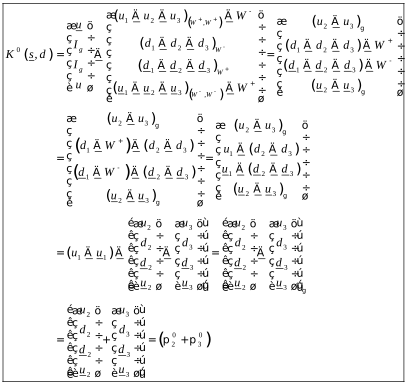
    </mixed-citation>
   </ref>
  </ref-list>
 </back>
</article>