In 1992 Kurokawa
[1]
defined the absolute tensor products (Kurokawa tensor products). The definition is given by
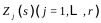
for some zeta functions , where the symbol , which was introduced by Deninger
[2]
, represents the zeta regularized product (see below) and the integer is defined by
where denotes the order of which is a zero of ; now, we regard the poles of as the zeros with negative orders in this paper. Here the zeta regularized products are defined by
where and are complex sequences such that
converges locally, uniformly and absolutely in some s-region included in for with some constant and is a meromorphic function of w at . If then is a meromorphic function of s in the whole and has zeros only at . The integer contributes to the order of . See
[3]
for more details concerning the zeta regularized products. The factors of the zeta regularized products are derived from the summands of , so we call the “factors series” in this paper.
Kurokawa
[1]
also predicted that the absolute tensor product of r arithmetic zeta functions which have the expression by the Euler product over primes would have the Euler product over r-tuples of primes. The validity of Kurokawa’s prediction has been confirmed in some cases, for example, the cases of the Hasse zeta functions of finite fields by Koyama and Kurokawa
[4]
for , by Akatsuka
[5]
for and by Kurokawa and Wakayama
[6]
for general r. Also, the case of the Riemann zeta function for was first proved by Koyama and Kurokawa
[4]
, and then by Akatsuka
[7]
in a different way.
In
[7]
, Akatsuka successfully eliminated the parameter α in the absolute tensor square of Koyama and Kurokawa. In that sense he obtained the true form of the Euler product expression of the absolute tensor square of the Riemann zeta function. He did so by establishing an equation which links the zeros of the Riemann zeta function to prime numbers. In this paper, according to Akatsuka’s method in
[7]
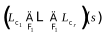
, we will reach the Euler product expression of the absolute tensor product , where denotes the Dirichlet L-function corresponding to a primitive Dirichlet character to the modulus . The key item which leads to our goal is an equation which links the factors series of to r-tuples of prime numbers (see Theorem 4.1 below). We name such equation the “key equation”. In the following, let denote the non-trivial zeros of corresponding to a non-principal primitive Dirichlet character to the modulus and let . We shall count the zeros with multiplicity. Then, letting , where r is a parameter in the key equation, we obtain the zeta regularized product expression of :
Theorem 1.1 We have the following expression for :
(1.1)
From (1.1) and the definition of the absolute tensor products, we find that has the following expression:
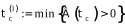
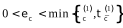
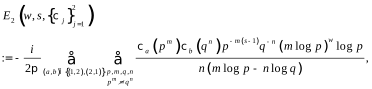
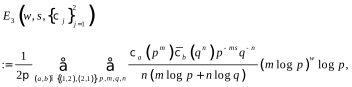
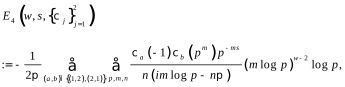
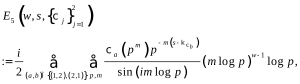
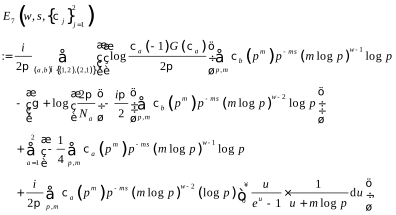
Now, let be primes and be positive integers, and let α be any fixed number with . For the complex numbers with , we define ; we fix arbitrarily with
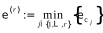
. Also, we define . Define that
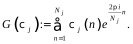
where and , and denote the Euler constant, the gamma function and the Gauss sum respectively, that is,
Then, letting in the key equation, we can deduce the Euler product expression of as follows:
Theorem 1.2 In we have
where , that is,
The proofs of Theorem 1.1 and Theorem 1.2 are given in Section 5 and Section 6 respectively. The contents of the other sections are as follows. In Section 2 some lemmas are proved which are made use of in Section 3 or later. In Section 3 a series is introduced which includes information on the zeros of the Dirichlet L-functions and some properties of the series is shown. In Section 4 the key equation is deduced.
In this section, we prove some lemmas which are used later.
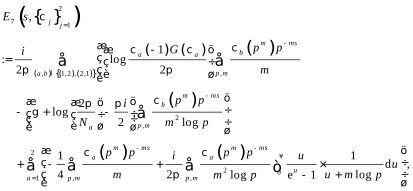
Define that
(2.1)
This function will appear in Section 3 in the properties of a series involving zeros of Dirichlet L-functions in Theorem 3.3.
Remark 2.1 In the following, it is found that has an analytic continuation, and let the same symbol denote its continuation.
We show the properties of in the following lemma:
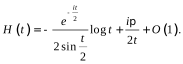
Lemma 2.2 (i) has the following asymptotic behavior at :
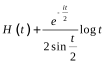
(ii) is a single-valued meromorphic function on the whole .
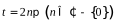
(iii) has the simple poles at with residue .
Remark 2.3 Let and the argument lie in . It follows from Lemma 2.2 (ii) that is a meromorphic function because
is such one.
Proof of Lemma 2.2.
(i) It was proved by Cramér [8, p.116, (19); p.117, (20)] that for
(2.2)
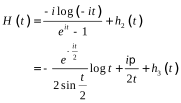
where was a power series of z which converged for . By replacing z for in (2.2), we obtain
(2.3)
for , where is a power series of t which converges for . We can derive the desired result from this.
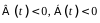
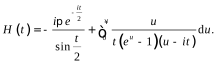
(ii) Note that the integral (2.1) also converges if and that the integrand has pole at with residue . Now, if t moves counterclockwise around the origin from the quadrant into the half-plane across the negative imaginary axis, then the pole at moves from the forth quadrant into the upper half-plane across the positive real axis. Since the positive real axis is the integral path in (2.1), the analytic continuation of into is given by subtracting times the residue of the integrand at from the integral (2.1), that is, for
(2.4)
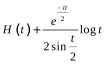
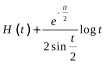
The right-hand side of (5) is meromorphic unless it is on the non-negative real axis, so we find that changes by when it moves counter-clockwise around the origin, making one complete circuit. Therefore is unchanged by the analytic continuation around the origin, so it is a single-valued function on . Furthermore, we find that
is meromorphic for from (4). The proof of (ii) is complete.
(iii) By (2.1) it is easily found that is holomorphic if . From this and Lemma 2.2 (ii), we can obtain the desired result. □
Next, we will show that the Euler product of converges locally and uniformly on . This fact will be used to justify the change of the order of limit and integration in the proof of Theorem 3.3.
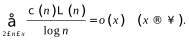
Lemma 2.4 (i) Let be the von Mangoldt function, that is
Then, we have
(2.5)
(ii) The Euler product of ,
converges locally and uniformly on .
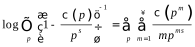
Proof of Lemma 2.4. (i) By the Abel’s summation formula, we have
It was proved in (
[9]
, Theorem 4.4.2) that
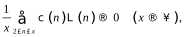
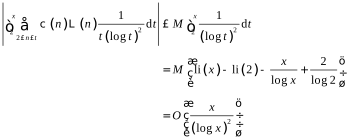
so there exists some positive constant M such that
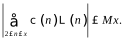
We find from this that
because
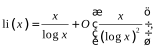
where is the logarithmic integral, that is
Therefore, we have
We obtain the desired result.
(ii) It suffice to prove the local and uniform convergence of
on . We will first show that tends to 0 uniformly on as , where
and then show that converges locally and uniformly as .
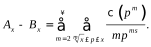
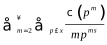
Let s be on . In , since the sum over m converges absolutely, we can exchange the order of the sums:
so we have
The series converges absolutely as if , so tends to 0 uniformly on as .
Since (2.5) holds and is regular at , we can derive the local and uniform convergency of on from M. Riesz’s statement (
[10]
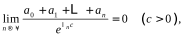
, Satz I): if the coefficients of a Dirichlet series meet the condition
(2.6)
and if the function , which is regular due to the condition (2.6) for , is also regular in certain points of the line then the series converges at these points. The convergence is uniform in any finite interval, which consists only of regularity points.
This completes the proof. □
Lemma 2.5 was proved by Akatsuka
[7]
.
Lemma 2.5 (i) (
[7]
, Lemma 2.5) For any satisfying
(ii) (
[7]
, Remark 2.1) .
(iii) (
[7]
, p.639, (4.4)) For any fixed and any
Also, we shall prove a formula for the gamma function in the following lemma.
Lemma 2.6 Let any fixed satisfy and let and . Then, we have
Proof of Lemma 2.6. For any fixed satisfying , let . Then, we have
When w is fixed in , the both sides are holomorphic in
This completes the proof. □
<xref ref-type="bibr" rid="scirp.133889-"></xref>3. Properties of a Series Concerning the Zeros of the Dirichlet L-Functions
For a series where with for the imaginary zeros of the Riemann zeta function, Cramér
[8]
and Guinand
[11]
deduced the properties: the explicit formula, the meromorphic continuation, the poles, the functional equation and the approximate behavior. Akatsuka
[7]
introduced and proved the properties on the basis of the results of Cramér and Guinand. Kaczorowski
[12]
introduced
and deduced the properties according to Cramér and Guinand.
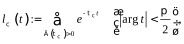
In this section, we define
(3.1)
rewrite the results of Kaczorowski into the ones for and derive the further properties with reference to the methods of Cramér, Guinand and Akatsuka.
Kaczorowski deduced the following assertions concerning :
Lemma 3.1 Let be a Riemann surface of logarithmic type.
(i) (
[12]
, Theorem 3.1) The function can be continued analytically to the meromorphic function on and
is a single-valued meromorphic function on for .
(ii) (
[12]
, Theorem 3.2, (3.4)] The meromorphic function on satisfies the following functional equation:
(3.2)
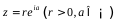
where noting that can be uniquely written as .
Any single-valued function on can be considered as a function on due to the natural projection and then we have . From this and Lemma 3.1 (i), it follows that
so, adding to the both sides of (3.2), we obtain
Noting that , we have
(3.3)
If and the argument lies in then we can derive
because , so under the same assumption, by replacing z by it and multiplying by the both sides in (3.3), we have
Replacing by respectively in this formula, we have
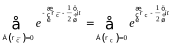
Note that
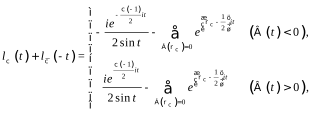
because is a zero of with the same order as . From the above and the meromorphy of if , we obtain the following theorem:
Theorem 3.2 has a meromorphic continuation to for which
(3.4)
where the argument lies in .
Next, we deduce the explicit formula, the approximate behavior and the poles of . Kaczorowski also deduced the explicit formula of , in the proof of which he used an integral path contained in the absolute convergence domain of the Euler product of . The path selection influences the convergence domain of the Euler product of , so we use a different path.
In preparation for the proof of Theorem 3.3, we need to choose a branch of . First, we cut the s-plane from to straight and also remove the area, determined by the inequalities
In the remaining part of the cut plane, each branch of is unique. We choose the one represented for by the series
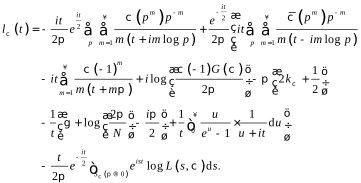
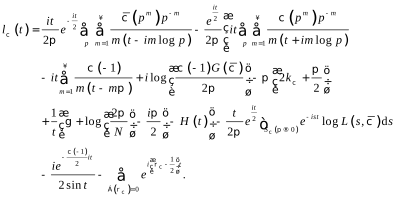
Theorem 3.3 Define .
(i) has the following expression for :
(ii) has the following expression for :
(3.5)
(iii) has the following approximate behavior at :
(iv) has simple poles in only at the following points:
where .
In (ii)-(iv), the argument lies in .
Remark 3.4 It follows from Lemma 2.5 (ii) that the sums over p and m in Theorem 3.3 (i)(ii) converge absolutely and uniformly on any compact subset of .
Proof of Theorem 3.3. (i) If then we have by Cauchy’s theorem
(3.6)
where, choosing that satisfies the condition that has no zeros on the interval ,
and we go around the integral path in the counterclockwise direction. By the integration by parts, (3.6) becomes
where we choose the branch of satisfying the following condition:
and s moves in the cut s-plane . Now, by the result of Montgomery and Vaughan (
[13]
, Theorem 10.16], i.e., there exists a constant such that
where we use the representation
and denotes the completed Dirichlet L-function, that is
so
Therefore, we have
so (3.6) can be rewritten into
(3.7)
where
From the functional equation
(3.8)
we have
where satisfies the following relation: arg(LHS of (3.8)) = arg(RHS of (3.8)) + . Then, the integral of the path becomes
(3.9)
(3.10)
(3.11)
(3.12)
(3.13)
(3.14)
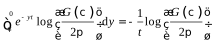
The integrals concerning (3.9) and (3.10) become
(3.15)
and
(3.16)
respectively. By the result of Cramér [8, p. 114, (12)]:
the integral concerning (3.11) is equal to
(3.17)
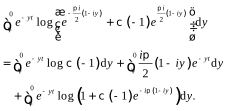
The integral concerning (3.12) is equal to
(3.18)
Since the third term of (3.18) becomes
we have
(3.18) (3.19)
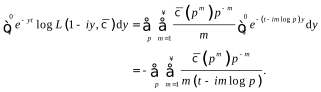
The integral concerning (3.13) becomes
(3.20)
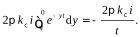
The integral concerning (3.14) becomes
(3.21)
The integral of the path of (3.7) becomes
(3.22)
The above changes of the orders of the sums and integrations are justified by Lemma 2.4(ii), Remark 3.4 and the Dini’s statement (
[8]
, p.112, footprint) that if converges uniformly for with every and also converges uniformly for all then we have
Applying (3.15), (3.16), (3.17), (3.19), (3.20), (3.21) and (3.22) to (3.7), we obtain the desired result.
(ii) Let the argument lie in . By Theorem 3.3 (i), we find that for
By using the equation for deduced in Theorem 3.2, we obtain (3.5) for . Since the right-hand side of (3.5) is meromorphic for if the argument lies in , the proof of (ii) is completed.
In the following, let .
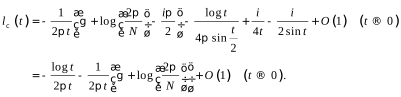
(iii) By Theorem 3.3 (ii) and Lemma 2.2 (i), we find that
(iv) By (3.1), we find trivially that is holomorphic for . From this and the expression obtained in Theorem 3.3 (ii), the desired result follows. □
We consider the bounds of which is needed later. Let denote .
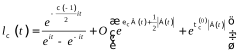
Lemma 3.5 (i) For
(ii) For
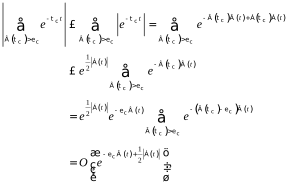
(iii) If with and , then
In (i)-(iii), the argument lies in .
Proof of Lemma 3.5. Let the argument lie in .
(i) If then we have
from (3.1). Since
we obtain the desired result.
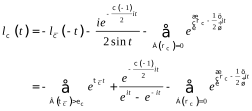
(ii) For , we have
(3.23)
by Theorem 3.2. Concerning the first and third term of the right-hand side of (3.23), we have
and
respectively. Hence, we obtain the desired result.
(iii) When with and , we have
(3.24)
by estimating trivially each term of the right-hand side of (3.5) in Theorem 3.3 except the first term.
If , then , so . Therefore, we have
In the last equation, we use Lemma 2.5 (ii). This completes the proof. □
Now, we fix arbitrarily with and .
Corollary 3.6 (i) For
(3.25)
(3.26)
(ii) If and then
(iii) If , and then
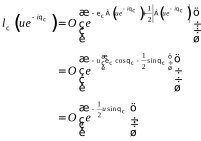
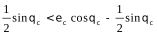
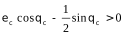
Proof of Corollary 3.6. (i) First, by Lemma 3.5 (i) we find
In the last equation we use the fact that because . Hence, (3.25) has been proved.
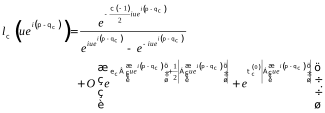
Next, by Lemma 3.5 (ii) we have
(3.27)
Now,
|(the first term of RHS of (3.27))|
Hence, we can deduce
where in the last equation we use the fact that because . Hence, (3.26) holds.
(ii) From Lemma 3.5 (i) and , we can easily deduce the desired result.
(iii) If (respectively ) then we can trivially deduce the desired result from Lemma 3.5 (i) (respectively Lemma 3.5 (ii)).
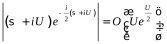
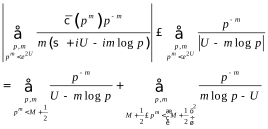
If then we can derive
from Lemma 3.5 (iii). Concerning the first term of the right-hand side, we find that
(3.28)
and that by Lemma 2.5 (i)
(the first term of (3.28))
(the second term of (3.28))
Hence, we can obtain
This completes the proof. □
<xref ref-type="bibr" rid="scirp.133889-"></xref>4. The “Key Equation”
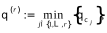
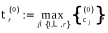
In this section, we prove an equation we name the “key equation” which links the “factors series” of to r-tuples of prime numbers .
Define that
(4.1)
(4.2)
Then, we will show the following theorem:
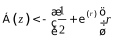
Theorem 4.1 (“key equation”) Let satisfy
and . Then,
(4.3)
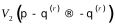
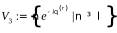
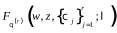
Proof of Theorem 4.1. Let be any fixed real number with and we define
where is the union of , and when
By Corollary 3.6 (i), for large enough u
Therefore, converges absolutely and uniformly on any compact subset of .
Now, when and , we have
by Theorem 3.3 (iv) and Cauchy’s theorem, where
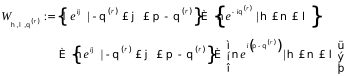
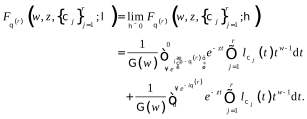
and we go around the integral path in the counterclockwise direction. If then by Theorem 3.3 (iii) we have
(4.4)
By replacing t with -t, using Theorem 3.2 and taking note of
we find that the first term of (4.4) is equal to
Hence, we have
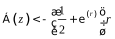
Next, we define that for and let with and with . By Theorem 3.3 (iv) and the residue theorem, we have
(4.5)
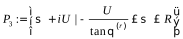
where
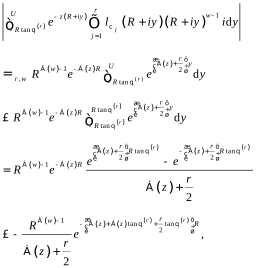
and we go around the integral path in the counterclockwise direction. First, we consider the limit of (4.5) as . Concerning the integral of the path , we have, by Corollary 3.6 (ii),
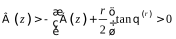
(4.6)
where in the last inequality we use the fact that . From because , it follows that (4.6) vanishes as . Hence, we have
(4.7)
where
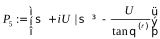
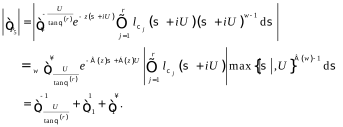
and we go around the integral path in the counterclockwise direction. Next, we consider the limit of (4.7) as . Concerning the integral of the path , we have
(4.8)
About the first term of (4.8), by using Corollary 3.6 (iii) we can deduce
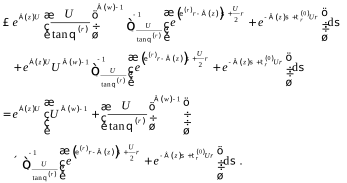
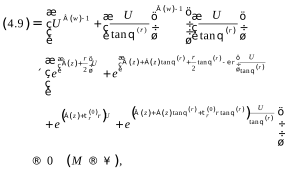
(4.9)
Since
we have
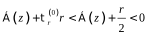
where in the last limit we use the fact that
(4.10)
and
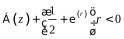
because and . About the second term of (4.8), by using Corollary 3.6 (iii) we have
where in the last limit we use . About the third term of (4.8), by Corollary 3.6 (iii) we have
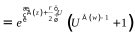
(4.11)
(4.12)
where in transforming (4.11) into (4.12) we use because , and in the last limit we use (4.10). Hence, we obtain
This completes the proof. □
In the following sections, it is necessary that the left-hand side of (4.3) be a meromorphic function of w at . To obtain the property we show a lemma. It is the generalization of the lemma proved by Hirano, Kurokawa and Wakayama (
[14]
, Lemma 1].
Let be any fixed real number and be a locally integrable function on . We define
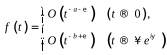
Now, assume that satisfies
for with and any ; converges absolutely, so is an analytic function, in . Then, the following lemma holds.
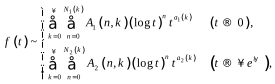
Lemma 4.2 Suppose that has the following approximate behaviors as and :
(4.13)
where are non-negative and finite integers for each k and and are complex sequences with and monotonically increasing. Then has a meromorphic continuation into with poles at and for each k. Especially the poles at are simple if .
Proof of Lemma 4.2. First we define as
Then, in , we have
(4.14)
The first and third terms of the right-hand side of (4.14) are analytic function of w in and in respectively. The second term becomes
and then by partial integration we can transform it into
Hence, we see that is a meromorphic function of w with having poles at in , especially the orders of which at are simple if . Since
, it is shown that the meromorphy of in the left half plane .
In a similar way, we can obtain a meromorphic continuation into the right half plane . □
The meromophy of the left-hand side of (4.3) follows from Lemma 4.2.
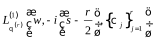
Corollary 4.3 If and
, then and
are meromorphic functions of w on the whole .
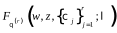
Proof of Corollary 4.3. By the consideration about in the proof of Theorem 4.1, and are holomorphic functions of w under the assumption that
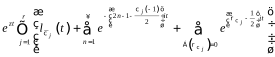
We can remove because it follows from Theorem 3.3 (iii) that
and
which appear in satisfy the condition concerning in (48). By putting we obtain the desired results. □
<xref ref-type="bibr" rid="scirp.133889-"></xref>5. The Zeta Regularized Product Expression of <img src="https://html.scirp.org/file/5302438-rId1024.svg?20240619045145" />
Our goal in this section is to prove Theorem 1.1. We will first obtain an equation which links the factors series of to prime numbers by calculating the both sides of (4.3) with and then prove Theorem 1.1 .
<xref ref-type="bibr" rid="scirp.133889-"></xref>5.1. The Key Equation for r = 1
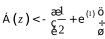
Lemma 5.1 Let satisfy and . Then,
Proof of Lemma 5.1. Since and , we have
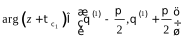
and from this we find . Therefore, by using Lemma 2.6 as we obtain
In a similar way as we can reach the desired result concerning . □
Lemma 5.2 If ,
and then we have
(5.1)
(5.2)
where the argument lies in . The series in (5.1) and (5.2) converge absolutely, locally and uniformly in the given -region above.
Proof of Lemma 5.2. Putting in Lemma 5.1, we obtain the conditions concerning and have
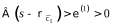
Now, since is derived from and , we find
In the same way, we obtain (5.2).
The absolute and locally uniform convergences of the series in (50) and (51) in and are easily derived from
The desired convergency follows immediately from and including the given -region. □
Lemma 5.3 If ,
and then we have
(5.3)
The series converges absolutely and uniformly on any compact subset of .
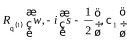
Proof of Lemma 5.3. By Theorem 3.3 (ii) and (iv), we find that the residue in is equal to
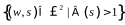
From this (5.3) follows.
It follows from Lemma 2.5 (iii) that the series in (5.3) converges absolutely and uniformly on any compact subset of . □
By using the above three lemmas we derive the desired equation.
Theorem 5.4 If ,
and , we have
(5.4)
Proof of Theorem 5.4. We put and in Theorem 4.1 and then by applying Lemma 5.2 and 5.3 we have
(5.5)
under the conditions that
Then, replacing with in (5.5), we obtain (5.4). □
<xref ref-type="bibr" rid="scirp.133889-"></xref>5.2. Proof of Theorem 1.1
Proof. The left-hand side of (5.4) is a meromorphic function of w on the whole by Corollary 4.3. Hence, by using the definition of the zeta regularized product we have
(5.6)
On the other hand, since , we have
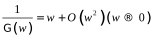
By the property of the zeta regularized products, (5.6) is a meromorphic function on the whole . Hence (1.1) holds. □
<xref ref-type="bibr" rid="scirp.133889-"></xref>6. The Euler Product Expression of <img src="https://html.scirp.org/file/5302438-rId1140.svg?20240619045145" />
In a similar way as Section 5, we will show Theorem 1.2.
<xref ref-type="bibr" rid="scirp.133889-"></xref>6.1. The Key Equation for r = 2
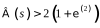
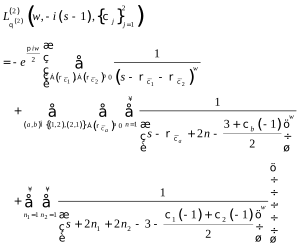
Lemma 6.1 If , and then we have
The series which appear here converge absolutely, locally and uniformly in the given -region above.
Proof of Lemma 6.1. In a similar way as Lemma 5.1 and 5.2 we can prove them. □
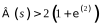
Lemma 6.2 If , and then we have
(6.1)
Proof of Lemma 6.2. Let p and m be any fixed prime number and positive integer respectively. By Theorem 3.3 (ii) and Remark 2.3 we have
Applying this to
leads to (6.1). □
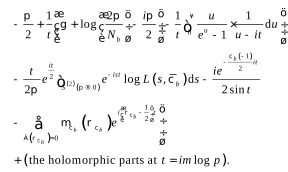
In the following lemma we will show the convergencies of which can be proved in almost the same way as Akatsuka’s method used in (
[7]
, Theorem 1.2).
Lemma 6.3 For , converges absolutely and uniformly on any compact subset of , where
Proof of Lemma 6.3. The desired results follow from Lemma 2.5 (iii) immediately except for , and .
Concerning , we can easily prove its absolute and locally uniform convergence by Lemma 2.5 (iii).
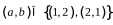
We consider . Let satisfy and for any fixed real numbers δ, A and B with and . Then, for any prime numbers and any we have
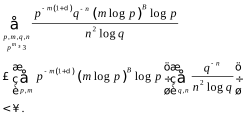
where . From Lemma 2.5 (ii), we have
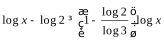
From Lemma 2.5 (ii)(iii), we have
Hence, we find that converges absolutely and uniformly on any compact subset of .
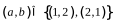
We consider . Let satisfy and for any fixed real numbers δ, A and B with and . Then, for any prime numbers and any we have
where . In the case of , from
for any and Lemma 2.5 (ii), it follows that
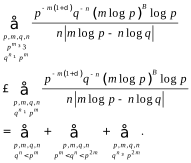
In the case of , we have
(6.2)
Concerning the third term of (6.2), we have because . Therefore, from Lemma 2.5 (ii)(iii), we have
(the third term of (6.2))
(6.3)
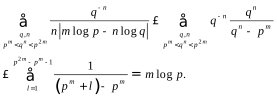
Concerning the second term of (6.2), from Lemma 2.5 (i), we have
Hence, from Lemma 2.5 (iii), we find
(the second term of (6.2)) (6.4)
Concerning the first term of (6.2), from Lemma 2.5 (i), we have
Hence, from Lemma 2.5 (iii), we find
(the first term of 6.2) (6.5)
From (6.3), (6.4) and (6.5), it follows that (6.2) converges. This completes the proof. □
From Lemma 6.1, Lemma 6.2 and Lemma 6.3 we derive the “key equation” for .
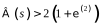
Theorem 6.4 If , and then the following equation holds:
Proof of Theorem 6.4. We put and in Theorem 4.1 and then by applying Lemma 6.1 and Lemma 6.2 and replacing with we obtain the desired result. □
<xref ref-type="bibr" rid="scirp.133889-"></xref>6.2. Proof of Theorem 1.2
Proof. The left-hand side of the formula in Theorem 6.4 is a meromorphic function of w on the whole by Corollary 4.3. Hence, by using the definition of zeta regularized products we have
On the other hand, by Theorem 6.4 and noting that
, we have
for . This completes the proof. □
Acknowledgements
The first author really thanks Ki-ichiro Hashimoto for his special support. The first author also thanks Hirotaka Akatsuka for his showing me the beneficial information for this study.
NOTES
*The second author was partially supported by the INOUE ENRYO Memorial Grant 2023, TOYO University.
References
Kurokawa, N. (1992) Multiple Zeta Functions: An Example. Advanced Studies in Pure Mathematics, 21, 219-226. >https://doi.org/10.2969/aspm/02110219
Deninger, C. (1992) Local L-Factors of Motives and Regularized Determinants. Inventiones Mathematicae, 107, 135-150. >https://doi.org/10.1007/bf01231885
Kurokawa, N. and Wakayama, M. (2004) Zeta Regularizations. Acta Applicandae Mathematicae, 81, 147-166. >https://doi.org/10.1023/b:acap.0000024207.37694.3b
Koyama, S. and Kurokawa, N. (2006) Multiple Euler Products. American Mathematical Society Translations: Series 2, 218, 101-140.
Akatsuka, H. (2005) Euler Product Expression of Triple Zeta Functions. International Journal of Mathematics, 16, 111-136. >https://doi.org/10.1142/s0129167x05002825
Kurokawa, N. and Wakayama, M. (2004) Absolute Tensor Products. International Mathematics Research Notices, 2004, 249-260. >https://doi.org/10.1155/s1073792804132327
Akatsuka, H. (2009) The Double Riemann Zeta Function. Communications in Number Theory and Physics, 3, 619-653. >https://doi.org/10.4310/cntp.2009.v3.n4.a2.
Cramér, H. (1919) Studien über die Nulstellen der Riemannschen Zetafunktion. Mathematische Zeitschrift, 4, 104-130.
Jameson, G.J.O. (2003). The Prime Number Theorem. Cambridge University Press, Cambridge. >https://doi.org/10.1017/cbo9781139164986
M. Riesz, M. (1916) Ein konvergenzsatz für Dirichletsche Reihen. Acta Mathematica, 40, 349-361. >https://doi.org/10.1007/bf02418551
Guinand, A.P. (1949) Fourier Reciprocities and the Riemann Zeta-Function. Proceedings of the London Mathematical Society, 2, 401-414. >https://doi.org/10.1112/plms/s2-51.6.401
Kaczorowski, J. (1990) The K-Functions in Multiplicative Number Theory. I. on Complex Explicit Formulae. Acta Arithmetica, 56, 195-211. >https://doi.org/10.4064/aa-56-3-195-211
Montgomery, H.L. and Vaughan, R.C. (2006) Multiplicative Number Theory I. Cambridge University Press, Cambridge.>https://doi.org/10.1017/cbo9780511618314
Hirano, M., Kurokawa, N. and Wakayama, M. (2003) Half Zeta Functions. Journal of the Ramanujan Mathematical Society, 18, 195-209.

 , where the symbol
  , which was introduced by Deninger
 is defined by
 denotes the order of
  which is a zero of
  ; now, we regard the poles of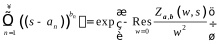
 and
and  are complex sequences such that
 converges locally, uniformly and absolutely in some s-region included in
  for
for  with some constant
  and is a meromorphic function of w at
  . If
. If  then
then  is a meromorphic function of s in the whole
  and has zeros only at
  . The integer
  contributes to the order of
  . See
. See
 , so we call
  of primes. The validity of Kurokawa’s prediction has been confirmed in some cases, for example, the cases of the Hasse zeta functions of finite fields by Koyama and Kurokawa
 , by Akatsuka
 and by Kurokawa and Wakayama
 was first proved by Koyama and Kurokawa
 , where
  denotes the Dirichlet L-function corresponding to a primitive Dirichlet character
  to the modulus
  . The key item which leads to our goal is an equation which links the factors series of
  to r-tuples of prime numbers (see Theorem 4.1 below). We name such equation the “key equation”. In the following, let
  denote the non-trivial zeros of
  corresponding to a non-principal primitive Dirichlet character
  to the modulus
  and let
  . We shall count the zeros with multiplicity. Then, letting
  , where r is a parameter in the key equation, we obtain the zeta regularized product expression of
  :
: :
: (1.1)
(1.1)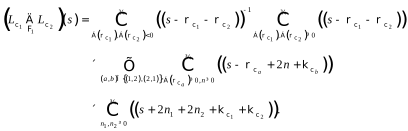
 be primes and
  be positive integers, and let α be any fixed number with
  . For the complex numbers
  with
with  , we define
  ; we fix
  arbitrarily with
  . Also, we define
  . Define that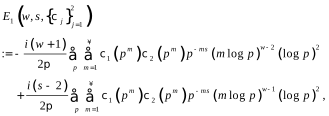


 and
and  ,
,  and
and  denote the Euler constant, the gamma function and the Gauss sum respectively, that is,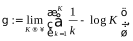

 in the key equation, we can deduce the Euler product expression of
  as follows:
 we have
 , that is,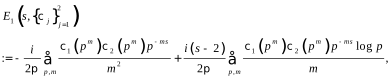






 (2.1)
(2.1) has an analytic continuation, and let the same symbol denote its continuation.
 in the following lemma:
 has the following asymptotic behavior at
  :
:
 is a single-valued meromorphic function on the whole
  .
. with residue
  .
. and the argument lie in
  . It follows from Lemma 2.2 (ii) that
  is a meromorphic function because
  is such one.
 (2.2)
(2.2) was a power series of z which converged for
  . By replacing z for
  in (2.2), we obtain
 (2.3)
(2.3) , where
  is a power series of t which converges for
  and that the integrand has pole at
  with residue
  . Now, if t moves counterclockwise around the origin from the quadrant
  into the half-plane
  across the negative imaginary axis, then the pole at
  moves from the forth quadrant into the upper half-plane across the positive real axis. Since the positive real axis is the integral path in (2.1), the analytic continuation of
  into
into  times the residue of the integrand at
  (2.4)
(2.4) when it moves counter-clockwise around the origin, making one complete circuit. Therefore
  is unchanged by the analytic continuation around the origin, so it is a single-valued function on
  . Furthermore, we find that
  is meromorphic for
  . From this and Lemma 2.2 (ii), we can obtain the desired result. □
 converges locally and uniformly on
  . This fact will be used to justify the change of the order of limit and integration in the proof of Theorem 3.3.
 be the von Mangoldt function, that is
 (2.5)
(2.5) ,
,
 .
.
 is the logarithmic integral, that is

 . We will first show that
  tends to 0 uniformly on
  as
as  , where
 converges locally and uniformly as
  .
. . In
. In  , since the sum over m converges absolutely, we can exchange the order of the sums: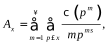
 converges absolutely as
  if
if  , so
, so  tends to 0 uniformly on
  .
. is regular at
  , we can derive the local and uniform convergency of
  on
on 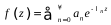 meet the condition
 (2.6)
(2.6) , which is regular due to the condition (2.6) for
  , is also regular in certain points of the line
  then the series converges at these points. The convergence is uniform in any finite interval, which consists only of regularity points.
 satisfying
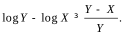
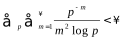 .
. and any
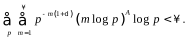
 satisfy
  and let
 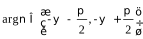 and
and  . Then, we have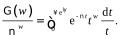
 satisfying
  . Then, we have
 , the both sides are holomorphic in
 where
where  with
with  for the imaginary zeros
  of the Riemann zeta function, Cramér
 and proved the properties on the basis of the results of Cramér and Guinand. Kaczorowski

 (3.1)
(3.1) and derive the further properties with reference to the methods of Cramér, Guinand and Akatsuka.
 :
: be a Riemann surface of logarithmic type.
 can be continued analytically to the meromorphic function on
  and
and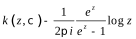
 for
for  .
. satisfies the following functional equation:
 (3.2)
(3.2) noting that
  .
. on
on  can be considered as a function on
  due to the natural projection
  and then we have
  . From this and Lemma 3.1 (i), it follows that
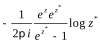 to the both sides of (3.2), we obtain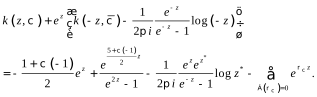
 , we have
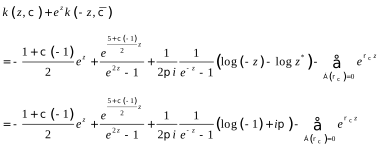 (3.3)
(3.3) and the argument lies in
  then we can derive
 , so under the same assumption, by replacing z by it and multiplying by
  the both sides in (3.3), we have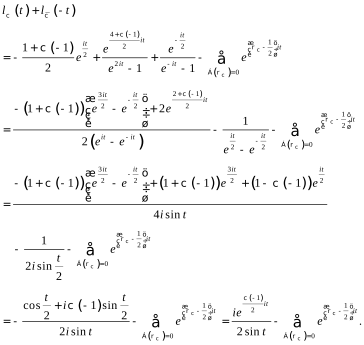
 by
by  respectively in this formula, we have
 is a zero of
  with the same order as
  . From the above and the meromorphy of
  if
if  , we obtain the following theorem:
 has a meromorphic continuation to
  for which
 (3.4)
(3.4) .
. . Kaczorowski also deduced the explicit formula of
  , in the proof of which he used an integral path contained in the absolute convergence domain of the Euler product of
  . The path selection influences the convergence domain of the Euler product of
  , so we use a different path.
 . First, we cut the s-plane from
  to
to  straight and also remove the area, determined by the inequalities
 is unique. We choose the one represented for
  by the series
 .
. has the following expression for
  :
:
 :
: (3.5)
(3.5) :
:
 only at the following points:
 .
. .
. .
. (3.6)
(3.6) that satisfies the condition that
  has no zeros on the interval
  ,
,




 satisfying the following condition: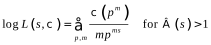
 . Now, by the result of Montgomery and Vaughan (
 such that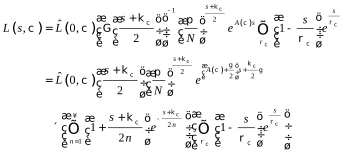
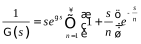
 denotes the completed Dirichlet L-function, that is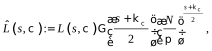


 (3.7)
(3.7)
 (3.8)
(3.8)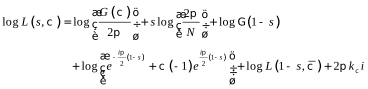
 satisfies the following relation: arg(LHS of (3.8)) = arg(RHS of (3.8)) +
  . Then, the integral of the path
  becomes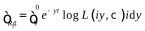
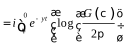 (3.9)
(3.9) (3.10)
 (3.11)
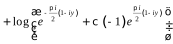 (3.12)
 (3.13)
 (3.14)
 (3.15)
 (3.16)
 (3.17)
 (3.18)
 (3.19)
 (3.20)
 (3.21)
 of (3.7) becomes
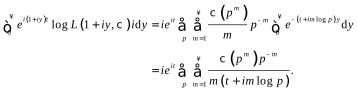 (3.22)
 converges uniformly for
  with every
  and
and  also converges uniformly for all
  then we have
 . By Theorem 3.3 (i), we find that for
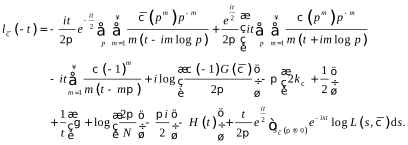
 deduced in Theorem 3.2, we obtain (3.5) for
  . Since the right-hand side of (3.5) is meromorphic for
  if the argument lies in
  , the proof of (ii) is completed.
 .
.
 is holomorphic for
  . From this and the expression obtained in Theorem 3.3 (ii), the desired result follows. □
 which is needed later. Let
  denote
  .
.
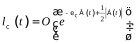

 with
with  and
and  , then
 .
. .
. then we have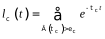
 , we have
 (3.23)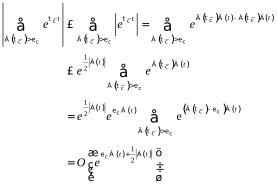
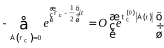
 with
with  and
and  , we have
 (3.24)
 , then
  , so
, so 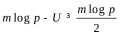 . Therefore, we have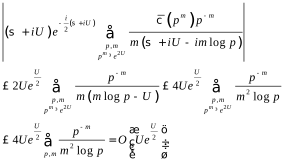
 arbitrarily with
  and
and  .
.
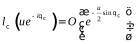 (3.25)
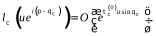 (3.26)
 and
and  then
then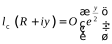
 ,
,  and
and  then
then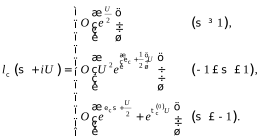
 because
  . Hence, (3.25) has been proved.
 (3.27)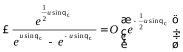

 because
  . Hence, (3.26) holds.
 , we can easily deduce the desired result.
 (respectively
  ) then we can trivially deduce the desired result from Lemma 3.5 (i) (respectively Lemma 3.5 (ii)).
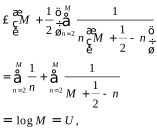
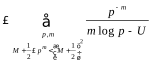
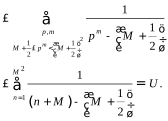
 then we can derive
 (3.28)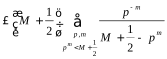

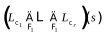 to r-tuples of prime numbers
  .
.

 (4.1)
(4.1)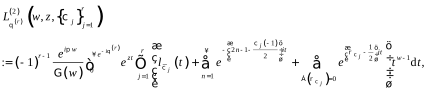

 satisfy
  and
and  . Then,
 (4.3)
(4.3) be any fixed real number with
  and we define
 is the union of
  ,
,  and
and  when
when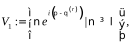


 converges absolutely and uniformly on any compact subset of
  .
. , we have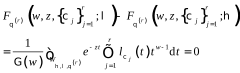
 then by Theorem 3.3 (iii) we have
 (4.4)
(4.4)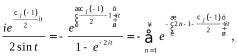


 for
for  and let
  and
and  with
with  . By Theorem 3.3 (iv) and the residue theorem, we have
 (4.5)
(4.5)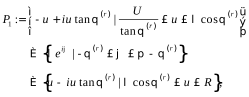

 . Concerning the integral of the path
  , we have, by Corollary 3.6 (ii),
 (4.6)
(4.6) . From
  because
  (4.7)
(4.7)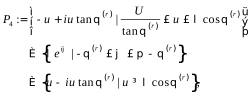
 . Concerning the integral of the path
  , we have
 (4.8)
(4.8)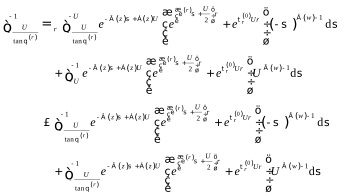
 (4.9)
(4.9)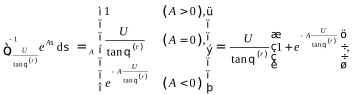
 (4.10)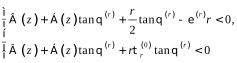
 . About the second term of (4.8), by using Corollary 3.6 (iii) we have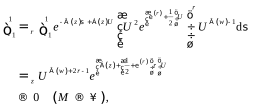
 . About the third term of (4.8), by Corollary 3.6 (iii) we have
 (4.11)
 (4.12)
 because
 . To obtain the property we show a lemma. It is the generalization of the lemma proved by Hirano, Kurokawa and Wakayama (
 be any fixed real number and
  be a locally integrable function on
  . We define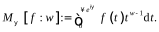
 with
with  and any
  ;
;  converges absolutely, so is an analytic function, in
  . Then, the following lemma holds.
 and
and  :
: (4.13)
 are non-negative and finite integers for each k and
  and
and  are complex sequences with
  and
and  monotonically increasing. Then
  with poles at
  and
and  for each k. Especially the poles at
  are simple if
  .
. as
as
 , we have
 (4.14)
 and in
  respectively. The second term becomes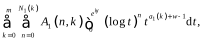

 in
in  , especially the orders of which at
  are simple if
  . Since
  , it is shown that the meromorphy of
  .
. . □
. □ and
and , then
  and
and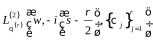 are meromorphic functions of w on the whole
  .
. in the proof of Theorem 4.1,
 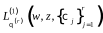 and
and 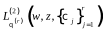 are holomorphic functions of w under the assumption that
 because it follows from Theorem 3.3 (iii) that
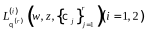 satisfy the condition concerning
  in (48). By putting
  we obtain the desired results. □
 to prime numbers by calculating the both sides of (4.3) with
  and then prove Theorem 1.1 .
 satisfy
  and
and  . Then,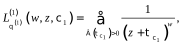
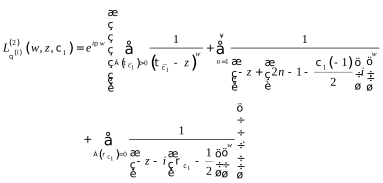
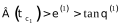 , we have
 . Therefore, by using Lemma 2.6 as
  we obtain
 we can reach the desired result concerning
  . □
. □ ,
,  and
and  then we have
 (5.1)
(5.1)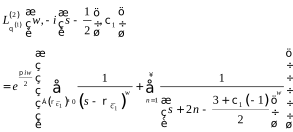 (5.2)
(5.2) . The series in (5.1) and (5.2) converge absolutely, locally and uniformly in the given
  -region above.
 in Lemma 5.1, we obtain the conditions concerning
  and have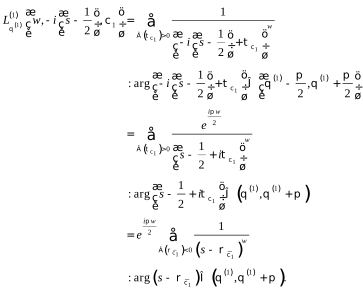
 is derived from
  and
and  , we find
 and
and  are easily derived from
 -region. □
 ,
,  and
and  (5.3)
(5.3)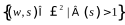 .
. is equal to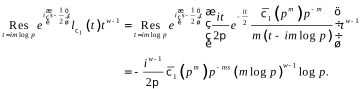
 . □
. □ ,
,  and
and  , we have
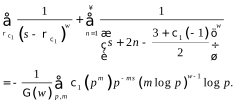 (5.4)
(5.4) and
and  in Theorem 4.1 and then by applying Lemma 5.2 and 5.3 we have
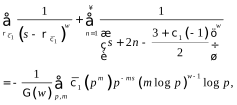 (5.5)
(5.5)

 with
with  in (5.5), we obtain (5.4). □
 by Corollary 4.3. Hence, by using the definition of the zeta regularized product we have
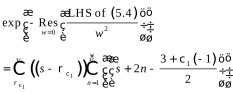 (5.6)
(5.6)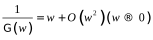 , we have
 . Hence (1.1) holds. □
 ,
,  and
and  then we have
 -region above.
 ,
,  and
and  then we have
 (6.1)
(6.1)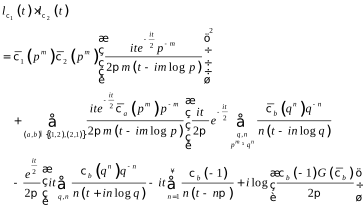

 which can be proved in almost the same way as Akatsuka’s method used in (
 ,
,  converges absolutely and uniformly on any compact subset of
  , where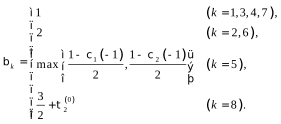
 ,
,  and
and  .
. satisfy
  and
and  for any fixed real numbers δ, A and B with
  and
and  . Then, for any prime numbers
  and any
  we have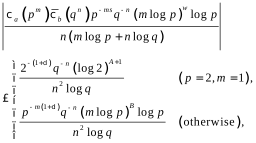
 . From Lemma 2.5 (ii), we have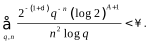
 converges absolutely and uniformly on any compact subset of
  .
. . Let
. Let  satisfy
  and
and  for any fixed real numbers δ, A and B with
  and
and  . Then, for any prime numbers
  and any
  we have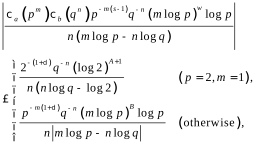
 . In the case of
  , from
  for any
  and Lemma 2.5 (ii), it follows that
 , we have
 (6.2)
(6.2)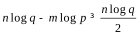 because
  . Therefore, from Lemma 2.5 (ii)(iii), we have
 (6.4)
(6.4)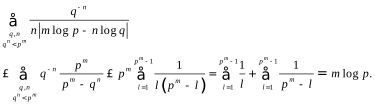
 (6.5)
(6.5) .
. ,
,  and
and  then the following equation holds: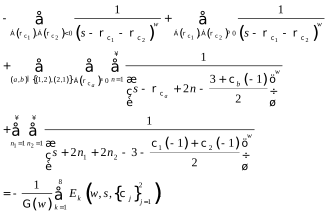
 and
and  in Theorem 4.1 and then by applying Lemma 6.1 and Lemma 6.2 and replacing
  with
with  we obtain the desired result. □
 by Corollary 4.3. Hence, by using the definition of zeta regularized products we have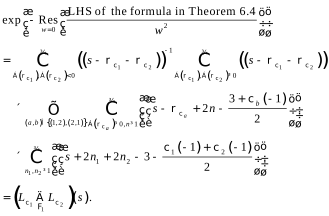
 , we have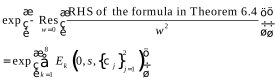
 . This completes the proof. □