<?xml version="1.0" encoding="UTF-8"?><!DOCTYPE article PUBLIC "-//NLM//DTD Journal Publishing DTD v3.0 20080202//EN" "http://dtd.nlm.nih.gov/publishing/3.0/journalpublishing3.dtd">
<article xmlns:mml="http://www.w3.org/1998/Math/MathML" xmlns:xlink="http://www.w3.org/1999/xlink" dtd-version="3.0" xml:lang="en" article-type="research article">
 <front>
  <journal-meta>
   <journal-id journal-id-type="publisher-id">
    ojcm
   </journal-id>
   <journal-title-group>
    <journal-title>
     Open Journal of Composite Materials
    </journal-title>
   </journal-title-group>
   <issn pub-type="epub">
    2164-5612
   </issn>
   <issn publication-format="print">
    2164-5655
   </issn>
   <publisher>
    <publisher-name>
     Scientific Research Publishing
    </publisher-name>
   </publisher>
  </journal-meta>
  <article-meta>
   <article-id pub-id-type="doi">
    10.4236/ojcm.2024.143008
   </article-id>
   <article-id pub-id-type="publisher-id">
    ojcm-133816
   </article-id>
   <article-categories>
    <subj-group subj-group-type="heading">
     <subject>
      Articles
     </subject>
    </subj-group>
    <subj-group subj-group-type="Discipline-v2">
     <subject>
      Chemistry 
     </subject>
     <subject>
       Materials Science
     </subject>
    </subj-group>
   </article-categories>
   <title-group>
    One-Pot Green Synthesis of 1,4-Dihydropyridine Derivatives Using Polyindole TiO
    <sub>2</sub> Nanocatalyst by Solvent Free Method
   </title-group>
   <contrib-group>
    <contrib contrib-type="author" xlink:type="simple">
     <name name-style="western">
      <surname>
       Deepak Babasaheb
      </surname>
      <given-names>
       Phasage
      </given-names>
     </name> 
     <xref ref-type="aff" rid="aff1"> 
      <sup>1</sup>
     </xref>
    </contrib>
    <contrib contrib-type="author" xlink:type="simple">
     <name name-style="western">
      <surname>
       Sanjay K.
      </surname>
      <given-names>
       Sharma
      </given-names>
     </name> 
     <xref ref-type="aff" rid="aff1"> 
      <sup>1</sup>
     </xref>
    </contrib>
    <contrib contrib-type="author" xlink:type="simple">
     <name name-style="western">
      <surname>
       Balram
      </surname>
      <given-names>
       Tripathi
      </given-names>
     </name> 
     <xref ref-type="aff" rid="aff2"> 
      <sup>2</sup>
     </xref>
    </contrib>
    <contrib contrib-type="author" xlink:type="simple">
     <name name-style="western">
      <surname>
       Sonia Chahar
      </surname>
      <given-names>
       Srivastava
      </given-names>
     </name> 
     <xref ref-type="aff" rid="aff2"> 
      <sup>2</sup>
     </xref>
    </contrib>
   </contrib-group> 
   <aff id="aff1">
    <addr-line>
     aDepartment of Chemistry, JECRC University Jaipur, India
    </addr-line> 
   </aff> 
   <aff id="aff2">
    <addr-line>
     aS. S. Jain Subodh PG College, Jaipur, India
    </addr-line> 
   </aff> 
   <pub-date pub-type="epub">
    <day>
     13
    </day> 
    <month>
     06
    </month>
    <year>
     2024
    </year>
   </pub-date> 
   <volume>
    14
   </volume> 
   <issue>
    03
   </issue>
   <fpage>
    109
   </fpage>
   <lpage>
    123
   </lpage>
   <history>
    <date date-type="received">
     <day>
      12,
     </day>
     <month>
      March
     </month>
     <year>
      2024
     </year>
    </date>
    <date date-type="published">
     <day>
      11,
     </day>
     <month>
      March
     </month>
     <year>
      2024
     </year> 
    </date> 
    <date date-type="accepted">
     <day>
      11,
     </day>
     <month>
      June
     </month>
     <year>
      2024
     </year> 
    </date>
   </history>
   <permissions>
    <copyright-statement>
     © Copyright 2014 by authors and Scientific Research Publishing Inc. 
    </copyright-statement>
    <copyright-year>
     2014
    </copyright-year>
    <license>
     <license-p>
      This work is licensed under the Creative Commons Attribution International License (CC BY). http://creativecommons.org/licenses/by/4.0/
     </license-p>
    </license>
   </permissions>
   <abstract>
    This study used a Polyindole in combination with TiO
    <sub>2</sub> nanocatalyst as an efficient heterogeneous catalyst to carry out a multi-component Hantzsch reaction involving different aromatic aldehydes with methyl acetoacetate, and aqueous ammonium to create 1,4-dihydropyridine derivatives under solvent free condition at ambient temperature. A broad range of aldehydes and methyl acetoacetates, ranging from heteroaromatic to polyaromatic one, with high level of functional group tolerance can be used to provide the desired products possessing relevant medicinal moiety in high yields. This technology has prospective advantages over current protocols, including the utilization of a cheap, stable, recyclable, and safe catalyst, quicker reaction times with higher yields and simple product isolation.
   </abstract>
   <kwd-group> 
    <kwd>
     TiO
     <sub>2</sub>
    </kwd> 
    <kwd>
      Nanocatalyst
    </kwd> 
    <kwd>
      Green Synthesis
    </kwd> 
    <kwd>
      Surface Morphology
    </kwd>
   </kwd-group>
  </article-meta>
 </front>
 <body>
  <sec id="s1">
   <title>1. Introduction</title>
   <p>1,4-dihydropyridine scaffolds represents heterocyclic unit of remarkable biological and pharmacological efficiency <xref ref-type="bibr" rid="scirp.133816-1">
     [1]
    </xref>. More than a hundred years ago, 1,4-dihydropyridine derivatives was reported by Arthur Hantzsch <xref ref-type="bibr" rid="scirp.133816-2">
     [2]
    </xref>. These are important precursors due to their pharmacological and biological activities such as antihypertensive <xref ref-type="bibr" rid="scirp.133816-3">
     [3]
    </xref>, anti-anginal and as calcium channel blockers <xref ref-type="bibr" rid="scirp.133816-4">
     [4]
    </xref> <xref ref-type="bibr" rid="scirp.133816-5">
     [5]
    </xref> <xref ref-type="bibr" rid="scirp.133816-6">
     [6]
    </xref> <xref ref-type="bibr" rid="scirp.133816-7">
     [7]
    </xref> <xref ref-type="bibr" rid="scirp.133816-8">
     [8]
    </xref> for the treatment of cardiovascular diseases <xref ref-type="bibr" rid="scirp.133816-9">
     [9]
    </xref>. A number of DHP derivatives are employed as potential drug candidates for the treatment of congestive heart failure, and also acts as NADH mimics for the reduction of carbonyl compounds and their derivatives. Apart from these 1,4-DHP also possess many more pharmacological activities such as anti-bacterial, anti-cancer, anti-microbial, anti-tubercular, antioxidant agents, antiulcer, CFTR, antimalarial and HIV-I protease inhibitory and many more (<xref ref-type="bibr" rid="scirp.133816-#s1">
     Scheme 1
    </xref>) <xref ref-type="bibr" rid="scirp.133816-10">
     [10]
    </xref> <xref ref-type="bibr" rid="scirp.133816-11">
     [11]
    </xref> <xref ref-type="bibr" rid="scirp.133816-12">
     [12]
    </xref>.</p>
   <p>The biological activity of 1,4-dihydropyridine derivatives in numerous sectors has recently gained significant attention, which have persuaded scientists to develop novel new processes for synthesizing them. 1,4-dihydropyridine generally synthesized by condensation of aldehydes, β-ketoester and ammonia or ammonium acetate. The number of attempts has been taken to improve the yield and selectivity of the product under milder condition of this Hantzsch reaction using different alternate process in the literature. All of these aforesaid reaction required one of the following conditions like microwave <xref ref-type="bibr" rid="scirp.133816-13">
     [13]
    </xref> <xref ref-type="bibr" rid="scirp.133816-14">
     [14]
    </xref> <xref ref-type="bibr" rid="scirp.133816-15">
     [15]
    </xref>, ionic liquids <xref ref-type="bibr" rid="scirp.133816-16">
     [16]
    </xref> and higher temperature <xref ref-type="bibr" rid="scirp.133816-17">
     [17]
    </xref> <xref ref-type="bibr" rid="scirp.133816-18">
     [18]
    </xref> <xref ref-type="bibr" rid="scirp.133816-19">
     [19]
    </xref>, ultrasound irradiation, catalyst or reagents like TMSl <xref ref-type="bibr" rid="scirp.133816-20">
     [20]
    </xref>, Molecular Iodine <xref ref-type="bibr" rid="scirp.133816-21">
     [21]
    </xref>, Yb(OTf)<sub>3</sub> <xref ref-type="bibr" rid="scirp.133816-22">
     [22]
    </xref>, FeCl<sub>3</sub> <xref ref-type="bibr" rid="scirp.133816-23">
     [23]
    </xref>, Ceric Ammonium Nitrate <xref ref-type="bibr" rid="scirp.133816-24">
     [24]
    </xref>, Silica gel supported sodium bisulfate <xref ref-type="bibr" rid="scirp.133816-25">
     [25]
    </xref> and Scandium (III) triflate <xref ref-type="bibr" rid="scirp.133816-26">
     [26]
    </xref>. However, all of these methods have some drawbacks, such as the use of hazardous solvents, extended heating, tiresome work-up, by-products, and limited yield.</p>
   <p>In a recent year, Nano catalytic approach for the synthesis of 1,4-dihydropyridine is more advantageous over conventional method due to its enormous activity and selectivity. This methodology becomes green, non-toxic and eco-friendly process. To this content, Safari et al. in 2011, introduce Cobalt nanoparticles catalysed synthesis of 1,4-dihydropyridine <xref ref-type="bibr" rid="scirp.133816-27">
     [27]
    </xref>. In 2012, Tajbakhsh et al. and co-workers reported that TiO<sub>2</sub> has been used as a catalyst in the production of Dihydropyridine <xref ref-type="bibr" rid="scirp.133816-28">
     [28]
    </xref>. In the same year Yang et al. synthesiszed the 1,4-dihydropyridine using magnetic nanocrystalline Fe<sub>3</sub>O<sub>4</sub> as catalyst <xref ref-type="bibr" rid="scirp.133816-29">
     [29]
    </xref>. Further, synthesis of 1,4-dihydropyridine derivatives via one pot condensation of dimedone or</p>
   <fig id="fig1" position="float">
    <label>Figure 1</label>
    <caption>
     <title>Scheme 1. Some commercial drugs containing the 1,4-dihydropyridine core moieties.4-hydroxycumarine, aldehydes and ammonium acetate using Fe<sub>3</sub>O<sub>4</sub>@SiO<sub>2</sub> nano-particles as a heterogeneous catalyst in 2014 by Dam et al. <xref ref-type="bibr" rid="scirp.133816-30">
       [30]
      </xref>. Alinezhad et al. reported synthesis of 1,4-dihydropyridine using Cu-doped ZnO nanocrystalline powder as a heterogeneous catalyst <xref ref-type="bibr" rid="scirp.133816-31">
       [31]
      </xref>. Bajajand and co-workers report CuO nanoflakes for the synthesis of 1,4-dihydropyridine <xref ref-type="bibr" rid="scirp.133816-32">
       [32]
      </xref>. Dehghanizadeh et al. used zinc oxide nanoparticles as heterogeneous nanocatalyst for the synthesis of 1,4-dihydropyridine <xref ref-type="bibr" rid="scirp.133816-33">
       [33]
      </xref>. A Nickel oxide loaded on Zirconia (NiO/ZrO<sub>2</sub>) as a nano catalyst for synthesis of 1,4-dihydropyridine reported by Bhaskaruni et al. in 2019 <xref ref-type="bibr" rid="scirp.133816-34">
       [34]
      </xref>. Later, Cahyana et al. introduce copper iodide nanoparticles for synthesis of 1,4-dihydropyridine <xref ref-type="bibr" rid="scirp.133816-35">
       [35]
      </xref>. However, all above methods has significant drawbacks, such as a longer reaction duration, low yield, lack of recyclability, and a challenging isolation process of the desired products. These challenges encourage researcher to developed new and green synthetic approach to overcome the disadvantages associated to Hantzsch condensation. In this context, polymer supported titanium dioxide (Polyindole TiO<sub>2</sub>) nanocatalytic systems have been developed as green, eco-friendly and reusable nanocatalyst to synthesized 1,4-dihydropyridine.The current study describes the synthesis of polyindole-TiO<sub>2</sub> nanocomposites and their use as a recyclable and possible catalyst for the single-pot, multicomponent synthesis of dihydropyridine without the need of solvents. The synthesis of 1,4-dihydropyridines derivatives derived from raw materials including aldehyde, methyl acetoacetate and ammonia solution under solvent free mild green condition.2. Results and DiscussionTiO<sub>2</sub> nanoparticle FTIR spectra are shown in <xref ref-type="fig" rid="fig1(a)">
       Figure 1(a)
      </xref>. The O-H bond’s stretching vibration shows band at ~3400 cm<sup>−1</sup>, and the bending vibration of O-H group shows peak at 1700 cm<sup>−1</sup>. The peaks identified at 461 and 501.5 cm<sup>−1</sup> is due to the stretching and bending vibrations of Ti-O-Ti group. Broad band in the polyindole-TiO<sub>2</sub> FTIR spectrum at about 3600 cm<sup>−1</sup> suggests the presence of -NH bonds (<xref ref-type="fig" rid="fig1(b)">
       Figure 1(b)
      </xref>). The nitrogen of the indole is not the polymerization site, as indicated by the band at 1570 cm<sup>−1</sup>, which is caused by stretching and deformation vibrations of the -NH bond. The benzene ring is not impacted during the polymerization of indole, according to the sharp band at 740 cm<sup>−1</sup>. The stretching mode of the benzene ring, which is represented by the peaks at 1454 cm<sup>−1</sup> and 1610 cm<sup>−1</sup>, indicates that the benzene ring was not the site of polymerization. This indicates that polymerization occurred.TiO<sub>2</sub> and polyindole-TiO<sub>2</sub> nanocomposites’ surface morphologies were examined using scanning electron microscopy (SEM), and they are depicted in <xref ref-type="fig" rid="fig2(a)">
       Figure 2(a)
      </xref> and <xref ref-type="fig" rid="fig2(b)">
       Figure 2(b)
      </xref>, respectively. As shown in the SEM image, the TiO<sub>2</sub> nanoparticles are heavily aggregated and have a spherical morphology. <xref ref-type="fig" rid="fig2(a)">
       Figure 2(a)
      </xref>. While the TiO<sub>2</sub> nanoparticles, which range in size from 40 to 60 nm, are dispersed in clusters formed by the accumulation of Polyindole particles. By<xref ref-type="bibr" rid="scirp.133816-"></xref><p class="imgGroupCss_v"><img class=" imgMarkCss lazy" data-original="https://html.scirp.org/file/1810423-rId13.jpeg?20240814120511" /></p>Figure 1. FT-IR spectra of (a) TiO<sub>2</sub> &amp; (b) Polyindole TiO<sub>2</sub> (Pin-TiO<sub>2</sub>) nanoparticles.</title>
    </caption>
    <graphic mimetype="image" position="float" xlink:type="simple" xlink:href="https://html.scirp.org/file/1810423-rId12.jpeg?20240814120510" />
   </fig>
   <fig id="fig2" position="float">
    <label>Figure 2</label>
    <caption>
     <title>Figure 2. SEM images of (a) TiO<sub>2</sub> &amp; (b) Polyindole TiO<sub>2</sub> (Pin-TiO<sub>2</sub>) nanoparticles.</title>
    </caption>
    <graphic mimetype="image" position="float" xlink:type="simple" xlink:href="https://html.scirp.org/file/1810423-rId14.jpeg?20240814120511" />
   </fig>
   <p>generating spheres, this functions as a soft template. According to SEM findings, the Polyindole matrix contains nanostructured TiO<sub>2</sub> particles that are evenly dispersed.</p>
   <p>The crystal structure of Polyindole (PIn), TiO<sub>2</sub> and Polyindole-TiO<sub>2</sub> (PIn-TiO<sub>2</sub>) are characterized by XRD. The X-ray diffraction pattern for the synthesized nano TiO<sub>2</sub> is shown in <xref ref-type="fig" rid="fig3(a)">
     Figure 3(a)
    </xref>. The diffraction peak appears at 2θ values with 27.19˚, 35.89˚, 39.56˚, 40.99˚, 44.45˚ and 54.18˚ correlates the crystal planes of (110), (101), (200), (111), (210) and (211) which is matched and confirmed with the standard reference XRD pattern of TiO<sub>2</sub> (JCPDS Card No.21-1276). The high intense peak of the XRD pattern at 2θ value of 27.19 confirmed the prepared TiO<sub>2</sub> nanoparticle correlates the rutile phase and the preferred orientation plane was (110). The X-ray diffraction pattern of synthesized polyindole (PIn) as presented in <xref ref-type="fig" rid="fig3(b)">
     Figure 3(b)
    </xref> shows broad peaks at 19.54 and 25.58˚. The presence of</p>
   <fig id="fig3" position="float">
    <label>Figure 3</label>
    <caption>
     <title>Figure 3. XRD spectra of (a) TiO<sub>2</sub> (b) Polyindole (c) Polyindole-TiO<sub>2</sub> nanoparticles.</title>
    </caption>
    <graphic mimetype="image" position="float" xlink:type="simple" xlink:href="https://html.scirp.org/file/1810423-rId15.jpeg?20240814120511" />
   </fig>
   <p>these broad peaks confirms the polymerization of indole, and diffraction peak at 25.58˚ validates the partial crystalline nature of PIn. Strong diffraction peak at 27.19˚ in the XRD pattern of the polyindole-TiO<sub>2</sub> nanocomposites shown in <xref ref-type="fig" rid="fig3(c)">
     Figure 3(c)
    </xref> indicate that TiO<sub>2</sub> is present in the nanocomposite in rutile phase.</p>
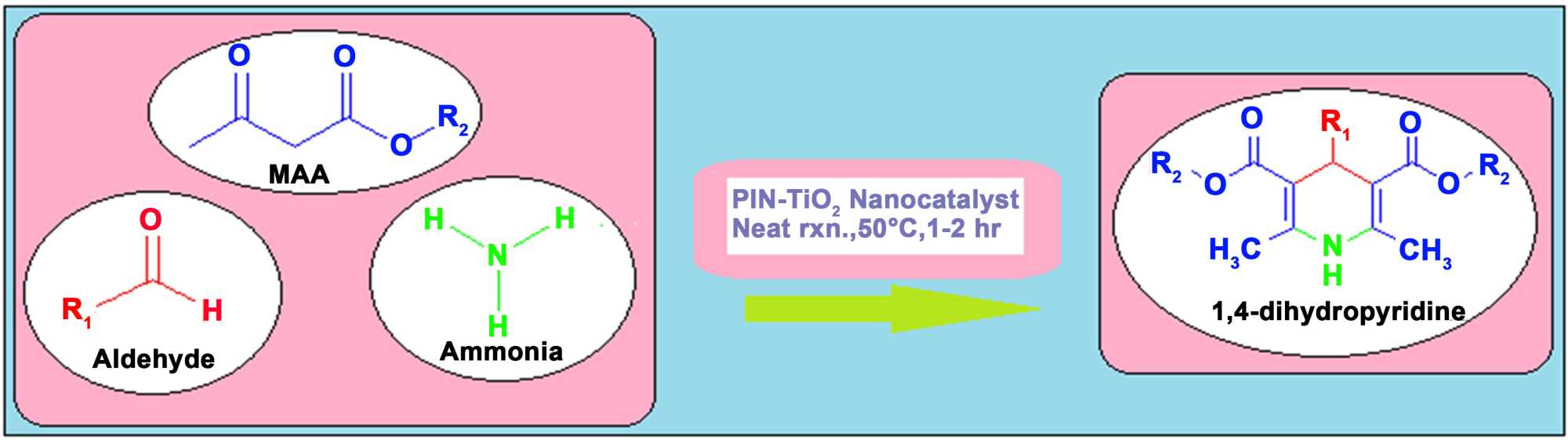
   <p>In these efforts to develop an efficient &amp; environmentally benign methodology for the synthesis of dihydropyridine, we initiated our studies by subjecting catalytic amount of polyindole TiO<sub>2</sub> to the mixture of benzaldehyde, methyl acetoacetate and ammonia solution (25%) in solvent free condition at room temperature. Unfortunately, the resulted yield was very poor even after 24 h of stirring. To increase the yield of the reaction, various solvent systems were screened at 50˚C temperature. We pleased to see that the synthesis of DHP was effective catalyzed by polyindole TiO<sub>2</sub> in solvent free condition at elevated temperature leading to high yield of product. The results are summarized in <xref ref-type="table" rid="table1">
     Table 1
    </xref>. It is evident that the best result was obtained by the application of 5 mol% of Polyindole TiO<sub>2</sub> in solvent free condition at 50˚C. Higher and lower amount of catalyst subsequently reduce the yield of the product (<xref ref-type="table" rid="table1">
     Table 1
    </xref>, entry 5). In typical procedure 1 mmole of aldehyde, 2 mmole of methyl acetoacetate and 2 mmole of ammonia solution were mixed in solvent free condition in presence of 5 mole % of polyindole TiO<sub>2</sub> and reaction mixture was stirred for 1 to 2 h at 50. After workup it produced the corresponding DHP’s with good yield.</p>
   <p>After having optimization condition in our hand, we further explore the substrate scope in <xref ref-type="fig" rid="fig4">
     Figure 4
    </xref>. Electron rich and electron deficient aromatic aldehyde as well as heterocyclic aldehyde work well with our protocol. First of all, aromatic aldehyde possessing an array of either electron donating or withdrawing substituents at both the p and m-position delivered the desired 1, 4-dihydropyridines products (2B, 2D-E, 2G, 2H) in excellent yields. Further, the sterically congested o-substituted aldehyde substrate is also suitable to produce the desired 1,4-dihydropyridines products (2C) in good yield. Interestingly, polyaromatic substrates like, [1,1’-biphenyl]-4-carbaldehyde were equally competent in furnishing the product 2J in excellent yield. Pleasingly, the efficiency of this reaction was not suppressed when heteroaromatic substrates such as thiophene-2-carbaldehyde and 1H-pyrrole-2-carbaldehyde was employed. Notably, the Polyindole TiO<sub>2</sub> offers much easier recyclability than the homogeneous one (<xref ref-type="table" rid="table2">
     Table 2
    </xref>).</p>
   <fig id="fig4" position="float">
    <label>Figure 4</label>
    <caption>
     <title>Figure 4. Substrate scope for the synthesis of 1,4-dihydropyridines derivatives<sup>a</sup>. <sup>a</sup>Reaction conditions: Aromatic aldehyde (1 mmol), methyl acetoacetate (2 mmol) and aq. ammonia solution (2 mmol), 50˚C, 1 - 2 h.</title>
    </caption>
    <graphic mimetype="image" position="float" xlink:type="simple" xlink:href="" />
   </fig>
   <fig id="fig4" position="float">
    <label>Figure 4</label>
    <caption>
     <title>Figure 4. Substrate scope for the synthesis of 1,4-dihydropyridines derivatives<sup>a</sup>. <sup>a</sup>Reaction conditions: Aromatic aldehyde (1 mmol), methyl acetoacetate (2 mmol) and aq. ammonia solution (2 mmol), 50˚C, 1 - 2 h.</title>
    </caption>
    <graphic mimetype="image" position="float" xlink:type="simple" xlink:href="https://html.scirp.org/file/1810423-rId16.jpeg?20240814120511" />
   </fig>
   <fig id="fig4" position="float">
    <label>Figure 4</label>
    <caption>
     <title>Figure 4. Substrate scope for the synthesis of 1,4-dihydropyridines derivatives<sup>a</sup>. <sup>a</sup>Reaction conditions: Aromatic aldehyde (1 mmol), methyl acetoacetate (2 mmol) and aq. ammonia solution (2 mmol), 50˚C, 1 - 2 h.</title>
    </caption>
    <graphic mimetype="image" position="float" xlink:type="simple" xlink:href="https://html.scirp.org/file/1810423-rId17.jpeg?20240814120511" />
   </fig>
   <p>Plausible General Mechanism:</p>
   <p>As reported in the literature, <xref ref-type="bibr" rid="scirp.133816-36">
     [36]
    </xref> the plausible mechanism for nanocatalyzed synthesis of 1,4-dihydropyridine contains the activation of aldehydes and diketones</p>
   <table-wrap id="table1">
    <label>
     <xref ref-type="table" rid="table1">
      Table 1
     </xref></label>
    <caption>
     <title>
      <xref ref-type="bibr" rid="scirp.133816-"></xref>Table 1. Optimization of reaction conditions for the synthesis of 1,4-dihydropyridines.</title>
    </caption>
    <table class="MsoTableGrid custom-table" border="0" cellspacing="0" cellpadding="0"> 
     <tr> 
      <td class="custom-bottom-td acenter" width="11.65%"><p style="text-align:center">Entry</p></td> 
      <td class="custom-bottom-td acenter" width="21.54%"><p style="text-align:center">Catalyst (wt.%)</p></td> 
      <td class="custom-bottom-td acenter" width="16.69%"><p style="text-align:center">Solvent</p></td> 
      <td class="custom-bottom-td acenter" width="16.71%"><p style="text-align:center">Temp ˚C</p></td> 
      <td class="custom-bottom-td acenter" width="16.69%"><p style="text-align:center">Time (h)</p></td> 
      <td class="custom-bottom-td acenter" width="16.71%"><p style="text-align:center">Yield (%)<sup>a</sup></p></td> 
     </tr> 
     <tr> 
      <td class="custom-top-td acenter" width="11.65%"><p style="text-align:center">1</p></td> 
      <td class="custom-top-td acenter" width="21.54%"><p style="text-align:center">5</p></td> 
      <td class="custom-top-td acenter" width="16.69%"><p style="text-align:center">Neat</p></td> 
      <td class="custom-top-td acenter" width="16.71%"><p style="text-align:center">RT</p></td> 
      <td class="custom-top-td acenter" width="16.69%"><p style="text-align:center">24</p></td> 
      <td class="custom-top-td acenter" width="16.71%"><p style="text-align:center">35</p></td> 
     </tr> 
     <tr> 
      <td class="acenter" width="11.65%"><p style="text-align:center">2</p></td> 
      <td class="acenter" width="21.54%"><p style="text-align:center">5</p></td> 
      <td class="acenter" width="16.69%"><p style="text-align:center">MeOH</p></td> 
      <td class="acenter" width="16.71%"><p style="text-align:center">RT</p></td> 
      <td class="acenter" width="16.69%"><p style="text-align:center">24</p></td> 
      <td class="acenter" width="16.71%"><p style="text-align:center">25</p></td> 
     </tr> 
     <tr> 
      <td class="acenter" width="11.65%"><p style="text-align:center">3</p></td> 
      <td class="acenter" width="21.54%"><p style="text-align:center">5</p></td> 
      <td class="acenter" width="16.69%"><p style="text-align:center">EtOH</p></td> 
      <td class="acenter" width="16.71%"><p style="text-align:center">RT</p></td> 
      <td class="acenter" width="16.69%"><p style="text-align:center">24</p></td> 
      <td class="acenter" width="16.71%"><p style="text-align:center">30</p></td> 
     </tr> 
     <tr> 
      <td class="acenter" width="11.65%"><p style="text-align:center">4</p></td> 
      <td class="acenter" width="21.54%"><p style="text-align:center">5</p></td> 
      <td class="acenter" width="16.69%"><p style="text-align:center">THF</p></td> 
      <td class="acenter" width="16.71%"><p style="text-align:center">RT</p></td> 
      <td class="acenter" width="16.69%"><p style="text-align:center">4</p></td> 
      <td class="acenter" width="16.71%"><p style="text-align:center">10</p></td> 
     </tr> 
     <tr> 
      <td class="acenter" width="11.65%"><p style="text-align:center">5</p></td> 
      <td class="acenter" width="21.54%"><p style="text-align:center">5</p></td> 
      <td class="acenter" width="16.69%"><p style="text-align:center">Neat</p></td> 
      <td class="acenter" width="16.71%"><p style="text-align:center">50</p></td> 
      <td class="acenter" width="16.69%"><p style="text-align:center">1.5</p></td> 
      <td class="acenter" width="16.71%"><p style="text-align:center">95</p></td> 
     </tr> 
     <tr> 
      <td class="acenter" width="11.65%"><p style="text-align:center">6</p></td> 
      <td class="acenter" width="21.54%"><p style="text-align:center">0</p></td> 
      <td class="acenter" width="16.69%"><p style="text-align:center">Neat</p></td> 
      <td class="acenter" width="16.71%"><p style="text-align:center">50</p></td> 
      <td class="acenter" width="16.69%"><p style="text-align:center">6.5</p></td> 
      <td class="acenter" width="16.71%"><p style="text-align:center">70</p></td> 
     </tr> 
     <tr> 
      <td class="acenter" width="11.65%"><p style="text-align:center">7</p></td> 
      <td class="acenter" width="21.54%"><p style="text-align:center">10</p></td> 
      <td class="acenter" width="16.69%"><p style="text-align:center">Neat</p></td> 
      <td class="acenter" width="16.71%"><p style="text-align:center">50</p></td> 
      <td class="acenter" width="16.69%"><p style="text-align:center">1.5</p></td> 
      <td class="acenter" width="16.71%"><p style="text-align:center">83</p></td> 
     </tr> 
     <tr> 
      <td class="acenter" width="11.65%"><p style="text-align:center">8</p></td> 
      <td class="acenter" width="21.54%"><p style="text-align:center">15</p></td> 
      <td class="acenter" width="16.69%"><p style="text-align:center">Neat</p></td> 
      <td class="acenter" width="16.71%"><p style="text-align:center">50</p></td> 
      <td class="acenter" width="16.69%"><p style="text-align:center">1.5</p></td> 
      <td class="acenter" width="16.71%"><p style="text-align:center">70</p></td> 
     </tr> 
     <tr> 
      <td class="acenter" width="11.65%"><p style="text-align:center">9</p></td> 
      <td class="acenter" width="21.54%"><p style="text-align:center">5</p></td> 
      <td class="acenter" width="16.69%"><p style="text-align:center">MeOH</p></td> 
      <td class="acenter" width="16.71%"><p style="text-align:center">50</p></td> 
      <td class="acenter" width="16.69%"><p style="text-align:center">4.0</p></td> 
      <td class="acenter" width="16.71%"><p style="text-align:center">75</p></td> 
     </tr> 
     <tr> 
      <td class="acenter" width="11.65%"><p style="text-align:center">10</p></td> 
      <td class="acenter" width="21.54%"><p style="text-align:center">5</p></td> 
      <td class="acenter" width="16.69%"><p style="text-align:center">EtOH</p></td> 
      <td class="acenter" width="16.71%"><p style="text-align:center">50</p></td> 
      <td class="acenter" width="16.69%"><p style="text-align:center">4.5</p></td> 
      <td class="acenter" width="16.71%"><p style="text-align:center">69</p></td> 
     </tr> 
     <tr> 
      <td class="acenter" width="11.65%"><p style="text-align:center">11</p></td> 
      <td class="acenter" width="21.54%"><p style="text-align:center">5</p></td> 
      <td class="acenter" width="16.69%"><p style="text-align:center">IPA</p></td> 
      <td class="acenter" width="16.71%"><p style="text-align:center">50</p></td> 
      <td class="acenter" width="16.69%"><p style="text-align:center">6</p></td> 
      <td class="acenter" width="16.71%"><p style="text-align:center">70</p></td> 
     </tr> 
    </table>
   </table-wrap>
   <p><sup>a</sup>Isolated yield.</p>
   <table-wrap id="table2">
    <label>
     <xref ref-type="table" rid="table2">
      Table 2
     </xref></label>
    <caption>
     <title>
      <xref ref-type="bibr" rid="scirp.133816-"></xref>Table 2. Catalyst recovery study data under optimized condition.</title>
    </caption>
    <table class="MsoTableGrid custom-table" border="0" cellspacing="0" cellpadding="0"> 
     <tr> 
      <td class="custom-bottom-td acenter" width="33.33%"><p style="text-align:center">Entry</p></td> 
      <td class="custom-bottom-td acenter" width="33.33%"><p style="text-align:center">Time (h)</p></td> 
      <td class="custom-bottom-td acenter" width="33.34%"><p style="text-align:center">Yield (%)<sup>a</sup></p></td> 
     </tr> 
     <tr> 
      <td class="custom-top-td acenter" width="33.33%"><p style="text-align:center">1<sup>st</sup> cycle</p></td> 
      <td class="custom-top-td acenter" width="33.33%"><p style="text-align:center">1.5</p></td> 
      <td class="custom-top-td acenter" width="33.34%"><p style="text-align:center">98</p></td> 
     </tr> 
     <tr> 
      <td class="acenter" width="33.33%"><p style="text-align:center">2<sup>nd</sup> cycle</p></td> 
      <td class="acenter" width="33.33%"><p style="text-align:center">1.5</p></td> 
      <td class="acenter" width="33.34%"><p style="text-align:center">96</p></td> 
     </tr> 
     <tr> 
      <td class="acenter" width="33.33%"><p style="text-align:center">3<sup>rd</sup> cycle</p></td> 
      <td class="acenter" width="33.33%"><p style="text-align:center">2.0</p></td> 
      <td class="acenter" width="33.34%"><p style="text-align:center">93</p></td> 
     </tr> 
     <tr> 
      <td class="acenter" width="33.33%"><p style="text-align:center">4<sup>th</sup> cycle</p></td> 
      <td class="acenter" width="33.33%"><p style="text-align:center">2.5</p></td> 
      <td class="acenter" width="33.34%"><p style="text-align:center">90</p></td> 
     </tr> 
     <tr> 
      <td class="acenter" width="33.33%"><p style="text-align:center">5<sup>th</sup> cycle</p></td> 
      <td class="acenter" width="33.33%"><p style="text-align:center">3.5</p></td> 
      <td class="acenter" width="33.34%"><p style="text-align:center">89</p></td> 
     </tr> 
     <tr> 
      <td class="acenter" width="33.33%"><p style="text-align:center">6<sup>th</sup> cycle</p></td> 
      <td class="acenter" width="33.33%"><p style="text-align:center">5.0</p></td> 
      <td class="acenter" width="33.34%"><p style="text-align:center">85</p></td> 
     </tr> 
    </table>
   </table-wrap>
   <p><sup>a</sup>Isolated yield.</p>
   <p>by nanoparticles followed by nucleophilic attack to form intermediate A. Intermediate A was further activated by the nanoparticle and facilitated the nucleophilic attack by intermediate B to form intermediate C. After following the intra-molecular cyclization to generate intermediate D, which was further deprotonated to form intermediate E, and finally the resulting 1,4-dihydropyridine (F) is formed after dehydration of intermediate E (<xref ref-type="bibr" rid="scirp.133816-#s2">
     Scheme 2
    </xref>).</p>
  </sec><sec id="s2">
   <title>3. Experimental Method</title>
   <p>General experimental description:</p>
   <p>Chemicals, reagents and solvents were obtained from Sigma Aldrich Company. All compounds were identified by their physical and spectroscopic data. The nanomaterial has been characterized by Fourier transform infrared analysis galaxy series FT-IR 5000 spectrometer, scanning electron microscopy (SEM) by MIRA III from TESCAN Company and Philips XL30, X-ray diffraction by JEOL JDX-8030 (30 kV, 20 mA), On a Brucker spectrophotometer (400 MHz) in</p>
   <fig id="fig5" position="float">
    <label>Figure 5</label>
    <caption>
     <title>Scheme 2. Plausible mechanism for synthesis of 1, 4-dihydropyridine.DMSO-d<sub>6</sub> or CDCl<sub>3</sub>. All the <sup>1</sup>H and <sup>13</sup>C{<sup>1</sup>H} NMR spectra were referenced internally to the residual solvent signals. On an Agilent model, the mass spectra were captured. Melting points were determined uncorrected utilizing capillary tubes on an electrothermal digital instrument.Preparation of TiO<sub>2</sub> Nanoparticles:Under a nitrogen atmosphere, titanium tetrachloride (TiCl<sub>4</sub>) was added drop by drop to ethanol and water (1:1) to create TiO<sub>2</sub> nanoparticles. At room temperature, the reaction mixture was agitated for 12 hours to produce a yellow-colored solution of TiO<sub>2</sub> nanoparticles. After being obtained, the nanoparticles were filtered, dried at 80˚C in an oven, and then calcined for an hour at 350˚C in a furnace.Preparation of Polyindole-TiO<sub>2</sub> Nanoparticles:The monomer indole (1 mmol) and a 5% aq hydrochloric acid solution were added to a round-bottom flask and warmed to 40˚C to form a clear solution. To this clear solution, TiO<sub>2</sub> nanoparticles were added, polymerization reaction was allowed to proceed for two hours. Under constant stirring, ammonium persulfate (1 mmol) solution in 10 ml de-ionised water was added dropwise to the monomer solution containing TiO<sub>2</sub> at 0˚C - 5˚C. The reaction mixture was allowed to stand for 12 hours at room temperature to form greenish-black precipitation of polymerized material, which was filtered and washed with cold water. The isolated polyindole-TiO<sub>2</sub> nanoparticles were dried under vacuum at 70˚C and characterized by FTIR, XRD, and SEM.General procedure for the synthesis of 1,4-dihydropyridine:A mixture of aromatic aldehyde (1 mmol), methyl acetoacetate (2 mmol), and aq. ammonia solution (2 mmol) was mixed at room temperature. The mixture was stirred for 5 minutes. Polyindole-TiO<sub>2</sub> Nano-PiN.TiO<sub>2</sub> (5%W) as a catalyst was then added, and the reaction mixture was stirred magnetically at 50˚C. The progress and completion of the reaction were monitored by TLC (n-hexane/ethyl acetate: 3:1 v/v) during appropriate time periods. After completion of the reaction, 5 ml of methanol was added, and the catalyst was separated by simple filtration. Filtrate was added to 15 ml of cold water, and precipitates were filtered off and washed with the cold methanol-water mixture. Further purification is done by crystallization using methanol to obtain a pure product as a solid material.4. Spectroscopic Data for the New CompoundsDimethyl 1,4-dihydro-2,6-dimethyl-4-phenylpyridine-3,5-dicarboxylate (2A):</title>
    </caption>
    <graphic mimetype="image" position="float" xlink:type="simple" xlink:href="https://html.scirp.org/file/1810423-rId18.jpeg?20240814120512" />
   </fig>
   <p>Appearance: white solid, Melting Point: 191˚C - 193˚C.</p>
   <p><sup>1</sup>H NMR (400 MHz, CDCl<sub>3</sub>) δ 7.27 - 7.25 (m, 2H), 7.23-7.21 (m, 2H), 7.15 - 7.11 (m, 1H), 5.65 (s, 1H), 5.00 (s, 1H), 3.64 (s, 6H), 2.34 (s, 6H) ppm. <sup>13</sup>C{<sup>1</sup>H} NMR (101 MHz, CDCl<sub>3</sub>) δ 168.2, 147.5, 144.3, 128.2, 127.8, 126.3, 104.1, 51.1, 39.4, 19.8 ppm. Mass (m/z): Mass (M + 1): 302.9.</p>
   <p>Dimethyl 4-(4-chlorophenyl)-1,4-dihydro-2,6-dimethylpyridine-3,5-icarboxylate (2B):</p>
   <p>Appearance: white solid, Melting Point: 196˚C - 198˚C.</p>
   <p><sup>1</sup>H NMR (400 MHz, CDCl<sub>3</sub>) δ 7.20 - 7.16 (m, 4H), 5.67 (s, 1H), 4.97 (s, 1H), 3.64 (s, 6H), 2.33 (s, 6H) ppm. <sup>13</sup>C{<sup>1</sup>H} NMR (101 MHz, CDCl<sub>3</sub>) δ 167.9, 146.1, 144.4, 132.0, 129.2, 128.3, 103.8, 51.2, 39.1, 19.8 ppm. Mass (M + 1): Mass (M + 1): 337.2.</p>
   <p>Dimethyl 4-(2-chlorophenyl)-1,4-dihydro-2,6-dimethylpyridine-3,5-dicarboxylate (2C):</p>
   <p>Appearance: white solid, Melting Point: 144˚C - 146˚C.</p>
   <p><sup>1</sup>H NMR (400 MHz, CDCl<sub>3</sub>) δ 7.37 - 7.35 (m, J = 7.7, 1.6 Hz, 1H), 7.23 (dd, J = 7.9, 1.1 Hz, 1H), 7.12 (td, J = 7.6, 1.1 Hz, 1H), 7.03 (td, J = 7.8, 1.6 Hz, 1H), 5.69 (s, 1H), 5.39 (s, 1H), 3.60 (s, 6H), 2.31 (s, 6H) ppm. <sup>13</sup>C{<sup>1</sup>H} NMR (101 MHz, CDCl<sub>3</sub>) δ 168.1, 146.0, 144.2, 132.5, 131.3, 129.4, 127.4, 127.0, 104.1, 51.0, 37.3, 19.6 ppm. Mass (M + 1): 337.1.</p>
   <p>Dimethyl 4-(4-fluorophenyl)-1,4-dihydro-2,6-dimethylpyridine-3,5-dicarboxylate (2D):</p>
   <p>Appearance: off white solid, Melting Point: 171˚C - 173˚C.</p>
   <p><sup>1</sup>H NMR (400 MHz, CDCl<sub>3</sub>) δ 7.22 - 7.19 (m, 2H), 6.90 - 6.86 (m, 2H), 5.81 (s, 1H), 4.97 (s, 1H), 3.64 (s, 6H), 2.32 (s, 6H) ppm. <sup>13</sup>C{<sup>1</sup>H} NMR (101 MHz, CDCl<sub>3</sub>) δ 168.1, 161.5 (d, J = 243.7 Hz), 144.3, 143.4, 129.2 (d, J = 7.8 Hz), 114.8 (d, J = 21.0 Hz), 104.0, 51.2, 38.8, 19.7 ppm. Mass (M + 1): 319.7.</p>
   <p>Dimethyl 1,4-dihydro-4-(4-methoxyphenyl)-2,6-dimethylpyridine-3,5-dicarboxylate (2E):</p>
   <p>Appearance: off white solid, Melting Point: 180˚C - 182˚C.</p>
   <p><sup>1</sup>H NMR (400 MHz, CDCl<sub>3</sub>) δ 7.17 (d, J = 8.4 Hz, 2H), 6.75 (d, J = 8.3 Hz, 2H), 5.74 (s, 1H), 4.94 (s, 1H), 3.75 (s, 3H), 3.64 (s, 6H), 2.32 (s, 6H) ppm. <sup>13</sup>C{<sup>1</sup>H} NMR (101 MHz, CDCl<sub>3</sub>) δ 168.2, 158.1, 144.0, 140.1, 128.7, 113.5, 104.3, 55.3, 51.1, 38.6, 19.7 ppm. Mass (M + 1): 332.2.</p>
   <p>Dimethyl 1,4-dihydro-2,6-dimethyl-4-(thiophen-2-yl)pyridine-3,5-dicarboxylate (2F):</p>
   <p>Appearance: pale yellow solid, Melting Point: 197-198˚C.</p>
   <p><sup>1</sup>H NMR (400 MHz, CDCl<sub>3</sub>) δ 7.05 (dd, J = 5.1, 1.2 Hz, 1H), 6.86-6.84 (m, 1H), 6.78-6.77 (m, 1H), 5.92 (s, 1H), 5.33 (s, 1H), 3.71 (s, 6H), 2.34 (s, 6H) ppm. <sup>13</sup>C{<sup>1</sup>H} NMR (101 MHz, CDCl<sub>3</sub>) δ 167.8, 151.5, 145.0, 126.6, 123.4, 123.1, 103.5, 51.3, 34.4, 19.6 ppm. Mass (M + 1): 307.9.</p>
   <p>Dimethyl 1,4-dihydro-2,6-dimethyl-4-(4-nitrophenyl)pyridine-3,5-dicarboxylate (2G):</p>
   <p>Appearance: yellow solid, Melting Point: 195˚C - 197˚C.</p>
   <p><sup>1</sup>H NMR (400 MHz, CDCl<sub>3</sub>) δ 8.08 (d, J = 8.7 Hz, 2H), 7.43 (t, J = 5.6 Hz, 2H), 5.81 (s, 1H), 5.10 (s, 1H), 3.64 (s, 6H), 2.35 (s, 6H) ppm. <sup>13</sup>C{<sup>1</sup>H} NMR (101 MHz, CDCl<sub>3</sub>) δ 167.6, 154.9, 146.5, 145.1, 128.7, 123.6, 103.1, 51.3, 40.0, 19.8 ppm. Mass (M + 1): 347.1, 348.2.</p>
   <p>Dimethyl 1,4-dihydro-2,6-dimethyl-4-(3-nitrophenyl)pyridine-3,5-dicarboxylate (2H):</p>
   <p>Appearance: pale yellow solid, Melting Point: 207˚C - 209˚C.</p>
   <p><sup>1</sup>H NMR (400 MHz, CDCl<sub>3</sub>) δ 8.09 (t, J = 2.0 Hz, 1H), 8.01-7.98 (m, 1H), 7.63 - 7.61 (m, 1H), 7.37 (t, J = 7.9 Hz, 1H), 5.86 (s, 1H), 5.10 (s, 1H), 3.64 (s, 6H), 2.36 (s, 6H) ppm. <sup>13</sup>C{<sup>1</sup>H} NMR (126 MHz, CDCl<sub>3</sub>) δ 167.6, 149.7, 148.5, 145.1, 134.3, 128.9, 122.9, 121.6, 103.3, 51.3, 39.8, 19.8 ppm. Mass (M + 1): 347.2, 348.2.</p>
   <p>Dimethyl 1,4-dihydro-2,6-dimethyl-4-(1H-pyrrol-2-yl)pyridine-3,5-dicarboxylate (2I):</p>
   <p>Appearance: green solid, Melting Point: 186˚C - 188˚C.</p>
   <p><sup>1</sup>H NMR (400 MHz, CDCl<sub>3</sub>) δ 8.69 (s, 1H), 6.65-6.63 (m, 1H), 6.04 - 6.02 (m, 1H), 5.72 (s, 2H), 5.04 (s, 1H), 3.71 (s, 6H), 2.30 (s, 6H) ppm. <sup>13</sup>C{<sup>1</sup>H} NMR (101 MHz, CDCl<sub>3</sub>) δ 168.7, 145.0, 136.9, 116.7, 107.7, 104.2, 102.1, 51.5, 32.4, 19.9 ppm. Mass (M + Na): 314.2.</p>
   <p>Dimethyl 4-([1,1’-biphenyl]-4-yl)-2,6-dimethyl-1,4-dihydropyridine-3,5-dicarboxylate (2J):</p>
   <p>Appearance: white solid, Melting Point: 225˚C - 227˚C.</p>
   <p><sup>1</sup>H NMR (400 MHz, CDCl<sub>3</sub>) δ 7.55 - 7.53 (m, 2H), 7.45 - 7.38 (m, 4H), 7.34 - 7.27 (m, 3H), 5.76 (s, 1H), 5.05 (s, 1H), 3.66 (s, 6H), 2.35 (s, 6H) ppm. <sup>13</sup>C{<sup>1</sup>H} NMR (126 MHz, CDCl<sub>3</sub>) δ 168.2, 146.6, 144.4, 141.3, 139.1, 128.8, 128.1, 127.1, 127.0, 127.0, 103.9, 51.2, 39.1, 19.7 ppm. Mass (M + 1): 378.1, 379.2.</p>
   <p>Dimethyl 4-(3-bromopyridin-2-yl)-1,4-dihydro-2,6-dimethylpyridine-3,5-dicarboxylate (2K):</p>
   <p>Appearance: Off white solid, Melting Point: 191˚C - 192˚C.</p>
   <p>
    <xref ref-type="bibr" rid="scirp.133816-"></xref><sup>1</sup>H NMR (400 MHz, CDCl<sub>3</sub>) δ 7.09 - 6.74 (m, 1H), 5.67 (s, 1H), 5.17 (s, 1H), 3.62 (s, 6H), 2.33 (s, 6H) ppm. <sup>13</sup>C{<sup>1</sup>H} NMR (126 MHz, CDCl<sub>3</sub>) δ 168.1, 167.0, 146.7, 141.6, 138.3, 126.4, 123.2, 100.8, 50.9, 43.2, 19.2 ppm. Mass (M/Z): 381.1.</p>
   <p>Dimethyl 4-(5-bromo-2-methoxyphenyl)-1,4-dihydro-2,6-dimethylpyridine-3,5-dicarboxylate (2L):</p>
   <p>Appearance: off white solid, Melting Point: 198˚C - 200˚C.</p>
   <p><sup>1</sup>H NMR (400 MHz, CDCl<sub>3</sub>) δ 7.21 - 7.18 (m, 2H), 6.68 (d, J = 8.5 Hz, 1H), 5.68 (s, 1H), 5.25 (s, 1H), 3.79 (s, 3H), 3.62 (s, 6H), 2.30 (s, 6H) ppm. <sup>13</sup>C{<sup>1</sup>H} NMR (101 MHz, CDCl<sub>3</sub>) δ 168.3, 156.1, 144.3, 137.8, 132.7, 130.2, 112.9, 112.8, 102.8, 56.0, 51.1, 34.9, 19.5 ppm. Mass (M + 1): 412.1, 413.</p>
  </sec><sec id="s3">
   <title>5. Conclusion</title>
   <p>We present a solvent-free catalytic method for synthesizing biologically relevant dihydropyridine derivatives from aromatic aldehydes, methyl acetoacetate, and aqueous ammonium. Key aspects of this protocol include 1) The use of a recyclable catalyst; 2) Short reaction times; 3) Broad substrate compatibility with excellent functional group tolerance, yielding compounds with potential medicinal activity. Additionally, recyclability studies demonstrate that the catalyst maintains nearly unchanged catalytic activity over multiple cycles without loss of efficacy. In order to synthesis 1,4-dihydropyridine under environmentally friendly conditions, we have created stable and novel polyindole-TiO<sub>2</sub> nanoparticles. This approach emphasizes the beneficial features such shorter reaction times, the removal of hazardous solvents and byproducts, quick work-up, and straightforward product separation. The nano-catalyst also demonstrated good reactivity and effective catalytic recyclability.</p>
  </sec><sec id="s4">
   <title>Appendix</title>
   <p><p class="imgGroupCss_v"><img class=" imgMarkCss lazy" data-original="https://html.scirp.org/file/1810423-rId54.jpeg?20240814120513" /></p></p>
  </sec>
 </body><back>
  <ref-list>
   <title>References</title>
   <ref id="scirp.133816-ref1">
    <label>1</label>
    <mixed-citation publication-type="other" xlink:type="simple">
     Stout, D.M. and Meyers, A.I. (1982) Recent Advances in the Chemistry of Dihydropyridines. Chemical Reviews, 82, 223-243. &gt;https://doi.org/10.1021/cr00048a004
    </mixed-citation>
   </ref>
   <ref id="scirp.133816-ref2">
    <label>2</label>
    <mixed-citation publication-type="other" xlink:type="simple">
     Eisner, U. and Kuthan, J. (1972) Chemistry of Dihydropyridines. Chemical Reviews, 72, 1-42. &gt;https://doi.org/10.1021/cr60275a001
    </mixed-citation>
   </ref>
   <ref id="scirp.133816-ref3">
    <label>3</label>
    <mixed-citation publication-type="other" xlink:type="simple">
     Mannhold, R., Jablonka, B., Voigt, W., Schönafinger, K. and Schraven, E. (1992) Calcium-and Calmodulin-Antagonism of Elnadipine Derivatives: Comparative SAR. European Journal of Medicinal Chemistry, 27, 229-235. &gt;https://doi.org/10.1016/0223-5234(92)90006-m
    </mixed-citation>
   </ref>
   <ref id="scirp.133816-ref4">
    <label>4</label>
    <mixed-citation publication-type="other" xlink:type="simple">
     Boecker, R.H. and Guengerich, F.P. (1986) Oxidation of 4-Aryl-and 4-Alkyl-Substituted 2, 6-Dimethyl-3, 5-Bis(alkoxycarbonyl)-1, 4-Dihydropyridines by Human Liver Microsomes and Immunochemical Evidence for the Involvement of a Form of Cytochrome P-450. Journal of Medicinal Chemistry, 29, 1596-1603. &gt;https://doi.org/10.1021/jm00159a007
    </mixed-citation>
   </ref>
   <ref id="scirp.133816-ref5">
    <label>5</label>
    <mixed-citation publication-type="other" xlink:type="simple">
     Duburs, G. and Sausins, A. (1988) Synthesis of 1, 4-Dihydropyridines by Cyclocondensation Reactions. Heterocycles, 27, Article 269. &gt;https://doi.org/10.3987/rev-87-370 
    </mixed-citation>
   </ref>
   <ref id="scirp.133816-ref6">
    <label>6</label>
    <mixed-citation publication-type="other" xlink:type="simple">
     Goldmann, S. and Stoltefuss, J. (1991) 1, 4-Dihydropyridines: Effects of Chirality and Conformation on the Calcium Antagonist and Calcium Agonist Activities. Angewandte Chemie International Edition in English, 30, 1559-1578. &gt;https://doi.org/10.1002/anie.199115591
    </mixed-citation>
   </ref>
   <ref id="scirp.133816-ref7">
    <label>7</label>
    <mixed-citation publication-type="other" xlink:type="simple">
     Bossert, F., Meyer, H. and Wehinger, E. (1981) 4-Aryldihydropyridines, a New Class of Highly Active Calcium Antagonists. Angewandte Chemie International Edition in English, 20, 762-769. &gt;https://doi.org/10.1002/anie.198107621
    </mixed-citation>
   </ref>
   <ref id="scirp.133816-ref8">
    <label>8</label>
    <mixed-citation publication-type="other" xlink:type="simple">
     Bossert, F. and Vater, W. (1989) 1, 4-Dihydropyridines—A Basis for Developing New Drugs. Medicinal Research Reviews, 9, 291-324. &gt;https://doi.org/10.1002/med.2610090304
    </mixed-citation>
   </ref>
   <ref id="scirp.133816-ref9">
    <label>9</label>
    <mixed-citation publication-type="other" xlink:type="simple">
     Reid, J.L., Meredith, P.A. and Pasanisi, F. (1985) Clinical Pharmacological Aspects of Calcium Antagonists and Their Therapeutic Role in Hypertension. Journal of Cardiovascular Pharmacology, 7, S18-S20. &gt;https://doi.org/10.1097/00005344-198507004-00004
    </mixed-citation>
   </ref>
   <ref id="scirp.133816-ref10">
    <label>10</label>
    <mixed-citation publication-type="other" xlink:type="simple">
     Sadeek, S.A., Zordok, W.A., El-Attar, M.S. and Ibrahim, M.S. (2015) Spectroscopic, Structural, Thermal and Antimicrobial Studies of 4, 6-Bis (4-Chlorophenyl)-2-Oxo-1, 2-Dihydropyridine-3-Carbonitrile with Some Transition Metals. Bulletin of the Chemical Society of Ethiopia, 29, 75-94. &gt;https://doi.org/10.4314/bcse.v29i1.7
    </mixed-citation>
   </ref>
   <ref id="scirp.133816-ref11">
    <label>11</label>
    <mixed-citation publication-type="other" xlink:type="simple">
     Nkosi, S.M., Anand, K., Anandakumar, S., Singh, S., Chuturgoon, A.A. and Gengan, R.M. (2016) Design, Synthesis, Anticancer, Antimicrobial Activities and Molecular Docking Studies of Novel Quinoline Bearing Dihydropyridines. Journal of Photochemistry and Photobiology B: Biology, 165, 266-276. &gt;https://doi.org/10.1016/j.jphotobiol.2016.10.009
    </mixed-citation>
   </ref>
   <ref id="scirp.133816-ref12">
    <label>12</label>
    <mixed-citation publication-type="other" xlink:type="simple">
     Upadhyay, S.K., Singh, R., Kumar, P., Singh, M., Yadav, M., Kumar, V., Aggarwal, D. and Sehrawat, N. (2019) In Vitro Antitubercular Activity of Dihydropyridine-Dicarboxamide and Pyrazole Derivatives against Mycobacterium Tuberculosis. Bulletin of Pure&amp;Applied Sciences-Zoology, 38, 102-109. &gt;https://doi.org/10.5958/2320-3188.2019.00011.1
    </mixed-citation>
   </ref>
   <ref id="scirp.133816-ref13">
    <label>13</label>
    <mixed-citation publication-type="other" xlink:type="simple">
     Khadilkar, B.M., Gaikar, V.G. and Chitnavis, A.A. (1995) Aqueous Hydrotrope Solution as a Safer Medium for Microwave Enhanced Hantzsch Dihydropyridine Ester Synthesis. Tetrahedron Letters, 36, 8083-8086. &gt;https://doi.org/10.1016/0040-4039(95)01680-g
    </mixed-citation>
   </ref>
   <ref id="scirp.133816-ref14">
    <label>14</label>
    <mixed-citation publication-type="other" xlink:type="simple">
     Öhberg, L. and Westman, J. (2001) An Efficient and Fast Procedure for the Hantzsch Dihydropyridine Synthesis Under Microwave Conditions. SYNLETT, No. 8, 1296-1298. &gt;https://doi.org/10.1055/s-2001-16043 
    </mixed-citation>
   </ref>
   <ref id="scirp.133816-ref15">
    <label>15</label>
    <mixed-citation publication-type="other" xlink:type="simple">
     Agarwal, A. and Chauhan, P.M.S. (2005) Solid Supported Synthesis of Structurally Diverse Dihydropyrido [2, 3-d] Pyrimidines Using Microwave Irradiation. Tetrahedron Letters, 46, 1345-1348. &gt;https://doi.org/10.1016/j.tetlet.2004.12.109
    </mixed-citation>
   </ref>
   <ref id="scirp.133816-ref16">
    <label>16</label>
    <mixed-citation publication-type="other" xlink:type="simple">
     Ji, S., Loh, T., Jiang, Z. and Lu, J. (2004) Facile Ionic Liquids-Promoted One-Pot Synthesis of Polyhydroquinoline Derivatives under Solvent Free Conditions. SYNLETT, No. 5, 831-835. &gt;https://doi.org/10.1055/s-2004-820035
    </mixed-citation>
   </ref>
   <ref id="scirp.133816-ref17">
    <label>17</label>
    <mixed-citation publication-type="other" xlink:type="simple">
     Phillips, A.P. (1949) Hantzsch’s Pyridine Synthesis. Journal of the American Chemical Society, 71, 4003-4007. &gt;https://doi.org/10.1021/ja01180a037
    </mixed-citation>
   </ref>
   <ref id="scirp.133816-ref18">
    <label>18</label>
    <mixed-citation publication-type="other" xlink:type="simple">
     Breitenbucher, J.G. and Figliozzi, G. (2000) Solid-Phase Synthesis of 4-Aryl-1, 4-Dihydropyridines via the Hantzsch Three Component Condensation. Tetrahedron Letters, 41, 4311-4315. &gt;https://doi.org/10.1016/s0040-4039(00)00660-2
    </mixed-citation>
   </ref>
   <ref id="scirp.133816-ref19">
    <label>19</label>
    <mixed-citation publication-type="other" xlink:type="simple">
     Kaur, M., Priya, A., Sharma, A., Singh, A. and Banerjee, B. (2022) Glycine and Its Derivatives Catalyzed One-Pot Multicomponent Synthesis of Bioactive Heterocycles. Synthetic Communications, 52, 1635-1636. &gt;https://doi.org/10.1080/00397911.2022.2090262 
    </mixed-citation>
   </ref>
   <ref id="scirp.133816-ref20">
    <label>20</label>
    <mixed-citation publication-type="other" xlink:type="simple">
     Sabitha, G., Reddy, G.S.K.K., Reddy, C.S. and Yadav, J.S. (2003) A Novel TMSI-Mediated Synthesis of Hantzsch 1, 4-Dihydropyridines at Ambient Temperature. Tetrahedron Letters, 44, 4129-4131. &gt;https://doi.org/10.1016/s0040-4039(03)00813-x
    </mixed-citation>
   </ref>
   <ref id="scirp.133816-ref21">
    <label>21</label>
    <mixed-citation publication-type="other" xlink:type="simple">
     Ko, S., Sastry, M.N.V., Lin, C. and Yao, C. (2005) Molecular Iodine-Catalyzed One-Pot Synthesis of 4-Substituted-1, 4-Dihydropyridine Derivatives via Hantzsch Reaction. Tetrahedron Letters, 46, 5771-5774. &gt;https://doi.org/10.1016/j.tetlet.2005.05.148
    </mixed-citation>
   </ref>
   <ref id="scirp.133816-ref22">
    <label>22</label>
    <mixed-citation publication-type="other" xlink:type="simple">
     Wang, L., Sheng, J., Zhang, L., Han, J., Fan, Z., Tian, H. and Qian, C. (2005) Facile Yb(OTf)
     <sub>3</sub> Promoted One-Pot Synthesis of Polyhydroquinoline Derivatives through Hantzsch Reaction. Tetrahedron, 61, 1539-1543. &gt;https://doi.org/10.1016/j.tet.2004.11.079
    </mixed-citation>
   </ref>
   <ref id="scirp.133816-ref23">
    <label>23</label>
    <mixed-citation publication-type="other" xlink:type="simple">
     Keyhani, A. and Hatamjafari, F. (2013) Synthesis of 1, 4-Dihydropyridine Derivatives Using FeCl3 as Catalyst under Solvent-Free Condition. Oriental Journal of Chemistry, 29, 783-785. &gt;https://doi.org/10.13005/ojc/290260
    </mixed-citation>
   </ref>
   <ref id="scirp.133816-ref24">
    <label>24</label>
    <mixed-citation publication-type="other" xlink:type="simple">
     Ko, S. and Yao, C. (2006) Ceric Ammonium Nitrate (CAN) Catalyzes the One-Pot Synthesis of Polyhydroquinoline via the Hantzsch Reaction. Tetrahedron, 62, 7293-7299. &gt;https://doi.org/10.1016/j.tet.2006.05.037
    </mixed-citation>
   </ref>
   <ref id="scirp.133816-ref25">
    <label>25</label>
    <mixed-citation publication-type="other" xlink:type="simple">
     Adharvana Chari, M. and Syamasundar, K. (2005) Silica Gel/NaHSo
     <sub>4</sub> Catalyzed One-Pot Synthesis of Hantzsch 1, 4-Dihydropyridines at Ambient Temperature. Catalysis Communications, 6, 624-626. &gt;https://doi.org/10.1016/j.catcom.2005.03.010
    </mixed-citation>
   </ref>
   <ref id="scirp.133816-ref26">
    <label>26</label>
    <mixed-citation publication-type="other" xlink:type="simple">
     Donelson, J.L., Gibbs, R.A. and De, S.K. (2006) An Efficient One-Pot Synthesis of Polyhydroquinoline Derivatives through the Hantzsch Four Component Condensation. Journal of Molecular Catalysis A: Chemical, 256, 309-311. &gt;https://doi.org/10.1016/j.molcata.2006.03.079
    </mixed-citation>
   </ref>
   <ref id="scirp.133816-ref27">
    <label>27</label>
    <mixed-citation publication-type="other" xlink:type="simple">
     Safari, J., Banitaba, S.H. and Dehghan Khalili, S. (2011) Cobalt Nanoparticles Promoted Highly Efficient One Pot Four-Component Synthesis of 1, 4-Dihydropyridines Under Solvent-Free Conditions. Chinese Journal of Catalysis, 32, 1850-1855. &gt;https://doi.org/10.1016/s1872-2067(10)60295-1
    </mixed-citation>
   </ref>
   <ref id="scirp.133816-ref28">
    <label>28</label>
    <mixed-citation publication-type="other" xlink:type="simple">
     Tajbakhsh, M., Alaee, E., Alinezhad, H., Khanian, M., Jahani, F., Khaksar, S., Rezaee, P. and Tajbakhsh, M. (2012) Titanium Dioxide Nanoparticles Catalyzed Synthesis of Hantzsch Esters and Polyhydroquinoline Derivatives. Chinese Journal of Catalysis, 33, 1517-1522. &gt;https://doi.org/10.1016/s1872-2067(11)60435-x
    </mixed-citation>
   </ref>
   <ref id="scirp.133816-ref29">
    <label>29</label>
    <mixed-citation publication-type="other" xlink:type="simple">
     Yang, S., Zhao, F., Lü, H., Deng, J. and Zhang, Z. (2012) An Eficient One-Pot Synthesis of 1, 4-Dihydropyridines Catalyzed by Magnetic Nanocrystalline Fe
     <sub>3</sub>O
     <sub>4</sub>. Journal of Heterocyclic Chemistry, 49, 1126-1129. &gt;https://doi.org/10.1002/jhet.953
    </mixed-citation>
   </ref>
   <ref id="scirp.133816-ref30">
    <label>30</label>
    <mixed-citation publication-type="other" xlink:type="simple">
     Dam, B., Nandi, S. and Pal, A.K. (2014) An Efficient ‘On-Water’ Synthesis of 1, 4-Dihydropyridines Using Fe
     <sub>3</sub>O
     <sub>4</sub>@SiO
     <sub>2</sub> Nanoparticles as a Reusable Catalyst. Tetrahedron Letters, 55, 5236-5240. &gt;https://doi.org/10.1016/j.tetlet.2014.08.002
    </mixed-citation>
   </ref>
   <ref id="scirp.133816-ref31">
    <label>31</label>
    <mixed-citation publication-type="other" xlink:type="simple">
     Alinezhad, H. and Mohseni Tavakkoli, S. (2014) Cu-Doped ZnO Nanocrystalline Powder as a Catalyst for Green and Convenient Multi-Component Synthesis of 1, 4-Dihydropyridine. Research on Chemical Intermediates, 41, 5931-5940. &gt;https://doi.org/10.1007/s11164-014-1712-8
    </mixed-citation>
   </ref>
   <ref id="scirp.133816-ref32">
    <label>32</label>
    <mixed-citation publication-type="other" xlink:type="simple">
     Bajaj, S.D., Tekade, P.V., Lakhotiya, G.V. and Borkar, P.G. (2017) Microwave Assisted Fast Synthesis of CuO Nanoflakes: Catalytic Application in the Synthesis of 1, 4-Dihydropyridine. Acta Physica Polonica A, 132, 1294-1300. &gt;https://doi.org/10.12693/aphyspola.132.1294
    </mixed-citation>
   </ref>
   <ref id="scirp.133816-ref33">
    <label>33</label>
    <mixed-citation publication-type="other" xlink:type="simple">
     Dehghanizadeh, Z. and Bauzar, F. (2018) Catalytic Effect of Green Zinc Oxide Nanoparticles on Multicomponent Reactions. International Journal of Heterocyclic Chemistry, 8, 18-25.
    </mixed-citation>
   </ref>
   <ref id="scirp.133816-ref34">
    <label>34</label>
    <mixed-citation publication-type="other" xlink:type="simple">
     Bhaskaruni, S.V.H.S., Maddila, S., van Zyl, W.E. and Jonnalagadda, S.B. (2019) Four-Component Fusion Protocol with NiO/ZrO
     <sub>2</sub> as a Robust Recyclable Catalyst for Novel 1, 4-Dihydropyridines. ACS Omega, 4, 21187-21196. &gt;https://doi.org/10.1021/acsomega.9b02608
    </mixed-citation>
   </ref>
   <ref id="scirp.133816-ref35">
    <label>35</label>
    <mixed-citation publication-type="other" xlink:type="simple">
     Cahyana, A.H., Liandi, A.R., Safitri, Y. and Yunarti, R.T. (2020) Synthesis of 1, 4-Dihydropiridine with Aromatic of Cinnamaldehyde Compound Using NiFe
     <sub>2</sub>o
     <sub>4</sub> Mnps Catalyst and the Activity Test as Antioxidant. Rasayan Journal of Chemistry, 13, 1491-1497. &gt;https://doi.org/10.31788/rjc.2020.1335700
    </mixed-citation>
   </ref>
   <ref id="scirp.133816-ref36">
    <label>36</label>
    <mixed-citation publication-type="other" xlink:type="simple">
     Mathur, R., Negi, K.S., Shrivastava, R. and Nair, R. (2021) Recent Developments in the Nanomaterial-Catalyzed Green Synthesis of Structurally Diverse 1, 4-Dihydropyridines. RSC Advances, 11, 1376-1393. &gt;https://doi.org/10.1039/d0ra07807g
    </mixed-citation>
   </ref>
  </ref-list>
 </back>
</article>