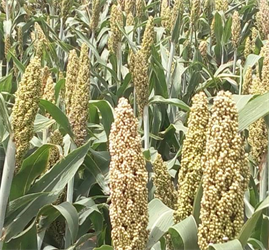
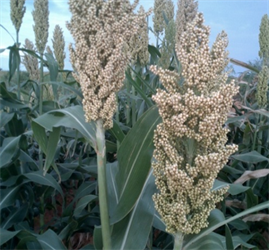
Participatory varietal selection (PVS) with farmers and Seed Companies was conducted at Maradi research station (07°05'E/13°48'N) and in farmer field to evaluate and select sorghum hybrid varieties for high yield and other important agronomic traits. The experimental design was a randomized complete block with three replications where flowering (days), plant height (cm) and yield (kg) were collected. The analysis of variance showed highly significance among treatments of all traits measured Environment and Genotype by Environment interactions also contributed significantly to the performance of yield components. The highest average grain yield was recorded from hybrids P9511A x ST9007-5-2-1 (4289 kg/ha), NE223A x 90SN1 (3666 kg/ha), NE223A x Sepon 82 (3533 kg/ha) and NE223A x P9405 (3519 kg/ha) across locations. Farmers’ preferences were the panicle size, good seed set, earliness, and seed color. Hence, in a variety selection farmer’s preferences focus more on prioritized yield-related trait. The best varieties ranked by traits of interest were P9511A x ST9007-5-2-1, NE223A x 90SN1, NE223A x P9405 and P9511A x SEPON 82 that performed well under their circumstances. The results showed that farmers’ preferred varieties match with researchers. Therefore, based on objectively measured traits, farmers’ preferences and the agro ecologies of the site, varieties NE223A x 90SN1 and P9511A x ST9007-5-2-1 were found promising for production.
Sorghum is one of the main staple food crops for the poorest and most food insecure people of the world [1] and is still largely a subsistence food crop in Sub-Saharan Africa. It is generally recognized to have wide agro-ecological adaptation, drought tolerance, diverse germplasm with varying degrees of photoperiod sensitivity associated with forage yield, excellent regenerative and tillering ability, and diverse sources of cytoplasmic-nuclear male sterility that enhance the possibility of exploiting heterosis for grain and forage production [2] [3] . It is one among the few resilient crops that can adapt well to future climate change conditions, particularly the increasing drought, soil salinity and high temperatures [4] . Sorghum is the second most important cereal crop in Niger after pearl millet. It is grown under rainfed conditions where annual precipitation never exceeds 400 - 800 mm. In Niger, only 12% of the land is available for rainfed agriculture cultivation and 85% of the crop is produced by subsistence farmers in marginal lands with declining fertility and the wide use of poor-yielding local cultivars which are largely responsible for the limited agricultural productivity [5] .
Yield increase offers the best approach to solve increasing food demands in developing countries [6] . Hybrids are known to capitalize on the phenomenon of heterosis to produce higher yields than open-pollinated varieties even under stress conditions. Adoption of hybrids would also be beneficial to the environment since high and stable productivity may restrain the desperate use of marginal soils [7] . Hybrids produce 50% more than the landraces [8] . On research stations, hybrid yield was 5 t∙ha−1 when local cultivars produce 2 t/ha or less. The margin of superiority was greater under rain-fed conditions than under irrigated conditions indicating that hybrid vigor or heterosis is not only limited to high input agriculture. But more research is needed to develop a wider range of sorghum hybrids that serve the diverse needs of the sorghum farmers and consumers in the country and the region.
Participatory plant breeding includes all approaches of close collaboration between farmer and scientist to bring about plant genetic improvement within a species [9] . A key attribute is the cooperation between scientists and farmers in evaluating plant material and in establishing plant-breeding goals. Farmer participation in the breeding of crop varieties for low-resource farmers is necessary to help ensure acceptance and eventual adoption [10] . In formal breeding programs yield is by far the most important. Sorghum farmers in most parts of Africa are known to select panicles with superior characters at maturity for seed [11] . Farmer-developed local varieties are an important resource and logical starting point for plant breeding programs that seek to strengthen plant-breeding systems. Evaluating the characteristics of pearl millets in western Niger, [12] , noted that farmers showed more concern for panicle, grain and growth cycle characteristics than for high grain yield. According to [13] next to yield, yield stability, adaptation to production techniques and conditions, and various consumption purposes are selected for by farmers.
Farmers need adaptation to the local and variable water and soil conditions in combination with a variety of characteristics related to labor and food availability, intercropping and weed competition [14] . Researchers found out that farmer participation in variety evaluation provided a means of identifying a wide range of traits that were valued by farmers. This could provide guidance on farmers’ demand for use in variety development.
Fifty-two (52) sorghum hybrids were generated by crossing the best varieties of the sorghum breeding program of Niger with male sterile lines (CMS). These hybrids were developed and evaluated at the research station of the national institute at the regional research center-CERRA of Maradi and in farmer’s fields to select the best hybrids to propose for extension [15] . After evaluation, thirteen (13) hybrids were selected by seed companies and producers under the supervision of researchers. This evaluation was made on the basis of grain yield, flowering time and other desirable agronomic characteristics. The principal objective was to select high yielding hybrids with early maturity and drought tolerance.
2. Material and Method
Thirteen (13) hybrids were used for the experiment. Each hybrid was planted on two rows of three meters each with 50 cm between hills. The spacing between two rows was 0.8 m meter. Two fertilizers of 100 kg∙ha−1 of NPK 15-15-15 and 100 kg∙ha−1 of urea were applied twice during the growing season (tillering and flowering stages). The field was kept weed free by hand weeding during the cropping season.
The plots on dune soils received an input of well-decomposed park manure at the rate of 5 tons per hectare. The manure was buried by plowing followed by harrowing before sowing. NPK 15-15-15 fertilizer was applied one week after emergence, as a localized supply in holes made 10 cm from the pockets at the rate of 6 g per pocket. Urea was applied 30 and 45 days after sowing, as a localized supply at the rate of 2 g at the seed hole.
Based on farmers’ criteria for the different regions and the Seed companies, thirteen (13) best performing hybrids were chosen derived from the Participatory Plant Breeding (PPB) approach conducted [15] . Hybrids were then subjected to participatory varietal selection (PVS) on-station at INRAN research station, farmers’ field and Seed Companies for three years.
The experimental design used is a randomized complete block (RCBD) with three repetitions at each site. The elementary plot is represented by 4 lines of 3 m, the two central ones of which are useful. The spacing used is 40 cm between pockets and 80 cm between rows. After sowing, the seedlings were thinned to three seedlings during the first weeding carried out one week after emergence. At all sites, the trial was conducted under optimal water supply conditions. Apart from deep plowing, all cultivation operations were done manually. The plots were weeded 2 to 3 times depending on the degree of weed infestation. The agronomic data collected (flowering, height and grain yield) were subjected to analysis of variance (ANOVA) separately for each environment and combined across environments using the GENSTAT version 18.1 procedure. Varieties were considered as fixed factors and evaluation sites (environments) as random factors. Mean separation was performed using the Least Significant Difference (LSD) test to discriminate and select genotypes higher as a function of the trait of interest at the significance level of 1% and 5%. Mota Maradi was used as check because of its high adoption rate among farmers. According to farmers, Mota Maradi is early maturing with a good yield and taste with average plant height of 1.75m and white colored grain [13] .
3. Results and Discussion
The analysis of variance (ANOVA) revealed significant differences for three major traits studied (Table 1). The interactions between genotypes, environments and the genotype-environment effect showed significant difference between the different genotypes for grain yield, plant height and earliness. Hence, the existence of genetic diversity between genotypes greatly contributed to the difference in the expression of these characters of the tested varieties.
The agronomic performance of the different varieties during the three years of experimentation is shown in Table 2. This table shows a significant variation for the different parameters studied during the three different years in the different environments. Very significant environmental variances were observed for all genotypes. This indicates that the conditions in the different environments were not similar and that the genotypes responded differently from one environment to another during each year.
The combined analysis of three years experimentation of the agronomic performance of the different varieties is shown in Table 3. The presence of highly significant differences (P < 0.01) between the genotypes tested for grain yields and other components indicates the presence of genetic variation between the
Analysis of variance of three traits studied
Source
DF
Flowering (days)
Height (cm)
Yield (kg∙ha−1)
Year x Rep.
5
38.48***
5134.9***
1,233,565***
Year x Rep. x Var.
10
575.12***
53909.0***
51,147,110***
Error
50
200.51
13309.0
27,027,861
Total
65
814.12
72352.9
79,408,536
CV (%)
3.3
9.6
26.1
Mean
60.7
170.0
2821
l.s.d. (5%)
2.32
18.92
852.6
***Highly significant at 1%.
Annual agronomic performance of the hybrids during the three years of experimentation
Varieties
Year 1
Year 2
Year 3
Flowering (days)
Height. (cm)
Yield (kg/ha)
Flowering (days)
Height. (cm)
Yield (kg/ha)
Flowering (days)
Height. (cm)
Yield (kg/ha)
NE223A x MDKSU-49-1
63.5
162.5
2500
64
170
2773
64.00
170.0
1878
NE223A x IRAT 204
58
127.5
1146
59.5
122
2024
56.50
145.0
2187
NE223A x SEPON 82
62
140.0
3437
63
132.5
3293
64.00
155.0
2083
NE223A x 90SN1
59.5
137.5
4248
61.5
157.5
3208
63.00
155.0
3542
NE223A x P9405
60.5
122.5
4075
57
140
3781
59.00
160.0
2700
NE223A x MDKSU-10-1
64
175.0
2562
65
217.5
2578
65.00
160.0
1042
NE223A x ST9007-5-4-2
64
135.0
1354
61.5
142.5
1971
63.00
165.0
2917
P9511A x ST9007-5-2-1
63
167.5
4583
60.5
197.5
3598
62.00
210.0
4687
P9511A x SEPON 82
63
152.5
4292
58
205
2807
58.50
205.0
3500
P9511A x Macia
63
192.5
3250
58
209
2349
60.00
202.5
4479
MM
57
227.5
1456
52
217.5
1354
52.50
230.0
1445
Mean
61.5
158.2
2991
60
173.7
2703
60.68
178
2769
F-Probability
0.019(*)
<0.001(**)
<0.001(**)
0.008(**)
<0.001(**)
0.135(ns)
<0.001(**)
<0.001(**)
<0.001(**)
LSD (5%)
3.859
26.91
517.7
5.152
34.91
1634
1.876
16.33
609.2
CV (%)
2.8
7.6
7.8
3.9
9
27.1
1.4
4.1
9.9
(ns) = not significant; (**) = significant at the 1% level; (*) = significant at the 5% probability level.
genotypes (Table 3). A significant genetic effect of genotypes on grain yield and yield components of sorghum has also been reported by different authors [16] [17] [18] . Similarly, the significant effect of environment and genotype-by-environment interaction on yield performance and some yield components showed that genotypes respond differently to various environments [17] [19] . They found that sorghum cultivars are significantly affected by phonological growth as well as yield and yield-related parameters.
Of all the varieties tested, the average number of days to flowering ranged from 58.00 for 223A x IRAT 204 to 64.67 for 223A x MDKSU-10-1. Early yield is a desirable attribute for sorghum production in dry lands because early maturing varieties can escape drought conditions that set in during the later stages of growth and allow farmers to find food and the money. Regarding days to physiological maturity, the earlier maturing varieties were 223A x IRAT 204 and 223A x P9405 with 58.00 and 58.83 days, respectively. Amongst these varieties were 223A x MDKSU-49-1 and 223A x MDKSU-10-1 genotype with 63.83 and 64.67 days, respectively.
Combined analysis of the characters observed and the comparison of the average for the grain yield during the three years of experimentation
Hybrids
Flow (days)
Height (cm)
Yield (kg/ha)
223A x MDKSU-49-1
63.83ab
167.5cd
2383cd
223A x IRAT 204
58.00f
131.5e
1786de
223A x SEPON 82
63.00abc
142.5e
2938bc
223A x 90SN1
61.33cd
150.0de
3666ab
223A x P9405
58.83ef
140.8e
3519ab
223A x MDKSU-10-1
64.67a
184.2bc
2061de
223A x ST9007-5-4-2
62.83abc
147.5e
2081de
P9511A x ST9007-5-2-1
61.83bcd
191.7b
4289a
P9511A x SEPON 82
59.83def
187.5b
3533ab
P9511A x Macia
60.33de
201.3b
3359b
MM
53.83g
225.0a
1418e
Mean
60.76
170
2821
ANOVA (F-Probability)
<0.001(**)
<0.001(**)
<0.001(**)
LSD (5%)
2.322
18.92
852.6
CV (%)
3.3
9.6
26.1
The means followed by the same letters are not significantly different according to the Fisher test at the 5% level of probability. (ns) = not significant; (**) = significant at the 1% level; (*) = significant at the 5% probability level.
The average plant height recorded was 170 cm with a range of 140.8 to 201.3 cm. The shorter plant in height was recorded with variety 223A x P9405 while the taller plant in height was recorded by variety P9511A x Macia. There were significant differences between the sorghum genotypes tested for aboveground biomass (p < 0.01). It is important to note that the control variety Mota Maradi was not only the earliest variety (53.83 days) but also the taller (225 cm) with the lowest yield (1418 kg/ha).
The mean grain yield obtained for all the trials is 2821 kg/ha, which is different from the average yield of 450 kg/ha published by the National Institute of Statistics of Niger (INS/Niger) for the cultivation of sorghum from 2017 to 2021. This is due to the good cultivation practices used and especially to the performance of the genotypes tested during the evaluation. Also, the yields varied from 1418 kg/ha for the control Mota Maradi to 4289 kg/ha for the hybrid P9511A x ST9007-5-2-1 (Table 3). The highest grain yields were observed with the hybrid varieties P9511A x ST9007-5-2-1 (4289 kg/ha), NE223A x 90SN1 (3666 kg/ha) and with NE223A x Sepon 82 (3533 kg/ha) and NE223A x P9405 (3519 kg/ha) compared to the NAD-1 hybrid which has an average yield of 1700 to 3300 kg/ha. The yield of the hybrid NE223A x 90SN1 (3666 kg/ha) more than doubled that of the control Mota Maradi (1418 kg/ha) an improved variety widely used by producers. But more research is needed to develop a wider range of hybrid sorghum cultivar that better meet the diverse needs of sorghum growers nationwide.
The comparison of the means and the grouping of the varieties tested on the basis of grain yield with the test of the least significant difference (LSD) in Table 4 brings out four homogeneous groups A, B, C and D. Group A consists of by hybrids P9511A x ST9007-5-2-1, NE223A x 90SN1, NE223A x P9405 and P9511A x SEPON 82 with yields above 3.5 tons/ha. The second group is that of the P9511A x Macia and P9511A x SEPON 82 hybrids with a yield ranging from 3 to 3.3 tons/ha. The other acceptable group in a country where the average yield rarely exceeds 460 Kg/ha is that made up of NE223A x MDKSU-49-1, NE223A x MDKSU-10-1, NE223A x ST9007-5-4-2 with a yield ranging from 2 to 2.3 tons/ha. These results corroborate the clear superiority of hybrids compared to other types of varieties.
Lower yields were observed with NE223A x IRAT 204 (1786 kg/ha), NE223A x MDKSU-10-1 (2061 kg/ha) NE223A x ST9007-5-4-2 (2081 kg/ha), thus there is a need to continue the development of much more productive varieties.
Means of level of tolerance to drought, smut and midge for tested varieties
Hybrids
Long Smut tolerance
Midge tolerance
Drought tolerance
NE223A x 90SN1
3
3
2
NE223A x P9405
5
3
3
NE223A x MDKSU-10-1
5
-
-
NE223A x MDKSU-49-1
2
4
3
NE223A x IRAT 204
3
3
2
NE223A x SEPON 82
3
3
2
NE223A x ST9007-5-2-1
3
-
-
NE223A x MR 732
3
-
-
P9511A x ST9007-5-2-1
2
2
2
P9511A x SEPON 82
2
2
3
P9511A x MR 732
2
-
-
P9511A x Macia
3
3
4
1 = No damaged kernels, 2 = 1% to 10% of damaged kernels, 3 = 11% to 25% of damaged kernels, 4 = 26% to 40% of damaged kernels, 5 = More than 40% of damaged kernels.
Midge, striga and smuts affect sorghum cultivation in Niger inflicting huge losses on tested varieties. Farmers have acknowledged that midge damage can be severe with late planting, reaching up to 100% yield losses. Smuts are the most prevalent disease group in all sorghum growing regions of the country. According to [20] , smuts affect both local and improved cultivars, especially where untreated seeds are sown. Table 4 shows the evaluation of the genetic material studied for the tolerance to drought, long smut and midge on the genetic material used. Also, Table 4 shows that hybrid NE223A x 90SN1 has a level of tolerance to drought but is sensitive to smut and midge. Hybrid P9511A x ST9007-5-2-1 is both tolerant to drought, midge, and long smut. It has been difficult to find cultivars with multiple resistances against all major diseases. The use of resistant cultivars as an alternative has been very slow in countries like Niger.
Parents A and R flowering synchronization test
The use of sterile male lines requires good synchronization during flowering period of the A and R parents for the production of hybrids on a large scale [5] [21] . Hence the importance of having restorer lines that synchronizes well with the sterile male line during flowering time. But according to the period of flowering of the A and R lines, it is important to note that the hybrids with the highest yield are not those that are selected for large-scale production.
Synchronization study between the flowering dates of the parents [22] showed that the differences in the flowering date between the parents (A and R lines) of the best hybrids is large enough to allow better synchronization (Table 5). Thus, the synchronization of flowering between the parents having exceeded more than three days, the production of hybrids for large-scale production is very difficult, especially because the female will no longer be receptive [5] . This explains why the most productive hybrids are not the best. This explained why the hybrid
Result of the flowering synchronization test of parents A and R
Hybrids
Flowering gap A-R (days)
Significance
NE223A x 90SN1
2
R flowers 2 days before A
NE223A x P9405
−3
R flowers 3 days later than A
NE223A x Sepon82
−2
R flowers 2 days later than A
NE223A x MR732
2
R flowers 2 days before A
NE223A x MDKSU49-1
−2
R flowers 2 days later than A
NE223A x MDKSU10-1
−7
R flowers 7 days later than A
P9511A x Sepon82
−6
R flowers 6 days later than A
P9511A x ST9007-5-2-1
−16
R flowers16 days later than A
NE223A x ST9007-5-4-2
−3
R flowers 3 days later than A
NE223A x ST9007-5-4-3
−7
A flowers 7 days before R
NE223A x 90SN1 has the best A and R synchronization and the best agronomic performance (flowering time, height and yield). Also, regarding the plant height and even the number of flowering days, this hybrid is very acceptable with height not exceeding 125 cm for a flowering cycle of 58 days.
4. Conclusions
The participation of producers in the varietal improvement process facilitates the selection of varieties in their own production situations while ensuring that the improved varieties are eventually adopted. This is how the hybrids NE223A x 90SN1 and NE223A x Sepon82 were selected by the producers and are already registered in the national catalog of plant species and varieties.
It is therefore hoped that farmers will highly use and adopt these hybrids for more dissemination.
Hybrid EL SALÉ Hybrid NE223A x P9405
Conflicts of Interest
The authors declare no conflicts of interest regarding the publication of this paper.
Cite this paper
Aissata, M.I., Kadi, H.A.K., Soulé, A.M. and Ousmane, Z.M. (2023) Farmer Participatory Evaluation of Sorghum Hybrid in Niger. Journal of Agricultural Chemistry and Environment, 12, 386-396. https://doi.org/10.4236/jacen.2023.124027
ReferencesMekbib, F. (2006) Farmer and Formal Breeding of Sorghum (Sorghum bicolor (L.) Moench) and the Implications for Integrated Plant Breeding. Euphytica, 152, 163-176. https://doi.org/10.1007/s10681-006-9191-7Rai, K.N., Reddy, B.V.S., Saxena, K.B. and Gowda, C.L.L. (2004) Prospects of Breeding Sorghum, Pearl Millet and Pigeonpea for High Forage Yield Quality. http://www.cropscience.org.au/icsc2004/poster/5/2/1033_raikn.htmRattunde, F., Toure, A., vom Brocke, K., Weltzien, E., Sansan, D., Kapran, I., Fofana, A. and Cisse, N. (2007) Guinea-Race Sorghum Hybrids: A New Approach for Increasing Yields of a Staple Crop of West Africa.Hossain, S., Islam, N., Rahman, M., Mostofa, M.G. and Khan, A.R. (2022) Sorghum: A Prospective Crop for Climatic Vulnerability, Food and Nutritional Security. Journal of Agriculture and Food Research, 8, Article ID: 100300. https://doi.org/10.1016/j.jafr.2022.100300Kapran, I., Adamou, M., Ejda, G. and Axtell, J.D. (1998) Review of Sorghum Hybrid Research in Niger.Pinstrup-Anderson, P. and Pandya-Lorch, R. (1995) The Future Food and Agricultural Situation in Developing Countries and the Role of Research and Training. The 21st James C. Snyder méMorial Lecture in Agricultural Economics, Purdue University, Purdue.Kapran, I., Axtell, J.D. and Ejeta, G. (1995) Sorghum Hybrids, a Viable Technology for Sustaining Sahelian Agriculture. Workshop on Technology Development and Transfer to Improve Natural Resource Management in West Africa, Niamey, 18-22 September 1995.Axtell, J., Kapran, I., Ibrahim, Y., Ejeta, G. and Andrews, D.J. (1999) Heterosis in Sorghum and Pearl Millet. In: Coors, J.G. and Pandey, S., Eds., Genetics and Exploitation of Heterosis in Crops, ASA-CSSA-SSSA, WI, USA, 375-386. https://doi.org/10.2134/1999.geneticsandexploitation.c35Eva, W., Christink, A. and Snapp, S. (2008) Chapter 7, Participatory Plant Breeding. In: Snapp, S. and Pound, B., Eds., Agricultural Systems; Agroecology and Rural Innovation for Development, Academic Press, Cambridge, 380.Mekbib, F. (2006) Farmer and Formal Breeding of Sorghum (Sorghum bicolor (L.) Moench) and the Implications for Integrated Plant Breeding. Euphytica, 152, 163-176. https://doi.org/10.1007/s10681-006-9191-7Kudadjie, C.Y. (2006) Integrating Science with Farmer Knowledge: Sorghum Diversity Management in North-East Ghana. Ph.D. Thesis, Wageningen University, Wageningen.Baidu-Forson J. ,et al. (1997)On-Station Farmer Participatory Varietal Evaluation: A Strategy for Client-Oriented Breeding Experimental Agriculture 33, 43-50.Aissata, M.I. (2018) Characteristization of Sorghum Production Constraints and Ideal Plant and Variety Traits as Perceived by Farmers in Niger. JSM Biotechnology & Biomedical Engineering, 5, Article 1084.Almekinders, C.J.M., Louwaars, N.P. and de Bruijn, G.H. (1994) Local Seed Systems and Their Importance for an Improved Seed Supply in Developing Countries. Euphytica, 78, 207-216. https://doi.org/10.1007/BF00027519Belay, B.F. and Wale, M.F. (2021) Participatory on Farm Evaluation of Improved Sorghum Varieties in North Gondar Areas of Ethiopia. Cogent Food & Agriculture, 7, Article ID: 1871809. https://doi.org/10.1080/23311932.2021.1871809Almeida, F.J.E., Tardin, F.D., Daher, R.F., Barbé, T.C., Paula, C.M., Cardoso, M.J. and Godinho, V.P.C. (2014) Stability and Adaptability of Grain Sorghum Hybrids in the Off Season. Genetic and Molecular Research, 13, 7626-7635. https://doi.org/10.4238/2014.March.24.24Asfaw, A. (2007) Assessment of Yield Stability in Sorghum. African Crop Science Journal, 15, 83-92. https://www.researchgate.net/publication/27792035Fahri, A. (2012) Yieldstability of some Turkishwinterwheat (Triticum aestivum L.) Genotypes in the Western Transitional Zone of Turkey. Turkish Journal of Field Crops, 17, 129-134.http://www.field-crops.org/assets/pdf/product512e711852038.pdfCrossa, J., Gauch, H.G. and Zobel, R.W. (1990) Additive Main Effects and Multiplicative Interaction Analysis of Two International Maize Cultivar Trials. Crop Science, 30, 493-500. https://doi.org/10.2135/cropsci1990.0011183X003000030003xGwary, D.M., Obida, A.L.I. and Gwary, S.D. (2007) Management of Sorghum Smuts and Anthracnose Using Cultivar Selection and Seed Dressing Fungicides in Maiduguri, Nigeria. International Journal of Agriculture & Biology, 9, 324-328.http://www.fspublishers.orgHouse, L.R., Verma, B.N., Ejeta, G., Rana, B.S., Kapran, I., Obilana, A.B. and Reddy, B.V.S. (1997) Developing Countries Breeding and Potential of Hybrid Sorghum. Proceedings of an International Conference on the Genetic Improvement of Sorghum and Pearl Millet, Texas, 22-27 September 1996, 84-96.Singh, F., Rai, K.N., Reddy, B.V.S. and Diwakar, B. (1997) Training Manual: Development of Cultivars and Seed Production Techniques in Sorghum and Pearl Millet. Training and Fellowships Program and Genetic Enhancement Division. ICRISAT International Crops Research Institute for the Semi-Arid Tropics. Andhra Pradesh, 31-33.