Substituted imidazoles are of interest because of their useful biological activities. While several methods have been developed for the synthesis of such compounds, some of the reported methods utilize corrosive or toxic catalysts. We report a bismuth (III) triflate catalyzed multicomponent synthesis of 2,4,5-trisubstituted imidazoles. Bismuth
(III) compounds are attractive from a green chemistry perspective because they are remarkably non-toxic and non-corrosive. Multicomponent syntheses save time and generate less waste.
Imidazoles Heterocycles Bismuth Compounds Green Chemistry Multicomponent Reactions1. Introduction
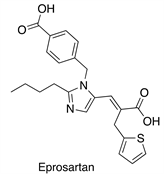
Heterocyclic compounds are of particular interest in medicinal chemistry due to the range of biological properties they exhibit [1] [2] . Among the various heterocycles, the imidazole ring has attracted a lot of attention due to the wide range of biological activities exhibited by substituted imidazoles [3] [4] . The imidazole ring is found in many common drugs such as eprosartan 1 (hypertension) [5] , ketoconazole 2 (antimycotic) [6] , losartan 3 (hypertension) [7] , and olmesartan 4 (hypertension) (Figure 1) [8] .
2,4,5-trisubstituted imidazoles exhibit many biological activities and hence have attracted attention. 2-substituted-4,5-diphenylimidazoles have been shown to exhibit antinociceptive and anti-inflammatory properties [9] . Owing to their useful biological properties, several methods have been developed for the synthesis of 2,4,5-trisubstituted imidazoles. The first synthesis, which remains one of the most viable routes, involved a multicomponent reaction between an aldehyde 5, benzil 6 and ammonium acetate 7 to generate a 2,4,5-trisubstituted imidazole 8 (Scheme 1) [10] .
1 2
Since the early method suffered from harsh reaction conditions, considerable efforts have been directed towards improving the reaction to provide high yields under milder conditions. Methods for the synthesis of polysubstituted imidazoles have been reviewed [11] [12] . Several catalysts have been used for the synthesis of 2,4,5-trisubstituted imidazoles. A few representative examples are cited here and include Yb(OTf)3 [13] , silica sulfuric acid [14] , NiCl2×6H2O [15] , microwave irradiation [16] , sodium bisulfite [17] , tetrabutylammonium bromide [18] , MoO3/SiO2 [19] , lipase [20] , mesoporous silica [21] , silica coated magnetite nanoparticles [22] , benzethonium chloride [23] , lactic acid [24] , magnetic nanoparticles [25] , CH3SO3H [26] , and mandelic acid [27] . While some of these catalysts are corrosive, a few others require preparation which detracts from their synthetic utility. In view of our continued interest in bismuth (III) salts, we investigated their use as catalysts for the synthesis of 2,4,5-trisubstituted imidazoles. Herein, we report a multicomponent synthesis of 2,4,5-trisubstituted imidazoles catalyzed by bismuth triflate, Bi(OTf)3×xH2O (1 < x < 4) (Table 1). Bismuth compounds are of interest because they are remarkably nontoxic and readily available [28] . Several reviews have summarized the applications of bismuth compounds in organic synthesis [29] [30] [31] [32] .The results of this study are summarized in Table 1.
Bismuth(III) triflate catalyzed multicomponent synthesis of 2,4,5-trisubstituted imidazoles.<sup>a </sup>
entry
aldehyde
yield (%)b,c,d
1
PhCHO
82 [22]
2
p-OHC6H4CHO
70 [22] e
3
p-CH3C6H4CHO
87 [22]
4
p-CH3OC6H4CHO
72 [22]
5
p-BrC6H4CHO
81 [13]
6
p-ClC6H4CHO
91 [22]
7
p-FC6H4CHO
67 [16]
8
2,4-Cl2C6H3CHO
88 [22]
9
m-ClC6H4CHO
80 [18]
10
m-CH3OC6H4CHO
87 [22]
11
m-CH3C6H4CHO
81 [22]
12
p-NO2C6H4CHO
64 [13] f
aRepresentative procedure (entry 4): A mixture of p-anisaldehyde (0.208 g, 1.528 mmol, 1.1 equiv), benzil (0.292 g, 1.389 mmol, 1.0 equiv), and ammonium acetate (0.428 g, 5.552 mmol, 4.0 equiv) in CH3CN (4.0 mL) was stirred as Bi(OTf)3 (0.182 g, 0.277 mmol, 20.0 mol%) was added. The reaction mixture was heated at 70˚C using a temperature controlled hot plate. Reaction progress was followed by TLC (CH3OH/CH2Cl2, 3/97, v/v). After 24 h (disappearance of aldehyde), the mixture was concentrated on a rotary evaporator. Hot methanol (5.0 mL) was added to the residue and the mixture was stirred and cooled in ice. The resulting crystals were collected by suction filtration to yield 0.324 g (72%) of a white solid that was analyzed by 1H, 13C NMR spectroscopy and TLC. bRefers to yield of isolated product that was deemed to be at least 98% pure by 1H NMR spectroscopy. All products were characterized by 1H and 13C NMR spectroscopy, TLC and by comparison to literature data. cAll products have been previously reported. Spectral data were compared to those reported in the literature. dSuperscript against yield refers to literature reference for spectral data of product. eWorkup was modified as follows: The reaction mixture was concentrated by rotary evaporation and the residue was loaded onto 30 g of silica gel. Product was isolated by elution with CH2Cl2/CH3OH (10/90, v/v). fReaction was run for 45 h using 40.0 mol% catalyst.
We investigated the utility of a few different Lewis acids as catalysts for the multicomponent synthesis of 2,4,5-trisubstituted imidazoles. These included BiO(NO3), BiBr3, Bi(OTf)3, FeCl3, Fe(OTf)3 in several solvents: CH3OH, CH3CH2OH, CH3COOH and CH3CN. We also investigated the use of Fe(OTs)3 as a catalyst for this reaction [33] . The best results were obtained with bismuth(III) triflate, Bi(OTf)3, as a catalyst, in CH3CN as the solvent. With all other catalysts significant amounts of starting material remained even after 24 h at 70˚C. Similar results were obtained in the absence of a catalyst. The multicomponent nature of this reaction allowed for the facile synthesis of the product in good to moderate yields in a single step that also eliminated the generation of an aqueous waste stream [34] . As can be seen from Table 1, good to moderate yields were obtained with a variety of aldehydes.
2. Conclusion
We have developed a bismuth (III) triflate catalyzed multicomponent synthesis of 2,4,5-trisubstituted imidazoles from a variety of substituted aldehydes, benzil, and ammonium acetate in CH3CN as the solvent. The nontoxic nature of bismuth compounds, along with the multicomponent nature of this method, makes this an attractive route for the synthesis of 2,4,5-trisubstituted imidazoles.
Acknowledgements
This material is based upon work supported by the National Science Foundation under CHE-1229133, which funded the purchase of a 400 MHz NMR spectrometer. RM would like to acknowledge an Artistic and Scholarly grant from Illinois Wesleyan University.
Conflicts of Interest
The authors declare no conflicts of interest regarding the publication of this paper.
Cite this paper
Thorp, S.C., Chisari, S.T., David, R.Q.V., Gjata, A., Good, A.L., Lopez, E. and Mohan, R.S. (2023) Bismuth (III) Triflate Catalyzed Multicomponent Synthesis of 2,4,5-Trisubstituted Imidazoles. Green and Sustainable Chemistry, 13, 209-215. https://doi.org/10.4236/gsc.2023.133011
ReferencesCabrele, C. and Reiser, O. (2016) The Modern Face of Synthetic Heterocyclic Chemistry. The Journal of Organic Chemistry, 81, 10109-10125. https://doi.org/10.1021/acs.joc.6b02034Taylor, A.P., Robinson, R.P., Fobian, Y.M., Blakemore, D.C., Jones, L.H. and Fadeyi, O. (2016) Modern Advances in Heterocyclic Chemistry in Drug Discovery. Organic & Biomolecular Chemistry, 14, 6611-6637. https://doi.org/10.1039/C6OB00936KKumar, V. and Mahajan, M.P. (2011) Pyrimidine and Imidazole. In: Majumdar, K.C. and Chattopadhyay, S.K., Eds., Heterocycles in Natural Product Synthesis, Wiley-VCH, Weinheim, 507-533. https://doi.org/10.1002/9783527634880.ch14Lombardino, J.G. and Wiseman, E.H. (1974) Preparation and Anti-Inflammatory Activity of Some Nonacidic Trisubstituted Imidazoles. Journal of Medicinal Chemistry, 17, 1182-1188. https://doi.org/10.1021/jm00257a011Eprosartan Mesylate. https://pubchem.ncbi.nlm.nih.gov/compound/Eprosartan-mesylateHeeres, J., Backx, L.J.J., Mostmans, J.H. and Van Cutsem, J. (1979) Antimycotic Imidazoles. Part 4. Synthesis and Antifungal Activity of Ketoconazole, a New Potent Orally Active Broad-Spectrum Antifungal Agent. Journal of Medicinal Chemistry, 22, 1003-1005. https://doi.org/10.1021/jm00194a023https://pubchem.ncbi.nlm.nih.gov/compound/Losartan#section=InChIKeyOlmesartan. https://pubchem.ncbi.nlm.nih.gov/compound/OlmesartanPuratchikody, A. and Doble, M. (2007) Antinociceptive and Anti-Inflammatory Activities and QSAR Studies on 2-Substituted-4,5-diphenyl-1H-imidazoles. Bioorganic & Medicinal Chemistry, 15, 1083-1090. https://doi.org/10.1016/j.bmc.2006.10.025Radziszewski, B. (1882) Ueber die Constitution des Lophins und verwandter Verbindungen. Berichte Der Deutschen Chemischen Gesellschaft, 15, 1493-1496. https://doi.org/10.1002/cber.18820150207Romero, D.H., Heredia, V.E.T., García-Barradas, O., López, M.E.M. and Pavón, E.S. (2014) Synthesis of Imidazole Derivatives and Their Biological Activities. Journal of Chemistry and Biochemistry, 2, 45-83. https://doi.org/10.15640/jcb.v2n2a3Patel, G., Dewangan, D.K., Bhakat, N. and Banerjee, S. (2021) Green Approaches for the Synthesis of Poly-Functionalized Imidazole Derivatives: A Comprehensive Review. Current Research in Green and Sustainable Chemistry, 4, Article ID: 100175. https://doi.org/10.1016/j.crgsc.2021.100175Wang, L.-M., Wang, Y.-H., Tian, H., Yao, Y.-F., Shao, J.-H. and Liu, B. (2006) Ytterbium Triflate as an Efficient Catalyst for One-Pot Synthesis of Substituted Imidazoles through Three-Component Condensation of Benzil, Aldehydes and Ammonium Acetate. Journal of Fluorine Chemistry, 127, 1570-1573. https://doi.org/10.1016/j.jfluchem.2006.08.005Shaabani, A. and Rahmati, A. (2006) Silica Sulfuric Acid as an Efficient and Recoverable Catalyst for the Synthesis of Trisubstituted Imidazoles. Journal of Molecular Catalysis A: Chemical, 249, 246-248. https://doi.org/10.1016/j.molcata.2006.01.006Heravi, M.M., Bakhtiari, K., Oskooie, H.A. and Taheri, S. (2007) Synthesis of 2,4,5-Triaryl-imidazoles Catalyzed by NiCl2·6H2O under Heterogeneous System. Journal of Molecular Catalysis A, 263, 279-281. https://doi.org/10.1016/j.molcata.2006.08.070Wolkenberg, S.E., Wisnoski, D.D., Leister, W.H., Wang, Y., Zhao, Z. and Lindsley, C.W. (2004) Efficient Synthesis of Imidazoles from Aldehydes and 1,2-Diketones Using Microwave Irradiation. Organic Letters, 6, 1453-1456. https://doi.org/10.1021/ol049682bSangshetti, J.N., Kokare, N.D., Kotharkar, S.A. and Shinde, D.B. (2008) Sodium Bisulfite as an Efficient and Inexpensive Catalyst for the One-Pot Synthesis of 2,4,5-Triaryl-1H-imidazoles from Benzil or Benzoin and Aromatic Aldehydes. Monatshefte für Chemie, 139, 125-127. https://doi.org/10.1007/s00706-007-0766-3Chary, M.V., Keerthysri, N.C., Vupallapati, S.V.N., Lingaiah, N. and Kantevari, S. (2008) Tetrabutylammonium Bromide (TBAB) in Isopropanol: An Efficient, Novel, Neutral and Recyclable Catalytic System for the Synthesis of 2,4,5-Trisubstituted Imidazoles. Catalysis Communications, 9, 2013-2017. https://doi.org/10.1016/j.catcom.2008.03.037Bhosale, S.V., Kalyankar, M.B., Nalage, S.V., Bhosale, D.S., Pandhare, S.L., Kotbagi, T.V., Umbarkar, S.B. and Dongare, M.K. (2011) One-Pot Synthesis of 2,4,5-Trisubstituted Imidazoles Using MoO3/SiO2, an Efficient and Recyclable Catalyst. Synthetic Communications, 41, 762-769. https://doi.org/10.1080/00397911003644415Zheng, H., Shi, Q.Y., Du, K., Mei, Y.J. and Zhang, P.F. (2013) One-Pot Synthesis of 2,4,5-Trisubstituted Imidazoles Catalyzed by Lipase. Catalysis Letters, 143, 118-121. https://doi.org/10.1007/s10562-012-0920-3Heravi, M.M., Zakeri, M. and Haghi, H. (2011) MCM-41 Mesoporous Silica: Efficient and Reusable Catalyst for the Synthesis of 2,4,5-Trisubstituted Imidazoles Under Solvent-Free Conditions. Synthesis and Reactivity in Inorganic, Metal-Organic, and Nano-Metal Chemistry, 41, 1310-1314. https://doi.org/10.1080/15533174.2011.609211Naeimi, H. and Aghaseyedkarimi, D. (2016) Ionophore Silica-Coated Magnetite Nanoparticles as a Recyclable Heterogeneous Catalyst for One-Pot Green Synthesis of 2,4,5-Trisubstituted Imidazoles. Dalton Transactions, 45, 1243-1253. https://doi.org/10.1039/C5DT03488DParthiban, D. and Karunakaran, R.J. (2018) Benzethonium Chloride Catalyzed One Pot Synthesis of 2,4,5-Trisubstituted Imidazoles and 1,2,4,5-Tetrasubstituted Imidazoles in Aqueous Ethanol as a Green Solvent. Oriental Journal of Chemistry, 34, 3004-3015. https://doi.org/10.13005/ojc/340642Sonar, J., Pardeshi, S., Dokhe, S., Pawar, R., Kharat, K., Zine, A., Matsagar, B., Wu, K. and Thore, S. (2019) An Efficient Method for the Synthesis of 2,4,5-Trisubstituted Imidazoles Using Lactic Acid as Promoter. SN Applied Sciences, 1, Article No. 1045. https://doi.org/10.1007/s42452-019-0935-0Nguyen, T.T., Le, N.-P.T., Nguyen, T.T. and Tran, P.H. (2019) An Efficient Multicomponent Synthesis of 2,4,5-Trisubstituted and 1,2,4,5-Tetrasubstituted Imidazoles Catalyzed by a Magnetic Nanoparticle Supported Lewis Acidic Deep Eutectic Solvent. RSC Advances, 9, 38148-38153. https://doi.org/10.1039/C9RA08074KLahari, M.S.V.S., Sankarao, D., Shyam, S., Syamala, Ch. and Krishnarao, N. (2022) Fast Rate of Catalyst Promoted by Bio Active Synthesis of 2,4,5-Triphenylimidazole Derivatives Employing Methane Sulphonic Acid. World Journal of Pharmaceutical Sciences, 11, 2429-2440.Ghogare, R.S. (2022) Mandelic Acid: An Efficient and Green Organo-Catalyst for Synthesis of 2,4,5-Trisubstituted Imidazoles under Solvent-Free Conditions. Organic Communications, 15, 44-58. https://doi.org/10.25135/acg.oc.118.22.01.2341Mohan, R. (2010) Green Bismuth. Nature Chemistry, 2, 336. https://doi.org/10.1038/nchem.609Lopez, E., Thorp, S.C. and Mohan, R.S. (2021) Bismuth(III) Compounds as Catalysts in Organic Synthesis: A Mini Review. Polyhedron, 222, Article ID: 115765. https://doi.org/10.1016/j.poly.2022.115765Moon, H.W. and Cornella, J. (2022) Bismuth Redox Catalysis: An Emerging Main-Group Platform for Organic Synthesis ACS Catalysis, 12, 1382-1393. https://doi.org/10.1021/acscatal.1c04897Gagnon, A., Dansereau, J. and Roch, A.L. (2017) Organobismuth Reagents: Synthesis, Properties and Applications in Organic Synthesis. Synthesis, 49, 1707-1745. https://doi.org/10.1055/s-0036-1589482Ondet, P., Lemière, G. and Dunach, E. (2017) Cyclisations Catalysed by Bismuth(III) Triflate. European Journal of Organic Chemistry, 4, 761-780. https://doi.org/10.1002/ejoc.201600937Starcevich, J.T., Laughlin, T.J. and Mohan, R.S. (2013) Iron(III) Tosylate Catalyzed Synthesis of 3,4-Dihydropyrimidin-2(1H)-ones/thiones via the Biginelli Reaction. Tetrahedron Letters, 54, 983-985. https://doi.org/10.1016/j.tetlet.2012.12.032Sunderhaus, J.D. and Martin, S.F. (2009) Applications of Multicomponent Reactions to the Synthesis of Diverse Heterocyclic Scaffolds. Chemistry: A European Journal, 15, 1300-1308. https://doi.org/10.1002/chem.200802140