The floristic diversity was carried out from the selected trails while studying wildlife at the Baraiyadhala National Park of Chattogram in Bangladesh from August 2012 to July 2013 and June to October 2017. In total 267 species of plants (Bryophytes three, Pteridophytes 15, Gymnosperm one, Dicotyledons 200 and Monocotyledons 48) belonging to 186 genera and 80 families were recorded, which included 102 (38.20%) species of trees, 84 (31.46%) shrubs, 66 (24.71%) herbs and 15 (5.61%) species of climbers. Overall, Euphorbiaceae (dicotyledon) constituted the largest family in the study area having 12 genera and 18 species, while Cyperaceae (monocotyledon) was the second largest family represented by four genera and 11 species. The single gymnosperm species was
Cycas pectinata Griff. (Assam cycas) under Cycadaceae family that naturally grows there. Most of the recorded plants were terrestrial while the others were aquatic or swampy. Among the plants, 210 (78.66%) species were native, of which 152 were Native (wild), 40 Native (wild & cultivated) and 18 Native (cultivated), and the remaining 57 (21.34%) alien species. Of the alien species seven were Alien (wild), ten Alien (wild and cultivated), four Alien (invasive) and 36 Alien (cultivated). Of the 267-plant species, the highest number was medicinally followed by 41 edible, 31 timber, 13 fuel wood and ornamental, 13 fodder, seven ornamental, six species used for domestic purposes and fodder, five edible and medicinal, three vegetables, two vegetables and medicinal, two edible and timber, two timber and leaf, two ornamental and medicinal, one chemical indicator, one ornamental and timber, and the use of 17 rest species was unknown.
Plant Diversity Baraiyadhala National Park Chattogram Bangladesh1. Introduction
Baraiyadhala National Park (BNP) ( Map one), formerly a part of the Reserved Forest of Chattogram North Forest Division, was designated a protected area on 6 April 2010 through a Gazette Notification (PaBaMa/Bon Sha-2/02/National Park/10/2010/210) under the provisions of Article 23(1) of the Bangladesh Wildlife (Preservation) (Amendment) Act, 1974 (which has now been altered by Wildlife [Conservation and Security] Act, 2012). The Park is located 172 km southeast of Dhaka and 45 km northwest of Chattogram City (22˚40.489' and 22˚48'N and 90˚40' and 91˚55.979'E). It covers the area of Sitakunda and Mirsharai Upazilas and is situated about 1.5 km west of the Dhaka-Chattogram Highway and 0.5 km west of Dhaka-Chattogram Railway Line. The park encompasses 2933.61 ha of land area under the Baraiyadhala Forest Range Office. The Park comprises three blocks: Baraiyadhala and Wahidpur Blocks under Baraiyadhala Forest Beat, and Kunderhat Block under Bartakia Forest Beat.
The BNP supports the following types of forest: tropical semi-evergreen; tropical wet evergreen; tropical moist deciduous; bamboo thickets; and plantation. The topography of the Park is very undulating and covered with a linear hill range (elongation north to south reaching an altitude up to 350 m). Hilly topography constitutes high (152 to 365 m), medium-high (76 to 152 m) and lower hills (15 to 76 m). The park area is Mio-Pliocene in origin where 3 representative geological series (Surma, Tipam and Dhupitila) are found and the soils are yellowish brown to strong brown (high hills), strong brown to yellowish red (low hills) [1] , and brown colored foothill (piedmont) soils are usual, slightly acid or neutral, with high base status [2] . The park is interspersed by valleys, gullies and streams. Most of the streams are seasonal and dry up during the off-monsoon season. The park area enjoys a moist tropical maritime climate and rainfall is frequent and heavy during the monsoon season (May to October) ranging between 115.2 mm to 561.1 mm. The average maximum annual temperature was 31.50˚C and the minimum 20.67˚C, whereas the average maximum and minimum range of relative humidity were respectively 99.10% and 49.86% (Sitakunda Agro-met. Office, 2012-13).
Literature survey reveals that the vegetation in this part of the Orient started in the 19th Century by [3] but [4] spent more time in the field and also contributed more than anybody else. [5] initiated writing of local flora of the Sundarbans. Later, [6] made a list of plants of Chittagong Collectorate and Hill Tracts. [7] and [2] contributed significantly to the floral study of the then East Pakistan (now Bangladesh), and in Bangladesh [8] was the pioneer to do the same. Recently, [9] and [10] [11] have compiled a list of the flora of Bangladesh, which indicate that 3562 species under 1379 genera and 199 families in Bangladesh. More recently, [12] have annotated a list of plants and mentioned 5016 species under 1666 genera and 219 families.
Although it is not a detail of the flora of an area studying vegetation is rather an integral part of understanding the ecology of the studied wildlife species. In this concept, while studying hoolock gibbon, [13] listed tree species from selected trails for phenological studies in Lawachara National Park (former West Bhanugach Reserved Forest) and Chunati Wildlife Sanctuary. [14] collected plant samples from Hazarikhil Forest Beat area of Chittagong (now called Hazarikhil Wildlife Sanctuary). [15] worked on plant diversity in the Sitakunda Forest Range area. [16] listed tree species from Rema-Kalenga Wildlife Sanctuary from the phenological study of the selected transects while studying langurs.
There is no published and/or unpublished work on plants of the Baraiyadhala National Park. So, an attempt was taken to make a preliminary list of plants from selected trails during studying the wildlife of the Park of Chattogram in Bangladesh.
2. Methods
Fieldwork was carried out at the BNP (Map 1) in Chittagong (now called Chattogram), Bangladesh from August 2012 to July 2013 and June to October 2017. Monthly minimum three and maximum five days were spent in the field during the study period. Plant samples were collected from selected trails while studying wildlife which covered almost all habitats of the study area including hilltops, slopes, foothills, valleys and wet areas in the BNP. To identify the plant specimens have been applied some techniques. Firstly, the local name of the plants has been collected from local people and then confirmed with the help of [12] . Secondly, flowering or fruiting specimens were collected and processed using standard herbarium techniques [17] [18] . The plant specimens were also identified by consulting different floras and literatures, viz., [9] [10] [11] [19] [20] [21] and by comparing with the herbarium specimens available at Department of Botany, University of Chittagong. Some noxious and beneficial exotic plant species were also identified comparing with the report of [22] . Field data on plants were arranged in alphabetic family sequence.
3. Results
A total 267 species of plants belonging to 186 genera and 80 families of four different categories (forms) viz., trees (38.20%), shrubs (31.46%), herbs (24.71%) and climbers (5.61%) has been documented from the Baraiyadhala National Park (BNP) (Figure 1) (Appendix 1).
Trees constituted the major category (102 species, 74 genera and 33 families) of the plant community, while climbers represented the minor group (15 species, 10 genera and eight families) (Table 1). Furthermore, among the plant species (267), Magnoliopsida (Dicotyledons) was the highest group (200 species, 144 genera and 59 families) followed by Liliopsida (Monocotyledons) (48 species, 30 genera and 12 families), Pteridophytes (15 species, eight genera and six families), Bryophytes (three species, three genera and two families) and Gymnosperms (single species). In Magnoliopsida, Euphorbiaceae constituted the largest family in the study area having 18 species under 12 genera while the several families
Synopsis of plant diversity of the Baraiyadhala National Park
Habit
No. of Species
No. of Genera
No. of Families
% of Habit
Uses
Medicine
Edible
Timber
Others
Trees
102
74
33
38.20
22
20
35
25
Shrubs
84
60
31
31.46
46
11
1
26
Herbs
66
45
29
24.71
23
7
-
36
Climbers
15
10
8
5.61
12
2
-
1
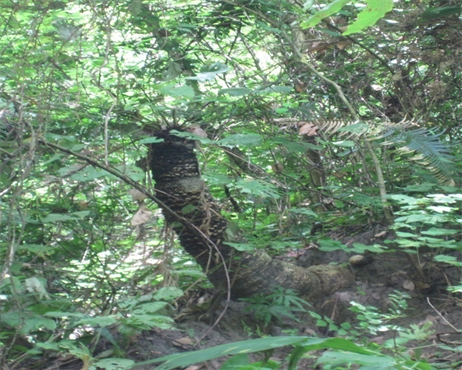
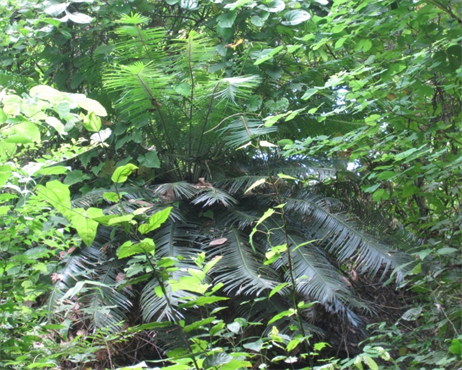
were supported by single species (Appendix 1). In Liliopsida, Cyperaceae represented the highest number of species (11) and genera (four), and several families had single species (Appendix 1). Among the Pteridophytes, several families dominated each which represented three species and in Bryophytes the representative family was Marchantiaceae having two species (Appendix 1). It is interesting to note that a single species, Cycas pectinata Griff. (Assam cycas) (Image 1) represented the Gymnosperms under Cycadaceae family that naturally occurs only in two areas of Bangladesh: shal (shorea robusta) forest of northern Mymensingh and the BNP of Chittagong [23] . Plant diversity of the BNP has briefly been analyzed based on their habits and uses by local people (Table 1).
Among the recorded plant species, almost all individuals were terrestrial while only 10 species were aquatic are denoted as star mark (*) in Appendix 1. Besides, the members of the family Cyperaceae were represented as swampy.
Image 1. Assam cycas (Cycas pectinata)—space missing between genus and species (Top: Young; Bottom: Older one).
Of the recorded plants (267 species) in the BNP, 104 (38.95%, belonging to 80 genera and 37 families) had medicinal values (including five edible and medicinal, two ornamental and medicinal and one vegetable and medicinal), which were the dominant group among the plants (Appendix 1).
Based on known origin the identified plant species of the BNP were basically divided into two major groups: native (210 species) and alien (57 species). These two groups were further distinguished into seven subgroups: (1) native wild, (2) native cultivated, (3) native wild and cultivated, (4) alien wild, (5) alien cultivated, (6) alien wild and cultivated and (7) alien invasive. Among the native plants, the dominant subcategory was native wild species (152 species) followed by native wild and cultivated (40 species), while for alien species, alien cultivated was the highest subcategory represented by 36 species. Both native and alien cultivated plants had 54 species (18 native and 36 alien). [22] enlisted a total of 299 species of exotic (alien) plants (trees, shrubs, herbs and lianas) known to occur in Bangladesh, where herbs and lianas are the dominant group followed by trees and shrubs.
4. Discussion
[14] identified 221 species (out of 390 samples) supported by 167 genera and 54 families from Hazarikhil Wildlife Sanctuary, Chittagong. [15] listed 203 species of plants represented by 154 genera and 54 families from the Sitakunda forested area of Chittagong (which partly includes the BNP), but they did not mention Assam cycas (Cycas pectinata), a common species in the BNP (globally Vulnerable [24] . Further, wildlife-related plant studies have been carried out by some workers at different places at different times. For example, during studying hoolock gibbon, [13] listed 114 tree species (plus about 100 unidentified) belonging to 74 genera and 39 families from trails for phenological studies in the Lawachara National Park (former West Bhanugach Reserved Forest) and 58 tree species (plus 5 unidentified) under 39 genera and 27 families from Chunati Wildlife Sanctuary. [16] enlisted 70 (plus five unidentified) tree species supported by 49 genera and 30 families from Rema-Kalenga Wildlife Sanctuary from the phenological study of the selected transects while studying capped and Phayre’s langurs.
As the study area is hilly, terrestrial habitat dominates there and also terrestrial plants. Due to the lack of large water bodies like ditches, and marshes, water is not available throughout the year except only wet season. That is why aquatic plant diversity is somewhat poor.
[25] reported 54 species (34 families) of medicinal plants from the Sitakunda Botanical Garden and Eco-Park of Chittagong and [26] recorded 55 tree species (26 families) of medicinal plants from the Chunati Wildlife Sanctuary, Chittagong. The demand for plant-based medicines is increasing day by day due to the side effects of pharmaceutical drugs and the reduction of their resistance to disease. So, medicinal plants are most important for traditional herbalists, Unani and Ayurvedic industries. There are 180 medicinal plant-based drug industries throughout Bangladesh [24] . But at the same time unfortunately it is true that 70% of raw materials for Unani and Ayurveda preparations are imported from foreign countries and most of them are from India due to the decline of production and abundance of natural forests in Bangladesh [27] . As part of wildlife habitat, BNP supports a significant amount (near about 25%) of edible and fodder plant species, which supply foods (fruits, leaves and other plant parts) to wildlife (Appendix 1). Furthermore, the Park also supports several keystone (plant) species for instance, Ficus spp., Bombax ceiba, and Phoenix sylvestris [28] on which several species of wildlife depend for foods during the lean season.
From the above discussion, it reveals that the BNP is important from both economic and wildlife habitat viewpoints, and needs attention to conserve it.
Conflicts of Interest
The authors declare no conflicts of interest regarding the publication of this paper.
Cite this paper
Karim, M.R., Ahsan, M.F., Uddin, S.B. and Rahman, A.S.M.S. (2023) Plant Diversity of the Baraiyadhala National Park in Chattogram, Bangladesh. American Journal of Plant Sciences, 14, 357-376. https://doi.org/10.4236/ajps.2023.143024
Appendix 1. List of the Plant Species through the Trails of the Study Area
Trees
Shrubs
Herbs
Climbers
Note: * = Aquatic, A (cul)—Alien (cultivated), A (inv)—Alien (invasive), A (wild)—Alien (wild), A (wild & cul)—Alien (wild & cultivated), D—Dicot, M—Monocot, N (cul)—Native (cultivated), N (wild)—Native (wild) and Nt—Not Known.
ReferencesHassan M.M. ,et al. (1994)Forest Soils of Bangladesh Bangladesh Journal of Forest Science 23, 1-11.Champion, H.G., Seth, S.K. and Khattack, G.M. (1965) Manual of Silviculture for Pakistan. Pakistan Forest Institute, Peshwar, 547 p.Roxburgh, W. (1814) Hortusbengalensis. Boerhaave Press, Leiden, 1-105.Hooker, J.D. (1872-1897) Flora of British India. Vol. I-VII, Reeve & Co. Ltd., London.Prain D. ,et al. (1903)Flora of Sundribans Records of the Botanical Survey of India 2, 271-370.Heinig, R.L. (1925) List of Plants of Chittagong Collectorate and the Hill Tracts. The Bengal Govt. Branch Press, Darjeeling, 1-84.Champion, H.G. (1935) A Preliminary Survey of the Forest Types of India and Burma. Indian Forestry Records (New Series), Silviculture, I, 1-351.Khan, M.S. (1972-1987) Flora of Bangladesh, Vol. 2-43. Bangladesh National Herbarium, Dhaka.Siddiki, K.U., Islam, M.A., Ahmed, Z.U., Begum, Z.N.T., Hassan, M.A., Khondker, M., Rahman, M.M., Kabir, S.M.H., Ahmad, M., Ahmed, A.T.A., Rahman, A.K.A. and Haque, E.U. (2007) Encyclopedia of Flora and Fauna of Bangladesh, Vol. 5. Bryophytes, Pteridophytes, Gymnosperms. Asiatic Society of Bangladesh, Dhaka, 339 p.Ahmed, Z. U., Begum, Z.N.T., Hassan, M.A., Khondker, M., Kabir, S.M.H., Ahmad, M., Ahmed, A.T.A., Rahman, A.K.A. and Haque, E.U. (2008) Encyclopedia of Flora and Fauna of Bangladesh, Vol. 12. Angiosperms: Monocotyledons (Orchidaceae-Zingiberacea). Asiatic Society of Bangladesh, Dhaka, 505 p.Ahmed, Z.U., Hassan, M.A., Begum, Z.N.T., Khondker, M., Kabir, S.M.H., Ahmad, M., Ahmed, A.T.A., Rahman, A.K.A. and Haque, E.U. (2009) Encyclopedia of Flora and Fauna of Bangladesh, Vol. 8. Angiosperms: Dicotyledons (Fabaceae-Lythraceae). Asiatic Society of Bangladesh, Dhaka, 478 p.Pasha, M.K. and Uddin, S.B. (2013) Dictionary of Plant Names of Bangladesh (Vascular Plants). Janokalyan Prokashni, Chittagong, 434 p.Ahsan, M.F. (1994) Behavioural Ecology of the Hoolock Gibbon (Hylobates hoolock) in Bangladesh. University of Cambridge, Cambridge, 446 p.Uddin, A.T.M.M. (1996) Investigation and Assessment of Plant Diversity of Hazarikhil, Chittagong. MS Thesis, Department of Botany, University of Chittagong, Chittagong, 219 p.Rahman, M.A. and Uddin, S.B. (1997) Angiospermic Flora of Sitakunda in Chittagong. Bangladesh Journal of Plant Taxonomy, 4, 17-36.Kabir, M.M. (2002) Behavioural Ecology of Two Sympatric Langur Species in the Semi-Evergreen Forest of Bangladesh. University of Cambridge, Cambridge, 351 p.Hyland B.P.M. ,et al. (1972)A Technique for Collecting Botanical Specimens in Rainforest Flora Malesiana Bulletin 26, 2038-2040.Alexiades, M.N. (1996) Selected Guidelines for Ethnobotanical Research: A Field Manual. New York Botanical Garden, New York, 99-133.Hossain, A.B.M., Alam, M.D., Rahim, M.A. and Rahim, M.A. (2009) A Pictorial Guide to Nursery Plants. Jahangirnagar University, Dhaka.Yusuf, M., Chowdhury, J.U., Wahab, M.A. and Begum, J. (2009) Medicinal Plants of Bangladesh. BCSIR, Dhaka, 794 p.Ghani, A. (2003) Medicinal Plants of Bangladesh with Chemical Constituents and Uses. Asiatic Society of Bangladesh, Dhaka, 603 p.Hossain, M. K. and Pasha, M.K. (2004) An Account of the Exotic Flora of Bangladesh. Journal of Forestry and Environment, 2, 99-115.Rahman, M.M. (2007) Cycas pectinata Griff., Notul. Pl. Asiat. 4, t 360, f. 3 10 t (1854), 347-348. In: Siddiki, K.U., Islam, M.A., Ahmed, Z.U., Begum, Z.N.T., Hassan, M.A., Khondker, M., Rahman, M.M., Kabir, S.M.H., Ahmad, M., Ahmed, A.T.A., Rahman, A.K.A. and Haque, E.U., Eds., Encyclopedia of Flora and Fauna of Bangladesh: Bryophytes, Pteridophytes, Gymnosperms, Vol. 5, Asiatic Society of Bangladesh, Dhaka, 391 p.Nguyen, H.T. (2010) Cycas pectinata. The IUCN Red List of Threatened Species 2010: e.T42062A10617695.
https://dx.doi.org/10.2305/IUCN.UK.2010-3.RLTS.T42062A10617695.enUddin, M.S., Hossain, M.K. and Huda, S.M.S. (2005) Distribution Pattern of Medicinal Plant Species in Sitakunda Botanical Garden and Eco-Park of Chittagong, Bangladesh. Hamdard Medicus, 48, 118-124.Rahman, M.L. and Hossain, M.K. (2002) Distribution Pattern of Medicinal Plant Species in Chunati Wildlife Sanctuary of Bangladesh. Journal of Tropical Medicinal Plants, 3, 65-72.Rashid, M.H., Mohiuddin, M., Ara, R. and Alam, M.J. (1990) Medicinal Plants and Their Cultivation (Bengali). Bulletin 4: Minor Forest Product Series, Bangladesh Forest Research Institute, Chittagong, 27 p.Ahsan, M.F. and Hannan, M.A. (2003) A Preliminary Observation on Keystone Plant Species for Birds of the Karnaphuli River Delta and Adjacent Areas of Chittagong, Bangladesh. Journal of Biological Sciences, 11, 39-44.Mazid, M.A., Datta, B.K., Nahar, L., Bashar, S.M.A., Bachar, S.C. and Sarker, S.D. (2009) Analgesic, Anti-Inflammatory and Diuretic Properties of Polygonum barbatum (L.) Hara var. barbata. Brazilian Journal of Pharmacognos, 19, 749-754.
https://doi.org/10.1590/S0102-695X2009000500017Khan, M.A., Marwat, K.B., Gul, B., Wahid, F., Khan, H. and Hashimi, S. (2014) Pistia stratiotes L. (Araceae): Phitochemistry, Use in Medicines, Phytoremediation, Biogas and Management Options. Pakistan Journal of Botany, 46, 851-860.Kirtikar, K.R. and Basu, B.D. (1918) Indian Medicinal Plants. Sudhindra Nath Basu, M.B. Panini Office, Bhuwanéswari Asrama, Bahadurganj, Allahabad, 800 p.
https://doi.org/10.5962/bhl.title.137025Zhuang, X. and Beentje, H.J. (2017) Hydrilla verticillata. The IUCN Red List of Threatened Species 2017: e.T167871A65905991.Kirtikar, K.R. and Basu, B.D. (1935) Indian Medicinal Plants. L.M. Basu, Allahabad, 2752.