

Paper Menu >>
Journal Menu >>
 Journal of Environmental Protection, 2011, 2, 1341-1346 doi:10.4236/jep.2011.210154 Published Online December 2011 (http://www.SciRP.org/journal/jep) Copyright © 2011 SciRes. JEP 1341 The Influence of Gas Flare Particulates and Rainfall on the Corrosion of Galvanized Steel Roofs in the Niger Delta, Nigeria Ajah Ekpeni Obia1, Hanson Effiong Okon1, Samuel Aji Ekum1, Eyo Effiom Eyo-Ita1, Ekpang Ajah Ekpeni2 1Department of Architecture, Cross River University of Technology, Calabar, Nigeria; 2Department of Chemistry, Cross River Co- llege of Education, Akamkpa, Nigeria. E-mail: [email protected] Received August 3rd, 2011; revised September 9th, 2011; accepted October 18th, 2011. ABSTRACT An experiment was conducted to determine the influence of air-borne particulates exuded from gas flare chambers and rainfall/rain water pH in the rusting of metallic building materials, particularly the galvanized iron roofing sheets, in the Niger Delta Region of Nigeria. Gas flaring and rain fall in this region are rated to be amongst the highest in the world. In this experiment, specimens of the metal (galvanized iron) were exposed in the atmosphere for one year, across four sites within the region. The monthly readings of concentrations of particulate matter (aerosol ) and rainfall at the sites were recorded. Equally, the average pH values of the collected rainwater were determined and recorded corre- spondingly. Multiple linear regression, analysis of variance (ANOVA) and Pearson Product Moment Correlation statis- tical analyses were performed on the obtained data and the outcome indicated that, with an R2 = 0.678, there was sig- nificant influence of industrial aerosol concentration, precipitation and pH on the degradation of galvanized iron roof- ing material in the region. It was also established that their individual influences were less than their joint impact, sug- gesting synergism. The ANOVA test further indicated that corrosion was severe in the industrial sites of Ibeno and Ebocha while Ekuri (the control station) recorded the least impact. This study recommends a discontinuation of gas flaring in th e region wh ile research on environ mentally resilient , relatively cheap and sustainable alternative materials should be encouraged. Keywords: Galvanized Iron, Gas Flares, Mass Loss, Pollutants, Rainfall 1. Introduction Metallic corrosion is an inarguably intractable problem in the construction industry. Global cost of corrosion to the industry is astronomical; especially in the developed and emerging economies [1-3]. Yet modern construction can safely be said to be most promoted and sustained with metals. Such unique qualities as durability, tensile strength, malleability, amongst others, make metals enviable com- ponents of modern construction. Unfortunately, this high profile material has one major shortcoming, susceptibi- lity to corrosion attack. There is the universal tendency for any metallic material to return to its natural stable state (through corrosion) and that is often not the state in which humans would prefer to use it [4,5]. This vulnerability is higher in some metals than others. In the building industry, iron, steel, aluminum and zinc are common on account of low cost and availability. Often times, some measures are taken to protect these metals against wear. Iron is galvanized (covered with protective zinc coating) and used as roof coverings. The material (galvanized iron) finds high use in the developing world, particularly the high rainfall regions like Niger Delta Region of Nigeria, where it is largely used as roofing ma- terial. The advantages of this material over the other two main rivals in roof covering, aluminum and asbestos, for instance, are quite obvious hence, its unassailable de- mand by the low and medium income earners as well as property developers. Atmospheric corrosion needs electrolytic medium to take place [5-9]. Therefore, the presence of moisture on the metallic surface is an obvious pre-condition for the metal to degrade. Some scholars suggest that extreme pre- 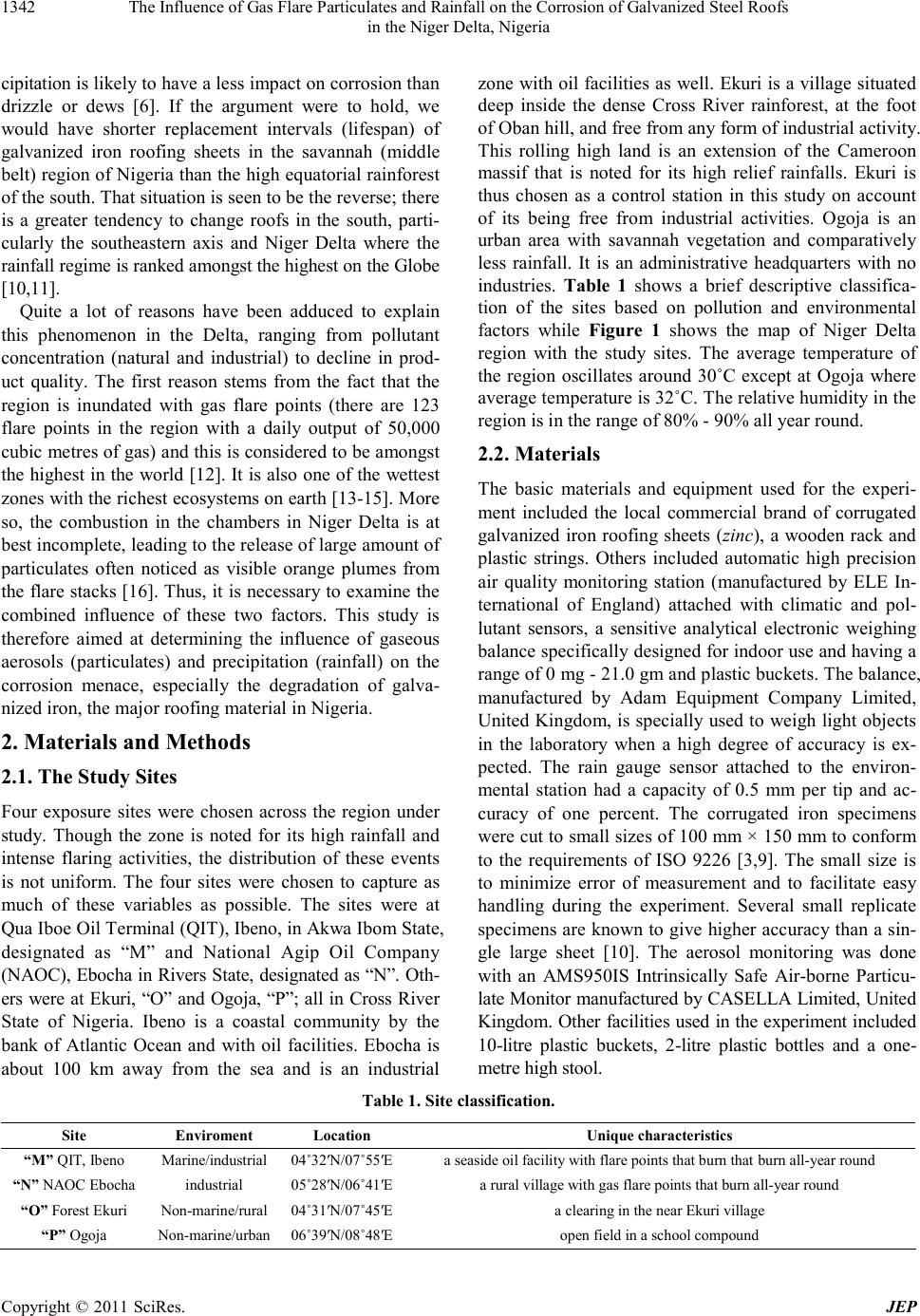 The Influence of Gas Flare Particulates and Rainfall on the Corrosion of Galvanized Steel Roofs 1342 in the Niger Delta, Nigeria cipitation is likely to have a less impact on corrosion than drizzle or dews [6]. If the argument were to hold, we would have shorter replacement intervals (lifespan) of galvanized iron roofing sheets in the savannah (middle belt) region of Nigeria than the high equatorial rainforest of the south. That situation is seen to be the reverse; there is a greater tendency to change roofs in the south, parti- cularly the southeastern axis and Niger Delta where the rainfall regime is ranked amongst the highest on the Globe [10,11]. Quite a lot of reasons have been adduced to explain this phenomenon in the Delta, ranging from pollutant concentration (natural and industrial) to decline in prod- uct quality. The first reason stems from the fact that the region is inundated with gas flare points (there are 123 flare points in the region with a daily output of 50,000 cubic metres of gas) and this is considered to be amongst the highest in the world [12]. It is also one of the wettest zones with the richest ecosystems on earth [13-15]. More so, the combustion in the chambers in Niger Delta is at best incomplete, leading to the release of large amount of particulates often noticed as visible orange plumes from the flare stacks [16]. Thus, it is necessary to examine the combined influence of these two factors. This study is therefore aimed at determining the influence of gaseous aerosols (particulates) and precipitation (rainfall) on the corrosion menace, especially the degradation of galva- nized iron, the major roofing material in Nigeria. 2. Materials and Methods 2.1. The Study Sites Four exposure sites were chosen across the region under study. Though the zone is noted for its high rainfall and intense flaring activities, the distribution of these events is not uniform. The four sites were chosen to capture as much of these variables as possible. The sites were at Qua Iboe Oil Terminal (QIT), Ibeno, in Akwa Ibom State, designated as “M” and National Agip Oil Company (NAOC), Ebocha in Rivers State, designated as “N”. Oth- ers were at Ekuri, “O” and Ogoja, “P”; all in Cross River State of Nigeria. Ibeno is a coastal community by the bank of Atlantic Ocean and with oil facilities. Ebocha is about 100 km away from the sea and is an industrial zone with oil facilities as well. Ekuri is a village situated deep inside the dense Cross River rainforest, at the foot of Oban hill, and free from any form of industrial activity. This rolling high land is an extension of the Cameroon massif that is noted for its high relief rainfalls. Ekuri is thus chosen as a control station in this study on account of its being free from industrial activities. Ogoja is an urban area with savannah vegetation and comparatively less rainfall. It is an administrative headquarters with no industries. Table 1 shows a brief descriptive classifica- tion of the sites based on pollution and environmental factors while Figure 1 shows the map of Niger Delta region with the study sites. The average temperature of the region oscillates around 30˚C except at Ogoja where average temperature is 32˚C. The relative humidity in the region is in the range of 80% - 90% all year round. 2.2. Materials The basic materials and equipment used for the experi- ment included the local commercial brand of corrugated galvanized iron roofing sheets (zinc), a wooden rack and plastic strings. Others included automatic high precision air quality monitoring station (manufactured by ELE In- ternational of England) attached with climatic and pol- lutant sensors, a sensitive analytical electronic weighing balance specifically designed for indoor use and having a range of 0 mg - 21.0 gm and plastic buckets. The balance, manufactured by Adam Equipment Company Limited, United Kingdom, is specially used to weigh light objects in the laboratory when a high degree of accuracy is ex- pected. The rain gauge sensor attached to the environ- mental station had a capacity of 0.5 mm per tip and ac- curacy of one percent. The corrugated iron specimens were cut to small sizes of 100 mm × 150 mm to conform to the requirements of ISO 9226 [3,9]. The small size is to minimize error of measurement and to facilitate easy handling during the experiment. Several small replicate specimens are known to give higher accuracy than a sin- gle large sheet [10]. The aerosol monitoring was done with an AMS950IS Intrinsically Safe Air-borne Particu- late Monitor manufactured by CASELLA Limited, United Kingdom. Other facilities used in the experiment included 10-litre plastic buckets, 2-litre plastic bottles and a one- metre high stool. Table 1. Site cl assi fication. Site Enviroment Location Unique characteristics “M” QIT, Ibeno Marine/industrial 04˚32′N/07˚55′Ea seaside oil facility with flare points that burn that burn all-year round “N” NAOC Ebocha industrial 05˚28′N/06˚41′Ea rural village with gas flare points that burn all-year round “O” Forest Ekuri Non-marine/rural 04˚31′N/07˚45′Ea clearing in the near Ekuri village “P” Ogoja Non-marine/urban 06˚39′N/08˚48′Eopen field in a school compound Copyright © 2011 SciRes. JEP 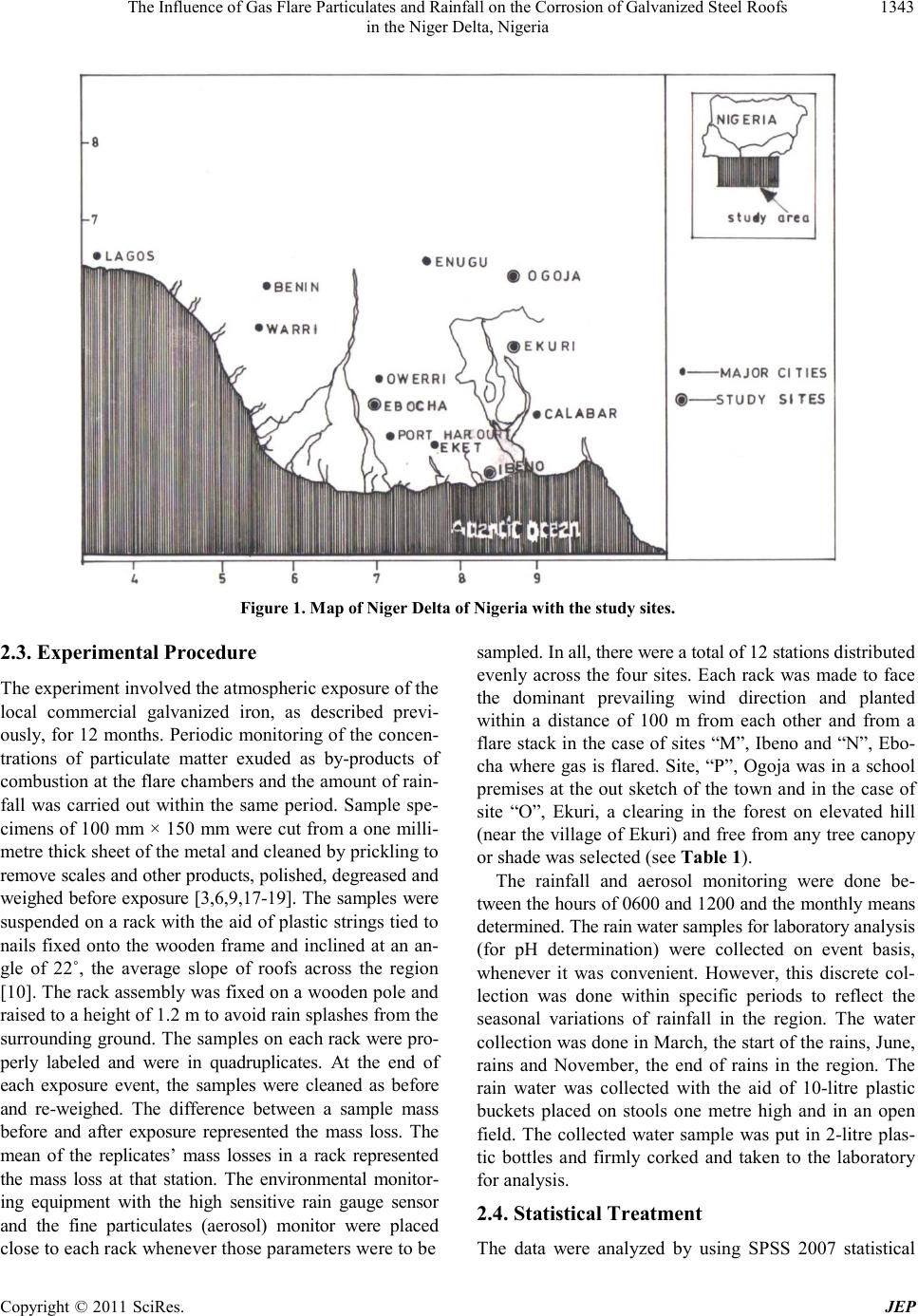 The Influence of Gas Flare Particulates and Rainfall on the Corrosion of Galvanized Steel Roofs 1343 in the Niger Delta, Nigeria Figure 1. Map of Niger Delta of Nigeria with the study sites. 2.3. Experimental Procedure The experiment involved the atmospheric exposure of the local commercial galvanized iron, as described previ- ously, for 12 months. Periodic monitoring of the concen- trations of particulate matter exuded as by-products of combustion at the flare chambers and the amount of rain- fall was carried out within the same period. Sample spe- cimens of 100 mm × 150 mm were cut from a one milli- metre thick sheet of the metal and cleaned by prickling to remove scales and other products, polished, degreased and weighed before exposure [3,6,9,17-19]. The samples were suspended on a rack with the aid of plastic strings tied to nails fixed onto the wooden frame and inclined at an an- gle of 22˚, the average slope of roofs across the region [10]. The rack assembly was fixed on a wooden pole and raised to a height of 1.2 m to avoid rain splashes from the surrounding ground. The samples on each rack were pro- perly labeled and were in quadruplicates. At the end of each exposure event, the samples were cleaned as before and re-weighed. The difference between a sample mass before and after exposure represented the mass loss. The mean of the replicates’ mass losses in a rack represented the mass loss at that station. The environmental monitor- ing equipment with the high sensitive rain gauge sensor and the fine particulates (aerosol) monitor were placed close to each rack whenever those parameters were to be sampled. In all, there were a total of 12 stations distributed evenly across the four sites. Each rack was made to face the dominant prevailing wind direction and planted within a distance of 100 m from each other and from a flare stack in the case of sites “M”, Ibeno and “N”, Ebo- cha where gas is flared. Site, “P”, Ogoja was in a school premises at the out sketch of the town and in the case of site “O”, Ekuri, a clearing in the forest on elevated hill (near the village of Ekuri) and free from any tree canopy or shade was selected (see Table 1). The rainfall and aerosol monitoring were done be- tween the hours of 0600 and 1200 and the monthly means determined. The rain water samples for laboratory analysis (for pH determination) were collected on event basis, whenever it was convenient. However, this discrete col- lection was done within specific periods to reflect the seasonal variations of rainfall in the region. The water collection was done in March, the start of the rains, June, rains and November, the end of rains in the region. The rain water was collected with the aid of 10-litre plastic buckets placed on stools one metre high and in an open field. The collected water sample was put in 2-litre plas- tic bottles and firmly corked and taken to the laboratory for analysis. 2.4. Statistical Treatment The data were analyzed by using SPSS 2007 statistical Copyright © 2011 SciRes. JEP 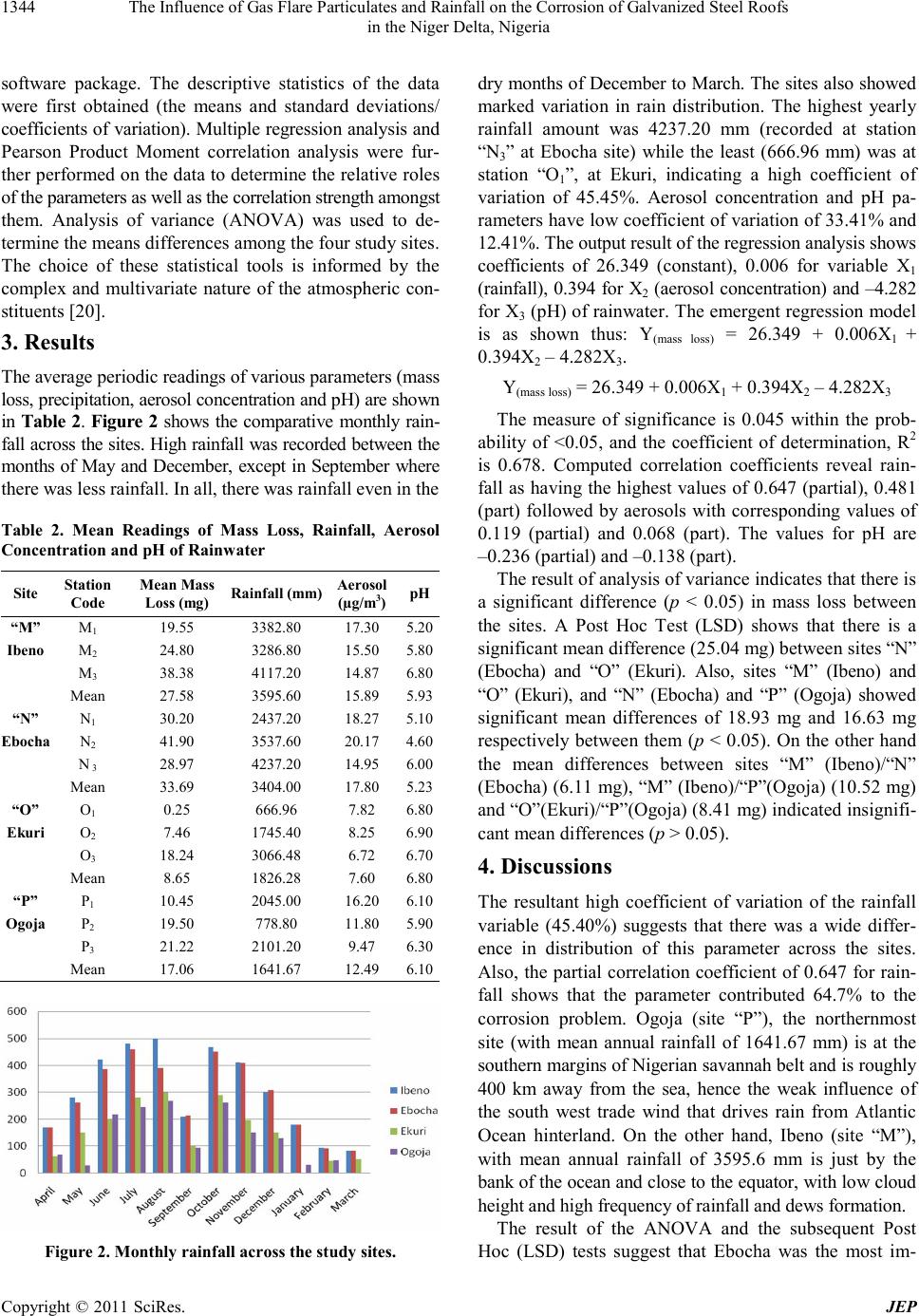 The Influence of Gas Flare Particulates and Rainfall on the Corrosion of Galvanized Steel Roofs 1344 in the Niger Delta, Nigeria software package. The descriptive statistics of the data were first obtained (the means and standard deviations/ coefficients of variation). Multiple regression analysis and Pearson Product Moment correlation analysis were fur- ther performed on the data to determine the relative roles of the parameters as well as the correlation strength amongst them. Analysis of variance (ANOVA) was used to de- termine the means differences among the four study sites. The choice of these statistical tools is informed by the complex and multivariate nature of the atmospheric con- stituents [20]. 3. Results The average periodic readings of various parameters (mass loss, precipitation, aerosol concentration and pH) are shown in Table 2. Figure 2 shows the comparative monthly rain- fall across the sites. High rainfall was recorded between the months of May and December, except in September where there was less rainfall. In all, there was rainfall even in the Table 2. Mean Readings of Mass Loss, Rainfall, Aerosol Conce ntr ation an d pH of Rain wat er Site Station Code Mean Mass Loss (mg) Rainfall (mm) Aerosol (µg/m3)pH “M” M1 19.55 3382.80 17.30 5.20 Ibeno M2 24.80 3286.80 15.50 5.80 M3 38.38 4117.20 14.87 6.80 Mean 27.58 3595.60 15.89 5.93 “N” N1 30.20 2437.20 18.27 5.10 Ebocha N2 41.90 3537.60 20.17 4.60 N 3 28.97 4237.20 14.95 6.00 Mean 33.69 3404.00 17.80 5.23 “O” O1 0.25 666.96 7.82 6.80 Ekuri O2 7.46 1745.40 8.25 6.90 O3 18.24 3066.48 6.72 6.70 Mean 8.65 1826.28 7.60 6.80 “P” P1 10.45 2045.00 16.20 6.10 Ogoja P2 19.50 778.80 11.80 5.90 P3 21.22 2101.20 9.47 6.30 Mean 17.06 1641.67 12.49 6.10 Figure 2. Monthly rainfall across the study sites. dry months of December to March. The sites also showed marked variation in rain distribution. The highest yearly rainfall amount was 4237.20 mm (recorded at station “N3” at Ebocha site) while the least (666.96 mm) was at station “O1”, at Ekuri, indicating a high coefficient of variation of 45.45%. Aerosol concentration and pH pa- rameters have low coefficient of variation of 33.41% and 12.41%. The output result of the regression analysis shows coefficients of 26.349 (constant), 0.006 for variable X1 (rainfall), 0.394 for X2 (aerosol concentration) and –4.282 for X3 (pH) of rainwater. The emergent regression model is as shown thus: Y(mass loss) = 26.349 + 0.006X1 + 0.394X2 – 4.282X3. Y(mass loss) = 26.349 + 0.006X1 + 0.394X2 – 4.282X3 The measure of significance is 0.045 within the prob- ability of <0.05, and the coefficient of determination, R2 is 0.678. Computed correlation coefficients reveal rain- fall as having the highest values of 0.647 (partial), 0.481 (part) followed by aerosols with corresponding values of 0.119 (partial) and 0.068 (part). The values for pH are –0.236 (partial) and –0.138 (part). The result of analysis of variance indicates that there is a significant difference (p < 0.05) in mass loss between the sites. A Post Hoc Test (LSD) shows that there is a significant mean difference (25.04 mg) between sites “N” (Ebocha) and “O” (Ekuri). Also, sites “M” (Ibeno) and “O” (Ekuri), and “N” (Ebocha) and “P” (Ogoja) showed significant mean differences of 18.93 mg and 16.63 mg respectively between them (p < 0.05). On the other hand the mean differences between sites “M” (Ibeno)/“N” (Ebocha) (6.11 mg), “M” (Ibeno)/“P”(Ogoja) (10.52 mg) and “O”(Ekuri)/“P”(Ogoja) (8.41 mg) indicated insignifi- cant mean differences (p > 0.05). 4. Discussions The resultant high coefficient of variation of the rainfall variable (45.40%) suggests that there was a wide differ- ence in distribution of this parameter across the sites. Also, the partial correlation coefficient of 0.647 for rain- fall shows that the parameter contributed 64.7% to the corrosion problem. Ogoja (site “P”), the northernmost site (with mean annual rainfall of 1641.67 mm) is at the southern margins of Nigerian savannah belt and is roughly 400 km away from the sea, hence the weak influence of the south west trade wind that drives rain from Atlantic Ocean hinterland. On the other hand, Ibeno (site “M”), with mean annual rainfall of 3595.6 mm is just by the bank of the ocean and close to the equator, with low cloud height and high frequency of rainfall and dews formation. The result of the ANOVA and the subsequent Post Hoc (LSD) tests suggest that Ebocha was the most im- Copyright © 2011 SciRes. JEP  The Influence of Gas Flare Particulates and Rainfall on the Corrosion of Galvanized Steel Roofs 1345 in the Niger Delta, Nigeria pact site, followed by Ibeno. The least impacted sites were Ekuri and Ogoja. Ekuri, the control station in the experiment, was relatively free from anthropogenic pol- lution as noticed at the two industrial sites of Ebocha and Ibeno. From the Post Hoc Test the mean mass loss dif- ference between Ibeno and Ebocha (6.11 mg) is insig- nificant (p > 0.05), indicating similarity in pollutant com- position between them. Similarly, the mean difference between Ekuri and Ogoja (8.4 mg) is insignificant (p < 0.05). On the other hand, Ibeno and Ekuri showed the largest significant mean difference of 25.04 mg (p < 0.05). The lesser correlation (partial and part) values of aero- sol of 0.119 and 0.068 and the corresponding negative values for pH of –0.236 and –0.138 could be understood. The heavy rainfall makes it difficult for particulates (aero- sols) and aqueous acidic pollutants to remain suspended in the atmosphere of this heavily wet region for long, thus masking their influences in the evolving atmosphe- ric corrosion chemistry. Moreover, only two sites (Ibeno and Ebocha) are within flare zones while the other two (Ogoja and Ekuri) are far away from crude oil exploita- tion activities (400 km and 200 km respectively). Coin- cidentally, the two aerosol-prone environments are also zones of heavy rainfall. Thus the diluting and scaven- ging effect of the rain reduces the apparent concentra- tion of the atmospheric aerosol and hence pH [5,21] and thus giving a pseudo-impression of light aerosol concen- tration across all the sites. As explained, this does not absolve these parameters from contributing to the corro- sion build up. Corrosion in this region could be caused more by dew as the pH of dew is far more acidic than that noticeable in the rain water [5]. The high humidity in the region leads to high frequency of dew formation. The dew wa- ter-bubbles on the metallic roof surface act as micro elec- trolyte that helps to initiate and promote corrosion. The subsequent rainfall would then likely wash away the for- med corrosion subtracts, thereby exposing the pitted sur- face to further corrosion attack. Precipitation, include- ing dew formation, is enhanced by particulates (aerosols) and acidic droplets (products of gas flaring). These parti- cles, most of which are hygroscopic, serve as nuclei for cloud droplets, thus accelerating condensation [18,19]. In all, the combined influence of all these parameters is highly significant (R2 = 0.678), suggesting that about 67.8% of the corrosion is attributed to these factors in combination. Much of the gas flared in this region is methane, which in combination with a small proportion of other hydro- carbons such as ethane and propane, constitute about 90% of the total, and as such the temperature of the flares is expected to be between 1870˚C and 3000˚C and this figure is far above the 1204˚C at which molecular nitro- gen begins to oxidize [21]. Therefore, it is evident that nitrous oxides (NOx) would be abundant within the vi- cinity of the flare chambers [21]. This invariably leads to the formation of the highly reactive nitric acid which, in addition to other acidic hydrocarbon particles of poor combustion, would be visited on the metallic roofs as acid rain, thereby initiating and promoting the corrosion in the region. 5. Conclusions This study has shown no doubt, that rainfall and gas flar- ing parameters have contributed significantly to the cor- rosion of galvanized iron roofs in the Niger Delta. While little or nothing could be done about the climate, the an- thropogenic impact of gas flaring could be checked. The most obvious environmental solution is the discontinua- tion of gas flaring in the region. The choice of another roofing material with high resilience to corrosion attack is an attractive alternative provided it is affordable to the ordinary low-income citizen of the region. Therefore, architects and material scientists should research alterna- tive ecologically benign and sustainable materials. The paper also recommends that more studies should be un- dertaken to verify the influence of dews in the corrosion of metals under such climates as seen in the Niger Delta. However, it is important to note that effect of gas flaring is not limited to material degradation; marine and terres- trial ecosystems are equally impacted besides the direct health effect often complained about. There is the need for research into alternative uses for the exuded gases even as it has an additional economic benefit. REFERENCES [1] A. K. Kuruvillo, “Life Prediction and Performance As- surance of Structural Materials in Corrosive Environ- ments—A State-of-the-Art Report,” Advanced Materials and Processes Technology Information Analysis Center, Falls Church, 1999. [2] J. Guthrie, B. Battat and C. Grethlein, “Accelerated Cor- rosion Testing,” AMPTIAC Quarterly, Vol. 6, No. 3, 2002, pp. 11-15. [3] M. Natesan, S. Selvaraj, T. Manickam and Venkatachari, “Corrosion Behaviour of Metals and Alloys in Marine– Industrial Environment,” Science and Technology of Ad- vanced Materials, Vol. 9, No. 4, 2008, Article ID 045002. do i:10. 1088 /14 68 -69 96/ 9/4 /045 002 [4] T. E. Graedel, “Effects of Emissions to the Atmosphere on Materials and Cultural Artifacts,” In: V. Galvert, Ed., The Chemistry of the Atmosphere; Its Impact on Global Change, Blackwell, Oxford, 1994, pp. 42-65. [5] E. Johansson and M. Linder, “The Influence of Environ- Copyright © 2011 SciRes. JEP  The Influence of Gas Flare Particulates and Rainfall on the Corrosion of Galvanized Steel Roofs in the Niger Delta, Nigeria Copyright © 2011 SciRes. JEP 1346 mental Acidification in the Atmospheric Corrosion of zinc,” Proceedings of 12th International Corrosion Con- gress, Vol. 2, 1993, pp. 549-560. [6] J. Tidblad, A. A. Mikhilov and V. Kucera, “Acid Deposi- tion Effect on Metals in Sub-Tropical Countries: Data Compilation and Temperate Climate Comparison,” SCI Report 2000:8E, Swedish Corrosion Institute, Stockholm, 2000. [7] T. E. Graedel and E. Legraf, “Scenarios for Atmospheric Corrosion in the 21st Century,” Electrochemical Society, 2001, pp. 24-30. [8] S. Syed, “Atmospheric Corrosion of Materials,” Emirate Journal of Engineering Research, Vol. 11, No. 1, 2006, pp. 1-24. [9] J. Tidblad, V. Kucera, F. Samie, S. N. Das, C. Bhamorn- sut, L. C. Peng, K. L. So, Z. Dawei, L. T. H. Lien, H. Schollenberger, C. V. Lungu and D. Simbi, “Exposure Programme on Atmospheric Corrosion Effects of Acidi- fying Pollutants in Tropical and Subtropical Climates,” Water, Air and Soil Pollution Focus, Vol. 7, No. 1-3, 2007, pp. 241-247. doi:10.1007/s11267-006-9078-6 [10] A. E. Obia, “Environmental Impact of Atmospheric Pol- lutants on Galvanized Iron Sheets in the Niger Delta Re- gion of Nigeria,” Ph. D. Thesis, University of Calabar, Calabar, 2008. [11] World Bank, “Defining an Environmental Strategy for Niger Delta (1),” World Bank Confidential Report, Wash- ington DC, 1995. [12] E. Uyigue and M. Agho, “Coping with Climate Change and Environmental Degradation in the Niger Delta of Southern Nigeria,” Community Research and Develop- ment Centre, Benin City, 2007. [13] I. J Ekpoh, and A. E. Obia, “The Role of Gas Flaring in the Rapid Corrosion of Zinc Roofs in the Niger Delta Re- gion of Nigeria,” Environ mentalist, Vol. 30, No. 4, 2010, pp. 347-352. doi.:10.1007/s10669-010-9292-7. [14] R. O. Idris, ”Impacts of Oil Spillage and Gas Flaring on the Population and Distribution of Birds in the Niger Delta region of Nigeria: A brief Interim Report Prepared for ABC Conservation Fund, United Kingdom,” 2010. www.africanbirdclub.org. [15] Wikipedia, “Environmental Issues in the Niger Delta,” 2010. http://en.wikipedia.org/wiki/sustainability/. [16] D. O. Egbuna, “The Environmental Hazard of Nigerian Natural Gas,” Proceedings of an International Seminar on the Petroleum Industry and the Nigerian Environment, Lagos, September 1987, pp. 346-351. [17] M. Moniruzzaman and A. S. M. A. Haseeb, “Investiga- tion into the Causes of Premature Corrosion of Pre-Fabri- cated Steel Factory Building,” Journal of Mechanical En- gineering, Vol. ME40, No. 2, 2009, pp. 90-94. [18] L. Chotimongkol, C. Barmornsut,, R. Nkuntool, N. Kaev- monkol, S. Sulphonlai, E. Vitiat, I. Cole and A. Neufeld, “Corrosion Monitoring of Metallic Building and Infra- structural Metals in Thailand,” Proceeding of Asian-Pa- cific Corrosion Control Conference, Ho Chi Minh City, Vol. 2, 1999, pp. 555-570. [19] L. T. H. Lien, P. T. San and H. L Hong, “Results of Studying Atmospheric Corrosion in Vietnam 1995-2005,” Science and Technology of Advanced Materials, Vol. 8, No. 7-8, 2007, pp. 552-558. doi :10. 1016 /j. stam.2 007 .08.0 11. [20] E. B. Eze, “Statistics in Environmental Management,” Dia- geg Nigeria Enterprises, Calabar, 2005. [21] C. T. I. Odu, “Gas Flare Emissions and Their Effects on the Acidity of Rain Water in the Ebocha Area,” Univer- sity of Ibadan, Ibadan, 1994. |