

Paper Menu >>
Journal Menu >>
 Journal of Environmental Protection, 2011, 2, 1295-1302 doi :1 0.4236/ jep.2011. 210149 Published Online December 2011 (http://www.SciRP.org/journal/jep) Copyright © 2011 SciRes. JEP 1295 Evaluation of Sources and Options for Possible Clean up of Anthropogenic Mercury Contamination in the Ankobra River Basin in South Western Ghana Thomas Mba Akabzaa, Sandow Mark Yidana* Department of Earth Science, University of Ghana, Legon, Ghana. E-mail: *[email protected], *[email protected] Received October 9th, 20 11; revised November 11th, 2011; accepted December 4th, 2011. ABSTRACT The study assesses the spatial distribution and sources of mercury contamination in the Ankobra River Basin in south- western Ghana and discusses possible remediation options and challenges. Eighty-two (82) samples of water and streambed sediments from areas of active and historic artisanal mining and historic mine spoil from large-scale mining were analysed for their total mercury content using cold vapour Atomic Fluorescence Spectrometry (CV-AAS). The highest Hg concentrations were recorded from historic mine tailings, legacy of large scale mines in the area, which averaged 795 ppb but ranged from 80 ppb to 2500 ppb. Concentrations in streambed sediments averaged 139 ppb, but ranged from 63 ppb to 270 ppb. Water, expectedly, gave the lowest Hg concentrations with a mean value of 1.5 ppb, but ranged from below detection to 8 ppb. Areas worked by artisanal miners and historic tailings dumps at Bondaye and Prestea recorded the highest mercury values. These high mercury concentration sites constitute potential sources of major mercury pollution in the area and therefore require major and urgent clean up to mitigate any major health risks. However, any remediation strategy would require further and detailed study of the contaminated sites and an evalua- tion of known remediation techniques to achieve maximum results. Keywords: Ankobra Basin, Mercury Contamination, Clean-Up, Old Tailings, Sediments, Water 1. Introduction Mercury pollution is a very serious environmental pro- blem because elevated concentrations are toxic to living organisms with the degree of toxicity varying with its chemical form. Organic mercury, particularly methyl mer- cury is said to be more than 1000 times as toxic as ele- mental mercury. The effects of mercury on humans are well documented. It causes damages to the central nerv- ous system and is especially toxic to the foetus [1,2]. Mercury in the environment comes from both natural and anthropogenic sources. Naturally, cinnabar (HgS) is practically the only source of the metal, while the most important anthropogenic sources of mercury pollution are from the mining industry [3]. Commercial deposits of cinnabar have not be reported in Ghana, although stream channel sampling have re- vealed a promising mercury dispersion zone in the valley of Tromia in Brong Ahafo region of the country [4]. On the whole, no significant natural sources of the metal are known in Ghana as efforts at other areas in the country have so far not indicated mercury concentrations signifi- cantly above its crustal abundance of 30 ppb. However, studies in traditional mining centres in Ghana such as Obuasi and Tarkwa have reported elevated mercury lev- els in stream water, sediments, fish, and plants [5,6]. Most of these studies a ssig ned the activitie s of artisa nal miners, who use mercury for gold recovery, as the primary sour- ce of mercury dispersion in Ghana. The present study are a has over 500 years of artisanal activ ities. Apart from these artisanal miners, mercury was pervasively used in large- scale mining in Ghana until the early 1990s when it was officially prohibited in large-scale mining. During that period, over 15 large-scale gold mines in the Tarkwa mi- ning district, many of them abandoned today, used mer- cury for gold recovery. The area has seen over 100 years of large-scale gold mining [7]. These mines left on their 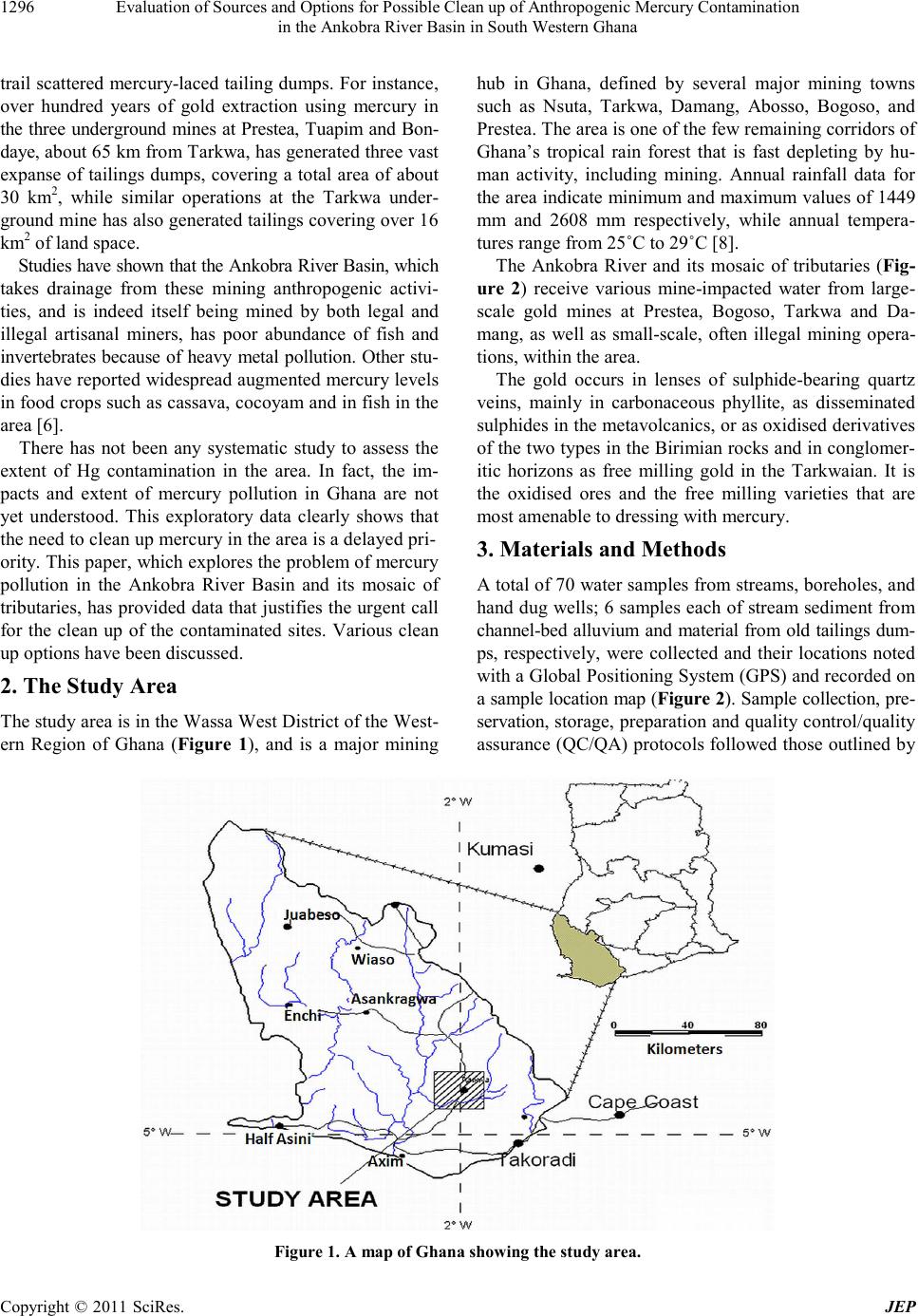 Evaluation of Sources and Options for Possible Clean up of Anthropogenic Mercury Contamination 1296 in the Ankobra River Basin in South Western Ghana trail scattered mercury-laced tailing dumps. For instance, over hundred years of gold extraction using mercury in the three underground mines at Prestea, Tuapim and Bon- daye, about 65 km from Tarkwa, has generated three vast expanse of tailings dumps, covering a total area of about 30 km2, while similar operations at the Tarkwa under- ground mine has also ge nerated tailings covering over 16 km2 of land space. Stud ies ha ve sho wn t hat the A nkob ra Ri ver Ba sin, whic h takes drainage from these mining anthropogenic activi- ties, and is indeed itself being mined by both legal and illegal artisanal miners, has poor abundance of fish and invertebrates because of heavy metal pollution. Other stu- dies have reported widespread augmented mercury levels in food crops such as cassava, cocoyam and in fish in the area [6]. There has not been any systematic study to assess the extent of Hg contamination in the area. In fact, the im- pacts and extent of mercury pollution in Ghana are not yet understood. This exploratory data clearly shows that the need to clean up merc ury in the area is a delaye d pri- ority. This paper, which explores the problem of mercury pollution in the Ankobra River Basin and its mosaic of tributaries, has provided data that justifies the urgent call for the clean up of the contaminated sites. Various clean up options have b een discussed. 2. The Study Area The study area is in the Wassa West District of the West- ern Region of Ghana (Figure 1), and is a major mining hub in Ghana, defined by several major mining towns such as Nsuta, Tarkwa, Damang, Abosso, Bogoso, and Prestea. The area is one of the few remaining corridors of Ghana’s tropical rain forest that is fast depleting by hu- man activity, including mining. Annual rainfall data for the area indicate minimum and maximum values of 1449 mm and 2608 mm respectively, while annual tempera- tures range from 25˚C to 29 ˚C [8]. The Ankobra River and its mosaic of tributaries (Fig- ure 2) receive various mine-impacted water from large- scale gold mines at Prestea, Bogoso, Tarkwa and Da- mang, as well as small-scale, often illegal mining opera- tions, within the area. The gold occurs in lenses of sulphide-bearing quartz veins, mainly in carbonaceous phyllite, as disseminated sulphides in the metavolcanics, or as oxidised derivatives of the two types in the Birimian rocks and in conglomer- itic horizons as free milling gold in the Tarkwaian. It is the oxidised ores and the free milling varieties that are most amenable to dressing with mercury. 3. Materials and Methods A total of 70 water samples from streams, boreholes, and hand dug wells; 6 samples each of stream sediment from channel-bed alluvium and material from old tailings dum- ps, respectively, were collected and their locations noted with a Global Positioning System (GPS) and recorded on a sample location map (Figure 2). Sample collec tion, pre - servation, storage, preparation and quality control/quality assurance (QC/QA) protocols followed those outlined by Figure 1. A map of Ghana showing the study area. Copyright © 2011 SciRes. JEP 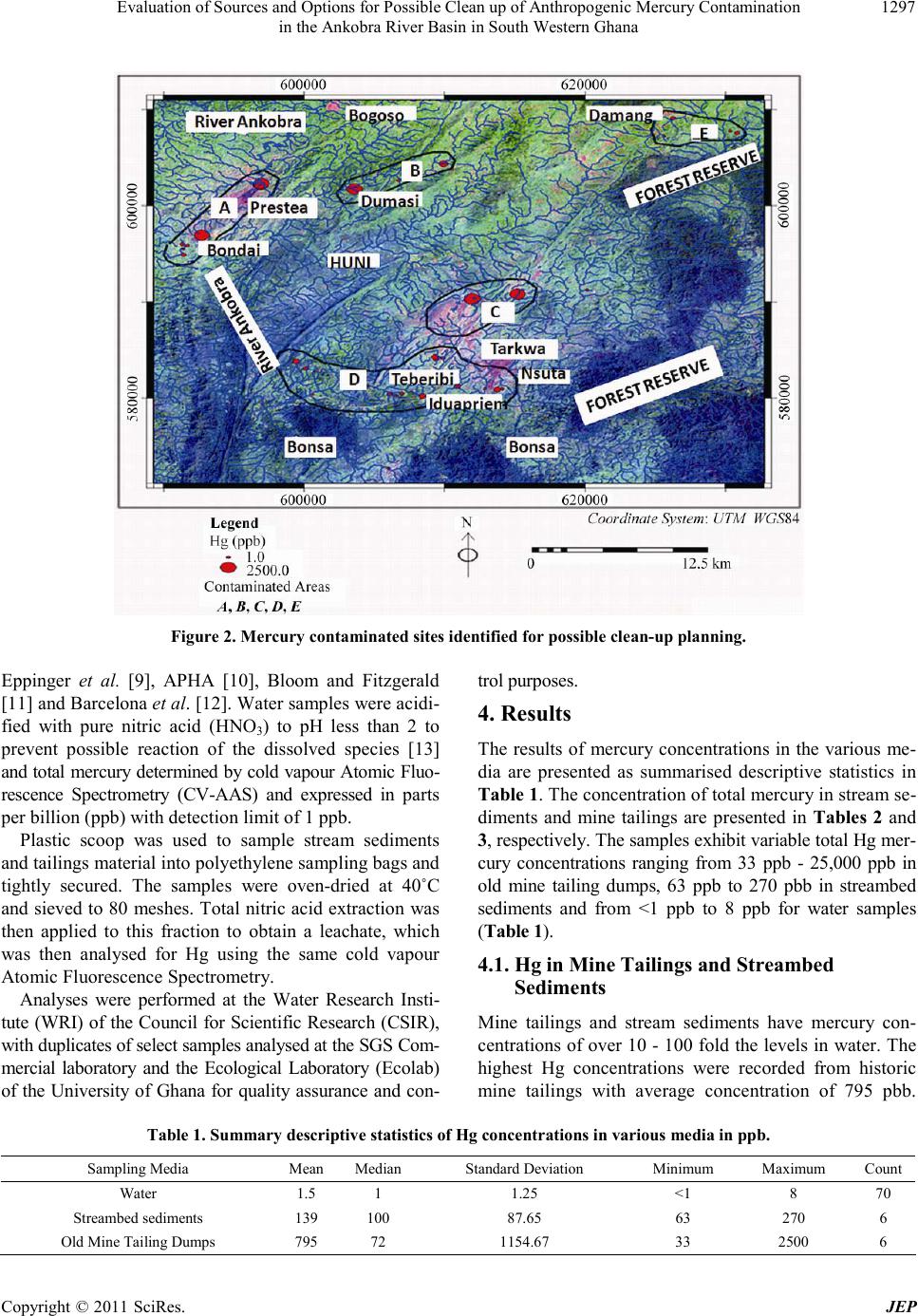 Evaluation of Sources and Options for Possible Clean up of Anthropogenic Mercury Contamination 1297 in the Ankobra River Basin in South Western Ghana Figure 2. Mercury conta minated sites identified for po ssi ble clean-up planning. Eppinger et al. [9], APHA [10], Bloom and Fitzgerald [11] and Barcelona et al. [12]. Water samples were acidi- fied with pure nitric acid (HNO3) to pH less than 2 to prevent possible reaction of the dissolved species [13] and total merc ury deter mined by cold vapour Ato mic Fl uo- rescence Spectrometry (CV-AAS) and expressed in parts per billion (ppb) with detection limit of 1 ppb. Plastic scoop was used to sample stream sediments and tailings material into p olyethylene sampling bags and tightly secured. The samples were oven-dried at 40˚C and sieved to 80 meshes. Total nitric acid extraction was then applied to this fraction to obtain a leachate, which was then analysed for Hg using the same cold vapour Atomic Fluorescence Spectrometry. Analyses were performed at the Water Research Insti- tute (WRI) of the Council for Scientific Research (CSIR), with duplicat es of select samp les anal ysed at the SGS Com- mercial laboratory and the Ecological Laboratory (Ecolab) of the University of Ghana for quality assurance and con- trol purpos es. 4. Results The results of mercury concentrations in the various me- dia are presented as summarised descriptive statistics in Table 1. T he concentration of total mercury in stream se- diments and mine tailings are presented in Tables 2 and 3, respective ly. Th e sa mpl es e xhibit var iable total Hg mer - cury concentrations ranging from 33 ppb - 25,000 ppb in old mine tailing dumps, 63 ppb to 270 pbb in streambed sediments and from <1 ppb to 8 ppb for water samples (Table 1). 4.1. Hg in Mine Tailings and Streambed Sediments Mine tailings and stream sediments have mercury con- centrations of over 10 - 100 fold the levels in water. The highest Hg concentrations were recorded from historic mine tailings with average concentration of 795 pbb. Table 1. Summary descripti ve statisti cs of Hg c once ntrations in various media i n ppb. Sampling Media Mean Media n Standard Deviation Minimum Maximum Count Water 1.5 1 1.25 <1 8 70 Streambed sediments 139 100 87.65 63 270 6 Old Mine Tailing Dumps 795 72 1154.67 33 2500 6 Copyright © 2011 SciRes. JEP 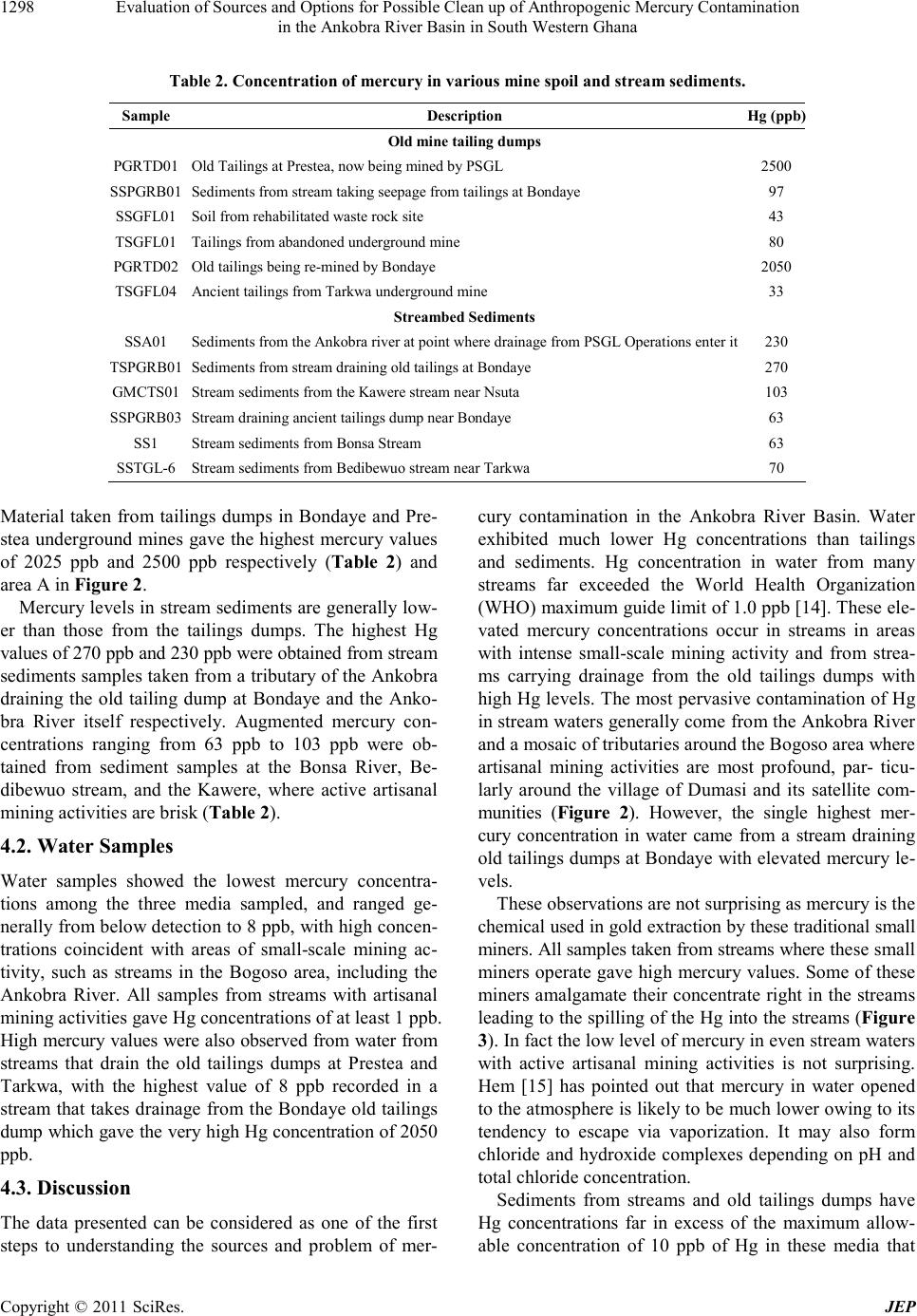 Evaluation of Sources and Options for Possible Clean up of Anthropogenic Mercury Contamination 1298 in the Ankobra River Basin in South Western Ghana Table 2. Conce ntration of mercury in vari ous mine s poil and stream sediments . Sample Description Hg (ppb) Old mine tailing dumps PGRTD01 Old Tailings at Prestea, now being mined by PSGL 2500 SSPGRB01 Sediments from stream ta kin g seepa ge from tailings at Bondaye 97 SSGFL01 Soil from rehabilitated waste rock site 43 TSGFL01 Tailings from abandoned underground mine 80 PGRTD02 Old tailings being re-mined by Bondaye 2050 TSGFL04 Ancient tailin gs from Tarkwa und erground mine 33 Streambed Sediments SSA01 Sediments from the Ankobra river at point where drainage from PSGL Operations enter it 230 TSPGRB01Sediments from stream draining old tailings at Bondaye 270 GMCTS01 Stream sediments from the Kawere stream near Nsuta 103 SSPGRB03 Stream draining ancient tailings dump near Bonda ye 63 SS1 Stream sediments from Bonsa Stream 63 SSTGL-6 Stream sediment s from Bedibewuo stream near Tarkwa 70 Material taken from tailings dumps in Bondaye and Pre- stea underground mines gave the highest mercury values of 2025 ppb and 2500 ppb respectively (Table 2) and area A in Figure 2. Merc ury le vels i n strea m sedi ments a re ge neral ly lo w- er than those from the tailings dumps. The highest Hg values of 270 ppb and 230 ppb were obtained from stream sedi ments samp les ta ken fro m a tr ibutar y of t he Anko bra draining the old tailing dump at Bondaye and the Anko- bra River itself respectively. Augmented mercury con- centrations ranging from 63 ppb to 103 ppb were ob- tained from sediment samples at the Bonsa River, Be- dibewuo stream, and the Kawere, where active artisanal mining activities are brisk (Table 2). 4.2. Water Samples Water samples showed the lowest mercury concentra- tions among the three media sampled, and ranged ge- nerally from below detection to 8 ppb, with high concen- trations coincident with areas of small-scale mining ac- tivity, such as streams in the Bogoso area, including the Ankobra River. All samples from streams with artisanal mining activities gave Hg concentrations of at least 1 ppb. High merc ury val ues wer e a lso obs erved from wa ter fro m streams that drain the old tailings dumps at Prestea and Tarkwa, with the highest value of 8 ppb recorded in a stream that takes drainage fro m the Bonda ye old tailings dump which gave the very high Hg concentration of 2050 ppb. 4.3. Discussion The data presented can be considered as one of the first steps to understanding the sources and problem of mer- cury contamination in the Ankobra River Basin. Water exhibited much lower Hg concentrations than tailings and sediments. Hg concentration in water from many streams far exceeded the World Health Organization (WHO) maximum guide limit of 1.0 ppb [14]. These ele- vated mercury concentrations occur in streams in areas with intense small-scale mining activity and from strea- ms carrying drainage from the old tailings dumps with high Hg levels. The most pervasive contamination of Hg in stre am water s ge ner all y come fr om t he A nkobr a Ri ver and a mosaic of tributaries around the Bogoso area where artisanal mining activities are most profound, par- ticu- larly around the village of Dumasi and its satellite com- munities (Figure 2). However, the single highest mer- cury concentration in water came from a stream draining old tailings dumps at Bondaye with elevated mercury le- vels. These observations are not surprising as mercury is the chemical used in gold e xtraction by t hese traditional small miner s. All sa mpl es take n fro m str ea ms whe re t hes e s ma ll miner s oper ate gave high mer cury val ues. So me of thes e miners amalgamate their concentrate right in the streams leading to the spilling of the Hg into the streams (Figure 3). In fact the low level of mercury in even stream waters with active artisanal mining activities is not surprising. Hem [15] has pointed out that mercury in water opened to the atmosphere is like ly to be much lower owing to its tendency to escape via vaporization. It may also form chloride and hydroxide complexes depending on pH and total chloride concentration. Sediments from streams and old tailings dumps have Hg concentrations far in excess of the maximum allow- ble concentration of 10 ppb of Hg in these media that a Copyright © 2011 SciRes. JEP  Evaluation of Sources and Options for Possible Clean up of Anthropogenic Mercury Contamination 1299 in the Ankobra River Basin in South Western Ghana Table 3. Su mmary of remediation meth ods. METHOD DESCRIPTION ADVANTAGES DISADVAN-TAGES SPECIAL REQUIREMENTS Removal Dredging and pu mping out contaminated materials Well-tested and effective Expensive, lengthy process; disposal sites can leak and re-release contaminant; significant disturbance of the environment Expensiv e equipment; mu st be monito r e d perio di cal l y and followed by either treatment and/or burial and containment in other location Physical treatment (i.e. sorting) Good for large q uantities of sediment (20 - 40 tons/hour) Doe s not work wi th high silt, clay content soils/sediments Therm al treatment res ulting in volatilization Mercury compounds are highly volatile at low temperature Causes more atmospheric mercury pollution Treatment Ch emical treatment on site or off site Mercury reacts with other c om pounds and can be made biologically unavailable Adding foreign chemicals into an ecosystem can be dan g erous when you aren’t sure of the out come These methods often a re best applied of site in contaminated medium that has been removed Immobilization Physical barriers placed on site to contain the contaminant so it can no longer spread through th e ecosystem Well-tested and effective High cost, barriers are of questionable permanence, unkn own unintended ecological effects fr o m the destruction of the benthic ecosystem Barriers can be top, bottom or lateral side barriers; sometimes barrie r s can be nat ur al and not man made Microbial Act ion Using microbes that can demethylate mercury to clean contaminated mediums Effective in sludges, wastewater and controlled environments like the lab oratory Not proven for on site remediation Forms the basis of phytoremediation Phytoremediation Various techniques using plants to remove mercury from the environment or immobilizing it within th e environment; methods include degradation, extraction, containment or a combo of all three Cost effective, less intrusive than other meth ods, pollution captured can be recycled and r eused in stead of mining more Plants grow slow and results take a while, mercury captured in the plant may be available to wildlife feeding on the plant, not well tested, envir onment must be suitable t o the acc umula ting plant Best for sites with low to medium levels of contamination Water Quality Management Manipulating the water quality such as oxygen content or pH to ensure methyl mercury prod uction will not occ ur Cost effective, less intrusive, not highly technical Mani p ul a tions ne e d to be monitored, and may likely need manipulati on often; ma y disrupt some ecosy funcstem tioning Mos t easily implemented by current water managing agencies Source: (Adopted from Fuller [3]). would require immediate remedial action [16]. Mercury concentrations in these media are about 5 to more than 500 times the maximum allowable limits. The results de- monstrate that Hg use by artisanal miners and Hg in old tailings dumps of large scale mining activities constitute the two major anthropogenic sources of mercury con- tamination in the area. The two extremely high anomalous Hg values in the Copyright © 2011 SciRes. JEP 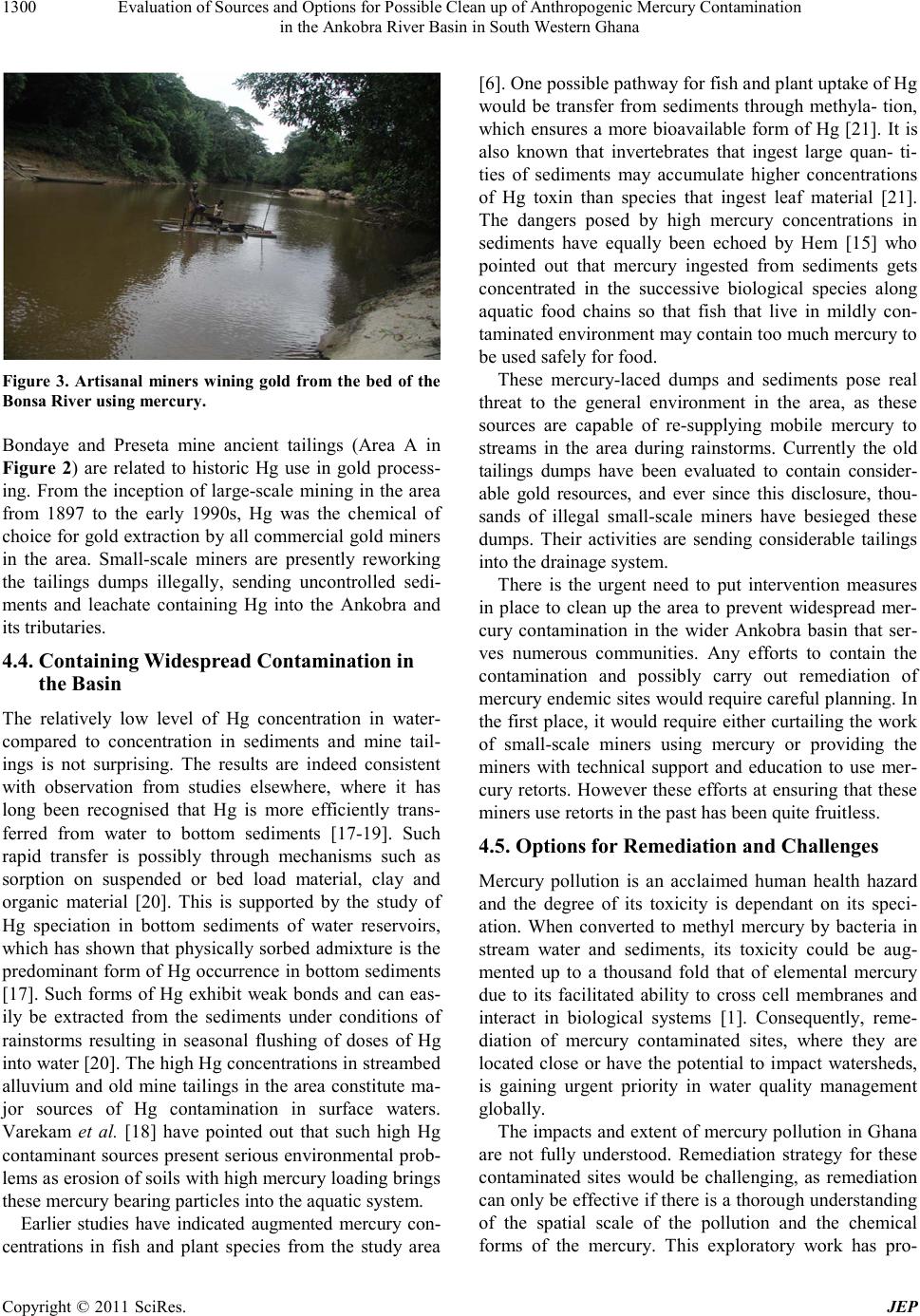 Evaluation of Sources and Options for Possible Clean up of Anthropogenic Mercury Contamination 1300 in the Ankobra River Basin in South Western Ghana Figure 3. Artisanal miners wining gold from the bed of the Bonsa River using mercury. Bondaye and Preseta mine ancient tailings (Area A in Figure 2) are related to historic Hg use in gold process- ing. From the inception of large-scale mining in the area from 1897 to the early 1990s, Hg was the chemical of choice for gold extraction b y all co mmercial gold miners in the area. Small-scale miners are presently reworking the tailings dumps illegally, sending uncontrolled sedi- ments and leachate containing Hg into the Ankobra and its tributaries. 4.4. Containing Widespread Contamination in the Bas in The relatively low level of Hg concentration in water- compared to concentration in sediments and mine tail- ings is not surprising. The results are indeed consistent with observation from studies elsewhere, where it has long been recognised that Hg is more efficiently trans- ferred from water to bottom sediments [17-19]. Such rapid transfer is possibly through mechanisms such as sorption on suspended or bed load material, clay and organic material [20]. This is supported by the study of Hg speciation in bottom sediments of water reservoirs, which has shown that physicall y sorbed admixture is the predominant form of Hg occurrence in bottom sediments [17]. Such forms of Hg exhibit weak bonds and can eas- ily be extracted from the sediments under conditions of rainstorms resulting in seasonal flushing of doses of Hg into water [20]. The high Hg co ncentrations in strea mbed alluvium and old mine tailings in the area constitute ma- jor sources of Hg contamination in surface waters. Varekam et al. [18] have pointed out that such high Hg contaminant sources present serious environmental prob- lems as erosion of soils with high mercur y loading bring s these mercury bearing particles into the aquatic system. Earlier studies have indicated augmented mercury con- centrations in fish and plant species from the study area [6]. One possible pathway for fish and plant uptake of Hg would be transfer fro m sediments through methyla- tion, which ensures a more bioavailable form of Hg [21]. It is also known that invertebrates that ingest large quan- ti- ties of sediments may accumulate higher concentrations of Hg toxin than species that ingest leaf material [21]. The dangers posed by high mercury concentrations in sediments have equally been echoed by Hem [15] who pointed out that mercury ingested from sediments gets concentrated in the successive biological species along aquatic food chains so that fish that live in mildly con- tami nated envir on ment ma y conta in too muc h merc ury to be used safely for food. These mercury-laced dumps and sediments pose real threat to the general environment in the area, as these sources are capable of re-supplying mobile mercury to streams in the area during rainstorms. Currently the old tailings dumps have been evaluated to contain consider- able gold resources, and ever since this disclosure, thou- sands of illegal small-scale miners have besieged these dumps. Their activities are sending considerable tailings into the drainage system. There is the urgent need to put intervention measures in place to clean up the area to prevent widespread mer- cury contamination in the wider Ankobra basin that ser- ves numerous communities. Any efforts to contain the contamination and possibly carry out remediation of mercury endemic sites would require careful planning. In the first place, it would require either curtailing the work of small-scale miners using mercury or providing the miners with technical support and education to use mer- cury retorts. However these efforts at ensuring that these miners use retorts in the past has been quite fruitless. 4.5. Options for Remediation and Challenges Mercury pollution is an acclaimed human health hazard and the degree of its toxicity is dependant on its speci- ation. When converted to methyl mercury by bacteria in stream water and sediments, its toxicity could be aug- mented up to a thousand fold that of elemental mercury due to its facilitated ability to cross cell membranes and interact in biological systems [1]. Consequently, reme- diation of mercury contaminated sites, where they are located close or have the potential to impact watersheds, is gaining urgent priority in water quality management globally. The impacts and extent of mercur y pollution in Gha na are not fully understood. Remediation strategy for these contaminated sites would be challenging, as remediation can only be effective if there is a thorough understanding of the spatial scale of the pollution and the chemical forms of the mercury. This exploratory work has pro- Copyright © 2011 SciRes. JEP 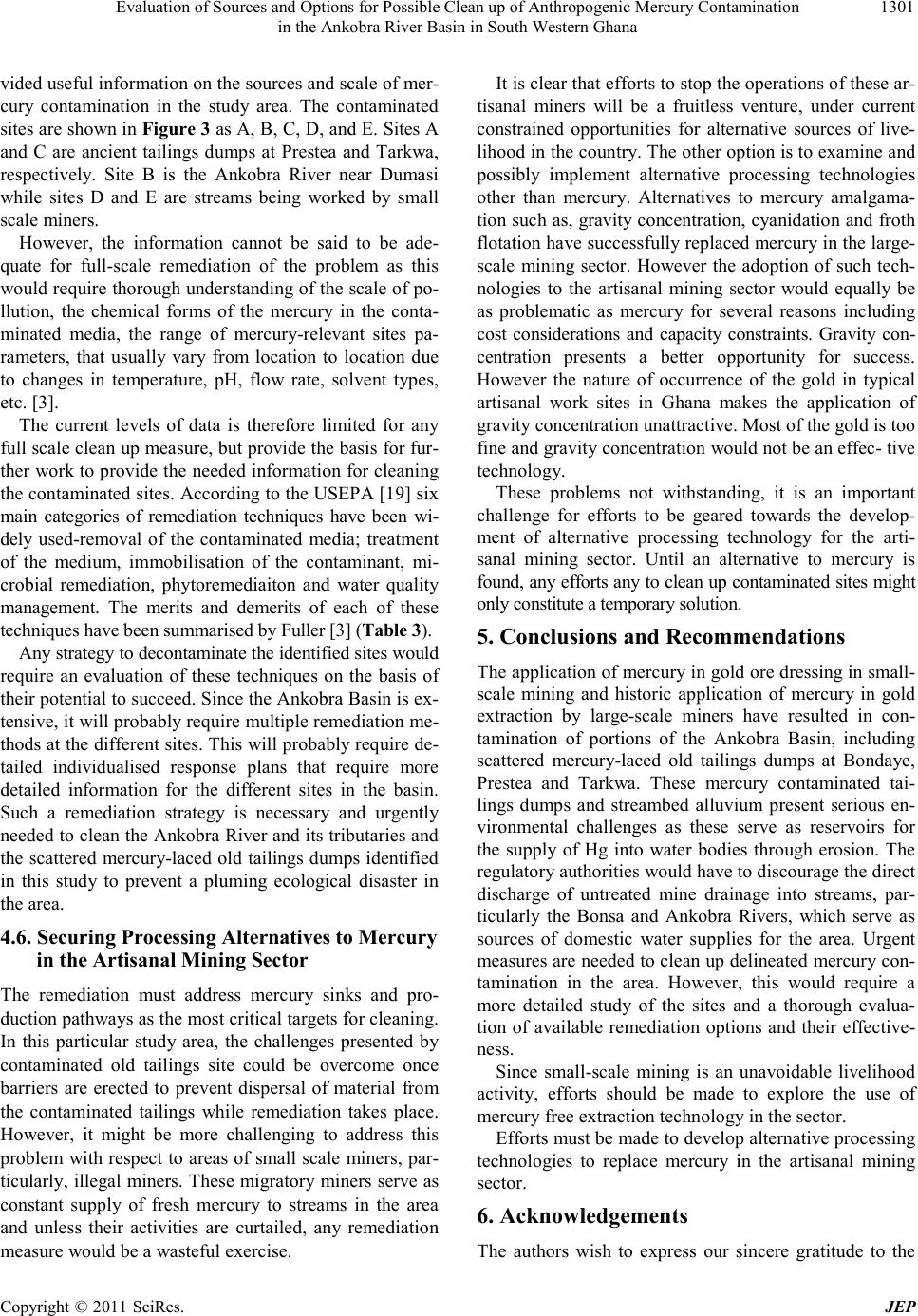 Evaluation of Sources and Options for Possible Clean up of Anthropogenic Mercury Contamination 1301 in the Ankobra River Basin in South Western Ghana vided useful information on the sources and scale of mer- cury contamination in the study area. The contaminated sites are sho wn in Figure 3 as A, B, C, D, and E. Sites A and C are ancient tailings dumps at Prestea and Tarkwa, respectively. Site B is the Ankobra River near Dumasi while sites D and E are streams being worked by small scale miners. However, the information cannot be said to be ade- quate for full-scale remediation of the problem as this would require thorough understanding of the scale of po- llution, the chemical forms of the mercury in the conta- minated media, the range of mercury-relevant sites pa- rameters, that usually vary from location to location due to changes in temperature, pH, flow rate, solvent types, etc. [3]. The current levels of data is therefore limited for any full scale clean up measure, but provide the basis for fur- ther work to provide the needed information for cleaning the contaminated sites. According to the USEPA [19] six main categories of remediation techniques have been wi- dely used-removal of the contaminated media; treatment of the medium, immobilisation of the contaminant, mi- crobial remediation, phytoremediaiton and water quality management. The merits and demerits of each of these techniques have been summ arised by Ful l er [3] (Table 3). Any strategy to deco nta minate the ide nti fied site s would require an evaluation of these techniques on the basis of their potential to succeed. Since the Ankobra Basin is ex- tensive, it will probably require multiple re mediation me- thods at the different sites. This will probably require de- tailed individualised response plans that require more detailed information for the different sites in the basin. Such a remediation strategy is necessary and urgently needed to clean the Ankobra River and its tributaries and the scattered mercury-laced old tailings dumps identified in this study to prevent a pluming ecological disaster in the area. 4.6. Securing Pr oc essing A lt er nati ve s t o Me rcury in the Artisanal Mining Sector The remediation must address mercury sinks and pro- duction pathways as the most critical targets for cleaning. In this particular study area, the challenges presented by contaminated old tailings site could be overcome once barriers are erected to prevent dispersal of material from the contaminated tailings while remediation takes place. However, it might be more challenging to address this problem with respect to areas of small scale miners, par- ticularly, illegal miners. These migratory miners serve as constant supply of fresh mercury to streams in the area and unless their activities are curtailed, any remediation measure would be a wasteful exercise. It is clear that efforts to stop the operations of these ar- tisanal miners will be a fruitless venture, under current constrained opportunities for alternative sources of live- lihood in the country. The other option is to examine and possibly implement alternative processing technologies other than mercury. Alternatives to mercury amalgama- tion such as, gravity concentration, cyanidation and froth flotation have successfully replaced mercury in the large- scale mining sector. However the adoption of such tech- nologies to the artisanal mining sector would equally be as problematic as mercury for several reasons including cost considerations and capacity constraints. Gravity con- centration presents a better opportunity for success. However the nature of occurrence of the gold in typical artisanal work sites in Ghana makes the application of gravity concentration unattractive. Most of the gold is too fine and gr avi t y co nc e ntr a tio n would not b e a n effe c - tive technology. These problems not withstanding, it is an important challenge for efforts to be geared towards the develop- ment of alternative processing technology for the arti- sanal mining sector. Until an alternative to mercury is found, any efforts any to clean up contaminated sites might only constitut e a tempor a ry solut ion. 5. Conclusions and Recommendations The application of mercury in gold ore dressing in small- scale mining and historic application of mercury in gold extraction by large-scale miners have resulted in con- tamination of portions of the Ankobra Basin, including scattered mercury-laced old tailings dumps at Bondaye, Prestea and Tarkwa. These mercury contaminated tai- lings dumps and streambed alluvium present serious en- vironmental challenges as these serve as reservoirs for the supply of Hg into water bodies through erosion. The regulatory authorities would have to disco urage the direct discharge of untreated mine drainage into streams, par- ticularly the Bonsa and Ankobra Rivers, which serve as sources of domestic water supplies for the area. Urgent measures are needed to clean up delineated mercury con- tamination in the area. However, this would require a more detailed study of the sites and a thorough evalua- tion of available remediation options and their effective- ness. Since small-scale mining is an unavoidable livelihood activity, efforts should be made to explore the use of mercury free extraction technology in the sector. Efforts must be made to develop alternative processing technologies to replace mercury in the artisanal mining sector. 6. Acknowledgements The authors wish to express our sincere gratitude to the Copyright © 2011 SciRes. JEP  Evaluation of Sources and Options for Possible Clean up of Anthropogenic Mercury Contamination in the Ankobra River Basin in South Western Ghana Copyright © 2011 SciRes. JEP 1302 DANIDA-ENRECA Hydrogeological Project for provi- ding the financial support for this study. REFERENCES [1] USEPA, “Nonpoint Source Program and Grants Guidance for Fiscal Year 1997 and Future Years,” US Environmental Protection Agency, Office of Water, Washington DC, 1996. [2] J. E. Gray, I. A. Greaves, D. M. Bustos and D. P. Krab- benhoft, “Mercury and Methyl Mercury Content in Mine- waste Calcine, Water, and Sediments Collected from the Palawan Quicksilver Mine, Philippines,” Environmental Geology, Vol. 43, No. 3, 2003, pp. 298-307. [3] A. Fuller, “Addressing the Environmental Mercury Prob- lem in Watersheds: Remediation in the Guadalupe River Watershed, SAN Jose, California,” Mercury Study: Re- port to Congress, EPA Report 452/-97-0003, 2003. http:/www.epa.gov/govttnuatwi/112nmerc/mercury.htm [4] G. O. Kesse, “M ineral and Rock resources o f Ghana,” A. A. Balkema Publishers, Accord, 1985, pp. 338-339. [5] T. M. Akabzaa, B. Banoeng-Yakubo and J. S. Seyire, “Evaluation of the status of Heavy Metal and Metalloid in Selected Mining Communities, in Adansi West and Aman- sie East Distri cts of Ashanti, Ghan a,” Ghana Science Jour- nal, 2003, i n pre s s . [6] M. Babut, R. Sekyi, A. Rambaud, M. Potrin-Gautier, S. Tellier, W. Bannerman and C. Beinhoff, “Improving the Environmental Management of Scale-Scale Mining Gold Mining in Ghana: A Case Study of Dumasi,” Journal of Cleaner Production, Vol. 11, No. 2, 2003, pp. 215-221. doi:10.1016/S0959-6526(02)00042-2 [7] E. A. Ofosu-Mensah, “Gold Mining and the Socio-Eco- nomic Development of Obuasi in Adanse,” African Jour- nal of History and Culture, Vol. 3, No. 4, 2011, pp. 54- 64. [8] K. A. Dickson and G. Benneh, “A New Geography of Ghana,” Longman, London, 1988. [9] R. G. Eppinger, P. H. Briggs, D. Rosenkrans and V. Ball- estrazze, “Environmental Geochemical Studies of Selected Mineral Deposits in Wrangell—St. Elias National Park and Preserve, Alaska,” USGS Professional Paper 1619, Gray and Sanzolone , 1996, p. 41. [10] APHA, AWWA and WEF, “Standard Methods for the Examination of Water and Wastewater,” 20th Edition, Wa- shington D C, N ew York, 1998. [11] N. S. Bloom and W. F. Fitzgerald, “Determination of Vol atile Mercu ry Species at the Picogram Level by Low- Temperature Gas Spectrometry,” Analycal Chimica Acta, Vol. 208, 1998 , pp. 15 1-161 . doi:10.1016/S0003-2670(00)80743-6 [12] M. Barcelona, J. P. Gibbs, J. A. Helfrich and E. E. Garske, “Practical Guide for Groundwater Sampling,” Illinois State Water Survey IDWS Contra c t Report 374, 1985. [13] C. A. J. Appelo and D. Postma, “Geochemistry, Ground- water and Pollution,” 2nd Edition, A. A. Balkema Pub- lishers, Accord, 2005. [14] W. H. O., “Guidelines for Drinking Water Quality, Health Criteria and Supporting Information,” Vol. 2, World Health Organisation Geneva, 1996. [15] J. D. Hem, “Study and Interpretation of the Chemical Characteristics of Natural Water,” US Geological Survey Water Supply Paper, 1985, pp. 142-143. [16] African Development Bank , “E nvironme ntal Guideline s f or Mining Projec t s,” 1994, p. 8 2. [17] P. V. Koval, G. V. Kalmychkov, V. F. Gelety, G. A. Leonova, V. I. Medvedev and L. D. Andrulaitis, “Corre- lation of Natural and Technogenic Mercury Sources in the Baikal Polygon, Russia,” Journal of Geochemical Explo- ration, Vol. 66, No. 1-2 , 199 9, pp . 277-289. doi:10.1016/S0375-6742(99)00041-2 [18] J. C. Varekam, B. Kreulen, B. Brink and E. L. Mecray, “Mercury Contamination Chronologies from Conecticut Wetlands and Long Island Sound Sediments,” Environ- mental Geology, Vol. 43, 2003, pp. 268-282. [19] United States Environmental Protection Agency, USEPA, “Mercury Study Report to Congress, Volume II: An In- ventory of Anthropogenic Mercury Emissions in the Uni- ted States.” Inves tigation Number EPA-452/R- 97-004, 1997. [20] E. A. Jenne, “Adsorption of Metals by Geomedia: Vari- ables, Mechanisms and Model Application,” Academia Press, Boston, 1997. [21] M. G. Kelly, “Effects of Heavy Metal in the Aquatic Bi- ota. In the Environmental Geochemistry of Mineral De- posits. Part A: Processes, Techniques and Health Issues,” In: S. G. Plumlee and J. M. Logsdon, Eds., Reviews in Economic Geology, Vol. 6A, 1999, pp. 363- 371. |