

Paper Menu >>
Journal Menu >>
 Journal of Environmental Protection, 2011, 2, 1388-1391 doi :1 0.4236/ jep.2011. 210161 Published Online December 2011 (http://www.SciRP.org/journal/jep) Copyright © 2011 SciRes. JEP Development of Automatically Updated Soundmaps for the Preservation of Natural Environment Ioannis Paraskevas1, Stylianos M. Potirakis1, Ioannis Liaperdos2, Mar ia Rangoussi1 1Department of Electronics Engineering, Technological Education Institute of Piraeus, Aigaleo-Athens, Greece; 2Department of Tech- nology of Informa tics a nd Te lecom m unic ations , Tec hnolog ica l Educ a tion Ins titute of Kalam a ta/Branch of Spa r ta, Spa r ta, Greece . E-mail: [email protected], {spoti, mariar}@teipir.gr, [email protected] Received October 2nd, 2011; revised November 2nd, 2011; accepted December 3rd, 2011. ABSTRACT Automatically Updated Soundmaps are maps that convey the sound rather than the visual information content of an area of interest, at a certain time instant or period. Sound features encapsulate information that can be combined with the visual features of the landscape, thus leading to useful environmental conclusions. This work aims to construct an Automatically Updated Soundmap of an area of environmental interest. A hierarchical pattern recognition approach method is proposed here that can exploit sound recordings collected by a network of microphones. Hence, after appro- priate signal processing, the large amounts of information, originally in the raw form of sound recordings, can be pre- sented in the concise yet meaningful form of a periodically updated soundmap. Keywords: Soundmaps, Acoustic Ecology, Hierarchical Pattern Recognition, Network of Microphones 1. Introduction Current research related to the environmental or ecolo- gical information o f landscapes is mostly focu sed on their visual content, e.g., the landscape characteristics of a biotope. In this work, the sound content of the landscape is proposed as an additional information stream, aiming to produce useful audio-visual features, [1]. An Auto- matically Updated Soundmap (AUS) is the map of a cer- tain region of environmental interest at a given time in- stant or period, which depicts the sound content, [2,3]. The periodic construction and comparison of AUSs for the same area is a useful tool for the detection of changes in an ecosystem, [4-6]. To this end, a method is proposed here for the devel- opment of AUSs for an area of environmental interest. In brief, the proposed method is based on sound recordings that are collected by microphones. Each sound recording is then processed and automatically classified. Classifi- cation results are placed on the exact recording spot of the geographical map of the area. The classification sche- me proceeds hierarchically from coarser to finer deci- sions and categorization. 2. Development of an AUS The proposed method for the development of an AUS is presented here based on a simulated recording setup. 2.1. Microphone Placement for Optimal Area Coverage In order to develop an AUS, the sound content of a geo- graphical area has to be recorded. A network of micro- phones deployed at appropriate spacing, can provide sat- isfactory spatial sampling. Spots of environmental inter- est are “sampled” more densely, whereas spots of lower interest and/or of restricted acc essibility are sampled more sparsel y. Eve ntua l, se nsors ’ ( micro pho nes) po sitioning i s a compromise between mathematical optimality and practi- cal restrictions. Sound is recorded locally but is processed centrally. Specifically, a wireless sensor network is employed so as to communicate the pre-processed sound information from the sensors to th e processing node (Figure 1). 2.2. Pattern Recognition of Environmental Sounds The sound information gathered in the processing node is subsequently transmitted to the central point of the net- wor k ( PC, in Fig ure 1), where the pat tern recognitio n and the soundmap development steps take place. The pattern re- 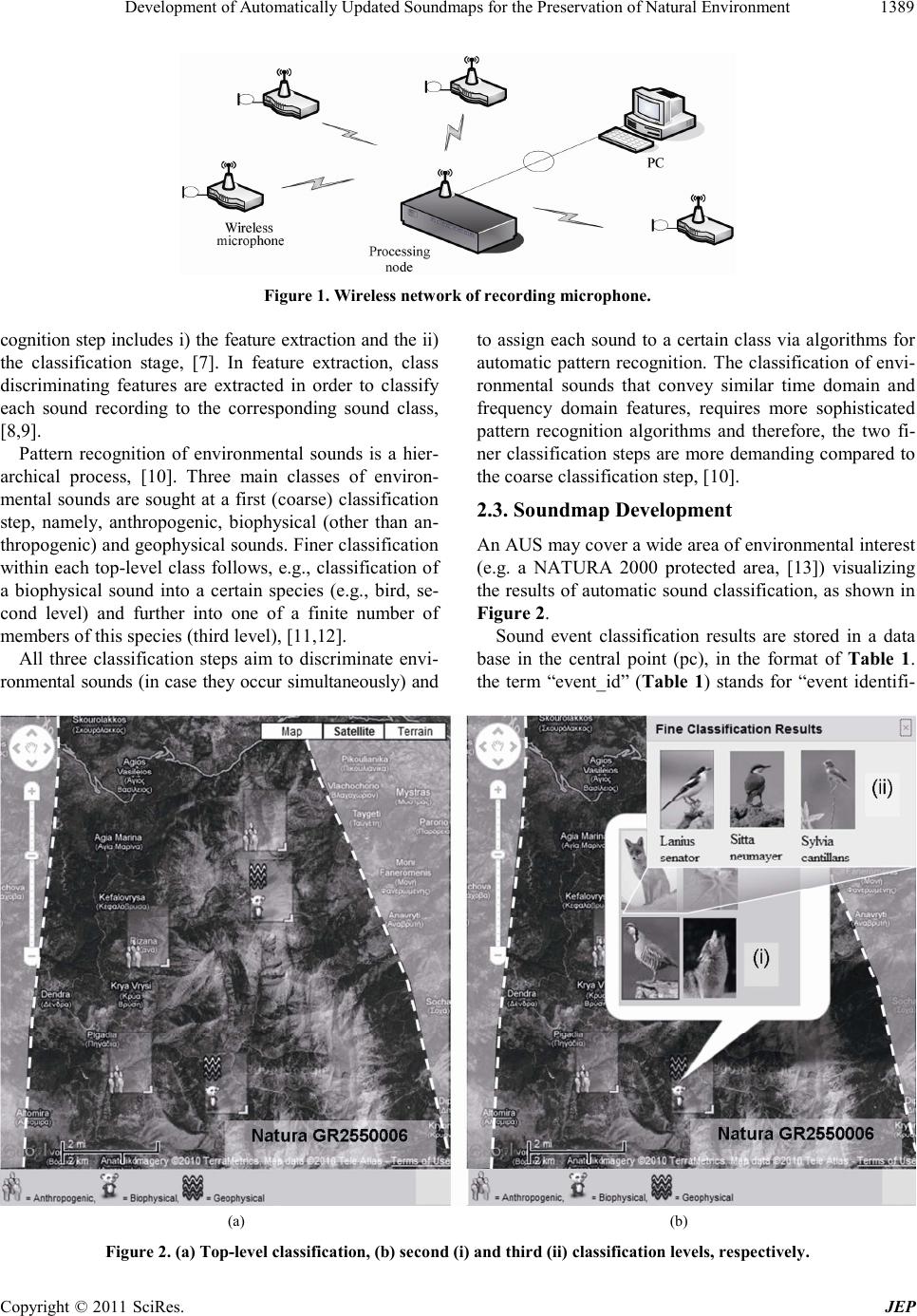 Development of Automatically Updated Soundmaps for the Preservation of Natural Environment1389 Figure 1. Wireless network of recording micropho ne. cognition step includes i) the feature extractio n and the ii ) the classification stage, [7]. In feature extraction, class discriminating features are extracted in order to classify each sound recording to the corresponding sound class, [8,9]. Pattern recognition of environmental sounds is a hier- archical process, [10]. Three main classes of environ- mental sounds are sought at a first (coarse) classification step, namely, anthropogenic, biophysical (other than an- thropogenic) and geophysical sounds. Finer classification within each top-level class follows, e.g., classification of a biophysical sound into a certain species (e.g., bird, se- cond level) and further into one of a finite number of members of this species (third level), [11,12]. All three classification steps aim to discriminate envi- ronmental sounds (in case they occur simultaneously) and to assign each sound to a certain class via algorithms for automatic pattern recognition. The classification of envi- ronmental sounds that convey similar time domain and frequency domain features, requires more sophisticated pattern recognition algorithms and therefore, the two fi- ner classification steps are more demanding compared to the coarse classification step, [10]. 2.3. Soundmap Development An AUS may cover a wide area of environmental interest (e.g. a NATURA 2000 protected area, [13]) visualizing the results of automatic sound classification, as sho wn in Figure 2. Sound event classification results are stored in a data base in the central point (pc), in the format of Table 1. the term “event_id” (Table 1) stands for “event identifi- (a) (b) Figure 2. (a) Top-level classification, (b) second (i) and third (ii) classification levels, respectively. Copyright © 2011 SciRes. JEP  Development of Automatically Updated Soundmaps for the Preservation of Natural Environment 1390 Table 1. Sound event. Event_id Microphone_id Time stamp (date, time) Level 1: Coarse classificationLevel 2: Intermediate classification Level 3: Fine classification 1423 4 05-15-2010, 19:35 Biophysical Bird Lanius senator cation number” which is a unique number that corres- ponds to a specific sound event appearing in the “list of sound events” of the database. Microphone_id (Table 1) stands for “microphone identification number” and repre- sents the number given to each microphone. The “mi- crophone identification number” indicates the exact geo- graphical area where a sound event is recorded; the geo- graphical area is derived from the coordinates where the microphone has been placed. The sound events are retrieved from the database in order to form the hierarchical soundmap, which includes three levels: The first, top-level presents the coarse classification results, by means of three markers, for the three afore- mentioned general classes of environmental sounds (anthropogenic, biophysical and geophysical, see Fi- gure 2(a)). Note that, the location of the markers on the map correspond to the spot where the relative reco r d ing was take n. The second level presents the intermediate classifi- cation results, within the three main classes of the first level, e.g., species of fox, frog, bird and wolf within the class of biophysical sounds, (see Figure 2(b)-i). Finally, the third level presents the fine classifica- tion results, e.g., specific bird ( here a Lanius senator) within the intermediate class of birds, see Figure 2(b)-ii. 3. Conclusions Monitoring through the development and periodic update of soundmaps is a tool of practical interest for environ- mental surveillance of sensitive areas, e.g., regions of the NATURA 2000 network. A method for the development of AUSs for such areas is proposed and tested on a simu- lated environmental setup, with encouraging results. Fur - ther experimentation and adaptation with real field data is necessary before an efficient implementation is avail- able. 4. Acknowledgements Research co-funded by the EU (European Social Fund) and national funds, action “Archimedes III—Funding of research groups in T.E.I.”, under the Operational Pro- gramme “Education and Lifelong Learning 2007-2013”. REFERENCES [1] A. D. Mazaris, A. S. Kallimanis, G. Hatzigiannidis, K. Papadimitriou and J. D. Pantis, “Spatiotemporal Analysis of an Acoustic Environment: Interactions between Land- scape Featu res and Sound ,” Landscape Ecology, Vol. 24, No. 6, 2009, pp. 817-831. do i:10.1007/s10980-009-9360-x [2] B. Krause, “Bioacoustics, Habitat Ambience in Ecolo- gical Balance,” Whole Earth Review, Vol. 57, 1987, pp. 267-271. [3] B. Krause, “Wild Sound scapes: Discovering the Vo ice of the Natural World,” Wilderness Press, Berkeley, 2002. [4] R. M. Schafer, “The Soundscape: Our Sonic Environment and the Tuning of the World,” Destiny Books, Rochester, 1993. [5] M. G. Turner, R. H. Gardner and R. V. O’Neill, “Land- scape Ecology in Theory and Practice: Pattern and Proc- ess,” Springer-Verlag, New York, 2 001. [6] SEKI Group, “Measurement and Analysis of Environ- mental Acoustics in Sequoia National Park: A Sound- scape P erspective,” 2010. http://envirosonic.cevl.msu.edu/seki [7] R. O. Duda, P. E. Hart and D. G. Stork, “Pattern Classifi- cation,” 2nd Edition, John Wiley & Sons, Ltd., Hoboken, 2000. [8] E. Wold, T. Blum, D. Keislar and J. Wheaton, “Content- based Classification, Search and Retrieval of Audio,” IEEE Multimedia, Vol. 3, No. 3, 1 996, pp. 27-36. doi:10.1109/93.556537 [9] T. Zhang and C. C. J. Kuo, “Audio Content Analysis for Online Audiovisual Data Segmentation and Classifica- tion,” IEEE Transactions on Speech and Audio Process- ing, Vol. 9, No. 4, 2001, pp. 441-457. do i:10.1109/89.917689 [10] I. Paraskevas, S. M . Po tir akis and M. Ran goussi, “Natu ral Soundscapes and Identification of Environmental Sounds: A Pattern Recognition Approach,” 16th International Con- ference on Digital Signal Processing (DSP’09), Santorini, 5-7 July 2009, pp. 1-6. [11] I. Paraskevas and E. Chilton, “Combination of Magnitude and Phase Statistical Features for Audio Classification,” Acoustics Research Letters Online, Vol. 5, No. 3, 2004, pp. 111- 117. doi:10.1121/1.1755731 Copyright © 2011 SciRes. JEP  Development of Automatically Updated Soundmaps for the Preservation of Natural Environment1391 [12] S. Parsons and G. Jones, “Acoustic Identification of Twelve Species of Echolocating Bat by Discriminant Functio n Ana- lysis and Artificial Neural Networks,” The Journal of Ex- perimental Biology, Vol. 203, No. 17, 2000, pp. 2641- 2656. [13] Natura, “2000 Ecological Network,” 2010. http://www.natura.org/ Copyright © 2011 SciRes. JEP |