

Paper Menu >>
Journal Menu >>
 Journal of Environmental Protection, 2011, 2, 1347-1352 doi:10.4236/jep.2011.210155 Published Online December 2011 (http://www.SciRP.org/journal/jep) Copyright © 2011 SciRes. JEP 1347 Evaluation of the Adsorption of Hexavalent Chromium on Kaolinite and Illite Omar Ajouyed, Charlotte Hurel, Nicolas Marmier Institute of Chemistry of Nice, Faculty of Science, University of Nice Sophia Antipolis, Nice, France. E-mail: [email protected] Received September 21st, 2011; revised October 23rd, 2011; accepted November 28th, 2011. ABSTRACT The adsorption of hexavalent chromium on Kaolinite and Illite was studied in order to evaluate their potential for the reduction of hexavalent chromium mobility and their possible application for the treatment of polluted sediment. The influence of various parameters affecting the adsorption of hexavalent chromium, such as the pH of aqueous solution, the ionic strength and the initial metal ion concentration were investigated. The optimal pH range corresponding to the hexavalent chromium adsorption maximum on the Kaolinite and Illite is 2 - 4 and 2 - 2.6, respectively. The results showed that hexavalent chromium sorption on Kaolinite and Illite was strongly influenced by the pH, the ionic strength and the initial metal ion concentration. Langmuir and Freundlich adsorption isotherms are employed to understand the nature of adsorption at room temperature. The characteristic parameters for each isotherm have been determined. This showed that the Freundlich isotherm model well described the equilibrium data. The data suggest that the charge of the clay mineral surface is one of the main factors controlling hexavalent chromium desorption at alkaline pHs. Keywords: Hexavalent Chromium, Clay Mineral, Sediment, Adsorption, Stabilization 1. Introduction Heavy-metal concentrations in aquatic ecosystems, espe- cially chromium, have increased considerably as a result of inputs from human production and consumption ac- tivities. In the ecosystem, sediments are the main sink for these elements, but when environmental conditions change (pH, redox potential, etc.), sediments can act as a source of metals. Sediments contaminated with heavy metals have the potential to impart adverse effects to aquatic or- ganisms and contribute to the degradation of ecosystem function. Sediment accumulation in ports and other wa- terways requires dredging to maintain navigation. If dre- dged sediments are contaminated, it is therefore neces- sary to propose appropriate treatment techniques that sa- tisfy environmental as well as economic criteria. Chromium is a common pollutant found in industrial effluents; chromium salts are extensively used in several industrial processes such as tanneries, electroplating, tex- tile, dyeing, and metal finishing industries. Chromium is found in various oxidation states ranging from −II to +VI. Trivalent [Cr(III)] and hexavalent [Cr(VI)] chromium are of major environmental significance depending on pH and redox conditions [1,2]. As an hexavalent chromium anions are highly mobile in sediment, soil and water en- vironments. Trivalent chromium, on the other hand, is known to be essential for protein, lipid and glucose me- tabolism of mammals. Trivalent chromium is a cationic species and is rather immobile due to its low solubility, high adsorption and complexation. Due to the severe toxicity of hexavalent chromium, the Agency for Toxic Substances and Diseases Registry classifies it as the top sixteenth hazardous substance [3]. Indicative limits for total chromium concentrations in drinking water and re- claimed wastewater for irrigation are 0.05 [4] and 0.1 - 1 mg/L [5], respectively. Clay minerals are hydrous aluminosilicates broadly de- fined as those minerals that make up the colloid fraction (<2 µ) of soils, sediments, etc. and may be composed of mixtures of fine grained clay minerals and clay-sized cry- stals of other minerals such as quartz, carbonate and me- tal oxides. Usually the term clay mineral is used for ma- terials that become plastic when mixed with a small amount of water. Clay minerals play an important role in the environment by acting as a natural scavenger of pol- lutants by taking up cations and anions which are toxic to human and wildlife even at very low concentrations. Clay minerals have been widely used in a range of applications because of either high cation exchange capacity, swelling  Evaluation of the Adsorption of Hexavalent Chromium on Kaolinite and Illite 1348 capacity, high specific surface area, and consequential strong adsorption capacity [6]. Kaolinite and Illite are two of the most important mineral components in crys- talline and sedimentary rock formations as far as adsorp- tion is concerned. For this reason we have decided to study these clay minerals and to investigate, qualify and quantify their role in the immobilization of metals in a polluted sediment. The aim of this work is to examine the hexavalent chromium ions adsorption behavior from aqueous solu- tion on commercial adsorbents (Kaolinite and Illite) by a batch method as a function of the pH, ionic strength and initial metal ion concentration of the solution. Adsorption isotherms have been analysed in terms of Langmuir and Freundlich equations. This study falls under the context of the management of dredged sediments, and focus on the mineralogical fraction which could accumulate ani- onic species of metals in a polluted sediment. 2. Materials The Kaolinite and Illite (Illite du Puy) used in this study come from Sigma-Aldrich and the region of Le Puy-en- Velay, France, repectively. These adsorbent materials were chosen on the basis of their availability, potential efficiency and market-price. A stock solution containing hexavalent chromium ions was prepared from the analytical grade K2Cr2O7 (Sigma- Aldrich, purity equal to 99.5%) in ultrapure water. NaNO3 was used as the supporting electrolyte to maintain the ionic strength constant during the adsorption experiments. Solutions of (0.01, 0.1 and 1 M) NaOH and HNO3 were used for pH adjustment. The pH of the solutions was measured using a Consort pH meter C 561, calibrated using buffer solutions at pH 4.00 and 7.00 at room tem- perature. Chromium concentrations in the supernatant were determined by Inductively Coupled Plasma-Optical Emission Spectrometry (ICP-OES). The content (%) of hexavalent chromium adsorbed by solid was determined from the difference between initial Ci and final Cf con- centrations of hexavalent chromium ion in aqueous solu- tion, before and after contact. The following equation was used for calculations: %Cr VI Adsorbed100 if i CC C 3. Batch Adsorption Experiments All adsorption experiments were conducted in 50 mL polypropylene tubes at room temperature by using batch technique. The effect of solution pH (range 2 - 11), ionic strength (0.01, 0.05 and 0.1 M) and initial Cr(VI) con- centrations (0.1 and 0.5 mg/L) on the adsorption were studied. A constant mass (0.2 g) of Kaolinite or Illite was equilibrated with chromium solution in the presence of sodium nitrate. A small amount of acid or base was added to the dispersions to fix pH. The dispersions were continuously stirred during 24 h, centrifuged at 4000 rpm for 15 min, filtered through 0.45 µm pore size acetate filters, acidified, and analysed for metal ion concentra- tions. The adsorption isotherms were determined by a batch technique in a background electrolyte of 0.01 M NaNO3. In the experiments, 0.2 g of Kaolinite or Illite were mixed with 50 mL solutions of various hexavalent chromium concentrations between 0.1 mg/L and 16 mg/L. The pH of the system was maintained at 8, characteristic of the pH value for sediment equilibrated with water. After that, the samples were shaken, the dispersions were centri- fuged, filtered and acidified for later analyses of anion concentration. 4. Results and Discussion Hexavalent chromium exists in solution as chromic acid (H2CrO4), dichromate (), bichromate (4 2 27 Cr OHCrO ) or chromate (2 4 CrO ) depending on the pH and the hexava- lent chromium concentration [7]. The pH and concentra- tion ranges were used in this study meant that bichromate (4 HCrO ) in an acidic medium and chromate (2 4 CrO ) in an neutral and basic medium would be the predominant form of hexavalent chromium which participate in ad- sorption [8]. For practical reasons, the hexavalent chro- mium writing will be used for both chromates and bich- romates. 4.1. Effet of Solution pH The pH of the solution is one of the prime factors that drastically influence the adsorption behavior of a system. In the present studies, the effect of pH has been observed by varying the pH of the dispersion in the range 2 - 11. The results are depicted in Figure 1, which clearly reveal that the optimum adsorption is at pH 4 for Kaolinite and pH 2.6 for Illite while the adsorption of hexavalent chromium decreases as solution pH increased. It is generally accepted that clay minerals possess two distinctly different surfaces, that of the basal faces, which possesses charge arising from isomorphous substitution within both tetrahedral and octahedral sheets (e.g., Al3+ for Si4+ in tetrahedral coordination, or Mg2+ for Al3+ in octahedral coordination), and that of the broken bond surface at the edge. These surfaces are expected to the adsorption process for cations and anions by cation ex- change and a surface complexation [9,10]. In our case, surface complexation at amphoteric edge sites (SOH) is expected to be the most relevant adsorption process for chromium. In aqueous systems, the surface groups of the clay mi- Copyright © 2011 SciRes. JEP 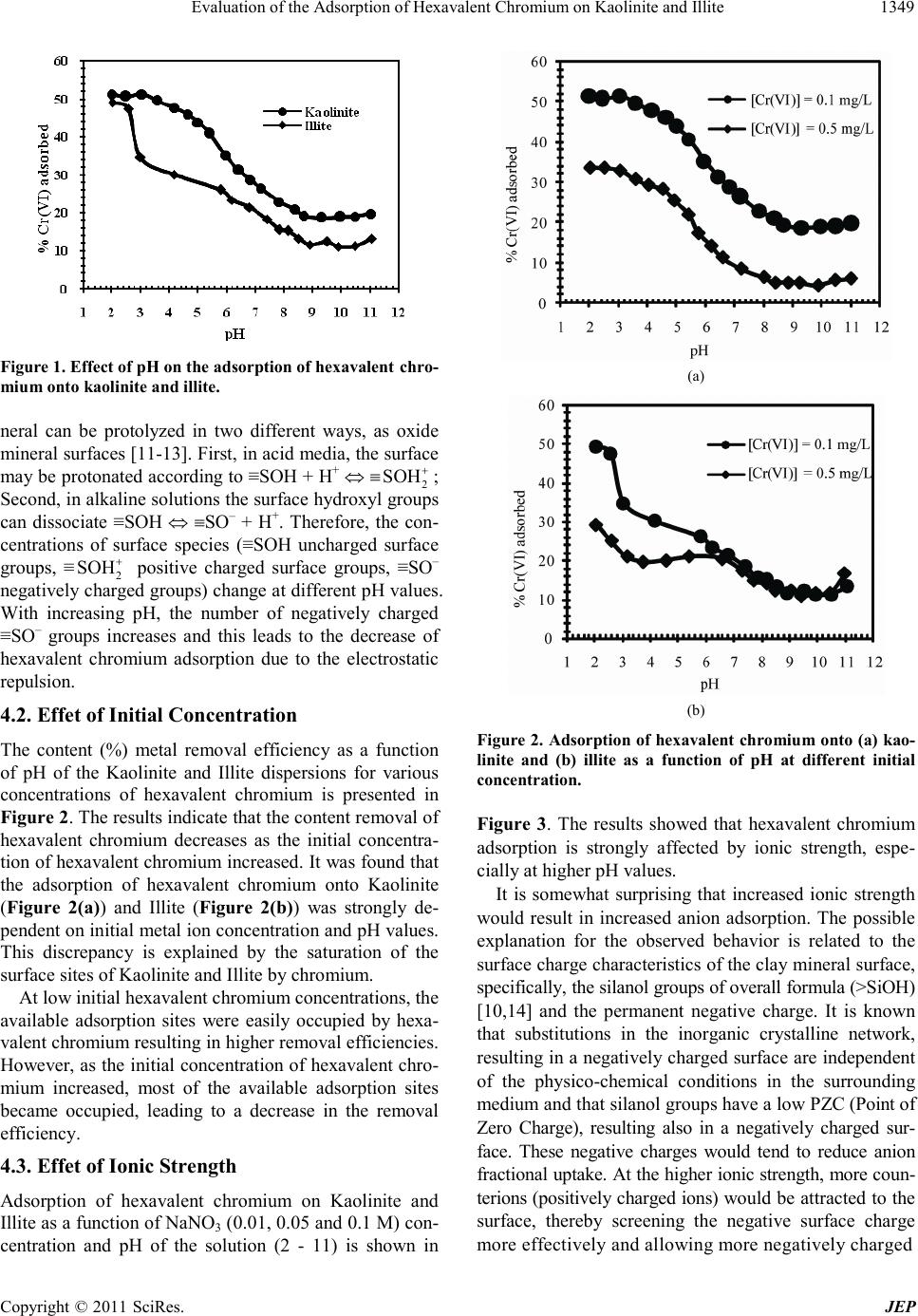 Evaluation of the Adsorption of Hexavalent Chromium on Kaolinite and Illite1349 Figure 1. Eff ect of pH on the adsorption of he xaval ent chro- mium onto kaolinite and illite. neral can be protolyzed in two different ways, as oxide mineral surfaces [11-13]. First, in acid media, the surface may be protonated according to ≡SOH + H+ 2 SOH ; Second, in alkaline solutions the surface hydroxyl groups can dissociate ≡SOH SO– + H+. Therefore, the con- centrations of surface species (≡SOH uncharged surface groups, ≡2 positive charged surface groups, ≡SO– negatively charged groups) change at different pH values. With increasing pH, the number of negatively charged ≡SO– groups increases and this leads to the decrease of hexavalent chromium adsorption due to the electrostatic repulsion. SOH 4.2. Effet of Initial Concentration The content (%) metal removal efficiency as a function of pH of the Kaolinite and Illite dispersions for various concentrations of hexavalent chromium is presented in Figure 2. The results indicate that the content removal of hexavalent chromium decreases as the initial concentra- tion of hexavalent chromium increased. It was found that the adsorption of hexavalent chromium onto Kaolinite (Figure 2(a)) and Illite (Figure 2(b)) was strongly de- pendent on initial metal ion concentration and pH values. This discrepancy is explained by the saturation of the surface sites of Kaolinite and Illite by chromium. At low initial hexavalent chromium concentrations, the available adsorption sites were easily occupied by hexa- valent chromium resulting in higher removal efficiencies. However, as the initial concentration of hexavalent chro- mium increased, most of the available adsorption sites became occupied, leading to a decrease in the removal efficiency. 4.3. Effet of Ionic Strength Adsorption of hexavalent chromium on Kaolinite and Illite as a function of NaNO3 (0.01, 0.05 and 0.1 M) con- centration and pH of the solution (2 - 11) is shown in (a) (b) Figure 2. Adsorption of hexavalent chromium onto (a) kao- linite and (b) illite as a function of pH at different initial concentration. Figure 3. The results showed that hexavalent chromium adsorption is strongly affected by ionic strength, espe- cially at higher pH values. It is somewhat surprising that increased ionic strength would result in increased anion adsorption. The possible explanation for the observed behavior is related to the surface charge characteristics of the clay mineral surface, specifically, the silanol groups of overall formula (>SiOH) [10,14] and the permanent negative charge. It is known that substitutions in the inorganic crystalline network, resulting in a negatively charged surface are independent of the physico-chemical conditions in the surrounding medium and that silanol groups have a low PZC (Point of Zero Charge), resulting also in a negatively charged sur- face. These negative charges would tend to reduce anion fractional uptake. At the higher ionic strength, more coun- terions (positively charged ions) would be attracted to the surface, thereby screening the negative surface charge more effectively and allowing more negatively charged Copyright © 2011 SciRes. JEP 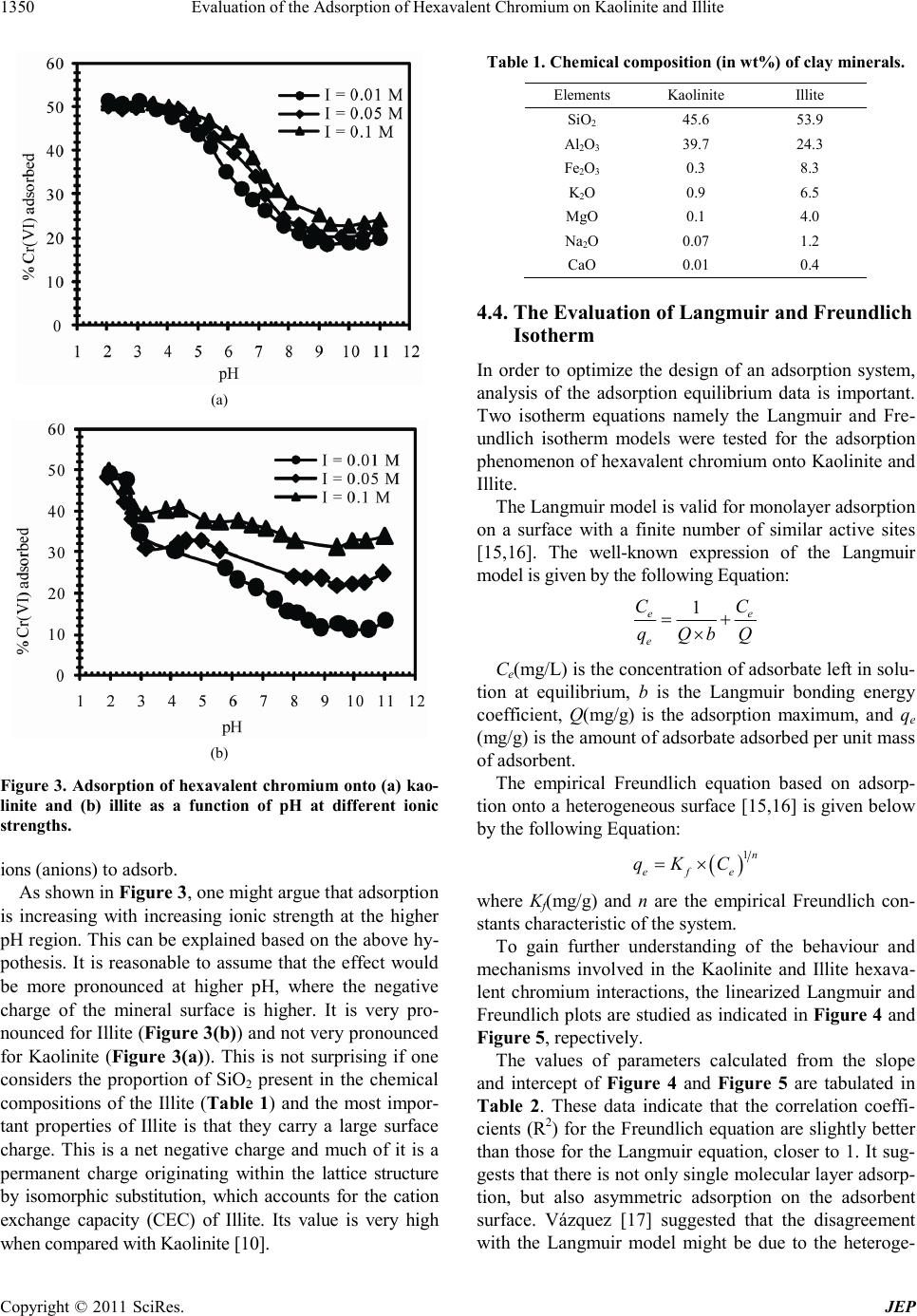 Evaluation of the Adsorption of Hexavalent Chromium on Kaolinite and Illite 1350 (a) (b) Figure 3. Adsorption of hexavalent chromium onto (a) kao- linite and (b) illite as a function of pH at different ionic strengths. ions (anions) to adsorb. As shown in Figure 3, one might argue that adsorption is increasing with increasing ionic strength at the higher pH region. This can be explained based on the above hy- pothesis. It is reasonable to assume that the effect would be more pronounced at higher pH, where the negative charge of the mineral surface is higher. It is very pro- nounced for Illite (Figure 3(b)) and not very pronounced for Kaolinite (Figure 3(a)). This is not surprising if one considers the proportion of SiO2 present in the chemical compositions of the Illite (Table 1) and the most impor- tant properties of Illite is that they carry a large surface charge. This is a net negative charge and much of it is a permanent charge originating within the lattice structure by isomorphic substitution, which accounts for the cation exchange capacity (CEC) of Illite. Its value is very high when compared with Kaolinite [10]. Table 1. Chemical composition (in wt%) of clay minerals. Elements Kaolinite Illite SiO2 45.6 53.9 Al2O3 39.7 24.3 Fe2O3 0.3 8.3 K2O 0.9 6.5 MgO 0.1 4.0 Na2O 0.07 1.2 CaO 0.01 0.4 4.4. The Evaluation of Langmuir and Freundlich Isotherm In order to optimize the design of an adsorption system, analysis of the adsorption equilibrium data is important. Two isotherm equations namely the Langmuir and Fre- undlich isotherm models were tested for the adsorption phenomenon of hexavalent chromium onto Kaolinite and Illite. The Langmuir model is valid for monolayer adsorption on a surface with a finite number of similar active sites [15,16]. The well-known expression of the Langmuir model is given by the following Equation: 1 ee e CC qQbQ Ce(mg/L) is the concentration of adsorbate left in solu- tion at equilibrium, b is the Langmuir bonding energy coefficient, Q(mg/g) is the adsorption maximum, and qe (mg/g) is the amount of adsorbate adsorbed per unit mass of adsorbent. The empirical Freundlich equation based on adsorp- tion onto a heterogeneous surface [15,16] is given below by the following Equation: 1n efe qK C where Kf(mg/g) and n are the empirical Freundlich con- stants characteristic of the system. To gain further understanding of the behaviour and mechanisms involved in the Kaolinite and Illite hexava- lent chromium interactions, the linearized Langmuir and Freundlich plots are studied as indicated in Figure 4 and Figure 5, repectively. The values of parameters calculated from the slope and intercept of Figure 4 and Figure 5 are tabulated in Table 2. These data indicate that the correlation coeffi- cients (R2) for the Freundlich equation are slightly better than those for the Langmuir equation, closer to 1. It sug- gests that there is not only single molecular layer adsorp- tion, but also asymmetric adsorption on the adsorbent surface. Vázquez [17] suggested that the disagreement with the Langmuir model might be due to the heteroge- Copyright © 2011 SciRes. JEP 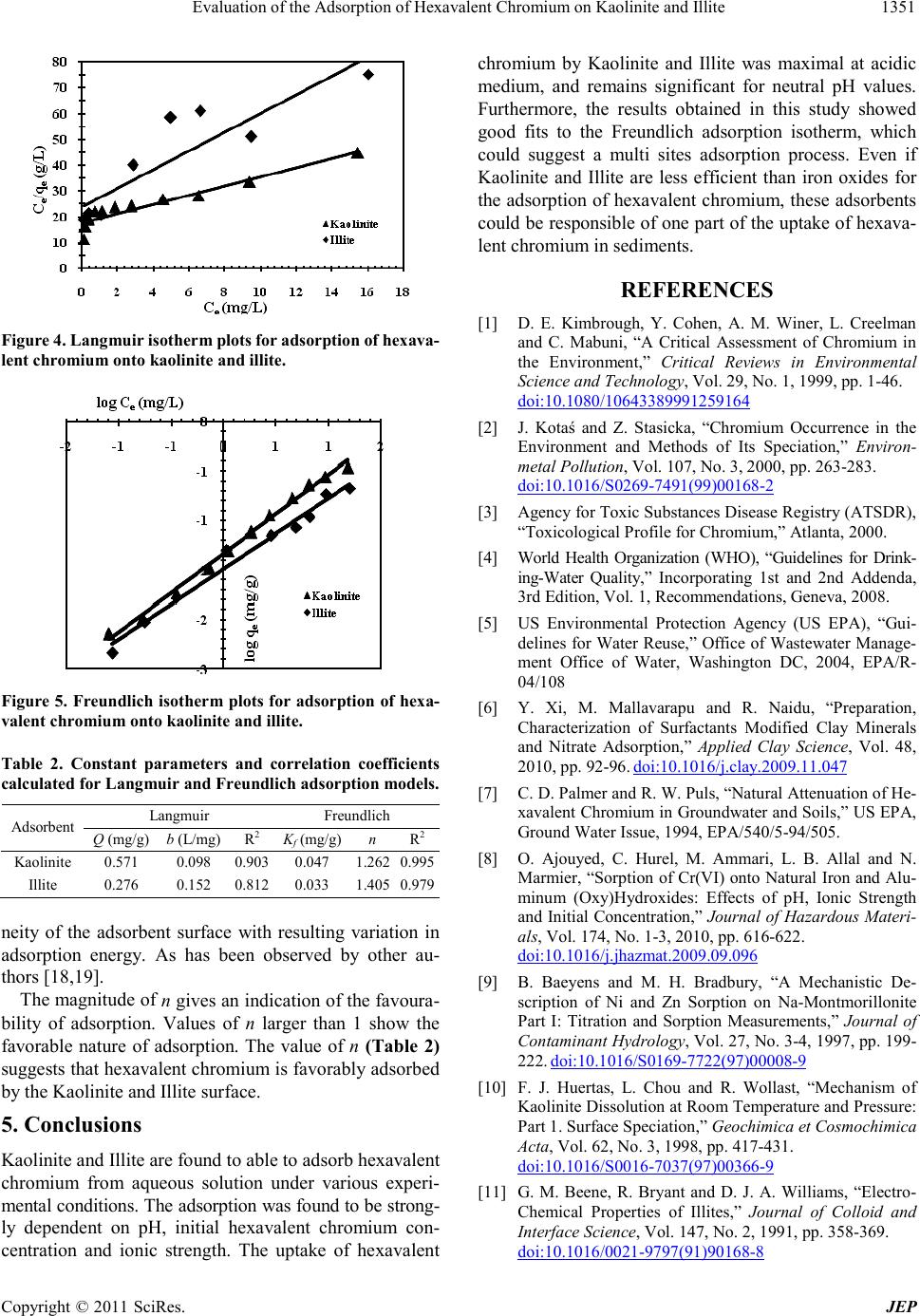 Evaluation of the Adsorption of Hexavalent Chromium on Kaolinite and Illite1351 Figure 4. Langmuir isotherm plots for adsorption of hexava- lent chromium onto kaolinite and illite. Fig ure 5. F reundlich is other m plots f or adsorpti on of hex a- valent chromium onto kaolinite and illite. Table 2. Constant parameters and correlation coefficients calculated for Langmuir and Freundlich adsor ption mod els. Langmuir Freundlich Adsorbent Q (mg/g) b (L/mg) R2 K f (mg/g) n R2 Kaolinite 0.571 0.098 0.903 0.047 1.2620.995 Illite 0.276 0.152 0.812 0.033 1.4050.979 neity of the adsorbent surface with resulting variation in adsorption energy. As has been observed by other au- thors [18,19]. The magnitude of n gives an indication of the favoura- bility of adsorption. Values of n larger than 1 show the favorable nature of adsorption. The value of n (Table 2) suggests that hexavalent chromium is favorably adsorbed by the Kaolinite and Illite surface. 5. Conclusions Kaolinite and Illite are found to able to adsorb hexavalent chromium from aqueous solution under various experi- mental conditions. The adsorption was found to be strong- ly dependent on pH, initial hexavalent chromium con- centration and ionic strength. The uptake of hexavalent chromium by Kaolinite and Illite was maximal at acidic medium, and remains significant for neutral pH values. Furthermore, the results obtained in this study showed good fits to the Freundlich adsorption isotherm, which could suggest a multi sites adsorption process. Even if Kaolinite and Illite are less efficient than iron oxides for the adsorption of hexavalent chromium, these adsorbents could be responsible of one part of the uptake of hexava- lent chromium in sediments. REFERENCES [1] D. E. Kimbrough, Y. Cohen, A. M. Winer, L. Creelman and C. Mabuni, “A Critical Assessment of Chromium in the Environment,” Critical Reviews in Environmental Science and Technology, Vol. 29, No. 1, 1999, pp. 1-46. doi:10.1080/10643389991259164 [2] J. Kotaś and Z. Stasicka, “Chromium Occurrence in the Environment and Methods of Its Speciation,” Environ- metal Pollution, Vol. 107, No. 3, 2000, pp. 263-283. doi:10.1016/S0269-7491(99)00168-2 [3] Agency for Toxic Substances Disease Registry (ATSDR), “Toxicological Profile for Chromium,” Atlanta, 2000. [4] World Health Organization (WHO), “Guidelines for Drink- ing-Water Quality,” Incorporating 1st and 2nd Addenda, 3rd Edition, Vol. 1, Recommendations, Geneva, 2008. [5] US Environmental Protection Agency (US EPA), “Gui- delines for Water Reuse,” Office of Wastewater Manage- ment Office of Water, Washington DC, 2004, EPA/R- 04/108 [6] Y. Xi, M. Mallavarapu and R. Naidu, “Preparation, Characterization of Surfactants Modified Clay Minerals and Nitrate Adsorption,” Applied Clay Science, Vol. 48, 2010, pp. 92-96. doi:10.1016/j.clay.2009.11.047 [7] C. D. Palmer and R. W. Puls, “Natural Attenuation of He- xavalent Chromium in Groundwater and Soils,” US EPA, Ground Water Issue, 1994, EPA/540/5-94/505. [8] O. Ajouyed, C. Hurel, M. Ammari, L. B. Allal and N. Marmier, “Sorption of Cr(VI) onto Natural Iron and Alu- minum (Oxy)Hydroxides: Effects of pH, Ionic Strength and Initial Concentration,” Journal of Hazardous Materi- als, Vol. 174, No. 1-3, 2010, pp. 616-622. doi:10.1016/j.jhazmat.2009.09.096 [9] B. Baeyens and M. H. Bradbury, “A Mechanistic De- scription of Ni and Zn Sorption on Na-Montmorillonite Part I: Titration and Sorption Measurements,” Journal of Contaminant Hydrology, Vol. 27, No. 3-4, 1997, pp. 199- 222. doi:10.1016/S0169-7722(97)00008-9 [10] F. J. Huertas, L. Chou and R. Wollast, “Mechanism of Kaolinite Dissolution at Room Temperature and Pressure: Part 1. Surface Speciation,” Geochimica et Cosmochimica Acta, Vol. 62, No. 3, 1998, pp. 417-431. doi:10.1016/S0016-7037(97)00366-9 [11] G. M. Beene, R. Bryant and D. J. A. Williams, “Electro- Chemical Properties of Illites,” Journal of Colloid and Interface Science, Vol. 147, No. 2, 1991, pp. 358-369. do i:1 0.10 16 /00 21 -97 97( 91) 90 168- 8 Copyright © 2011 SciRes. JEP 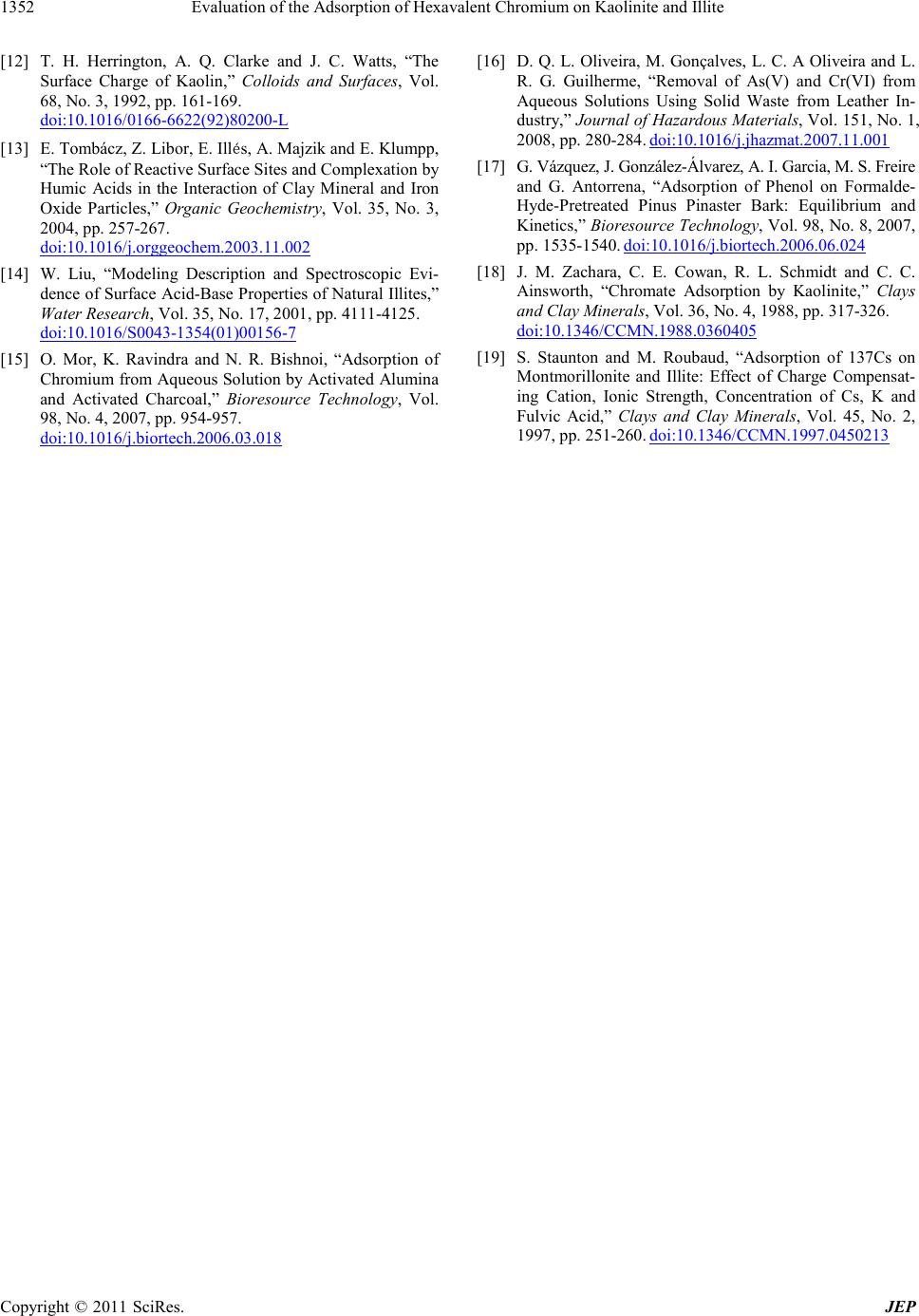 Evaluation of the Adsorption of Hexavalent Chromium on Kaolinite and Illite Copyright © 2011 SciRes. JEP 1352 [12] T. H. Herrington, A. Q. Clarke and J. C. Watts, “The Surface Charge of Kaolin,” Colloids and Surfaces, Vol. 68, No. 3, 1992, pp. 161-169. do i:1 0.10 16 /01 66 -66 22( 92) 80 200- L [13] E. Tombácz, Z. Libor, E. Illés, A. Majzik and E. Klumpp, “The Role of Reactive Surface Sites and Complexation by Humic Acids in the Interaction of Clay Mineral and Iron Oxide Particles,” Organic Geochemistry, Vol. 35, No. 3, 2004, pp. 257-267. doi:10.1016/j.orggeochem.2003.11.002 [14] W. Liu, “Modeling Description and Spectroscopic Evi- dence of Surface Acid-Base Properties of Natural Illites,” Water Research, Vol. 35, No. 17, 2001, pp. 4111-4125. doi:10.1016/S0043-1354(01)00156-7 [15] O. Mor, K. Ravindra and N. R. Bishnoi, “Adsorption of Chromium from Aqueous Solution by Activated Alumina and Activated Charcoal,” Bioresource Technology, Vol. 98, No. 4, 2007, pp. 954-957. doi:10.1016/j.biortech.2006.03.018 [16] D. Q. L. Oliveira, M. Gonçalves, L. C. A Oliveira and L. R. G. Guilherme, “Removal of As(V) and Cr(VI) from Aqueous Solutions Using Solid Waste from Leather In- dustry,” Journal of Hazardous Materials, Vol. 151, No. 1, 2008, pp. 280-284. doi:10.1016/j.jhazmat.2007.11.001 [17] G. Vázquez, J. González-Álvarez, A. I. Garcia, M. S. Freire and G. Antorrena, “Adsorption of Phenol on Formalde- Hyde-Pretreated Pinus Pinaster Bark: Equilibrium and Kinetics,” Bi oresource T echnology, Vol. 98, No. 8, 2007, pp. 1535-1540. doi:10.1016/j.biortech.2006.06.024 [18] J. M. Zachara, C. E. Cowan, R. L. Schmidt and C. C. Ainsworth, “Chromate Adsorption by Kaolinite,” Clays and Clay Minerals, Vol. 36, No. 4, 1988, pp. 317-326. doi:10.1346/CCMN.1988.0360405 [19] S. Staunton and M. Roubaud, “Adsorption of 137Cs on Montmorillonite and Illite: Effect of Charge Compensat- ing Cation, Ionic Strength, Concentration of Cs, K and Fulvic Acid,” Clays and Clay Minerals, Vol. 45, No. 2, 1997, pp. 251-260. doi:10.1346/CCMN.1997.0450213 |