

Paper Menu >>
Journal Menu >>
 Journal of Analytical Sciences, Methods and Instrumentation, 2011, 1, 31-36 doi:10.4236/jasmi.2011.12005 Published Online December 2011 (http://www.SciRP.org/journal/jasmi) Copyright © 2011 SciRes. JASMI 31 Determination of Di-n-Butyl Phosphate in Organic Streams of FBTR Mixed Carbide Fuel Reprocessing Solution by Gas Chromatographic Technique P. Velavendan, S. Ganesh, N. K. Pandey, U. Kamachi Mudali, R. Natarajan Reprocessing Group, Indira Gandhi centre for Atomic Research, Kalpakkam, India. Email: [email protected] Received September 20th, 2011; revised October 25th, 2011; accepted November 16th, 2011. ABSTRACT The present work describes the amount of Di-n-butyl phosphate (DBP) produced when PUREX solvent (30% tri-n-butyl phosphate (TBP) mixed with 70% hydrocarbon diluent) is exposed to intensive radiolytic and chemical attack during the separation of uranium and plutonium from fission products of FBTR mixed carbide fuel reprocessing solution. DBP is the major degradation product of Tri-n-butyl phosphate (TBP). Amount of DBP formed in the lean organic streams of different fuel burn-up FBTR carbide fuel reprocessing solutions were analyzed by Gas Chromatographic technique. The method is based on the preparation of diazo methane and conversion of non-volatile Di-n-butyl phosphate in to volatile and stable derivatives by the action of diazomethane and then determined by Gas Chromatography (GC). A calibration graph was made for DBP over a concentration in the range from 200 to 1800 ppm with correlation coefficient of 0.99587 and RSD 1.2%. The degraded 30% TBP-NPH solvent loaded with heavy metal ions like uranium was analyzed after repeated use and results are compared with standard ion chromatographic technique. A column comparison study to select of proper gas chromatographic column for the separation of DBP from other components in a single aliquot of injection is also examined. Keywords: Gas Chromatography, Flame Ionization Detector, Diazomethane, Di-n-Butyl Phosphate, PUREX Process, Degradation of TBP, Lean Organic Streams, Carbide Fuel 1. Introduction Tributylphosphate (TBP) is the most popular reagent in liquid-liquid extraction. Di-n-butyl phosphate (DBP) is one of the degradation products of Tri-n-butyl phosphate (TBP) ((C4H9O)3P = O), used in the well known PUREX (Plutonium Uranium Refining by Extraction) process [1] for the separation of uranium and plutonium from fission products in nuclear fuel reprocessing. During the solvent extraction process the solvent TBP undergoes degrada- tion by hydrolysis and radiolysis yielding mainly Di -n-butyl phosphate (DBP) ((C4H9O)2P = O-(OH)), to a lesser extent monobutylphosphate (MBP) ((C4H9O)P = O- (OH)2), phosphoric acid and butanol [2]. The DBP com- plexes with Zr, Pu and other metal ions [3] which leads to loss of heavy metals to lean organic stream. Hence the quality of PUREX solvent is generally measured in terms of the concentration of DBP. Various analytical methods were reported in the literature for the determination of DBP. Bocek et al. [4] have used high-speed Isotachophoresis, a form of capillary electrophoresis with conductivity detec- tion, to analyze TBP for its degradation products in solu- tions containing nitrates and nitrites. Muller et al. [5] have determined trace amounts of DBP and TBP in nuclear fuel reprocessing solutions by Liquid Chromatography [6] while Wilkinson and Williams [7] determined DBP and MBP by direct titration of irradiated TBP samples. The latter method fails in presence of nitric acid. Krishna- murthy and Sampathkumar [8] have used titrimetry to determine DBP and MBP as degradation products in the two component TBP-nitric acid system. Grant et al. [9] have performed the separation and measurement of TBP, DBP and MBP by Ion-pair Chromatography with refrac- tive index detection. Infra Red Spectroscopy is used [10] for determination of DBP concentration in the solvent based on the P=O absorption at 1230 cm–1 with a poor detection limit due to interferences from the TBP. Tech- niques [11] of ionization at atmospheric pressure, i.e., elec- trospray (ESI) or atmospheric pressure chemical ionization (APCI) with Mass Spectrometry (MS) have been used 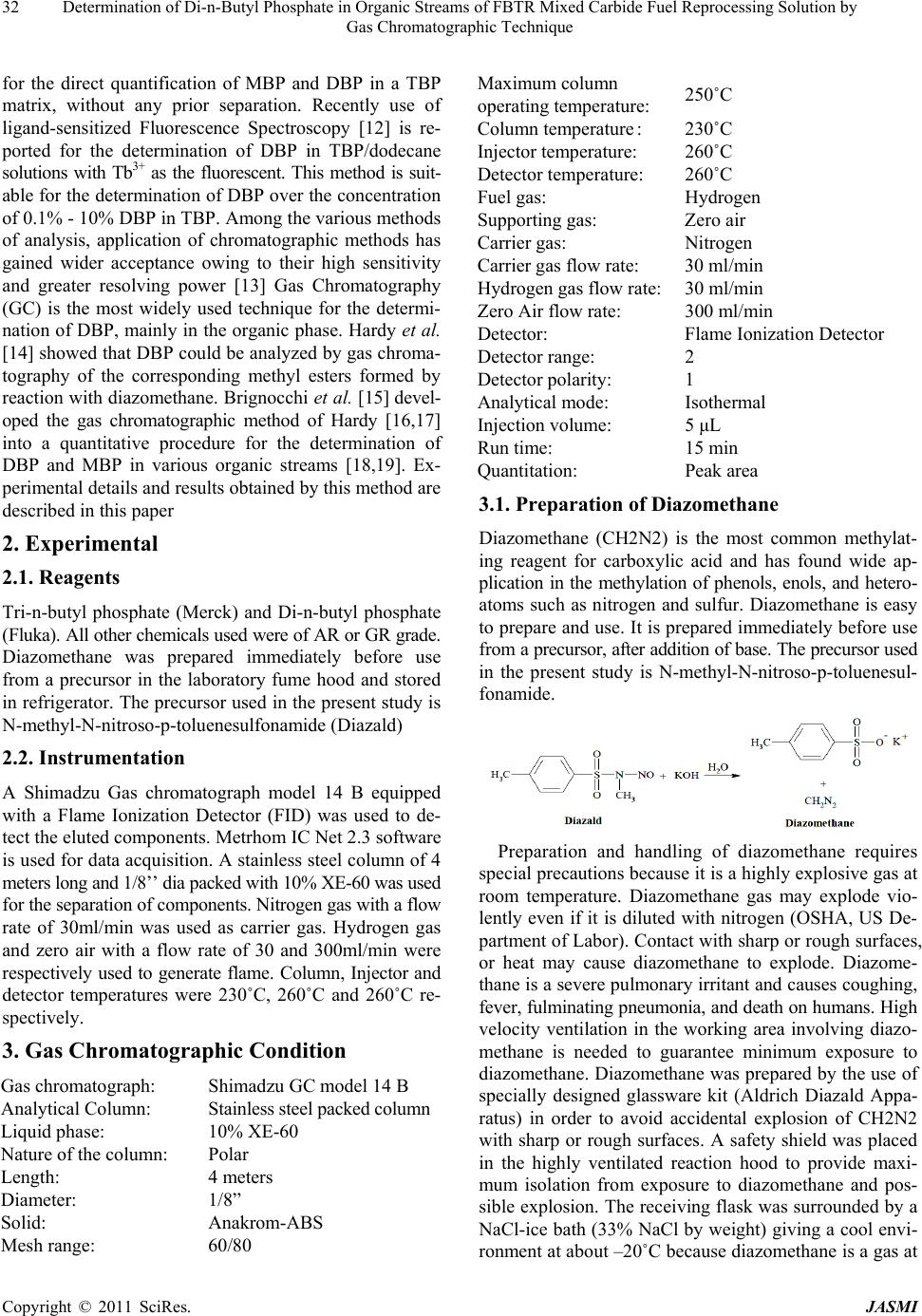 Determination of Di-n-Butyl Phosphate in Organic Streams of FBTR Mixed Carbide Fuel Reprocessing Solution by 32 Gas Chromatographic Technique for the direct quantification of MBP and DBP in a TBP matrix, without any prior separation. Recently use of ligand-sensitized Fluorescence Spectroscopy [12] is re- ported for the determination of DBP in TBP/dodecane solutions with Tb3+ as the fluorescent. This method is suit- able for the determination of DBP over the concentration of 0.1% - 10% DBP in TBP. Among the various methods of analysis, application of chromatographic methods has gained wider acceptance owing to their high sensitivity and greater resolving power [13] Gas Chromatography (GC) is the most widely used technique for the determi- nation of DBP, mainly in the organic phase. Hardy et al. [14] showed that DBP could be analyzed by gas chroma- tography of the corresponding methyl esters formed by reaction with diazomethane. Brignocchi et al. [15] devel- oped the gas chromatographic method of Hardy [16,17] into a quantitative procedure for the determination of DBP and MBP in various organic streams [18,19]. Ex- perimental details and results obtained by this method are described in this paper 2. Experimental 2.1. Reagents Tri-n-butyl phosphate (Merck) and Di-n-butyl phosphate (Fluka). All other chemicals used were of AR or GR grade. Diazomethane was prepared immediately before use from a precursor in the laboratory fume hood and stored in refrigerator. The precursor used in the present study is N-methyl-N-nitroso-p-toluenesulfonamide (Diazald) 2.2. Instrumentation A Shimadzu Gas chromatograph model 14 B equipped with a Flame Ionization Detector (FID) was used to de- tect the eluted components. Metrhom IC Net 2.3 software is used for data acquisition. A stainless steel column of 4 meters long and 1/8’’ dia packed with 10% XE-60 was used for the separation of components. Nitrogen gas with a flow rate of 30ml/min was used as carrier gas. Hydrogen gas and zero air with a flow rate of 30 and 300ml/min were respectively used to generate flame. Column, Injector and detector temperatures were 230˚C, 260˚C and 260˚C re- spectively. 3. Gas Chromatographic Condition Gas chromatograph: Shimadzu GC model 14 B Analytical Column: Stainless steel packed column Liquid phase: 10% XE-60 Nature of the column: Polar Length: 4 meters Diameter: 1/8” Solid: Anakrom-ABS Mesh range: 60/80 Maximum column operating temperature: 250˚C Column temperature : 230˚C Injector temperature: 260˚C Detector temperature: 260˚C Fuel gas: Hydrogen Supporting gas: Zero air Carrier gas: Nitrogen Carrier gas flow rate: 30 ml/min Hydrogen gas flow rate: 30 ml/min Zero Air flow rate: 300 ml/min Detector: Flame Ionization Detector Detector range: 2 Detector polarity: 1 Analytical mode: Isothermal Injection volume: 5 μL Run time: 15 min Quantitation: Peak area 3.1. Preparation of Diazomethane Diazomethane (CH2N2) is the most common methylat- ing reagent for carboxylic acid and has found wide ap- plication in the methylation of phenols, enols, and hetero- atoms such as nitrogen and sulfur. Diazomethane is easy to prepare and use. It is prepared immediately before use from a precursor, after addition of base. The precursor used in the present study is N-methyl-N-nitroso-p-toluenesul- fonamide. Preparation and handling of diazomethane requires special precautions because it is a highly explosive gas at room temperature. Diazomethane gas may explode vio- lently even if it is diluted with nitrogen (OSHA, US De- partment of Labor). Contact with sharp or rough surfaces, or heat may cause diazomethane to explode. Diazome- thane is a severe pulmonary irritant and causes coughing, fever, fulminating pneumonia, and death on humans. High velocity ventilation in the working area involving diazo- methane is needed to guarantee minimum exposure to diazomethane. Diazomethane was prepared by the use of specially designed glassware kit (Aldrich Diazald Appa- ratus) in order to avoid accidental explosion of CH2N2 with sharp or rough surfaces. A safety shield was placed in the highly ventilated reaction hood to provide maxi- mum isolation from exposure to diazomethane and pos- sible explosion. The receiving flask was surrounded by a NaCl-ice bath (33% NaCl by weight) giving a cool envi- ronment at about –20˚C because diazomethane is a gas at Copyright © 2011 SciRes. JASMI 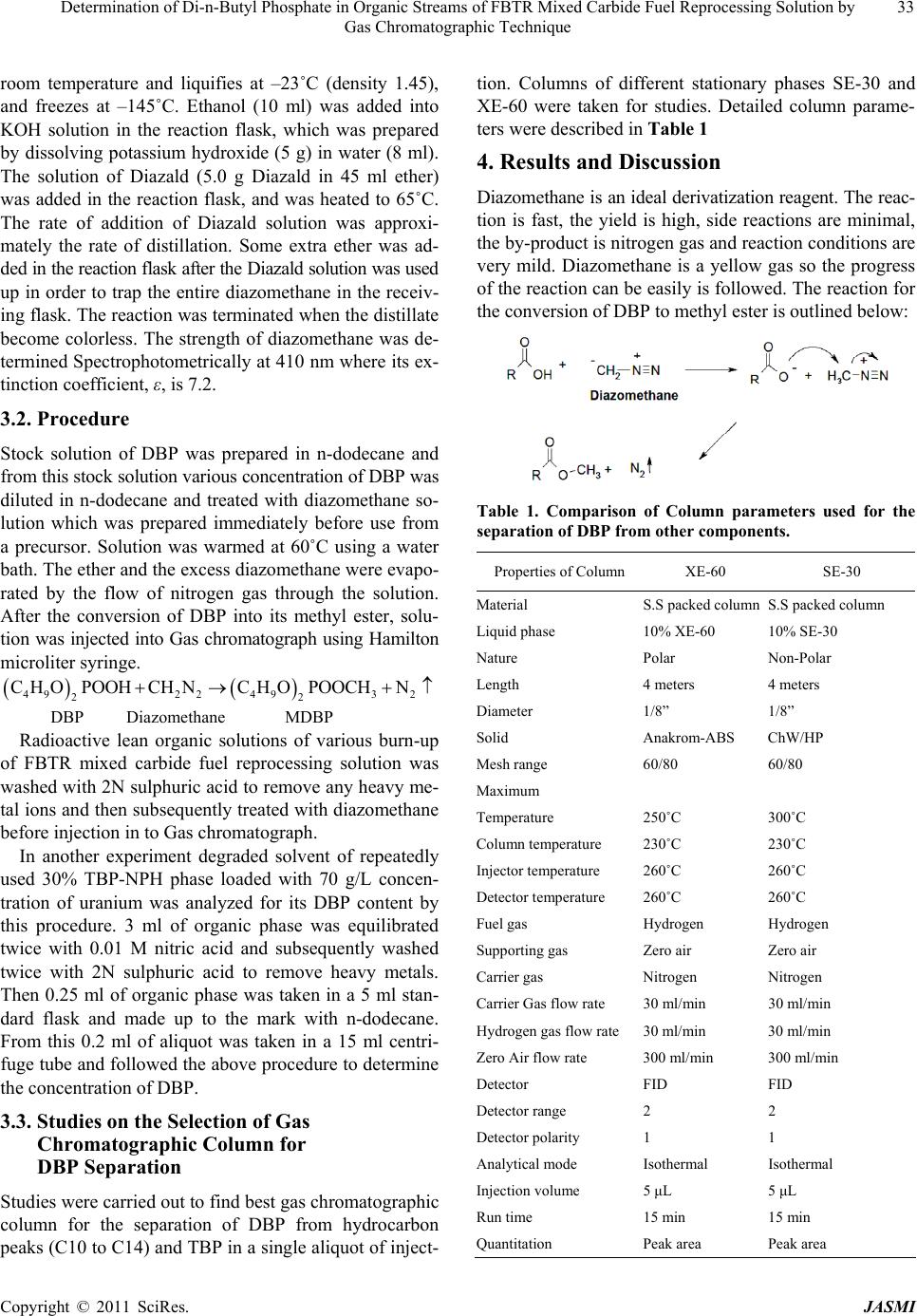 Determination of Di-n-Butyl Phosphate in Organic Streams of FBTR Mixed Carbide Fuel Reprocessing Solution by 33 Gas Chromatographic Technique room temperature and liquifies at –23˚C (density 1.45), and freezes at –145˚C. Ethanol (10 ml) was added into KOH solution in the reaction flask, which was prepared by dissolving potassium hydroxide (5 g) in water (8 ml). The solution of Diazald (5.0 g Diazald in 45 ml ether) was added in the reaction flask, and was heated to 65˚C. The rate of addition of Diazald solution was approxi- mately the rate of distillation. Some extra ether was ad- ded in the reaction flask after the Diazald solution was used up in order to trap the entire diazomethane in the receiv- ing flask. The reaction was terminated when the distillate become colorless. The strength of diazomethane was de- termined Spectrophotometrically at 410 nm where its ex- tinction coefficient, ε, is 7.2. 3.2. Procedure Stock solution of DBP was prepared in n-dodecane and from this stock solution various concentration of DBP was diluted in n-dodecane and treated with diazomethane so- lution which was prepared immediately before use from a precursor. Solution was warmed at 60˚C using a water bath. The ether and the excess diazomethane were evapo- rated by the flow of nitrogen gas through the solution. After the conversion of DBP into its methyl ester, solu- tion was injected into Gas chromatograph using Hamilton microliter syringe. 4922493 2 22 C H OPOOHCHNCH OPOOCHN DBP Diazomethane MDBP Radioactive lean organic solutions of various burn-up of FBTR mixed carbide fuel reprocessing solution was washed with 2N sulphuric acid to remove any heavy me- tal ions and then subsequently treated with diazomethane before injection in to Gas chromatograph. In another experiment degraded solvent of repeatedly used 30% TBP-NPH phase loaded with 70 g/L concen- tration of uranium was analyzed for its DBP content by this procedure. 3 ml of organic phase was equilibrated twice with 0.01 M nitric acid and subsequently washed twice with 2N sulphuric acid to remove heavy metals. Then 0.25 ml of organic phase was taken in a 5 ml stan- dard flask and made up to the mark with n-dodecane. From this 0.2 ml of aliquot was taken in a 15 ml centri- fuge tube and followed the above procedure to determine the concentration of DBP. 3.3. Studies on the Selection of Gas Chromatographic Column for DBP Separation Studies were carried out to find best gas chromatographic column for the separation of DBP from hydrocarbon peaks (C10 to C14) and TBP in a single aliquot of inject- tion. Columns of different stationary phases SE-30 and XE-60 were taken for studies. Detailed column parame- ters were described in Table 1 4. Results and Discussion Diazomethane is an ideal derivatization reagent. The reac- tion is fast, the yield is high, side reactions are minimal, the by-product is nitrogen gas and reaction conditions are very mild. Diazomethane is a yellow gas so the progress of the reaction can be easily is followed. The reaction for the conversion of DBP to methyl ester is outlined below: Table 1. Comparison of Column parameters used for the separation of DBP from other components. Properties of Column XE-60 SE-30 Material S.S packed column S.S packed column Liquid phase 10% XE-60 10% SE-30 Nature Polar Non-Polar Length 4 meters 4 meters Diameter 1/8” 1/8” Solid Anakrom-ABS ChW/HP Mesh range 60/80 60/80 Maximum Temperature 250˚C 300˚C Column temperature 230˚C 230˚C Injector temperature 260˚C 260˚C Detector temperature 260˚C 260˚C Fuel gas Hydrogen Hydrogen Supporting gas Zero air Zero air Carrier gas Nitrogen Nitrogen Carrier Gas flow rate 30 ml/min 30 ml/min Hydrogen gas flow rate 30 ml/min 30 ml/min Zero Air flow rate 300 ml/min 300 ml/min Detector FID FID Detector range 2 2 Detector polarity 1 1 Analytical mode Isothermal Isothermal Injection volume 5 μL 5 μL Run time 15 min 15 min Quantitation Peak area Peak area Copyright © 2011 SciRes. JASMI 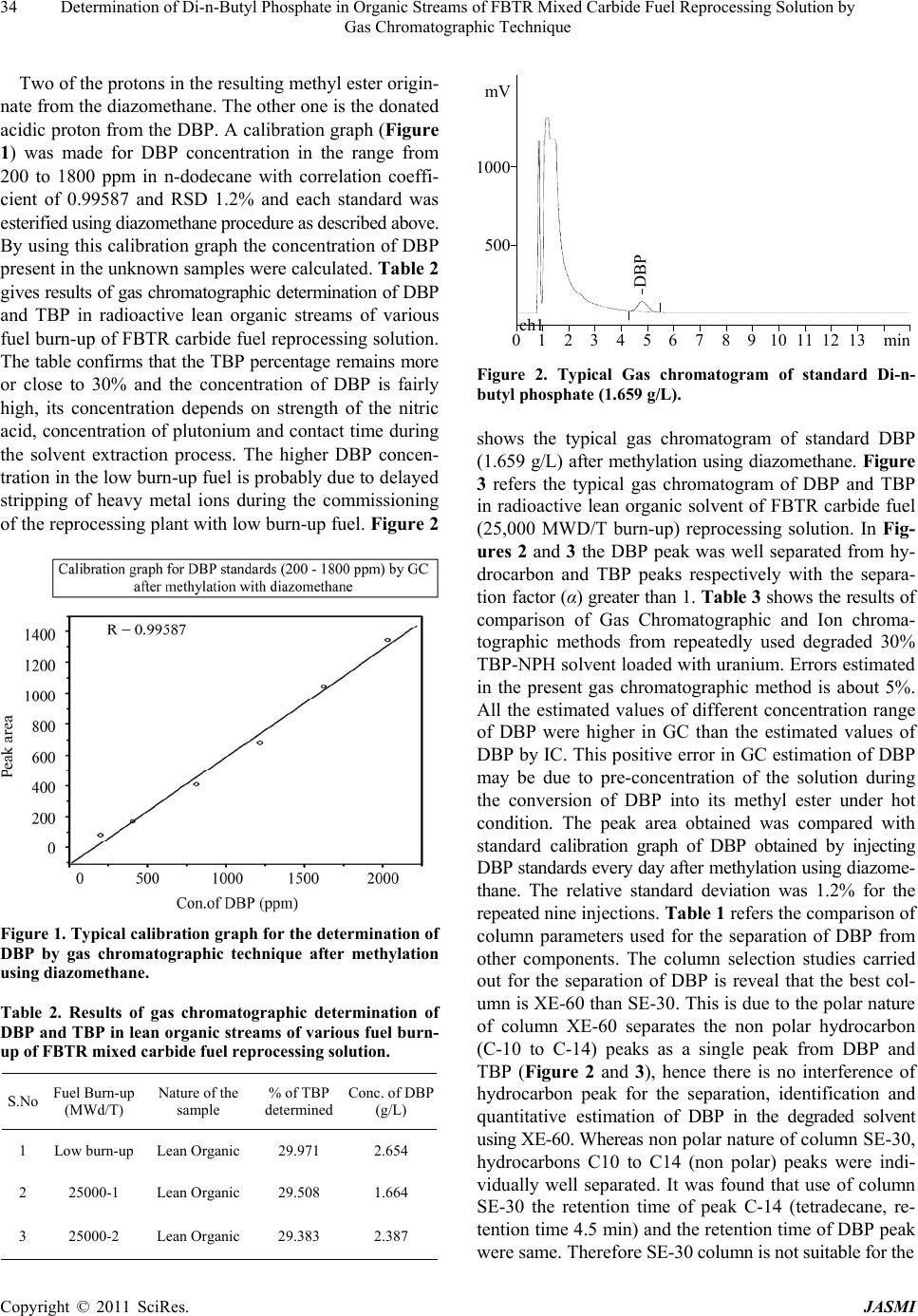 Determination of Di-n-Butyl Phosphate in Organic Streams of FBTR Mixed Carbide Fuel Reprocessing Solution by 34 Gas Chromatographic Technique Two of the protons in the resulting methyl ester origin- nate from the diazomethane. The other one is the donated acidic proton from the DBP. A calibration graph (Figure 1) was made for DBP concentration in the range from 200 to 1800 ppm in n-dodecane with correlation coeffi- cient of 0.99587 and RSD 1.2% and each standard was esterified using diazomethane procedure as described above. By using this calibration graph the concentration of DBP present in the unknown samples were calculated. Table 2 gives results of gas chromatographic determination of DBP and TBP in radioactive lean organic streams of various fuel burn-up of FBTR carbide fuel reprocessing solution. The table confirms that the TBP percentage remains more or close to 30% and the concentration of DBP is fairly high, its concentration depends on strength of the nitric acid, concentration of plutonium and contact time during the solvent extraction process. The higher DBP concen- tration in the low burn-up fuel is probably due to delayed stripping of heavy metal ions during the commissioning of the reprocessing plant with low burn-up fuel. Figure 2 Figure 1. Typical calibration graph for the determination of DBP by gas chromatographic technique after methylation using diazomethane. Table 2. Results of gas chromatographic determination of DBP and TBP in lean organic streams of various fuel burn- up of FBTR mixed carbide fuel reproce ssing solution. S.No Fuel Burn-up (MWd/T) Nature of the sample % of TBP determined Conc. of DBP (g/L) 1 Low burn-up Lean Organic29.971 2.654 2 25000-1 Lean Organic29.508 1.664 3 25000-2 Lean Organic29.383 2.387 01 23 4 56 7 8 910111213 min 500 1000 mV ch1 DBP Figure 2. Typical Gas chromatogram of standard Di-n- butyl phosphate (1. 659 g/L). shows the typical gas chromatogram of standard DBP (1.659 g/L) after methylation using diazomethane. Figure 3 refers the typical gas chromatogram of DBP and TBP in radioactive lean organic solvent of FBTR carbide fuel (25,000 MWD/T burn-up) reprocessing solution. In Fig- ures 2 and 3 the DBP peak was well separated from hy- drocarbon and TBP peaks respectively with the separa- tion factor (α) greater than 1. Table 3 shows the results of comparison of Gas Chromatographic and Ion chroma- tographic methods from repeatedly used degraded 30% TBP-NPH solvent loaded with uranium. Errors estimated in the present gas chromatographic method is about 5%. All the estimated values of different concentration range of DBP were higher in GC than the estimated values of DBP by IC. This positive error in GC estimation of DBP may be due to pre-concentration of the solution during the conversion of DBP into its methyl ester under hot condition. The peak area obtained was compared with standard calibration graph of DBP obtained by injecting DBP standards every day after methylation using diazome- thane. The relative standard deviation was 1.2% for the repeated nine injections. Tab le 1 refers the comparison of column parameters used for the separation of DBP from other components. The column selection studies carried out for the separation of DBP is reveal that the best col- umn is XE-60 than SE-30. This is due to the polar nature of column XE-60 separates the non polar hydrocarbon (C-10 to C-14) peaks as a single peak from DBP and TBP (Figure 2 and 3), hence there is no interference of hydrocarbon peak for the separation, identification and quantitative estimation of DBP in the degraded solvent using XE-60. Whereas non polar nature of column SE-30, hydrocarbons C10 to C14 (non polar) peaks were indi- vidually well separated. It was found that use of column SE-30 the retention time of peak C-14 (tetradecane, re- tention time 4.5 min) and the retention time of DBP peak were same. Therefore SE-30 column is not suitable for the Copyright © 2011 SciRes. JASMI 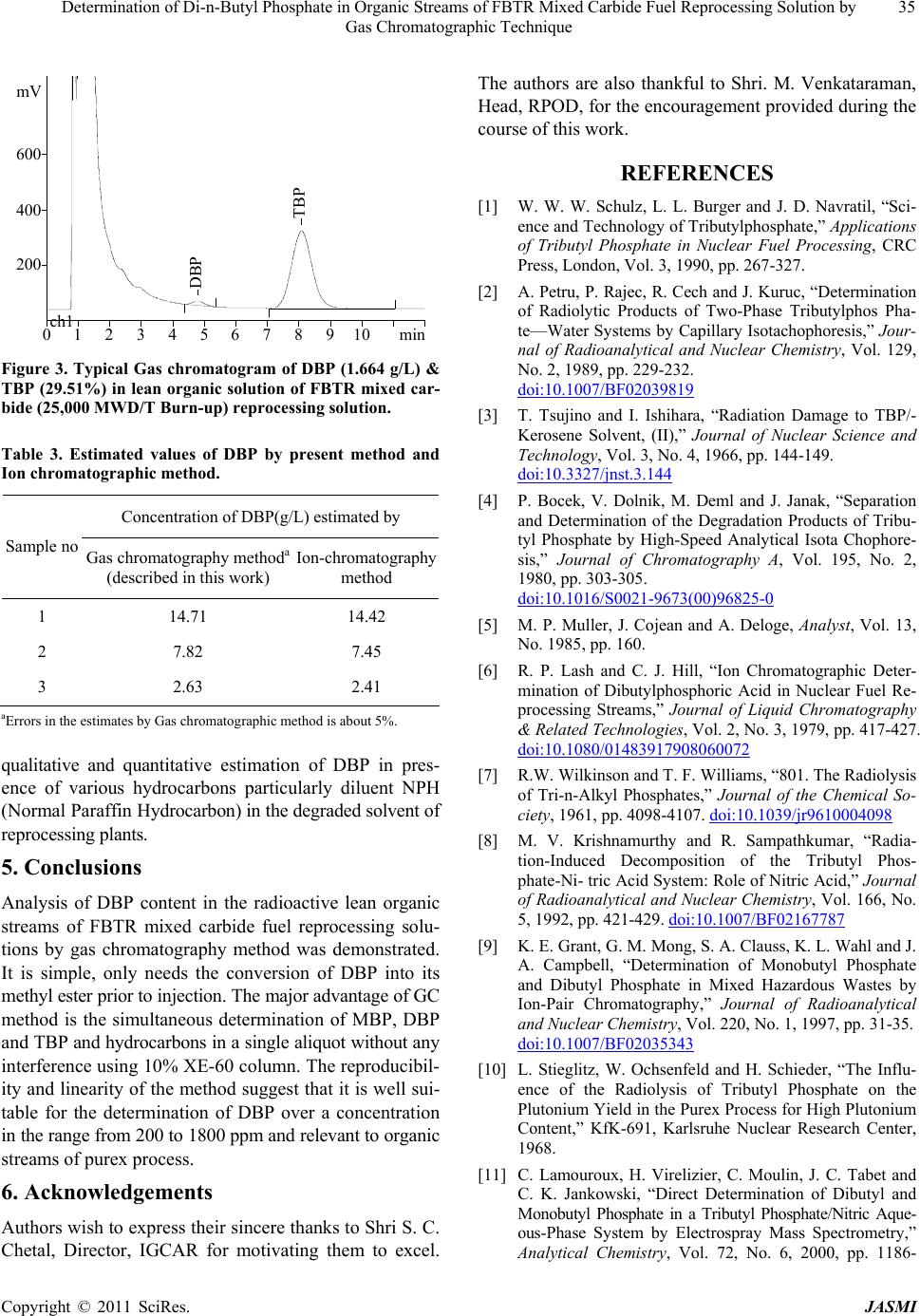 Determination of Di-n-Butyl Phosphate in Organic Streams of FBTR Mixed Carbide Fuel Reprocessing Solution by 35 Gas Chromatographic Technique 01 2 3 4 56 7 8 910min 200 400 600 ch1 mV DBP TBP Figur3.pical Gasra oB(1.664 g able 3. Estimated values of DBP by present method and Concentration of DBP(g/L) estimated by e Ty chromatogmf DP /L) & TBP (29.51%) in lean organic solution of FBTR mixed car- bide (25,000 MWD/T Burn-up) reprocessing solution. T Ion chromatographic method. Sample no Gas chromatography method Ion-chromatography a (described in this work) method 1 14.71 14.42 2 7.82 7.45 3 2.63 2.41 aError the estimates by Gaatographic method is a. ualitative and quantitative estimation of DBP in pres- ntent in the radioactive lean organic s incere thanks to Shri S. C. REFERENCES [1] W. W. W. Sch. D. Navratil, “Sci- Determination s ins chrombout 5% q ence of various hydrocarbons particularly diluent NPH (Normal Paraffin Hydrocarbon) in the degraded solvent of reprocessing plants. 5. Conclusions Analysis of DBP co streams of FBTR mixed carbide fuel reprocessing solu- tions by gas chromatography method was demonstrated. It is simple, only needs the conversion of DBP into its methyl ester prior to injection. The major advantage of GC method is the simultaneous determination of MBP, DBP and TBP and hydrocarbons in a single aliquot without any interference using 10% XE-60 column. The reproducibil- ity and linearity of the method suggest that it is well sui- table for the determination of DBP over a concentration in the range from 200 to 1800 ppm and relevant to organic streams of purex process. 6. Acknowledgement Authors wish to express their s Chetal, Director, IGCAR for motivating them to excel. The authors are also thankful to Shri. M. Venkataraman, Head, RPOD, for the encouragement provided during the course of this work. ulz, L. L. Burger and J ence and Technology of Tributylphosphate,” Applications of Tributyl Phosphate in Nuclear Fuel Processing, CRC Press, London, Vol. 3, 1990, pp. 267-327. [2] A. Petru, P. Rajec, R. Cech and J. Kuruc, “ of Radiolytic Products of Two-Phase Tributylphos Pha- te—Water Systems by Capillary Isotachophoresis,” Jour- nal of Radioanalytical and Nuclear Chemistry, Vol. 129, No. 2, 1989, pp. 229-232. doi:10.1007/BF02039819 [3] T. Tsujino and I. Ishihara, “Radiation Damage to TBP/- Kerosene Solvent, (II),” Journal of Nuclear Science and Technology, Vol. 3, No. 4, 1966, pp. 144-149. doi:10.3327/jnst.3.144 [4] P. Bocek, V. Dolnik, M. Deml and J. Janak, “Separation 673(00)96825-0 and Determination of the Degradation Products of Tribu- tyl Phosphate by High-Speed Analytical Isota Chophore- sis,” Journal of Chromatography A, Vol. 195, No. 2, 1980, pp. 303-305. doi:10.1016/S0021-9 e, Analyst, Vol. 13, . Hill, “Ion Chromatographic Deter- [5] M. P. Muller, J. Cojean and A. Delog No. 1985, pp. 160. [6] R. P. Lash and C. J mination of Dibutylphosphoric Acid in Nuclear Fuel Re- processing Streams,” Journal of Liquid Chromatography & Related Technologies, Vol. 2, No. 3, 1979, pp. 417-427. doi:10.1080/01483917908060072 [7] R.W. Wilkinson and T. F. Williams, “801. The Radiolysis of Tri-n-Alkyl Phosphates,” Journal of the Chemical So- ciety, 1961, pp. 4098-4107. doi:10.1039/jr9610004098 [8] M. V. Krishnamurthy and R. Sampathkumar, “Radia- tion-Induced Decomposition of the Tributyl Phos- phate-Ni- tric Acid System: Role of Nitric Acid,” Journal of Radioanalytical and Nuclear Chemistry, Vol. 166, No. 5, 1992, pp. 421-429. doi:10.1007/BF02167787 [9] K. E. Grant, G. M. Mong, S. A. Clauss, K. L. Wahl and J. A. Campbell, “Determination of Monobutyl Phosphate and Dibutyl Phosphate in Mixed Hazardous Wastes by Ion-Pair Chromatography,” Journal of Radioanalytical and Nuclear Chemistry, Vol. 220, No. 1, 1997, pp. 31-35. doi:10.1007/BF02035343 [10] L. Stieglitz, W. Ochsenfeld and H. Schieder, “The Influ- H. Virelizier, C. Moulin, J. C. Tabet and Analytical Chemistry, Vol. 72, No. 6, 2000, pp. 1186- ence of the Radiolysis of Tributyl Phosphate on the Plutonium Yield in the Purex Process for High Plutonium Content,” KfK-691, Karlsruhe Nuclear Research Center, 1968. [11] C. Lamouroux, C. K. Jankowski, “Direct Determination of Dibutyl and Monobutyl Phosphate in a Tributyl Phosphate/Nitric Aque- ous-Phase System by Electrospray Mass Spectrometry,” Copyright © 2011 SciRes. JASMI  Determination of Di-n-Butyl Phosphate in Organic Streams of FBTR Mixed Carbide Fuel Reprocessing Solution by Gas Chromatographic Technique Copyright © 2011 SciRes. JASMI 36 1191. doi:10.1021/ac990613y [12] S. Maji and K. S. Viswa rescence of Tb3+ in Tb nathan, “Ligand-Sensitized Fluo- 3+ Dibutylphosphate Complexes: Application for the Estimation of DBP,” Spectrochimica Acta, Part A, Vol. 64, 2006, pp. 972-976. doi:10.1016/j.saa.2005.09.006 [13] S. C. Tripathi and P. Bindu, “Studies on th of Harmful Radiolytic Produ e Identification cts of 30% TBP-n-Do- decane- HNO3 by Gas Liquid Chromate Graphy I. For- mation of Diluent Degradation Products and Their Role in Plutonium Retention Behaviours,” Separation Science and Technology, Vol. 36, No. 7, 2001, pp. 1463-1478. doi:10.1081/SS-100103882 [14] C. J. Hardy, “Analysis of Alkyl Esters of Phosphoricac by Gas Chromatography,” Jo id urnal of Chromatography A , Vol. 13, 1964, pp. 372-376. doi:10.1016/S0021-9673(01)95133-7 [15] A. Brignocchi and G. M. Gasparini, “ tographic Determination of the Deco The Gas Chroma- mposition Products of Tributyl Phosphate,” Analytical Letters, Vol. 6, No. 6, 1973, pp. 523-530. doi:10.1080/00032717308058700 [16] J. Glastrup, “Diazomethane Preparation for Gas Chroma- tographic Analysis,” Journal of Chromatography A, Vol. 827, No. 1, 1998, pp. 133-136. doi:10.1016/S0021-9673(98)00745-6 [17] C. J. Hardy and D. Scargill, “Studies on Mono- and Di-n-Butylphosphoric Acids. II the Solubility and Distri- bution of Mono- and Di-n-Butylphosphoric Acids in Aqueous-Organic Solvent Systems,” Journal of Inorganic and Nuclear Chemistry, Vol. 11, No. 2, 1959, pp. 128- 143. doi:10.1016/0022-1902(59)80057-9 [18] P. Velavendan, S. Ganesh, N. K. Pandey, U. Kamachi and R. Nata- Mudali and R. Natarajan, “Gas Chromatographic Deter- mination of Di-n-Butyl Phosphate in Radioactive Lean Organic Solvent of FBTR Carbide Fuel Reprocessing,” Nuclear and Radiochemistry Symposium, Visakhapatnam, Vol. 1, 22-26 February 2011, pp. 250-251. [19] P. Velavendan, N. K. Pandey, U. K. Mudali rajan, “Ion Chromatographic Determination of Di-n-Butyl Phosphate in Degraded Organic Solvent,” Nuclear and Radiochemistry Symposium, Visakhapatnam, Vol. 1, 22-26 February 2011, pp. 234-235. |