

Paper Menu >>
Journal Menu >>
 Journal of Analytical Sciences, Methods and Instrumentation, 2011, 1, 25-30 doi:10.4236/jasmi.2011.12004 Published Online December 2011 (http://www.SciRP.org/journal/jasmi) Copyright © 2011 SciRes. JASMI 25 Removal of As (III) from Aqueous Solutions Using Montmorillonite Ansar Anjum, Punnuswamy Lokeswari, Manpreet Kaur, Monika Datta Department of Chemistry, University of Delhi, Delhi, India. Email: [email protected] Received September 6th, 2011; revised October 26th, 2011; accepted November 11th, 2011. ABSTRACT Arsenic (III) adsorption has been studied as a function of concentration of arsenic (III) in the solution, pH of the solu- tion, contact time during the batch extraction process using montmorillonite (MMT) and surfactant modified MMT (CPC-MMT and CTAB-MMT) from aqueous solution It has been observed that up to 90% of arsenic (III) can be ex- tracted from a solution containing 100 ppm of As (III) at pH 8.0, within a contact time of 10 minutes. The lowest level of As (III) that could be extracted was found to be 0.4 ppm. Keywords: Arsenic (III), MMT, Surfactant Modified MMT, Adsorption Isotherm 1. Introduction Arsenic, cadmium, chromium, cobalt, copper, lead, man- ganese, mercury, nickel and zinc, etc. are the metals of major environmental concern in the present day world. Ar- senic has been classified as one of the most toxic and car- cinogenic metal and has therefore been recorded by the World Health Organization as a first priority issue [1]. Arsenic is ubiquitous and ranks 20th in natural abun- dance, comprising about 0.00005% of the earth’s crust. Most environmental problems are due to the mobilization of arsenic under natural conditions (natural weathering reactions, biological activity, geochemical reactions, vol- canic emissions and other anthropogenic activities). Arsenic is known to exist in various oxidation states as arsenious acids, arsenic acids, arsenites, arsenates, methy- larsenic acid, dimethylarsinic acid, etc., in water Two forms that are commonly found in natural water are arsenite (3 As ), As (III) and arsenate (4), As (V). Arsenic (V) dominates in oxic water, while arsenic (III) is more likely to occur in anoxic water [2]. Of both the forms As (III) is known to be more toxic than As (V) and is pre- dominant in ground waters [3]. 3 O3 AsO The occurrence of arsenic in natural water is a world- wide problem. Arsenic pollution has been reported in the Argentina, Bangladesh, Canada, China, India, Japan, Mexico, New Zealand, Taiwan and USA. Fifty districts of Bangladesh and nine in West Bengal (India) have been reported to have the concentration of arsenic above the World Health Organization’s arsenic guideline value of 10 mg·L−1 [4,5] in the drinking water. Prolonged consumption of water containing arsenic is known to produce long term health effects, including der- mal changes and respiratory, cardiovascular, gastrointesti- nal, genotoxic, mutagenic, and carcinogenic effects [6]. Long term exposure to arsenic via drinking water causes skin, lung, bladder, and kidney cancer, skin thickening (hy- perkeratosis) neurological disorders, muscular weakness, loss of appetite, and nausea. Various methods that have been reported for the re- moval of arsenic from aqueous solutions include coagu- lation and flocculation, precipitation, adsorption and ion exchange, membrane filtration, ozone oxidation, biore- mediation and electrochemical treatments. Most of these methods involve production of high arsenic contaminated sludge [7], high maintenance cost and require relatively expensive mineral adsorbents which offset performance and efficiency advantages [8]. Of all the methods adsorption has been most extensi- vely used as reported by Abhijit and Sunando [9]. As cited by Deliyanni, Peleka and Matis [10] selective adsorption utilizing biological materials, mineral oxides, clay min- erals, zeolites, fly ash, activated carbons, or polymer res- ins, has generated increasing interest. In the present work, montmorillonite (a member of the smectite group of the clay mineral) has been selected as the host material for the removal of arsenic from aqueous solutions. MMT is known for its low cost, high surface area, high chemical stability, high sorption properties and rich intercalation chemistry. To the best of our knowledge, the best result 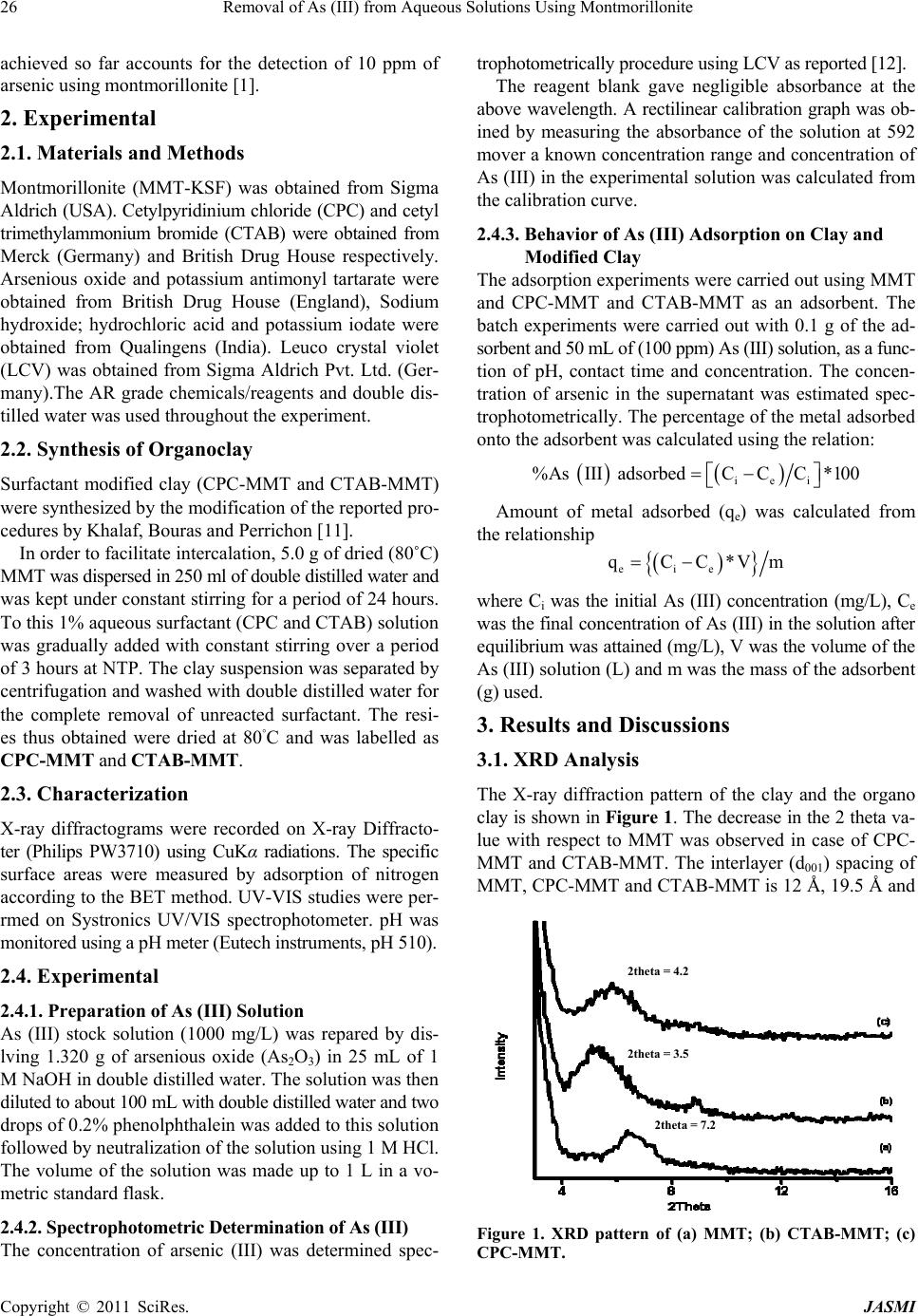 Removal of As (III) from Aqueous Solutions Using Montmorillonite 26 achieved so far accounts for the detection of 10 ppm of arsenic using montmorillonite [1]. 2. Experimental 2.1. Materials and Methods Montmorillonite (MMT-KSF) was obtained from Sigma Aldrich (USA). Cetylpyridinium chloride (CPC) and cetyl trimethylammonium bromide (CTAB) were obtained from Merck (Germany) and British Drug House respectively. Arsenious oxide and potassium antimonyl tartarate were obtained from British Drug House (England), Sodium hydroxide; hydrochloric acid and potassium iodate were obtained from Qualingens (India). Leuco crystal violet (LCV) was obtained from Sigma Aldrich Pvt. Ltd. (Ger- many).The AR grade chemicals/reagents and double dis- tilled water was used throughout the experiment. 2.2. Synthesis of Organoclay Surfactant modified clay (CPC-MMT and CTAB-MMT) were synthesized by the modification of the reported pro- cedures by Khalaf, Bouras and Perrichon [11]. In order to facilitate intercalation, 5.0 g of dried (80˚C) MMT was dispersed in 250 ml of double distilled water and was kept under constant stirring for a period of 24 hours. To this 1% aqueous surfactant (CPC and CTAB) solution was gradually added with constant stirring over a period of 3 hours at NTP. The clay suspension was separated by centrifugation and washed with double distilled water for the complete removal of unreacted surfactant. The resi- es thus obtained were dried at 80◦C and was labelled as CPC-MMT and CTAB-MMT. 2.3. Characterization X-ray diffractograms were recorded on X-ray Diffracto- ter (Philips PW3710) using CuKα radiations. The specific surface areas were measured by adsorption of nitrogen according to the BET method. UV-VIS studies were per- rmed on Systronics UV/VIS spectrophotometer. pH was monitored using a pH meter (Eutech instruments, pH 510). 2.4. Experimental 2.4.1. Pre paration of As (I II) Solution As (III) stock solution (1000 mg/L) was repared by dis- lving 1.320 g of arsenious oxide (As2O3) in 25 mL of 1 M NaOH in double distilled water. The solution was then diluted to about 100 mL with double distilled water and two drops of 0.2% phenolphthalein was added to this solution followed by neutralization of the solution using 1 M HCl. The volume of the solution was made up to 1 L in a vo- metric standard flask. 2.4.2. Spectrophotometric Determination of As (III) The concentration of arsenic (III) was determined spec- trophotometrically procedure using LCV as reported [12]. The reagent blank gave negligible absorbance at the above wavelength. A rectilinear calibration graph was ob- ined by measuring the absorbance of the solution at 592 mover a known concentration range and concentration of As (III) in the experimental solution was calculated from the calibration curve. 2.4.3. Behavior of As (III) Adsorption on Clay and Modified C l ay The adsorption experiments were carried out using MMT and CPC-MMT and CTAB-MMT as an adsorbent. The batch experiments were carried out with 0.1 g of the ad- sorbent and 50 mL of (100 ppm) As (III) solution, as a func- tion of pH, contact time and concentration. The concen- tration of arsenic in the supernatant was estimated spec- trophotometrically. The percentage of the metal adsorbed onto the adsorbent was calculated using the relation: iei %As III adsorbedCCC*100 Amount of metal adsorbed (qe) was calculated from the relationship eie qCC*V m where Ci was the initial As (III) concentration (mg/L), Ce was the final concentration of As (III) in the solution after equilibrium was attained (mg/L), V was the volume of the As (III) solution (L) and m was the mass of the adsorbent (g) used. 3. Results and Discussions 3.1. XRD Analysis The X-ray diffraction pattern of the clay and the organo clay is shown in Figure 1. The decrease in the 2 theta va- lue with respect to MMT was observed in case of CPC- MMT and CTAB-MMT. The interlayer (d001) spacing of MMT, CPC-MMT and CTAB-MMT is 12 Å, 19.5 Å and 2theta = 7.2 2theta=3.5 2theta = 4.2 Figure 1. XRD pattern of (a) MMT; (b) CTAB-MMT; (c) CPC-MMT. Copyright © 2011 SciRes. JASMI 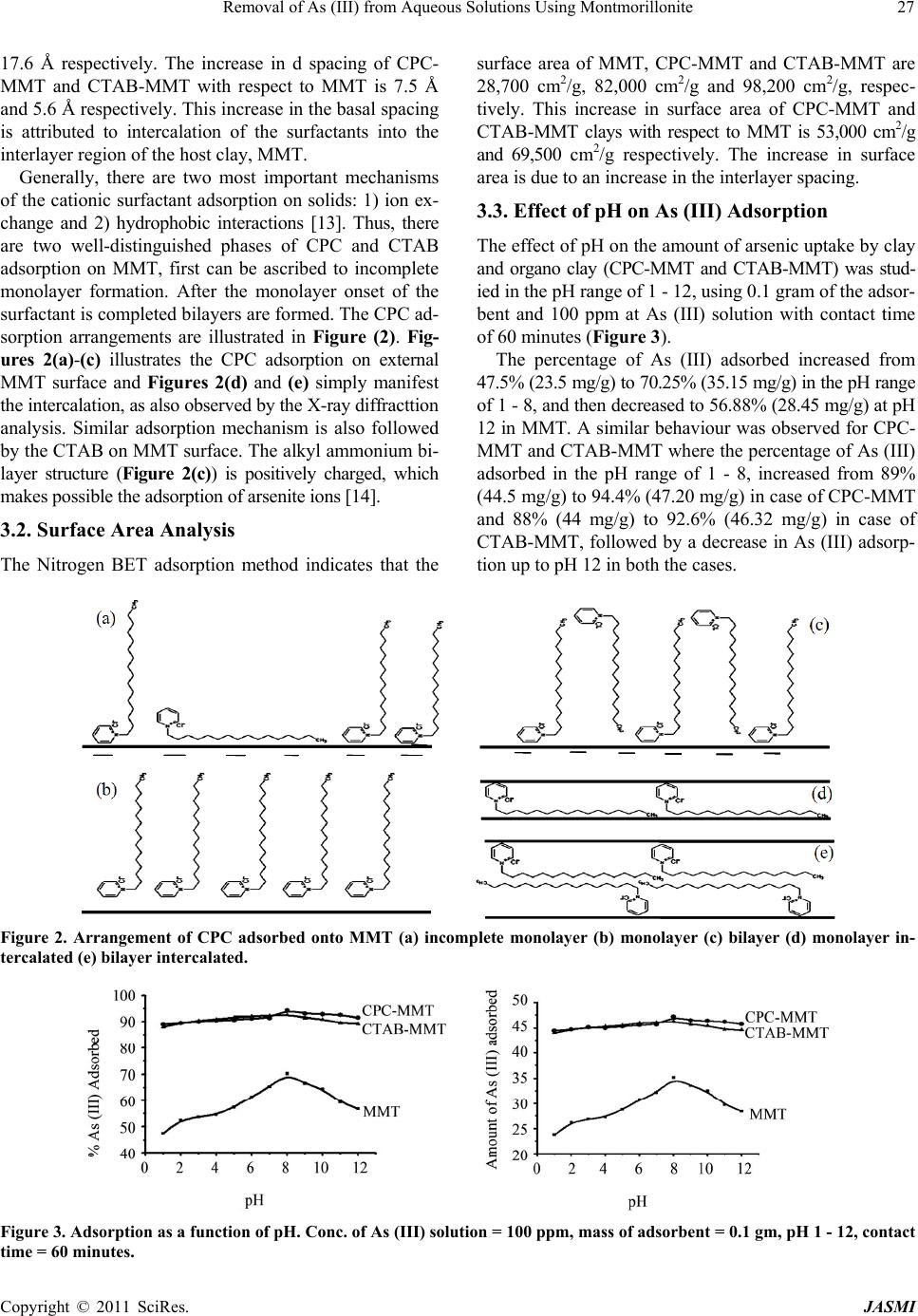 Removal of As (III) from Aqueous Solutions Using Montmorillonite Copyright © 2011 SciRes. JASMI 27 ctively. The increase in d spacing of CPC- nt mechanisms of ethod indicates that the 17.6 Å respe MMT and CTAB-MMT with respect to MMT is 7.5 Å and 5.6 Å respectively. This increase in the basal spacing is attributed to intercalation of the surfactants into the interlayer region of the host clay, MMT. Generally, there are two most importa the cationic surfactant adsorption on solids: 1) ion ex- change and 2) hydrophobic interactions [13]. Thus, there are two well-distinguished phases of CPC and CTAB adsorption on MMT, first can be ascribed to incomplete monolayer formation. After the monolayer onset of the surfactant is completed bilayers are formed. The CPC ad- sorption arrangements are illustrated in Figure (2). Fig- ures 2(a)-(c) illustrates the CPC adsorption on external MMT surface and Figures 2(d) and (e) simply manifest the intercalation, as also observed by the X-ray diffracttion analysis. Similar adsorption mechanism is also followed by the CTAB on MMT surface. The alkyl ammonium bi- layer structure (Figure 2(c)) is positively charged, which makes possible the adsorption of arsenite ions [14]. 3.2. Surface Area Analysis The Nitrogen BET adsorption m surface area of MMT, CPC-MMT and CTAB-MMT are 28,700 cm2/g, 82,000 cm2/g and 98,200 cm2/g, respec- tively. This increase in surface area of CPC-MMT and CTAB-MMT clays with respect to MMT is 53,000 cm2/g and 69,500 cm2/g respectively. The increase in surface area is due to an increase in the interlayer spacing. 3.3. Effect of pH on As (III) Adsorption The effect of pH on the amount of arsenic uptake by clay and organo clay (CPC-MMT and CTAB-MMT) was stud- ied in the pH range of 1 - 12, using 0.1 gram of the adsor- bent and 100 ppm at As (III) solution with contact time of 60 minutes (Figure 3). The percentage of As (III) adsorbed increased from 47.5% (23.5 mg/g) to 70.25% (35.15 mg/g) in the pH range of 1 - 8, and then decreased to 56.88% (28.45 mg/g) at pH 12 in MMT. A similar behaviour was observed for CPC- MMT and CTAB-MMT where the percentage of As (III) adsorbed in the pH range of 1 - 8, increased from 89% (44.5 mg/g) to 94.4% (47.20 mg/g) in case of CPC-MMT and 88% (44 mg/g) to 92.6% (46.32 mg/g) in case of CTAB-MMT, followed by a decrease in As (III) adsorp- tion up to pH 12 in both the cases. Figure 2. Arrangement of CPC adsorbed onto MMT (a) incomplete monolayer (b) monolayer (c) bilayer (d) monolayer in- tercalated (e) bilayer intercalated. Figure 3. Adsorption as a function of pH. Conc. of As (III) solution = 100 ppm, mass of adsorbent = 0.1 gm, pH 1 - 12, contact time = 60 minutes.  Removal of As (III) from Aqueous Solutions Using Montmorillonite 28 These results show that in a highly acidic medium, where h TAB-MMT w which maxi- m t of Contact Time on As (III) Adsorption by clay (MMT) and organoclay (CPC-MMT and CTAB- m 67 y oc n on As (III) The concentration on the amount of arse- II) adsorbed was ob te adsorbent surfaces are highly protonated and As (III) mainly exists in the form of neutral H3AsO3 species, ad- sorption of As (III) is not favorable. This is due to the weak interaction that occurs between the adsorbent and H3AsO3. Therefore, the only driving force between H3AsO3 and the adsorbent is the physical adsorption, thereby resulting in less adsorption. At near neutral pH values (7 - 9), slow dissociation of H3AsO3 producing arsenite ions begins and it reaches a maximum at pH 8.0. These partially neu- tral and partially negatively charged arsenite ions are at- tracted to the positively charged surface of the adsorbent thereby resulting in high As (III) uptake by the adsorbent in this pH range. At pH 10 and above, the adsorbent sur- faces become negatively charged. Hence, the interaction between the adsorbent and arsenite ions decreases lead- ing to low As (III) uptake by the adsorbent. The As (III) uptake by CPC-MMT and C as observed to be higher than MMT. This is because, the surface of the organo clay composites is highly posi- tively charged than MMT, as indicated by the zeta poten- tial values (MMT = 12.9 mV, CPC-MMT = 17.2 mV, CTAB-MMT = 22.6 mV). This in turn facilitates stronger interaction between the positively charged clay surface and the existing species of arsenite ions in the solution, thereby leading to a higher As (III) uptake. Therefore pH (8.0) was fixed as the pH at um As (III) adsorption on the clay and organoclay had occurred. 3.4. Effec The effect of contact time on the amount of arsenic uptake MMT) was studied as a function of time in the range of 10 - 120 minutes, using 0.1 gram of the adsorbent, at pH 8.0 with initial concentration of As (III) at100 ppm (Figure 4). The percentage of As (III) adsorbed increased fro % (33.5 mg/g) at 10 minutes to 70% (35 mg/g) at 60 minutes on MMT and decreases thereafter. A similar be- haviour was observed for CPC-MMT and CTAB-MMT where the percentage of As (III) adsorbed increased from 88% (44 mg/g) at 10 minutes to 94% (47.44 mg/g) at 60 minutes in the former and 89% (44.75 mg/g) at 10 min- utes to 92.5% (46.25 mg/g) at 60 minutes in the latter. The adsorption of As (III) on the clay and organocla curred very quickly in the initial phase of the experi- ment. This could be due to the availability of a large number of adsorption sites on the clay surface. Maximum adsor- ption of the As (III) was observed in the time duration of 60 minutes and beyond this no further increase in adsor- ption was observed. Therefore, 60 minutes was fixed as the time at which maximum As (III) adsorption on the clay and modified clay had occurred. 3.5. Effect of Initial Concentratio Adsorption effect of initial nic uptake by clay (MMT) and organoclay (CPC-MMT and CTAB-MMT) was studied using 0.1 gram of the ad- sorbent and by varying the concentration of As (III) solu- tion from 0.2 - 100 ppm and maintaining pH 8.0 and a contact time of 60 minutes. (Figur e 5) An increase in the percentage of As (I served from 24% to 71% in MMT on varying the metal Figure 4. Adsorption as a function of co ntact time. Conc. of As (III) solution = 100 ppm, mass of adsorbent = 0.1 gm, pH 8.0, contact time = 10 – 120 minutes. Figure 5. Adsorption as a function of As (III) concentration. Conc. of As (III) solution = 10 ppm – 100 ppm, mass of adsorb- ent = 0.1 gm, pH 8.0, contact time = 60 minutes. Copyright © 2011 SciRes. JASMI 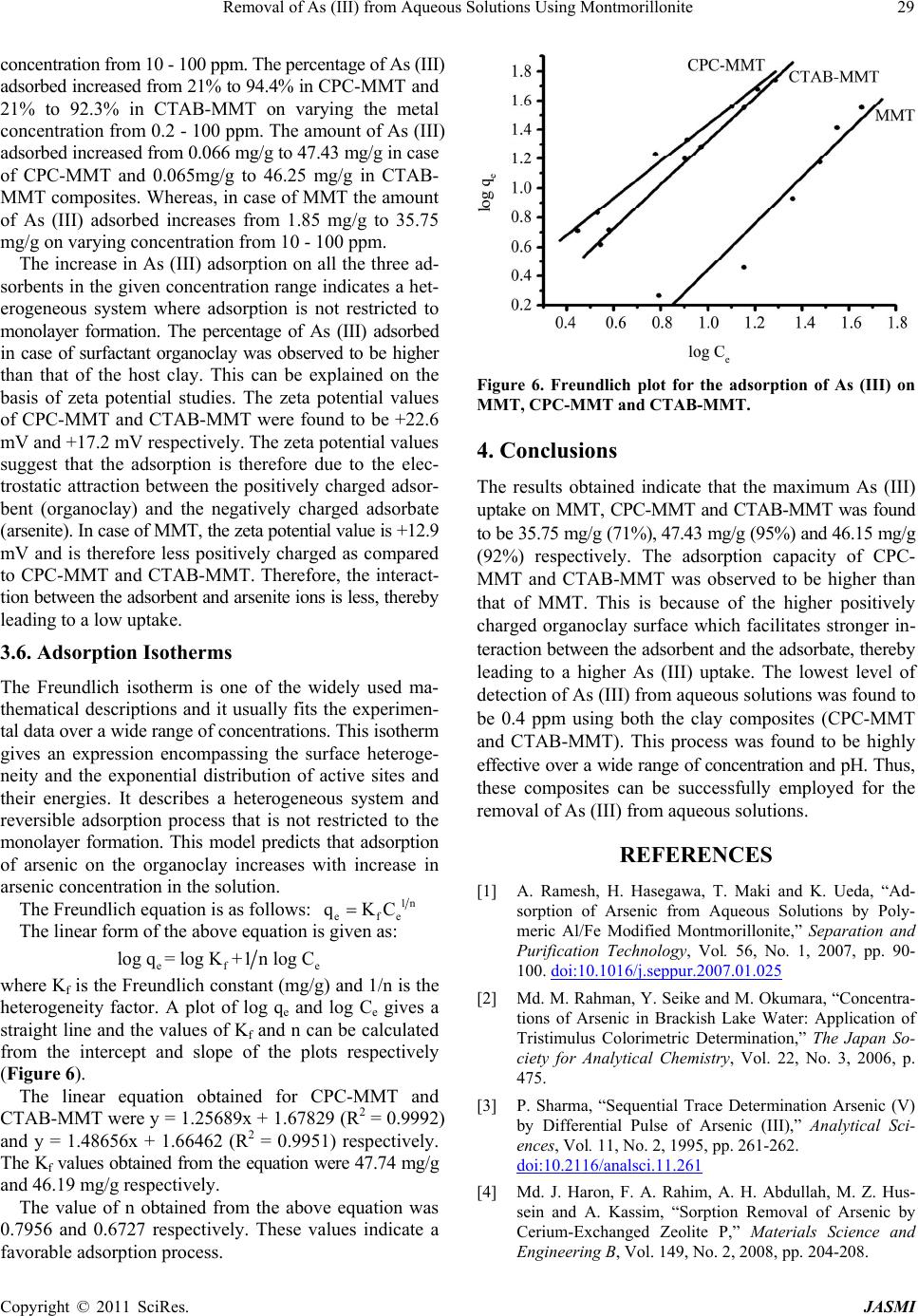 Removal of As (III) from Aqueous Solutions Using Montmorillonite29 -MMT and a het- er of the widely used ma- sually fits the experimen- concentration from 10 - 100 ppm. The percentage of As (III) dsorbed increased from 21% to 94.4% in CPCa 21% to 92.3% in CTAB-MMT on varying the metal concentration from 0.2 - 100 ppm. The amount of As (III) adsorbed increased from 0.066 mg/g to 47.43 mg/g in case of CPC-MMT and 0.065mg/g to 46.25 mg/g in CTAB- MMT composites. Whereas, in case of MMT the amount of As (III) adsorbed increases from 1.85 mg/g to 35.75 mg/g on varying concentration from 10 - 100 ppm. The increase in As (III) adsorption on all the three ad- sorbents in the given concentration range indicates ogeneous system where adsorption is not restricted to monolayer formation. The percentage of As (III) adsorbed in case of surfactant organoclay was observed to be higher than that of the host clay. This can be explained on the basis of zeta potential studies. The zeta potential values of CPC-MMT and CTAB-MMT were found to be +22.6 mV and +17.2 mV respectively. The zeta potential values suggest that the adsorption is therefore due to the elec- trostatic attraction between the positively charged adsor- bent (organoclay) and the negatively charged adsorbate (arsenite). In case of MMT, the zeta potential value is +12.9 mV and is therefore less positively charged as compared to CPC-MMT and CTAB-MMT. Therefore, the interact- tion between the adsorbent and arsenite ions is less, thereby leading to a low uptake. 3.6. Adsorption Isotherms The Freundlich isotherm is one thematical descriptions and it u tal data over a wide range of concentrations. This isotherm gives an expression encompassing the surface heteroge- neity and the exponential distribution of active sites and their energies. It describes a heterogeneous system and reversible adsorption process that is not restricted to the monolayer formation. This model predicts that adsorption of arsenic on the organoclay increases with increase in arsenic concentration in the solution. The Freundlich equation is as follows: 1n efe qKC The linear form of the above equation is given as: ef e here Kf is the Freundlich constant (mg/g) and 1/n is logq= log K+1nlog C wthe heterogeneity factor. A plot of log qe and log Ce giv were y = 1.25689x + 1.67829 (R = 0.999 an values indicate a favorable adsorption process. es a straight line and the values of Kf and n can be calculated from the intercept and slope of the plots respectively (Figure 6). The linear equation obtained for CPC-MMT and CTAB-MMT 22) d y = 1.48656x + 1.66462 (R2 = 0.9951) respectively. The Kf values obtained from the equation were 47.74 mg/g and 46.19 mg/g respectively. The value of n obtained from the above equation was 0.7956 and 0.6727 respectively. These Figure 6. Freundlich plot for the adsorption of As (III) on MMT, CPC-MMT and CTAB-MMT. 4. Conclusions and 46.15 mg/g . The adsorption capacity of CPC- MT was observed to be higher than eparation and Purification Technology. 1, 2007, pp. 90- 100. doi:10.10 The results obtained indicate that the maximum As (III) uptake on MMT, CPC-MMT and CTAB-MMT was found be 35.75 mg/g (71%), 47.43 mg/g (95%)to (92%) respectively MMT and CTAB-M that of MMT. This is because of the higher positively charged organoclay surface which facilitates stronger in- teraction between the adsorbent and the adsorbate, thereby leading to a higher As (III) uptake. The lowest level of detection of As (III) from aqueous solutions was found to be 0.4 ppm using both the clay composites (CPC-MMT and CTAB-MMT). This process was found to be highly effective over a wide range of concentration and pH. Thus, these composites can be successfully employed for the removal of As (III) from aqueous solutions. REFERENCES [1] A. Ramesh, H. Hasegawa, T. Maki and K. Ueda, “Ad- sorption of Arsenic from Aqueous Solutions by Poly- meric Al/Fe Modified Montmorillonite,” S , Vol. 56, No 16/j.seppur.2007.01.025 [2] Md. M. Rahman, Y. Seike and M. Okumara, “Concentra- tions of Arsenic in Brackish Lake Water: Application of Tristimulus Colorimetric Determination,” The Japan So- ciety for Analytical Chemistry, Vol. 22, No. 3, 2006, p. 475. [3] P. Sharma, “Sequential Trace Determination Arsenic (V) by Differential Pulse of Arsenic (III),” Analytical Sci- ences, Vol. 11, No. 2, 1995, pp. 261-262. doi:10.2116/analsci.11.261 [4] Md. J. Haron, F. A. Rahim, A. H. Abdullah, M. Z. Hus- sein and A. Kassim, “Sorption Removal of Arsenic by Cerium-Exchanged Zeolite P,” Materials Science and Engineering B, Vol. 149, No. 2, 2008, pp. 204-208. Copyright © 2011 SciRes. JASMI  Removal of As (III) from Aqueous Solutions Using Montmorillonite 30 doi:10.1016/j.mseb.2007.11.028 [5] P. Mohanty, C. B. Majumder and B. Mohanty, “Labora- tory Based Approaches for Arsenic Remediation from Contaminated Water: Recent Developments,” Journal of Hazardous materials, Vol. 137, No. 1, 2006, pp. 464-479. doi:10.1016/j.jhazmat.2006.02.023 [6] X. Dai, O. Nekrassova, M. E. Hyde and R. G. Compton, orge and L. Gardea- “Anodic Stripping Voltammetry of Arsenic (III) Using Gold Nanoparticle-Modified Electrodes,” Analytical Che- mistry, Vol. 76, No. 19, 2004, pp.5924-5929. http://www.who.int/inf-fs/en/fact210.html. (1993) [7] N. Haque, G. Morrison, I. C.-A. J Torresday, “Iron Modified Light Expanded Clay Aggre- gates for the Removal of Arsenic (V) from Ground Wa- ter,” Microchemical Journal, Vol. 88, No. 1, 2008, pp. 7-13. doi:10.1016/j.microc.2007.08.004 [8] A. Maiti, S. D. Gupta, J. K. Basu and S. De, “Adsorption of Arsenite Using Natural Laterite As Adsorbent,” Sepa- ration and Purification Technology, Vol. 55, No. 3, 2007, pp. 350-359. doi:10.1016/j.seppur.2007.01.003 [9] E. A. Deliyanni, E. N. Peleka and K. A. Matis, “Effect of Cationic Surfactant on Adsorption of Arsenates onto Aka- ganeite Nanocrystals,” Separation science and Technol- ogy, Vol. 42, No. 5, 2007, pp. 993-1012. doi:10.1080/01496390701206306 [10] H. Khalaf, O. Bouras and V. Perrichon, “Synthesis and Characterization of Al-Pillared and Cation Modified Al-Pillared Algerian Be ic Surfactant ntonite,” Microporous l of Chi- Materials, Vol. 8, No. 3-4, 1997, pp. 141-150. [11] O. Agrawal, G. Sunita and V. K. Gupta, “A Sensitive Colorimetric Method for the Determination of Arsenic in Environmental and Biological Samples,” Journa nese Chemical Society, Vol. 46, No. 4, 1999, pp. 641-645. [12] B. Ersoy and M. Çelik, “Effect of Hydrocarbon Chain Length on Adsorption of Cationic Surfactants onto Cli- noptilolite,” Clays Clay Minerals, Vol. 51, No. 2, 2003, pp. 172-180. doi:10.1346/CCMN.2003.0510207 [13] Z. Li and R. S. Bowman, “Retention of Inorganic Oxyan- ions by Organo-Kaolinite,” Water Research, Vol. 35, No. 6, 2001, pp. 3771-3776. Copyright © 2011 SciRes. JASMI |