

Paper Menu >>
Journal Menu >>
 Journal of Quantum Informatio n Science, 2011, 1, 121-126 doi:10.4236/jqis.2011.13017 Published Online December 2011 (http://www.SciRP.org/journal/jqis) Copyright © 2011 SciRes. JQIS 121 On the Theory of Topological Computation in the Lowest Landau Level of QHE Dipti Banerjee Department of Physi cs , Vidyasagar College for Women, Kolkata, India E-mail: [email protected], d b a ncu @ g mai l.com Received August 28, 2011; revised November 20, 2011; accepted November 28, 2011 Abstract We have studied the formation of Hall-qubit in lowest Landau level of (LLL) Quantum Hall effect due to the Aharonov-Bohm oscillation of quasiparticles. The spin echo method plays the key role in the topological entanglement of qubits. The proper ratio of fluxes for maximally entangling qubits has also been pointed out. The generation of higher Quantum Hall state may be possible with the help of quantum teleportation. Keywords: Spin Echo, Aharonov-Bohm Phase 1. Introduction Entanglement is one of the basic aspects of Quantum mechanics that exhibits the peculiar correlations between two physically distant parts of the total systems. The Geometric phase such as Berry phase (BP) [1] and Aha- ronov-Bohm phase [2] play an important role in Quan- tum mechanics. The effect of Berry phase on the entan- gled quantum system is less known. The quantum gates that convey topological transformation is known as topological gates. These gates are advantageous for their immunity and resistive power for local disturbances. They do not depend on the overall time evolution nor on small deformations on the control parameter. This indi- cates that a quantum mechanical state would carry its memory during its spatial variation and the influence of Berry phase on an entangled state could be linked up with the local observations of spins. Few attempts have been made connecting the Berry phase with entangle- ment of spin-1/2 particles resulting the outcome of Geo- metric/Holonomic quantum computation [3]. The transport of information through quasi-particles exhibiting long-range non-abelian Aharonov-Bohm in- teractions can yield similar topological quantum compu- tation [4]. Kitaev [5] pointed out topological quantum computer as a device in which quantum numbers carried by quasi-particles residing on 2DES have long range Aharonov-Bohm interactions with one another. There exist a strong quantum correlation between the quasi- particles interacting by A-B effect extending out over large distances [6]. The interwinding of the quasi-particles trajectories in the course of time evolution of the qubits realizes con- trolled-phase transformations with nontrivial phase val- ues. One of the remarkable discoveries of recent decades is the infinite range A-B interactions observed in Frac- tional Quantum Hall effect [7]. The electrons in the Quantum Hall systems are so highly frustrated that the ground state is an extremely entangled state. The quan- tum entanglement of particle having nontrivial Berry phase is associated with the transport of a charge around a flux which is equivalent to the Aharonov-Bohm phase in the analogy with the gauge theory. A similar reflection is seen in FQHE when one quasi-particle/composite par- ticle goes around another encircling an area A. The total phase associated with this path is given by [8] * 0 2πBA2 enc pN (1) where enc is the number of composite fermion inside the loop. The first term on the right hand side is usual A- B phase and the second term is the contribution from the vortices bound to composite fermions indicating that each enclosed composite fermion effectively reduces the flux by flux quanta. These particles of a nontrivial condensed matter state obey fractional statistics and Arovas et al. [9] pointed out that the exchange of parti- cles over a half loop producing phase factor N 2p 1 πi e . In the entanglement of two spin-1/2 particles in pres- ence of magnetic field through the spin echo method BP plays an important role [10]. We have studied in pres- ence of Rabi oscillation the rotation of qubit through BP 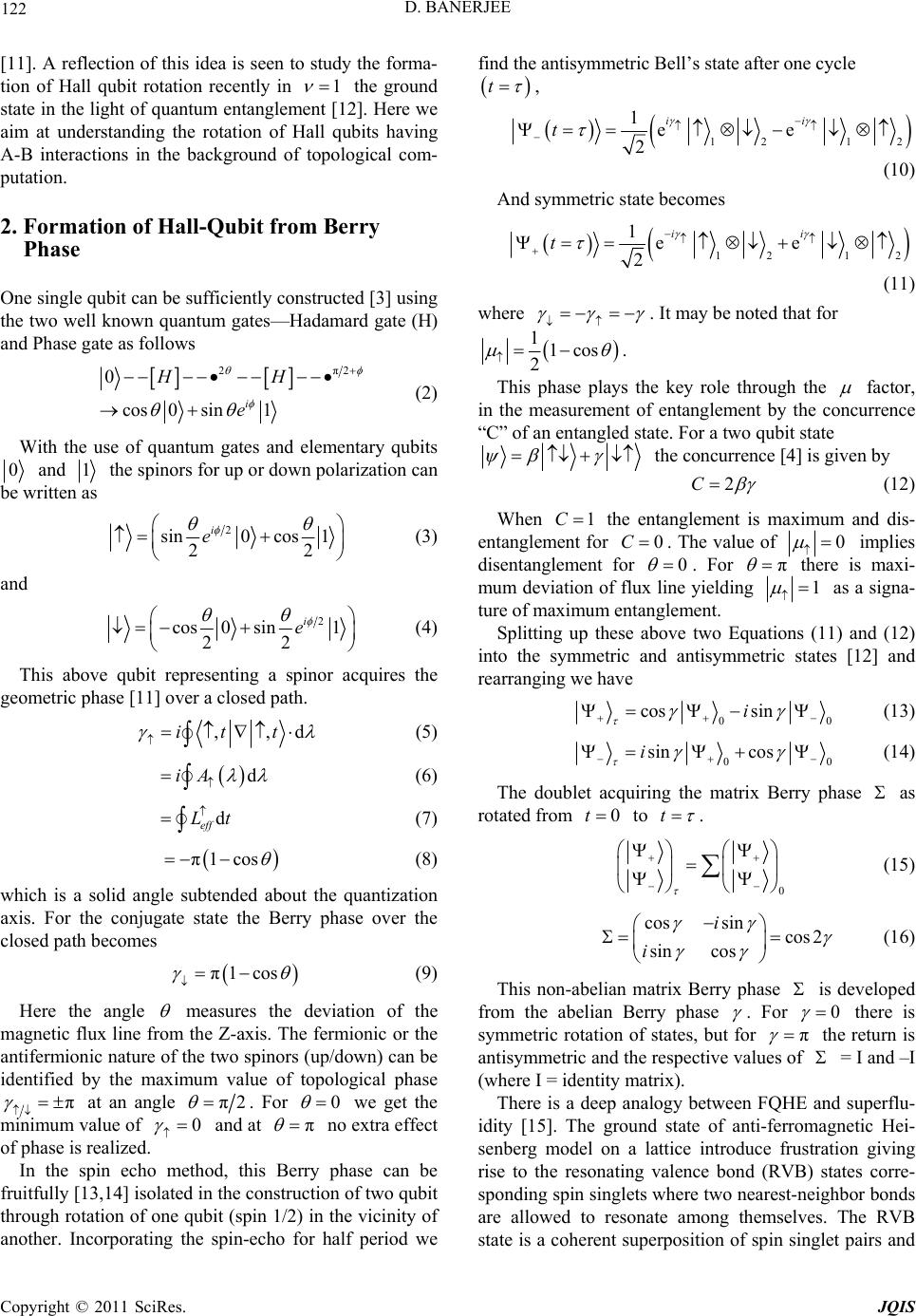 D. BANERJEE 122 [11]. A reflection of this idea is seen to study the forma- tion of Hall qubit rotation recently in 1 the ground state in the light of quantum entanglement [12]. Here we aim at understanding the rotation of Hall qubits having A-B interactions in the background of topological com- putation. 2. Formation of Hall-Qubit from Berry Phase One single qubit can be sufficiently constructed [3] using the two well known quantum gates—Hadamard gate (H) and Phase gate as follows 2π2 0 cos 0sin1 i HH e (2) With the use of quantum gates and elementary qubits 0 and 1 the spinors for up or down polarization can be written as 2 sin0cos 1 22 i e (3) and 2 cos 0 sin1 22 i e (4) This above qubit representing a spinor acquires the geometric phase [11] over a closed path. ,,dit t (5) diA (6) d eff Lt (7) π1cos (8) which is a solid angle subtended about the quantization axis. For the conjugate state the Berry phase over the closed path becomes π1cos (9) Here the angle measures the deviation of the magnetic flux line from the Z-axis. The fermionic or the antifermionic nature of the two spinors (up/down) can be identified by the maximum value of topological phase π at an angle π2 . For 0 we get the minimum value of 0 and at π no extra effect of phase is realized. In the spin echo method, this Berry phase can be fruitfully [13,14] isolated in the construction of two qubit through rotation of one qubit (spin 1/2) in the vicinity of another. Incorporating the spin-echo for half period we find the antisymmetric Bell’s state after one cycle t , 12 12 1ee 2 ii t (10) And symmetric state becomes 12 12 1ee 2 ii t (11) where . It may be noted that for 1. 1c os 2 This phase plays the key role through the factor, in the measurement of entanglement by the concurrence “C” of an entangled state. For a two qubit state the concurrence [4] is given by 2C (12) When 1C the entanglement is maximum and dis- entanglement for 0C . The value of 0 implies disentanglement for 0 . For π there is maxi- mum deviation of flux line yielding 1 as a signa- ture of maximum entanglement. Splitting up these above two Equations (11) and (12) into the symmetric and antisymmetric states [12] and rearranging we have 00 cos sini (13) 0 sin cosi 0 (14) The doublet acquiring the matrix Berry phase as rotated from 0t to t . 0 (15) cossin cos2 sin cos i i (16) This non-abelian matrix Berry phase is developed from the abelian Berry phase . For 0 there is symmetric rotation of states, but for π the return is antisymmetric and the respective values of = I and –I (where I = identity matrix). There is a deep analogy between FQHE and superflu- idity [15]. The ground state of anti-ferromagnetic Hei- senberg model on a lattice introduce frustration giving rise to the resonating valence bond (RVB) states corre- sponding spin singlets where two nearest-neighbor bonds are allowed to resonate among themselves. The RVB state is a coherent superposition of spin singlet pairs and Copyright © 2011 SciRes. JQIS 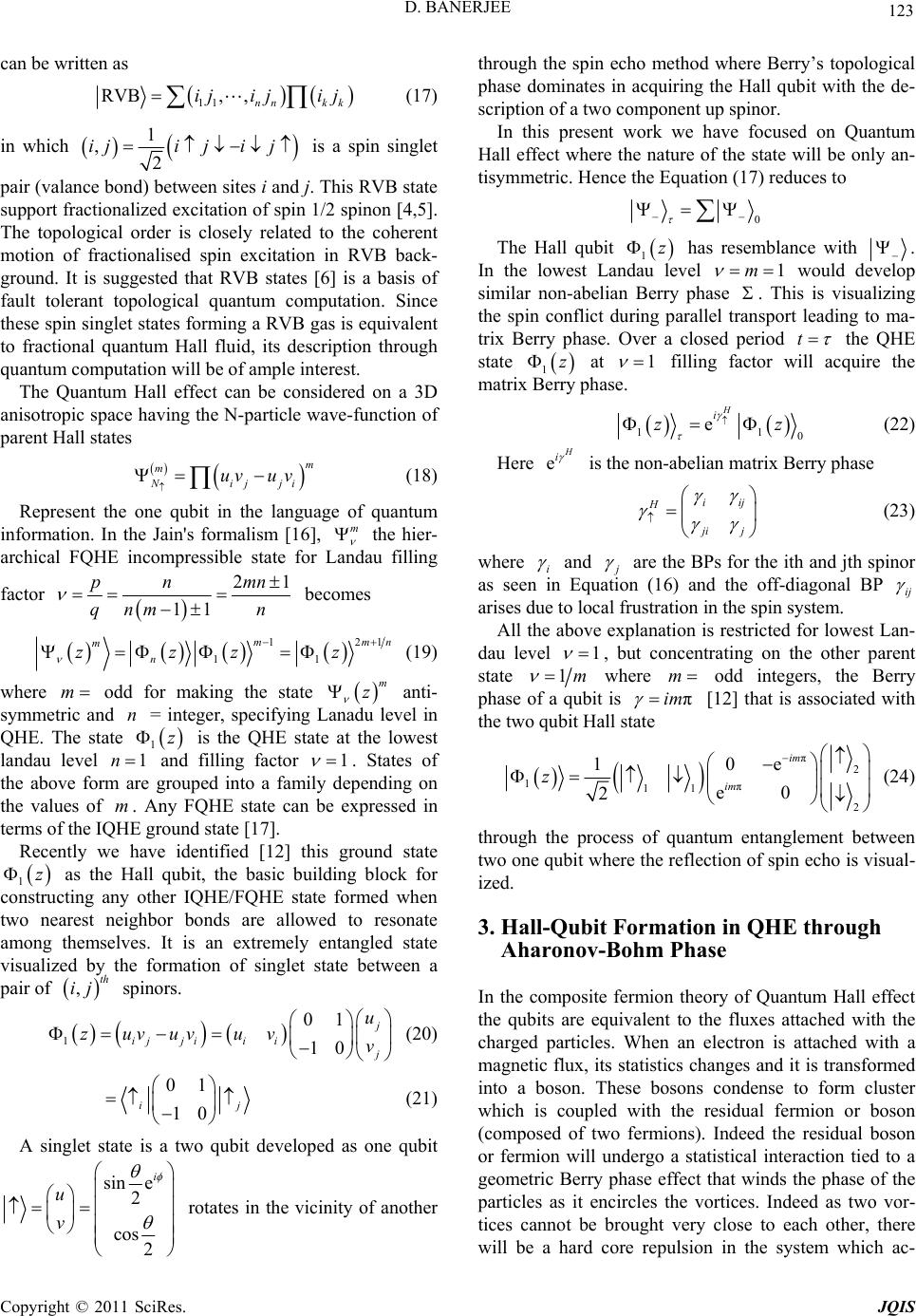 D. BANERJEE 123 can be written as 11 RVB,, nn kk ij ijij (17) in which 1 ,2 ijij ij is a spin singlet pair (valance bond) between sites i and j. This RVB state support fractionalized excitation of spin 1/2 spinon [4,5]. The topological order is closely related to the coherent motion of fractionalised spin excitation in RVB back- ground. It is suggested that RVB states [6] is a basis of fault tolerant topological quantum computation. Since these spin singlet states forming a RVB gas is equivalent to fractional quantum Hall fluid, its description through quantum computation will be of ample interest. The Quantum Hall effect can be considered on a 3D anisotropic space having the N-particle wave-function of parent Hall states m mij ji Nuv uv (18) Represent the one qubit in the language of quantum information. In the Jain's formalism [16], m the hier- archical FQHE incompressible state for Landau filling factor 2 11 pn mn qnm n 1 becomes 12 11 mm m n zzz z 1n (19) where odd for making the state anti- symmetric and = integer, specifying Lanadu level in QHE. The state is the QHE state at the lowest landau level n and filling factor m m z 1 n 1 1z . States of the above form are grouped into a family depending on the values of . Any FQHE state can be expressed in terms of the IQHE ground state [17]. m Recently we have identified [12] this ground state as the Hall qubit, the basic building block for constructing any other IQHE/FQHE state formed when two nearest neighbor bonds are allowed to resonate among themselves. It is an extremely entangled state visualized by the formation of singlet state between a pair of spinors. 1z ,th ij 1 01 10 j ijjiii j u zuvuv uvv (20) 01 10 i j (21) A singlet state is a two qubit developed as one qubit sin e 2 cos 2 i u v through the spin echo method where Berry’s topological phase dominates in acquiring the Hall qubit with the de- scription of a two component up spinor. In this present work we have focused on Quantum Hall effect where the nature of the state will be only an- tisymmetric. Hence the Equation (17) reduces to 0 The Hall qubit 1z has resemblance with . In the lowest Landau level 1m would develop similar non-abelian Berry phase . This is visualizing the spin conflict during parallel transport leading to ma- trix Berry phase. Over a closed period t the QHE state 1z at 1 filling factor will acquire the matrix Berry phase. 10 e H i z 1 z (22) Here e H i is the non-abelian matrix Berry phase iij H j ij (23) where i and j are the BPs for the ith and jth spinor as seen in Equation (16) and the off-diagonal BP ij arises due to local frustration in the spin system. All the above explanation is restricted for lowest Lan- dau level 1 , but concentrating on the other parent state 1m where m odd integers, the Berry phase of a qubit is πim [12] that is associated with the two qubit Hall state π 2 1π 11 2 0e 1 e0 2 im im z (24) through the process of quantum entanglement between two one qubit where the reflection of spin echo is visual- ized. 3. Hall-Qubit Formation in QHE through Aharonov-Bohm Phase In the composite fermion theory of Quantum Hall effect the qubits are equivalent to the fluxes attached with the charged particles. When an electron is attached with a magnetic flux, its statistics changes and it is transformed into a boson. These bosons condense to form cluster which is coupled with the residual fermion or boson (composed of two fermions). Indeed the residual boson or fermion will undergo a statistical interaction tied to a geometric Berry phase effect that winds the phase of the particles as it encircles the vortices. Indeed as two vor- tices cannot be brought very close to each other, there will be a hard core repulsion in the system which ac- rotates in the vicinity of another Copyright © 2011 SciRes. JQIS 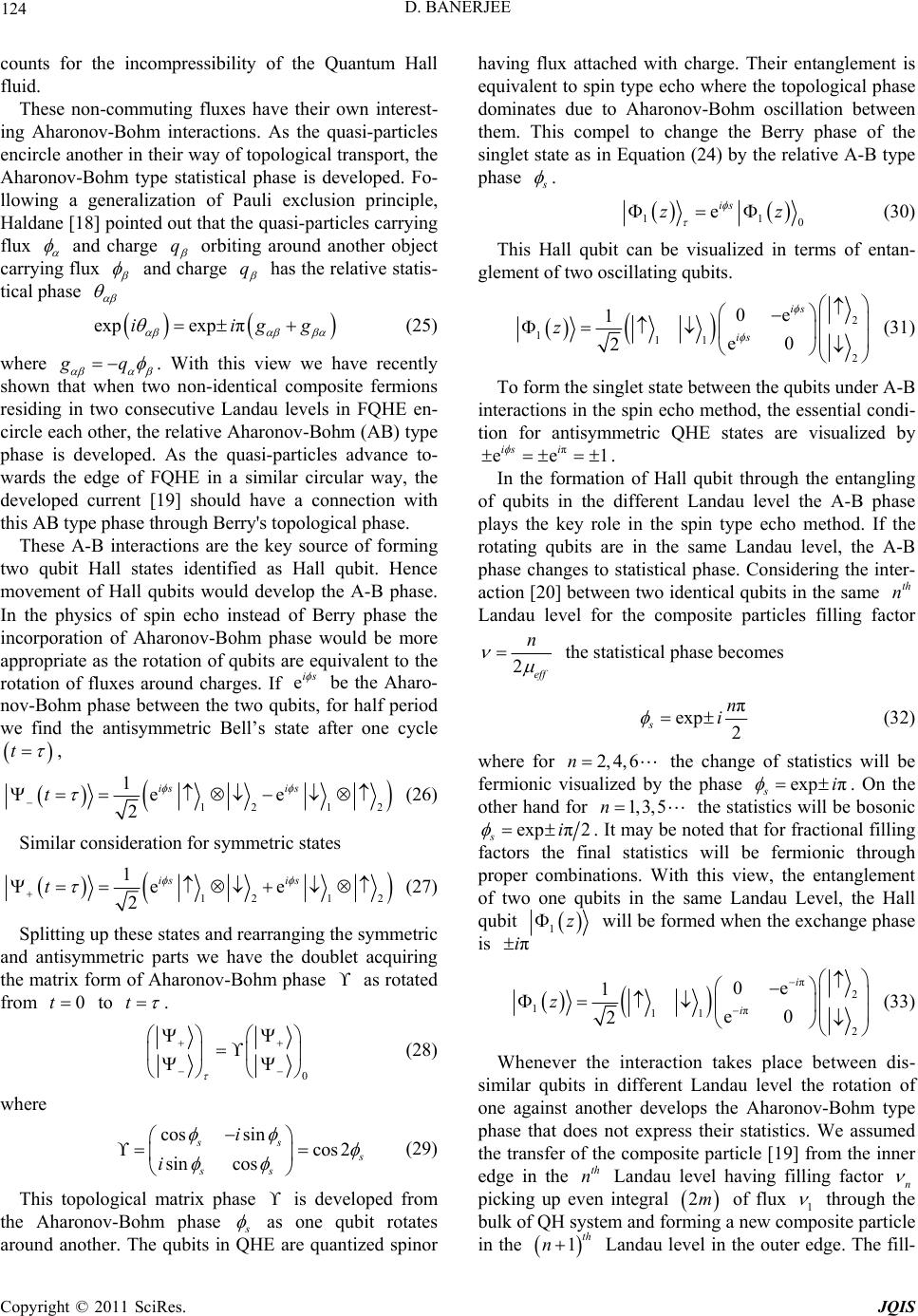 D. BANERJEE 124 counts for the incompressibility of the Quantum Hall fluid. These non-commuting fluxes have their own interest- ing Aharonov-Bohm interactions. As the quasi-particles encircle another in their way of topological transport, the Aharonov-Bohm type statistical phase is developed. Fo- llowing a generalization of Pauli exclusion principle, Haldane [18] pointed out that the quasi-particles carrying flux and charge q orbiting around another object carrying flux and charge q has the relative statis- tical phase expexp πiig g (25) where gq . With this view we have recently shown that when two non-identical composite fermions residing in two consecutive Landau levels in FQHE en- circle each other, the relative Aharonov-Bohm (AB) type phase is developed. As the quasi-particles advance to- wards the edge of FQHE in a similar circular way, the developed current [19] should have a connection with this AB type phase through Berry's topological phase. These A-B interactions are the key source of forming two qubit Hall states identified as Hall qubit. Hence movement of Hall qubits would develop the A-B phase. In the physics of spin echo instead of Berry phase the incorporation of Aharonov-Bohm phase would be more appropriate as the rotation of qubits are equivalent to the rotation of fluxes around charges. If eis be the Aharo- nov-Bohm phase between the two qubits, for half period we find the antisymmetric Bell’s state after one cycle t , 12 12 1ee 2 is is t (26) Similar consideration for symmetric states 12 12 1ee 2 is is t (27) Splitting up these states and rearranging the symmetric and antisymmetric parts we have the doublet acquiring the matrix form of Aharonov-Bohm phase as rotated from to t 0 t . 0 (28) where cossin cos 2 sin cos ss s ss i i (29) This topological matrix phase is developed from the Aharonov-Bohm phase s as one qubit rotates around another. The qubits in QHE are quantized spinor having flux attached with charge. Their entanglement is equivalent to spin type echo where the topological phase dominates due to Aharonov-Bohm oscillation between them. This compel to change the Berry phase of the singlet state as in Equation (24) by the relative A-B type phase s . 10 eis z 1 z (30) This Hall qubit can be visualized in terms of entan- glement of two oscillating qubits. 2 1z ee 11 2 0e 1 e0 2 is is 1 (31) To form the singlet state between the qubits under A-B interactions in the spin echo method, the essential condi- tion for antisymmetric QHE states are visualized by πis i . In the formation of Hall qubit through the entangling of qubits in the different Landau level the A-B phase plays the key role in the spin type echo method. If the rotating qubits are in the same Landau level, the A-B phase changes to statistical phase. Considering the inter- action [20] between two identical qubits in the same Landau level for the composite particles filling factor th n 2eff n the statistical phase becomes π exp 2 sn i (32) where for 2, 4, 6n the change of statistics will be fermionic visualized by the phase exp π si . On the other hand for 1, 3,5n the statistics will be bosonic exp π2 si . It may be noted that for fractional filling factors the final statistics will be fermionic through proper combinations. With this view, the entanglement of two one qubits in the same Landau Level, the Hall qubit 1z will be formed when the exchange phase is πi π 2 1π 11 2 0e 1 e0 2 i i z (33) Whenever the interaction takes place between dis- similar qubits in different Landau level the rotation of one against another develops the Aharonov-Bohm type phase that does not express their statistics. We assumed the transfer of the composite particle [19] from the inner edge in the Landau level having filling factor n th n picking up even integral 2m of flux 1 through the bulk of QH system and forming a new composite particle in the Landau level in the outer edge. The fill- 1n th Copyright © 2011 SciRes. JQIS 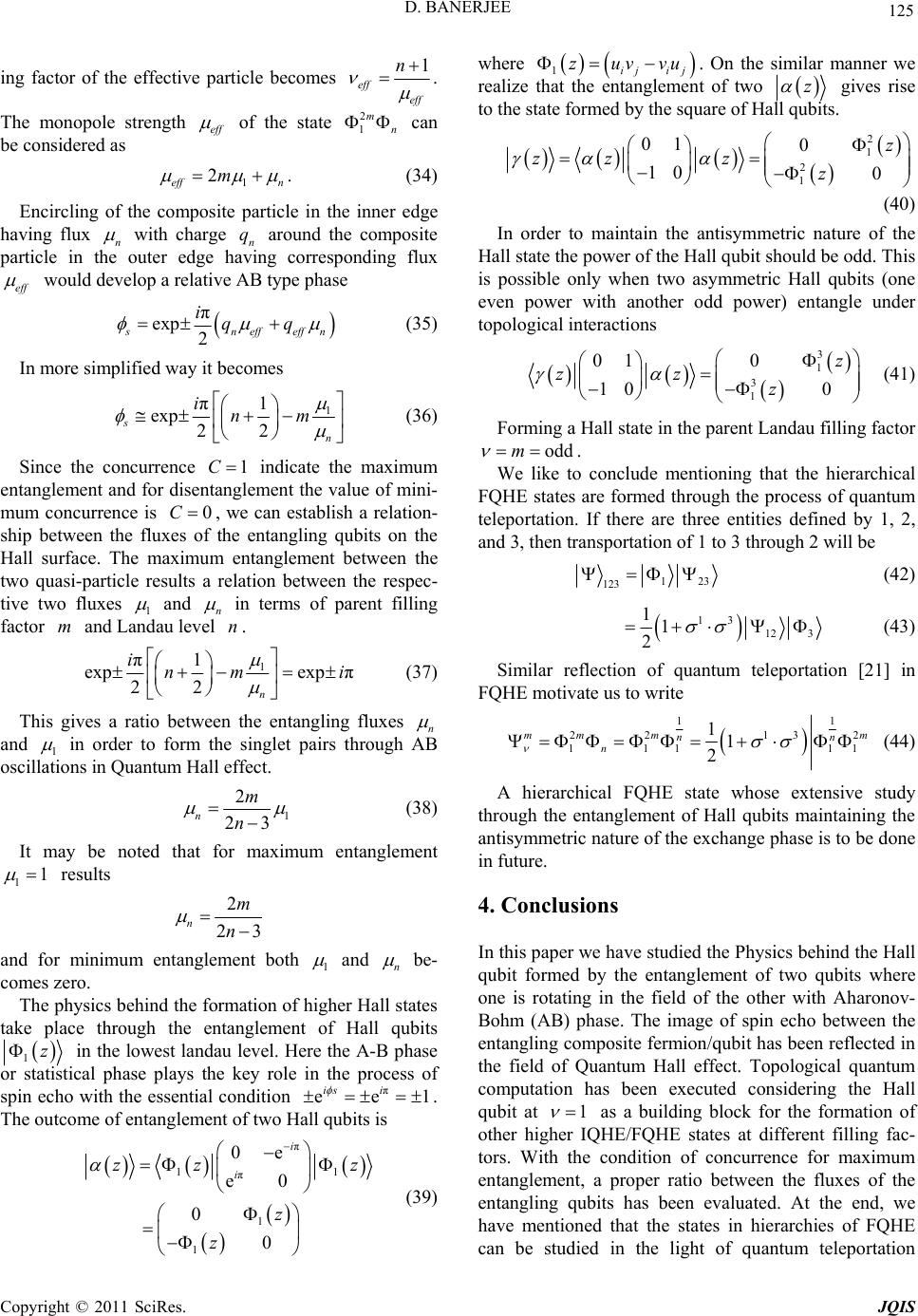 D. BANERJEE 125 ing factor of the effective particle becomes 1 eff eff n . The monopole strength eff of the state can be considered as 2 1 mn 1 2 eff n m . (34) Encircling of the composite particle in the inner edge having flux n with charge n around the composite particle in the outer edge having corresponding eff q flux would develop a relative AB type phase π exp 2 s neffeff n iqq (35) In more simplified way it becomes 1 π1 exp 22 sn inm (36) Since the concurrence 1C indicate the maximum entanglement and for disentanglement the value of mini- mum concurrence is , we can establish a relation- ship between the fluxes of the entangling qubits on the Hall surface. The maximum entanglement between the two quasi-particle results a relation between the respec- tive two fluxes 1 0C and n in terms of parent filling factor and Landau level . m n 1 π1 expexp π 22 n inm i (37) This gives a ratio between the entangling fluxes n and 1 in order to form the singlet pairs through AB oscillations in Quantum Hall effect. 1 2 23 nm n (38) It may be noted that for maximum entanglement 11 results 2 23 nm n and for minimum entanglement both 1 and n be- comes zero. The physics behind the formation of higher Hall states take place through the entanglement of Hall qubits 1 in the lowest landau level. Here the A-B phase or statistical phase plays the key role in the process of spin echo with the essential condition . The outcome of entanglement of two Hall qubits is z 1 π ee is i π 1 π 1 1 0e e0 0 0 i i zz z z where 1ijij zuvvu. On the similar manner we realize that the entanglement of two z gives rise to the state formed by the square of Hall qubits. 2 1 2 1 01 0 10 0 z zzz z (40) In order to maintain the antisymmetric nature of the Hall state the power of the Hall qubit should be odd. This is possible only when two asymmetric Hall qubits (one even power with another odd power) entangle under topological interactions 3 1 3 1 01 0 10 0 z zz z (41) Forming a Hall state in the parent Landau filling factor oddm . We like to conclude mentioning that the hierarchical FQHE states are formed through the process of quantum teleportation. If there are three entities defined by 1, 2, and 3, then transportation of 1 to 3 through 2 will be 123 123 (42) 13 12 3 11 2 (43) Similar reflection of quantum teleportation [21] in FQHE motivate us to write 11 22 13 111 1 11 2 mm m nn n 2 1 m (44) A hierarchical FQHE state whose extensive study through the entanglement of Hall qubits maintaining the antisymmetric nature of the exchange phase is to be done in future. 4. Conclusions 1 z (39) In this paper we have studied the Physics behind the Hall qubit formed by the entanglement of two qubits where one is rotating in the field of the other with Aharonov- Bohm (AB) phase. The image of spin echo between the entangling composite fermion/qubit has been reflected in the field of Quantum Hall effect. Topological quantum computation has been executed considering the Hall qubit at 1 as a building block for the formation of other higher IQHE/FQHE states at different filling fac- tors. With the condition of concurrence for maximum entanglement, a proper ratio between the fluxes of the entangling qubits has been evaluated. At the end, we have mentioned that the states in hierarchies of FQHE can be studied in the light of quantum teleportation Copyright © 2011 SciRes. JQIS 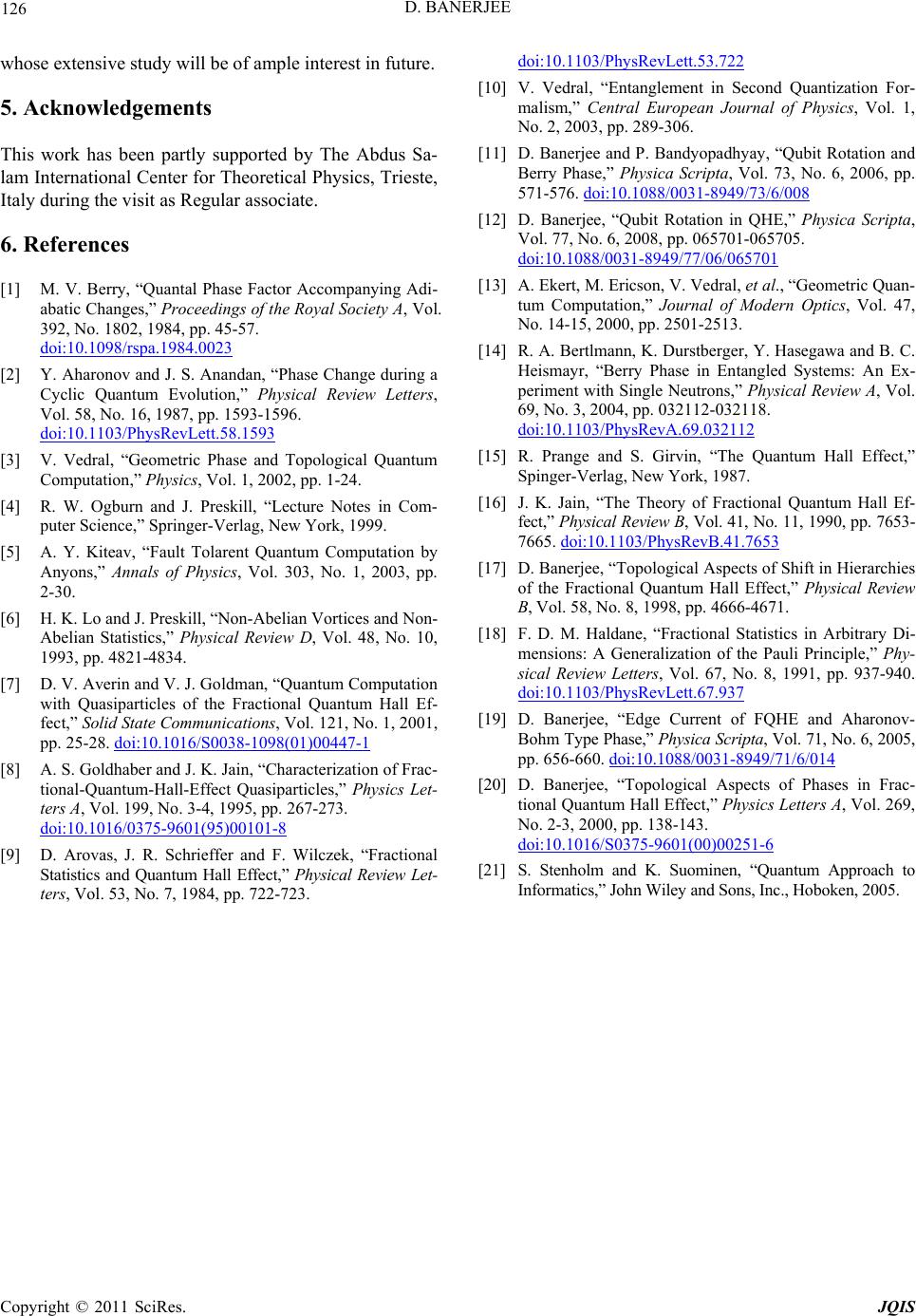 D. BANERJEE Copyright © 2011 SciRes. JQIS 126 whose extensive study will be of ample interest in future. 5. Acknowledgements This work has been partly supported by The Abdus Sa- lam International Center for Theoretical Physics, Trieste, Italy during the visit as Regular associate. 6. References [1] M. V. Berry, “Quantal Phase Factor Accompanying Adi- abatic Changes,” Proceedings of the Royal Society A, Vol. 392, No. 1802, 1984, pp. 45-57. doi:10.1098/rspa.1984.0023 [2] Y. Aharonov and J. S. Anandan, “Phase Change during a Cyclic Quantum Evolution,” Physical Review Letters, Vol. 58, No. 16, 1987, pp. 1593-1596. doi:10.1103/PhysRevLett.58.1593 [3] V. Vedral, “Geometric Phase and Topological Quantum Computation,” Physics, Vol. 1, 2002, pp. 1-24. [4] R. W. Ogburn and J. Preskill, “Lecture Notes in Com- puter Science,” Springer-Verlag, New York, 1999. [5] A. Y. Kiteav, “Fault Tolarent Quantum Computation by Anyons,” Annals of Physics, Vol. 303, No. 1, 2003, pp. 2-30. [6] H. K. Lo and J. Preskill, “Non-Abelian Vortices and Non- Abelian Statistics,” Physical Review D, Vol. 48, No. 10, 1993, pp. 4821-4834. [7] D. V. Averin and V. J. Goldman, “Quantum Computation with Quasiparticles of the Fractional Quantum Hall Ef- fect,” Solid State Communications, Vol. 121, No. 1, 2001, pp. 25-28. doi:10.1016/S0038-1098(01)00447-1 [8] A. S. Goldhaber and J. K. Jain, “Characterization of Frac- tional-Quantum-Hall-Effect Quasiparticles,” Physics Let- ters A, Vol. 199, No. 3-4, 1995, pp. 267-273. doi:10.1016/0375-9601(95)00101-8 [9] D. Arovas, J. R. Schrieffer and F. Wilczek, “Fractional Statistics and Quantum Hall Effect,” Physical Review Let- ters, Vol. 53, No. 7, 1984, pp. 722-723. doi:10.1103/PhysRevLett.53.722 [10] V. Vedral, “Entanglement in Second Quantization For- malism,” Central European Journal of Physics, Vol. 1, No. 2, 2003, pp. 289-306. [11] D. Banerjee and P. Bandyopadhyay, “Qubit Rotation and Berry Phase,” Physica Scripta, Vol. 73, No. 6, 2006, pp. 571-576. doi:10.1088/0031-8949/73/6/008 [12] D. Banerjee, “Qubit Rotation in QHE,” Physica Scripta, Vol. 77, No. 6, 2008, pp. 065701-065705. doi:10.1088/0031-8949/77/06/065701 [13] A. Ekert, M. Ericson, V. Vedral, et al., “Geometric Quan- tum Computation,” Journal of Modern Optics, Vol. 47, No. 14-15, 2000, pp. 2501-2513. [14] R. A. Bertlmann, K. Durstberger, Y. Hasegawa and B. C. Heismayr, “Berry Phase in Entangled Systems: An Ex- periment with Single Neutrons,” Physical Review A, Vol. 69, No. 3, 2004, pp. 032112-032118. doi:10.1103/PhysRevA.69.032112 [15] R. Prange and S. Girvin, “The Quantum Hall Effect,” Spinger-Verlag, New York, 1987. [16] J. K. Jain, “The Theory of Fractional Quantum Hall Ef- fect,” Physical Review B, Vol. 41, No. 11, 1990, pp. 7653- 7665. doi:10.1103/PhysRevB.41.7653 [17] D. Banerjee, “Topological Aspects of Shift in Hierarchies of the Fractional Quantum Hall Effect,” Physical Review B, Vol. 58, No. 8, 1998, pp. 4666-4671. [18] F. D. M. Haldane, “Fractional Statistics in Arbitrary Di- mensions: A Generalization of the Pauli Principle,” Phy- sical Review Letters, Vol. 67, No. 8, 1991, pp. 937-940. doi:10.1103/PhysRevLett.67.937 [19] D. Banerjee, “Edge Current of FQHE and Aharonov- Bohm Type Phase,” Physica Scripta, Vol. 71, No. 6, 2005, pp. 656-660. doi:10.1088/0031-8949/71/6/014 [20] D. Banerjee, “Topological Aspects of Phases in Frac- tional Quantum Hall Effect,” Physics Letters A, Vol. 269, No. 2-3, 2000, pp. 138-143. doi:10.1016/S0375-9601(00)00251-6 [21] S. Stenholm and K. Suominen, “Quantum Approach to Informatics,” John Wiley and Sons, Inc., Hoboken, 2005. |