

Paper Menu >>
Journal Menu >>
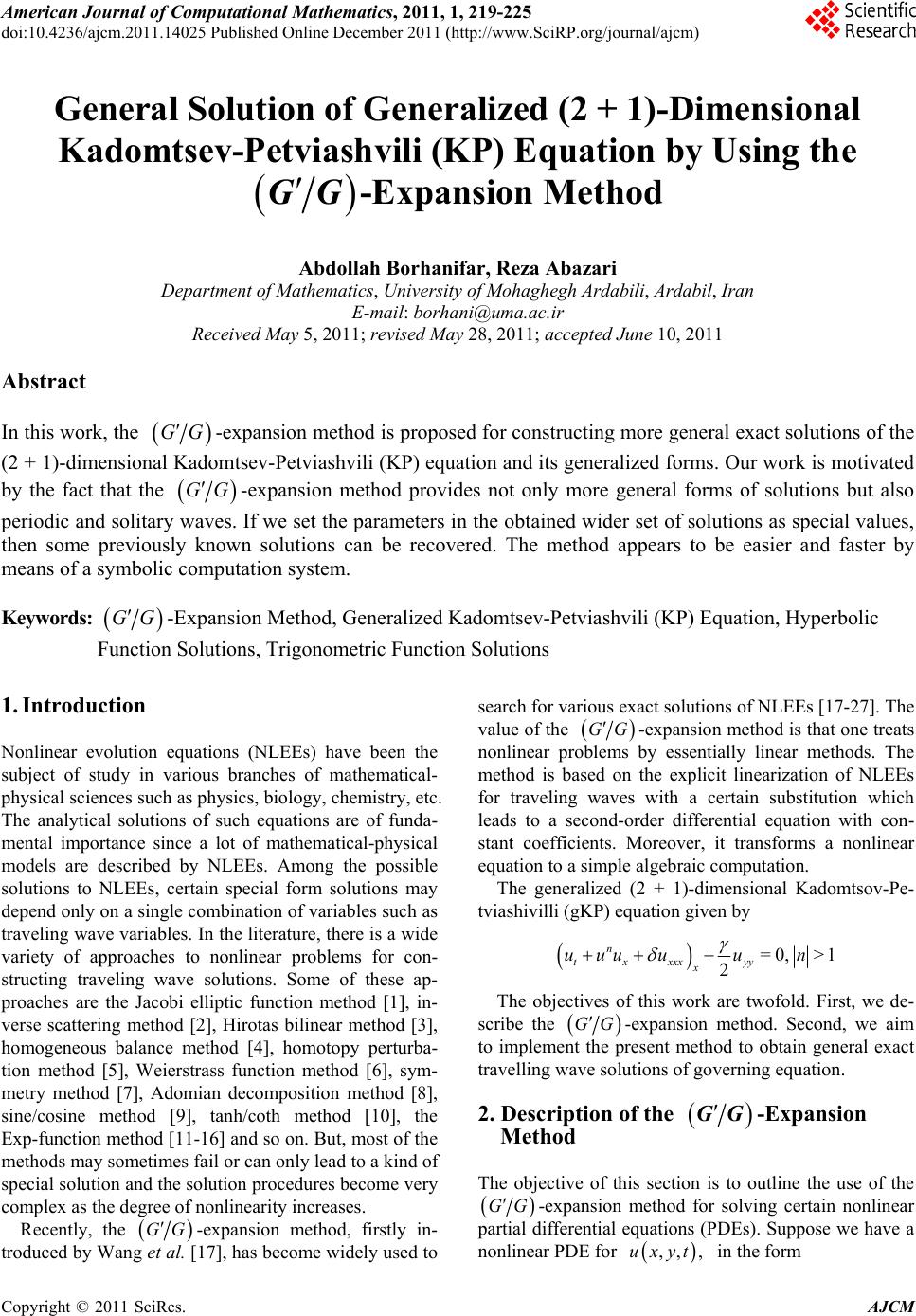 American Journal of Computational Mathematics, 2011, 1, 219-225 doi:10.4236/ajcm.2011.14025 Published Online December 2011 (http://www.SciRP.org/journal/ajcm) Copyright © 2011 SciRes. AJCM General Solution of Generalized (2 + 1)-Dimensional Kadomtsev-Petviashvili (KP) Equation by Using the GG-Expansion Method Abdollah Borhanifar, Reza Abazari Department of Mathematics, University of Mohaghegh Ardabili, Ardabil, Iran E-mail: [email protected] Received May 5, 2011; revised May 28, 2011; accepted June 10, 20 11 Abstract In this work, the GG -expansion method is proposed for constructing more general exact solutions of the (2 + 1)-dimensional Kadomtsev-Petviashvili (KP) equation and its generalized forms. Our work is motivated by the fact that the GG -expansion method provides not only more general forms of solutions but also periodic and solitary waves. If we set the parameters in the obtained wider set of solutions as special values, then some previously known solutions can be recovered. The method appears to be easier and faster by means of a symbolic computation system. Keywords: GG -Expansion Method, Generalized Kadomtsev-Petviashvili (KP) Equation, Hyperbolic Function Solutions, Trigonometric Function Solutions 1. Introduction Nonlinear evolution equations (NLEEs) have been the subject of study in various branches of mathematical- physical sciences such as physics, biology, chemistry, etc. The analytical solutions of such equations are of funda- mental importance since a lot of mathematical-physical models are described by NLEEs. Among the possible solutions to NLEEs, certain special form solutions may depend only on a sing le combination of variables su ch as traveling wave variables. In the literatu re, there is a wide variety of approaches to nonlinear problems for con- structing traveling wave solutions. Some of these ap- proaches are the Jacobi elliptic function method [1], in- verse scattering method [2], Hirotas bilinear method [3], homogeneous balance method [4], homotopy perturba- tion method [5], Weierstrass function method [6], sym- metry method [7], Adomian decomposition method [8], sine/cosine method [9], tanh/coth method [10], the Exp-function method [11-16] and so on. But, most of the methods may sometimes fail or can only lead to a kind of special solution and the solution procedures become very complex as the degree of nonlinearity increases. Recently, the GG troduced by Wang et al. [17], has become widely used to -expansion method, firstly in- search for various exact solutions of NLEEs [17-27]. The value of the GG -expansion method is that one treats nonlinear proby essentially linear methods. The method is based on the explicit linearization of NLEEs for traveling waves with a certain substitution which leads to a second-order differential equation with con- stant coefficients. Moreover, it transforms a nonlinear equation to a simple algebraic computation. The generalized (2 + 1)-dimensional Ka blems domtsov-Pe- tviashivilli (gKP) equ ation given by =0, >1 2 n tx xxxyy x uuu uun The objectives of this work are twofold. First, we de- scribe the GG -expansion method. Second, we aim to implemenresent method to obtain general exact travelling wave solutions of governing equation. t the p 2. Description of the GG-Expansion The objective of this section is to outline the use of the Method GG -expansion method for solving certain nonlinear ifferential equations (PDEs). Suppose we have a partial d nonlinear PDE for ,, ,uxyt in the form 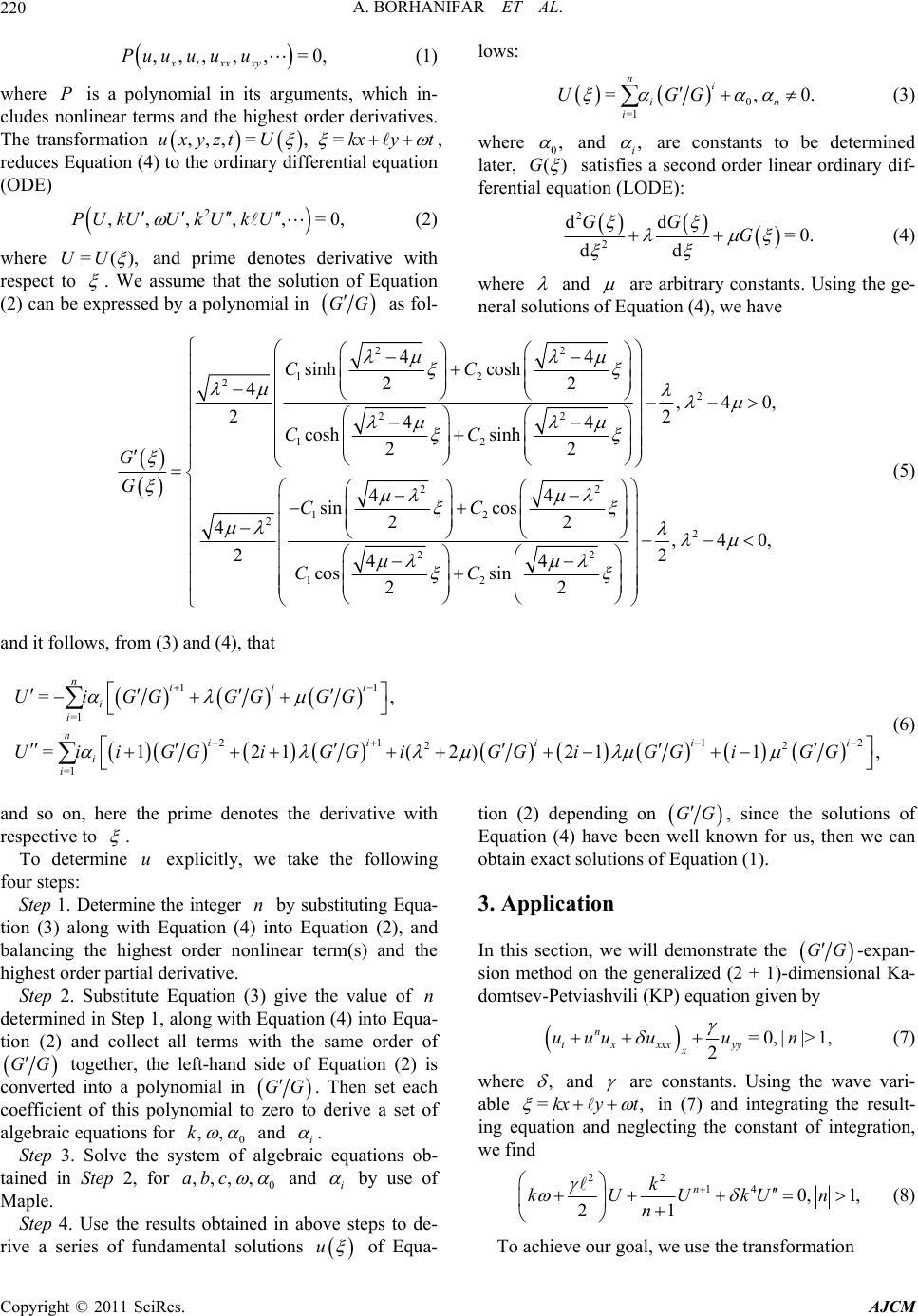 A. BORHANIFAR ET AL. 220 where is a polynomial in its argumen cludes inear terms and the highest ord ,,,, ,=0, xy Puuu uu (1) x txx P nonl nsf ts, which in- er derivatives. The traormation ,,, =uxyzt U , =kx yt , reduces Equation (4) to the ordinary differential equation (ODE) 2 ,,, ,,=0,PU kUUkUkU (2) where =(),UU and prime denotes derivat respect tive with o . be expresse We assume that the solution of Equation (2) cand by a polynomial in GG as fol- lows: 0 =1 =,0 ni in i UGG . (3) where 0, and , i are constants to be determined later, ()G satisfies a second order linear ordinary dif- ferential equation (LODE): 2 2 dd =0. dd GG G (4) where and are arbitrary constants. Using the ge- neral solutions of Equation (4), we have 22 12 22 22 12 22 12 2 2 12 44 sinh cosh 22 4,4 22 44 cosh sinh 22 44 sin cos 22 4 24 cos sin 2 CC CC G G CC CC 0, 2 2,40, 2 4 2 (5) and it follows, from (3) and (4), that 1 =1 21 12 22 =1 , =121(2) 211, i i nii iii i i GG Ui iGGiGGiGGiGGiGG (6) and so on, here the prime denotes the derivative with spective to 1 = nii i UiGGGG re . To determine u explicitly, we take the following four steps: Step 1. Determin the integer n by substituting Equa- tion (3) aloe ng with Equation (4) into Equation (2), and ba nl Equation (4) into Equ tio lancing the highest order noinear term(s) and the highest order partial derivative. Step 2. Substitute Equation (3) give the value of n determined in Step 1, along witha- fn (2) and collect all terms with the same order o GG together, the left-hand side of Equation (2) is converted into a polynomial in GG . Then set each ent of this polynomial to zero to derive a set of algebraic equations for 0 ,,k coeffici and i . Step 3. Solve the system of algebraic equations ob- tained in Step 2, for 0 ,,,,abc a ndi by use of Mobtained e eries of fundamental solutions aple. Step 4. Use the results in abovsteps to de- rive a s u of Equa- tion (2) depending on GG , since the solutions of Equation (4) have bn for us, then we can ob e een well know tain exact solutions of Equation (1). 3. Application In this section, we will demonstrate th GG -dimension -expan- sion method on the generalized (2 + 1)al Ka- ation given by domtsev-Petviashvili (KP) equ =0,| 2 n txxxx yy x uuu uun|>1, (7) where , and are constants. Using the wave vari- able =,kx yt in (7) and integrating the result- ing equation and neglecting the constant of i we find ntegration, 22 140, 1, 21 n kUkUn n kU our goal, we use the transformation (8) To achieve Copyright © 2011 SciRes. AJCM 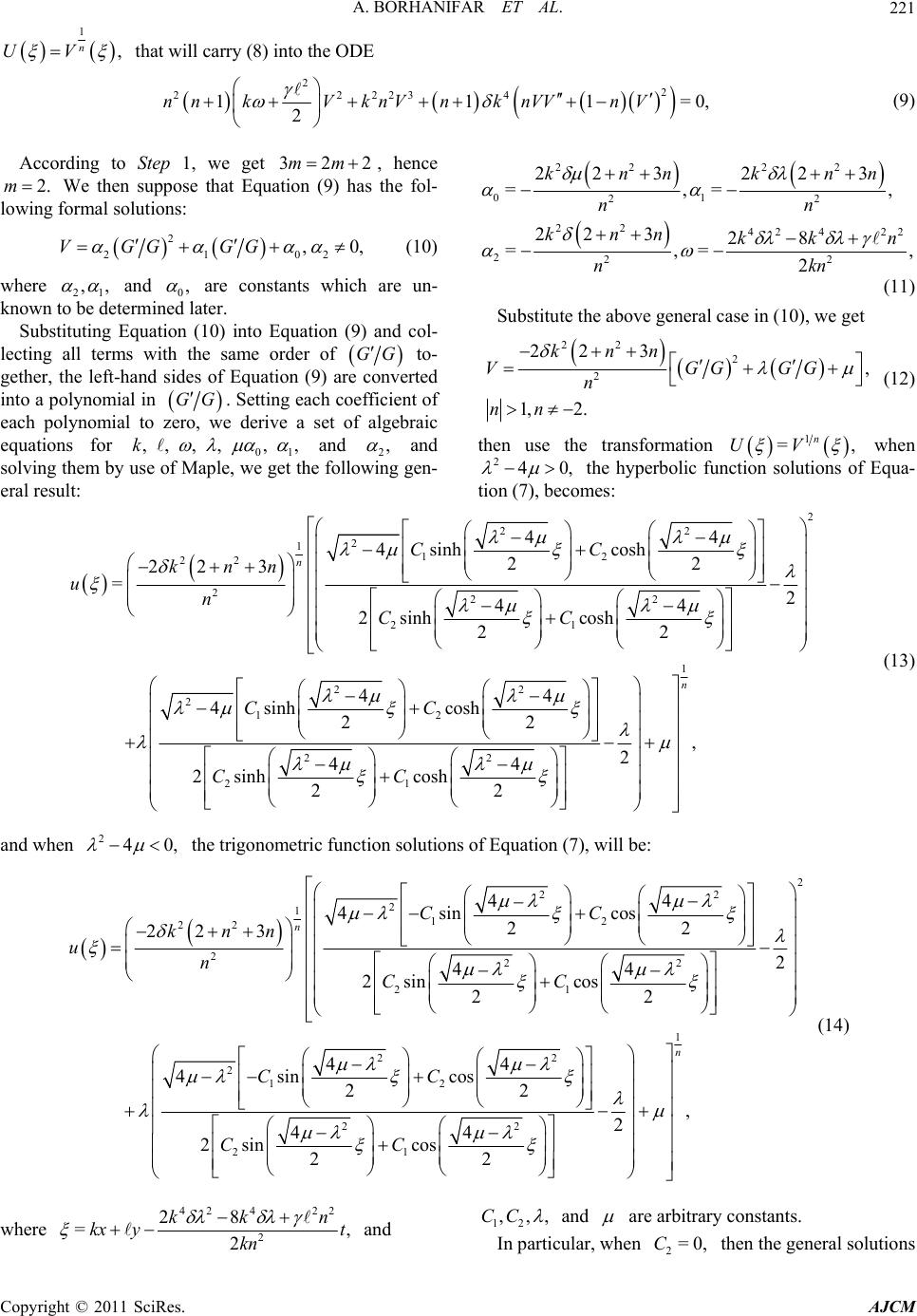 A. BORHANIFAR ET AL.221 , n UV 1 that will carry (8) into the ODE 22 222234 111 2 nnkVknVnknVVnV =0, (9) According to Step 1, we get2, hence We then suppose that Equatioe fol- lo 32mm n (9) has th2.m wing formal solutions: 2 21,0,VGG GG (10) 02 where 21 ,, and 0, are constants which known to be determined later. titutingon me order of are un- Subs Equati(10) into Equation (9) and col- lecting all terms with the sa GG 22 22 01 22 22 42 422 222 22 322 3 =,= 22 328 =,= 2 knnknn nn knn kk nk , , n n (11) Substitute the above general case in (10), we get to- gether, the left-hand sides of Equation (9) are converted into a polynomial in GG . Setting each coefficient of each polynomial to zero, we derive a set of algebraic equations for 01 ,, ,k,,, and 2, and solving them by use of Maple, we get the following gen- eral result: 22 2 22 3, knnGGG 2 1, 2. VG n nn (12) then use the transformation 1 =, n UV when , 240 the hyperbolic function solutions of Equa- tion (7), becomes: 2 2 4 cos 2 2 112 22 222 21 2 212 4 4sinh h 22 22 3 =2 44 2sinh cosh 22 4 4sinh cosh 2 nCC knn un CC CC 1 2 22 21 4 2, 2 44 2sinh cosh 22 n CC (13) and when , the trigonometric function solutions of Equation (7), will be: 240 2 2 4 2 2 112 22 222 21 2 212 4 4sin cos 22 22 3 2 44 2sin cos 22 44 4sin cos 2 nCC knn un CC CC 1 2 22 21 2, 2 44 2sin cos 22 n CC (14) here w42 422 2 28 =, 2 kk n kx yt kn 12 ,,,CC and are arbitrary constants. In particular, when then the general solutions and 2=0,C Copyright © 2011 SciRes. AJCM 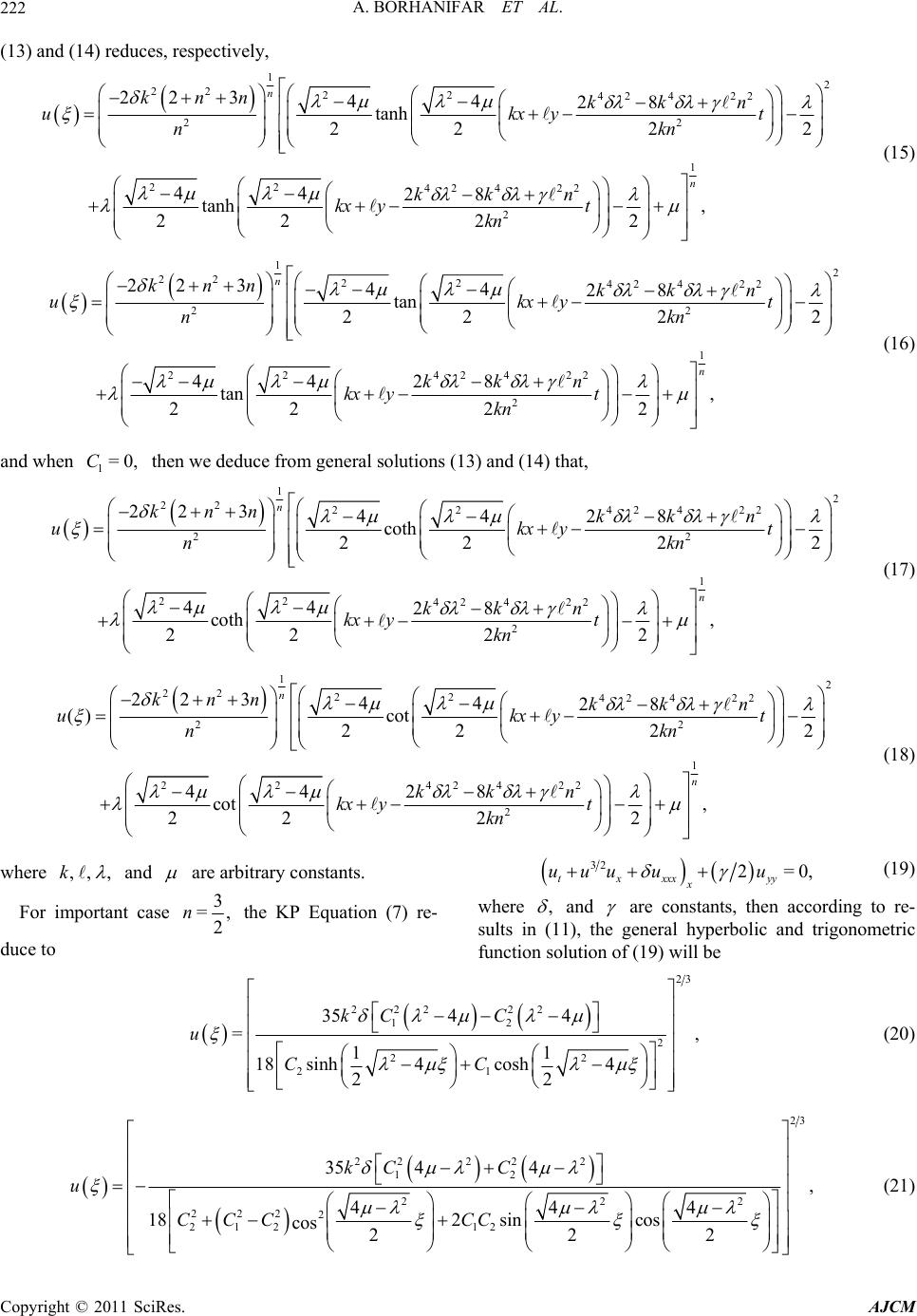 A. BORHANIFAR ET AL. 222 (13) and (14) reduces , res pectively, 12 42 22 2 28 2 kk n kxyt n 22 22 4 2 1 22 42 422 2 22 344 22 2 44 28 tanh , 22 2 2 n n knn nk kk n kx yt kn tanhu (15) 1 2 t n 2 22 22 42 4 22 2 2 1 22 42 422 2 22 344 28 tan 22 2 44 28 tan , 22 22 n n knnkk n ukxy nk kk n kx yt kn (16) and when then we deduce from general solutions (13) and (14) that, 1=0,C 12 22 22 42 422 2 2 1 22 42 422 2 22 344 28 coth 22 2 44 28 coth , 22 22 n n knnkk n ukxy nk kk n kx yt kn 2 t n (17) 12 22 22 42 422 2 2 1 22 42 422 2 22 344 28 () cot 22 2 44 28 cot , 22 2 2 n n knnkk n ukxy nk kk n kx yt kn 2 t n (18) where ,, ,k and are arbitrary constants. For important case 3 =, 2 n 32 2=0 txxxxyy , x uuuuu where (19) and , are constants, then according to re- sults in (11), the general hyperbolic and trigonometric function solution of (19) will be the KP Equation (7) re- duce to 23 222 1 35kC 2 2 2 4 cosh 4 C C (20) 2 22 21 4 =, 11 18 sinh4 22 u C 23 22 22 2 12 22 222 2 212 12 35 44, 444 182 sincos cos 222 kC C u CCC CC 2 (21) Copyright © 2011 SciRes. AJCM 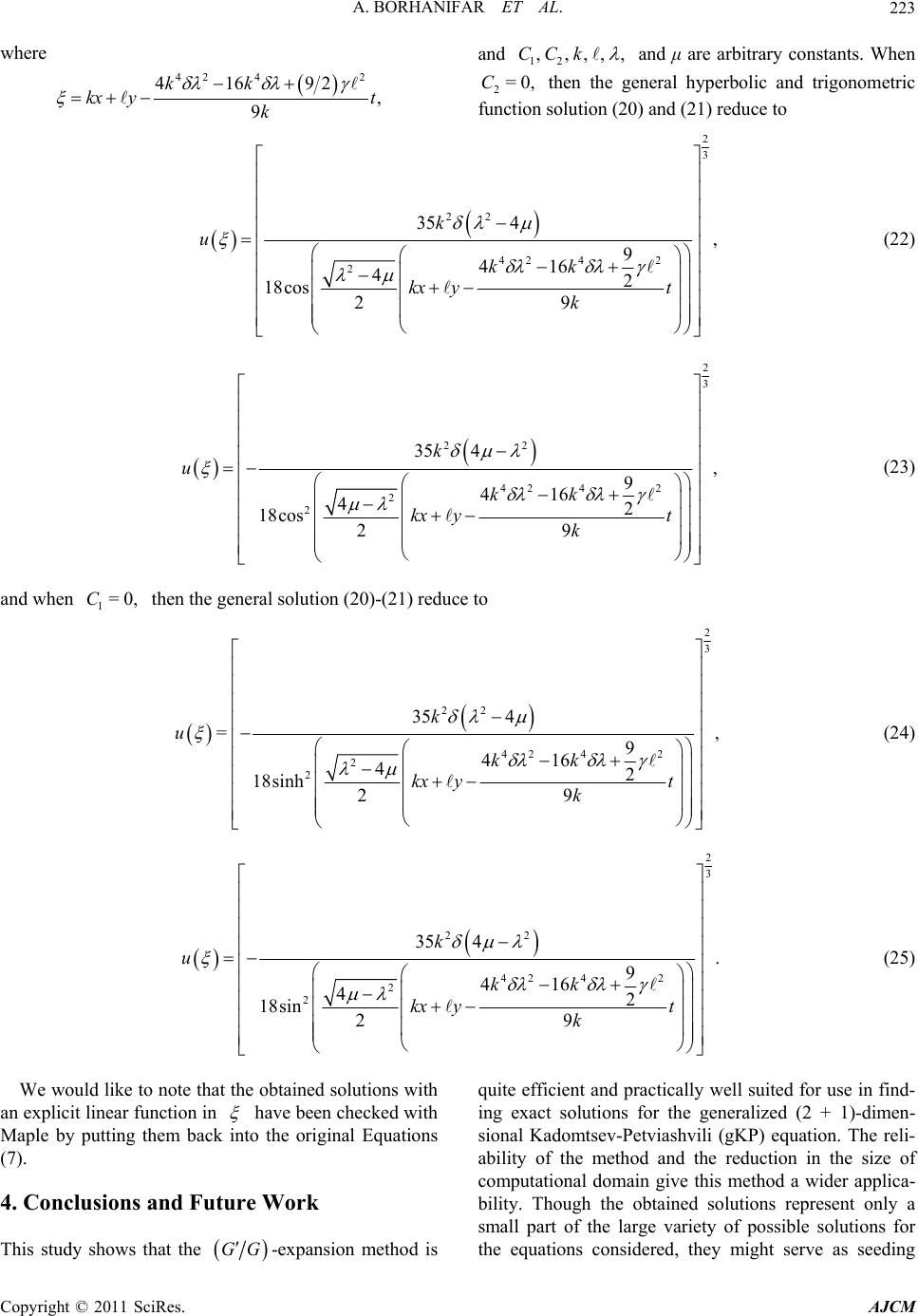 A. BORHANIFAR ET AL.223 where and , 42 42 41692 , 9 kk kx yt k 12 ,,,,CC k =0, then the ge and μ are arbitrary constants. When neral hyperbolic and trigonometric function solution (20) and (21) reduce to 2 C 2 3 22 42 42 , 9 41 6 2 kk (22) 2 35 4 4 18cos 29 k u kx yt k 2 3 22 42 42 2 2 35 4, 9 416 42 18cos 29 k u kk kx yt k (23) and when then the general solution (20)-(21) reduce to 1=0,C 2 3 22 42 42 24 4kk 2 35 4 =, 9 16 2 18sinh 29 k u kx yt k (24) 2 3 22 42 42 2 2 35 4. 9 416 42 18sin 29 k u kk kx yt k (25) We would like to note that the obtained solutions with an explicit linear function in have been checked with Maple by putting them back into the original Equations (7). 4. Conclusions and Future Work This study shows that the GG -expansion method is the equations considered, they might serve as seeding quite efficient and practically well suited for use in find- ing exact solutions for the ge sional Kadomtsev-Petviashvili (gKP) equation. The reli- ability of the method and the reduction in the size of computational domain give this method a wider applica- bility. Though the obtained solutions represent only a small part of the large variety of possible solutions for neralized (2 + 1)-dimen- Copyright © 2011 SciRes. AJCM 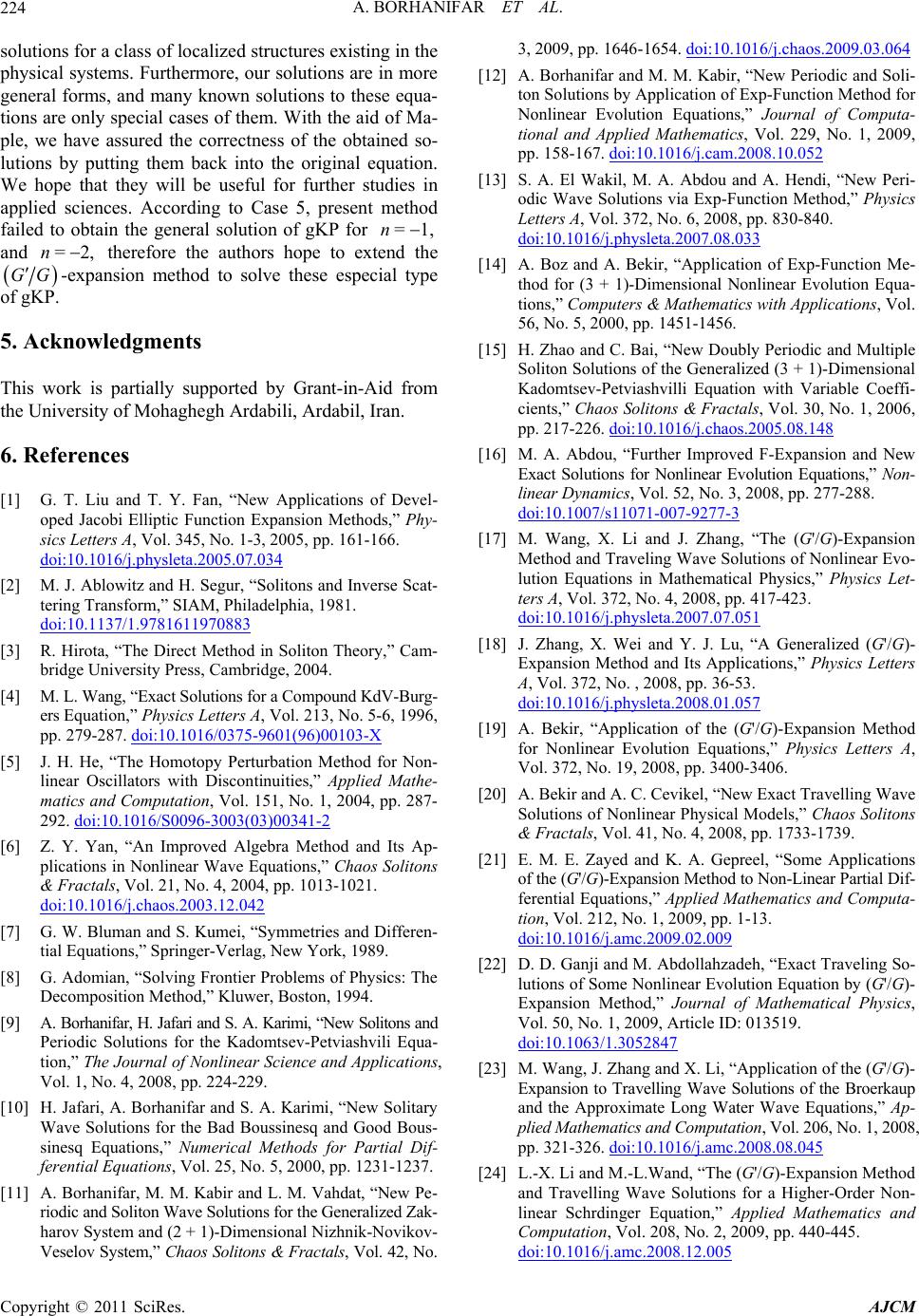 A. BORHANIFAR ET AL. 224 ical systems. Furthermore, our solutions are in m general forms, and many known solutions to these equa- he aid of Ma- ple, we have assured the correctness of the obtained so- k into solutions for a class of localized structures existing in the physore tions are only special cases of them. With t lutions by putting them bacthe original equation. We hope that they will be useful for further studies in applied sciences. According to Case 5, present method failed to obtain the general solution of gKP for =1,n and =2,n therefore the authors hope to extend the GG -expansion method to solve these especial type of gKP. 5. Acknowledgments This work is partially supported by Grant-in-Aid from the University of Mohaghegh Ardabili, Ardabil, Iran. 6. References [1] G. T. Liu and T. Y. Fan, “New Applications of Devel- oped Jacobi Elliptic Function Expansion Methods,” Phy- sics Letters A, Vol. 345, No. 1-3, 2005, pp. 161-166. doi:10.1016/j.physleta.2005.07.034 [2] . J. Ablowitz and H. Segur, “Solitons and Inverse Scat- tering Transform,” SIAM, Philadelphia, 1981. doi:1 M 0.1137/1.9781611970883 ethod in Soliton Theory,” Cam- ambridge, 2004. [3] R. Hirota, “The Direct M bridge University Press, C [4] M. L. Wang, “Exact Solutions for a Compound KdV-Burg- er s Equation,” Physics Letters A, Vol. 213, No. 5-6, 1996, pp. 279-287. doi:10.1016/0375-9601(96)00103-X [5] J. H. He, “The linear Oscillat Homotopy Perturbation Method for Non- ors with Discontinuities,” Applied Mathe- matics and Computation, Vol. 151, No. 1, 2004, pp. 287- 292. doi:10.1016/S0096-3003(03)00341-2 [6] Z. Y. Yan, “An Improved Algebra Method and Its Ap- plications in Nonlinear Wave Equations,” Chaos Solito & Fractals, Vol. 21, No. 4, 2004, ppns . 1013-1021. doi:10.1016/j.chaos.2003.12.042 [7] G. W. Bluman and S. Kumei, “Symmetries and tial Equations,” Springer-Verlag Differen- , New York, 1989. 994. ca r Partial Dif- ional Nizhnik-Novikov- .064 [8] G. Adomian, “Solving Frontier Problems of Physics: The Decomposition Method,” Kluwer, Boston, 1 [9] A. Borhanifar, H. Jafari and S. A. Karimi, “New Solitons and Periodic Solutions for the Kadomtsev-Petviashvili Equa- tion,” The Journal of Nonlinear Science and Applitions, Vol. 1, No. 4, 2008, pp. 224-229. [10] H. Jafari, A. Borhanifar and S. A. Karimi, “New Solitary Wave Solutions for the Bad Boussinesq and Good Bous- sinesq Equations,” Numerical Methods fo ferential Equations, Vol. 25, No. 5, 2000, pp. 1231-1237. [11] A. Borhanifar, M. M. Kabir and L. M. Vahdat, “New Pe- riodic and Soliton Wave Solutions for the Generalized Zak- harov System and (2 + 1)-Dimens Veselov Sy stem,” Chaos Solitons & Fractals, Vol. 42, No. 3, 2009, pp. 1646-1654. doi:10.1016/j.chaos.2009.03 thod for [12] A. Borhanifar and M. M. Kabir, “New Periodic and Soli- ton Solutions by Application of Exp-Function Me Nonlinear Evolution Equations,” Journal of Computa- tional and Applied Mathematics, Vol. 229, No. 1, 2009, pp. 158-167. doi:10.1016/j.cam.2008.10.052 [13] S. A. El Wakil, M. A. Abdou and A. Hendi, “New Peri- odic Wave Solutions via Exp-Function Method,” Physics Letters A, Vol. 372, No. 6, 2008, pp. 830-840. doi:10.1016/j.physleta.2007.08.033 [14] A. Boz and A. Bekir, “Application of Exp-Function Me- thod for (3 + 1)-Dimensional Nonlinear Evolution Equa- tions,” Computers & Mathematics with Applications, Vol. 56, No. 5, 2000, pp. 1451-1456. [15] H. Zhao and C. Bai, “New Doubly Periodic and Multiple Soliton Solutions of the Generalized (3 + 1)-Dimensional Kadomtsev-Petviashvilli Equation with Variable Coeffi- cients,” Chaos Solitons & Fractals, Vol. 30, No. 1, 2006, pp. 217-226. doi:10.1016/j.chaos.2005.08.148 [16] M. A. Abdou, “Further Improved F-Expansion and New Exact Solutions for Nonlinear Evolution Equations,” Non- linear Dynamics, Vol. 52, No. 3, 2008, pp. 277-288. doi:10.1007/s11071-007-9277-3 [17] M. Wang, X. Li and J. Zhang, “The (G'/G)-E Method and Traveling Wave Solutioxpansion ns of Nonlinear Evo- lution Equations in Mathematical Physics,” Physics Let- ters A, Vol. 372, No. 4, 2008, pp. 417-423. doi:10.1016/j.physleta.2007.07.051 [18] J. Zhang, X. Wei and Y. J. Lu, “A Generalized (G'/G)- Expansion Method and Its Applications,” Physics Letters A, Vol. 372, No. , 2008, pp. 36-53. doi:10.1016/j.physleta.2008.01.057 [19] A. Bekir, “Application of the (G'/G)-Expansion Method for Nonlinear Evolution Equations,” Physics Letters A, ons Vol. 372, No. 19, 2008, pp. 3400-3406. [20] A. Bekir and A. C. Cevikel, “New Exact Travelling Wave Solutions of Nonlinear Physical Models,” Chaos Solit & Fractals, Vol. 41, No. 4, 2008, pp. 1733-1739. [21] E. M. E. Zayed and K. A. Gepreel, “Some Applications of the (G'/G)-Expansion Met hod to Non -Linear Pa rtial Dif- ferential Equations,” Applied Mathematics and Computa- tion, Vol. 212, No. 1, 2009, pp. 1-13. doi:10.1016/j.amc.2009.02.009 [22] D. D. Ganji and M. Abdollahzadeh, “Exact Traveling So- lutions of Some Nonlinear Evolution Equation by (G'/G)- Expansion Method,” Journal of Ma Vol. 50, No. 1, 2009, Article ID: 013thematical Physics, 519. doi:10.1063/1.3052847 [23] M. Wang, J. Zhang and X. Li, “Application of the (G'/G)- Expansion to Travelling Wave Solutions of the Broerkaup and the Approximate Long Water Wave Equations,” Ap- plied Mathematics and Computation, Vol. 206, No. 1, 2008, pp. 321-326. doi:10.1016/j.amc.2008.08.045 [24] L.-X. Li and M.-L.Wand, “The (G'/G)-Expansion Method and Travelling Wave Solutions for a Higher-Order Non- linear Schrdinger Equation,” Applied Mathematics and Computation, Vol. 208, No. 2, 2009, pp. 440-445. doi:10.1016/j.amc.2008.12.005 Copyright © 2011 SciRes. AJCM  A. BORHANIFAR ET AL. Copyright © 2011 SciRes. AJCM 225 reel, “The (G'/G)-Expan-[25] E. M. E. Zayed and K. A. Gep sion Method for Finding Traveling Wave Solutions of Nonlinear Partial Differential Equations in Mathematical Physics,” Journal of Mathematical Physics, Vol. 50, No. 1, 2008, Article ID: 013502. doi:10.1063/1.3033750 [26] I. Aslan and T. Ozis, “Analytic Study on Two Nonlinear , Vol. 209, No. 2 Evolution Equations by Using the (G'/G)-Expansion Me- thod,” Applied Mathematics and Computation , 2009, pp. 425-429. doi:10.1016/j.amc.2008.12.064 [27] I. Aslan and T. Ozis, “On the Validity and Reliability of the (G'/G)-Expansion Method by Using Higher-Order Non- linear Equations,” Applied Mathematics and Computation, Vol. 211, No. 2, 2009, pp. 531-536. doi:10.1016/j.amc.2009.01.075 |