

Paper Menu >>
Journal Menu >>
 iBusiness, 2011, 3, 353-358 doi:10.4236/ib.2011.34047 Published Online December 2011 (http://www.SciRP.org/journal/ib) Copyright © 2011 SciRes. IB 353 The Usefulness of Global Student Rating Items under End Program Evaluation Surveys in Quality Improvements: An Institutional Experience in Higher Education, Saudi Arabia Abdullah Al Rubaish Office of the Presid e n t , Uni v ersity of Dammam, Damma m, Saudi Arabia. Email: [email protected], [email protected] Received September 19th, 2011; revised October 23rd, 2011; accepted November 2nd, 2011. ABSTRACT Program evaluation survey (PES) by students in higher education is one of the range of evaluations of academic pro- grams. Others are course eva l uati o n, teaching skills evaluation; and surveys of facilities and services. The present study employs the available PES data collected in colleges of Dentistry and Medicine, University of Dammam (UD), Saudi Arabia. Our PES relates to students’ experience at the end of their academic program. The present paper analyses these data and discusses the usefulne ss of global item resu lts vis-a- vis individ ual item resu lts in quality imp rovemen ts of higher education. The respective percentage of participating students was 100 and 65. The PES results revealed that in view of poorly graded global items results, there is need of focus on global item results, leading to continuing im- provements in all the areas covered in the questionnaire. Keywords: Glo bal It em , Individual Items, Program Evaluation Survey, Academic Program, Higher Education, High Quality, Acceptable and I mpr ovement Required 1. Introduction It is mandatory for academic institution s in higher educa- tion to perform various continuing evaluations of courses offered, the teaching skills of faculty member s as well as facilities and services. This is especially the case if the institution is pursuing accreditation for its academic pro- grams, or further improvement in quality, or both. The data generated through these evaluations, if collected accurately, analyzed appropriately and interpreted cor- rectly [1-4], produce some of the most important inputs required in this regard. Furthermore, the utility of such evidence can be maximized through enhancement of the awareness and knowledge of users and policy planners [2, 4-5]. In the University of Dammam, academic programs are currently in phases of developmental review. Each of these evaluation activities are at peak in five colleges: namely: Dentistry, Medicine, Nursing, Applied Medical Sciences and Architecture. All the remaining colleges are also developing such evaluation practices. A series of earlier publications have addressed some of the merits and demerits of such evaluation results [6-19]. Instead of documented limitations of such surveys, the related re- sults still remain the backbone of the mandatory inputs for further quality improvements in higher education [5-20]. Their innovative uses may meet the varying re- quirements of the users and policy planners [1,21-22]. Primarily to obtain academic accreditation from the National Commission for Academic Accreditation & Assessment (NCAAA), UD focuses on three evaluations —course evaluation survey (CES), student experience survey (SES), and, program evaluation survey (PES). A recent study by Rubaish, Wosornu and Dwivedi [4] used CES data from a nursing program to describe institu- tional practice related to students’ global experience at the end of a course, and its comparative appraisal with students’ experience related to various aspects of that course. They also described the utilities of the global item in deriving policy-oriented clues at three upper lev- els, namely: semester, year and program. The present article deals with PES data aiming at two-fold objectives. First, it describes university practice 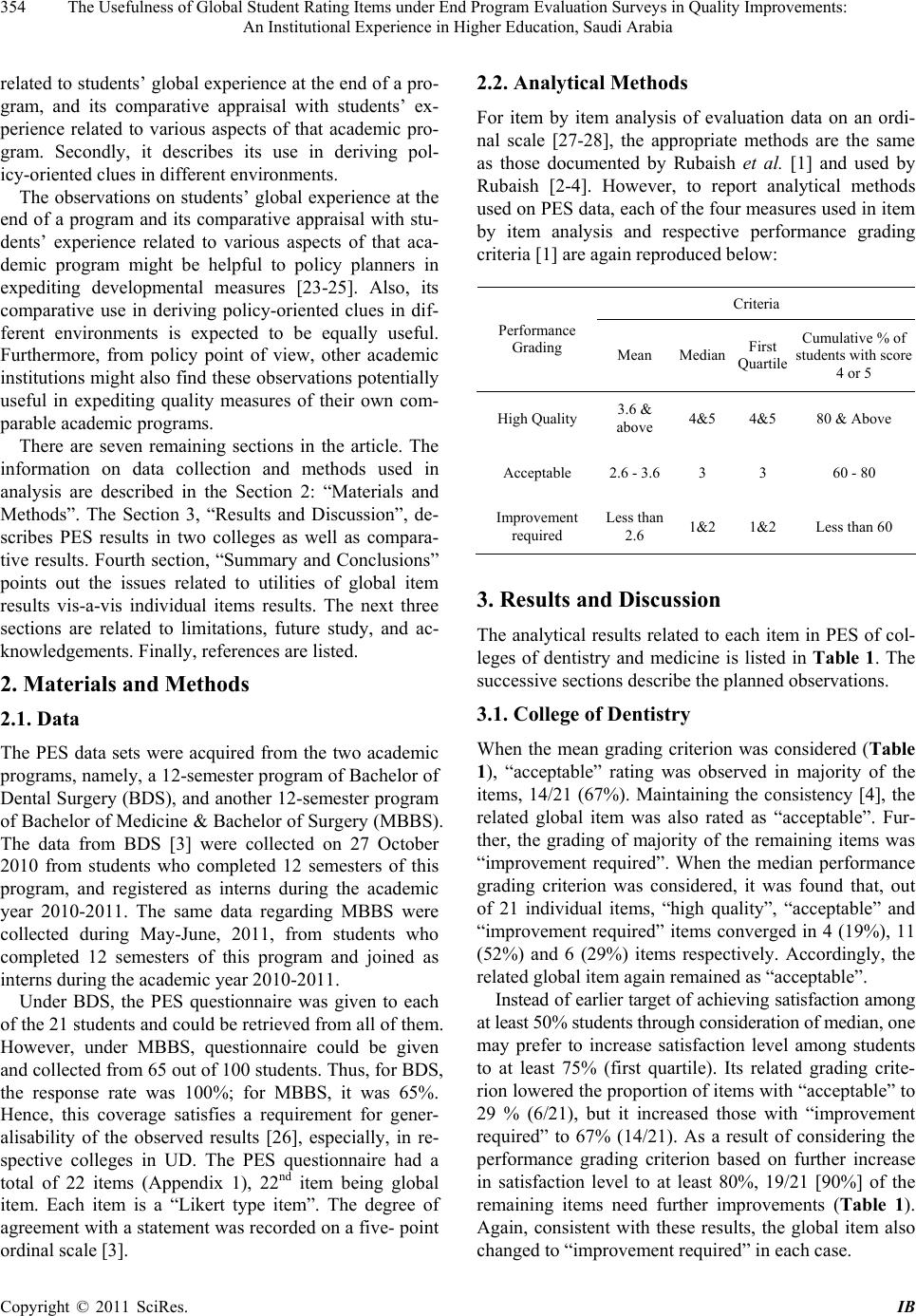 The Usefulness of Global Student Rating Items under End Program Evaluation Surveys in Quality Improvements: 354 An Institutional Experience in Higher Education, Saudi Arabia related to students’ global experience at the end of a pro- gram, and its comparative appraisal with students’ ex- perience related to various aspects of that academic pro- gram. Secondly, it describes its use in deriving pol- icy-oriented clues in different environments. The observations on students’ global experience at the end of a program and its comparative appraisal with stu- dents’ experience related to various aspects of that aca- demic program might be helpful to policy planners in expediting developmental measures [23-25]. Also, its comparative use in deriving policy-oriented clues in dif- ferent environments is expected to be equally useful. Furthermore, from policy point of view, other academic institutions might also find these observations potentially useful in expediting quality measures of their own com- parable academic programs. There are seven remaining sections in the article. The information on data collection and methods used in analysis are described in the Section 2: “Materials and Methods”. The Section 3, “Results and Discussion”, de- scribes PES results in two colleges as well as compara- tive results. Fourth section, “Summary and Conclusions” points out the issues related to utilities of global item results vis-a-vis individual items results. The next three sections are related to limitations, future study, and ac- knowledgements. Finally, references are listed. 2. Materials and Methods 2.1. Data The PES data sets were acquired from the two academic programs, namely, a 12-semester program of Bachelor of Dental Surgery (BDS), and another 12-semester program of Bachelor of Medicine & Bachelor of Surgery (MBBS). The data from BDS [3] were collected on 27 October 2010 from students who completed 12 semesters of this program, and registered as interns during the academic year 2010-2011. The same data regarding MBBS were collected during May-June, 2011, from students who completed 12 semesters of this program and joined as interns during the academic year 2010 -2011. Under BDS, the PES questionnaire was given to each of the 21 students and could be retrieved from all of them. However, under MBBS, questionnaire could be given and collected fr om 65 out o f 100 stud en ts. Thus , fo r BDS, the response rate was 100%; for MBBS, it was 65%. Hence, this coverage satisfies a requirement for gener- alisability of the observed results [26], especially, in re- spective colleges in UD. The PES questionnaire had a total of 22 items (Appendix 1), 22nd item being global item. Each item is a “Likert type item”. The degree of agreement with a statement was recorded on a five- point ordinal scale [3]. 2.2. Analytical Methods For item by item analysis of evaluation data on an ordi- nal scale [27-28], the appropriate methods are the same as those documented by Rubaish et al. [1] and used by Rubaish [2-4]. However, to report analytical methods used on PES data, each of the four measures used in item by item analysis and respective performance grading criteria [1] are again reproduced below: Criteria Performance Grading Mean Median First Quartile Cumulative % of students with score 4 or 5 High Quality 3.6 & above 4&5 4&5 80 & Above Acceptable 2.6 - 3.63 3 60 - 80 Improvement required Less than 2.6 1&2 1&2 Less than 60 3. Results and Discussion The analytical results related to each item in PES of col- leges of dentistry and medicine is listed in Table 1. The successive sections describe the planned observations. 3.1. College of Dentistry When the mean grading criterion was considered (Table 1), “acceptable” rating was observed in majority of the items, 14/21 (67%). Maintaining the consistency [4], the related global item was also rated as “acceptable”. Fur- ther, the grading of majority of the remaining items was “improvement required”. When the median performance grading criterion was considered, it was found that, out of 21 individual items, “high quality”, “acceptable” and “improvement required” items converged in 4 (19%), 11 (52%) and 6 (29%) items respectively. Accordingly, the related global item again remained as “acceptable”. Instead of earlier target of achieving satisfaction among at least 50% students through consi deration of m edian, one may prefer to increase satisfaction level among students to at least 75% (first quartile). Its related grading crite- rion lowered the proportion of items with “acceptable” to 29 % (6/21), but it increased those with “improvement required” to 67% (14/21). As a result of considering the performance grading criterion based on further increase in satisfaction level to at least 80%, 19/21 [90%] of the remaining items need further improvements (Table 1). Again, consistent with these results, the global item also changed to “improvement required” in each case. Copyright © 2011 SciRes. IB 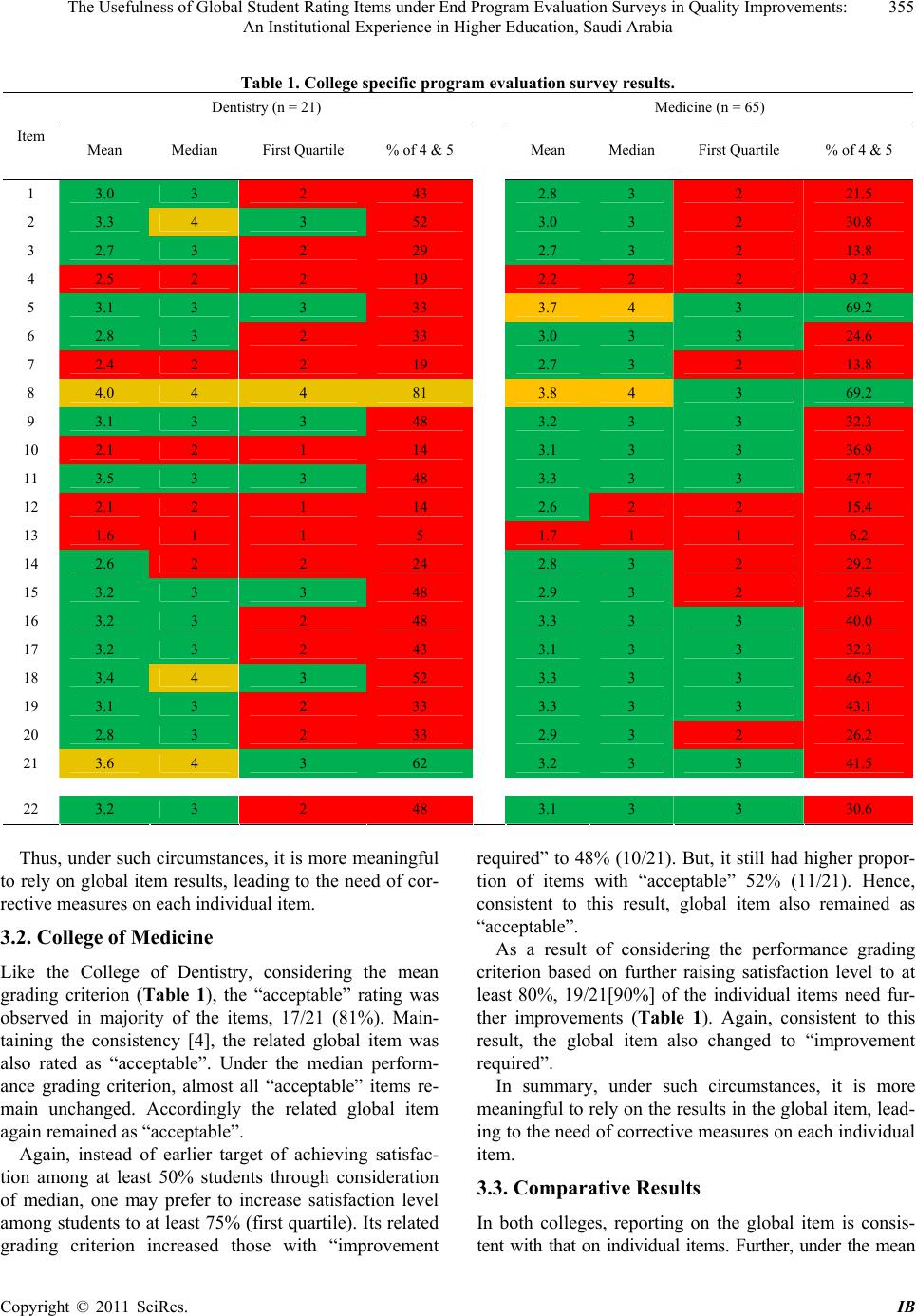 The Usefulness of Global Student Rating Items under End Program Evaluation Surveys in Quality Improvements: An Institutional Experience in Higher Education, Saudi Arabia Copyright © 2011 SciRes. IB 355 Table 1. College specific program evaluation survey results. Dentistry (n = 21) Medicine (n = 65) Item Mean Median First Quartile % of 4 & 5 Mean Median First Quartile % of 4 & 5 1 3.0 3 2 43 2.8 3 2 21.5 2 3.3 4 3 52 3.0 3 2 30.8 3 2.7 3 2 29 2.7 3 2 13.8 4 2.5 2 2 19 2.2 2 2 9.2 5 3.1 3 3 33 3.7 4 3 69.2 6 2.8 3 2 33 3.0 3 3 24.6 7 2.4 2 2 19 2.7 3 2 13.8 8 4.0 4 4 81 3.8 4 3 69.2 9 3.1 3 3 48 3.2 3 3 32.3 10 2.1 2 1 14 3.1 3 3 36.9 11 3.5 3 3 48 3.3 3 3 47.7 12 2.1 2 1 14 2.6 2 2 15.4 13 1.6 1 1 5 1.7 1 1 6.2 14 2.6 2 2 24 2.8 3 2 29.2 15 3.2 3 3 48 2.9 3 2 25.4 16 3.2 3 2 48 3.3 3 3 40.0 17 3.2 3 2 43 3.1 3 3 32.3 18 3.4 4 3 52 3.3 3 3 46.2 19 3.1 3 2 33 3.3 3 3 43.1 20 2.8 3 2 33 2.9 3 2 26.2 21 3.6 4 3 62 3.2 3 3 41.5 22 3.2 3 2 48 3.1 3 3 30.6 Thus, under such circumstances, it is more meaningful to rely on global item results, leading to the need of cor- rective measures on each individual item. 3.2. College of Medicine Like the College of Dentistry, considering the mean grading criterion (Table 1), the “acceptable” rating was observed in majority of the items, 17/21 (81%). Main- taining the consistency [4], the related global item was also rated as “acceptable”. Under the median perform- ance grading criterion, almost all “acceptable” items re- main unchanged. Accordingly the related global item again remained as “acceptable”. Again, instead of earlier target of achieving satisfac- tion among at least 50% students through consideration of median, one may prefer to increase satisfaction level among students to at least 75% (first quartile). Its related grading criterion increased those with “improvement required” to 48% (10/21). But, it still had higher propor- tion of items with “acceptable” 52% (11/21). Hence, consistent to this result, global item also remained as “acceptable”. As a result of considering the performance grading criterion based on further raising satisfaction level to at least 80%, 19/21[90%] of the individual items need fur- ther improvements (Table 1). Again, consistent to this result, the global item also changed to “improvement required”. In summary, under such circumstances, it is more meaningful to rely on the results in the global item, lead- ing to the need o f corrective measures on each individual item. 3.3. Comparative Results In both colleges, reporting on the global item is consis- tent with that on individual items. Further, under the mean  The Usefulness of Global Student Rating Items under End Program Evaluation Surveys in Quality Improvements: 356 An Institutional Experience in Higher Education, Saudi Arabia as well as the median grading criteria, both colleges had an almost identical pattern of results. However, a com- paratively lower proportion of individual items in the college of medicine had grading “improvement required”. As a result, when the threshold of satisfaction among students was raised to at least 75%, a higher proportion of items in college of dentistry reached to grading of “improvement required”. Also, the global item grading changed to this level. By contrast, global item grading in the college of medicine remained as “acceptable”. How- ever, with further increase in threshold of satisfaction among students to at least 80%, the global item grading in the college of medicine also reached to “improvement required”. 4. Summary and Conclusions Thus, irrespective of the grading criterion, both colleges need to focus on the global item results, leading to cor- rective measures related to almost all individual items. However, under changing thresholds of satisfaction among students, both colleges need slightly different corrective measures. Other institutions having similar environments, especially those working for quality and academic ac- creditation in higher education, might also find these observations useful. 5. Limitations This study is limited to only two colleges of this univer- sity with their specific environments. Also, one of the considered academic programs involves a comparatively small number of students. To ensure appropriate gener- alisability of the results, even in similar environments, programs involving larger number of students would be a better choice. Accordingly, one needs to take precaution while generalizing these results. 6. Future Research Each program as well as college involve varying envi- ronment [2-3]. Thus, each college requires such evalua- tions in relation to each of its academic programs [3]. The meaningful clues derived from such evaluations may be helpful to the policy planners in developing and man- aging sustainable high quality in higher education. The feedback from students regarding an academic program is useful, especially when it is early phase of develop- ment. 7. Acknowledgements The author is thankful to Professor Lade Wosornu and Professor Sada Nand Dwivedi, Deanship of Quality & Academic Accreditation (DQAA), University of Dam- mam [UD], for their help in completion of this article. He is also thankful to the Dean, College of Dentistry; and Quality Management Officer, Q & P Unit, College of Dentistry, for cooperation in data collection. Also, help from Mr. R. Somasundaram, Mr Arun Vijay and Mr C. C. L. Raymond, DQAA, UD, in this regard is acknowledged. Further, he is equally thankful to the Dean, College of Medicine, and Prof EB Larbi, Coordinator, Q & P Unit, for cooperation in data collection. He is equally thankful to Mr Sachin Jose, DQAA, UD, for his help in analysis. He thanks all students for their mature, balanced and objective response. Finally, Ms Marg Ungson for secre- tarial assistance. REFERENCES [1] A. Al Rubaish, L. Wosornu and S. N. Dwivedi, “Using Deductions from Assessment Studies towards Further- ance of the Academic Program: An Empirical Appraisal of Institutional Student Course Evaluation,” iBusiness, Vol. 3, No. 2, 2011, pp. 220-228. [2] A. Al Rubaish, “On the Contribution of Student Experi- ence Survey Regarding Quality Management in Higher Education: An Institutional Study in Saudi Arabia,” Journal of Service Science & Management, Vol. 3, No. 4, 2010, pp. 464-469. [3] A. Al Rubaish, “A Comparative Appraisal of Timings for Program Evaluation Survey and Related Institutional Re- sults in Saudi Arabia: Quality Management in Higher Education,” Journal of Service Science & Management, Vol. 4, No. 4, 2011, pp. 184-190. [4] A. Al Rubaish, L. Wosornu and S. N. Dwivedi, “Ap- praisal of Using Global Student Rating Items in Quality Management of Higher Education in Saudi Arabian Uni- versity,” iBusiness, (not published). [5] P. Gravestock and E. Gregor-Greenleaf, “Student Course Evaluations: Research, Models and Trends,” Higher Edu- cation Quality Council of Ontario, Toronto, 2008. [6] L. P. Aultman, “An Expected Benefit of Formative Stu- dent Evaluations,” College Teaching, Vol. 54, No. 3, 2006, pp. 251-285. doi:10.3200/CTCH.54.3.251-285 [7] T. Beran, C. Violato and D. Kline, “What’s the ‘Use’ of Students Ratings of Instruction for Administrators? One University’s Experience,” Canadian Journal of Higher Education, Vol. 35, No.2, 2007, pp. 48-70. [8] L. A. Braskamp and J. C. Ory , “Assessing Faculty Work: Enhancing Individual and Institutional Performance,” Jossey-Ba ss, San Francisco, 1994. [9] J. P. Campbell and W. C. Bozeman, “The Value of Stu- dent Ratings: Perceptions of Students, Teachers and Ad- ministrators,” Community College Journal of Research and Practice, Vol. 32, No. 1, 2008, pp. 13-24. doi:10.1080/10668920600864137 [10] W. E. Cashin and R. G. Downey, “Using Global Student Rating Items for Summative Evaluation,” Journal of Edu- cational Psychology, Vol. 84, No. 4, 1992, pp. 563-572. Copyright © 2011 SciRes. IB  The Usefulness of Global Student Rating Items under End Program Evaluation Surveys in Quality Improvements: An Institutional Experience in Higher Education, Saudi Arabia Copyright © 2011 SciRes. IB 357 doi:10.1037/0022-0663.84.4.563 [11] M. R. Diamond, “The Usefulness of Structured Mid- Term Feedback as a Catalyst for Change in Higher Edu- cation Classes,” Active Learning in Higher Education, Vol. 5, No. 3, 2004, pp. 217-231. doi:10.1177/1469787404046845 [12] L. C. Hodges and K. Stanton, “Translating Comments on Student Evaluations into Language of Learning,” Innova- tive Higher Education, Vol. 31, No. 5, 2007, pp. 279-286. doi:10.1007/s10755-006-9027-3 [13] J. W. B. Lang and M. Kersting, “Regular Feedback from Student Ratings of Instruction: Do College Teachers Im- prove Their Ratings in the Long Run?” Instructional Sci- ence, Vol. 35, No. 3, 2007, pp. 187-205. doi:10.1007/s11251-006-9006-1 [14] H. W. Marsh, “Do University Teachers Become More Effective with Experience? A Multilevel Growth Model of Students’ Evaluations of Teaching over 13 Years,” Journal of Educational Psychology, Vol. 99, No. 4, 2007, pp. 775-790. doi:10.1037/0022-0663.99.4.775 [15] R. J. Menges, “Shortcomings of Research on Evaluating and Improving Teaching in Higher Education,” In: K. E. Ryan, Ed., Evaluating Teaching in Higher Education: A Vision for the Future, Vol. 83, 2000, pp. 5-11 [16] A. R. Penny and R. Coe, “Effectiveness of Consultations on Student Ratings Feedback: A Meta-Analysis,” Review of Educational Research, Vol. 74, No. 2, 2004, pp. 215- 253. doi:10.3102/00346543074002215 [17] R. E. Wright, “Student Evaluations of Faculty: Concerns Raised in the Literature, and Possible Solutions,” College Student Journal, Vol. 40, No. 2, 2008, pp. 417-422. [18] F. Zabaleta, “The Use and Misuse of Student Evaluation of Teaching,” Teaching in Higher Education, Vol. 12, No. 1, 2007, pp. 55-76. doi:10.1080/13562510601102131 [19] A. S. Aldosary, “Students’ Academic Satisfaction: The Case of CES at KFUPM,” Journal of King AbdulAziz University, Vol. 11, No. 1, 1999, pp. 99-107. [20] M. Yorke, “Student Experience Surveys: Some Meth- odological Considerations and an Empirical Investiga- tion,” Assessment & Evaluation in Higher Education, Vol. 34, No. 6, 2009, pp. 721-739. doi:10.1080/02602930802474219 [21] W. J. McKeachie, “Students Ratings: The Validity of Use,” American Psychologist, Vol. 51, No. 11, 1997, pp. 1218-1225. doi:10.1037/0003-066X.52.11.1218 [22] M. Theall and J. Franklin, “Looking for Bias in All the Wrong Places: A Search for Truth or a Witch Hunt in Student Ratings of Instruction?” In M. Theall, P. C. Abrami and L. A. Mets, Eds., The Student Ratings Debate: Are They Valid? How Can We Best Use Them? Vol. 109, 2001, pp. 45-46. [23] NCAAA, “Handbook of Quality Assurance and Accredi- tation in Saudi Arabia, Part 2 Internal Quality Assurance Arrangements,” Monograph, University of Dammam, September 2007, p. 19. [24] P. C. Abrami, “Improving Judgements About Teaching Effectiveness Using Teacher Rating Forms,” John Wiley & Sons, Inc., New york, 2001. [25] C. S. Nir and L. Bennet, “Using Student Satisfaction Data to Start Conversations About Continuous Improvement,” Quality Approaches in Higher Education, Vol. 2, No. 1. 2011, pp. 17-22. [26] W. E. Cashin, “Students do Rate Different Academic Fields Differently,” In M. Theall and J. Franklin, Eds., Student Ratings of Instruction: Issues for Improving Practice, Vol. 43, 1990, pp. 113-121. [27] R. Gob, C. Mc Collin and M. F. Rmalhoto, “Ordinal Methodology in the Analysis of Likert Scales,” Qualilty & Quantity, Vol. 41, No. 5, 2007, pp. 601-626. doi:10.1007/s11135-007-9089-z [28] K. R. Sundaram, S. N. Dwivedi and V. Sreenivas, “Medi- cal Statistics: Principles & Methods,” BI Publications Pvt. Ltd., New Delhi, 2009. 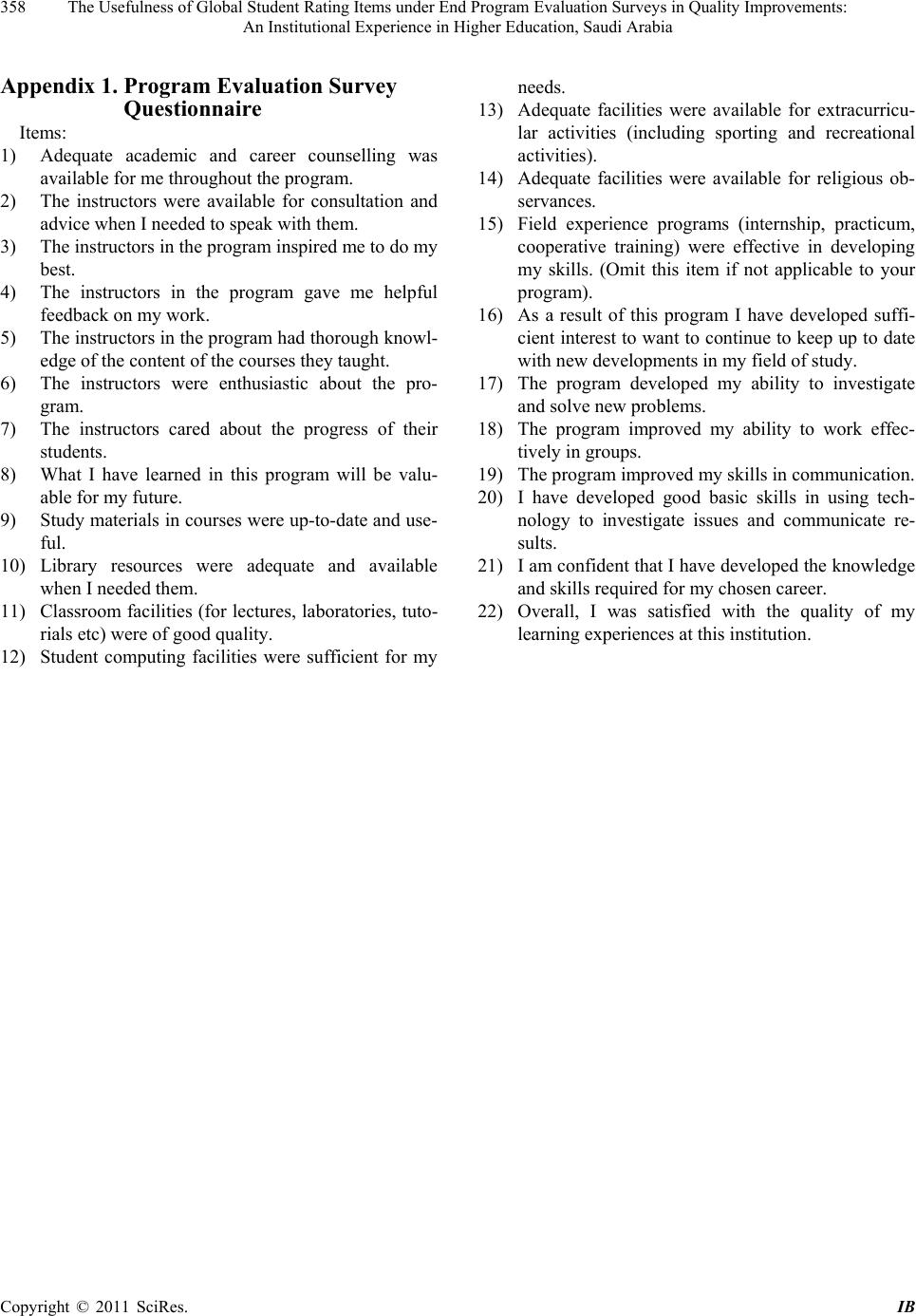 The Usefulness of Global Student Rating Items under End Program Evaluation Surveys in Quality Improvements: 358 An Institutional Experience in Higher Education, Saudi Arabia Appendix 1. Program Evaluation Survey Questionnaire Items: 1) Adequate academic and career counselling was available for me throughout the program. 2) The instructors were available for consultation and advice when I needed to speak with them. 3) The instructors in the program inspired me to do my best. 4) The instructors in the program gave me helpful feedback on my work. 5) The instructors in the prog ram had thorough kno wl- edge of the content of the courses they taught. 6) The instructors were enthusiastic about the pro- gram. 7) The instructors cared about the progress of their students. 8) What I have learned in this program will be valu- able for my future. 9) Study materials in courses were up-to-date and use- ful. 10) Library resources were adequate and available when I needed them. 11) Classroom facilities (for lectures, laboratories, tuto- rials etc) were of good quality. 12) Student computing facilities were sufficient for my needs. 13) Adequate facilities were available for extracurricu- lar activities (including sporting and recreational activities). 14) Adequate facilities were available for religious ob- servances. 15) Field experience programs (internship, practicum, cooperative training) were effective in developing my skills. (Omit this item if not applicable to your program). 16) As a result of this program I have developed suffi- cient interest to want to continue to keep up to date with new developments in my field of study. 17) The program developed my ability to investigate and solve new problems. 18) The program improved my ability to work effec- tively in groups. 19) The program improved my skills in communication. 20) I have developed good basic skills in using tech- nology to investigate issues and communicate re- sults. 21) I am confident that I have developed the knowledge and skills required for my chosen career. 22) Overall, I was satisfied with the quality of my learning experiences at this institution. Copyright © 2011 SciRes. IB |