

Paper Menu >>
Journal Menu >>
 Natural Resources, 2011, 2, 244-249 doi:10.4236/nr.2011.24031 Published Online December 2011 (http://www.SciRP.org/journal/nr) Copyright © 2011 SciRes. NR Recycling of Ornamental Stones Hazardous Wastes Abdel Monem Soltan, Zeinab Taman, Baher El-Kaliouby Geology Department, Faculty of Science, Ain Shams University, Cairo, Egypt. Email: abdelmonems[email protected] Received September 11th, 2011; revised October 10th, 2011; accepted October 20th, 2011. ABSTRACT Sawing and polishing of the ornamental stones always generate large amount of solid and wet hazardous wastes, which pollute the environment. In Shak Al-Thoaban area, East Cairo, Egypt, huge amounts of these wastes were accumulated, during the last years, as rejects “Solid” and wet “Sahala” wastes, representing one of the main sources of environ- mental pollution. The aim of this work is to characterize and evaluate these wastes for recycling in quicklime produc- tion. Hence, samples of both wastes were investigated for their chemical and mineral composition applying XRF, XRD, DTA and TGA methods. Free lime content and reactivity (RDIN) of both samples were also determined after calcination for differnt soaking times (0.25 - 2.0 h) at 1000˚C. The results were interpreted in relation to composition and micro- structure of the fired samples as revealed by TLM and SEM methods. The RDIN reactivity of the resulted lime is changeable along soaking time at 1000˚C because of the microfabric of its crystallites. The lime of the “Solid” sample is preserving the original limestone microstructure that contributes in its higher RDIN reactivity values at all soaking times. The relatively higher degree of grain growth of lime crystallites in the “Sahala” sample leads to its lower reactiv- ity. The optimum soaking times for the highest lime reactivity are 0.25 and 1 h for the “Solid” and “Sahala” samples, respectively. On increasing soaking time up to 2 h, both samples show minimum RDIN values. The “Solid” sample also gives higher free lime content than the “Sahala” one at all soaking times. It is gradually increased in the former sample up to a maximum (96% - 97%) on increasing soaking time up to 1 - 2 h. On the other side, a maximum free lime (~95%) is detected in “Sahala” sample at 0.25 h soaking time and gradually decreased to (87%) up to 2 h. Keywords: Recycling, Ornamental Stones, Wastes, Microstructure, Quicklime 1. Introduction Development of the ornamental stone industry in Egypt is related to the expansion in the building and construc- tion sector in the last three decades [1,2]. Most of the or- namental stone factories are located in Shak Al-Thoaban area, Katameya, East Cairo, Egypt. The quarrying, sizing and polishing of the limestone, granite, marble rocks among others are the main proce- sses for ornamental stone production. Through these pro- cesses 20% - 30% of the sawed blocks become fine pow- der and solid-cutting rejects [3]. The solid-reject wastes cause dangerous effects on the people working condi- tions if stacked carelessly, however, the land filling is costly and has serious drawbacks. Also, the fine powder can cause serious health problems on inhalation and eco- logical problems, when mixed with water and poured into the natural water resources, such as rivers and chan- nels [4,5]. Recycling of the ornamental stone wastes is the best way for eliminating their hazardous impact on the people and environment. This is encouraged by the fact that these waste materials are mainly rock-derived with high purity and can be consequently incorporated in different industries [6]. Many possible applications were suggested to incur- porate proportions of the wastes in the processing of tiles [7-12], red ceramics [13-16], building materials [17], mortars [18], concrete aggregates and mixtures [6,19] and clay products [20,21]. According to the author’s knowledge, no research works were directed to recycling of the solid rejects and wet-powder “Sahala” wastes as a source of quicklime after calcination. Therefore, this work directly aims at re- cycling both of these ornamental stone wastes accumu- lated in Shak Al-Thoaban area for production of reactive quicklime. Hence, samples of both wastes were investi- gated for their chemical and mineral composition apply- 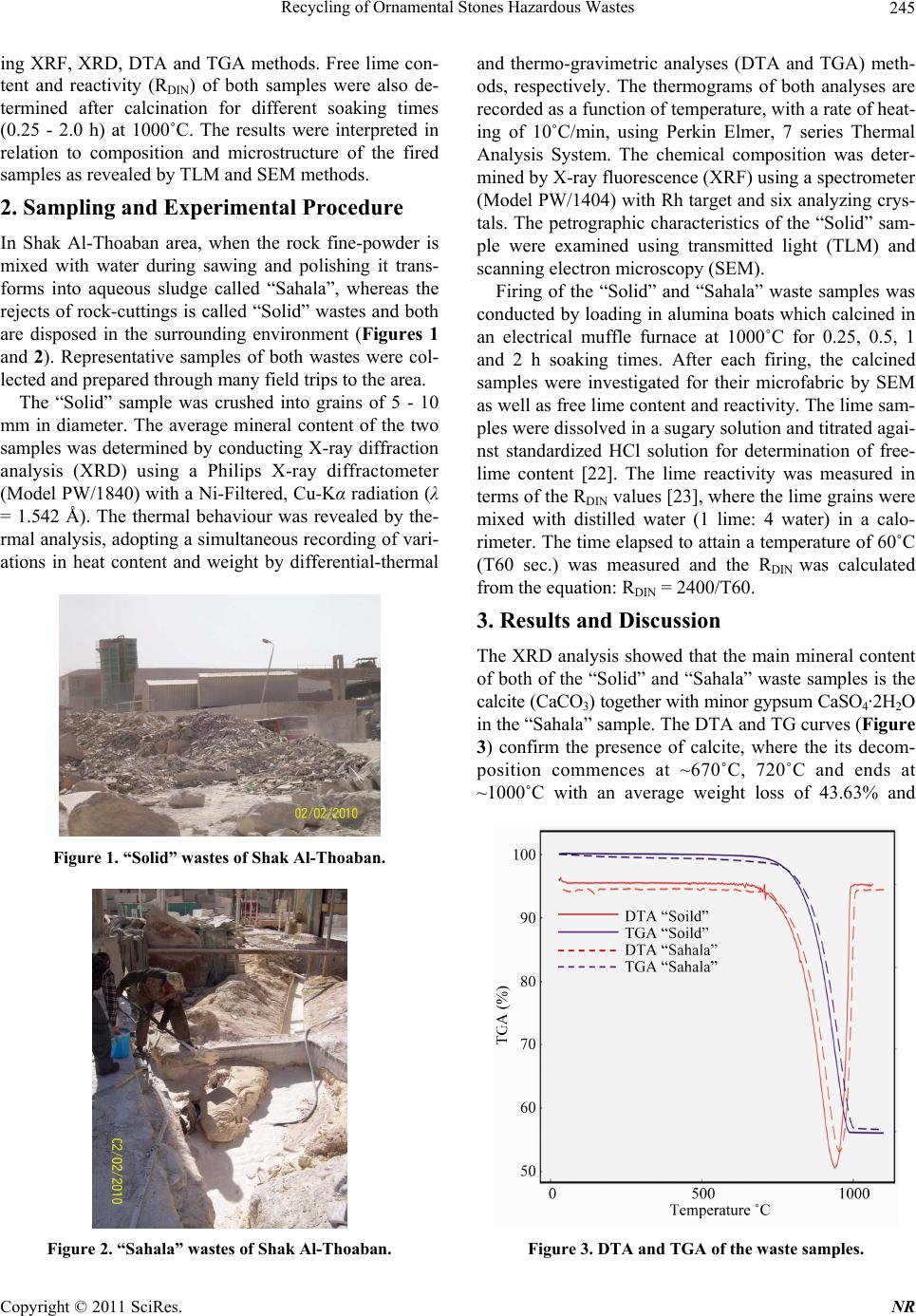 Recycling of Ornamental Stones Hazardous Wastes245 ing XRF, XRD, DTA and TGA methods. Free lime con- tent and reactivity (RDIN) of both samples were also de- termined after calcination for different soaking times (0.25 - 2.0 h) at 1000˚C. The results were interpreted in relation to composition and microstructure of the fired samples as revealed by TLM and SEM methods. 2. Sampling and Experimental Procedure In Shak Al-Thoaban area, when the rock fine-powder is mixed with water during sawing and polishing it trans- forms into aqueous sludge called “Sahala”, whereas the rejects of rock-cuttings is called “Solid” wastes and both are disposed in the surrounding environment (Figures 1 and 2). Representative samples of both wastes were col- lected and prepared through many field trips to the area. The “Solid” sample was crushed into grains of 5 - 10 mm in diameter. The average mineral content of the two samples was determined by conducting X-ray diffraction analysis (XRD) using a Philips X-ray diffractometer (Model PW/1840) with a Ni-Filtered, Cu-Kα radiation (λ = 1.542 Å). The thermal behaviour was revealed by the- rmal analysis, adopting a simultaneous recording of vari- ations in heat content and weight by differential-thermal Figure 1. “Solid” wastes of Shak Al-Thoaban. Figure 2. “Sahala” wastes of Shak Al-Thoaban. and thermo-gravimetric analyses (DTA and TGA) meth- ods, respectively. The thermograms of both analyses are recorded as a function of temperature, with a rate of heat- ing of 10˚C/min, using Perkin Elmer, 7 series Thermal Analysis System. The chemical composition was deter- mined by X-ray fluorescence (XRF) using a spectrometer (Model PW/1404) with Rh target and six analyzing crys- tals. The petrographic characteristics of the “Solid” sam- ple were examined using transmitted light (TLM) and scanning electron microscopy (SEM). Firing of the “Solid” and “Sahala” waste samples was conducted by loading in alumina boats which calcined in an electrical muffle furnace at 1000˚C for 0.25, 0.5, 1 and 2 h soaking times. After each firing, the calcined samples were investigated for their microfabric by SEM as well as free lime content and reactivity. The lime sam- ples were dissolved in a sugary solution and titrated agai- nst standardized HCl solution for determination of free- lime content [22]. The lime reactivity was measured in terms of the RDIN values [23], where the lime grains were mixed with distilled water (1 lime: 4 water) in a calo- rimeter. The time elapsed to attain a temperature of 60˚C (T60 sec.) was measured and the RDIN was calculated from the equation: RDIN = 2400/T60. 3. Results and Discussion The XRD analysis showed that the main mineral content of both of the “Solid” and “Sahala” waste samples is the calcite (CaCO3) together with minor gypsum CaSO4·2H2O in the “Sahala” sample. The DTA and TG curves (Figure 3) confirm the presence of calcite, where the its decom- position commences at ~670˚C, 720˚C and ends at ~1000˚C with an average weight loss of 43.63% and Figure 3. DTA and TGA of the waste samples. Copyright © 2011 SciRes. NR 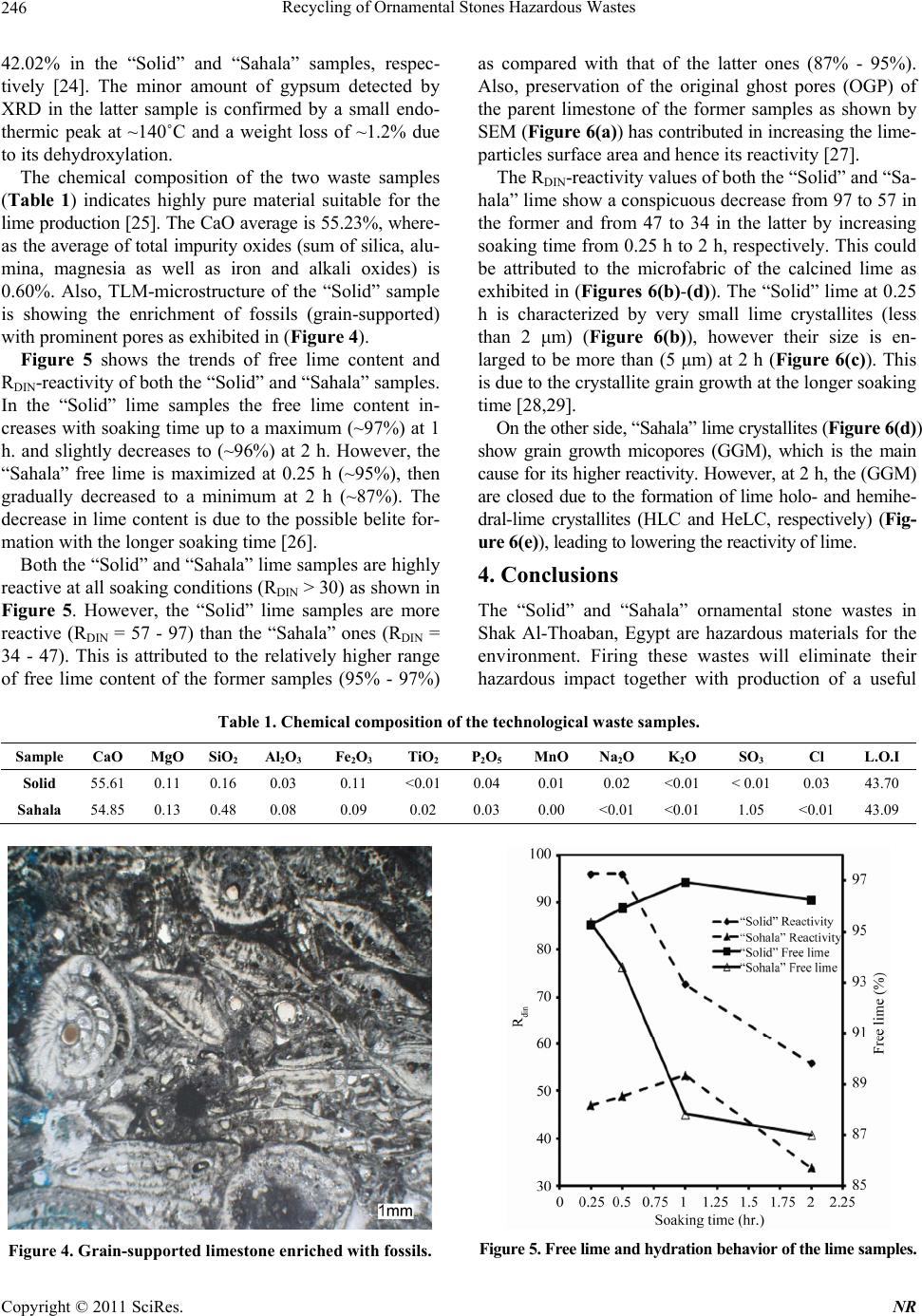 Recycling of Ornamental Stones Hazardous Wastes Copyright © 2011 SciRes. NR 246 42.02% in the “Solid” and “Sahala” samples, respec- tively [24]. The minor amount of gypsum detected by XRD in the latter sample is confirmed by a small endo- thermic peak at ~140˚C and a weight loss of ~1.2% due to its dehydroxylation. The chemical composition of the two waste samples (Table 1) indicates highly pure material suitable for the lime production [25]. The CaO average is 55.23%, where- as the average of total impurity oxides (sum of silica, alu- mina, magnesia as well as iron and alkali oxides) is 0.60%. Also, TLM-microstructure of the “Solid” sample is showing the enrichment of fossils (grain-supported) with prominent pores as exhibited in (Figure 4). Figure 5 shows the trends of free lime content and RDIN-reactivity of both the “Solid” and “Sahala” samples. In the “Solid” lime samples the free lime content in- creases with soaking time up to a maximum (~97%) at 1 h. and slightly decreases to (~96%) at 2 h. However, the “Sahala” free lime is maximized at 0.25 h (~95%), then gradually decreased to a minimum at 2 h (~87%). The decrease in lime content is due to the possible belite for- mation with the longer soaking time [26]. Both the “Solid” and “Sahala” lime samples are highly reactive at all soaking conditions (RDIN > 30) as shown in Figure 5. However, the “Solid” lime samples are more reactive (RDIN = 57 - 97) than the “Sahala” ones (RDIN = 34 - 47). This is attributed to the relatively higher range of free lime content of the former samples (95% - 97%) as compared with that of the latter ones (87% - 95%). Also, preservation of the original ghost pores (OGP) of the parent limestone of the former samples as shown by SEM (Figure 6(a)) has contributed in increasing the lime- particles surface area and hence its reactivity [27]. The RDIN-reactivity values of both the “Solid” and “Sa- hala” lime show a conspicuous decrease from 97 to 57 in the former and from 47 to 34 in the latter by increasing soaking time from 0.25 h to 2 h, respectively. This could be attributed to the microfabric of the calcined lime as exhibited in (Figures 6(b)-(d)). The “Solid” lime at 0.25 h is characterized by very small lime crystallites (less than 2 μm) (Figure 6(b)), however their size is en- larged to be more than (5 μm) at 2 h (Figure 6(c)). This is due to the crystallite grain growth at the longer soaking time [28,29]. On the other side, “Sahala” lime crystallites (Figure 6(d)) show grain growth micopores (GGM), which is the main cause for its higher reactivity. However, at 2 h, the (GGM) are closed due to the formation of lime holo- and hemihe- dral-lime crystallites (HLC and HeLC, respectively) (Fig- ure 6(e)), leading to lowering the reactivity of lime. 4. Conclusions The “Solid” and “Sahala” ornamental stone wastes in Shak Al-Thoaban, Egypt are hazardous materials for the environment. Firing these wastes will eliminate their hazardous impact together with production of a useful Table 1. Chemical composition of the technological waste samples. Sample CaO MgO SiO2 Al2O3 Fe2O3 TiO2 P2O5 MnO Na2OK 2O SO3 Cl L.O.I Solid 55.61 0.11 0.160.03 0.11 <0.01 0.04 0.01 0.02 <0.01 < 0.01 0.03 43.70 Sahala 54.85 0.13 0.480.08 0.09 0.02 0.03 0.00 <0.01<0.01 1.05 <0.0143.09 Figure 5. Free lime and hydration behavior of the lime sample s. Figure 4. Grain-supported limestone enriched with fossils. 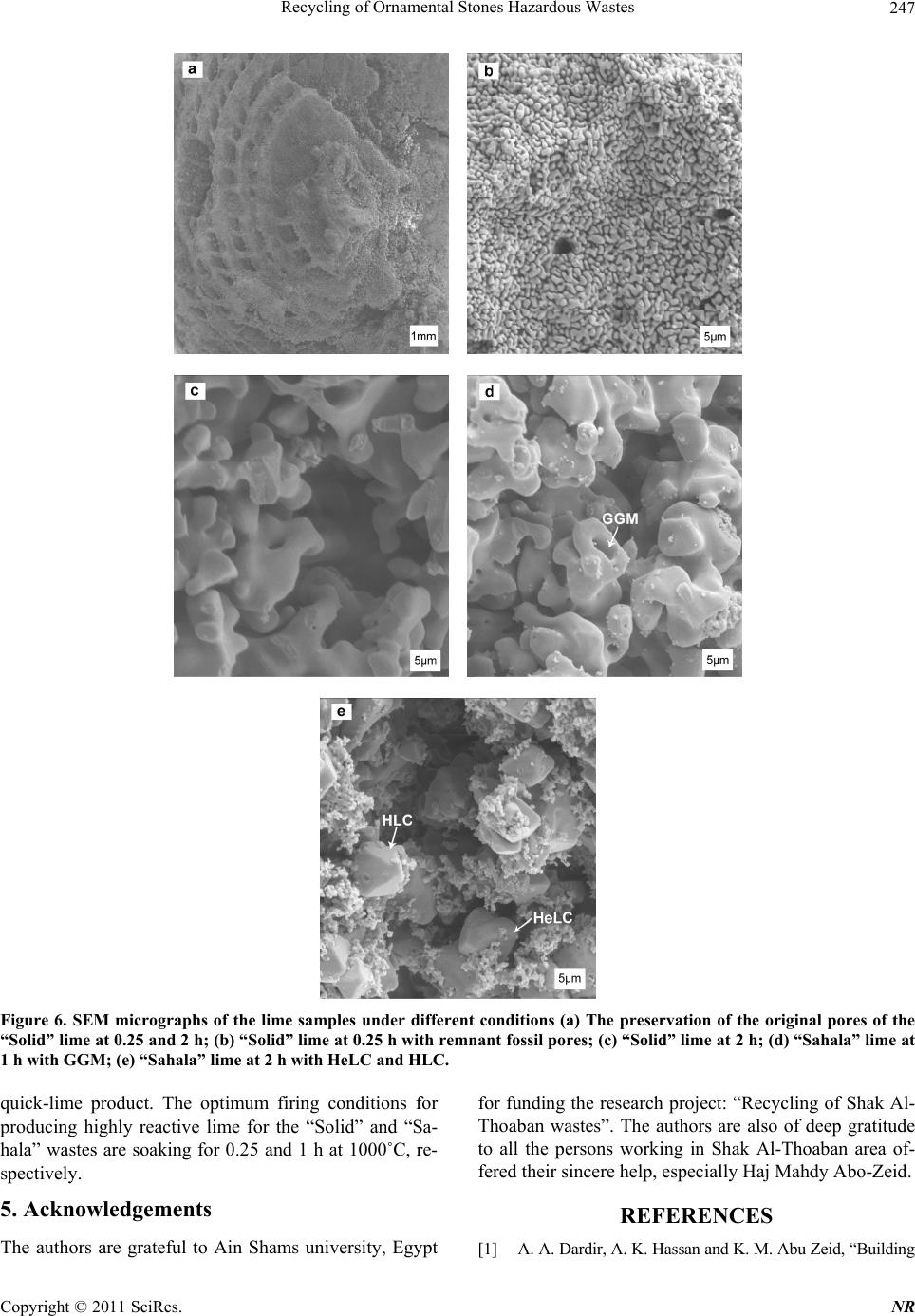 Recycling of Ornamental Stones Hazardous Wastes247 Figure 6. SEM micrographs of the lime samples under different conditions (a) The preservation of the original pores of the “Solid” lime at 0.25 and 2 h; (b) “Solid” lime at 0.25 h with remnant fossil pores; (c) “Solid” lime at 2 h; (d) “Sahala” lime at 1 h with GGM; (e) “Sahala” lime at 2 h with HeLC and HLC. quick-lime product. The optimum firing conditions for producing highly reactive lime for the “Solid” and “Sa- hala” wastes are soaking for 0.25 and 1 h at 1000˚C, re- spectively. 5. Acknowledgements The authors are grateful to Ain Shams university, Egypt for funding the research project: “Recycling of Shak Al- Thoaban wastes”. The authors are also of deep gratitude to all the persons working in Shak Al-Thoaban area of- fered their sincere help, especially Haj Mahdy Abo-Zeid. REFERENCES [1] A. A. Dardir, A. K. Hassan and K. M. Abu Zeid, “Building Copyright © 2011 SciRes. NR 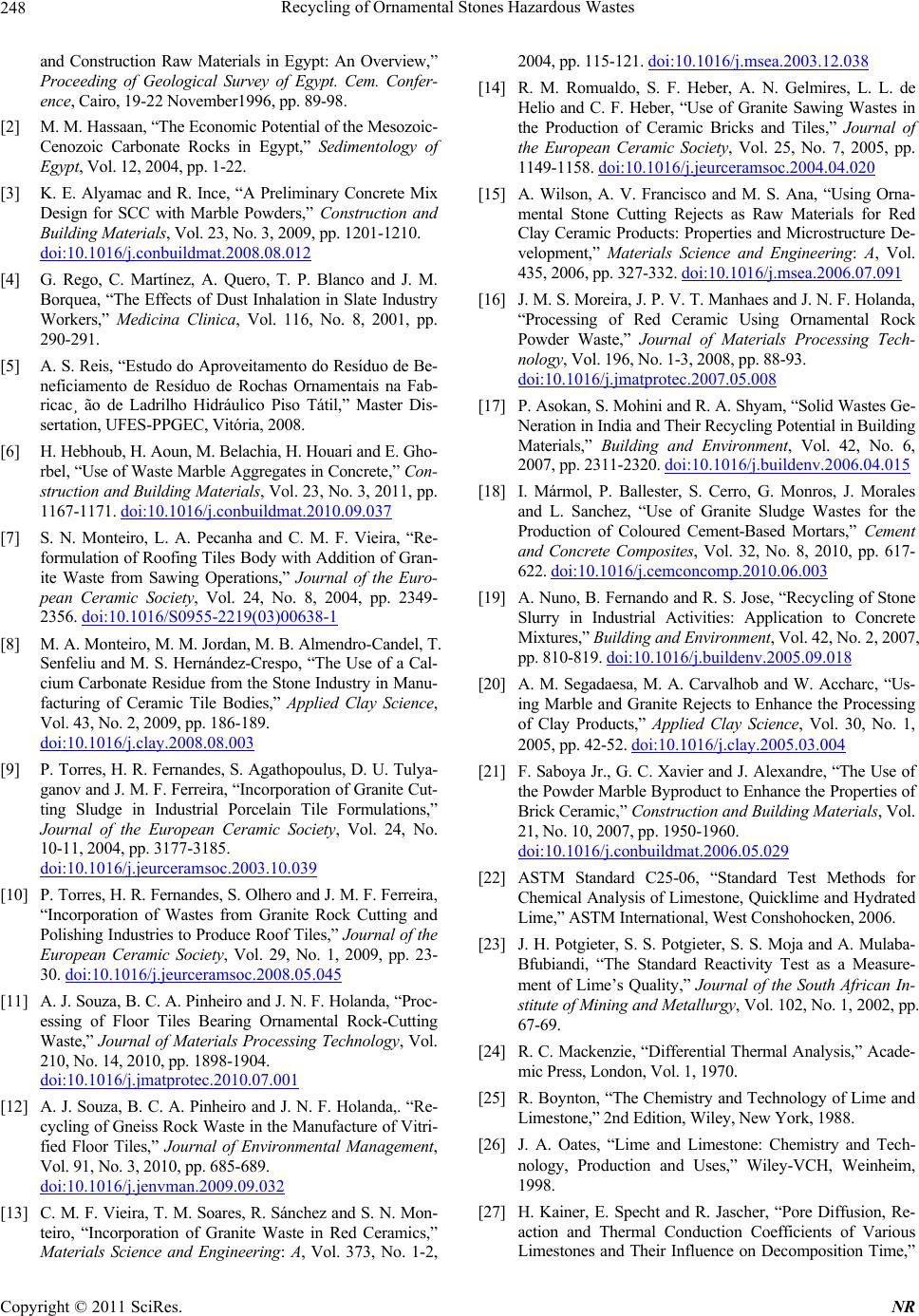 Recycling of Ornamental Stones Hazardous Wastes 248 and Construction Raw Materials in Egypt: An Overview,” Proceeding of Geological Survey of Egypt. Cem. Confer- ence, Cairo, 19-22 November1996, pp. 89-98. [2] M. M. Hassaan, “The Economic Potential of the Mesozoic- Cenozoic Carbonate Rocks in Egypt,” Sedimentology of Egypt, Vol. 12, 2004, pp. 1-22. [3] K. E. Alyamac and R. Ince, “A Preliminary Concrete Mix Design for SCC with Marble Powders,” Construction and Building Materials, Vol. 23, No. 3, 2009, pp. 1201-1210. doi:10.1016/j.conbuildmat.2008.08.012 [4] G. Rego, C. Martínez, A. Quero, T. P. Blanco and J. M. Borquea, “The Effects of Dust Inhalation in Slate Industry Workers,” Medicina Clinica, Vol. 116, No. 8, 2001, pp. 290-291. [5] A. S. Reis, “Estudo do Aproveitamento do Resíduo de Be- neficiamento de Resíduo de Rochas Ornamentais na Fab- ricac¸ ão de Ladrilho Hidráulico Piso Tátil,” Master Dis- sertation, UFES-PPGEC, Vitória, 2008. [6] H. Hebhoub, H. Aoun, M. Belachia, H. Houari and E. Gho- rbel, “Use of Waste Marble Aggregates in Concrete,” Con- struction and Building Materials, Vol. 23, No. 3, 2011, pp. 1167-1171. doi:10.1016/j.conbuildmat.2010.09.037 [7] S. N. Monteiro, L. A. Pecanha and C. M. F. Vieira, “Re- formulation of Roofing Tiles Body with Addition of Gran- ite Waste from Sawing Operations,” Journal of the Euro- pean Ceramic Society, Vol. 24, No. 8, 2004, pp. 2349- 2356. doi:10.1016/S0955-2219(03)00638-1 [8] M. A. Monteiro, M. M. Jordan, M. B. Almendro-Candel, T. Senfeliu and M. S. Hernández-Crespo, “The Use of a Cal- cium Carbonate Residue from the Stone Industry in Manu- facturing of Ceramic Tile Bodies,” Applied Clay Science, Vol. 43, No. 2, 2009, pp. 186-189. doi:10.1016/j.clay.2008.08.003 [9] P. Torres, H. R. Fernandes, S. Agathopoulus, D. U. Tulya- ganov and J. M. F. Ferreira, “Incorporation of Granite Cut- ting Sludge in Industrial Porcelain Tile Formulations,” Journal of the European Ceramic Society, Vol. 24, No. 10-11, 2004, pp. 3177-3185. doi:10.1016/j.jeurceramsoc.2003.10.039 [10] P. Torres, H. R. Fernandes, S. Olhero and J. M. F. Ferreira, “Incorporation of Wastes from Granite Rock Cutting and Polishing Industries to Produce Roof Tiles,” Journal of the European Ceramic Society, Vol. 29, No. 1, 2009, pp. 23- 30. doi:10.1016/j.jeurceramsoc.2008.05.045 [11] A. J. Souza, B. C. A. Pinheiro and J. N. F. Holanda, “Proc- essing of Floor Tiles Bearing Ornamental Rock-Cutting Waste,” Journal of Materials Processing Technology, Vol. 210, No. 14, 2010, pp. 1898-1904. doi:10.1016/j.jmatprotec.2010.07.001 [12] A. J. Souza, B. C. A. Pinheiro and J. N. F. Holanda,. “Re- cycling of Gneiss Rock Waste in the Manufacture of Vitri- fied Floor Tiles,” Journal of Environmental Management, Vol. 91, No. 3, 2010, pp. 685-689. doi:10.1016/j.jenvman.2009.09.032 [13] C. M. F. Vieira, T. M. Soares, R. Sánchez and S. N. Mon- teiro, “Incorporation of Granite Waste in Red Ceramics,” Materials Science and Engineering: A, Vol. 373, No. 1-2, 2004, pp. 115-121. doi:10.1016/j.msea.2003.12.038 [14] R. M. Romualdo, S. F. Heber, A. N. Gelmires, L. L. de Helio and C. F. Heber, “Use of Granite Sawing Wastes in the Production of Ceramic Bricks and Tiles,” Journal of the European Ceramic Society, Vol. 25, No. 7, 2005, pp. 1149-1158. doi:10.1016/j.jeurceramsoc.2004.04.020 [15] A. Wilson, A. V. Francisco and M. S. Ana, “Using Orna- mental Stone Cutting Rejects as Raw Materials for Red Clay Ceramic Products: Properties and Microstructure De- velopment,” Materials Science and Engineering: A, Vol. 435, 2006, pp. 327-332. doi:10.1016/j.msea.2006.07.091 [16] J. M. S. Moreira, J. P. V. T. Manhaes and J. N. F. Holanda, “Processing of Red Ceramic Using Ornamental Rock Powder Waste,” Journal of Materials Processing Tech- nology, Vol. 196, No. 1-3, 2008, pp. 88-93. doi:10.1016/j.jmatprotec.2007.05.008 [17] P. Asokan, S. Mohini and R. A. Shyam, “Solid Wastes Ge- Neration in India and Their Recycling Potential in Building Materials,” Building and Environment, Vol. 42, No. 6, 2007, pp. 2311-2320. doi:10.1016/j.buildenv.2006.04.015 [18] I. Mármol, P. Ballester, S. Cerro, G. Monros, J. Morales and L. Sanchez, “Use of Granite Sludge Wastes for the Production of Coloured Cement-Based Mortars,” Cement and Concrete Composites, Vol. 32, No. 8, 2010, pp. 617- 622. doi:10.1016/j.cemconcomp.2010.06.003 [19] A. Nuno, B. Fernando and R. S. Jose, “Recycling of Stone Slurry in Industrial Activities: Application to Concrete Mixtures,” Building and Environment, Vol. 42, No. 2, 2007, pp. 810-819. doi:10.1016/j.buildenv.2005.09.018 [20] A. M. Segadaesa, M. A. Carvalhob and W. Accharc, “Us- ing Marble and Granite Rejects to Enhance the Processing of Clay Products,” Applied Clay Science, Vol. 30, No. 1, 2005, pp. 42-52. doi:10.1016/j.clay.2005.03.004 [21] F. Saboya Jr., G. C. Xavier and J. Alexandre, “The Use of the Powder Marble Byproduct to Enhance the Properties of Brick Ceramic,” Construction and Building Materials, Vol. 21, No. 10, 2007, pp. 1950-1960. doi:10.1016/j.conbuildmat.2006.05.029 [22] ASTM Standard C25-06, “Standard Test Methods for Chemical Analysis of Limestone, Quicklime and Hydrated Lime,” ASTM International, West Conshohocken, 2006. [23] J. H. Potgieter, S. S. Potgieter, S. S. Moja and A. Mulaba- Bfubiandi, “The Standard Reactivity Test as a Measure- ment of Lime’s Quality,” Journal of the South African In- stitute of Mining and Metallurgy, Vol. 102, No. 1, 2002, pp. 67-69. [24] R. C. Mackenzie, “Differential Thermal Analysis,” Acade- mic Press, London, Vol. 1, 1970. [25] R. Boynton, “The Chemistry and Technology of Lime and Limestone,” 2nd Edition, Wiley, New York, 1988. [26] J. A. Oates, “Lime and Limestone: Chemistry and Tech- nology, Production and Uses,” Wiley-VCH, Weinheim, 1998. [27] H. Kainer, E. Specht and R. Jascher, “Pore Diffusion, Re- action and Thermal Conduction Coefficients of Various Limestones and Their Influence on Decomposition Time,” Copyright © 2011 SciRes. NR  Recycling of Ornamental Stones Hazardous Wastes Copyright © 2011 SciRes. NR 249 ZKG, Vol. 39, No. 5, 1986, pp. 259-268. [28] W. D. Kingery, H. K. Bowen and D. R. Uhlmann, “Intro- duction to Ceramics,” 2nd Edition, John Wiley and Sons, New York, 1976. [29] R. Gotthardt, W. Dornap and H. Wilder, “Effect of Lime- stone Structure and Facies on the “R” Value as a Criterion of the Degree of Burning,” ZKG International, Vol. 34, No. 8, 1981, pp. 424-429. |