

Paper Menu >>
Journal Menu >>
 Vol.3, No.12, 732-736 (2011) doi:10.4236/health.2011.312121 C opyright © 2011 SciRes. Openly accessible at http://www.scirp.org/journal/HEALTH/ Health Acute myocardial infarction (AMI) in context with the paradigm―month of birth and longevity Elyiahu Stoupel1,2*, Abdonas Tamoshiunas3, Richardas Radishauskas3, Gailute Bernotiene3, Evgeny Abramson4, Peter Israelevich5 1Division of Cardiology, Rabin Medical Center, Petah Tiqwa, Israel; 2Sackler Faculty of Medicine, Tel Aviv University, Tel Aviv, Israel; *Corresponding Author: [email protected] 3Institute of Cardiology, Lithuanian University of Medical Sciences, Kaunas, Lithuania; 4Managing Information Center, Rabin Medical Center, Petah Tiqwa, Israel; 5Department of Geophysics & Planetary Science, Tel Aviv University, Tel Aviv, Israel. Received 9 September 2011; revised 4 November 2011; accepted 16 November 2011. ABSTRACT Time and environmental physical activity are involved in timing of many medical events. In a recent study published by the National Acad- emy of Science, US A it was sh o wn that mon th of birth is related to longevity. The aim of this study was to check the month of birth distribu- tion in a great group of AMI patients of both gender, one of the great killers in the developed countries, to check the mentioned paradigm of month of birth and longevity. Methods & Pa- tients: Patients admitted to Cardiology Depart- ment s of a tertiary University Hospital in Kaunas, Lithuania w ith AMI at years 1990-2010 (n-22047) were studied. Month of birth of these patients, total and both gender were checked. Monthly, quarterly and trimester comparison were done. Statistical differences established using t-Stu- dent test and distribution by percents of the yearly months of birth. Results: It was a sig- nificant difference in the month of birth of the studied AMI population. January and first quar- ter and trimester born patients w ere more often in the studied AMI patients group. The higher morbidity by Cardiovascular diseases can be a significant ingredient in the structure of popula- tion longevity. Possible mechanisms explaining our findings are discussed. Conclusion: In the AMI population people born in January, first quarter or trimester of the year are dominating in both gender groups. The results of this study can be an additional confirmation of the para- digm about links between month of birth and longevity. Keywords: Acute Myocardial Infarction; Month; Birth; Men; Women; Solar; Geomagnetic; Cosmi c Ray; Activity; Nutrition 1. INTRODUCTION For a long time the yearly circle of the Earths dynam- ics is divided in 12 parts of 30˚ named months. The first calendars are assumed to appear at 4241 BC [1-3]. In the ancient world some figures or animals were connected with time of the year, close to the Zodiac symbols classification. Specific yearly parting were done in Rome by Julius Caesar, Augustus and others, with Gregorian (Vatican), Christian Orthodox and Muslim and Jewish modification in their calendars. A yearly calendar exist in China and a number of Buddhist Cul- tures connected with some animals. For a long time the individual human fate and it’s specificities were linked with the month of birth, or Zo- diac sign (close to monthly separation) at the time of birth, a part of Astrology. Despite wide skepticism by many thinkers about such connection, many periodicals are regularly publishing Astrological data and predic- tions. S. Hawking and “black hole” assumption as a physical beginning of time [4], the recent works showing the ori- gin of Cosmic Ray (highest known form of energy in the Universe ) with a close to our Galactic black hole radia- tion (2007) [5,6] space for time understanding. A special part of knowledge―Chronobiology is studying the time―biology, health interrelationship [7-9]. In the year 2001, the Academy of Science of the USA. published a study in the Annals of the Academy about links between month of birth and longevity (inverse for each Hemisphere) [10]. Cardiovascular disease is one of the big killers in the developed countries (Industrial World) [11-13]. Some inequalities can exist in the monthly number of births 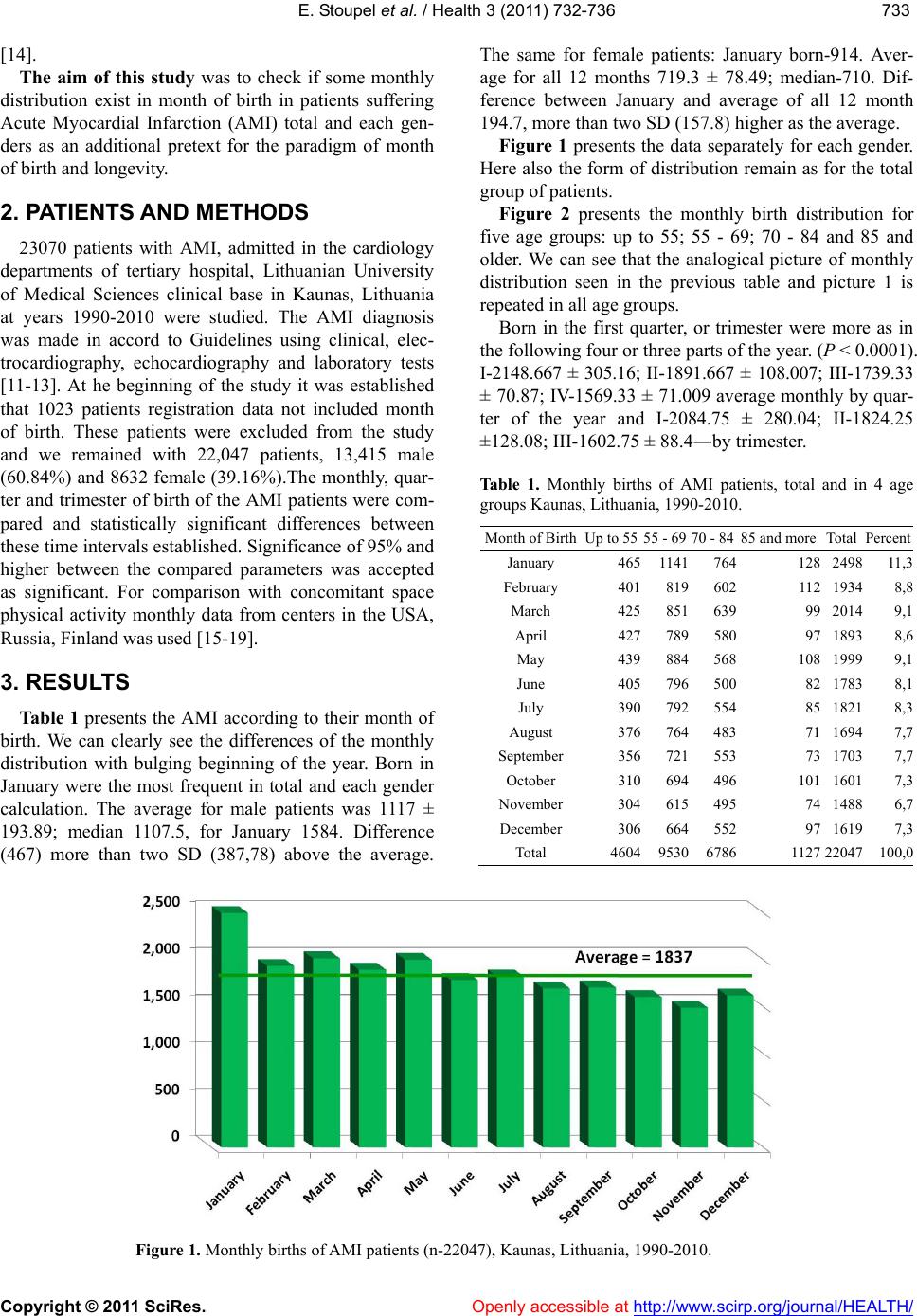 E. Stoupel et al. / Health 3 (2011) 732-736 Copyright © 2011 SciRes. Openly accessible at http:// www.scirp.org/journal/HEALTH/ 733733 [14]. The aim of this study was to check if some monthly distribution exist in month of birth in patients suffering Acute Myocardial Infarction (AMI) total and each gen- ders as an additional pretext for the paradigm of month of birth and longevity. 2. PATIENTS AND METHODS 23070 patients with AMI, admitted in the cardiology departments of tertiary hospital, Lithuanian University of Medical Sciences clinical base in Kaunas, Lithuania at years 1990-2010 were studied. The AMI diagnosis was made in accord to Guidelines using clinical, elec- trocardiography, echocardiography and laboratory tests [11-13]. At he beginning of the study it was established that 1023 patients registration data not included month of birth. These patients were excluded from the study and we remained with 22,047 patients, 13,415 male (60.84%) and 8632 female (39.16%).The monthly, quar- ter and trimester of birth of the AMI patients were com- pared and statistically significant differences between these time intervals established. Significance of 95% and higher between the compared parameters was accepted as significant. For comparison with concomitant space physical activity monthly data from centers in the USA, Russia, Finland was used [15-19]. 3. RESULTS Table 1 presents the AMI according to their month of birth. We can clearly see the differences of the monthly distribution with bulging beginning of the year. Born in January were the most frequent in total and each gender calculation. The average for male patients was 1117 ± 193.89; median 1107.5, for January 1584. Difference (467) more than two SD (387,78) above the average. The same for female patients: January born-914. Aver- age for all 12 months 719.3 ± 78.49; median-710. Dif- ference between January and average of all 12 month 194.7, more than two SD (157.8) higher as the average. Figure 1 presents the data separately for each gender. Here also the form of distribution remain as for the total group of patients. Figure 2 presents the monthly birth distribution for five age groups: up to 55; 55 - 69; 70 - 84 and 85 and older. We can see that the analogical picture of monthly distribution seen in the previous table and picture 1 is repeated in all age groups. Born in the first quarter, or trimester were more as in the following four or three parts of the year. (P < 0.0001). I-2148.667 ± 305.16; II-1891.667 ± 108.007; III-1739.33 ± 70.87; IV-1569.33 ± 71.009 average monthly by quar- ter of the year and I-2084.75 ± 280.04; II-1824.25 ±128.08; III-1602.75 ± 88.4―by trimester. Table 1. Monthly births of AMI patients, total and in 4 age groups Kaunas, Lithuania, 1990-2010. Month of BirthUp to 5555 - 6970 - 84 85 and more TotalPercent January 4651141764128249811,3 February 40181960211219348,8 March 4258516399920149,1 April 4277895809718938,6 May 43988456810819999,1 June 4057965008217838,1 July 3907925548518218,3 August 3767644837116947,7 September 3567215537317037,7 October 31069449610116017,3 November 3046154957414886,7 December 3066645529716197,3 Total 460495306786112722047100,0 Figure 1. Monthly births of AMI patients (n-22047), Kaunas, Lithuania, 1990-2010. 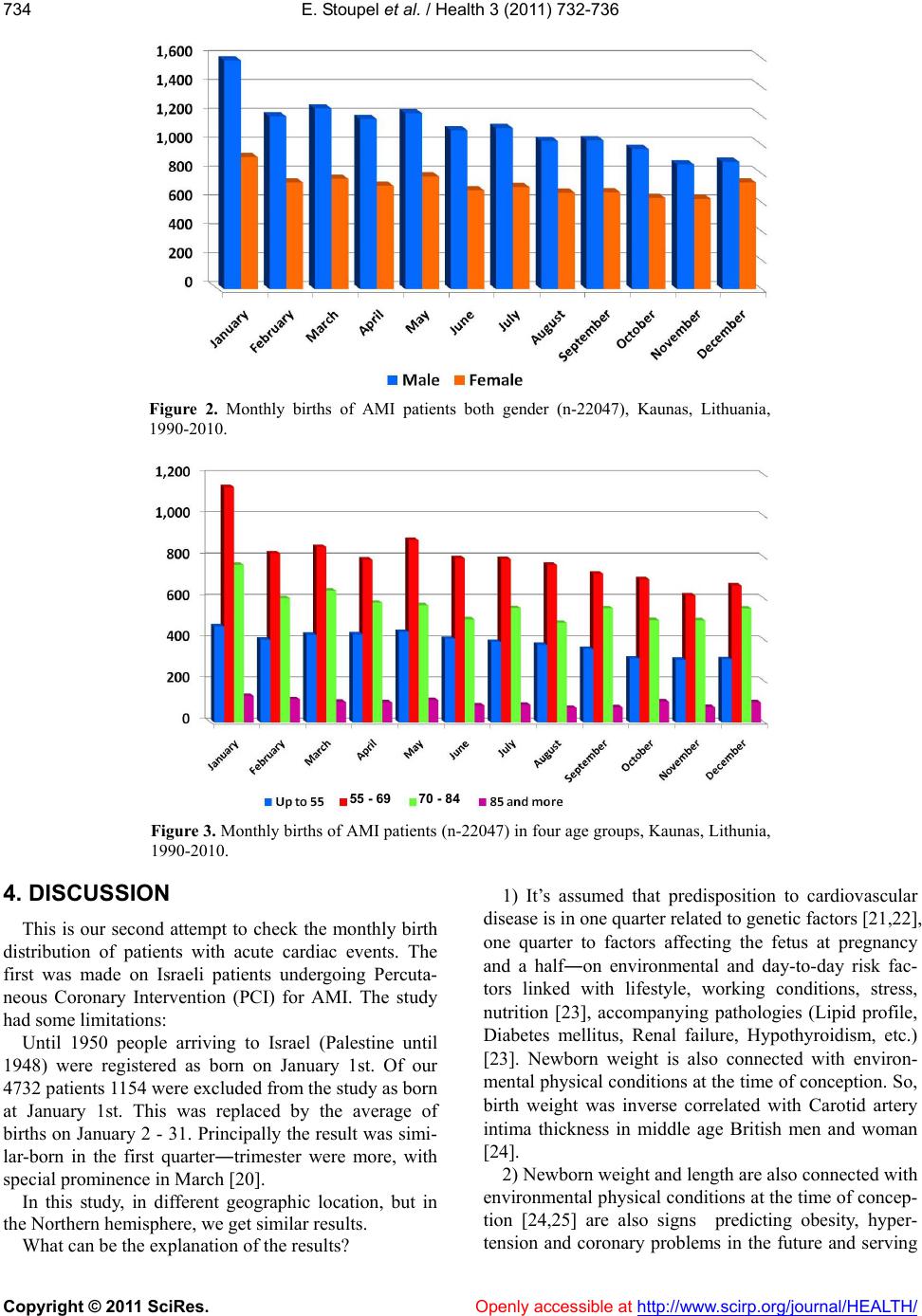 E. Stoupel et al. / Health 3 (2011) 732-736 Copyright © 2011 SciRes. Openly accessible at http:// www.scirp.org/journal/HEALTH/ 734 Figure 2. Monthly births of AMI patients both gender (n-22047), Kaunas, Lithuania, 1990-2010. 55 - 6970 - 84 Figure 3. Monthly births of AMI patients (n-22047) in four age groups, Kaunas, Lithunia, 1990-2010. 4. DISCUSSION This is our second attempt to check the monthly birth distribution of patients with acute cardiac events. The first was made on Israeli patients undergoing Percuta- neous Coronary Intervention (PCI) for AMI. The study had some limitations: Until 1950 people arriving to Israel (Palestine until 1948) were registered as born on January 1st. Of our 4732 patients 1154 were excluded from the study as born at January 1st. This was replaced by the average of births on January 2 - 31. Principally the result was simi- lar-born in the first quarter―trimester were more, with special prominence in March [20]. In this study, in different geographic location, but in the Northern hemisphere, we get similar results. What can be the explanation of the results? 1) It’s assumed that predisposition to cardiovascular disease is in one quarter related to genetic factors [21,22], one quarter to factors affecting the fetus at pregnancy and a half―on environmental and day-to-day risk fac- tors linked with lifestyle, working conditions, stress, nutrition [23], accompanying pathologies (Lipid profile, Diabetes mellitus, Renal failure, Hypothyroidism, etc.) [23]. Newborn weight is also connected with environ- mental physical conditions at the time of conception. So, birth weight was inverse correlated with Carotid artery intima thickness in middle age British men and woman [24]. 2) Newborn weight and length are also connected with environmental physical conditions at the time of concep- tion [24,25] are also signs predicting obesity, hyper- tension and coronary problems in the future and serving 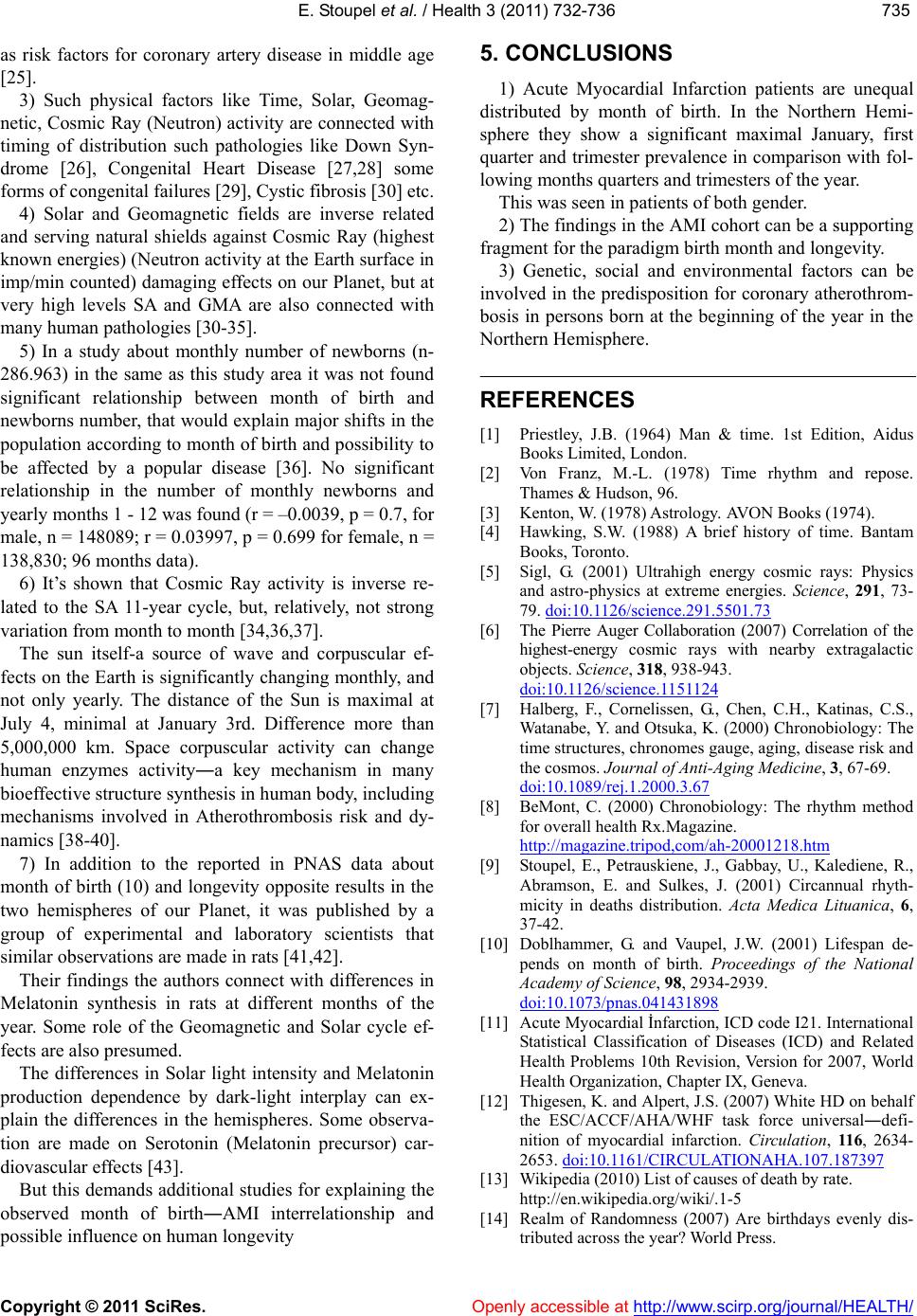 E. Stoupel et al. / Health 3 (2011) 732-736 Copyright © 2011 SciRes. Openly accessible at http:// www.scirp.org/journal/HEALTH/ 735735 as risk factors for coronary artery disease in middle age [25]. 3) Such physical factors like Time, Solar, Geomag- netic, Cosmic Ray (Neutron) activity are connected with timing of distribution such pathologies like Down Syn- drome [26], Congenital Heart Disease [27,28] some forms of congenital failures [29], Cystic fibrosis [30] etc. 4) Solar and Geomagnetic fields are inverse related and serving natural shields against Cosmic Ray (highest known energies) (Neutron activity at the Earth surface in imp/min counted) damaging effects on our Planet, but at very high levels SA and GMA are also connected with many human pathologies [30-35]. 5) In a study about monthly number of newborns (n- 286.963) in the same as this study area it was not found significant relationship between month of birth and newborns number, that would explain major shifts in the population according to month of birth and possibility to be affected by a popular disease [36]. No significant relationship in the number of monthly newborns and yearly months 1 - 12 was found (r = –0.0039, p = 0.7, for male, n = 148089; r = 0.03997, p = 0.699 for female, n = 138,830; 96 months data). 6) It’s shown that Cosmic Ray activity is inverse re- lated to the SA 11-year cycle, but, relatively, not strong variation from month to month [34,36,37]. The sun itself-a source of wave and corpuscular ef- fects on the Earth is significantly changing monthly, and not only yearly. The distance of the Sun is maximal at July 4, minimal at January 3rd. Difference more than 5,000,000 km. Space corpuscular activity can change human enzymes activity―a key mechanism in many bioeffective structure synthesis in human body, including mechanisms involved in Atherothrombosis risk and dy- namics [38-40]. 7) In addition to the reported in PNAS data about month of birth (10) and longevity opposite results in the two hemispheres of our Planet, it was published by a group of experimental and laboratory scientists that similar observations are made in rats [41,42]. Their findings the authors connect with differences in Melatonin synthesis in rats at different months of the year. Some role of the Geomagnetic and Solar cycle ef- fects are also presumed. The differences in Solar light intensity and Melatonin production dependence by dark-light interplay can ex- plain the differences in the hemispheres. Some observa- tion are made on Serotonin (Melatonin precursor) car- diovascular effects [43]. But this demands additional studies for explaining the observed month of birth―AMI interrelationship and possible influence on human longevity 5. CONCLUSIONS 1) Acute Myocardial Infarction patients are unequal distributed by month of birth. In the Northern Hemi- sphere they show a significant maximal January, first quarter and trimester prevalence in comparison with fol- lowing months quarters and trimesters of the year. This was seen in patients of both gender. 2) The findings in the AMI cohort can be a supporting fragment for the paradigm birth month and longevity. 3) Genetic, social and environmental factors can be involved in the predisposition for coronary atherothrom- bosis in persons born at the beginning of the year in the Northern Hemisphere. REFERENCES [1] Priestley, J.B. (1964) Man & time. 1st Edition, Aidus Books Limited, London. [2] Von Franz, M.-L. (1978) Time rhythm and repose. Thames & Hudson, 96. [3] Kenton, W. (1978) Astrology. AVON Books (1974). [4] Hawking, S.W. (1988) A brief history of time. Bantam Books, Toronto. [5] Sigl, G. (2001) Ultrahigh energy cosmic rays: Physics and astro-physics at extreme energies. Science, 291, 73- 79. doi:10.1126/science.291.5501.73 [6] The Pierre Auger Collaboration (2007) Correlation of the highest-energy cosmic rays with nearby extragalactic objects. Science, 318, 938-943. doi:10.1126/science.1151124 [7] Halberg, F., Cornelissen, G., Chen, C.H., Katinas, C.S., Watanabe, Y. and Otsuka, K. (2000) Chronobiology: The time structures, chronomes gauge, aging, disease risk and the cosmos. Journal of Anti-Aging Medicine, 3, 67-69. doi:10.1089/rej.1.2000.3.67 [8] BeMont, C. (2000) Chronobiology: The rhythm method for overall health Rx.Magazine. http://magazine.tripod,com/ah-20001218.htm [9] Stoupel, E., Petrauskiene, J., Gabbay, U., Kalediene, R., Abramson, E. and Sulkes, J. (2001) Circannual rhyth- micity in deaths distribution. Acta Medica Lituanica, 6, 37-42. [10] Doblhammer, G. and Vaupel, J.W. (2001) Lifespan de- pends on month of birth. Proceedings of the National Academy of Science, 98, 2934-2939. doi:10.1073/pnas.041431898 [11] Acute Myocardial İnfarction, ICD code I21. International Statistical Classification of Diseases (ICD) and Related Health Problems 10th Revision, Version for 2007, World Health Organization, Chapter IX, Geneva. [12] Thigesen, K. and Alpert, J.S. (2007) White HD on behalf the ESC/ACCF/AHA/WHF task force universal―defi- nition of myocardial infarction. Circulation, 116, 2634- 2653. doi:10.1161/CIRCULATIONAHA.107.187397 [13] Wikipedia (2010) List of causes of death by rate. http://en.wikipedia.org/wiki/.1-5 [14] Realm of Randomness (2007) Are birthdays evenly dis- tributed across the year? World Press.  E. Stoupel et al. / Health 3 (2011) 732-736 Copyright © 2011 SciRes. http://www.scirp.org/journal/HEALTH/Openly accessible at 736 [15] SESC Glossary of Solar-Terrestrial Terms (1988, revised 1992) NOAA-USAF, Space Environment Services Cen- ter, Boulder. [16] Solar Indices Bulletin (monthly) NOAA. National Geo- physocal Data Center. Boulder, Co, Boulder. [17] NOAA, SWPC, US AF Preliminary Report and Forecast of Solar Geophysical Data (Weekly) Boulder, Co, Boul- der. [18] Moscow Neutron Monitoring Station. IZMIRAN Insti- tute. Russian Academy of Sciences, Moscow. [19] Oulu University. Neutron Monitorig Data. Daily, Monthly. Oulu. Finland. [20] Stoupel, E., Abramson, E., Israelevich, P. and Sulkes, J. (2011) Monthly births distribution in patients with ath- eroth-rombosis related Acute Coronary Events-(ACS) treated by Percutaneous Coronary Intervention (PCI). Journal of Basic and Clinical Physiology and Pharma- cology, 23, 43-47 [21] (2010) Genetic signatures of human exceptional longev- ity discovered science. http://www.sciencedaily.com/releases/2010/07/10070114 5521.htm [22] Science News. Longevity tied to genes that preserve tips of chromosomes. http://www.sciencedaily.com/releases/200911/091/11200 225.htm [23] American Heart Association (2010) AHA scientific posi- tion. Risk factors and coronary artery disease. americanheart. org/presenter. jhtml?ide. [24] Merlob, P., Raisner, S.H., Shimshoni, M. and Stoupel, E. (1989) Foetal growth in extreme periods of solar activity in the 21-22 solar cycles. Journal of Foetal Medicine, 9, 1-2:1-5. [25] Lawlor, D.A., Davey, S.G., Wincup, P., Wannamethee, G., et al. (2003) Association between offspring birth weight and atherosclerosis in middle aged British men and woman: British regional heart study. Journal of Epidemi- ology & Community Health, 57, 462-463. doi:10.1136/jech.57.6.462 [26] Stoupel, E., Frimer, H., Appelman, Z., Ben-Neriah, Z., Dar, H., Fejgin, M.D., Gershoni, B.R., Manor, E., Barkai, G., Halevy, S., Gelman-Kohan, Z., Reish, O., Lev, D., Davidov, B., Goldman, B. and Shohat, M. (2005) Chro- mosome aberration and environmental physical activity: Down syndrome and solar and cosmic ray activity. Israel, 1990-2000. International Journal of Biometeorology, 26, 1-9. doi:10.1007/s00484-005-0274-2 [27] Stoupel, E., Birk, E., Kogan, A., Klinger, G., Abramson, E., Israelevich, P., Sulkes, J. and Linder, N. (2009) Con- genital heart disease: Correlation with fluctuation in cosmophysical activity Intern. Journal of Cardiology, 135, 207-210 [28] Stoupel, E., Dulskiene, V., Kuciene, R., Abramson, E., Is- raelevich, P. and Sulkes, J. Congenital heart disease and congenital heart disease and environmental physical activity- kaunas data, 1995-2005. Sun and Geosphere, 4, 45-49. [29] Archer, V.E. (1979) Anencephalus, drinking water, geo- magnetism and cosmic radiation. American Journal of Epidemiology, 109, 88-97. [30] Brackenridge, C.J. and Miller, J.R. (2001) Bimodal month of birth distribution in cystic fibrosis. American Journal of Medical Genetics, 5, 295-301. doi:10.1002/ajmg.1320050312 [31] Stoupel, E. (2008) Atherothrombosis-environmental links. Journal of Basic and Clinical Physiology and Pharma- cology, 19, 37-45. doi:10.1515/JBCPP.2008.19.1.37 [32] Stoupel, E., Domarkiene, S., Radishauskas, R., Bernotiene, G., Abramson, E., Israelevich, P. and Sulkes, J. (2004) Links between monthly rates of four subtypes of acute myocardial infarction and their corresponding cosmo- physical activity parameters. Journal of Basic and Clini- cal Physiology and Pharmacology, 15, 175-184. doi:10.1515/JBCPP.2004.15.3-4.175 [33] Stoupel, E., Babayev, E., Mustafa, F., Abramson, E., Is- raelevich, P. and Sulkes, J. (2007) Acute myocardial in- farction occurrence: Environmental links. Medical Sci- ence Monitor, 13, 175-179 [34] Stoupel, E., Tamoshiunas, A., Radishauskas, R., Berno- tiene, G., Abramson, E. and Israelevich, P. (2011) Clin & exper cardiology neutrons and the plaque: AMI (n-8920) at days of zero GMA/high neutron activity (n-36) and the following days, Kaunas, Lithuania, 2000-2007. Experi- mental & Clinical Cardiology, 2, 1-4. [35] Cornelissen, G., Maggioni, C. and Halberg, F. (2002) Is a birth-dependence of human longevity influenced by half- yearly changes in geomagnetics? Kola Science Center. [36] Stoupel, E., Kalediene, R., Petrauskiene, J., Gaiz- hauskiene, A., Israelevicxh, P., Abramson, E. and Sulkes, J. (2006) Monthly number of newborns and environ- mental physical activity. Medici na, 42, 238-241. [37] Usoskin, I.G., Alanko-Huotari, K., Kovaltsov, G.A. and Mursula, K. (2005) Heliospheric modulation of cosmic rays: Monthly reconstruction for 1951-2004. Journal of Geophysical Research, 110, A12108. doi:10.1029/2005JA011250. [38] Wikipedia Sunlight. http://en.wikipedia.org/wiki/Sunlight// [39] Kirby, A.J. and Hollffelder, F. (2008) Enzymes under the nanoscope. Nature, 456, 45-47. doi:10.1038/456045a [40] Feelisch, M., Kolb-Bachofen, V., Liu, D., Lundsberg, J.O., Rovedo, L.P., Suschek, C.V. and Weller, R.B. (2010) Is sunlight good for the heart. European Heart Journal, 31, 1041-10 [41] Bartsch, H., Bartsch, Ch., Mecke, D. and Lippert, T.T. (1994) Seasonality-pineal melatonin production in the rat. Possible synchronization by the geomagnetic field. Chro- nobiology International, 11, 21-26. doi:10.3109/07420529409057227 [42] Bartsch, H., Kupper, H., Scheurlen, U., Deerberg, F.D., Seebald, E., Dietz, K., Mecke, D., Probst, H., Stehle, T. and Bartsch, Ch. (2010) Effect to a chronic exposure to a GSM-like signal (mobile phone) on survival of female Sprague Dawley rats: Modulatory effects by month of birth and possibly stage of the solar cycle. Neuroendo- crinogy Letters, 31, 457-473. [43] Saxena, P.R., Wallis, D.I., Woulters, W. and Bevan, P. (1990) Cardiovascular pharmacology of 5-hydroxytryptamine. Kluver Academic Publishers, Dordrecht. |