

Paper Menu >>
Journal Menu >>
 Vol.3, No.12, 748-751 (2011) doi:10.4236/health.2011.312124 Copyright © 2011 SciRes. Openly accessible at http://www.scirp.org/journal/HEALTH/ Health Factors associated with psychological distress of medical doctor in Kagawa prefecture, Japan: a pilot study Takeshi Suzue1, Noriko Sakano2, Yo shikazu Miyamae3, Takeshi Yo da1, Akira Yoshioka1, Taich i Nagatomi4, Wataru Shiraki5, Tomohiro Hirao1 1Department of Public Health, Faculty of Medicine, Kagawa University, Kagawa, Japan; *Corresponding Author: [email protected] 2Department of Hygiene, Faculty of Medicine, Kagawa University, Kagawa, Japan; 3Center for Educational Research and Teacher Development, Faculty of Education, Kagawa University, Kagawa, Japan; 4Institute of Research Partnership Center for Social Collaboration and Intellectual Property, Kagawa University, Kagawa, Japan; 5Department of Reliability-Based Information Systems Engineering, Faculty of Engineering, Kagawa University, Kagawa, Japan. Received 6 September 2011; revised 15 November 2011; accepted 30 November 2011. ABSTRACT Objective: We evaluated the psychological dis- tress of medical doctor using a 6-item instru- ment (the K6) in Kagawa prefecture, Japan. Me- thods: A total of 284 medical doctors (236 men and 48 women) were analyzed in a cross-sec- tional investigation study. The association be- tween psychological distress and clinical fac- tors were evaluated by the K6 instrument, with psychological distress defined as 13 or more point s out of a total of 24 points. Results: A total of 17 doctors (6.0% ) as defined as p s ychological distress. The significant relationships between the K6 score and age, experience duration as clinician were not noted. The K6 score in sub- jects with consciousness of suicide was sig- nificantly higher than that without. In addition, the K6 score in subjects without cooperation with specialists was higher than those without, but not at a significant lev el. Conclusions: Some factors i.e. consciousness of suicide and coop- eration with specialists might be associated with psychological distress, as assessed by the K6 instrument, in medical doctor in Kagawa pre- fecture, Japan. Keywords: Psychological Distress; T he K6; Medical Doctor; Kaga wa; Japan 1. INTRODUCTION Mental health has become public health challenge in Japan. For example, over 30 thousand subjects suicide in a year for over 10 years [1]. About 14% of the global disease burden has been attributed to mental illness, mostly due to the chronically disabling nature of depres- sion and othe r common mental disorde rs [ 2]. Recently, the demand for medical doctors has been increasing in various areas because of a medical reform bill and government amendments to the medical service payment structure in Japan. In some literatures, the psy- chological distress of medical doctors in Japan has re- ported [3,4]. However, the evaluation of psychological distress of medical doctors in Japan still remains to be investigated. Therefore, we evaluated the psychological distress of medical doctors by using the K6 instrument, the scale of psychological distress, in Kagawa prefecture, Japan and its relation to clinical factors in this cross-sectional in- vestigation study. 2. SUBJECTS AND METHODS 2.1. Subjects We used data of 334 respondents (37.8%) among 884 medical doctors (physician, surgeon and psychiatrist) in Kagawa prefecture, Japan, who met the following crite- ria; 1) they had completely answered the questionnaires (clinical characteristics and the K6); and 2) they pro- vided informed consent. Therefore, we analyzed 284 (32.1%) medical doctors (236 men and 48 women), aged 55.8 ± 11.9 years in this cross sectional investigation study. Ethical approval for the study was obtained from the Ethical Committee of Faculty of Medicine, Kagawa University, Japan. 2.2. Psychological Distress The K6 was used as an indicator of psychological dis- 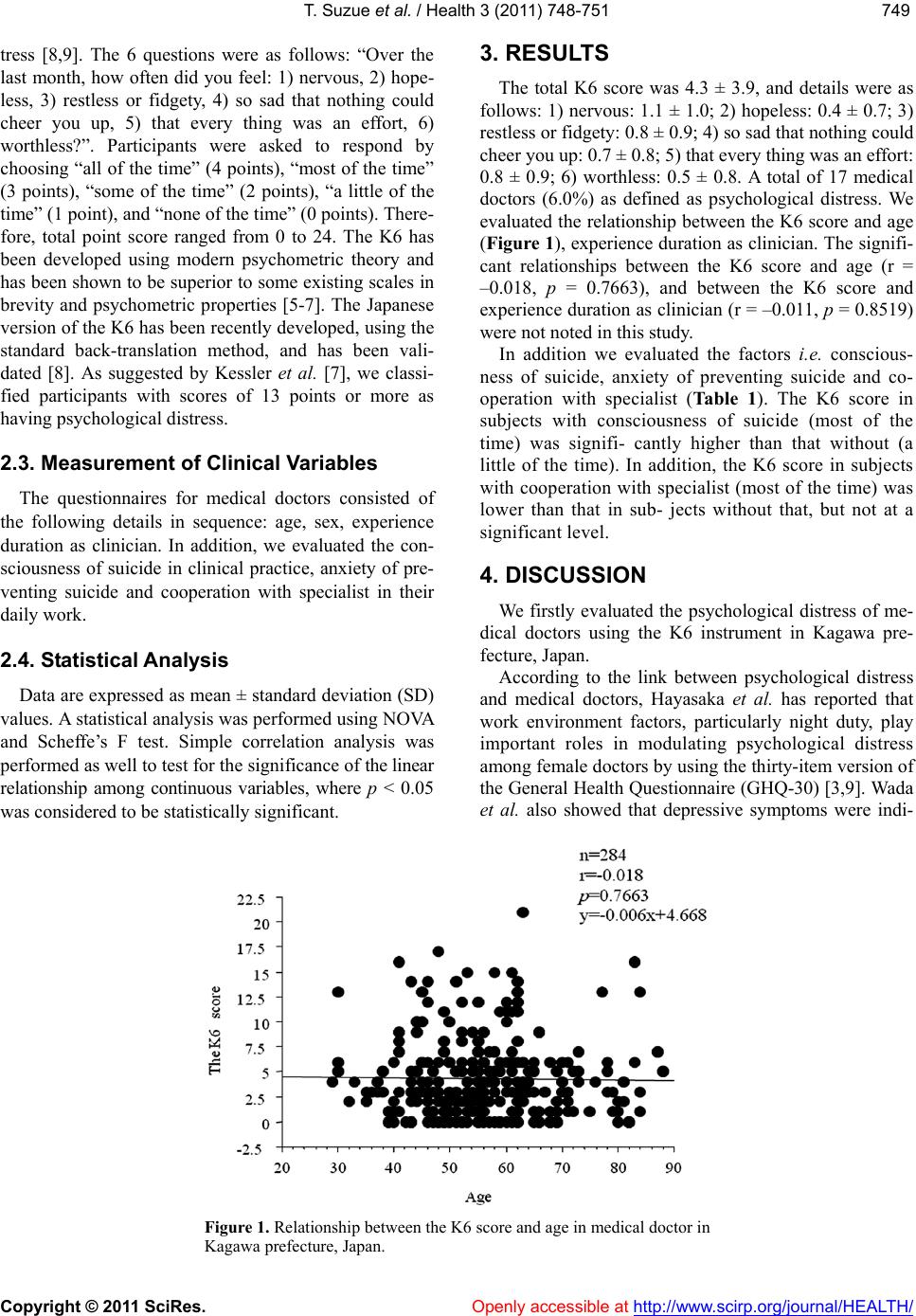 T. Suzue et al. / Health 3 (2011) 748-751 Copyright © 2011 SciRes. Openly accessible at http://www.scirp.org/journal/HEALTH/ 749749 tress [8,9]. The 6 questions were as follows: “Over the last month, how often did you feel: 1) nervous, 2) hope- less, 3) restless or fidgety, 4) so sad that nothing could cheer you up, 5) that every thing was an effort, 6) worthless?”. Participants were asked to respond by choosing “all of the time” (4 points), “most of the time” (3 points), “some of the time” (2 points), “a little of the time” (1 point), and “none of the time” (0 points). There- fore, total point score ranged from 0 to 24. The K6 has been developed using modern psychometric theory and has been shown to be superior to some existing scales in brevity and psychometric properties [5-7]. The Japanese version of the K6 has been recently developed, using the standard back-translation method, and has been vali- dated [8]. As suggested by Kessler et al. [7], we classi- fied participants with scores of 13 points or more as having psychological distress. 2.3. Measurement of Clinical Variables The questionnaires for medical doctors consisted of the following details in sequence: age, sex, experience duration as clinician. In addition, we evaluated the con- sciousness of suicide in clinical practice, anxiety of pre- venting suicide and cooperation with specialist in their daily work. 2.4. Statistical Analysis Data are expressed as mean ± standard deviation (SD) values. A statistical analysis was performed using NOVA and Scheffe’s F test. Simple correlation analysis was performed as well to test for the significance of the linear relationship among continuous variables, where p < 0.05 was considered to be statistically significant. 3. RESULTS The total K6 score was 4.3 ± 3.9, and details were as follows: 1) nervous: 1.1 ± 1.0; 2) hopeless: 0.4 ± 0.7; 3) restless or fidgety: 0.8 ± 0.9; 4) so sad that nothing could cheer you up: 0.7 ± 0.8; 5) that every thing was an effort: 0.8 ± 0.9; 6) worthless: 0.5 ± 0.8. A total of 17 medical doctors (6.0%) as defined as psychological distress. We evaluated the relationship between the K6 score and age (Figure 1), exp erience duration as clinician. The signifi- cant relationships between the K6 score and age (r = –0.018, p = 0.7663), and between the K6 score and experience duration as clinician (r = –0.011, p = 0.8519) were not noted in this study. In addition we evaluated the factors i.e. conscious- ness of suicide, anxiety of preventing suicide and co- operation with specialist (Table 1). The K6 score in subjects with consciousness of suicide (most of the time) was signifi- cantly higher than that without (a little of the time). In addition, the K6 score in subjects with cooperation with specialist (most of the time) was lower than that in sub- jects without that, but not at a significant level. 4. DISCUSSION We firstly evaluated the psychological distress of me- dical doctors using the K6 instrument in Kagawa pre- fecture, Japan. According to the link between psychological distress and medical doctors, Hayasaka et al. has reported that work environment factors, particularly night duty, play important roles in modulating psychological distress among female doctors by using the thirty-item version of the General Health Questionnaire (GHQ-30) [3,9]. Wada et al. also showed that depressive symptoms were indi- Figure 1. Relationship between the K6 score and age in medical doctor in Kagawa prefecture, Japan. 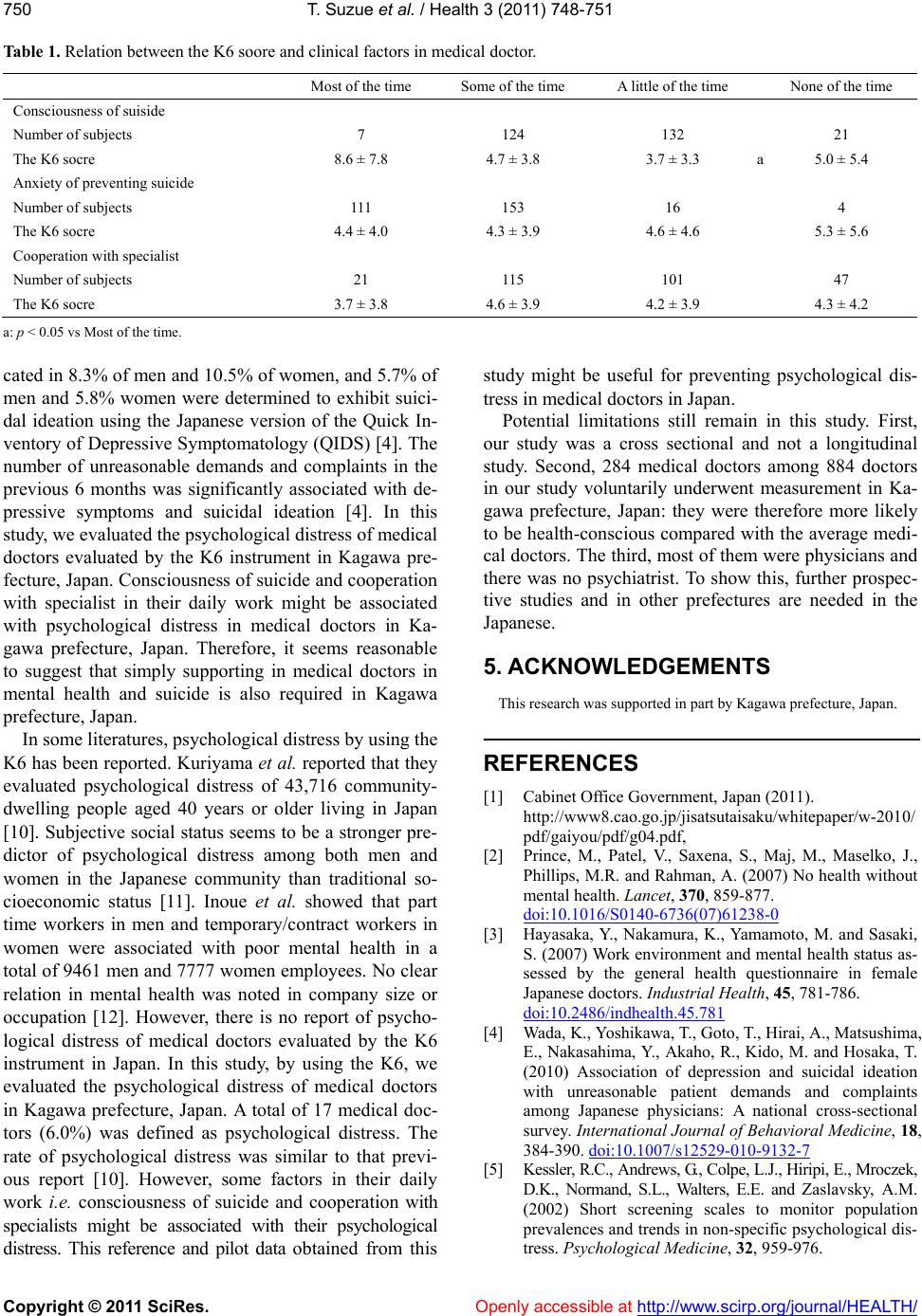 T. Suzue et al. / Health 3 (2011) 748-751 Copyright © 2011 SciRes. Openly accessible at http://www.scirp.org/journal/HEALTH/ 750 Table 1. Relation between the K6 soore and clinical factors in medical doctor. Most of the time Some of the time A little of the time None of the time Consciousness of suiside Number of subjects 7 124 132 21 The K6 socre 8.6 ± 7.8 4.7 ± 3.8 3.7 ± 3.3 a 5.0 ± 5.4 Anxiety of preventing suicide Number of subject s 111 153 16 4 The K6 socre 4.4 ± 4.0 4.3 ± 3.9 4.6 ± 4.6 5.3 ± 5.6 Cooperation with specialist Number of subjects 21 115 101 47 The K6 socre 3.7 ± 3.8 4.6 ± 3.9 4.2 ± 3.9 4.3 ± 4.2 a: p < 0.05 vs Most of th e time. cated in 8.3% of men and 10.5% of women, and 5.7% of men and 5.8% women were determined to exhibit suici- dal ideation using the Japanese version of the Quick In- ventory of Depressive Symptomatology (QIDS) [4]. The number of unreasonable demands and complaints in the previous 6 months was significantly associated with de- pressive symptoms and suicidal ideation [4]. In this study, we evaluated the psychological distress of medical doctors evaluated by the K6 instrument in Kagawa pre- fecture, Japan. Consciousness of suicide and cooperation with specialist in their daily work might be associated with psychological distress in medical doctors in Ka- gawa prefecture, Japan. Therefore, it seems reasonable to suggest that simply supporting in medical doctors in mental health and suicide is also required in Kagawa prefecture, Japan. In some literatures, psychological distress by using the K6 has been reported. Kuriyama et al. reported that they evaluated psychological distress of 43,716 community- dwelling people aged 40 years or older living in Japan [10]. Subjective social status seems to be a stronger pre- dictor of psychological distress among both men and women in the Japanese community than traditional so- cioeconomic status [11]. Inoue et al. showed that part time workers in men and temporary/contract workers in women were associated with poor mental health in a total of 9461 men and 7777 women employees. No clear relation in mental health was noted in company size or occupation [12]. However, there is no report of psycho- logical distress of medical doctors evaluated by the K6 instrument in Japan. In this study, by using the K6, we evaluated the psychological distress of medical doctors in Kagawa prefecture, Japan. A total of 17 medical doc- tors (6.0%) was defined as psychological distress. The rate of psychological distress was similar to that previ- ous report [10]. However, some factors in their daily work i.e. consciousness of suicide and cooperation with specialists might be associated with their psychological distress. This reference and pilot data obtained from this study might be useful for preventing psychological dis- tress in medical doctors in Japan. Potential limitations still remain in this study. First, our study was a cross sectional and not a longitudinal study. Second, 284 medical doctors among 884 doctors in our study voluntarily underwent measurement in Ka- gawa prefecture, Japan: they were therefore more likely to be health-conscious compared with the average medi- cal doctors. The third, most of them were physicians and there was no psychiatrist. To show this, further prospec- tive studies and in other prefectures are needed in the Japanese. 5. ACKNOWLEDGEMENTS This research was supported in pa rt by Kagawa prefecture, Japan. REFERENCES [1] Cabinet Office Government, Japan (2011). http://www8.cao.go.jp/jisatsutaisaku/whitepaper/w-2010/ pdf/gaiyou/pdf/g04.pdf, [2] Prince, M., Patel, V., Saxena, S., Maj, M., Maselko, J., Phillips, M.R. and Rahman, A. (2007) No health without mental health. Lancet, 370, 859-877. doi:10.1016/S0140-6736(07)61238-0 [3] Hayasaka, Y., Nakamura, K., Yamamoto, M. and Sasaki, S. (2007) Work environment and mental health status as- sessed by the general health questionnaire in female Japanese doctors. Industrial Health, 45, 781-786. doi:10.2486/indhealth.45.781 [4] Wada, K., Yoshikawa, T., Goto, T., Hirai, A., Matsushima, E., Nakasa hima, Y., Akaho, R., Kido, M. and Hosaka, T. (2010) Association of depression and suicidal ideation with unreasonable patient demands and complaints among Japanese physicians: A national cross-sectional survey. International Journal of Behavioral Medicine, 18, 384-390. doi:10.1007/s12529-010-9132-7 [5] Kessler, R.C., Andrews, G., Colpe, L.J., Hiri pi, E., Mroczek, D.K., Normand, S.L., Walters, E.E. and Zaslavsky, A.M. (2002) Short screening scales to monitor population prevalences and trends in non-specific psychological dis- tress. Psychological Medicine, 32, 959-976.  T. Suzue et al. / Health 3 (2011) 748-751 Copyright © 2011 SciRes. Openly accessible at http://www.scirp.org/journal/HEALTH/ 751751 doi:10.1017/S0033291702006074 [6] Furukawa, T.A., Kessler, R.C., Slade, T. and Andrews, G. (2003) The performance of the K6 and K10 screening scales for psychological distress in the Australian Na- tional Survey of Mental Health and Well-Bing. Psycho- logical Medicine, 33, 357-362. doi:10.1017/S0033291702006700 [7] Kessler, R.C., Barker, P.R., Colpe, L.J., Epstein, J.F., Gfroerer, J.C., Hiripi, E., Howes, M.J., Normand, S.L., Manderscheid, R.W., Walters, E.E. and Zaslavsky, A.M. (2003) Screening for serious mental illness in the general population. Archives of General Psychiatry, 60, 184-189. doi:10.1001/archpsyc.60.2.184 [8] Furukawa, T.A., Kawakami, N., Saitoh, M., Ono, Y., Nakane, Y., Nakamura, Y., Tachimori, H., Iwata, N., Uda, H., Nakane, H., Watanabe, M., Naganuma, Y., Hata, Y., Kobayashi, M., Miyake, Y., Takeshima, T. and Kikkawa, T. (2008) The performance of the Japanese version of the K6 and K10 in the World Mental Health Survey Japan. International Journal of Methods in Psychiatric Re- search, 17, 152-158. doi:10.1002/mpr.257 [9] Iwata, N., Uno, B. and Suzuki, T. (1994) Psychometric properties of the 30-item version general health question- naire in Japanese. Japanese Journal of Psychiatry & Neu- rology, 48, 547-556. [10] Kuriyama, S., Nakaya, N., Ohmori-Matsuda, K., Shi- mazu, T., Kikuchi, N., Kakizaki, M., Sone, T., Sato, F., Nagai, M., Sugawara, Y., Akhter, M., Higashiguchi, M., Fukuchi, N., Takahashi, H., Hozawa, A. and Tsuji, I. (2009) Factors associated with psy chological distress in a community dwelling Japanese population: the Ohsaki Cohort 2006 Study. Journal of Epidemiology, 19, 294- 302. doi:10.2188/jea.JE20080076 [11] Sakurai, K., Kawakami, N., Yamaoka, K., Ishikawa, H. and Hashimoto, H. (2010) The impact of subjective and objective social status on psychological distress among men and women in Japan. Social Science & Medicine, 70, 1832-1839. doi:10.1016/j.socscimed.2010.01.019 [12] Inoue, A., Kawakami, N., Tsuchiya, M., Sakurai, K. and Hashimoto, H. (2010) Association of occupation, em- ployment contract, and company size with mental health in a national representative sample of employees in Japan. Journal of Occupational Health, 52, 227-240. doi:10.1539/joh.O10002 |