

Paper Menu >>
Journal Menu >>
 Journal of Service Science and Management, 2011, 4, 453-457 doi:10.4236/jssm.2011.44051 Published Online December 2011 (http://www.SciRP.org/journal/jssm) Copyright © 2011 SciRes. JSSM 453 In Search of the Effects of Competition on Unemployment: Evidence from OECD Countries Bo Zhao School of International Trade and Economics, University of International Business and Economics, Beijing, China. E-mail: [email protected] Received September 13th, 2011; revised October 18th, 2011; accepted November 15th, 2011. ABSTRACT This paper explores the empirical relationship between unemployment rate and product market competition in eighteen OECD countries through three sets of quantitative analyses. We find that the effect of competition on employment de- pends on the existing competition intensity and the relationship between the unemployment and competition appears to be inverted-N shape—in countries where existing competition intensity is either high or low, an increase in competition tends to reduce unemployment rate significantly; but for countries where existing competition intensity is moderate, intensified competition is more likely to increase unemployment rate significantly. Keywords: Competition, Unemployment, Panel Data, SVAR 1. Introduction Recent report from the International Labor Organization indicates that global unemployment rate in 2009 soared to an unprecedented height of approximately 6.6%. Espe- cially, the unemployment rates in the Developed Econo- mies and European Union region jumped to 8.4%. Mo- reover, the overall unemployment rates in the next ten years are expected to keep increasing [1]. Against such a background, the importance of understanding the factors that influence a country’s unemployment cannot be over- stated. Labor market institutions and distortions are argua- bly among the most significant factors. However, as ob- served and argued by many economists, the labor market institutions and distortions cannot fully explain the high unemployment rates (see Nickell et al. [2] for example). More attention, therefore, has been directed at the pro- duct market imperfections and distortions, especially pro- duct market power, as a possible reason for the increas- ing unemployment rates. However, theoretical analyses suggest that the relationship between competition and unemployment may be ambiguous. Hence, it is necessary to examine the empirical evidence on this relationship. As far as we know, however, there is surprisingly little empirical work on this subject. Therefore, the main ob- jective of this paper is to search for the effects of product market competition on unemployment by using data from eighteen OECD countries. The rest of this chapter is organized as follows. Sec- tion 2 gives the list of estimation variables and discusses the measures of competition. In section 3, quantitative a- nalyses are conducted to explore the relationship bet- ween unemployment and competition. Main conclusions are summarized in section 4. 2. Variables, Database and Proxies Our data sample mainly spans over 1970-2005 and cro- sses eighteen OECD countries: Australia, Austria, Bel- gium, Canada, Denmark, Finland, France, Greece, Ire- land, Japan, Italy, Luxembourg, Netherlands, New Zea- land, Norway, Sweden, the United Kingdom and the Uni- ted States of America. A complete list of variables and their proxies used in our estimations is provided in Table 1. Specifically, pro- duct market competition is a non-monetary concept whi- ch makes it hard to measure. The Herfindahl Index (HHI) and the Price Cost Margin (PCM) are the two theoretical measures that are often used to identify the degree of competition in the product market. In this paper, we use PCM to measure the degree of competition because of two advantages that it has over HHI: 1) PCM can be ap- proximated by using the macro level data; and 2) PCM can capture the competitions in both domestic and fo- reign markets. Although the robustness of PCM as a measure of com- petition intensity has been questioned by many econo- mists, there is no other practical measure for competition intensity, especially at the macro level [3]. 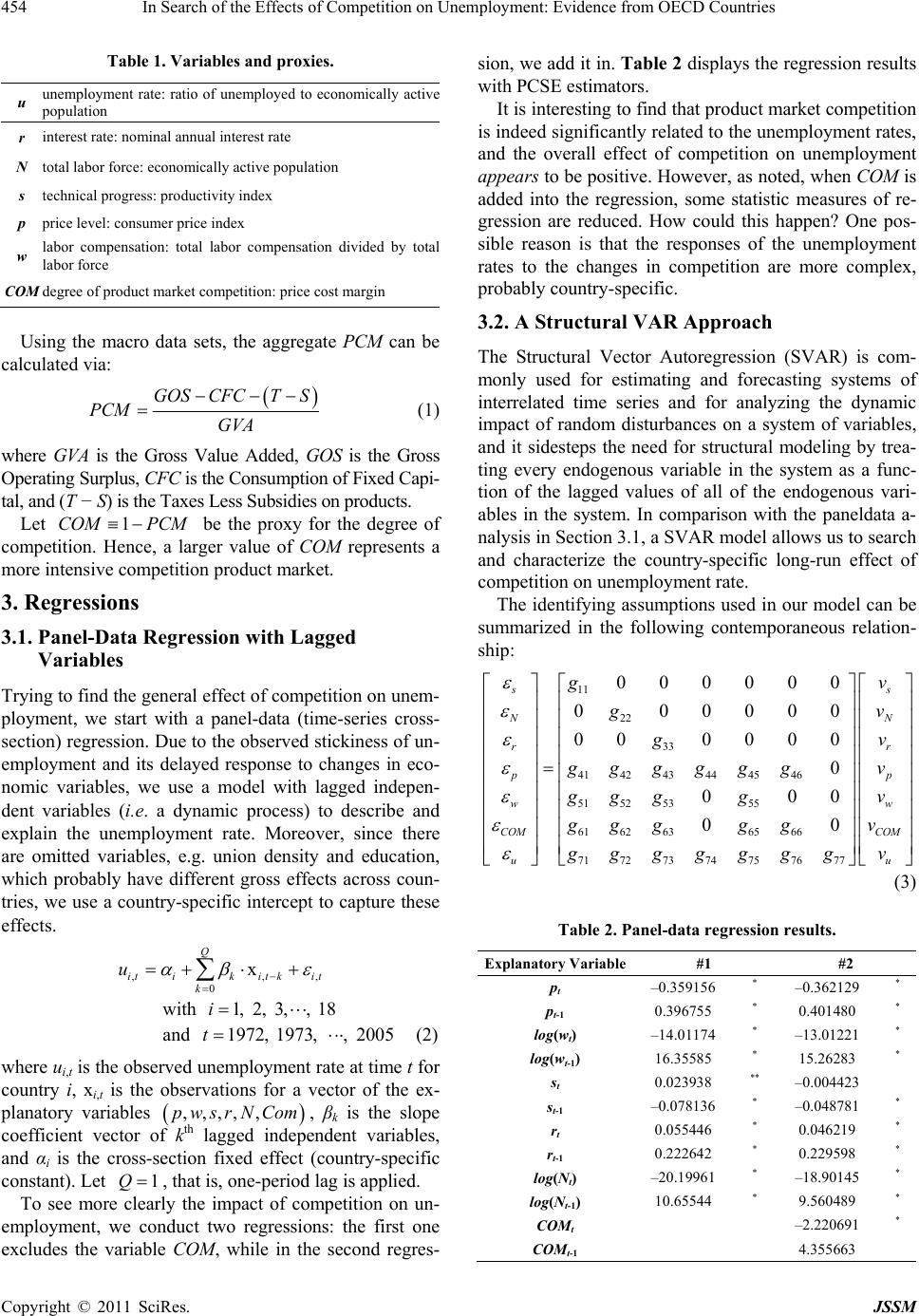 In Search of the Effects of Competition on Unemployment: Evidence from OECD Countries 454 Table 1. Variables and proxies. u unemployment rate: ratio of unemployed to economically active population r interest rate: nominal annual interest rate N total labor force: economically active population s technical progress: productivity index p price level: consumer price index w labor compensation: total labor compensation divided by total labor force COM degree of product market competition: price cost margin Using the macro data sets, the aggregate PCM can be calculated via: GOS CFCTS PCM GVA (1) where GVA is the Gross Value Added, GOS is the Gross Operating Surplus, CFC is the Consumption of Fixed Capi- tal, and (T − S) is the Taxes Less Subsidies on products. Let be the proxy for the degree of competition. Hence, a larger value of COM represents a more intensive competition product market. 1COM PCM 3. Regressions 3.1. Panel-Data Regression with Lagged Variables Trying to find the general effect of competition on unem- ployment, we start with a panel-data (time-series cross- section) regression. Due to the observed stickiness of un- employment and its delayed response to changes in eco- nomic variables, we use a model with lagged indepen- dent variables (i.e. a dynamic process) to describe and explain the unemployment rate. Moreover, since there are omitted variables, e.g. union density and education, which probably have different gross effects across coun- tries, we use a country-specific intercept to capture these effects. ,, 0 x Q itikit kit k u, 1, 2, 3,, 18i 1972, 1973, t with and (2) , 2005 where ui,t is the observed unemployment rate at time t for country i, xi,t is the observations for a vector of the ex- planatory variables , βk is the slope coefficient vector of kth lagged independent variables, and αi is the cross-section fixed effect (country-specific constant). Let , that is, one-period lag is applied. ,,,, ,pwsrNCom 1 Q To see more clearly the impact of competition on un- employment, we conduct two regressions: the first one excludes the variable COM, while in the second regres- sion, we add it in. Table 2 displays the regression results with PCSE estimators. It is interesting to find that product market competition is indeed significantly related to the unemployment rates, and the overall effect of competition on unemployment appears to be positive. However, as noted, when COM is added into the regression, some statistic measures of re- gression are reduced. How could this happen? One pos- sible reason is that the responses of the unemployment rates to the changes in competition are more complex, probably country-specific. 3.2. A Structural VAR Approach The Structural Vector Autoregression (SVAR) is com- monly used for estimating and forecasting systems of interrelated time series and for analyzing the dynamic impact of random disturbances on a system of variables, and it sidesteps the need for structural modeling by trea- ting every endogenous variable in the system as a func- tion of the lagged values of all of the endogenous vari- ables in the system. In comparison with the paneldata a- nalysis in Section 3.1, a SVAR model allows us to search and characterize the country-specific long-run effect of competition on unemployment rate. The identifying assumptions used in our model can be summarized in the following contemporaneous relation- ship: 11 22 33 4142 43 44 45 46 51 525355 61 62636566 7172 73 74 75 76 77 000000 0 00000 000000 0 000 00 s s N N r r p p w w COM COM u u gv gv gv gggggg v ggg gv ggg gg v ggggggg v (3) Table 2. Panel-data regression results. Explanatory Variable#1 #2 pt –0.359156 * –0.362129 * pt-1 0.396755 * 0.401480 * log(wt) –14.01174 * –13.01221 * log(wt-1) 16.35585 * 15.26283 * st 0.023938 ** –0.004423 st-1 –0.078136 * –0.048781 * rt 0.055446 * 0.046219 * rt-1 0.222642 * 0.229598 * log(Nt) –20.19961 * –18.90145 * log(Nt-1) 10.65544 * 9.560489 * COMt –2.220691 * COMt-1 4.355663 Copyright © 2011 SciRes. JSSM 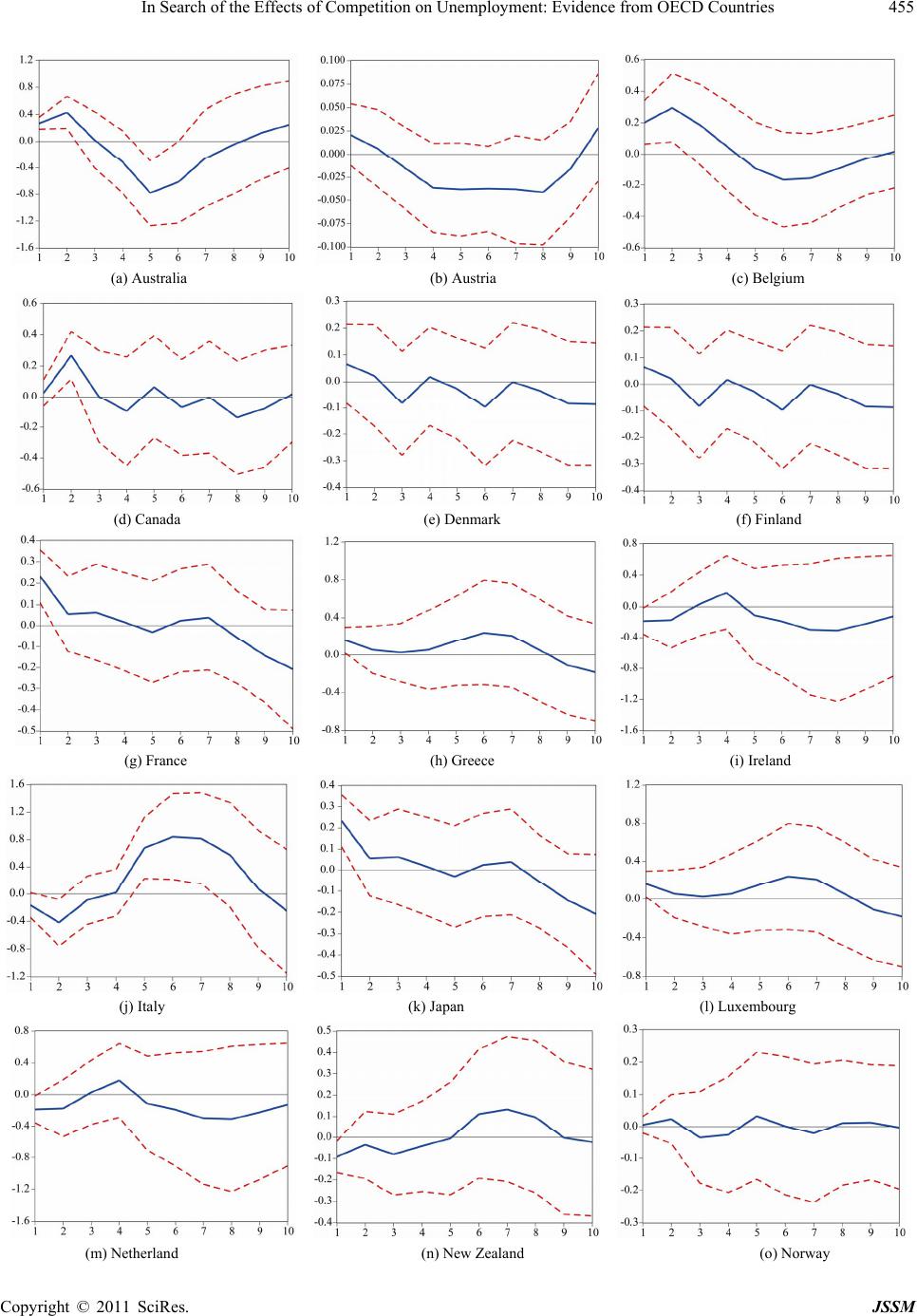 In Search of the Effects of Competition on Unemployment: Evidence from OECD Countries Copyright © 2011 SciRes. JSSM 455 (a) Australia (b) Austria (c) Belgium (d) Canada (e) Denmark (f) Finland (g) France (h) Greece (i) Ireland (j) Italy (k) Japan (l) Luxembourg (m) Netherland (n) New Zealand (o) Norway 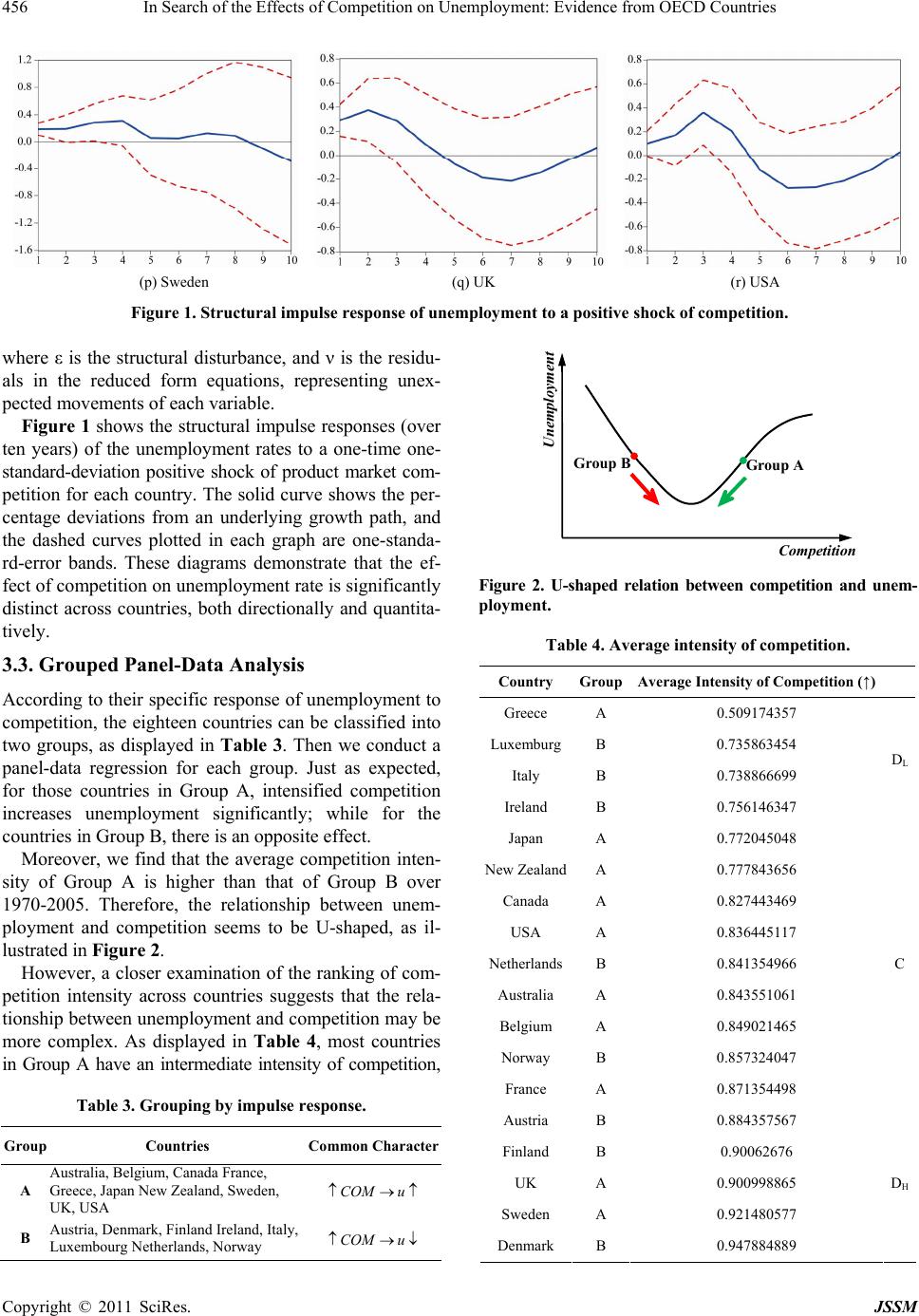 In Search of the Effects of Competition on Unemployment: Evidence from OECD Countries 456 (p) Sweden (q) UK (r) USA Figure 1. Structural impulse response of unemployment to a positive shock of competition. where ε is the structural disturbance, and ν is the residu- als in the reduced form equations, representing unex- pected movements of each variable. Figure 1 shows the structural impulse responses (over ten years) of the unemployment rates to a one-time one- standard-deviation positive shock of product market com- petition for each country. The solid curve shows the per- centage deviations from an underlying growth path, and the dashed curves plotted in each graph are one-standa- rd-error bands. These diagrams demonstrate that the ef- fect of competition on unemployment rate is significantly distinct across countries, both directionally and quantita- tively. 3.3. Grouped Panel-Data Analysis According to their specific response of unemployment to competition, the eighteen countries can be classified into two groups, as displayed in Table 3. Then we conduct a panel-data regression for each group. Just as expected, for those countries in Group A, intensified competition increases unemployment significantly; while for the countries in Group B, there is an opposite effect. Moreover, we find that the average competition inten- sity of Group A is higher than that of Group B over 1970-2005. Therefore, the relationship between unem- ployment and competition seems to be U-shaped, as il- lustrated in Figure 2. However, a closer examination of the ranking of com- petition intensity across countries suggests that the rela- tionship between unemployment and competition may be more complex. As displayed in Table 4, most countries in Group A have an intermediate intensity of competition, Table 3. Grouping by impulse response. Group Countries Common Character A Australia, Belgium, Canada France, Greece, Japan New Zealand, Sweden, UK, USA COM u Unemployment Competition Group B Group A Figure 2. U-shaped relation between competition and unem- ployment. Table 4. Average intensity of competition. Country GroupAverage Intensity of Competition (↑) Greece A 0.509174357 LuxemburgB 0.735863454 Italy B 0.738866699 Ireland B 0.756146347 DL Japan A 0.772045048 New ZealandA 0.777843656 Canada A 0.827443469 USA A 0.836445117 NetherlandsB 0.841354966 Australia A 0.843551061 Belgium A 0.849021465 Norway B 0.857324047 France A 0.871354498 C Austria B 0.884357567 Finland B 0.90062676 UK A 0.900998865 Sweden A 0.921480577 Denmark B 0.947884889 DH B Austria, Denmark, Finland Ireland, Italy, Luxembourg Netherlands, Norway COM u Copyright © 2011 SciRes. JSSM 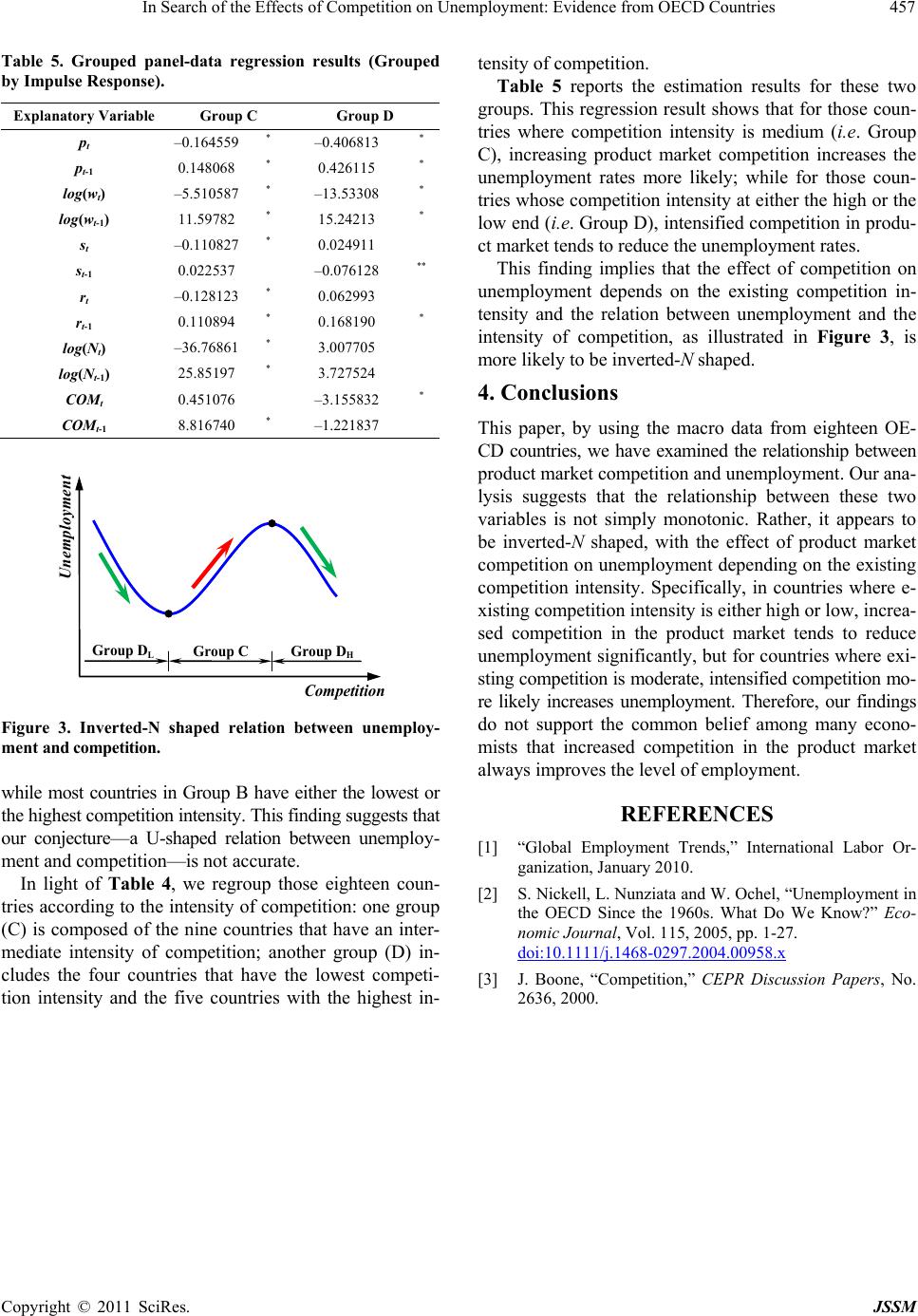 In Search of the Effects of Competition on Unemployment: Evidence from OECD Countries457 Table 5. Grouped panel-data regression results (Grouped by Impulse Response). Explanatory Variable Group C Group D pt –0.164559 * –0.406813 * pt-1 0.148068 * 0.426115 * log(wt) –5.510587 * –13.53308 * log(wt-1) 11.59782 * 15.24213 * st –0.110827 * 0.024911 st-1 0.022537 –0.076128 ** rt –0.128123 * 0.062993 rt-1 0.110894 * 0.168190 * log(Nt) –36.76861 * 3.007705 log(Nt-1) 25.85197 * 3.727524 COMt 0.451076 –3.155832 * COMt-1 8.816740 * –1.221837 Unemploymen t Group C Group D H Group D L Competition Figure 3. Inverted-N shaped relation between unemploy- ment and competition. while most countries in Group B have either the lowest or the highest competition intensity. This finding suggests that our conjecture—a U-shaped relation between unemploy- ment and competition—is not accurate. In light of Table 4, we regroup those eighteen coun- tries according to the intensity of competition: one group (C) is composed of the nine countries that have an inter- mediate intensity of competition; another group (D) in- cludes the four countries that have the lowest competi- tion intensity and the five countries with the highest in- tensity of competition. Table 5 reports the estimation results for these two groups. This regression result shows that for those coun- tries where competition intensity is medium (i.e. Group C), increasing product market competition increases the unemployment rates more likely; while for those coun- tries whose competition intensity at either the high or the low end (i.e. Group D), intensified competition in produ- ct market tends to reduce the unemployment rates. This finding implies that the effect of competition on unemployment depends on the existing competition in- tensity and the relation between unemployment and the intensity of competition, as illustrated in Figure 3, is more likely to be inverted-N shaped. 4. Conclusions This paper, by using the macro data from eighteen OE- CD countries, we have examined the relationship between product market competition and unemployment. Our ana- lysis suggests that the relationship between these two variables is not simply monotonic. Rather, it appears to be inverted-N shaped, with the effect of product market competition on unemployment depending on the existing competition intensity. Specifically, in countries where e- xisting competition intensity is either high or low, increa- sed competition in the product market tends to reduce unemployment significantly, but for countries where exi- sting competition is moderate, intensified competition mo- re likely increases unemployment. Therefore, our findings do not support the common belief among many econo- mists that increased competition in the product market always improves the level of employment. REFERENCES [1] “Global Employment Trends,” International Labor Or- ganization, January 2010. [2] S. Nickell, L. Nunziata and W. Ochel, “Unemployment in the OECD Since the 1960s. What Do We Know?” Eco- nomic Journal, Vol. 115, 2005, pp. 1-27. doi:10.1111/j.1468-0297.2004.00958.x [3] J. Boone, “Competition,” CEPR Discussion Papers, No. 2636, 2000. Copyright © 2011 SciRes. JSSM |