

Paper Menu >>
Journal Menu >>
 Applied Mathematics, 2011, 2, 1432-1436 doi:10.4236/am.2011.212202 Published Online December 2011 (http://www.SciRP.org/journal/am) Copyright © 2011 SciRes. AM Approximate Analytical Solutions for the Nonlinear Brinkman-Forchheimer-Extended Darcy Flow Model Basant K. Jha1, Muhammad L. Kaurangini2* 1Department of Mathematics, Ahmadu Bello University, Zaria, Nigeria 2Department of Mathematical Sciences, Kano University of Science and Technology, Wudil, Nigeria E-mail: *[email protected] Received September 6, 2011; revised November 6, 2011; accepted November 13, 2011 Abstract New approximate analytical solutions for steady flow in parallel-plates channels filled with porous materials governed by non-linear Brinkman-Forchheimer extended Darcy model for three different physical situations are presented. These results are compared with those obtained from an implicit finite-difference solution of the corresponding time dependent flow problem. It is seen that the time dependent flow solutions yield the almost same steady state values as obtained by using the new approximate analytical solutions Keywords: Non-Linear, Darcy, Time Dependent Flow, Steady State 1. Introduction The behaviour of fluid flow in porous media has achi- eved considerab le attention due to its important practical applications. Applications include packed-bed catalytic reactor, geothermal reservoir, drying of porous solids, shell-side flow model in shell-and tube heat exchanger, petroleum resources and many others. Reference [1] and [2] studied the mixed convection flow problems in porous media based on the model of Darcy law. For flow through the porous media with solid boundary, [3] pro- posed the classical boundary term in addition to Darcy’s law. This Brinkman-extended Darcy model analyzed the no slip boundary condition at the wall and showed that although the wall shear resistance has little influence on the pressure drop, it has drastic effects on stream-wise velocity component and heat transfer rate at the interface between porous media and solid boundary. In many modern applications, porous media are cha- racterized by high velocities, i.e., the Reynolds number based on mean pore size is grater than unity. In such cases, it is necessary to account for deviation from li- nearity in the momentum equation for porous media. This deviation is accounted for by the Forchheimer term representing the quadratic drag which is essential for lar- ge particle Reynolds numbers. From the physical point quadratic drag appears in the momentum equation for porous media because of large filtration velocities, the form drag due to the solid obstacles becomes comparable with the surface drag due to friction [4]. Reference [5] also presented a closed form solution of the Brinkman-Forchheimer-extended Darcy momentum equation and the associated heat transfer equation for the case of fully developed flow with uniform heat flux at the boundary. They assumed a boundary-layer-type de- veloped flow and as a consequence their solution is inac- curate when the inertia parameter is small and Darcy number approaches and exceeds the value of unity. Refe- rence [ 6] reco nsidered th e analysis pr esented in [5] with- out invoking their boundary-layer assumption and de- rived a more general theoretical solution. Recent results on the model (Brinkman-Forchheimer extended Darcy) presented are in [7-10]. In all the resu lts presented above, no attempt was made to solve the non- linear equations analytically. In the present work, flow formation in a parallel plate channels filled with a fluid saturated porous media is analyzed analytically and numerically. The flow is des- cribed by the Brinkman-Forchheimer extended Darcy equation. 2. Mathematical Model The physical problem under consideration consists of a steady laminar fully developed flow between two infi- nitely long horizontal parallel plates filled with porous material. The flow formation is caused either by pressure gradient or (and) by the movement of one of the bound- ing plates. The fluid is assumed to be Newtonian with uniform properties and the porous medium is isotropic 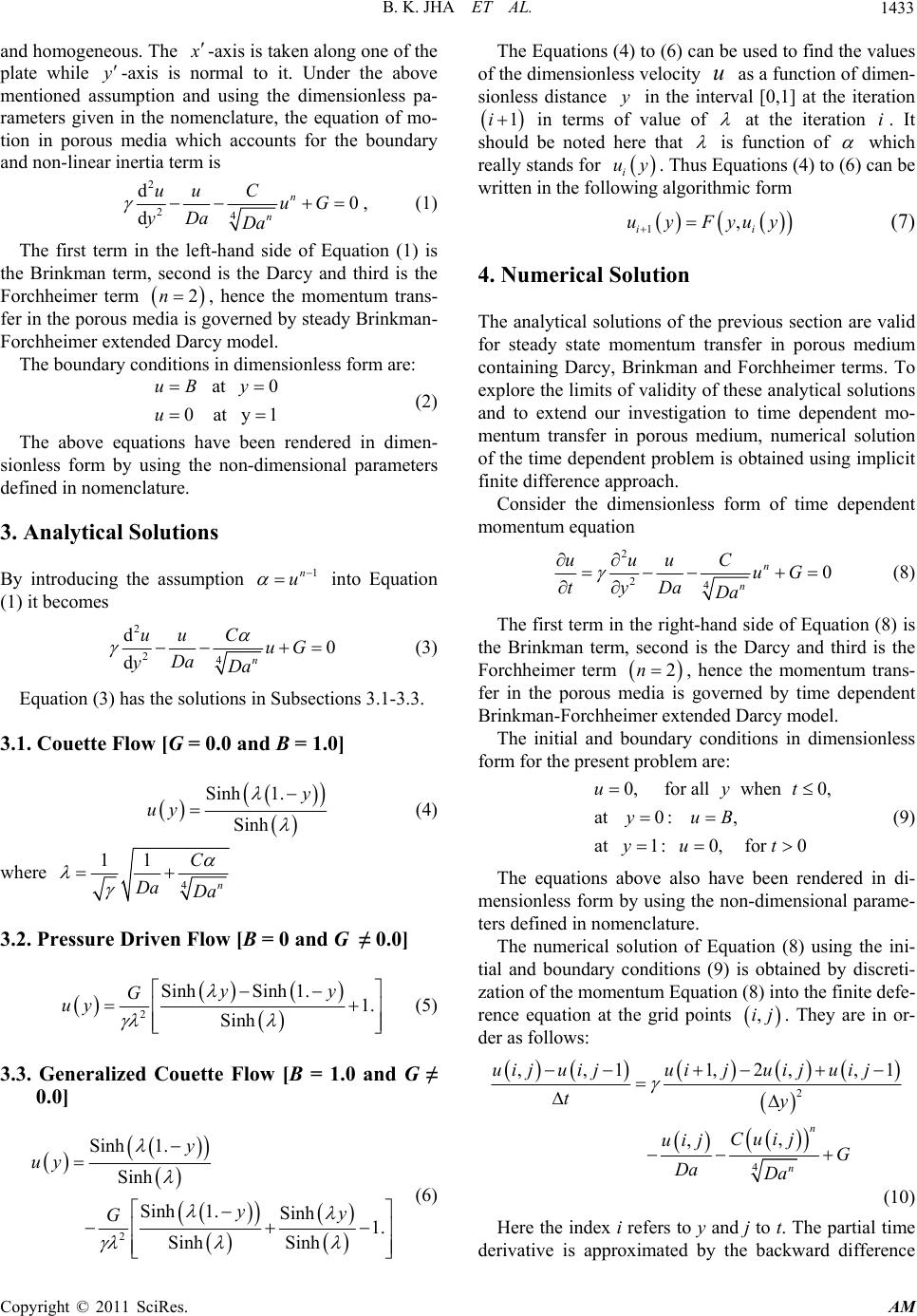 B. K. JHA ET AL.1433 and homogeneous. The x -axis is taken along one of the plate while -axis is normal to it. Under the above mentioned assumption and using the dimensionless pa- rameters given in the nomenclature, the equation of mo- tion in porous media which accounts for the boundary and non-linear inertia term is y 2 24 d0 d n n uu C uG Da yDa , (1) The first term in the left-hand side of Equation (1) is the Brinkman term, second is the Darcy and third is the Forchheimer term 2n, hence the momentum trans- fer in the porous media is governed by steady Brinkman- Forchheimer extended Darcy model. The boundary conditions in dimensionless form are: at 0 0 at y1 uB y u (2) The above equations have been rendered in dimen- sionless form by using the non-dimensional parameters defined in nomenclature. 3. Analytical Solutions By introducing the assumption into Equation (1) it becomes 1n u 2 24 d0 dn uu CuG Da yDa (3) Equation (3) has the so lutions in Subsections 3.1-3.3. 3.1. Couette Flow [G = 0.0 and B = 1.0] Sinh 1. Sinh y uy (4) where 4 11 n C Da Da 3.2. Pressure Driven Flow [B = 0 and G ≠ 0.0] 2 SinhSinh 1.1. Sinh yy G uy (5) 3.3. Generalized Couette Flow [B = 1.0 and G ≠ 0.0] 2 Sinh 1. Sinh Sinh 1.Sinh 1. Sinh Sinh y uy yy G The Equations (4) to (6) can be used to find the values of the dimensionless velocity as a function of dimen- sionless distance in the interval [0,1] at the iteration u y 1i in terms of value of at the iteration . It should be noted here that i is function of which really stands for y i u. Thus Equation s (4 ) to (6) can be written in the following algorithmic form 1, i uyFyuy i (7) 4. Numerical Solution The analytical solutions of the previous section are valid for steady state momentum transfer in porous medium containing Darcy, Brinkman and Forchheimer terms. To explore the limits of validity of these analytical solutions and to extend our investigation to time dependent mo- mentum transfer in porous medium, numerical solution of the time dependent problem is obtained using implicit finite difference approach. Consider the dimensionless form of time dependent momentum equation 2 240 n n uuuC uG tDa yDa (8) The first term in the right-hand side of Equation (8) is the Brinkman term, second is the Darcy and third is the Forchheimer term 2n , hence the momentum trans- fer in the porous media is governed by time dependent Brinkman-Forchheimer extended Darcy model. The initial and boundary conditions in dimensionless form for the present problem are: 0, for all when 0, at 0: , at1: 0, for 0 uy yuB yu t t (9) The equations above also have been rendered in di- mensionless form by using the non-dimensional parame- ters defined in nomenclature. The numerical solution of Equation (8) using the ini- tial and boundary conditions (9) is obtained by discreti- zation of the momentum Equation (8) into the finite defe- rence equation at the grid points . They are in or- der as follows: ,ij (6) 2 4 ,,1 1,2,, , ,n n uij uijuijuij uij ty Cui j uij G Da Da 1 (10) Here the index i refers to y and j to t. The partial time derivative is approximated by the backward difference Copyright © 2011 SciRes. AM 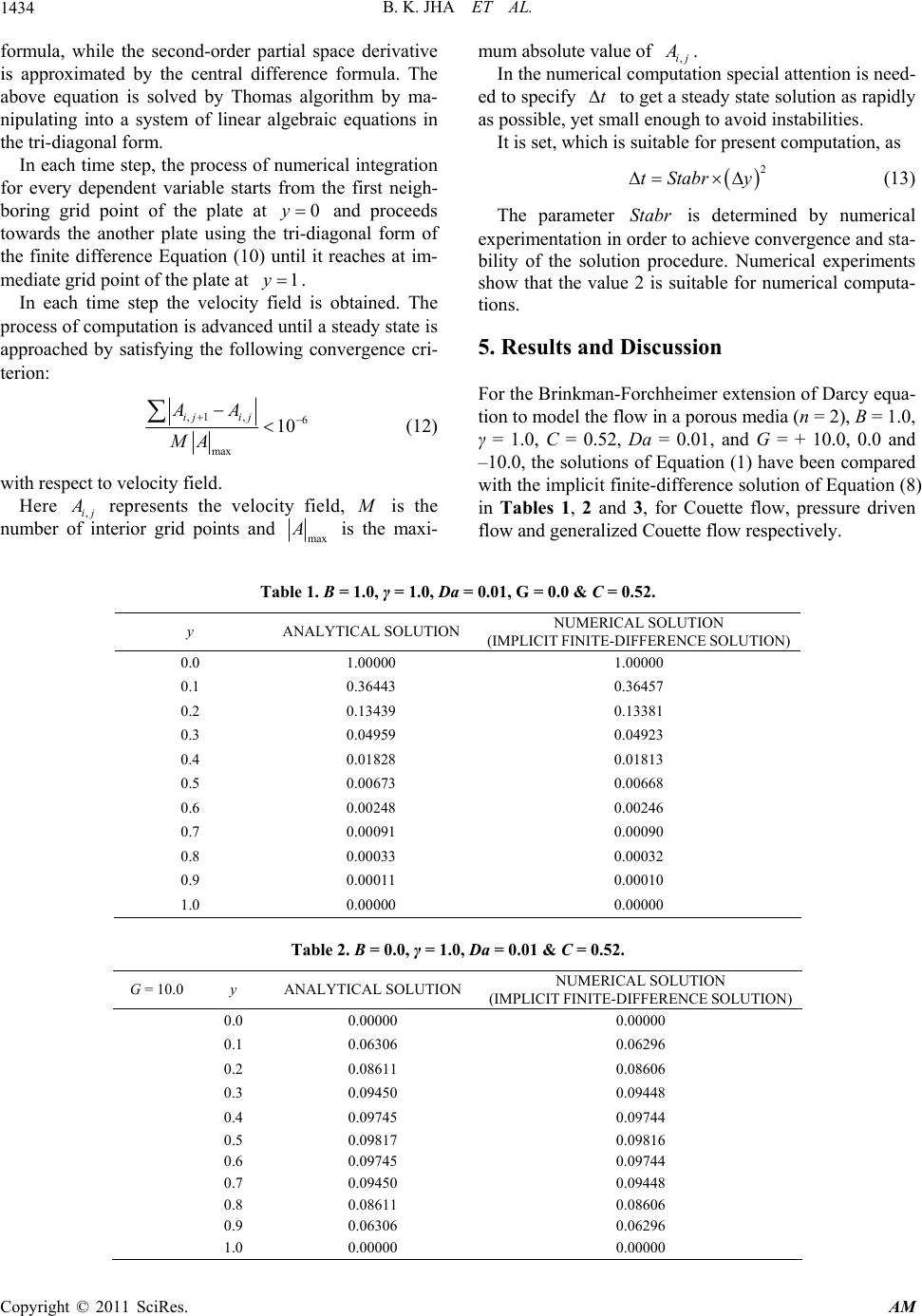 B. K. JHA ET AL. Copyright © 2011 SciRes. AM 1434 formula, while the second-order partial space derivative is approximated by the central difference formula. The above equation is solved by Thomas algorithm by ma- nipulating into a system of linear algebraic equations in the tri-diagonal form. In each time step, the process of numerical integratio n for every dependent variable starts from the first neigh- boring grid point of the plate at and proceeds towards the another plate using the tri-diagonal form of the finite difference Equation (10) until it reaches at im- 0y mediate grid point of the plate at . 1y In each time step the velocity field is obtained. The process of computation is advanced until a steady state is approached by satisfying the following convergence cri- terion: ,1 ,6 max 10 ij ij AA MA (12) with respect to velocity field. Here ,ij A represents the velocity field, M is the number of interior grid points and max A is the maxi- mum absolute value of ,ij A . In the numerical computation special attention is need- ed to specify t to get a steady state solution as rapidly as possible, yet small enough to avoid instabilities. It is set, which is suitable for present computation, as 2 tStabr y (13) The parameter is determined by numerical experimentation in order to achieve convergence and sta- bility of the solution procedure. Numerical experiments show that the value 2 is suitable for numerical computa- tions. Stabr 5. Results and Discussion For the Brinkman-Forchheimer extension of Darcy equa- tion to model the flow in a porous media (n = 2), B = 1.0, γ = 1.0, C = 0.52, Da = 0.01, and G = + 10.0, 0.0 and –10.0, the solutions of Equation (1) have been compared with the implicit finite-difference solution of Equation (8) in Tables 1, 2 and 3, for Couette flow, pressure driven flow and generalized Couette flow respectively. Table 1. B = 1.0, γ = 1.0, Da = 0.01, G = 0.0 & C = 0.52. y ANALYTICAL SOLUT ION NUMERICAL SOLUTION (IMPLICIT FINITE-DIFFERENCE SOLUTION) 0.0 1.00000 1.00000 0.1 0.36443 0.36457 0.2 0.13439 0.13381 0.3 0.04959 0.04923 0.4 0.01828 0.01813 0.5 0.00673 0.00668 0.6 0.00248 0.00246 0.7 0.00091 0.00090 0.8 0.00033 0.00032 0.9 0.00011 0.00010 1.0 0.00000 0.00000 Table 2. B = 0.0, γ = 1.0, Da = 0.01 & C = 0.52. G = 10.0 y ANALYTICAL S OLUT ION NUMERICAL SOLUTION (IMPLICIT FINITE-DIFFERENCE SOLUTION) 0.0 0.00000 0.00000 0.1 0.06306 0.06296 0.2 0.08611 0.08606 0.3 0.09450 0.09448 0.4 0.09745 0.09744 0.5 0.09817 0.09816 0.6 0.09745 0.09744 0.7 0.09450 0.09448 0.8 0.08611 0.08606 0.9 0.06306 0.06296 1.0 0.00000 0.00000 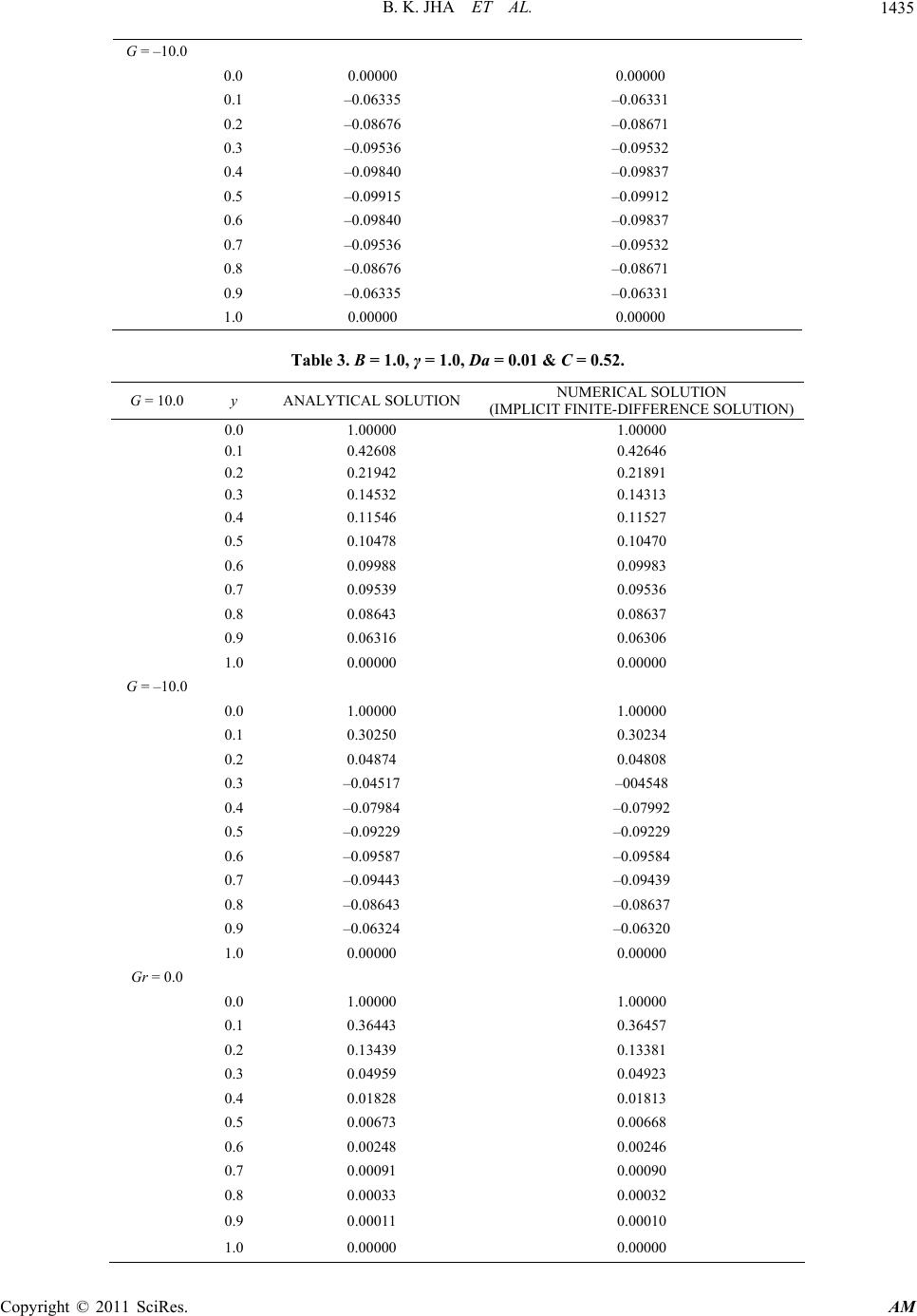 B. K. JHA ET AL.1435 G = –10.0 0.0 0.00000 0.00000 0.1 –0.06335 –0.06331 0.2 –0.08676 –0.08671 0.3 –0.09536 –0.09532 0.4 –0.09840 –0.09837 0.5 –0.09915 –0.09912 0.6 –0.09840 –0.09837 0.7 –0.09536 –0.09532 0.8 –0.08676 –0.08671 0.9 –0.06335 –0.06331 1.0 0.00000 0.00000 Table 3. B = 1.0, γ = 1.0, Da = 0.01 & C = 0.52. G = 10.0 y ANALYTICAL SOLUTION NUMERICAL SOLUTION (IMPLICIT FINIT E-DIFFERENCE SOLU TION) 0.0 1.00000 1.00000 0.1 0.42608 0.42646 0.2 0.21942 0.21891 0.3 0.14532 0.14313 0.4 0.11546 0.11527 0.5 0.10478 0.10470 0.6 0.09988 0.09983 0.7 0.09539 0.09536 0.8 0.08643 0.08637 0.9 0.06316 0.06306 1.0 0.00000 0.00000 G = –10.0 0.0 1.00000 1.00000 0.1 0.30250 0.30234 0.2 0.04874 0.04808 0.3 –0.04517 –004548 0.4 –0.07984 –0.07992 0.5 –0.09229 –0.09229 0.6 –0.09587 –0.09584 0.7 –0.09443 –0.09439 0.8 –0.08643 –0.08637 0.9 –0.06324 –0.06320 1.0 0.00000 0.00000 Gr = 0.0 0.0 1.00000 1.00000 0.1 0.36443 0.36457 0.2 0.13439 0.13381 0.3 0.04959 0.04923 0.4 0.01828 0.01813 0.5 0.00673 0.00668 0.6 0.00248 0.00246 0.7 0.00091 0.00090 0.8 0.00033 0.00032 0.9 0.00011 0.00010 1.0 0.00000 0.00000 Copyright © 2011 SciRes. AM  B. K. JHA ET AL. Copyright © 2011 SciRes. AM 1436 From the results presented in Tables, it can be noticed that the approximate analytical solutions presented in this work, though it is simple, it gives good and accurate re- sults, and hence it can be efficiently used to solve this class of nonlinear differential equation models. 6. References [1] W. J. Minkowycz, P. Cheng and R. N. Hirschberg, “Non- similar Boundary Layer Analysis of Mixed Convection about a Horizontal Heated Surface in a Fluid—Saturated Porous Medium,” International Communications in Heat and Mass Transfer, Vol. 11, 1984, pp. 127-141. doi:10.1016/0735-1933(84)90017-4 [2] M. P. Cheng and C. H. Chang, “Mixed Convection about a Nonisothermal Cylinder and Sphere in a Porous Me- dium,” Numerical Heat and Mass Transfer, Vol. 8, 1985, pp. 349-359. [3] H. C. Brinkman, “A Calculation of the Viscous Force Exerted by a Flowing Fluid on a Dence Swarm of Parti- cles,” Applied Scientific Research, Vol. 1, No. 1, 1949, pp. 727-734. [4] D. A. Nield and A. Bejan, “Convection in Porous Me- dia,” Springer-Verlag, New York, 1992. [5] K. Vafai and S. J. Kim, “Forced Convection in a Channel filled with a Porous Medium: An Exact Solution,” Tran- sactions of the ASME (American Society of Mechanical Engineers) Series C: Journal of Heat Transfer, Vol. 111, No. 4, 1989, pp. 1103-1106. doi:10.1115/1.3250779 [6] D. A. Nield, S. L. M. Junqueira and J. L. Lage, “Forced Convection in a Fluid-Saturated Porous-Medium Channel with Isothermal or Iso-Flux Boundaries,” Journal of Fluid Mechanics, Vol. 322, 1996, pp. 201-214. doi:10.1017/S0022112096002765 [7] M. A. Al-Nimr and T. K. Aldoss, “The Effect of the Mac- roscopic Local Inertial Term on the Non-Newtonian Fluid Flow in Channels Filled with Porous Medium,” Interna- tional Journal of Heat and Mass Transfer, Vol. 47, 2004, pp. 125-133. doi:10.1016/S0017-9310(03)00382-X [8] B. A. Abu-Hijleh and M. A. Al-Nimr, “The Effect of the Local Inertial Term on the Fluid Flow in Channels Par- tially Filled with Porous Material,” International Journal of Heat Mass Transfer, Vol. 44, No. 8, 2001, pp. 1565- 1572. doi:10.1016/S0017-9310(00)00207-6 [9] A. F. Khadrawi and M. A. Al-Nimr, “The Effect of the Local Inertial Term on the Free Convection Fluid Flow in Vertical Channels Partially Filled with Porous Media,” Journal of Porous Media, Vol. 6, No. 1, 2003, pp. 1-12. doi:10.1615/JPorMedia.v6.i1.40 [10] M. L. Kaurangini and B. K. Jha, “Effect of Inertial on Generalized Couette Flow in Composite Parallel Plates with Uniform Porous Medium in the Presence of Suction and Injection,” International Journal of Modelling, Simu- lation and Control (AMSE), 2011, Article in Press. Nomenclature d d p x axial pressure gradient Darcy number, 2 K H Da dimensionless pressu re gra die nt, 3 2 d d H p x u velocity of the fluid G dimensionless velocity of the fluid, uH u H total width of the channel ydimensional co-ordinate t dimensional time dimensionless co-ordinate, y H dimensionless tim e , 2 t H yt nindex Greek symbols eff effective kinematics viscosity of porous medium Cinertia coefficient C = dimensionless inertia coefficient, 3 3 22 n n CH kinematics viscosity of fluid ratio of kinematics viscosity G = dimensionless axial pressure gradient 0 Umotion of the channel wall at 0y Bdimensionless m otion of the channel wall at 0y Kpermeability of the porous medium |