

Paper Menu >>
Journal Menu >>
 World Journal of AIDS, 2011, 1, 139-145 doi:10.4236/wja.2011.14020 Published Online December 2011 (http://www.SciRP.org/journal/wja) Copyright © 2011 SciRes. WJA 139 The Impact of Depressive Symptoms on Neuropsychological Performance Tests in HIV-Infected Individuals: A Study of the Hawaii Aging with HIV Cohort Sheri M. Shimizu1, Dominic C. Chow1*, Victor Valcour1,2, Kamal Masaki3, Beau Nakam o to1,4, Kalpana J. Kallianpur1, Cecil i a Sh i k u m a 1 1Hawaii Center for AIDS, John A. Burns School of Medicine, University of Hawaii at Manoa, Honolulu, USA; 2Department of Neu- rology and Division of Geriatric Medicine, Memory and Aging Center, Department of Medicine, University of California at San Francisco, San Francisco, USA; 3Geriatric Medicine, John A. Burns School of Medicine, University of Hawaii, Honolulu, USA; 4Department of Neurology, Straub Clinic and Hospital, Honolulu, USA. E-mail: *[email protected] Received August 19th, 2011; revised October 8th, 2011; accepted October 24th, 2011. ABSTRACT Background: The frequency of neurocognitive impairment (NCI) in human immunodeficiency virus (HIV)-infected in- dividuals remains high despite the availability of potent antiretroviral therapy (ART). The concurrence of depression among HIV-infected patients with NCI is common, especially among older individuals. Depression has been implicated as a risk factor for impaired neuropsychological performance (NP). This study explored the relationship between de- pressive symptoms and NP testing in HIV-infected individuals. Methods: A cross-sectional analysis was performed within the Hawaii Aging with HIV Cohort, a large prospective study of cognition of older (50 or more years old) com- pared to younger (20 to 39 years old) HIV-infected individuals. Results: Two hundred and eighty-five HIV infected par- ticipants (157 older and 128 younger) were administered a battery of NP tests to measure performance in major cogni- tive domains. Depressive symptoms were measured using the Beck Depression Inventory (BDI). The rates of depressive symptoms and neuropsychological impairment were similar in older and younger groups. Multivariate analyses re- vealed depressive symptoms were associated with NP test impairment in the younger group. In the older group, depres- sive symptoms were not associated with NP. Conclusion: This study suggests that depressive symptoms are associated with NP test impairment in younger HIV-infected individuals, but not in older individuals. Keywords: Depression, HIV, Neurocognitive Function, Aging 1. Background The frequency of neurocognitive impairment (NCI) in human immunodeficiency virus (HIV)-infected individu- als remains high despite the availability of potent anti- retroviral therapy (ART). Neuropsychological perform- ance (NP) testing provides diagnostic clarification and grading of clinical severity for patients with subtle or obvious cognitive disorders. This testing provides clini- cal classification as to whether a HIV-infected patient may have HIV associated neurocognitive disorder (HAND) and dementia. Depression has been implicated as a risk factor for impaired NP in HIV individuals and has been shown to cause poor concentration, lack of in- terest and apathy towards NP testing [1-6]. Studies have found an association between subtypes of depressive symptoms and cognitive deficits [5,7]. However, incon- sistencies are present with some studies demonstrating that depressive symptoms do not influence NP testing [8-12]. Few studies in the era of highly active antiretro- viral therapy (HAART) have looked at depression in aging HIV populations. Depression is commonly observed in HIV-infected in- dividuals, where the prevalence is estimated to be over 36% [1,13]. Among older HIV-infected patients, depres- sion is the second most prevalent behavioral health issues [14]. Aging is a potential risk factor for depression and  The Impact of Depressive Symptoms on Neuropsychological Performance Tests in HIV-Infected Individuals: 140 A Study of the Hawaii Aging with HIV Cohort neuropsychological impairment. Individuals with HIV today have a longer life expectancy with more than 114,951 individuals with AIDS over the age of 50 cur- rently living in the United States [15]. There is limited data on neuropsychological functioning in older HIV infected individuals. Previous studies have found a higher frequency of dementia in older HIV infected indi- viduals and that older adults may be at greater risk of NCI [16,17]. The importance of furthering our under- standing of the impact of aging and depression on NP testing is necessitated by the growing population of older HIV infected individuals. The changing nature of HIV treatment and longer pa- tient survival highlight the need to re-evaluate these rela- tionships in aging cohorts. This study evaluated the rela- tionship between depressive symptoms using the Beck Depression Inventory (BDI) and NP tests in a well- characterized cohort of older and younger HIV-infected individuals. 2. Methods 2.1. Study Population—Hawaii Aging with HIV Cohort The analyses utilized baseline (entry) data from the Ha- waii Aging with HIV Cohort study (HAHC), a longitudi- nal cohort study assessing cognitive and neurologic out- comes in older compared to younger HIV-infected indi- viduals [16]. Briefly, 158 older (50 years of age or older) and 128 younger (20 - 39 years of age) HIV-infected individuals were recruited between October 2001 to Oc- tober 2005. Major exclusion criteria were the following: 1) head injury with loss of consciousness greater than 1 hour, 2) opportunistic brain infection, 3) learning disabil- ity, 4) major neurologic disease such as multiple sclerosis, major stroke, or current delirium, and 5) diagnosed major psychiatric disorder including bipolar illness, schizo- phrenia, or active major depression at baseline based on DSM-IV criteria. All individuals identified English as their primary language of communication. Most partici- pants were Caucasian, and all were living in Hawaii at the time of enrollment and were recruited from all major islands of Hawaii. 2.2. Neuropsychological Performance Tests Participant evaluations included the macro-neurologic examination, neuropsychological testing, medical intake with record of co-morbid illnesses, demographic data, risk behavior inventory, HIV laboratory parameters, and medication histories. The 80-minute neuropsychological battery designed to assess multiple cognitive domains most affected by HIV was administered and included the following: Choice and Sequential Reaction Time (Cal- Cap), Rey Auditory Verbal Learning Test (RAVLT), Rey-Osterreith Complex Figure Test (RCF), Trail Mak- ing Tests A and B, WAIS-R Digit Symbol, Grooved Pegboard, Timed Gait, Odd Man Out, FAS, Animal Naming, Boston Naming Test (BNT), and WAIS-R Digit Span. The Human Subjects Review Committee of the University of Hawaii approved the study protocol, and all subjects signed a written informed consent prior to entry. Raw scores from the neuropsychological tests were transformed to standardized z-scores using published age- and education-matched normative datasets, as pre- viously described [16]. Four composite neuropsycholo- gical indices were examined in the present study, includ- ing 1) Psychomotor (Grooved Pegboard Non-Dominant hand, Digit Symbol subtest from the WAIS-R, and Trail Making Test Trial B), 2) Memory (RAVLT Trial De- layed Recall Trial, Rey Complex Figure Test Delayed Recall, and the RAVLT Trial 5 minus Immediate Recall) 3) and a global NPZ-8 score. We used the NPZ8 score, a summary measure of neuropsychological testing per- formance and cognitive diagnostic categorizations for NCI and HIV-associated dementia as determined by a consensus conference with neurologists and neuropsy- chologists based on the American Academy of Neurol- ogy 1991 criteria [18]. The NPZ-8 score is defined as the average of z-scores for Timed Gait, Grooved Pegboard Dominant hand, Grooved Pegboard Non-Dominant hand, Trail Making Tests Parts A and B, the Digit Symbol subtest from the WAIS-R, and the Choice and Sequential Reaction Time trials from the CalCap test battery. This common composite score was first reported to relate to cognitive improvement following AZT treatment [19]. Our version substitutes the Choice and Sequential reac- tion times from the CalCap test for the Finger Tapping tests. For participants over the age of 60, the NPZ-8 score did not include the CalCap tests due to limited normative data for this age group (n = 18). 2.3. Beck Depression Inventory The Beck Depression Inventory (BDI) was used to assess the presence and severity of depressive symptoms. The BDI has high validity and reliability in measuring de- pressive symptoms and takes approximately [20]. In this self-completed questionnaire, participants are asked to rate 21 items from zero to three according to how they have felt during the past week. 2.4. Statistical Considerations All statistical analyses were carried out on SAS v9.1 (SAS Institute Inc., Cary, NC). Group differences in con- tinuous outcome variables were analyzed using two- Copyright © 2011 SciRes. WJA 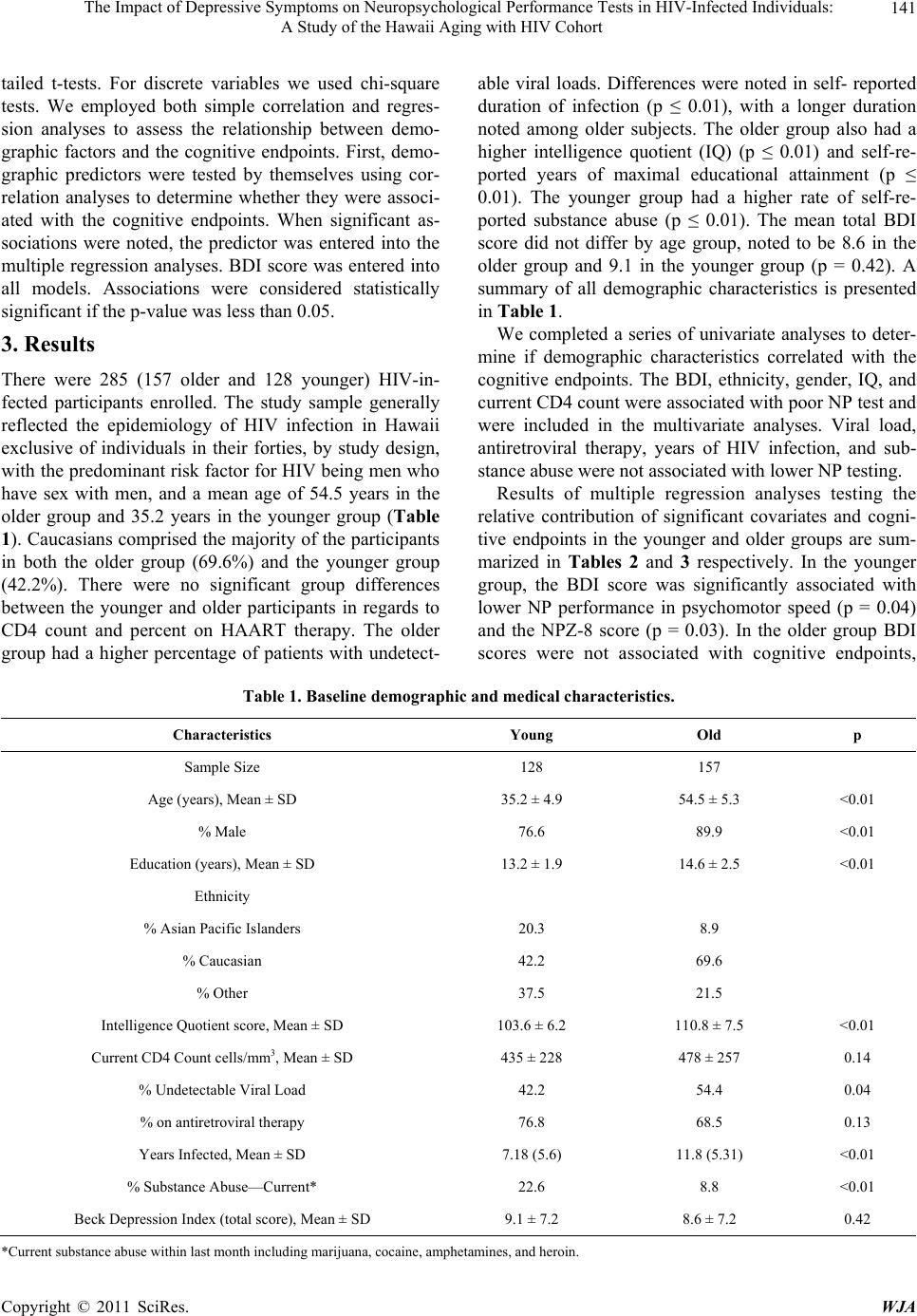 The Impact of Depressive Symptoms on Neuropsychological Performance Tests in HIV-Infected Individuals: A Study of the Hawaii Aging with HIV Cohort Copyright © 2011 SciRes. WJA 141 tailed t-tests. For discrete variables we used chi-square tests. We employed both simple correlation and regres- sion analyses to assess the relationship between demo- graphic factors and the cognitive endpoints. First, demo- graphic predictors were tested by themselves using cor- relation analyses to determine whether they were associ- ated with the cognitive endpoints. When significant as- sociations were noted, the predictor was entered into the multiple regression analyses. BDI score was entered into all models. Associations were considered statistically significant if the p-value was less than 0.05. 3. Results There were 285 (157 older and 128 younger) HIV-in- fected participants enrolled. The study sample generally reflected the epidemiology of HIV infection in Hawaii exclusive of individuals in their forties, by study design, with the predominant risk factor for HIV being men who have sex with men, and a mean age of 54.5 years in the older group and 35.2 years in the younger group (Table 1). Caucasians comprised the majority of the participants in both the older group (69.6%) and the younger group (42.2%). There were no significant group differences between the younger and older participants in regards to CD4 count and percent on HAART therapy. The older group had a higher percentage of patients with undetect- able viral loads. Differences were noted in self- reported duration of infection (p ≤ 0.01), with a longer duration noted among older subjects. The older group also had a higher intelligence quotient (IQ) (p ≤ 0.01) and self-re- ported years of maximal educational attainment (p ≤ 0.01). The younger group had a higher rate of self-re- ported substance abuse (p ≤ 0.01). The mean total BDI score did not differ by age group, noted to be 8.6 in the older group and 9.1 in the younger group (p = 0.42). A summary of all demographic characteristics is presented in Table 1. We completed a series of univariate analyses to deter- mine if demographic characteristics correlated with the cognitive endpoints. The BDI, ethnicity, gender, IQ, and current CD4 count were associated with poor NP test and were included in the multivariate analyses. Viral load, antiretroviral therapy, years of HIV infection, and sub- stance abuse were not associated with lower NP testing. Results of multiple regression analyses testing the relative contribution of significant covariates and cogni- tive endpoints in the younger and older groups are sum- marized in Tables 2 and 3 respectively. In the younger group, the BDI score was significantly associated with lower NP performance in psychomotor speed (p = 0.04) and the NPZ-8 score (p = 0.03). In the older group BDI scores were not associated with cognitive endpoints, Table 1. Baseline demographic and medical characteristics. Characteristics Young Old p Sample Size 128 157 Age (years), Mean ± SD 35.2 ± 4.9 54.5 ± 5.3 <0.01 % Male 76.6 89.9 <0.01 Education (years), Mean ± SD 13.2 ± 1.9 14.6 ± 2.5 <0.01 Ethnicity % Asian Pacific Islanders 20.3 8.9 % Caucasian 42.2 69.6 % Other 37.5 21.5 Intelligence Quotient score, Mean ± SD 103.6 ± 6.2 110.8 ± 7.5 <0.01 Current CD4 Count cells/mm3, Mean ± SD 435 ± 228 478 ± 257 0.14 % Undetectable Viral Load 42.2 54.4 0.04 % on antiretroviral therapy 76.8 68.5 0.13 Years Infected, Mean ± SD 7.18 (5.6) 11.8 (5.31) <0.01 % Substance Abuse—Current* 22.6 8.8 <0.01 Beck Depression Index (total score), Mean ± SD 9.1 ± 7.2 8.6 ± 7.2 0.42 *Current substance abuse within last month including marijuana, cocaine, amphetamines, and heroin. 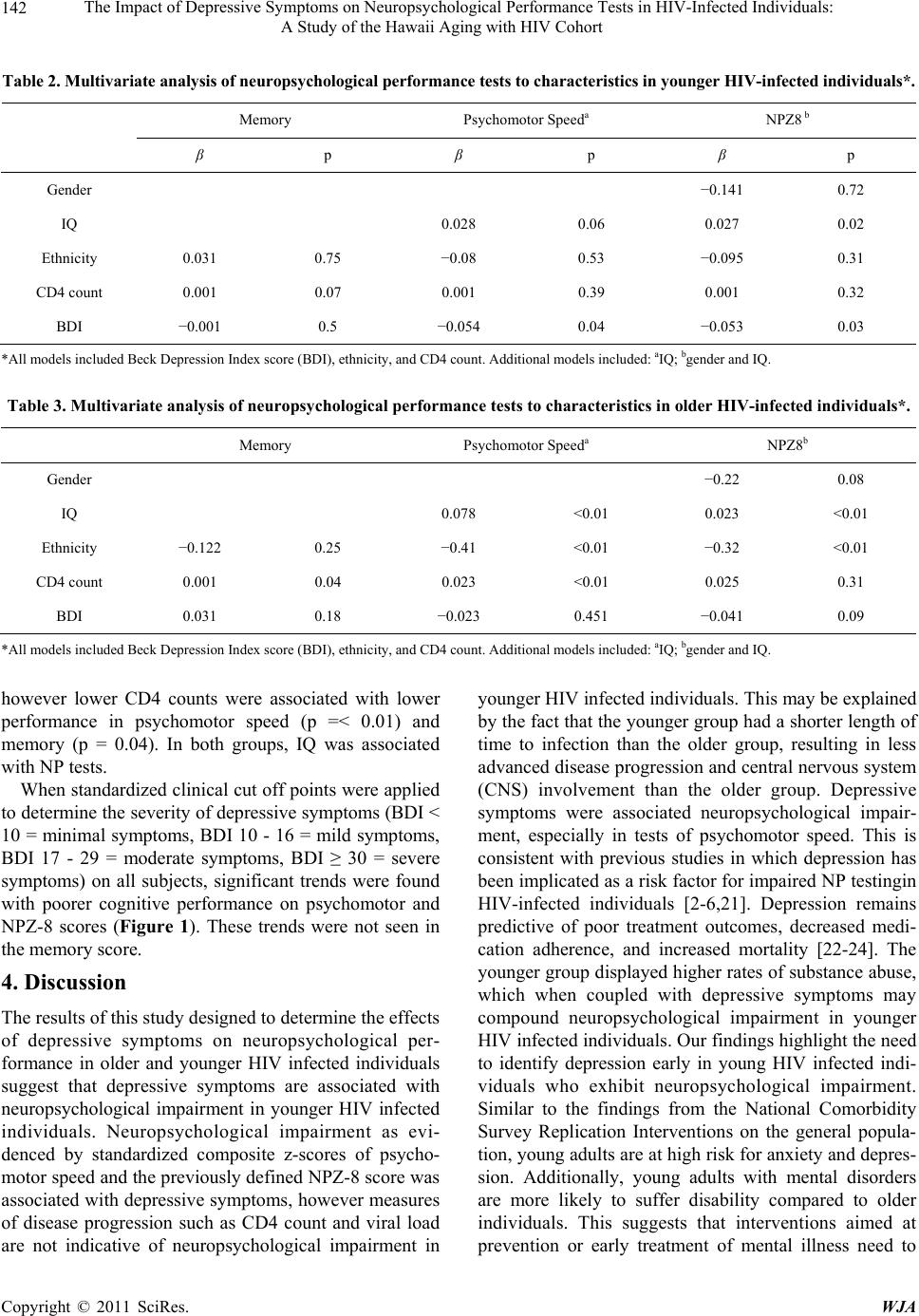 The Impact of Depressive Symptoms on Neuropsychological Performance Tests in HIV-Infected Individuals: 142 A Study of the Hawaii Aging with HIV Cohort Table 2. Multivariate analysis of neuropsychological performance tests to characteristics in young er HIV-infected individuals*. Memory Psychomotor Speeda NPZ8 b β p β p β p Gender −0.141 0.72 IQ 0.028 0.06 0.027 0.02 Ethnicity 0.031 0.75 −0.08 0.53 −0.095 0.31 CD4 count 0.001 0.07 0.001 0.39 0.001 0.32 BDI −0.001 0.5 −0.054 0.04 −0.053 0.03 *All models included Beck Depression Index score (BDI), ethnicity, and CD4 count. Additional models included: aIQ; bgender and IQ. Table 3. Multivariate analysis of neuropsychological performance tests to characteristics in older HIV-infected individuals*. Memory Psychomotor Speeda NPZ8b Gender −0.22 0.08 IQ 0.078 <0.01 0.023 <0.01 Ethnicity −0.122 0.25 −0.41 <0.01 −0.32 <0.01 CD4 count 0.001 0.04 0.023 <0.01 0.025 0.31 BDI 0.031 0.18 −0.023 0.451 −0.041 0.09 *All models included Beck Depression Index score (BDI), ethnicity, and CD4 count. Additional models included: aIQ; bgender and IQ. however lower CD4 counts were associated with lower performance in psychomotor speed (p =< 0.01) and memory (p = 0.04). In both groups, IQ was associated with NP tests. When standardized clinical cut off points were applied to determine the severity of depressive symptoms (BDI < 10 = minimal symptoms, BDI 10 - 16 = mild symptoms, BDI 17 - 29 = moderate symptoms, BDI ≥ 30 = severe symptoms) on all subjects, significant trends were found with poorer cognitive performance on psychomotor and NPZ-8 scores (Figure 1). These trends were not seen in the memory score. 4. Discussion The results of this study designed to determine the effects of depressive symptoms on neuropsychological per- formance in older and younger HIV infected individuals suggest that depressive symptoms are associated with neuropsychological impairment in younger HIV infected individuals. Neuropsychological impairment as evi- denced by standardized composite z-scores of psycho- motor speed and the previously defined NPZ-8 score was associated with depressive symptoms, however measures of disease progression such as CD4 count and viral load are not indicative of neuropsychological impairment in younger HIV infected individuals. This may be explained by the fact that the younger group had a shorter length of time to infection than the older group, resulting in less advanced disease progression and central nervous system (CNS) involvement than the older group. Depressive symptoms were associated neuropsychological impair- ment, especially in tests of psychomotor speed. This is consistent with previous studies in which depression has been implicated as a risk factor for impaired NP testingin HIV-infected individuals [2-6,21]. Depression remains predictive of poor treatment outcomes, decreased medi- cation adherence, and increased mortality [22-24]. The younger group displayed higher rates of substance abuse, which when coupled with depressive symptoms may compound neuropsychological impairment in younger HIV infected individuals. Our findings highlight the need to identify depression early in young HIV infected indi- viduals who exhibit neuropsychological impairment. Similar to the findings from the National Comorbidity Survey Replication Interventions on the general popula- tion, young adults are at high risk for anxiety and depres- sion. Additionally, young adults with mental disorders are more likely to suffer disability compared to older individuals. This suggests that interventions aimed at prevention or early treatment of mental illness need to Copyright © 2011 SciRes. WJA 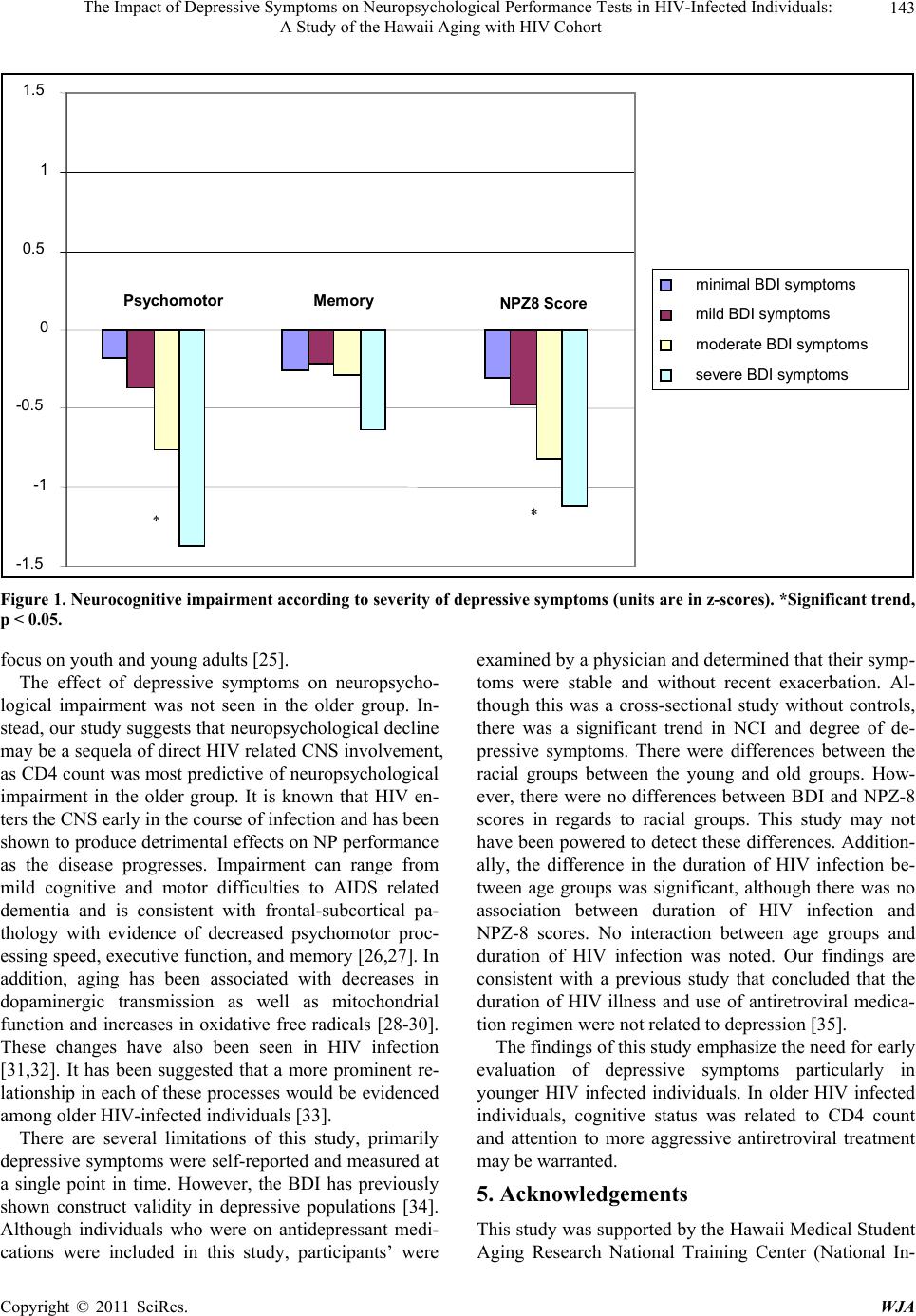 The Impact of Depressive Symptoms on Neuropsychological Performance Tests in HIV-Infected Individuals: 143 A Study of the Hawaii Aging with HIV Cohort -1.5 -1 -0.5 0 0.5 1 1.5 minimal BDI symptoms mild BDI symptoms moder ate BDI symptoms severe BDI symptoms Psychomotor Memory NPZ8 Score * * Figure 1. Neurocognitive impairment according to severity of depressive symptoms (units are in z-scores). *Significant trend, p < 0.05. focus on youth and young adults [25]. The effect of depressive symptoms on neuropsycho- logical impairment was not seen in the older group. In- stead, our study suggests that neuropsychological decline may be a sequela of direct HIV related CNS involvement, as CD4 count was most predictive of neuropsychological impairment in the older group. It is known that HIV en- ters the CNS early in the course of infection and has been shown to produce detrimental effects on NP performance as the disease progresses. Impairment can range from mild cognitive and motor difficulties to AIDS related dementia and is consistent with frontal-subcortical pa- thology with evidence of decreased psychomotor proc- essing speed, executive function, and memory [26,27]. In addition, aging has been associated with decreases in dopaminergic transmission as well as mitochondrial function and increases in oxidative free radicals [28-30]. These changes have also been seen in HIV infection [31,32]. It has been suggested that a more prominent re- lationship in each of these processes would be evidenced among older HIV-infected individuals [33]. There are several limitations of this study, primarily depressive symptoms were self-reported and measured at a single point in time. However, the BDI has previously shown construct validity in depressive populations [34]. Although individuals who were on antidepressant medi- cations were included in this study, participants’ were examined by a physician and determined that their symp- toms were stable and without recent exacerbation. Al- though this was a cross-sectional study without controls, there was a significant trend in NCI and degree of de- pressive symptoms. There were differences between the racial groups between the young and old groups. How- ever, there were no differences between BDI and NPZ-8 scores in regards to racial groups. This study may not have been powered to detect these differences. Addition- ally, the difference in the duration of HIV infection be- tween age groups was significant, although there was no association between duration of HIV infection and NPZ-8 scores. No interaction between age groups and duration of HIV infection was noted. Our findings are consistent with a previous study that concluded that the duration of HIV illness and use of antiretroviral medica- tion regimen were not related to depression [35]. The findings of this study emphasize the need for early evaluation of depressive symptoms particularly in younger HIV infected individuals. In older HIV infected individuals, cognitive status was related to CD4 count and attention to more aggressive antiretroviral treatment may be warranted. 5. Acknowledgements This study was supported by the Hawaii Medical Student Aging Research National Training Center (National In- Copyright © 2011 SciRes. WJA  The Impact of Depressive Symptoms on Neuropsychological Performance Tests in HIV-Infected Individuals: 144 A Study of the Hawaii Aging with HIV Cohort stitute on Aging, John A. Hartford Foundation and American Federation for Aging Research grant T35 AG-026722-02), National Institute of Neurological Dis- orders and Stroke (1U54NS43049). Additionally, D Chow received funding from the National Institutes of Health NHLBI 1 K23 HL088981, P20RR011091and NCRR 1 R25 RR019321. The content is solely the re- sponsibility of the authors and does not necessarily rep- resent the official views of the National Institute of Neu- rological Diseases and Stroke or the National Institutes of Health. REFERENCES [1] F. K. Judd and A. M. Mijch, “Depressive Symptoms in Patients with HIV Infection,” The Australian and New Zealand Journal of Psychiatry, Vol. 30, No. 1, 1996, pp. 104-109. doi:10.3109/00048679609076077 [2] R. H. McAllister-Williams, I. N. Ferrier and A. H. Young, “Mood and Neuropsychological Function in Depression: The Role of Corticosteroids and Serotonin,” Psychologi- cal Medicine, Vol. 28, No. 3, 1998, pp. 573-584. doi:10.1017/S0033291798006680 [3] T. D. Marcotte, R. K. Heaton, T. Wolfson, et al., “The Impact of HIV-Related Neuropsychological Dysfunction on Driving Behavior. The HNRC Group,” Journal of the International Neuropsychological Society, Vol. 5, No. 7, 1999, pp. 579-592. doi:10.1017/S1355617799577011 [4] A. Ammassari, A. Antinori, M. S. Aloisi, et al., “Depres- sive Symptoms, Neurocognitive Impairment, and Adher- ence to Highly Active Antiretroviral Therapy among HIV-Infected Persons,” Psychosomatics, Vol. 45, No. 5, 2004, pp. 394-402. doi:10.1176/appi.psy.45.5.394 [5] S. A. Castellon, D. J. Hardy, C. H. Hinkin, et al., “Com- ponents of Depression in HIV-1 Infection: Their Differ- ential Relationship to Neurocognitive Performance,” Jour- nal of Clinical and Experimental Neuropsychology, Vol. 28, No. 3, 2006, pp. 420-437. doi:10.1080/13803390590935444 [6] J. D. Hartzell, I. E. Janke and A. C. Weintrob, “Impact of Depression on HIV Outcomes in the HAART Era,” Jour- nal of Antimicrobial Chemotherapy, Vol. 62, No. 2, 2008, pp. 246-255. doi:10.1093/jac/dkn193 [7] M. A. Cole, S. A. Castellon, A. C. Perkins, et al., “Rela- tionship between Psychiatric Status and Frontal-Subco- rtical Systems in HIV-Infected Individuals,” Journal of the International Neuropsychological Society, Vol. 13, No. 3, 2007, pp. 549-554. doi:10.1017/S135561770707066X [8] R. A. Bornstein, H. A. Nasrallah, M. F. Para, C. C. Whi- tacre, P. Rosenberger and R. J. Fass, “Neuropsychological Performance in Symptomatic and Asymptomatic HIV In- fection,” AIDS, Vol. 7, No. 4, 1993, pp. 519-524. doi:10.1097/00002030-199304000-00011 [9] R. L. Mapou, W. A. Law, A. Martin, D. Kampen, A. M. Salazar and J. R. Rundell, “Neuropsychological Per- formance, Mood, and Complaints of Cognitive and Motor Difficulties in Individuals Infected with the Human Im- munodeficiency Virus,” Journal of Neuropsychiatry & Clinical Neurosciences, Vol. 5, 1993, pp. 86-93. [10] B. C. Bix, G. Glosser, W. Holmes, et al., “Relationship between Psychiatric Disease and Neuropsychological Im- pairment in HIV Seropositive Individuals,” Journal of the International Neuropsychological Society, Vol. 1, No. 6, 1995, pp. 581-588. doi:10.1017/S1355617700000722 [11] K. J. Goggin, S. Zisook, R. K. Heaton, et al., “Neuropsy- chological Performance of HIV-1 Infected Men with Ma- jor Depression. HNRC Group. HIV Neurobehavioral Re- search Center,” Journal of the International Neuropsy- chological Society, Vol. 3, 1997, pp. 457-464. [12] S. B. Rourke, M. H. Halman and C. Bassel, “Neurocogni- tive Complaints in HIV-Infection and Their Relationship to Depressive Symptoms and Neuropsychological Func- tioning,” Journal of Clinical and Experimental Neuro- psychology, Vol. 21, No. 6, 1999, pp. 737-756. doi:10.1076/jcen.21.6.737.863 [13] E. G. Bing, M. A. Burnam, D. Longshore, et al., “Psychi- atric Disorders and Drug Use among Human Immunode- ficiency Virus-Infected Adults in the United States,” Ar- chives of General Psychiatry, Vol. 58, No. 8, 2001, pp. 721-728. doi:10.1001/archpsyc.58.8.721 [14] C. Grov, S. A. Golub, J. T. Parsons, M. Brennan and S. E. Karpiak, “Loneliness and HIV-Related Stigma Explain Depression among Older HIV-Positive Adults,” AIDS Care, Vol. 22, No. 5, pp. 630-639. doi:10.1080/09540120903280901 [15] Centers for Disease Control and Prevention, “CDC Sur- veillance Report Notes Slowdown in New HIV/AIDS Rates,” AIDS Policy Law, Vol. 17, No. 5, 2002, p. 8. [16] V. Valcour, C. Shikuma, B. Shiramizu, et al., “Higher Frequency of Dementia in Older HIV-1 Individuals: The Hawaii Aging with HIV-1 Cohort,” Neurology, Vol. 63, 2004, pp. 822-827. [17] M. Cherner, R. J. Ellis, D. Lazzaretto, et al., “Effects of HIV-1 Infection and Aging on Neurobehavioral Func- tioning: Preliminary Findings,” AIDS, Vol. 18, Suppl. 1, 2004, pp. S27-S34. doi:10.1097/00002030-200401001-00005 [18] American Academy of Neurology AIDS Task Force, “Nomenclature and Research Case Definitions for Neu- rologic Manifestations of Human Immunodeficiency Vi- rus-Type 1 (HIV-1) Infection,” Neurology, Vol. 41, 1991, pp. 778-785. [19] F. A. Schmitt, J. W. Bigley, R. McKinnis, P. E. Logue, R. W. Evans and J. L. Drucker, “Neuropsychological Out- come of Zidovudine (AZT) Treatment of Patients with AIDS and AIDS-Related Complex,” The New England Journal of Medicine, Vol. 319, 1988, pp. 1573-1578. doi:10.1056/NEJM198812153192404 [20] A. T. Beck and R. A. Steer, “Internal Consistencies of the Original and Revised Beck Depression Inventory,” Jour- nal of Clinical Psychology 1984, Vol. 40, No. 6, pp. Copyright © 2011 SciRes. WJA  The Impact of Depressive Symptoms on Neuropsychological Performance Tests in HIV-Infected Individuals: A Study of the Hawaii Aging with HIV Cohort Copyright © 2011 SciRes. WJA 145 1365-1367. doi:10.1002/1097-4679(198411)40:6<1365::AID-JCLP22 70400615>3.0.CO;2-D [21] F. K. Judd and A. M. Mijch, “Depressive Symptoms in Patients with HIV Infection,” The Australian and New Zealand Journal of Psychiatry, Vol. 30, No. 1, 1996, pp. 104-109. doi:10.3109/00048679609076077 [22] T. Gibbie, A. Mijch, S. Ellen, et al., “Depression and Neurocognitive Performance in Individuals with HIV/ AIDS: 2-Year Follow-Up,” HIV Medicine, Vol. 7, No. 2, 2006, pp. 112-121. doi:10.1111/j.1468-1293.2006.00350.x [23] F. K. Judd, A. M. Cockram, A. Komiti, A. M. Mijch, J. Hoy and R. Bell, “Depressive Symptoms Reduced in In- dividuals with HIV/AIDS Treated with Highly Active Antiretroviral Therapy: A Longitudinal Study,” The Aus- tralian and New Zealand Journal of Psychiatry, Vol. 34, No. 6, 2000, pp. 1015-1021. doi:10.1080/000486700278 [24] C. H. Hinkin, S. A. Castellon, R. S. Durvasula, et al., “Medication Adherence among HIV+ Adults: Effects of Cognitive Dysfunction and Regimen Complexity,” Neu- rology, Vol. 59, 2002, pp. 1944-1950. [25] R. C. Kessler, P. Berglund, O. Demler, R. Jin, K. R. Merikangas and E. E. Walters, “Lifetime Prevalence and Age-of-Onset Distributions of DSM-IV Disorders in the National Comorbidity Survey Replication,” Archives of General Psychiatry, Vol. 62, No. 6, 2005, pp. 593-602. doi:10.1001/archpsyc.62.6.593 [26] L. Boisse, M. J. Gill and C. Power, “HIV Infection of the Central Nervous System: Clinical Features and Neuropa- thogenesis,” Neurologic Clinics, Vol. 26, No. 3, 2008, pp. 799-819. doi:10.1016/j.ncl.2008.04.002 [27] B. M. Ances and R. J. Ellis, “Dementia and Neurocogni- tive Disorders Due to HIV-1 Infection,” Seminars in Neurology, Vol. 27, No. 1, 2007, pp. 86-92. doi:10.1055/s-2006-956759 [28] D. B. Miller, J. P. O’Callaghan and S. F. Ali, “Age as a Susceptibility Factor in the Striatal Dopaminergic Neuro- toxicity Observed in the Mouse Following Substituted Amphetamine Exposure,” Annals of the New York Aca- demy of Sciences, Vol. 914, 2000, pp. 194-207. doi:10.1111/j.1749-6632.2000.tb05196.x [29] V. A. Bohr, “Repair of Oxidative DNA Damage in Nu- clear and Mitochondrial DNA, and Some Changes with Aging in Mammalian Cells,” Free Radical Biology and Medicine, Vol. 32, No. 9, 2002, pp. 804-812. doi:10.1016/S0891-5849(02)00787-6 [30] J. B. Lohr, “Oxygen Radicals and Neuropsychiatric Ill- ness. Some Speculations,” Archives of General Psychia- try, Vol. 48, No. 12, 1991, pp. 1097-1106. [31] J. R. Berger and G. Arendt, “HIV Dementia: The Role of the Basal Ganglia and Dopaminergic Systems,” Journal of Psychopharmacology, Vol. 14, No. 3, 2000, pp. 214- 221. doi:10.1177/026988110001400304 [32] T. Yamaguchi, I. Katoh and S. Kurata, “Azidothymidine Causes Functional and Structural Destruction of Mito- chondria, Glutathione Deficiency and HIV-1 Promoter Sensitization,” European Journal of Biochemistry, Vol. 269, No. 11, 2002, pp. 2782-2788. doi:10.1046/j.1432-1033.2002.02954.x [33] F. L. Wilkie, K. Goodkin, I. Khamis, et al., “Cognitive Functioning in Younger and Older HIV-1-Infected Adults,” Journal of Acquired Immune Deficiency Syndromes, Vol. 33, Suppl. 2, 2003, pp. S93-S105. doi:10.1097/00126334-200306012-00006 [34] C. K. Schotte, M. Maes, R. Cluydts, D. De Doncker and P. Cosyns, “Construct Validity of the Beck Depression In- ventory in a Depressive Population,” Journal of Affective Disorders, Vol. 46, No. 2, 1997, pp. 115-125. doi:10.1016/S0165-0327(97)00094-3 [35] A. Komiti, F. Judd, P. Grech, et al., “Depression in Peo- ple Living with HIV/AIDS Attending Primary Care and Outpatient Clinics,” The Australian and New Zealand Journal of Psychiatry, Vol. 37, 2003, pp. 70-77. doi:10.1046/j.1440-1614.2003.01118.x |