

Paper Menu >>
Journal Menu >>
 World Journal of AIDS, 2011, 1, 131-135 doi:10.4236/wja.2011.14018 Published Online December 2011 (http://www.SciRP.org/journal/wja) Copyright © 2011 SciRes. WJA 131 HIV/STIs and Pregnancy Prevention, Using a Cervical Barrier and Microbicide Alfred A. Shihata1, Steven A. Brody2 1Scripps Institution of Medicine and Science, San Diego, USA; 2Department Endocrinology & Metabolism, School of Medicine, University of California, La Jolla, USA. E-mail: [email protected], [email protected] Received August 5th, 2011; revised September 27th, 2011; accepted October 13th, 2011. ABSTRACT Objectives: 1) HIV prevention, using a mechanical cervical barrier in combination with microbicide. 2) Prevention of pregnancy. 3) Shield the cervix to prevent sperm penetration and Gonorrhea, Chlamydia and HIV virus invasion. Me- thods: We investigated a new FDA approved cervical barrier FemCap (Figure 1). The FemCap is a contraceptive de- vice that is designed with a unique delivery system for microbicides on its cervical and vaginal sides (Figure 2) to en- sure better coverage, and retention of gel on the cervix and va gina. We also compared the acceptability and adh erence with the FemCap, and retention of a stained vaginal lubricant when delivered with the FemCap versus the vaginal lu- bricant when delivered using a traditional vag inal applicator (Figure 3). We used th e same vaginal applicator utilized in the CAPRISA 004 [1] study, to deliver Tenofovir microbicide. Thirty women compared the use of a vaginal applica- tor to deliver a high viscosity stained vaginal lubricant before and after intercourse, versus the FemCap to deliver the same lubricant once before intercourse. The acceptability and efficacy of this delivery system was evaluated. Results: Forty percent (12) women missed the application of the lubricant with the vaginal applicator before intercourse and 10% missed it after intercourse. Amongst FemCap users (3) wom en (10%) missed application of the vaginal lubricant before intercourse and all of them inserted it after intercourse. The stained gel was better retained over the cervix (Figure 4) by single application with the FemCap versus two applications with the traditional applicator (Figure 3). Conclusions: Women in this study preferred the FemCap due to elimination of leakage and the single application, me- thod versus two applications with the traditional vaginal applicator. The use of the FemCap, can prevent pregnancy, HIV mother-to-child tran smission, enhance compliance and retention of gel over the cervix and vagina that may poten- tially prevent STIs and increase the efficacy of Tenofovir. Keywords: HIV Prevention, Mi crobi ci de Tenofovir, FemCap Delivery System 1. Introduction Despite numerous effective evidence-based preventive interventions, such as the condom [2,3], circumcision, Tenfovir gel [1], the HIV pandemic is still outpacing all the above methods. Therefore the importance of innova- tive practices employing the a bo ve mentioned methods as well as novel interventions are need ed. Women are the fastest growing population affected by sexually transmitted infections and Acquired Immune Deficiency Syndrome (STIs/AIDS) worldwide [4]. Women are biologically vulnerable, and suffer disproportionately more from the consequences of unplanned pregnancy and STIs/HIV infections. The cervix is the main portal of entry for the HIV virus. This is due to the presence of high concentration of the Chemokine receptors CCR5 and CRX4 on the cervix [5]. Gonorrhea and Chlamydia are intracellular organisms and they invade and colonize the endocervical canal. These non-ulcerative STIs, when present, enhance the invasion of HIV [6]. Covering the cervix by a cervical barrier in combination of spermicide/microbicide can 1) prevent sperm penetration 2) potentially prevent Gonorrhea Ch- lamydia, and 3) potentially prevent HIV virus invasion of the cervix. With no cure or vaccine anticipated in the near future, HIV continues to spread despite the availability of the condom and other preventive measures. Vaginal micro- bicides are a female-initiated new class of drugs that are intended to prevent the transmission of STIs/HIV fr om the male to the female and from the female to the male. They come in gels, creams, suppositories, films, and tablets. 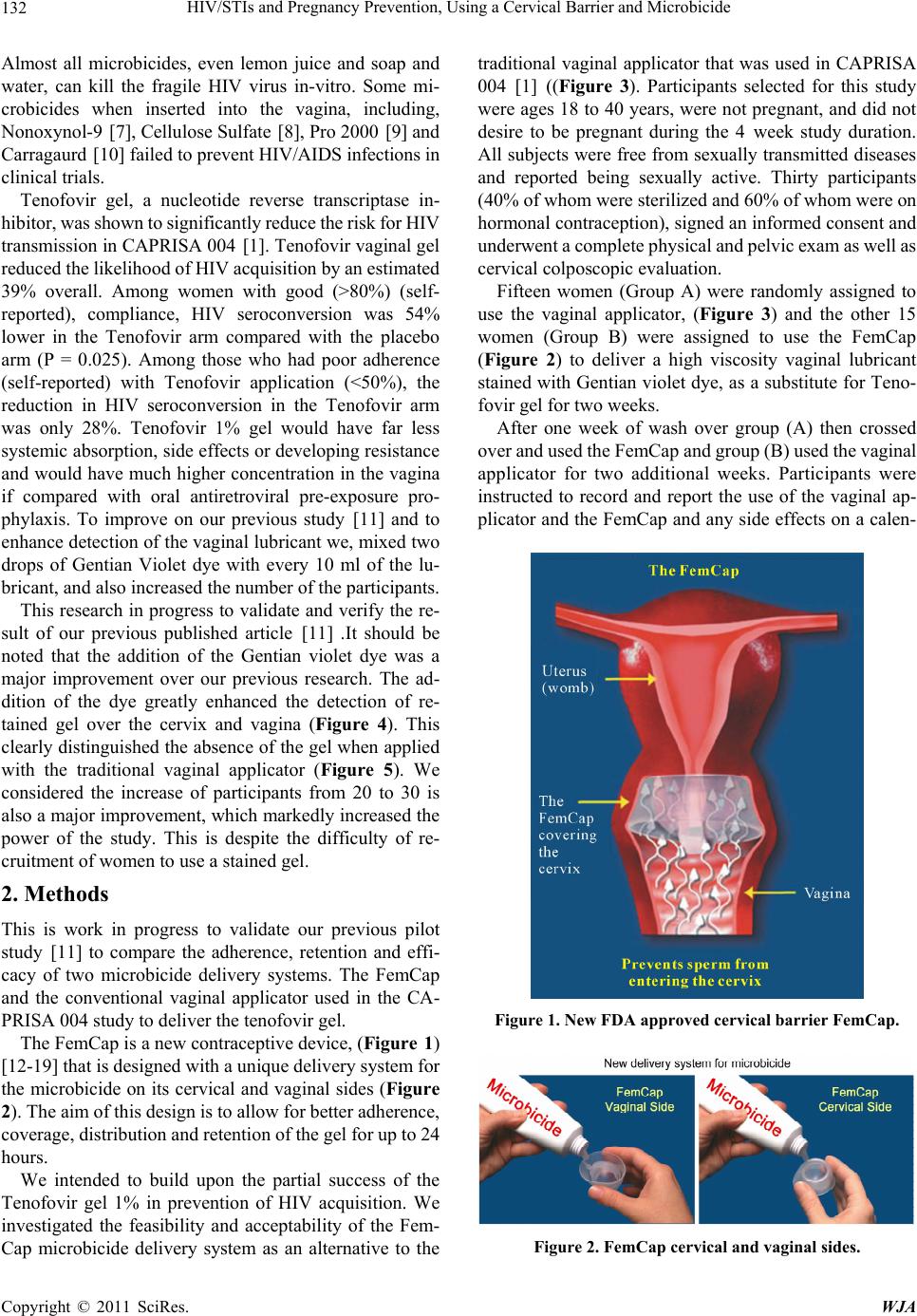 HIV/STIs and Pregnancy Prevention, Using a Cervical Barrier and Microbicide 132 Almost all microbicides, even lemon juice and soap and water, can kill the fragile HIV virus in-vitro. Some mi- crobicides when inserted into the vagina, including, Nonoxynol-9 [7], Cellulose Sulfate [8], Pro 2000 [9] and Carragaurd [10] failed to prevent HIV/AIDS infections in clinical trials. Tenofovir gel, a nucleotide reverse transcriptase in- hibitor, was shown to significantly reduce the risk for HIV transmission in CAPRISA 004 [1]. Tenofovir vaginal gel reduced the likelihood of HIV acquisition by an estimated 39% overall. Among women with good (>80%) (self- reported), compliance, HIV seroconversion was 54% lower in the Tenofovir arm compared with the placebo arm (P = 0.025). Among those who had poor adherence (self-reported) with Tenofovir application (<50%), the reduction in HIV seroconversion in the Tenofovir arm was only 28%. Tenofovir 1% gel would have far less systemic absorption, side effects or developing resistance and would have much higher concentration in the vagina if compared with oral antiretroviral pre-exposure pro- phylaxis. To improve on our previous study [11] and to enhance detection of the vaginal lubricant we, mixed two drops of Gentian Violet dye with every 10 ml of the lu- bricant, and also increased the number of the participants. This research in progress to validate and verify the re- sult of our previous published article [11] .It should be noted that the addition of the Gentian violet dye was a major improvement over our previous research. The ad- dition of the dye greatly enhanced the detection of re- tained gel over the cervix and vagina (Figure 4). This clearly distinguished the abse nce of the gel when applied with the traditional vaginal applicator (Figure 5). We considered the increase of participants from 20 to 30 is also a major improvement, which markedly in creased the power of the study. This is despite the difficulty of re- cruitment of women to use a stained gel. 2. Methods This is work in progress to validate our previous pilot study [11] to compare the adherence, retention and effi- cacy of two microbicide delivery systems. The FemCap and the conventional vaginal applicator used in the CA- PRISA 004 study to deliver the tenofovir gel. The FemCap is a new contraceptive device, (Figure 1) [12-19] that i s desi g ned with a unique del i ve ry sy st em for the microbicide on its cervical and vaginal sides (Figure 2). The aim of this design is to allow for better adherence, coverag e, dist r ibut i on a nd r et ent io n o f t he g el for u p to 24 hours. We intended to build upon the partial success of the Tenofovir gel 1% in prevention of HIV acquisition. We investigated the feasibility and acceptability of the Fem- Cap microbicide delivery system as an alternative to the traditional vaginal applicator that was used in CAPRISA 004 [1] ((Figure 3). Participants selected for this study were ages 18 to 40 years, were not pregnant, and did not desire to be pregnant during the 4 week study duration. All subjects were free from sexually transmitted diseases and reported being sexually active. Thirty participants (40% of wh om were sterilized an d 6 0% of whom were on hormonal contraception), signed an informed consent and underwent a complete physical and pelvic exam as well as cervical colposcopic evaluation. Fifteen women (Group A) were randomly assigned to use the vaginal applicator, (Figure 3) and the other 15 women (Group B) were assigned to use the FemCap (Figure 2) to deliver a high viscosity vaginal lubricant stained with Gentian violet dye, as a substitute fo r Teno- fovir gel for two weeks. After one week of wash over group (A) then crossed over an d us ed the Fem Cap an d gr oup (B) us ed t he va gina l applicator for two additional weeks. Participants were instructed to record and report the use of the vaginal ap- plicator and the FemCap and any side effects on a calen- Figure 1. New FDA approved cervical barrier FemCap. Figure 2. FemCap cervical and vaginal sides. Copyright © 2011 SciRes. WJA 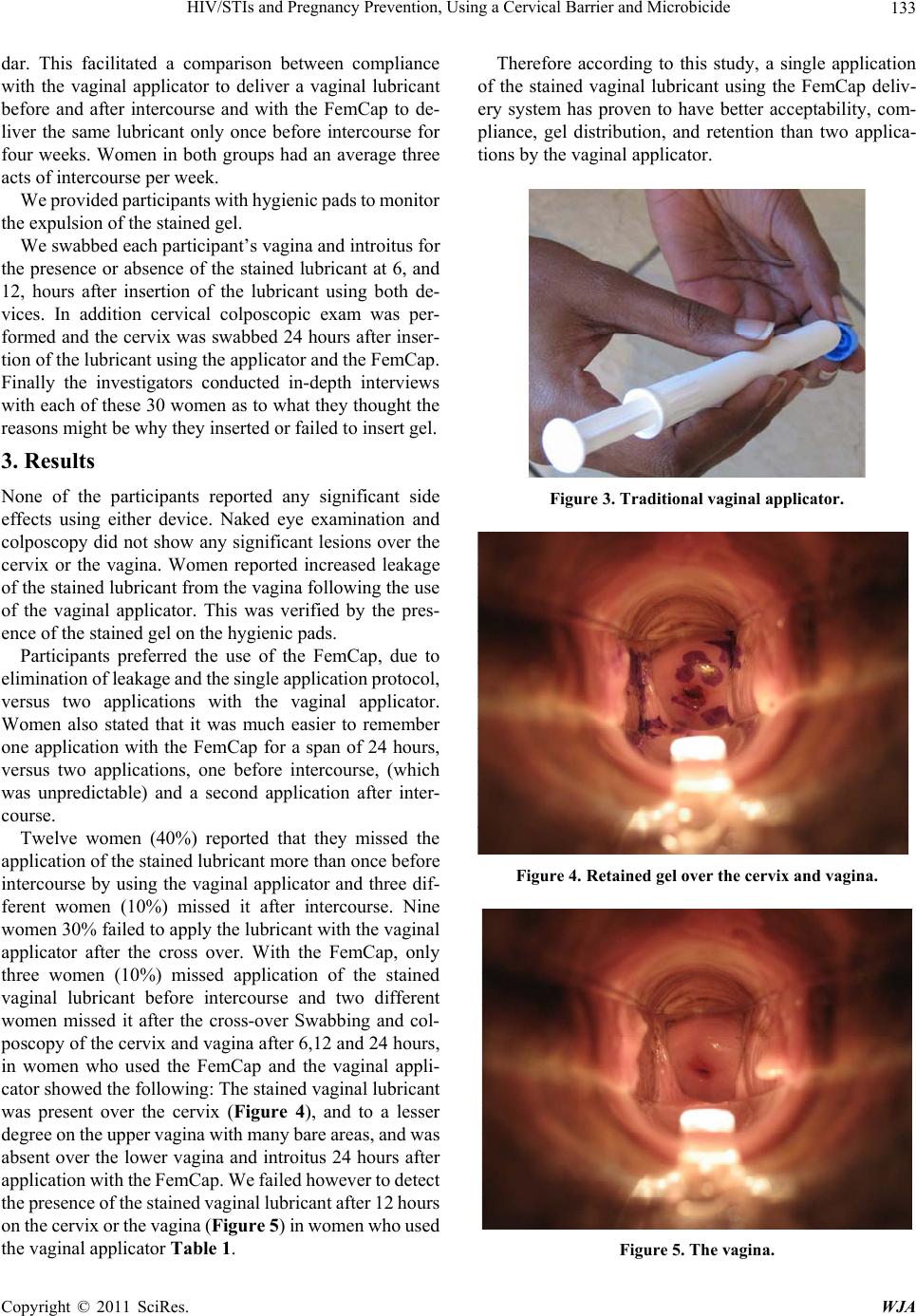 HIV/STIs and Pregnancy Prevention, Using a Cervical Barrier and Microbicide133 dar. This facilitated a comparison between compliance with the vaginal applicator to deliver a vaginal lubricant before and after intercourse and with the FemCap to de- liver the same lubricant only once before intercourse for four weeks. Women in both groups had an average three acts of intercourse per week. We provided participants with hygienic pads to monitor the expulsion of the stained gel. We swabbed each participant’s vagina and introitus for the presence or absence of the stained lubricant at 6, and 12, hours after insertion of the lubricant using both de- vices. In addition cervical colposcopic exam was per- formed and the cervix was swabb ed 24 hours after in ser- tion of the lubricant using the applicator and the FemCap. Finally the investigators conducted in-depth interviews with each of these 30 women as to what they thought the reasons might be why they inserted or failed to insert gel. 3. Results None of the participants reported any significant side effects using either device. Naked eye examination and colposcopy did not show any significant lesions over the cervix or the vagina. Women reported increased leakage of the stained lubricant from the vagina following the use of the vaginal applicator. This was verified by the pres- ence of the stained gel on the hygienic pads. Participants preferred the use of the FemCap, due to elimination of leakage and the single a pplicati on protoc ol, versus two applications with the vaginal applicator. Women also stated that it was much easier to remember one application with the FemCap for a span of 24 hours, versus two applications, one before intercourse, (which was unpredictable) and a second application after inter- course. Twelve women (40%) reported that they missed the application of the stained lubrican t more than once before intercourse by using the vaginal applicator and three dif- ferent women (10%) missed it after intercourse. Nine women 30% failed to apply the lubrican t with the vaginal applicator after the cross over. With the FemCap, only three women (10%) missed application of the stained vaginal lubricant before intercourse and two different women missed it after the cross-over Swabbing and col- poscopy of the cervix and vagina after 6,12 and 24 hours, in women who used the FemCap and the vaginal appli- cator showed the following: The stained vaginal lubricant was present over the cervix (Figure 4), and to a lesser degree on t he upper vagina with m any bare a reas, and was absent over the lower vagina and introitus 24 hours after application with the FemCap. We failed however to detect the presence of the st ained vaginal lu bricant after 12 hours on the cervi x or the vagina (Figure 5) in wo men who use d the vaginal applicator Table 1. Therefore according to this study, a single application of the stained vaginal lubricant using the FemCap deliv- ery system has proven to have better acceptability, com- pliance, gel distribution, and retention than two applica- tions by the vaginal applicator. Figure 3. Traditional vaginal applicator. Figure 4. Retained gel over the cervix and vagina. Figure 5. The vagina. Copyright © 2011 SciRes. WJA 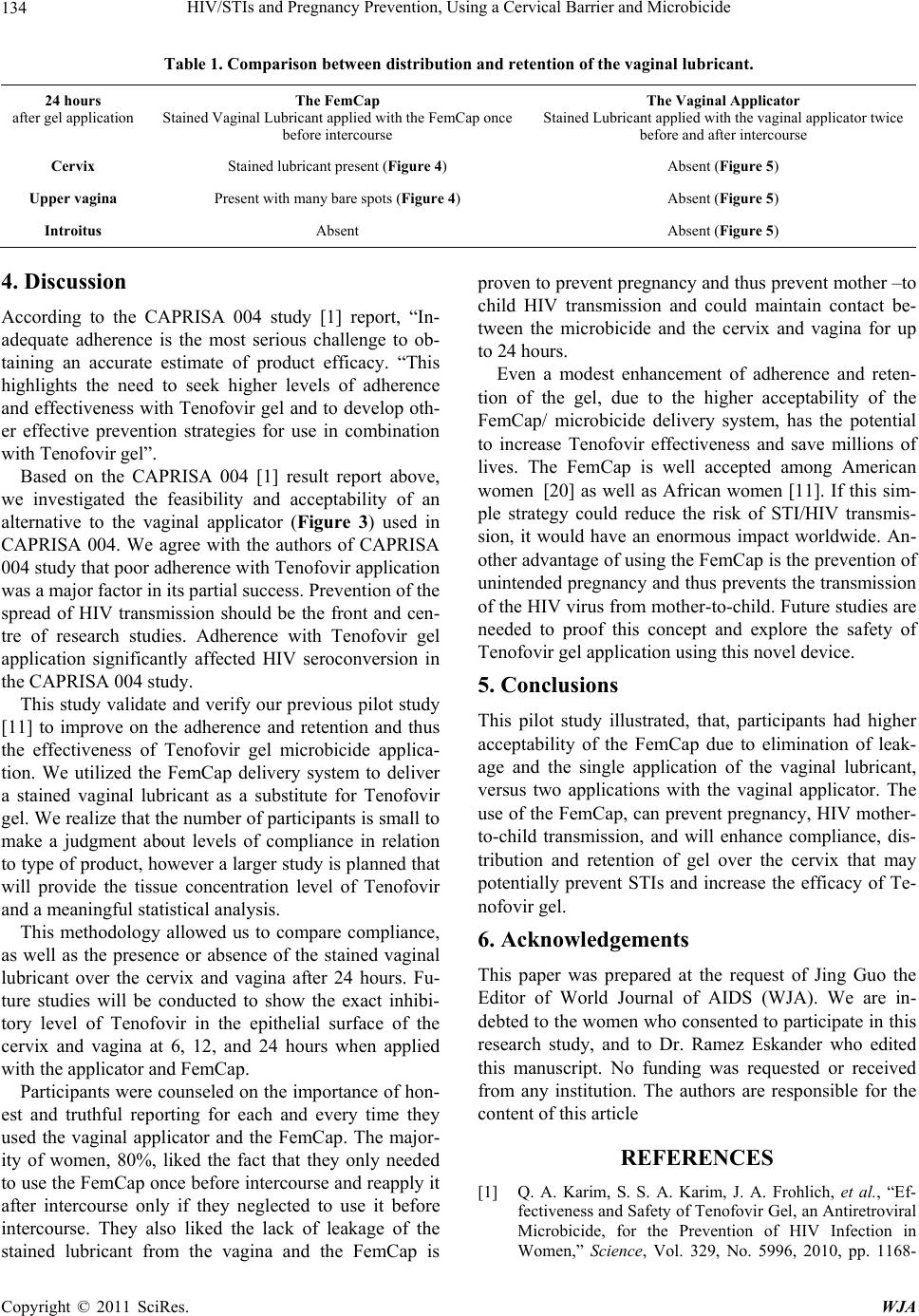 HIV/STIs and Pregnancy Prevention, Using a Cervical Barrier and Microbicide Copyright © 2011 SciRes. WJA 134 Table 1. Comparison between distribution and retention of the vaginal lubricant. 24 hours after gel application The FemCap Stained Vaginal Lubricant applied with t he F emCap once before intercourse The Vaginal Applicator Stained Lubricant applied with the vaginal applicator t wi ce before and after intercourse Cervix Stained lubricant present (Figure 4) Absent (Figure 5) Upper vagina Present with many bare spots (Figure 4) Absent (Figure 5) Introitus Absent Absent (Figure 5) 4. Discussion According to the CAPRISA 004 study [1] report, “In- adequate adherence is the most serious challenge to ob- taining an accurate estimate of product efficacy. “This highlights the need to seek higher levels of adherence and effectiveness with Tenofovir gel and to develop oth- er effective prevention strategies for use in combination with Tenofovir gel”. Based on the CAPRISA 004 [1] result report above, we investigated the feasibility and acceptability of an alternative to the vaginal applicator (Figure 3) used in CAPRISA 004. We agree with the authors of CAPRISA 004 study that poor adheren ce with Tenofovir application was a major factor in its partial success. Prevention of the spread of HIV transmission should be the front and cen- tre of research studies. Adherence with Tenofovir gel application significantly affected HIV seroconversion in the CAPRISA 004 study. This study validate and verify our previous pilot study [11] to improve on the adherence and retention and thus the effectiveness of Tenofovir gel microbicide applica- tion. We utilized the FemCap delivery system to deliver a stained vaginal lubricant as a substitute for Tenofovir gel. We realize that the number of participants is small to make a judgment about levels of compliance in relation to type of product, however a larger study is planned that will provide the tissue concentration level of Tenofovir and a meaningful statistical analysis. This methodology allowed us to compare compliance, as well as the presence or absence of the stained vaginal lubricant over the cervix and vagina after 24 hours. Fu- ture studies will be conducted to show the exact inhibi- tory level of Tenofovir in the epithelial surface of the cervix and vagina at 6, 12, and 24 hours when applied with the applicator and FemCap. Participants were coun seled on the importance of hon- est and truthful reporting for each and every time they used the vaginal applicator and the FemCap. The major- ity of women, 80%, liked the fact that they only needed to use the FemCap once before intercourse and reapply it after intercourse only if they neglected to use it before intercourse. They also liked the lack of leakage of the stained lubricant from the vagina and the FemCap is proven to preven t pregnancy an d thus prev ent mother – to child HIV transmission and could maintain contact be- tween the microbicide and the cervix and vagina for up to 24 hours. Even a modest enhancement of adherence and reten- tion of the gel, due to the higher acceptability of the FemCap/ microbicide delivery system, has the potential to increase Tenofovir effectiveness and save millions of lives. The FemCap is well accepted among American women [20] as well as African women [11]. If this sim- ple strategy could reduce the risk of STI/HIV transmis- sion, it would have an enormous impact worldwide. An- other advantage of using the FemCap is the prevention of unintended pregnancy and thus prevents the transmission of the HIV virus from mother-to-child. Future studies are needed to proof this concept and explore the safety of Tenofovir gel app li cat i o n usi ng thi s n ovel d e vi ce. 5. Conclusions This pilot study illustrated, that, participants had higher acceptability of the FemCap due to elimination of leak- age and the single application of the vaginal lubricant, versus two applications with the vaginal applicator. The use of the FemCap, can prevent pregnancy, HIV mother- to-child transmission, and will enhance compliance, dis- tribution and retention of gel over the cervix that may potentially prevent STIs and increase the efficacy of Te- nofovir gel. 6. Acknowledgements This paper was prepared at the request of Jing Guo the Editor of World Journal of AIDS (WJA). We are in- debted to th e women who consented to p articipate in this research study, and to Dr. Ramez Eskander who edited this manuscript. No funding was requested or received from any institution. The authors are responsible for the content of this article REFERENCES [1] Q. A. Karim, S. S. A. Karim, J. A. Frohlich, et al., “Ef- fectiveness and Safety of Tenofovir Gel, an Antiretroviral Microbicide, for the Prevention of HIV Infection in Women,” Science, Vol. 329, No. 5996, 2010, pp. 1168-  HIV/STIs and Pregnancy Prevention, Using a Cervical Barrier and Microbicide135 1174. [2] T. Silvio, D. Martinelli, C. Germinario, et al., “Deter- mining Factors for Condom Use: A Survey of Young Italian Adults,” European Journal of Contraception Re- productive Health Care, Vo. 15, No. 1, 2010, pp. 24-30. doi:10.3109/13625180903427683 [3] R. A. Crosby, W. L. Yarber, C. A. Graham, et al., “Does It Fit Okay? Problems with Condom Use as a Function of Self-Reported Poor Fit,” Sexually Transmitted Infections, Vo. 86, No. 1, 2010, pp. 36-38. doi:10.1136/sti.2009.036665 [4] World Savvy Monitor, “HIV/AIDS and Sexually Trans- mitted Infections,” Global Status of Women, 2009. http://worldsavvy.org/monitor/index.php?option=com_co ntent&view=article&id=582&Itemid=1029 [5] J. Pudney, A. J. Quayle and D. J. Anderson, “Immu- nological Microenvironments in the Human Vagina and Cervix: Mediators of Cellular Immunity Are Concen- trated in the Cervical Transformation Zone,” Biology of Reproduction, Vol. 73, No. 6, 2005, pp. 1253-1263. doi:10.1095/biolreprod.105.043133 [6] M. Laga, A. Manoka, M. Kivuvu, et al., “Non-Ulcerative Sexually Transmitted Diseases as Risk Factors for HIV-1 Transmission in Women: Results from a Cohort Study,” AIDS, Vol. 7, No. 1, 1993, pp. 95-102. doi:10.1097/00002030-199301000-00015 [7] L. Van Damme, G. Ramjee, M. Alary, et al., “Effective- ness of COL-1492, a Nonoxynol-9 Vaginal Gel, on HIV-1 Transmission in Female Sex Workers: A Ran- domised Controlled Trial,” Lancet, Vol. 360, No. 9938, 2002, pp. 971-977. doi:10.1016/S0140-6736(02)11079-8 [8] L. Van Damme, R. Govinden, F. Mirembe, et al., “Lack of Effectiveness of Cellulose Sulfate Gel for the Preven- tion of Vaginal HIV Transmission,” The New England Journal of Medicine, Vol. 359, 2008, pp. 463-472. doi:10.1056/NEJMoa0707957 [9] S. Salim, “HIV Prevention Gel Proven Ineffective in Largest Clinical Trials,” Centre for the AIDS Program of Research in South Africa (CAPRISA), University of KwaZulu-Natal, 2009, pp. 527-529. [10] S. Skoler-Karpoff, G. Ramjee, K. Ahmed, et al., “Effi- cacy of Carraguard for Prevention of HIV in Women in South Africa,” Lancet, Vol. 372, No. 9654, 2008, pp. 1977-1987. doi:10.1016/S0140-6736(08)61842-5 [11] A. Shihata and S. Brody, “HIV Prevention by Enhancing Compliance of Tenofovir Microbicide. Using a Novel Delivery System,” HIV &AIDS Review, Vol. 9, No. 4, 2010, pp. 107-110. [12] H. Carcio, M. Clarke Secor and R. Koeniger-Donohue, “Advanced Health Assessment of Women: Clinical Skills and Procedures, Chapter 15 The FemCap,” Springer Pub- lishing Company, New York, 2010, pp. 271-278. [13] R. Koeniger-Donohue, “The FemCap: A Non-Hormonal Contraceptive,” Women’s Health Care, Vol. 5, No. 4, 2006, pp. 79-91. [14] A. Shihata, “The FemCap™, a New Contraceptive Cho- ice,” European Journal of Contraception Reproductive Health Care, Vol. 3, 1998, pp. 160-166. [15] D. Shoupe and S. Kjos, “The Handbook of Contraception, Barrier Contraceptives,” Humana Press, Totowa, 2006, pp. 147-177. [16] A. Shihata, “Microbicides Delivery System,” 5th Euro- pean Congress on Tropical Medicine and International Health, Amsterdam, 24-28 May 2007, pp. 131-134. [17] A. Shihata, “Novel Delivery System for Microbicides,” 2007 National HIV Prevention Conference, Atlanta, 2-5 December 2007, p. 378. [18] A. Shihata, “New FDA Approved Woman-Controlled, Latex-Free Barrier Contraceptive Device ‘FemCap™’,” Fertility and Sterility, Vol. 5, No. 103, 2004, pp. 303-330. [19] A. Shihata and E. Gollub, “Acceptability of a New In- travaginal Barrier Contraceptive Device FemCap,” Con- traception, Vol. 46, No. 6, 1992, pp. 511-519. doi:10.1016/0010-7824(92)90115-A [20] A. van der Straten, N. Sahin-Hodoglugil, K. Clouse, S. Mtetwa and M. Z. Chirenje, “Feasibility and Potential Acceptability of Three Cervical Barriers among Vulner- able Young Women in Zimbabwe,” Journal of Family Planning and Reproductive Health Care, Vol. 36, No. 1, 2010, pp. 13-19. Copyright © 2011 SciRes. WJA |