

Paper Menu >>
Journal Menu >>
 World Journal of AIDS, 2011, 1, 182-184 doi:10.4236/wja.2011.14026 Published Online December 2011 (http://www.SciRP.org/journal/wja) Copyright © 2011 SciRes. WJA Zinc Status in Virological Controlled Human Immunodeficiency Virus Type 1 Infected Patients Carlos Tornero, Consuelo Lapuebla, Ana Ventura, Julian Diaz, Maricarmen Mafe Internal Medicine Department and Laboratory, Hospital Gandia, Valencia, Spain. E-mail: [email protected] Received August 1st, 2011; revised September 12th, 2011; accepted September 24th, 2011. ABSTRACT Zinc (Zn) is a key micronutrient for correct immune function and its deficiency correction has been shown to be useful in HIV-infected but most of the studies included a significant proportion of patients without adequate virological con- trol. It would be interesting to establish the prevalence, associated factors and clinical repercussions of Zn deficiency in patients with good virological to assessing the usefulness of Zn monitoring in the routine follow-up of well controlled HIV-infected patients, based on the colorimetric techniques commonly used in daily clinical practice. We included the first 100 patients that met the requirements of HAART and viremia levels under 200 copies for at least 6 consecutive months, with no active illicit drug use, active infections or weight loss of any cause during the previous 6 months. Se- rum Zn concentration was measured using a colorimetric assay (Sentinel Diagnostics®) adapted to the Cobas 8000 analyzer (Roche Diagnostics). The Zn values showed a normal distribution with a mean concentration of 88.7 µg/dl (SD 23.3) and were found to b e decreased in 13 patients and in 6 subjects were below 61 µg/dl. Both the simple statis- tical analysis and the multivariate regression model only identified a significant effect for age and alcoho l consumption. In sum an important number of HIV-infected with effective and prolonged HAART and no evidence of active infections or other associated factor show diminished serum Zn concentrations. The inclusion of at least occasional Zn determi- nations should be considered in the regular follow-up evaluations of HIV-infected patients. Keywords: Zinc, Micronutrients, HAART 1. Introduction Zinc (Zn) is a key micronutrient for correct immune function. Zinc deficiency is not uncommon, and its cor- rection has been shown to be useful in a number of clini- cal contexts [1]. HIV-infected patients often present Zn deficiency, and normalization of the levels of this ele- ment likewise offers benefit for such individuals [2]. However, most of the studies conducted in these subjects were published before highly active antiretoviral therapy (HAART) were available, and included a significant proportion of patients without adequate virological con- trol, illicit drug users, and patients with active infections or malnutrition of different origins. It would be interest- ing to establish the prevalence, associated factors and clinical repercussions of Zn deficiency in patients with good virological control and without the aforementioned factors, with a view to assessing the usefulness of Zn monitoring in the routine follow-up of well controlled HIV-infected patients, based on the colorimetric tech- niques commonly used in daily clinical practice. 2. Material and Methods The systematic determination of Zn was introduced in all patients followed-up on in a center specialized in the management of HIV-infected individuals. We included the first 100 patients that met the requirements of HAART and viremia levels under 200 copies for at least 6 consecutive months, with no active illicit drug use, active infections or weight loss of any cause during the previous 6 months. Anthropometric data were collected, together with information relating to alcohol consump- tion, the presence of diarrhea, lipodystrophy, skin lesions, nadir and present CD4+ lymphocytes counts, transami- nases levels and antecedents of decompensated liver cir- rhosis. A total of 13 4 patients were seen until the planned 00 subjects were recruited (Table 1). 1 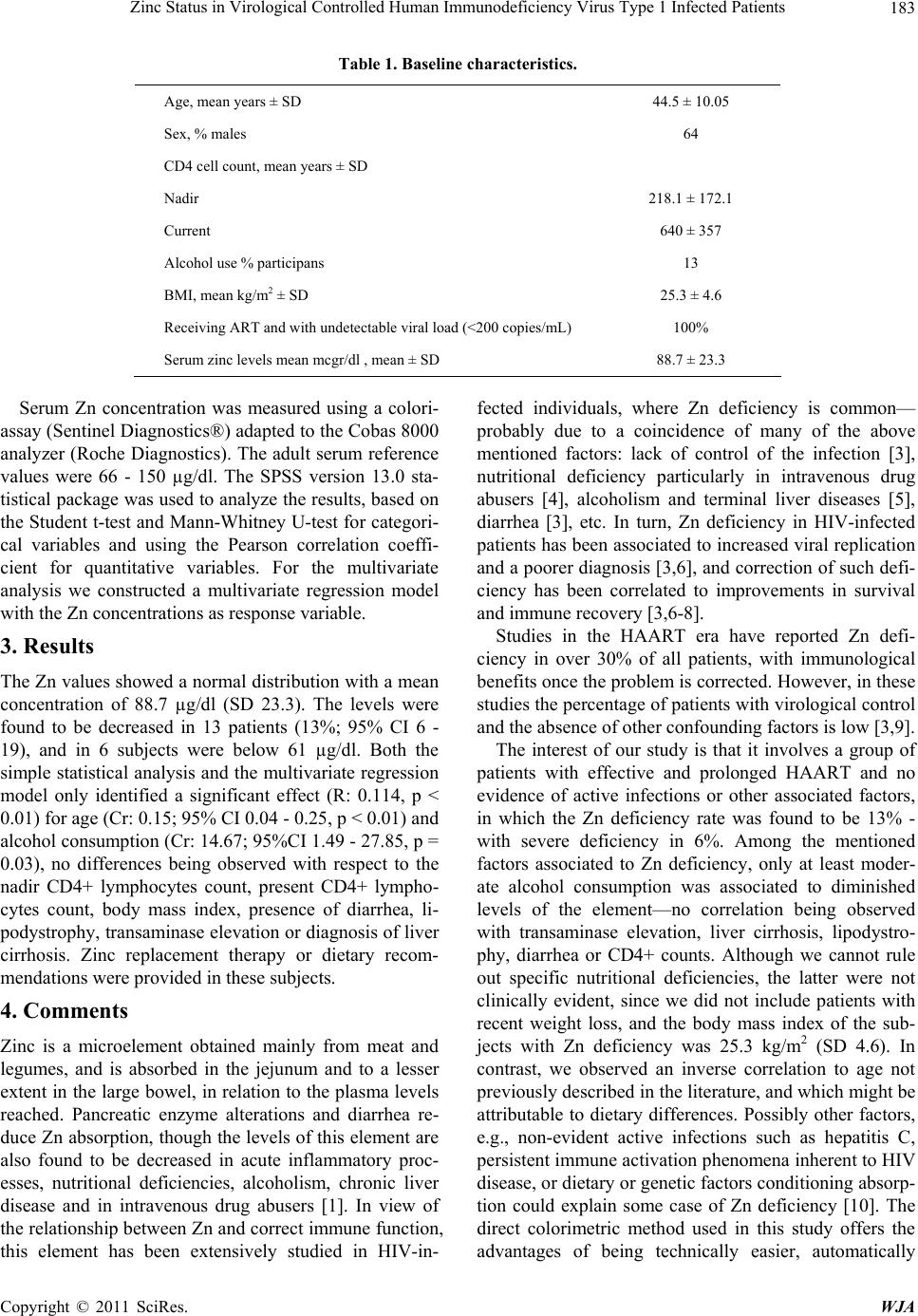 Zinc Status in Virological Controlled Human Immunodeficiency Virus Type 1 Infected Patients183 Table 1. Baseline characteristics. Age, mean years ± SD 44.5 ± 10.05 Sex, % males 64 CD4 cell count, mean years ± SD Nadir 218.1 ± 172.1 Current 640 ± 357 Alcohol use % participans 13 BMI, mean kg/m2 ± SD 25.3 ± 4.6 Receiving ART and with undetectable viral load (<200 copies/mL) 100% Serum zinc levels mean mcgr/dl , mean ± SD 88.7 ± 23.3 Serum Zn concentration was measured using a colori- assay (Sentinel Diagno stics®) adapted to the Cobas 8000 analyzer (Roche Diagnostics). The adult serum reference values were 66 - 150 µg/dl. The SPSS version 13.0 sta- tistical package was used to analyze the results, based on the Student t-test and Mann-Whitney U-test for categ ori- cal variables and using the Pearson correlation coeffi- cient for quantitative variables. For the multivariate analysis we constructed a multivariate regression model with the Zn concen tratio ns as response variable. 3. Results The Zn values showed a normal distribution with a mean concentration of 88.7 µg/dl (SD 23.3). The levels were found to be decreased in 13 patients (13%; 95% CI 6 - 19), and in 6 subjects were below 61 µg/dl. Both the simple statistical analysis and the multivariate regression model only identified a significant effect (R: 0.114, p < 0.01) for age (Cr : 0.15 ; 95% CI 0.04 - 0.25 , p < 0.01) an d alcohol consumption (Cr: 14.67 ; 95%CI 1.49 - 27.85, p = 0.03), no differences being observed with respect to the nadir CD4+ lymphocytes count, present CD4+ lympho- cytes count, body mass index, presence of diarrhea, li- podystrophy, transaminase elevation or diagnosis of liver cirrhosis. Zinc replacement therapy or dietary recom- mendations were provided in these subjects. 4. Comments Zinc is a microelement obtained mainly from meat and legumes, and is absorbed in the jejunum and to a lesser extent in the large bowel, in relation to the plasma levels reached. Pancreatic enzyme alterations and diarrhea re- duce Zn absorp tion, though the levels of this element are also found to be decreased in acute inflammatory proc- esses, nutritional deficiencies, alcoholism, chronic liver disease and in intravenous drug abusers [1]. In view of the relationship between Zn and correct immune function, this element has been extensively studied in HIV-in- fected individuals, where Zn deficiency is common— probably due to a coincidence of many of the above mentioned factors: lack of control of the infection [3], nutritional deficiency particularly in intravenous drug abusers [4], alcoholism and terminal liver diseases [5], diarrhea [3], etc. In turn, Zn deficiency in HIV-infected patients has been associated to increased viral replication and a poorer diag nosis [3,6], and correction of such defi- ciency has been correlated to improvements in survival and immune recovery [3,6-8]. Studies in the HAART era have reported Zn defi- ciency in over 30% of all patients, with immunological benefits once the problem is corrected. However, in these studies the percentage of patients with virological control and the absence of other confounding factors is low [3,9]. The interest of our study is that it involves a group of patients with effective and prolonged HAART and no evidence of active infections or other associated factors, in which the Zn deficiency rate was found to be 13% - with severe deficiency in 6%. Among the mentioned factors associated to Zn deficiency, only at least moder- ate alcohol consumption was associated to diminished levels of the element—no correlation being observed with transaminase elevation, liver cirrhosis, lipodystro- phy, diarrhea or CD4+ counts. Although we cannot rule out specific nutritional deficiencies, the latter were not clinically evident, since we did not include patients with recent weight loss, and the body mass index of the sub- jects with Zn deficiency was 25.3 kg/m2 (SD 4.6). In contrast, we observed an inverse correlation to age not previously d e scribed in the literature, and which might be attributable to dietary differences. Possibly other factors, e.g., non-evident active infections such as hepatitis C, persistent immune activation phenomena inherent to HIV disease, or dietary or genetic factors co nditioning absorp- tion could explain some case of Zn deficiency [10]. The direct colorimetric method used in this study offers the advantages of being technically easier, automatically Copyright © 2011 SciRes. WJA  Zinc Status in Virological Controlled Human Immunodeficiency Virus Type 1 Infected Patients 184 performed and less costly than the atomic absorption spectrophotometric techniques used in other studies, and as such is the method usually employed in clinical labo- ratories. As has been commented, the clinical relevance of Zn deficiency and the benefits derived from correcting the problem are difficult to establish in our case, because most of the patients had high CD4+ counts (640 cells/mm3, SD 357)—with no differences versus patients without Zn deficiency. In sum, an important number of HIV-infected patients in the HAART era show diminished serum Zn concentra- tions. In a large percentage of cases the underlying cause cannot be identified, since these subjects have good vi- rological control, with no liver disease or malnutrition. Further studies are needed to establish the causes and corroborate the usefulness of Zn replacement therapy— though given the high prevalence of Zn deficiency even in patients with good nutritional status and virological control, the inclusion of at least occasional Zn determi- nations should be considered in the regular follow-up evaluations of HIV-infected patients. REFERENCES [1] M. Hambridge, “Human Zinc Deficiency,” Journal of Nutrition, Vol. 130, Suppl. 5S, 2000, pp. 1344S-1349S. [2] E. Mochegiani and M. Muzzioli, “Therapeutic Applica- tion of Zinc in Human Immunodeficiency Virus against Opportunistic Infections,” Journal of Nutrition, Vol. 130, 2000, Suppl. 5S, pp. 1424S-1431S. [3] C. Y. Jones, A. M. Tang, J. E. Forrester, et al., “Micronu- trient Levels and HIV Disease Status in HIV-Infected Pa- tients on Highly Active Antiretroviral Therapy in the Nu- trition for Health Living Cohort,” Journal of Acquired Immune Deficiency Syndromes, Vol. 43, No. 4, 2006, pp. 475-482. doi:10.1097/01.qai.0000243096.27029.fe [4] M. K. Bann, A. Campa, S. Lai, H. Lai and J. B. Page, “Zinc Status in Human Immunodeficiency Virus Type 1 Infection in Illicit Drug Use,” Clinical Infectious Dis- eases, Vol. 37, Suppl. 2, 2003, pp. S117-S123. doi:10.1086/375875 [5] J. P. Zarski, J. Arnaud, H. Labadie, et al., “Serum and Tissue Concentrations of Zinc after Oral Supplementation in Chronic Alcoholics with or without Cirrhosis,” Gas- troenterologie Clinique et Biologique, Vol. 11, No. 12, 1987, pp. 856-860. [6] M. K. Baum, G. Shor-Posner, Y. Lu, et al., “Micronutri- ents and HIV-1 Disease Progression,” AIDS, Vol. 9, No. 9, 1995, pp. 1051-1056. doi:10.1097/00002030-199509000-00010 [7] E. Mocchegiani, M. Muzzioli, R. Gaetti, et al., “Contri- bution of Zinc to Reduce CD4+ Risk Factor for “Severe” Infection Relapse in Aging: Parallelism with HIV,” In- ternational Journal of Immunopharmacology, Vol. 21, No. 4, 1999, pp. 271-281. doi:10.1016/S0192-0561(99)00009-0 [8] E. Mocchegiani, S. Veccia, F. Ancarani, et al., “Benefit of Oral Zinc Supplementation as an Adjunct to Zi- dovudine (AZT) Therapy against Opportunistic Infections in AIDS,” International Journal of Immunopharmacology, Vol. 17, No. 9, 1995, pp. 719-727. doi:10.1016/0192-0561(95)00060-F [9] M. K. Bann, L. Shenghan, S. Sales, J. B. Page and A. Campa, “Randomized, Controlled Clinical Trial of Zinc Supplementation to Prevent Immunological Failure in HIV Infected Adults,” Clinical Infectious Diseases, Vol. 50, No. 12, 2010, pp. 1653-1660. doi:10.1086/652864 [10] B. Lönerdal, “Dietary Factors Influencing Zinc Absorp- tion,” Journal of Nutrition, Vol. 130, 2000, pp. 1378S- 1383S. Copyright © 2011 SciRes. WJA |