

Paper Menu >>
Journal Menu >>
 Psychology 2011. Vol.2, No.9, 992-997 Copyright © 2011 SciRes. DOI:10.4236/psych.2011.29149 To Wash Your Body, or Purify Your Soul: Physical Cleansing Would Strengthen the Sense of High Moral Character* Zhixiong Yan1, Daoqun Ding1,2#, Liangshi Yan2 1Department of Psychology, Hunan Normal University, Changsha, China; 2Institute of Educational Science, Hunan Normal University, Changsha, China. Email: #[email protected] Received September 7th, 2011; revised October 8th, 2011; accepted November 9th, 2011. Physical cleansing, such as bathing or washing hands, is at the core of many religious rituals, suggesting that physical cleansing ceremonies can purify the soul. The present research examines the association between physical and moral purity by the semantic priming paradigm on which the participants made a lexical decision task. There is an interaction effect between the prime word (cleaning related vs. non-cleaning related) and target word (moral related word vs. non-word) which shows a significant priming effect. Thus, we think that physical cleansing would not only associate with moral transgression in memory stage, but also the sense of high moral character in perception stage. Keywords: Physical Cleansing, Moral Purity, Moral Disgust, Priming Effect Introduction Baptism has existed as a significant ritual in many religions such as Christianity, Mandaeanism, Judaism, and Sikhism for thousands of years. The prevalence of this practice suggests a psychological association between bodily purity and moral purity. Uncleanness has been served as a metaphor for sexual misdeed, idolatry, or unethical behavior. Cleanness has been compared to sexual purity, service to one God alone, and cor- rect action (Neusner, 1973). In China, Water-Splashing Festival is a grand traditional festival for The Dai in April 13 to 15 of every year. The Dai people splash water on one another to vanquish the devil and symbolically express the wish for better times ahead, meanwhile, singing the song “Ode to Dripping Water” in order to wash away all their worries and misfortunes, cleanse them of their selfishness and greediness, and keep them safe and sound forever. Moreover, no important ceremonies, such as wedding, funeral and birth, will take place without wa- ter. When young couples get married, the old man who presides over the wedding ceremony will sprinkle water on them to wish a happy time and a good future. In a word, Chinese are sure about that physi cal cleansing ceremony can purify the soul. In Western cultures, the association between physical and moral purity has been demonstrated by Zhong and Liljenquist (Zhong & Liljenquist, 2006). Participants are more likely to think of cleansing-related words after recalling a moral trans- gression from their own lives, and they reveal a desire to en- gage in cleansing behavior. Schnall (2008) uses prime para- digm and further demonstrates that the feeling of cleanliness reduce the perceived seriousness of moral transgressions (Schnall, Benton, & Harvey, 2008). Schnall also demonstrate that induced feelings of disgust can attach themselves to moral judgments, leading the person to conclude that a particular moral action is quite wrong (Schnall, Haidt, Clore, & Jordan, 2008). The experiments reported in this article investigate the basic relationship: the feeling of cleanliness would strengthen the sense of high moral character through priming paradigm because concepts of cleanliness can be primed in subtle ways. In research 2, we investigate if one after moral trespasses would be induced to clean body for keep a good self-image. A lexical decision task has been used in this experiment. The prime and the target are presented in pairs and a word/non-word judgment to the target is required. Because the sense of physical cleaning from the priming should be attributed to the moral judgments and one after moral trespasses would be induced to clean body, it is expected that priming with cleanliness words would strengthen the sense of high moral character more so than would priming with neutral control words. We also infer that priming with moral trespasses words would strengthen the ten- dency to clean body more so than would priming with neutral control words. Experiment 1 Method Participants Forty Hunan normal university undergraduate students (30 female, 10 male; mean age = 20.00 years, SD = 1.85 years) participated as part of a course requirement. All subjects were healthy, right-handed, with normal or corrected to normal vi- sion, and reported no history of affective disorder. Each subject signed an informed consent form for the experiment. Materials The stimulus material consisted of 80 prime-target pairs, which were divided into four experimental conditions, and each including 20 prime-target pairs (See Appendix A). All pairs repeat twice (160 prime-target trials). The main factors ma- nipulated in the experiment are prime word (cleaning related or non-cleaning related word) and target word (moral purity word or pseudo word). All prime words are verbs and target words are adjectives. All experimental stimuli were made into images by PC with Microsoft Office Picture Manager, with the image size, word length and familiarity matched between cleaning related or non-cleaning related words. The level of design is 2 *This research was supported by the National Social Science Foundation o f China (Grant No.11BSH046). #Corresponding author. 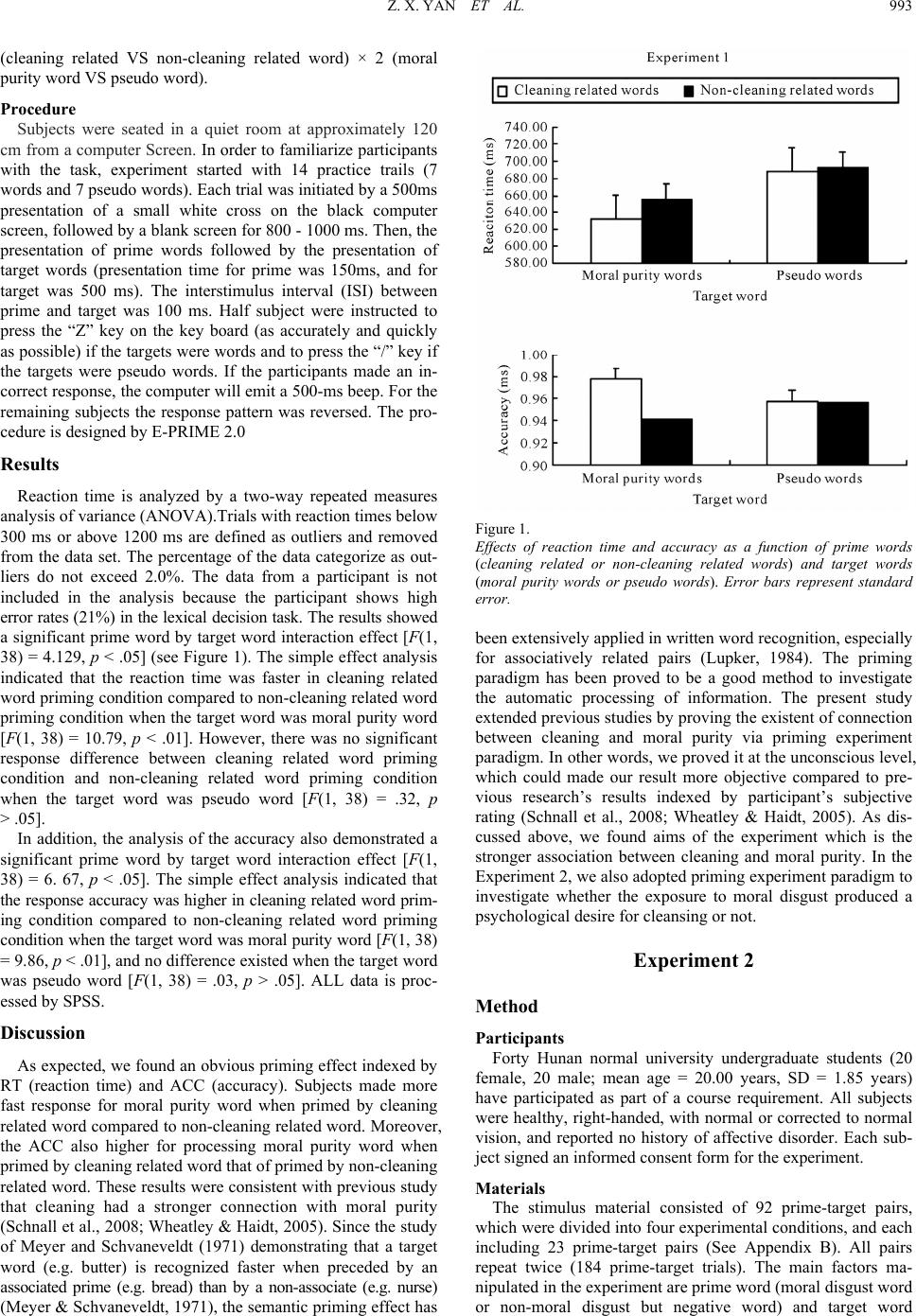 Z. X. YAN ET AL. 993 (cleaning related VS non-cleaning related word) × 2 (moral purity word VS pseudo word). Procedure Subjects were seated in a quiet room at approximately 120 cm from a computer Screen. In order to familiarize participants with the task, experiment started with 14 practice trails (7 words and 7 pseudo words). Each trial was initiated by a 500ms presentation of a small white cross on the black computer screen, followed by a blank screen for 800 - 1000 ms. Then, the presentation of prime words followed by the presentation of target words (presentation time for prime was 150ms, and for target was 500 ms). The interstimulus interval (ISI) between prime and target was 100 ms. Half subject were instructed to press the “Z” key on the key board (as accurately and quickly as possible) if the targets were words and to press the “/” key if the targets were pseudo words. If the participants made an in- correct response, the computer will emit a 500-ms beep. For the remaining subjects the response pattern was reversed. The pro- cedure is designed by E-PRIME 2.0 Results Reaction time is analyzed by a two-way repeated measures analysis of variance (ANOVA).Trials with reaction times below 300 ms or above 1200 ms are defined as outliers and removed from the data set. The percentage of the data categorize as out- liers do not exceed 2.0%. The data from a participant is not included in the analysis because the participant shows high error rates (21%) in the lexical decision task. The results showed a significant prime word by target word interaction effect [F(1, 38) = 4.129, p < .05] (see Figure 1). The simple effect analysis indicated that the reaction time was faster in cleaning related word priming condition compared to non-cleaning related word priming condition when the target word was moral purity word [F(1, 38) = 10.79, p < .01]. However, there was no significant response difference between cleaning related word priming condition and non-cleaning related word priming condition when the target word was pseudo word [F(1, 38) = .32, p > .05]. In addition, the analysis of the accuracy also demonstrated a significant prime word by target word interaction effect [F(1, 38) = 6. 67, p < .05]. The simple effect analysis indicated that the response accuracy was higher in cleaning related word pri m- ing condition compared to non-cleaning related word priming condition when the target word was moral purity word [F(1, 38) = 9.86, p < .01], and no difference existed when the target word was pseudo word [F(1, 38) = .03, p > .05]. ALL data is proc- essed by SPSS. Discussion As expected, we found an obvious priming effect indexed by RT (reaction time) and ACC (accuracy). Subjects made more fast response for moral purity word when primed by cleaning related word compared to non-cleaning related word. Moreover, the ACC also higher for processing moral purity word when primed by cleaning related word that of primed by non-cleaning related word. These results were consistent with previous study that cleaning had a stronger connection with moral purity (Schnall et al., 2008; Wheatley & Haidt, 2005). Since the study of Meyer and Schvaneveldt (1971) demonstrating that a target word (e.g. butter) is recognized faster when preceded by an associated prime (e.g. bread) than by a non-associate (e.g. nurse) (Meyer & Schvaneveldt, 1971), the semantic priming effect has Figure 1. Effects of reaction time and accuracy as a function of prime words (cleaning related or non-cleaning related words) and target words (moral purity words or pseudo words). Error bars represent standard error. been extensively applied in written word recognition, especially for associatively related pairs (Lupker, 1984). The priming paradigm has been proved to be a good method to investigate the automatic processing of information. The present study extended previous studies by proving the existent of connection between cleaning and moral purity via priming experiment paradigm. In other words, we proved it at the unconscious level, which could made our result more objective compared to pre- vious research’s results indexed by participant’s subjective rating (Schnall et al., 2008; Wheatley & Haidt, 2005). As dis- cussed above, we found aims of the experiment which is the stronger association between cleaning and moral purity. In the Experiment 2, we also adopted priming experiment paradigm to investigate whether the exposure to moral disgust produced a psychological desire for cleansing or not. Experiment 2 Method Participants Forty Hunan normal university undergraduate students (20 female, 20 male; mean age = 20.00 years, SD = 1.85 years) have participated as part of a course requirement. All subjects were healthy, right-handed, with normal or corrected to normal vision, and reported no history of affective disorder. Each sub- ject signed an informed consent form for the experiment. Materials The stimulus material consisted of 92 prime-target pairs, which were divided into four experimental conditions, and each including 23 prime-target pairs (See Appendix B). All pairs repeat twice (184 prime-target trials). The main factors ma- nipulated in the experiment ar e prime word (moral disgust word or non-moral disgust but negative word) and target word 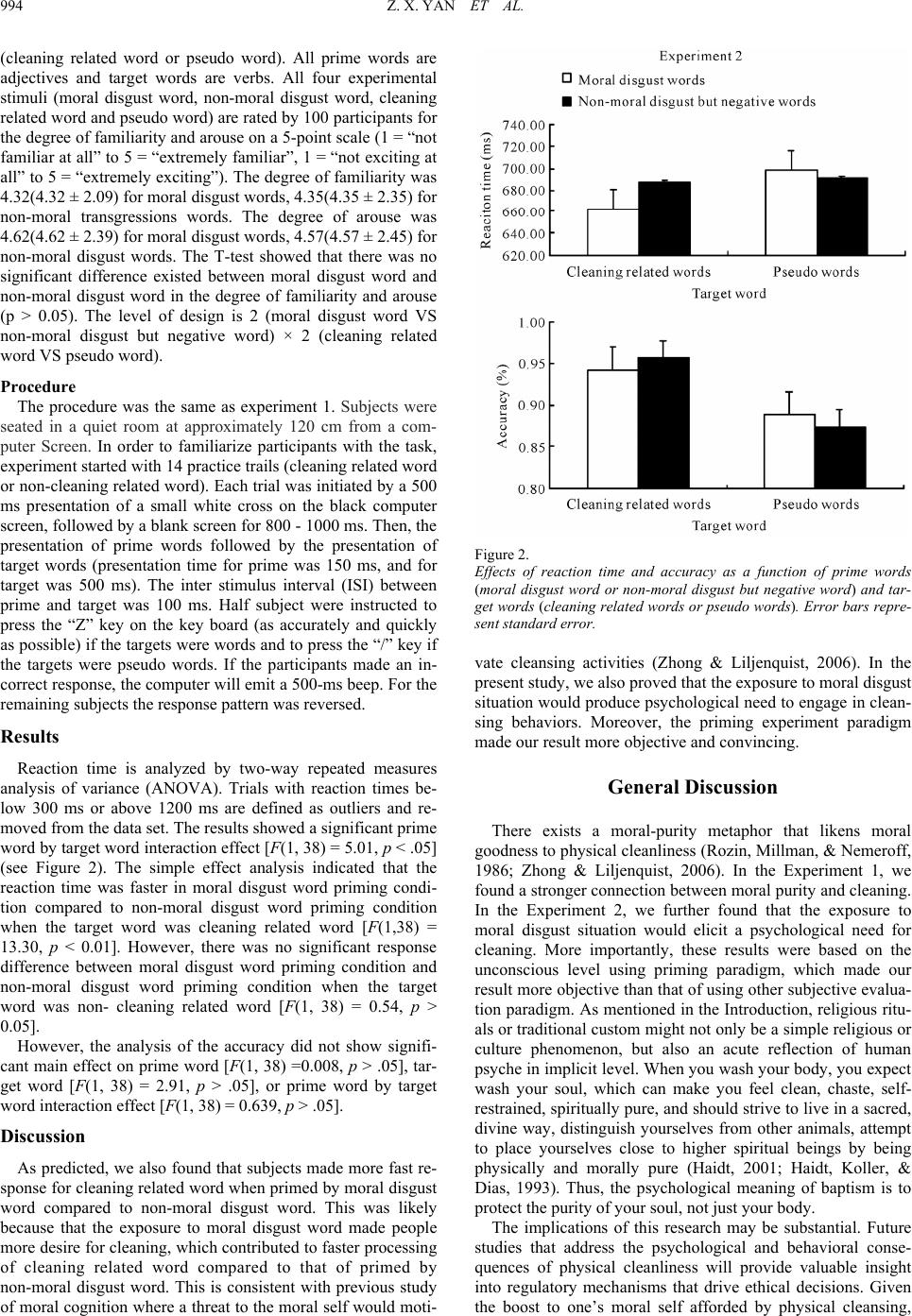 Z. X. YAN ET AL. 994 (cleaning related word or pseudo word). All prime words are adjectives and target words are verbs. All four experimental stimuli (moral disgust word, non-moral disgust word, cleaning related word and pseudo word) are rated by 100 participants for the degree of familiarity and arouse on a 5-point scale (1 = “not familiar at all” to 5 = “extremely familiar”, 1 = “not exciting at all” to 5 = “extremely exciting”). The degree of familiarity was 4.32(4.32 ± 2.09) for moral disgust words, 4.35(4.35 ± 2.35) for non-moral transgressions words. The degree of arouse was 4.62(4.62 ± 2.39) for moral disgust words, 4.57(4.57 ± 2.45) for non-moral disgust words. The T-test showed that there was no significant difference existed between moral disgust word and non-moral disgust word in the degree of familiarity and arouse (p > 0.05). The level of design is 2 (moral disgust word VS non-moral disgust but negative word) × 2 (cleaning related word VS pseudo word). Procedure The procedure was the same as experiment 1. Subjects were seated in a quiet room at approximately 120 cm from a com- puter Screen. In order to familiarize participants with the task, experiment started with 14 practice trails (cleaning related word or non-cleaning related word). Each trial was initiated by a 500 ms presentation of a small white cross on the black computer screen, followed by a blank screen for 800 - 1000 ms. Then, the presentation of prime words followed by the presentation of target words (presentation time for prime was 150 ms, and for target was 500 ms). The inter stimulus interval (ISI) between prime and target was 100 ms. Half subject were instructed to press the “Z” key on the key board (as accurately and quickly as possible) if the targets were words and to press the “/” key if the targets were pseudo words. If the participants made an in- correct response, the computer will emit a 500-ms beep. For the remaining subjects the response pattern was reversed. Results Reaction time is analyzed by two-way repeated measures analysis of variance (ANOVA). Trials with reaction times be- low 300 ms or above 1200 ms are defined as outliers and re- moved from the data set. The results showed a significant prime word by target word interaction effect [F(1, 38) = 5.01, p < .05] (see Figure 2). The simple effect analysis indicated that the reaction time was faster in moral disgust word priming condi- tion compared to non-moral disgust word priming condition when the target word was cleaning related word [F(1,38) = 13.30, p < 0.01]. However, there was no significant response difference between moral disgust word priming condition and non-moral disgust word priming condition when the target word was non- cleaning related word [F(1, 38) = 0.54, p > 0.05]. However, the analysis of the accuracy did not show signifi- cant main effect on prime word [F(1, 38) =0.008, p > .05], tar- get word [F(1, 38) = 2.91, p > .05], or prime word by target word interaction effect [F(1, 38) = 0.639, p > .05]. Discussion As predicted, we also found that subjects made more fast re- sponse for cleaning related word when primed by moral disgust word compared to non-moral disgust word. This was likely because that the exposure to moral disgust word made people more desire for cleaning, which contributed to faster processing of cleaning related word compared to that of primed by non-moral disgust word. This is consistent with previous study of moral cognition where a threat to the moral self would moti- Figure 2. Effects of reaction time and accuracy as a function of prime words (moral disgust word or non-moral disgust but negative word) and tar- get words (cleaning related words or pseudo words). Error bars repre- sent standard error. vate cleansing activities (Zhong & Liljenquist, 2006). In the present study, we also proved that the exposure to moral disgust situation would produce psychological need to engage in clean- sing behaviors. Moreover, the priming experiment paradigm made our result more objective and convincing. General Discussion There exists a moral-purity metaphor that likens moral goodness to physical cleanliness (Rozin, Millman, & Nemeroff, 1986; Zhong & Liljenquist, 2006). In the Experiment 1, we found a stronger connection between moral purity and cleaning. In the Experiment 2, we further found that the exposure to moral disgust situation would elicit a psychological need for cleaning. More importantly, these results were based on the unconscious level using priming paradigm, which made our result more objective than that of using other subjective evalua- tion paradigm. As mentioned in the Introduction, religious ritu- als or traditional custom might not only be a simple religious or culture phenomenon, but also an acute reflection of human psyche in implicit level. When you wash your body, you expect wash your soul, which can make you feel clean, chaste, self- restrained, spiritually pure, and should strive to live in a sacred, divine way, distinguish yourselves from other animals, attempt to place yourselves close to higher spiritual beings by being physically and morally pure (Haidt, 2001; Haidt, Koller, & Dias, 1993). Thus, the psychological meaning of baptism is to protect the purity of your soul, not just your body. The implications of this research may be substantial. Future studies that address the psychological and behavioral conse- quences of physical cleanliness will provide valuable insight into regulatory mechanisms that drive ethical decisions. Given the boost to one’s moral self afforded by physical cleansing,  Z. X. YAN ET AL. 995 how might it influence subsequent behavior? Would adherence to a rigorous hygiene regimen facilitate ethical behavior? It remains to be seen whether clean hands really do make a pure heart, but our studies indicate that they at least provide a clean conscience after moral trespasses. The future research would investigate the electrophysiological evidence through Event- related potential technology. Acknowledgements We thank Carl. D. Brady for editing English . References Haidt, J. et al. (1993). Affect, culture, and morality, or is it wrong to eat your dog? Journal of Personality and Social Psychology, 65, 613-628. doi:10.1037/0022-3514.65.4.613 Haidt, J. (2001). The emotional dog and its rational tail: A social intu- itionist approach to moral judgment. Psychological Review, 108, 814. doi:10.1037/0033-295X.108.4.814 Lupker, S. J. (1984). Semantic priming without association: A second look. Journal of Verbal Learning and Verbal Behavior, 23, 709-733. doi:10.1016/S0022-5371(84)90434-1 Meyer, D. E., & Schvaneveldt, R. W. (1971). Facilitation in recogniz- ing pairs of words: Evidence of a dependence between retrieval op- erations. Journal of experimental psychology, 90, 227. doi:10.1037/h0031564 Neusner, J. (1973). The idea of purity in ancient Judaism. Leiden: Brill Academic Pub. Rozin, P. et al. (1986). Operation of the laws of sympathetic magic in disgust and other domains. Journal of Personality and Social Psy- chology, 50, 703. doi:10.1037/0022-3514.50.4.703 Schnall, S. et al. (2008). With a clean conscience cleanliness reduces the severity of moral judgments. Psychological Science, 19, 1219-1222. doi:10.1111/j.1467-9280.2008.02227.x Schnall, S. et al. (2008). Disgust as embodied moral judgment. Person- ality and Social Psychology Bulletin, 34, 1096. doi:10.1177/0146167208317771 Wheatley, T., & Haidt, J.(2005).Hypnotic disgust makes moral judg- ments more severe. Psychological Science: A Journal of the Ameri- can Psychological Society / APS, 16, 780-784. Zhong, C. B., & Liljenquist, K. (2006). Washing away your sins: Threatened morality and physical cleansing. Science, 313, 1451- 1452. doi:10.1126/science.1130726 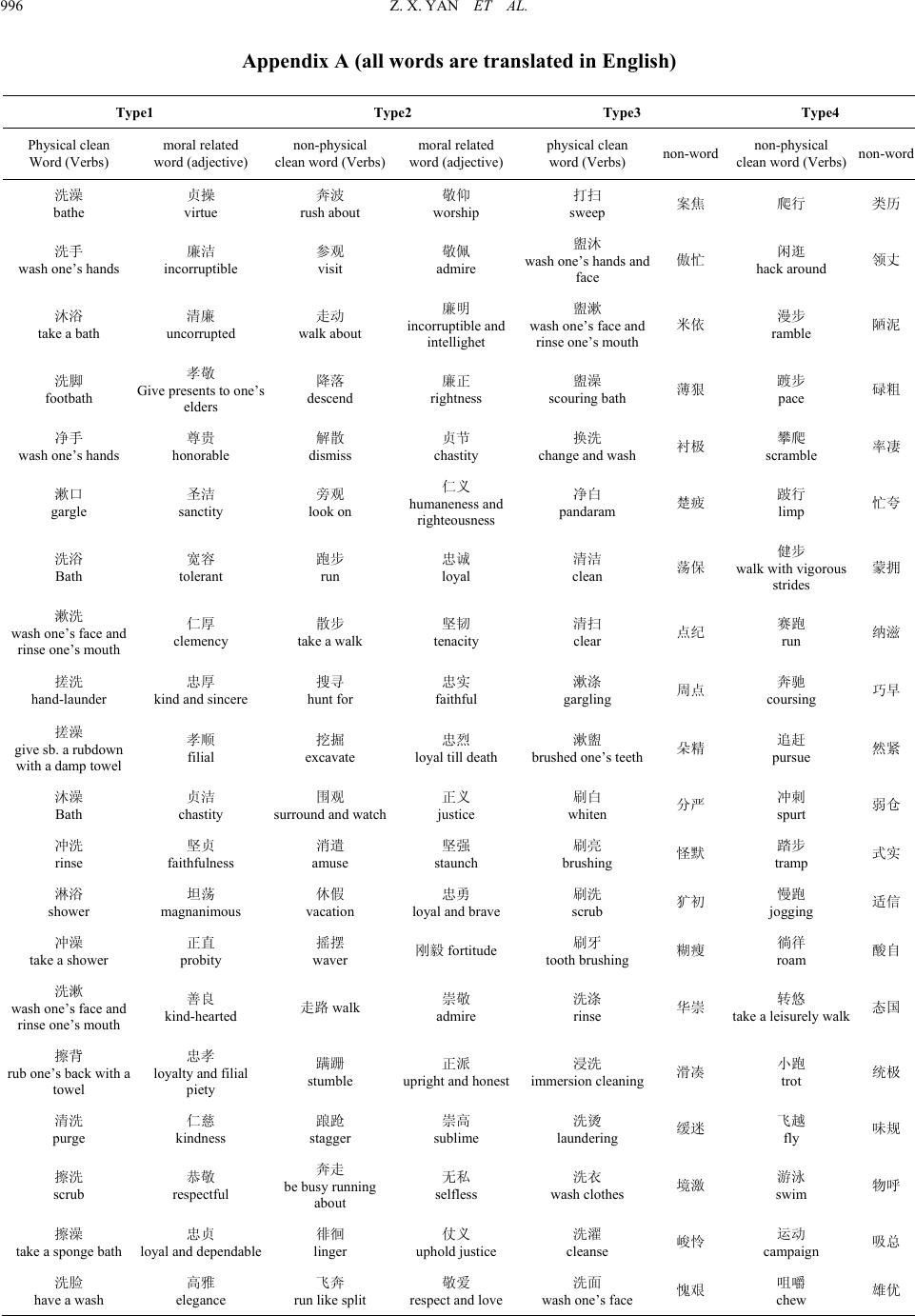 Z. X. YAN ET AL. 996 Appendix A (all words are translated in English) Type1 Type2 Type3 Type4 Physical clean Word (Verbs) moral rela ted word (adjective) non-physical clean word (Verbs)moral rela ted word (adjective) physical clean word (Verbs) non-word non-physical clean word (Verbs)non-word 洗澡 bathe 贞操 virtue 奔波 rush about 敬仰 worship 打扫 sweep 案焦 爬行 类历 洗手 wash one’s hands 廉洁 incorruptible 参观 visit 敬佩 admire 盥沐 wash one’s hands and face 傲忙 闲逛 hack around 领丈 沐浴 take a bath 清廉 uncorrupted 走动 walk about 廉明 incorruptible and intellighet 盥漱 wash one’s face and rinse one’s mouth 米依 漫步 ramble 陋泥 洗脚 footbath 孝敬 Give presents to one’s elders 降落 descend 廉正 rightness 盥澡 scouring bath 薄狠 踱步 pace 碌粗 净手 wash one’s hands 尊贵 honorable 解散 dismiss 贞节 chastity 换洗 change and wash 衬极 攀爬 scramble 率凄 漱口 gargle 圣洁 sanctity 旁观 look on 仁义 humaneness and righteousness 净白 pandaram 楚疲 跛行 limp 忙夸 洗浴 Bath 宽容 tolerant 跑步 run 忠诚 loyal 清洁 clean 荡保 健步 walk with vigorous strides 蒙拥 漱洗 wash one’s face and rinse one’s mouth 仁厚 clemency 散步 take a walk 坚韧 tenacity 清扫 clear 点纪 赛跑 run 纳滋 搓洗 hand-launder 忠厚 kind and sincere 搜寻 hunt for 忠实 faithful 漱涤 gargling 周点 奔驰 coursing 巧早 搓澡 give sb. a rubdown with a damp towel 孝顺 filial 挖掘 excavate 忠烈 loyal till death 漱盥 brushed one ’ s teeth朵精 追赶 pursue 然紧 沐澡 Bath 贞洁 chastity 围观 surround and watch 正义 justice 刷白 whiten 分严 冲刺 spurt 弱仓 冲洗 rinse 坚贞 faithfulness 消遣 amuse 坚强 staunch 刷亮 brushing 怪默 踏步 tramp 式实 淋浴 shower 坦荡 magnanimous 休假 vacation 忠勇 loyal and brave 刷洗 scrub 犷初 慢跑 jogging 适信 冲澡 take a shower 正直 probity 摇摆 waver 刚毅 fortitude 刷牙 tooth brushing 糊瘦 徜徉 roam 酸自 洗漱 wash one’s face and rinse one’s mouth 善良 kind-hearted 走路 walk 崇敬 admire 洗涤 rinse 华崇 转悠 take a leisurely walk态国 擦背 rub one ’ s b ack wit h a towel 忠孝 loyalty and filial piety 蹒跚 stumble 正派 upright and honest 浸洗 immersion cleaning滑凑 小跑 trot 统极 清洗 purge 仁慈 kindness 踉跄 stagger 崇高 sublime 洗烫 laundering 缓迷 飞越 fly 味规 擦洗 scrub 恭敬 respectful 奔走 be busy running about 无私 selfless 洗衣 wash clothes 境激 游泳 swim 物呼 擦澡 take a sponge bath 忠贞 loyal and dependable 徘徊 linger 仗义 uphold justice 洗濯 cleanse 峻怜 运动 campaign 吸总 洗脸 have a wash 高雅 elegance 飞奔 run like split 敬爱 respect and love 洗面 wash one’s face 愧艰 咀嚼 chew 雄优 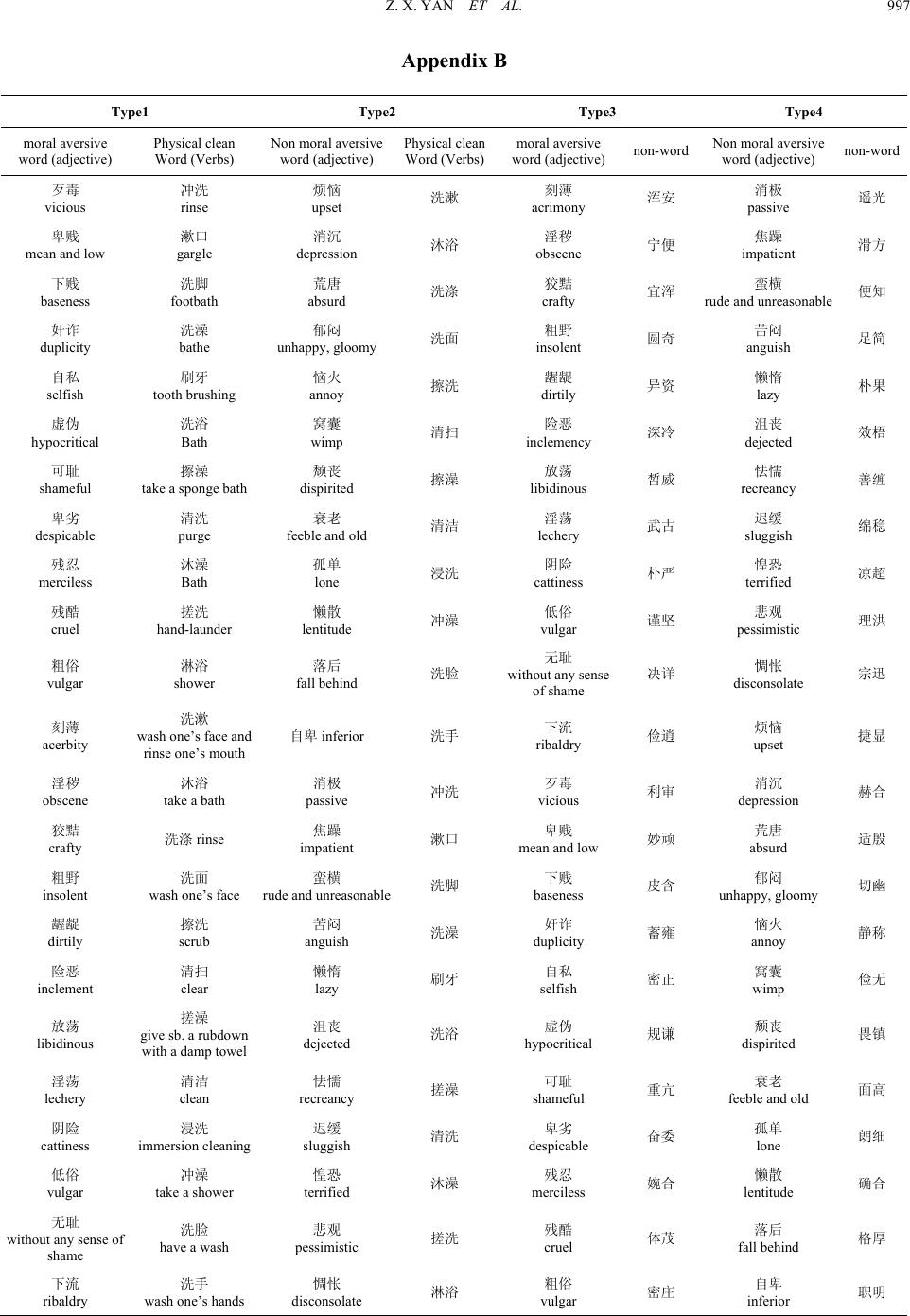 Z. X. YAN ET AL. 997 Appendix B Type1 Type2 Type3 Type4 moral aversive word (adjective) Physical clean Word (Verbs) Non moral aversive word (adjective) Physical clean Word (Verbs)moral aversive word (adjective) non-word Non moral aversive word (adjective) non-word 歹毒 vicious 冲洗 rinse 烦恼 upset 洗漱 刻薄 acrimony 浑安 消极 passive 遥光 卑贱 mean and low 漱口 gargle 消沉 depression 沐浴 淫秽 obscene 宁便 焦躁 impatient 滑方 下贱 baseness 洗脚 footbath 荒唐 absurd 洗涤 狡黠 crafty 宜浑 蛮横 rude and unrea sonable便知 奸诈 duplicity 洗澡 bathe 郁闷 unhappy, gloomy 洗面 粗野 insolent 圆奇 苦闷 anguish 足简 自私 selfish 刷牙 tooth brushing 恼火 annoy 擦洗 龌龊 dirtily 异资 懒惰 lazy 朴果 虚伪 hypocritical 洗浴 Bath 窝囊 wimp 清扫 险恶 inclemency 深冷 沮丧 dejected 效梧 可耻 shameful 擦澡 take a sponge bath 颓丧 dispirited 擦澡 放荡 libidinous 皙威 怯懦 recreancy 善缠 卑劣 despicable 清洗 purge 衰老 feeble and old 清洁 淫荡 lechery 武古 迟缓 sluggish 绵稳 残忍 merciless 沐澡 Bath 孤单 lone 浸洗 阴险 cattiness 朴严 惶恐 terrified 凉超 残酷 cruel 搓洗 hand-launder 懒散 lentitude 冲澡 低俗 vulgar 谨坚 悲观 pessimistic 理洪 粗俗 vulgar 淋浴 shower 落后 fall behind 洗脸 无耻 without any sense of shame 决详 惆怅 disconsolate 宗迅 刻薄 acerbity 洗漱 wash one’s face and rinse one’s mouth 自卑 inferior 洗手 下流 ribaldry 俭逍 烦恼 upset 捷显 淫秽 obscene 沐浴 take a bath 消极 passive 冲洗 歹毒 vicious 利审 消沉 depression 赫合 狡黠 crafty 洗涤 rinse 焦躁 impatient 漱口 卑贱 mean and low 妙顽 荒唐 absurd 适殷 粗野 insolent 洗面 wash one’s face 蛮横 rude and unrea sonable洗脚 下贱 baseness 皮含 郁闷 unhappy, gloomy 切幽 龌龊 dirtily 擦洗 scrub 苦闷 anguish 洗澡 奸诈 duplicity 蓄雍 恼火 annoy 静称 险恶 inclement 清扫 clear 懒惰 lazy 刷牙 自私 selfish 密正 窝囊 wimp 俭无 放荡 libidinous 搓澡 give sb. a rubdown with a damp towel 沮丧 dejected 洗浴 虚伪 hypocritical 规谦 颓丧 dispirited 畏镇 淫荡 lechery 清洁 clean 怯懦 recreancy 搓澡 可耻 shameful 重亢 衰老 feeble and old 面高 阴险 cattiness 浸洗 immersion cleaning 迟缓 sluggish 清洗 卑劣 despicable 奋委 孤单 lone 朗细 低俗 vulgar 冲澡 take a shower 惶恐 terrified 沐澡 残忍 merciless 婉合 懒散 lentitude 确合 无耻 without any sense of shame 洗脸 have a wash 悲观 pessimistic 搓洗 残酷 cruel 体茂 落后 fall behind 格厚 下流 ribaldry 洗手 wash one’s hands 惆怅 disconsolate 淋浴 粗俗 vulgar 密庄 自卑 inferior 职明 |