

Paper Menu >>
Journal Menu >>
 Psychology 2011. Vol.2, No.9, 936-940 Copyright © 2011 SciRes. DOI:10.4236/psych.2011.29141 Forgiving Significant Interpersonal Offenses: The Role of Victim/Offender Racial Similarity* Courtney Cornick1, Jessica M. Schultz2, Benjamin Tallman3, Elizabeth M. Altmaier1,4 1Department of Psychological and Quantitative Foundations, University of Iowa, Iowa City, USA; 2Department of Psychology, Augustana College, Rock Island, USA; 3Edward Hines Jr. VA Hospital, Chicago, USA; 4Department of Community and Behavioral Health, University of Iowa, Iowa City, USA. Email: [email protected] Received August 17th, 2011; revised September 20th, 2011; accepted October 22nd, 2011. The influence of victim/offender racial similarity on victim forgiveness was investigated in a study of interper- sonal transgressions. It was hypothesized that racial similarity between victim and offender would influence for- giveness only for transgressions that were less distressing for the victim. Participants were 104 adults (45 Black and 59 White) who provided a narrative description of a significant interpersonal transgression they had experi- enced and completed measures of transgression-related distress and forgiveness. Forgiveness was measured as positive (benevolence) and negative (revenge, avoidance) motivations toward the offender. For negative motive- tions, revenge and avoidance, there was no effect of racial similarity: more severe distress was associated with less forgiveness for all victim/offender pairings. However, the results revealed a significant interaction of vic- tim/offender racial similarity and distress for positive motivations: Black victims reported increased benevolence towards Black offenders after more distressing transgressions. Victims in other racial combinations reported re- duced benevolence for more distressing transgressions. In group favoring of Black offenders by Black victims may be an unexplored aspect of forgiveness. Little research has addressed the potential influence of context on interpersonal forgiveness, and this study suggests that these influences may play an important role. Keywords: Forgiveness, Race, Cultural Psychology, Counseling Introduction McCullough et al. (1998) defined forgiveness in motivational terms: the victim releases negative motivations (e.g., revenge) towards the offender and assumes positive motivations (e.g., goodwill) in the aftermath of an interpersonal transgression. Similarly, Enright and Fitzgibbons (2000) suggest that forgive- ness involves the victim overcoming negative affect and judg- ment towards the offender and instead viewing him or her with empathy or compassion. However, it is important to consider forgiveness in a larger context than that encompassing solely two people, particularly when a larger perspective suggests societal or contextual influ- ences on a victim’s forgiveness response. For example, Digeser (2001) argued that oppressed groups experience a historical burden of transgressions. Thus, forgiveness may be more diffi- cult for oppressed persons than for persons with a history of privilege. This difficulty may be especially present in person- to-person forgiveness when the offender has a history of privi- lege and the victim has a history of oppression. Race is an area of clear differences between groups in terms of privilege and oppression. Unfortunately, little is known about the role of race in for- giveness. Erguner-Tekinalp (2007) studied Black college stu- dents’ perceptions of historical racism and personally experi- enced racially offensive acts. When Black students perceived societal remorse and motivations for reparation, they reported more forgiveness of historical racial transgressions. However, these societal influences did not predict forgiveness for person- ally experienced acts. When the context of racial similarity of victim to offender is taken into account, forgiveness may be altered. Miller (2001) summarized research that suggests a victim will find an offender’s action more disrespectful if the offender belongs to the same social group as the victim. Distantly related research that explores whether culturally different groups are able to forgive one another is relevant to the current study. One of the primary examples of intergroup forgiveness was the Truth and Reconciliation Commission of South Africa. This commission was created to assist with repa- ration to, and the rehabilitation and restoration of human and civil dignity of, victims of violations of human rights following the Promotion of National Unity and Reconciliation Act in 1995. Research following the actions of the Commission dem- onstrated that even in the context of profoundly severe transgressions, such as murder and torture, victims of one race were able to forgive offenders of another (Kaminer, Stein, Mbanga, & Zungu-Dirwayi, 2001; Stein et al., 2008). Forgiveness is predicted by many factors. For example, hav- ing an offender apologize for the transgression is positively related to the victim forgiving him or her (Girard, Mullet, & Calahan, 2002). Transgression severity is also related to for- giveness, with more severe transgressions predicting less for- giveness. However, researchers have not analyzed the role of racial similarity versus dissimilarity. The above discussion suggests that people of varying races are able to forgive each other, although the influence of past historical wrongs may continue. If one considers research on racial micro aggressions (see Sue et al., 2007) in combination with privilege and oppres- sion, it would be reasonable to expect that a transgression *This research was supported in part by a Summer Research Opportunity Fellowship awarded to the first author by the Committee on Institutional Cooperation. 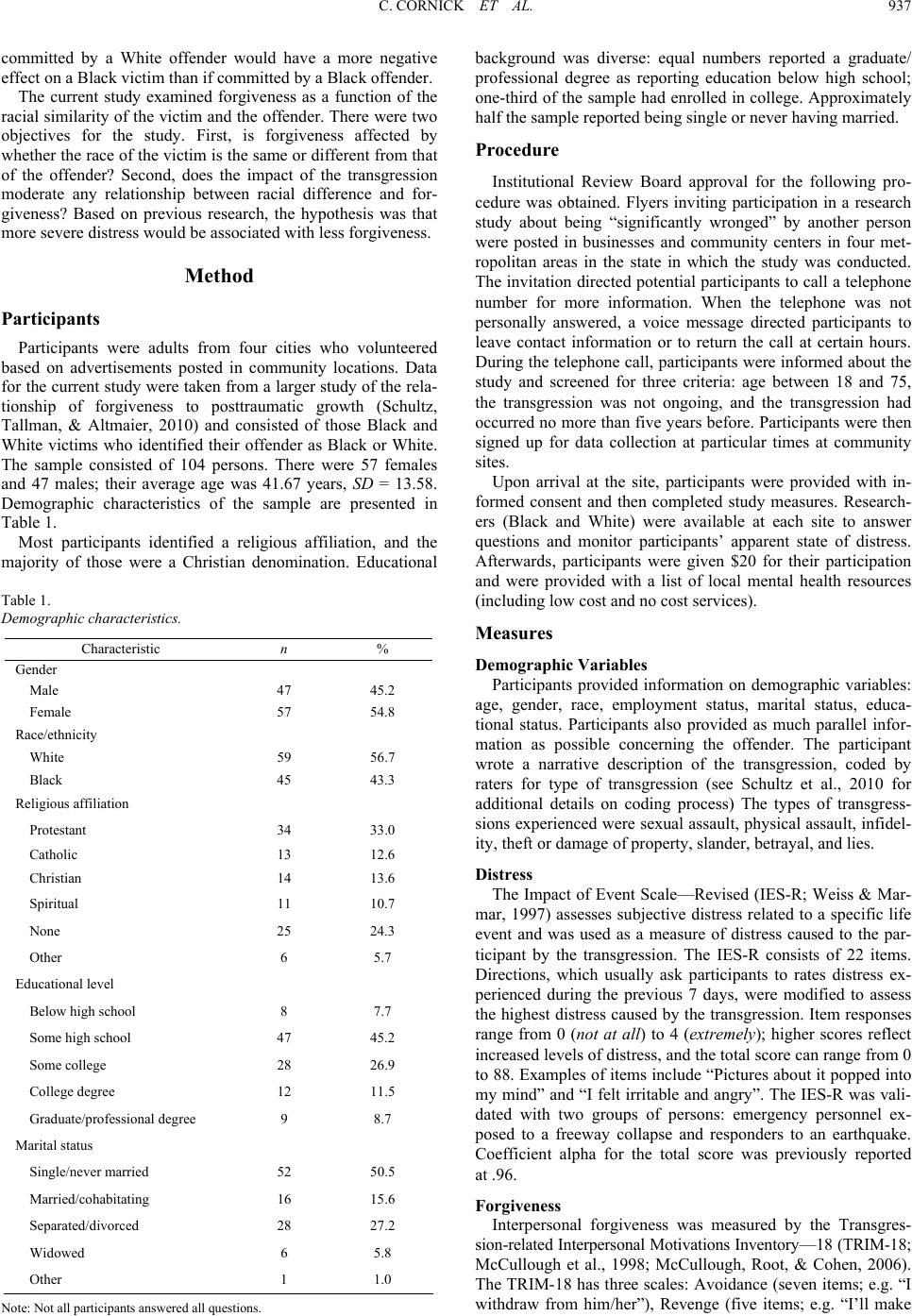 C. CORNICK ET AL. 937 committed by a White offender would have a more negative effect on a Black victim than if committed by a Black offender. The current study examined forgiveness as a function of the racial similarity of the victim and the offender. There were two objectives for the study. First, is forgiveness affected by whether the race of the victim is the same or different from that of the offender? Second, does the impact of the transgression moderate any relationship between racial difference and for- giveness? Based on previous research, the hypothesis was that more severe distress would be associated with less forgiveness. Method Participants Participants were adults from four cities who volunteered based on advertisements posted in community locations. Data for the current study were taken from a larger study of the rela- tionship of forgiveness to posttraumatic growth (Schultz, Tallman, & Altmaier, 2010) and consisted of those Black and White victims who identified their offender as Black or White. The sample consisted of 104 persons. There were 57 females and 47 males; their average age was 41.67 years, SD = 13.58. Demographic characteristics of the sample are presented in Table 1. Most participants identified a religious affiliation, and the majority of those were a Christian denomination. Educational Table 1. Demographic characteristics. Characteristic n % Gender Male 47 45.2 Female 57 54.8 Race/ethnicity White 59 56.7 Black 45 43.3 Religious affiliation Protestant 34 33.0 Catholic 13 12.6 Christian 14 13.6 Spiritual 11 10.7 None 25 24.3 Other 6 5.7 Educational level Below high school 8 7.7 Some high school 47 45.2 Some college 28 26.9 College degree 12 11.5 Graduate/professional degree 9 8.7 Marital status Single/never married 52 50.5 Married/cohabitating 16 15.6 Separated/divorced 28 27.2 Widowed 6 5.8 Other 1 1.0 Note: Not all participants answered all questions. background was diverse: equal numbers reported a graduate/ professional degree as reporting education below high school; one-third of the sample had enrolled in college. Approximately half the sample reported being single or never having married. Procedure Institutional Review Board approval for the following pro- cedure was obtained. Flyers inviting participation in a research study about being “significantly wronged” by another person were posted in businesses and community centers in four met- ropolitan areas in the state in which the study was conducted. The invitation directed potential participants to call a telephone number for more information. When the telephone was not personally answered, a voice message directed participants to leave contact information or to return the call at certain hours. During the telephone call, participants were informed about the study and screened for three criteria: age between 18 and 75, the transgression was not ongoing, and the transgression had occurred no more than five years before. Participants were then signed up for data collection at particular times at community sites. Upon arrival at the site, participants were provided with in- formed consent and then completed study measures. Research- ers (Black and White) were available at each site to answer questions and monitor participants’ apparent state of distress. Afterwards, participants were given $20 for their participation and were provided with a list of local mental health resources (including low cost and no cost services). Measures Demographic Variables Participants provided information on demographic variables: age, gender, race, employment status, marital status, educa- tional status. Participants also provided as much parallel infor- mation as possible concerning the offender. The participant wrote a narrative description of the transgression, coded by raters for type of transgression (see Schultz et al., 2010 for additional details on coding process) The types of transgress- sions experienced were sexual assault, physical assault, infidel- ity, theft or damage of property, slander, betrayal, and lies. Distress The Impact of Event Scale—Revised (IES-R; Weiss & Mar- mar, 1997) assesses subjective distress related to a specific life event and was used as a measure of distress caused to the par- ticipant by the transgression. The IES-R consists of 22 items. Directions, which usually ask participants to rates distress ex- perienced during the previous 7 days, were modified to assess the highest distress caused by the transgression. Item responses range from 0 (not at all) to 4 (extremely); higher scores reflect increased levels of distress, and the total score can range from 0 to 88. Examples of items include “Pictures about it popped into my mind” and “I felt irritable and angry”. The IES-R was vali- dated with two groups of persons: emergency personnel ex- posed to a freeway collapse and responders to an earthquake. Coefficient alpha for the total score was previously reported at .96. Forgiveness Interpersonal forgiveness was measured by the Transgres- sion-related Interpersonal Motivations Inventory—18 (TRIM-18; McCullough et al., 1998; McCullough, Root, & Cohen, 2006). The TRIM-18 has three scales: Avoidance (seven items; e.g. “I withdraw from him/her”), Revenge (five items; e.g. “I’ll make 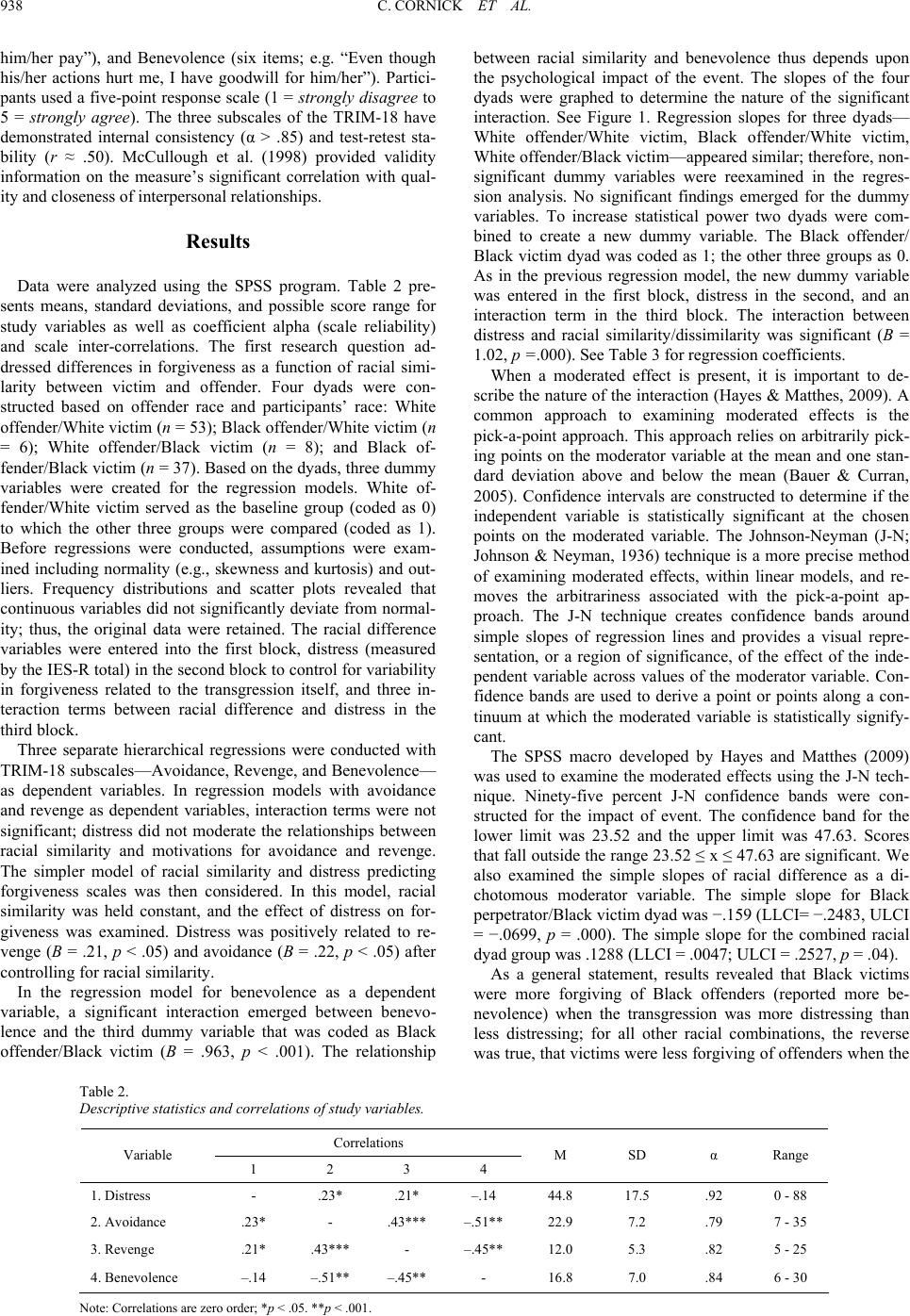 C. CORNICK ET AL. 938 him/her pay”), and Benevolence (six items; e.g. “Even though his/her actions hurt me, I have goodwill for him/her”). Partici- pants used a five-point response scale (1 = strongly disagree to 5 = strongly agree). The three subscales of the TRIM-18 have demonstrated internal consistency (α > .85) and test-retest sta- bility (r ≈ .50). McCullough et al. (1998) provided validity information on the measure’s significant correlation with qual- ity and closeness of interpersonal relationships. Results Data were analyzed using the SPSS program. Table 2 pre- sents means, standard deviations, and possible score range for study variables as well as coefficient alpha (scale reliability) and scale inter-correlations. The first research question ad- dressed differences in forgiveness as a function of racial simi- larity between victim and offender. Four dyads were con- structed based on offender race and participants’ race: White offender/White victim (n = 53); Black offender/White victim (n = 6); White offender/Black victim (n = 8); and Black of- fender/Black victim (n = 37). Based on the dyads, three dummy variables were created for the regression models. White of- fender/White victim served as the baseline group (coded as 0) to which the other three groups were compared (coded as 1). Before regressions were conducted, assumptions were exam- ined including normality (e.g., skewness and kurtosis) and out- liers. Frequency distributions and scatter plots revealed that continuous variables did not significantly deviate from normal- ity; thus, the original data were retained. The racial difference variables were entered into the first block, distress (measured by the IES-R total) in the second block to control for variability in forgiveness related to the transgression itself, and three in- teraction terms between racial difference and distress in the third block. Three separate hierarchical regressions were conducted with TRIM-18 subscales—Avoidance, Revenge, and Benevolence— as dependent variables. In regression models with avoidance and revenge as dependent variables, interaction terms were not significant; distress did not moderate the relationships between racial similarity and motivations for avoidance and revenge. The simpler model of racial similarity and distress predicting forgiveness scales was then considered. In this model, racial similarity was held constant, and the effect of distress on for- giveness was examined. Distress was positively related to re- venge (B = .21, p < .05) and avoidance (B = .22, p < .05) after controlling for racial similarity. In the regression model for benevolence as a dependent variable, a significant interaction emerged between benevo- lence and the third dummy variable that was coded as Black offender/Black victim (B = .963, p < .001). The relationship between racial similarity and benevolence thus depends upon the psychological impact of the event. The slopes of the four dyads were graphed to determine the nature of the significant interaction. See Figure 1. Regression slopes for three dyads— White offender/White victim, Black offender/White victim, White offender/Black victim—appeared similar; therefore, non- significant dummy variables were reexamined in the regres- sion analysis. No significant findings emerged for the dummy variables. To increase statistical power two dyads were com- bined to create a new dummy variable. The Black offender/ Black victim dyad was coded as 1; the other three groups as 0. As in the previous regression model, the new dummy variable was entered in the first block, distress in the second, and an interaction term in the third block. The interaction between distress and racial similarity/dissimilarity was significant (B = 1.02, p =.000). See Table 3 for regression coefficients. When a moderated effect is present, it is important to de- scribe the nature of the interaction (Hayes & Matthes, 2009). A common approach to examining moderated effects is the pick-a-point approach. This approach relies on arbitrarily pick- ing points on the moderator variable at the mean and one stan- dard deviation above and below the mean (Bauer & Curran, 2005). Confidence intervals are constructed to determine if the independent variable is statistically significant at the chosen points on the moderated variable. The Johnson-Neyman (J-N; Johnson & Neyman, 1936) technique is a more precise method of examining moderated effects, within linear models, and re- moves the arbitrariness associated with the pick-a-point ap- proach. The J-N technique creates confidence bands around simple slopes of regression lines and provides a visual repre- sentation, or a region of significance, of the effect of the inde- pendent variable across values of the moderator variable. Con- fidence bands are used to derive a point or points along a con- tinuum at which the moderated variable is statistically signify- cant. The SPSS macro developed by Hayes and Matthes (2009) was used to examine the moderated effects using the J-N tech- nique. Ninety-five percent J-N confidence bands were con- structed for the impact of event. The confidence band for the lower limit was 23.52 and the upper limit was 47.63. Scores that fall outside the range 23.52 ≤ x ≤ 47.63 are significant. We also examined the simple slopes of racial difference as a di- chotomous moderator variable. The simple slope for Black perpetrator/Black victim dyad was −.159 (LLCI= −.2483, ULCI = −.0699, p = .000). The simple slope for the combined racial dyad group was .1288 (LLCI = .0047; ULCI = .2527, p = .04). As a general statement, results revealed that Black victims were more forgiving of Black offenders (reported more be- nevolence) when the transgression was more distressing than less distressing; for all other racial combinations, the reverse was true, that victims were less forgiving of offenders when the Table 2. Descriptive statistics and corre l a tions of study variables. Correlations Variable 1 2 3 4 M SD α Range 1. Distress - .23* .21* –.14 44.8 17.5 .92 0 - 88 2. Avoidance .23* - .43*** –.51** 22.9 7.2 .79 7 - 35 3. Revenge .21* .43*** - –.45** 12.0 5.3 .82 5 - 25 4. Benevolence –.14 –.51** –.45** - 16.8 7.0 .84 6 - 30 Note: Correlations are zero order; *p < .05. **p < .001. 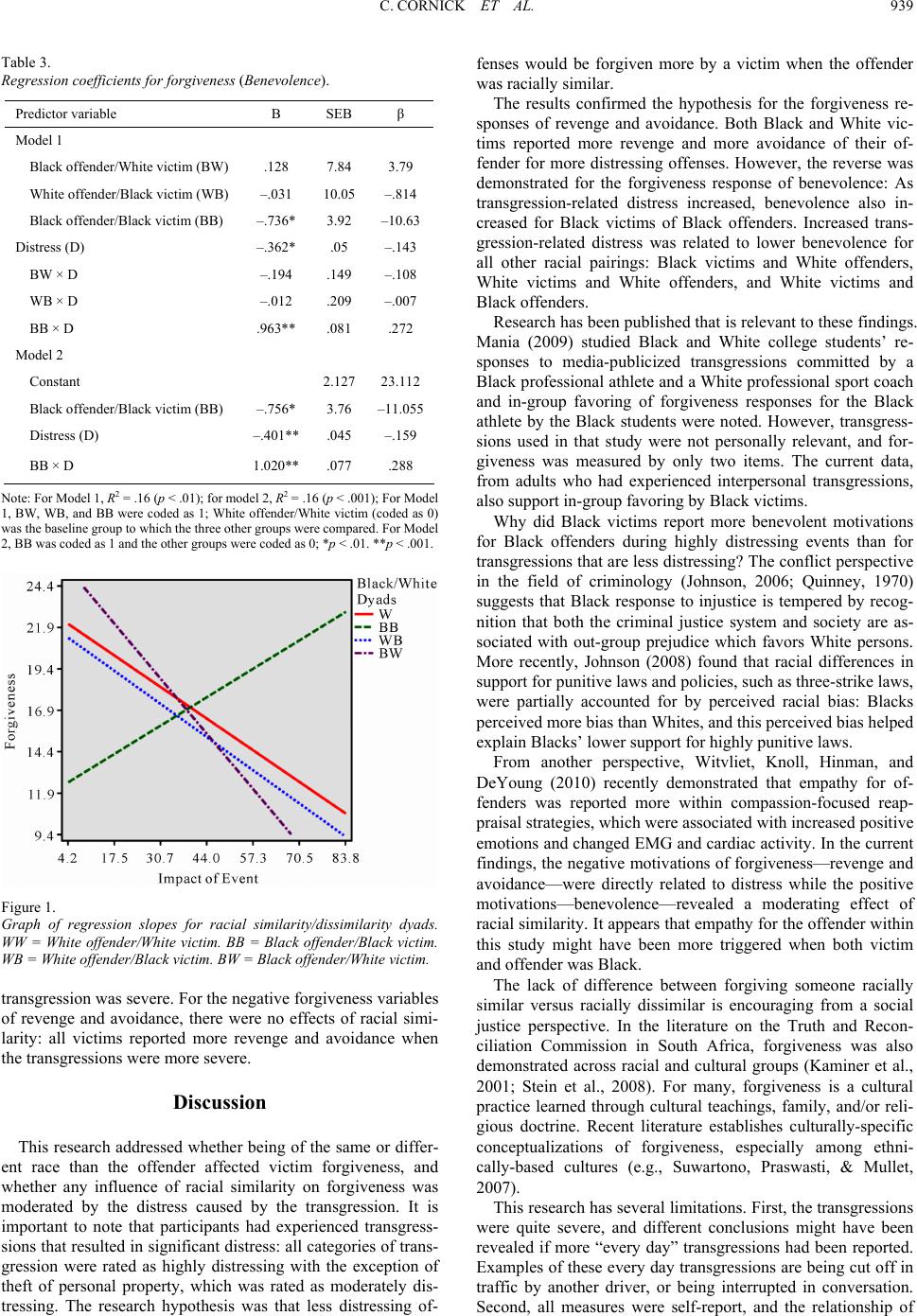 C. CORNICK ET AL. 939 Table 3. Regression coefficients for forgiveness (Benevolence). Predictor variable B SEB β Model 1 Black offender/White victim (BW).128 7.84 3.79 White offender/Black victim (WB)–.031 10.05 –.814 Black offender/Black victim (BB) –.736* 3.92 –10.63 Distress (D) –.362* .05 –.143 BW × D –.194 .149 –.108 WB × D –.012 .209 –.007 BB × D .963** .081 .272 Model 2 Constant 2.127 23.112 Black offender/Black victim (BB) –.756* 3.76 –11.055 Distress (D) –.401** .045 –.159 BB × D 1.020** .077 .288 Note: For Model 1, R2 = .16 (p < .01); for model 2, R2 = .16 (p < .001); For Model 1, BW, WB, and BB were coded as 1; White offender/White victim (coded as 0) was the baseline group to which the three other groups were compared. For Model 2, BB was coded as 1 and the other groups were coded as 0; *p < .01. **p < .001. Figure 1. Graph of regression slopes for racial similarity/dissimilarity dyads. WW = White offender/White victim. BB = Black offender/Black victim. WB = White offender/Black victim. BW = Black offender/White victim. transgression was severe. For the negative forgiveness variables of revenge and avoidance, there were no effects of racial simi- larity: all victims reported more revenge and avoidance when the transgressions were more severe. Discussion This research addressed whether being of the same or differ- ent race than the offender affected victim forgiveness, and whether any influence of racial similarity on forgiveness was moderated by the distress caused by the transgression. It is important to note that participants had experienced transgress- sions that resulted in significant distress: all categories of trans- gression were rated as highly distressing with the exception of theft of personal property, which was rated as moderately dis- tressing. The research hypothesis was that less distressing of- fenses would be forgiven more by a victim when the offender was racially similar. The results confirmed the hypothesis for the forgiveness re- sponses of revenge and avoidance. Both Black and White vic- tims reported more revenge and more avoidance of their of- fender for more distressing offenses. However, the reverse was demonstrated for the forgiveness response of benevolence: As transgression-related distress increased, benevolence also in- creased for Black victims of Black offenders. Increased trans- gression-related distress was related to lower benevolence for all other racial pairings: Black victims and White offenders, White victims and White offenders, and White victims and Black offenders. Research has been published that is relevant to these findings. Mania (2009) studied Black and White college students’ re- sponses to media-publicized transgressions committed by a Black professional athlete and a White professional sport coach and in-group favoring of forgiveness responses for the Black athlete by the Black students were noted. However, transgress- sions used in that study were not personally relevant, and for- giveness was measured by only two items. The current data, from adults who had experienced interpersonal transgressions, also support in-group favoring by Black victims. Why did Black victims report more benevolent motivations for Black offenders during highly distressing events than for transgressions that are less distressing? The conflict perspective in the field of criminology (Johnson, 2006; Quinney, 1970) suggests that Black response to injustice is tempered by recog- nition that both the criminal justice system and society are as- sociated with out-group prejudice which favors White persons. More recently, Johnson (2008) found that racial differences in support for punitive laws and policies, such as three-strike laws, were partially accounted for by perceived racial bias: Blacks perceived more bias than Whites, and this perceived bias helped explain Blacks’ lower support for highly punitive laws. From another perspective, Witvliet, Knoll, Hinman, and DeYoung (2010) recently demonstrated that empathy for of- fenders was reported more within compassion-focused reap- praisal strategies, which were associated with increased positive emotions and changed EMG and cardiac activity. In the current findings, the negative motivations of forgiveness—revenge and avoidance—were directly related to distress while the positive motivations—benevolence—revealed a moderating effect of racial similarity. It appears that empathy for the offender within this study might have been more triggered when both victim and offender was Black. The lack of difference between forgiving someone racially similar versus racially dissimilar is encouraging from a social justice perspective. In the literature on the Truth and Recon- ciliation Commission in South Africa, forgiveness was also demonstrated across racial and cultural groups (Kaminer et al., 2001; Stein et al., 2008). For many, forgiveness is a cultural practice learned through cultural teachings, family, and/or reli- gious doctrine. Recent literature establishes culturally-specific conceptualizations of forgiveness, especially among ethni- cally-based cultures (e.g., Suwartono, Praswasti, & Mullet, 2007). This research has several limitations. First, the transgressions were quite severe, and different conclusions might have been revealed if more “every day” transgressions had been reported. Examples of these every day transgressions are being cut off in traffic by another driver, or being interrupted in conversation. Second, all measures were self-report, and the relationship of  C. CORNICK ET AL. 940 this self-report to behavior is not certain. Forgiveness is more than an interesting aspect of life; signi- ficant mental and physical health benefits are related to for- giveness (Harris & Thoresen, 2005; Wade, Worthington, & Meyer, 2005). Psychological variables associated with race, such as collectivist orientation or religious salience, are impor- tant areas to explore with regard to forgiveness. Other variables for future research in this area include one’s exposure to dif- ferent racial groups and forgiveness of racially motivated transgressions such as discrimination. Last, the potential influ- ence of race and other societal and contextual variables in study of forgiveness treatments is also an important area for investi- gation. References Bauer, D., J., & Curran, P. J. (2005). Probing interaction in fixed and multilevel regression: Inferential and graphical techniques, Multivariate Behavioral Research, 40, 373-400. doi:10.1207/s15327906mbr4003_5 Digeser, P. (2001). Political forgiveness. Ithaca, NY: Cornell Univer- sity Press. Erguner-Tekinalp, B. (2007). Forgiveness of historical and current racial transgressions: A study of intergroup forgiveness among Blacks. Dissertation Abstracts International: Section A. Humanities and Social Sciences, 68. Enright, R. D., & Fitzgibbons, R. P. (2000). Helping clients forgive: An empirical guide for resolving anger and restoring hope. Washington, DC: American Psychological Association. doi:10.1037/10381-000 Girard, M., Mullet, E., & Calahan, S. (2002). Mathematics of forgiveness. American Journal of Psychology, 115, 351-375. doi:10.2307/1423422 Harris, A. H. S., & Thoresen, C. E. (2005). Forgiveness, unforgiveness, health, and disease. In E. L. Worthington (Ed.), Handbook of for- giveness (pp. 321-334). New York: Routledge. Hayes, A. F., & Matthes, J. (2009). Computational procedures for in- teraction in OLS and logistic regression: SPSS and SAS implementa- tions. Behavior Research Me th o ds , 41, 924-936. doi:10.3758/BRM.41.3.924 Johnson, D. (2006). Crime salience, perceived racial bias, and Blacks’ punitive attitudes. Journal of Ethnicity in Criminal Justice, 4, 1-18. doi:10.1300/J222v04n04_01 Johnson, D. (2008). Racial prejudice, perceived injustice, and the Black-White gap in punitive attitudes. Journal of Criminal Justice, 36, 198-206. doi:10.1016/j.jcrimjus.2008.02.009 Johnson, P. O., & Neyman, J. (1936). Tests of certain linear hypotheses and their applications to some educational problems. Statistical Re- search Memoirs, 1, 115-134. Kaminer, D., Stein, D. J., Mbanga, I., & Zungu-Dirwayi, N. (2001). The Truth and Reconciliation Commission in South Africa: Relation to psychiatric status and forgiveness among survivors of human rights abuses. British Journa l o f Psychiatry, 178, 373-377. doi:10.1192/bjp.178.4.373 Mania, E. W. (2009). The intergroup dynamics of responding to trans- gression: An examination of racial biases and disparities in re- sponding to wrongdoers. Doctoral Thesis, ProQuest Dissertations and Theses Database, UMI No. 3373307. McCullough, M. E., Rachal, K. C., Sandage, S. J., Worthington, E. L., Jr., Brown, S. W., & Hight, T. L. (1998). Interpersonal forgiving in close relationships: II. Theoretical elaboration and measurement. Journal of Personality a nd Social Psychology, 75, 1586-1603. doi:10.1037/0022-3514.75.6.1586 McCullough, M. E., Root, L. M., & Cohen, A. D. (2006). Writing about the benefits of an interpersonal transgression facilitates forgiveness. Journal of Consulting and Clinical Psychology, 74, 887-897. doi:10.1037/0022-006X.74.5.887 Miller, D. T. (2001). Disrespect and the experience of injustice. Annual Review of Psychology, 52, 527-553. doi:10.1146/annurev.psych.52.1.527 Quinney, R. (1970). The social reality of crime. Boston, MA: Little, Brown. Schultz, J. M., Tallman, B. A., & Altmaier, E. M. (2010). Pathways to posttraumatic growth: The contributions of forgiveness and impor- tance of religion and spirituality. Psychology of Religion and Spiritu- ality, 2, 104-114. doi:10.1037/a0018454 Stein, D. J., Seedat, S., Kaminer, D., Moomal, H., Herman, A., Sonnega, J., & Williams, D. R. (2008). The impact of the Truth and Reconcilia- tion Commission on psychological distress and forgiveness in South Africa. Social Psychiatry and Psychiatric Epidemiology, 43, 462-468. doi:10.1007/s00127-008-0350-0 Sue, D. W., Capodilupo, C. M., Torino, G. C., Bucceri, J. M., Holder, A. M. B., Nadal, K. L., & Esquilin, M. (2007). Racial microaggres- sions in everyday life: Implications for clinical practice. American Psychologist, 62, 271-286. doi:10.1037/0003-066X.62.4.271 Suwartono, C., Praswasti, C. Y., & Mullet, E. (2007). Effect of culture on forgivingness: A Southern Asia-Western Europe comparison. Personality and Individual Differences, 42, 513-523. doi:10.1016/j.paid.2006.07.027 Truth and Reconciliation Commission (2003). Final report of the South African Truth and Reconciliation Commission. URL (last checked 20 January 2011) http://www.info.gov.za/otherdocs/2003/trc/ Wade, N. G., Worthington, E. L. Jr., & Meyer, J. E. (2005). But do they work? A meta-analysis of group interventions to promote forgiveness. In E. L. Jr. Worthington, (Ed.), Handbook of forgiveness (pp. 423-439). New York, NY: Routledge. Weiss, D. S., & Marmar, C. R. (1997). The impact of event scale— Revised. In J. P. Wilson, & T. M. Keane (Eds.), Assessing psycho- logical trauma and PTSD (pp. 399-411). New York, NY: Guilford Press. Witvliet, C. V., Knoll, R. W., Himnan, N. G, & DeYoung, P. A. (2010). Compassion-focused reappraisal, benefit-focused reappraisal, and rumination after an interpersonal transgression: Emotion-regulation implications for subjective emotion, linguistic responses, and physi- ology. Journal of Positive Psychology, 5, 226-242. doi:10.1080/17439761003790997 |