

Paper Menu >>
Journal Menu >>
 Psychology 2011. Vol.2, No.9, 902-908 Copyright © 2011 SciRes. DOI:10.4236/psych.2011.29136 The Relationship between Teachers’ Effectiveness and Management of Classroom Misbehaviours in Secondary Schools Bonke A. Omoteso, Adeola Semudara Department of Educational Foundations and Counselling, Obafemi Awolowo University, Ile-Ife, Nigeria. Email: [email protected] Received August 4th, 2011; revised September 20th, 2011; accepted October 29th, 2011. The study investigated the nature of classroom misbehaviours among secondary school students in Ondo State, Nigeria. It also determined the effectiveness of the teachers and the strategies adopted by the teachers to manage classroom misbehaviours. Furthermore, it established the relationship between teachers’ effectiveness and man- agement of classroom misbehavior with a view to maintaining discipline in schools. The study adopted descrip- tive survey design. The population comprised the teachers and school administrators in Ondo State. The sample consisted of 420 teachers and 180 school administrators selected randomly from 10 secondary schools selected by stratified sampling technique using location of schools and ownerships of schools as strata. Two instruments namely “Questionnaire on Management of Classroom Misbehaviour” (QMCM) and “Teacher Effectiveness Scale” (TES) were used to elicit information from the students. QMCM was made up of three sections. Section A consisted of items on socio-demographic variables such as sex, location of schools and ownership of schools. Section B requested the teachers to indicate the types of misbehavior that take place in the classroom and their frequencies of occurrence. Section C comprises strategies used by teachers to manage classroom misbehaviours. TES was the ratings of teachers’ effectiveness as done by the school administrators. Results showed that the fol- lowing misbehaviours occurred frequently in the classrooms: talking while was teaching (75.4%) and fighting (90.9%). The strategies adopted by teachers included giving advice (90.5) and referring the students to the school counsellors (88.6%). The teachers were rated effective in attending classes punctually (81.3%) and in communicating clearly with the students (96.0%). Furthermore, there existed a significant relationship between teachers’ effectiveness and management of classroom misbehavior, r = 0.0525 which is signifi ca n t at .05 level. Keywords: Teachers’ Effectiveness, Management, Misbehaviour Introduction Classroom misbehavior among students is one issue that both parents and educators agree is a problem. Many people blame the teachers and the school authority. Many others believe that the media including music, television, books and recently the internet have been responsible for classroom misbehaviours. It is a fact that in the past, our secondary schools experienced only few cases of classroom misbehaviour, but in the “com- puter age” where adolescents are exposed to violent films, wrestling, boxing and other different kinds of exposure, class- room misbehavior increases. Classroom misbehavior among secondary school students is any activity that interferes with teaching and learning. Activi- ties such as unpreparedness for class, talking in class, fighting, cheating, rudeness to teachers, and so on might disrupt the process of teaching and learning (Slavin, 2001; Hussain, 2005). Misbehaviour is also any activity that hinders the misbehaving students to learn. Misbehaviour can arise because students feel frustrated and bored in schools. Another reason why students misbehave is because they want teachers’ attention. A lot of problems which teachers must deal with are minor disruptions in the classroom. In dealing with classroom problems, it is best to correct behaviours by using the simplest intervention. Thus, it is expected that if the teachers takes cognizance of the unruly behavior of the students and applies the appropriate class con- trol method, punishment or sanctions, the students will derive maximum advantage from the classroom learning. However, in order that the teacher may be able to effectively manage his/her classroom, he/she needs to have sufficient and more importantly confidence and develop abilities in classroom management (Cartledge & Johnson, 1996). Martin, Limfort & Stephenson, 1999) revealed that most teachers confessed that their inability to deal with misbehavior in their classrooms was as a result of their lack of experience and preparation. By im- plication, confidence is a prerequisite to effective classroom management (Cartledge & Johnson, 1996). The ability of a teacher to effectively manage a classroom depends also on the teacher’s mode of training and work ex- perience (Lin & Gomell, 1998). The Nigerian Certificate of Education (NCE) is the basic qualification for teachers in pri- mary and junior secondary schools in Nigeria. This minimum standard was fashioned out to produce highly qualified and competent teachers in primary and junior secondary schools in Nigeria. (National Policy on Education (NPE), 2004). As indi- cated in the NPE a would be teacher should undergo at least a three year teacher training programme in the university in order to qualify as senior secondary school teacher. Sadly, many teachers lack the skills required to be effective as teachers, due to poor preparation in the training process. In fact, Little (1999) found that many teachers who completed their teacher educa- tion reported not to have received formal training on classroom management. It is therefore not surprising that most teachers find it difficult to handle classroom behavioural problems that students elicit (Cains & Brown, 1998). Further, the experience (length of service) of the teacher may also be a potent factor in determining the success that the teacher makes of his or her teaching in the classroom. Perhaps, it may be highly expected that a teacher with a long service in  B. A. OMOTESO ET AL. 903 the school would have developed level of experience that can make him to be confidence in classroom management (Welsh, 1995). It may thus be expected that a teacher who has spent a long time in teaching activities would likely surpass his coun- terparts with fewer years in the teaching career. This may sug- gest that there is a relationship between work experience and ability to effectively manage classroom misbehavior. In the opinions of Gailo & Little, (2003), teachers develop a range of behaviour management strategies as they spend more time in the classroom and deal with behavioural problems of their stu- dents. A teacher’s gender may also affect the effective management of classroom behavioural problems. It is common belief that female teachers are less firm when it comes to management of classroom misbehaviours and may not be able to effectively manage the classroom as their male counterparts. To Savran and Cakirogu (2003) male teachers are more in control of their classrooms because they are autocratic, rigid, impersonal, as- sertive and more aggressive than female teachers. There are lots of other factors that influence the classroom misbehavior like peer influence, school size and school climate, poverty and so on. Manifestation of students’ misbehaviour can range from mild indiscipline to non-criminal acts committed in the school and juvenile delinquency. While the most common students’ behaviour problems involve non-criminal conduct, behaviour problems can appear in children as young as early elementary years. Hence, the worst student behavior problems are often experienced in high school. The issue of classroom misbehavior calls for concern, In Ondo state it has been taken for granted for a long time conse- quently contributing considerably to poor and under-achieve- ment of most students in secondary schools. In fact, it hinders the misbehaving students’ ability to learn. Purpose of the Study The purpose of this study is to 1) Investigate the nature of classroom misbehavior in secon- dary schools; 2) Examine the factors (sex, location of school, school own- ership) associated with classroom misbehavior in secondary schools; 3) Investigate the strategies that are being used by teachers to manage classr oom misbehavior; 4) Determine the teachers effectiveness in managing class- room misbehavior; and 5) Establish the relationship between teachers’ effectiveness and their ability to manage classroom misbehavior. The following question are asked to guide the study 1) What is the nature of classroom misbehaviours among secondary school students? 2) What are the factors associated with classroom misbehav- ior among the students? 3) What are the strategies adopted by the teachers to manage classroom misbehaviours? 4) How effective are the teachers in managing classroom misbehaviour? Research Hypotheses 1) There is no significant sex difference in the management of classroom misbehavious by the teachers. 2) There is no significant influence of school location on the management of classroom misbehaviours by the teachers. 3) There is no significant influence of ownership of school on the management of classroom misbehavior by the tea che rs 4) There is no significant relationship between teachers’ ef- fectiveness and management of classroom misbehaviours by the teachers. Methods Research Design The study employed survey research design. Populati on and Sample The population comprised all teachers and school adminis- trators (Principals, Vice Principals and Heads of Departments) in Ondo State, Nigeria. The sample for the study consisted of 420 teachers and 180 school administrators selected randomly from 10 secondary schools selected by stratified randomly (us- ing location of school and school ownership as strata) from each of the six senatorial districts in the state. Seven teachers and three school administrators were selected from each of the selected sixty secondary schools. Research Instruments Two instruments titled “Questionnaire on Management of Classroom Misbehaviour” (QMCM) and “Teachers’ Effective- ness Scale” (TES). The QMCM was adopted from Adeniyi (2007) while the TES was adopted from Omoteso (1998). The QMCM was made up of three sections. Section A was made of socio—demographic variables such as sex, school location and school ownership. Section B requested the teachers to indicate the frequencies of occurrence of the various classroom misbe- haviours such as talking while the teacher is teaching, rudeness to teachers, distraction, eating during lesson, sleeping during lesson, chorus answers, chewing gum and leaving classroom without permission. Three points Likert scale was used ranging from “Always”, “Frequently”, and “Never” which were coded 3 2, and 1 respectively. Section comprised strategies for manag- ing classroom misbehaviours. The teachers responded to the items on three points Likert scale from “Agreed” (3), or “Dis- agreed” (2) or “Undecided” (1). The School Administrators also filled this section for the teachers they rated for effective- ness. The TES was the ratings of teachers’ effectiveness as done by the School Administrators The items were also rated on four points of “Very Effective” (3) “Effective” (2), and “Not Effective” (1). The instruments were validated by the original users. The test re-test reliability of QMCM as carried out by Adeniyi (2007) yielded a correlation coefficient of 0.86 while that of TES was 0.76 (Omoteso, 2004). The test re-test reliabil- ity coefficients of the instruments as carried out by the re- searchers were 0.79 for QMCM and 0.85 for TES. All these values are significant at .05 l evel. Results First, answers are provided for the research questions. Research Question 1: What is the nature of classroom mis- behaviours am ong secondary schoo l students? In order to answer this question, the information elicited from the teachers on the nature of misbehaviours they experi- enced in their classrooms was subjected to frequency counts and percentage analysis. The results are presented in Table 1. Table 1 shows the nature of classroom misbehaviour in sec- 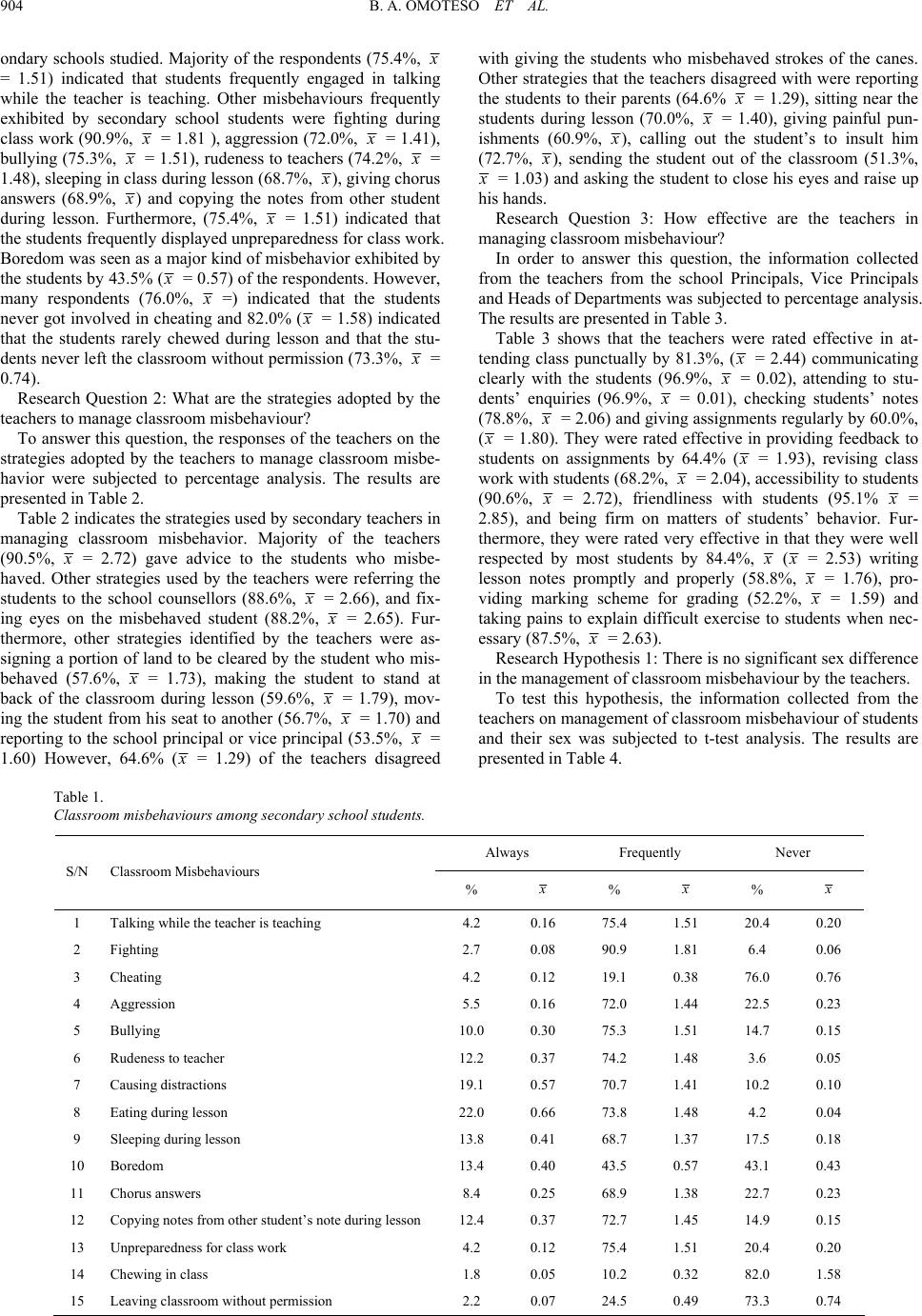 B. A. OMOTESO ET AL. 904 ondary schools studied. Majority of the respondents (75.4%, x = 1.51) indicated that students frequently engaged in talking while the teacher is teaching. Other misbehaviours frequently exhibited by secondary school students were fighting during class work (90.9%, x = 1.81 ), aggression (72.0%, x = 1.41), bullying (75.3%, x = 1.51), rudeness to teachers (74.2%, x = 1.48), sleeping in class during lesson (68.7%, x ), giving chorus answers (68.9%, x ) and copying the notes from other student during lesson. Furthermore, (75.4%, x = 1.51) indicated that the students frequently displayed unpreparedness for class work. Boredom was seen as a major kind of misbehavior exhibited by the stu dent s by 43 .5% ( x = 0.57) of the respondents. However, many respondents (76.0%, x =) indicated that the students never got involved in cheating and 82.0% ( x = 1.58) indicated that the students rarely chewed during lesson and that the stu- dents never left the classroom without permission (73.3%, x = 0.74). Research Question 2: What are the strategies adopted by the teachers to manage classroom misbehaviour? To answer this question, the responses of the teachers on the strategies adopted by the teachers to manage classroom misbe- havior were subjected to percentage analysis. The results are presented in Table 2. Table 2 indicates the strategies used by secondary teachers in managing classroom misbehavior. Majority of the teachers (90.5%, x = 2.72) gave advice to the students who misbe- haved. Other strategies used by the teachers were referring the students to the school counsellors (88.6%, x = 2.66), and fix- ing eyes on the misbehaved student (88.2%, x = 2.65). Fur- thermore, other strategies identified by the teachers were as- signing a portion of land to be cleared by the student who mis- behaved (57.6%, x = 1.73), making the student to stand at back of the classroom during lesson (59.6%, x = 1.79), mov- ing the student from his seat to another (56.7%, x = 1.70) and reporting to the school principal or vice principal (53.5%, x = 1.60) However, 64.6% ( x = 1.29) of the teachers disagreed with giving the students who misbehaved strokes of the canes. Other strategies that the teachers disagreed with were reporting the students to their parents (64.6% x = 1.29), sitting near the students during lesson (70.0%, x = 1.40), giving painful pun- ishments (60.9%, x ), calling out the student’s to insult him (72.7%, x ), sending the student out of the classroom (51.3%, x = 1.03) and asking the student to close his eyes and raise up his hands. Research Question 3: How effective are the teachers in managing classroom misbehaviour? In order to answer this question, the information collected from the teachers from the school Principals, Vice Principals and Heads of Departments was subjected to percentage analysis. The results are presented in Table 3. Table 3 shows that the teachers were rated effective in at- tending class punctually by 81.3%, ( x = 2.44) communicating clearly with the students (96.9%, x = 0.02), attending to stu- dents’ enquiries (96.9%, x = 0.01), checking students’ notes (78.8%, x = 2.06) and giving assignments regularly by 60.0%, ( x = 1.80). They were rated effective in providing feedback to students on assignments by 64.4% ( x = 1.93), revising class work with students (68.2%, x = 2.04), accessibi lity to st udents (90.6%, x = 2.72), friendliness with students (95.1% x = 2.85), and being firm on matters of students’ behavior. Fur- thermore, they were rated very effective in that they were well respected by most students by 84.4%, x ( x = 2.53) writing lesson notes promptly and properly (58.8%, x = 1.76), pro- viding marking scheme for grading (52.2%, x = 1.59) and taking pains to explain difficult exercise to students when nec- essary (87.5%, x = 2.63). Research Hypothesis 1: There is no significant sex difference in the management of classroom misbehaviour by the teachers. To test this hypothesis, the information collected from the teachers on management of classroom misbehaviour of students and their sex was subjected to t-test analysis. The results are presented in Table 4. Table 1. Classroom misbehaviours amon g s e co n da ry sc hool students. Always Frequently Never S/N Classroom Misbehaviours % x % x % x 1 Talking whi le the teacher is teaching 4.2 0.16 75.4 1.51 20.4 0.20 2 Fighting 2.7 0.08 90.9 1.81 6.4 0.06 3 Cheating 4.2 0.12 19.1 0.38 76.0 0.76 4 Aggression 5.5 0.16 72.0 1.44 22.5 0.23 5 Bullying 10.0 0.30 75.3 1.51 14.7 0.15 6 Rudeness to teacher 12.2 0.37 74.2 1.48 3.6 0.05 7 Causing distractions 19.1 0.57 70.7 1.41 10.2 0.10 8 Eating during lesson 22.0 0.66 73.8 1.48 4.2 0.04 9 Sleeping during lesson 13.8 0.41 68.7 1.37 17.5 0.18 10 Boredom 13.4 0.40 43.5 0.57 43.1 0.43 11 Chorus answers 8.4 0.25 68.9 1.38 22.7 0.23 12 Copying notes from other student’s note during lesson 12.4 0.37 72.7 1.45 14.9 0.15 13 Unpreparedness for class work 4.2 0.12 75.4 1.51 20.4 0.20 14 Chewing in class 1.8 0.05 10.2 0.32 82.0 1.58 15 Leaving classroom without permission 2.2 0.07 24.5 0.49 73.3 0.74 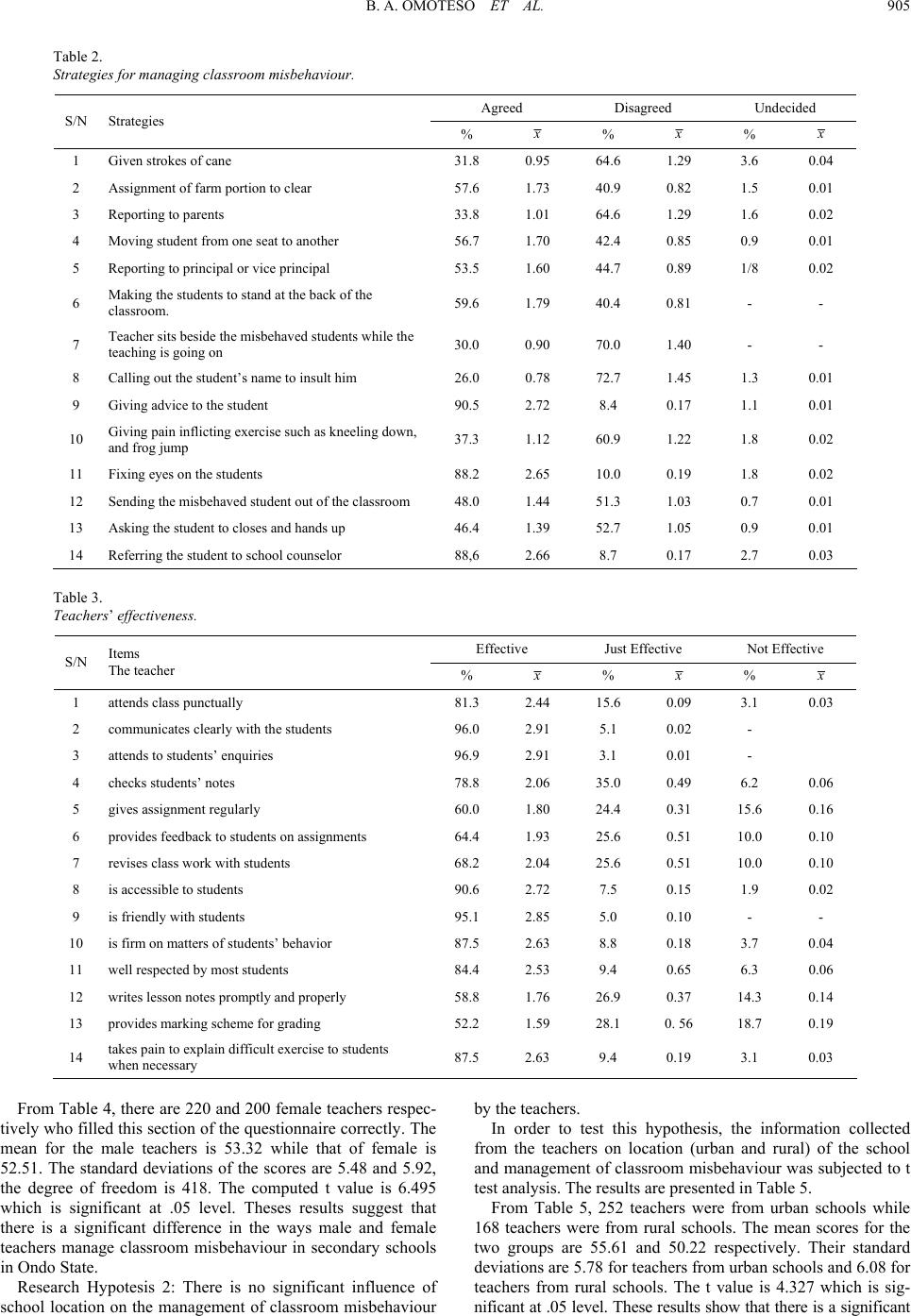 B. A. OMOTESO ET AL. 905 Table 2. Strategies for managing classroom misbehaviour. Agreed Disagreed Undecided S/N Strategies % x % x % x 1 Given strokes of cane 31.8 0.95 64.6 1.29 3. 6 0.04 2 Assignment of farm portion to clear 57.6 1.73 40.9 0.82 1.5 0.01 3 Reporting to parents 33.8 1.01 64.6 1.29 1.6 0.02 4 Moving stu dent from on e seat to another 56.7 1.70 42.4 0.85 0.9 0.01 5 Reporting to principal or vi ce principal 53.5 1.60 44.7 0.89 1/8 0.02 6 Making the students to stand at the back of the classroom. 59.6 1.79 40.4 0.81 - - 7 Teacher sits beside the misbehaved students w h il e the teaching is going on 30.0 0.90 70.0 1.40 - - 8 Calling out the student’s name to insult him 26.0 0.78 72.7 1.45 1.3 0.01 9 Giving advice to the student 9 0.5 2.72 8.4 0.17 1.1 0.01 10 Giving pain inflicting exercise such as kneeling down, and frog jump 37.3 1.12 60.9 1.22 1.8 0.02 11 Fixing eye s on the students 88.2 2.65 10.0 0.19 1.8 0.02 12 Sending the misbehaved student out of the classroom 48.0 1.44 51.3 1.03 0.7 0.01 13 Asking the stude nt to closes and hands up 46.4 1.39 52.7 1.05 0.9 0.01 14 Referring the student to school counselor 88,6 2.66 8.7 0.17 2.7 0.03 Table 3. Teachers’ effectiveness. Effective Just Effective Not Effective S/N Items The teacher % x % x % x 1 attends class punctually 81.3 2.44 15.6 0.09 3.1 0.03 2 communic ates clearly w i th the students 96.0 2.91 5.1 0.02 - 3 a tte nds to stud ent s’ enqu ir ies 96.9 2.91 3.1 0.01 - 4 checks students’ notes 78.8 2.06 35.0 0.49 6.2 0.06 5 gives assignment regularly 60.0 1.80 24.4 0.31 15.6 0.16 6 provides feedback to students on assignments 64.4 1.93 25.6 0.51 10.0 0.10 7 revises class work with stude nts 68.2 2.04 25.6 0.51 10.0 0.10 8 is accessible to students 90.6 2.72 7.5 0.15 1.9 0.02 9 is friendly with students 95.1 2.85 5.0 0.10 - - 10 is firm on matters of students’ behavio r 87.5 2.63 8.8 0.18 3.7 0.04 11 well respect ed by most students 84.4 2.53 9.4 0.65 6.3 0.06 12 writes lesson note s promptly and properly 58.8 1.76 26.9 0.37 14.3 0.14 13 provides marking scheme for grading 52.2 1.59 28.1 0. 56 18.7 0.19 14 takes pain to explain difficult exercise to students when necessary 87.5 2.63 9.4 0.19 3.1 0.03 From Table 4, there are 220 and 200 female teachers respec- tively who filled this section of the questionnaire correctly. The mean for the male teachers is 53.32 while that of female is 52.51. The standard deviations of the scores are 5.48 and 5.92, the degree of freedom is 418. The computed t value is 6.495 which is significant at .05 level. Theses results suggest that there is a significant difference in the ways male and female teachers manage classroom misbehaviour in secondary schools in Ondo State. Research Hypotesis 2: There is no significant influence of school location on the management of classroom misbehaviour by the teachers. In order to test this hypothesis, the information collected from the teachers on location (urban and rural) of the school and management of classroom misbehaviour was subjected to t test analysis. The results are presented in Table 5. From Table 5, 252 teachers were from urban schools while 168 teachers were from rural schools. The mean scores for the two groups are 55.61 and 50.22 respectively. Their standard deviations are 5.78 for teachers from urban schools and 6.08 for teachers from rural schools. The t value is 4.327 which is sig- nificant at .05 level. These results show that there is a significant 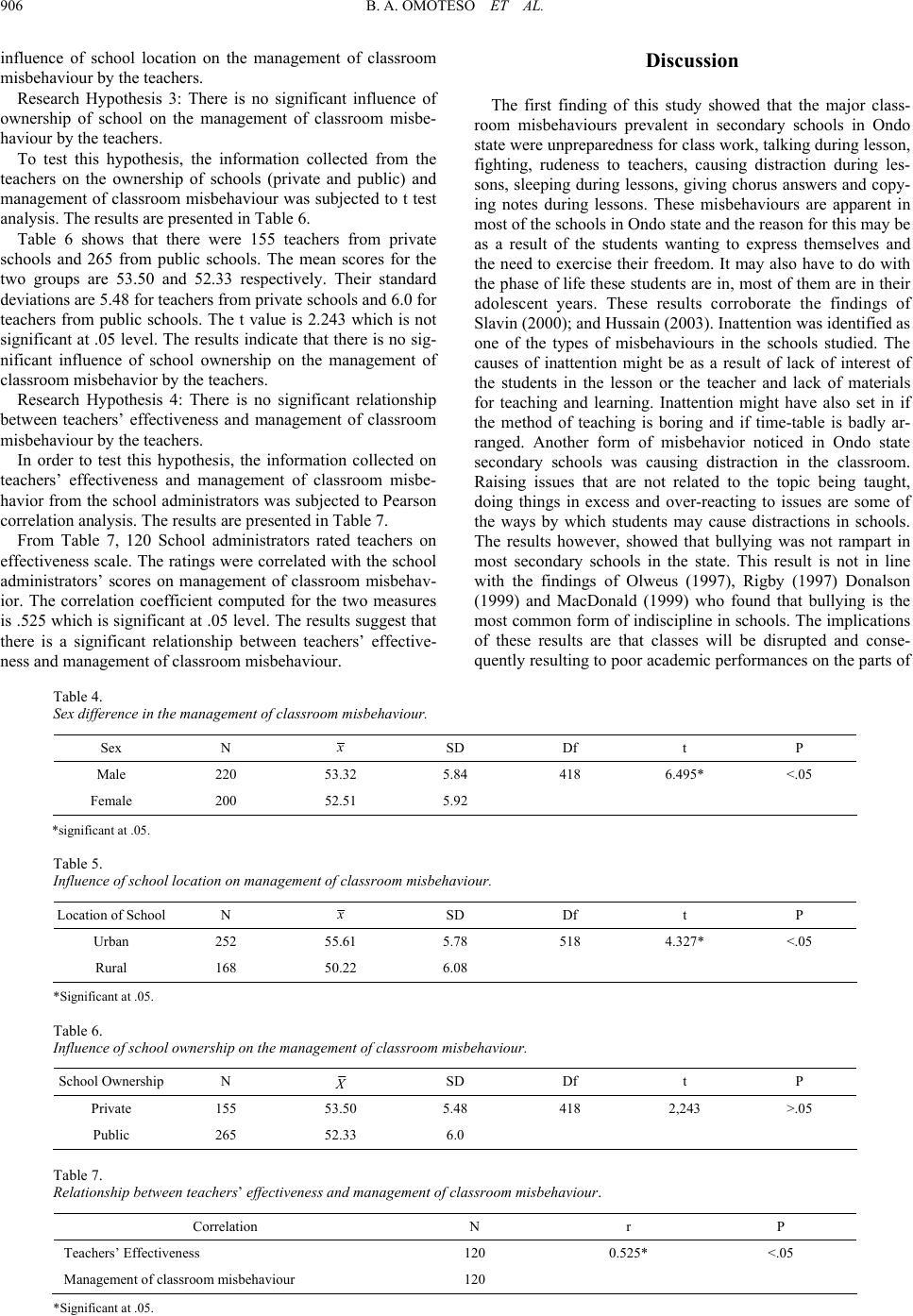 B. A. OMOTESO ET AL. 906 influence of school location on the management of classroom misbehaviour by the teachers. Research Hypothesis 3: There is no significant influence of ownership of school on the management of classroom misbe- haviour by the teachers. To test this hypothesis, the information collected from the teachers on the ownership of schools (private and public) and management of classroom misbehaviour was subjected to t test analysis. The results are presented in Table 6. Table 6 shows that there were 155 teachers from private schools and 265 from public schools. The mean scores for the two groups are 53.50 and 52.33 respectively. Their standard deviations are 5.48 for teachers from private schools and 6.0 for teachers from public schools. The t value is 2.243 which is not significant at .05 level. The results indicate that there is no sig- nificant influence of school ownership on the management of classroom misbehavior by the teachers. Research Hypothesis 4: There is no significant relationship between teachers’ effectiveness and management of classroom misbehaviour by the teachers. In order to test this hypothesis, the information collected on teachers’ effectiveness and management of classroom misbe- havior from the school administrators was subjected to Pearson correlation analysis. The results are presented in Table 7. From Table 7, 120 School administrators rated teachers on effectiveness scale. The ratings were correlated with the school administrators’ scores on management of classroom misbehav- ior. The correlation coefficient computed for the two measures is .525 which is significant at .05 level. The results suggest that there is a significant relationship between teachers’ effective- ness and management of classroom misbehaviour. Discussion The first finding of this study showed that the major class- room misbehaviours prevalent in secondary schools in Ondo state were unpreparedness for class work, talking during lesson, fighting, rudeness to teachers, causing distraction during les- sons, sleeping during lessons, giving chorus answers and copy- ing notes during lessons. These misbehaviours are apparent in most of the schools in Ondo state and the reason for this may be as a result of the students wanting to express themselves and the need to exercise their freedom. It may also have to do with the phase of life these students are in, most of them are in their adolescent years. These results corroborate the findings of Slavin (2000); and Hussain (2003). Inattention was identified as one of the types of misbehaviours in the schools studied. The causes of inattention might be as a result of lack of interest of the students in the lesson or the teacher and lack of materials for teaching and learning. Inattention might have also set in if the method of teaching is boring and if time-table is badly ar- ranged. Another form of misbehavior noticed in Ondo state secondary schools was causing distraction in the classroom. Raising issues that are not related to the topic being taught, doing things in excess and over-reacting to issues are some of the ways by which students may cause distractions in schools. The results however, showed that bullying was not rampart in most secondary schools in the state. This result is not in line with the findings of Olweus (1997), Rigby (1997) Donalson (1999) and MacDonald (1999) who found that bullying is the most common form of indiscipline in schools. The implications of these results are that classes will be disrupted and conse- quently resulting to poor academic performances on the parts of Table 4. Sex difference in the mana gement of classroom misbehaviour. Sex N x SD Df t P Male 220 53.32 5.84 418 6.495* <.05 Female 200 52.51 5.92 *significant at .05. Table 5. Influence of school l ocation on management of classr o om misbehaviour. Location of S chool N x SD Df t P Urban 252 55.61 5.78 518 4.327* <.05 Rural 168 50.22 6.08 *Significant at .05. Table 6. Influence of school ownership on the management of classroom misbehaviour. School Ownership N X SD Df t P Private 155 53.50 5.48 418 2,243 >.05 Public 265 52.33 6.0 Table 7. Relationship between te a ch e rs’ effectiveness and manageme n t of classroom misbehaviour. Correlation N r P Teachers’ Effectiveness 120 0.525* <.05 Management of classroom misbehaviour 120 *Significant at .05. 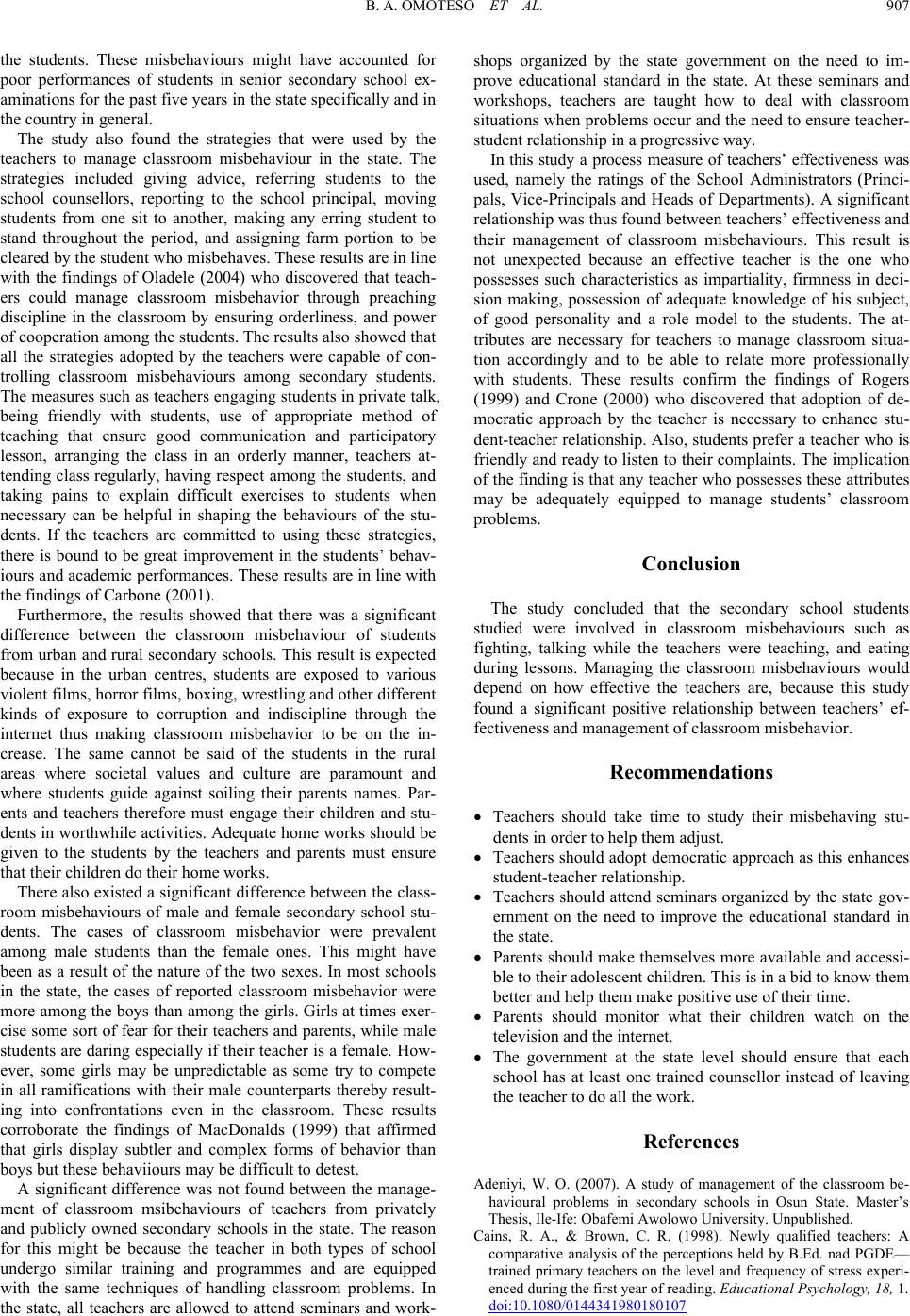 B. A. OMOTESO ET AL. 907 the students. These misbehaviours might have accounted for poor performances of students in senior secondary school ex- aminations for the past five years in the state specifically and in the country in general. The study also found the strategies that were used by the teachers to manage classroom misbehaviour in the state. The strategies included giving advice, referring students to the school counsellors, reporting to the school principal, moving students from one sit to another, making any erring student to stand throughout the period, and assigning farm portion to be cleared by the student who misbehaves. These results are in line with the findings of Oladele (2004) who discovered that teach- ers could manage classroom misbehavior through preaching discipline in the classroom by ensuring orderliness, and power of cooperation among the students. The results also showed that all the strategies adopted by the teachers were capable of con- trolling classroom misbehaviours among secondary students. The measures such as teachers engaging students in private talk, being friendly with students, use of appropriate method of teaching that ensure good communication and participatory lesson, arranging the class in an orderly manner, teachers at- tending class regularly, having respect among the students, and taking pains to explain difficult exercises to students when necessary can be helpful in shaping the behaviours of the stu- dents. If the teachers are committed to using these strategies, there is bound to be great improvement in the students’ behav- iours and academic performances. These results are in line with the findings of Carbone (2001). Furthermore, the results showed that there was a significant difference between the classroom misbehaviour of students from urban and rural secondary schools. This result is expected because in the urban centres, students are exposed to various violent films, horror films, boxing, wrestling and other different kinds of exposure to corruption and indiscipline through the internet thus making classroom misbehavior to be on the in- crease. The same cannot be said of the students in the rural areas where societal values and culture are paramount and where students guide against soiling their parents names. Par- ents and teachers therefore must engage their children and stu- dents in worthwhile activities. Adequate home works should be given to the students by the teachers and parents must ensure that their children do their home works. There also existed a significant difference between the class- room misbehaviours of male and female secondary school stu- dents. The cases of classroom misbehavior were prevalent among male students than the female ones. This might have been as a result of the nature of the two sexes. In most schools in the state, the cases of reported classroom misbehavior were more among the boys than among the girls. Girls at times exer- cise some sort of fear for their teachers and parents, while male students are daring especially if their teacher is a female. How- ever, some girls may be unpredictable as some try to compete in all ramifications with their male counterparts thereby result- ing into confrontations even in the classroom. These results corroborate the findings of MacDonalds (1999) that affirmed that girls display subtler and complex forms of behavior than boys but these behaviiours may be difficul t to d etest. A significant difference was not found between the manage- ment of classroom msibehaviours of teachers from privately and publicly owned secondary schools in the state. The reason for this might be because the teacher in both types of school undergo similar training and programmes and are equipped with the same techniques of handling classroom problems. In the state, all teachers are allowed to attend seminars and work- shops organized by the state government on the need to im- prove educational standard in the state. At these seminars and workshops, teachers are taught how to deal with classroom situations when problems occur and the need to ensure teacher- student relationship in a progressive way. In this study a process measure of teachers’ effectiveness was used, namely the ratings of the School Administrators (Princi- pals, Vice-Principals and Heads of Departments). A significant relationship was thus found between teachers’ effectiveness and their management of classroom misbehaviours. This result is not unexpected because an effective teacher is the one who possesses such characteristics as impartiality, firmness in deci- sion making, possession of adequate knowledge of his subject, of good personality and a role model to the students. The at- tributes are necessary for teachers to manage classroom situa- tion accordingly and to be able to relate more professionally with students. These results confirm the findings of Rogers (1999) and Crone (2000) who discovered that adoption of de- mocratic approach by the teacher is necessary to enhance stu- dent-teacher relationship. Also, students prefer a teacher who is friendly and ready to listen to their complaints. The implication of the finding is that any teacher who possesses these attributes may be adequately equipped to manage students’ classroom problems. Conclusion The study concluded that the secondary school students studied were involved in classroom misbehaviours such as fighting, talking while the teachers were teaching, and eating during lessons. Managing the classroom misbehaviours would depend on how effective the teachers are, because this study found a significant positive relationship between teachers’ ef- fectiveness and management of clas sroom misbehavior. Recommendations Teachers should take time to study their misbehaving stu- dents in order to help them adjust. Teachers should adopt democratic approach as this enhances student-teacher relationship. Teachers should attend seminars organized by the state gov- ernment on the need to improve the educational standard in the state. Parents should make themselves more available and accessi- ble to their adolescent children. This is in a bid to know them better and help them make positive use of their time. Parents should monitor what their children watch on the television and the internet. The government at the state level should ensure that each school has at least one trained counsellor instead of leaving the teacher to do all the work. References Adeniyi, W. O. (2007). A study of management of the classroom be- havioural problems in secondary schools in Osun State. Master’s Thesis, Ile-Ife: Obafemi Awolowo University. Unpublished. Cains, R. A., & Brown, C. R. (1998). Newly qualified teachers: A comparative analysis of the perceptions held by B.Ed. nad PGDE— trained primary teachers on the level and frequency of stress experi- enced during the first year of reading. Educational Ps ych ol ogy , 18, 1. doi:10.1080/0144341980180107  B. A. OMOTESO ET AL. 908 Carbone, E. (2001). Arranging the classroom with an eye (and ear) to students with ADHD. Teaching Exceptional children, 39, 211-228. Catledge, G., & Johnson, C. T. (1996). Inclusive classrooms for stu- dents with emotional and behavioural disorder: Critical variables. Theory and Practice, 35, 51-57. doi:10.1080/00405849609543701 Crone, F. (2000). The responsible thinking classroom. The Boys in school bulletin, 3, 4- 9. Donaldson, E. L. (1999). A comparative study of educational policies and effective school-based strategies to reduce violence in schools: Canada, Finland and Scotland. In G. Malicky. B. Shapiro, & K. Mazurek (Eds.), Building foundations for safe and caring schools: Research on distruptive behavior and violence (pp. 199-200). Ed- monton: Duval House. Gailo, R., & Little, E. (2003) Classroom behavior problems: The rela- tionship between preparedness, classroom experiences and self-effi- cacy in graduate and student teachers. Australian Journal Educa- tional and Developmental Psychology, 3, 21-24. Hussain, N. (2003). Helping EFL/ESL students by asking quality ques- tions. The Internet TESL Jo u r n al, 9, 10. Lin, H., & Gomell, J. (1998). Pre-service teachers’ efficacy beliefs in Taiwan. Journal of Research and Development in Education, 32, 17-25. Little, E. (1999). Conduct disorder: Generalization across settings and implications for home school-based intervention. Unpublished Doc- toral Dissertation, Victoria: RMIT University,. MacDonalds, I. M. (1999). Cross-cultural and cross-national perspec- tives. In G. Malicky, B. Shapiro, & K. Mazurek (Eds.), Building foundations for safe and caring schools: Research on distruptive behavior and violence (pp. 199-200). Edmonton: Duval House. Martin, A., Limfort, K., & Stephenson, J. (1999). How teachers respond to concern about misbehavior in their classroom. Psychology in the Schools, 36, 347-358. doi:10.1002/(SICI)1520-6807(199907)36:4<347::AID-PITS7>3.0.C O;2-G National Policy on Education (2004 ). Federal Government of N igeria. Oladele, J. O. (2004). Fundamentals of educational psychology. Hand- book for Education students and teachers. Lagos: Johns-Lads Pub- lishers Ltd. Olweus, D. (1998). Bullying or peer abuse at school. Facts and inter- vention. Current Di rections in Psychological Science, 4, 196-200. doi:10.1111/1467-8721.ep10772640 Omoteso, B. A. (1998). The relationship between teacher verbal be- havior and teacher effectiveness in secondary schools in Ife Central Local government Area. Unpublished Masters’ Thesis of Obafemi, Ile-Ife: Awolowo University. Rigby, K. (1997). Attitudes and beliefs about bullying among Ausralian children. Irish Journal of Psychology, 18, 202-209. Rogers, B. (1999). Links between students behavior problems. Class- room, 20, 20-21. Slavin, R. E. (2000). Educational psychology: Theory and practice. Boston: Allyn and Bacon. |