

Paper Menu >>
Journal Menu >>
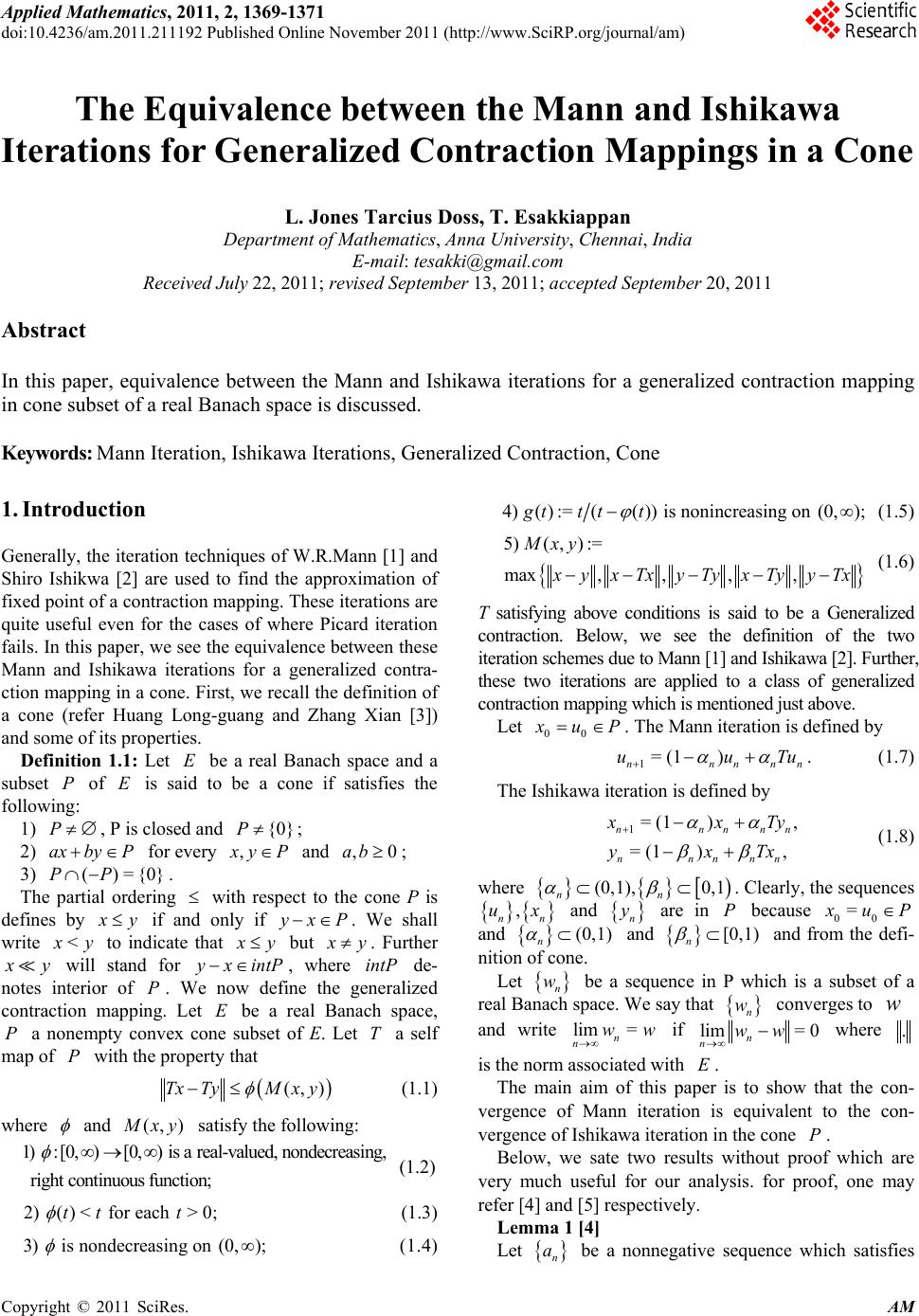 Applied Mathematics, 2011, 2, 1369-1371 doi:10.4236/am.2011.211192 Published Online November 2011 (http://www.SciRP.org/journal/am) Copyright © 2011 SciRes. AM The Equivalence between the Mann and Ishikawa Iterations for Generalized Contraction Mappings in a Cone L. Jones Tarcius Doss, T. Esakkiappan Department of Mat hematics, Anna University, Chennai, India E-mail: [email protected] Received July 22, 201 1; revised Septe mber 13, 2011; accepted September 20, 2011 Abstract In this paper, equivalence between the Mann and Ishikawa iterations for a generalized contraction mapping in cone subset of a real Banach space is discussed. Keywords: Mann Iteration, Ishikawa Iterations, Generalized Contraction, Cone 1. Introduction Generally, the iteration techniques of W.R.Mann [1] and Shiro Ishikwa [2] are used to find the approximation of fixed point of a contraction mapping. These iterations are quite useful even for the cases of where Picard iteration fails. In this paper, we see the equivalence between these Mann and Ishikawa iterations for a generalized contra- ction mapping in a cone. First, we recall the definition of a cone (refer Huang Long-guang and Zhang Xian [3]) and some of its properties. Definition 1.1: Let be a real Banach space and a subset of is said to be a cone if satisfies the following: E P E 1) , P is closed and ; P ax by {0}P ,2) for every P x yP and ; ,0ab 3) . ()=PP{0} The partial ordering with respect to the cone P is defines by x y if and only if y xP. We shall write < x y to indicate that x y but x y. Further x y will stand for y xintP, where in de- notes interior of . We now define the generalized contraction mapping. Let be a real Banach space, a nonempty convex cone subset of E. Let a self map of with the property that tP PE P T P (, )TxTyMx y (1.1) where and (, ) M xy satisfy the following: 1) :[0,)[0,)isareal-valued,nondecreasing, rightcontinuous function; (1.2) 2) ()<foreach>0; ttt (1.3) 3) isnondecreasingon(0,); (1.4) 4) ():=(())isnonincreasingon(0,); gtt tt (1.5) 5) (,):= max, ,,, Mxy x yxTxyTyxTyyTx (1.6) T satisfying above conditions is said to be a Generalized contraction. Below, we see the definition of the two iteration schemes due to Mann [1] and Ishikawa [2]. Further, these two iterations are applied to a class of generalized contraction mapping which is mentioned just above. Let 00 x uP . The Mann iteration is defined by 1=(1) nnnn uu n Tu . (1.7) The Ishikawa iteration is defined by 1=(1), =(1), nnnn nnnn n n x xTy yxT x (1.8) where (0,1), 0,1 nn . Clearly, the sequences n x, n u and n y are in because 00 P= x uP and (0,1) n and [0 n ,1) and from the defi- nition of cone. Let n w li be a sequence in P which is a subset of a real Banach space. We say that converges to n ww and write if m = n nww lim= 0 n nww where . is the norm associated with . E The main aim of this paper is to show that the con- vergence of Mann iteration is equivalent to the con- vergence of Ishikawa iteration in the cone . P Below, we sate two results without proof which are very much useful for our analysis. for proof, one may refer [4] and [5] respectively. Lemma 1 [4] Let n a be a nonnegative sequence which satisfies 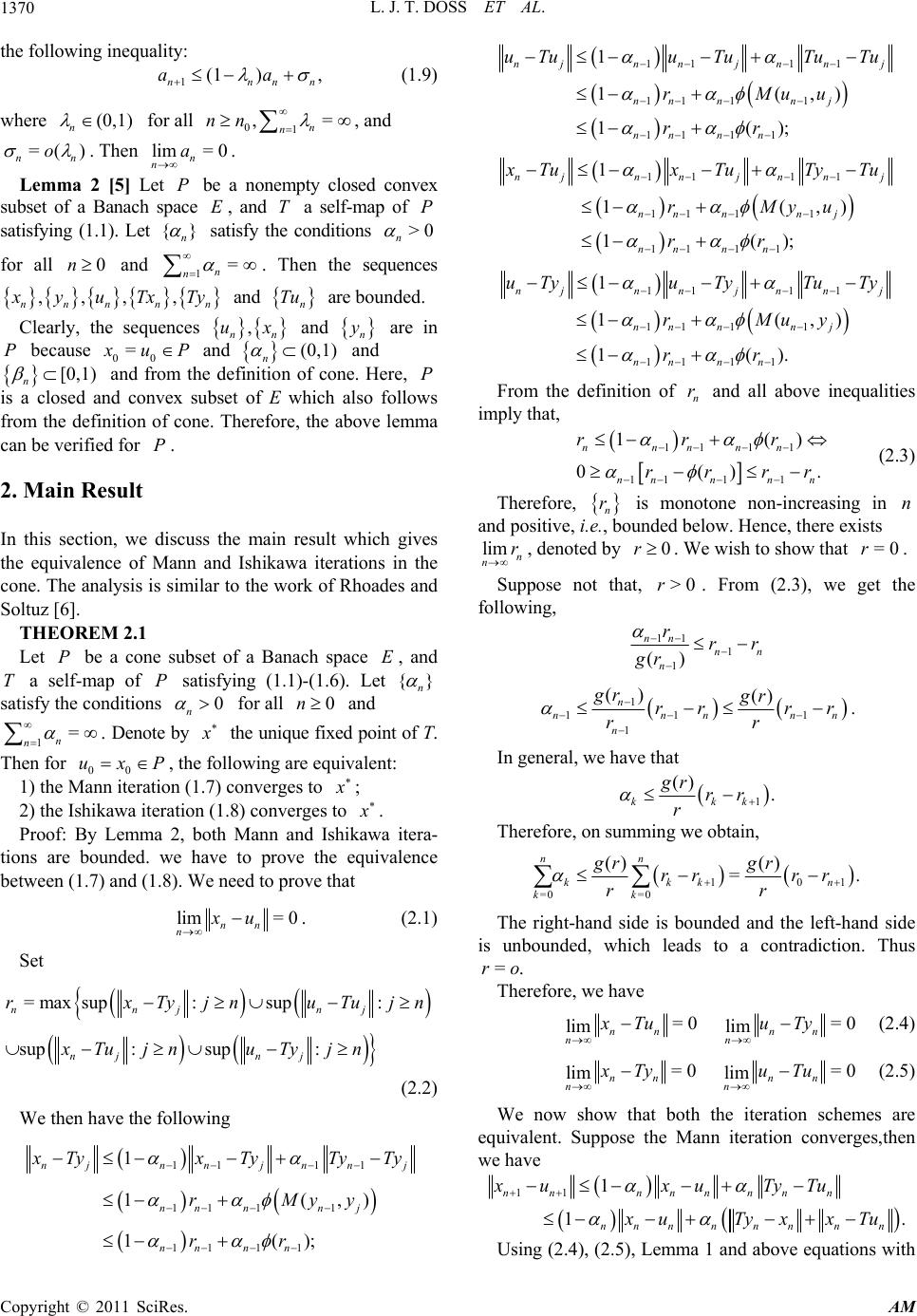 L. J. T. DOSS ET AL. 1370 n the following inequality: 1(1 ), nnn aa (1.9) where (0,1) n =( ) n for all , and 01 ,= n n nn n o . Then . lim n na = 0 Lemma 2 [5] Let be a nonempty closed convex subset of a Banach space , and T a self-map of satisfying (1.1). Let P { n E }P satisfy the conditions >0 n for all and . Then the sequences 0n ,, nn 1n , n = n n , n x yuTxTy and are bounded. n Tu Clearly, the sequences and , nn ux n y are in because 00 P= x uP and (0,1) n and and from the definition of cone. Here, is a closed and convex subset of E which also follows from the definition of cone. Therefore, the above lemma can be verified for . [0,1) n P P 2. Main Result In this section, we discuss the main result which gives the equivalence of Mann and Ishikawa iterations in the cone. The analysis is similar to the work of Rhoades and Soltuz [6]. THEOREM 2.1 Let be a cone subset of a Banach space , and a self-map of satisfying (1.1)-(1.6). Let {} P E T Pn satisfy the conditions 0 n for all and 0n 1= n n . Denote by x the unique fixed point of T. Then for , the following are equivalent: 00 uxP 1) the Mann iteration (1.7) converges to x ; 2) the Ishikawa iteration (1.8) converges to x . Proof: By Lemma 2, both Mann and Ishikawa itera- tions are bounded. we have to prove the equivalence between (1.7) and (1. 8). We need to prove that lim= 0 nn nxu . (2.1) Set = maxsup:sup: sup: sup: nnj nj nj nj rxTyjnuTu xTu jnuTy jn jn (2.2) We then have the following 11 11 11 11 111 1 1 1(, 1(); njnnjnn j nnnn j nnn n 111 1 11 11 111 1 1 1(, 1(); njnnjnn nnnn j nnn n u TuuTuTuTu rMuu rr ) j 11 11 11 11 111 1 1 1( 1(); njnnjnn nnnn j nnn n ,) j x Tux TuTy Tu rMyu rr 111 1 11 11 111 1 1 1(, 1(). njnnjnn j nnnn j nnn n u TyuTyTuTy rMuy rr ) From the definition of and all above inequalities imply that, n r 111 1 1111 1( 0() nnnnn nnnn n rrr rrrr ) . (2.3) Therefore, n r is monotone non-increasing in and positive, i.e., bounded below. Hence, there exists n lim n nr, denoted by . We wish to show that . 0r=0r Suppose not that, . From (2.3), we get the following, >0r 11 1 1 () nn nn n rrr gr 1 11 1 () () n nnnn n gr gr rr rr rr 1 n . In general, we have that 1 () . kkk gr rr r Therefore, on summing we obtain, 10 =0 =0 () () =. nn kkk kk gr gr rr rr rr 1 n The right-hand side is bounded and the left-hand side is unbounded, which leads to a contradiction. Thus =.ro Therefore, we have =0 =0 lim lim nn nn nn xTu uTy (2.4) =0 =0 lim lim nn nn nn xTy uTu (2.5) ) x Tyx TyTy Ty rMyy rr We now show that both the iteration schemes are equivalent. Suppose the Mann iteration converges,then we have 11 1 1. nn nnnnnn nnn n nnnn xux uTyTu xuTyxxTu Using (2.4), (2.5) , Lemma 1 and above eq uations with Copyright © 2011 SciRes. AM 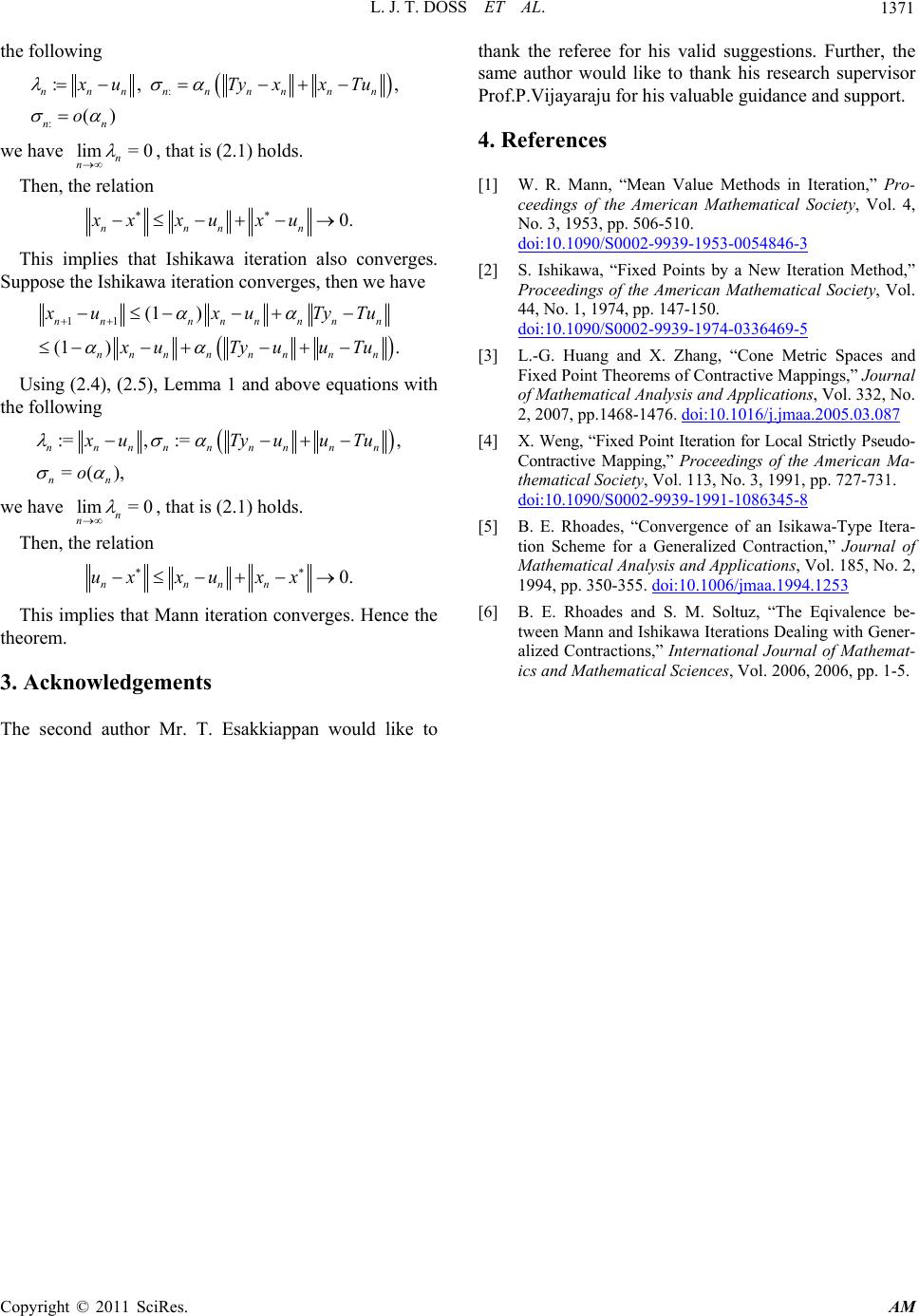 L. J. T. DOSS ET AL. Copyright © 2011 SciRes. AM 1371 the following : : :, , () nnnnnnnnn nn x uTyxxTu o we have lim= 0 n n , that is (2.1) holds. Then, the relation 0. nnnn xxxuxu This implies that Ishikawa iteration also converges. Suppose the Ishikawa iteration converges, then we have 11 (1 ) (1 ). nn nnnnnn nn nnn nnn x uxuTy x uTy uu Tu Tu Using (2.4), (2.5) , Lemma 1 and above eq uations with the following :=, :=, =( ), nnnnnnnnn nn xuTyu uTu o we have lim= 0 n n , that is (2.1) holds. Then, the relation 0. nnnn uxxu xx This implies that Mann iteration converges. Hence the theorem. 3. Acknowledgements The second author Mr. T. Esakkiappan would like to thank the referee for his valid suggestions. Further, the same author would like to thank his research supervisor Prof.P.Vijayaraju for his valuable guidance and support. 4. References [1] W. R. Mann, “Mean Value Methods in Iteration,” Pro- ceedings of the American Mathematical Society, Vol. 4, No. 3, 1953, pp. 506-510. doi:10.1090/S0002-9939-1953-0054846-3 [2] S. Ishikawa, “Fixed Points by a New Iteration Method,” Proceedings of the American Mathematical Society, Vol. 44, No. 1, 1974, pp. 147-150. doi:10.1090/S0002-9939-1974-0336469-5 [3] L.-G. Huang and X. Zhang, “Cone Metric Spaces and Fixed Point Theorems of Contractive Mappings,” Journal of Mathematical Analysis and Applications, Vol. 332, No. 2, 2007, pp.1468-1476. doi:10.1016/j.jmaa.2005.03.087 [4] X. Weng, “Fixed Point Iteration for Local Strictly Pseudo- Contractive Mapping,” Proceedings of the American Ma- thematical Society, Vol. 113, No. 3, 1991, pp. 727-731. doi:10.1090/S0002-9939-1991-1086345-8 [5] B. E. Rhoades, “Convergence of an Isikawa-Type Itera- tion Scheme for a Generalized Contraction,” Journal of Mathematical Analysis and Applications, Vol. 185, No. 2, 1994, pp. 350-355. doi:10.1006/jmaa.1994.1253 [6] B. E. Rhoades and S. M. Soltuz, “The Eqivalence be- tween Mann and Ishikawa Iterations Dealing with Gener- alized Contractions,” International Journal of Mathemat- ics and Mathematical Sciences, Vol. 2006, 2006, pp. 1-5. |