

Paper Menu >>
Journal Menu >>
 Applied Mathematics, 2011, 2, 1323-1326 doi:10.4236/am.2011.211185 Published Online November 2011 (http://www.SciRP.org/journal/am) Copyright © 2011 SciRes. AM A New Uniformly Ultimate Boundedness Criterion for Discrete-Time Nonlinear Systems Zhishuai Ding1, Guifang Cheng1,2 1Department of Mat hem at i cs, Zhengzhou Uni versi t y , Zhengzhou, China 2Physical Engineering College, Zhengzhou University, Zhengzhou, China E-mail: zsding@163.com, [email protected] Received August 11, 2011; revised September 27, 2011; aceepted O ct o ber 5, 2011 Abstract A new type criterion of globally uniformly ultimate boundedness for discrete-time nonlinear systems is in- troduced. In classical Lyapunov theory about globally uniformly ultimate boundedness, Lyapunov function is assumed to be positive definite and its difference at the every latter moment and the former moment is negative definite. In this paper the condition of difference of Lyapunov function is relaxed. Under the re- laxed condition, the result of this paper can be considered as the extension of the classical Lyapunov theory about uniformly ultimate boundedness. Keywords: Uniformly Ultimate Boundedness, Lyapunov Function, Discrete-Time Nonlinear Systems 1. Introduction Discrete-time systems of difference equations have attra- cted considerable attention. A remarkable book [1] by Agarwal makes the general survey on theory of diffe- rence equation and introduces a detailed account of the application of difference equations. Stability analysis is one of the main issues in the area of control systems the- ory.The classical Lyapunov theory [2] is an important tool to discuss the stability and stabilization problems of dynamical systems. A candidate Lyapunov function is required to satisfy positive definite, and its difference be negative definite or semi-negative definite at the every latter moment and the former moment [3-4]. For dis- crete-time nonlinear systems, the relation of smooth Lya- punov function and asymptotical stability is presented in paper [5]. In paper [6], new results on the existence of Lyapunov function are presented for discrete-time sys- tems described by difference inclusions. Some new cha- racterizations of uniform global asymptotic stability for nonlinear timevarying discrete-time systems with or with- out an output-dominant perturbation are proposed on the basis of the detectability for the reduced limiting systems associated with the original system in paper [7]. A new asymptotic stability criterion for nonlinear time-varying differential equations is demonstrated in paper [8] by Aeyels and Peuteman. The Lyapunov function need not be differentiable, and not even be Lipschitz continuous. Under the relaxed condition, a new asymptotic stability criterion is introduced. Uniform boundness and uniformly ultimate bounded- ness is an indispensable part of stability problems [1,2]. In paper [9], Aeyels, Peuteman and Sepulchre transform the problem of uniform boundedness and uniform ulti- mate boundedness for nonautonomous continuous sys- tems to time-invariant frozen systems and introduced some important results. Bu and Mu [10] extend those results and present Lyapu nov theorems of uniform boun - dedness and uniform ultimate boundedness for nonau- tonomous homogeneous systems. Paper [11] by Cheng, Mu and Ding discusses the problem of uniformly ulti- mate boundedness of nonautonomous nonlinear systems with discontinuous right-hand sides and gives some re- sults based on differential inclusions and Filippov solu- tions. Under arbitrary switching laws, a continuous state feedback control [12] scheme is proposed in order to guarantee uniformly ultimate boundedness of every sys- tem response within an arbitrary small neighborhood of the zero state. In the research area about uniformly ultimate bound- edness, the condition of Lyapunov function usually con- sidered is differentiable or Lipschitz continuous and re- gular. In this paper, based on [8] given by Aeyels and Peuteman, we relax the assumption condition of Lya- punov function. We don’t suppose the difference of Lya- punov function at the every latter moment and the former 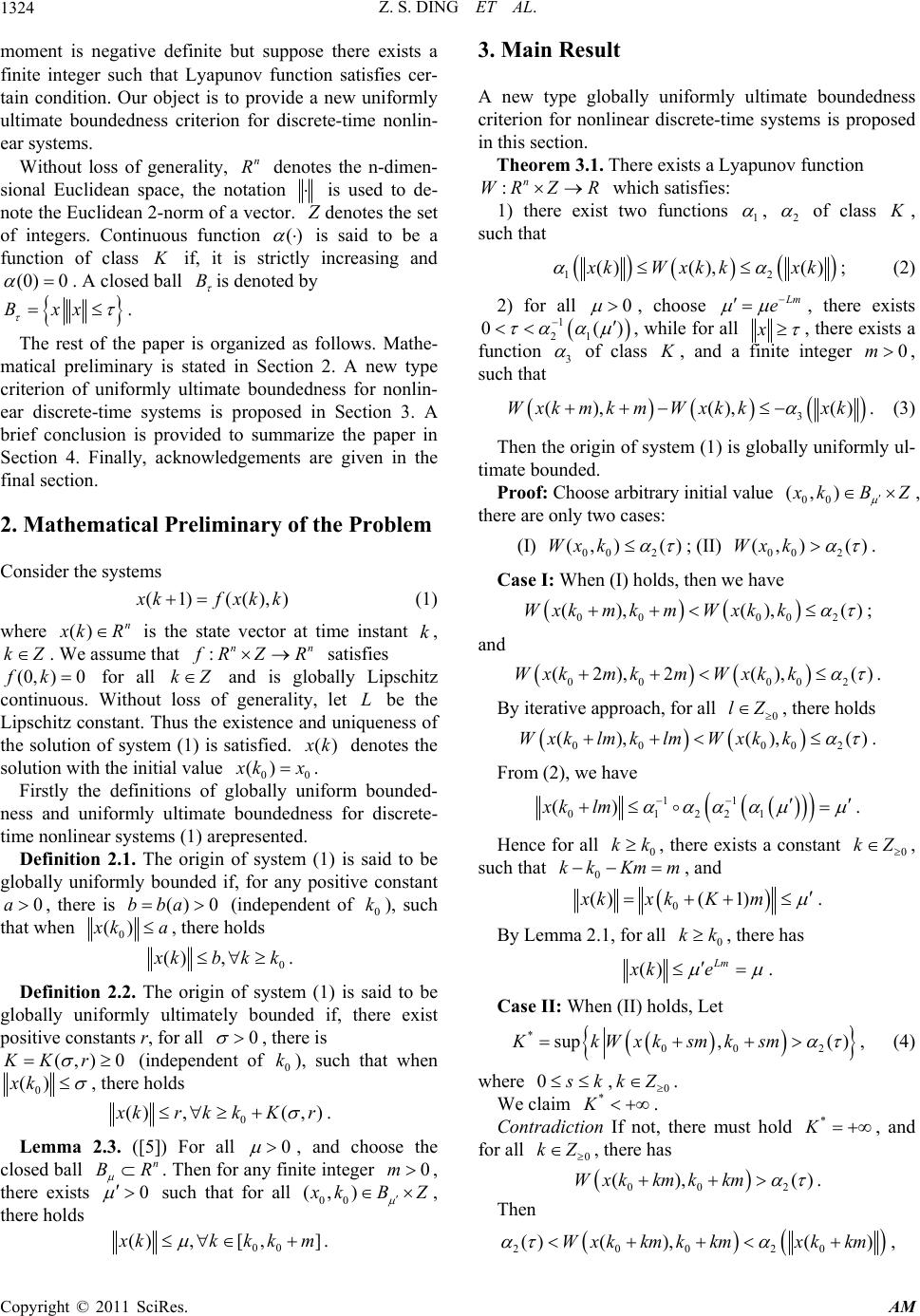 Z. S. DING ET AL. 1324 moment is negative definite but suppose there exists a finite integer such that Lyapunov function satisfies cer- tain condition. Our object is to provide a new uniformly ultimate boundedness criterion for discrete-time nonlin- ear systems. Without loss of generality, denotes the n-dimen- sional Euclidean space, the notation n R is used to de- note the Euclidean 2-norm of a vector. Z denotes the set of integers. Continuous function () is said to be a function of class K if, it is strictly increasing and (0) 0 . A closed ball B is denoted by Bxx . The rest of the paper is organized as follows. Mathe- matical preliminary is stated in Section 2. A new type criterion of uniformly ultimate boundedness for nonlin- ear discrete-time systems is proposed in Section 3. A brief conclusion is provided to summarize the paper in Section 4. Finally, acknowledgements are given in the final section. 2. Mathematical Preliminary of the Problem Consider the systems (1) ((),) x kfxk k (1) where () n x kR is the state vector at time instant , . We assume that k kZ:nn f RZ R kZ ( satisfies for all and is globally Lipschitz continuous. Without loss of generality, let be the Lipschitz constant. Thus the existence and uniqueness of the solution of system (1) is satisfied. (0,fk) 0L ) x k denotes the solution with the initial value 00 () x kx. Firstly the definitions of globally uniform bounded- ness and uniformly ultimate boundedness for discrete- time nonlinear systems (1) arepresented. Definition 2.1. The origin of system (1) is said to be globally uniformly bounded if, for any positive constant , there is (independent of ), such that when 0a() 0bba 0 k 0 () x ka, there holds 0 () , x kbkk. Definition 2.2. The origin of system (1) is said to be globally uniformly ultimately bounded if, there exist positive constants r, for all 0 , there is (,) 0KK r (independent of ), such that when 0 k 0 ()xk , there holds 0 () ,(,) x krkkKr . Lemma 2.3. ([5]) For all 0 , and choose the closed ball . Then for any finite integer , there exists n BR 00 m such that for all 00 (,) x kBZ , there holds 00 (),[ ,] x kkkk 3. Main Result A new type globally uniformly ultimate boundedness criterion for nonlinear discrete-time systems is proposed in this section. Theorem 3.1. There exists a Lyapunov function which satisfies: :n WR ZR 1) there exist two functions 1 , 2 of class , such that K 12 () (),() x kWxkk xk ; (2) 2) for all 0 , choose L m e , there exists 21 1 0() , while for all x , there exists a function 3 of class K , and a finite integer , such that 0m 3 (),(), ()Wxkmkm Wxkkxk . (3) Then the origin of system (1) is globally uniformly ul- timate bounded. Proof: Choose arbitrary initial value 00 (,) x kBZ , there are only two cases: (I) 002 (,) ()Wx k ; (II) 00 2 (,) ()Wx k . Case I: When (I) holds, then we have 00 002 (),(), (WxkmkmWxkk) ; and 00 002 (2),2(),(WxkmkmWxkk) . By iterative approach, for all , there holds 0 lZ 00 002 (),(), (WxklmklmWxk k) . From (2), we have 11 01221 ()xk lm . Hence for all , there exists a constant 0 kk0 kZ , such that 0 kk mKm , and 0 ()( 1)xkxkK m . By Lemma 2.1, for all , there has 0 kk () Lm xk e . Case II: When (II) holds, Let *00 2 sup,( )KkWxksmksm , (4) where 0 s k ,0 kZ . We claim * K . Contradiction If not, there must hold * K , and for all 0 kZ , there has 00 2 (),Wxkkmk km() . Then 20020 ()( ),( )Wx kkmkkmx kkm , m . Copyright © 2011 SciRes. AM 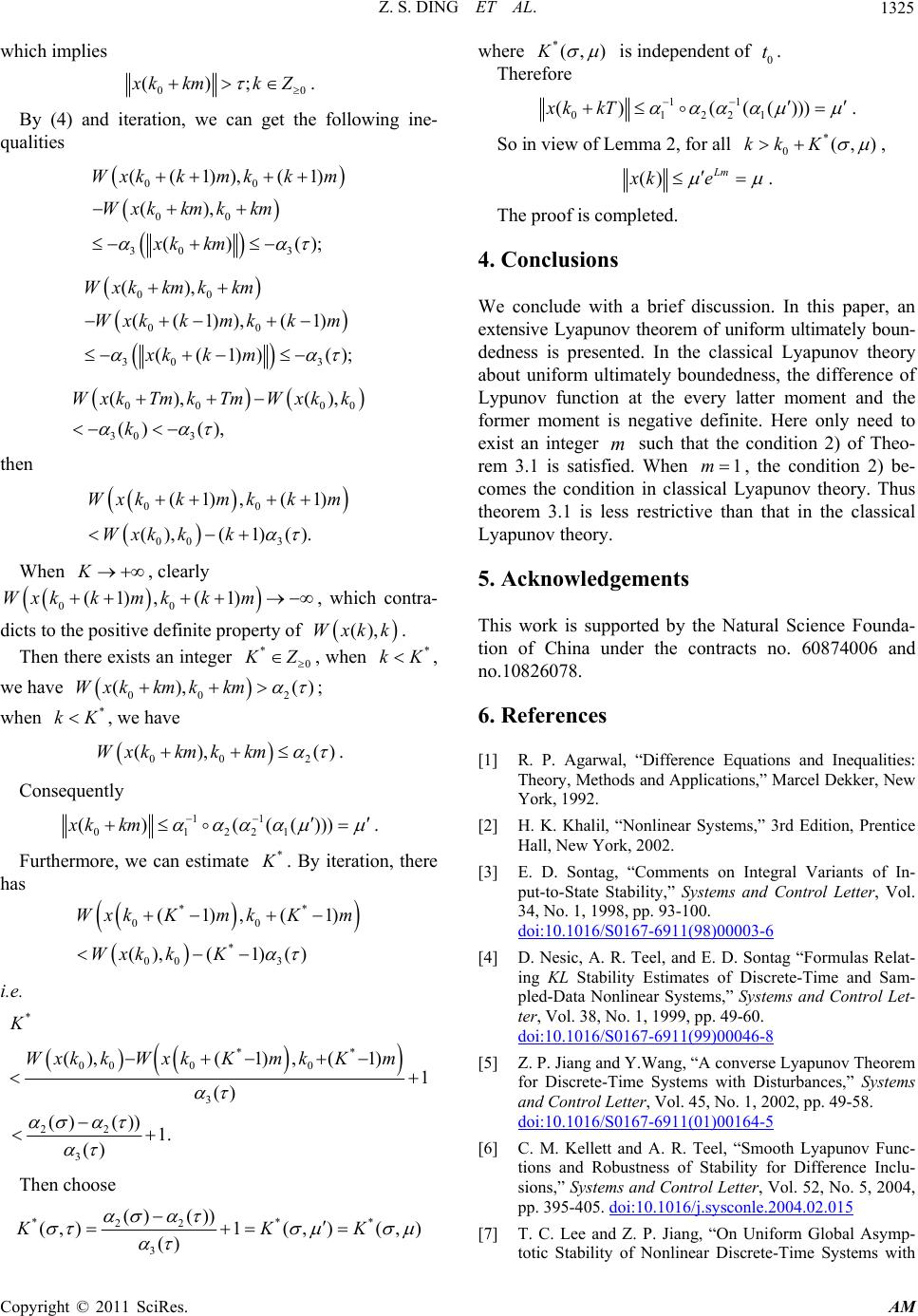 Z. S. DING ET AL.1325 which implies 00 (); x kkm kZ . By (4) and iteration, we can get the following ine- qualities 00 00 30 3 ((1)),(1) (), () (); Wxkkmk km Wxk kmkkm xk km 00 00 30 3 (), ((1)),(1) ((1)) (); Wxkkmk km Wxk k mkk m xkkm 00 0 30 3 (), (), () (), WxkTmk TmWxkk k 0 then 00 00 3 (1),(1) (),( 1)(). Wxkkmkkm Wxkkk When , clearly K 00 (1), (1)Wxk k mk k m , which contra- dicts to the positive definite property of . (),Wxkk Then th ere exists a n integer *0 K Z 2 m , when , we have * Kk 00 (),Wxkkmk k() * ; when , we have kK 00 2 (),(Wxkkmk km) . Consequently 11 01221 ()((( )))xkkm . Furthermore, we can estimate * K . By iteration, there has ** 00 * 00 3 (1),(1) (),( 1)() WxkKmk Km WxkkK i.e. * ** 00 00 3 22 3 (),( 1),( 1)1 () ()()) 1. () K WxkkWxkKmkK m Then choose ** 22 3 () ()) (,)1(, )(,) () KK where *(,)K is independent of . 0 t Therefore 11 01221 () ((()))xk kT . So in view of Lemma 2, for all * 0(,)kkK , () Lm xk e . The proof is completed. 4. Conclusions We conclude with a brief discussion. In this paper, an extensive Lyapunov theorem of uniform ultimately boun- dedness is presented. In the classical Lyapunov theory about uniform ultimately boundedness, the difference of Lypunov function at the every latter moment and the former moment is negative definite. Here only need to exist an integer such that the condition 2) of Theo- rem 3.1 is satisfied. When , the condition 2) be- comes the condition in classical Lyapunov theory. Thus theorem 3.1 is less restrictive than that in the classical Lyapunov theory. m1m 5. Acknowledgements This work is supported by the Natural Science Founda- tion of China under the contracts no. 60874006 and no.10826078. 6. References [1] R. P. Agarwal, “Difference Equations and Inequalities: Theory, Methods and Applications,” Marcel Dekker, New York, 1992. [2] H. K. Khalil, “Nonlinear Systems,” 3rd Edition, Prentice Hall, New York, 2002. [3] E. D. Sontag, “Comments on Integral Variants of In- put-to-State Stability,” Systems and Control Letter, Vol. 34, No. 1, 1998, pp. 93-100. doi:10.1016/S0167-6911(98)00003-6 [4] D. Nesic, A. R. Teel, and E. D. Sontag “Formulas Relat- ing KL Stability Estimates of Discrete-Time and Sam- pled-Data Nonlinear Systems,” Systems and Control Let- ter, Vol. 38, No. 1, 1999, pp. 49-60. doi:10.1016/S0167-6911(99)00046-8 [5] Z. P. Jiang and Y.Wang, “A converse Lyapunov Theorem for Discrete-Time Systems with Disturbances,” Systems and Control Letter, Vol. 45, No. 1, 2002, pp. 49-58. doi:10.1016/S0167-6911(01)00164-5 * K [6] C. M. Kellett and A. R. Teel, “Smooth Lyapunov Func- tions and Robustness of Stability for Difference Inclu- sions,” Systems and Control Letter, Vol. 52, No. 5, 2004, pp. 395-405. doi:10.1016/j.sysconle.2004.02.015 [7] T. C. Lee and Z. P. Jiang, “On Uniform Global Asymp- totic Stability of Nonlinear Discrete-Time Systems with Copyright © 2011 SciRes. AM  Z. S. DING ET AL. Copyright © 2011 SciRes. AM 1326 Applications,” IEEE Transactions on Automatic Control, Vol. 51, No. 10, 2006, pp. 1644-1660. doi:10.1109/TAC.2006.882770 [8] D. Ayels and J. Peuteman, “A New Asymptotic Stability Criterion for Nonlinear Time-Variant Differential Equa- tion,” IEEE Transactions on Automatic Control, Vol. 43, No. 7, 1998, pp. 968-971. doi:10.1109/9.701102 [9] J. Peuteman, D. Aeyels and R. Sepulchre, “Boundeded- ness Properties for Timevarying Nonlinear Systems,” SIAM Journal on Control and Optimization, Vol. 39, No. 5, 2000, pp. 1408-1422. doi:10.1137/S0363012999361652 [10] C. X. Bu and X. W. Mu, “A Note for Uniform Bounded- ness of a Class of Timevarying Nonlinear Systems,” Ma- thematics in Practice and Theory, Vol. 34, No. 6, 2004, pp. 138-142. [11] G. F. Cheng, X. W. Mu and Z. S. Ding, “Uniformly Ul- timate Boundedness for a Class of Discontinuous Nonau- tonomous Systems,” ACTA Mathematicae Applicatae Si- nica, Vol. 30, No. 4, 2007, pp. 675-681. [12] L. G. Zhang, Y. Z. Chen, Z. G. Sun, N. E. Mastorakis and A. Y. Alexsandrov, “Uniformly Ultimate Boundedness Control for Switched Linear Systems with Parameter Uncertainties,” Proceedings of 2008 American Control Conference, Seattle, 11-13 June 2008, pp. 3971-3974. doi:10.1109/ACC.2008.4587113 |