

Paper Menu >>
Journal Menu >>
 Engineering, 2009, 1, 188-195 doi:10.4236/eng.2009.13022 Published Online November 2009 (http://www.scirp.org/journal/eng). Copyright © 2009 SciRes. ENGINEERING Energy Analysis of Pid Controlled Heat Pump Dryer Ilhan CEYLAN Mechanical Education Department, Technical Education Faculty, Karabuk University, Karabuk, Turkey E-mail: [email protected] Received September 2, 2009; revised September 18, 2009; accepted September 23, 2009 Abstract In this experimental study, a heat pump dryer was designed and manufactured, in which drying air tempera- ture was controlled PID. Manufactured heat pump dryer was tested in drying kiwi, avocado and banana from among tropical fruits and energy and exergy analyses were made. Drying air temperature changed between 40 oC - 40.2 oC while drying the tropical fruits. Before the drying process in heat pump dryer, initial moisture contents were determined as 4.31 g water / g dry matter for kiwi, 1.51 g water / g dry matter for avocado and 4.71 g water / g dry matter for banana. Then tropical fruits were dried separately in heat pump dryer. Drying air temperature was kept unchanged with the error of +0.2 oC. Drying air velocity changed between 0.3 and 0.4 m/s in a period of 310 min. COPws of the heat pump dryer was calculated as 2.49 for kiwi, 2.47 for ba- nana and 2.41 for avocado during the experiments. EUR changed between 13 % and 28 % for kiwi, 18% and 33% for avocado and 13% and 42% for banana in heat pump dryer. Keywords: Tropical Fruit, Drying, Heat Pump Dryer, PID Control 1. Introduction Drying is extracting liquids in a matter. In technical dry- ing, external interference is applied to the drying process and the moisture in the matter is extracted through vari- ous methods. Thus, drying is described as the reduction of product moisture to the required dryness values at a defi- nite process. All of the units that enable the product to reach the drying values at the definite process and which consist of various units (heating, dehumidifying) are de- scribed as the drying system [1]. The systems used at the drying process are applied at many industrial branches (such as food, paper, cement, timber and chemistry). The drying applied to the food- stuff serves a number of aims, the most important of which is to prevent the product from breaking down dur- ing the long storage. During the long storage, the drying process helps product remain without breaking down by reducing the moisture of the product to the level, which is enough to limit microbial development or other reactions. Besides, with the reduction of the moisture content, the conservation of the characterizations of quality such as the value of aroma and food is realized. The other aim of drying process is to reduce the product volume, thus in- creasing the efficiency during the storage and transporta- tion of the essential components of the foodstuff. In the literature, there are a lot of studies about heat pump drying systems. However, there have been no stud- ies interested in PID controlled heat pump dryer. In this study, the energy balance of PID controlled heat pump dryer has been achieved successfully. The purpose of this paper is an understanding of energy and exergy analysis of PID controlled heat pump dryer. With the PID control over drying air temperature in the dryer the tropical fruits such as kiwi, avocado and banana were dried. Fatouh et al. dried herbs using a heat pump dryer [2]. Ogura et al. made energy and cost estimation for applica- tion of chemical heat pump dryer [3]. Queiroz et al. de- termined the drying kinetics of tomato by using electric resistance and heat pump dryers [4]. Chua and Chou made performance analysis two stage heat pump system for drying [5]. Achariyaviriya et al. presented mathe- matical model development and simulation of heat pump fruit dryer [6]. Chua et al. investigated recent develop- ments and future trends for heat pump drying [7]. Haw- lader et al. used a different drying method by using a heat pump dryer for the drying of guava and papaya [8]. 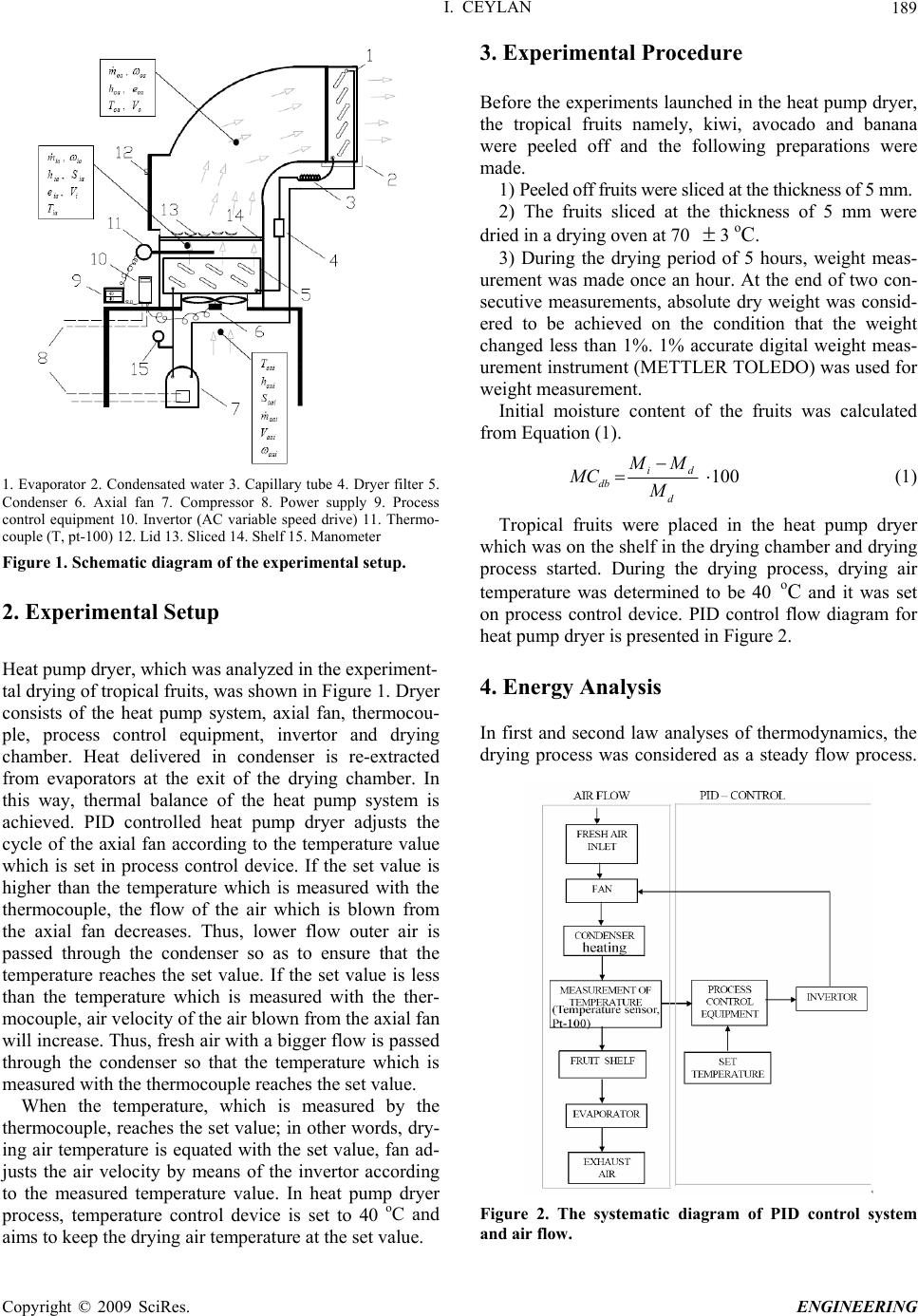 I. CEYLAN189 1. Evaporator 2. Condensated water 3. Capillary tube 4. Dryer filter 5. Condenser 6. Axial fan 7. Compressor 8. Power supply 9. Process control equipment 10. Invertor (AC variable speed drive) 11. Thermo- couple (T, pt-100) 12. Lid 13. Sliced 14. Shelf 15. Manometer Figure 1. Schematic diagram of the experimental setup. 2. Experimental Setup Heat pump dryer, which was analyzed in the experiment- tal drying of tropical fruits, was shown in Figure 1. Dryer consists of the heat pump system, axial fan, thermocou- ple, process control equipment, invertor and drying chamber. Heat delivered in condenser is re-extracted from evaporators at the exit of the drying chamber. In this way, thermal balance of the heat pump system is achieved. PID controlled heat pump dryer adjusts the cycle of the axial fan according to the temperature value which is set in process control device. If the set value is higher than the temperature which is measured with the thermocouple, the flow of the air which is blown from the axial fan decreases. Thus, lower flow outer air is passed through the condenser so as to ensure that the temperature reaches the set value. If the set value is less than the temperature which is measured with the ther- mocouple, air velocity of the air blown from the axial fan will increase. Thus, fresh air with a bigger flow is passed through the condenser so that the temperature which is measured with the thermocouple reaches the set value. When the temperature, which is measured by the thermocouple, reaches the set value; in other words, dry- ing air temperature is equated with the set value, fan ad- justs the air velocity by means of the invertor according to the measured temperature value. In heat pump dryer process, temperature control device is set to 40 oC and aims to keep the drying air temperature at the set value. 3. Experimental Procedure Before the experiments launched in the heat pump dryer, the tropical fruits namely, kiwi, avocado and banana were peeled off and the following preparations were made. 1) Peeled off fruits were sliced at the thickness of 5 mm. 2) The fruits sliced at the thickness of 5 mm were dried in a drying oven at 70 3 oC. 3) During the drying period of 5 hours, weight meas- urement was made once an hour. At the end of two con- secutive measurements, absolute dry weight was consid- ered to be achieved on the condition that the weight changed less than 1%. 1% accurate digital weight meas- urement instrument (METTLER TOLEDO) was used for weight measurement. Initial moisture content of the fruits was calculated from Equation (1). 100 id db d MM MC M (1) Tropical fruits were placed in the heat pump dryer which was on the shelf in the drying chamber and drying process started. During the drying process, drying air temperature was determined to be 40 oC and it was set on process control device. PID control flow diagram for heat pump dryer is presented in Figure 2. 4. Energy Analysis In first and second law analyses of thermodynamics, the drying process was considered as a steady flow process. Figure 2. The systematic diagram of PID control system and air flow. Copyright © 2009 SciRes. ENGINEERING  I. CEYLAN Copyright © 2009 SciRes. ENGINEERING 190 o The SMER can be defined as the energy required to remove 1 kg of water and may be related to the power input to the compressor (SMERhp) or to the total power to the dryer including the fan power and the efficiencies of the electrical devices (SMERws), as given by Jia et al. [11], Schmidt et al. [13], Hawlader et al. at Table 1 and Equation 12 [14]. The main basis of these analyses is the phenomena of thermodynamics of humid air. Within the scope of the first law of thermodynamics, energy analysis of heat pump dryer of tropical fruits is performed to find out more about the energy aspects and behaviour of drying air throughout the heat pump dryer. Actually, the air conditioning processes can be modeled as steady flow processes which are analyzed by employing steady flow conservation of mass (for both dry air and moisture) and conservation of energy principles [9]. 5. The Second Law Analysis: Exergy Analysis For energy and exergy analyses of the single-layer drying process, the following equations are generally employed to compute the mass conservation of drying air and moisture, energy conservation, and the exergy bal- ance rate of the process [9,10]: In the scope of the second law analysis of thermody- namics, total exergy inflow, outflow and losses of the heat pump dryer were estimated. The basic procedure for exergy analysis of the chamber is to determine the ex- ergy values at steady-state points and the reason of ex- ergy variation for the process [9,15]. The exergy values are calculated by using the characteristics of the working medium from a first law energy balance at Table 1 equa- tion 13 [16]. The overall performance of a HPD may be character- ized by several criteria. Among them, the coefficient of performance (COP) and the specific moisture extraction rate (SMER) have been used by Jia et al. [11]. For an ideal refrigeration system operating between a condenser temperature of TC and an evaporator temperature of TE, the maximum heating coefficient of performance, COPc,h was obtained from the Carnot cycle as Table 1 and Equa- tion 10 [12]. There are variations of this general exergy equation. In the analyses of many systems, some, but not all, of the terms shown in Equation (13) are used. Since exergy is energy available from any source, the terms can be de- Table 1. The equations of energy and heat pump dryer performance. General equation of mass conservation of drying air i mm (2) General equation of mass conservation of moisture wi mpwo mm m (3) General equation of mass conservation of moisture ia impoa o mm m (4) General equation of energy conservation 22 2 oi Cdiaoa ia VV QW mhh (5) Heat used during moisture extraction in drying cham- ber D ciaiaoa Qmhh (6) The heat delivered in the condenser () was esti- mated using the experimental values [11]. Cd Q ,( Cdiap airiaaai QmC TT ) V (7) iaia i m (8) Energy utilization ratios of chamber , iaia oa dc iap airiaaai mhh EUR mCT T (9) The coefficient of performance , C ch CE T COP TT (10) The system COP Cd ws F C Q COP ww (11) Specific moisture extraction rate (SMER) d hpd F C m SMER ww (12)  I. CEYLAN 191 veloped using electrical current flow, magnetic fields, and diffusional flow of materials. One common simpli- fication is to substitute enthalpy for the internal energy and PV terms that are applicable for steady-flow systems. Equation (13) is often used under conditions where the gravitational and momentum terms are neglected. In ad- dition to these, the pressure changes in the system are also neglected because of . VV In this case, Equation (13) is derived Equation (14). The inflow and outflow of exergy can be found de- pending on the inlet and outlet temperatures of the shelf and the HPD chamber. Applying Equations (17-21), the inflow, and outflow of exergy can be found depending on the inlet and outlet temperatures of the drying chamber. Hence, the exergy loss is determined by Table 2 and Equation (19). The quantity of the exergy loss is calculated by apply- ing Equations (14-21). The exergetic efficiency can be defined as the ratio of the product exergy to exergy in- flow for the dryer chamber. However, it is explained as the ratio of exergy outflow to exergy inflow for the chamber. Thus, the general form of exergetic efficiency is written as Table 2 and Equation 21 [16,17]. Figure 3. Variation of drying air temperature with drying time. Figure 4. Variation in moisture content as a function of drying time. Figure 5. Variation in energy utilization as a function of drying time for the tropical fruits. Figure 6. Variation in energy utilization ratio as a function of drying time at for the tropical fruits. Figure 7. Variation in exergy loss with drying time for the drying chamber and the tropical fruit. Figure 8. Variation in exergetic efficiency as a function of drying time in the drying chamber for the tropical fruit. C opyright © 2009 SciRes. ENGINEERING 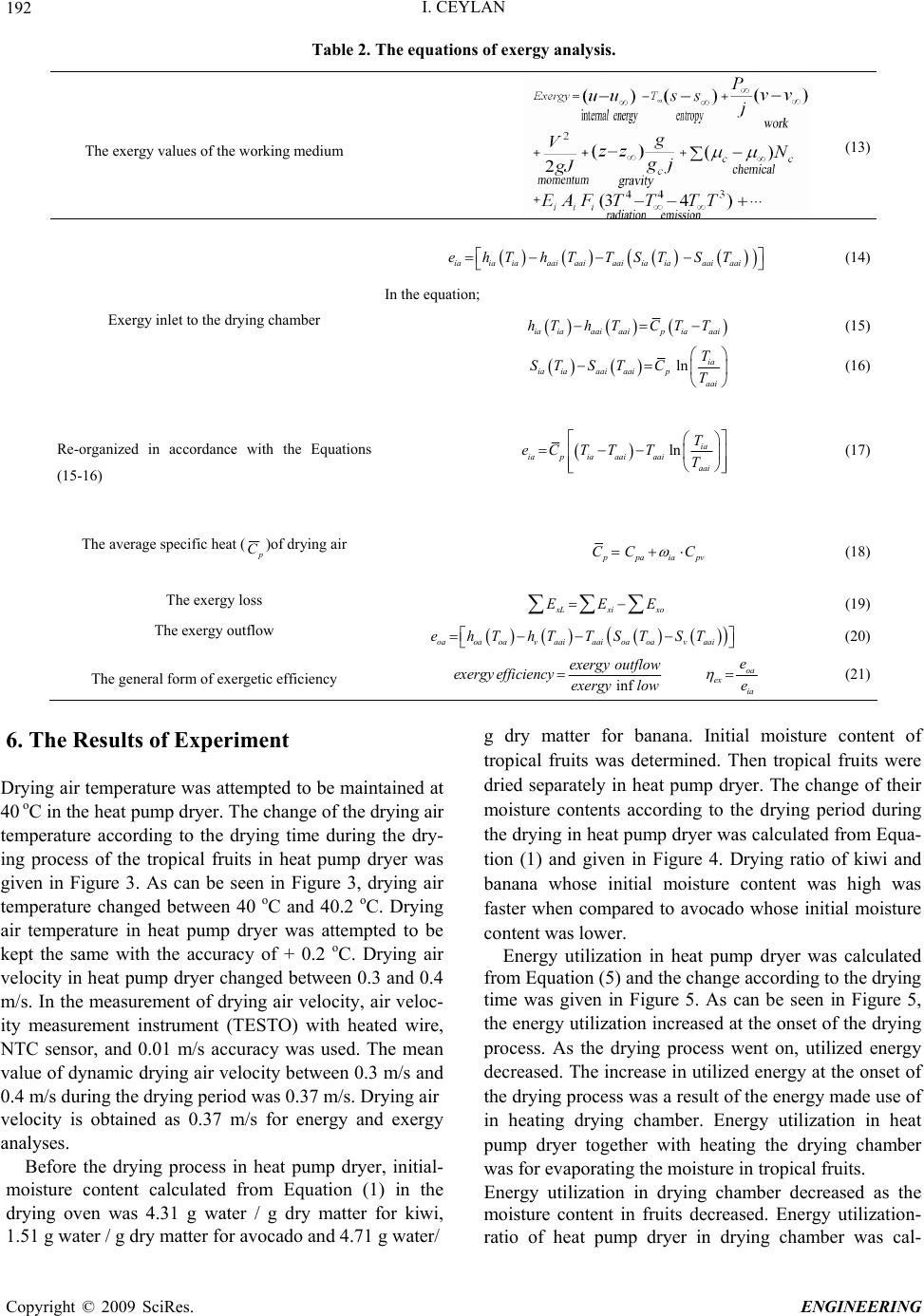 I. CEYLAN 192 Table 2. The equations of exergy analysis. The exergy values of the working medium (13) Exergy inlet to the drying chamber iaiaiaaai aaiaaiia iaaai aai ehThT TSTST (14) In the equation; ia iaaaiaaip iaaai hTh TCT T (15) ln ia ia iaaai aaip aai T STS TCT (16) Re-organized in accordance with the Equations (15-16) ln ia iapiaaaiaai aai T eCTT TT (17) The average specific heat (p C)of drying air ppaiap CC C v (18) The exergy loss xL xi xo EEE (19) The exergy outflow oaoa oav aaiaaioaoav aai ehThTTSTST (20) The general form of exergetic efficiency inf exergy outflow exergy efficiencyexergy low oa ex ia e e (21) 6. The Results of Experiment Drying air temperature was attempted to be maintained at 40 oC in the heat pump dryer. The change of the drying air temperature according to the drying time during the dry- ing process of the tropical fruits in heat pump dryer was given in Figure 3. As can be seen in Figure 3, drying air temperature changed between 40 oC and 40.2 oC. Drying air temperature in heat pump dryer was attempted to be kept the same with the accuracy of + 0.2 oC. Drying air velocity in heat pump dryer changed between 0.3 and 0.4 m/s. In the measurement of drying air velocity, air veloc- ity measurement instrument (TESTO) with heated wire, NTC sensor, and 0.01 m/s accuracy was used. The mean value of dynamic drying air velocity between 0.3 m/s and 0.4 m/s during the drying period was 0.37 m/s. Drying air velocity is obtained as 0.37 m/s for energy and exergy analyses. Before the drying process in heat pump dryer, initial- moisture content calculated from Equation (1) in the drying oven was 4.31 g water / g dry matter for kiwi, 1.51 g water / g dry matter for avocado and 4.71 g water/ g dry matter for banana. Initial moisture content of tropical fruits was determined. Then tropical fruits were dried separately in heat pump dryer. The change of their moisture contents according to the drying period during the drying in heat pump dryer was calculated from Equa- tion (1) and given in Figure 4. Drying ratio of kiwi and banana whose initial moisture content was high was faster when compared to avocado whose initial moisture content was lower. Energy utilization in heat pump dryer was calculated from Equation (5) and the change according to the drying time was given in Figure 5. As can be seen in Figure 5, the energy utilization increased at the onset of the drying process. As the drying process went on, utilized energy decreased. The increase in utilized energy at the onset of the drying process was a result of the energy made use of in heating drying chamber. Energy utilization in heat pump dryer together with heating the drying chamber was for evaporating the moisture in tropical fruits. Energy utilization in drying chamber decreased as the moisture content in fruits decreased. Energy utilization- ratio of heat pump dryer in drying chamber was cal- C opyright © 2009 SciRes. ENGINEERING 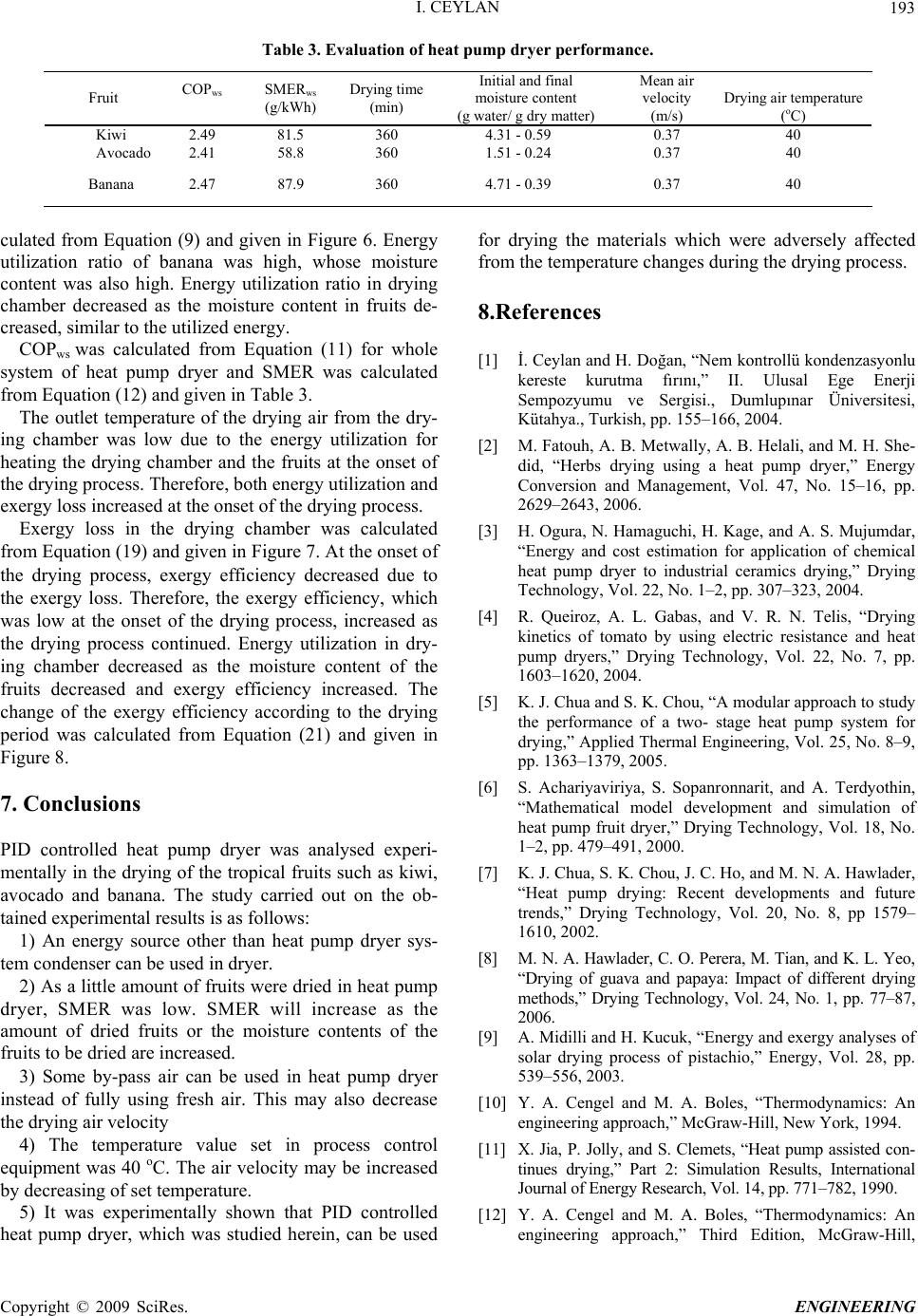 I. CEYLAN 193 Table 3. Evaluation of heat pump dryer performance. Fruit COPws SMERws (g/kWh) Drying time (min) Initial and final moisture content (g water/ g dry matter) Mean air velocity (m/s) Drying air temperature (oC) Kiwi 2.49 81.5 360 4.31 - 0.59 0.37 40 Avocado 2.41 58.8 360 1.51 - 0.24 0.37 40 Banana 2.47 87.9 360 4.71 - 0.39 0.37 40 culated from Equation (9) and given in Figure 6. Energy utilization ratio of banana was high, whose moisture content was also high. Energy utilization ratio in drying chamber decreased as the moisture content in fruits de- creased, similar to the utilized energy. COPws was calculated from Equation (11) for whole system of heat pump dryer and SMER was calculated from Equation (12) and given in Table 3. The outlet temperature of the drying air from the dry- ing chamber was low due to the energy utilization for heating the drying chamber and the fruits at the onset of the drying process. Therefore, both energy utilization and exergy loss increased at the onset of the drying process. Exergy loss in the drying chamber was calculated from Equation (19) and given in Figure 7. At the onset of the drying process, exergy efficiency decreased due to the exergy loss. Therefore, the exergy efficiency, which was low at the onset of the drying process, increased as the drying process continued. Energy utilization in dry- ing chamber decreased as the moisture content of the fruits decreased and exergy efficiency increased. The change of the exergy efficiency according to the drying period was calculated from Equation (21) and given in Figure 8. 7. Conclusions PID controlled heat pump dryer was analysed experi- mentally in the drying of the tropical fruits such as kiwi, avocado and banana. The study carried out on the ob- tained experimental results is as follows: 1) An energy source other than heat pump dryer sys- tem condenser can be used in dryer. 2) As a little amount of fruits were dried in heat pump dryer, SMER was low. SMER will increase as the amount of dried fruits or the moisture contents of the fruits to be dried are increased. 3) Some by-pass air can be used in heat pump dryer instead of fully using fresh air. This may also decrease the drying air velocity 4) The temperature value set in process control equipment was 40 oC. The air velocity may be increased by decreasing of set temperature. 5) It was experimentally shown that PID controlled heat pump dryer, which was studied herein, can be used for drying the materials which were adversely affected from the temperature changes during the drying process. 8.References [1] İ. Ceylan and H. Doğan, “Nem kontrollü kondenzasyonlu kereste kurutma fırını,” II. Ulusal Ege Enerji Sempozyumu ve Sergisi., Dumlupınar Üniversitesi, Kütahya., Turkish, pp. 155–166, 2004. [2] M. Fatouh, A. B. Metwally, A. B. Helali, and M. H. She- did, “Herbs drying using a heat pump dryer,” Energy Conversion and Management, Vol. 47, No. 15–16, pp. 2629–2643, 2006. [3] H. Ogura, N. Hamaguchi, H. Kage, and A. S. Mujumdar, “Energy and cost estimation for application of chemical heat pump dryer to industrial ceramics drying,” Drying Technology, Vol. 22, No. 1–2, pp. 307–323, 2004. [4] R. Queiroz, A. L. Gabas, and V. R. N. Telis, “Drying kinetics of tomato by using electric resistance and heat pump dryers,” Drying Technology, Vol. 22, No. 7, pp. 1603–1620, 2004. [5] K. J. Chua and S. K. Chou, “A modular approach to study the performance of a two- stage heat pump system for drying,” Applied Thermal Engineering, Vol. 25, No. 8–9, pp. 1363–1379, 2005. [6] S. Achariyaviriya, S. Sopanronnarit, and A. Terdyothin, “Mathematical model development and simulation of heat pump fruit dryer,” Drying Technology, Vol. 18, No. 1–2, pp. 479–491, 2000. [7] K. J. Chua, S. K. Chou, J. C. Ho, and M. N. A. Hawlader, “Heat pump drying: Recent developments and future trends,” Drying Technology, Vol. 20, No. 8, pp 1579– 1610, 2002. [8] M. N. A. Hawlader, C. O. Perera, M. Tian, and K. L. Yeo, “Drying of guava and papaya: Impact of different drying methods,” Drying Technology, Vol. 24, No. 1, pp. 77–87, 2006. [9] A. Midilli and H. Kucuk, “Energy and exergy analyses of solar drying process of pistachio,” Energy, Vol. 28, pp. 539–556, 2003. [10] Y. A. Cengel and M. A. Boles, “Thermodynamics: An engineering approach,” McGraw-Hill, New York, 1994. [11] X. Jia, P. Jolly, and S. Clemets, “Heat pump assisted con- tinues drying,” Part 2: Simulation Results, International Journal of Energy Research, Vol. 14, pp. 771–782, 1990. [12] Y. A. Cengel and M. A. Boles, “Thermodynamics: An engineering approach,” Third Edition, McGraw-Hill, C opyright © 2009 SciRes. ENGINEERING  I. CEYLAN Copyright © 2009 SciRes. ENGINEERING 194 New York, pp. 1056, 1998. [13] E. L. Schmidt, K. Klocker, N. Flacke, and F. Steimle, “Applying the transcritical CO2 process to a drying heat pump,” International Journal of Refrigeration, Vol. 21, No. 3, pp. 202–211, 1998. [14] M. N. A. Hawlader, S. K. Chou, J. C. Ho, and K. J. Chua, “On the development of a heat pump dryer to maximise heat recevery,” in A. S. Mujumdar (Series Ed.), Proceed- ings of the 11th International Drying Symposium, Halkidiki, Greece, No. 19–22, pp. 616–623, August 1998. [15] A. Bejan, “Advanced engineering thermodynamics,” Wiley, New York, 1988. [16] O. Zuhal, “Testing of a heat-pump-assisted mechanical opener dryer,” Applied Thermal Engineering, Vol. 23, pp. 153–162, 2003. [17] I. Ceylan, M. Aktaş, and H. Doğan, “Energy and exergy analysis of timber dryer assisted heat pump,” Applied Thermal Engineering, Vol. 27, pp. 216–222, 2007.  I. CEYLAN 195 Nomenclature Mi initial weight Md exact dry weight p C specific heat, kJ kg -1 K -1 p C mean specific heat, kJ kg -1 K -1 m mass flow rate, kg s -1 Cd Q heat delivered in condenser, kJ s -1 T temperature, K W energy utilization, kJ s -1 specific humidity, g g -1 V velocity, m s -1 density of air , kg m -3 C w power input to compressor (kW) F H enthalpy, kJ kg -1 w power input to fan (kW) hc COP , heating coefficient of performance of Carnot cycle ws COP heating coefficient of performance of heat pump d m drying rate, kg h -1 e exergy, kJ kg-1 S specific entropy, kJ kg -1 K-1 i V volumetric flow rate of air, m3 s-1 EUR energy utilization ratio, % PID proportional integral derivative Subscripts wi water inlet we water evaporation wo water outlet i inlet oa outlet air surrounding or ambient ci condenser inlet ws whole system HPD heat pump dryer v vapour ia inlet air aai ambient air inlet hpd SMER action rate for whole system, kg kJ-1 s h-1 specific moisture extr C opyright © 2009 SciRes. ENGINEERING |