

Paper Menu >>
Journal Menu >>
 Open Journal of Physical Chemistry, 2011, 1, 104-108 doi:10.4236/ojpc.2011.13014 Published Online November 2011 (http://www.SciRP.org/journal/ojpc) Copyright © 2011 SciRes. OJPC Atomistic Simulations of Formation of Elementary Zr-I Systems Matthew L. Rossi, Christopher D. Taylor Materials Scie nce an d Tech nol o gy , MST-6, Los Alamos Na t ional La b, Los Alamos, USA E-mail: [email protected] Received August 6, 2011; revised September 8, 2011; accepted October 14, 2011 Abstract We report results of simulations on the formation of simple zirconium iodide molecules. Previous work by Wimmer et al. [1] explored the relationship between iodine and a zirconium surface. We investigate the re- action schemes through atomistic simulations to better understand the nature of Zr-I interactions through iso- lated molecules. The computed energy values of varying Zr-I systems suggests a strong binding mechanism between zirconium and iodine, and offer predictions of likely reaction products. The computed results pre- dict condensation of volatile ZrI4 with ZrI2 to form Zr2I6. Keywords: Nuclear Chemistry, Quantum Chemistry, Computational Modelling 1. Introduction Considerable amounts of research have been performed regarding zirconium and zirconium-based alloys in the past few decades, due to usage in cladding for light water nuclear reactors (LWR).Stress-corrosion cracking (SCC) of the cladding has been observed [2] over the course of fuel-cycle lifetimes in nuclear reactors; the exact initia- tion of which, however, remains yet unclear [3,4]. Much research has been done regarding iodine-influenced SCC, (I-SCC), which regards iodine as a strong accelerating factor in the corrosion of the zirconium cladding [5-7]. In LWRs, the uranium fuel pellets are enclosed within a zirconium-based alloy, such as Zircaloy-4 or Zirlo. These materials are chosen due to the very low cross- section of zirconium with respect to thermal neutrons. However, these materials can undergo significant corro- sion due to stress cracking and fission product reactivity, in addition to other sources such as radiation or hydrogen embrittlement. The effect of iodine, a fission product of uranium, can affect the system in several ways. The first is direct chemical interaction and changes to the basal layer morphology characteristics due to bonding; the second, a physical localized stress induced via iodine adsorption. It is likely that I-SCC is caused by a combi- nation of both effects on the exposed Zr surface, and investigation is required to better understand the initia- tion and nucleation mechanics of I-SCC. Physical stress on the system can be caused by gas pressure of the fis- sion products on the cladding walls. The internal fuel rod pressures can range from 1 - 14 MPa during standard operating conditions, up to 1 GPa in contained “bubbles”, [8] with pressure increasing [9] with burn-up. The focus of this research is the chemical interactions between zir- conium and iodine. The Zr cladding is expected to react strongly with the released iodine during fission; iodine is indeed used to purify Zr metal in a filament method [10]. Under this scheme, iodine is used such that: Zr+2I2 ↔ ZrI4 (1) 2I ↔ I 2 (2) with the combination of the impure Zr and I2 gas forming volatile ZrI4, which then deposits on a filament, and can decompose under the equilibrium of (1), result- ing in pure zirconium. This same mechanism is sus- pected to be a means of I-SCC in Zr cladding [11]. For- mation of zirconium iodides, however, can occur in mul- tiple stoichiometries. There are structures provided in the Inorganic Crystal Structure Database (ICSD) for ZrI2 [12], ZrI3 [13], in addition to ZrI4 [14]. One must con- sider each of these molecular crystals in the effort to un- derstand I-SCC, as it is likely that as iodine gas evolves from the fuel pellet, the surface concentration of iodine increases, and the surface Zr atoms undergo changes in crystal morphology to reflect the current ZrIx stoich- iometry. Shown in Equation (2), evolution of free iodine atoms occurs during fission, which can combine to form I2 gas, in cooperative equilibrium with (1). 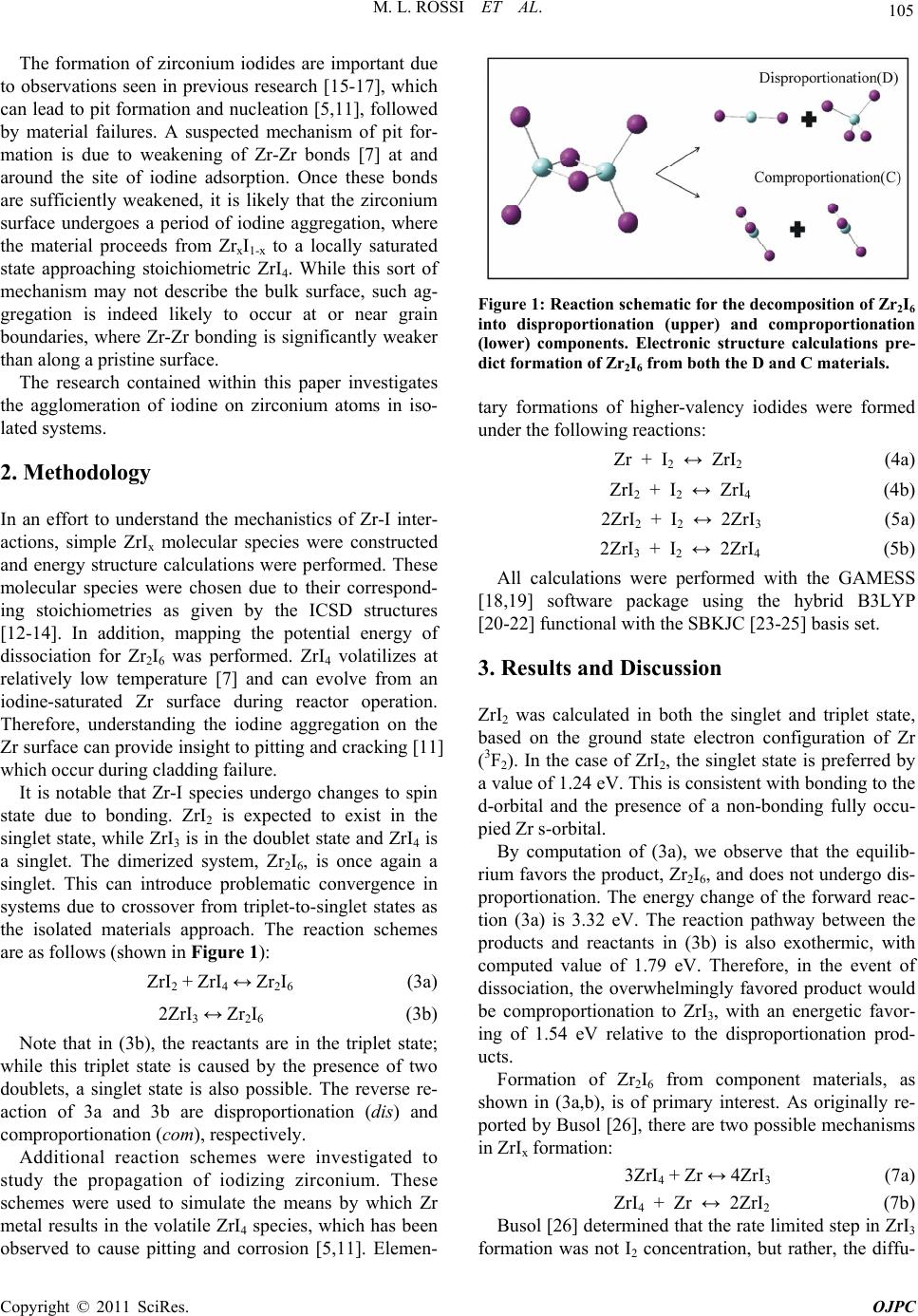 105 M. L. ROSSI ET AL. The formation of zirconium iodides are important due to observations seen in previous research [15-17], which can lead to pit formation and nucleation [5,11], followed by material failures. A suspected mechanism of pit for- mation is due to weakening of Zr-Zr bonds [7] at and around the site of iodine adsorption. Once these bonds are sufficiently weakened, it is likely that the zirconium surface undergoes a period of iodine aggregation, where the material proceeds from ZrxI1-x to a locally saturated state approaching stoichiometric ZrI4. While this sort of mechanism may not describe the bulk surface, such ag- gregation is indeed likely to occur at or near grain boundaries, where Zr-Zr bonding is significantly weaker than along a pristine surface. The research contained within this paper investigates the agglomeration of iodine on zirconium atoms in iso- lated systems. 2. Methodology In an effort to understand the mechanistics of Zr-I inter- actions, simple ZrIx molecular species were constructed and energy structure calculations were performed. These molecular species were chosen due to their correspond- ing stoichiometries as given by the ICSD structures [12-14]. In addition, mapping the potential energy of dissociation for Zr2I6 was performed. ZrI4 volatilizes at relatively low temperature [7] and can evolve from an iodine-saturated Zr surface during reactor operation. Therefore, understanding the iodine aggregation on the Zr surface can provide insight to pitting and cracking [11] which occur during cladding failure. It is notable that Zr-I species undergo changes to spin state due to bonding. ZrI2 is expected to exist in the singlet state, while ZrI3 is in the doublet state and ZrI4 is a singlet. The dimerized system, Zr2I6, is once again a singlet. This can introduce problematic convergence in systems due to crossover from triplet-to-singlet states as the isolated materials approach. The reaction schemes are as follows (shown in Figure 1): ZrI2 + ZrI4 ↔ Zr2I6 (3a) 2ZrI3 ↔ Zr2I6 (3b) Note that in (3b), the reactants are in the triplet state; while this triplet state is caused by the presence of two doublets, a singlet state is also possible. The reverse re- action of 3a and 3b are disproportionation (dis) and comproportionation (com), respectively. Additional reaction schemes were investigated to study the propagation of iodizing zirconium. These schemes were used to simulate the means by which Zr metal results in the volatile ZrI4 species, which has been observed to cause pitting and corrosion [5,11]. Elemen- Figure 1: Reaction schematic for the decomposition of Zr2I6 into disproportionation (upper) and comproportionation (lower) components. Electronic structure calculations pre- dict formation of Zr2I6 from both the D and C materials. tary formations of higher-valency iodides were formed under the following reactions: Zr + I2 ↔ ZrI2 (4a) ZrI2 + I2 ↔ ZrI4 (4b) 2ZrI2 + I2 ↔ 2ZrI3 (5a) 2ZrI3 + I2 ↔ 2ZrI4 (5b) All calculations were performed with the GAMESS [18,19] software package using the hybrid B3LYP [20-22] functional with the SBKJC [23-25] basis set. 3. Results and Discussion ZrI2 was calculated in both the singlet and triplet state, based on the ground state electron configuration of Zr (3F2). In the case of ZrI2, the singlet state is preferred by a value of 1.24 eV. This is consistent with bonding to the d-orbital and the presence of a non-bonding fully occu- pied Zr s-orbital. By computation of (3a), we observe that the equilib- rium favors the product, Zr2I6, and does not undergo dis- proportionation. The energy change of the forward reac- tion (3a) is 3.32 eV. The reaction pathway between the products and reactants in (3b) is also exothermic, with computed value of 1.79 eV. Therefore, in the event of dissociation, the overwhelmingly favored product would be comproportionation to ZrI3, with an energetic favor- ing of 1.54 eV relative to the disproportionation prod- ucts. Formation of Zr2I6 from component materials, as shown in (3a,b), is of primary interest. As originally re- ported by Busol [26], there are two possible mechanisms in ZrIx formation: 3ZrI4 + Zr ↔ 4ZrI3 (7a) ZrI4 + Zr ↔ 2ZrI2 (7b) Busol [26] determined that the rate limited step in ZrI3 formation was not I2 concentration, but rather, the diffu- Copyright © 2011 SciRes. OJPC 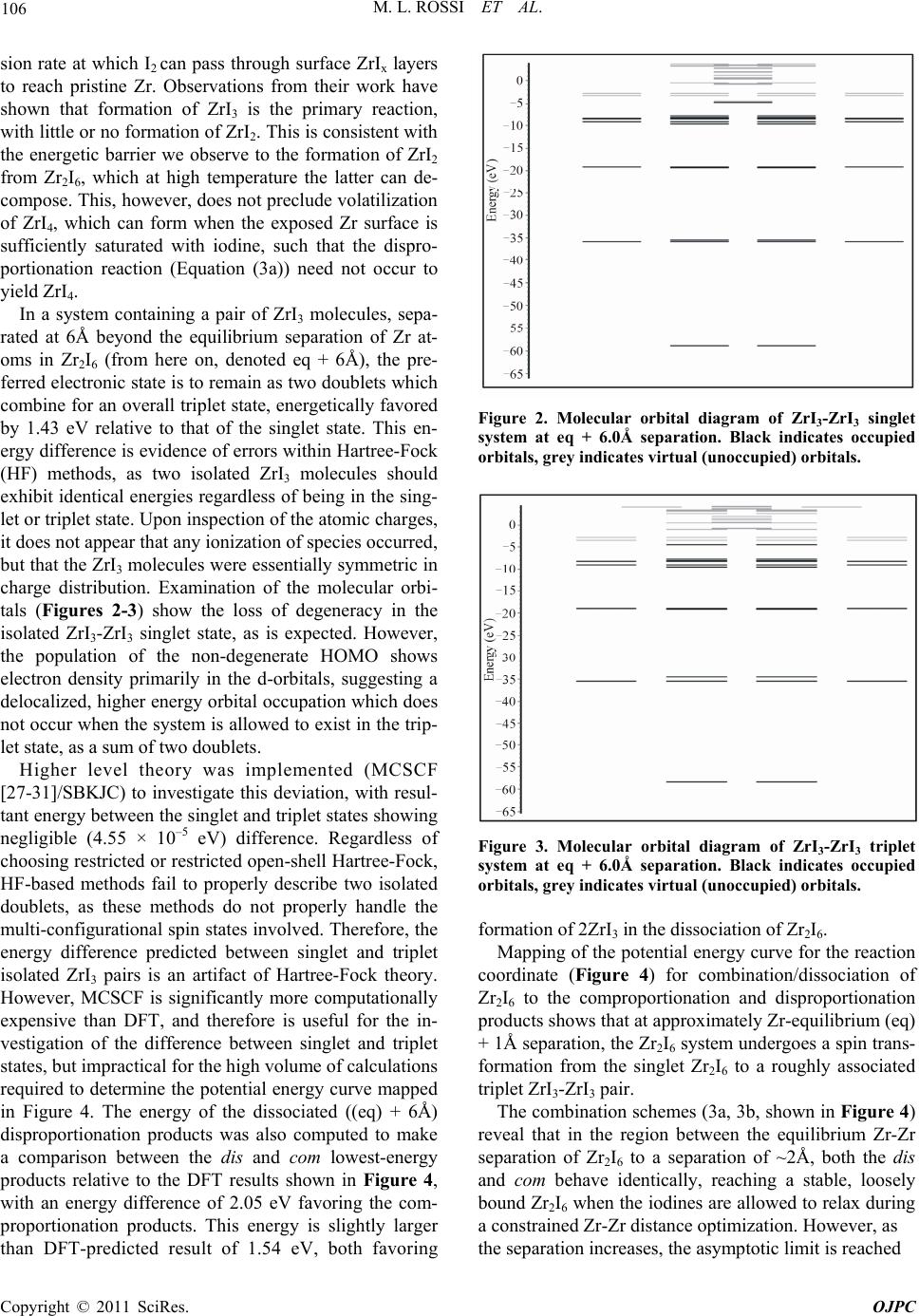 M. L. ROSSI ET AL. 106 sion rate at which I2 can pass through surface ZrIx layers to reach pristine Zr. Observations from their work have shown that formation of ZrI3 is the primary reaction, with little or no formation of ZrI2. This is consistent with the energetic barrier we observe to the formation of ZrI2 from Zr2I6, which at high temperature the latter can de- compose. This, however, does not preclude volatilization of ZrI4, which can form when the exposed Zr surface is sufficiently saturated with iodine, such that the dispro- portionation reaction (Equation (3a)) need not occur to yield ZrI4. In a system containing a pair of ZrI3 molecules, sepa- rated at 6Å beyond the equilibrium separation of Zr at- oms in Zr2I6 (from here on, denoted eq + 6Å), the pre- ferred electronic state is to remain as two doublets which combine for an overall triplet state, energetically favored by 1.43 eV relative to that of the singlet state. This en- ergy difference is evidence of errors within Hartree-Fock (HF) methods, as two isolated ZrI3 molecules should exhibit identical energies regardless of being in the sing- let or triplet state. Upon inspection of the atomic charges, it does not appear that any ionization of species occurred, but that the ZrI3 molecules were essentially symmetric in charge distribution. Examination of the molecular orbi- tals (Figures 2-3) show the loss of degeneracy in the isolated ZrI3-ZrI3 singlet state, as is expected. However, the population of the non-degenerate HOMO shows electron density primarily in the d-orbitals, suggesting a delocalized, higher energy orbital occupation which does not occur when the system is allowed to exist in the trip- let state, as a sum of two doublets. Higher level theory was implemented (MCSCF [27-31]/SBKJC) to investigate this deviation, with resul- tant energy between the singlet and triplet states showing negligible (4.55 × 10⁻⁵ eV) difference. Regardless of choosing restricted or restricted open-shell Hartree-Fock, HF-based methods fail to properly describe two isolated doublets, as these methods do not properly handle the multi-configurational spin states involved. Therefore, the energy difference predicted between singlet and triplet isolated ZrI3 pairs is an artifact of Hartree-Fock theory. However, MCSCF is significantly more computationally expensive than DFT, and therefore is useful for the in- vestigation of the difference between singlet and triplet states, but impractical for the high volume of calculations required to determine the potential energy curve mapped in Figure 4. The energy of the dissociated ((eq) + 6Å) disproportionation products was also computed to make a comparison between the dis and com lowest-energy products relative to the DFT results shown in Figure 4, with an energy difference of 2.05 eV favoring the com- proportionation products. This energy is slightly larger than DFT-predicted result of 1.54 eV, both favoring Figure 2. Molecular orbital diagram of ZrI3-ZrI3 singlet system at eq + 6.0Å separation. Black indicates occupied orbitals, grey indicates virtual (unoccupie d) orbitals. Figure 3. Molecular orbital diagram of ZrI3-ZrI3 triplet system at eq + 6.0Å separation. Black indicates occupied orbitals, grey indicates virtual (unoccupie d) orbitals. formation of 2ZrI3 in the dissociation of Zr2I6. Mapping of the potential energy curve for the reaction coordinate (Figure 4) for combination/dissociation of Zr2I6 to the comproportionation and disproportionation products shows that at approximately Zr-equilibrium (eq) + 1Å separation, the Zr2I6 system undergoes a spin trans- formation from the singlet Zr2I6 to a roughly associated triplet ZrI3-ZrI3 pair. The combination schemes (3a, 3b, shown in Figure 4) reveal that in the region between the equilibrium Zr-Zr separation of Zr2I6 to a separation of ~2Å, both the dis and com behave identically, reaching a stable, loosely bound Zr2I6 when the iodines are allowed to relax during a constrained Zr-Zr distance optimization. However, as the separation increases, the asymptotic limit is reached Copyright © 2011 SciRes. OJPC 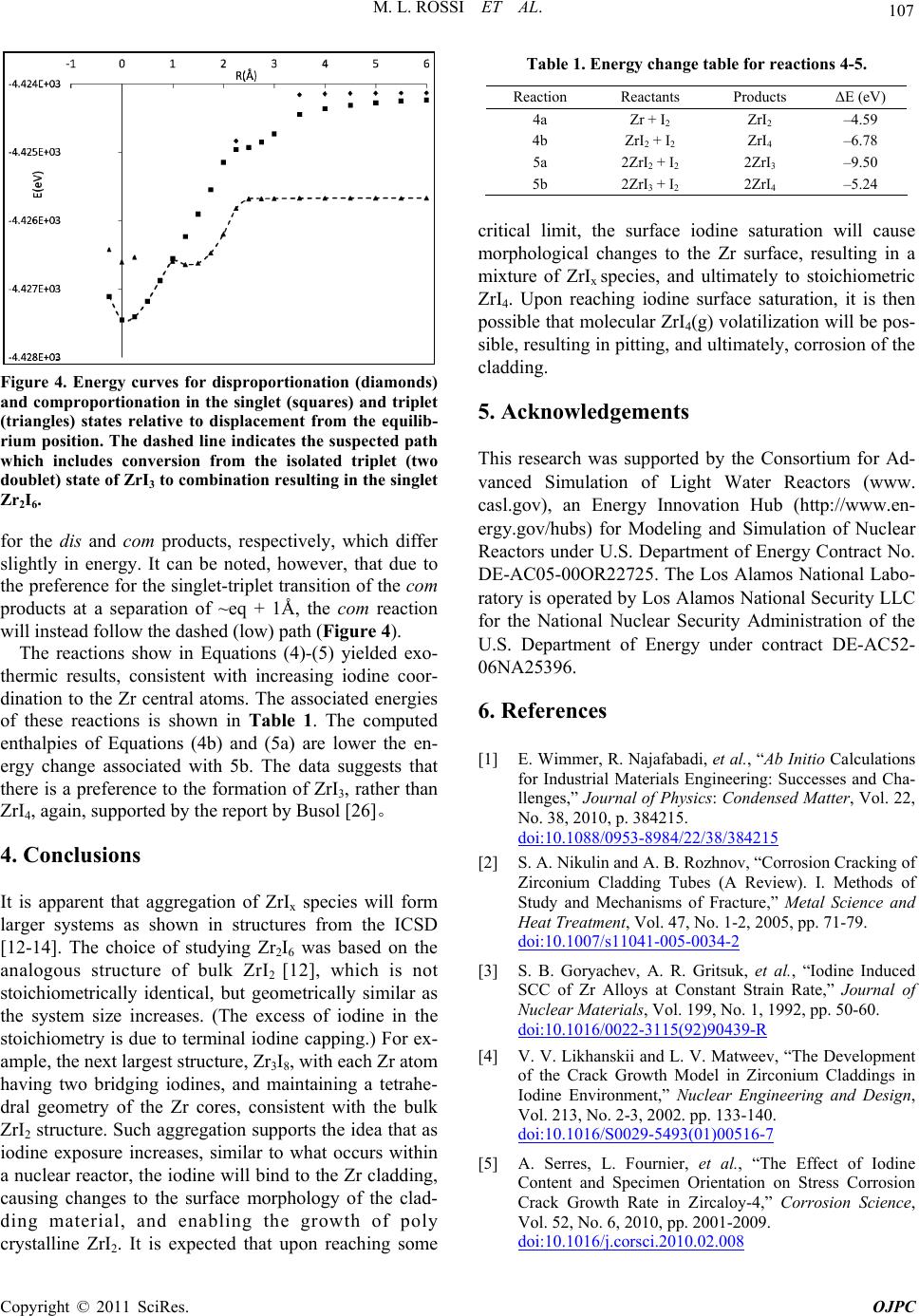 107 M. L. ROSSI ET AL. Figure 4. Energy curves for disproportionation (diamonds) and comproportionation in the singlet (squares) and triplet (triangles) states relative to displacement from the equilib- rium position. The dashed line indicates the suspected path which includes conversion from the isolated triplet (two doublet) state of ZrI3 to combination resulting in the singlet Zr2I6. for the dis and com products, respectively, which differ slightly in energy. It can be noted, however, that due to the preference for the singlet-triplet transition of the co m products at a separation of ~eq + 1Å, the com reaction will instead follow the dashed (low) path (Figure 4). The reactions show in Equations (4)-(5) yielded exo- thermic results, consistent with increasing iodine coor- dination to the Zr central atoms. The associated energies of these reactions is shown in Table 1. The computed enthalpies of Equations (4b) and (5a) are lower the en- ergy change associated with 5b. The data suggests that there is a preference to the formation of ZrI3, rather than ZrI4, again, supported by the report by Busol [26]。 4. Conclusions It is apparent that aggregation of ZrIx species will form larger systems as shown in structures from the ICSD [12-14]. The choice of studying Zr2I6 was based on the analogous structure of bulk ZrI2 [12], which is not stoichiometrically identical, but geometrically similar as the system size increases. (The excess of iodine in the stoichiometry is due to terminal iodine capping.) For ex- ample, the next largest structure, Zr3I8, with each Zr atom having two bridging iodines, and maintaining a tetrahe- dral geometry of the Zr cores, consistent with the bulk ZrI2 structure. Such aggregation supports the idea that as iodine exposure increases, similar to what occurs within a nuclear reactor, the iodine will bind to the Zr cladding, causing changes to the surface morphology of the clad- ding material, and enabling the growth of poly crystalline ZrI2. It is expected that upon reaching some Table 1. Energy change table for reactions 4-5. Reaction Reactants Products ΔE (eV) 4a Zr + I2 ZrI2 –4.59 4b ZrI2 + I2 ZrI4 –6.78 5a 2ZrI2 + I2 2ZrI3 –9.50 5b 2ZrI3 + I2 2ZrI4 –5.24 critical limit, the surface iodine saturation will cause morphological changes to the Zr surface, resulting in a mixture of ZrIx species, and ultimately to stoichiometric ZrI4. Upon reaching iodine surface saturation, it is then possible that molecular ZrI4(g) volatilization will be pos- sible, resulting in pitting, and ultimately, corrosion of the cladding. 5. Acknowledgements This research was supported by the Consortium for Ad- vanced Simulation of Light Water Reactors (www. casl.gov), an Energy Innovation Hub (http://www.en- ergy.gov/hubs) for Modeling and Simulation of Nuclear Reactors under U.S. Department of Energy Contract No. DE-AC05-00OR22725. The Los Alamos National Labo- ratory is operated by Los Alamos National Security LLC for the National Nuclear Security Administration of the U.S. Department of Energy under contract DE-AC52- 06NA25396. 6. References [1] E. Wimmer, R. Najafabadi, et al., “Ab Initio Calculations for Industrial Materials Engineering: Successes and Cha- llenges,” Journal of Physics: Condensed Matter, Vol. 22, No. 38, 2010, p. 384215. doi:10.1088/0953-8984/22/38/384215 [2] S. A. Nikulin and A. B. Rozhnov, “Corrosion Cracking of Zirconium Cladding Tubes (A Review). I. Methods of Study and Mechanisms of Fracture,” Metal Science and Heat Treatment, Vol. 47, No. 1-2, 2005, pp. 71-79. doi:10.1007/s11041-005-0034-2 [3] S. B. Goryachev, A. R. Gritsuk, et al., “Iodine Induced SCC of Zr Alloys at Constant Strain Rate,” Journal of Nuclear Materials, Vol. 199, No. 1, 1992, pp. 50-60. doi:10.1016/0022-3115(92)90439-R [4] V. V. Likhanskii and L. V. Matweev, “The Development of the Crack Growth Model in Zirconium Claddings in Iodine Environment,” Nuclear Engineering and Design, Vol. 213, No. 2-3, 2002. pp. 133-140. doi:10.1016/S0029-5493(01)00516-7 [5] A. Serres, L. Fournier, et al., “The Effect of Iodine Content and Specimen Orientation on Stress Corrosion Crack Growth Rate in Zircaloy-4,” Corrosion Science, Vol. 52, No. 6, 2010, pp. 2001-2009. doi:10.1016/j.corsci.2010.02.008 Copyright © 2011 SciRes. OJPC 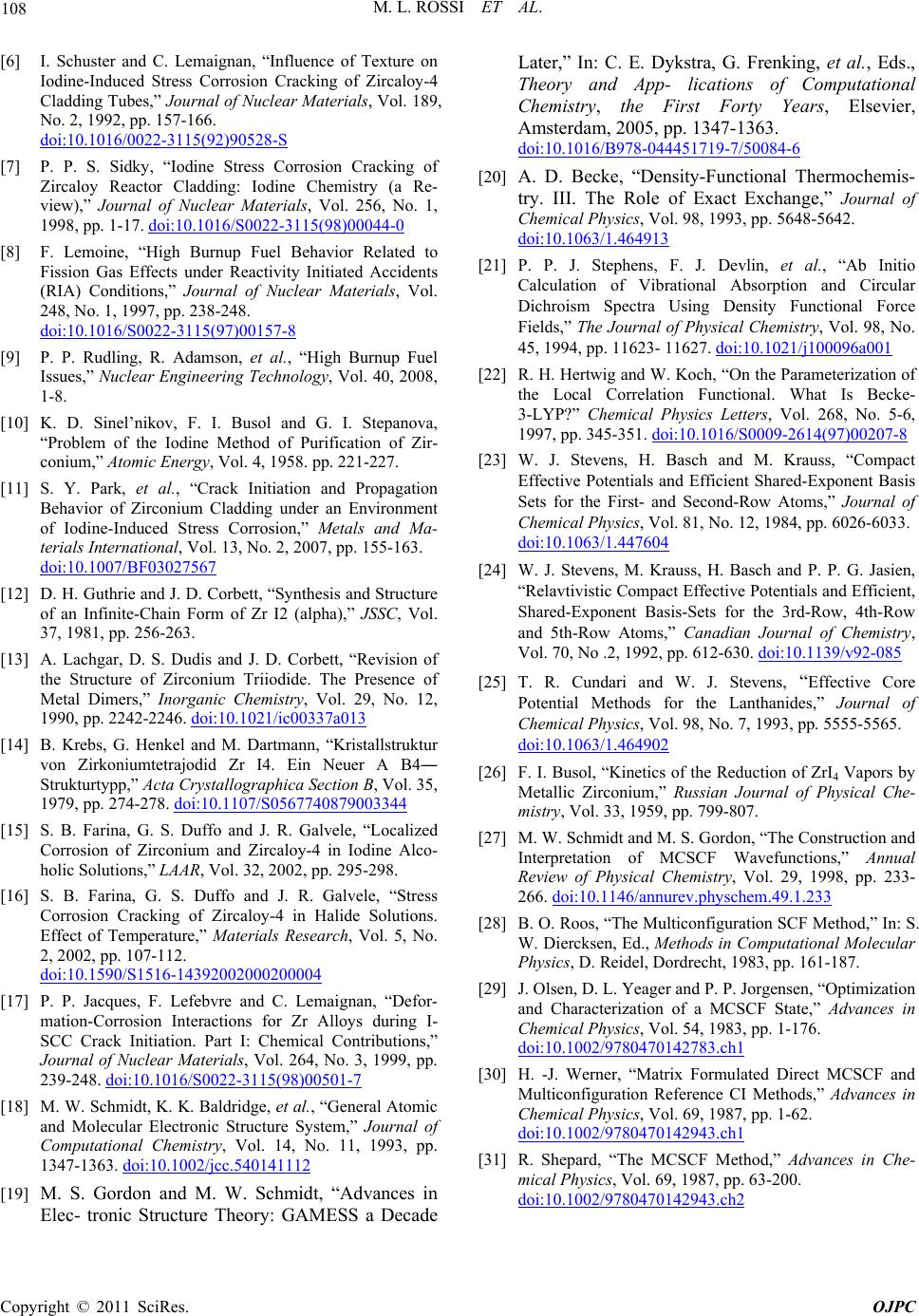 M. L. ROSSI ET AL. Copyright © 2011 SciRes. OJPC 108 [6] I. Schuster and C. Lemaignan, “Influence of Texture on Iodine-Induced Stress Corrosion Cracking of Zircaloy-4 Cladding Tubes,” Journal of Nuclear Materials, Vol. 189, No. 2, 1992, pp. 157-166. doi:10.1016/0022-3115(92)90528-S [7] P. P. S. Sidky, “Iodine Stress Corrosion Cracking of Zircaloy Reactor Cladding: Iodine Chemistry (a Re- view),” Journal of Nuclear Materials, Vol. 256, No. 1, 1998, pp. 1-17. doi:10.1016/S0022-3115(98)00044-0 [8] F. Lemoine, “High Burnup Fuel Behavior Related to Fission Gas Effects under Reactivity Initiated Accidents (RIA) Conditions,” Journal of Nuclear Materials, Vol. 248, No. 1, 1997, pp. 238-248. doi:10.1016/S0022-3115(97)00157-8 [9] P. P. Rudling, R. Adamson, et al., “High Burnup Fuel Issues,” Nuclear Engineering Technology, Vol. 40, 2008, 1-8. [10] K. D. Sinel’nikov, F. I. Busol and G. I. Stepanova, “Problem of the Iodine Method of Purification of Zir- conium,” Atomic Energy, Vol. 4, 1958. pp. 221-227. [11] S. Y. Park, et al., “Crack Initiation and Propagation Behavior of Zirconium Cladding under an Environment of Iodine-Induced Stress Corrosion,” Metals and Ma- terials International, Vol. 13, No. 2, 2007, pp. 155-163. doi:10.1007/BF03027567 [12] D. H. Guthrie and J. D. Corbett, “Synthesis and Structure of an Infinite-Chain Form of Zr I2 (alpha),” JSSC, Vol. 37, 1981, pp. 256-263. [13] A. Lachgar, D. S. Dudis and J. D. Corbett, “Revision of the Structure of Zirconium Triiodide. The Presence of Metal Dimers,” Inorganic Chemistry, Vol. 29, No. 12, 1990, pp. 2242-2246. doi:10.1021/ic00337a013 [14] B. Krebs, G. Henkel and M. Dartmann, “Kristallstruktur von Zirkoniumtetrajodid Zr I4. Ein Neuer A B4― Strukturtypp,” Acta Crystallographica Section B, Vol. 35, 1979, pp. 274-278. doi:10.1107/S0567740879003344 [15] S. B. Farina, G. S. Duffo and J. R. Galvele, “Localized Corrosion of Zirconium and Zircaloy-4 in Iodine Alco- holic Solutions,” LAAR, Vol. 32, 2002, pp. 295-298. [16] S. B. Farina, G. S. Duffo and J. R. Galvele, “Stress Corrosion Cracking of Zircaloy-4 in Halide Solutions. Effect of Temperature,” Materials Research, Vol. 5, No. 2, 2002, pp. 107-112. doi:10.1590/S1516-14392002000200004 [17] P. P. Jacques, F. Lefebvre and C. Lemaignan, “Defor- mation-Corrosion Interactions for Zr Alloys during I- SCC Crack Initiation. Part I: Chemical Contributions,” Journal of Nuclear Materials, Vol. 264, No. 3, 1999, pp. 239-248. doi:10.1016/S0022-3115(98)00501-7 [18] M. W. Schmidt, K. K. Baldridge, et al., “General Atomic and Molecular Electronic Structure System,” Journal of Computational Chemistry, Vol. 14, No. 11, 1993, pp. 1347-1363. doi:10.1002/jcc.540141112 [19] M. S. Gordon and M. W. Schmidt, “Advances in Elec- tronic Structure Theory: GAMESS a Decade Later,” In: C. E. Dykstra, G. Frenking, et al., Eds., Theory and App- lications of Computational Chemistry, the First Forty Years, Elsevier, Amsterdam, 2005, pp. 1347-1363. doi:10.1016/B978-044451719-7/50084-6 [20] A. D. Becke, “Density-Functional Thermochemis- try. III. The Role of Exact Exchang e, ” Journal of Chemical Physics, Vol. 98, 1993, pp. 5648-5642. doi:10.1063/1.464913 [21] P. P. J. Stephens, F. J. Devlin, et al., “Ab Initio Calculation of Vibrational Absorption and Circular Dichroism Spectra Using Density Functional Force Fields,” The Journal of Physical Chemistry, Vol. 98, No. 45, 1994, pp. 11623- 11627. doi:10.1021/j100096a001 [22] R. H. Hertwig and W. Koch, “On the Parameterization of the Local Correlation Functional. What Is Becke- 3-LYP?” Chemical Physics Letters, Vol. 268, No. 5-6, 1997, pp. 345-351. doi:10.1016/S0009-2614(97)00207-8 [23] W. J. Stevens, H. Basch and M. Krauss, “Compact Effective Potentials and Efficient Shared-Exponent Basis Sets for the First- and Second-Row Atoms,” Journal of Chemical Physics, Vol. 81, No. 12, 1984, pp. 6026-6033. doi:10.1063/1.447604 [24] W. J. Stevens, M. Krauss, H. Basch and P. P. G. Jasien, “Relavtivistic Compact Effective Potentials and Efficient, Shared-Exponent Basis-Sets for the 3rd-Row, 4th-Row and 5th-Row Atoms,” Canadian Journal of Chemistry, Vol. 70, No .2, 1992, pp. 612-630. doi:10.1139/v92-085 [25] T. R. Cundari and W. J. Stevens, “Effective Core Potential Methods for the Lanthanides,” Journal of Chemical Physics, Vol. 98, No. 7, 1993, pp. 5555-5565. doi:10.1063/1.464902 [26] F. I. Busol, “Kinetics of the Reduction of ZrI4 Vapors by Metallic Zirconium,” Russian Journal of Physical Che- mistry, Vol. 33, 1959, pp. 799-807. [27] M. W. Schmidt and M. S. Gordon, “The Construction and Interpretation of MCSCF Wavefunctions,” Annual Review of Physical Chemistry, Vol. 29, 1998, pp. 233- 266. doi:10.1146/annurev.physchem.49.1.233 [28] B. O. Roos, “The Multiconfiguration SCF Method,” In: S. W. Diercksen, Ed., Methods in Computational Molecular Physics, D. Reidel, Dordrecht, 1983, pp. 161-187. [29] J. Olsen, D. L. Yeager and P. P. Jorgensen, “Optimization and Characterization of a MCSCF State,” Advances in Chemical Physics, Vol. 54, 1983, pp. 1-176. doi:10.1002/9780470142783.ch1 [30] H. -J. Werner, “Matrix Formulated Direct MCSCF and Multiconfiguration Reference CI Methods,” Advances in Chemical Physics, Vol. 69, 1987, pp. 1-62. doi:10.1002/9780470142943.ch1 [31] R. Shepard, “The MCSCF Method,” Advances in Che- mical Physics, Vol. 69, 1987, pp. 63-200. doi:10.1002/9780470142943.ch2 |