

Paper Menu >>
Journal Menu >>
 Open Journal of Physical Chemistry, 2011, 1, 70-76 doi:10.4236/ojpc.2011.13010 Published Online November 2011 (http://www.SciRP.org/journal/ojpc) Copyright © 2011 SciRes. OJPC Peculiar Concentration Dependence of H/D Exchange Reaction in 1-Butyl-3-methylimidazolium Tetrafluoroborate-D2O Mixtures Souichi Ohta1, Akio Shimizu1, Yusuke Imai2, Hiroshi Abe2, Naohiro Hatano3, Yukihiro Yoshimura3* 1Department of Environmental Engineering for Symbiosis, Soka University, Tokyo, Japan 2Department of Materials Science and Engineering, National Defense Academy, Yokosuka, Japan 3Department of Applied Chemistry, National Defense Academy, Yokosuka, Japan *E-mail: [email protected] Received June 7, 2011; revised August 4, 2011; accepted September 5, 2011 Abstract We have investigated the H/D exchange reaction between heavy water and an ionic liquid, 1-butyl-3-methyl- imidazolium tetrafluoroborate ([bmim][BF4]), throughout the whole concentration region as a function of D2O mol% at room temperature. We expected that the extent of the H/D reaction would increase linearly with increasing content of D2O, but the results show an extended N-shaped behavior having a small maxi- mum at around 40 mol% and the reaction becomes very slow at a specific concentration around 80 mol%. We found that this non-linear concentration dependence correlates with the pD dependence of the solutions. Keywords: H/D Exchange Reaction, pD, NMR, Ionic Liquid 1. Introduction Room temperature Ionic liquids (RTILs) shows versatil- ity of their properties by interchanging cations and ani- ons [1,2]. Typical ionic liquids are composed of a large bulky, asymmetric organic cation containing nitrogen (e.g. imidazole, pyrrole, piperidine and pyridine) and a wide variety of anions ranging from simple halides to more complex organic species. The liquid structure of ionic liquids results from a balance between geometric factors and long-range electrostatic forces is a key to prevent crystallization. When mixing water into RTILs, the following unique features were so far reported to occur in the RTILs-water mixtures. Firstly, a nearly-free hydrogen bonded band (NFHB) of water molecules which are not associated into the hydrogen-bonded water network structure is ob- served up to the water-rich region (~80 mol% H2O) in the Raman spectra of 1-butyl-3-methylimidazolium tetra- fluoroborate, [bmim][BF4]-water mixtures [3,4]. The NFHB waters are probably very weakly interacting via H-bonding with the BF4 anions. In previous studies, we found that the NFHB is preserved even at 77 K and the NFHB water survives, not forming the hydrogen bond network among themselves as in pure H2O liquid, when making the glassy water-ionic liquid solutions [5,6]. More surprisingly, even at water-rich conditions, H2O ice crystals and the solitary water co-exist in the solutions. These facts imply that the nearly-free hydrogen bonded state of water molecule is fairly stable once formed in the RTIL. Another notable feature is the unique spatial hetero- geneity resulting from their inherent polar/nonpolar phase separation [7-9]. The pure 1-alkyl-3-methylimida- zolium based RTILs with various alkyl chain lengths show nano-phase separation (a nano-structural organiza- tion) [8]. There is also a nano-structuring of the mixtures of [bmim][BF4] [10] and/or 1-octyl-3-methylimidazo- lium nitrate [omim][NO3] [11] with water, but no mac- roscopic phase separation occurs. We presume that the nano-phase separation existing in the RTIL may be en- hanced by the presence of NFHB water molecules [5]. The final one is that the H/D exchange reaction in which HDO is generated by the rapid exchange of D between D2O and the C-H at position 2 of the 1-butyl- 3-methylimidazolium (denoted as [bmim]) ring occurs [12,13]. Now a protein H/D exchange method in deute- rium solvents using NMR spectroscopy can provide the direct information on the detailed structure, dynamics, folding and local fluctuations [14,15]. Actually, whether the hydrogens are buried or at the solvent-exposed sur- face is quantitatively predictable from the exchange rates 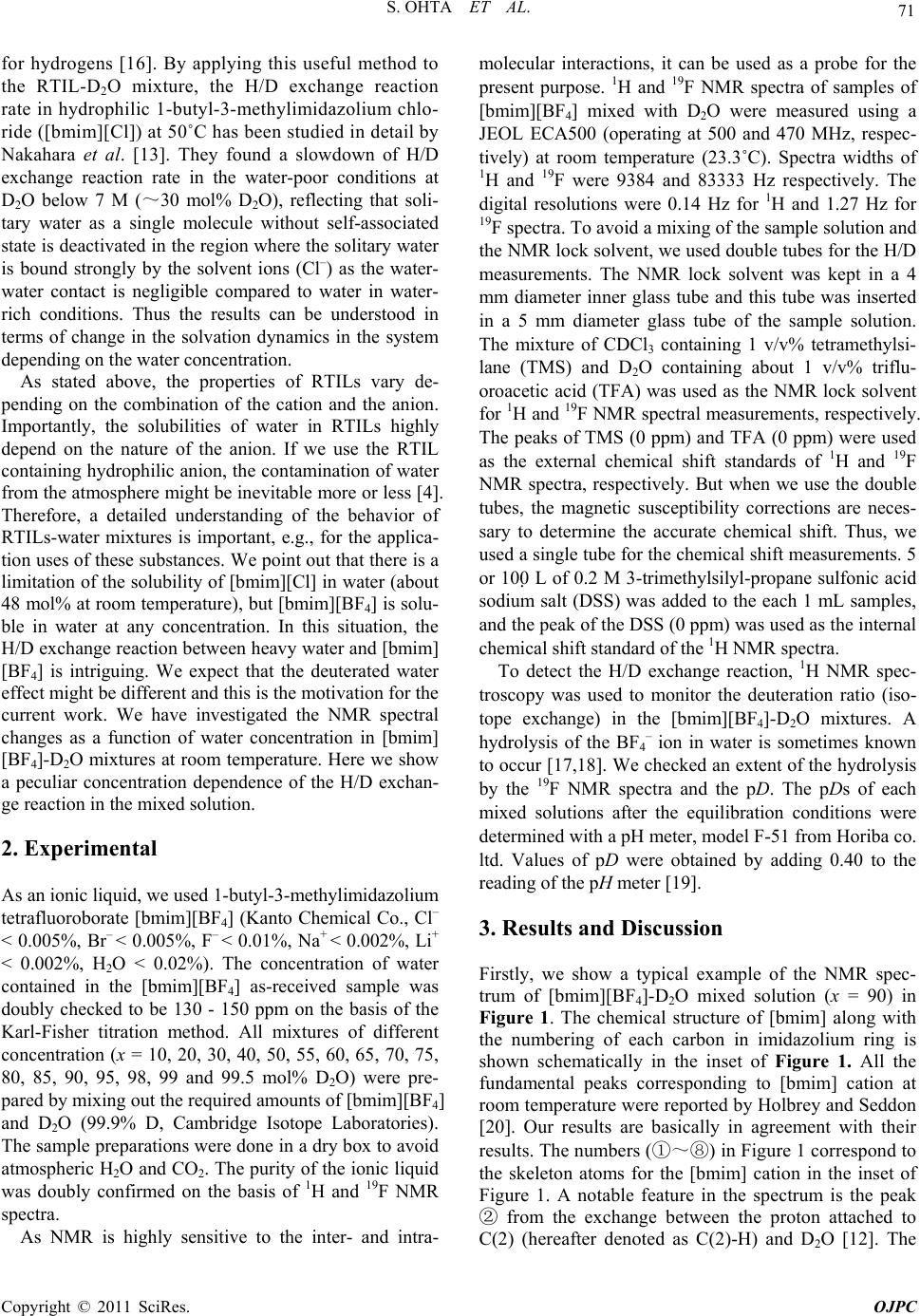 71 S. OHTA ET AL. for hydrogens [16]. By applying this useful method to the RTIL-D2O mixture, the H/D exchange reaction rate in hydrophilic 1-butyl-3-methylimidazolium chlo- ride ([bmim][Cl]) at 50˚C has been studied in detail by Nakahara et al. [13]. They found a slowdown of H/D exchange reaction rate in the water-poor conditions at D2O below 7 M (~30 mol% D2O), reflecting that soli- tary water as a single molecule without self-associated state is deactivated in the region where the solitary water is bound strongly by the solvent ions (Cl–) as the water- water contact is negligible compared to water in water- rich conditions. Thus the results can be understood in terms of change in the solvation dynamics in the system depending on the water concentration. As stated above, the properties of RTILs vary de- pending on the combination of the cation and the anion. Importantly, the solubilities of water in RTILs highly depend on the nature of the anion. If we use the RTIL containing hydrophilic anion, the contamination of water from the atmosphere might be inevitable more or less [4]. Therefore, a detailed understanding of the behavior of RTILs-water mixtures is important, e.g., for the applica- tion uses of these substances. We point out that there is a limitation of the solubility of [bmim][Cl] in water (about 48 mol% at room temperature), but [bmim][BF4] is solu- ble in water at any concentration. In this situation, the H/D exchange reaction between heavy water and [bmim] [BF4] is intriguing. We expect that the deuterated water effect might be different and this is the motivation for the current work. We have investigated the NMR spectral changes as a function of water concentration in [bmim] [BF4]-D2O mixtures at room temperature. Here we show a peculiar concentration dependence of the H/D exchan- ge reaction in the mixed solution. 2. Experimental As an ionic liquid, we used 1-butyl-3-methylimidazolium tetrafluoroborate [bmim][BF4] (Kanto Chemical Co., Cl– < 0.005%, Br– < 0.005%, F– < 0.01%, Na+ < 0.002%, Li+ < 0.002%, H2O < 0.02%). The concentration of water contained in the [bmim][BF4] as-received sample was doubly checked to be 130 - 150 ppm on the basis of the Karl-Fisher titration method. All mixtures of different concentration (x = 10, 20, 30, 40, 50, 55, 60, 65, 70, 75, 80, 85, 90, 95, 98, 99 and 99.5 mol% D2O) were pre- pared by mixing out the required amounts of [bmim][BF4] and D2O (99.9% D, Cambridge Isotope Laboratories). The sample preparations were done in a dry box to avoid atmospheric H2O and CO2. The purity of the ionic liquid was doubly confirmed on the basis of 1H and 19F NMR spectra. As NMR is highly sensitive to the inter- and intra- molecular interactions, it can be used as a probe for the present purpose. 1H and 19F NMR spectra of samples of [bmim][BF4] mixed with D2O were measured using a JEOL ECA500 (operating at 500 and 470 MHz, respec- tively) at room temperature (23.3˚C). Spectra widths of 1H and 19F were 9384 and 83333 Hz respectively. The digital resolutions were 0.14 Hz for 1H and 1.27 Hz for 19F spectra. To avoid a mixing of the sample solution and the NMR lock solvent, we used double tubes for the H/D measurements. The NMR lock solvent was kept in a 4 mm diameter inner glass tube and this tube was inserted in a 5 mm diameter glass tube of the sample solution. The mixture of CDCl3 containing 1 v/v% tetramethylsi- lane (TMS) and D2O containing about 1 v/v% triflu- oroacetic acid (TFA) was used as the NMR lock solvent for 1H and 19F NMR spectral measurements, respectively. The peaks of TMS (0 ppm) and TFA (0 ppm) were used as the external chemical shift standards of 1H and 19F NMR spectra, respectively. But when we use the double tubes, the magnetic susceptibility corrections are neces- sary to determine the accurate chemical shift. Thus, we used a single tube for the chemical shift measurements. 5 or 100 L of 0.2 M 3-trimethylsilyl-propane sulfonic acid sodium salt (DSS) was added to the each 1 mL samples, and the peak of the DSS (0 ppm) was used as the internal chemical shift standard of the 1H NMR spectra. To detect the H/D exchange reaction, 1H NMR spec- troscopy was used to monitor the deuteration ratio (iso- tope exchange) in the [bmim][BF4]-D2O mixtures. A hydrolysis of the BF4 – ion in water is sometimes known to occur [17,18]. We checked an extent of the hydrolysis by the 19F NMR spectra and the pD. The pDs of each mixed solutions after the equilibration conditions were determined with a pH meter, model F-51 from Horiba co. ltd. Values of pD were obtained by adding 0.40 to the reading of the pH meter [19]. 3. Results and Discussion Firstly, we show a typical example of the NMR spec- trum of [bmim][BF4]-D2O mixed solution (x = 90) in Figure 1. The chemical structure of [bmim] along with the numbering of each carbon in imidazolium ring is shown schematically in the inset of Figure 1. All the fundamental peaks corresponding to [bmim] cation at room temperature were reported by Holbrey and Seddon [20]. Our results are basically in agreement with their results. The numbers (①~) in Fig⑧ure 1 correspond to the skeleton atoms for the [bmim] cation in the inset of Figure 1. A notable feature in the spectrum is the peak ② from the exchange between the proton attached to C(2) (hereafter denoted as C(2)-H) and D2O [12]. The Copyright © 2011 SciRes. OJPC 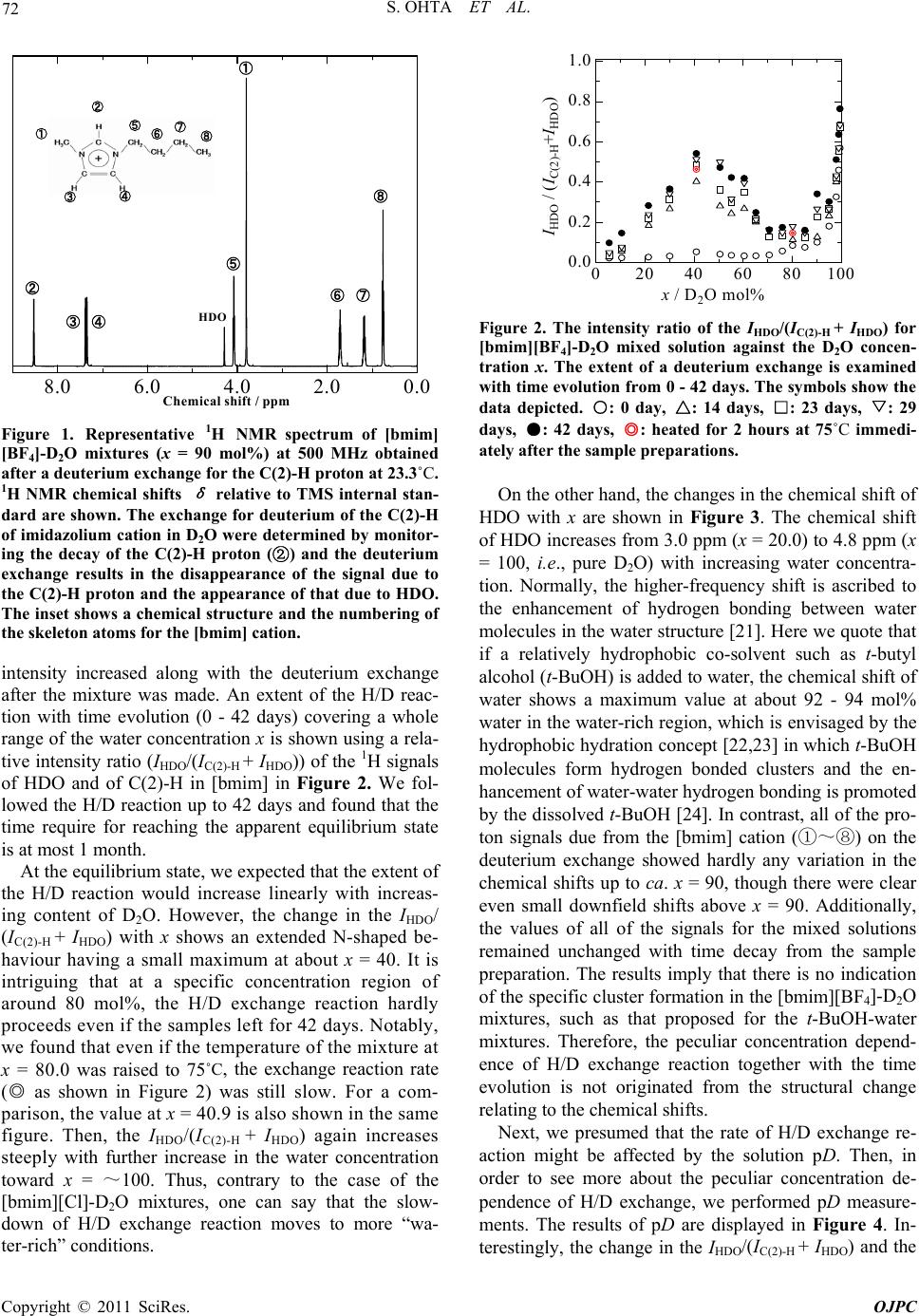 S. OHTA ET AL. 72 0.02.04.06.08.0 ② ③④ ① ⑤ ⑥⑦ ⑧ Che mic a l sh ift / ppm HDO ③ ④ ⑥ ⑧ ⑤ ⑦ ② ① Figure 1. Representative 1H NMR spectrum of [bmim] [BF4]-D2O mixtures (x = 90 mol%) at 500 MHz obtained after a deuterium exchange for the C(2)-H proton at 23.3˚C. 1H NMR chemical shifts δ relative to TMS internal stan- dard are shown. The exchange for deuterium of the C(2)-H of imidazolium cation in D2O were determined by monitor- ing the decay of the C(2)-H proton (②) and the deuterium exchange results in the disappearance of the signal due to the C(2)-H proton and the appearance of that due to HDO. The inset shows a chemical structure and the numbering of the skeleton atoms for the [bmim] cation. intensity increased along with the deuterium exchange after the mixture was made. An extent of the H/D reac- tion with time evolution (0 - 42 days) covering a whole range of the water concentration x is shown using a rela- tive intensity ratio (IHDO/(IC(2)-H + IHDO)) of the 1H signals of HDO and of C(2)-H in [bmim] in Figure 2. We fol- lowed the H/D reaction up to 42 days and found that the time require for reaching the apparent equilibrium state is at most 1 month. At the equilibrium state, we expected that the extent of the H/D reaction would increase linearly with increas- ing content of D2O. However, the change in the IHDO/ (IC(2)-H + IHDO) with x shows an extended N-shaped be- haviour having a small maximum at about x = 40. It is intriguing that at a specific concentration region of around 80 mol%, the H/D exchange reaction hardly proceeds even if the samples left for 42 days. Notably, we found that even if the temperature of the mixture at x = 80.0 was raised to 75˚C, the exchange reaction rate ( as shown in Figure 2) was sti◎ll slow. For a com- parison, the value at x = 40.9 is also shown in the same figure. Then, the IHDO/(IC(2)-H + IHDO) again increases steeply with further increase in the water concentration toward x = ~100. Thus, contrary to the case of the [bmim][Cl]-D2O mixtures, one can say that the slow- down of H/D exchange reaction moves to more “wa- ter-rich” conditions. 020 40 6080 100 0.0 0.2 0.4 0.6 0.8 1.0 x / D2O mol% IHDO / (IC(2)-H+IHDO) Figure 2. The intensity ratio of the IHDO/(IC(2)-H + IHDO) for [bmim][BF4]-D2O mixed solution against the D2O concen- tration x. The extent of a deuterium exchange is examined with time evolution from 0 - 42 days. The symbols show the data depicted. ○: 0 day, △: 14 days, □: 23 days, ▽: 29 days, ●: 42 days, ◎: heated for 2 hours at 75˚C immedi- ately after the sample preparations. On the other hand, the changes in the chemical shift of HDO with x are shown in Figure 3. The chemical shift of HDO increases from 3.0 ppm (x = 20.0) to 4.8 ppm (x = 100, i.e., pure D2O) with increasing water concentra- tion. Normally, the higher-frequency shift is ascribed to the enhancement of hydrogen bonding between water molecules in the water structure [21]. Here we quote that if a relatively hydrophobic co-solvent such as t-butyl alcohol (t-BuOH) is added to water, the chemical shift of water shows a maximum value at about 92 - 94 mol% water in the water-rich region, which is envisaged by the hydrophobic hydration concept [22,23] in which t-BuOH molecules form hydrogen bonded clusters and the en- hancement of water-water hydrogen bonding is promoted by the dissolved t-BuOH [24]. In contrast, all of the pro- ton signals due from the [bmim] cation (①~) on the ⑧ deuterium exchange showed hardly any variation in the chemical shifts up to ca. x = 90, though there were clear even small downfield shifts above x = 90. Additionally, the values of all of the signals for the mixed solutions remained unchanged with time decay from the sample preparation. The results imply that there is no indication of the specific cluster formation in the [bmim][BF4]-D2O mixtures, such as that proposed for the t-BuOH-water mixtures. Therefore, the peculiar concentration depend- ence of H/D exchange reaction together with the time evolution is not originated from the structural change relating to the chemical shifts. Next, we presumed that the rate of H/D exchange re- action might be affected by the solution pD. Then, in order to see more about the peculiar concentration de- pendence of H/D exchange, we performed pD measure- ments. The results of pD are displayed in Figure 4. In- terestingly, the change in the IHDO/(IC(2)-H + IHDO) and the Copyright © 2011 SciRes. OJPC 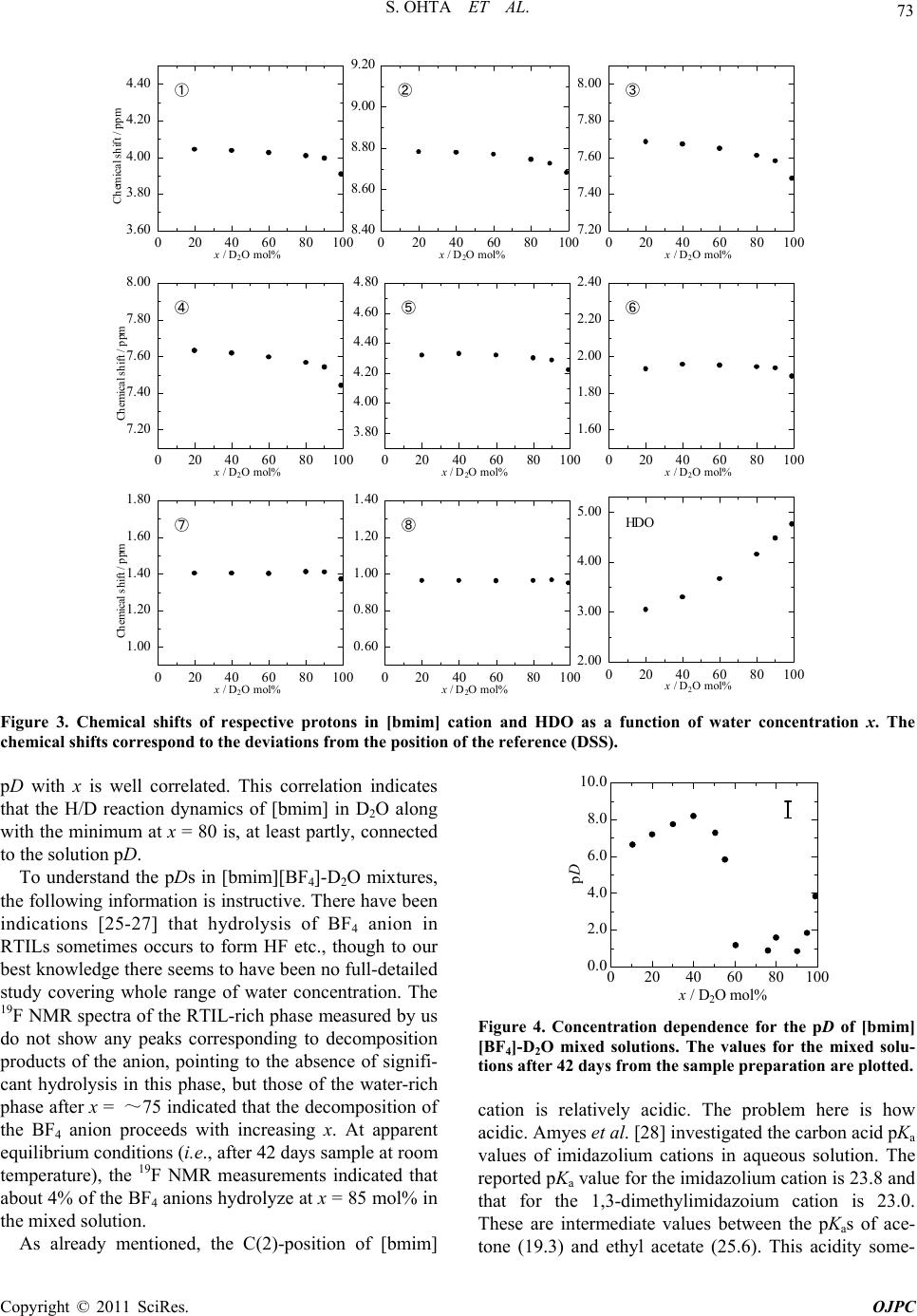 S. OHTA ET AL. Copyright © 2011 SciRes. OJPC 73 020 40 60 80100 2.00 3.00 4.00 5.00 x / D2O mol% HDO 020 40 60 80100 3.60 3.80 4.00 4.20 4.40 x / D2O mol% ① Chemical shift / ppm 020 406080 100 8. 4 0 8. 6 0 8. 8 0 9. 0 0 9. 2 0 x / D2O mol% ② 020 40 60 80100 7.20 7.40 7.60 7.80 8.00 x / D2O mol% ③ 020 40 60 80 100 3.80 4.00 4.20 4.40 4.60 4.80 x / D2O mol% ⑤ 020 40 60 80100 1.60 1.80 2.00 2.20 2.40 x / D2O mol% ⑥ 020 40 60 80100 1.00 1.20 1.40 1.60 1.80 x / D2O mol% ⑦ Chemical shift / ppm 020 40 60 80 100 0.60 0.80 1.00 1.20 1.40 x / D2O mol% ⑧ 020 40 60 80100 7.20 7.40 7.60 7.80 8.00 x / D2O mol% ④ Chemical shift / ppm Figure 3. Chemical shifts of respective protons in [bmim] cation and HDO as a function of water concentration x. The chemical shifts correspond to the deviations from the position of the reference (DSS). 020 40 60 80100 0.0 2.0 4.0 6.0 8.0 10.0 x / D2O mol% pD pD with x is well correlated. This correlation indicates that the H/D reaction dynamics of [bmim] in D2O along with the minimum at x = 80 is, at least partly, connected to the solution pD. To understand the pDs in [bmim][BF4]-D2O mixtures, the following information is instructive. There have been indications [25-27] that hydrolysis of BF4 anion in RTILs sometimes occurs to form HF etc., though to our best knowledge there seems to have been no full-detailed study covering whole range of water concentration. The 19F NMR spectra of the RTIL-rich phase measured by us do not show any peaks corresponding to decomposition products of the anion, pointing to the absence of signifi- Figure 4. Concentration dependence for the pD of [bmim] [BF4]-D2O mixed solutions. The values for the mixed solu- tions after 42 days from the sample preparation are plotted. cant hydrolysis in this phase, but those of the water-rich phase after x = ~75 indicated that the decomposition of the BF4 anion proceeds with increasing x. At apparent equilibrium conditions (i.e., after 42 days sample at room temperature), the 19F NMR measurements indicated that about 4% of the BF4 anions hydrolyze at x = 85 mol% in the mixed solution. cation is relatively acidic. The problem here is how acidic. Amyes et al. [28] investigated the carbon acid pKa values of imidazolium cations in aqueous solution. The reported pKa value for the imidazolium cation is 23.8 and that for the 1,3-dimethylimidazoium cation is 23.0. These are intermediate values between the pKas of ace- tone (19.3) and ethyl acetate (25.6). This acidity some- As already mentioned, the C(2)-position of [bmim]  S. OHTA ET AL. 74 times leads to undesired side reactions for the purpose of using imidazolium ionic liquids as solvents under certain reaction conditions [29]. Handy and Okello [30] reported that by replacing the H with a CH3 group the exchange became slow, though it was detectable even in the pres- ence of a very mild base. Considering the aforementioned results in the litera- tures, we presumed that the rate of H/D exchange reac- tion might be affected by the solution pD. To confirm this expectation, we performed the additional experi- ments using the buffered solutions. The mixed solutions of x = 10, 20, 40, 80, 90 and 99 mol% were adjusted to certain pDs (= 11 - 12) by NaOD. As might be expected, the rate of exchange in the presence of strong base at higher x regions was found to accelerate where the reac- tion of the starting materials were complete quickly after mixing, done in five minutes, as shown in Fi g u r e 5. It is interesting to refer that this results are basically in agreement with the results on the hydrolysis of imida- zole-2-ylidenes (imidazole-derived carbenes) under strongly alkaline solutions (pH = 12 - 13) studied by Hollóczki, et al. [31]. On the other hand, in a lower D2O concentration region, little effect of the base on the rate of H/D exchange reaction could be detected. This is rea- sonable because an extent of the H/D reaction is already almost completed. We also confirmed that there were no significant acid and/or base catalysis pD effects on the chemical shifts at given concentrations (data not shown). 4. Conclusions In summary, we have demonstrated the H/D exchange reaction of D2O in [bmim][BF4] throughout the whole concentration range (x = 0 - 100) at room temperature. We found that there is no linear increase in the extent of the H/D reaction with D2O concentration. The results show an extended N-shaped behavior having a small maximum at around 40 mol% and the reaction does hardly occurs at a specific concentration region of ~80 mol%. This is, at least partly, ascribed to the hydrolysis of BF4 anion in this concentration region. We should keep this in mind and be cautious of the H/D exchange reaction, e.g., for the application use of [bmim][BF4] in water. Although we find the good correlation between the H/D exchange reaction and the solution pD, to give a clear-cut answer for whether the peculiar concentration dependence of H/D exchange occurred at a specific con- centration solely depend on the pD or not is more diffi- cult task. The interaction between D2O water and the RTIL is probably anisotropic because of the inherent heterogeneity existing in the RTILs in nano-scale order that operates at a molecular level in such systems. We suppose that it may be also connected to the existence of 020 40 60 80 100 0.0 0.2 0.4 0.6 0.8 1.0 x / D2O mol% IHDO / (IC(2)-H+IHDO) Figure 5. The intensity ratio (IHDO/(IC(2)-H + IHDO)) of the H/D exchange reaction in buffered solutions at a basic con- dition (adjusted to pD = 11 - 12) against the D2O concentra- tion x. For a comparison, the values for the mixed solutions without the addition of the base (open circle symbols) after 42 days left from the sample preparation are plotted in the same figure. solitary water molecules in [bmim][BF4] along with the spatial heterogeneity. Further quantitative understanding of the detailed interactions existing in the system at mo- lecular level would require e.g., a still more precise modelling of structures of [bmim]-[BF4], [bmim] -water, [BF4]-water, water-water interactions. MD simulation and small angle x-ray scattering studies would help greatly, but this is beyond the present study. We believe that the present findings denote for the fundamental im- portance of the substances. 5. Acknowledgements We are grateful to Dr. T. Takekiyo for experimental as- sistance and Ms. K. Yamazaki for help with the manu- script. 6. References [1] T. Welton, “Ionic Liquids in Synthesis,” Wiley-VCH, Weinheim, 2002. [2] R. D. Rogers, K. R. Seddon and S. Volkov, “Green In- dustrial Applications of Ionic Liquids,” NATO Science Series, Springer, New York, 2002. [3] Y. Jeon, J. Sung, D. Kim, C. Seo, H. Cheong, Y. Ouchi, R. Ozawa and H. Hamaguchi, “Structural Change of 1-Butyl-3-methylimidazolium Tetrafluoroborate + Water Mixtures Studied by Infrared Vibrational Spectroscopy,” The Journal of Physical Chemistry B, Vol. 112, No. 3, 2008, pp. 923-928. doi:10.1021/jp0746650 [4] L. Cammarata, S. G. Kazarian, P. A. Salter and T. Welton, “Molecular States of Water in Room Temperature Ionic Liquids,” Physical Chemistry Chemical Physics, Vol. 3, 2001, pp. 5192-5200. doi:10.1039/b106900d [5] Y. Yoshimura, T. Goto, H. Abe and Y. Imai, “Existence of Nearly-Free Hydrogen Bonds in an Ionic Liquid, Copyright © 2011 SciRes. OJPC 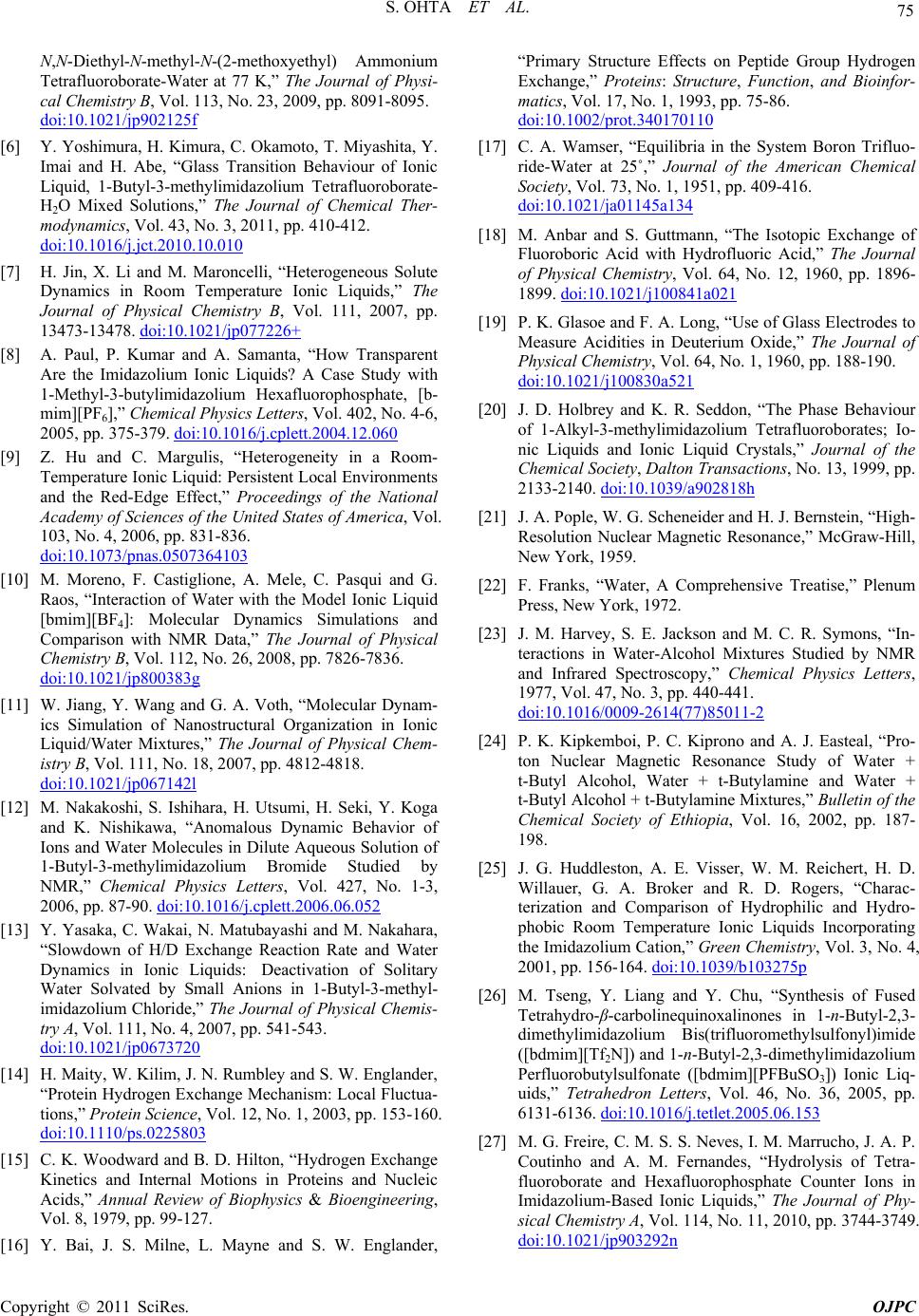 75 S. OHTA ET AL. N,N-Diethyl-N-methyl-N-(2-methoxyethyl) Ammonium Tetrafluoroborate-Water at 77 K,” The Journal of Physi- cal Chemistry B, Vol. 113, No. 23, 2009, pp. 8091-8095. doi:10.1021/jp902125f [6] Y. Yoshimura, H. Kimura, C. Okamoto, T. Miyashita, Y. Imai and H. Abe, “Glass Transition Behaviour of Ionic Liquid, 1-Butyl-3-methylimidazolium Tetrafluoroborate- H2O Mixed Solutions,” The Journal of Chemical Ther- modynamics, Vol. 43, No. 3, 2011, pp. 410-412. doi:10.1016/j.jct.2010.10.010 [7] H. Jin, X. Li and M. Maroncelli, “Heterogeneous Solute Dynamics in Room Temperature Ionic Liquids,” The Journal of Physical Chemistry B, Vol. 111, 2007, pp. 13473-13478. doi:10.1021/jp077226+ [8] A. Paul, P. Kumar and A. Samanta, “How Transparent Are the Imidazolium Ionic Liquids? A Case Study with 1-Methyl-3-butylimidazolium Hexafluorophosphate, [b- mim][PF6],” Chemical Physics Letters, Vol. 402, No. 4-6, 2005, pp. 375-379. doi:10.1016/j.cplett.2004.12.060 [9] Z. Hu and C. Margulis, “Heterogeneity in a Room- Temperature Ionic Liquid: Persistent Local Environments and the Red-Edge Effect,” Proceedings of the National Academy of Sciences of the United States of America, Vol. 103, No. 4, 2006, pp. 831-836. doi:10.1073/pnas.0507364103 [10] M. Moreno, F. Castiglione, A. Mele, C. Pasqui and G. Raos, “Interaction of Water with the Model Ionic Liquid [bmim][BF4]: Molecular Dynamics Simulations and Comparison with NMR Data,” The Journal of Physical Chemistry B, Vol. 112, No. 26, 2008, pp. 7826-7836. doi:10.1021/jp800383g [11] W. Jiang, Y. Wang and G. A. Voth, “Molecular Dynam- ics Simulation of Nanostructural Organization in Ionic Liquid/Water Mixtures,” The Journal of Physical Chem- istry B, Vol. 111, No. 18, 2007, pp. 4812-4818. doi:10.1021/jp067142l [12] M. Nakakoshi, S. Ishihara, H. Utsumi, H. Seki, Y. Koga and K. Nishikawa, “Anomalous Dynamic Behavior of Ions and Water Molecules in Dilute Aqueous Solution of 1-Butyl-3-methylimidazolium Bromide Studied by NMR,” Chemical Physics Letters, Vol. 427, No. 1-3, 2006, pp. 87-90. doi:10.1016/j.cplett.2006.06.052 [13] Y. Yasaka, C. Wakai, N. Matubayashi and M. Nakahara, “Slowdown of H/D Exchange Reaction Rate and Water Dynamics in Ionic Liquids: Deactivation of Solitary Water Solvated by Small Anions in 1-Butyl-3-methyl- imidazolium Chloride,” The Journal of Physical Chemis- try A, Vol. 111, No. 4, 2007, pp. 541-543. doi:10.1021/jp0673720 [14] H. Maity, W. Kilim, J. N. Rumbley and S. W. Englander, “Protein Hydrogen Exchange Mechanism: Local Fluctua- tions,” Protein Science, Vol. 12, No. 1, 2003, pp. 153-160. doi:10.1110/ps.0225803 [15] C. K. Woodward and B. D. Hilton, “Hydrogen Exchange Kinetics and Internal Motions in Proteins and Nucleic Acids,” Annual Review of Biophysics & Bioengineering, Vol. 8, 1979, pp. 99-127. [16] Y. Bai, J. S. Milne, L. Mayne and S. W. Englander, “Primary Structure Effects on Peptide Group Hydrogen Exchange,” Proteins: Structure, Function, and Bioinfor- matics, Vol. 17, No. 1, 1993, pp. 75-86. doi:10.1002/prot.340170110 [17] C. A. Wamser, “Equilibria in the System Boron Trifluo- ride-Water at 25˚,” Journal of the American Chemical Society, Vol. 73, No. 1, 1951, pp. 409-416. doi:10.1021/ja01145a134 [18] M. Anbar and S. Guttmann, “The Isotopic Exchange of Fluoroboric Acid with Hydrofluoric Acid,” The Journal of Physical Chemistry, Vol. 64, No. 12, 1960, pp. 1896- 1899. doi:10.1021/j100841a021 [19] P. K. Glasoe and F. A. Long, “Use of Glass Electrodes to Measure Acidities in Deuterium Oxide,” The Journal of Physical Chemistry, Vol. 64, No. 1, 1960, pp. 188-190. doi:10.1021/j100830a521 [20] J. D. Holbrey and K. R. Seddon, “The Phase Behaviour of 1-Alkyl-3-methylimidazolium Tetrafluoroborates; Io- nic Liquids and Ionic Liquid Crystals,” Journal of the Chemical Society, Dalton Transactions, No. 13, 1999, pp. 2133-2140. doi:10.1039/a902818h [21] J. A. Pople, W. G. Scheneider and H. J. Bernstein, “High- Resolution Nuclear Magnetic Resonance,” McGraw-Hill, New York, 1959. [22] F. Franks, “Water, A Comprehensive Treatise,” Plenum Press, New York, 1972. [23] J. M. Harvey, S. E. Jackson and M. C. R. Symons, “In- teractions in Water-Alcohol Mixtures Studied by NMR and Infrared Spectroscopy,” Chemical Physics Letters, 1977, Vol. 47, No. 3, pp. 440-441. doi:10.1016/0009-2614(77)85011-2 [24] P. K. Kipkemboi, P. C. Kiprono and A. J. Easteal, “Pro- ton Nuclear Magnetic Resonance Study of Water + t-Butyl Alcohol, Water + t-Butylamine and Water + t-Butyl Alcohol + t-Butylamine Mixtures,” Bulletin of the Chemical Society of Ethiopia, Vol. 16, 2002, pp. 187- 198. [25] J. G. Huddleston, A. E. Visser, W. M. Reichert, H. D. Willauer, G. A. Broker and R. D. Rogers, “Charac- terization and Comparison of Hydrophilic and Hydro- phobic Room Temperature Ionic Liquids Incorporating the Imidazolium Cation,” Green Chemistry, Vol. 3, No. 4, 2001, pp. 156-164. doi:10.1039/b103275p [26] M. Tseng, Y. Liang and Y. Chu, “Synthesis of Fused Tetrahydro-β-carbolinequinoxalinones in 1-n-Butyl-2,3- dimethylimidazolium Bis(trifluoromethylsulfonyl)imide ([bdmim][Tf2N]) and 1-n-Butyl-2,3-dimethylimidazolium Perfluorobutylsulfonate ([bdmim][PFBuSO3]) Ionic Liq- uids,” Tetrahedron Letters, Vol. 46, No. 36, 2005, pp. 6131-6136. doi:10.1016/j.tetlet.2005.06.153 [27] M. G. Freire, C. M. S. S. Neves, I. M. Marrucho, J. A. P. Coutinho and A. M. Fernandes, “Hydrolysis of Tetra- fluoroborate and Hexafluorophosphate Counter Ions in Imidazolium-Based Ionic Liquids,” The Journal of Phy- sical Chemistry A, Vol. 114, No. 11, 2010, pp. 3744-3749. doi:10.1021/jp903292n Copyright © 2011 SciRes. OJPC  S. OHTA ET AL. Copyright © 2011 SciRes. OJPC 76 [28] T. L. Amyes, S. T. Diver, J. P. Richard, F. M. Rivas and K. Toth, “Formation and Stability of N-Heterocyclic Carbenes in Water: The Carbon Acid pKa of Imida- zolium Cations in Aqueous Solution,” Journal of the American Chemical Society, Vol. 126, No. 13, 2004, pp. 4366-4374. doi:10.1021/ja039890j [30] S. T. Handy and M. Okello, “The 2-Position of Imida- zolium Ionic Liquids: Substitution and Exchange,” The Journal of Organic Chemistry, Vol. 70, No. 5, 2005, pp. 1915-1918. doi:10.1021/jo0480850 [31] O. Hollóczki, P. Terleczky, D. Szieberth, G. Mourgas, D. Gudat and L. Nyulászi, “Hydrolysis of Imidazole-2- ylidenes,” Journal of the American Chemical Society, Vol. 133, No. 4, 2011, pp. 780-789. doi:10.1021/ja103578y [29] J. Dupont and J. Spencer, “On the Noninnocent Nature of 1,3-Dial kylimidazolium Ionic Liquids,” Angewandte Chemie International Edition, Vol. 43, No. 40, 2004, pp. 5296-5297. doi:10.1002/anie.200460431 |