

Paper Menu >>
Journal Menu >>
 American Journal of Plant Sciences, 2011, 2, 675-682 doi:10.4236/ajps.2011.25081 Published Online November 2011 (http://www.SciRP.org/journal/ajps) Copyright © 2011 SciRes. AJPS 675 Covering Tree Line with Black Poly Ethylene Sheets for Composting Fresh Animal Manures Reduces Weeds and Improves Tree Growth in Newly Established Orchards Barakat Abu Irmaileh1, Azmi Abu Rayyan2, Fahmi Shatat2 1Department of Plant Protection, Faculty of Agriculture, University of Jordan, Amman, Jordan; 2Department of Horticulture and Crop Science, Faculty of Agriculture, University of Jordan, Amman, Jordan. Email: [email protected] Received July 23rd, 2011; revised August 25th, 2011; accepted October 9th, 2011. ABSTRACT Three field experiments were carried out over two growing seasons to evaluate the response of weeds and the volume of fruit trees; peach, pear and olive to composting of manures at 10 kg·m–2. Planting holes were prepared early January. Animal manures from different sources; broiler, cow, layer and sheep were mixed in the top 20-cm of the soil surface over a 40-cm band X 2.5m row per treatment in the planting row then either non covered or covered with black poly- ethylene (BPE) sheets for six weeks or for the period from January to October. Trees were then planted late February. The same treatments were repeated in November of the next year. Weeds were significantly reduced and fruit trees were significantly larger in the treatments with manures in the BPE-covered treatments as compared to the non-covered treatment. Perennials; Cynodon dactylon (L.) Pers. and Cardaria draba L. in addition to Convolvulus arvensis L. and Sorghum halepense (L.) Pers. tolerated the composting process. Most annual weeds did not appear in composted ma- nure subplots. Main annual weeds included; Amaranthus blitoides S. Wats. A. garacilis Desf. Sinapis arvensis L. Chenpodium album L. in addition to some weeds species belonging to Leguminosae and Caryphyllaceae. Keywords: Orga ni c F ar mi n g , Crop Tolerance, Sustainable Agriculture, Environmental Safety 1. Introduction The use of composted organic matter, which contains essential nutrients for plants, reduces chemical use, thus reducing fertilizer imports and or their manufacture. Ani- mal manure supp lies all major nutrients (N, P, K, Ca, Mg, S), necessary for plant growth, as well as micronutrients (trace elements), hence it acts as a mixed fertilizer. The chemical composition of fresh manures varies according to the animal source and th e type of feed and location. In general, the percentages of N, P2O5, K2O, Ca, Mg, or- ganic matter, and moisture in cow, sheep and poultry manures are: 0.5%, 0.5%, 0.3%, 0.1%, 0.3%, 16.7%, 81.3%; 0.9%, 0.5%, 0.8 %, 0.2%, 0.3%, 30.7%, 64.8%, and 0.9% , 0.5%, 0.8 % , 0.4%, 0.2%, 30.7%, 64. 8% ; respectivel y [1]. In addition, a small fraction of the added organic mate- rial is transformed into humus or stable organic matter. Humus contributes to soil fertility by retaining plant nu- trients through adsorption. It also acts as binding material in the soil, thus improv ing soil structure. It is respon sible for making clay less susceptible to compaction, silt less susceptible to erosion, and it increases water holding capacity and cation exchange capacity of soil [2,3]. It was always looked upon manure favorably because of its fertilizing value since ancient times. However, raw ma- nure generally releases nitrogen compounds and ammo- nia which may burn plant roots, young plants and inter- fere with seed germination. Application of fresh manures attracts large amount of plant pests and houseflies as manure is a favorable medium for the multiplication and propagation of various microorganisms and insects, in- cluding houseflies (Musca domestica L.) [4,5]. Surface application of manure, particularly liquid manure, may cause substantial losses of NH3 by volatilization [2,3]. Most of the emitted NH3 is deposited near the emission source which lowers soil pH and may lead to mobiliza- tion of aluminum ions, which disturbs the nutrient uptake  Covering Tree Line with Black Poly Ethylene Sheets for Composting Fresh Animal Manures Reduces Weeds 676 and Improves Tree Growth in Newly Established Orchards by plants and enhances sensitivity to stress factors like drought and fungi. Besides its acidifying effect, NH3 deposition accounts for a considerable N load to the en- vironment, causing eutrophication problems and N en- richment of the soils in nature reserves, causing undesir- able changes in species composition and biodiversity [2]. Most of the odor comes from the anaerobic decomposi- tion of manure due to the production of hydrogen sul- phide and ammonia among other compounds. Thus, dis- posal of manures, without any further composting treat- ment, is a major environmental pollutant in agro-eco- systems. Composting animal manures and recycling them in cultivated fields has been widely adopted in many coun- tries [6] as it improves soil physical characteristics, low- ers C:N ratio, thus reducing competition for nutrients between plants and microorganisms, and the high tem- perature produced during composting process reduces the viability o f soil borne pests and weed seeds [7,8 ] and lower housefly populations [9]. Composting of manure can also solve odor problems, recover nutrients and en- ergy from manure, increase the fertilizer value, and de- crease the pollution potential to allow safe discharge of the manure in the environment [10]. Manure manage- ment practices are strictly regulated and enforced in the developed countries to minimize pollution problems [10], but management of surplus manure in the animal produc- tion sector is far from satisfactory in developing coun- tries where it is sold at low prices to farmers who spread raw manure on soil surface at rates ranging from 50 to 100 t·ha–1. Collected raw manure from grazing animal barnyards (goat and sheep) is normally contaminated with seeds of various p lant species; as these animals, and to a lesser extent cattle, are normally allowed to graze crop remains and weeds after harvest [8 ]. Therefore, raw manure could increase the weed seed bank in receiving fields. Weeds are one of the most limiting factors in ag- ricultural production, as weed infestations can result in serious yield losses compared to other constraints in crop productio n [11,12]. Farmers in most developing countries remove weeds by manual hoeing [13]. In these countries chemical weed control is typically unaffordable, especially if more than one herbicide is required and if market economics limit profits. Nonchemical weed control practices, such as soil solarization with black polyethylene mulch during the hottest months of the year, are favored for the control of weeds and other pests [14]. Recent findings indicated that pre-plant composting of various organic manures in the planting rows for six weeks can effectively control weeds including broomrapes [8,15]. Good weed control is essential for rapid establishment and vigorous growth of you ng tr ees. Gr owth of fruit tr ees during the phase of orchard establishment is normally hampered by the presence of weeds. Weed control in young orchards is critical. Competition from smooth pigweed reduced tree growth of newly established trees by more than 40% [16], and Bermuda grass infestation can reduce fresh weights of peach trees by 87% after one year [17]. The objective of this research is to evaluate the impact of pre- and post-plant composting of different manures on weed infestation and tree growth in newly established olive, pear and peach orchards. 2. Materials and Methods Three field experiments were conducted over two grow- ing seasons (2009-2011) at the University of Jordan re- search stations, to study the growth response of three species of fruit trees; olive (Olea europea) cv. “Grosadi” (own rooted cuttings), peach (Prunus persica) cv. “Crim- son Lady”/Montclar and pear (Pyrus communis) cv. “Cosia”/BA29 rootstock to composting treatments of four types of fresh manures in the tree line. Each manure type; cow, sheep, broiler and layer, was incorporated with the soil six weeks before planting the trees during January in the first growing season and during the fall period (November) in the second season. Planting holes were prepared before manure application in the first growing season, and manure was also mixed in the soil of the planting holes. The main treatments were: BPE6- composting by covering the tree line by black polyethy- lene (BPE) sheets for only six weeks before planting th en the cover was removed, BPEC—as in the treatment BPE6, but BPE cover was retained for the whole growing sea- son, NO BPE—treatment without BPE cover. Each main treatment included five sub treatments; cow, sheep, broi- ler, layer manures and a check (no-manure treatment). Each manure sub-treatment received a different source of manure in 40 cm bands, at the rate of 10 kg·m–2. Planting of fruit trees commenced at late February. Planting dis- tances were 3 m within the tree lines which were 3 m apart. Each sub-treatment included three trees in plots of 3 × 9 m2. The area of each main treatment was 45 × 3 m2. The area of each experiment was 45 × 9 m2. The same set of treatments was also repeated during the second season in an open area nearby, in order to verify the ef- fect of composting on weeds without interference of the shading effect of the tree canopies on weed growth. All experiments were drip irrigated to field capacity at weekly intervals except during the period of rainfall. No chemical fertilizers were added. Light pruning was car- ried out late autumn of the first growing season to re- move the dead branches and suckers. The same treat- Copyright © 2011 SciRes. AJPS  Covering Tree Line with Black Poly Ethylene Sheets for Composting Fresh Animal Manures Reduces Weeds 677 and Improves Tree Growth in Newly Established Orchards ments were repeated for the next growing season. Each of the fruit tree species; olive, peach and pear, was planted separately to constitute an experiment by itself. Experiments were conducted at the Agricultural Research Station in Jubeiha, 32˚N, 35 ˚ longitu de an d 980 m above sea level. It was considered that the incorpo- rated manure was composted in the soil when it was moistened under BPE during the covering period. The uncovered manure-treated soil was considered as a treat- ment without manure composting. All experiments were arranged in a split plot design. The main plots were three composting methods; BPE cover for 6 weeks (BPE6), BPE cover for the whole growing season (BPEC) and no BPE cover (NO BPE) in each of the fruit tree types. Each main plot included five subplots; four different types of manure in addition to no-manure as a check. Three trees were planted in each subplot. The initial tree volume was visually estimated for each tree by three researchers on a scale from 1 (for the smallest-sized tree) to 10 (for the largest-sized tree). Tree volumes were estimated during the period from mid- August to mid-October. The estimated tree size at plant- ing for olive, peach, and pear was 2, 2 and 1; respect- tively. Weeds were collected from the middle of each plot during spring and late summer. Weeds were identi- fied and dried at 70˚C for three days in a drying oven. Weed dry weights were recorded. Analysis of variance was conducted with the SAS program, version 7 for split-plot arrangement, and the interactive means were separated by least squared means according to GLM procedure [18]. Means were separated according to Duncan’s Multiple Range Test at 5% level of probability. 3. Results and Discussion 3.1. Effect of Main Treatments of Manure Composting on Weed Control The grand means of dry weights of weeds collected from the main treatments with BPE cover for 6 weeks (BPE6), or with BPE cover for the whole growing season (BPEC), were significantly lower than in the uncovered treatment (NO BPE) in all fruit tree types (Table 1). When the BPE cover was removed after 6 weeks, weeds that tolerated the treatments under the BPE cover grew to the end of the season, but their dry weights re- mained significantly lower compared to those in the main treatment NO BPE, except in the pear experiment. This was related to the fact that weed populations in the pear experiment were mixed with perennial weeds that tolerated the BPE cover treatment, namely; Cynodon dactylon (L.) Pers. and Cardaria draba L. in addition to Convolvulus arvensis L. and Sorghum halepense (L.) Pers. which appeared sporadically. When BPE cover was removed after 6 weeks, the treatment-tolerant weeds grew in the absence of weed interference from the weeds that did not tolerate the treatments. Most annual weeds did not appear in composted manure subplots. Main an- nual weeds included; Amaranthus blitoides S. Wats. A. garacilis Desf. Sinapis arvensis L. Ch enpodium a lbum L. in addition to some weeds species belonging to Legumi- nosae and Caryphyllacea. A second factor that may have contributed to such result is that pear branching was mostly upright compared to that in peach and olive where the tree line was mostly shaded, thus discouraged weed growth as compared to pear. No weeds were col- lected from the main treatment BPEC as the BPE cover was retained on the surface of the planting line for the whole season. The impact of different treatments on weed dry weights varied among experiments, depending on the dominating weed types in each. The overall impact of composting manures on weed dry weights was apparent during summer, especially in peach as weed dry weights in the check plots (the no-manure subplots) were significantly lower (Table 2). Weed dry weights in the olive experi- ment had the same trend, but only weed weights in the check plots were significantly lower than those that re- ceived sheep and broiler manures. No significant diffe- rences appeared in weed dry weights either in pear or in the open area experiment. All subplots with manur e had h igh er weed dry weigh ts within the main treatment without BPE cover, NO BPE, compared to treatment with BPE cover for six weeks, BPE6, and with continuous BPE cover, BPEC (Tabl e 3 ). This was an expected result as manures are organic fer- tilizers; in addition to the untreated manures are normally contaminated with weed seeds, depending on the types of feed lots or the grazing areas [8]. Weeds continued to grow faster in most of the subplots which received ma- nure application than the weeds in the no-manure sub- plots across all experiments. When weed dry weight measurements were carried out late summer, about 5 - 6 months after PBE removal in the main treatment BPE6, weed dry weights in the no-manure subplot (check) was either significantly lower than those in the check sub- plots of the NO BPE in peach and olive experiments, but were similar to those in the pear and the open area ex- periments. The different weed population in the pear experiment resulted in almost equal dry weights of weed masses across all subplots compared to those in peach and olive experiments. Annual weeds that dominated peach and olive areas were mostly annuals, while the pear and the open areas were dominated by perennials, Copyright © 2011 SciRes. AJPS 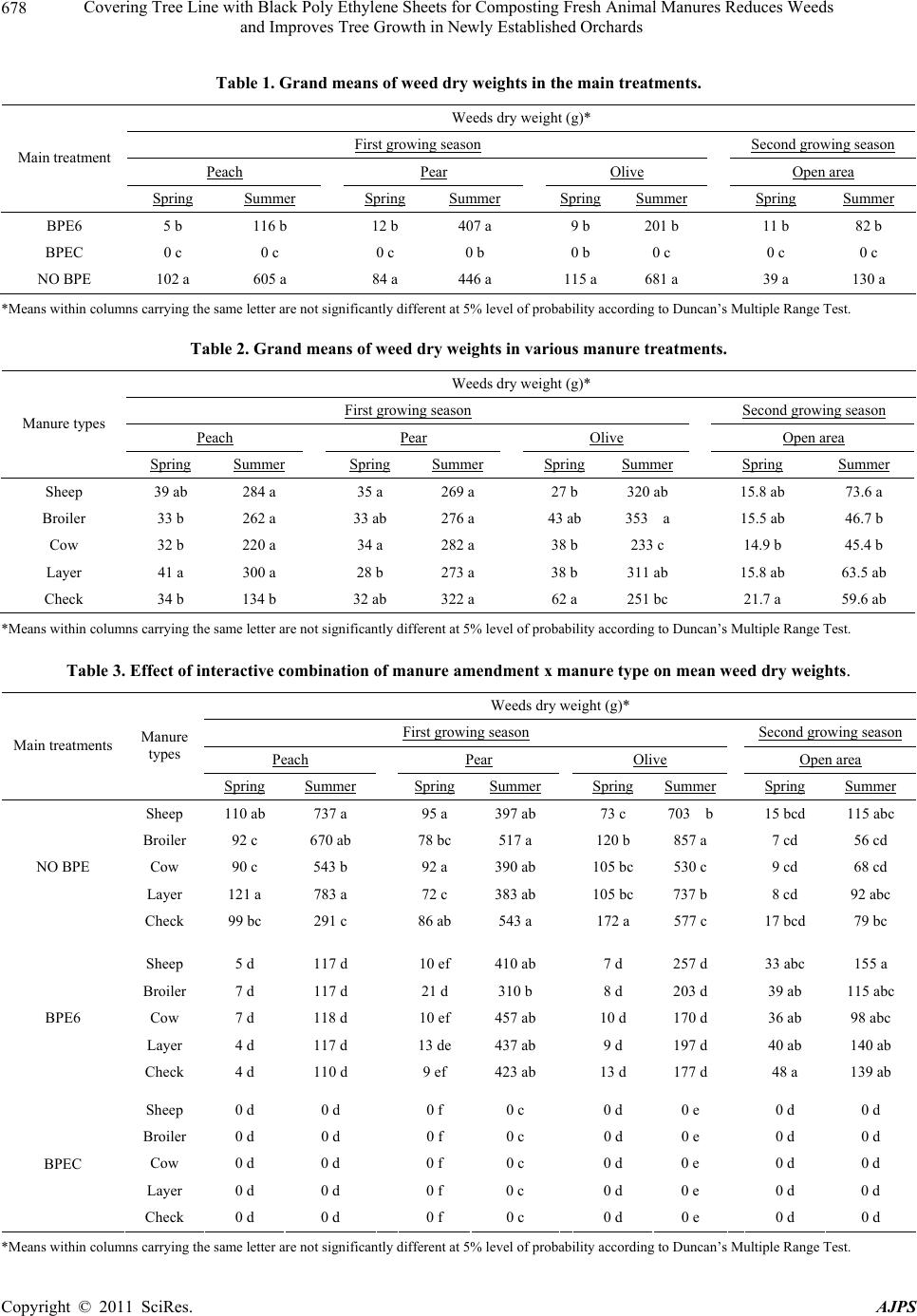 Covering Tree Line with Black Poly Ethylene Sheets for Composting Fresh Animal Manures Reduces Weeds and Improves Tree Growth in Newly Established Orchards Copyright © 2011 SciRes. AJPS 678 Table 1. Grand means of weed dry weights in the main treatments. Weeds dry weight (g)* First growing season Second growing season Peach Pear Olive Open area Main treatment Spring Summer Spring Summer Spring Summer Spring Summer BPE6 5 b 116 b 12 b 407 a 9 b 201 b 11 b 82 b BPEC 0 c 0 c 0 c 0 b 0 b 0 c 0 c 0 c NO BPE 102 a 605 a 84 a 446 a 115 a 681 a 39 a 13 0 a *Means within columns carrying the same l etter are not significant ly different at 5% level of probab i l ity accor d ing to Duncan’s Multiple Range Test. Table 2. Grand means of weed dry weights in various manure treatments. Weeds dry weight (g)* First growing season Second growing season Peach Pear Olive Open area Manure types Spring Summer Spring Summer Spring Summer Spring Summer Sheep 39 ab 284 a 35 a 269 a 27 b 320 ab 15.8 ab 73.6 a Broiler 33 b 262 a 33 ab 276 a 43 ab 353 a 15.5 ab 46.7 b Cow 32 b 220 a 34 a 282 a 38 b 233 c 14.9 b 45.4 b Layer 41 a 300 a 28 b 273 a 38 b 311 ab 15.8 ab 63.5 ab Check 34 b 134 b 32 ab 322 a 62 a 251 bc 21.7 a 59.6 ab *Means within columns carrying the same l etter are not significant ly different at 5% level of probab i l ity accor d ing to Duncan’s Multiple Range Test. Table 3. Effect of interactive combination of manure amendment x manure type on mean weed dry weights. Weeds dry weight (g)* First growing season Second growing season Peach Pear Olive Open area Main treatments Manure types Spring Summer Spring Summer Spring Summer Spring Summer Sheep 110 a b 737 a 95 a 397 ab 73 c 703 b 15 bcd 115 abc Broiler 92 c 670 ab 78 bc 517 a 120 b 857 a 7 cd 56 cd Cow 90 c 543 b 92 a 390 ab 105 bc 530 c 9 cd 68 cd Layer 121 a 783 a 72 c 38 3 ab 105 bc 737 b 8 cd 92 abc NO BPE Check 99 bc 291 c 86 ab 543 a 172 a 577 c 17 bcd 79 bc Sheep 5 d 117 d 10 ef 410 ab 7 d 257 d 33 abc 155 a Broiler 7 d 117 d 21 d 310 b 8 d 203 d 39 ab 115 abc Cow 7 d 118 d 10 ef 457 ab 10 d 170 d 36 ab 98 abc Layer 4 d 117 d 13 de 437 ab 9 d 197 d 4 0 ab 140 ab BPE6 Check 4 d 110 d 9 ef 423 ab 13 d 177 d 48 a 139 ab Sheep 0 d 0 d 0 f 0 c 0 d 0 e 0 d 0 d Broiler 0 d 0 d 0 f 0 c 0 d 0 e 0 d 0 d Cow 0 d 0 d 0 f 0 c 0 d 0 e 0 d 0 d Layer 0 d 0 d 0 f 0 c 0 d 0 e 0 d 0 d BPEC Check 0 d 0 d 0 f 0 c 0 d 0 e 0 d 0 d *Means within columns carrying the same l etter are not significant ly different at 5% level of probab i l ity accor d ing to Duncan’s Multiple Range Test. 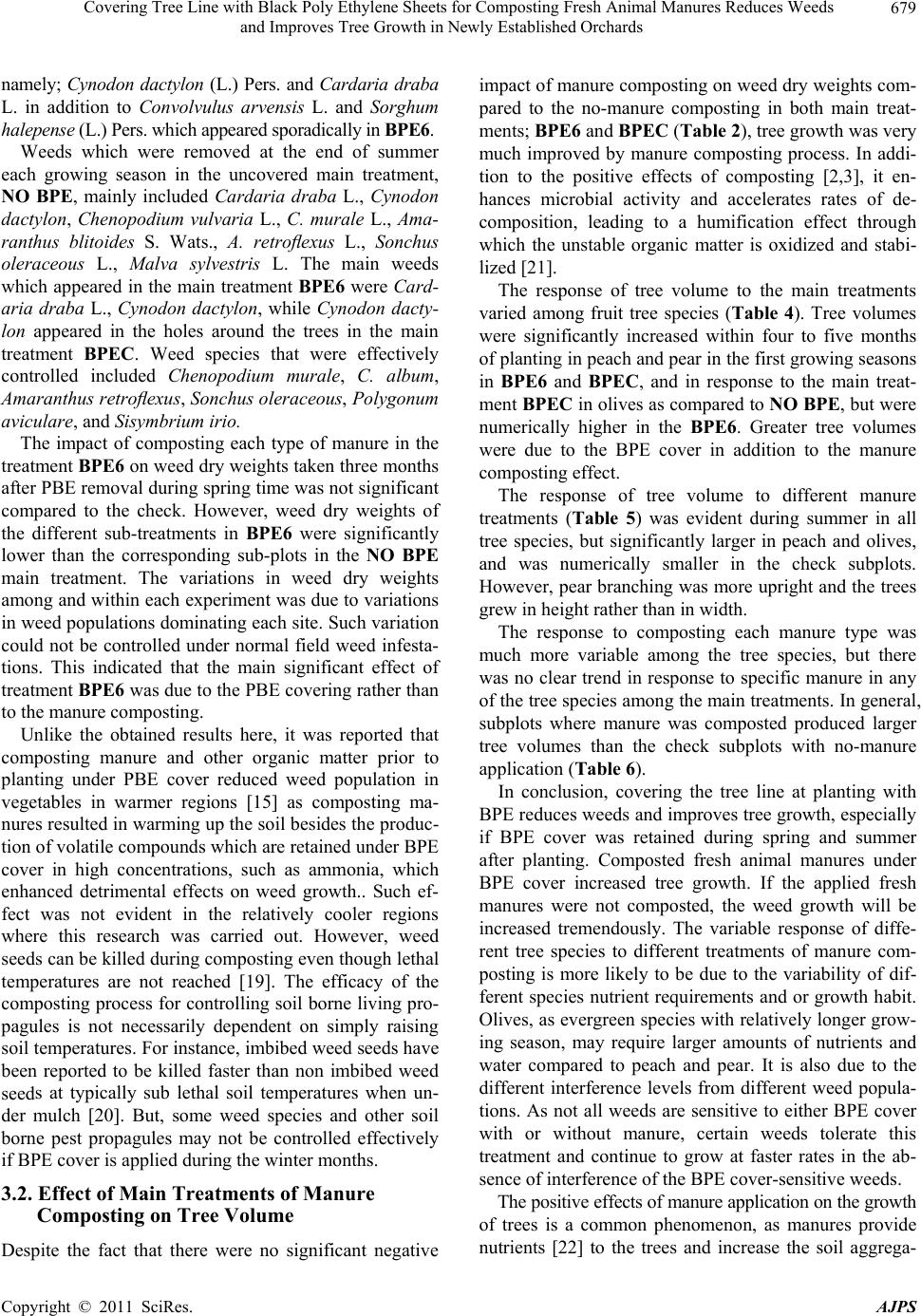 Covering Tree Line with Black Poly Ethylene Sheets for Composting Fresh Animal Manures Reduces Weeds 679 and Improves Tree Growth in Newly Established Orchards namely; Cynodon dactylon (L.) Pers. and Cardaria draba L. in addition to Convolvulus arvensis L. and Sorghum halepense (L.) Pers. which appeared sporadically in BPE6. Weeds which were removed at the end of summer each growing season in the uncovered main treatment, NO BPE, mainly included Cardaria draba L., Cynodon dactylon, Chenopodium vulvaria L., C. murale L., Ama- ranthus blitoides S. Wats., A. retroflexus L., Sonchus oleraceous L., Malva sylvestris L. The main weeds which appeared in the main treatment BPE6 were Card- aria draba L., Cynodon dactylon, while Cynodon dacty- lon appeared in the holes around the trees in the main treatment BPEC. Weed species that were effectively controlled included Chenopodium murale, C. album, Amaranthus retroflexus, Sonchus oleraceous, Polygonum aviculare, and Sisymbrium irio. The impact of composting each type of manure in the treatment BPE6 on weed dry weights taken three months after PBE removal during spring time was not significant compared to the check. However, weed dry weights of the different sub-treatments in BPE6 were significantly lower than the corresponding sub-plots in the NO BPE main treatment. The variations in weed dry weights among and within each experiment was due to variations in weed populations dominating each site. Such variation could not be controlled under normal field weed infesta- tions. This indicated that the main significant effect of treatment BPE6 was due to the PBE covering rather than to the manure composting. Unlike the obtained results here, it was reported that composting manure and other organic matter prior to planting under PBE cover reduced weed population in vegetables in warmer regions [15] as composting ma- nures resulted in warming up the soil besides the produc- tion of volatile compounds wh ich are retained und er BPE cover in high concentrations, such as ammonia, which enhanced detrimental effects on weed growth.. Such ef- fect was not evident in the relatively cooler regions where this research was carried out. However, weed seeds can be killed during composting even though lethal temperatures are not reached [19]. The efficacy of the composting process for controlling soil borne living pro- pagules is not necessarily dependent on simply raising soil temperatures. For instance, imbibed weed seeds have been reported to be killed faster than non imbibed weed seeds at typically sub lethal soil temperatures when un- der mulch [20]. But, some weed species and other soil borne pest propagules may not be controlled effectively if BPE cover is applied during the winter months. 3.2. Effect of Main Treatments of Manure Composting on Tree Volume Despite the fact that there were no significant negative impact of manure composting on weed dry weights com- pared to the no-manure composting in both main treat- ments; BPE6 and BPEC (Table 2), tr ee grow th w as very much improved by manure composting process. In addi- tion to the positive effects of composting [2,3], it en- hances microbial activity and accelerates rates of de- composition, leading to a humification effect through which the unstable organic matter is oxidized and stabi- lized [21]. The response of tree volume to the main treatments varied among fruit tree species (Table 4). Tree volumes were significantly increased within four to five months of planting in peach and pear in the first growing seasons in BPE6 and BPEC, and in response to the main treat- ment BPEC in olives as compared to NO BPE, but were numerically higher in the BPE6. Greater tree volumes were due to the BPE cover in addition to the manure composting effect. The response of tree volume to different manure treatments (Table 5) was evident during summer in all tree species, but significantly larger in peach and olives, and was numerically smaller in the check subplots. However, pear branching was more upright and the trees grew in height rather than in width. The response to composting each manure type was much more variable among the tree species, but there was no clear trend in response to specific manure in any of the tree species among the main treatments. In general, subplots where manure was composted produced larger tree volumes than the check subplots with no-manure application (Table 6). In conclusion, covering the tree line at planting with BPE reduces weeds and improves tree growth, especially if BPE cover was retained during spring and summer after planting. Composted fresh animal manures under BPE cover increased tree growth. If the applied fresh manures were not composted, the weed growth will be increased tremendously. The variable response of diffe- rent tree species to different treatments of manure com- posting is more likely to be due to the variability of dif- ferent species nutrient requirements and or growth habit. Olives, as evergreen species with relatively longer grow- ing season, may require larger amounts of nutrients and water compared to peach and pear. It is also due to the different interference levels from different weed popula- tions. As not all weeds are sensitive to either BPE cover with or without manure, certain weeds tolerate this treatment and continue to grow at faster rates in the ab- sence of interference of the BPE cover-sensitive weeds. The positive effects of manure application on the growth of trees is a common phenomenon, as manures provide nutrients [22] to the trees and increase the soil aggrega- Copyright © 2011 SciRes. AJPS 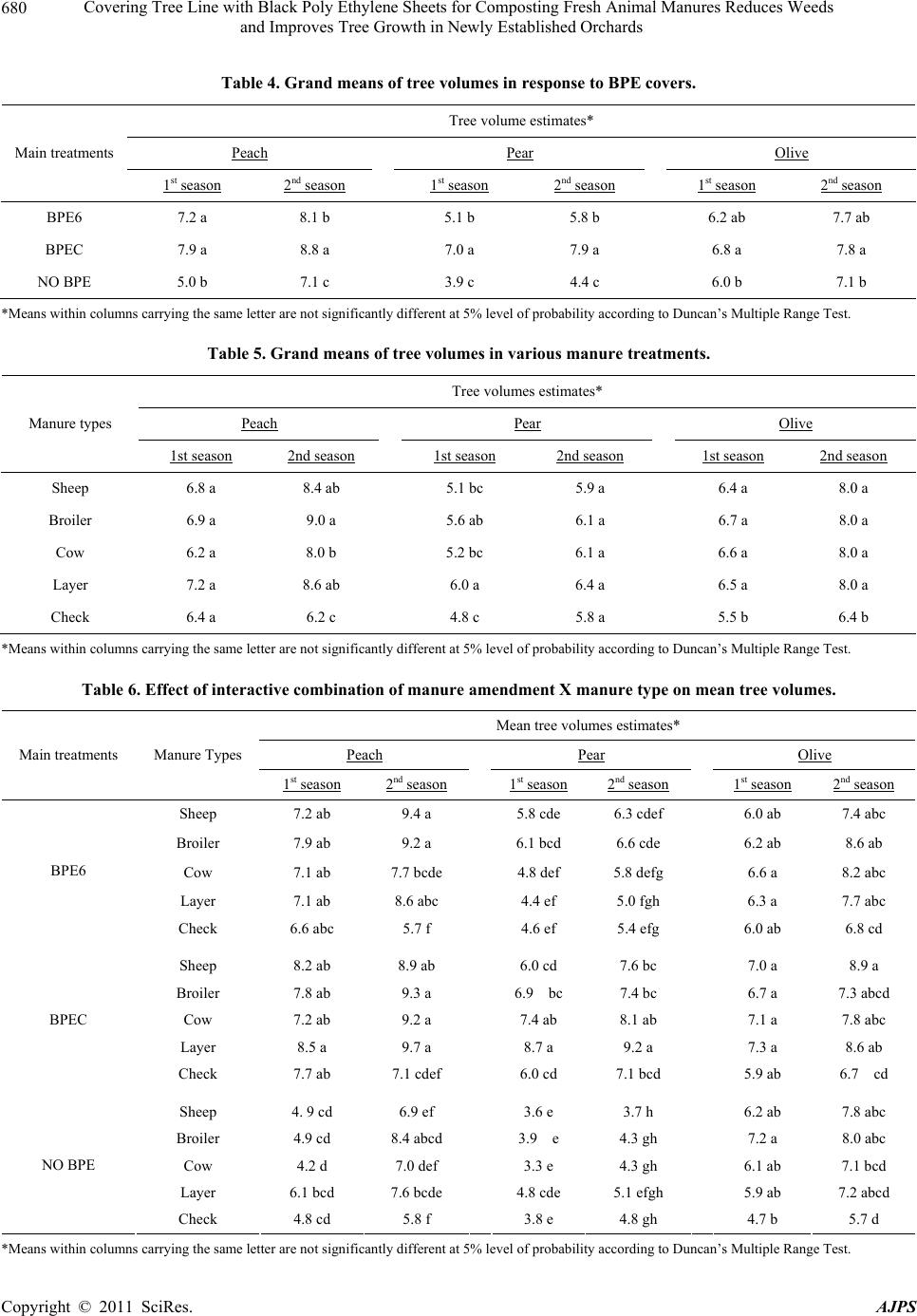 Covering Tree Line with Black Poly Ethylene Sheets for Composting Fresh Animal Manures Reduces Weeds 680 and Improves Tree Growth in Newly Established Orchards Table 4. Grand means of tree volumes in response to BPE covers. Tree volume estimates* Peach Pear Olive Main treatments 1st season 2nd season 1st season 2nd season 1st season 2nd season BPE6 7.2 a 8.1 b 5.1 b 5.8 b 6.2 ab 7.7 ab BPEC 7.9 a 8.8 a 7.0 a 7.9 a 6.8 a 7.8 a NO BPE 5.0 b 7.1 c 3.9 c 4.4 c 6.0 b 7.1 b *Means within columns carrying the same l etter are not significant ly different at 5% level of probab i l ity accor d ing to Duncan’s Multiple Range Test. Table 5. Grand means of tree volumes in various manure treatments. Tree volumes estimates* Peach Pear Olive Manure types 1st season 2nd season 1st season 2nd season 1st season 2nd sea son Sheep 6.8 a 8.4 ab 5.1 bc 5.9 a 6.4 a 8.0 a Broiler 6.9 a 9.0 a 5.6 ab 6.1 a 6.7 a 8.0 a Cow 6.2 a 8. 0 b 5.2 bc 6.1 a 6.6 a 8.0 a Layer 7.2 a 8.6 ab 6.0 a 6.4 a 6.5 a 8.0 a Check 6.4 a 6.2 c 4.8 c 5.8 a 5.5 b 6.4 b *Means within columns carrying the same l etter are not significant ly different at 5% level of probab i l ity accor d ing to Duncan’s Multiple Range Test. Table 6. Effect of interactive combination of manure amendment X manure type on mean tree volumes. Mean tree volumes estimates* Peach Pear Olive Main treatments Manure Types 1st season 2nd season 1st season 2nd season 1st season 2nd season Sheep 7.2 ab 9.4 a 5.8 cde 6.3 cdef 6.0 ab 7.4 abc Broiler 7.9 ab 9.2 a 6.1 bcd 6.6 cd e 6.2 ab 8.6 ab Cow 7.1 ab 7.7 bcde 4.8 def 5.8 defg 6.6 a 8.2 abc Layer 7.1 ab 8.6 abc 4.4 ef 5.0 fgh 6.3 a 7.7 abc BPE6 Check 6.6 abc 5.7 f 4.6 ef 5.4 efg 6.0 ab 6.8 cd Sheep 8.2 ab 8.9 ab 6.0 cd 7.6 bc 7.0 a 8.9 a Broiler 7.8 ab 9.3 a 6.9 bc 7.4 bc 6.7 a 7.3 abcd Cow 7.2 ab 9.2 a 7.4 ab 8.1 ab 7.1 a 7.8 abc Layer 8.5 a 9.7 a 8.7 a 9.2 a 7.3 a 8.6 ab BPEC Check 7.7 ab 7.1 cdef 6.0 cd 7.1 bcd 5.9 ab 6.7 cd Sheep 4. 9 cd 6.9 ef 3.6 e 3.7 h 6.2 ab 7.8 abc Broiler 4.9 cd 8.4 abcd 3.9 e 4.3 gh 7.2 a 8.0 abc Cow 4.2 d 7.0 def 3.3 e 4.3 gh 6.1 ab 7.1 bcd Layer 6.1 bcd 7.6 bcde 4.8 cde 5.1 efgh 5.9 ab 7.2 abcd NO BPE Check 4.8 cd 5.8 f 3.8 e 4.8 gh 4.7 b 5.7 d *Means within columns carrying the same l etter are not significant ly different at 5% level of probab i l ity accor d ing to Duncan’s Multiple Range Test. Copyright © 2011 SciRes. AJPS 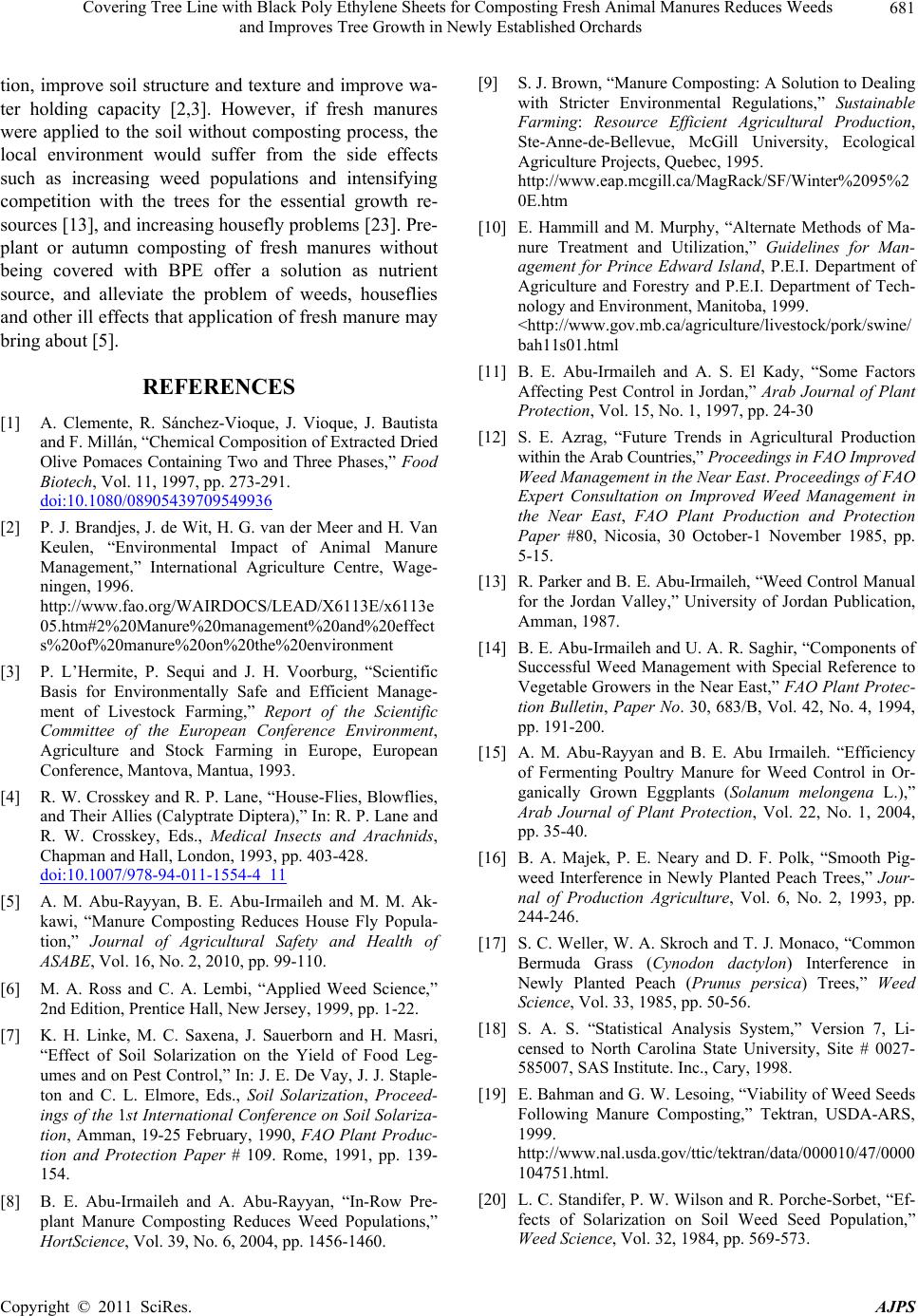 Covering Tree Line with Black Poly Ethylene Sheets for Composting Fresh Animal Manures Reduces Weeds 681 and Improves Tree Growth in Newly Established Orchards tion, improve soil structure and texture and improve wa- ter holding capacity [2,3]. However, if fresh manures were applied to the soil without composting process, the local environment would suffer from the side effects such as increasing weed populations and intensifying competition with the trees for the essential growth re- sources [13], and incr easing housefly problems [2 3]. Pre- plant or autumn composting of fresh manures without being covered with BPE offer a solution as nutrient source, and alleviate the problem of weeds, houseflies and other ill effects that application of fresh man ure may bring about [5]. REFERENCES [1] A. Clemente, R. Sánchez-Vioque, J. Vioque, J. Bautista and F. Millán, “Chemical Composition of Extracted Dried Olive Pomaces Containing Two and Three Phases,” Food Biotech, Vol. 11, 1997, pp. 273-291. doi:10.1080/08905439709549936 [2] P. J. Bran djes, J. de Wit, H. G. van der Me er and H. Van Keulen, “Environmental Impact of Animal Manure Management,” International Agriculture Centre, Wage- ningen, 1996. http://www.fao.org/WAIRDOCS/LEAD/X6113E/x6113e 05.htm#2%20Manure%20management%20and%20effect s%20of%20manure%20on%20the%20environment [3] P. L’Hermite, P. Sequi and J. H. Voorburg, “Scientific Basis for Environmentally Safe and Efficient Manage- ment of Livestock Farming,” Report of the Scientific Committee of the European Conference Environment, Agriculture and Stock Farming in Europe, European Conference, Mantova, Mantua, 1993. [4] R. W. Crosskey and R. P. Lane, “House-Flies, Blowflies, and Their Allies (Calyptrate Diptera),” In: R. P. Lane and R. W. Crosskey, Eds., Medical Insects and Arachnids, Chapman and Hall, London, 1993, pp. 403-428. doi:10.1007/978-94-011-1554-4_11 [5] A. M. Abu-Rayyan, B. E. Abu-Irmaileh and M. M. Ak- kawi, “Manure Composting Reduces House Fly Popula- tion,” Journal of Agricultural Safety and Health of ASABE, Vol. 16, No. 2, 2010, pp. 99-110. [6] M. A. Ross and C. A. Lembi, “Applied Weed Science,” 2nd Edition, Prentice Hall, New Jersey, 1999, pp. 1-22. [7] K. H. Linke, M. C. Saxena, J. Sauerborn and H. Masri, “Effect of Soil Solarization on the Yield of Food Leg- umes and on Pest Control,” In: J. E. De Vay, J. J. Staple- ton and C. L. Elmore, Eds., Soil Solarization, Proceed- ings of the 1st International Conference on Soil Solariza- tion, Amman, 19-25 February, 1990, FAO Plant Produc- tion and Protection Paper # 109. Rome, 1991, pp. 139- 154. [8] B. E. Abu-Irmaileh and A. Abu-Rayyan, “In-Row Pre- plant Manure Composting Reduces Weed Populations,” HortScience, Vol. 39, No. 6, 2004, pp. 1456-1460. [9] S. J. Brown, “Manure Composting: A Solution to Dealing with Stricter Environmental Regulations,” Sustainable Farming: Resource Efficient Agricultural Production, Ste-Anne-de-Bellevue, McGill University, Ecological Agriculture Projects, Quebec, 1995. http://www.eap.mcgill.ca/MagRack/SF/Winter%2095%2 0E.htm [10] E. Hammill and M. Murphy, “Alternate Methods of Ma- nure Treatment and Utilization,” Guidelines for Man- agement for Prince Edward Island, P.E.I. Department of Agriculture and Forestry and P.E.I. Department of Tech- nology and Environment, Manitoba, 1999. <http://www.gov.mb.ca/agriculture/livestock/pork/swine/ bah11s01.html [11] B. E. Abu-Irmaileh and A. S. El Kady, “Some Factors Affecting Pest Control in Jordan,” Arab Journal of Plant Protection, Vol. 15, No. 1, 1997, pp. 24-30 [12] S. E. Azrag, “Future Trends in Agricultural Production within the Arab Countries,” Proceedings in FAO I m p r ove d Weed Management in the Near East. Proceedings of FAO Expert Consultation on Improved Weed Management in the Near East, FAO Plant Production and Protection Paper #80, Nicosia, 30 October-1 November 1985, pp. 5-15. [13] R. Parker and B. E. Abu-Irmaileh, “Weed Co ntrol Man ual for the Jordan Valley,” University of Jordan Publication, Amman, 1987. [14] B. E. Abu-Irmaileh and U. A. R. Saghir, “Components of Successful Weed Management with Special Reference to Vegetable Growers in the Near East,” FAO Plant Protec- tion Bulletin, Paper No. 30, 683/B, Vol. 42, No. 4, 1994, pp. 191-200. [15] A. M. Abu-Rayyan and B. E. Abu Irmaileh. “Efficiency of Fermenting Poultry Manure for Weed Control in Or- ganically Grown Eggplants (Solanum melongena L.),” Arab Journal of Plant Protection, Vol. 22, No. 1, 2004, pp. 35-40. [16] B. A. Majek, P. E. Neary and D. F. Polk, “Smooth Pig- weed Interference in Newly Planted Peach Trees,” Jour- nal of Production Agriculture, Vol. 6, No. 2, 1993, pp. 244-246. [17] S. C. Weller, W. A. Skroch and T. J. Monaco, “Common Bermuda Grass (Cynodon dactylon) Interference in Newly Planted Peach (Prunus persica) Trees,” Weed Science, Vol. 33, 1985, pp. 50-56. [18] S. A. S. “Statistical Analysis System,” Version 7, Li- censed to North Carolina State University, Site # 0027- 585007, SAS Institute. Inc., Cary, 1998. [19] E. Bahman and G. W. Lesoing, “Viability of Weed Seeds Following Manure Composting,” Tektran, USDA-ARS, 1999. http://www.nal.usda.gov/ttic/tektran/data/000010/47/0000 104751.html. [20] L. C. Standifer, P. W. Wils on and R. Porche-Sorbet, “Ef- fects of Solarization on Soil Weed Seed Population,” Weed Science, Vol. 32, 1984, pp. 569-573. Copyright © 2011 SciRes. AJPS  Covering Tree Line with Black Poly Ethylene Sheets for Composting Fresh Animal Manures Reduces Weeds 682 and Improves Tree Growth in Newly Established Orchards [21] C. Elvira, L. Sampedro, E. Benitez and R. Nogales, “Vermicomposting of Sludges from Paper Mill and Dairy Industries with Eisenia Andrei,” A Pilot-Scale Study, Bioresource Technology, Vol. 63, 1998, pp. 205-211. doi:10.1016/S0960-8524(97)00145-4 [22] F. M. Bradley and B. W. Ellis, “Rodale’s All-New Ency- clopedia of Organic Gardening. The Indispensable Re- source for Every Gardener,” Rodale Books, Emmaus, 1993. [23] N. A. Romiah and H. M. Elmosa, “A Cultural Method for Controlling the House Fly Musca domestica (Diptera: Muscidae) and Studying Certain Aspects of Its Biology in the Jordan Valley,” MSc. Thesis, University of Jordan, Amman, 1996. Copyright © 2011 SciRes. AJPS |