

Paper Menu >>
Journal Menu >>
 American Journal of Plant Sciences, 2011, 2, 644-649 doi:10.4236/ajps.2011.25076 Published Online November 2011 (http://www.SciRP.org/journal/ajps) Copyright © 2011 SciRes. AJPS Variation in Wood Properties and Growth in Some Clones of Populus deltoides Bartr. ex Marsh P. K. Pande Wood Anatomy Discipline, Botany Division, Forest Research Institute, Dehradun, India. Email: [email protected] Received October 27th, 2010; revised November 27th, 2010; accepted January 11th, 2011. ABSTRACT The present paper deals with within ramet radial, intra- and inter-clonal variations in the wood element’s dimensions and specific gravity o f 10 clones of Populus deltoides Bartr. ex Marsh. The growth parameters namely ramet height and DBH were also considered for the study. Study material was collected from the 10 clones of Populus deltoids raised by WIMCO Plantations Ltd. at Rudrapur (Udhamsingh Nagar), India. Three clones were parent viz. G48, S7C8 (female) and G3 (male). Other clones represent hybrids of F1 generation. Inter- and intra-clon al variations were significant for all the wood traits except vessel element length for intra-clonal variations. Within ramet variations due to radial loca- tion were significant for fiber length and specific gravity with increasing trend from pith to periphery. Interaction of clone*replication was also significant for all the wood traits. Variations were significant for the DBH for the clones. Fiber length and sp ecific gravity was significantly higher in fema le while wall thickness and vessel element length was in male clones (P < 0.01). Female parents (G48 and S7C8) showed higher fiber length and specific gravity than of the male parent (G3) while vessel element diameter and wall thickness was higher in male parent (G3). Fiber length was higher in offspring than the parent clones which may be the reflection of hybrid vigor for the trait. The clones of F1 offspring followed the similar patterns for the other wood traits as in the parent clones. Hierarchical cluster analysis showed that W/A 39 (male) and W 39 (female) clones of F1 generation were highly divergent than of the other clones. Keywords: Fiber Length, Specific Gravity, Vessel Elemen t Length Wall Thickness, Wood Variations 1. Introduction Wood quality and growth are two important parameters need to be analyzed for the utilization and development of new clones. Populus deltoides Bartr. ex Marsh is grown under different forestry programs as clonal planta- tions to ensure the genetic superiority for better growth and superior wood quality. The variability in wood anatomical characteristics has profound influence on the properties of wood [1,2]. Fea- tures of interest in this connection include cell size, pro- portion and arrangements of different elements of se- condary xylem and specific gravity. The general pattern of variation in wood element dimensions is found not only within a species but also observed within a tree by many a worker [3-5]. Variations in the dimensions of wood elements and specific gravity both within tree and among the clones have co me un der clo se scr utiny in r ecen t year s. Th er e are reports available on the variation in wood anatomical and other properties in different clones of Populus elsewhere [6-9]. Populus deltoides showed intra- and inter-clonal vari- ability in wood traits [8-11]. So, the close scrutiny of different clones is essential to understand the variability trends for different wood traits in the species. The wood elements dimensions and specific gravity are the impor- tant parameters to be assesses in terms of their within ramet, intra- and inter-clonal variability so that clones having desired wood traits can be used for the develop- ment of new clones. Hence, the present paper deals with the, inter- and intra-clonal and within ramet radial varia- tions in wood anatomical parameters and specific gravity of 10 clones of Populus deltoides. 2. Materials and Methods 2.1. The Experimental Site Study site was located at Rudrapur (Udhamsing Nagar), Uttarakhand, Ind ia. It is situated at around 28˚N latitude; 78˚E longitude and at the altitude of 200 m asl (Figure 1). The annual rainfall was 1200 mm; of which 88% occurs 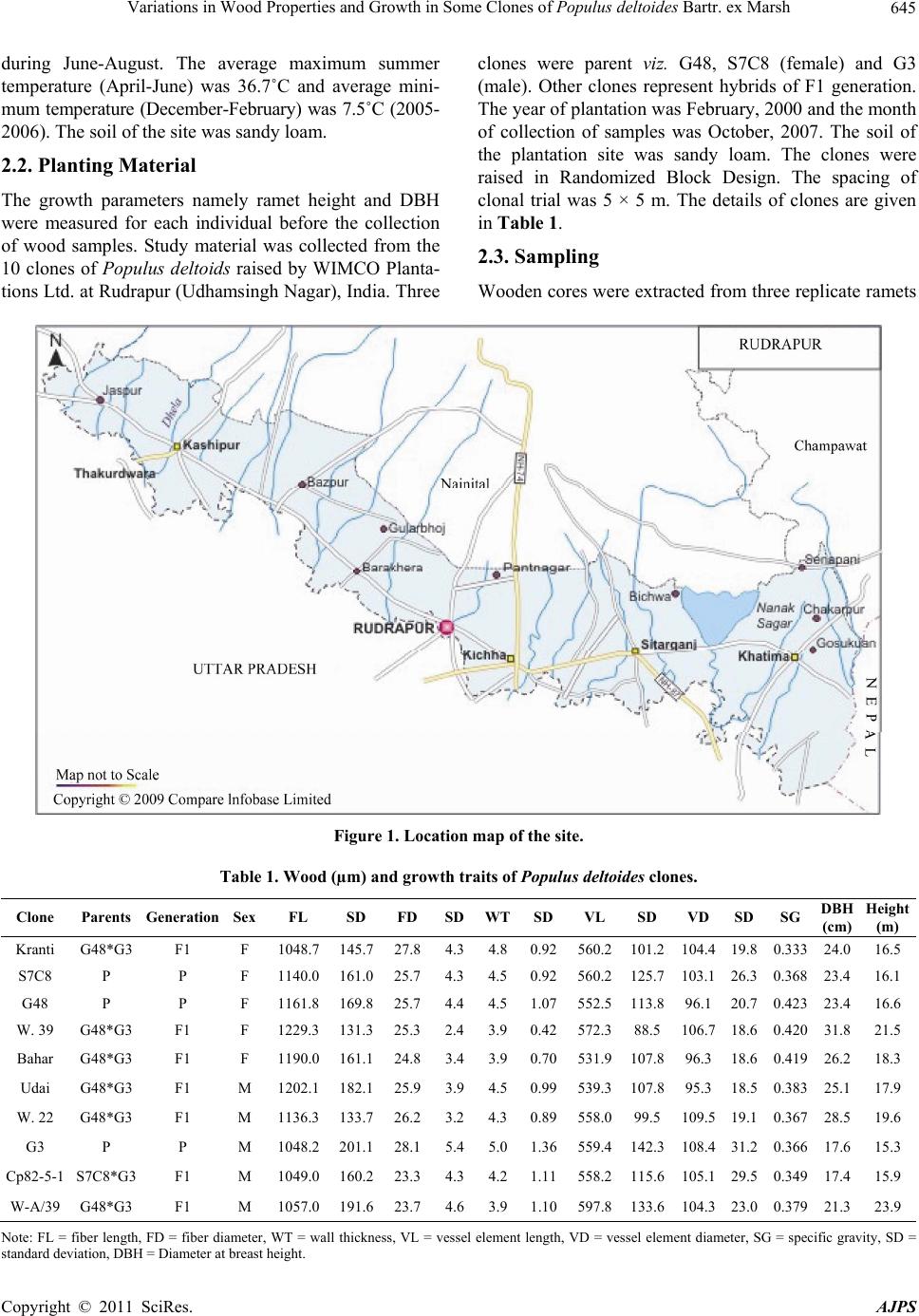 Variations in Wood Properties and Growth in Some Clones of Populus deltoides Bartr. ex Marsh645 during June-August. The average maximum summer temperature (April-June) was 36.7˚C and average mini- mum temperature (December-February) was 7.5˚C (2005- 2006). The soil of th e site was sandy loam. 2.2. Planting Material The growth parameters namely ramet height and DBH were measured for each individual before the collection of wood samples. Study material was collected from the 10 clones of Populus deltoids raised by WIMCO Planta- tions Ltd. at Rudrapur (Udhamsingh Nagar), India. Three clones were parent viz. G48, S7C8 (female) and G3 (male). Other clones represent hybrids of F1 generation. The year of plantation was February, 2000 and the month of collection of samples was October, 2007. The soil of the plantation site was sandy loam. The clones were raised in Randomized Block Design. The spacing of clonal trial was 5 × 5 m. The details of clones are given in Table 1. 2.3. Sampling Wooden cores were extracted from three replicate ramets Figure 1. Location map of the site. Table 1. Wood (µm) and growth traits of Populus deltoides clones. Clone Parents Generation Sex FL SD FDSDWT SD VL SD VD SD SG DBH (cm) Height (m) Kranti G48*G3 F1 F 1048.7 145.727.84.34.8 0.92560.2101.2104.4 19.8 0.333 24.016.5 S7C8 P P F 1140.0 161.025.74.34.50.92560.2125.7103.1 26.3 0.368 23.416.1 G48 P P F 1161.8 169.825.74.44.51.07552.5113.896.1 20.7 0.423 23.416.6 W. 39 G48*G3 F1 F 1229.3 131.325.32.43.90.42572.388.5106.7 18.6 0.420 31.821.5 Bahar G48*G3 F1 F 1190.0 161.124.8 3.4 3.90.70531.9107.896.3 18.6 0.419 26.2 18.3 Udai G48*G3 F1 M 1202.1 182.125.93.94.50.99539.3107.895.3 18.5 0.383 25.117.9 W. 22 G48*G3 F1 M 1136.3 133.726.23.24.30.89558.099.5109.5 19.1 0.367 28.519.6 G3 P P M 1048.2 201.128.15.45.01.36559.4142.3108.4 31.2 0.366 17.615.3 Cp82-5-1 S7C8*G3 F1 M 1049.0 160.223.34.34.21.11558.2115.6105.1 29.5 0.349 17.415.9 W-A/39 G48*G3 F1 M 1057.0 191.623.74.63.91.10597.8133.6 104.3 23.0 0.379 21.323.9 Note: FL = fiber length, FD = fiber diameter, WT = wall thickness, VL = vessel element length, VD = vessel element diameter, SG = specific gravity, SD = standard deviation, DBH = Diameter at breast height. Copyright © 2011 SciRes. AJPS 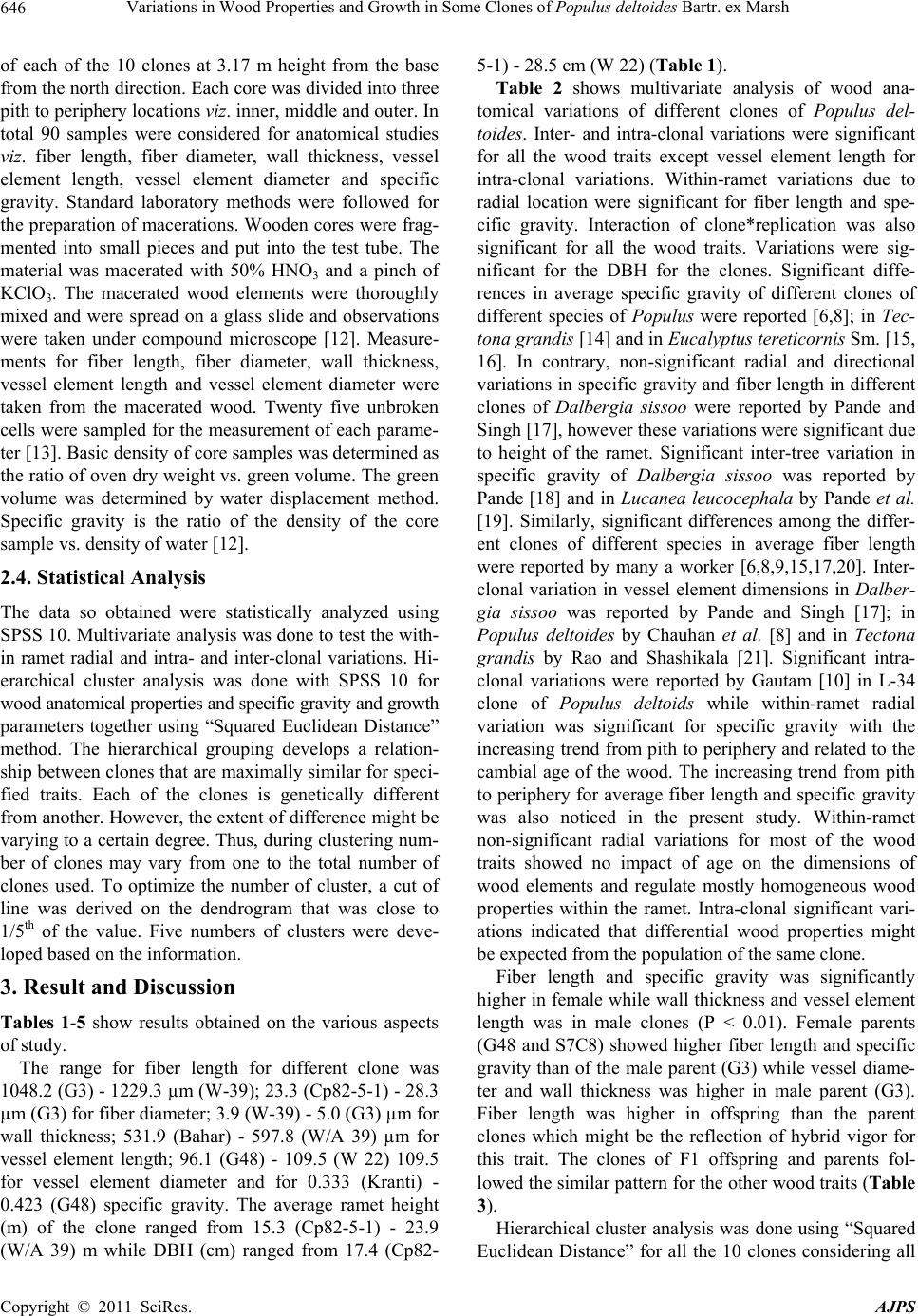 Variations in Wood Properties and Growth in Some Clones of Populus deltoides Bartr. ex Marsh 646 of each of the 10 clones at 3.17 m height from the base from the north direction. Each core was divided into three pith to periphery locations viz. inner, middle and outer. In total 90 samples were considered for anatomical studies viz. fiber length, fiber diameter, wall thickness, vessel element length, vessel element diameter and specific gravity. Standard laboratory methods were followed for the preparation of macerations. Wooden cores were frag- mented into small pieces and put into the test tube. The material was macerated with 50% HNO3 and a pinch of KClO3. The macerated wood elements were thoroughly mixed and were spread on a glass slide and observations were taken under compound microscope [12]. Measure- ments for fiber length, fiber diameter, wall thickness, vessel element length and vessel element diameter were taken from the macerated wood. Twenty five unbroken cells were sampled for the measurement of each parame- ter [13]. Basic density of core samples was determined as the ratio of oven dry weight vs. green volume. The green volume was determined by water displacement method. Specific gravity is the ratio of the density of the core sample vs. density of water [12]. 2.4. Statistical Analysis The data so obtained were statistically analyzed using SPSS 10. Multivariate analysis was done to test the with- in ramet radial and intra- and inter-clonal variations. Hi- erarchical cluster analysis was done with SPSS 10 for wood anatomical properties and sp ecific grav ity and grow th parameters together using “Squared Euclidean Distance” method. The hierarchical grouping develops a relation- ship between clones that are maximally similar for speci- fied traits. Each of the clones is genetically different from another. However, the extent of difference might be varying to a certain degree. Thus, during clustering num- ber of clones may vary from one to the total number of clones used. To optimize the number of cluster, a cut of line was derived on the dendrogram that was close to 1/5th of the value. Five numbers of clusters were deve- loped based on the information. 3. Result and Discussion Tables 1-5 show results obtained on the various aspects of study. The range for fiber length for different clone was 1048.2 (G3 ) - 1229 .3 µm (W -39); 23 .3 (Cp8 2-5-1) - 28.3 µm (G3) for fiber diameter; 3.9 (W-39) - 5.0 (G3) µm for wall thickness; 531.9 (Bahar) - 597.8 (W/A 39) µm for vessel element length; 96.1 (G48) - 109.5 (W 22) 109.5 for vessel element diameter and for 0.333 (Kranti) - 0.423 (G48) specific gravity. The average ramet height (m) of the clone ranged from 15.3 (Cp82-5-1) - 23.9 (W/A 39) m while DBH (cm) ranged from 17.4 (Cp82- 5-1) - 28.5 cm (W 22 ) (Table 1). Table 2 shows multivariate analysis of wood ana- tomical variations of different clones of Populus del- toides. Inter- and intra-clonal variations were significant for all the wood traits except vessel element length for intra-clonal variations. Within-ramet variations due to radial location were significant for fiber length and spe- cific gravity. Interaction of clone*replication was also significant for all the wood traits. Variations were sig- nificant for the DBH for the clones. Significant diffe- rences in average specific gravity of different clones of different species of Populus were reported [6,8]; in Tec- tona grand is [14] and in Eucalyptus tereticornis Sm. [15, 16]. In contrary, non-significant radial and directional variations in specific gravity and fiber length in different clones of Dalbergia sissoo were reported by Pande and Singh [17], however these variations were significant due to height of the ramet. Significant inter-tree variation in specific gravity of Dalbergia sissoo was reported by Pande [18] and in Lucanea leucocephala by Pande et al. [19]. Similarly, significant differences among the differ- ent clones of different species in average fiber length were reported by many a worker [6,8,9,15,17,20]. Inter- clonal variation in vessel element dimensions in Dalber- gia sissoo was reported by Pande and Singh [17]; in Populus deltoides by Chauhan et al. [8] and in Tectona grandis by Rao and Shashikala [21]. Significant intra- clonal variations were reported by Gautam [10] in L-34 clone of Populus deltoids while within-ramet radial variation was significant for specific gravity with the increasing trend from pith to periphery and related to the cambial age of the wood. The increasing trend from pith to periphery for average fiber length and specific gravity was also noticed in the present study. Within-ramet non-significant radial variations for most of the wood traits showed no impact of age on the dimensions of wood elements and regulate mostly homogeneous wood properties within the ramet. Intra-clonal significant vari- ations indicated that differential wood properties might be expected from the population of the same clone. Fiber length and specific gravity was significantly higher in female while wall thickness and vessel element length was in male clones (P < 0.01). Female parents (G48 and S7C8) showed higher fiber length and specific gravity than of th e male parent (G3) while vessel diame- ter and wall thickness was higher in male parent (G3). Fiber length was higher in offspring than the parent clones which might be the reflection of hybrid vigor for this trait. The clones of F1 offspring and parents fol- lowed the similar pattern for the other wood traits (Table 3). Hierarchical cluster analysis was done using “Squared Euclidean Distance” for all the 10 clones considering all Copyright © 2011 SciRes. AJPS 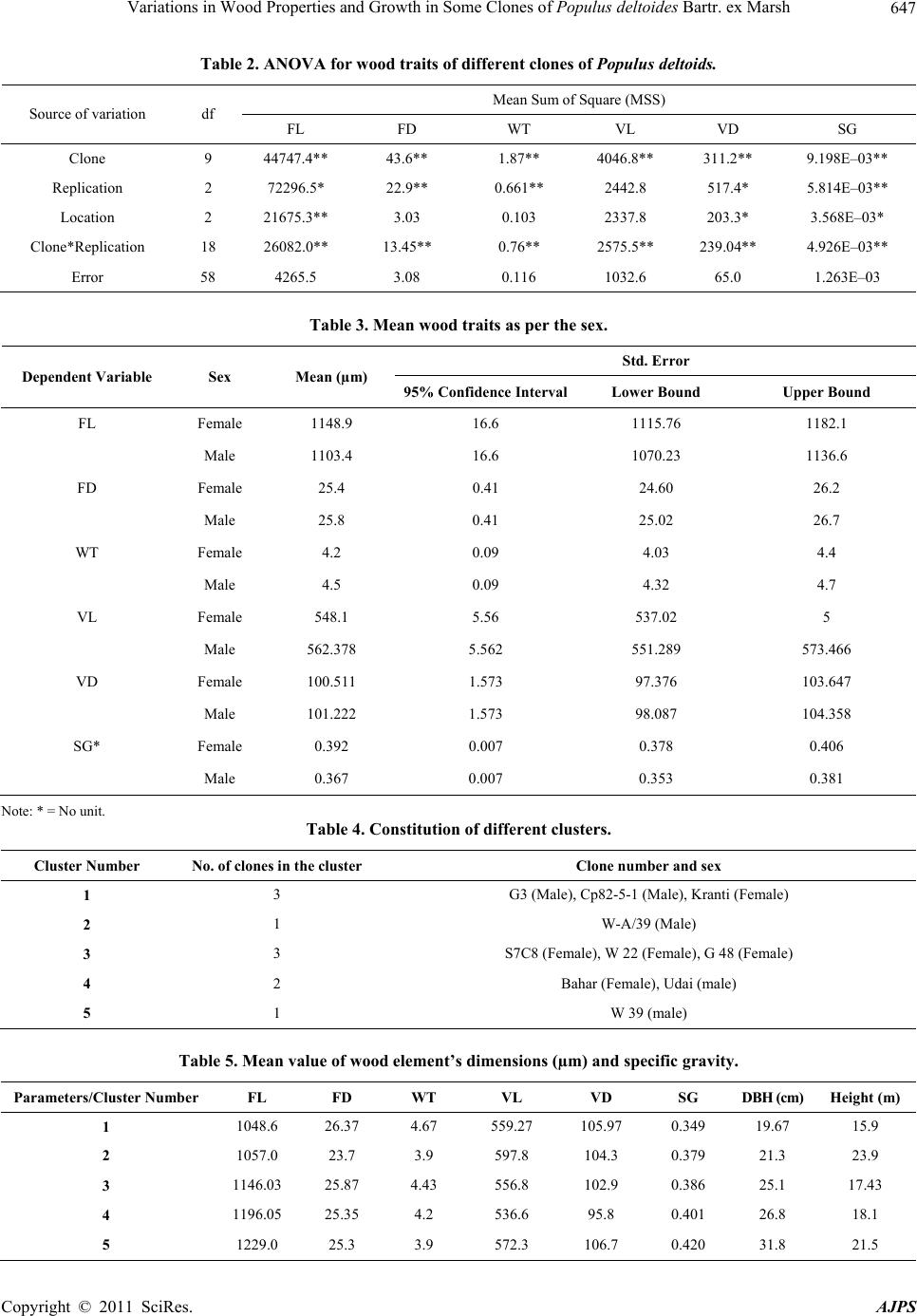 Variations in Wood Properties and Growth in Some Clones of Populus deltoides Bartr. ex Marsh647 Table 2. ANOVA for wood traits of different clones of Populus deltoids. Mean Sum of Square (MSS) Source of variation df FL FD WT VL VD SG Clone 9 44747.4** 43.6** 1.87** 4046.8** 311.2** 9.198E–03** Replication 2 72296.5* 22.9** 0.661** 2442.8 517.4* 5.814E–03** Location 2 21675.3** 3.03 0.103 2337.8 203.3* 3.568E–03* Clone*Replication 18 26082.0** 13.45** 0.76** 2575.5** 239.04** 4.926E–03** Error 58 4265.5 3.08 0.116 1032.6 65.0 1.263E–03 Table 3. Mean wood traits as per the sex. Std. Error Dependent Variable Sex Mean (µm) 95% Confidence IntervalLower Bound Upper Bound FL Female 1148.9 16.6 1115.76 1182.1 Male 1103.4 16.6 1070.23 1136.6 FD Female 25.4 0.41 24.60 26.2 Male 25.8 0.41 25.02 26.7 WT Female 4.2 0.09 4.03 4.4 Male 4.5 0.09 4.32 4.7 VL Female 548.1 5.56 537.02 5 Male 562.378 5.562 551.289 573.466 VD Female 100.511 1.573 97.376 103.647 Male 101.222 1.573 98.087 104.358 SG* Female 0.392 0.007 0.378 0.406 Male 0.367 0.007 0.353 0.381 Note: * = No unit. Table 4. Constitution of different clusters. Cluster Number No. of clones in the cluster Clone number and sex 1 3 G3 (Male), Cp82-5-1 (Male), Kranti (Female) 2 1 W-A/39 (Male) 3 3 S7C8 (Female), W 22 (Female), G 48 (Female) 4 2 Bahar (Female), Udai (male) 5 1 W 39 (male) Table 5. Mean value of wood element’s dimensions (µm) and specific gravity. Parameters/Cluster Number FL FD WT VL VD SG DBH (cm) Height (m) 1 1048.6 26.37 4.67 559.27 105.97 0.349 19.67 15.9 2 1057.0 23.7 3.9 597.8 104.3 0.379 21.3 23.9 3 1146.03 25.87 4.43 556.8 102.9 0.386 25.1 17.43 4 1196.05 25.35 4.2 536.6 95.8 0.401 26.8 18.1 5 1229.0 25.3 3.9 572.3 106.7 0.420 31.8 21.5 Copyright © 2011 SciRes. AJPS 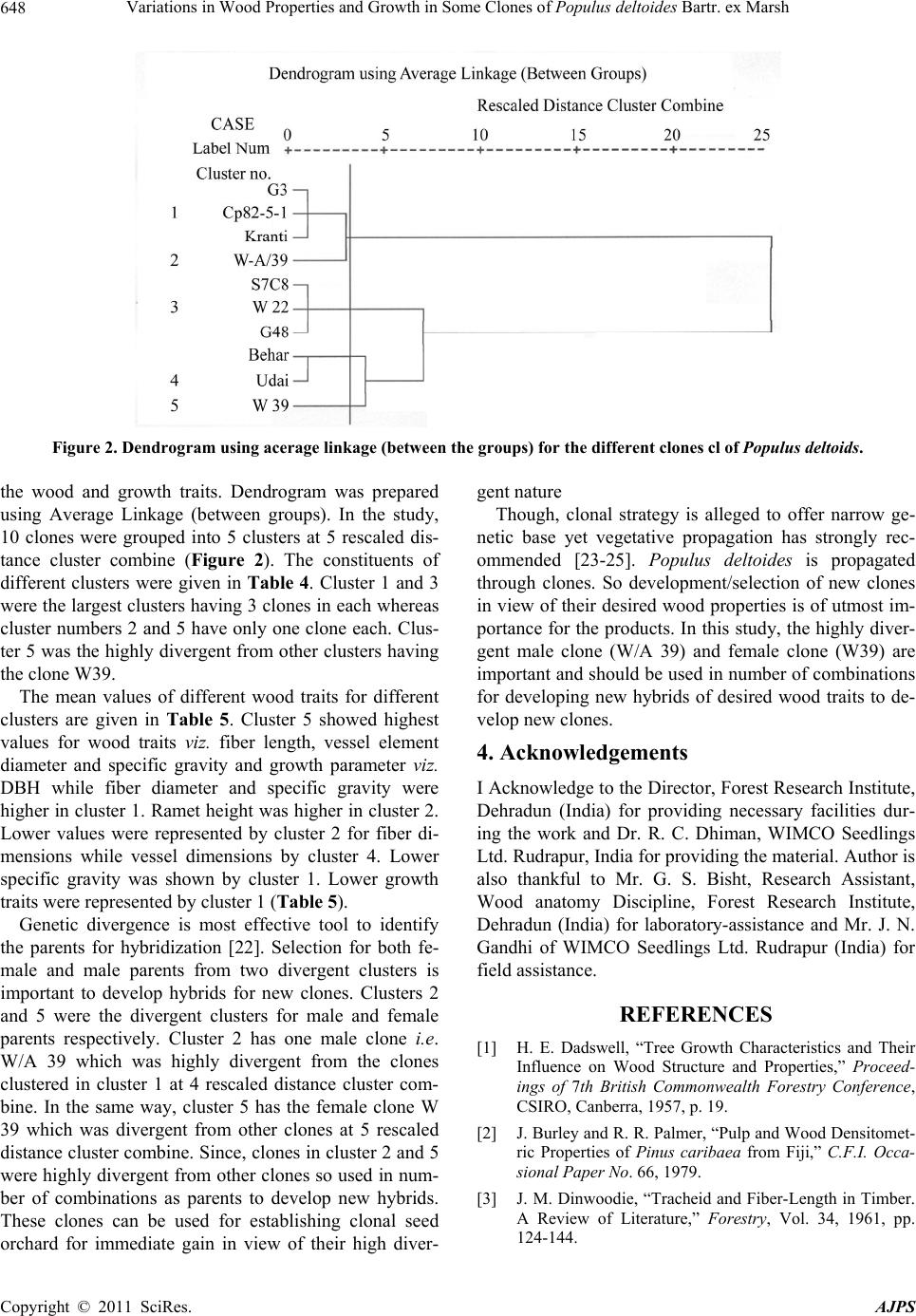 Variations in Wood Properties and Growth in Some Clones of Populus deltoides Bartr. ex Marsh 648 Figure 2. Dendrogram using acerage linkage (between the groups) for the different clones cl of Populus deltoids. the wood and growth traits. Dendrogram was prepared using Average Linkage (between groups). In the study, 10 clones were grouped into 5 clusters at 5 rescaled dis- tance cluster combine (Figure 2). The constituents of different clusters were given in Table 4. Cluster 1 and 3 were the largest clusters having 3 clones in each whereas cluster numbers 2 and 5 have only one clone each. Clus- ter 5 was the highly divergent from other clusters having the clone W39. The mean values of different wood traits for different clusters are given in Table 5. Cluster 5 showed highest values for wood traits viz. fiber length, vessel element diameter and specific gravity and growth parameter viz. DBH while fiber diameter and specific gravity were higher in cluster 1. Ramet height was higher in cluster 2. Lower values were represented by cluster 2 for fiber di- mensions while vessel dimensions by cluster 4. Lower specific gravity was shown by cluster 1. Lower growth traits were represented by cluster 1 (Table 5). Genetic divergence is most effective tool to identify the parents for hybridization [22]. Selection for both fe- male and male parents from two divergent clusters is important to develop hybrids for new clones. Clusters 2 and 5 were the divergent clusters for male and female parents respectively. Cluster 2 has one male clone i.e. W/A 39 which was highly divergent from the clones clustered in cluster 1 at 4 rescaled distance cluster com- bine. In the same way, cluster 5 has the female clone W 39 which was divergent from other clones at 5 rescaled distance cluster combine. Since, clones in cluster 2 and 5 were highly divergent from other clones so used in num- ber of combinations as parents to develop new hybrids. These clones can be used for establishing clonal seed orchard for immediate gain in view of their high diver- gent nature Though, clonal strategy is alleged to offer narrow ge- netic base yet vegetative propagation has strongly rec- ommended [23-25]. Populus deltoides is propagated through clones. So development/selection of new clones in view of their desired wood properties is of utmost im- portance for the products. In this study, the highly diver- gent male clone (W/A 39) and female clone (W39) are important and should be used in number of combinations for developing new hybrids of desired wood traits to de- velop new clones. 4. Acknowledgements I Acknowledge to the Director, Forest Research Institute, Dehradun (India) for providing necessary facilities dur- ing the work and Dr. R. C. Dhiman, WIMCO Seedlings Ltd. Rudrapur, India for providing the material. Author is also thankful to Mr. G. S. Bisht, Research Assistant, Wood anatomy Discipline, Forest Research Institute, Dehradun (India) for laboratory-assistance and Mr. J. N. Gandhi of WIMCO Seedlings Ltd. Rudrapur (India) for field assistance. REFERENCES [1] H. E. Dadswell, “Tree Growth Characteristics and Their Influence on Wood Structure and Properties,” Proceed- ings of 7th British Commonwealth Forestry Conference, CSIRO, Canberra, 1957, p. 19. [2] J. Burley and R. R. Palmer, “Pulp and Wood Densitomet- ric Properties of Pinus caribaea from Fiji,” C.F.I. Occa- sional Paper No. 66, 1979. [3] J. M. Dinwoodie, “Tracheid and Fiber-Length in Timber. A Review of Literature,” Forestry, Vol. 34, 1961, pp. 124-144. Copyright © 2011 SciRes. AJPS  Variations in Wood Properties and Growth in Some Clones of Populus deltoides Bartr. ex Marsh649 [4] B. S. S. Rao and R. V. Rao, “Variation in Length of Ver- tical Elements within One Tree of Betula pubercens Ehrh,” Journal of Indian Academy of Wood Science, Vol. 9, No. 2, 1978, pp. 105-110. [5] P. K. Pande, R. V. Rao, S. P. Agrawal and M. Singh, “Variation in the Dimensions of Trachied Elements of Pinus caribaea var. Bahamensis,” Journal of Tropical Forest Products, Vol. 1, No. 2, 1995, pp. 117-123. [6] J. E. Phelps, J. G. Isebrands and D. Jowett, “Raw Material Quality of Short Rotation Intensively Cultured Populus Clones. A Comparison of Stem and Branches Properties at Three Species,” IAWA Journal, Vol. 3, No. 3-4, 1982, pp. 193-200. [7] A. Kaubaa, A. E. Hernandez, M. Beaudoin and J. Poliquin, “Interclonal, Intra-Clonal and within Tree Variationin Fiber-Length of Popular Hybrid Clones,” Wood and Fiber Science, Vol. 30, No. 1, 1998, pp. 140-147. [8] L. Chauhan, R. D. Raturi and S. Gupta, “Studies on ana- tomical variations in different clones of Populus del- toides,” Indian Forester, Vol. 125, 1999, pp. 526-532. [9] L. Chauhan, S. Gupta, R. C. Madhwal, R. Pandey and M. Pal, “Interclonal, Intraclonal and within Tree Variation in Wood Parameters of Different Clones of Populus del- toides,” Indian Forester, Vol. 127, No. 7, 2001, pp. 777- 784. [10] P. Gautam, “Multilocational Trials of Micro-Propa- Gated L-34 Clone of Populus deltoides Bartr. ex Marsh: Analy- sis of Wood Anatomical Properties and Growth,” Ph.D Thesis, Forest Research Institute University, Dehradun, 2010. [11] P. K. Pande and R. C. Dhiman, “Variations in Wood Tra- tis in Micro and Macro Propagated Plantation Woods of Populus deltoides Bartr. ex Marsh,” Advances in Biosci- ences and Biotechnology, Vol. 1, 2010, pp. 263-275. doi:10.4236/abb.2010.14035 [12] S. K. Purkayastha, S. P. Agrawal, P. Farooqui, R. D. Tan- don, L. Chauhan and N. Misra, “Evaluation of Wood Quality of Eucalyptus Plantations in Various States,” Fi- nal Technical Report, PL 480 Project no Inn FS-66, 1979-1980, p. 85. [13] IAWA, “Committee List of Microscopic Features for Hardwood Identification,” IAWA Bulletin, Vol. 10, 1989, pp. 201-332. [14] T. Okuyama, H. Yamamoto, I. Wahyudi, Y. S. Hadi and K. M. Bhat, “Some Wood Quality Issues in Planted Teak,” International Conference on Quality Timber Prod- ucts of Teak from Sustainable Forest Management, KFRI, Kerala, 2-5 December 2003, p. 21. [15] R. V. Rao, S. Shashikala, P. Sreevani, V. Kothiyal, C. R. Sharma and P. Lal, “Within Tree Variation in Anatomical Properties of Some Clones of Eucalyptus tereticornis Sm,” Wood Science Technology, Vol. 36, No. 3, 2002, pp. 271-285. doi:10.1007/s00226-002-0139-3 [16] P. K. Pande, “Assessment of the Performance of Different Clones of Dalbergia Sissoo and Eucalyptus tereticornis on the Basis of Wood Quality under Different Farm For- estry Programs,” Final Technical Report, ICFRE, De- hradun, 2005. [17] P. K. Pande and M. Singh, “Intraclonal, Inter-Clonal and Single Tree Variations of Wood Anatomical Properties and Specific Gravity of Clonal Ramets of Dalbergia sis- soo Roxb,” Wood Science Technology, Vol. 39, No. 5, 2005, pp. 351-366. doi:10.1007/s00226-004-0273-1 [18] P. K. Pande, “Assessment of the Wood Quality Parameter in Seed Raised Plantations of Different Diameter Classes of Dalbergia sissoo Roxb,” FRI-299/Bot-45, FTR sub- mitted to ICFRE, 2008, pp 120-126. [19] P. K. Pande, S. Naithani, V. Kothiyal, Mohanta, S. S., N. Juyal and R. Rawat, “Intra and Inter Tree Variations in Physico-Chemical and Wood Anatomical Properties of Leucaena leucocephala (Lam.) De Wit,” Indian Forester, Vol. 134, No. 5, 2008, pp. 622-632. [20] W. K. Murphey, T. W. Bowersox and P. R. Blankenhorn, “Selected Wood Properties of Young Populus Hybrid,” Wood Science, Vol. 11, No. 4, 1979, pp. 236-267. [21] R. V. Rao and S. Shashikala, “Assessment of Growth Rate, Basic Density and Heart Wood Content in Selected Teak Clones of CSO, Thithimathi in Karnataka State, In- dia,” International Conference on Quality Timber Prod- ucts of Teak from Sustainable Forest Management, KFRI, Kerala, 2-5 December 2003, p. 57. [22] G. M. Bhatt, “Comparison of Various Methods of Select- ing Parents for Hybridization in Common Bread Wheat (Triticum aestivum),” Australian Journal Agriculture Re- search, Vol. 24, No. 4, 1973, pp. 457-484. doi:10.1071/AR9730457 [23] E. Camphinhos and Y. K. Ikemori, “Mass Production of Eucalyptus Species by Rooting Cuttings,” Proceedings IUFRO symposium Genetic Improvement and Production of Fast Growing Trees, Sao Pede Sao Paulo, 1980, p. 16. [24] M. R. Ahuja and W. J. Libby, “Clonal Forestry I: Genet- ics and Biotechnology,” Springer-Verlag, New York, 1993 a, p. 227. [25] M. R. Ahuja and W. J. Libby, “Clonal Forestry II: Genet- ics and Biotechnology,” Springer-Verlag, New York, 1993 b, p. 240. Copyright © 2011 SciRes. AJPS |