

Paper Menu >>
Journal Menu >>
 American Journal of Plant Sciences, 2011, 2, 636-643 doi:10.4236/ajps.2011.25075 Published Online November 2011 (http://www.SciRP.org/journal/ajps) Copyright © 2011 SciRes. AJPS Dependence of Pumpkin Yield on Plant Density and Variety Khalid El-Sayed Abd El-Hamed, Mohammed Wasfy Mohammed Elwan Department of Horticulture, Faculty of Agriculture, Suez Canal University, Ismailia, Egypt. Email: [email protected] Received July 5th, 2011; revised August 29th, 2011; accepted October 4th, 2011. ABSTRACT Pumpkins (Cucurbita spp.) are an important specialty vegetable. Field studies were conducted on three pumpkin culti- vars characterized with different growth habits to determine the effects of plant population and genotypes on market- able yield. Increasing plant populations from 4780 to 9560 plant per hectare resulted in significantly greater fruit number and yield in both growing seasons and for all tested genotypes. Average fruit weight declined at the higher populations. The resp onse of pumpkin genotypes to different planting d ensities was genotype (growth habit) dependent since the response was pronou nced in large vine types co mpared to bush type. Th e phenotypic variation existed among pumpkin genotypes for yield seems to be under genetic control. Foliar application of potassium improved growth and yield of pumpkin plants althou gh the non-significan t effect. These results demonstrate that growers may increase pump- kin yield by increasin g pla nt p op ulat io ns. Keywords: Cucurbita Pepo, Cucurbita Moschat a, Pumpkin, Planting Density, Plant Population, Competition, Potassium, Cultivar by Environment Interaction 1. Introduction The relationship between crop yield and planting density (number of plant unit area) is of considerable agronomic interest [1-3]. It is clear that the density-dependent ef- fects on the yield are due to the competition between adjacent plants for the necessary natural resources. There is a basic assumption that a plant located at a given site is constrained to draw nutrients only from its immediate vicinity and this zone may be larger than the size of the actual plant both on the surface and into the ground [4,5]. If a crop is grown at a range of plant densities, and all the plants are harvested at one time, it is generally supposed that the total dry matter yield per unit area will increase with increasing density until a level of yield is reached which is barely exceeded as density increase further. This constant yield over a wide range of high density is thought of as representing the maximum fixation of en- ergy that crop can achieve in the time between sowing and harvest [6]. Yield eventually reaches a plateau as plant density increases to the point when crop yield be- come unmarketable. Since competition between plants greatly affect yield [3,7] it is therefore possible to adjust size of the harvested crop to meet the requirements of the market by manipulating density [8]. Plant population can influence crop by pest interactions. For instance, closer plant spacing may give crops competitive advantage over weeds or provide ecological weed control. A key com- ponent of alternative approaches to weed management (other than chemical control) is the enhancement of crop competitiveness against weeds [9]. Manipulation agro- nomic factors such as row and plant spacing may provide a non-chemical means of reducing the impact of weeds interference on crop yields [10]. Leaf area increases and light transmittance to the soil decreases as plant popula- tion increases [11]. Decreased light transmittance through the leaf canopy of crops planted in narrow rows or at high populations could suppress growth and development of weeds [12]. Increased plant density may discourage colonization by certain insects or reduce percentage of insect-dam- aged plants. While, in terms of disease pressure high- density plantings may cause more rapid dissemination of certain pathogens [12]. Also, closer rows and higher plant populations reduced evaporation, increased effi- ciency of water use and gave higher growth and yields by increasing the energy available to the crop [13]. Pumpkin is commonly refers to cultivars of any one of the species Cucurbita pepo, Cucurbita mixta, Cucurbita  Dependence of Pumpkin Yield on Plant Density and Variety637 maxima, Cucurbita moschata [14]. Pumpkin is popular vegetable with high productivity, high nutritive value and good storability. Pumpkin has good nutritive benefits with balanced colories and is believed to be a good source of carotenoids [15-17]. Plant density affects the growth and productivity of numerous vegetable crops including cucurbits such as squash [18,19], watermelon [20-23], muskmelon [24-29], cucumber [30-35]. In pumpkin, Reiners and Riggs [36] reported a signi- ficantly linear increase in the number of fruit per acre as plant population increased from 1874 to 7495 plant/acre in two different types of pumpkin cultivars (semi-vining and large-sized vine). Increased plant population resulted in a significantly linear decrease in average fruit size [36]. The same authors reported in a similar study a signifi- cantly linear increase in yield of same cultivars as plant population increased from 1210 to 3626 plants/acre [37]. Increased plant population resulted in increased number of fruit per acre and decreased average fruit size. In- creased number of fruit more than compensated for de- creasing fruit weight and resulted in an overall increase in yield [37]. Cushman et al. [8] reported that plant population significantly affected pumpkin yield and yield components associated with plant productivity (fruit weight and size, number and weight of fruit per plant). Plant spacing had no significant effect on color, handle quality and shape of marketable pumpkins [38]. Pumpkin fruit is characterized by its large volume and heavy weight which hinder the harvest and transportation processes. The consumption of pumpkin is constrained by the inappropriate size of the fruit to most of consu- mers. Small-to medium-sized fruits may assist in spread- ing of pumpkin between consumers. Pumpkin growers are exploring ways to increase yield per unit area in order to save on land and maximize profitability. Increasing the number of plants per area with careful attention to nitro- gen nutrition and variety may accomplish this goal. Growers have two options when increasing plant popula- tions per unit area, either within-row or between-row spacing can be decreased. Better understanding of genotype and environment in- teraction will help to optimize yield and quality of crops. Any individual organism is able to alter its morphology and/or physiology in response to changes in environ- mental conditions [39]. The higher the proportion of the phenotypic variation attributed to the genotypic diffe- rences, the greater the feasibility of genetic manipulation to improve crop performance. Partitioning of phenotypic variance requires evaluating performance of genotypes in a range of environments (years and/or locations). Since competition between plants for water and nutri- ents such as potassium deeply affect yield [3], the heal- thy nutritional status of the plants can reduce competition. If potassium is deficient or not supplied in adequate amounts, growth is stunted and yields are reduced [40]. Potassium is associated with movement of water, nutri- ents and carbohydrates in plants. The relation between potassium and fruity vegetables such as pumpkin is well established long time ago [41]. There is increasing evi- dence from the literature that optimizing the potassium nutritional status of plants can reduce the detrimental build up of reactive oxygen species (ROS) which result from various environmental stress factors [40]. In addi- tion, it is widely acceptable that in general, high potas- sium status in crops decreases the incidence of diseases and pests [42]. The objectives of this research were to determine the effect of altering plant population by varying in row spacing while holding between row spacing constant on the yield of three pumpkin varieties of different growth habit (bush-type vs. vine type). 2. Materials and Methods 2.1. Experimental Set up Field experiment was conducted at the Experimental Re- search Farm, Faculty of Agriculture, Suez Canal Univer- sity, Ismailia, Egypt. The experiment was carried out in spring-summer season of 2010 and was repeated in spring-summer season of 2011. The soil of the experi- mental site was sandy soil (82.21% sand, 11.5% silt and 3.29% clay) with pH 8.27 and EC 0.47 dsm–1. Before each planting, the experimental location was prepared three months before transplanting. During preparation, a rate of 48 m3 of cattle manure plus 700 kg calcium super- phosphate (15.5% P2O5) per ha was supplemented, then the soil of the site was cleared, ploughed, harrowed and divided into plots. Each genotype occupied three rows per replicate, each row represents one of the spacing treatments and each row was 10 m in length and 2 m width containing 10, 15 and 20 plants. Three different plants spacing of 1, 0.75 and 0.5 m were used for each genotype in each replicate. Weeds were controlled using cultivation and hand weeding. Insect and disease pres- sure was monitored and protective treatments applied when warranted. A one-time harvest was made when fruits reached marketable ripening stage, counted and weighted. Only fruit that were representative to the cul- tivars, firm and free from major blemishers or rot were considered marketable. 2.2. Plant Materials Pumpkin genotypes were “Frosty F1” (Cucurbita pepo), “Dicknson F1” (Cucurbita moschata) and “Pro-gold F1” (Cucurbita pepo). Seeds of pumpkin genotypes were Copyright © 2011 SciRes. AJPS  Dependence of Pumpkin Yield on Plant Density and Variety 638 sown in 84-cell styrophom trays under greenhouse con- ditions. The trays were filled with soil mixture (Peat moss and vermiculite mixes in 1:1 v/v, enriched with different nutrients). After emerging, seeds were watered with a commercial nutrient solution (19-19-19 N-P-K) with micronutrient at a dilution of 1:200. The seedlings were maintained in the greenhouse under high humidity and with day/night temperature of 30/20˚C for four weeks. Pumpkin seedlings, four weeks old were trans- planted from the mid of February to the end of May in both seasons. 2.3. Potassium Foliar Application In the second experiment the plants of genotypes “Frosty” and “Dickinson” were sprayed with KNO3 at a concen- tration of 10 mM/l. Potassium nitrate was applied three times during flowering and fruiting stages with one week interval. The volume of sprayed solution ranged from 50 to 100 ml per plant each time, depending on plant size or development. The same amount of water was pulverized to the control plants. The pH was measured for water and KNO3 solutions and adjusted to 7.0. All theses sprays were applied in the morning (8.00 - 9.00 a.m.). 2.4. Statistical Analysis The experiment was laid-out in a Randomized Complete Block Design (RCBD) with three replications. Data were statistically analyzed using ANOVA/MANOVA of Sta- tistica 6 software (Statsoft, [43], Tulsa, Ok, USA) with mean values compared using Duncanś multiple range with a significance level of at least p ≤ 0.05. 3. Results 3.1. The Effect of Planting Density The effects of planting population on fruit weight and fruit yield in three different genotypes of pumpkin in both growing seasons are presented on Table 1. Increasing the plant population from 4780 to 9560 plant/ha by decreas- ing the in row spacing from 1.0 m to 0.5 m significantly decreased the fruit weight in genotype “Pro-gold” (large vine type) while it did not show any effect on the other two genotypes in the first season. In the second season the performance of genotype “Frosty” (push type) was not changed comparing with the first season while the other two large vine type genotypes showed slightly dif- ferent performance than first season. The high density population showed significantly dif- ferent fruit weight in genotype “Dickinson” (large vine type) while genotype “Pro-gold” showed less pronounced differences than the first season. In accordance with pre- vious research, the fruit weight reduction associated with increasing population density was compensated by the increasing in the number of fruits due to the increasing in number of plants which resulted in overall increase in yield. The fruit yield expressed in ton/ha significantly in- creased with the increase of plant population in all three pumpkin genotypes of different growth habit in the first season. In the second season the genotypes almost showed the same trend and this was clear in the genotype “Frosty” and also in genotype “Pro-gold” but with less pronounced effects. While the bush-type genotype “Frosty” did not show any significance difference between different plant populations in the second season. The growth performance and yield of all genotypes showed a consistent decline in the second season com- pared with the first season. The performance of the geno- types concerning fruit weight were reduced in the second season by 33.4%, 35.2%, and 32.7% for the three geno- types “Frosty”, “Dickinson” and “Pro-gold”, respectively. Regarding fruit yield, the reduction was somewhat simi- lar since the yield of three genotypes reduced by 32.1%, 37.4%, and 33.5% respectively compared with the first season. The response of pumpkin genotypes to different plant densities was genotype (growth habit) dependent. The response was pronounced (high) in large vine type geno- type (Dickinson and Pro-gold) compared to bush type with compact growth (Frosty). Generally, the large vine type genotypes gave higher yield compared to the bush type and this may be due to the large size of its fruits. Dickinson tends to give higher yield compared to pro- gold (Figure 1). 3.2. The Effect of Potassium Foliar Application To add more information regarding the interaction be- tween different planting density and the nutrition status of the plants, a small scale experiment was conducted by foliar application of KNO3 to pumpkin plants grown in different densities only in two genotypes, “frosty” (bush- type) and “Dickinson” (large vine type) for only one year which was the second growing season and the results are showed in Table 2. Generally, the foliar application of KNO3 to pumpkin genotypes did not show significant effect on yield. However the KNO3 sprayed plants tended to give slightly higher yield in the different planting den- sities in both genotypes, the data also did not give clear trend of interaction between growth habit or plant densi- ties on pumpkin fruit weight or yield. 3.3. Analysis of Variance Pooled analysis of variance was applied to investigate the interaction between pumpkin genotypes and the growing environments and the contribution of each of them to the total variation of yield. In general, the data showed con- Copyright © 2011 SciRes. AJPS 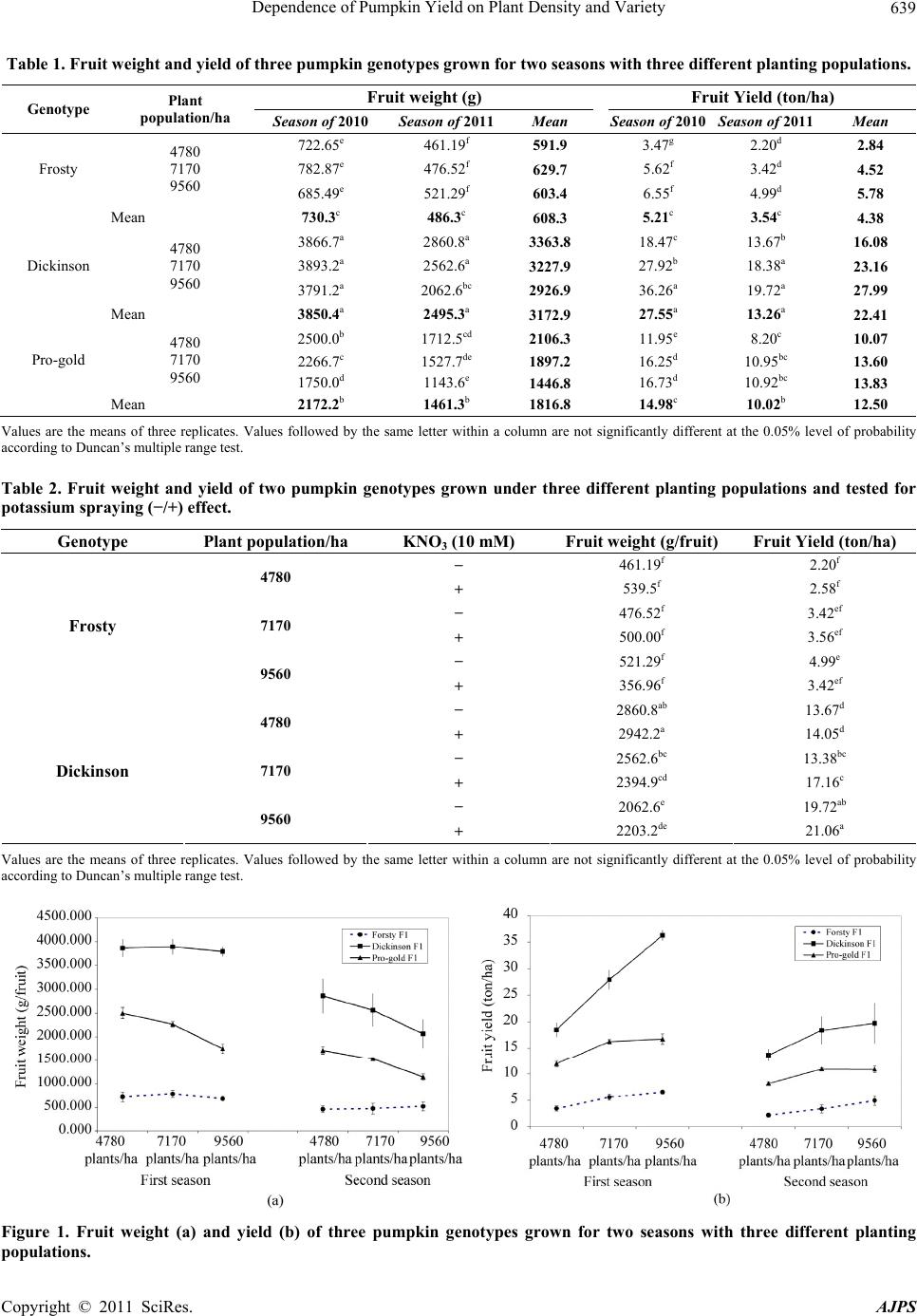 Dependence of Pumpkin Yield on Plant Density and Variety Copyright © 2011 SciRes. AJPS 639 Table 1. Fruit weight and yield of three pumpkin genotypes grown for two seasons with three different planting populations. Fruit weight (g) Fruit Yield (ton/ha) Genotype Plant population/ha Season of 2010 Season of 2011 Mean Season of 2010 Season of 2011 Mean 722.65e 461.19f 591.9 3.47g 2.20d 2.84 782.87e 476.52f 629.7 5.62f 3.42d 4.52 Frosty 4780 7170 9560 685.49e 521.29f 603.4 6.55f 4.99d 5.78 Mean 730.3c 486.3c 608.3 5.21c 3.54c 4.38 3866.7a 2860.8a 3363.8 18.47c 13.67b 16.08 3893.2a 2562.6a 3227.9 27.92b 18.38a 23.16 Dickinson 4780 7170 9560 3791.2a 2062.6bc 2926.9 36.26a 19.72a 27.99 Mean 3850.4a 2495.3a 3172.9 27.55a 13.26a 22.41 2500.0b 1712.5cd 2106.3 11.95e 8.20c 10.07 2266.7c 1527.7de 1897.2 16.25d 10.95bc 13.60 Pro-gold 4780 7170 9560 1750.0d 1143.6e 1446.8 16.73d 10.92bc 13.83 Mean 2172.2b 1461.3b 1816.8 14.98c 10.02b 12.50 Values are the means of three replicates. Values followed by the same letter within a column are not significantly different at the 0.05% level of probability according to Duncan’s multiple range test. Table 2. Fruit weight and yield of two pumpkin genotypes grown under three different planting populations and tested for potassium spraying (−/+) effect. Genotype Plant population/ha KNO3 (10 mM) Fruit weight (g/fruit) Fruit Yield (ton/ha) − 461.19f 2.20f 4780 + 539.5f 2.58f − 476.52f 3.42ef 7170 + 500.00f 3.56ef − 521.29f 4.99e Frosty 9560 + 356.96f 3.42ef − 2860.8ab 13.67d 4780 + 2942.2a 14.05d − 2562.6bc 13.38bc 7170 + 2394.9cd 17.16c − 2062.6e 19.72ab Dickinson 9560 + 2203.2de 21.06a Values are the means of three replicates. Values followed by the same letter within a column are not significantly different at the 0.05% level of probability according to Duncan’s multiple range test. Figure 1. Fruit weight (a) and yield (b) of three pumpkin genotypes grown for two seasons with three different planting populations.  Dependence of Pumpkin Yield on Plant Density and Variety 640 siderable environment and genotype variation (Table 1) (Figure 1). The range in fruit weight of genotypes was between 0.7 to 3.9 kg in the first season and between 0.5 to 2.5 kg in the second season. While the range for fruit yield was from 3.5 to 36.26 t·ha–1 in the first season and from 2.2 to 19.72 t·ha–1 in the second season (Table 1). When the genotypes were ranked for fruit yield and fruit weight, there were high agreement from environment to environment indicating the importance of genotype in determining the yield of pumpkin (Table 1) (Figure 1). Dickinson and Frosty usually exhibited the highest and lowest pumpkin fruit weight and yield respectively. The pooled analysis of variance over seasons for three geno- types is presented in Table 3. For fruit weight, genotypic differences described the greatest percent of the variation. Genotypic sum of squares accounted for almost 91% of total sum of squares (Figure 2). Although variation due to the environment and geno- type by environment interaction were significant but they contribute less to the total variation (5% and 4% respec- tively) (Table 3, Figure 2). Similar trend was observed for fruit yield since all the three components were statis- tically significant and represented 88%, 6%, and 6% for genotype, environment and genotype by environment interaction respectively (Table 3, Figure 2). 4. Discussion Pumpkin growers are seeking different approaches to maximize yield per unit are in order to save on land and increase profitability. Growers need to be cognizant of the market demands and adjust their cultural practices accordingly to meet market expectations. The current pumpkin market is limited by the improper size of the fruit to most consumers. Since competition between plants for natural resources greatly affect yield [3] consequently it is feasible to mo- dify size of the harvest crop to meet the requirements of the different markets by manipulating plant density [8]. The effect of plant population on fruit weight and yield in pumpkin genotypes were investigated in this study. The increase of plant population from 4780 to 9560 plant/ha significantly decreased the fruit weight in particular in large vine type genotypes which was asso- ciated with increase in overall yield due to the increase in number of plant per unit area. These results are in ac- cordance with previous research in pumpkin [8,36-38, 44-46]. Potassium is the most abundant inorganic cation in plant tissues and involved in many biochemical and physiological functions in plant such as osmoregulation and cell extension, stomatal movement, activation of enzymes, protein synthesis, photosynthesis and many Table 3. Analysis of variance for yield weight (g/fruit) and fruit yield (ton/ha) in three pumpkin genotypes grown over two environments. EffectSS df MS F P Season (S) 20116218 1 20116218 155.4050.0000*** Genotype (g) 378322805 2 189161402 1461.3370.0000*** Fruit Weight (g/fruit) S*G 159316692 7965835 61.5390.0000*** Season (S) 228.326 1 228.326 64.9470.0000*** Genotype (g) 3281.5662 1640.783 466.7150.0000*** Fruit Yield (ton/ha.) S*G 225.34 2 112.670 32.0490.0000*** ***Significant at 0.001% level. Figure 2. Percentages of total phenotypic variation of fruit weight (a) and yield (b) associated with genotype, environ- ment, and genotype by environment interaction for three pumpkin genotypes grown over two seasons. more [40]. Although the foliar application of potassium to pumpkin cultivars did not reveal any significant effect on yield, the sprayed plants tended to show slightly higher yield in both tested genotypes overall planting densities. The failure of potassium application to show any significance may be due to either the low concentra- tion of potassium foliar fertilizers or the low number of applications. The pumpkin plants are characterized by the huge volume of vegetative growth particularly in the large vining types which require high inputs of foliar application of fertilizers to be effective. Also, pumpkin plants are known to have stiff hairs on leaf surface which may also explain the reason of the non-significant effect of foliar application. The slight increase in yield as a result of potassium foliar application may be due to the known effect of potassium in plant tolerance of biotic and a biotic stresses [47]. In addition, this can be ex- plained by the process of biomass allocation [48]. Ac- cording to this process the group of non-sprayed plants allocates a greater proportion of their biomass to the root system compared to the sprayed plants which accumu- lated more in their shoot system that resulted in slightly higher fruit yield [48]. Copyright © 2011 SciRes. AJPS  Dependence of Pumpkin Yield on Plant Density and Variety641 Development of pumpkin germplasm with enhanced yield will potentially promote pumpkin cultivation and production. This investigation found that the phenotypic variation existing among pumpkin genotypes for yield is primarily under genetic control. The ANOVA revealed that the mean squares for genotypes were significant for fruit yield. This indicates the existence of a high degree of genetic variability in the tested plant materials that can be exploited in a breeding programme which was also reflected in the broad ranges observed between geno- types for fruit yield (Table 1). The differences between pumpkin genotypes for yield were recorded also in pre- vious studies [49]. Plant size and growth habit differen- ces can profoundly affect response to plant density varia- tion [6]. Differential response of pumpkin cultivars to increased plant density can be explained by differences in their plant size and growth habits. The results of this study concerning the genetic control of pumpkin yield are supported by the moderate herita- bility (43%) with moderately high genetic gain (44%) that was recorded for yield by Mohanty and Mishra [50]. In addition, additive gene action has been suggested to control the expression of yield and its components in pumpkin [51]. These results support the feasibility of ge- netic manipulation of yield in pumpkin. Further research is required to investigate the influence of between rows spacing on pumpkin yield and to confirm same results from experiments conducted over one year (potassium foliar application) or one location (genotype by envi- ronment interaction). Higher plant densities may maximize pumpkin num- bers per unit area, but growers must realize that greater fruit number will result in a smaller average fruit size. Growers who choose higher population need to ensure that all inputs are optimized to reduce potential plant-to- plant competition. These data provide a basis for new closer spacing recommendations for pumpkin in Egypt as long as water and nutrients are limiting. REFERENCES [1] R. Holliday “Plant Population and Crop Yield,” Nature, Vol. 186, No. 4718, 1960, pp. 22-24. doi:10.1038/186022b0 [2] J. K. A. Bleasdale and J. A. Nelder, “Plant Population and Crop Yield,” Nature, Vol. 186, 1960, pp. 342. doi:10.1038/188342a0 [3] J. H. M. Thornley, “Crop Yield and Planting Density,” Annals of Botany, Vol. 52, No. 2, 1983, pp. 257-259. [4] M. M. Pant, “Dependence of Plant Yield on Density and Planting Pattern,” Annals of Botany, Vol. 44, No. 4, 1979, pp. 513-516. [5] B. B. Casper and R. B. Jackson, “Plant Competition Un- derground,” Annual Review of Ecology and Systematics, Vol. 28, 1997, pp. 545-570. doi:10.1146/annurev.ecolsys.28.1.545 [6] J. K. A. Bleasdale, “Plant Growth and Crop Yield,” An- nals of Applied Biology, Vol. 57, No. 2, 1966, pp. 173-182. doi:10.1111/j.1744-7348.1966.tb03812.x [7] R. W. Willey and S. B. Heath, “The Quantitive Relation- ships between Plant Population and Crop Yield,” Ad- vances in Agronomy, Vol. 21, 1969, pp. 281-321. doi:10.1016/S0065-2113(08)60100-5 [8] K. E. Cushman, D. H. Nagel, T. E. Horgan and P. D. Gerard, “Plant Population Affects Pumpkin Yield Com- ponents,” HortTechnology, Vol. 14, No. 3, 2004, pp. 326-331. [9] C. J. Swanton and S. F. Weise, “Integrated Weed Man- agement in the Rational and Approach,” Weed Technol- ogy, Vol. 5, No. 3, 1991, pp. 657-663. [10] D. D. Buhler, “Challenges and Opportunities for Inte- grated Weed Management,” Weed Science, Vol. 50, No. 3, 2002, 273-280. doi:10.1614/0043-1745(2002)050[0273:AIAAOF]2.0.CO ;2 [11] J. R. Teasdale, “Influence of Narrow Row/High Popula- tion Corn (Zea Mays) on Weed Control and Light Trans- mittance,” Weed Technology, Vol. 9, No. 1, 1995, pp. 113-118. [12] M. R. Speight, “The Potential of Ecosystem Management for Pest Control. Agriculture,” Ecosystems and Environ- ment, Vol. 10, 1983, pp. 183-199. doi:10.1016/0167-8809(83)90061-0 [13] R. H. Walker and G. A. Buchanan, “Crop Manipulation in Integrated Weed Management Systems,” Weed Science, Vol. 30, 1981, pp. 17-24. [14] V. E. Rubatzky and M. Yamaguchi, “World Vegetables Principles, Production and Nutritive Values,” 2nd Edition, Aspen Publishers, Inc., Maryland, 1999. [15] M. Murkovic, U. Mülleder and H. Nevnteuft, “Carote- noid Content in Different Varieties of Pumpkin,” Journal of Food Composition and Analysis, Vol. 15, No. 6, 2002, pp. 633-638. doi:10.1006/jfca.2002.1052 [16] T. Hidaka and T. A. Nakatsu, “The Composition and Vitamin a Value of the Carotenoids of Pumpkins of Dif- ferent Colors,” Journal of Food Biochemistry, Vol. 11, 1987, pp. 59-68. doi:10.1111/j.1745-4514.1987.tb00112.x [17] Y. I. Kwon, E. Apostolidis, Y. C. Kim and K. Shetty, “Health Benefits of Traditional Corn, Beans and Pumpkin: In Vitro Studies for Hyperglycemia and Hypertension Management,” Journal of Medicinal Food, Vol. 10, No. 2, 2007, pp. 266-275. doi:10.1089/jmf.2006.234 [18] I. M. Dweikat and S. R. Kostewicz, “Row Arrangement, Plant Spacing, and Nitrogen Rate Effects on Zucchini Squash Yield,” HortScience, Vol. 24, No. 1, 1989, pp. 86-88. [19] C. A. Powell, P. J. Stoffella and H. S. Paris, “Plant Popu- lation Influence on Squash Yield, Sweet Potato Whitefly, Squash Silverleaf, and Zucchini Yellow Mosaic,” Hort- Copyright © 2011 SciRes. AJPS  Dependence of Pumpkin Yield on Plant Density and Variety 642 Science, Vol. 28, No. 8, 1993, pp. 796-798. [20] M. Edelstein and H. Nerson, “Genotype and Plant Den- sity Affect Watermelon Grown for Seed Consumption,” Hort-Science, Vol. 37, No. 6, 2002, pp. 981-983. [21] C. E. Motsenbocker and R. A. Arancibia, “In-Row Spac- ing Influences Triploid Watermelon Yield and Crop Value,” HortTechnology, Vol. 12, No. 3, 2002, pp. 437-440. [22] D. S. NeSmith, “Plant Spacing Influences Watermelon Yield and Yield Components,” HortScience, Vol. 28, No. 9, 1993, pp. 885-887. [23] D. C. Sanders, J. D. Cure and J. R. Schultheis, “Yield Response of Watermelon to Planting Density, Planting Pattern, and Polyethylene Mulch,” HortScience, Vol. 34, No. 7, 1999, pp. 1221-1223. [24] D. Ban, S. Goreta and J. Borosic, “Plant Spacing and Cultivar Affect Melon Growth and Yield Components,” Scientia Horticulturae, Vol. 109, No. 3, 2006, pp. 238- 243. doi:10.1016/j.scienta.2006.04.015 [25] D. E. Knavel, “Productivity and Growth of Short-Inter- node Muskmelon Plants at Various Spacing or Densities,” Journal of the American Society for H or ti cu l tu ra l S ci e nc e, Vol. 116, No. 6, 1991, pp. 926-929. [26] F. Kultur, H. G. Harrison and J. E. Staub, “Spacing and Genotype Affect Fruit Sugar Concentration, Yield, and Fruit Size of Muskmelon,” HortScience, Vol. 36, No. 3, 2001, pp. 274-278. [27] E. T. Maynard and W. D. Scott, “Plant Spacing Affects Yield of ‘Superstar’ Muskmelon,” HortScience, Vol. 33, No. 1, 1998, pp. 52-54. [28] S. Mendlinger, “Effect of Increasing Plant Density and Salinity on Yield and Fruit Quality in Muskmelon,” Sci- entia Horticulturae, Vol. 57, No. 1-2, 1994, pp. 41-49. doi:10.1016/0304-4238(94)90033-7 [29] J. C. Roderiguez, N. L. Shaw and D. J. Cantliffe, “Influ- ence of Plant Density on Yield and Fruit Quality of Greenhouse-Grown Galia Muskmelons,” HortTechnology, Vol. 1, No. 4, 2007, pp. 580-585. [30] N. Gebologlu and N. Saglam, “The Effect of Different Plant Spacing and Mulching Materials on the Yield and Fruit Quality of Pickling Cucumber,” Acta Horticulturae, Vol. 579, 2002, pp. 603-607. [31] J. E. Staub, L. D. Knerr and H. J. Hopen, “Plant Density and Herbicides Affect Cucumber Productivity,” Journal of the American Society for Horticultural Science, Vol. 117, No. 1, 1992, pp. 48-53. [32] I. E. Widders and H. C. Price, “Effects of Plant Density on Growth and Biomass Partitioning in Pickling Cucum- bers,” Journal of the American Society for Horticultural Science, Vol. 114, No. 5, 1989, pp. 751-755. [33] J. O’Sullivan, “Irrigation, Spacing and Nitrogen Effects on Yield and Quality of Pickling Cucumber Grown for Mechanical Harvesting,” Canadian Journal of Plant Sci- ence, Vol. 60, No. 3, 1980, pp. 923-928. doi:10.4141/cjps80-135 [34] Z. Gur and L. Garte, “Influence of the Plant Density and Sowing Date on the Yield of Pickling Cucumbers,” Acta Horticulturae, Vol. 52, 1975, pp. 169-176. [35] C. S. Tan, J. M. Fulton and V. W. Nuttal, “The Influence of Soil Moisture Stress and Plant Populations on the Yield of Pickling Cucumbers,” Scientia Horticulturae, Vol. 21, No. 3, 1983, pp. 217-224. doi:10.1016/0304-4238(83)90094-8 [36] S. Reiners and D. I. M. Riggs, “Plant Spacing and Variety Affect Pumpkin Yield and Fruit Size, but Supplemental Nitrogen Does Not,” HortScience, Vol. 32, No. 6, 1997, pp. 1037-1039. [37] S. Reiners and D. I. M. Riggs, “Plant Population Affects Yield and Fruit Size of Pumpkin,” HortScience, Vol. 34, No. 6, 1999, pp. 1076-1078. [38] R. J. Dufault and A. Korkmaz, “Influence of Plant Spac- ing on Connecticult Field Pumpkin Size Density and Yield,” In: J. D. McCreight, Ed., Evaluation and En- hancement of Cucurbit Germplasm, American Society for Horticultural Science Press, New York, 1998, pp. 51-52. [39] C. D. Schlichting, “The Evolution of Phenotypic Plastic- ity in Plants,” Annual Review of Ecology and Systematics, Vol. 17, 1986, pp. 667-693. doi:10.1146/annurev.es.17.110186.003315 [40] V. Romheld and E. Kirkby, “Research on Potassium in Agriculture: Needs and Prospects,” Plant Soil, Vol. 335, No. 1-2, 2010, pp. 155-180. doi:10.1007/s11104-010-0520-1 [41] H. Marschner, “Mineral Nutrition of Higher Plants,” 2nd Edition, Academic Press, London, 1995. [42] A. Amtmann, S. Troufflard and P. Armengaud, “The Effect of Potassium Nutrition on Pest and Disease Resis- tance in Plants,” Physiologia Plantarum, Vol. 133, No. 4, 2008, pp. 682-691. doi:10.1111/j.1399-3054.2008.01075.x [43] Statsoft Inc. “STATISTICA für Windows [Software- system für Datenanalyse] Version 6,” 2001. www.Statsoft.com [44] S. Reiners, “Stand Establishment, Spacing and Fertiliza- tion to Maximize Pumpkin Yield,” New England Vegeta- ble and Fruit Conference, Manchester, 18 December 2003. http://www.newenglandvtc.org/2003_conferance/proceed ings_ 03/pumpkin_ scholl1/stand_ establishment_ spac- ing_ fertilization_ maximize_ pumkin_y.pdf. [45] K. E. Cushman, T. E. Horgan, D. H. Nagel, M. Maqbool and P. D. Gerard, “The Effect of Plant Population on Pumpkin Yield,” Annual Report of the North Mississippi Reseach and Extension Center, Mississippi Agricultural and Forestry Experiment Station Information Bulletin, Vol. 375, 2001, pp. 296-297. [46] K. E. Cushman, T. E. Horgan, D. H. Nagel and P. D. Gerard, “Planting Density Affects Pumpkin Size and Weigh but Not Yield,” Annual Report of the North Mis- sissippi Reseach and Extension Center, Mississippi Agri- cultural and Forestry Experiment Station Information Bulletin, Vol. 386, 2002, pp. 282-283. [47] S. Perrenoud, “Potassium and Plant Health,” IPI-Re- Copyright © 2011 SciRes. AJPS  Dependence of Pumpkin Yield on Plant Density and Variety Copyright © 2011 SciRes. AJPS 643 search Topics No. 3, 2nd Edition, International Potash Institute, Basel, 1990, p. 365. [48] C. Hermans, J. R. Hammond, P. J. White and N. Ver- bruggen, “How do Plants Respond to Nutrient Shortage by Biomass Allocation?” Trends in Plant Science, Vol. 1, 2006, pp. 610-617. doi:10.1016/j.tplants.2006.10.007 [49] R. Karkleliene, P. Viskelis and M. Rubinskiene, “Grow- ing, Yielding and Quality of Different Ecologically Grown Pumpkin Cultivars,” Sodininkyste Ir Darzinin- kyste, Vol. 27, No. 2, 2008, pp. 401-409. [50] B. K. Mohanty and R. S. Mishra, “Variation and Genetic Parameters of Yield and Its Components in Pumpkin,” Indian Journal of Horticulture, Vol. 56, No. 4, 1999, pp. 337-342. [51] B. K. Mohanty, “Combining Ability for Yield and Its Components in Pumpkin,” Indian Journal of Genetics and Plant Breeding, Vol. 60, No. 3, 2000, pp. 33-379. |