

Paper Menu >>
Journal Menu >>
 Vol.2, No.4, 505-510 (2011) Agricultural Sciences doi:10.4236/as.2011.24065 Copyright © 2011 SciRes. Openly accessible at http://www.scirp.org/journal/AS/ Analysis of the relation between organic products consumption and box schemes use in Alicante (Spain) Fernando Vidal, David Bernardo López*, Francisco José del Campo Departamento de Economía Agroambiental, EPSO, Universidad Miguel Hernández, Carretera de Beniel, Orihuela (Alicante), España; *Corresponding Aut hor: [email protected] Received 29 August 2011; revised 27 September 2011; accepted 15 October 2011. ABSTRACT Box-schemes or organic food subscription plans consist on a regular delivery of a box of seasonal fruits and/or vegetables, preferably organic, cul- tivated in the vicinity at a specified point using subscription, The object of the present work is trying to examine whether th ere is a re lationship between consumer knowledge about these short distribution channels and the consumption of organic products in the province of Alicante. A survey has been conducted among 400 usual food buyers in this Spanish province. It has been found that the consumption of organic products and the knowledge of such initiatives are linked. We recommend to companies that use this type of distribution channel to publicize it s benefits. Keywords: Box-Scheme; Environmental; Consumer; K nowledge; D i stribution 1. INTRODUCTION A box-scheme is a regular home delivery (or at a cen- tral sale point), through subscription, of a seasonal fruit and/or vegetables box, preferably organic, locally culti- vated. Factors identified as success keys of this market- ing channel are: supply variety, price/quality ratio, high- quality and reliable delivery (Alonso and Guzmán, 2002 [1] and 2006 [2]; Alonso et al., 2002 [3]; Haldy, 2004 [4]; Midmore et al., 2004 [5]; Padel et al., 2004 [6]; Cavard and Baros, 2005 [7]; Seyf ang, 2006 [8]; Baros, 2007 [9]; Brown et al., 2009 [10]; Diaz et al., 2009 [11]; Gliess- man and Rosemeyer, 2010 [12,13]). Main operational features of this distribution tool are: regular delivery; product range and limited customer choice. Spanish fresh fruit and vegetables consumption tends to equalize models in European developed countries based on differentiation and segmentation factors ac- cording to demographic and social trends, and the in- corporation to the demand function of product new fea- tures and values of new features and values relative to the product (Sanchez et al., 2001 [14]; Brugarolas and Rivera, 2001 [15]; Colom and Saez, 2001 [16]; Soler et al., 2002 [17]; Bernabéu et al., 2004 [18]; Montoro and Castaneda, 2005 [19]; Brugarolas et al., 2005 [20] and 2007 [21] ). Spain, despite being a major producer of organic farm- ing, has a weak market and most of this production (around 85%) is exported (Alonso, 2001 [22]; Guzmán and Alonso, 2003 [23]). The growth of emerging envi- ronmental markets need to maintain and enhance short distribution channels and farmers cooperation (Alonso and Guzmán, 2000 [24]; Cobo and González, 2001 [25]; Vicente and Ruiz, 2003 [26]; Padel et al. 2004 [6], Alonso, 2004 [27]; Midmore et al., 2004 [5]; Diaz et al., 2009 [11]). This work aims to examine if there is a relationship between consumer knowledge of these distribution chan- nels and consumption of organic products in Alicante province. Variables related to fresh product characteris- tics that were most important for consumers have been defined as factors. Then, segmentations have been made attending organic products consumption and the box- schemes level of knowledge. Finally, relationship be- tween both is analysed. 2. MATERIALS AND METHODS 400 surveys were made throughout the province of Alicante, with a maximum error of 5% and a level of confidence of 95%, through a conglomerates sampling with ramdom subsampling, looking for usual market basket buyers of the usual food basket in entrance access to facilities (supermarkets, hypermarkets, central mar- kets, street markets, etc.). In order to get a self—weighed up resulting sample, the selection of conglomerates was done related to their size at the first stage. Participation units in the sample were also proportional to th e size of the conglomerate at the second stage. A pre-test to 20 people was done to  F. Vidal et al. / Agricultural Sciences 2 (2011) 505-510 Copyright © 2011 SciRes. Openly accessible at http://www.scirp.org/journal/AS/ 506 detect possible errors in the questionnaire design. Sur- veys were conducted during June, October and Novem- ber 2007 in order to avoid making surveys in the sum- mer period due to the great possibility of finding non- residents during July and August. Survey s were conducted in Alcoy, Alicante, Villena, Elda, Petrer, Novelda, Denia, Javea, Calpe, Benidorm, Villajoyosa, Altea, San Vicente del Raspeig, San Juan, Elche, Crevillente, Torrevieja, Orihuela and Pilar de la Horadada. The survey consisted of 26 closed questions. It in- cluded a filter question to rule ou t those who do not usu- ally perform familiar food purchasing. The questionnaire asked about organic products knowledge and consump- tion frequency. It looked at buying and fruit/vegetables consumption habits. It also asked about the willingness to consume them. It also looked for identifying which the most important features of fresh products were in order to be purchased, the most valued characteristics of the box-scheme, population lifestyles and the most rele- vant socio-e conomic charac t eristics of the respondent. 3. RESULTS AND DIS CUSSION As it has been said, the more valuated (b y responden ts) variables related to the fresh product characteristics of the fresh product were simplified in factors before the segmentat i on s (Di az et al., 2009) [14]). The first grou p of v ar iables, co nsisting of three factors (which explain a total variance of 63.95%), refer to val- ued attributes in fruit and vegetables. The first factor, “product composition” includes attributes such as nutria- tional value, health and texture; along with those pro- duction methods that guarantee a more natural product composition (organic and integrated production). A sec- ond factor would be “production method and origin re- gardless of the price” and it groups production related attributes (local origin, D.O., etc.). The third factor, “or- ganoleptic characteristics”, focuses on fresh product taste, aroma and visual appearance. A second group of variables would be box-scheme product/service features. The three extracted factors ex- plain a total variance of 66.73%. The first one, “product characteristics and environmental benefits”, groups fea- tures related to the product (freshness, local origin, healthy, organic) and the environmental benefits th at this type of direct sale produces (packaging and food miles reduction, biodiversity improvement, etc.). The second, “social and economic benefits” encompasses variables related to support local economies and rural development. Finally, the “personal benefits” factor groups variables which impact directly on consumers (home delivery ser- vice and shopping experience). Finally, the third group of factors, consumer lifestyle, shows two factors which explain a total variance of 53.60%. The first factor, “concern for health and nutria- tion” encompasses aspects related to food and exercise. The second factor, “social and environmental awareness and responsible consumption” groups variables related to environmental concern and collaboration with non- governmental organizations and the fact of reading the product labels. 3.1. Segmentation Based on the Level of Organic Product Consumption Alicante consumers have been segmented in four groups based on organic products consumption (Table 1): usual (9.2% of population), occasional and/or test (45%), potential (those who do not consume but stated that they could do it, 41.2% of resp ondents) and non consumption (those who stated that they would not consume such products, 4.6%). Table 2 shows the characterization of these four segments attending different descriptive vari- ables (the table only shows those variables that have statistically significant relationships). Table 1. Consumers segment characterization according to thei r orga ni c p r od u ct consumption based on several variables. Segment 1 Segment 2 Segment 3 Segment 4 Variables/Factors Usual consumption (9.2%) Occasional consumption (45.0%)Potential consumption (41.2%) Non consumption (4.6%) Fruits and vegetables attributes Product compos i tion* 1.292a –0.308b 0.066b –0.148b Production method and origin regardless of the price * 1.288a –0.043b –0.210b –0.262b Organoleptic charac teristics* –0.389a –0.064a,b 0.090a,b 0.605b Box-scheme product/service features Product characteristics and environmental benefit s* 1.354a –0.108b –0.136b –0.424b Social and economic benefi t s 0.348 –0.047 0.018 –0.400 Personal benefits –0.099 –0.111 0.116 0.237 Consumer lifestyle Concern for health and nutrition* 1.001a –0.168b 0.031b –0.625b Social and environmental awareness and responsible consumption* 1.030a 0.102b –0.278b –0.560b *Significant differences for p < 1%; Averages with different letters at the same row are statistically different (Tukey, p < 0.05). 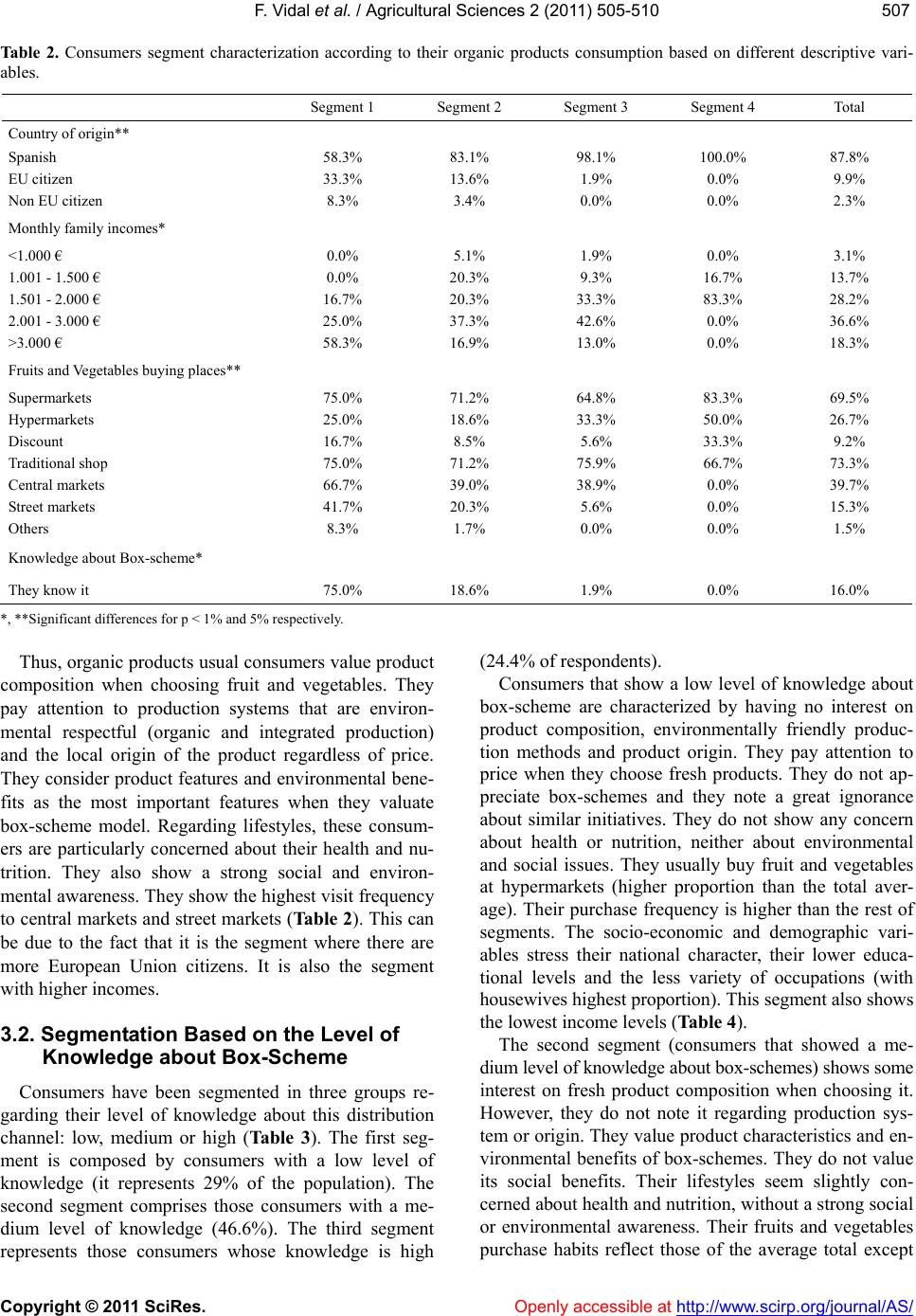 F. Vidal et al. / Agricultural Sciences 2 (2011) 505-510 Copyright © 2011 SciRes. Openly accessible at http://www.scirp.org/journal/AS/ 507507 Table 2. Consumers segment characterization according to their organic products consumption based on different descriptive vari- ables. Segment 1 Segment 2 Segment 3 Segment 4 Total Country of origin** Spanish 58.3% 83.1% 98.1% 100.0% 87.8% EU citizen 33.3% 13.6% 1.9% 0.0% 9.9% Non EU citizen 8.3% 3.4% 0.0% 0.0% 2.3% Monthly fam ily incomes* <1.000 € 0.0% 5.1% 1.9% 0.0% 3.1% 1.001 - 1.500 € 0.0% 20.3% 9.3% 1 6.7% 13.7% 1.501 - 2.000 € 16.7% 20.3% 33.3% 83.3% 28.2% 2.001 - 3.000 € 25.0% 37.3% 42.6% 0.0% 36.6% >3.000 € 58.3% 16.9% 13.0% 0.0% 18.3% Fruits and Vegetables buying places** Supermarkets 75.0% 71.2% 64.8% 83.3% 69.5% Hypermarkets 25.0% 18.6% 33.3% 50.0% 26.7% Discount 16.7% 8.5% 5.6% 33.3% 9.2% Traditional shop 75.0% 71.2% 75.9% 66.7% 73.3% Central markets 66.7% 39.0% 38.9% 0.0% 39.7% Street markets 41.7% 20.3% 5.6% 0.0% 15.3% Others 8.3% 1.7% 0.0% 0.0% 1.5% Knowledge about Box-sch eme* They know it 75.0% 18.6% 1.9% 0.0% 16.0% *, **Significant differences for p < 1% and 5 % r espectively. Thus, organic products usual consumers value product composition when choosing fruit and vegetables. They pay attention to production systems that are environ- mental respectful (organic and integrated production) and the local origin of the product regardless of price. They consider product features and environmental bene- fits as the most important features when they valuate box-scheme model. Regarding lifestyles, these consum- ers are particularly concerned about their health and nu- trition. They also show a strong social and environ- mental awareness. They show the highest visit frequency to central markets and street markets (Table 2). Th is can be due to the fact that it is the segment where there are more European Union citizens. It is also the segment with higher incomes. 3.2. Segmentation Based on the Level of Knowledge about Box-Scheme Consumers have been segmented in three groups re- garding their level of knowledge about this distribution channel: low, medium or high (Tab le 3). The first seg- ment is composed by consumers with a low level of knowledge (it represents 29% of the population). The second segment comprises those consumers with a me- dium level of knowledge (46.6%). The third segment represents those consumers whose knowledge is high (24.4% of re spondent s). Consumers that show a low level of knowledge about box-scheme are characterized by having no interest on product composition, environmentally friendly produc- tion methods and product origin. They pay attention to price when they choose fresh products. They do not ap- preciate box-schemes and they note a great ignorance about similar initiatives. They do not show any concern about health or nutrition, neither about environmental and social issues. They usually buy fruit and vegetables at hypermarkets (higher proportion than the total aver- age). Their purchase frequency is higher than the rest of segments. The socio-economic and demographic vari- ables stress their national character, their lower educa- tional levels and the less variety of occupations (with housewives highest proportion). This segment also shows the lowest income levels (Table 4). The second segment (consumers that showed a me- dium level of knowledge about box-schemes) shows some interest on fresh product composition when choosing it. However, they do not note it regarding production sys- tem or origin. They value produc t characteristics and en- vironmental benefits of box-schemes. They do not value its social benefits. Their lifestyles seem slightly con- cerned about health and nutrition, without a strong social or environmental awareness. Their fruits and vegetables purchase habits reflect those of the average total except 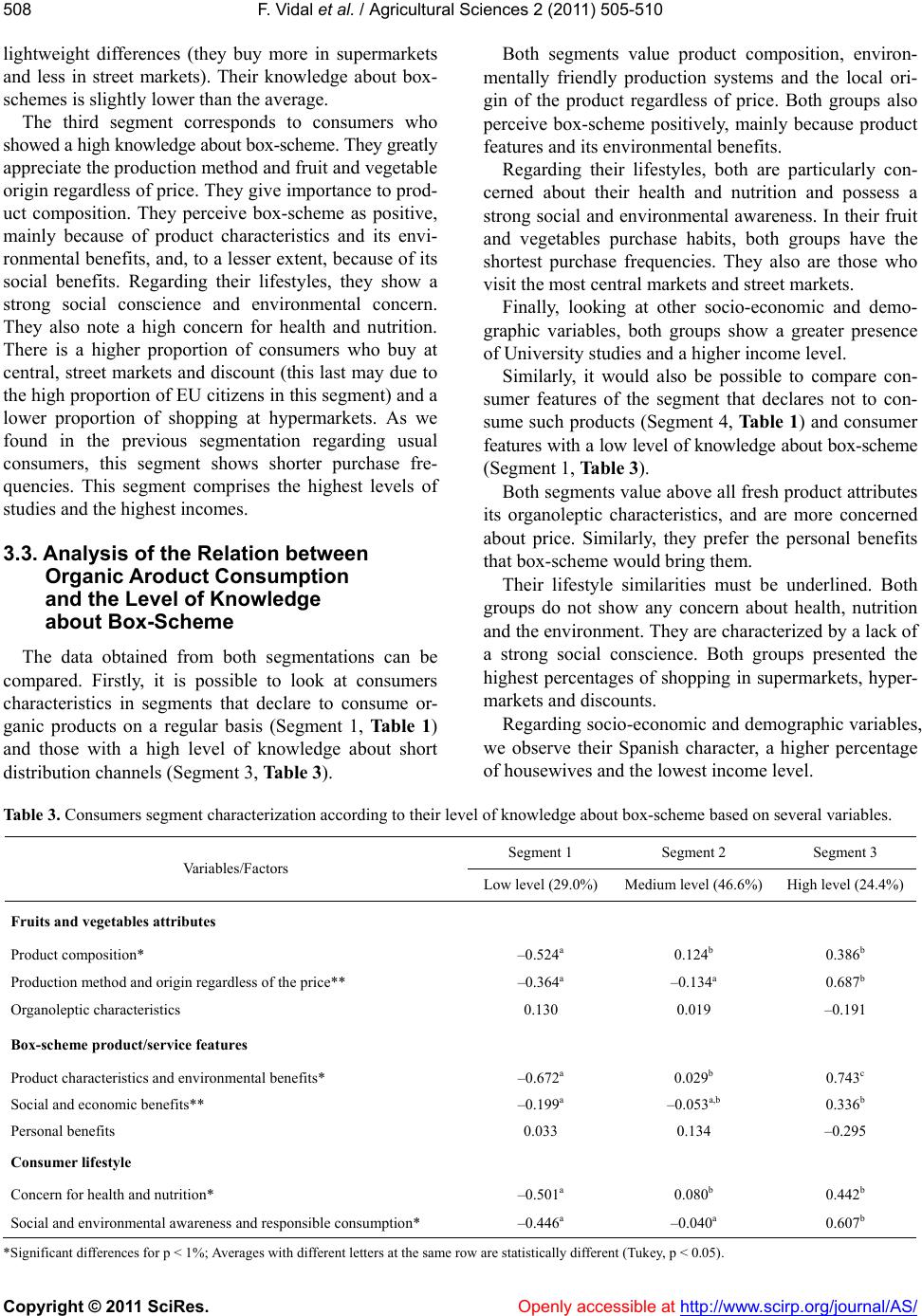 F. Vidal et al. / Agricultural Sciences 2 (2011) 505-510 Copyright © 2011 SciRes. Openly accessible at http://www.scirp.org/journal/AS/ 508 lightweight differences (they buy more in supermarkets and less in street markets). Their knowledge about box- schemes is slightly lower than the average. The third segment corresponds to consumers who showed a high knowledge about box-scheme. They greatly appreciate the production method and fruit and vegetable origin regardless of price. They give importance to prod- uct composition. They perceive box-scheme as positive, mainly because of product characteristics and its envi- ronmental benefits, and, to a lesser extent, because of its social benefits. Regarding their lifestyles, they show a strong social conscience and environmental concern. They also note a high concern for health and nutrition. There is a higher proportion of consumers who buy at central, street markets and discount (this last may due to the high proportion of EU citizens in this segmen t) and a lower proportion of shopping at hypermarkets. As we found in the previous segmentation regarding usual consumers, this segment shows shorter purchase fre- quencies. This segment comprises the highest levels of studies and the highest incomes. 3.3. Analysis of the Relation between Organic Aroduct Consumption and the Level of Knowledge about Box-Scheme The data obtained from both segmentations can be compared. Firstly, it is possible to look at consumers characteristics in segments that declare to consume or- ganic products on a regular basis (Segment 1, Tab l e 1 ) and those with a high level of knowledge about short distribution channels (Segment 3, Table 3). Both segments value product composition, environ- mentally friendly production systems and the local ori- gin of the product regardless of price. Both groups also perceive box-scheme positively, mainly because product features and its environmental benefits. Regarding their lifestyles, both are particularly con- cerned about their health and nutrition and possess a strong social and environmental awareness. In their fruit and vegetables purchase habits, both groups have the shortest purchase frequencies. They also are those who visit the most central markets and street markets. Finally, looking at other socio-economic and demo- graphic variables, both groups show a greater presence of University studies and a higher income level. Similarly, it would also be possible to compare con- sumer features of the segment that declares not to con- sume such products (Segment 4, Table 1) and consumer features with a low level of knowledge about box-scheme (Segment 1, Table 3). Both segments va lue above all fresh product attributes its organoleptic characteristics, and are more concerned about price. Similarly, they prefer the personal benefits that box-scheme would bring them. Their lifestyle similarities must be underlined. Both groups do not show any concern about health, nutrition and the environment. They are characterized by a lack of a strong social conscience. Both groups presented the highest percentages of shopping in supermarkets, hyper- markets and discounts. Regarding socio-economic and demographic variables, we observe their Spanish character, a higher percentage of housewives and the lowest income level. Table 3. Consumers segment characterization according to their level of knowledge about box-scheme based on several variables. Segment 1 Segment 2 Segment 3 Variables/Factors Low level (29.0%) Medium level (46.6%) High level (24.4%) Fruits and vegetables attributes Product compos i tion* –0.524a 0.124b 0.386b Production m ethod and origin regardless of the price* * –0.364a –0.134a 0.687b Organoleptic characteristics 0.130 0.019 –0.191 Box-scheme product/service features Product characteristics and environmental benefit s* –0.672a 0.029b 0.743c Social and economic benefits** –0.199a –0.053a,b 0.336b Personal benefits 0.033 0.134 –0.295 Consumer lifestyle Concern for health and nutrition* –0.501a 0.080b 0.442b Social and environmental aware ness and responsible cons umption* –0.446a –0.040a 0.607b *Significant differences for p < 1%; Averages with different letters at the same row are statistically different (Tukey, p < 0.05). 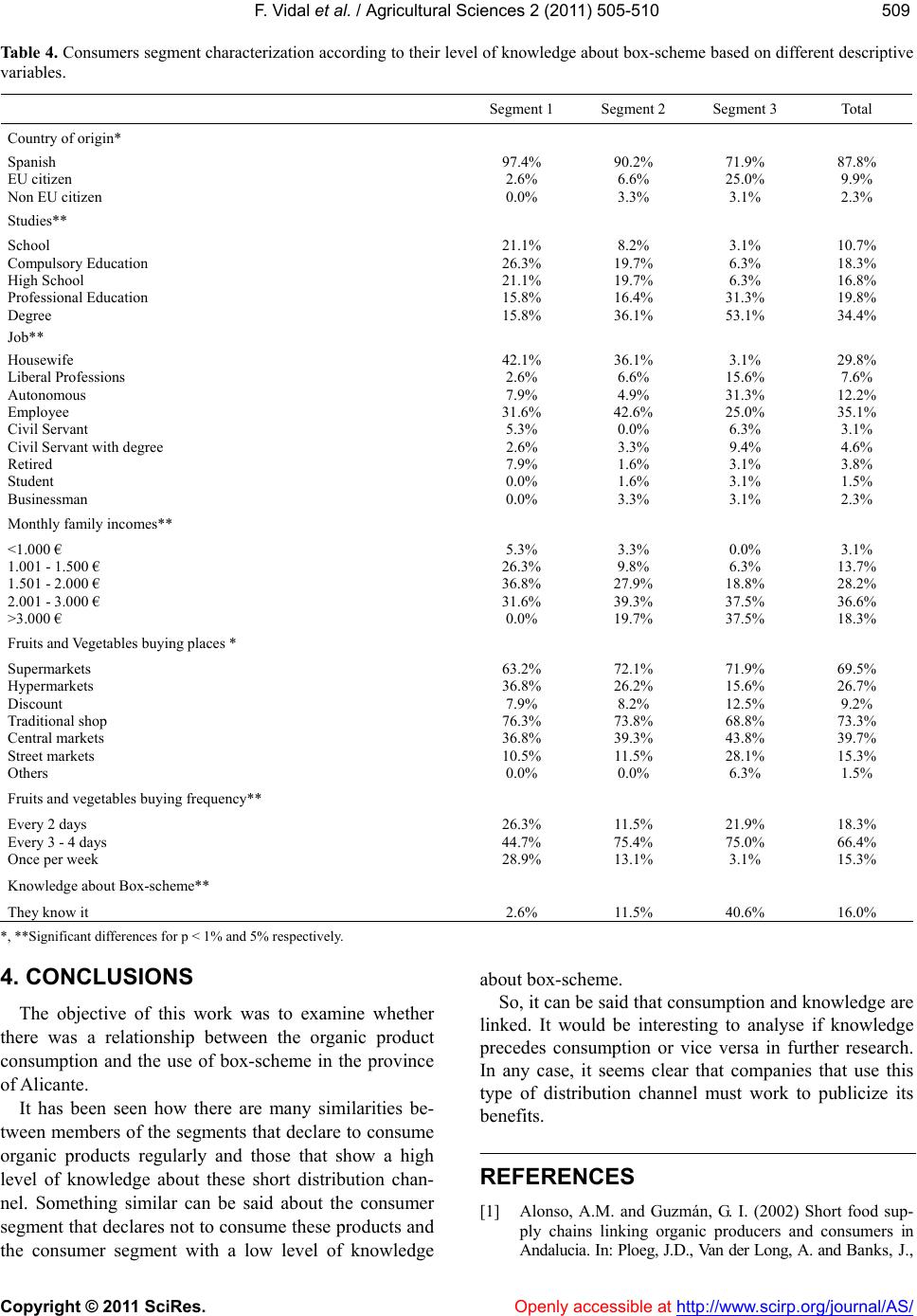 F. Vidal et al. / Agricultural Sciences 2 (2011) 505-510 Copyright © 2011 SciRes. Openly accessible at http://www.scirp.org/journal/AS/ 509509 Table 4. Consumers segment characterization according to their level of knowledge about box-scheme based on different descriptive variables. Segment 1 Segment 2 Segment 3 Total Country of origin* Spanish 97.4% 90.2% 71.9% 87.8% EU citizen 2.6% 6.6% 25.0% 9.9% Non EU citizen 0.0% 3.3% 3.1% 2.3% Studies** School 21.1% 8.2% 3.1% 10.7% Compulsory Educ ati on 26.3% 19.7% 6.3% 18.3% High School 21.1% 19.7% 6.3% 16.8% Professional Education 15.8% 16.4% 31.3% 19.8% Degree 15.8% 36.1% 53.1% 34.4% Job** Housewife 42.1% 36.1% 3.1% 29.8% Liberal Professi ons 2.6% 6.6% 15.6% 7.6% Autonomous 7.9% 4.9% 31.3% 12.2% Employee 31.6% 42.6% 25.0% 35.1% Civil Servant 5.3% 0.0% 6.3% 3.1% Civil Servant with degree 2.6% 3.3% 9.4% 4.6% Retired 7.9% 1.6% 3.1% 3.8% Student 0.0% 1.6% 3.1% 1.5% Businessman 0.0% 3.3% 3.1% 2.3% Monthly family incomes** <1.000 € 5.3% 3.3% 0.0% 3.1% 1.001 - 1.500 € 26.3% 9.8% 6.3% 13.7% 1.501 - 2.000 € 36.8% 27.9% 18.8% 28.2% 2.001 - 3.000 € 31.6% 39.3% 37.5% 36.6% >3.000 € 0.0% 19.7% 37.5% 18.3% Fruits and Vegetables buying pla c e s * Supermarkets 63.2% 72.1% 71.9% 69.5% Hypermarkets 36.8% 26.2% 15.6% 26.7% Discount 7.9% 8.2% 12.5% 9.2% Traditional shop 76.3% 73.8% 68.8% 73.3% Central markets 36.8% 39.3% 43.8% 39.7% Street markets 10.5% 11.5% 28.1% 15.3% Others 0.0% 0.0% 6.3% 1.5% Fruits and vegetables buying frequency** Every 2 days 26.3% 11.5% 21.9% 18.3% Every 3 - 4 days 44.7% 75.4% 75.0% 66.4% Once per week 28.9% 13.1% 3.1% 15.3% Knowledge about Box-sch eme** They know it 2.6% 11.5% 40.6% 16.0% *, **Significant differences for p < 1% and 5 % r espectively. 4. CONCLUSIONS The objective of this work was to examine whether there was a relationship between the organic product consumption and the use of box-scheme in the province of Alicante. It has been seen how there are many similarities be- tween members of the segments that declare to consume organic products regularly and those that show a high level of knowledge about these short distribution chan- nel. Something similar can be said about the consumer segment that declares not to consume these products and the consumer segment with a low level of knowledge about box-scheme. So, it can be said that consumption and knowledge are linked. It would be interesting to analyse if knowledge precedes consumption or vice versa in further research. In any case, it seems clear that companies that use this type of distribution channel must work to publicize its benefits. REFERENCES [1] Alonso, A.M. and Guzmán, G. I. (2002) Short food sup- ply chains linking organic producers and consumers in Andalucia . In: Ploeg, J.D., Van der Long, A. and Ba nk s , J. , 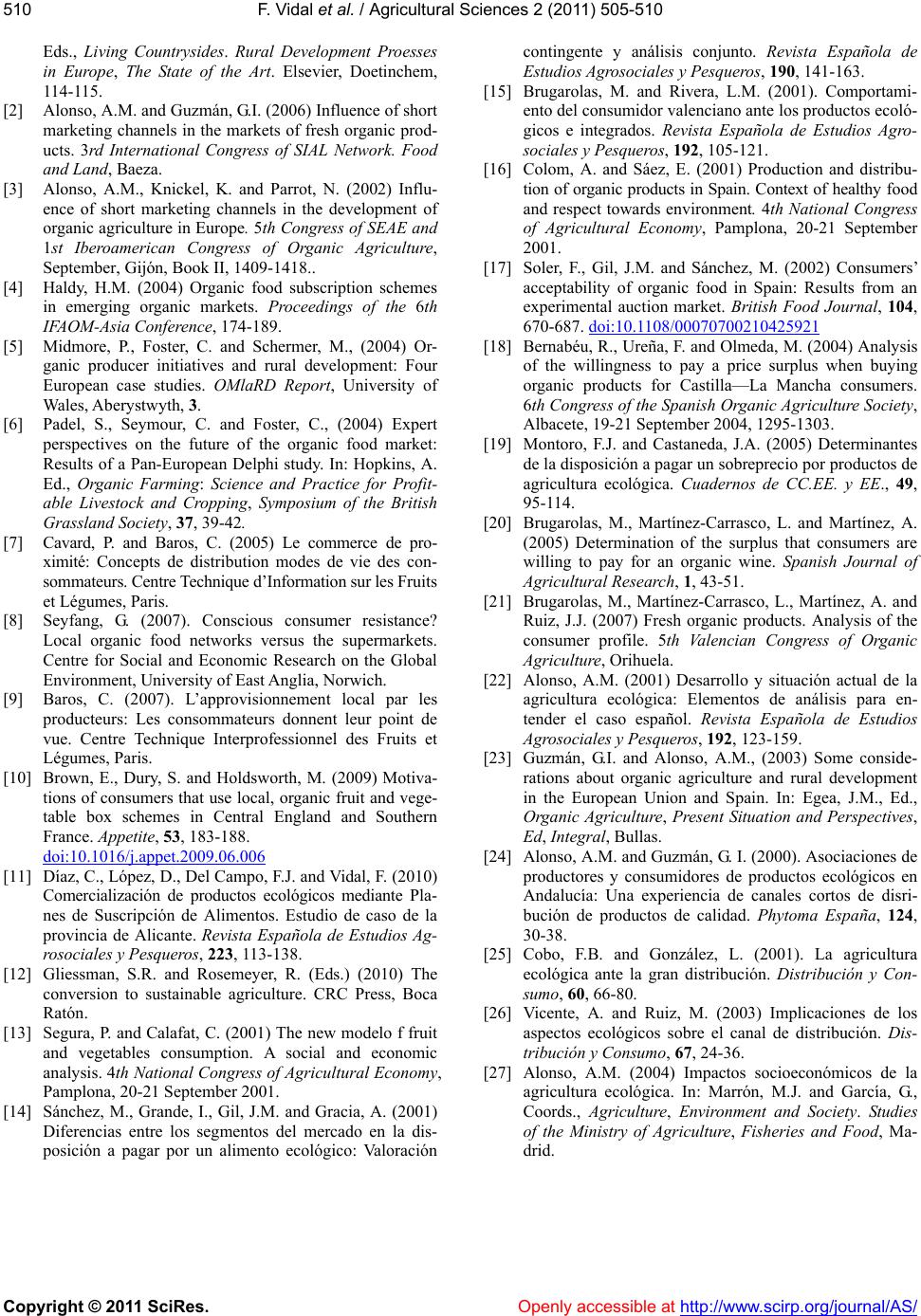 F. Vidal et al. / Agricultural Sciences 2 (2011) 505-510 Copyright © 2011 SciRes. Openly accessible at http://www.scirp.org/journal/AS/ 510 Eds., Living Countrysides. Rural Development Proesses in Europe, The State of the Art. Elsevier, Doetinchem, 114-115. [2] Alonso, A.M. and Guzmán, G.I. (2006) Influence of short marketing channels in the markets of fresh organic prod- ucts. 3rd International Congress of SIAL Network. Food and Land, Baeza. [3] Alonso, A.M., Knickel, K. and Parrot, N. (2002) Influ- ence of short marketing channels in the development of organic agriculture in Europe. 5th Congress of SEAE and 1st Iberoamerican Congress of Organic Agriculture, September, Gijón, Book II, 1409-1418.. [4] Haldy, H.M. (2004) Organic food subscription schemes in emerging organic markets. Proceedings of the 6th IFAOM-Asia Conference, 174-189. [5] Midmore, P., Foster, C. and Schermer, M., (2004) Or- ganic producer initiatives and rural development: Four European case studies. OMlaRD Report, University of Wales, Aberystwyth , 3. [6] Padel, S., Seymour, C. and Foster, C., (2004) Expert perspectives on the future of the organic food market: Results of a Pan-European Delphi study. In: Hopkins, A. Ed., Organic Farming: Science and Practice for Profit- able Livestock and Cropping, Symposium of the British Grassland Society, 37, 39-42. [7] Cavard, P. and Baros, C. (2005) Le commerce de pro- ximité: Concepts de distribution modes de vie des con- sommateurs. Centre Technique d’Information sur les Fruits et Légumes, Paris. [8] Seyfang, G. (2007). Conscious consumer resistance? Local organic food networks versus the supermarkets. Centre for Social and Economic Research on the Global Environment, University of East Anglia, Norwich. [9] Baros, C. (2007). L’approvisionnement local par les producteurs: Les consommateurs donnent leur point de vue. Centre Technique Interprofessionnel des Fruits et Légumes, Paris. [10] Brown, E., Dury, S. and Holdsworth, M. (2009) Motiva- tions of consumers that use local, organic fruit and vege- table box schemes in Central England and Southern France. Appetite, 53, 183-188. doi:10.1016/j.appet.2009.06.006 [11] Díaz, C., López, D., Del Campo, F.J. and Vidal, F. (2010) Comercialización de productos ecológicos mediante Pla- nes de Suscripción de Alimentos. Estudio de caso de la provincia de Alicante. Revista Española de Estudios Ag- rosociales y Pesqueros, 223, 113-138. [12] Gliessman, S.R. and Rosemeyer, R. (Eds.) (2010) The conversion to sustainable agriculture. CRC Press, Boca Ratón. [13] Segura, P. and Calafat, C. (2001) The new modelo f fruit and vegetables consumption. A social and economic analysis. 4th National Congress of Agricultural Economy, Pamplona, 20-21 September 2001. [14] Sánchez, M., Grande, I., Gil, J.M. and Gracia, A. (2001) Diferencias entre los segmentos del mercado en la dis- posición a pagar por un alimento ecológico: Valoración contingente y análisis conjunto. Revista Española de Estudios Agrosociales y Pesqueros, 190, 141-163. [15] Brugarolas, M. and Rivera, L.M. (2001). Comportami- ento del consumidor valenciano ante los productos ecoló- gicos e integrados. Revista Española de Estudios Agro- sociales y Pes q ueros , 192, 105-121. [16] Colom, A. and Sáez, E. (2001) Production and distribu- tion of organic products in Spain. Context of healthy foo d and respect towards environment. 4th National Congress of Agricultural Economy, Pamplona, 20-21 September 2001. [17] Soler, F., Gil, J.M. and Sánchez, M. (2002) Consumers’ acceptability of organic food in Spain: Results from an experimental auction market. British Food Journal, 104, 670-687. doi:10.1108/00070700210425921 [18] Bernabéu, R., Ureña, F. and Olmeda, M. (2004) Analysis of the willingness to pay a price surplus when buying organic products for Castilla—La Mancha consumers. 6th Congress of the Spanish Organic Agriculture Society, Albacete, 19-21 September 2004, 1295-1303. [19] Montoro, F.J. and Castaneda, J.A. (2005) Determinantes de la disposición a pagar un sobreprecio por productos de agricultura ecológica. Cuadernos de CC.EE. y EE., 49, 95-114. [20] Brugarolas, M., Martínez-Carrasco, L. and Martínez, A. (2005) Determination of the surplus that consumers are willing to pay for an organic wine. Spanish Journal of Agricultural Research, 1, 43-51. [21] Brugarolas, M., Martínez-Carrasco, L., Martínez, A. and Ruiz, J.J. (2007) Fresh organic products. Analysis of the consumer profile. 5th Valencian Congress of Organic Agriculture, Orihuela. [22] Alonso, A.M. (2001) Desarrollo y situación actual de la agricultura ecológica: Elementos de análisis para en- tender el caso español. Revista Española de Estudios Agrosociales y Pesqueros, 192, 123-159. [23] Guzmán, G.I. and Alonso, A.M., (2003) Some conside- rations about organic agriculture and rural development in the European Union and Spain. In: Egea, J.M., Ed., Organic Agriculture, Present Situation and Perspectives, Ed, Integral, Bullas. [24] Alonso, A.M. and Guzmán, G. I. (2000). Asociaciones de productores y consumidores de productos ecológicos en Andalucía: Una experiencia de canales cortos de disri- bución de productos de calidad. Phytoma España, 124, 30-38. [25] Cobo, F.B. and González, L. (2001). La agricultura ecológica ante la gran distribución. Distribución y Con- sumo, 60, 66-80. [26] Vicente, A. and Ruiz, M. (2003) Implicaciones de los aspectos ecológicos sobre el canal de distribución. Dis- tribución y Consumo, 67, 24-36. [27] Alonso, A.M. (2004) Impactos socioeconómicos de la agricultura ecológica. In: Marrón, M.J. and García, G., Coords., Agriculture, Environment and Society. Studies of the Ministry of Agriculture, Fisheries and Food, Ma- drid. |