

Paper Menu >>
Journal Menu >>
 Vol.2, No.4, 498-504 (2011) doi:10.4236/as.2011.24064 C opyright © 2011 SciRes. Openly accessible at http://www.scirp.org/journal/AS/ Agricultural Scienc es Changes of phenolic compounds in Carignan merithallus (Vitis vinifera L.) during bud dormancy and end of dormancy phase: correlation with rhizogenesis Kraiem Dardour Zohra1*, Zairi Asma1, Msaada Kamel2, Hamdi Helmi3, Ezzili Béchir1 1Biotechnology Center in Borj Cedria Technopole, Hammam-lif, T unisia; *Corresponding Author: [email protected] 2Laboratory of Bioactive Substances, Biotechnology Center in Borj Cedria Technopole, Hammam-lif, T unisia; 3Water Research and Technology Center, Borj Cédria Technopole, Soliman, Tunisia. Received 29 August 2011; revised 17 September 2011; accepted 21 October 2011. ABSTRACT The aim of the present study is to address the type of correlation that may exist between phe- nolic compounds and vine rhizogenetic poten- tial by analyzing some phenolic compounds in the Carignan merithallus. Phenolic compounds were analyzed by HPLC in the young shoots (or merithallus) of Carignan vine (Vitis vinifera L.) and we established a correlation between the studied compounds and the rhizogenetic po- tential of shoots during the phases of bud dor- mancy and end of dormancy, taking into ac- count the position effect on shoots. This work was carried out for the first time on this type of vine. Among the studied phenolic compounds, we observed a negative correlation between coumarin and rhizogenetic potential of Carignan vine. In contrast, positive correlations were found with naringin and syringic acid. Obtained re- sults confirmed the fact that the action of phe- nolic compounds is complex and might be qualified as cofactors th at interact with auxin on rhizogenesis. Keywords: Phenolic Compounds; HPLC; Carignan Shoots; Rhizogenesis 1. INTRODUCTION Polyphenols, a group of substances with a broad spec- trum of physiological activities, are spread in plants used in traditional and modern medical systems. Phenolics have been shown to have a role in tissue browning, fla- vor, and color characteristics of the derived products [1]. An understanding of phenolic composition in fresh fruit and the factors that affect phenolic compounds are criti- cal in the design of products and storage conditions [2]. Many studies have been undertaken on the phenolic acid compositions of various fruits and their related cultivars such as apples and pears [3,4], Pyrus [5,6], pome and stone fruit [7], Diospyros [8], carrots [9], and Prunus [10]. Phenolic compounds are active biological molecules having one or more benzene rings with one or more hy- droxyl functions [11]. At the plant level, phenolic com- pounds contribute to development, cell multiplication, reproduction, differen tiation, flowering, and lignification. Their content in plants depends on many genetic, phy- siological and environmental parameters [12]. Phenolic compounds accumulate mainly in the cell membrane (lignin and some flavonoids) and in vacuoles where soluble phenols such as chlorogenic acid, antho- cyanins, flavonols and tannins are stocked [13]. These compounds can participate also in the phenomenon of rhizogenesis. Some authors reported that such contribu- tion might be positive [14-17]. However, other studies showed no or negative effects of these compounds on rhizogen esi s [1 8 - 2 1]. The purpose of this work was to establish the correla- tion type that may exist between phenolic compounds and vine rhizogenetic potential by analyzing some phe- nolic compounds in the Carignan merithallus. 2. EXPERIMENT 2.1. Plant Material The influence of the sampling date on the rhizogenetic potentiality of vine merithallus has been previously studied [22], Carignan vines grown in double Guyot at the experimental station of the Obligatory Grouping of Wine Growers and Fruit Producers (GOVPF) in Baddar (Northeast Tunisia). In this study, vine shoots of various Carignan genotypes were sampled monthly on five spe- cific dates that coincide with the phenomenon of bud dormancy and end of dormancy [23]. The first sampling 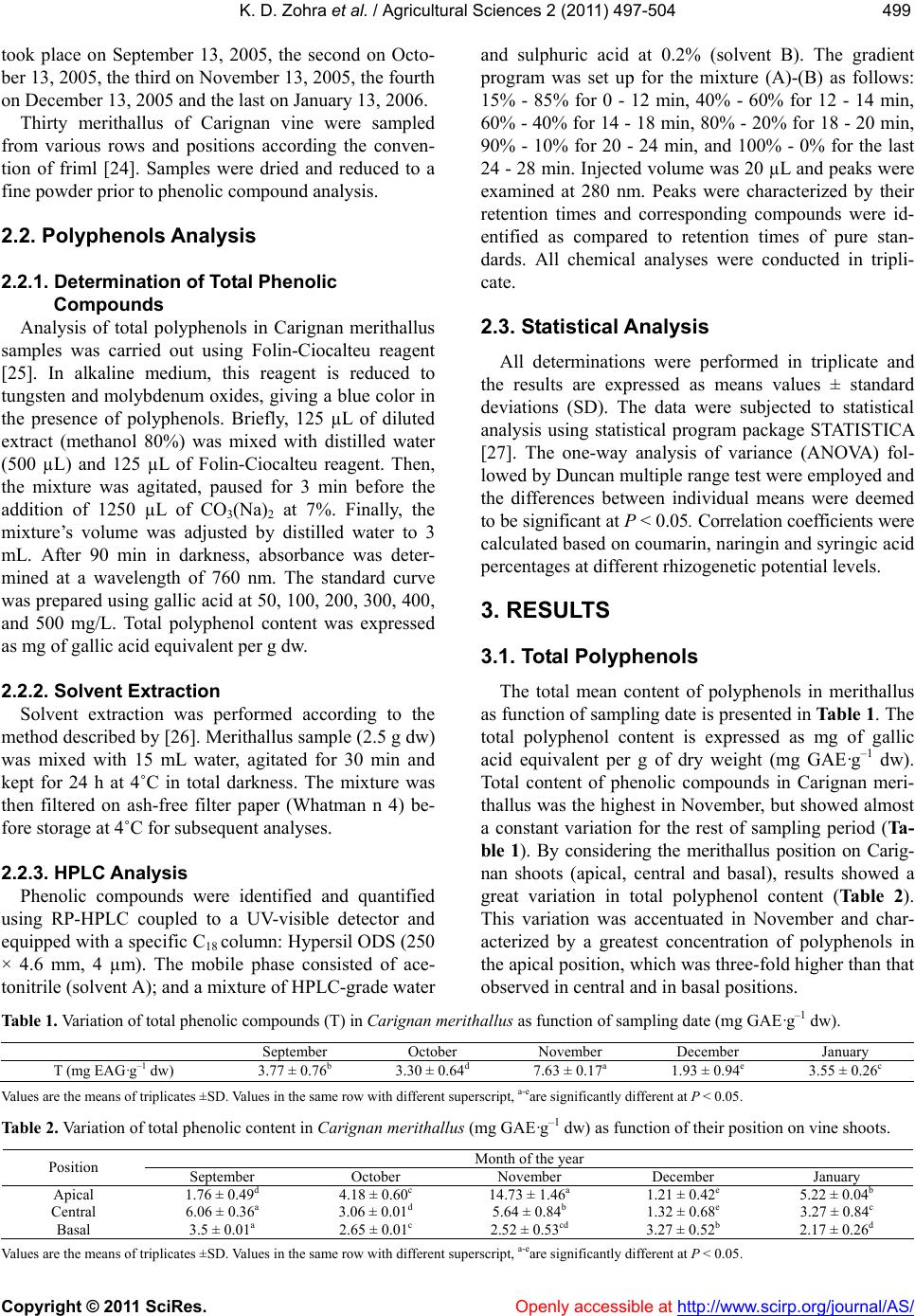 K. D. Zohra et al. / Agricultural Sciences 2 (2011) 497-504 Copyright © 2011 SciRes. Openly accessible at http://www.scirp.org/journal/AS/ 499499 took place on September 13, 2005, the second on Octo- ber 13, 2005, the th ird on November 13 , 2005, th e fourth on December 13, 2005 and the last on January 13, 2006. Thirty merithallus of Carignan vine were sampled from various rows and positions according the conven- tion of friml [24]. Samples were dried and reduced to a fine powder prior to phenolic compound analysis. 2.2. Polyphenols Analysis 2.2.1. Determination of Total Phenolic Compounds Analysis of total polyphenols in Carignan merithallus samples was carried out using Folin-Ciocalteu reagent [25]. In alkaline medium, this reagent is reduced to tungsten and molybdenum oxides, giving a blue color in the presence of polyphenols. Briefly, 125 µL of diluted extract (methanol 80%) was mixed with distilled water (500 µL) and 125 µL of Folin-Ciocalteu reagent. Then, the mixture was agitated, paused for 3 min before the addition of 1250 µL of CO3(Na)2 at 7%. Finally, the mixture’s volume was adjusted by distilled water to 3 mL. After 90 min in darkness, absorbance was deter- mined at a wavelength of 760 nm. The standard curve was prepared using gallic acid at 50, 100, 200, 3 00, 400, and 500 mg/L. Total polyphenol content was expressed as mg of gallic acid equivalent p er g dw. 2.2.2. Solvent Extraction Solvent extraction was performed according to the method described by [26]. Merithallus sample (2.5 g dw) was mixed with 15 mL water, agitated for 30 min and kept for 24 h at 4˚C in total darkness. The mixture was then filtered on ash-free filter paper (Whatman n 4) be- fore storage at 4˚C for subsequent analyses. 2.2.3. HPLC Analysis Phenolic compounds were identified and quantified using RP-HPLC coupled to a UV-visible detector and equipped with a specific C18 column: Hypersil ODS (250 × 4.6 mm, 4 µm). The mobile phase consisted of ace- tonitrile (solvent A); and a mixture of HPLC-grade water and sulphuric acid at 0.2% (solvent B). The gradient program was set up for the mixture (A)-(B) as follows: 15% - 85% for 0 - 12 min, 40% - 60% for 12 - 14 min, 60% - 40% for 14 - 18 min, 80% - 20% for 18 - 20 min, 90% - 10% for 20 - 24 min, and 100% - 0% for the last 24 - 28 min. Injected volume was 20 µL and peaks were examined at 280 nm. Peaks were characterized by their retention times and corresponding compounds were id- entified as compared to retention times of pure stan- dards. All chemical analyses were conducted in tripli- cate. 2.3. Statistical Analysis All determinations were performed in triplicate and the results are expressed as means values ± standard deviations (SD). The data were subjected to statistical analysis using statistical program package STATISTICA [27]. The one-way analysis of variance (ANOVA) fol- lowed by Duncan multiple range test were employed and the differences between individual means were deemed to be significant at P < 0.05. Correlation coefficients were calculated based on coumarin, naringin and syringic acid percentages at different rhizogenetic potential levels. 3. RESULTS 3.1. Total Polyphenols The total mean content of polyphenols in merithallus as function of sampling date is presented in Table 1. The total polyphenol content is expressed as mg of gallic acid equivalent per g of dry weight (mg GAE·g–1 dw). Total content of phenolic compounds in Carignan meri- thallus was the high est in November, but sho wed almost a constant variation for the rest of sampling period (Ta- ble 1). By considering the merithallus position on Carig- nan shoots (apical, central and basal), results showed a great variation in total polyphenol content (Table 2). This variation was accentuated in November and char- acterized by a greatest concentration of polyphenols in the apical position , which was three-fold high er than that observed in central and in basal positions. Table 1. Va riation of total phenolic compounds (T) in Carignan merithallu s as function of sampling date (mg GAE·g–1 dw). September October November December January T (mg EAG·g–1 dw) 3.77 ± 0.76b 3.30 ± 0.64d 7.63 ± 0.17a 1.93 ± 0.94e 3.55 ± 0.26c Values are the means of triplicates ±SD. Values in the same row with different superscript, a-eare significantly different at P < 0.05. Table 2. Variation of total phenolic content in Carignan merithallus (mg GAE·g–1 dw) as function of their position on vine shoots. Month of the year Position September October November December January Apical 1.76 ± 0.49d 4.18 ± 0.60c 14.73 ± 1.46a 1.21 ± 0.42e 5.22 ± 0.04b Central 6.06 ± 0.36a 3. 06 ± 0 .01d 5.64 ± 0.84b 1.32 ± 0.68e 3.27 ± 0. 84c Basal 3.5 ± 0.01a 2.65 ± 0.01c 2.52 ± 0.53cd 3.27 ± 0.52b 2.17 ± 0.26d Values are the means of triplicates ±SD. Values in the same row with different superscript, a-eare significantly different at P < 0.05. 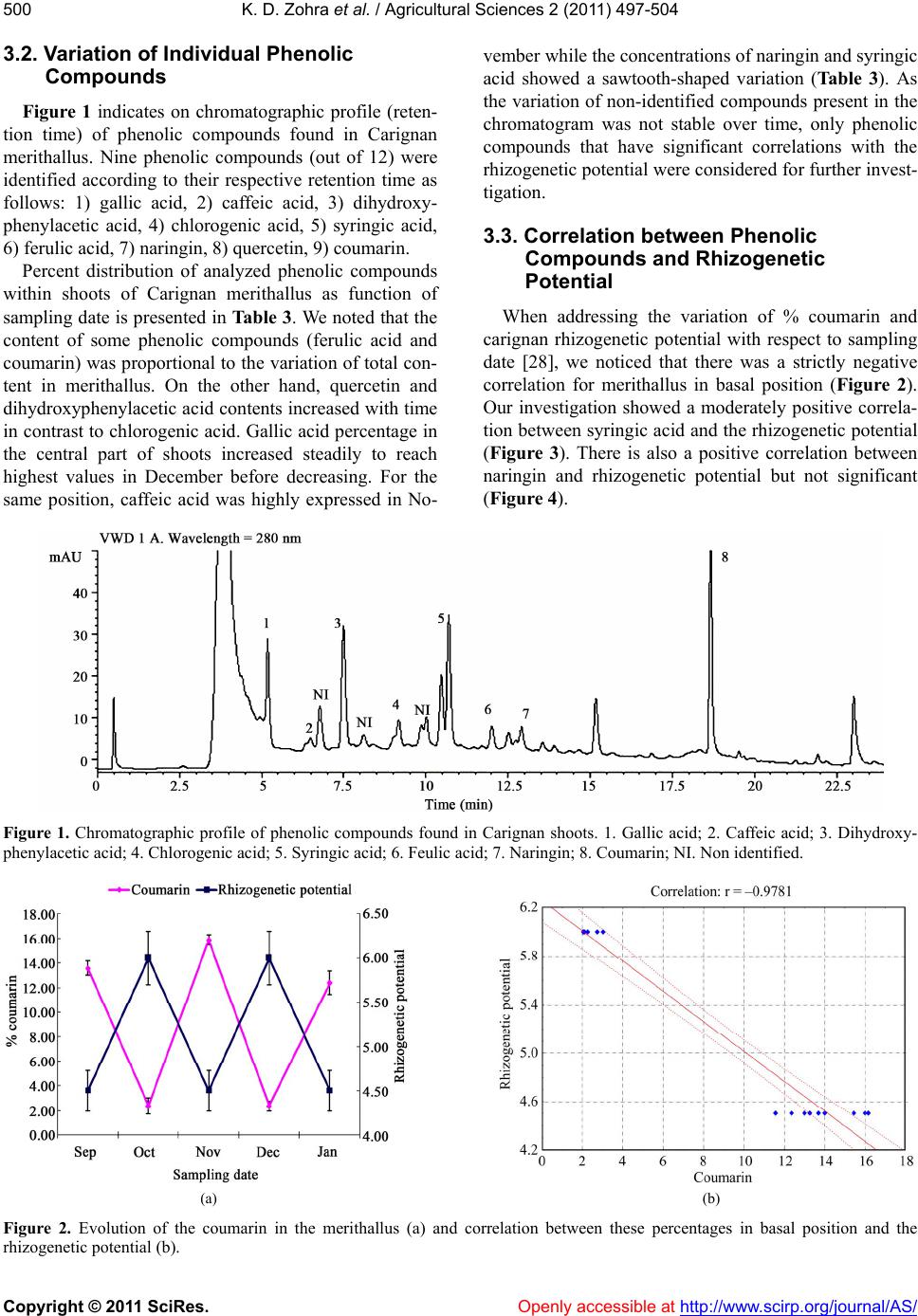 K. D. Zohra et al. / Agricultural Sciences 2 (2011) 497-504 Copyright © 2011 SciRes. Openly accessible at http://www.scirp.org/journal/AS/ 500 3.2. Variation of Individual Phenolic Compounds Figure 1 indicates on chromatographic profile (reten- tion time) of phenolic compounds found in Carignan merithallus. Nine phenolic compounds (out of 12) were identified according to their respective retention time as follows: 1) gallic acid, 2) caffeic acid, 3) dihydroxy- phenylacetic acid, 4) chlorogenic acid, 5) syringic acid, 6) ferulic acid, 7) naringin, 8) quercetin, 9) coumarin. Percent distribution of analyzed phenolic compounds within shoots of Carignan merithallus as function of sampling date is presented in Table 3. We noted that the content of some phenolic compounds (ferulic acid and coumarin) was proportional to the v ariation of total con- tent in merithallus. On the other hand, quercetin and dihydroxyphenylacetic acid contents increased with time in contrast to chlorogenic acid. Gallic acid percentage in the central part of shoots increased steadily to reach highest values in December before decreasing. For the same position, caffeic acid was highly expressed in No- vember while the concentrations of naringin and syringic acid showed a sawtooth-shaped variation (Ta bl e 3). As the variation of non-id entified compounds present in the chromatogram was not stable over time, only phenolic compounds that have significant correlations with the rhizogenetic potential were co nsidered for fu rther invest- tigation. 3.3. Correlation between Phenolic Compounds and Rhizogenetic Potential When addressing the variation of % coumarin and carignan rhizogenetic potential with respect to sampling date [28], we noticed that there was a strictly negative correlation for merithallus in basal position (Figure 2). Our investigation showed a moderately positive correla- tion between syringic acid and the rhizogenetic potential (Figure 3). There is also a positive correlation between naringin and rhizogenetic potential but not significant (Figure 4). Figure 1. Chromatographic profile of phenolic compounds found in Carignan shoots. 1. Gallic acid; 2. Caffeic acid; 3. Dihydroxy- phenylacetic acid; 4. Chlorogenic acid; 5. Syringic acid; 6. Feulic acid; 7. Naringin; 8. Coumarin; NI. Non identified. (a) (b) Figure 2. Evolution of the coumarin in the merithallus (a) and correlation between these percentages in basal position and the rhizogenetic potential (b). 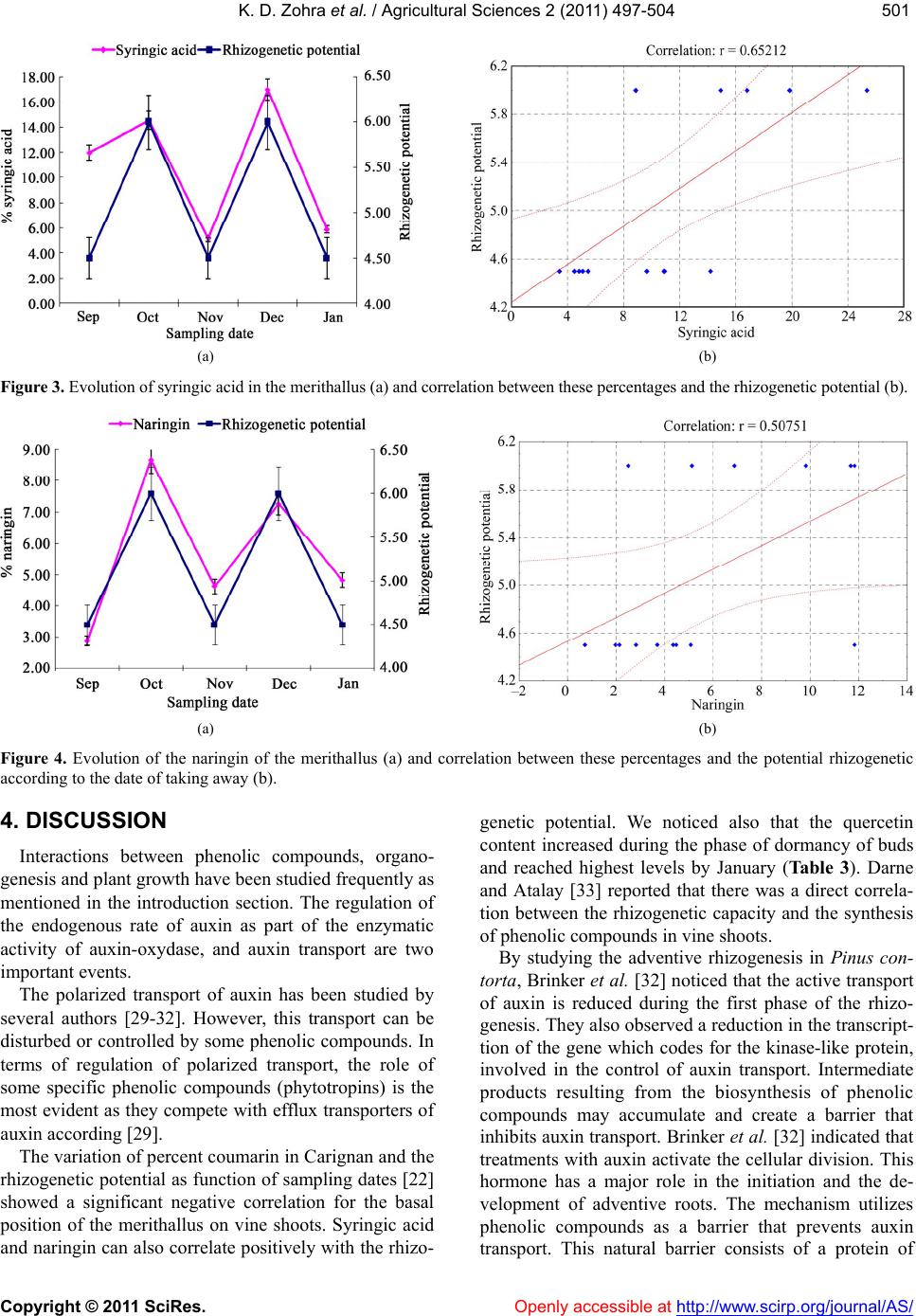 K. D. Zohra et al. / Agricultural Sciences 2 (2011) 497-504 Copyright © 2011 SciRes. Openly accessible at http://www.scirp.org/journal/AS/ 501501 (a) (b) Figure 3. Evolution of syringic acid in the merithallus (a) and correlation between these percentages and the rhizogenetic potential (b). (a) (b) Figure 4. Evolution of the naringin of the merithallus (a) and correlation between these percentages and the potential rhizogenetic according to the date of taking away (b). 4. DISCUSSION Interactions between phenolic compounds, organo- genesis and plant growth have been studied frequently as mentioned in the introduction section. The regulation of the endogenous rate of auxin as part of the enzymatic activity of auxin-oxydase, and auxin transport are two important events. The polarized transport of auxin has been studied by several authors [29-32]. However, this transport can be disturbed or controlled by some phenolic compounds. In terms of regulation of polarized transport, the role of some specific phenolic compounds (phytotropins) is the most evident as they compete with efflux transporters of auxin according [29]. The variation of percent coumarin in Carignan and the rhizogenetic potential as function of sampling dates [22 ] showed a significant negative correlation for the basal position of the merithallus on vine shoots. Syringic acid and naringin can also co rrelate positively with the rhizo- genetic potential. We noticed also that the quercetin content increased during the phase of dormancy of buds and reached highest levels by January (Ta bl e 3). Darne and Atalay [33] reported that there was a direct correla- tion between the rhizogenetic capacity and the synthesis of phenolic compounds in vine shoots. By studying the adventive rhizogenesis in Pinus con- torta, Brinker et al. [32] noticed that the active transport of auxin is reduced during the first phase of the rhizo- genesis. They also observed a reduction in the transcript- tion of the gene which codes for the kinase-like protein, involved in the control of auxin transport. Intermediate products resulting from the biosynthesis of phenolic compounds may accumulate and create a barrier that inhibits auxin transport. Brinker et al. [32] indicated that treatments with auxin activate the cellular division. This hormone has a major role in the initiation and the de- velopment of adventive roots. The mechanism utilizes phenolic compounds as a barrier that prevents auxin transport. This natural barrier consists of a protein of  K. D. Zohra et al. / Agricultural Sciences 2 (2011) 497-504 Copyright © 2011 SciRes. Openly accessible at http://www.scirp.org/journal/AS/ 502 alue Table 3. Percent distribution (%, w/w) of analyzed phenolic compounds within shoots of Carignan merithallus as function of sampling date. Vs are the means of triplicates ±SD. Values in the same row with different superscript, a-kare significantly different at P < 0.05. Co mp ou nd s : 1: Gallic acid, 2: cafeic ac i d, 3: NI, 4: dihy droxypheny l ac et i c acid, 5: N I, 6: chlorogenic acid, 7: NI, 8: syringic acid, 9: ferrulic acid, 10: Naringin, 11: Coumarin.  K. D. Zohra et al. / Agricultural Sciences 2 (2011) 497-504 Copyright © 2011 SciRes. Openly accessible at http://www.scirp.org/journal/AS/ 503503 having a flavonolic origin [30,32] noticed that the tran- scription of the gene coding for this enzyme is affected during the pha se of radial primordial formation. 5. CONCLUSIONS The evolution of phenolic compounds was studied on Carignan merithallus during the phases of bud dormancy and end of dormancy. Our outcomes indicate that rhizo- genesis coincides with quercetin synthesis. This phenolic compound belongs to the class of phytotropins according to Brunn et al. [29]. We observed also a negative corre- lation between coumarin and rhizogenetic potential of Carignan vine. In contrast, positive correlations were found with naringin and syringic acid. REFERENCES [1] Ho, C.T., Lee, C.Y. and Houng, M.T. (1992) Phenolic compounds in food and their effects on health. I. Analy- sis, occurrence, and chemistry. ACS Symposium Series, 506. [2] Oleszek, W., Amiot, M.J. and Aubert, S.Y. (1994) Identi- fication of some phenolics in pear fruit. Journal of Agri- cultural and Food Chemistry, 42, 1261-1265. doi:10.1021/jf00042a002 [3] Amiot, M.J., Aubert, S. and Nicolas, J. (1993) Phenolic composition and browning susceptibility of various apple and pear cultivars at maturity and postharvest. Acta Hor- ticultureae, 343, 67-69. [4] Blankenship, S.M. and Richardson, D.G. (1985) Ch an ges i n phenolic acids and external ethylene during long-term cold storage of pears. Journal of American Society of Horticulturea Science, 110, 336-339. [5] Challice, J.C. and A.H. Williams, (1968) Phenolic com- pounds of genus Pyrus-II. A chemotaxonomic survey. Phytochemistry, 7, 1781. doi:10.1016/S0031-9422(00)86651-0 [6] Challice, J.C. and Williams, A.H. (1972) Phenolic com- pounds of genus Pyrus. Phytochemistry, 11, 37-44. doi:10.1016/S0031-9422(00)89964-1 [7] Risch, B. and Hermann, K. (1989) Contents of hydroxy- cinnamic acid derivates and catechins in pome and stone fruits. Zeitschrift Fuer Lebensmittel-Untersuchung Und -forschung, 186, 225-230. doi:10.1007/BF01043317 [8] Ayaz, F.A., Kadioglu, A. and Reunanen, M. (1997) Changes in phenolic acid contents of Diospyros lotus L. during fruit development. Journal of Agricultural and Food Chemistry, 45, 2539-2541. doi:10.1021/jf960741c [9] Babic, I., Amiot, M.J., Nguyen-The, C. and Aubert, S. (1993) Changes in phenolic content in fresh readyto-use shredded carrots during storage. Journal of Food Science, 58, 351-356. doi: 10. 1111/j .1365-2621.1993.tb04273.x [10] Nortje, B.K. and Koeppen, B.H. (1965) The flavanol glycosides in the fruit of Prunus communis L. cultivar Bon Chrestien. Biochemist r y J ournal, 95, 209-211. [11] Manach, C., Scalbert, A., Morand, C., Rémésy, C. and Jiménez, L. (2004) Polyphenols: Food sources and bioa- vailability. American Journal of Clinical Nutrition, 79, 727-747. [12] Balasundram, N., Sundram, K. and Samman, S. (2007). Phenolic compounds in plants and agri-industrial by products: Antioxidant activity, occurrence, and potential uses. Food Chemistry, 99, 191-203. doi:10.1016/j.foodchem.2005.07.042 [13] Peer, W.A, Brown, D.E., Tague, B.W., Muday, G.K. and Murpky, A.S. (2001) Flavonoid accumulation patterns of transparent testa mutants of Arabidopsis. Plant Physiol- ogy, 126, 536-548. doi:10.1104/pp.126.2.536 [14] HESS, C.E. (1962) A physiological analysis of root ini- tiation in easy and difficult to root cuttings. 16th Interna- tional Horticutureae Congress, 4, 375-381. [15] Bachelard, E.P. and Stowe, B. (1963) Rooting of cuttings of Acer rubrum L. and eucalyptus camaldulensis Delh. Australian Journal of Biological Science, 16, 751-767. [16] Arnold, A.W. and Albert, L.S. (1964) Chemical factors affecting anthocyanin formation and morphogenesis in cultured hypocotyl segments of impatiens balsamina. Plant Physiology, 39, 307-312. doi:10.1104/pp.39.3.307 [17] Stafford, H.A. (1968) Relationships between the devel- opment of adventitous roots and biosynthesis of antho- cyanins in first internodes of Sorghum. Plant Physiology, 43, 318-326. doi:10.1104/pp.43.3.318 [18] Tomaszewski, M. (1964) The mecanism of synergistic effects between auxin and some natural phenolic sub- stances. Colloque International C.N.R.S., 123, 335-351. [19] Bachelard, E.P. (1965) The interrelations between root formation and anthocyanin synthesis in red maple cutting: Effects of gibberelic acid, CCC and 8 azaguanine. Aus- tralian Journal of Biol o g i ca l Science, 18, 699-702. [20] Fernqvist, I. (1966) Studies on factors in adventitious root formation. Lantbruskshgskol Ann als, 32, 109-244 . [21] Paupardin, C. (1969) Sur le moment d’action de l’acide caféique dans la rhizogenèse de fragments de tubercules de Tapinambour cultivé in vitro. Comptes. Rendues de l’Académie des Sciences, Paris, 269, 1532-1534 . [22] Kraeim, Z., Bouzazi, R. and Ezzili, B. (2006) Influence of collection date on rhyzogenetic potentiality of Muscat d’Italy (Vitis vinifera L.) cultivated on sandy substrate. Arid Zones Workshop Communications, December 2006, Djerba T un isia. [23] Ezzili, B. (2001) Essai de régulation du fonctionnement du méristème terminal, de la dormance des bourgeons et de l’initiation florale de Vitis vinifera L. Thèse de doctorat d’état, Faculté Des Sciences, Université Tunis El Manar, 187. [24] Friml, J. and Murphy, A.S. (2006) Nomenclature for apical/basal polarity in plants. In: Taiz, L. and Zeiger, E., Eds., Plant Physiology, 4th Edition, Web Essay, Sinauer Associates, Sunderland. [25] Dewanto, V., Wu, X., Adom, K.K and Liu, R.H. (2002) Thermal processing enhaces the nutritional value of to- matoes by increasing total antioxidant activity. Journal of Agricultural and Food Chemistry, 50, 3010-3014. doi:10.1021/jf0115589 [26] Mau, J.L., Chao, G.R. and Wu, K.T. (2001) Antioxidant properties of methanolic extracts from several ear mush- rooms. Journal of Agricultural and Food Chemistry, 49, 5461-5467. doi:10.1021/jf010637h [27] Statsoft, (1998) STATISTICA for Windows (Computer  K. D. Zohra et al. / Agricultural Sciences 2 (2011) 497-504 Copyright © 2011 SciRes. Openly accessible at http://www.scirp.org/journal/AS/ 504 program electronic manual). StatSoft Inc, Tulsa. [28] Kraiem, Z., Aidi, W., Zairi, A. and Ezzili, B. (2010) Ef- fect of cutting date and position on rooting ability and fatty acid composition of Carignan (Vitis vinifera L.) shoot. Scientia Horti c ul t u ra e, 125, 146-150. doi:10.1016/j.scienta.2010.03.008 [29] Brunn, S.A., Munday, G.K. and Haworth, P. (1992) Auxin transport and the interraction of phytotropins. Plant Phyisiology, 98, 101-107. doi:10.1104/pp.98.1.101 [30] Mylona, P., Moerman, M., Yang, W.C., Gloudemans, T., Van De Kerckhove, J.A., Van Kammen, A., Bisseling, T. and Franssen, H.J. (1994) The root epidermis specific pea gene RH2 is homologous to a pathogenesis-related gene. Plant Molecular Biology, 26, 39-50. doi:10.1007/BF00039518 [31] Insight (2002) An emerging model of auxin transport regulation. The Plant Cell, 14, 293-299. [32] Brinker, M., Brinker, L. Van Zyl, W., Liu, D. and Craig, R.R. (2004). Microarray analyses of gene expression during adventitious root development in Pinus contorta. Plant Physiology, 135, 1526-1539. doi:10.1104/pp.103.032235 [33] Darne, G. and Atalay, D. (1977) Relationship between the synthesis of phenolic compounds and fatty acids in vine cuttings, and rooting ability. Connaissance de la Vigne et du Vin, 11, 287-293. |