

Paper Menu >>
Journal Menu >>
 International Journal of Geosciences, 2011, 2, 669-675 doi:10.4236/ijg.2011.24068 Published Online November 2011 (http://www.SciRP.org/journal/ijg) Copyright © 2011 SciRes. IJG 669 Degradation of Gesaprim Herbicide by Heterogeneous Photocatalysis Using Fe-Doped TiO2 Noemí Acevedo Quiroz1, Dulce Jocelyn Ramos Gutierrez1, Susana Silva Martínez2, Cristina Lizama Bahena1 1Posgrado de la Facultad de Ciencias Químicas e Ingeniería y Centro de Investigación en Ingeniería y Ciencias Aplicadas, Universid ad Autónoma del Estado de Morelos, Cuernavaca, Mexico 2Centro de Investigación en Ingeniería y Ciencias Aplicadas, Universidad Autónoma del Estado de Morelos, Cuernavaca, Mexico E-mail: [email protected] Received June 21, 2011; revised August 7, 2011; accepted September 26, 2011 Abstract Fe-doped TiO2 was prepared by the sol gel method and characterized by X-ray diffraction. All the Fe-doped TiO2 were composed of an anatase crystal form. The activity of the Fe-doped TiO2 for the degradation of the gesaprim commercial herbicide (which contains atrazine as active compound and formulating agents) was studied by varying the iron content during UV (15 W), visible light and solar irradiations. The visible light came from commercial saving energy lamps (13, 15 and 20 Watts). The gesaprim degradation rate depended on the iron content in the photo catalyst. The Fe-doped TiO2 (0.5% by weight of TiO2) showed higher TOC removal under visible light and was more active than the undoped TiO2 photo catalyst under the light irradia- tion sources tested. Over 90% of chemical oxygen demand abatement was achieved with both UV and visi- ble light but less time was required to decrease the chemical oxygen demand content by using the catalyst doped with iron at 0.5% under visible light. It was observed that the degradation of gesaprim increased by increasing the iron content in the catalyst under visible light. Keywords: Atrazine, Iron Doped TiO2, Solar Irradiation, Visible Light Irradiation 1. Introduction Nowadays, the use of herbicides in agriculture activities to control weedy plants and to increase food production has become an important tool to the detriment of the en- vi- ronment. The herbicides and their degradation products (complex metabolites) may alter the natural habitats for different plant and animal species depending on how they are transported in the environment. Chlorinated tri- azines are herbicides widely used for selective weed control, and are amongst the most commonly used herbicides in the world [1]. The main compound of this family is the atrazine (2-chloro-4-ethylamino-6-isopropylamino-s-triazine) and it is found in the environment contaminating soil and water reserves [2]. This herbicide belongs to the persistent or- ganic pollutants because of its low biodegradability and long half-life (60 and 100 days) in water. Several processes have been developed to remove atrazine from aqueous wastes, such as activated carbon and its combination with ozone [3,4], adsorption onto carbon nanotubes [5], adsorption onto zeolites [6], ad- sorption on fractionated Al-pillared and Fe-Al-pillared clays [7], photochemical degradation in the presence of hydrogen peroxide and microwave [8], reverse osmosis [9], ozone [10], hydrogen peroxide with ozone [11], elec- tro-Fenton [12], Fenton and photo-Fenton [13], photoly- sis by TiO2 semiconductor [14-18], atrazine by nanoscale zero valent iron supported on organobentonite [19], and hydrogen peroxide with TiO2, and Fe2O3 semiconductor suspensions assisted by light [20-22], among others. Amongst the treatment methods, the semiconductor photocatalytic process for the photocatalytic oxidation mediated by titanium dioxide appears to be an effective strategy for degrading chlorinated triazine herbicides because the semiconductor has shown a great potential as a low-cost, and environmental friendly alternative for wastewater treatment. Besides, this advanced oxidation process has been widely demonstrated to remove persis- tent organic compounds and microorganisms in water. The photocatalytic oxidation of s-triazine herbicides and  670 N. A. QUIROZ ET AL. the pathways of their degradation intermediates have been reported by several studies [22,23]. It has been con- cluded that the oxidation of the lateral chains and subse- quent disappearance of the initial compound is very fast, but the formation of the final product (cyanuric acid) may require a long irradiation time [23]. Also, it has been reported that complete mineralization of atrazine could not be attained because of the stability of the s- triazine ring toward oxidation which only affects the lateral chains with 5 of the 8 carbons removed as CO2. Hustert et al. studied the photocatalytic treatment of atrazine herbicide, and also other s-triazine herbicides (simazine, and cyanzine) [19]. These researchers re- ported that the degradation of the s-triazines occurred in various steps with cyanuric acid was formed as end product of degradation. Hequet et al. studied the photo- lytic degradation of atrazine and found that the UV photolysis was efficient [24]. They reported that the main degradation pathway was deshalogenation and hydroxya- trazine was generated as the main intermediate with cyanuric acid as the final end product. These authors also studied the photocatalytic degradation of atrazine, and found that the major intermediates were desalkylated compounds with cyanuric acid as the final degradation product. McMurray and coworkers reported that the pri- mary pathway for atrazine degradation on nanoparticu- late TiO2 films involved the oxidation of the lateral side chains of atrazine, producing dealkylated derivatives (2- chloro-4-acctamido-6-isopropylamino-1,3,5-triazine, 2- chloro-4-ethylamino-6-(2-propanol)amino-1,3,5-triazine, 2-chlor o-4-ethyla mino-6 -(2-propanol)amino-1,3,5-triazin e, desethylatrazine, deisopropylatrazine and desethylde- sisopropyl atrazine) [16]. They also reported that the hydrolysis of the chlorine substituent in desethylatrazine, desethyldesisopropyl atrazine and deisopropylatrazine led to the production of 2-hydroxydesethyl atrazine with the further displacement of the amino groups by hy- droxyl groups resulting in cyanuric acid. These authors proposed a secondary pathway which follows a hy- droxylated pathway with immediate substitution of the chlorine at position two with a hydroxyl group. They neither observed complete mineralization of atrazine nor photolysis of atrazine either with the UVA or UVB source. Peñuela and Barceló studied the photo degrada- tion of atrazine and desethylatrazine in water with TiO2/ H2O2 and FeCl3/H2O2 by using a xenon arc lamp and sunlight irradiation [25]. These authors reported that atrazine degraded faster than desethylatrazine in the presence of FeCl3 using both light sources with half-lives varying from 5 to 11 min and from 19 to 26 min, respec- tively. Měšt’ánková et al., reported that the degradation rate of the herbicide monuron was enhanced when TiO2 was in contact with Fe(III) (from Fe(ClO4)3) because the Fe(III) acted as scavenger of electrons photogenerated in TiO2 particles which let down hole–electron recombina- tion [26]. The doping with small amounts of metal impurities aims at facing one relevant drawback of TiO2, which is its poor absorption of visible light. Enhanced visible light absorption has been reported in the presence of transition metals [27,28], nitrogen and carbon as dopants [29]. It was reported that the UV-Vis absorption studies showed significantly enhanced red-shift in UV-Vis absorption spectra with an increased amount of iron [30,31]. The photocatalytic activity of nano-sized Fe-doped TiO2, examined by the mineralization of oxalic acid under visible light irradiation, showed highest activity with 2% of Fe-doped TiO2 [31]. However, it was reported that the photocatalytic efficiency of metal doped TiO2 strongly depends on the conditions of preparation, on the mor- phostructural properties (crystalline structure, specific surface area) and on the type of the organic pollutant to be photooxidized. The aim of this work was to synthesize TiO2 and iron- doped TiO2 with the sol-gel method and to study the ef- ficiency of Fe-doped titania suspensions in the photo- catalytic degradation of the gesaprim commercial herbi- cide under UV light, visible light and solar light. Ge- saprim, herbicide used for the control of broadleaf weeds and some grassy weeds, contains atrazine as active com- pound and formulating agents as additional components. 2. Material and Methods 2.1. Chemicals Gesaprim herbicide (90 GDA) was directly purchased from Syngenta Crop Protection Inc. (USA); the gesaprim contained 90% of atrazine as active ingredient. Titanium tetrabutoxide (Ti(OC4H9)4), anhydride ethanol, distilled water, ferric chloride (FeCl3), HNO3 and H2SO4 were analytical grade (Sigma-Aldrich). All chemicals were used as received without further purification. 2.2. Synthesis of Fe-Modified TiO2 Photo Catalyst The Fe-doped TiO2 catalyst was prepared by the sol–gel method as below: A mixture of H2O (1.25 ml), HCl (0.5 ml), C2H6O (5 ml) and FeCl3 (different iron amounts) was prepared with stirring for 5 min. Separately, Ti(OC4H9)4 solution at a concentration of 44.7 g/l ex- pressed as TiO2 was added drop wise to 22.5 ml C2H6O solution (99.9%) with stirring under nitrogen atmosphere, this solution was kept under stirring during 20 min. Then, the iron mixture was added drop by drop to the ethanol- C opyright © 2011 SciRes. IJG 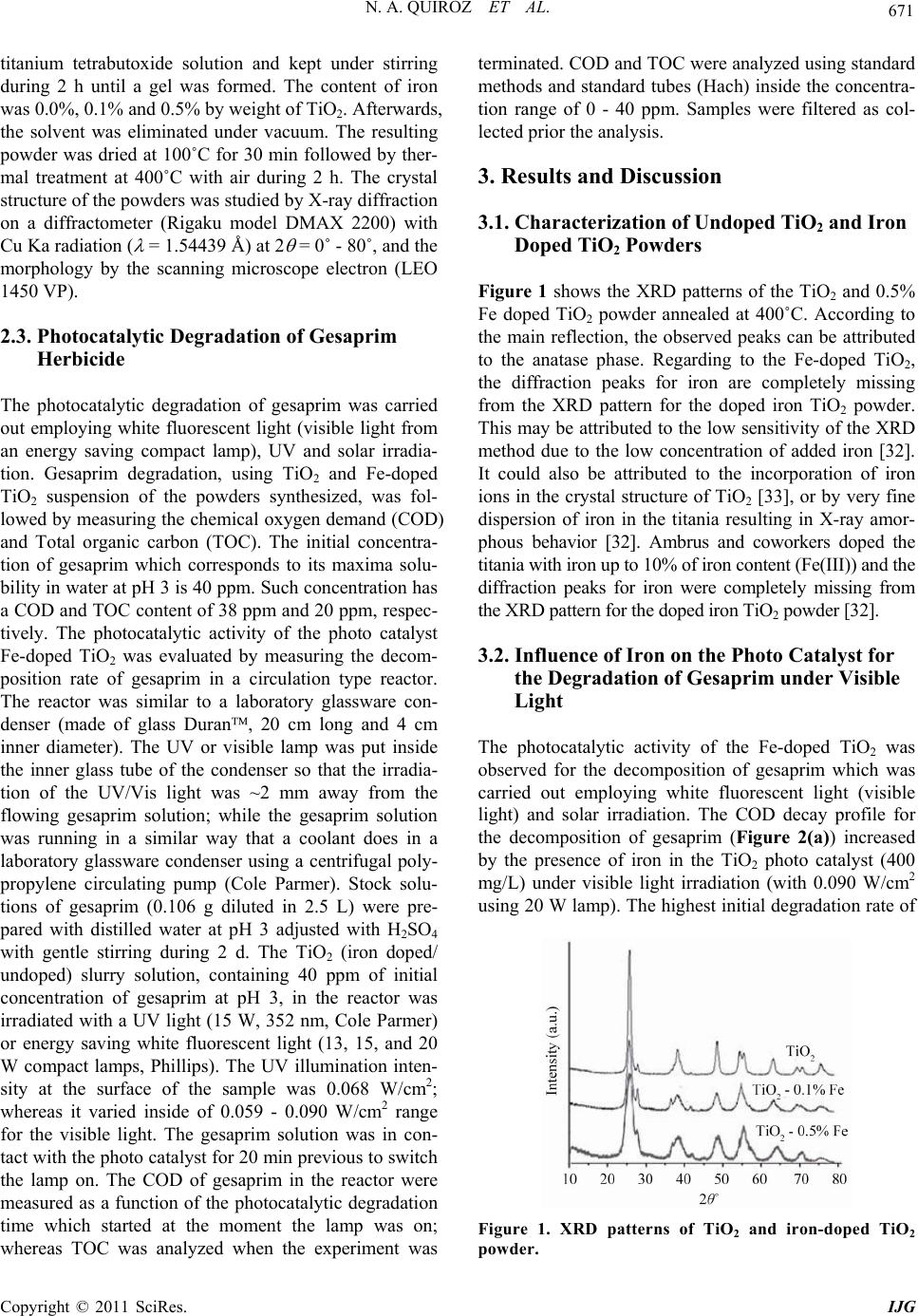 671 N. A. QUIROZ ET AL. titanium tetrabutoxide solution and kept under stirring during 2 h until a gel was formed. The content of iron was 0.0%, 0.1% and 0.5% by weight of TiO2. Afterwards, the solvent was eliminated under vacuum. The resulting powder was dried at 100˚C for 30 min followed by ther- mal treatment at 400˚C with air during 2 h. The crystal structure of the powders was studied by X-ray diffraction on a diffractometer (Rigaku model DMAX 2200) with Cu Ka radiation ( = 1.54439 Å) at 2 = 0˚ - 80˚, and the morphology by the scanning microscope electron (LEO 1450 VP). 2.3. Photocatalytic Degradation of Gesaprim Herbicide The photocatalytic degradation of gesaprim was carried out employing white fluorescent light (visible light from an energy saving compact lamp), UV and solar irradia- tion. Gesaprim degradation, using TiO2 and Fe-doped TiO2 suspension of the powders synthesized, was fol- lowed by measuring the chemical oxygen demand (COD) and Total organic carbon (TOC). The initial concentra- tion of gesaprim which corresponds to its maxima solu- bility in water at pH 3 is 40 ppm. Such concentration has a COD and TOC content of 38 ppm and 20 ppm, respec- tively. The photocatalytic activity of the photo catalyst Fe-doped TiO2 was evaluated by measuring the decom- position rate of gesaprim in a circulation type reactor. The reactor was similar to a laboratory glassware con- denser (made of glass Duran, 20 cm long and 4 cm inner diameter). The UV or visible lamp was put inside the inner glass tube of the condenser so that the irradia- tion of the UV/Vis light was ~2 mm away from the flowing gesaprim solution; while the gesaprim solution was running in a similar way that a coolant does in a laboratory glassware condenser using a centrifugal poly- propylene circulating pump (Cole Parmer). Stock solu- tions of gesaprim (0.106 g diluted in 2.5 L) were pre- pared with distilled water at pH 3 adjusted with H2SO4 with gentle stirring during 2 d. The TiO2 (iron doped/ undoped) slurry solution, containing 40 ppm of initial concentration of gesaprim at pH 3, in the reactor was irradiated with a UV light (15 W, 352 nm, Cole Parmer) or energy saving white fluorescent light (13, 15, and 20 W compact lamps, Phillips). The UV illumination inten- sity at the surface of the sample was 0.068 W/cm2; whereas it varied inside of 0.059 - 0.090 W/cm2 range for the visible light. The gesaprim solution was in con- tact with the photo catalyst for 20 min previous to switch the lamp on. The COD of gesaprim in the reactor were measured as a function of the photocatalytic degradation time which started at the moment the lamp was on; whereas TOC was analyzed when the experiment was terminated. COD and TOC were analyzed using standard methods and standard tubes (Hach) inside the concentra- tion range of 0 - 40 ppm. Samples were filtered as col- lected prior the analysis. 3. Results and Discussion 3.1. Characterization of Undoped TiO2 and Iron Doped TiO2 Powders Figure 1 shows the XRD patterns of the TiO2 and 0.5% Fe doped TiO2 powder annealed at 400˚C. According to the main reflection, the observed peaks can be attributed to the anatase phase. Regarding to the Fe-doped TiO2, the diffraction peaks for iron are completely missing from the XRD pattern for the doped iron TiO2 powder. This may be attributed to the low sensitivity of the XRD method due to the low concentration of added iron [32]. It could also be attributed to the incorporation of iron ions in the crystal structure of TiO2 [33], or by very fine dispersion of iron in the titania resulting in X-ray amor- phous behavior [32]. Ambrus and coworkers doped the titania with iron up to 10% of iron content (Fe(III)) and the diffraction peaks for iron were completely missing from the XRD pattern for the doped iron TiO2 powder [32]. 3.2. Influence of Iron on the Photo Catalyst for the Degradation of Gesaprim under Visible Light The photocatalytic activity of the Fe-doped TiO2 was observed for the decomposition of gesaprim which was carried out employing white fluorescent light (visible light) and solar irradiation. The COD decay profile for the decomposition of gesaprim (Figure 2(a)) increased by the presence of iron in the TiO2 photo catalyst (400 mg/L) under visible light irradiation (with 0.090 W/cm2 using 20 W lamp). The highest initial degradation rate of Figure 1. XRD patterns of TiO2 and iron-doped TiO2 powder. Copyright © 2011 SciRes. IJG 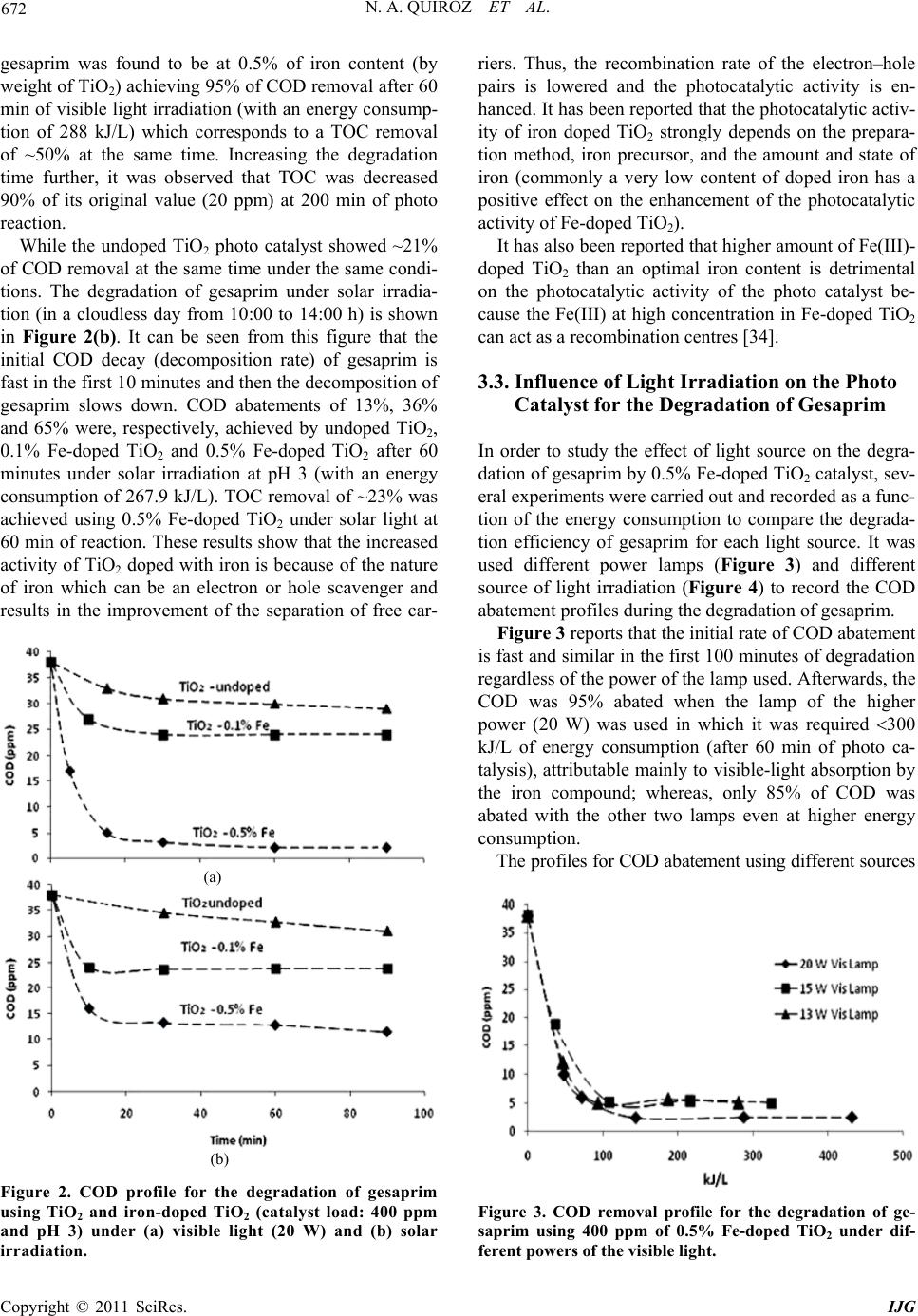 672 N. A. QUIROZ ET AL. gesaprim was found to be at 0.5% of iron content (by weight of TiO2) achieving 95% of COD removal after 60 min of visible light irradiation (with an energy consump- tion of 288 kJ/L) which corresponds to a TOC removal of ~50% at the same time. Increasing the degradation time further, it was observed that TOC was decreased 90% of its original value (20 ppm) at 200 min of photo reaction. While the undoped TiO2 photo catalyst showed ~21% of COD removal at the same time under the same condi- tions. The degradation of gesaprim under solar irradia- tion (in a cloudless day from 10:00 to 14:00 h) is shown in Figure 2(b). It can be seen from this figure that the initial COD decay (decomposition rate) of gesaprim is fast in the first 10 minutes and then the decomposition of gesaprim slows down. COD abatements of 13%, 36% and 65% were, respectively, achieved by undoped TiO2, 0.1% Fe-doped TiO2 and 0.5% Fe-doped TiO2 after 60 minutes under solar irradiation at pH 3 (with an energy consumption of 267.9 kJ/L). TOC removal of ~23% was achieved using 0.5% Fe-doped TiO2 under solar light at 60 min of reaction. These results show that the increased activity of TiO2 doped with iron is because of the nature of iron which can be an electron or hole scavenger and results in the improvement of the separation of free car- (a) (b) Figure 2. COD profile for the degradation of gesaprim using TiO2 and iron-doped TiO2 (catalyst load: 400 ppm and pH 3) under (a) visible light (20 W) and (b) solar irradiat ion. riers. Thus, the recombination rate of the electron–hole pairs is lowered and the photocatalytic activity is en- hanced. It has been reported that the photocatalytic activ- ity of iron doped TiO2 strongly depends on the prepara- tion method, iron precursor, and the amount and state of iron (commonly a very low content of doped iron has a positive effect on the enhancement of the photocatalytic activity of Fe-doped TiO2). It has also been reported that higher amount of Fe(III)- doped TiO2 than an optimal iron content is detrimental on the photocatalytic activity of the photo catalyst be- cause the Fe(III) at high concentration in Fe-doped TiO2 can act as a recombination centres [34]. 3.3. Influence of Light Irradiation on the Photo Catalyst for the Degradation of Gesaprim In order to study the effect of light source on the degra- dation of gesaprim by 0.5% Fe-doped TiO2 catalyst, sev- eral experiments were carried out and recorded as a func- tion of the energy consumption to compare the degrada- tion efficiency of gesaprim for each light source. It was used different power lamps (Figure 3) and different source of light irradiation (Figure 4) to record the COD abatement profiles during the degradation of gesaprim. Figure 3 reports that the initial rate of COD abatement is fast and similar in the first 100 minutes of degradation regardless of the power of the lamp used. Afterwards, the COD was 95% abated when the lamp of the higher power (20 W) was used in which it was required 300 kJ/L of energy consumption (after 60 min of photo ca- talysis), attributable mainly to visible-light absorption by the iron compound; whereas, only 85% of COD was abated with the other two lamps even at higher energy consumption. The profiles for COD abatement using different sources Figure 3. COD removal profile for the degradation of ge- saprim using 400 ppm of 0.5% Fe-doped TiO2 under dif- ferent powers of the visible light. C opyright © 2011 SciRes. IJG 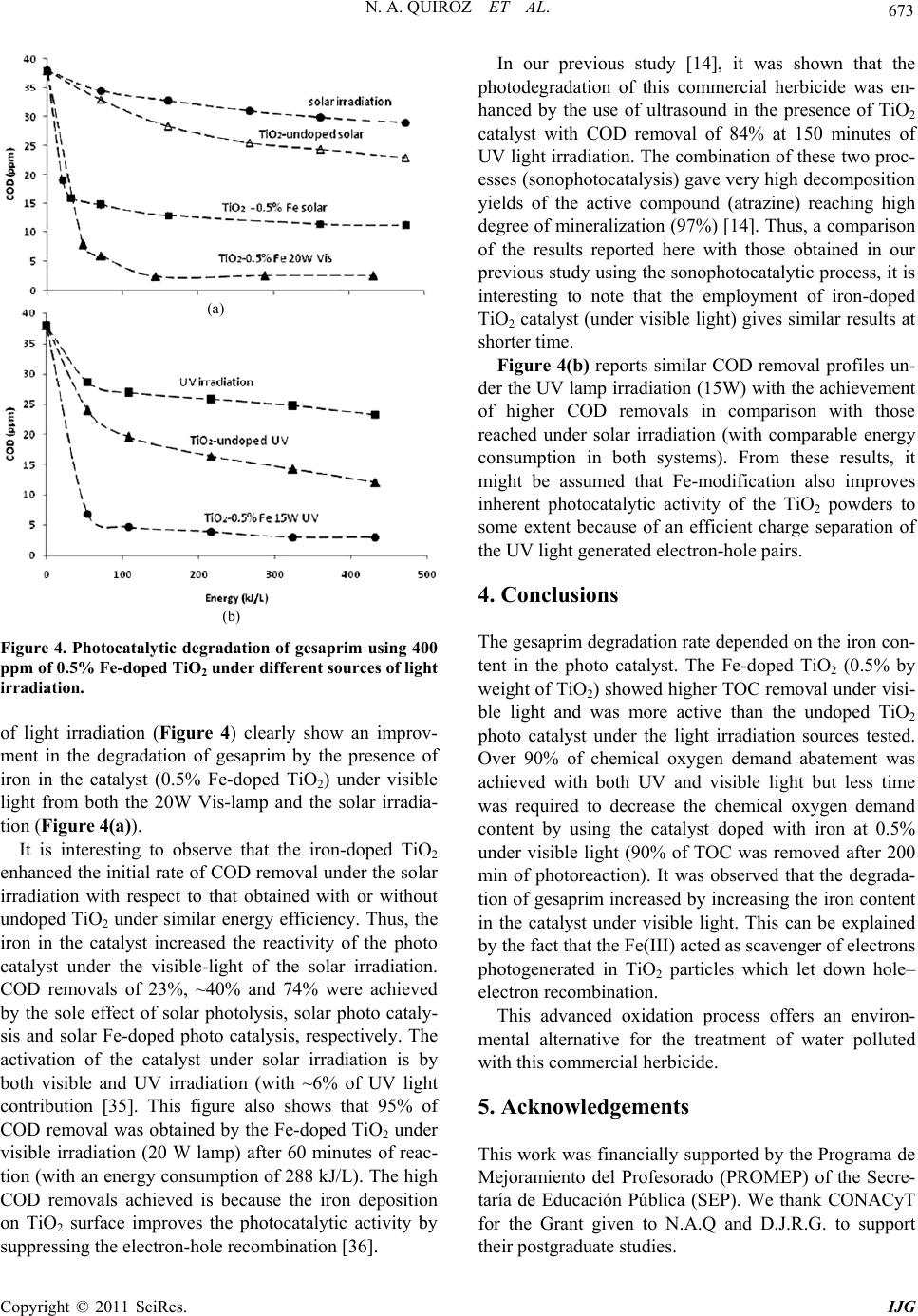 673 N. A. QUIROZ ET AL. (a) (b) Figure 4. Photocatalytic degradation of gesaprim using 400 ppm of 0.5% Fe-doped TiO2 under different sources of light irradiation. of light irradiation (Figure 4) clearly show an improv- ment in the degradation of gesaprim by the presence of iron in the catalyst (0.5% Fe-doped TiO2) under visible light from both the 20W Vis-lamp and the solar irradia- tion (Figure 4(a)). It is interesting to observe that the iron-doped TiO2 enhanced the initial rate of COD removal under the solar irradiation with respect to that obtained with or without undoped TiO2 under similar energy efficiency. Thus, the iron in the catalyst increased the reactivity of the photo catalyst under the visible-light of the solar irradiation. COD removals of 23%, ~40% and 74% were achieved by the sole effect of solar photolysis, solar photo cataly- sis and solar Fe-doped photo catalysis, respectively. The activation of the catalyst under solar irradiation is by both visible and UV irradiation (with ~6% of UV light contribution [35]. This figure also shows that 95% of COD removal was obtained by the Fe-doped TiO2 under visible irradiation (20 W lamp) after 60 minutes of reac- tion (with an energy consumption of 288 kJ/L). The high COD removals achieved is because the iron deposition on TiO2 surface improves the photocatalytic activity by suppressing the electron-hole recombination [36]. In our previous study [14], it was shown that the photodegradation of this commercial herbicide was en- hanced by the use of ultrasound in the presence of TiO2 catalyst with COD removal of 84% at 150 minutes of UV light irradiation. The combination of these two proc- esses (sonophotocatalysis) gave very high decomposition yields of the active compound (atrazine) reaching high degree of mineralization (97%) [14]. Thus, a comparison of the results reported here with those obtained in our previous study using the sonophotocatalytic process, it is interesting to note that the employment of iron-doped TiO2 catalyst (under visible light) gives similar results at shorter time. Figure 4(b) reports similar COD removal profiles un- der the UV lamp irradiation (15W) with the achievement of higher COD removals in comparison with those reached under solar irradiation (with comparable energy consumption in both systems). From these results, it might be assumed that Fe-modification also improves inherent photocatalytic activity of the TiO2 powders to some extent because of an efficient charge separation of the UV light generated electron-hole pairs. 4. Conclusions The gesaprim degradation rate depended on the iron con- tent in the photo catalyst. The Fe-doped TiO2 (0.5% by weight of TiO2) showed higher TOC removal under visi- ble light and was more active than the undoped TiO2 photo catalyst under the light irradiation sources tested. Over 90% of chemical oxygen demand abatement was achieved with both UV and visible light but less time was required to decrease the chemical oxygen demand content by using the catalyst doped with iron at 0.5% under visible light (90% of TOC was removed after 200 min of photoreaction). It was observed that the degrada- tion of gesaprim increased by increasing the iron content in the catalyst under visible light. This can be explained by the fact that the Fe(III) acted as scavenger of electrons photogenerated in TiO2 particles which let down hole– electron recombination. This advanced oxidation process offers an environ- mental alternative for the treatment of water polluted with this commercial herbicide. 5. Acknowledgements This work was financially supported by the Programa de Mejoramiento del Profesorado (PROMEP) of the Secre- taría de Educación Pública (SEP). We thank CONACyT for the Grant given to N.A.Q and D.J.R.G. to support their postgraduate studies. Copyright © 2011 SciRes. IJG 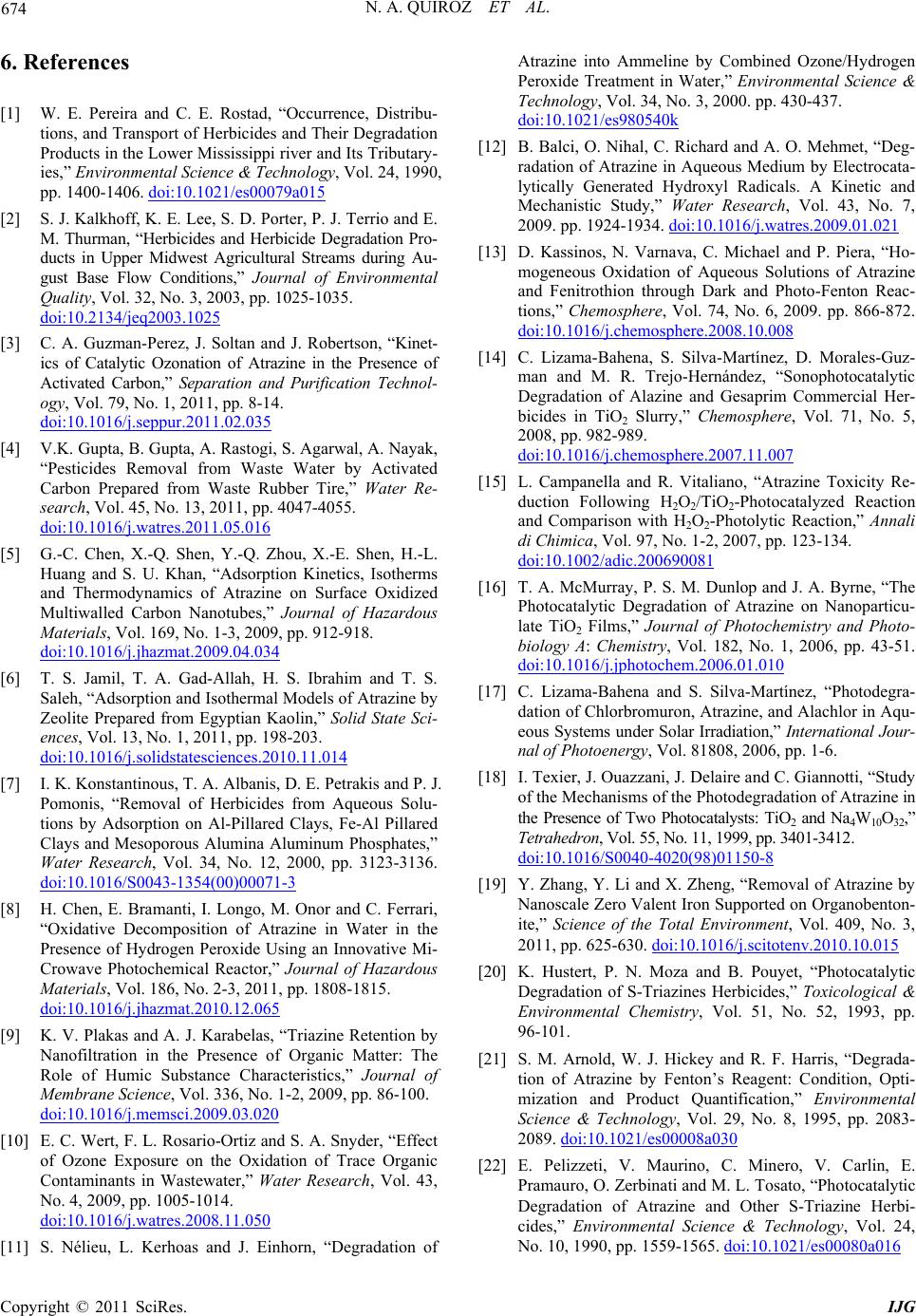 674 N. A. QUIROZ ET AL. 6. References [1] W. E. Pereira and C. E. Rostad, “Occurrence, Distribu- tions, and Transport of Herbicides and Their Degradation Products in the Lower Mississippi river and Its Tributary- ies,” Environmental Science & Technology, Vol. 24, 1990, pp. 1400-1406. doi:10.1021/es00079a015 [2] S. J. Kalkhoff, K. E. Lee, S. D. Porter, P. J. Terrio and E. M. Thurman, “Herbicides and Herbicide Degradation Pro- ducts in Upper Midwest Agricultural Streams during Au- gust Base Flow Conditions,” Journal of Environmental Quality, Vol. 32, No. 3, 2003, pp. 1025-1035. doi:10.2134/jeq2003.1025 [3] C. A. Guzman-Perez, J. Soltan and J. Robertson, “Kinet- ics of Catalytic Ozonation of Atrazine in the Presence of Activated Carbon,” Separation and Purification Technol- ogy, Vol. 79, No. 1, 2011, pp. 8-14. doi:10.1016/j.seppur.2011.02.035 [4] V.K. Gupta, B. Gupta, A. Rastogi, S. Agarwal, A. Nayak, “Pesticides Removal from Waste Water by Activated Carbon Prepared from Waste Rubber Tire,” Water Re- search, Vol. 45, No. 13, 2011, pp. 4047-4055. doi:10.1016/j.watres.2011.05.016 [5] G.-C. Chen, X.-Q. Shen, Y.-Q. Zhou, X.-E. Shen, H.-L. Huang and S. U. Khan, “Adsorption Kinetics, Isotherms and Thermodynamics of Atrazine on Surface Oxidized Multiwalled Carbon Nanotubes,” Journal of Hazardous Materials, Vol. 169, No. 1-3, 2009, pp. 912-918. doi:10.1016/j.jhazmat.2009.04.034 [6] T. S. Jamil, T. A. Gad-Allah, H. S. Ibrahim and T. S. Saleh, “Adsorption and Isothermal Models of Atrazine by Zeolite Prepared from Egyptian Kaolin,” Solid State Sci- ences, Vol. 13, No. 1, 2011, pp. 198-203. doi:10.1016/j.solidstatesciences.2010.11.014 [7] I. K. Konstantinous, T. A. Albanis, D. E. Petrakis and P. J. Pomonis, “Removal of Herbicides from Aqueous Solu- tions by Adsorption on Al-Pillared Clays, Fe-Al Pillared Clays and Mesoporous Alumina Aluminum Phosphates,” Water Research, Vol. 34, No. 12, 2000, pp. 3123-3136. doi:10.1016/S0043-1354(00)00071-3 [8] H. Chen, E. Bramanti, I. Longo, M. Onor and C. Ferrari, “Oxidative Decomposition of Atrazine in Water in the Presence of Hydrogen Peroxide Using an Innovative Mi- Crowave Photochemical Reactor,” Journal of Hazardous Materials, Vol. 186, No. 2-3, 2011, pp. 1808-1815. doi:10.1016/j.jhazmat.2010.12.065 [9] K. V. Plakas and A. J. Karabelas, “Triazine Retention by Nanofiltration in the Presence of Organic Matter: The Role of Humic Substance Characteristics,” Journal of Membrane Science, Vol. 336, No. 1-2, 2009, pp. 86-100. doi:10.1016/j.memsci.2009.03.020 [10] E. C. Wert, F. L. Rosario-Ortiz and S. A. Snyder, “Effect of Ozone Exposure on the Oxidation of Trace Organic Contaminants in Wastewater,” Water Research, Vol. 43, No. 4, 2009, pp. 1005-1014. doi:10.1016/j.watres.2008.11.050 [11] S. Nélieu, L. Kerhoas and J. Einhorn, “Degradation of Atrazine into Ammeline by Combined Ozone/Hydrogen Peroxide Treatment in Water,” Environmental Science & Technology, Vol. 34, No. 3, 2000. pp. 430-437. doi:10.1021/es980540k [12] B. Balci, O. Nihal, C. Richard and A. O. Mehmet, “Deg- radation of Atrazine in Aqueous Medium by Electrocata- lytically Generated Hydroxyl Radicals. A Kinetic and Mechanistic Study,” Water Research, Vol. 43, No. 7, 2009. pp. 1924-1934. doi:10.1016/j.watres.2009.01.021 [13] D. Kassinos, N. Varnava, C. Michael and P. Piera, “Ho- mogeneous Oxidation of Aqueous Solutions of Atrazine and Fenitrothion through Dark and Photo-Fenton Reac- tions,” Chemosphere, Vol. 74, No. 6, 2009. pp. 866-872. doi:10.1016/j.chemosphere.2008.10.008 [14] C. Lizama-Bahena, S. Silva-Martínez, D. Morales-Guz- man and M. R. Trejo-Hernández, “Sonophotocatalytic Degradation of Alazine and Gesaprim Commercial Her- bicides in TiO2 Slurry,” Chemosphere, Vol. 71, No. 5, 2008, pp. 982-989. doi:10.1016/j.chemosphere.2007.11.007 [15] L. Campanella and R. Vitaliano, “Atrazine Toxicity Re- duction Following H2O2/TiO2-Photocatalyzed Reaction and Comparison with H2O2-Photolytic Reaction,” Annali di Chimica, Vol. 97, No. 1-2, 2007, pp. 123-134. doi:10.1002/adic.200690081 [16] T. A. McMurray, P. S. M. Dunlop and J. A. Byrne, “The Photocatalytic Degradation of Atrazine on Nanoparticu- late TiO2 Films,” Journal of Photochemistry and Photo- biology A: Chemistry, Vol. 182, No. 1, 2006, pp. 43-51. doi:10.1016/j.jphotochem.2006.01.010 [17] C. Lizama-Bahena and S. Silva-Martínez, “Photodegra- dation of Chlorbromuron, Atrazine, and Alachlor in Aqu- eous Systems under Solar Irradiation,” International Jour- na l of Photoener gy, Vol. 81808, 2006, pp. 1-6. [18] I. Texier, J. Ouazzani, J. Delaire and C. Giannotti, “Study of the Mechanisms of the Photodegradation of Atrazine in the Presence of Two Photocatalysts: TiO2 and Na4W10O32,” Tetrahedron, Vol. 55, No. 11, 1999, pp. 3401-3412. doi:10.1016/S0040-4020(98)01150-8 [19] Y. Zhang, Y. Li and X. Zheng, “Removal of Atrazine by Nanoscale Zero Valent Iron Supported on Organobenton- ite,” Science of the Total Environment, Vol. 409, No. 3, 2011, pp. 625-630. doi:10.1016/j.scitotenv.2010.10.015 [20] K. Hustert, P. N. Moza and B. Pouyet, “Photocatalytic Degradation of S-Triazines Herbicides,” Toxicological & Environmental Chemistry, Vol. 51, No. 52, 1993, pp. 96-101. [21] S. M. Arnold, W. J. Hickey and R. F. Harris, “Degrada- tion of Atrazine by Fenton’s Reagent: Condition, Opti- mization and Product Quantification,” Environmental Science & Technology, Vol. 29, No. 8, 1995, pp. 2083- 2089. doi:10.1021/es00008a030 [22] E. Pelizzeti, V. Maurino, C. Minero, V. Carlin, E. Pramauro, O. Zerbinati and M. L. Tosato, “Photocatalytic Degradation of Atrazine and Other S-Triazine Herbi- cides,” Environmental Science & Technology, Vol. 24, No. 10, 1990, pp. 1559-1565. doi:10.1021/es00080a016 C opyright © 2011 SciRes. IJG  N. A. QUIROZ ET AL. Copyright © 2011 SciRes. IJG 675 [23] I. K. Konstantinou and T. A. Albanis, “Photocatalytic Transformation of Pesticides in Aqueous Titanium Diox- ide Suspensions Using Artificial and Solar Light: Inter- mediates and Degradation Pathways,” Applied Catalysis B: Environmental, Vol. 42, No. 4, 2003, pp. 319-335. doi:10.1016/S0926-3373(02)00266-7 [24] V. Hequet, C. Gonzalez and P. Le-Cloirec, “Photo- Chemical Processes for Atrazine Degradation: Methodo- logical Approach,” Water Research, Vol. 35, No. 18, 2001, pp. 4253-4260. doi:10.1016/S0043-1354(01)00166-X [25] G. A. Peñuela and D. Barceló, “Comparative Photodegra- dation Study of Atrazine and Desethylatrazine in Water Samples Containing Titanium,” Journal of AOAC Inter- national, Vol. 83, No. 1, 2000, pp. 53-60. [26] H. Měšt’ánková, J. Krýsa, J. Jirkovský, G. Mailhot and M. Bolte, “The influence of Fe(III) Speciation on Supported TiO2 Efficiency: Example of Monuron Photocatalytic Degradation,” Applied Catalysis B: Environmental, Vol. 58, No. 3-4, 2005, pp. 185-191. doi:10.1016/j.apcatb.2003.09.017 [27] K. Horst, G. Burgeth and W. Macyk, “Visible Light Photocatalysis by a Titania Transition Metal Complex,” Advances in Inorganic Chemistry, Vol. 56, 2004, pp. 241- 259. doi:10.1016/S0898-8838(04)56008-7 [28] M. Anpo, “Preparation, Characterization, and Reactivities of Highly Functional Titanium Oxide-Based Photocata- lysts Able to Operate under UV-Visible Light Irradiation: Approaches in Realizing High Efficiency in the Use of Visible Light,” Bulletin of the Chemical Society of Japan, Vol. 77, No. 8, 2004, pp. 1427-1442. doi:10.1246/bcsj.77.1427 [29] Y. Aita, M. Komatsu, S. Yin and T. Sato, “Phase-Compo- sitional Control and Visible Light Photocatalytic Activity of Nitrogen-Doped Titania via Solvothermal Process,” Journal of Solid State Chemistry, Vol. 177, No. 9, 2004, pp. 3235-3238. doi:10.1016/j.jssc.2004.04.048 [30] M. S. Diallo and S. Nora, “Nanoparticles and water qual- ity,” Journal of Nanoparticle Research, Vol. 7, No. 4-5, 2005, pp. 325–330. doi:10.1007/s11051-005-8543-x [31] N. Wetchakun, P. Pirakitikulr, K. Chiang and S. Phanich- phant, “Visible Light-Active Nano-Sized Fe-Doped TiO2 Photocatalysts and Their Characterization,” 2nd IEEE In- ternational Nanoelectronics Conference, Shanghai, 2008, pp. 836-841. [32] Z. Ambrus, N. Balázs, T. Alapi, G. Wittmann, P. Sipos, A. Dombi and K. Mogyorósi, “Synthesis, Structure and Photocatalytic Properties of Fe(III)-Doped TiO2 Prepared from TiCl3,” Applied Catalysis B: Environmental, Vol. 81, No. 1-2, 2008, pp. 27-37. doi:10.1016/j.apcatb.2007.11.041 [33] M. K. Seery, G. Reenamole, P. Floris and S. Pillai, “Sil- ver Doped Titanium Dioxide Nanomaterials for En- hanced Visible Light Photocatalysis,” Journal of Photo- chemistry and Photobiology A: Chemistry, Vol. 189, No. 2-3, 2007, pp. 259-263. doi:10.1016/j.jphotochem.2007.02.010 [34] B. Tryba, “Increase of the Photocatalytic Activity of TiO2 by Carbon and Iron Modifications,” International Journal of Photoenergy, Vol. 2008, 2008, pp. 1-15. doi:10.1155/2008/721824 [35] A. Katsambas, C. A. Varotsos, G. Veziryianni and C. Antoniou, “Surface Solar Ultraviolet Radiation: A Theo- retical Approach of the SUVR Reaching the Ground in Athens, Greece,” Environmental Science and Pollution Research, Vol. 4, No. 2, 1997, pp. 69-73. doi:10.1007/BF02986280 [36] U. I. Gaya and H. A. Abdul, “Heterogeneous Photocata- lytic Degradation of Organic Contaminants over Tita- nium Dioxide: A Review of Fundamentals, Progress and Problems,” Journal of Photochemistry and Photobiology C: Photochemistry Reviews, Vol. 9, No. 1, 2008, pp. 1-12. doi:10.1016/j.jphotochemrev.2007.12.003 |