

Paper Menu >>
Journal Menu >>
 Wireless Sensor Network, 2009, 1, 340-349 doi:10.4236/wsn.2009.14042 Published Online November 2009 (http://www.scirp.org/journal/wsn). Copyright © 2009 SciRes. WSN Dynamic Hierarchical Communication Paradigm for Wireless Sensor Networks: A Centralized, Energy Efficient Approach Suraiya TARANNUM1, S. Srividya2, D. S. Asha2, K. R. Venugopal2 1Department of Telecommunication Engineering, AMC Engineering College, Bangalore, India 2Department of Computer Science and Engineering, Bangalore University, Bangalore, India Email: [email protected] Abstract A Wireless Sensor Network (WSN) consists of a large number of randomly deployed sensor nodes. These sensor nodes organize themselves into a cooperative network and perform the three basic functions of sens- ing, computations and communications. Research in WSNs has become an extensive explorative area during the last few years, especially due the challenges offered, energy constraints of the sensors being one of them. In this paper, the need for effective utilization of limited power resources is emphasized, which becomes pre-eminent to the Wireless Sensor Networks. Organizing the network to achieve balanced clusters based on assigning equal number of sensors to each cluster may have the consequence of unbalanced load on the clus- ter heads. This results in an unbalanced consumption of energy by the nodes, cumulatively leading to mini- mization of network lifetime. In this paper, we put forth a Sink administered Load balanced Dynamic Hier- archical Protocol (SLDHP) to balance the load on the principal nodes. Hierarchical layout of the sensors en- dows the network with considerable minimization of energy consumption of nodes leading to an increased lifespan. Simulation results indicate significant improvement of performance over Base station Controlled Dynamic Clustering Protocol (BCDCP). Keywords: Wireless Sensor Network, Sink, Principal Node, Superior Node, Network Lifetime 1. Introduction A Wireless Sensor Network (WSN) is an ad-hoc wireless telecommunication network which embodies a number of tiny, low-powered sensor nodes densely deployed either inside a phenomenon or close to it [1]. The multi- functioning sensor nodes operate in an unattended envi- ronment with limited sensing and computational capa- bilities. The advent of wireless sensor networks has marked a remarkable change in the field of information sensing and detection. It is a conjunction of sensor, dis- tributed information processing, embedded and commu- nication techniques. WSNs may in the near future be equally prominent by providing information of the physical phenomena of interest and ultimately being able to detect and control them or enable us to construct more meticulous models of the physical world. WSNs are easier, faster and cheaper to deploy than other forms of wireless networks as there are no prede- termined positions for the sensors. They have higher de- gree of faulttolerance than other wireless networks and are self-configuring or self-organizing [2]. Sensors are deployed randomly and are expected to perform their mission properly and efficiently. Another unique feature of sensor networks is the co-operative effort of sensor nodes to achieve a particular task. A WSN is envisioned to consist of a large number of sensors and many base stations. The sensors are equipped with transceivers to gather information from the environ- ment and pass it on to one of the base stations. A typical sensor node consists of four major components: a data processor unit; a sensor; a radio communication subsystem that consists of transmitter/receiver electronics, antennas, an amplifier; and a power supply unit [3]. The sensors are compact in size which make them extremely energy re- strained. Further more, replacing batteries in large scales in possibly harsh terrain becomes infeasible. Hence, it is well accepted that the key challenge in unlocking the potential of such networks is maximizing their post-deployment active lifetime. The lifetime of the wireless sensors may be pro- longed by ensuring that all aspects of the system achieve energy efficiency. Since communications in wireless sensor networks consume significant amount of energy, the de- signed algorithms must ensure that nodes expend minimum amount of energy for transmitting and receiving data.  S. TARANNUM ET AL. 341 A web of sensor nodes can be deployed to gather productive information from the sensor field. Some of the benefits of using WSNs are extended range of sensing, fault-tolerance, improved accuracy and lower cost. As a consequence, the sensor networks are ex- pected to find extensive use in a variety of applications including remote climate monitoring, seismic, acoustic, medical and intelligence data-gathering [4,5]. Hence, they are suitable for a wide range of applications like military, health, education, commerce and so on. Mili- tary applications may range from tracking enemy movement in the battlefield to guiding targeting system. Bio-sensors are used for monitoring patients blood sugar level. Commercial applications may range from tracking postal packages or office equipment to moni- toring product quality on an assembly line. Environ- mental applications include forest-fire detection, flood detection, tracking movements of birds etc. Sensors are also used to simulate home automation and to build smart environments. Efficient utilization of energy is crucial to the WSNs. Wireless microsensor network protocols should therefore be selfconfiguring to enable ease of deployment of nodes, latency aware, qualitative, robust and to extend system lifetime. The sensors are extremely energy bounded, hence the network formed by these sensors are also en- ergy constrained. The communication devices on these sensors are small and have limited power and sensing ranges. A routing protocol coordinates the activities of individual nodes in the network to achieve global goals and does it in an efficient manner. The simplest is the Direct Communication Routing Protocol, where each node transmits the sensed information directly to the base station. The nodes consume considerable amount of energy if the communication path is long. This results in the early death of distant nodes. To overcome this draw- back, the technique of Minimum Transmission Energy utilizes a multhop routing scheme. In this scheme, the nodes that are close to the base station drain their energy rapidly as they are involved in transmission of messages on behalf of others. Hierarchical routing groups sensors in the entire net- work into clusters. It aims at reduction of energy con- sumption by localizing data communication within a cluster and aggregating data to decrease transmissions to the base station. The first attempt in this regard, was made by Low Energy Adaptive Cluster Hierarchy (LEACH). The operation is framed in iterations and each iteration comprises of a setup and a data transmission phase. During the setup phase, nodes organize them- selves into clusters with predetermined number of nodes serving as cluster heads. In the data transmission phase, the self-elected cluster heads aggregate data re- ceived from the nodes in their cluster before forwarding to the base station. The role of cluster heads is randomly rotated among all the nodes in the network. This tech- nique serves as a basic model for other hierarchical rout- ing protocols. A centralized version of the adaptive ap- proach comprises a hierarchical structure in which the base station has control over the cluster formation. The base station uses the location and energy information sent by the nodes to select the predetermined number of cluster heads. Efficient clustering is achieved as the base station possess the global knowledge of the network. This technique exhibits improvement over the adaptive approach. In Power Efficient Gathering in Sensor Information Systems (PEGASIS), the nodes function co-operatively to optimize network lifetime. A greedy algorithm is used to configure the network into chains. In each iteration, a randomly chosen leader node directs the aggregated data to the base station. A centralized energy efficient routing protocol called Base Station Controlled Dynamic Clus- tering Protocol (BCDCP), was proposed which widened the area for research in hierarchical routing. Here, much of the functionalities like formation of clusters and rout- ing paths are performed by the high energy base station which lightens the load of sensor nodes. This protocol configures the network into balanced clusters where each cluster head serves an approximately equal number of member nodes. Cluster head-to-cluster head multihop routing is employed in this protocol to transfer the data to the base station. Motivation: Efficient management of energy deserves much of the attention in the WSNs. Routing protocols designed for WSNs must therefore effectively tackle this issue in order to enhance the lifetime of the network. Hierarchical routing techniques are preferable in this direction. The arrangement of the nodes in the form of a load balanced hierarchy proves to be beneficial. Contribution: In our paper, we propose a energy effi- cient hierarchical routing protocol, SLDHP to increase the lifetime of homogeneous as well as heterogeneous WSNs. SLDHP achieves a load balanced hierarchical arrangement of nodes in the network which performs better than the other hierarchical routing protocols. Organization: The rest of the paper is organized as follows. In section II, we discuss the related work. In section III, the underlying model is described and the problem is defined in section IV. Our proposed algorithm, SLDHP is presented in section V. Performance analysis is presented in section VI and section VII contains the conclusion. 2. Related Work Hierarchical routing aims to efficiently maintain the en- ergy consumption of sensor nodes by involving them in multihop communication within a particular cluster and C opyright © 2009 SciRes. WSN 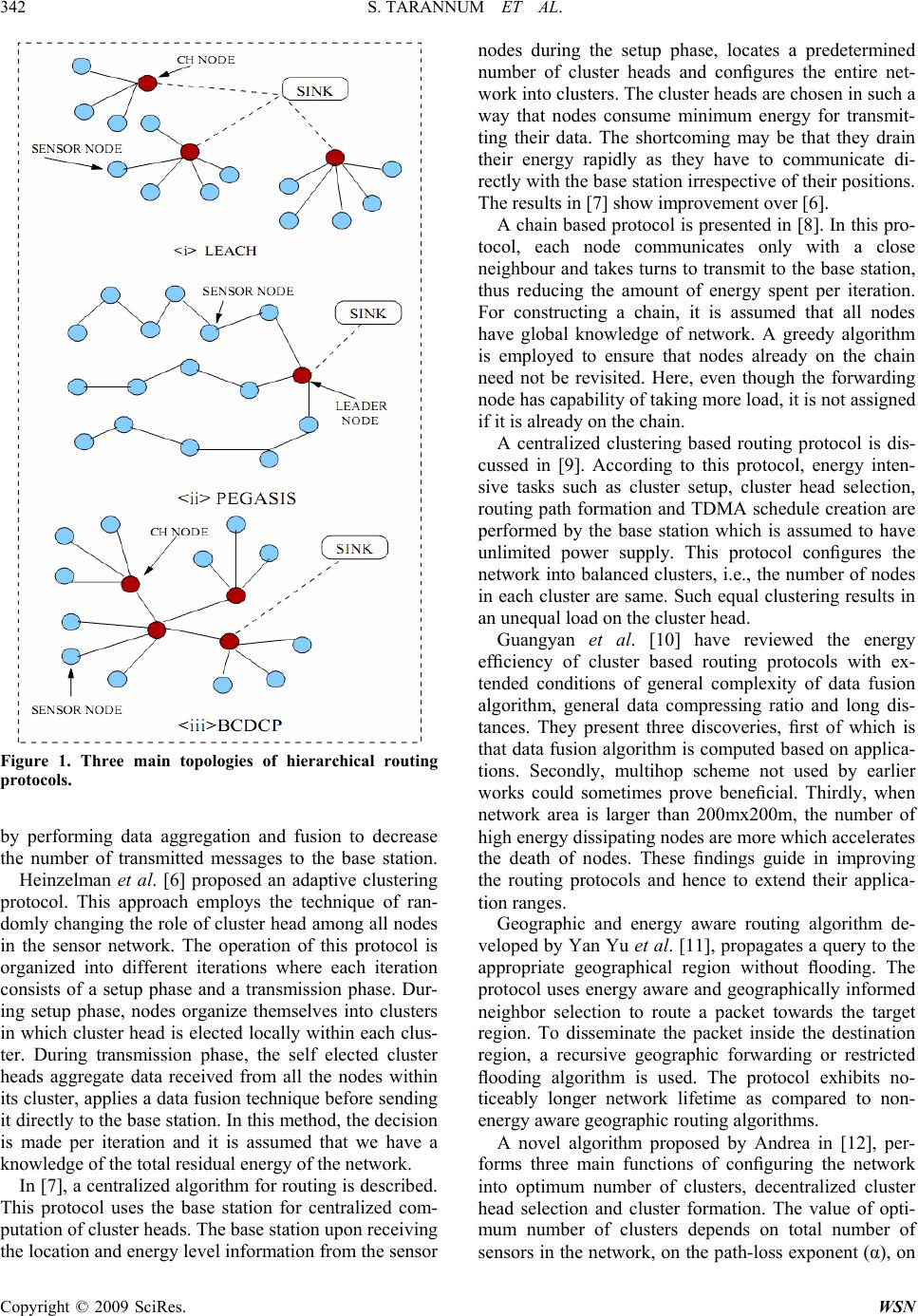 342 S. TARANNUM ET AL. Figure 1. Three main topologies of hierarchical routing protocols. by performing data aggregation and fusion to decrease the number of transmitted messages to the base station. Heinzelman et al. [6] proposed an adaptive clustering protocol. This approach employs the technique of ran- domly changing the role of cluster head among all nodes in the sensor network. The operation of this protocol is organized into different iterations where each iteration consists of a setup phase and a transmission phase. Dur- ing setup phase, nodes organize themselves into clusters in which cluster head is elected locally within each clus- ter. During transmission phase, the self elected cluster heads aggregate data received from all the nodes within its cluster, applies a data fusion technique before sending it directly to the base station. In this method, the decision is made per iteration and it is assumed that we have a knowledge of the total residual energy of the network. In [7], a centralized algorithm for routing is described. This protocol uses the base station for centralized com- putation of cluster heads. The base station upon receiving the location and energy level information from the sensor nodes during the setup phase, locates a predetermined number of cluster heads and configures the entire net- work into clusters. The cluster heads are chosen in such a way that nodes consume minimum energy for transmit- ting their data. The shortcoming may be that they drain their energy rapidly as they have to communicate di- rectly with the base station irrespective of their positions. The results in [7] show improvement over [6]. A chain based protocol is presented in [8]. In this pro- tocol, each node communicates only with a close neighbour and takes turns to transmit to the base station, thus reducing the amount of energy spent per iteration. For constructing a chain, it is assumed that all nodes have global knowledge of network. A greedy algorithm is employed to ensure that nodes already on the chain need not be revisited. Here, even though the forwarding node has capability of taking more load, it is not assigned if it is already on the chain. A centralized clustering based routing protocol is dis- cussed in [9]. According to this protocol, energy inten- sive tasks such as cluster setup, cluster head selection, routing path formation and TDMA schedule creation are performed by the base station which is assumed to have unlimited power supply. This protocol configures the network into balanced clusters, i.e., the number of nodes in each cluster are same. Such equal clustering results in an unequal load on the cluster head. Guangyan et al. [10] have reviewed the energy efficiency of cluster based routing protocols with ex- tended conditions of general complexity of data fusion algorithm, general data compressing ratio and long dis- tances. They present three discoveries, first of which is that data fusion algorithm is computed based on applica- tions. Secondly, multihop scheme not used by earlier works could sometimes prove beneficial. Thirdly, when network area is larger than 200mx200m, the number of high energy dissipating nodes are more which accelerates the death of nodes. These findings guide in improving the routing protocols and hence to extend their applica- tion ranges. Geographic and energy aware routing algorithm de- veloped by Yan Yu et al. [11], propagates a query to the appropriate geographical region without flooding. The protocol uses energy aware and geographically informed neighbor selection to route a packet towards the target region. To disseminate the packet inside the destination region, a recursive geographic forwarding or restricted flooding algorithm is used. The protocol exhibits no- ticeably longer network lifetime as compared to non- energy aware geographic routing algorithms. A novel algorithm proposed by Andrea in [12], per- forms three main functions of configuring the network into optimum number of clusters, decentralized cluster head selection and cluster formation. The value of opti- mum number of clusters depends on total number of sensors in the network, on the path-loss exponent (α), on Copyright © 2009 SciRes. WSN  S. TARANNUM ET AL. 343 dimensions of the network and distance of the broadcast packets. They use an adaptive strategy for cluster head selection. The algorithm for cluster formation uses total path energy dissipation instead of energy lost in path from the node to its cluster head. The algorithm opti- mizes system lifetime in a large range of applications and situations. A cost based comparison of homogeneous and het- erogeneous clustered sensor networks has been presented. It first considers single hop clustered sensor networks and use adaptive clustering protocol. It also takes into account sensor-network with two types of nodes as rep- resentative single hop heterogeneous networks. For mul- tihop homogeneous network Vivek et al. [13] propose and analyze a multihop variant of the adaptive approach. They consider communication radius for in-cluster communication and size of clusters. This algorithm ex- hibits better energy efficiency in many cases, but does not give expected performance if the heterogeneity is due to the operation of the network. An energy efficient distributed clustering approach for adhoc sensor network is developed in paper [14]. In this approach, cluster heads are chosen randomly based on their residual energy and nodes participate in cluster op- eration such that the communication cost is minimized. The protocol does not make any assumptions regarding the distribution density of nodes. The clustering process takes a fixed number of iterations and does not depend on network topology. This protocol acheives only a two-level hierarchy. Alan et al. [15] have derived a load balancing heuristic for wireless adhoc networks in order to extend the life- span of a cluster head to as large an extent as possible before another node becomes the cluster head. Two cluster head load balancing heuristics are described. The first approach is for cluster election heuristics that favour the election of cluster head based on node-id, and the second approach is based on the degree of connectivity. In [16], a cluster based query protocol is illustrated for wireless sensor networks using self-organized sensor clusters to register queries, process queries and dissemi- nate data within the network. This protocol uses cluster heads as data storage and aggregation points. Instead of sending large amounts of raw data over a network to reply to a query, each cluster head collects and filters data from its member sensors. This is achieved using the information about the cluster location. With this protocol, energy efficiency is achieved by reducing the number of data transmissions over the network during the course of the data collection and query processing. A stable election protocol is described in [17] which is a heterogeneous-energy-aware protocol. It is based on weighted election probabilities of each node to become cluster head based on the remaining energy of each node. In this approach every sensor node in a heterogeneous two-level hierarchical network independently elects itself as a cluster head based on its initial energy relative to that of other nodes. The protocol does not demand any global knowledge of energy at every election iteration and also does not consider as to how nodes could be as- signed optimally to cluster heads. In [18], a balanced k-clustering algorithm, for cluster- ing sensor nodes into k number of clusters is described. Each cluster is balanced and the total distance between sensor nodes and the head nodes is minimized. Mini- mizing the total distance helps in reducing the commu- nication overhead and hence energy dissipation. The algorithm demonstrates that the balanced k-clustering problem can be solved optimally using network flow, but assumes the number of nodes as a multiple of k at all times, which may not be practical. A cluster based routing algorithm is depicted in [19] to extend the lifetime of the sensor networks and hence to maintain a uniform consumption of the energy by the nodes. This is obtained by the addition of a slot in a frame, which enables the exchange of residual energy messages between the base station, cluster heads and nodes. The algorithm takes into account the residual en- ergy of the nodes during cluster head selection, resulting in balanced energy consumption of the sensor nodes. The protocol performs better than the adaptive approach. In [2], the authors focus on the design criteria for routing protocols and issues and challenges of clus- ter-based routing in WSNs. The characteristics and the general routing models for protocols in sensor networks are studied here. Yunfeng et al. [20] have devised a pro- tocol called energy balancing multipath routing, the basic idea being that instead of source-initiated or destina- tion-initiated route discovery, it is the base station that finds multiple paths to the source of the data and selects one of them to be used during communication. It is based on the assumption that the base stations are typically many orders of magnitude more powerful than common sensor nodes. It adopts a scheme similar to the well known software architecture client server model. Energy aware routing that uses sub-optimal paths oc- casionally to provide substantial gains is designed by Rahul et al. [22]. It emphasizes that using lowest energy paths may not be always optimal from the point of view of network lifetime and long-term connectivity. The protocol is suitable for low energy and low bitrate net- works. The key concept is to send traffic through differ- ent routes which helps in using the node resources more evenly. It sends the traffic on multiple paths without adding much complexity by using a probabilistic for- warding technique. According to this method, the nodes burn their energy uniformly across the network ensuring a more graceful degradation of service with time. The problem of energy-aware routing in networks with renewable energy sources is adressed by Longbi et al. [21]. They present a simple, static multi-path routing approach that is optimal in the large system limit. The C opyright © 2009 SciRes. WSN 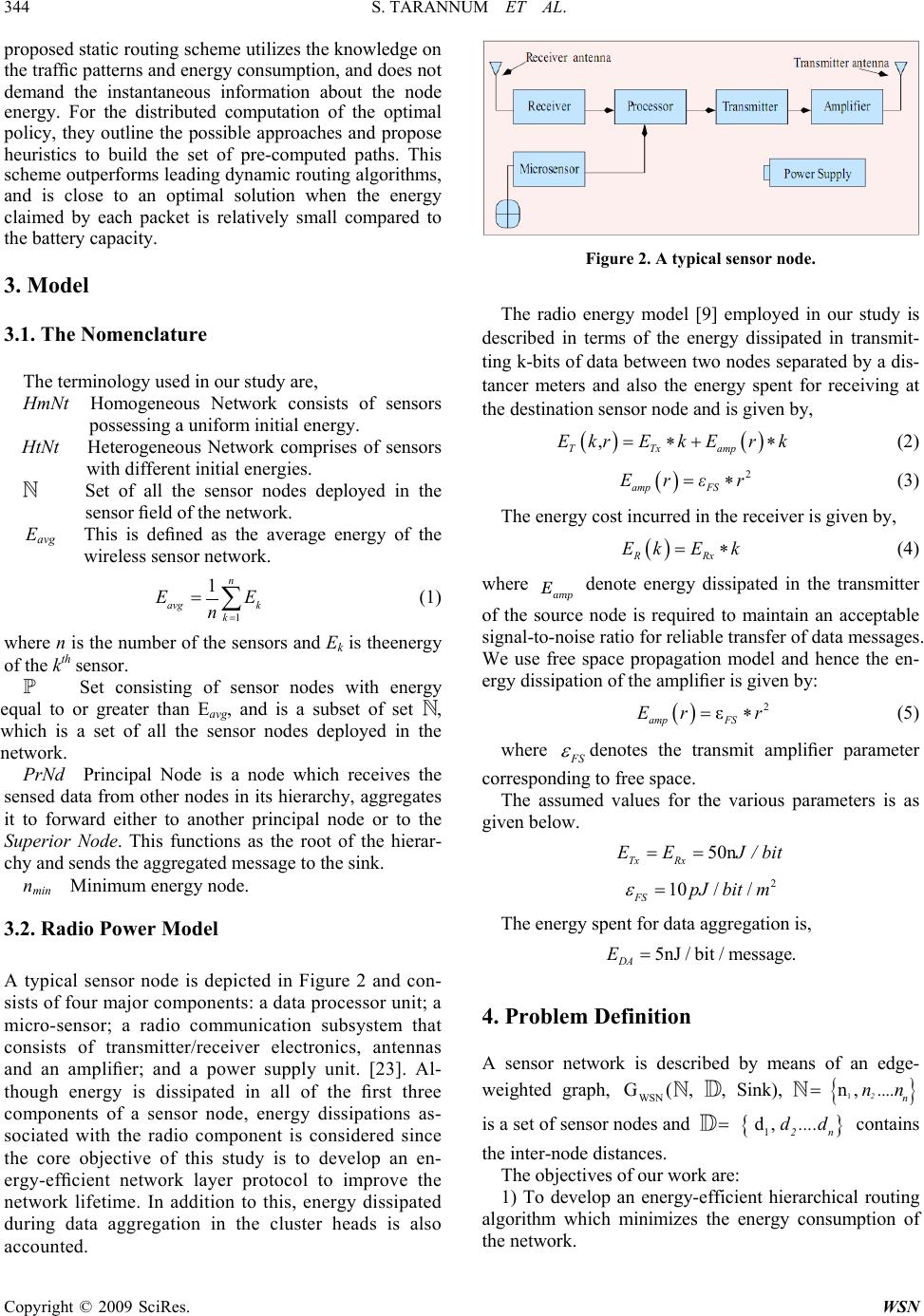 344 S. TARANNUM ET AL. proposed static routing scheme utilizes the knowledge on the traffic patterns and energy consumption, and does not demand the instantaneous information about the node energy. For the distributed computation of the optimal policy, they outline the possible approaches and propose heuristics to build the set of pre-computed paths. This scheme outperforms leading dynamic routing algorithms, and is close to an optimal solution when the energy claimed by each packet is relatively small compared to the battery capacity. 3. Model 3.1. The Nomenclature The terminology used in our study are, HmNt Homogeneous Network consists of sensors possessing a uniform initial energy. HtNt Heterogeneous Network comprises of sensors with different initial energies. Set of all the sensor nodes deployed in the sensor field of the network. Eavg This is defined as the average energy of the wireless sensor network. 1 1n avg k k E n E (1) where n is the number of the sensors and Ek is theenergy of the kth sensor. Set consisting of sensor nodes with energy equal to or greater than Eavg, and is a subset of set , which is a set of all the sensor nodes deployed in the network. PrNd Principal Node is a node which receives the sensed data from other nodes in its hierarchy, aggregates it to forward either to another principal node or to the Superior Node. This functions as the root of the hierar- chy and sends the aggregated message to the sink. nmin Minimum energy node. 3.2. Radio Power Model A typical sensor node is depicted in Figure 2 and con- sists of four major components: a data processor unit; a micro-sensor; a radio communication subsystem that consists of transmitter/receiver electronics, antennas and an amplifier; and a power supply unit. [23]. Al- though energy is dissipated in all of the first three components of a sensor node, energy dissipations as- sociated with the radio component is considered since the core objective of this study is to develop an en- ergy-efficient network layer protocol to improve the network lifetime. In addition to this, energy dissipated during data aggregation in the cluster heads is also accounted. Figure 2. A typica l se nsor node. The radio energy model [9] employed in our study is described in terms of the energy dissipated in transmit- ting k-bits of data between two nodes separated by a dis- tancer meters and also the energy spent for receiving at the destination sensor node and is given by, , TTxamp EkrEkEr k (2) 2 amp FS Erεr (3) The energy cost incurred in the receiver is given by, RRx EkE k (4) where denote energy dissipated in the transmitter of the source node is required to maintain an acceptable signal-to-noise ratio for reliable transfer of data messages. We use free space propagation model and hence the en- ergy dissipation of the amplifier is given by: amp E 2 ε amp FS Er r (5) where FS denotes the transmit amplifier parameter corresponding to free space. The assumed values for the various parameters is as given below. 50n Tx Rx EE J/bit 2 10 // FS pJbitm The energy spent for data aggregation is, 5nJ / bit/ message. DA E 4. Problem Definition A sensor network is described by means of an edge- weighted graph, ( WSN G, , Sink), 1 n, 2n n ....n is a set of sensor nodes and 1 d, d . 2n ...d contains the inter-node distances. The objectives of our work are: 1) To develop an energy-efficient hierarchical routing algorithm which minimizes the energy consumption of the network. Copyright © 2009 SciRes. WSN 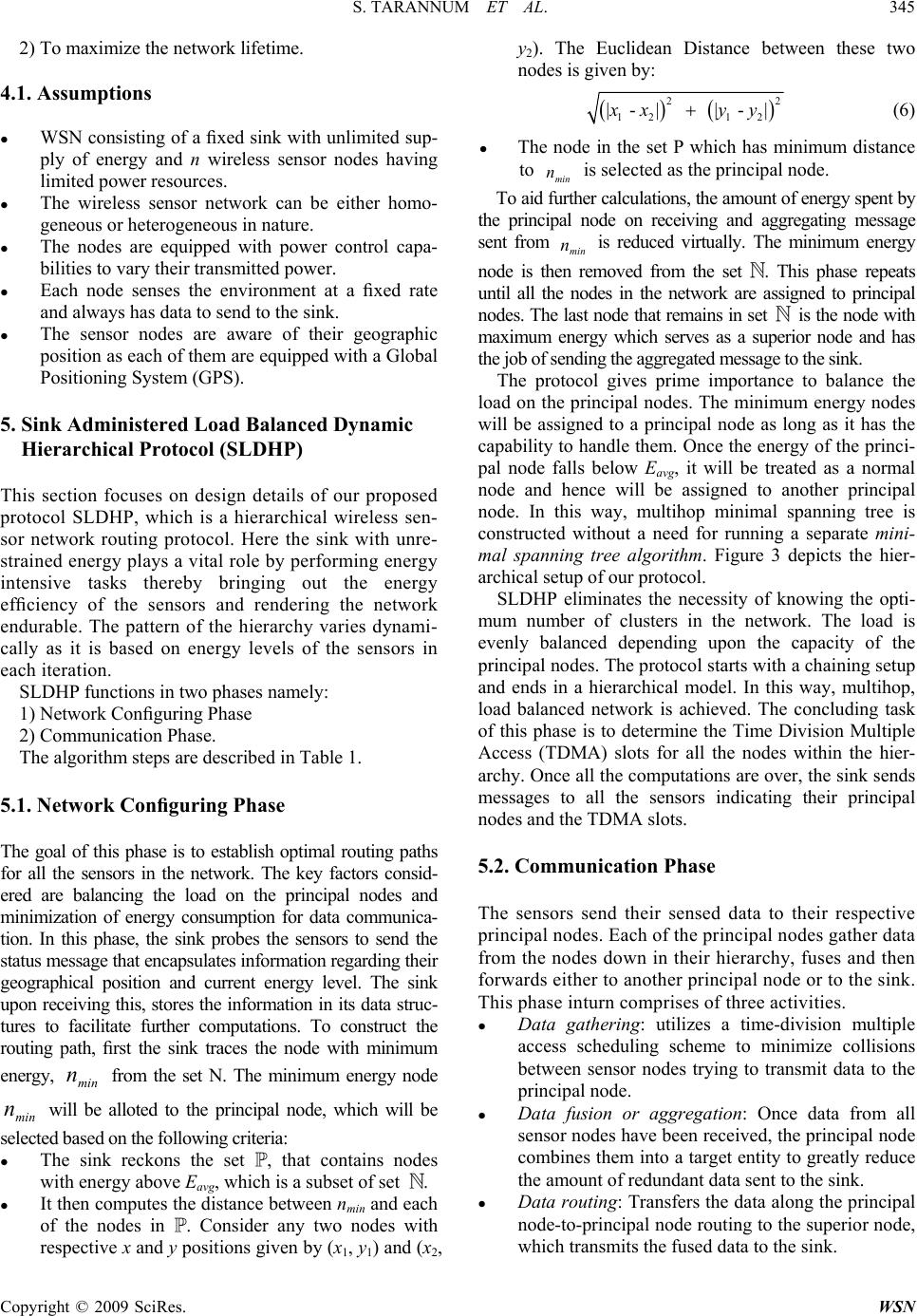 S. TARANNUM ET AL. 345 2) To maximize the network lifetime. 4.1. Assumptions WSN consisting of a fixed sink with unlimited sup- ply of energy and n wireless sensor nodes having limited power resources. The wireless sensor network can be either homo- geneous or heterogeneous in nature. The nodes are equipped with power control capa- bilities to vary their transmitted power. Each node senses the environment at a fixed rate and always has data to send to the sink. The sensor nodes are aware of their geographic position as each of them are equipped with a Global Positioning System (GPS). 5. Sink Administered Load Balanced Dynamic Hierarchical Protocol (SLDHP) This section focuses on design details of our proposed protocol SLDHP, which is a hierarchical wireless sen- sor network routing protocol. Here the sink with unre- strained energy plays a vital role by performing energy intensive tasks thereby bringing out the energy efficiency of the sensors and rendering the network endurable. The pattern of the hierarchy varies dynami- cally as it is based on energy levels of the sensors in each iteration. SLDHP functions in two phases namely: 1) Network Configuring Phase 2) Communication Phase. The algorithm steps are described in Table 1. 5.1. Network Configuring Phase The goal of this phase is to establish optimal routing paths for all the sensors in the network. The key factors consid- ered are balancing the load on the principal nodes and minimization of energy consumption for data communica- tion. In this phase, the sink probes the sensors to send the status message that encapsulates information regarding their geographical position and current energy level. The sink upon receiving this, stores the information in its data struc- tures to facilitate further computations. To construct the routing path, first the sink traces the node with minimum energy, from the set N. The minimum energy node will be alloted to the principal node, which will be selected based on the following criteria: min n min n The sink reckons the set , that contains nodes with energy above Eavg, which is a subset of set . It then computes the distance between nmin and each of the nodes in . Consider any two nodes with respective x and y positions given by (x1, y1) and (x2, y2). The Euclidean Distance between these two nodes is given by: 2 12 12 | - | | - |xx yy2 (6) The node in the set P which has minimum distance to min n is selected as the principal node. To aid further calculations, the amount of energy spent by the principal node on receiving and aggregating message sent from is reduced virtually. The minimum energy node is then removed from the set min n . This phase repeats until all the nodes in the network are assigned to principal nodes. The last node that remains in set is the node with maximum energy which serves as a superior node and has the job of sending the aggregated message to the sink. The protocol gives prime importance to balance the load on the principal nodes. The minimum energy nodes will be assigned to a principal node as long as it has the capability to handle them. Once the energy of the princi- pal node falls below Eavg, it will be treated as a normal node and hence will be assigned to another principal node. In this way, multihop minimal spanning tree is constructed without a need for running a separate mini- mal spanning tree algorithm. Figure 3 depicts the hier- archical setup of our protocol. SLDHP eliminates the necessity of knowing the opti- mum number of clusters in the network. The load is evenly balanced depending upon the capacity of the principal nodes. The protocol starts with a chaining setup and ends in a hierarchical model. In this way, multihop, load balanced network is achieved. The concluding task of this phase is to determine the Time Division Multiple Access (TDMA) slots for all the nodes within the hier- archy. Once all the computations are over, the sink sends messages to all the sensors indicating their principal nodes and the TDMA slots. 5.2. Communication Phase The sensors send their sensed data to their respective principal nodes. Each of the principal nodes gather data from the nodes down in their hierarchy, fuses and then forwards either to another principal node or to the sink. This phase inturn comprises of three activities. Data gathering: utilizes a time-division multiple access scheduling scheme to minimize collisions between sensor nodes trying to transmit data to the principal node. Data fusion or aggregation: Once data from all sensor nodes have been received, the principal node combines them into a target entity to greatly reduce the amount of redundant data sent to the sink. Data routing: Transfers the data along the principal node-to-principal node routing to the superior node, which transmits the fused data to the sink. C opyright © 2009 SciRes. WSN 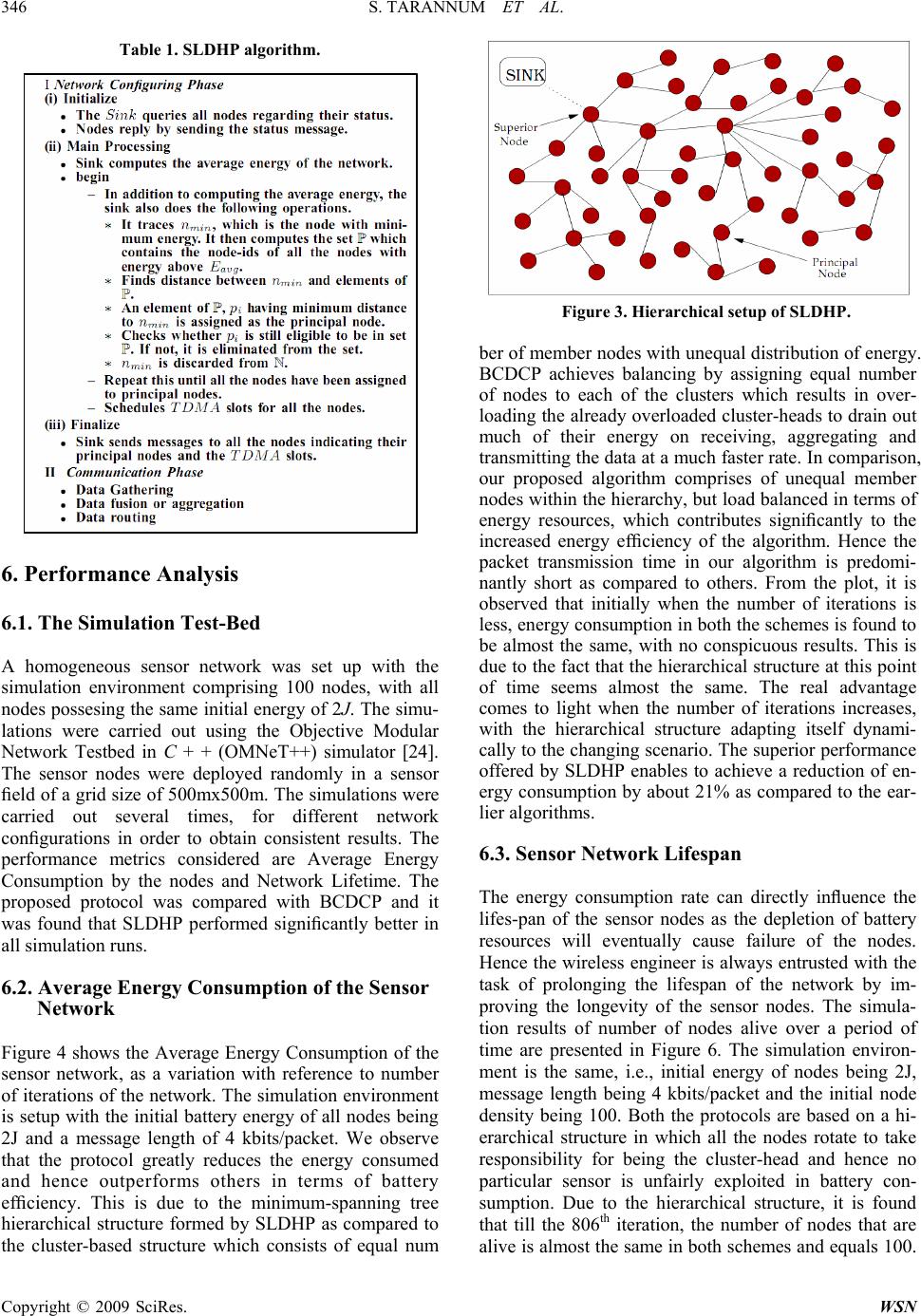 346 S. TARANNUM ET AL. Table 1. SLDHP algorithm. 6. Performance Analysis 6.1. The Simulation Test-Bed A homogeneous sensor network was set up with the simulation environment comprising 100 nodes, with all nodes possesing the same initial energy of 2J. The simu- lations were carried out using the Objective Modular Network Testbed in C + + (OMNeT++) simulator [24]. The sensor nodes were deployed randomly in a sensor field of a grid size of 500mx500m. The simulations were carried out several times, for different network configurations in order to obtain consistent results. The performance metrics considered are Average Energy Consumption by the nodes and Network Lifetime. The proposed protocol was compared with BCDCP and it was found that SLDHP performed significantly better in all simulation runs. 6.2. Average Energy Consumption of the Sensor Network Figure 4 shows the Average Energy Consumption of the sensor network, as a variation with reference to number of iterations of the network. The simulation environment is setup with the initial battery energy of all nodes being 2J and a message length of 4 kbits/packet. We observe that the protocol greatly reduces the energy consumed and hence outperforms others in terms of battery efficiency. This is due to the minimum-spanning tree hierarchical structure formed by SLDHP as compared to the cluster-based structure which consists of equal num Figure 3. Hierarchical setup of SLDHP. ber of member nodes with unequal distribution of energy. BCDCP achieves balancing by assigning equal number of nodes to each of the clusters which results in over- loading the already overloaded cluster-heads to drain out much of their energy on receiving, aggregating and transmitting the data at a much faster rate. In comparison, our proposed algorithm comprises of unequal member nodes within the hierarchy, but load balanced in terms of energy resources, which contributes significantly to the increased energy efficiency of the algorithm. Hence the packet transmission time in our algorithm is predomi- nantly short as compared to others. From the plot, it is observed that initially when the number of iterations is less, energy consumption in both the schemes is found to be almost the same, with no conspicuous results. This is due to the fact that the hierarchical structure at this point of time seems almost the same. The real advantage comes to light when the number of iterations increases, with the hierarchical structure adapting itself dynami- cally to the changing scenario. The superior performance offered by SLDHP enables to achieve a reduction of en- ergy consumption by about 21% as compared to the ear- lier algorithms. 6.3. Sensor Network Lifespan The energy consumption rate can directly influence the lifes-pan of the sensor nodes as the depletion of battery resources will eventually cause failure of the nodes. Hence the wireless engineer is always entrusted with the task of prolonging the lifespan of the network by im- proving the longevity of the sensor nodes. The simula- tion results of number of nodes alive over a period of time are presented in Figure 6. The simulation environ- ment is the same, i.e., initial energy of nodes being 2J, message length being 4 kbits/packet and the initial node density being 100. Both the protocols are based on a hi- erarchical structure in which all the nodes rotate to take responsibility for being the cluster-head and hence no particular sensor is unfairly exploited in battery con- sumption. Due to the hierarchical structure, it is found that till the 806th iteration, the number of nodes that are alive is almost the same in both schemes and equals 100. Copyright © 2009 SciRes. WSN 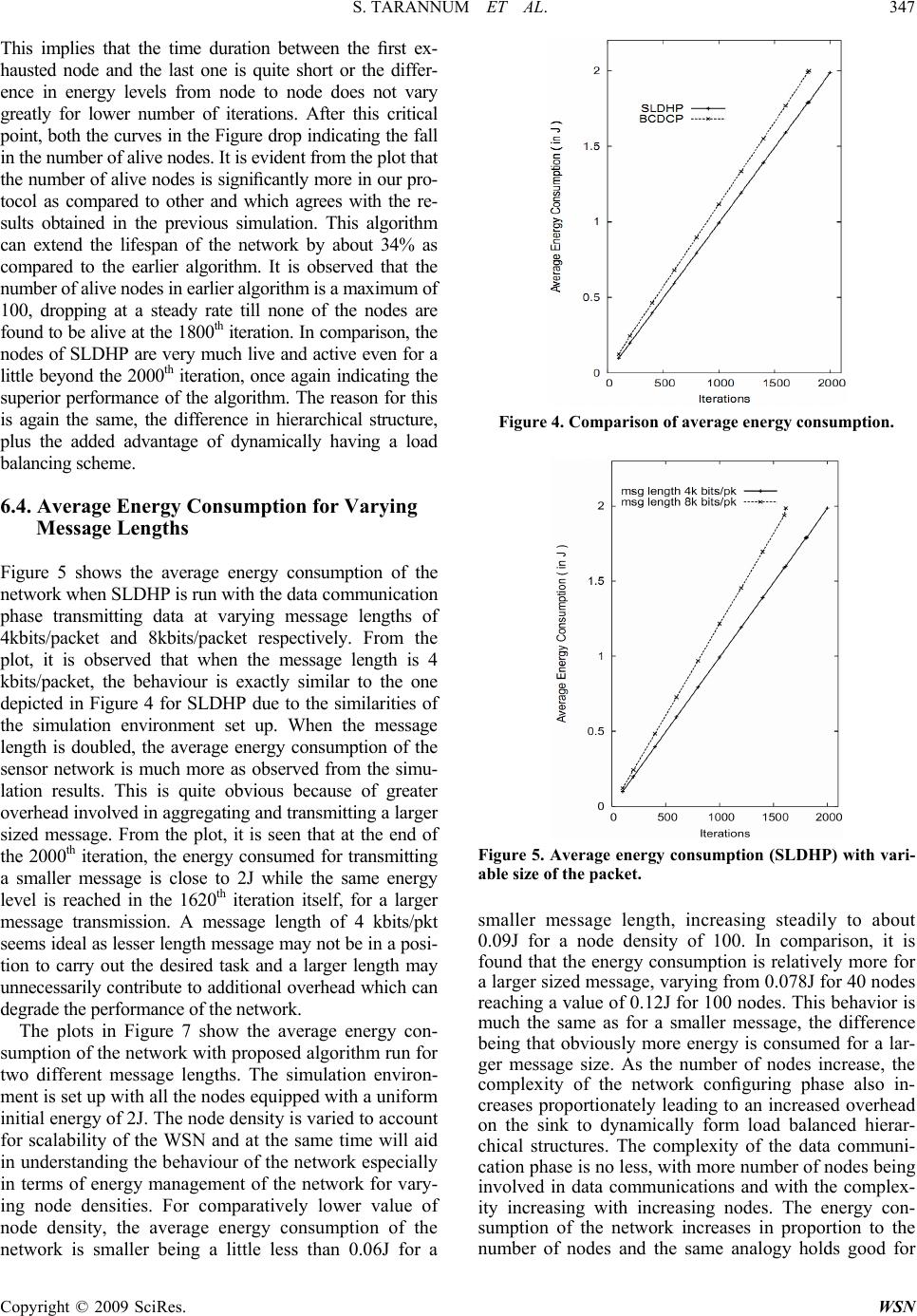 S. TARANNUM ET AL. 347 This implies that the time duration between the first ex- hausted node and the last one is quite short or the differ- ence in energy levels from node to node does not vary greatly for lower number of iterations. After this critical point, both the curves in the Figure drop indicating the fall in the number of alive nodes. It is evident from the plot that the number of alive nodes is significantly more in our pro- tocol as compared to other and which agrees with the re- sults obtained in the previous simulation. This algorithm can extend the lifespan of the network by about 34% as compared to the earlier algorithm. It is observed that the number of alive nodes in earlier algorithm is a maximum of 100, dropping at a steady rate till none of the nodes are found to be alive at the 1800th iteration. In comparison, the nodes of SLDHP are very much live and active even for a little beyond the 2000th iteration, once again indicating the superior performance of the algorithm. The reason for this is again the same, the difference in hierarchical structure, plus the added advantage of dynamically having a load balancing scheme. 6.4. Average Energy Consumption for Varying Message Lengths Figure 5 shows the average energy consumption of the network when SLDHP is run with the data communication phase transmitting data at varying message lengths of 4kbits/packet and 8kbits/packet respectively. From the plot, it is observed that when the message length is 4 kbits/packet, the behaviour is exactly similar to the one depicted in Figure 4 for SLDHP due to the similarities of the simulation environment set up. When the message length is doubled, the average energy consumption of the sensor network is much more as observed from the simu- lation results. This is quite obvious because of greater overhead involved in aggregating and transmitting a larger sized message. From the plot, it is seen that at the end of the 2000th iteration, the energy consumed for transmitting a smaller message is close to 2J while the same energy level is reached in the 1620th iteration itself, for a larger message transmission. A message length of 4 kbits/pkt seems ideal as lesser length message may not be in a posi- tion to carry out the desired task and a larger length may unnecessarily contribute to additional overhead which can degrade the performance of the network. The plots in Figure 7 show the average energy con- sumption of the network with proposed algorithm run for two different message lengths. The simulation environ- ment is set up with all the nodes equipped with a uniform initial energy of 2J. The node density is varied to account for scalability of the WSN and at the same time will aid in understanding the behaviour of the network especially in terms of energy management of the network for vary- ing node densities. For comparatively lower value of node density, the average energy consumption of the network is smaller being a little less than 0.06J for a Figure 4. Comparison of average energy consumption. Figure 5. Average energy consumption (SLDHP) with vari- able size of the packet. smaller message length, increasing steadily to about 0.09J for a node density of 100. In comparison, it is found that the energy consumption is relatively more for a larger sized message, varying from 0.078J for 40 nodes reaching a value of 0.12J for 100 nodes. This behavior is much the same as for a smaller message, the difference being that obviously more energy is consumed for a lar- ger message size. As the number of nodes increase, the complexity of the network configuring phase also in- creases proportionately leading to an increased overhead on the sink to dynamically form load balanced hierar- chical structures. The complexity of the data communi- cation phase is no less, with more number of nodes being involved in data communications and with the complex- ity increasing with increasing nodes. The energy con- sumption of the network increases in proportion to the number of nodes and the same analogy holds good for C opyright © 2009 SciRes. WSN 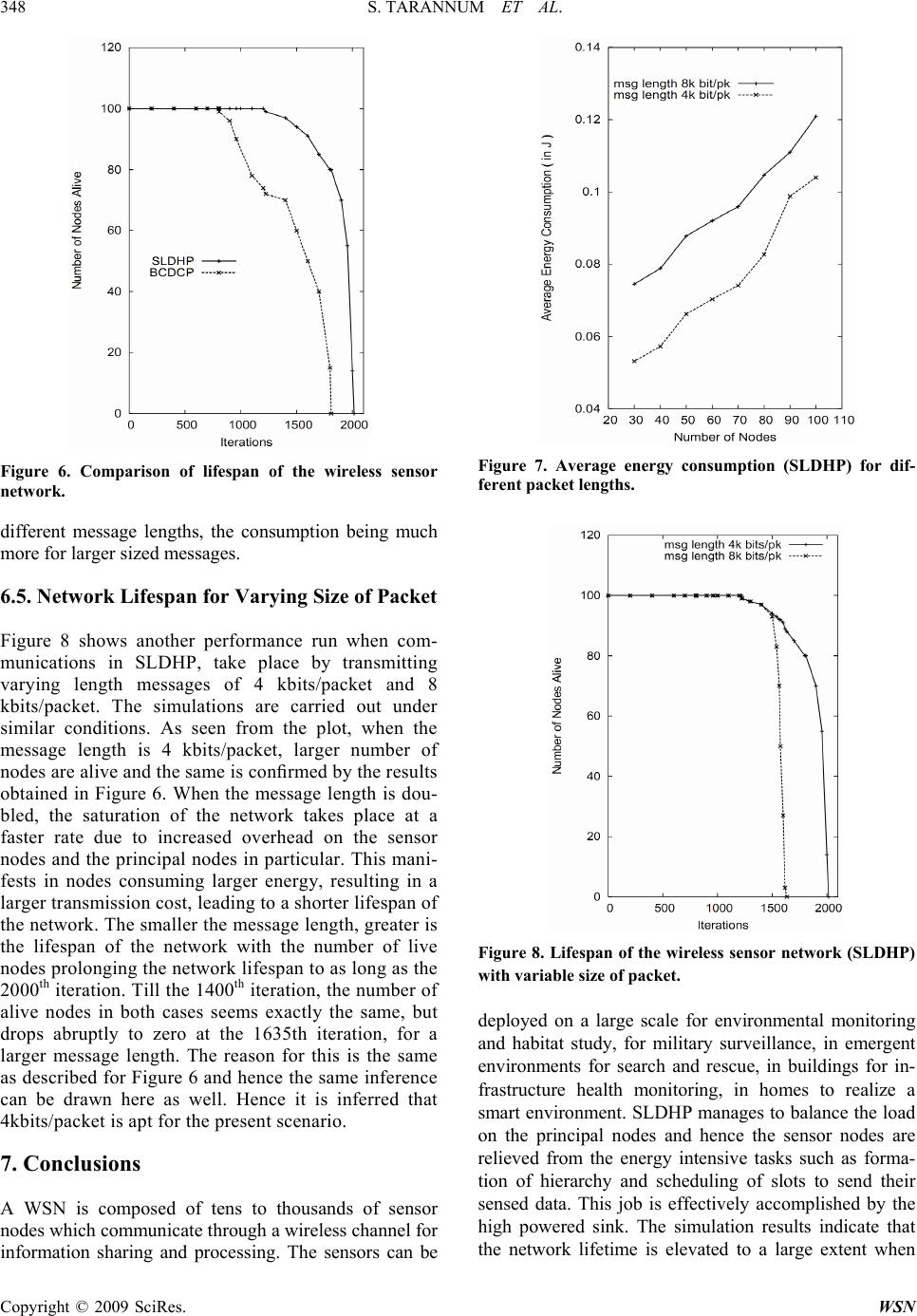 348 S. TARANNUM ET AL. Figure 6. Comparison of lifespan of the wireless sensor network. different message lengths, the consumption being much more for larger sized messages. 6.5. Network Lifespan for Varying Size of Packet Figure 8 shows another performance run when com- munications in SLDHP, take place by transmitting varying length messages of 4 kbits/packet and 8 kbits/packet. The simulations are carried out under similar conditions. As seen from the plot, when the message length is 4 kbits/packet, larger number of nodes are alive and the same is confirmed by the results obtained in Figure 6. When the message length is dou- bled, the saturation of the network takes place at a faster rate due to increased overhead on the sensor nodes and the principal nodes in particular. This mani- fests in nodes consuming larger energy, resulting in a larger transmission cost, leading to a shorter lifespan of the network. The smaller the message length, greater is the lifespan of the network with the number of live nodes prolonging the network lifespan to as long as the 2000th iteration. Till the 1400th iteration, the number of alive nodes in both cases seems exactly the same, but drops abruptly to zero at the 1635th iteration, for a larger message length. The reason for this is the same as described for Figure 6 and hence the same inference can be drawn here as well. Hence it is inferred that 4kbits/packet is apt for the present scenario. 7. Conclusions A WSN is composed of tens to thousands of sensor nodes which communicate through a wireless channel for information sharing and processing. The sensors can be Figure 7. Average energy consumption (SLDHP) for dif- ferent packet lengths. Figure 8. Lifespan of the wireless sensor network (SLDHP) with variable size of packet. deployed on a large scale for environmental monitoring and habitat study, for military surveillance, in emergent environments for search and rescue, in buildings for in- frastructure health monitoring, in homes to realize a smart environment. SLDHP manages to balance the load on the principal nodes and hence the sensor nodes are relieved from the energy intensive tasks such as forma- tion of hierarchy and scheduling of slots to send their sensed data. This job is effectively accomplished by the high powered sink. The simulation results indicate that the network lifetime is elevated to a large extent when Copyright © 2009 SciRes. WSN 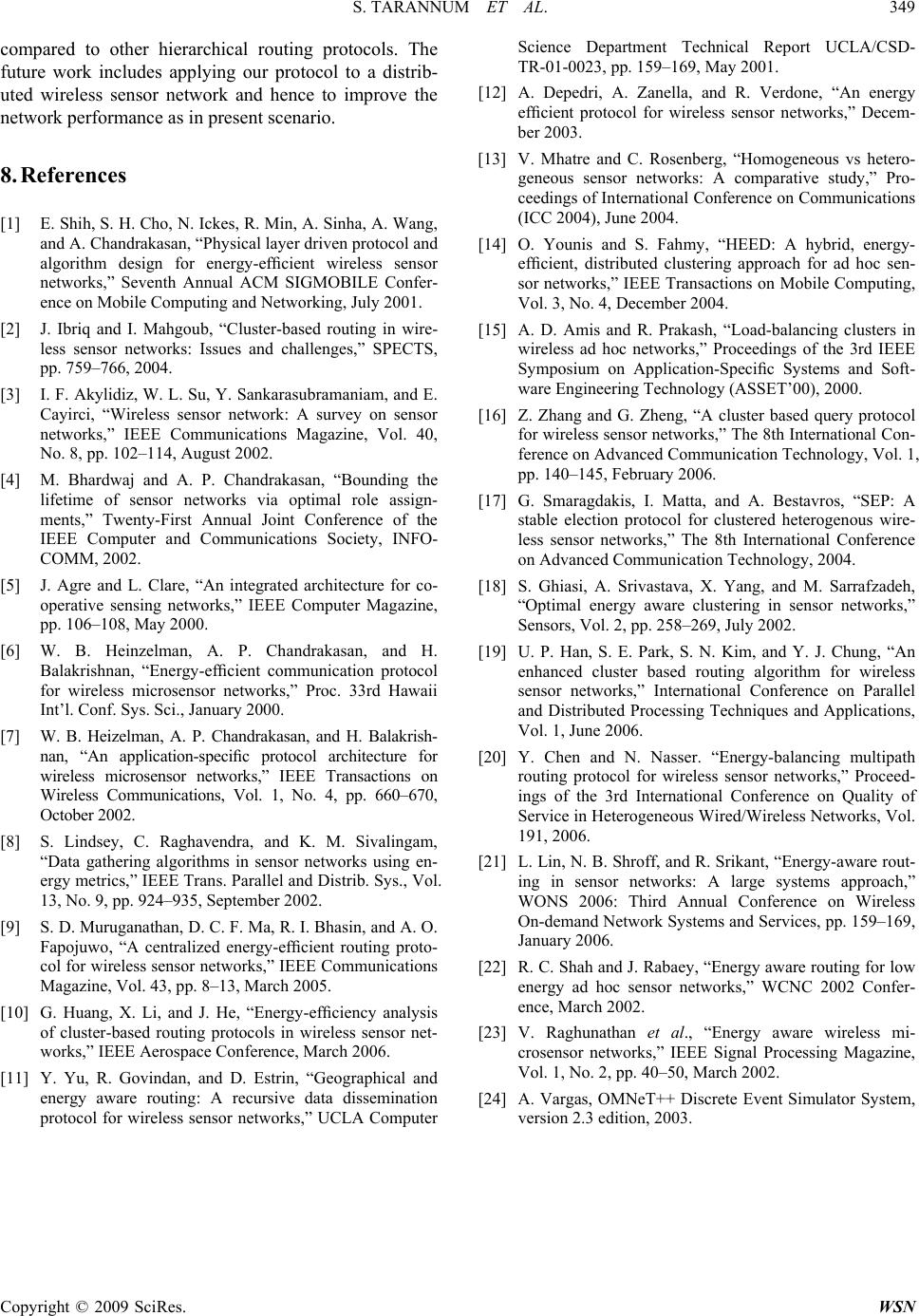 S. TARANNUM ET AL. 349 Copyright © 2009 SciRes. WSN compared to other hierarchical routing protocols. The future work includes applying our protocol to a distrib- uted wireless sensor network and hence to improve the network performance as in present scenario. 8. References [1] E. Shih, S. H. Cho, N. Ickes, R. Min, A. Sinha, A. Wang, and A. Chandrakasan, “Physical layer driven protocol and algorithm design for energy-efficient wireless sensor networks,” Seventh Annual ACM SIGMOBILE Confer- ence on Mobile Computing and Networking, July 2001. [2] J. Ibriq and I. Mahgoub, “Cluster-based routing in wire- less sensor networks: Issues and challenges,” SPECTS, pp. 759–766, 2004. [3] I. F. Akylidiz, W. L. Su, Y. Sankarasubramaniam, and E. Cayirci, “Wireless sensor network: A survey on sensor networks,” IEEE Communications Magazine, Vol. 40, No. 8, pp. 102–114, August 2002. [4] M. Bhardwaj and A. P. Chandrakasan, “Bounding the lifetime of sensor networks via optimal role assign- ments,” Twenty-First Annual Joint Conference of the IEEE Computer and Communications Society, INFO- COMM, 2002. [5] J. Agre and L. Clare, “An integrated architecture for co- operative sensing networks,” IEEE Computer Magazine, pp. 106–108, May 2000. [6] W. B. Heinzelman, A. P. Chandrakasan, and H. Balakrishnan, “Energy-efficient communication protocol for wireless microsensor networks,” Proc. 33rd Hawaii Int’l. Conf. Sys. Sci., January 2000. [7] W. B. Heizelman, A. P. Chandrakasan, and H. Balakrish- nan, “An application-specific protocol architecture for wireless microsensor networks,” IEEE Transactions on Wireless Communications, Vol. 1, No. 4, pp. 660–670, October 2002. [8] S. Lindsey, C. Raghavendra, and K. M. Sivalingam, “Data gathering algorithms in sensor networks using en- ergy metrics,” IEEE Trans. Parallel and Distrib. Sys., Vol. 13, No. 9, pp. 924–935, September 2002. [9] S. D. Muruganathan, D. C. F. Ma, R. I. Bhasin, and A. O. Fapojuwo, “A centralized energy-efficient routing proto- col for wireless sensor networks,” IEEE Communications Magazine, Vol. 43, pp. 8–13, March 2005. [10] G. Huang, X. Li, and J. He, “Energy-efficiency analysis of cluster-based routing protocols in wireless sensor net- works,” IEEE Aerospace Conference, March 2006. [11] Y. Yu, R. Govindan, and D. Estrin, “Geographical and energy aware routing: A recursive data dissemination protocol for wireless sensor networks,” UCLA Computer Science Department Technical Report UCLA/CSD- TR-01-0023, pp. 159–169, May 2001. [12] A. Depedri, A. Zanella, and R. Verdone, “An energy efficient protocol for wireless sensor networks,” Decem- ber 2003. [13] V. Mhatre and C. Rosenberg, “Homogeneous vs hetero- geneous sensor networks: A comparative study,” Pro- ceedings of International Conference on Communications (ICC 2004), June 2004. [14] O. Younis and S. Fahmy, “HEED: A hybrid, energy- efficient, distributed clustering approach for ad hoc sen- sor networks,” IEEE Transactions on Mobile Computing, Vol. 3, No. 4, December 2004. [15] A. D. Amis and R. Prakash, “Load-balancing clusters in wireless ad hoc networks,” Proceedings of the 3rd IEEE Symposium on Application-Specific Systems and Soft- ware Engineering Technology (ASSET’00), 2000. [16] Z. Zhang and G. Zheng, “A cluster based query protocol for wireless sensor networks,” The 8th International Con- ference on Advanced Communication Technology, Vol. 1, pp. 140–145, February 2006. [17] G. Smaragdakis, I. Matta, and A. Bestavros, “SEP: A stable election protocol for clustered heterogenous wire- less sensor networks,” The 8th International Conference on Advanced Communication Technology, 2004. [18] S. Ghiasi, A. Srivastava, X. Yang, and M. Sarrafzadeh, “Optimal energy aware clustering in sensor networks,” Sensors, Vol. 2, pp. 258–269, July 2002. [19] U. P. Han, S. E. Park, S. N. Kim, and Y. J. Chung, “An enhanced cluster based routing algorithm for wireless sensor networks,” International Conference on Parallel and Distributed Processing Techniques and Applications, Vol. 1, June 2006. [20] Y. Chen and N. Nasser. “Energy-balancing multipath routing protocol for wireless sensor networks,” Proceed- ings of the 3rd International Conference on Quality of Service in Heterogeneous Wired/Wireless Networks, Vol. 191, 2006. [21] L. Lin, N. B. Shroff, and R. Srikant, “Energy-aware rout- ing in sensor networks: A large systems approach,” WONS 2006: Third Annual Conference on Wireless On-demand Network Systems and Services, pp. 159–169, January 2006. [22] R. C. Shah and J. Rabaey, “Energy aware routing for low energy ad hoc sensor networks,” WCNC 2002 Confer- ence, March 2002. [23] V. Raghunathan et al., “Energy aware wireless mi- crosensor networks,” IEEE Signal Processing Magazine, Vol. 1, No. 2, pp. 40–50, March 2002. [24] A. Vargas, OMNeT++ Discrete Event Simulator System, version 2.3 edition, 2003. |