

Paper Menu >>
Journal Menu >>
 Open Journal of Obstetrics and Gynecology, 2011, 1, 187-190 doi:10.4236/ojog.2011.14036 Published Online December 2011 (http://www.SciRP.org/journal/ojog/ OJOG ). Published Online December 2011 in SciRes. http://www.scirp.org/journal/OJOG Comparison of two misoprostol regimens for cervical priming before surgical pregnancy termination at 13 to 16 weeks gestations Dennis G. Chambers, Robin J. Willcourt, Anthony R. Laver, Jane K. Baird, Wye Y. Herbert The Queen Elizabeth Hospital Pregnancy Advisory Centre, Woodville Park, Adelaide, Australia. Email: [email protected] Received 14 October 2011; revised 19 November 2011; accepted 4 December 2011. ABSTRACT Background: The optimal regimen has still to be de- termined for the use of misoprostol in the surgical termination of pregnancy in the early second trimes- ter. Objective: To compare the outcomes of two diffe- rent regimens for cervical priming with misoprostol before dilatation and evacuation (D & E) in 13 weeks - 16 weeks gestation pregnancy terminations. Methods: A retrospective analysis was performed of the medi- cal records of two cohorts of 334 women each who were treated with either 3 sublingual doses of 2 mi- soprostol 200 µg tablets 30 minutes apart on admis- sion or the same dosage preceded by 1 oral tablet of misoprostol 200 µg at home 3 hours before admission. Results: The addition of the home tablet of misopros- tol increased the rate of one day completion of D & E from 97.3% to 100% (P = 0.004), and the overall mean theatre time for D&E was reduced by 12.3% in parous women (P = 0.001) and 6.4% in nulliparous women (P = 0.003) with the reduction being consis- tent across all gestations. Conclusions: This retrospe- ctive study showed that the addition of 1 oral tablet of misoprostol 200 µg at home 3 hours before admis- sion to a regimen of 3 sublingual doses of 2 misopro- stol 200 µg tablets 30 minutes apart on admission sig- nificantly increases the probability of all women at 13 weeks - 16 weeks gestation completing a termination of pregnancy in one day with a single D & E proce- dure and with a reduced theatre time. Keywords: Early Second-Trimester Surgical Abortion; D & E; Misoprostol; Cervical Priming 1. INTRODUCTION The Pregnancy Advisory Centre (PAC) is a government funded day-surgery clinic providing over 2500 surgical and medical terminations of pregnancy (TOP) each year in South Australia. Second trimester surgical termination of pregnancies up to 22 weeks gestation have been per- formed in this clinic using misoprostol and osmotic cer- vical dilators where necessary since 1994. The incidence of these terminations has remained constant over this pe- riod with approximately 9% of all terminations occur- ring at 13 weeks - 16 weeks gestation, an incidence in line with published figures overseas [1]. Although most wo- men in our clinic at 13 weeks - 16 weeks gestation have been terminated in one day after cervical priming with 3 sublingual doses of 2 misoprostol 200 µg tablets 30 minu- tes apart, with dilatation and evacuation (D & E) 3 hours after the last dose, we have found that approximately 3% of women could not be adequately cervically dilated in one day with this regimen because they were very poor responders to misoprostol. Therefore in December 2009 the clinic introduced the add ition to this reg imen of a sin- gle oral tablet of misoprostol 200 µg taken at home 3 hours before admission. Oral administration was chosen to avoid distressing cramping, bleeding and nausea that occur more frequently following sublingual administra- tion [2]. Because there is little published data on the out- comes of different cervical priming regimens before D & E at 13 weeks - 16 weeks we decided to research the out- comes in our clinic of the two misoprostol regimens. 2. MATERIALS AND METHODS The study design was a retrospective review of the clini- cal records of two cohorts of consecutive cases of wo- men undergoing surgical termination of pregnancy at 13 to 16 weeks gestation. This clinical audit study confor- med to the standards required for Australian National Health and Medical Research Council exclusion for eth- ics approval. The first cohort of 334 women was treated with 3 sublingual doses of 2 misoprostol 200 µg tablets administered 30 minutes apart on admission. The second cohort of 334 women was treated with the same dosage after admission preceded by 1 oral tablet of misoprostol 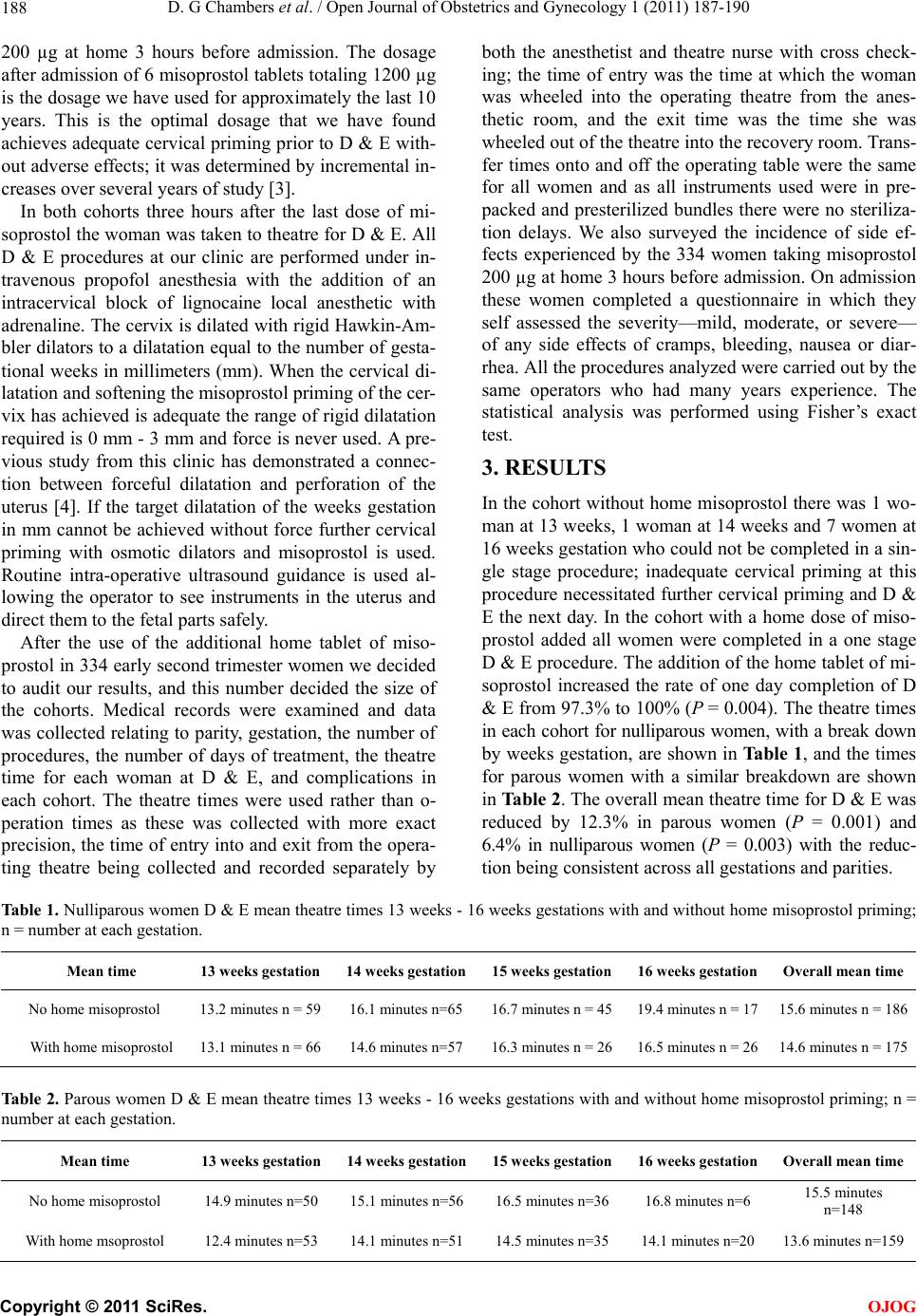 D. G Chambers et al. / Open Journal of Obstetrics and Gynecology 1 (2011) 187-190 188 200 µg at home 3 hours before admission. The dosage after admission of 6 misoprostol tablets to taling 1200 µg is the dosage we h ave used for approximately the last 1 0 years. This is the optimal dosage that we have found achieves adequate cervical priming pr ior to D & E with- out adverse effects; it was determined by incremental in- creases over several years of study [3]. In both cohorts three hours after the last dose of mi- soprostol the woman was taken to theatre for D & E. All D & E procedures at our clinic are performed under in- travenous propofol anesthesia with the addition of an intracervical block of lignocaine local anesthetic with adrenaline. The cervix is dilated with rigid Hawkin-Am- bler dilators to a dilatation equal to the number of gesta- tional weeks in millimeters (mm). When the cervical di- latation and softening th e miso pro sto l primi ng of th e cer- vix has achieved is ad equate the range of rigid dilatation required is 0 mm - 3 mm and force is never used. A pre- vious study from this clinic has demonstrated a connec- tion between forceful dilatation and perforation of the uterus [4]. If the target dilatation of the weeks gestation in mm cannot be achieved without force further cervical priming with osmotic dilators and misoprostol is used. Routine intra-operative ultrasound guidance is used al- lowing the operator to see instruments in the uterus and direct them to the fetal parts safely. After the use of the additional home tablet of miso- prostol in 334 early second trimester women we decided to audit our results, and this number decided the size of the cohorts. Medical records were examined and data was collected relating to parity, gestation, the number of procedures, the number of days of treatment, the theatre time for each woman at D & E, and complications in each cohort. The theatre times were used rather than o- peration times as these was collected with more exact precision, the time of en try into and exit from the opera- ting theatre being collected and recorded separately by both the anesthetist and theatre nurse with cross check- ing; the time of entry was the time at which the woman was wheeled into the operating theatre from the anes- thetic room, and the exit time was the time she was wheeled out of the theatre into the recovery room. Trans- fer times onto and off the operating table were the same for all women and as all instruments used were in pre- packed and presterilized bundles there were no steriliza- tion delays. We also surveyed the incidence of side ef- fects experienced by the 334 women taking misoprostol 200 µg at home 3 hours before admission. On admission these women completed a questionnaire in which they self assessed the severity—mild, moderate, or severe— of any side effects of cramps, bleeding, nausea or diar- rhea. All the procedures analyzed were carried out by the same operators who had many years experience. The statistical analysis was performed using Fisher’s exact test. 3. RESULTS In the cohort without home misoprosto l there was 1 wo- man at 13 weeks, 1 wo man at 14 weeks and 7 women at 16 weeks gestation who could not be completed in a sin- gle stage procedure; inadequate cervical priming at this procedure necessitated further cervical priming and D & E the next day. In the cohort with a home dose of miso- prostol added all women were completed in a one stage D & E procedure. The addition of the home tablet of mi- soprostol increased the rate of one day completion of D & E from 97.3% to 100% (P = 0.004). The theatre times in each cohort for nulliparous women, with a break down by weeks gestation, are shown in Table 1, and the times for parous women with a similar breakdown are shown in Table 2. The overall mean theatre time for D & E was reduced by 12.3% in parous women (P = 0.001) and 6.4% in nulliparous women (P = 0.003) with the reduc- tion being consistent across all gestations and parities. Table 1. Nulliparous women D & E mean theatre times 13 weeks - 16 weeks gestations with and without home misoprostol priming; n = number at each gestation. MMean time 13 weeks gestation 14 weeks gestation15 weeks gestation16 weeks gestation Overall mean time No home misoprostol 13.2 minute s n = 5 9 16.1 minutes n=65 16.7 minutes n = 4519.4 minutes n = 17 15.6 minute s n = 1 86 WWith home misoprostol 13.1 minutes n = 6 6 14.6 minutes n=57 16.3 minutes n = 2616.5 minutes n = 26 14.6 minutes n = 1 7 5 Table 2. Parous women D & E mean theatre times 13 weeks - 16 weeks gestations with and without home misoprostol priming; n = number at each gestation. Mean time 13 weeks gestation 14 weeks gestation15 weeks gestation16 weeks gestati on Overall mean time No home misoprostol 14.9 minutes n=50 15.1 minutes n=56 16.5 minutes n=36 16.8 minutes n=6 15.5 minutes n=148 With home msoprostol 12.4 minutes n=53 14.1 minutes n=51 14.5 minutes n=35 14.1 minutes n=20 13.6 minutes n=159 C opyright © 2011 SciRes. OJOG 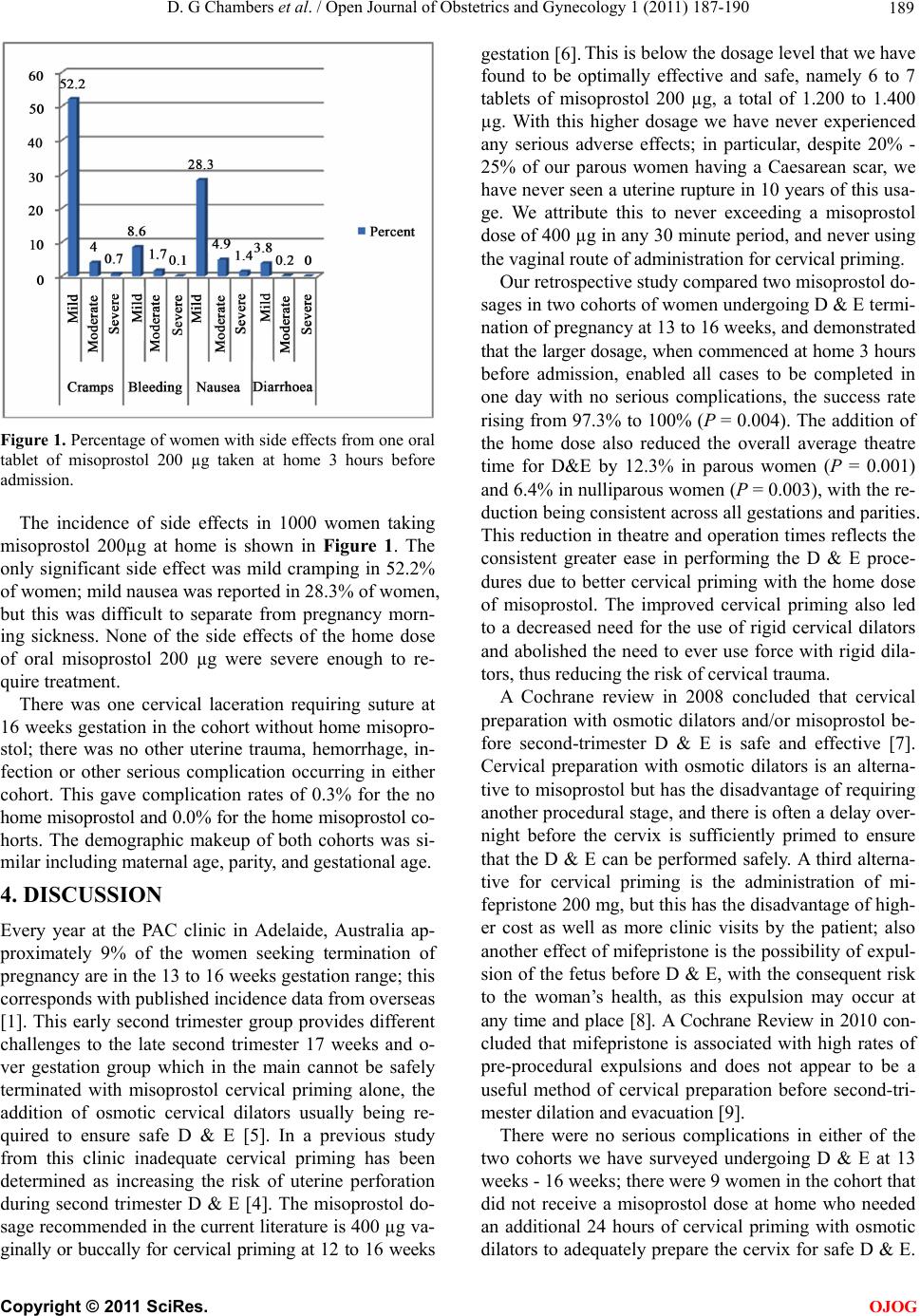 D. G Chambers et al. / Open Journal of Obstetrics and Gynecology 1 (2011) 187-190 189 Figure 1. Percentage of women with side effects from one oral tablet of misoprostol 200 µg taken at home 3 hours before admission. The incidence of side effects in 1000 women taking misoprostol 200µg at home is shown in Figure 1. The only significant side effect was mild cramping in 52.2% of women; mild nausea was reported in 28.3% of women, but this was difficult to separate from pregnancy morn- ing sickness. None of the side effects of the home dose of oral misoprostol 200 µg were severe enough to re- quire treatment. There was one cervical laceration requiring suture at 16 weeks gestation in the cohort without home misopro- stol; there was no other uterine trauma, hemorrhage, in- fection or other serious complication occurring in either cohort. This gave complication rates of 0.3% for the no home misoprostol and 0.0% for the home misoprostol co- horts. The demographic makeup of both cohorts was si- milar including maternal age, parity, and gestational age. 4. DISCUSSION Every year at the PAC clinic in Adelaide, Australia ap- proximately 9% of the women seeking termination of pregnancy are in th e 13 to 16 weeks g estation rang e; this corresponds with published incidence data from overseas [1]. This early second trimester group provides different challenges to the late second trimester 17 weeks and o- ver gestation group which in the main cannot be safely terminated with misoprostol cervical priming alone, the addition of osmotic cervical dilators usually being re- quired to ensure safe D & E [5]. In a previous study from this clinic inadequate cervical priming has been determined as increasing the risk of uterine perforation during second trimester D & E [4]. The misoprostol do- sage recommended in the curren t literature is 400 µg va- ginally or buccally for cervical priming at 12 to 16 weeks gestation [6]. This is be low the dosage level that we have found to be optimally effective and safe, namely 6 to 7 tablets of misoprostol 200 µg, a total of 1.200 to 1.400 µg. With this higher dosage we have never experienced any serious adverse effects; in particular, despite 20% - 25% of our parous women having a Caesarean scar, we have never seen a uterine rupture in 10 years of this usa- ge. We attribute this to never exceeding a misoprostol dose of 400 µg in an y 30 minute period , and never using the vaginal route of administration for cervical priming. Our retrospective study co mpared two misoprostol do- sages in two cohorts of women undergoing D & E termi- nation of preg nanc y at 13 to 16 weeks, an d demonstr ated that the larger dosage, when commenced at home 3 hours before admission, enabled all cases to be completed in one day with no serious complications, the success rate rising from 97.3% to 100% (P = 0.004). The addition of the home dose also reduced the overall average theatre time for D&E by 12.3% in parous women (P = 0.001) and 6.4% in nulliparou s women (P = 0.003), with the re- duction being consistent across all gestations and p arities. This reduction in theatre and operation times reflects th e consistent greater ease in performing the D & E proce- dures due to better cervical priming with the home dose of misoprostol. The improved cervical priming also led to a decreased need for the use of rigid cervical dilators and abolished the need to ever use force with rigid dila- tors, thus reducing the risk of cervical trauma. A Cochrane review in 2008 concluded that cervical preparation with osmotic dilators and/or misoprostol be- fore second-trimester D & E is safe and effective [7]. Cervical preparation with osmotic dilators is an alterna- tive to misoprostol but has the disad vantage of requiring another procedural stage, and there is often a delay over- night before the cervix is sufficiently primed to ensure that the D & E can be performed safely. A third alterna- tive for cervical priming is the administration of mi- fepristone 200 mg, but this has the disadvantage of high- er cost as well as more clinic visits by the patient; also another effect of mifepristone is the possibility of expul- sion of the fetus before D & E, with the consequent risk to the woman’s health, as this expulsion may occur at any time and place [8]. A Cochrane Review in 2010 con- cluded that mifepristone is associated with high rates of pre-procedural expulsions and does not appear to be a useful method of cervical preparation before second-tri- mester dilation and evacuation [9]. There were no serious complications in either of the two cohorts we have surveyed undergoing D & E at 13 weeks - 16 weeks; there were 9 women in the cohort that did not receive a misoprostol dose at home who needed an additional 24 hours of cervical priming with osmotic dilators to adequately prep are the cervix for safe D & E. C opyright © 2011 SciRes. OJOG  D. G Chambers et al. / Open Journal of Obstetrics and Gynecology 1 (2011) 187-190 190 All women receiving a home dose of misoprostol 3 hours before admission had their D & E completed in one day in a single stage procedure without any complications. Nucatola et al. have reviewed complication rates for misoprostol primed D & E at 12 weeks - 16 weeks, and for their series they recorded a perforation rate of 0.045% which they determined was in line with rates previously repo rted in the literature [10]. The same doctors performed all the operations in both cohorts and all operators were very experienced at the beginning of the study period and unlikely to have gain- ed any relevant increase in experience by its end. A limitation of the study was the use of theatre times rather than operation times. Reliable operation times we- re not available as, this being a retrospective study, ope- ration times had not been recorded with the same accu- racy as would occur in a prospective study; accurate theatre times were available as our clinic has a protocol in place for precision in the recording of theatre times. We believe the consistency of difference of the theatre times between the two cohorts indicates that they do re- liably reflect operation times. It is our opinion that it would have been unethical to conduct a prospective dou- ble blind study as we already had firm evidence from our first trimester study of home misoprostol dosage of the significant benefits of this regime [3]. This retrospective study demonstrates that the addition of one oral tablet of misoprostol 200 µg at home 3 hours before admission to a regimen of 2 tablets 1/2 hourly for three doses on admission enables 100% of women at 13 weeks - 16 weeks gestation to complete a termination of pregnancy 3 hours after the last dose of misoprostol, in one day, with a single D & E procedure, in a shorter time, and with minimal complications. This certainty of outcome is of help in the planning and scheduling of operation lists 5. ACKNOWLEDGEMENTS We are grateful to Dr John Field, Statistician, Faculty of Health Sci- ences, University of Adelaide for statistical analysis. No author has any conflict of interest. REFERENCES [1] Gamble, S.B., Strauss, L.T., Parker, W.Y., Cook, D.A., Zane, S.B. and Hamdan, S. (2008) Centers for disease control and prevention (CDC). Abortion Surveillance- United States 2005. MMWR Surveillance Summaries, 57, 1-32. [2] Aronsson, A., Bygdeman, M. and Gemzell-Danielsson, K. (2004) Effects of misoprostol on uterine contractility fo- llowing different routes of administration. Human Re- production, 19, 81-84. doi:10.1093/humrep/deh005 [3] Chambers, D.G., Mulligan, E.C., Laver, A.R., Weller, B.K., Baird, J.K. and Herbert, W.Y. (2009) Comparison of four perioperative misoprostol regimens for surgical termination of first-trimester pregnancy. International Journal of Gynecology and Obstetrics, 7, 211-215. doi:10.1016/j.ijgo.2009.07.034 [4] Pridmore, B.R. and Chambers, D.G. (1999) Uterine per- foration during surgical abortion: Review of diagnosis, management and prevention. Australian and New Zea- land Journal of Obstetrics and Gynaecology, 39, 349-353. doi:10.1111/j.1479-828X.1999.tb03413.x [5] Chambers, D.G., Willcourt, R.J., Laver, A.R., Baird, J.K. and Herbert, W.Y. (2011) Comparison of Dilapan-S and laminaria tents for cervical priming before surgical preg- nancy termination at 17 to 22 weeks gestations. Interna- tional Journal of Women’s Health, 3, 347-352. doi:10.2147/IJWH.S25551 [6] Wilson, L.C., Meyn, L.A. and Creinin, M.D. (2011) Cer- vical preparation for surgical abortion between 12 and 18 weeks of gestation using vaginal misoprostol and Dila- pan-S. Contraception, 8, 511-516. doi:10.1016/j.contraception.2010.10.004 [7] Lohr, P.A., Hayes, J.L. and Gemzell-Danielsson, K. (2008) Surgical versus medical methods for second trim- ester induced abortion. Cochrane Database Systematic Reviews, 1, CD006714. [8] Carbonell, J.L., Gallego, F.G., Lorente, M.P., Bermudez, S.B., Sala, E.S., Gonzalez, L.V. and Texido, C.S. (2007) Vaginal vs. sublingual misoprostol with mifepristone for cervical priming in second-trimester abortion by dilata- tion and evacuation: A randomized clinical trial.. Con- traception, 75, 230-237. doi:10.1016/j.contraception.2006.11.007 [9] Newman, S.J., Dalve-Endres, A., Diedrich, J.T., Steinauer, J.E., Meckstroth, K. and Drey, E.A. (2010) Cervical pre- paration for second trimester dilatation and evacuation. Cochrane Database Systematic Reviews, 8, CD007310. [10] Nucatola, D., Roth, N., Saulsberry, V. and Gatter, M. (2008) Serious adverse events associated with the use of misoprostol alone for cervical preparation prior to early second trimester surgical abortion (12 weeks - 16 weeks).. Contraception, 78, 245-248. doi:10.1016/j.contraception.2008.04.121 C opyright © 2011 SciRes. OJOG |